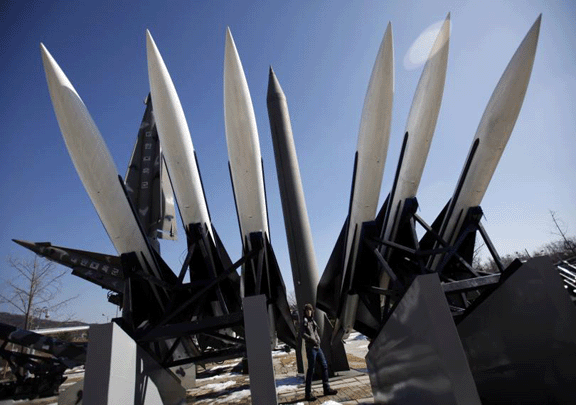
North Korea prompts US cities to prepare for a nuclear attack, SMH, Ralph Vartabedian and W.J. Hennigan, 29 July 17, Fleets of big black trucks, harbor boats and aircraft, equipped with radiation sensors and operated by specially trained law enforcement teams, are ready to swing into action in Los Angeles for a catastrophe that nobody even wants to think about: a North Korean nuclear attack.
American cities have long prepared for a terrorist attack, even one involving nuclear weapons or a “dirty bomb,” but North Korea’s long-range missile and weapons programs have now heightened concerns along the West Coast over increasing vulnerability to a strike……..
This month, Wellerstein and other researchers launched Reinventing Civil defence, a nonprofit project that over the next two years will examine how best to reeducate the American public on the nuclear threat – one that never went away. It is being funded by a $US500,000 ($626,000) grant from Carnegie Corporation of New York.
“If we live in a world where a nuclear detonation is possible, and we do, then people should be informed on what that means,” he said. “It’s something that’s been nonexistent in our society since the late 1980s.”
The reluctance to prepare reflects what LoPresti calls a “generational PTSD” from the decades of living under the threat of instant thermonuclear war. “It is not something people are comfortable talking about,” he said……
The main responsibility would lie with the Federal Emergency Management Agency, which declined to provide an official to discuss the issue and did not answer written questions.
Some arms control experts say it would be a mistake to launch a full-scale civil defence effort in response to North Korea. Wright, the expert at the Union of Concerned Scientists, said such a response would send the wrong message that North Korean dictator Kim Jong Un has put a dent in US confidence.
Jeffrey Lewis, a nuclear weapons analyst with the James Martin Center for Nonproliferation Studies in Monterey, California, said Kim presents the same threat that existed throughout most of the last century. “He’s ruthless, but he’s not crazy,” Lewis said. “There’s reason to be cautious. But it’s not a reason to start digging bomb shelters.”
But Levin, the Ventura County health director, argues that doing nothing is equally wrong. The key point of the Ventura plan is to ask residents not flee, but to “get inside and stay inside” immediately after a detonation.
The county’s plan was developed with technical assistance from Brooke Buddemeier, a nuclear weapons effects expert at the Lawrence Livermore National Laboratory. He has made the case that sheltering indoors for just 24 hours after a detonation provides significantly reduced exposure.
“Talking about nuclear detonation is not one of those topics you can bring up at a cocktail party,” Buddemeier said. “But a little knowledge can save a lot of lives.” http://www.smh.com.au/world/north-korea-prompts-us-cities-to-prepare-for-a-nuclear-attack-20170727-gxkdu2.html
July 29, 2017
Posted by Christina Macpherson |
safety, USA, weapons and war |
Leave a comment
US admiral stands ready to obey a Trump nuclear strike order CANBERRA, Australia (AP) 28 July 17 — The U.S. Pacific Fleet commander said Thursday he would launch a nuclear strike against China next week if President Donald Trump ordered it, and warned against the military ever shifting its allegiance from its commander in chief.
Adm. Scott Swift was responding to a hypothetical question at an Australian National University security conference following a major joint U.S.- Australian military exercise off the Australian coast. The drills were monitored by a Chinese intelligence-gathering ship off northeast Australia.
Asked by an academic in the audience whether he would make a nuclear attack on China next week if Trump ordered it, Swift replied: “The answer would be: Yes.”
“Every member of the U.S. military has sworn an oath to defend the constitution of the United States against all enemies foreign and domestic and to obey the officers and the president of the United States as commander and chief appointed over us,” Swift said.
He added: “This is core to the American democracy and any time you have a military that is moving away from a focus and an allegiance to civilian control, then we really have a significant problem.”
Pacific Fleet spokesman Capt. Charlie Brown later said Swift’s answer reaffirmed the principle of civilian control over the military.
“The admiral was not addressing the premise of the question, he was addressing the principle of civilian authority of the military,” Brown said. “The premise of the question was ridiculous.”
The biennial Talisman Saber exercise involved 36 warships including the aircraft carrier USS Ronald Reagan, 220 aircraft and 33,000 military personnel……. https://apnews.com/e7a5db2a77b94ce78f6ef13b6562b8e2/US-admiral-stands-ready-to-obey-a-Trump-nuclear-strike-order
July 28, 2017
Posted by Christina Macpherson |
USA, weapons and war |
Leave a comment
BMJ 25th July 2017, A group of leading doctors and healthcare professionals have called on
Britain to work towards multilateral nuclear disarmament. In a letter to
the Daily Telegraph published on 25 July, 15 doctors and health
professionals wrote that Britain should “take a lead in making the world
safer” by working towards multilateral disarmament. The letter’s
signatories include Fiona Godlee, editor in chief of The BMJ, Richard
Horton, editor in chief of the Lancet. http://www.bmj.com/content/358/bmj.j3600
July 28, 2017
Posted by Christina Macpherson |
UK, weapons and war |
Leave a comment

 The U.S. military burns millions of pounds of munitions in a tiny, African-American corner of Louisiana. The town’s residents say they’re forgotten in the plume, by Abrahm Lustgarten, ProPublica, Photography by Ashley Gilbertson/VII Photo, special to ProPublica July 21, 2017 COLFAX, LOUISIANA— Two years ago, the U.S. military had an embarrassment on its hands: A stockpile of aging explosives blew up at a former Army ammunition plant in Minden, Louisiana, sending a cloud of debris 7,000 feet into the sky
Local residents, alarmed by toxic contaminants from the accident, were nothing short of furious when they learned what the military intended to do with the 18 million of pounds of old explosives still remaining at the depot. The Army was set to dispose of the explosives through what are known as “open burns,” processes that would result in still more releases of pollutants.
Facing an uproar, the Army turned to a familiar partner to help placate the residents of Minden: A private facility in Colfax, 95 miles south, operated by Clean Harbors, a longtime Defense Department contractor and one of the largest hazardous waste handlers in North America.
The Colfax plant is the only commercial facility in the nation allowed to burn explosives and munitions waste with no environmental emissions controls, and it has been doing so for the military for decades. And so while the Army ultimately commissioned a special incinerator to dispose of most of the Minden explosives, more than 350,000 pounds of them were shipped here. Over the ensuing months, the munitions were burned on the grounds of the plant, fueling raging fires that spewed smoke into the air just hundreds of yards from a poor, largely black community.
Beyond the story of the Minden explosives, the Clean Harbors facility here has become an important clearinghouse for military-related waste as the Department of Defense and its contractors struggle to deal with hazardous byproducts from weapons manufacturing and huge stockpiles of aging munitions. For years, defense-related firms have burned this waste at their own facilities, stubbornly clinging to the practice even as it has been outlawed in parts of Europe and Canada. But the permits to do so have become harder to get, the terms less flexible, and, increasingly, the pollution unacceptable to surrounding communities. Clean Harbors offers a legal way to get rid of dangerous materials from a wide range of sites that can’t or don’t want to handle them on their own.
In 2015 alone, 700,000 pounds of military-related munitions and explosives were trucked to Colfax, where both Clean Harbors and the military have so far been able to outmaneuver a community with abundant concerns but little money, and even less political influence, to fight back.
The Department of Defense did not respond to questions regarding its use of the Clean Harbors burn facility in Colfax, or environmental concerns related to it.
That such material is being shipped anywhere appears to contradict the military’s longstanding claim that these wastes are too dangerous to move, so they must be burned in the open where they were made or used. Yet every year, military bases and defense contractors send munitions or other explosive material to Colfax, packing explosives into cardboard boxes, shuffling them onto 18-wheelers and driving them sometimes thousands of miles across the country. Delivery manifests filed with Louisiana regulators detail the variety of materials: rocket fuel from a missile factory near Los Angeles; hand grenades from a munitions factory in Arkansas; detonating fuses from Cincinnati; solid propellant from an Aerojet Rocketdyne factory in Virginia; explosive lead from a North Carolina military aircraft factory; warhead rockets from a Lockheed Martin facility in Alabama.
Once received, they are burned on a set of 20 metal-lined pans on a parking-lot-like patch of concrete with “no risk to human health or the environment,” according to Clean Harbor’s senior vice president for compliance and regulatory affairs, Phillip Retallick.
The burns take place several times each day, and when they do, they turn parts of Colfax into a virtual war zone.
“It’s like a bomb, shaking this trailer,” said Elouise Manatad, who lives in one of the dozen or so mobile homes speckling the hillside just a few hundred yards from the facility’s perimeter. The rat-tat-tat of bullets and fireworks crackles through the woods and blasts rattle windows 12 miles away. Thick, black smoke towers hundreds of feet into the air, dulling the bright slices of sky that show through the forest cover. Manatad’s nephew Frankie McCray — who served two tours at Camp Victory in Iraq — runs inside and locks the door, huddling in the dark behind windows covered in tinfoil.
Like most of the people who live there, Manatad and McCray find it difficult to believe the booms and clouds aren’t also exacting some sort of toxic price.
Colfax is a rough-hewn, mostly black town of 1,532 people that hugs a levee separating it from the surging mud and wild alligators of the Red River. Fleeing former slaves once camped under thatched tents in the bayou, and a historic marker serves as a reminder that more than 150 “negroes” were once massacred here. Another monument, in the graveyard a few steps away, praises the three white men who also died, as “heroes … fighting for white supremacy.”……
Last November, state environment officials parked an air monitoring van on Bush road a few doors down from Elouise Manatad’s trailer. Manatad says they never told her what they were doing or what they’d found, but lab samples obtained from the state show environmental regulators detected notable levels of acrolein, a highly toxic vapor commonly associated with open burns of munitions. A division of the U.S. Centers for Disease Control and Prevention describes acrolein as having a “suffocating odor” and causing severe respiratory problems and heart attacks — even at low doses and for as long as 18 months after exposure.
The lab reports also showed low levels of other volatile organic compounds, including benzene, known to cause cancer, and which the World Health Organization warns has “no safe level of exposure.”
Soil, groundwater and stream beds sampled on the Clean Harbors site over the past few months have also been found to contain an array of extremely harmful substances likely connected with the burning of munitions waste. Underground water supplies sampled this spring show perchlorate, a type of rocket fuel, at more than 18 times Louisiana’s trigger levels for additional screening and eight times greater than what California, which sets stringent regulatory limits on perchlorate in groundwater, permits. RDX and HMX, both military explosive compounds, were also detected. Soil tested near the fence line of the facility contained dioxin — a chemical that builds up in fish and affects the human immune, reproductive and nervous systems — at three times the limits that trigger a state safety review. Silt scraped from a stream bed that runs toward the plant’s fence line and a nearby farm contained lead at nearly four times the level that triggers additional state screening.
State inspections also found Clean Harbors in violation of a number of regulations, including handling hazardous waste in unpermitted ways, failing to make repairs to its burn pads, and discharging unauthorized pollutants in violation of its state water permit………
Neither the Louisiana Chemical Industry Alliance nor representatives from Southern Strategies, the lobbying firm hired by Clean Harbors, responded to requests for comment for this story.
In Colfax, the fight endures. The state is pressing for more water and air samples. It is threatening Clean Harbors with sanctions for some of its violations. Its health department has promised to continue watching the issue. But almost nobody — especially Manatad and others living pressed up against the Clean Harbors fence line — expects officials to force Clean Harbors to stop burning altogether.
“I’m pretty sure if they was living in an environment like this they wouldn’t be pleased either, because it’s not safe,” said Annie Tolbert, 80, resting from the heavy heat in her fenced-in porch. Tolbert takes a puff of steroids from an inhaler, prescribed for her severe asthma. “They are not going to listen to us because we are black.”
“But we are citizens, too.”
Abrahm Lustgarten is a senior environmental reporter, with a focus at the intersection of business, climate and energy.
Nina Hedevang, Razi Syed, Clare Victoria Church, students in the NYU Arthur L. Carter Journalism Institute graduate studies program, contributed reporting for this story. Other students in the program who also contributed were Alex Gonzalez, Lauren Gurley, Alessandra Freitas and Eli Kurland.
July 26, 2017
Posted by Christina Macpherson |
environment, USA, weapons and war |
Leave a comment
 Times 23rd July 2017,New questions are being raised about the UK’s £41bn programme to replace
its Trident nuclear deterrent after the cost of building the reactors that
will power the submarine fleet soared.
An extra £235m of taxpayers’ money is needed for the £1.465bn scheme to make and maintain the reactor cores
for the navy’s existing nuclear submarines and the four Dreadnought-class
ballistic missile submarines, the first of which is expected to enter
service in 2028.
Last week a government watchdog gave the project a damning “red” warning. The rating – the severest possible – by officials at the Infrastructure and Projects Authority (IPA), which reports to the Cabinet
Office and Treasury, means a successful delivery of the project “appe ars
to be unachievable” under the original budget and that “there are major
issues on project definition, schedule, budget, quality and/or benefits
delivery, which at this stage do not appear to be manageable or
resolvable.” https://www.thetimes.co.uk/edition/news/red-alert-over-trident-reactorcosts-6np7vsr6b
July 26, 2017
Posted by Christina Macpherson |
UK, weapons and war |
Leave a comment
 Why The U.S. Must Get Rid Of Its Land-Based Nuclear Missiles, Foxtrot Alpha, Terrell Jermaine Starr, 7/18/17 The Cold War is over. And so is the need for America’s land-based Intercontinental Ballistic Missiles. Not only are the costs of maintaining 450 Minuteman-III missiles unsustainable, keeping them in the nuclear arsenal is hardly practical. Maintaining hundreds of outdated, budget-draining Minuteman-IIIs when the Pentagon has the more accurate, multi-dimensional Trident II that can be shot from Ohio-class submarines that are virtually undetectable makes little sense.
July 26, 2017
Posted by Christina Macpherson |
business and costs, USA, weapons and war |
Leave a comment
 Vatican conference aims to build momentum for nuclear disarmament, Catholic News Agency, By Andrea Gagliarducci, 25 July 17, Vatican City, Nuclear disarmament will be the focus of a Vatican conference this Nov. 10-11, following recent progress toward international bans on nuclear weapons.
Archbishop Silvano Maria Tomasi told CNA that “the Holy See is working to create a public opinion convinced that the world is safer without nuclear weapons, rather than with them.”
The archbishop is delegate secretary to the Dicastery for Promoting Integral Human Development, which is working to organize the disarmament conference.
The Holy See has invited Antonio Gutierres, Secretary General of the United Nations, to address the conference. It is not reported whether he has accepted the invitation.
Archbishop Tomasi said that the conference is conceived as a follow-up to the Treaty on the Prohibition of Nuclear Weapons, passed July 7 at the United Nations.
Until the treaty, nuclear weapons were the only weapons of mass destruction not explicitly banned by any international document.
The treaty passed with 122 votes in favor and one abstention, Singapore. However, 69 countries, namely all nuclear weapons states and all NATO members excepting the Netherlands, did not take part in the vote.
The U.N. decided to start negotiations for the treaty after a series of three conferences on the humanitarian consequences of nuclear weapons. The first conference took place in Oslo, Norway in March 2013. The second was held in Nayarit, Mexico in February 2014.
The third conference, held in Vienna, Austria, Dec. 8-9, 2014, was the first meeting on nuclear weapons attended by some nuclear weapons states.
At the end of the Vienna conference, 127 states formally endorsed a humanitarian pledge, with 23 more voting to approve a resolution in its favor. The endorsing states said they were aware that the risk of nuclear weapons use and their “unacceptable consequences” are avoidable only “when all nuclear weapons have been eliminated.”
The pledge called on all nuclear powers to take concrete measures to reduce the operational status of nuclear weapons and remove them from deployment. It called on nuclear powers to diminish nuclear weapons’ role in their military doctrines and to make “rapid reductions of all types of nuclear weapons.”
Archbishop Tomasi, who attended the Vienna conference in his former position of Holy See Permanent Observer to the U.N. in Geneva, told CNA that the Vienna conference is “particularly important, because it underscores that just being in possession of nuclear weapons is already not ethical.”
The November 2017 conference at the Vatican aims to be another step on the path towards nuclear disarmament.
It would build on the conference to negotiate the Nuclear Weapons Ban Treaty, which took place in New York in March 2017……..http://www.catholicnewsagency.com/news/vatican-conference-aims-to-build-momentum-for-nuclear-disarmament-69412/
July 26, 2017
Posted by Christina Macpherson |
2 WORLD, Religion and ethics, weapons and war |
Leave a comment
Why it’s time to fear North Korea, The Australian July 26, 2017, CAMERON STEWART North Korea will be able to reliably launch a nuclear-armed long range missile at Australia and the United States as early as next year, according to a stunning new assessment by the Pentagon.
The prediction brings forward by around two years previous US intelligence assessments of the progress of North Korea’s nuclear and missile programs.
It follows an analysis of recent missile tests by the hermit kingdom which found that scientists in Pyongyang have advanced their technology on the country’s missile testing program faster and more efficiently that was predicted by the west.
Senior US officials have told the Washington Post that the Pentagon’s Defense Intelligence Agency has concluded that North Korea’s leader Kim Jong-un will be able to make a ‘reliable, nuclear-capable Intercontinental Ballistic Missile’ sometime in 2018.
In July 4, Mr Kim launched his country’s first missile with the range to strike the US state of Alaska and northern Australia.
The US intelligence assessment shows that the US now believes North Korea is closer than previously thought to having the know-how to miniaturise its nuclear weapons to arm its new ICBM……http://www.theaustralian.com.au/news/world/north-korea-able-to-launch-nuclear-strike-on-australia-as-early-as-2018/news-story/6602ff2c8575b1cd5d7c8dcb93577096
July 26, 2017
Posted by Christina Macpherson |
North Korea, weapons and war |
Leave a comment
More certain is the fact that the danger has not entirely passed. With dozens of Islamic State stragglers still loose in the city, U.S. officials requested that details about the cobalt’s current whereabouts not be revealed.
They also acknowledged that their worries extend far beyond Mosul. Similar equipment exists in hundreds of cities around the world, some of them in conflict zones.
“Nearly every country in the world either has them, or is a transit country” through which high-level radiological equipment passes
 How ISIS nearly stumbled on the ingredients for a ‘dirty bomb’, WP, By Joby Warrick and Loveday Morris July 22 On the day the Islamic State overran the Iraqi city of Mosul in 2014, it laid claim to one of the greatest weapons bonanzas ever to fall to a terrorist group: a large metropolis dotted with military bases and garrisons stocked with guns, bombs, rockets and even battle tanks.
But the most fearsome weapon in Mosul on that day was never used by the terrorists. Only now is it becoming clear what happened to it.Locked away in a storage room on a Mosul college campus were two caches of cobalt-60, a metallic substance with lethally high levels of radiation. When contained within the heavy shielding of a radiotherapy machine, cobalt-60 is used to kill cancer cells. In terrorists’ hands, it is the core ingredient of a “dirty bomb,” a weapon that could be used to spread radiation and panic.
Western intelligence agencies were aware of the cobalt and watched anxiously for three years for signs that the militants might try to use it. Those concerns intensified in late 2014 when Islamic State officials boasted of obtaining radioactive material, and again early last year when the terrorists took over laboratories at the same Mosul college campus with the apparent aim of building new kinds of weapons.
In Washington, independent nuclear experts drafted papers and ran calculations about the potency of the cobalt and the extent of the damage it could do. The details were kept under wraps on the chance that Mosul’s occupiers might not be fully aware of what they had.
Iraqi military commanders were apprised of the potential threat as they battled Islamic State fighters block by block through the sprawling complex where the cobalt was last seen. Finally, earlier this year, government officials entered the bullet-pocked campus building and peered into the storage room where the cobalt machines were kept.
They were still there, exactly as they were when the Islamic State seized the campus in 2014. The cobalt apparently had never been touched.
“They are not that smart,” a relieved health ministry official said of the city’s former occupiers.
Why the Islamic State failed to take advantage of its windfall is not clear. U.S. officials and nuclear experts speculate that the terrorists may have been stymied by a practical concern: how to dismantle the machines’ thick cladding without exposing themselves to a burst of deadly radiation.
More certain is the fact that the danger has not entirely passed. With dozens of Islamic State stragglers still loose in the city, U.S. officials requested that details about the cobalt’s current whereabouts not be revealed.
They also acknowledged that their worries extend far beyond Mosul. Similar equipment exists in hundreds of cities around the world, some of them in conflict zones.
“Nearly every country in the world either has them, or is a transit country” through which high-level radiological equipment passes, said Andrew Bieniawski, a vice president for the Washington-based Nuclear Threat Initiative who once led U.S. government efforts to safeguard such materials.
“This,” he said, “is a global problem.”
A lethal dose in three minutes
The worries began within hours of the Islamic State’s stunning blitz into Iraq’s second-largest city. As TV networks showed footage of triumphant terrorists parading through Mosul’s main thoroughfares, intelligence agencies took quiet inventory of the vast array of military and material wealth the Islamist militants had suddenly acquired. The list included three Iraqi military bases, each supplied with U.S.-made weapons and vehicles. It also included bank vaults containing hundreds of millions of dollars in hard currency, as well as factories for making munitions and university laboratories for mixing chemicals used in explosives or as precursors for poison gas.
U.S. officials also were aware that the Islamic State had gained control of small quantities of natural or low-enriched uranium — the remnants of Iraq’s nuclear projects from the time of Saddam Hussein’s presidency — as well as some relatively harmless radioactive iridium used in industrial equipment.
But a far bigger radiological concern was the cobalt. Intelligence agencies knew of the existence in Mosul of at least one powerful radiotherapy machine used for cancer treatment, one that could potentially provide the Islamic State with a potent terrorist weapon.
Outside experts were becoming aware of the threat as well…..
Leaders of the Islamic State and al-Qaeda are known to have sought materials for a dirty bomb, a threat that has added urgency to efforts by U.S. agencies and private groups to improve security for machines with heavy concentrations of cobalt-60, or other radioactive elements such as cesium-137, which comes in a powdery form that is even easier to disperse.
The machines are a necessary fixture in many cancer clinics around the world, but in Western countries efforts are underway to replace the most dangerous models with new technology that cannot be easily exploited by terrorists, said Bieniawski, the former Energy Department official. His organization, the Nuclear Threat Initiative, has raised money to try to speed up the transition, but for now, he said, older machines such as the ones in Mosul are commonly found in developing countries where the risk of theft or terrorism is greatest.
“The ones we see overseas are in the highest category — the highest levels of curies — and they are also portable,” he said. “They are exactly the ones we are most worried about.”
Morris reported from Beirut. Mustafa Salim in Irbil, Iraq, contributed to this report. https://www.washingtonpost.com/world/national-security/how-isis-nearly-stumbled-on-the-ingredients-for-a-dirty-bomb/2017/07/22/6a966746-6e31-11e7-b9e2-2056e768a7e5_story.html?utm_term=.564e04f5c470
July 24, 2017
Posted by Christina Macpherson |
Iraq, safety, weapons and war |
Leave a comment

 Plans to replace Trident slammed as “unachievable” by Westminster watchdog, http://www.heraldscotland.com/news/15427620.Plans_to_replace_Trident_slammed_as____unachievable____by_Westminster_watchdog/ 23rd July, THE UK Government’s £43 billion plans to replace the Trident nuclear weapons system and build a new fleet of nuclear-powered submarines for the Clyde are “in doubt” or “unachievable”, according to a high-powered Westminster spending watchdog.
A new report from the Infrastructure and Projects Authority (IPA) to the Cabinet Office and the Treasury in London has condemned three major nuclear projects run by the Ministry of Defence (MoD) for being poorly managed, over-budget and beset by technical problems.
The financial rating for a submarine reactor manufacturing plant has been sharply downgraded for 2017, while two other nuclear submarine projects have had “major risks” every year for the last three years. All of the IPA’s assessment of a fourth £20bn plan to upgrade Trident warheads has been kept secret for national security reasons.
To try and combat the problems the MoD has launched a major reorganisation and set up a new Submarine Delivery Agency. It has also renamed the Trident replacement programme Dreadnought, and engaged in “rebaselining” to delay project delivery.
The IPA report, which covers 143 projects run by 17 UK Government departments, was posted online last week. Buried in a table and spreadsheet released at the same time were damning indictments of the MoD’s flagship nuclear projects.
A £1.7bn project to build new submarine reactor manufacturing plants at Rolls Royce in Derby called Core Production Capability is given the IPA’s worst rating of ‘red’ for 2017. “Successful delivery of the project appears to be unachievable,” said IPA.
“There are major issues with project definition, schedule, budget, quality and/or benefits delivery, which at this stage do not appear to be manageable or resolvable. The project may need re-scoping and/or its overall viability reassessed.”
The reactor plants were £250 million over budget and needed “rebaselining” to meet target dates, IPA said. It had previously rated the plants as “amber” in 2015 and 2016, meaning they they had “significant issues” requiring management attention.
The £31.6bn project to build four new nuclear-armed Dreadnought submarines to replace Trident and a £9.9bn programme to build seven new conventionally-armed nuclear-powered Astute-class submarines were both rated as “amber/red” for the third year running. All the submarines are due to be based at Faslane on the Gareloch near Helensburgh.
According to the IPA an amber/red rating suggests the schemes may not be viable. “Successful delivery of the project is in doubt, with major risks or issues apparent in a number of key areas,” it said.
“Urgent action is needed to address these problems and/or assess whether resolution is feasible.”
Three of the Astute submarines have been delivered to the MoD, and four are still to be completed. “Overall affordability remains the programme’s key challenge,” said the IPA.
The date when the nuclear-armed Dreadnought submarines are currently scheduled to be ready to replace ageing Trident boats has been kept secret. The Vanguard-class submarines that carry Trident nuclear missiles have already had their lives extended from 25 to 38 years.
The IPA has also assessed the financial viability of the MoD’s £20bn Nuclear Warhead Capability Sustainment Programme to upgrade the weapons. But its verdict has been deleted from its report on the grounds that it is exempt from freedom of information law under national security and defence provisions.
The Scottish National Party argued that Trident costs were escalating out of control. “A billion here – a billion there – to add to the bill for these weapons of mass destruction,” said SNP defence spokesperson, Stewart McDonald MP.
“The Westminster obsession with Trident is already squeezing conventional defence expenditure as everything else is sacrificed for these redundant, eye-wateringly expensive weapons. The Tories need to get a grip on costs if they insist on Trident renewal.”
Arthur West, chair of the Scottish Campaign for Nuclear Disarmament, pointed out that MoD projects kept going substantially over budget. “The Trident programme in particular continues to be a shambles from a cost point of view,” he said.
The Nuclear Information Service, which monitors nuclear activities, warned that the UK was going to encounter more problems building a new generation of nuclear weapons. “The delays and cost increases that we are already seeing cast further doubt on the MoD’s ability to deliver these projects on time and within budget,” said the group’s research manager, David Cullen.
The MoD has set aside a “contingency” of £10bn in case replacing the four Trident submarines costs more that the estimated £31bn. There were matters relating to nuclear weapons that it could not discuss openly, it said.
“These ratings reflect the complexity and scale of delivering the most advanced submarines ever commissioned by the Royal Navy, the ultimate guarantee of our national security,” stated an MoD spokesperson.
“We are determined to get our submarine programmes right. That’s why we have established a new Director General Nuclear sponsor organisation and a new Submarine Delivery Agency.”
July 24, 2017
Posted by Christina Macpherson |
politics, UK, weapons and war |
Leave a comment
 Hawaii is preparing for a North Korea nuclear attack, New York Post, 21 July 17, Officials in Hawaii are launching a campaign to help residents plan for a nuclear missile attack from North Korea — much to the dismay of the state’s tourism industry.
The Aloha State’s Emergency Management Agency is kicking off an educational campaign aimed at helping people figure out what to do if strongman Kim Jung Un decides to follow through with his threats, according to Hawaii News Now.
We need to tell the public what the state is doing,” agency chief Vern Miyagi said. “We do not want to cause any undue stress for the public; however, we have a responsibility to plan for all hazards.”
The plan, which will be unveiled in full on Friday, includes Cold War-style evacuation drills for school students and announcements that say “Get inside, stay inside, and stay tuned,” according to the Honolulu Star Advertiser.
The plan also includes tests of a new emergency siren on the first work day of every month, according to Hawaii News Now.
Tourism officials said the plan could be a blow to one of the state’s most important industries…….
Miyagi said the public should simply liken the preparation for a doomsday to the work being done to prepare for hurricanes and tsunamis……..http://nypost.com/2017/07/21/hawaii-is-preparing-for-a-north-korea-nuclear-attack/
July 22, 2017
Posted by Christina Macpherson |
USA, weapons and war |
Leave a comment
More than three decades ago, Congress banned American industries and localities from disposing of hazardous waste in these sorts of “open burns,’’ concluding that such uncontrolled processes created potentially unacceptable health and environmental hazards.
That exemption has remained in place ever since, even as other Western countries have figured out how to destroy aging armaments without toxic emissions.
Federal environmental regulators have warned for decades that the burns pose a threat to soldiers, contractors and the public stationed at, or living near, American bases.
“They are not subject to the kind of scrutiny and transparency and disclosure to the public as private sites are,”

 How The Pentagon’s Handling Of Munitions And Their Waste Has Poisoned America
Many nations have destroyed aging armaments without toxic emissions. The U.S., however, has poisoned millions of acres. Huffington Post, 20/07/2017 Co-published with ProPublica 20 July 17 RADFORD, Va. — Shortly after dawn most weekdays, a warning siren rips across the flat, swift water of the New River running alongside the Radford Army Ammunition Plant. Red lights warning away boaters and fishermen flash from the plant, the nation’s largest supplier of propellant for artillery and the source of explosives for almost every American bullet fired overseas.
Along the southern Virginia riverbank, piles of discarded contents from bullets, chemical makings from bombs, and raw explosives — all used or left over from the manufacture and testing of weapons ingredients at Radford — are doused with fuel and lit on fire, igniting infernos that can be seen more than a half a mile away. The burning waste is rich in lead, mercury, chromium and compounds like nitroglycerin and perchlorate, all known health hazards. The residue from the burning piles rises in a spindle of hazardous smoke, twists into the wind and, depending on the weather, sweeps toward the tens of thousands of residents in the surrounding towns.
Nearby, Belview Elementary School has been ranked by researchers as facing some the most dangerous air-quality hazards in the country. The rate of thyroid diseases in three of the surrounding counties is among the highest in the state, provoking town residents to worry that emissions from the Radford plant could be to blame. Government authorities have never studied whether Radford’s air pollution could be making people sick, but some of their hypothetical models estimate that the local population faces health risks exponentially greater than people in the rest of the region.
More than three decades ago, Congress banned American industries and localities from disposing of hazardous waste in these sorts of “open burns,’’ concluding that such uncontrolled processes created potentially unacceptable health and environmental hazards. Companies that had openly burned waste for generations were required to install incinerators with smokestacks and filters and to adhere to strict limits on what was released into the air. Lawmakers granted the Pentagon and its contractors a temporary reprieve from those rules to give engineers time to address the unique aspects of destroying explosive military waste.
That exemption has remained in place ever since, even as other Western countries have figured out how to destroy aging armaments without toxic emissions. While American officials are mired in a bitter debate about how much pollution from open burns is safe, those countries have pioneered new approaches. Germany, for example, destroyed hundreds of millions of pounds of aging weapons from the Cold War without relying on open burns to do it.
In the United States, outdoor burning and detonation is still the military’s leading method for dealing with munitions and the associated hazardous waste. It has remained so despite a U.S. Senate resolution a quarter of a century ago that ordered the Department of Defense to halt the practice “as soon as possible.” It has continued in the face of a growing consensus among Pentagon officials and scientists that similar burn pits at U.S. bases in Iraq and Afghanistan sickened soldiers.
Federal records identify nearly 200 sites that have been or are still being used to open-burn hazardous explosives across the country. Some blow up aging stockpile bombs in open fields. Others burn bullets, weapons parts and — in the case of Radford — raw explosives in bonfire-like piles. The facilities operate under special government permits that are supposed to keep the process safe, limiting the release of toxins to levels well below what the government thinks can make people sick. Yet officials at the Environmental Protection Agency, which governs the process under federal law, acknowledge that the permits provide scant protection.
Consider Radford’s permit, which expired nearly two years ago. Even before then, government records show, the plant repeatedly violated the terms of its open burn allowance and its other environmental permits. In a typical year, the plant can spew many thousands of pounds of heavy metals and carcinogens — legally — into the atmosphere. But Radford has, at times, sent even more pollution into the air than it is allowed. It has failed to report some of its pollution to federal agencies, as required. And it has misled the public about the chemicals it burns. Yet every day the plant is allowed to ignite as much as 8,000 pounds of hazardous debris.
“It smells like plastic burning, but it’s so much more intense,” said Darlene Nester, describing the acrid odor from the burns when it reaches her at home, about a mile and a half away. Her granddaughter is in second grade at Belview. “You think about all the kids.”
Internal EPA records obtained by ProPublica show that the Radford plant is one of at least 51 active sites across the country where the Department of Defense or its contractors are today burning or detonating munitions or raw explosives in the open air, often in close proximity to schools, homes and water supplies. The documents — EPA PowerPoint presentations made to senior agency staff — describe something of a runaway national program, based on “a dirty technology” with “virtually no emissions controls.” According to officials at the agency, the military’s open burn program not only results in extensive contamination, but “staggering” cleanup costs that can reach more than half a billion dollars at a single site.
The sites of open burns — including those operated by private contractors and the Department of Energy — have led to 54 separate federal Superfund declarations and have exposed the people who live near them to dangers that will persist for generations.
In Grand Island, Nebraska, groundwater plumes of explosive residues spread more than 20 miles away from the Cornhusker Army Ammunition Plant into underground drinking water supplies, forcing the city to extend replacement water to rural residents. And at the Redstone Arsenal, an Army experimental weapons test and burn site in Huntsville, Alabama, perchlorate in the soil is 7,000 times safe limits, and local officials have had to begin monitoring drinking water for fear of contamination.
Federal environmental regulators have warned for decades that the burns pose a threat to soldiers, contractors and the public stationed at, or living near, American bases. Local communities – from Merrimac, Wisconsin, to Romulus, New York – have protested them. Researchers are studying possible cancer clusters on Cape Cod that could be linked to munitions testing and open burns there, and where the groundwater aquifer that serves as the only natural source of drinking water for the half-million people who summer there has been contaminated with the military’s bomb-making ingredients……..
ProPublica reviewed the open burns and detonations program as part of an unprecedented examination of America’s handling of munitions at sites in the United States, from their manufacture and testing to their disposal. We collected tens of thousands of pages of documents, and interviewed more than 100 state and local officials, lawmakers, military historians, scientists, toxicologists and Pentagon staff. Much of the information gathered has never before been released to the public, leaving the full extent of military-related pollution a secret.
“They are not subject to the kind of scrutiny and transparency and disclosure to the public as private sites are,” said Mathy Stanislaus, who until January worked on Department of Defense site cleanup issues as the assistant administrator for land and emergency management at the EPA.
Our examination found that open burn sites are just one facet of a vast problem. From World War I until today, military technologies and armaments have been developed, tested, stored, decommissioned and disposed of on vast tracts of American soil. The array of scars and menaces produced across those decades is breathtaking: By the military’s own count, there are 39,400 known or suspected toxic sites on 5,500 current or former Pentagon properties. EPA staff estimate the sites cover 40 million acres — an area larger than the state of Florida — and the costs for cleaning them up will run to hundreds of billions of dollars.
The Department of Defense’s cleanups of the properties have sometimes been delegated to inept or corrupt private contractors, or delayed as the agency sought to blame the pollution at its bases on someone else. Even where the contamination and the responsibility for it are undisputed, the Pentagon has stubbornly fought the EPA over how much danger it presents to the public and what to do about it, letters and agency records show.
Chapter 1. Rules With Exceptions……..
Chapter 2. Debating the Dangers…….
Chapter 3. Awakening to Threats…….
Chapter 4. Risks and Choices……. alternatives only seem to be deployed after communities have mobilized to fight the burning with a vigor that has proven elusive in many military towns. “Sometimes it’s easier for everybody to just lie low and keep doing what they are doing,” Hayes added. “Short term thinking is the problem. In the immediate, it costs them nothing to keep burning.”
The success in Louisiana could be the start of a shift in momentum. In the 2017 Defense Department funding bill, Sen. Mitch McConnell, the majority leader, supported an amendment ordering the National Academy of Sciences to evaluate alternatives to open burning. ………
For Devawn Bledsoe, the foot dragging and decades of delay have led to profound disillusionment. For a long time, she thought her responsibility was to bring light to the issue. Now she thinks it takes more than that. “There’s something so immoral about this,” she said. “I really thought that when enough people in power — the Army, my Army — understood what was going on, they would step in and stop it.”
“It’s hard to see people who ought to know better look away.”
Nina Hedevang, Razi Syed and Alex Gonzalez, students in the NYU Arthur L. Carter Journalism Institute graduate studies program, contributed reporting for this story. Other students in the program who also contributed were Clare Victoria Church, Lauren Gurley, Clare Victoria Church, Alessandra Freitas and Eli Kurland. http://www.huffingtonpost.com.au/entry/open-burns-ill-winds_us_5970112de4b0aa14ea770b08
July 21, 2017
Posted by Christina Macpherson |
investigative journalism, Reference, USA, wastes, weapons and war |
Leave a comment

 North Korea Wants to Deter a U.S. Attack. That’s Why It Has Nukes. Truth Dig Jul 17, 2017 By Col. Ann Wright / Consortiumnews Despite the rhetoric from the Trump administration about military confrontation with North Korea, the common theme of many U.S. experts on North Korea is that the U.S. presidential administration must conduct a dialogue with North Korea—and quickly. Military confrontation is not an option, according to the experts.
And most importantly, the new president of South Korea, Moon Jae-in, was elected in May 2017 on a pledge to engage in talks with North Korea and pursue diplomacy to finally officially end the Korean conflict. Nearly 80 percent of South Koreans support a resumption of long-suspended inter-Korean dialogue, according to a survey by a presidential advisory panel showed in late June.
On June 28, 2017, six former high-level experienced U.S. government officials from both Republican and Democratic administrations over the past 30 years sent a letter to President Trump stating that “Kim Jong Un is not irrational and highly values preserving his regime. … Talking is not a reward or a concession to Pyongyang and should not be construed as signaling acceptance of a nuclear-armed North Korea. It is a necessary step to establishing communication to avoid a nuclear catastrophe. The key danger today is not that North Korea would launch a surprise nuclear attack. Instead the primary danger is a miscalculation or mistake that could lead to war.”
The experts:
–William J. Perry, 19th U.S. Secretary of Defense under the Clinton administration,
–George P. Shultz, 60th Secretary of State under the Reagan administration and now Distinguished Fellow, Hoover institution, Stanford University,
–Former Gov. Bill Richardson, U.S. Secretary of Energy and U.S. Ambassador to the United Nations under the Clinton administration,
–Robert L. Gallucci, former negotiator in the Clinton administration and now with Georgetown University,
–Sigfrid S. Hecker, nuclear weapons expert and the last U.S. official to visit the North Korea nuclear facilities and now with the Center for International Security and Cooperation, Stanford University,
— Retired U.S. Sen. Richard G. Lugar, R-Indiana, now President of the Lugar Center,
They wrote: “There are no good military options, and a North Korean response to a U.S. attack would devastate South Korea and Japan. Tightening sanctions can be useful in increasing pressure on North Korea, but sanctions alone will not solve the problem. Pyongyang has shown that it can make progress on missile and nuclear technology despite its isolation. Without a diplomatic effort to stop its progress, there is little doubt that it will develop a long-range missile capable of carrying a nuclear warhead to the United States.”
The experts ended their letter to President Trump calling for quick action: “Today, there is a window of opportunity to stop these programs, and it may be the last chance before North Korea acquires long-range capability. Time is not on our side. We urge you to put diplomacy at the top of the list of options on the table.”…….http://www.truthdig.com/report/item/the_united_states_double_standard_with_north_korea_20170717
July 21, 2017
Posted by Christina Macpherson |
North Korea, weapons and war |
Leave a comment
While the new NPT is far from perfect and weak in some aspects, it is likely to enter into force in due course. Although some sceptics have dismissed its implementation as difficult if not impossible, the new NPT can do no worse than the old one.
Irrespective of its future prospects, the passing of the new NPT has already challenged the very basis of nuclear deterrence and the nuclear order based on the old NPT.
 The birth of the new Nuclear Prohibition Treaty http://www.livemint.com/Opinion/sTcLTFjktzVq66wyOHj2NP/The-birth-of-the-new-Nuclear-Prohibition-Treaty.html
The myths perpetrated by the Nuclear Non-Proliferation Treaty are being challenged by the Nuclear Prohibition Treaty, W.P.S. Sidhu, 16 July 17, The 1968 Nuclear Non-Proliferation Treaty (NPT) is based on three myths: first, that nuclear weapons are an entitlement bestowed upon only a handful of countries that had tested a nuclear weapon before the treaty entered into force in 1970. Second, that the security of most of the world’s nations—indeed world order itself—is based on the possession of or protection by nuclear weapons. Third, that nuclear weapons cannot be banned and nuclear disarmament was only possible as part of a process of “general and complete disarmament”, implying that nuclear weapons might be the last to be disarmed.
These myths have been effectively challenged by the treaty on the prohibition of nuclear weapons or the Nuclear Prohibition Treaty (NPT), as it is being popularly called, which was voted into existence at the UN on 7 July. Of the 125-odd non-nuclear weapon states that participated in the negotiations, 122 voted in favour of the new NPT and only one state, the Netherlands—the sole North Atlantic Treaty Organization (Nato) representative which lives under a nuclear umbrella—voted against. Indeed, had the Netherlands not called for a vote, the treaty would have been approved by consensus. This move was a comic case of Dutch courage—a valiant but vacuous gesture.
The new NPT challenges the old NPT’s myth of entitlement by holding states that after 7 July “owned, possessed or controlled nuclear weapons or other nuclear explosive devices” responsible for “verifying the irreversible elimination of its nuclear-weapon programme” if they become parties to the treaty. In doing so, nuclear weapons have been devalued and are reduced to a liability rather than being treated as an asset. Continue reading →
July 17, 2017
Posted by Christina Macpherson |
2 WORLD, politics international, weapons and war |
Leave a comment
Warnings of a ‘chance of war’ between India and China as nuclear rivals face off Benedict Brooknews.com.au JULY 17, 2017 ASK most people to name a current crisis between nuclear armed states and North Korea and the US’ rapidly worsening relations would come to mind.
July 17, 2017
Posted by Christina Macpherson |
China, India, politics international, weapons and war |
2 Comments