Cancer and other health problems still being caused because of past nuclear explosions
Nuclear explosions from the past are still causing cancer and health problems today https://www.businessinsider.com.au/nuclear-explosion-fallout-cancer-health-effects-2017-8?r=US&IR=T, KEVIN LORIA AUG 18, 2017
Pre-emptive attack on North Korea is not an option: get used to N Korea having nuclear weapons
North Korea’s nuclear weapons ‘aren’t going away’, says former US intelligence boss, ABC News Breakfast, 17 Aug 17,
Gregory Treverton was the chairman of the powerful US National Intelligence Council until he stood down in January, and today said the US may need to back down a bit to avoid conflict.
“We have got to find a way to avoid [war] … That means climbing down on our side,” he told News Breakfast.
“It means, over time, I think [it will be] very, very hard for us, but to recognise those North Korean nuclear weapons aren’t going to go away.
“The best thing we can try and do is cap them, contain them.”
After a week of rising tensions and threats, US President Donald Trump this week praised North Korean leader Kim Jong-un for a “wise and well reasoned” decision not to fire missiles towards Guam. However, Mr Treverton said the threat of war had by no means passed…….
The plain fact is there is no good military option.”
According to Mr Treverton a pre-emptive attack by the US against North Korea was not a feasible option.
He said North Korea had been building hidden facilities and moving its missiles around. And even if the US could target its nuclear facilities, it would still have non-nuclear options that could devastate South Korean targets.
Trump’s diplomacy is ‘erratic’
Mr Treverton said Mr Trump had “painted himself into a corner” after ramping up his threats towards North Korea and that his approach to foreign policy was “really quite erratic”.
“I came to realise that almost nothing he says has any content,” Mr Treverton said.
“It’s really attention, self-aggrandisement, upsetting the apple cart.”……http://www.abc.net.au/news/2017-08-17/north-koreas-nuclear-weapons-arent-going-away/8816010
The weapons industry is polluting our environment – Potomac River as an example
 How War Pollutes the Potomac River, DAVID SWANSON AND PAT ELDER FOR BUZZFLASH AT TRUTHOUT, 17 AUG 17, The Pentagon’s impact on the river on whose bank it sits is not simply the diffuse impact of global warming and rising oceans contributed to by the U.S. military’s massive oil consumption. The U.S. military also directly poisons the Potomac River in more ways than almost anyone would imagine.
Let’s take a cruise down the Potomac from its source in the mountains of West Virginia to its mouth at the Chesapeake Bay. The journey down this mighty waterway details six EPA Superfund sites created by the Pentagon’s reckless disregard for the fragile ecosystem of the Potomac River watershed.
The U.S. Navy’s Allegany Ballistics Laboratory in Rocket Center, West Virginia, 130 miles north of Washington, is a critical source of contamination in the Potomac River. The on-site disposal of explosive metals and solvent wastes contaminates soil and groundwater with hazardous chemicals. The groundwater and soil along the river are laced with explosives, dioxins, volatile organic compounds, acids, laboratory and industrial wastes, bottom sludge from solvent recovery, metal plating pretreatment sludge, paints, and thinners. The site also has a beryllium landfill. An active burning area is still used for waste disposal, sprinkling chemical dust over the river. It’s not good.
Traveling the river 90 miles further south brings us to Fort Detrick in Frederick, Maryland, the Army’s “proving ground” for the nation’s biological warfare program. Anthrax, Phosgene, and radioactive carbon, sulfur, and phosphorous are buried here. The groundwater is laced with deadly trichloroethylene, a human carcinogen, and tetrachloroethene, suspected of causing tumors in laboratory animals. The Army tested ghastly and heinous agents here, like Bacillus globigii, Serratia marcescens, and Escherichia coli. Although the DOD says it ceased biological weapons testing for offensive purposes in 1971, the claim is like the military’s placement of “defensive” missile systems near an enemy’s border.
Fort Detrick also has a history of dumping high levels of phosphorus into its drain system that ultimately washes into the lower Monocacy River, a tributary of the Potomac. In fact, the Maryland Department of Environment has cited the Army for exceeding allowable permit levels. Too much phosphorus in the water causes algae to grow faster than the Potomac ecosystem can handle. It is deadly. The Army is a leading polluter of the Potomac River watershed……..
The Potomac is far from unique. Sixty-nine percent of U.S. Superfund environmental disaster sites are the result of war preparations.
Preparations for war cost over 10 times the money that actual wars do, and cause at least 10 times the deaths. Routine U.S. military war preparations cause deaths by diverting resources from human needs and directly through massive environmental destruction spread all over the world including in the United States, and including in the Potomac.
So-called foreign intervention in civil wars around the world is, according to comprehensive studies, 100 times more likely — not where there is suffering, not where there is cruelty, not where there is a threat to the world, but where the country at war has large reserves of oil or the intervener has a high demand for oil.
The U.S. military is the top consumer of petroleum around, burning more of it than most entire countries, and burning much of it in routine preparations for more wars. There are military planes that can cause more damage with jet fuel in 10 minutes than you can with gasoline driving your car for a year.
All such calculations omit the environmental destruction done by private weapons makers and by their weapons. The U.S. is the leading exporter of war weapons to the rest of the world.
All such calculations also omit much of the damage and all of the details of the human suffering. The U.S. military burns toxic waste in the open, near its own troops in places like Iraq, near the homes of the people who live in the countries it has invaded, and within the United States in many — often poor and minority — communities such as Colfax, Louisiana, and at Dahlgren on the Potomac.
Much of the damage is essentially permanent, such as the poison of depleted uranium, used in places like Syria and Iraq. But this is true in locations all around the United States as well. Near St. Louis, Missouri, an underground fire is moving ever closer to an underground pile of radioactive waste.
And then there is the Potomac River. It flows south between the Lincoln and Jefferson Memorials in Washington, D.C. on the east, and Arlington, Virginia, on the west, where the Pentagon Lagoon brings the water up to the headquarters of world militarism.
Not only does the home of war making sit near rising waters — rising first and foremost because of the effects of war making, but those particular waters — the waters of the Potomac and of the Chesapeake Bay into which it flows, and the tides of which raise and lower the waters of the Pentagon Lagoon each day — are heavily polluted by war preparations.
This is why we are planning and invite you to join in a kayactivist flotilla to the Pentagon on September 16th. We need to bring the demand of No More Oil for Wars to the doorstep of our leading destroyer of the environment.
David Swanson is an author, activist, journalist, and radio host. He is director of WorldBeyondWar.org and campaign coordinator for RootsAction.org. Swanson’s books include War Is A Lie. He blogs at DavidSwanson.org and WarIsACrime.org. He hosts Talk Nation Radio. He is a 2015, 2016, 2017 Nobel Peace Prize Nominee. Follow him on Twitter: @davidcnswanson and FaceBook. http://truth-out.org/buzzflash/commentary/how-war-pollutes-the-potomac-river
TSAR BOMBA – Most Horrific Man-made Explosion in History
 The monster atomic bomb that was too big to use, In 1961, the Soviet Union tested a nuclear bomb so powerful that it would have been too big to use in war. And it had far-reaching effects of a very different kind. By Stephen Dowling, BBC, 16 August 2017, On the morning of 30 October 1961, a Soviet Tu-95 bomber took off from Olenya airfield in the Kola Peninsula in the far north of Russia……
nothing the Soviet Union had tested would compare to this.
TSAR BOMBA – Most Horrific Man-made Explosion in History – USSR Hydrogen Bomb
The Tu-95 carried an enormous bomb underneath it, a device too large to fit inside the aircraft’s internal bomb-bay, where such munitions would usually be carried. The bomb was 8m long (26ft), had a diameter of nearly 2.6m (7ft) and weighed more than 27 tonnes. It was, physically, very similar in shape to the ‘Little Boy’ and ‘Fat Man’ bombs which had devastated the Japanese cities of Hiroshima and Nagasaki a decade-and-a-half earlier. The bomb had become known by a myriad of neutral technical designations – Project 27000, Product Code 202, RDS-220, and Kuzinka Mat (Kuzka’s Mother). Now it is better known as Tsar Bomba – the ‘Tsar’s bomb’……
It was more than a metal monstrosity too big to fit inside even the largest aircraft – it was a city destroyer, a weapon of last resort…… In order to give the two planes a chance to survive – and this was calculated as no more than a 50% chance – Tsar Bomba was deployed by a giant parachute weighing nearly a tonne. The bomb would slowly drift down to a predetermined height – 13,000ft (3,940m) – and then detonate. By then, the two bombers would be nearly 50km (30 miles) away. It should be far enough away for them to survive.
The bomb’s mushroom cloud soared to 64km (40 miles) high, with its cap spreading outwards until it stretched nearly 100km (63 miles) from end to end. It must have been, from a very far distance perhaps, an awe-inspiring sight.
On Novaya Zemlya, the effects were catastrophic. In the village of Severny, some 55km (34 miles) from Ground Zero, all houses were completely destroyed (this is the equivalent to Gatwick airport being destroyed by a bomb that had fallen on Central London). In Soviet districts hundreds of miles from the blast zone, damage of all kinds – houses collapsing, roofs falling in, damage to doors, windows shattering – were reported. Radio communications were disrupted for more than an hour.……
Tsar Bomba unleashed almost unbelievable energy – now widely agreed to be in the order of 57 megatons, or 57 million tons of TNT. That is more than 1,500 times that of the Hiroshima and Nagasaki bombs combined, and 10 times more powerful than all the munitions expended during World War Two. Sensors registered the bomb’s blast wave orbiting the Earth not once, not twice, but three times……
One of the architects of this formidable device was a Soviet physicist called Andrei Sakharov – a man who would later become world famous for his attempts to rid the world of the very weapons he had helped create. He was a veteran of the Soviet atomic bomb programme from the very beginning, and had been part of the team that had built some of the USSR’s earliest atom bombs…….
With such immense power, there would be no guarantee that the giant bomb wouldn’t swamp the north of the USSR with a vast cloud of radioactive fallout.
That was of particular concern to Sakharov, says Frank von Hippel, a physicist and head of Public and International Affairs at Princeton University.
“He was really apprehensive about the amount of radioactivity it would create,” he says, “and the genetic effects that could have on future generations
“It was the beginning of his journey from being a bomb designer to becoming a dissident.”…….
The Soviets had built a weapon so powerful that they were unwilling to even test it at its full capacity. And that was only one of the problems with this devastating device.
The Tu-95 bombers built to carry the Soviet Union’s nuclear weapons were designed to carry much lighter weapons. The Tsar Bomba was so big that it couldn’t be placed on a missile, and so heavy that the planes designed to carry it wouldn’t have been able to take them all the way to their targets with enough fuel. And, if the bomb was as powerful as intended, the aircraft would have been on a one-way mission anyway…..
Tsar Bomba had other effects. Such was the concern over the test – which was 20% of the size of every atmospheric test combined before it, von Hippel says – that it hastened the end of atmospheric testing in 1963. Von Hippel says that Sakharov was particularly worried by the amount of radioactive carbon 14 that was being emitted into the atmosphere – an isotope with a particularly long half-life. “This has been partly mitigated by all the fossil fuel carbon in the atmosphere which has diluted it,” he says.
Sakharov worried that a bomb bigger than the one tested would not be repelled by its own blastwave – like Tsar Bomba had been – and would cause global fallout, spreading toxic dirt across the planet.
Sakharov become an ardent supporter of the 1963 Partial Test Ban, and an outspoken critic of nuclear proliferation and, in the late 1960s, anti-missile defences that he feared would spur another nuclear arms race. He became increasingly ostracised by the state, a dissident against oppression who would in 1975 be awarded the Nobel Peace Prize, and referred to as “the conscience of mankind”, says von Hippel.
Tsar Bomba, it seems, may have had fallout of a very different kind. http://www.bbc.com/future/story/20170816-the-monster-atomic-bomb-that-was-too-big-to-use
Still possibility of a non military solution to the USA- North Korean nuclear crisis
Korean leaders, US open door to diplomacy in nuclear crisis, Yahoo News, The Canadian Press, August 16, 2017 SEOUL, Korea, Republic Of — North Korea’s military on Tuesday presented leader Kim Jong Un with plans to launch missiles into waters near Guam and “wring the windpipes of the Yankees,” even as both Koreas and the United States signalled their willingness to avert a deepening crisis, with each suggesting a path toward negotiations.
The tentative interest in diplomacy follows unusually combative threats between President Donald Trump and North Korea amid worries Pyongyang is nearing its long-sought goal of being able to send a nuclear missile to the U.S. mainland. Next week’s start of U.S.-South Korean military exercises that enrage the North each year could make diplomacy even more difficult.
During an inspection of the North Korean army’s Strategic Forces, which handles the missile program, Kim praised the military for drawing up a “close and careful plan” and said he would watch the “foolish and stupid conduct of the Yankees” a little more before deciding whether to order the missile test, the state-run Korean Central News Agency said. Kim appeared in photos sitting at a table with a large map marked by a straight line between what appeared to be northeastern North Korea and Guam, and passing over Japan — apparently showing the missiles’ flight route.
The missile plans were previously announced. Kim said North Korea would conduct the launches if the “Yankees persist in their extremely dangerous reckless actions on the Korean Peninsula and its vicinity,” warning the United States to “think reasonably and judge properly” to avoid shaming itself, the news agency said.
The Trump administration had no immediate comments on Kim’s declaration……..
Kim’s conditional tone, however, hinted the friction could ease if the U.S. offered a gesture that Pyongyang sees as a step back from “extremely dangerous reckless actions.”
That could refer to the U.S.-South Korean military drills set to begin Aug. 21, which the North claims are rehearsals for invasion. It also could mean the B-1B bombers that the U.S. occasionally flies over the Korean Peninsula as a show of force…….
South Korean President Moon Jae-in, meanwhile, a liberal who favours diplomacy, urged North Korea to stop provocations and to commit to talks over its nuclear weapons program……..
North Korea’s military said last week it would finalize the plan to fire four ballistic missiles near Guam, which is about 3,200 kilometres (2,000 miles) from Pyongyang. It would be a test of the Hwasong-12, a new missile the country flight-tested for the first time in May. The liquid-fuel missile is designed to be fired from road mobile launchers and has been described by North Korea as built for attacking Alaska and Hawaii. https://ca.ne
Americans all too easily accept the idea of a pre-emptive nuclear strike?
The Real Nuclear Option, Americans are disturbingly unbothered by the idea of striking first with nuclear weapons, Slate ,By Fred Kaplan, 15 Aug 17, As President Trump rails against North Korea, threatening to rain down “fire and fury like the world has never seen” if it so much as tests another long-range missile, the world can’t help but wonder: Would he really do this? Would he order a nuclear strike, the ultimate fire and fury, against a country that hadn’t attacked us first?
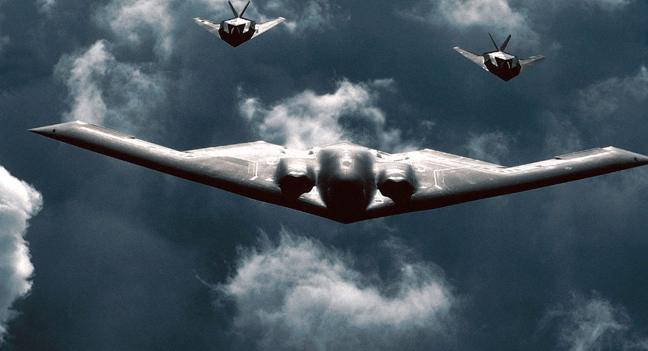
Kim Jong Un unlikely to commit nuclear suicide. (but what about Trump?)
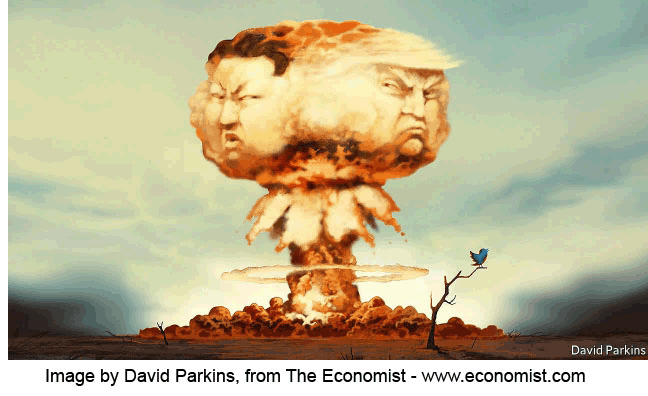 Where will Trump and Kim’s nuclear brinkmanship lead? CBS News, 13 Aug 17, President Trump says the U.S. military is “locked and loaded” in its confrontation with North Korea. But how exactly would all that firepower be used? Here’s David Martin at the Pentagon:Behind the “fire and fury” rhetoric, there is one very hard fact: If the U.S. were to unleash its military power against North Korea, it would result — in Secretary of Defense James Mattis’ words — in “the end of its regime and the destruction of its people.”
Before he retired, Admiral James Winnefeld was the vice chairman of the Joint Chiefs of Staff, the number two man in uniform, during the Obama Administration. He knows that one submarine like the USS Kentucky can by itself carry enough nuclear weapons to annihilate North Korea.
When asked to compare America’s nuclear forces to Korean nuclear forces, Adm. Winnefeld replied, “Well, there’s just no comparison whatsoever.”
Martin asked, “Were Kim Jong Un, for whatever reason, to launch a nuclear weapon against the United States, would he, in essence, be committing suicide?”
“Absolutely. Yeah, I mean, there is just no question that we would undertake a proportional response,” Adm. Winnefeld replied. “But in the case of a nuclear weapon, that proportional response would be overwhelming and would probably mean the end of the Kim regime — and he knows it.”…..
“The North Korean regime has hundreds of artillery cannons and rocket launchers within range of one of the most densely-populated cities on Earth, which is the capital of South Korea,” said Mattis.
Kim — like his father and grandfather before him — has lived under what he believes to be the constant threat of an attack from the south. That fear (some would call it paranoia) is what is driving his quest for a nuclear weapon.
“He wants to have what we would view as a credible nuclear threat so we won’t attack him,” WInnefeld said, …. he could not be certain a nuclear armed missile would get through the missile defense system, but he could be certain that if he tried, it would be the end of his regime.
“I think At the end of the day,” said Adm. Winnefeld, “two essential facts stand out: The first is, it’s very unlikely that he will ever willingly give up his program. But it’s also very, very unlikely that he will ever use it, as long as we don’t try to overthrow his regime.”
Can the U.S. live with that? It’s up to the commander-in-chief, who has said he will not allow North Korea to threaten America or its allies. http://www.cbsnews.com/news/donald-trump-kim-jong-un-nuclear-brinkmanship/
Global suicide – the climate effects of nuclear war with North Korea
Nuclear war with North Korea ‘would be suicidal’, climate experts warn, Mashable BY ANDREW FREEDMAN, 10 Aug 17, It’s winter, 2018, in Iowa, five months after the last of the nuclear bombs detonated across megacities in northeast Asia, from Seoul to Tokyo to Shanghai. Radioactive fallout was the initial concern, but now something else is going awry: the weather.
Forecasters say the corn and wheat harvest may be significantly shortened this year, and for the next several years. In fact, fears of a famine on an international scale are settling in.
This is what our world could look like just a few months to years after a regional nuclear war breaks out on the Korean Peninsula and spreads to include China and possibly Russia.

Such a war could cause the planet to cool by up to 10 degrees Celsius, or 18 degrees Fahrenheit, with larger regional swings and extremes, according to Owen Brian Toon, a scientist at the University of Colorado at Boulder. The amount of cooling could be far lower, depending on whether the conflict were more limited in scope.
Apocalyptic visions of a so-called global “nuclear winter” were popular during the Cold War when envisioning a U.S. conflict with the then-Soviet Union, but the odds of a regional nuclear war in recent times have jumped higher after President Donald Trump’s bellicose rhetoric toward North Korea on Tuesday. …….
It’s not just national security experts who are horrified by Trump’s words. Trump’s rhetoric, and history of openly considering using nuclear weapons, is also concerning to climate scientists.
Robock has conducted much of the research into the idea of a nuclear winter, whereby a global thermonuclear war vaults so much smoke into the upper atmosphere to block out the sun for years afterwards, causing temperatures to plunge and killing off vital crops and plant and animal species…….
Robock says most people, including high-ranking defense officials, are unaware that a nuclear war occurring halfway around the world from the U.S. could seriously harm the homeland, by altering the climate.
A new little ice age
The modern-day nuclear scenario that Robock, Toon and others have studied closely involves an exchange of nuclear weapons between India and Pakistan, with about 50 bombs of 15 kilotons each, which is less than half of those nations’ nuclear arsenals.
Such a war would induce massive firestorms in urban areas that could send up to 5 million tons of smoke high into the upper atmosphere, where tiny particles known as aerosols would scatter sunlight, preventing it from reaching the Earth’s surface.
This would turn the planet’s climate sharply colder, despite the effects of human-caused global warming, and impact areas far from the actual fighting. The global cooling from such a regional war could be near 1.25 degrees Celsius, or 2.25 degrees Fahrenheit, studies have shown.
Once in the stratosphere, the particles contributed by the smoke would stick around for a long time, Toon and Robock’s simulations show. Observations after volcanic eruptions and wildfires support the model simulations.
“It circles the globe and stays there for many years,” Toon said. ……..http://mashable.com/2017/08/09/north-korea-nuclear-war-climate-change-winter/#WoP6BE3O6iq4
Nuclear war danger – GREAT FOR INVESTORS IN WEAPONS!!!

Following Pyongyang‘s August 8 pronouncement that it had successfully miniaturized a nuclear warhead for its burgeoning ICBM fleet, US President Donald Trump made several inflammatory statements involving the phrase “fire and fury” and, one day later, the stocks of arms builders and weapons manufacturers skyrocketed.
While the stock market has been noted to be on an upswing in recent weeks, last week’s midweek figures were notably down — except for those of weapons manufacturers.
Defense technology companies Textron, General Dynamics, L3 Technologies and Huntington Ingalls all notched gains, while weapons giants Raytheon, Northrop Grumman, and Lockheed Martin saw the highest stock valuation of their history, according to Defense One.
Financial analysts gushing about potential profit quickly alerted investors to developing or planned missile defense interceptor networks and the lucrative firms that design and manufacture those weapons.
Weapons builders and military equipment suppliers are an attractive investment, if you can stomach that your money comes from selling devices that are made specifically to kill people, according to Defense One.
A recent Morgan Stanley analysis of weapons builders has suggested that stocks will rise.
“[W]e expect this intense budget debate over the next few weeks and months to yield positive results,” asserted an L3 Technologies spokesperson only last month.
The business and financial community note that US military spending is on track to top last year, and that increases are likely in the coming months.
“I believe that there is real interest and desire in additional [military] spending which will manifest itself in some more additional funding and budget for defense,” said General Dynamics CEO Phebe Novakovic.
“It’s just a question of how much,” she said.
A pre-emptive nuclear strike on North Korea? – catastrophic, and illegal
A Preemptive Strike on North Korea Would Be Catastrophic and Illegal TruthOut , August 12, 2017, By Marjorie Cohn, As Special Counsel Robert Mueller impanels two grand juries to investigate Donald Trump and his associates, and former Trump campaign manager Paul Manafort’s home is searched, Trump needs to distract attention from the investigation into his alleged wrongdoing.
North Korea has provided just such a distraction — albeit a potentially catastrophic one.
On Tuesday, Trump stated, “North Korea best not make any more threats to the United States. They will be met with fire and fury like the world has never seen.” Friday morning, Trump warned North Korea that the US military is “locked and loaded.”
Trump has learned that bombing other countries enhances a president’s popularity. In April, with 59 Tomahawk cruise missiles, each armed with over 1,000 pounds of explosives, he went from scoundrel-in-chief to national hero virtually overnight. The corporate media, the neoconservatives and most of Congress hailed Trump as strong and presidential for lobbing the missiles into Syria, reportedly killing nine civilians, including four children.
Several hours after Trump’s recent “fire and fury” statement, Pyongyang warned it was “carefully examining” a strike that would create “an enveloping fire” around Guam, the site of an important US military base and home to more than 160,000 people.
North Korea has accused the United States of planning a “preventive war,” saying that plans to mount one would be met with an “all-out war, wiping out all the strongholds of enemies, including the US mainland.” A spokesman for the General Staff of the Korean People’s Army promised, “the tragic end of the American empire will be hastened.”
In an attempt to tamp down fears of all-out war, Secretary of State Rex Tillerson said there is not “any imminent threat” from North Korea.
But Defense Secretary James Mattis cautioned that Pyongyang “should cease any consideration of actions that would lead to the end of its regime and the destruction of its people.” And National Security Adviser H.R. McMaster said that the White House is considering all options, including “preventative war.”…….
An Attack on North Korea Would Be Dangerous
The Intercept reports that “even a conventional war between the US and [North Korea] could kill more than 1 million people; a nuclear exchange, therefore, might result in tens of millions of casualties.”……
A Preemptive Strike on North Korea Would Violate the UN Charter
A preemptive strike on North Korea would be illegal. It would violate the United Nations Charter, which forbids the use of military force unless conducted in self-defense or when approved by the Security Council…..
Sign a Peace Treaty, End the Korean War
Moreover, North Korea cannot forget the 1950-1953 Korean War, which reduced North Korea’s population of 10 million by approximately one-third. Sixty-four years ago, the United States and North Korea signed an armistice agreement, but the US never permitted the creation of a peace treaty……..
Far from being an intractable foe, North Korea has repeatedly asked the United States to sign a peace treaty that would bring the unresolved Korean War to a long-overdue end.”
A month ago, China and Russia proposed a “freeze-for-freeze” strategy, which would entail North Korea freezing its nuclear and missile testing, and in return, the US and South Korea would end their annual joint military exercises. This proposal, issued in a joint statement by the Chinese and Russian Foreign Ministries after meetings between Russian President Vladimir Putin and Chinese President Xi Jinping, is a diplomatic solution that should be pursued……..
As we stand on the precipice of a disastrous war, these are the right circumstances for Trump to meet with Kim Jong-un. If Trump were to successfully negotiate a peace treaty with North Korea, he would receive plaudits for being a real diplomat. The unthinkable alternative is military action that would cause the deaths of untold numbers of Koreans, Japanese people and Americans. http://www.truth-out.org/news/item/41598-a-preemptive-strike-on-north-korea-would-be-catastrophic-and-illegal
Avoiding the fate of Saddam Hussein and Gadhafi – this is Kim Jong-un’s nuclear strategy
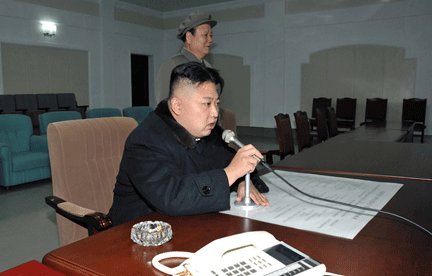 Kim Jong-un views nuclear weapons as a way to escape fate of Saddam and Gadhafi North Korea’s nuclear weapons unnerve the world, but are a security blanket for the regime, By Mark Gollom, CBC News Aug 13, 2017 William Tobey, a nuclear non-proliferation expert who has taken part in past Six Party Talks with North Korea, says anyone who claims to perfectly understand the motivations of the North Korean government, and does not live in Pyongyang, is probably blowing smoke.
But Tobey and most experts agree that North Korean leader Kim Jong-un’s No. 1 goal is self-preservation. For Kim, the pursuit of nuclear weapons and a missile program is a rational way to stave off attempts by the U.S. to overthrow his regime.
“I think most people ascribe a motivation of regime preservation to their nuclear programs,” Tobey said. “So it would be used to deter any attacks that would be aimed at dislodging the government.”
Nuclear ‘treasure sword’
The North Korean government has said as much in its public statements, Tobey said, and those should be taken “at face value.”
A commentary published by North Korea’s state KCNA news agency in January last year stated that “history proves that powerful nuclear deterrence serves as the strongest treasure sword for frustrating outsider’s aggression.”
The piece suggested North Korea fears suffering the same demise as Saddam Hussein’s Iraq and Moammar Gadhafi’s Libya, that neither could “escape the fate of destruction after being deprived of their foundations of nuclear development and giving up undeclared programs of their own accord.”
Philip Yun, a former senior adviser to two U.S. co-ordinators for North Korea at the Department of State, said that he has been in hundreds of hours of negotiations with the North Koreans. “Every single time during that period, they talked about [Slobodan] Milosevic and they talked about Saddam Hussein and subsequently talked about Gadhafi — if they had nuclear weapons they’d still be there.”…….
Preserving the dynasty
If North Korea truly believes an attack is imminent, it would launch its own strike, believing it has nothing to lose, said Tom Collina, director of policy at Ploughshares Fund, a think-tank dedicated to reducing the dangers of nuclear weapons.
But North Korea would not attack “out of the blue,” because it knows that would be suicidal, the end of the regime, he said…….
Tobey said he believes the “no viable options” view is a myth and that the U.S., South Korea and Japan need to step back and take a deep breath. North Korea, he reminded, is a tiny country, with a tiny economy, and it knows the regime would end if it deployed any serious weapons.
“We managed to deter the Soviet Union for decades with basically rough parity in the two military arsenals. There’s no comparison with U.S. and North Korea military capabilities. We can deter them.” http://www.cbc.ca/news/world/north-korea-nuclear-weapons-donald-trump-1.4244020
Very few veterans of Gulf War approved for health claims
Report: VA office denies 90 percent of Gulf War claims, Santa Fe New Mexican, The Associated Press, 13 Aug 17, ALBUQUERQUE — A Veterans Affairs office in New Mexico during the 2015 fiscal year denied more than 90 percent of benefit claims related to Gulf War illnesses, marking the ninth-lowest approval rating among VA sites nationwide, according to a federal report.
The U.S. Department of Veterans Affairs’ Albuquerque office denied 592 of 640 Gulf War illness claims in 2015, which is the latest yearly data available, The Albuquerque Journal reported earlier this week.
The report released in June from the Government Accountability Office found approval rates for Gulf War illness claims are one-third as high as for other disabling conditions. The Gulf War illness claims also took an average of four months longer to process…….http://www.santafenewmexican.com/news/local_news/report-va-office-denies-percent-of-gulf-war-claims/article_d2865b60-6a15-5877-a134-7b47ce5266d0.html
Never again – new Hibakusha victims – no nuclear weapons – Sueichi Kido
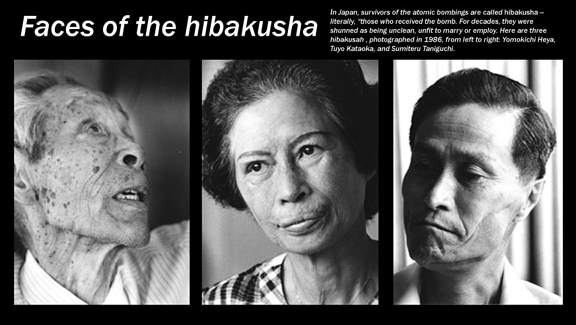 New head of A-bomb sufferers’ group strives for a world with no new hibakusha https://mainichi.jp/english/articles/20170812/p2a/00m/0na/025000c, August 13, 2017 (Mainichi Japan) “The dropping of an atomic bomb is an act decided by humans. Likewise, if humans decide to work together, we can eliminate nuclear weapons.” These were the words uttered by 77-year-old Sueichi Kido, who took over from Terumi Tanaka, 85, in June, as secretary-general of the Japan Confederation of A- and H-Bomb Sufferers Organizations after Tanaka had served in the role for 20 years.
Kido, himself an atomic bomb survivor (hibakusha), was just 5 years old when the atomic bomb was dropped on the city of Nagasaki. He was about 2 kilometers away from the hypocenter, and suffered burns to his face and upper body as a result.
The existence of hibakusha such as Kido became widely known once the press code that was in place during the Allied Occupation after World War II was lifted. He soon began to realize that he himself was a hibakusha. However, fearing discrimination, he decided not to tell people around him.
Twenty-five years after the atomic bomb was dropped on Nagasaki, Kido’s father died after bleeding from his eyes, nose and gums. Before Kido got married, he told his wife that he was a hibakusha. His wife’s older brother opposed the marriage and refused to attend the wedding.
In 1990, he attended a meeting in Gifu Prefecture aimed toward providing consultations for hibakusha, and the following year, he decided to set up a hibakusha group in the same prefecture. He came to feel that it was his duty as a hibakusha “to put his life on the line and strive toward making sure there are no more hibakusha in the future.”
In July this year, a historic treaty banning nuclear weapons was adopted — something hibakusha had wanted to see for many years. Nuclear nations and Japan are critical of the treaty, but Kido says, “There is no justice in the theory of nuclear deterrence. Nuclear nations and Japan are obviously being driven into a corner.”
To date, the Japan Confederation of A- and H-Bomb Sufferers Organizations has demanded that a clause on government compensation to people who have suffered from atomic bombs be inserted in the Atomic Bomb Survivors’ Assistance Act. As the new secretary-general of the confederation, Kido is striving toward achieving this goal.
“This clause isn’t just about atonement for the past. It is necessary in order to ensure that there are no more wars or damage involving nuclear weapons in the future,” Kido says.
Call for unilateral disarmament of UK’s nuclear arsenal

 Herald 13th Aug 2017, THE only sensible response to the escalating nuclear stand-off between
Donald Trump and Kim Jong-un is to rid the UK of its atomic arsenal,
according to a Nobel Peace Prize-nominated SNP MSP.
Bill Kidd, who was put forward for the honour by Parliamentarians for Nuclear Non-proliferation
and Disarmament (PNND) in 2016, said the UK should take a fresh look at
unilateral disarmament in the face of rising tensions between the US and
North Korea – a position that has been backed by the Scottish Greens.
http://www.heraldscotland.com/news/15470103.SNP__UK_must_ditch_Trident_in_response_to_nuclear_stand_off_between_North_Korea_and_US/
Donald Trump: USA ready to act militarily against North Korea: Merkel calls for de-escalation of the rhetoric
 Donald Trump says US military solutions ‘locked and loaded’ against North. Korea.news.com.au , AUGUST 12, 2017 US PRESIDENT Donald Trump says North Korean leader Kim Jong-un will “regret it and regret it fast” if he attacks the US air bases in Guam or any of America’s allies.
Mr Trump’s latest threat comes after he declared on Friday via Twitter that the US military was “locked and loaded”, and ready to act against the rogue regime……..
While Mr Trump talks up the US’s military might, his lieutenants have been attempting to diffuse the situation via diplomatic backchannels, but the President declined to discuss these tactics.
“We don’t want to talk about progress, we don’t want to talk about backchannels, we want to talk about a country that has misbehaved for many, many years — decades actually — through numerous administrations and they didn’t want to take on the issue and I have no choice but to take it on and I’m taking it on,” Mr Trump said.
German Chancellor Angela Merkel has criticised Mr Trump’s inflammatory language towards North Korea, saying “I  consider an escalation of rhetoric the wrong answer”.
“I do not see a military solution to this conflict,” she added.
“Let her speak for Germany,” Mr Trump said in response.
Politicians from both sides of American politics have criticised Mr Trump’s approach to the conflict — especially his threat to rain down “fire and fury” on North Korea — saying his comments have raised the tension.
“My critics are only saying that because it’s me,” he said.
“If somebody else uttered the exact same words that I uttered they’d say, ‘What a great statement, what a wonderful statement’……
Also on Friday, Mr Trump retweeted a US Pacific Command message that said US planes stand ready to “fulfill a #FightTonight mission”.
The threats follow a week of escalating rhetoric between the two countries after the US threatened “fire and fury” against the rogue state.
North Korea retaliated by releasing potential plans to strike the US territory of Guam in the Western Pacific, however US diplomats say a dialogue is being pursued and Americans should “sleep well” at night.
On Thursday North Korea threatened to use its young people to “blow the US from this planet”.
The country’s official Korean Central News Agency reported on a mass rally held in Pyongyang’s Kim Il-sung Square and cited the secretary of the Pyongyang City Youth League Committee as saying “the young people in the country would become five million human bullets and bombs and nuclear warheads to blow the US from this planet”.
Meanwhile Australian Prime Minister Malcolm Turnbull said Australia would come to the aid of the United States if North Korea attacks America……
Despite the rhetoric, US officials said there was no major movement of U.S. military assets to the region, nor were there signs Pyongyang was actively preparing for war.
Military officials will move ahead with planned drills between the US and South Korea. Called Ulchi-Freedom Guardian, the exercises are expected to run from August 21-31 and involve tens of thousands of American and South Korean troops on the ground and in the sea and air.
Washington and Seoul say the exercises are defensive in nature and crucial to maintaining a deterrent against North Korean aggression…..
The streets of Pyongyang also reportedly remain calm amid rising tension in the region.
German Chancellor Angela Merkel says she doesn’t see a military solution to rising tensions between the United States and North Korea and called for a de- escalation of the rhetoric.
Asked Friday about U.S. President Donald Trump’s latest statements, Merkel declined to say whether Germany would stand with the U.S. in case of a military conflict with North Korea. She said, “I don’t see a military solution and I don’t think it’s called for.”http://www.news.com.au/finance/work/leaders/president-trump-says-us-military-solutions-locked-and-loaded-against-north-korea/news-story/4a41381154397a5c939b39d300019ebf
1 This Month
23-25 October – on Zoom – World BEYOND War’s annual global conferenc

To see nuclear-related stories in greater depth and intensity – go to https://nuclearinformation.wordpress.com

Say No to NASA’s Reckless Nuclear Reactor on the Moon
Say No to NASA’s Reckless Nuclear Reactor on the Moon
-
Archives
- October 2026 (160)
- September 2026 (339)
- August 2026 (330)
- July 2026 (355)
- June 2026 (287)
- May 2026 (306)
- April 2026 (356)
- March 2026 (251)
- February 2026 (267)
- January 2026 (308)
- December 2025 (358)
- November 2025 (359)
-
Categories
- 1
- 1 NUCLEAR ISSUES
- business and costs
- climate change
- culture and arts
- ENERGY
- environment
- health
- history
- indigenous issues
- Legal
- marketing of nuclear
- media
- opposition to nuclear
- PERSONAL STORIES
- politics
- politics international
- Religion and ethics
- safety
- secrets,lies and civil liberties
- spinbuster
- technology
- Uranium
- wastes
- weapons and war
- Women
- 2 WORLD
- ACTION
- AFRICA
- Atrocities
- AUSTRALIA
- Christina's notes
- Christina's themes
- culture and arts
- Events
- Fuk 2022
- Fuk 2023
- Fukushima 2017
- Fukushima 2018
- fukushima 2019
- Fukushima 2020
- Fukushima 2021
- general
- global warming
- Humour (God we need it)
- Nuclear
- RARE EARTHS
- Reference
- resources – print
- Resources -audiovicual
- Weekly Newsletter
- World
- World Nuclear
- YouTube
-
RSS
Entries RSS
Comments RSS

