Facing reality: North Korea already is a nuclear weapons state
Treating North Korea as another rival nuclear power would involve using the tools the U.S. has employed for decades to deal with such adversaries: containment, deterrence, and measures designed to lower the risk of a small incident escalating into an all-out confrontation. It might be the least bad option there is left
Is It Time to Accept the Reality of a Nuclear-Armed North Korea? By John Cassidy, 12 Aug 17, “…….A year ago, the Institute for Science and International Security estimated that Pyongyang had between thirteen and twenty-one nuclear warheads; since then, the number has likely grown. Last month, the North Koreans carried out two tests of ballistic missiles that, at least in theory, could hit parts of the U.S. mainland. The tests were apparently successful. And, according to a recent report in the Washington Post, the Defense Intelligence Agency believes that Kim’s regime has developed a miniature nuclear warhead that could soon be fitted to these long-range missiles……In a presentation to the Asia Society last week, John Park, a director of the Korea Working Group at the Belfer Center, pointed out the Kim had been entirely consistent in his desire to obtain a nuclear deterrent, which, in addition to safeguarding his regime, would enable North Korea to avoid a costly conventional-arms race and focus on economic development. Park said that many Chinese officials privately sympathized with the North Korean policy………
North Korea could collapse if it gives up nuclear weapons
Paul Keating: North Korea could collapse if it gives up nuclear weapons, SMH, James Massola,
Fergus Hunter, 12 Aug 17, Former Australian Prime Minister Paul Keating has warned that North Korea will never abandon its nuclear weapon program and that this new reality will have to be addressed in the same way as the west sought to contain the former Soviet Union.
The former prime minister, one of Australia’s most-respected foreign policy thinkers and a strong advocate for a more independent foreign policy, has disagreed strongly with the language and approach being taken the US President Donald Trump towards the rogue state…….
Mr Keating said his criticism could be extended to Australia’s pledge to enter any potential conflict between the US and North Korea. He also disagreed with former prime ministers Kevin Rudd and Tony Abbott that Australia should pursue a missile defence system against North Korea’s intercontinental ballistic missiles.
His comments about the growing tensions on the Korean peninsula come on the same day that Prime Minister Malcolm Turnbull declared Australia would assist America if it was attacked by North Korea……..
Mr Keating decided to speak publicly after being contacted by Fairfax Media and his views will be expanded in a major essay for a new magazine, Australian Foreign Affairs, to be published in October.
“I have long believed, especially after the unprovoked Western attack on Iraq and the ransacking of the Gaddafi regime in Libya, that North Korea would not desist from the full development of its nuclear weapons program, despite threats and sanctions from the West and even from China,” he said
“I said in April, we should regard North Korea as a full and capable nuclear weapons state – a state that would, in future, need to be contained, in the way the Soviet Union was contained during the Cold War. Developments since April have only confirmed my view.”
“More than that, it may be, that because the development of nuclear weapons in North Korea has, in a sense, become the raison d’etre of the state, were Kim Jong-Un and his generals to agree to the West’s demands, they may not politically survive that acquiescence.”……http://www.smh.com.au/federal-politics/political-news/paul-keating-north-korea-could-collapse-if-it-gives-up-nuclear-weapons-20170811-gxua4x.html
President Donald Trump’s “loose rhetoric” on North Korea could have deadly consequences
Trump’s rhetoric could see U.S. ‘blunder into a war’ with North Korea, warns former negotiator, CBC Radio, 11 Aug 17 U.S. President Donald Trump’s “loose rhetoric” on North Korea could have deadly consequences, says the former U.S. defence secretary who negotiated with Pyongyang for the Clinton administration.
“In any war with North Korea, North Korea would surely lose. They know that, so they’re not seeking a war,” William Perry told As It Happens guest host Rosemary Barton.
“But we could blunder into a war, and this kind of loose rhetoric probably makes that more likely than less likely.”
‘Even with conventional weapons, it could be at least as bad as the first Korean War, in which more than a million people died.’– William Perry, former U.S. defence secretary
Perry says he came close to brokering a deal with the regime in 1999 to not develop a nuclear arsenal, but negotiations came to a halt when George W. Bush took over the White House from Bill Clinton.
He spoke with Barton about the escalating threats being exchanged by Trump and North Korean Leader Kim Jong-Un. Here is part of their conversation. …….
Unlike the first Korean War, this one always has the potential of escalating into a nuclear war.
I do not believe that North Korea would initiate any attack with nuclear weapons because I do not believe the leadership is suicidal. They’re not seeking martyrdom; they’re seeking to preserve the regime in power. But they’re playing a very dangerous game.
Do you think, as some have suggested, there would be any consideration or benefit to an American pre-emptive strike?
That would be exceedingly dangerous. It would almost certainly lead to a North Korean military response on South Korea
That could very well then escalate into a general Korean war, with the horrible consequences of the first Korean War and beyond that.
We have learned today, according to an Associated Press report, that the Trump administration has had some backchannel diplomacy with North Korea for a number of months with Joseph Yun, the U.S. envoy for North Korea. What does that tell you?
I would certainly hope it were true that besides dealing with this with bluster, we’re dealing with it with a sober, cautious attempt to enter into a dialogue with North Korea to see if we can resolve this crisis through diplomacy instead of through a military conflict. That’s why Yun is over there — to see if he can find a peaceful solution…….http://www.cbc.ca/radio/asithappens/as-it-happens-friday-edition-1.4201412/trump-s-rhetoric-could-see-u-s-blunder-into-a-war-with-north-korea-warns-former-negotiator-1.4201420
Donald Trump’s longterm obsession with nuclear war
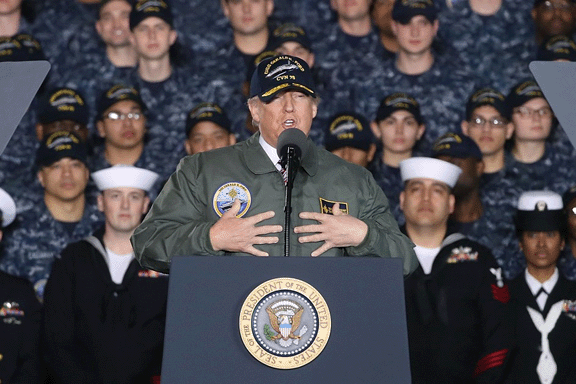 Trump Has Been Thinking About Nuclear War for Decades. Here’s Why That’s Scary. He seems to think it’s inevitable. Mother Jones, AUG. 11, 2017 “……In a 1984 interview with the Washington Post, Trump, then merely a 38-year-old celebrity developer, shared his fantasies: He was hoping to build the “greatest hotel in the world” and construct the world’s “tallest” building in New York City—and one day become the United States’ chief negotiator with the Soviet Union for nuclear weapons. In between boasts of how rich and famous he was, Trump declared that he could negotiate a great nuclear arms deal with Moscow and said he wanted to head the US arms negotiating squad. “He says he has never acted on his nuclear concern,” the newspaper reported. “But he says that his good friend Roy Cohn, the flamboyant Republican lawyer, has told him this interview is a perfect time to start.”
Comparing crafting an arms accord with cooking up a real estate deal, Trump insisted he had innate talent for this mission. “Some people have an ability to negotiate,” he said. “It’s an art you’re basically born with. You either have it or you don’t.” Trump claimed he would know exactly what to demand of the Russians—though that would have to remain a secret for the time being. He was undaunted by his lack of experience in the technical field of nuclear weaponry: “It would take an hour-and-a-half to learn everything there is to learn about missiles…I think I know most of it anyway. …….
he continued to think and talk about nuclear weapons—often voicing a fatalistic approach, as if he believed nuclear conflagration was unavoidable. During a 1990 interview with Playboy, Trump was asked to describe his “longer-term views of the future.” Trump answered, “I think of the future, but I refuse to paint it. Anything can happen. But I often think of nuclear war.”…….
Trump pushed on with his notion that nuclear annihilation could be on the horizon:……..
It’s clear: Trump has been fretting about nuclear destruction for many years. But for all his concern, he seemingly has not done much to educate himself on the weighty subject. During the presidential campaign, he uttered several troubling comments about nuclear arms. At a Republican primary debate, he botched a question about the nuclear triad—a sign he did not understand the most basic information about the structure of the US nuclear command. As a candidate, Trump noted that he would support allowing Japan, South Korea, and Saudi Arabia to obtain nuclear weapons—that is, he was advocating nuclear proliferation—and that he would be open to using the ultimate weapons against ISIS and in other conflicts. He asserted that when it came to national security, he had “a very good brain.”
These days, his cavalier talk of “fire and fury” in response to Kim Jong-un’s reckless remarks about Pyongyang’s nuclear weapons show that Trump doesn’t bother to consider the difficult and vexing nuances of nuclear diplomacy. (Attack North Korea, and North Korea could well destroy Seoul with or without nuclear weapons.) Since the days of the Cold War, Trump has repeatedly signaled that he fears that nuclear war may be inescapable but that he also believes nuclear policy is an easy matter to master. At least for him. Each of these notions is frightening. Together, they can be terrifying. http://www.motherjones.com/politics/2017/08/trump-has-been-thinking-about-nuclear-war-for-decades-heres-why-thats-scary/
Debate on whether it would be constitutional for Trump to make a nuclear strike against North Korea
A Trump nuclear strike against North Korea: constitutional or not? http://www.politifact.com/truth-o-meter/article/2017/aug/10/nuclear-strike-against-north-korea-constitutional-/
But some members of Congress argue that the current process by which the president can order a nuclear strike is illegal.
“Our view is the current nuclear launch approval process is unconstitutional,” U.S. Rep. Ted Lieu, D-Calif, said on CNN on Aug. 8, 2017. Lieu has filed a proposal to require congressional approval before the president could launch a first nuclear strike.
“Right now one person can launch thousands of nuclear weapons, and that’s the president. No one can stop him. Under the law, the secretary of defense has to follow his order. There’s no judicial oversight, no congressional oversight,” Lieu said.
Lieu, a colonel in the Air Force reserves, is generally correct about the president’s power to initiate a nuclear strike. The constitutionality, however, is a more complex question. We won’t rate Lieu’s claims on the Truth-O-Meter, but we did think it was important to provide context to his statement and the law.
The current nuclear launch approval process was enshrined after the atomic bombings of Hiroshima and Nagasaki in Japan to end World War II. President Harry Truman signed the Atomic Energy Act of 1946 to give the president full responsibility over the nation’s nuclear arsenal.
(As an aside, Lieu’s argument wouldn’t apply in cases when Congress formally declares war, since the president has a longstanding right as commander-in-chief to decide how to wage war.)
So the current nuclear launch approval process doesn’t include the same checks and balances as other executive branch decisions. The launch process allows the president to use nuclear weapons with a single verbal order. Some experts believethe president doesn’t need to consult with the defense secretary. The president’s order cannot be overridden.
The U.S. Supreme Court has never weighed in on the question of whether the current nuclear launch approval process is legal. Not surprisingly, we heard mixed opinions from legal scholars.
The Constitution allows the president to use significant military force without congressional approval if it’s in self-defense. But would it be constitutional for the president to respond to a conventional bombing with a nuclear strike? What about a state-sponsored act of terror?
These questions have no definitive answer.
The murkiness is due in some part to the framers not foreseeing the capability for mass destruction that nuclear weapons guarantee, said Samuel Issacharoff, a constitutional law professor at New York University. But, he said, the narrow design of a founding document doesn’t necessarily make a president’s unilateral military action — nuclear or non-nuclear — unconstitutional.
“The best one can say is that the constitutional scheme may be poorly designed
for modern circumstances,” he said.
The Constitution does give Congress the authority to declare war, which it hasn’t done since World War II. But presidents before Trump — and including Trump with his April airstrikes in Syria — have initiated war or war actions without express congressional permission.
In 1973, Congress passed the War Powers Resolution requiring that in the absence of a war declaration by Congress, the president report to Congress within 48 hours of introducing armed forces into hostilities and remove forces within 60 days if Congress does not approve.
A simple reading, then, could give Trump a 48-hour window of unilateral power.
But the War Powers Resolution hasn’t stopped longer military interventions. President Bill Clinton sent U.S. troops into the former Yugoslav republic of Kosovo in 1999, and they remained in place despite the failure to receive congressional authorization.
There’s a final wrinkle to all of this: Some experts say that Trump could circumvent the need for Congress to declare war against North Korea, because the United States is already at war with North Korea.
The Korean War (1950-3) ended with an armistice, but the two parties never signed the peace treaty scheduled in Geneva in 1954 formally ending the war.
“In the absence of some new legal instrument that makes fighting the war improper, you can say that the president has whatever authority he had before,” said Saikrishna Prakash, a law professor at the University of Virginia.
But there’s a caveat to that, too. Congress approved funding to fight the Korean War, but never formally declared war. That was done by the United Nations.
Can Donald Trump be prevented from plunging the world into nuclear war?
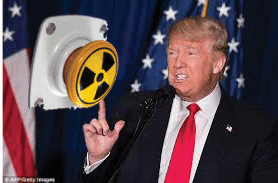 Trump has taken us to the brink of nuclear war. Can he be stopped?In previous standoffs, Trump’s predecessors knew when to hold back. Now there is no such certainty, Irish Times,
Jonathan Freedland, 1o Aug 17, his was the moment many Americans, along with the rest of the world, feared. This – precisely this – was what alarmed us most about the prospect of Donald Trump becoming president of the US. Not that he would hire useless people or that he would tweet all day or use high office to enrich himself and his family or that he’d be cruel, bigoted and divisive – though those were all concerns. No, the chief anxiety provoked by the notion of Trump in the White House was this: that he was sufficiently reckless, impulsive and stupid to bring the world to the brink of nuclear war.
‘Fire and fury’ wasn’t tough enough – Trump on North Korea
Of course, cooler heads might soon prevail. China might find the diplomatic back-channel that persuades North Korea to step back from the current clash with Washington. The Pyongyang regime might calculate for itself that, despite its latest threat to attack the US airbase in the Pacific island of Guam, further escalation risks its own survival. Or the generals that now flank Trump – John Kelly as chief of staff, Jim Mattis as defence secretary – might succeed in talking their boss down from the ledge.
But make no mistake. Trump’s remarks on Tuesday have pushed the US to the precipice of nuclear confrontation with North Korea. We have to hope that both parties will step back, but be under no illusion that the brink is where we stand. And Trump put us there.
The form of words the president used made the critical difference. Threatening Kim Jong-un with “fire and fury” was bellicose enough. But adding the words “the likes of which this world has never seen before” left no doubt that he was talking about a nuclear strike against North Korea.
It is worth pausing to consider the obvious consequences of such an action. About 75 million people live on the Korean peninsula. There are also 30,000 US servicemen and women stationed there. How many would die if Trump made good on his threat? And that is to reckon without further retaliation and escalation, as Russia or China unleashed their own nuclear arsenals. This is why all previous US presidents have used only the most sober language when speaking of North Korea. They have understood the human stakes. They have sought to reduce tension, not ratchet it up……..
The point is that since the dawn of the atomic age the world’s leaders have understood that these weapons have to be handled with the greatest delicacy. Nuclear standoffs happen, but each side has always understood where the brink lies and were careful not to overstep it. That means, especially, understanding the need not to say anything that the other side might misinterpret as a cue for war.
Both Washington and Moscow understood that throughout the cold war; it’s what stopped the Cuban missile crisis turning into Armageddon. Most analysts believe the regime in Pyongyang, for all its brutality, understands that too: it is not suicidal. But the question hanging over the world today is one that has never had to be asked before: does the US president understand this most essential point, one on which the fate of the world depends?
Jonathan Freedland is a Guardian columnist https://www.irishtimes.com/opinion/trump-has-taken-us-to-the-brink-of-nuclear-war-can-he-be-stopped-1.3182374
Risk of US-N.Korea nuclear war increases, but is still unlikely
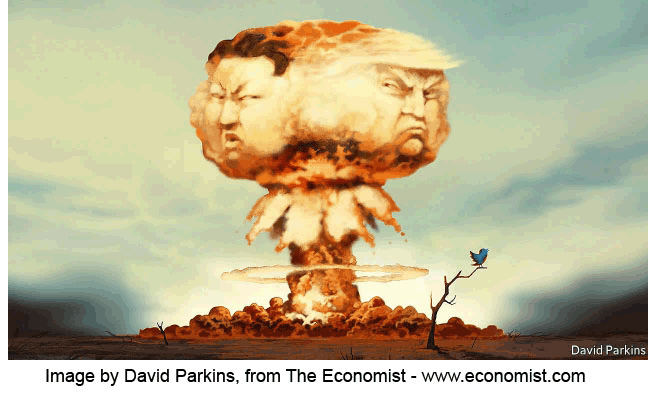 Experts: US-N.Korea nuclear war unlikely, but risk is rising, https://www.apnews.com/95ffd16e43af4bca815a22f39813a8ac, — Martha Mendoza in San Jose, California, 10 Aug 17 A nuclear war between North Korea and the United States is not imminent, analysts said, but the inflammatory rhetoric on both sides is increasing the risk. They called on all parties to de-escalate.
North Korea’s army said in a statement distributed by state media Wednesday that it was examining a plan to use ballistic missiles to make an “enveloping fire” around Guam, a U.S. territory that is home to Andersen Air Force Base. The statement came a day after President Donald Trump warned North Korea against making more threats, saying, “They will be met with fire and fury like the world has never seen.”
What experts in South Korea, China and the U.S. had to say:
SLIM CHANCE OF ATTACK
A North Korean attack or an American pre-emptive strike is unlikely, said John Delury, an associate professor of East Asian Studies at Yonsei University in Seoul.
He saw North Korea’s statement as a warning to Washington that its missiles could reach targets in the region, rather than one of an actual attack.
“Well, I’m gonna go out on a limb here and say if North Korea was planning some kind of pre-emptive or surprise attack on Guam, we would not be reading about it in North Korean media,” Delury said in an interview at his office. “Now that said, you do need to track their threats. And there are cases where they (have) made a specific threat and carried it out.”
A U.S. strike against North Korea would need the support of South Korea, he said, because the North would likely retaliate against the South and its 600,000 troops.
“It’s not something you can do without robust, full support from the South Korean government people, and there’s absolutely no sign that South Korea will support military options with North Korea,” Delury said.
— Yong Jun Chang in Seoul, South Korea
DEEP CONCERN IN BEIJING
Chinese government-backed scholars said Beijing is deeply concerned about the latest statements from Trump and North Korea. They hold the U.S. partly responsible, saying Trump’s heated rhetoric is fueling the flames.
Trump’s tough talk has contributed to an increase in animosity that is pushing the sides closer to armed conflict, said Cheng Xiaohe of the School of International Studies at Beijing’s Renmin University.
“If not kept well under control, this verbal spat could turn into a military clash,” he said, adding that China should dispatch diplomats to engage in shuttle diplomacy to bring the sides to the negotiating table.
China’s patience with North Korea, its onetime close ally, appears to be running thin: Beijing agreed to recent U.N. sanctions, despite potential losses to Chinese firms doing business with North Korea and fears over destabilizing the Pyongyang regime.
A top Chinese expert on North Korea said Pyongyang seemed to have been heartened by Washington’s failure to take firm measures in response to earlier actions.
“Trump said the U.S. would take tough measures if North Korea fired off missiles, but it did not,” said Zhang Liangui, a professor at the ruling Communist Party’s main training academy. “This might make North Korea think that’s just some verbal threat, so its attitude is getting tougher and tougher.”
The U.S., China and Russia need to come together to force the North to de-escalate, he said. “The big countries should not attack each other, but unite to better cooperate on maintaining the denuclearization of the Korean Peninsula.”
— Christopher Bodeen and Fu Ting in Beijing
NO CAPABILITY YET
U.S. nuclear expert Siegfried Hecker, who has repeatedly visited North Korea’s nuclear facilities, said he doesn’t think North Korea currently has weapons systems for “enveloping fire” around Guam, as it threatened.
“I don’t believe they have the capability to do so yet, and besides, why would they want to commit suicide by attacking a remote target like Guam?” he said. “The real threat is stumbling into an inadvertent nuclear war on the Korean Peninsula by misunderstanding or miscalculation. Inflammatory rhetoric on both sides will make that more likely. It’s time to tone down the rhetoric.”
Hecker said North Korea does not have a sophisticated nuclear weapon like those of the U.S., Russia, Britain, China or France, the major nuclear superpowers.
“The shorter-range missile that can reach South Korea and Japan can accommodate larger nuclear warhead payloads,” he said. “Making the warhead sufficiently small, light and robust to survive an ICBM delivery is extremely challenging and still beyond North Korea’s reach.”
The way to avert a war with North Korea is to have a conversation, and that’s not happening, Hecker said.
“Unfortunately, there seems to be no serious dialogue between Washington and Pyongyang, only threats,” he said.
Haunting photographs of 1945 Hiroshima and Nagasaki
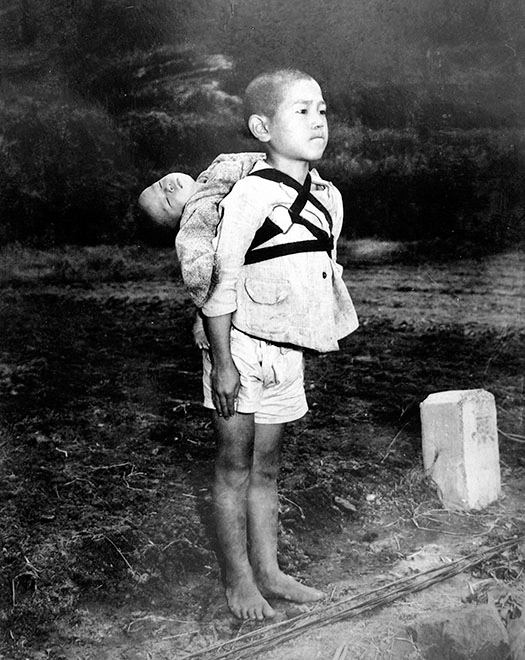 If you’re against war, get this book: The photos will haunt you http://www.asahi.com/ajw/articles/AJ201708100035.html By SONOKO MIYAZAKI/ Staff Writer August 10, 2017 A boy standing at rigid attention with the dead body of his infant brother strapped to his back at a crematorium in Nagasaki is one of searing images of the city’s destruction after the U.S. atomic bombing in 1945.
In a book published Aug. 9, Kimiko Sakai, the widow of Joe O’Donnell, the photographer who snapped the image, tells the story of her husband’s life work through photographs he shot in Japan in the immediate aftermath of the war.
Aug. 9 marked the 72nd anniversary of the bombing as well as the 10th anniversary of O’Donnell’s death at the age of 85.
The 192-page book, titled “Kamisama no Finder: Moto-Beijugun Cameraman no Isan” (God’s finder: the legacy of a former war photographer), was published by the Tokyo-based Word of Life Press Ministries.
After Japan’s surrender, O’Donnell, who was attached to the U.S. Marine Corps, traveled to Hiroshima, Nagasaki and other Japanese cities to document the wartime devastation. He stayed in Japan from September 1945 to March 1946.
He took 300 or so photographs for his private use.
He believed it was wrong to drop the atomic bombs after witnessing the sufferings of the victims.
But O’Donnell didn’t exhibit these pictures for decades because of prevailing U.S. sentiment that the atomic bombings of Hiroshima and Nagasaki hastened the end of World War and saved many American lives.
O’Donnell later decided to exhibit the photographs in the hope they would help advance the anti-war movement.
The catalyst for this was when he gazed on a sculpture evoking Jesus on the cross and engulfed by flames at a church in Kentucky in 1989. The life-size work, titled “Once,” was created for the repose of the tens of thousands of people killed in that atomic bombings, with photos of victims pasted all over the body. O’Donnell was stunned.
After that, O’Donnell until his death held exhibitions of his photos in the United States and Japan to convey the horrors of nuclear war.
The image of the boy at the crematorium stayed with him. O’Donnell recalled that the boy stared motionless as bodies were being burned and he awaited his turn. He also noticed that the boy’s lips were caked with blood because he was biting them so hard, although no blood spilled.
Sakai agreed to a proposal to publish the book after she was contacted by the publisher two years or so ago. Sakai, who lives in Tennessee, said she accepted out of respect for her husband’s commitment to the anti-war cause.
“My husband photographed his subjects as fellow human beings, not as an occupier,” she said in a recent interview with The Asahi Shimbun.
Asked if she had a message for those working to rid the world of nuclear arsenals, she said, “Just ‘not to forget,’ which is important.”
Dispelling the myths about U.S. President Harry Truman’s decision to nuclear bomb Japanese cities
The destruction of Hiroshima and Nagasaki was a war crime worse than any that Japanese generals were executed for in Tokyo and Manila. If Harry Truman was not a war criminal, then no one ever was.
 Mises Institute 10 Aug 17 [Excerpted from “Harry S. Truman: Advancing the Revolution,” in Reassessing the Presidency: The Rise of the Executive State and the Decline of Freedom, John Denson, ed.]
The most spectacular episode of Harry Truman’s presidency will never be forgotten but will be forever linked to his name: the atomic bombings of Hiroshima on August 6, 1945, and of Nagasaki three days later. Probably around two hundred thousand persons were killed in the attacks and through radiation poisoning; the vast majority were civilians, including several thousand Korean workers. Twelve US Navy fliers incarcerated in a Hiroshima jail were also among the dead.1
Great controversy has always surrounded the bombings. …….
the rationale for the atomic bombings has come to rest on a single colossal fabrication, which has gained surprising currency — that they were necessary in order to save a half-million or more American lives. These, supposedly, are the lives that would have been lost in the planned invasion of Kyushu in December, then in the all-out invasion of Honshu the next year, if that had been needed. But the worst-case scenario for a full-scale invasion of the Japanese home islands was forty-six thousand American lives lost.7 The ridiculously inflated figure of a half-million for the potential death toll — nearly twice the total of US dead in all theaters in the Second World War — is now routinely repeated in high-school and college textbooks and bandied about by ignorant commentators. Unsurprisingly the prize for sheer fatuousness on this score goes to President George H.W. Bush, who claimed in 1991 that dropping the bomb “spared millions of American lives.”8
Still, Truman’s multiple deceptions and self-deceptions are understandable, considering the horror he unleashed. It is equally understandable that the US occupation authorities censored reports from the shattered cities and did not permit films and photographs of the thousands of corpses and the frightfully mutilated survivors to reach the public.9 Otherwise, Americans — and the rest of the world — might have drawn disturbing comparisons to scenes then coming to light from the Nazi concentration camps.
The bombings were condemned as barbaric and unnecessary by high American military officers, including Eisenhower and MacArthur.10 The view of Admiral William D. Leahy, Truman’s own chief of staff, was typical:
the use of this barbarous weapon at Hiroshima and Nagasaki was of no material assistance in our war against Japan. … My own feeling was that in being the first to use it, we had adopted an ethical standard common to the barbarians of the Dark Ages. I was not taught to make wars in that fashion, and wars cannot be won by destroying women and children.11
The political elite implicated in the atomic bombings feared a backlash that would aid and abet the rebirth of horrid prewar “isolationism.” Apologias were rushed into print, lest public disgust at the sickening war crime result in erosion of enthusiasm for the globalist project.12 No need to worry. A sea change had taken place in the attitudes of the American people. Then and ever after, all surveys have shown that the great majority supported Truman, believing that the bombs were required to end the war and save hundreds of thousands of American lives, or, more likely, not really caring one way or the other.
Those who may still be troubled by such a grisly exercise in cost-benefit analysis — innocent Japanese lives balanced against the lives of Allied servicemen — might reflect on the judgment of the Catholic philosopher G.E.M. Anscombe, who insisted on the supremacy of moral rules.13 When, in June 1956, Truman was awarded an honorary degree by her university, Oxford, Anscombe protested.14 Truman was a war criminal, she contended, for what is the difference between the US government massacring civilians from the air, as at Hiroshima and Nagasaki, and the Nazis wiping out the inhabitants of some Czech or Polish village?……
While the mass media parroted the government line in praising the atomic incinerations, prominent conservatives denounced them as unspeakable war crimes. Felix Morley, constitutional scholar and one of the founders of Human Events, drew attention to the horror of Hiroshima, including the “thousands of children trapped in the thirty-three schools that were destroyed.” He called on his compatriots to atone for what had been done in their name, and proposed that groups of Americans be sent to Hiroshima, as Germans were sent to witness what had been done in the Nazi camps.
The Paulist priest, Father James Gillis, editor of The Catholic World and another stalwart of the Old Right, castigated the bombings as “the most powerful blow ever delivered against Christian civilization and the moral law.” David Lawrence, conservative owner of US News and World Report, continued to denounce them for years.21 The distinguished conservative philosopher Richard Weaver was revolted by
the spectacle of young boys fresh out of Kansas and Texas turning nonmilitary Dresden into a holocaust … pulverizing ancient shrines like Monte Cassino and Nuremberg, and bringing atomic annihilation to Hiroshima and Nagasaki.
Weaver considered such atrocities as deeply “inimical to the foundations on which civilization is built.”22
Today, self-styled conservatives slander as “anti-American” anyone who is in the least troubled by Truman’s massacre of so many tens of thousands of Japanese innocents from the air. This shows as well as anything the difference between today’s “conservatives” and those who once deserved the name.
Leo Szilard was the world-renowned physicist who drafted the original letter to Roosevelt that Einstein signed, instigating the Manhattan Project. In 1960, shortly before his death, Szilard stated another obvious truth:
If the Germans had dropped atomic bombs on cities instead of us, we would have defined the dropping of atomic bombs on cities as a war crime, and we would have sentenced the Germans who were guilty of this crime to death at Nuremberg and hanged them.23
The destruction of Hiroshima and Nagasaki was a war crime worse than any that Japanese generals were executed for in Tokyo and Manila. If Harry Truman was not a war criminal, then no one ever was. https://mises.org/blog/harry-truman-and-atomic-bomb
Just what is America doing on Guam?
Q&A: What does the US military do on the island of Guam? https://www.apnews.com/2a347e608d2d48fe9f03e545285b2783
By AUDREY McAVOY, 11 Aug 17, HONOLULU (AP) — The small U.S. territory of Guam has become a focal point after North Korea’s army threatened to use ballistic missiles to create an “enveloping fire” around the island. The exclamation came after President Donald Trump warned Pyongyang of “fire and fury like the world has never seen.” Here’s a look at the U.S. military’s role on the island, which became a U.S. territory in 1898.
WHAT INSTALLATIONS ARE ON GUAM AND HOW SIGNIFICANT ARE THEY? There are two major bases on Guam: Andersen Air Force Base in the north and Naval Base Guam in the south. They are both managed under Joint Base Marianas. The tourist district of Tumon, home to many of Guam’s hotels and resorts, is in between.
The naval base dates to 1898, when the U.S. took over Guam from Spain after the Spanish-American War. The air base was built in 1944, when the U.S. was preparing to send bombers to Japan during World War II.
Today, Naval Base Guam is the home port for four nuclear-powered fast attack submarines and two submarine tenders.
Andersen Air Force Base hosts a Navy helicopter squadron and Air Force bombers that rotate to Guam from the U.S. mainland. It has two 2-mile (3-kilometer) long runways and large fuel and munitions storage facilities.
Altogether, 7,000 U.S. military personnel are stationed on Guam. Most are sailors and airmen. The military plans to move thousands of U.S. Marines to Guam from Okinawa in southern Japan.
Guam’s total population is 160,000.
___
WHAT ROLES DO THE BASES PLAY IN THE REGION
Guam is strategically located a short flight from the Korean peninsula and other potential flashpoints in East Asia. Seoul is 2,000 miles (3,200 kilometers) to the northwest, Tokyo is 1,500 miles (2,400 kilometers) north and Taipei is 1,700 miles (2,700 kilometers) west.
Because Guam is a U.S. territory, the U.S. military may launch forces from there without worrying about upsetting a host nation that may object to U.S. actions.
The naval base is an important outpost for U.S. fast-attack submarines that are a key means for gathering intelligence in the region, including the Korean peninsula and the South China Sea where China has been building military bases on man-made islands.
___
HOW HAS THE U.S. USED GUAM TO ADDRESS THE THREAT FROM NORTH KOREA?
The U.S. military began rotating bombers — the B-2 stealth bomber as well as the B-1 and B-52 — to Andersen in 2004. It did so to compensate for U.S. forces diverted from other bases in the Asia-Pacific region to fight in the Middle East. The rotations also came as North Korea increasingly upped the ante in the standoff over its development of nuclear weapons.
In 2013, the Army sent a missile defense system to Guam called Terminal High Altitude Area Defense or THAAD.
It’s designed to destroy ballistic missiles during their final phase of flight. A THAAD battery includes a truck-mounted launcher, tracking radar, interceptor missiles and an integrated fire control system.
___
WHAT’S THE HISTORY OF THE U.S. MILITARY ON GUAM?
The U.S. took control of Guam in 1898, when Spanish authorities surrendered to the U.S. Navy. President William McKinley ordered Guam to be ruled by the U.S. Navy. The Navy used the island as a coaling base and communications station until Japan seized the island on Dec. 10, 1941. The U.S. took back control of Guam on July 21, 1944.
During the Vietnam War, the Air Force sent 155 B-52 bombers to Andersen to hit targets in Southeast Asia. Guam was also a refueling and transfer spot for military personnel heading to Southeast Asia. Many refugees fleeing Vietnam were evacuated through Guam.
A North Korean miniaturised hydrogen bomb would change everything
Why a North Korean miniaturised hydrogen bomb would be a game changer http://www.abc.net.au/news/2017-08-09/why-a-north-korean-miniaturised-bomb-would-be-a-game-changer/8790998ANALYSIS, By Anne Barker When the United States dropped the atomic bomb Little Boy on the Japanese city of Hiroshima 72 years ago, the nuclear bomb exploded with a force equivalent to about 15 kilotons of TNT and sent a mushroom cloud literally sky high.
Little Boy itself was three metres long, about 70 centimetres in diameter and weighed nearly 4,500 kilograms. Its destruction extended for miles.
In fact, the biggest nuclear bomb ever detonated was the Tsar Bomba, a hydrogen bomb exploded by the Russians in 1961.
It produced a 50-megaton blast and a mushroom cloud nearly 40 kilometres high, making it about 3,300 times more powerful than Little Boy.
An atomic bomb relies on nuclear fission — the splitting of an atom’s nucleus to create different elements — a process which produces extraordinary energy.
Whereas an H-bomb, or thermonuclear bomb, uses the energy from nuclear fission to fuel a secondary process of nuclear fusion, where the nuclei of smaller atoms fuse together to create even heavier elements, and thereby release even more energy.
By its nature then, a thermonuclear bomb produces an exponentially higher force than an atomic bomb of the same size or weight.
And given that today’s weapons are so much more precise than those unleashed in the 1950s and 60s, it follows that modern day nuclear bombs are now smaller, but more powerful.
This process of miniaturisation has continued ever since. By the early 1960s the US was well on the way to developing the Davy Crockett — the first nuclear rocket and small enough to use on a battlefield. Today, the US is believed to have hundreds of these so-called “tactical nukes” that in theory could be deployed from nuclear submarines.
They could include missiles and artillery shells. And their small size means they can be deployed at shorter range, but still with extraordinary power.
By contrast, North Korea’s recent missile tests have involved intercontinental ballistic missiles — that by definition cover a trajectory of thousands of kilometres and reach into space before re-entering the atmosphere. The heat and energy required for re-entry means size and weight are crucial.
As such the US, Japan and South Korea have been deeply sceptical until now that North Korea could possibly have the capability of fitting a nuclear warhead on a ballistic missile. If indeed Pyongyang has developed a miniaturised bomb, that would be a game changer.
Because it means North Korea has mastered the technology to build a Hydrogen bomb that is exponentially more powerful than an atomic bomb and could feasibly fit onto the end of an intercontinental ballistic missile.
It would mean the perceived threat from North Korea’s nuclear program is far more serious than thought.
And specifically, its threats to attack the US mainland — and potentially its allies, including Australia — can no longer be taken as just sabre rattling.
Donald Trump’s long term enthusiasm for nuclear weapons
Donald Trump’s nuclear fixation – from the 1980s to now, BBC, 10 August 2017 “…….The president’s recent nuclear sabre-rattling shouldn’t be viewed as an isolated incident, however. Mr Trump has displayed a keen interest in the utility of atomic weapons for decades…..
his thoughts on atomic weaponry reflect a certain strain of Cold War arms-race enthusiasm and diplomatic brinkmanship.
Last December President-elect Trump emphasised that the US had to “greatly strengthen and expand” its nuclear weaponry and would “outmatch” any adversaries.In August MSNBC’s Joe Scarborough reported that candidate Trump had asked his foreign policy advisors several times why the US couldn’t use its nuclear weapons – a claim the Trump campaign denied.
The report, however, followed on the heels of an April 2016 town hall forum exchange between Mr Trump and MSNBC’s Chris Matthews, who asked him why he had refused to categorically rule out the use of nuclear weapons.
“Would there be a time when it could be used?” Trump replied. “Possibly. Possibly.”
When pressed on the risks of openly talking of using nuclear weapons, Mr Trump said: “Then why are we making them? Why do we make them?”(The US no longer makes new nuclear warheads. It maintains its current arsenal.)
He repeated that he is not going to take any of his “cards off the table”.
Digging back further, in 1990 Mr Trump gave an interview with Playboy Magazine in which the topic of atomic weaponry came up.
“I’ve always thought about the issue of nuclear war; it’s a very important element in my thought process,” Mr Trump said. He called it the “ultimate catastrophe” and compared it to an illness no one wants to talk about it.
“I believe the greatest of all stupidities is people’s believing it will never happen,” he continued, “because everybody knows how destructive it will be, so nobody uses weapons. What [expletive].”
In 1984 – at the height of the Cold War – Mr Trump even told a Washington Post interviewer he wanted to be put in charge of US-Russia nuclear arms negotiations.”It would take an hour-and-a-half to learn everything there is to learn about missiles,” Mr Trump said. “I think I know most of it anyway.”
Around the time of this interview a computer game called Balance of Power, which simulated the Cold War struggle between the US and Soviet Unions, became a surprise hit.
Players could sabotage, scheme and sabre-rattle up to the brink of nuclear war. The trick was you were never quite sure how close you could get before the missiles started flying. Escalation could lead to inadvertent annihilation.
And if it did, this was the message, displayed in white letters on a black screen: “You have ignited an accidental nuclear war. And no, there is no animated display of a mushroom cloud with parts of bodies flying through the air. We do not reward failure.”
If Mr Trump’s past comments are any guide, he appears to be making the calculus that the US nuclear arsenal is ineffective if adversaries don’t believe the nation is willing to pull the trigger. It’s all part of the “unpredictability” strategy he repeatedly touted during his presidential campaign (and plugged again in a recent tweet).Mr Trump – and his Defence Secretary Jim Mattis – have spoken of how the US will prevail in any military confrontation with North Korea. Largely left unmentioned amid the bluster, however, is the danger that an extended standoff could spin out of control and the high cost in human lives – in civilian lives on both sides of the Korean demilitarised zone and for US military personnel – that any such conflict would entail.
The US would almost certainly prevail, but it would be difficult to view such a result as anything but a failure. http://www.bbc.com/news/world-us-canada-40879868
A missile strike on Guam is considered by North Korea
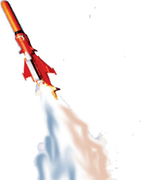 North Korea considers missile strike on Guam after Trump’s ‘fire and fury’ warning, Maureen N. Maratita and Philip Wen, GUAM/DANDONG, China (Reuters) 8 Aug 17,- North Korea said on Wednesday it is considering plans for a missile strike on the U.S. Pacific territory of Guam, just hours after President Donald Trump told the North that any threat to the United States would be met with “fire and fury”.
The sharp increase in tensions rattled financial markets and prompted warnings from U.S. officials and analysts not to engage in rhetorical slanging matches with North Korea.
Pyongyang said it was “carefully examining” a plan to strike Guam, which is home to about 163,000 people and a U.S. military base that includes a submarine squadron, an airbase and a Coast Guard group.
A Korean People’s Army spokesman said in a statement carried by state-run KCNA news agency the plan would be put into practice at any moment GUAM/DANDONG, China (Reuters) – North Korea said on Wednesday it is considering plans for a missile strike on the U.S. Pacific territory of Guam, just hours after President Donald Trump told the North that any threat to the United States would be met with “fire and fury”.
The sharp increase in tensions rattled financial markets and prompted warnings from U.S. officials and analysts not to engage in rhetorical slanging matches with North Korea.
Pyongyang said it was “carefully examining” a plan to strike Guam, which is home to about 163,000 people and a U.S. military base that includes a submarine squadron, an airbase and a Coast Guard group.
A Korean People’s Army spokesman said in a statement carried by state-run KCNA news agency the plan would be put into practice at any moment ….. GUAM/DANDONG, China (Reuters) – North Korea said on Wednesday it is considering plans for a missile strike on the U.S. Pacific territory of Guam, just hours after President Donald Trump told the North that any threat to the United States would be met with “fire and fury”.
The sharp increase in tensions rattled financial markets and prompted warnings from U.S. officials and analysts not to engage in rhetorical slanging matches with North Korea.
Pyongyang said it was “carefully examining” a plan to strike Guam, which is home to about 163,000 people and a U.S. military base that includes a submarine squadron, an airbase and a Coast Guard group.
A Korean People’s Army spokesman said in a statement carried by state-run KCNA news agency the plan would be put into practice at any moment once leader Kim Jong Un makes a decision……http://www.reuters.com/article/us-northkorea-missiles-china-idUSKBN1AO011
Donald Trump threatens north Korea with ‘fire and fury’
Trump warns North Korea of ‘fire and fury’, http://www.theaustralian.com.au/in-depth/us-politics/donald-trump-threatens-fire-and-fury-against-north-korea/news-story/75274296325581df29207164d5c20eb3, CAMERON STEWART, WASHINGTON, The Australian August 9, 2017
Donald Trump has threatened to hit North Korea with ‘fire and fury like the world has never seen’ if it escalates its nuclear threat against the United States.
His strong words came after the revelation that North Korea has successfully miniaturised a nuclear warhead, removing the last major obstacle to Kim Jong-un’s regime launching a nuclear attack on the United States or Australia.
It was met by a furious response from the president. “(They) best not make any more threats,” he said. “They will be met with fire and fury like the world has never seen.”
The frightening new assessment by US intelligence is a game-changer for the west, catapulting the rogue regime into the status of a genuine nuclear weapons state.
“The IC [intelligence community] assesses North Korea has produced nuclear weapons for ballistic missile delivery, to include delivery by ICBM-class missiles,” says a confidential US intelligence assessment by the Defence Intelligence Agency reported by the Washington Post.
A separate US intelligence assessment also estimates that North Korea now has as many as 60 nuclear weapons, up the three times the number of previous estimates.
The conclusions are startling because they shows North Korea had developed all aspects of its nuclear and missile capability much faster than previously thought.
The regime successfully tested its first long range ICBM last month, bringing some of continental US and parts of Northern Australia into its missile range.
But the west was still sceptical that North Korea had advanced its technology to be able to miniaturise its nuclear weapons to place them on the ICBM and deliver them to a distant target.
The alarming new assessments come as North Korea threatened ‘thousands-fold revenge’ against the US over its role in obtained UN Security Council agreement for sweeping new sanctions against North Korea.
Donald Trump’s national security adviser HR McMaster said at the weekend that a North Korea with nuclear-tipped ICBMs would be ‘intolerable from the president’s perspective.”
Hiroshima’s mayor urges that Japan join the UN nuclear weapons ban: PM Abe toes the USA line on keeping nuclear weapons
 Hiroshima anniversary highlights contrasting nuclear views, TODAY, AUGUST 7, 2017, TOKYO — Japan yesterday marked 72 years since the nuclear bombing of Hiroshima, with the nation’s traditional contradictions over atomic weapons again coming into focus.
The anniversary came after Japan sided last month with nuclear powers Britain, France and the United States to dismiss a United Nations treaty banning atomic weapons, which was rejected by critics for ignoring the reality of security threats such as North Korea. Japan is the only country to have suffered atomic attacks, in 1945.
This hell is not a thing of the past,” said Hiroshima Mayor Kazumi Matsui in his peace declaration at yesterday’s ceremony.
“As long as nuclear weapons exist and policymakers threaten their use, their horror could leap into our present at any moment. You could find yourself suffering their cruelty.
“Today, a single bomb can cause even greater damage than the bombs dropped 72 years ago.
“Humankind must never commit such an act,’’ he added, urging nuclear states, as well as Japan, to join the UN nuclear weapons ban treaty adopted in July.
Japanese officials have criticised the treaty as deepening a divide between countries with and without nuclear arms.None of the nine countries that possess nuclear weapons took part in the negotiations or voted on the treaty. Japanese officials routinely argue that they abhor nuclear weapons, but the nation’s defence is firmly set under the US nuclear umbrella.
In his message to Hiroshima, UN Secretary-General Antonio Guterres said the presence of some 15,000 nuclear weapons, along with “dangerous rhetoric regarding their use”, has exacerbated the threat they pose……
Many in Japan feel the attacks on Hiroshima and Nagasaki amounted to war crimes and atrocities because they targeted civilians, and also because of the unprecedented destructive nature of the weapons…….http://www.todayonline.com/world/asia/hiroshima-anniversary-highlights-contrasting-nuclear-views
1 This Month
23-25 October – on Zoom – World BEYOND War’s annual global conferenc

To see nuclear-related stories in greater depth and intensity – go to https://nuclearinformation.wordpress.com

Say No to NASA’s Reckless Nuclear Reactor on the Moon
Say No to NASA’s Reckless Nuclear Reactor on the Moon
-
Archives
- October 2026 (160)
- September 2026 (339)
- August 2026 (330)
- July 2026 (355)
- June 2026 (287)
- May 2026 (306)
- April 2026 (356)
- March 2026 (251)
- February 2026 (267)
- January 2026 (308)
- December 2025 (358)
- November 2025 (359)
-
Categories
- 1
- 1 NUCLEAR ISSUES
- business and costs
- climate change
- culture and arts
- ENERGY
- environment
- health
- history
- indigenous issues
- Legal
- marketing of nuclear
- media
- opposition to nuclear
- PERSONAL STORIES
- politics
- politics international
- Religion and ethics
- safety
- secrets,lies and civil liberties
- spinbuster
- technology
- Uranium
- wastes
- weapons and war
- Women
- 2 WORLD
- ACTION
- AFRICA
- Atrocities
- AUSTRALIA
- Christina's notes
- Christina's themes
- culture and arts
- Events
- Fuk 2022
- Fuk 2023
- Fukushima 2017
- Fukushima 2018
- fukushima 2019
- Fukushima 2020
- Fukushima 2021
- general
- global warming
- Humour (God we need it)
- Nuclear
- RARE EARTHS
- Reference
- resources – print
- Resources -audiovicual
- Weekly Newsletter
- World
- World Nuclear
- YouTube
-
RSS
Entries RSS
Comments RSS

