North Korea also has the collective memory of the horror wrought by the US in the three year conflict on a country then with a population of just 9.6 million souls. US General Curtis Lemay in the aftermath stated: “After destroying North Korea’s seventy eight cities and thousands of her villages, and killing countless numbers of her civilians … Over a period of three years or so we killed off – what – twenty percent of the population.”

 North Korea, An Aggressor? A Reality Check http://www.globalresearch.ca/north-korea-an-aggressor-a-reality-check/5605534, By Felicity Arbuthnot, Global Research, August 24, 2017
“ … war in our time is always indiscriminate, a war against innocents, a war against children.”(Howard Zinn, 1922-2010.)
“All war represents a failure of diplomacy.” (Tony Benn, MP. 1925-2014.)
“No country too poor, too small, too far away, not to be threat, a threat to the American way of life.” (William Blum, “Rogue State.”)
The mention of one tiny country appears to strike at the rationality and sanity of those who should know far better. On Sunday, 6th August, for example, The Guardian headed an editorial: “The Guardian view on sanctions: an essential tool.” Clearly the average of five thousands souls a month, the majority children, dying of “embargo related causes” in Iraq, year after grinding year – genocide in the name of the UN – for over a decade has long been forgotten by the broadsheet of the left.
This time of course, the target is North Korea upon whom the United Nations Security Council has voted unanimously to freeze, strangulate and deny essentials, normality, humanity. Diplomacy as ever, not even a consideration. The Guardian, however, incredibly, declared the decimating sanctions: “A rare triumph of diplomacy …” (Guardian 6th August 2017.)
As US Secretary of State, Rex Tillerson, the US’ top “diplomat” and his North Korean counterpart Ri Yong-ho headed for the annual Ministerial meeting of the Association of Southeast Asian Nations (ASEAN) in Manila on 5th August, a State Department spokesperson said of Tillerson:
“The Secretary has no plans to meet the North Korean Foreign Minister in Manila, and I don’t expect to see that happen”
Pathetic. In April, approaching his hundredth day in office, Trump said of North Korea:
“We’d love to solve things diplomatically but it’s very difficult.”
No it is not. Talk, walk in the other’s psychological shoes. Then, there they were at the same venue but the Trump Administration clearly does not alone live in a land of missed opportunities, but of opportunities deliberately buried in landfill miles deep. This in spite of his having said in the same statement:
“There is a chance that we could end up having a major, major conflict with North Korea. Absolutely.”
A bit of perspective: 27th July 2017 marked sixty four years since the armistice agreement that ended the devastating three year Korean war, however there has never been a peace treaty, thus technically the Korean war has never ended. Given that and American’s penchant for wiping out countries with small populations which pose them no threat (think most recently, Afghanistan, Iraq, Libya) no wonder North Korea wishes to look as if it has some heavy protective gear behind the front door, so to speak.
Tiny North Korea has a population of just 25.37 million and landmass of 120,540 km² (square kilometres.) The US has a population of 323.1 million and a landmass of 9.834 MILLION km² (square kilometres.) Further, since 1945, the US is believed to have produced some 70,000 nuclear weapons – though now down to a “mere” near 7,000 – but North Korea is a threat?
America has fifteen military bases in South Korea – down from a staggering fifty four – bristling with every kind of weapons of mass destruction. Two bases are right on the North Korean border and another nearly as close. See full details of each, with map at (1.)
North Korea also has the collective memory of the horror wrought by the US in the three year conflict on a country then with a population of just 9.6 million souls. US General Curtis Lemay in the aftermath stated: “After destroying North Korea’s seventy eight cities and thousands of her villages, and killing countless numbers of her civilians … Over a period of three years or so we killed off – what – twenty percent of the population.”
“It is now believed that the population north of the imposed 38th Parallel lost nearly a third its population of 8 – 9 million people during the 37-month long ‘hot’ war, 1950 – 1953, perhaps an unprecedented percentage of mortality suffered by one nation due to the belligerence of another.” (2)
In context:
“During The Second World War the United Kingdom lost 0.94% of its population, France lost 1.35%, China lost 1.89% and the US lost 0.32%. During the Korean war, North Korea lost close to 30 % of its population.” (Emphasis added.)
“We went over there and fought the war and eventually burned down every town in North Korea anyway, some way or another …”, boasted Lemay.
Gen. Douglas MacArthur said during a Congressional hearing in 1951 that he had never seen such devastation.
“I shrink with horror that I cannot express in words … at this continuous slaughter of men in Korea,” MacArthur said. “I have seen, I guess, as much blood and disaster as any living man, and it just curdled my stomach, the last time I was there.” (CNN, 28th July 2017.)
Horrified as he was, he did not mention the incinerated women, children, infants in the same breath.
Moreover, as Robert M. Neer wrote in “Napalm, an American Biography”:
‘“Practically every U.S. fighter plane that has flown into Korean air carried at least two napalm bombs,” Chemical Officer Townsend wrote in January 1951. About 21,000 gallons of napalm hit Korea every day in 1950. As combat intensified after China’s intervention, that number more than tripled (…) a total of 32,357 tons of napalm fell on Korea, about double that dropped on Japan in 1945. Not only did the allies drop more bombs on Korea than in the Pacific theater during World War II – 635,000 tons, versus 503,000 tons – more of what fell was napalm …’
In the North Korean capitol, Pyongyang, just two buildings were reported as still standing.
In the unending history of US warmongering, North Korea is surely the smallest population they had ever attacked until their assault on tiny Grenada in October 1983, population then just 91,000 (compulsory silly name: “Operation Urgent Fury.)
North Korea has been taunted by the US since it lay in ruins after the armistice sixty five years ago, yet as ever, the US Administration paints the vast, self appointed “leader of the free world” as the victim.
As Fort-Russ pointed out succinctly (7th August 2017):
“The Korean Peninsula is in a state of crisis not only due to constant US threats towards North Korea, but also due to various provocative actions, such as Washington conducting joint military exercises with Seoul amid tensions, and which Pyongyang considered a threat to its national security.”
This month “massive land, sea and air exercises” involving “tens of thousands of troops” from the US and South Korea began on 21st of August and continue until 31st.
‘In the past, the practices are believed to have included “decapitation strikes” – trial operations for an attempt to kill Kim Jong-un and his top Generals …’, according to the Guardian (11th August 2017.)
The obligatory stupid name chosen for this dangerous, belligerent, money burning, sabre rattling nonsense is Ulchi-Freedom Guardian. It is an annual occurrence since first initiated back in 1976.
US B-1B bombers flying from Guam recently carried out exercises in South Korea and “practiced attack capabilities by releasing inert weapons at the Pilsung Range.” In a further provocative (and illegal) move, US bombers were again reported to overfly North Korea, another of many such bullying, threatening actions, reportedly eleven just since May this year.
Yet in spite of all, North Korea is the “aggressor.”
“The nuclear warheads of United States of America are stored in some twenty one locations, which include thirteen U.S. states and five European countries … some are on board U.S. submarines. There are some “zombie” nuclear warheads as well, and they are kept in reserve, and as many as 3,000 of these are still awaiting their dismantlement. (The US) also extends its “nuclear umbrella” to such other countries as South Korea, Japan, and Australia.” (worldatlas.com)
Russian Foreign Minister Sergey Lavrov who also attended the ASEAN meeting in Manila, did of course, do what proper diplomats do and talked with his North Korean counterpart Ri Yong-ho. Minister Lavrov’s opinion was summed up by a Fort Russ News observer as:
“The Korean Peninsula is in a state of crisis not only due to constant US threats towards North Korea, but also due to various provocative actions, such as Washington conducting joint military exercises with Seoul amid tensions, and which Pyongyang considered a threat to its national security.”
The “provocative actions” also include the threatening over-flights by US ‘planes flying from Guam. However when North Korea said if this continued they would consider firing missiles in to the ocean near Guam – not as was reported by some hystericals as threatening to bomb Guam – Agent Orange who occasionally pops in to the White House between golf rounds and eating chocolate cake whilst muddling up which country he has dropped fifty nine Tomahawk Cruise missiles on, responded that tiny North Korea will again be: “… met with fire and fury and frankly power, the likes of which the world has never seen before.”
It was barely noticed that North Korea qualified the threat of a shot across the bows by stating pretty reasonably:
(The US) “should immediately stop its reckless military provocation against the State of the DPRK so that the latter would not be forced to make an unavoidable military choice.” (3)
As Cheryl Rofer (see 3) continued, instead of endless threats, US diplomacy could have many routes:
“We could have sent a message to North Korea via the recent Canadian visit to free one of their citizens. We could send a message through the Swedish embassy to North Korea, which often represents US interests. We could arrange some diplomatic action on which China might take the lead. There are many possibilities, any of which might show North Korea that we are willing to back off from practices that scare them if they will consider backing off on some of their actions. That would not include their nuclear program explicitly at this time, but it would leave the way open for later.”
There are in fact, twenty four diplomatic missions in all, in North Korea through which the US could request to communicate – or Trump could even behave like a grown up and pick up the telephone.
Siegfried Hecker is the last known American official to inspect North Korea’s nuclear facilities. He says that treating Kim Jong-un as though he is on the verge of attacking the U.S. is both inaccurate and dangerous.
“Some like to depict Kim as being crazy – a madman – and that makes the public believe that the guy is undeterrable. He’s not crazy and he’s not suicidal. And he’s not even unpredictable. The real threat is we’re going to stumble into a nuclear war on the Korean Peninsula.” (5)
Trump made his crass “fire and fury” threat on the eve of the sixty second commemoration of the US nuclear attack on Nagasaki, the nauseating irony seemingly un-noticed by him.
Will some adults pitch up on Capitol Hill before it is too late?
Notes
- https://militarybases.com/ south-korea/
- http://www.globalresearch.ca/ know-the-facts-north-korea- lost-close-to-30-of-its- population-as-a-result-of-us- bombings-in-the-1950s/22131
- https://nucleardiner. wordpress.com/2017/08/11/ north-korea-reaches-out/
- https://www.commondreams.org/ news/2017/08/08/sane-voices- urge-diplomacy-after-lunatic- trump-threatens-fire-and-fury
August 25, 2017
Posted by Christina Macpherson |
North Korea, politics international, Reference, weapons and war |
Leave a comment
 American experts say that US nuclear might depends crucially on the
civilian use of atomic energy, and believe the country will lose its place
as the world’s nuclear superpower if it does not support its nuclear
industry. The link between the civil nuclear industry and the military’s
ability to maintain its nuclear weapons capability is spelt out in a report
by experts close to the Pentagon.
It states openly that tritium, an essential component of nuclear weapons, is manufactured in civilian
reactors for military use. It also says that civilian reactors are needed
to produce highly enriched uranium.
The Washington-based Energy Futures Initiative report, says that Russia and China, which are both building
civil nuclear stations outside their national borders, will overtake
America both in influence and ability to deliver a nuclear threat unless
steps are taken to prop up the civil nuclear programme at home.
This is the first time that the dependence of nuclear weapons states on their civil
nuclear programmes has been so clearly spelt out.
Governments, particularly the United Kingdom’s, have repeatedly claimed there is no connection
between the civil and military nuclear industries, but this report makes
clear that is not the case. “With renewable costs tumbling and the
international nuclear industry in growing crisis, it is becoming ever more
difficult to carry on concealing this key underlying military reason for
attachment to civil nuclear power” http://climatenewsnetwork.net/us-nuclear-might-rests-on-civil-reactors/
August 25, 2017
Posted by Christina Macpherson |
USA, weapons and war |
Leave a comment
 Lockheed, Raytheon Win Contracts for New Nuclear Cruise Missile, Bloomberg, By Anthony Capaccio, August 24, 2017
Lockheed Martin Corp. and Raytheon Co. were picked by the U.S. Air Force to begin development of a new nuclear cruise missile for long-range bombers, while Boeing Co. was shut out of the effort to replace its aging weapon that’s in use today.
The initial contracts of about $900 million each are for a 54-month phase to refine designs and prove out technologies for the Long-Range Standoff missile, Captain Emily Grabowski, an Air Force spokeswoman, said in a statement Wednesday.
After that, the Air Force will pick one of the contractors for full production of as many as 1,000 missiles — not all of them topped by nuclear warheads — in an acquisition phase the service values at about $10 billion……
With this week’s awards, the outlines of the Pentagon’s long-range nuclear modernization program are emerging. The Defense Department published in May the first official cost report for the 12-vessel Columbia-class nuclear-missile submarines, estimated as a $127 billion acquisition program.
The Congressional Budget Office is working on its first 30-year look at the cost to develop, acquire and sustain a new nuclear arsenal. While lawmakers and analysts have estimated it’s a $1 trillion program, the Arms Control Association last week projected the potential cost through 2047 at as much as $1.46 trillion.
— With assistance by Nafeesa Syeed https://www.bloomberg.com/news/articles/2017-08-23/lockheed-raytheon-win-contracts-for-new-nuclear-cruise-missile
August 25, 2017
Posted by Christina Macpherson |
business and costs, USA, weapons and war |
Leave a comment
US nuclear arms should be removed from Germany – chancellor candidate, Rt. 23 Aug, 2017 German Social Democrat candidate for chancellor Martin Schulz says he will push for US nuclear weapons to be removed from Germany, calling for an end to the “armament spiral” pushed by US President Donald Trump.
“As German Chancellor… I will champion for the withdrawal of the nuclear weapons stationed in Germany,” the leader of the Social Democrats (SPD) said in Trier, addressing a campaign rally on Tuesday.
About 20 US nuclear warheads are currently stationed at a military base in Buechel, Germany, DPA news agency reported, citing unofficial estimates. The SPD leader also made it clear that, unlike Angela Merkel, he is strongly opposed to President Trump’s demands for NATO members to increase their defense spending.
“Trump wants nuclear armament. We reject it,” Schulz said, adding that his position also applies to the North Korea crisis.
“More than ever, the North Korean conflict signals the need for arms limitation, especially [need for] nuclear disarmament.”….
Schulz says the money would be better used for other purposes, like schools. “It cannot be that Federal Republic of Germany looks without any comment or action at how the armament spiral, which is wanted by Trump, continues to develop.”
In an opinion piece last week, German Foreign Minister and SPD leader Sigmar Gabriel slammed Trump’s calls for NATO members to meet the defense spending target of two percent of GDP, accusing Merkel of following Trump’s “dictate” and essentially “kneeling” to the US leader.
“We must free ourselves from the devilish logic saying that security is to be reached through armament,” Gabriel said…..
Strong opposition to Trump’s armament plans also came from European Commission President Jean-Claude Juncker earlier this year. “I am very much against letting ourselves be pushed into this,”he said……https://www.rt.com/news/400656-schulz-germany-us-nuclear/#.WZ3nUOZRYVQ.facebook
August 25, 2017
Posted by Christina Macpherson |
Germany, politics, weapons and war |
Leave a comment
US-South Korea begin wargames https://uk.news.yahoo.com/us-south-korea-begin-wargames-051130924.html, 23 Aug 17 The United States and South Korea have kicked off their annual military exercise, known as Ulchi Freedom Guardian.
The wargames use computer simulations to prepare for conflict with nuclear-capable North Korea.
Troops from seven allied nations, including Britain, Canada and Australia, are also taking part.
South Korean President Moon Jae-in denied Pyongyang’s accusation that the drills are a rehearsal for an invasion.
“This year’s Ulchi exercise is to check the defensive postures of our civilians, government and military to secure the lives and safety of our people”, Moon said at a cabinet meeting. “It is an annual exercise of a defensive nature, and there is no intention of heightening military tensions on the Korean Peninsula”.
Peace activists in Seoul protested the decision to go ahead with the drill, concerned it could trigger retaliation by North Korea. Pyongyang last week appeared to back down from a threat to launch a missile strike on the US territory of Guam.
China has also urged Washington to scrap the ten-day-long exercise.
August 23, 2017
Posted by Christina Macpherson |
South Korea, USA, weapons and war |
Leave a comment
US refuses to pause drills despite North’s vow of ‘merciless retaliation’ http://www.todayonline.com/world/asia/us-refuses-pause-drills-despite-norths-vow-merciless-retaliation AUGUST 23, 2017, SEOUL — As North Korea vowed “merciless retaliation” against United States-South Korean military drills it claims are an invasion rehearsal, senior US military commanders yesterday dismissed calls to pause or downsize the exercises they said were crucial to countering a clear threat from Pyongyang.
The heated North Korean rhetoric, along with occasional weapons tests, is standard fare during the spring and summer war games by allies Seoul and Washington.
USA persists with But uneasy ties between the Koreas are worse than normal this year following weeks of tit-for-tat threats between US President Donald Trump and Pyongyang in the wake of the North’s two intercontinental ballistic missile tests last month.
There have been calls in both the US and South Korea to postpone or modify the drills in an attempt to ease hostility on the Korean peninsula following North Korea’s threat to fire missiles toward the US territory of Guam.
But a visiting group of senior US military commanders, including Admiral Harry Harris, the commander of US forces in the Pacific, said the drills are critical for the allies to maintain readiness against an aggressive North Korea.
“A strong diplomatic effort backed by a strong military effort is key because credible combat power should be in support of diplomacy and not the other way around,” Adm Harris said during a news conference at South Korea’s Osan Air Base.
General Vincent Brooks, commander of US Forces Korea, said the allies should continue the war games until they “have reason not to”. He added: “That reason has not yet emerged.”
The North Korean military said in a statement that it will launch an unspecified “merciless retaliation and unsparing punishment” on the US over the Ulchi Freedom Guardian drills that began on Monday for an 11-day run.
Despite the threat, an unprovoked direct attack is unlikely because the US vastly outguns Pyongyang, which values the continuation of its dictatorship above all else. The impoverished North hates the drills in part because they force it to respond with expensive military measures of its own.
The North Korean statement accused the US of deploying unspecified “lethal” weapons for the drills that it says involve a “beheading operation” training aimed at removing absolute ruler Kim Jong-un.
“No one can vouch that these huge forces concentrated in South Korea will not go over to an actual war action now that the military tensions have reached an extreme pitch in the Korean Peninsula,” the statement said.
“Moreover, high-ranking bosses of the US imperialist aggressor forces flew into South Korea to hold a war confab. Such huddle is increasing the gravity of the situation.” Adm Harris said yesterday it was more important to use diplomacy to counter North Korea’s missile threat rather than consider what actions by the reclusive nation might trigger a preemptive strike. “So we hope and we work for diplomatic solutions to the challenge presented by Kim Jong-un,” Adm Harris said.
When asked what actions by North Korea might trigger a preemptive US strike against Pyongyang, he added: “As far as a timeline, it would be crazy for me to share with you those tripwires in advance. If we did that, it would hardly be a military strategy.”
The Ulchi drills are largely computer-simulated war games held every summer, and this year’s exercise involves 17,500 American troops and 50,000 South Korean soldiers.
No field training like live-fire exercises or tank manoeuvring is involved in the Ulchi drills, in which alliance officers sit at computers to practise how they would engage in battles and hone their decision-making capabilities. The allies have said the drills are defensive in nature. AGENCIES
August 23, 2017
Posted by Christina Macpherson |
South Korea, USA, weapons and war |
Leave a comment
 David Lowry’s Blog 16th Aug 2017, Bennett Ramberg, now a professor at the University of California at Los Angeles (U.C.L.A.) – and formerly a senior official at the State Department’s Bureau of Politico-Military Affairs under the first Bush
administration – has written extensively that, even if the U.S. were to destroy North Korea’s military nuclear infrastructure, Kim Jong-un has thousands of conventional missiles, many aimed at South Korea’s national infrastructure, including its 23 nuclear reactors at four sites ( with another under construction at Yeongdeok.)
Any such attack would inevitably destroy the containment for the irradiated (spent) nuclear fuel storage ponds adjoining each reactor complex, distributing uncontrolled radiation across the densely populated peninsula, and, almost certainly near –neighbor Japan too.
South Korea’s new President Moon Jae-in has recognised the risk of his nation having nuclear power plants and has
pledged to pull out of the nuclear business, asserting in a speech in June “We will abolish our nuclear-centred energy policy and move towards a nuclear-free era.” http://drdavidlowry.blogspot.co.uk/2017/08/korean-crisis-conventional-threat-to.html
August 21, 2017
Posted by Christina Macpherson |
North Korea, weapons and war |
1 Comment

 North Korea Warns US-South Korea War Games Driving Toward ‘Uncontrollable Nuclear War‘ https://www.commondreams.org/news/2017/08/20/north-korea-warns-us-south-korea-war-games-driving-toward-uncontrollable-nuclear-war The North called the planned joint military exercises “reckless” and said the U.S. is “lost in a fantasy”, by Jake Johnson, staff writer
With the United States and South Korea set to begin joint military exercises on Monday—and as Trump administration officials attempt to de-escalate tensions after the president threatened to bring “fire and fury” upon North Korea—the regime of Kim Jong-un published an editorial in a state-run newspaper on Sunday calling the planned war games “reckless behavior” that is “driving the situation into the uncontrollable phase of a nuclear war.” The editorial added that the military exercises amount to “pouring gasoline on fire,” and warned that the U.S. would not be able to “dodge the merciless strike” the regime claims it is prepared to launch.
“The Korean People’s Army is keeping a high alert, fully ready to contain the enemies,” the editorial continued. “It will take resolute steps the moment even a slight sign of the preventive war is spotted.”
“If the U.S. is lost in a fantasy that war on the peninsula is at somebody else’s doorstep far away from them across the Pacific, it is far more mistaken than ever,” the editorial concluded.
The U.S.-South Korea military exercises are set to last for ten days, and they will consist of 17,500 American troops and 50,000 South Korean troops. As the Associated Press noted, the drills “hold more potential to provoke than ever,” and some are calling on the U.S. and South Korea “to postpone or drastically modify drills to ease the hostility on the Korean Peninsula.
Tensions between the U.S. and North Korea have been running high of late as the North continues to develop its nuclear capacities and as U.S. President Donald Trump continues to ratchet up tensions by responding erratically. Trump recently suggested that his “fire and fury” remarks were not “tough enough.”
As a result, a growing number of lawmakers are calling for Trump to be stripped of the “nuclear football.” “No U.S. President, certainly not Trump, should have sole authority to initiate an unprovoked nuclear war,” argued Sen. Ed Markey (D-Mass.).
According to a recent CBS News poll, nearly 60 percent of Americans are “uneasy” about Trump’s ability to deal reasonably with North Korea, and the same percentage believes that the U.S. should not be threatening Pyongyang with military action.
As Common Dreams has reported, activists and analysts have issued urgent calls for diplomacy in recent weeks as tensions continue to intensify. The failure to pursue diplomatic avenues could result in a “nuclear nightmare,” some have warned.
“Time has proven that coercion doesn’t work,” CODEPINK co-founder Medea Benjamin recently wrote. “There’s an urgent need to hit the reset button on U.S.-Korean policy.”
August 21, 2017
Posted by Christina Macpherson |
North Korea, politics international, South Korea, USA, weapons and war |
Leave a comment
Herald 20th Aug 2017, COUNCIL leaders are backing a call by Hiroshima and Nagasaki, the two
Japanese cities devastated by US atomic bombs 72 years ago, to accelerate
international moves for a nuclear ban.
They are calling for the UK and other nations to renew their nuclear disarmament efforts in a bid to defuse
growing fears of nuclear war in the wake of destabilising tensions between
North Korea and the Trump administration. A conference of ‘Mayors for
Peace’ in Nagasaki earlier this month passed a resolution urging
countries to ratify a new United Nations (UN) treaty prohibiting nuclear
weapons as soon as possible.
The treaty has been agreed by 122 countries
but opposed by nuclear weapons states, including the UK.
http://www.heraldscotland.com/news/15483955.Council_leaders_call_to_accelerate_international_moves_for_a_nuclear_ban/
August 21, 2017
Posted by Christina Macpherson |
UK, weapons and war |
Leave a comment
Time for nuclear balancing act?, Korea HeraldBy Yeo Jun-suk, 20 Aug 17 Calls grow in Seoul to deploy tactical atomic weapons to counter NK nuclear threats, Aug 20, 2017 Despite under a constant threat of war from the communist North Korea, South Korea has remained a nuclear weapons-free zone since 1991. But with Pyongyang nearing the finish line in its atomic weapons program, politicians and security experts in Seoul are calling for “a balancing act” to adapt to the new security environment on the Korean Peninsula: A North Korean nuclear weapon can only be deterred by a nuclear weapon — by either South Korea’s own or the US, they said.
“We can’t fight against the North with bare hands,” said Rep. Jeong Yong-ki, a spokesman for the main opposition Liberty Party Korea. “It’s time for us to be in a tit-for-tat over North Korea’s nuclear weapons.”
The conservative party, who favors hardline approaches toward the North, adopted as its party platform last week a call for redeploying US tactical nuclear weapons that were withdrawn from the peninsula in 1991.The minor conservative Bareun Party, while also advocating nuclear deterrence, floated an idea of US “sharing” its nuclear weapons with South Korea.
As opposed to the Liberty Party’s proposal of bringing US nuclear weapons back here, the idea calls for the US granting South Korea a right to use US nuclear assets operating outside the peninsula, such as nuclear-powered submarines or fighter jets carrying nuclear bombs, when the need arises.
“Our idea allows us to have nuclear deterrence without deploying nukes here,” while avoiding possible backlashes from neighboring countries, said Rep. Ha Tae-kyung of Bareun Party.
The need for a nuclear deterrent was echoed even from a former security advisor to President Moon Jae-in, a liberal favoring re-engagement with the North and nuclear disarmament of both Koreas. …….http://www.koreaherald.com/view.php?ud=20170820000215
August 21, 2017
Posted by Christina Macpherson |
politics, South Korea, weapons and war |
Leave a comment
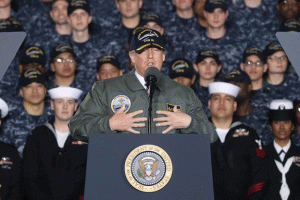 President Trump’s Top Defense and Diplomatic Chiefs Insist There’s a Military Option for North Korea, Time, Matthew Pennington / AP, Aug 17, 2017 (WASHINGTON) — America’s diplomatic and defense chiefs sought Thursday to reinforce the threat of possible U.S. military action against North Korea after President Donald Trump’s top strategist essentially called the commander-in-chief’s warnings a bluff.
Secretary of State Rex Tillerson stressed after security talks with close ally Japan that the U.S. seeks a peaceful solution to the standoff over North Korea’s nuclear weapons program. But he said a U.S.-led campaign of economic pressure and diplomacy needs to be backed by potential military consequences.
Washington is “prepared militarily” to respond, if necessary, he said…..
North Korea’s missile launches “must stop immediately,” Tillerson said. Given the magnitude of the threat posed by the North’s weapons development, he said any diplomatic effort “has to be backed by a strong military consequence if North Korea chooses wrongly.”
“That is the message the president has wanted to send to the leadership of North Korea,” Tillerson said, “to remind the regime of what the consequences for them would be if they chose to carry out those threats.”
Trump last week pledged to answer North Korean aggression with “fire and fury.” He later tweeted that a military solution was “locked and loaded,” after leader Kim Jong Un was said to be considering a provocative launch of missiles into waters near Guam…..
Tensions have since eased somewhat since North Korea said Kim doesn’t immediately plan to fire the missiles. But fears of conflict remain as the U.S. and South Korea next week begin military drills that the North views as preparation for invasion, and as Washington seeks to stop the North’s progress toward having a nuclear-tipped missile that could strike the continental United States……http://time.com/4905989/donald-trump-steve-bannon-rex-tillerson-north-korea/
August 19, 2017
Posted by Christina Macpherson |
USA, weapons and war |
1 Comment
The potential conflict between nuclear powers that Trump barely acknowledges, https://www.washingtonpost.com/news/worldviews/wp/2017/08/18/the-potential-conflict-between-nuclear-powers-that-trump-barely-acknowledges/?utm_term=.bdf29c5159e7 By Adam Taylor August 18, The two most populous countries in the world are dangerously close to armed conflict. Both are fast-growing and ambitious nations with something to prove — and they have nuclear weapons. Yet you’ll find surprisingly little discussion of the issue in Washington, where President Trump’s ongoing controversies and the threat of terrorist attacks (more on the horrific attack in Barcelona later in the newsletter) continue to dominate the discussion.The military standoff between India and China over a remote plateau in the Himalayas has been going on for months now. This week, The Post’s Annie Gowen and Simon Denyer took a look at the complicated dispute, which was sparked by China’s move to build a road in territory claimed by Bhutan, a close ally of India that does not have formal diplomatic relations with Beijing.
Territorial disputes between in the area are far from new — India and China briefly went to war over contest territory in 1962. And much of the present dispute dates back to an 1890 border agreement made between British India and China’s Qing Dynasty, one of a number of lingering problems caused by colonial cartographers.
But experts say the current standoff is the worst in decades and has taken on a different tone than previous flare-ups. “It would be very complacent to rule out escalation,” Shashank Joshi, an analyst with the Royal United Services Institute in London, told The Post. “It’s the most serious crisis in India-China relations for 30 years.”
Both India and China are speaking openly and seriously of armed conflict, with Beijing’s state media striking a indigent and at times uncharacteristically vulgar tone. An English-language video posted by the Xinhua news agency Wednesday accused India of “trampling international law” and “inventing various excuses to whitewash its illegal moves” — before showing a Chinese actor in a Sikh turban who spoke in an insulting Indian accent.
If India and China were to go to war, it would be no small matter. Over 2.6 billion people live in the two nations. Between them, they are estimated to have 380 nuclear weapons (though both China and India subscribe to a “no first use” policy, which should — hopefully — mean they wouldn’t be used in such any conflict).
In a briefing last month, the U.S. State Department urged restraint. During a press briefing last week, spokeswoman Heather Nauert said, “It’s a situation that we have certainly followed closely. And as you know, we have relationships with both governments. We continue to encourage both parties to sit down and have conversations about that.”
The dispute centers not only on the territory in question — an obscure, 34-square-mile area known as the Dolam Plateau that is claimed by both Bhutan and China — but a narrow strip of strategically important Indian land called the Siliguri Corridor. This tract, unaffectionately nicknamed the “chicken’s neck,” connects the bulk of the India with its remote east. Delhi has long feared Chinese troops could cut across the corridor if war broke out, effectively cutting the country in half. It’s not an unreasonable fear, given that the region is just 14 miles wide at its thinnest point; Ankit Panda of the Diplomat once dubbed it a “terrifyingly vulnerable artery in India’s geography.”
It is widely assumed that Washington would side with India in the dispute. Trump is a frequent critic of China, and some in his administration have pushed for tough responses to other territorial claims made by Beijing, such as the ongoing disputes in the South China Sea. Trump called Indian Prime Minister Narendra Modi on India’s Independence Day this week, which some media outlets interpreted as a gesture of support for New Delhi.
And yet, there is a nagging sense among some in India that Trump won’t have Modi’s back if push comes to shove. “If ever there was a war with China, America would never come to our rescue,” one government official told Indian journalist Barkha Dutt recently, according to a story Dutt wrote for The Post’s Global Opinion section.
Washington also may be diplomatically limited in the region: A number of key State Department positions that would have responsibility for handling an India-China crisis remain unfilled. Another part of the problem is simply the complexity of the issue, which could prove hard to communicate to a leader with seemingly limited knowledge of the world and a notoriously short attention span.
There is also an argument that perhaps Trump should keep his nose out of this. The Post’s Jackson Diehl wrote he didn’t find much enthusiasm for U.S. involvement in the dispute while in Delhi last week. The U.S. president has gained a reputation there for being hotheaded and impulsive — even the drawdown in tensions with North Korea seems to have happened in spite of his involvement, not because of it.
August 19, 2017
Posted by Christina Macpherson |
China, India, politics international, weapons and war |
Leave a comment
 Americans are afraid of war with North Korea — and of how Trump could handle it, New polls show Americans are divided on how to handle the North Korea threat , Vox, by Ella Nilsen Aug 11, 2017,
“…….New polls show a majority of Americans are afraid the US is about to wade into a war with North Korea, but are split on whether America should take military action in the face of increased threats from Pyongyang. At the same time, some of the public’s anxiety is about Trump and his off the cuff handling of the situation. Trump’s approval rating has dipped to historic lows, and Republicans and Democrats disagree sharply on whether they think the president is capable of dealing with North Korea…..
in the past month, North Korea has successfully
completed an intercontinental ballistic missile test that could reach the mainland United States, and American intelligence officials say the country is nearing its
goal of being able to fit a nuclear weapon on one of those long-range missiles.
And Trump hasn’t exactly been doing a lot to quell those fears. On Tuesday, Trump appeared to threaten nuclear war, vowing to respond to North Korean threats with “fire and fury like the world has never seen.”
Two days later, the president doubled down, saying of his remarks, “maybe it wasn’t tough enough.” He followed that up with a Friday tweet that the US military solutions were “locked and loaded should North Korea act unwisely.”
As a result, the possibility of war is on a lot of people’s minds.
A new poll from Public Policy Polling released by Axios on Friday morning shows 82 percent of Americans say they are afraid of nuclear war with North Korea. Another poll released by Rasmussen Report on Friday showed 63 percent of voters polled believe the US is now likely to take nuclear action against Kim Jong Un.
Meanwhile, the CBS poll conducted last week revealed 72 percent of Americans were already feeling uneasy about a possible conflict, while another 26 percent said they were confident things would be resolved.
However, the majority of those polled (60 percent), were optimistic the threat from North Korea could still be contained, with another 29 percent saying they believed it required immediate military action……
Another poll conducted by the Chicago Council on Foreign Affairs earlier this month found something similar, with a slim majority of respondents saying they supported military intervention if North Korea attacked South Korea.
The Chicago Council poll is the first time that more than half of Americans voiced support for sending in troops to help South Korea in the event of an attack. However, the same poll found Americans were still reticent to get involved in an armed conflict with North Korea and more likely to support increased sanctions instead.
Amidst the escalation, Americans still don’t have a lot of confidence in their commander in chief.
Just 35 percent of respondents to the CBS poll said they were confident in Trump’s ability to handle the North Korea threat, while 61 percent said they were uneasy. Confidence in Trump’s ability fell largely along party lines, with 76 percent of Republicans saying they were confident, and 31 percent of independents and just 10 percent of Democrats agreeing with them.
Many more people said they were uneasy about Trump, including 87 percent of Democrats, 64 percent of independents, and 22 percent of Republicans……https://www.vox.com/policy-and-politics/2017/8/11/16131016/americans-afraid-war-north-korea
August 19, 2017
Posted by Christina Macpherson |
USA, weapons and war |
Leave a comment
North Korea Could Unleash the Unthinkable: Nuclear War Between Russia and America, National Interest, Dave Majumdar, 18 Aug 17, In the event that North Korea tests another Intercontinental Ballistic Missile (ICBM) or potentially launches an attack on the United States, the Pentagon could try to intercept those missiles with the Ground-Based Midcourse Defense (GMD) system. However, as many analysts have pointed out, the interceptors that miss their target could reenter the Earth’s atmosphere inside Russian airspace. Such an eventuality could prove to be a serious problem unless steps are taken to address the issue now.
“You should also be aware of the concern that those interceptors fired from Alaska that miss or don’t engage an incoming North Korean ICBM(s) will continue on and reenter the Earth’s atmosphere over Russia,” Kingston Reif, director for disarmament and threat reduction policy at the Arms Control Association told The National Interest.
“This carries a nontrivial risk of unintended escalation.”
Jeffrey Lewis, director of the East Asia Nonproliferation Program at the James Martin Center for Nonproliferation Studies at the Middlebury Institute of International Studies at Monterey, told The National Interest that the United States should open a dialogue with Russia on the issue immediately.
“Good god, yes,” Lewis said emphatically.
Olya Oliker, director of the Russia and Eurasia program at the Center for Strategic and International Studies agreed.
“We have time now to consult with Moscow, talk about plans, discuss how notification would work,” Oliker told The National Interest.
“This isn’t the rocket science part of all this.”
Indeed, in a recent op-ed, Lewis argues that an American interceptor launch could accidentally trigger a nuclear exchange if the Russians mistook such a weapon for an incoming ICBM.
“We can’t assume that Russia would realize the launch from Alaska was a missile defense interceptor rather than an ICBM. From Russia, the trajectories might appear quite similar, especially if the radar operator was under a great deal of stress or pressure,” Lewis wrote for The Daily Beast.
“It doesn’t matter how Russia’s early warning system ought to work on paper, the reality of the Russian system in practice has been a lot less impressive.”
Joshua H. Pollack, editor of the The Nonproliferation Review and a senior research associate at the James Martin Center for Nonproliferation Studies, said that the danger is real.
“Whether they actually would enter Russian airspace is probably less important than whether they break the line of sight of Russia’s early-warning radars,” Pollack said…….
Pavel Podvig, an independent analyst based in Geneva who runs the Russian Nuclear Forces research project disagreed with Lewis and Pollack. Podvig noted that the Russian early warning system is in far better shape today than it was during the 1990s. While a GMD launch from Alaska might cause alarm, the Russian philosophy has been to essentially absorb the first initial blows before launching a retaliatory counterstrike.
“The Russian system is built to ‘absorb’ events like this,” Podvig told The National Interest……..
The Russians, however, are not too worried by the prospect of discarded American interceptors landing on their soil. However, Moscow would likely want to be consulted because the interceptors might set off Russia’s ballistic missile early warning system (BMEWS)……..
What is surprising to the Russians is that the United States did not install a self-destruct system on the GMD interceptors to prevent the missiles from landing where they should not……..
the United States should probably consult with Russia about the possibility of intercepting North Korean ICBMs over Moscow’s territory and set up an agreement ahead of time. But even then, during a real intercept attempt, the United States will likely have to count on Russia’s early warning system operating correctly and the Kremlin’s restraint to avoid an unintended nuclear war.
Dave Majumdar is the defense editor for The National Interest. You can follow him on Twitter: @Davemajumdar. http://nationalinterest.org/blog/the-buzz/north-korea-could-unleash-the-unthinkable-nuclear-war-21948
August 19, 2017
Posted by Christina Macpherson |
Russia, USA, weapons and war |
Leave a comment
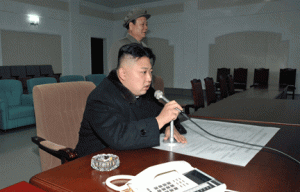 Ex-CIA analyst Bruce Klinger predicts Kim Jong-un will target Guam to defy Trump. Australian Financial Review, by John Kehoe, 13 Aug 17,
 Kim Jong-un will probably defy Donald Trump and soon try to land missiles in waters near the US Pacific island of Guam to show off strength and test the US President’s resolve, according to one of the world’s top North Korean analysts.
Ahead of a trip this week to Australia to speak to government officials about the North Korean nuclear crisis, former senior US Central Intelligence Agency officer for Korea, Bruce Klinger, said President Trump could hasten or delay war in attempting to shoot down any missile around the US military island.
“Given the specificity of what North Korea is saying they are thinking of doing and about the number of seconds the flight would take I would think they will launch the missiles towards Guam,” Mr Klinger said in an interview with The Australian Financial Review.
“I don’t think it’s an attack. It would be a very, very provocative demonstration…….
Mr Klinger, who led the CIA’s Korea branch in 1994 when president Bill Clinton nearly went to war with Pyongyang to stop its nuclear weapons program, said it was debatable whether or not the US or its allies should unleash missile defence systems if a North Korean demonstration missile were targeted just outside US territory………
Mr Klinger will visit Canberra and Sydney and consult with government intelligence and defence officials about the rapidly escalating North Korea nuclear weapon crisis.
He met North Korean officials in Europe earlier this year and recently testified before Congress…….
Unless there was very strong evidence that Mr Kim was about to strike the US, Mr Klinger opposed a preventative US attack and said it could have “catastrophic” consequences for millions of people.
“The President’s trying to demonstrate resolve to our allies and send a signal to North Korea and China,” Mr Klinger said.
“The wording is over the top and distracting.” http://www.afr.com/news/world/asia/excia-analyst-bruce-klinger-predicts-kim-jongun-will-target-guam-to-defy-trump-20170813-gxv3cc
August 18, 2017
Posted by Christina Macpherson |
politics international, weapons and war |
Leave a comment