Western Australia submarine’s base the only reason for AUKUS

Australia’s acquisition of nuclear-powered submarines is not in fact the most important part of the AUKUS deal – they are a distraction … AUKUS’s main game is the base that Australia intends to give to the US at HMAS Stirling in Western Australia
Albert Palazzo , adjunct professor at UNSW Canberra., February 28, 2026, https://www.thesaturdaypaper.com.au/comment/topic/2026/02/28/wa-subs-base-the-only-reason-aukus?utm_campaign=SharedArticle&utm_source=share&utm_medium=link&utm_term=VFZ0rLaV&token=2PZRyQNr
It is tempting to label the AUKUS project an exercise in self-delusion and self-denial. The number of commentators who believe the project’s core promise will actually be honoured – the transfer of Virginia-class nuclear-powered submarines from the United States to Australia – is astonishingly small and mainly limited to politicians and their hangers-on.
Even in the US, the likelihood of the transfer taking place is openly discounted, including by the chief of naval operations, Admiral Daryl Caudle. As if preparing for a let-down, a new report from the Congressional Research Service advances alternatives to the transfer of the promised submarines that will still allow the US to meet its strategic priorities.
In addition, it is hard to square the submarine promise with the reality that is Washington these days. US President Donald Trump’s willingness to pressure America’s allies and turn the US into a rogue superpower is well documented – just ask the Canadians and Danes. We have witnessed in real time his destruction of the global rules-based order as the US withdraws from dozens of international organisations and agreements.
That the US warship-building industry is in poor shape is also no secret. The odds of the nation being able to increase its submarine build rate to the required level for the transfer to go ahead without a loss of US operational capability is virtually nil, according to a December 2025 report from the Washington-based Center for Strategic and International Studies.
One must accept that Australia’s politicians are reasonably intelligent, yet with the myriad well-known problems facing the nuclear-powered submarine transfer it is hard to understand how they can still insist that the project is “full steam ahead”. Nor is this insistence without cost to the taxpayer, as evidenced in the recent promise to spend $30 billion on South Australia’s Osborne shipyard to make it AUKUS ready. How can our politicians sustain their faith in AUKUS and not be rightly labelled as delusional?
The answer to this contradiction lies in recognising what AUKUS is really about – what the parties actually expect to gain from the agreement. Australia’s acquisition of nuclear-powered submarines is not in fact the most important part of the AUKUS deal – they are a distraction. There are too many challenges to Australia’s acquisition, operation and maintenance of these boats for any rational person to believe they will arrive as promised. Hence AUKUS’s main game is the base that Australia intends to give to the US at HMAS Stirling in Western Australia.
This base may be on Australian soil but its primary beneficiary will be the US, just as it is the US that disproportionately gains from the seemingly “joint” military facilities at Pine Gap and North West Cape.
The forthcoming nuclear submarine base is part of a wider American preparation for a possible war between the US and China. From the base, American submarines will be able to operate against China’s southern flank and sever its lines of communication across the Indian Ocean. In addition, the base allows the US to complicate China’s security arrangements by allowing American forces to operate on multiple lines of attack – westwards across the Pacific Ocean and northwards from Australia.
For the US, the defence of Australia is a distant secondary goal for this base. Our politicians are not therefore being delusional; they are being actively deceptive to their voters, since they must know what it is that the US really wants.
Australia is making enormous improvements to Fleet Base West (Stirling). The base is being upgraded so it can sustain and maintain a fleet of foreign nuclear-powered submarines, principally the US Navy’s Virginia-class attack boats, Ohio-class nuclear-armed missile submarines and the occasional British submarine.
The Stirling upgrade is similar in intent to what is happening at RAAF Base Tindal in the Northern Territory, which is being improved to accept US heavy bombers, presumably including nuclear-armed ones.
As a second order effect, the US presence at Stirling will see a significant influx of American sailors, maintenance personnel and administrative staff to the area. So determined is our government to meet its AUKUS responsibilities and make the US submarine base a reality that it plans to build new homes for the 1200 mainly American military personnel and their families who will be calling Australia home.
In the midst of a national housing crisis, and in a region where home prices increased by 15 per cent in a single year, a similar urgent housing build for Australian citizens is apparently not on the cards.
If one examines AUKUS from the perspective of Australia’s longstanding security practice, what appears to be merely senseless starts to reveal a disturbing logic.
Since the end of World War II, Australian governments have gone to great lengths and expense to keep the US interested in our part of the world. Australia needs to get US attention because the south-west Pacific has never been – and still isn’t – an important part of the world in the eyes of our great power leader.
In order to keep our protector onside and interested in our fate, Australia has had to demonstrate repeated and enthusiastic support for American policy. The need to maintain relevance explains why Robert Menzies encouraged the US to fight in Vietnam, why Australia then invited itself to the war, and why this country went to such great lengths to be included in the 2003 invasion of Iraq, as well as other military missions. Of course, getting into such conflicts was easy. Getting out again can be a lot harder. Any early withdrawal risks offending the US, so Australians have fought to the end.
Generating relevance also explains the readiness with which successive governments have accepted the establishment of US military bases on Australian soil. The most important of these are the spy and signals establishment at Pine Gap and the Naval Communication Station Harold E. Holt.
Just how vital these facilities are to America should not be minimised – they are critical for the conduct of US military and CIA operations, as well as the interception of communications by individuals ranging from actual terrorists to ordinary people, including Australians. The submarine base at Stirling will join Pine Gap and Naval Station Holt as a third facility of great operational importance.
AUKUS has a grim rationale when it is seen as the latest initiative in Australia’s longstanding tradition of seeking American attention. What is different in this case is that Australia’s leaders have increased the nation’s exposure to risk in any future war to a potentially existential level.
In the past, our participation in Vietnam, Iraq and Afghanistan did not create any threat to Australia itself. Only those who served were placed in harm’s way. That is no longer the case.
China is a great power and, unlike Vietnam 60 years ago, has power projection capabilities that can hold Australian territory and population centres at real risk. The Australian government has placed a bullseye on Australia’s back and it isn’t clear if our leaders understand this.
Since the US bases are of great military importance, China would likely seek to destroy them in order to protect its own interests. Worse, China could safely employ nuclear weapons against Australia because the US would be unlikely to retaliate against such distant damage and risk the incineration of one of its own cities.
Without any commensurate benefit, the Australian government has embraced AUKUS and accepted the tremendous costs and risks it entails. It has done so with an appalling lack of honesty towards the Australian public, using the submarine promise like a set of shiny keys in front of a baby.
Our leaders must know that the US will not have submarines to spare when the time comes for the transfer. Instead, they employ deception to distract from the real game – a US submarine base and the unstated commitment of Australia to the American side in a war between great powers.
Of course, this need not be the outcome. Despite tradition and reluctance by our political leaders to embrace new ideas, policy can change. An independent defence policy that puts Australian sovereignty first is within reach, and the military technologies to enact it already exist.
The impediment is the Australian government’s inability to accept the reality of the present security situation. Instead, it opts for nostalgia. Australia needs a government that is willing to embrace the necessary changes in perspective and culture that will allow it to consider other security options.
Perhaps one day our politicians can rise to conceiving and implementing a different security policy, rather than falling back on the traditional default response of jumping up and down to get the attention of Washington. One can only hope.
Nuclear Weapons in Australia – Time to End the Secrecy

March 1, 2026, Australians for War Powers Reform (AWPR) , https://warpowersreform.org.au/nuclear-weapons-in-australia-time-to-end-the-secrecy/
Under secretly-concluded arrangements with our allies, Australia is now on track to have US nuclear weapons on Australian soil for lengthy periods, starting very soon.
A new report released today details this dangerous development and exposes how the Australian community is being kept in the dark about it.
The report by civil society group Australians for War Powers Reform (AWPR) examines efforts by the Albanese government to facilitate the increasing presence of nuclear weapons capable aircraft and submarines.
“Many Australians are completely unaware that under current agreements with the US Australian airfields and port facilities will be hosting US aircraft and subs that could be carrying nuclear weapons. And those visits will increase dramatically, possibly in breach of the South Pacific Nuclear Free Zone Treaty,” said AWPR spokesperson Peter Murphy.
“A massive 1.6 billion dollars is currently being spent to upgrade the Tindal RAAF base in the Northern Territory and media reports describe six B-52, long-range, nuclear-capable bombers being “housed” there. But so far there’s been no proper public debate about Australia’s increasing involvement in the US nuclear weapons system.”
The Albanese government currently has a “we don’t ask” policy when it comes to whether US aircraft and ships are carrying nuclear weapons while in Australia. At the same time the US has a “neither confirm nor deny” policy on nuclear weapons. These policies are unwarranted and unacceptable.
“It’s time to end the secrecy on nuclear weapons and let the public have an informed debate. Do we really want these weapons of mass destruction in Australia? Shouldn’t the parliament discuss and vote on these matters?”
Australians have consistently rejected any role for nuclear weapons in our defence policies. A national poll last year revealed that two-thirds of Australians want the government to sign and ratify the UN Treaty on the Prohibition of Nuclear Weapons (TPNW).
“In this new report we are also urging the government to initiate a full independent inquiry into the AUKUS pact, as repeatedly called for by civil society and former prime ministers and foreign ministers. It should include a comprehensive review of Australia’s policies on nuclear weapons,” Peter Murphy said.
The full report “Australia and US Nuclear Weapons: Time to End the Secrecy” is available here
International Physicians for the Prevention of Nuclear War (IPPNW)condemns strikes against Iran, calls for return to negotiations
IPPNW. 28 Feb 2026, https://peaceandhealthblog.com/2026/02/28/ippnw-condemns-strikes-against-iran-calls-for-return-to-negotiations/
International Physicians for the Prevention of Nuclear War (IPPNW) unequivocally condemns the attack on Iran by the United States and Israel and calls on them to cease immediately all further use of force and to return to the negotiating table.
The unprovoked strikes, ostensibly to stop Iran from acquiring nuclear weapons and the ballistic missiles capable of delivering a nuclear warhead, are incredibly dangerous and counterproductive. The conflict threatens the lives of large numbers of civilians in Iran and Israel. Attacking Iranian facilities could cause widespread devastation and significant releases of radioactivity. And the situation could escalate into a regional war and ultimately lead to the use of nuclear weapons — the very thing the world most needs to prevent.
For decades, the US and Israel have rejected multiple opportunities to seek a peaceful resolution to the legitimate concerns that Iran may be developing a nuclear weapons capability to counter Israel’s illegal clandestine possession of nuclear weapons. This has included refusal of multiple attempts by the United Nations and States Parties to the Nuclear Non-Proliferation Treaty (NPT) to negotiate a Middle East Nuclear Weapon Free Zone. During his first term, US President Trump summarily abandoned the Iran Nuclear Deal negotiated in 2015 that had successfully contained Iran’s nuclear program.
Omani Foreign Minister Badr Albusaidi, who had been mediating the current round of negotiations between the U.S. and Iran condemned the attacks saying, “Active and serious negotiations have, once again, been undermined. Neither the interests of the United States nor the cause or world peace are served.”
There is no military solution to the problem of nuclear weapons proliferation anywhere in the world, particularly in the Middle East. The need for regional and international efforts to negotiate a nuclear-weapons-free Middle East have never been more urgent. The only way to prevent the further spread of nuclear weapons – and to ensure that nuclear weapons are never used again – is for all nations to join the UN Treaty on the Prohibition of Nuclear Weapons (TPNW) that will eliminate all existing nuclear weapons and prevent all states from acquiring or reacquiring them in the future.
Exiled Iranian Denounces War: ‘The People Will Suffer, Not Gain!’
by ScheerPost Staff, 28 Feb 26, https://scheerpost.com/2026/02/28/exiled-iranian-denounces-war-the-people-will-suffer-not-gain/
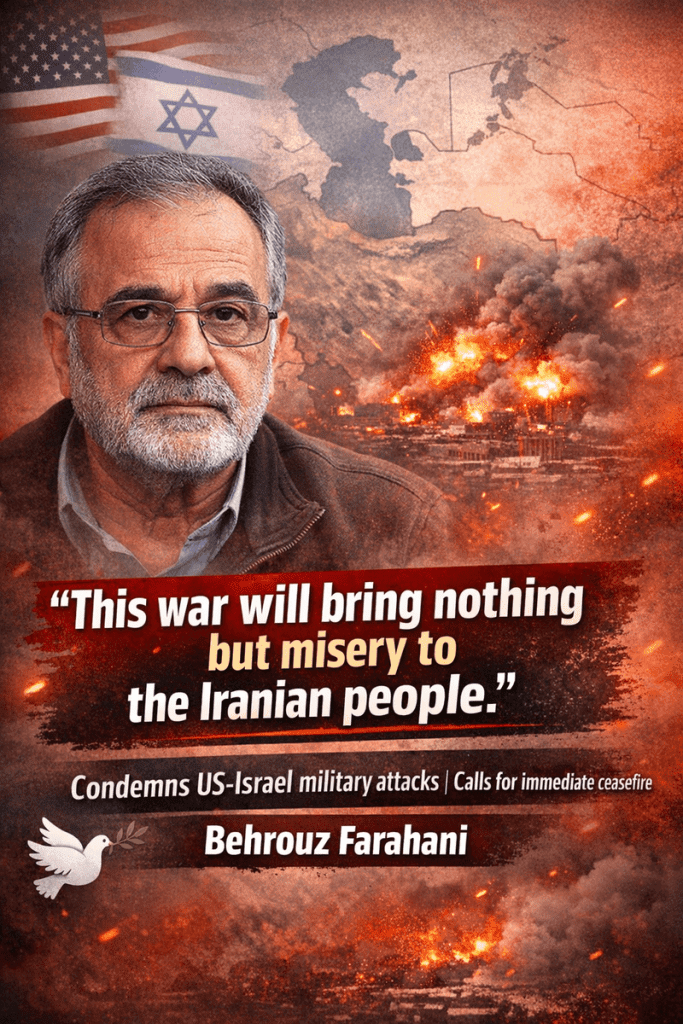
Behrouz Farahani, a political analyst and opponent of the Islamic Republic living in exile, condemned the US and Israeli military attack on Iran. Speaking to Middle East Eye about how Iranian opposition figures who also oppose the war are responding, he said:
“In this situation, we oppose both sides. This war is between an international imperialist power, the US, and its regional ally, Israel, on one side, and the reactionary regime of Iran on the other. We are against both sides and against this war.”
He added that opponents of the Islamic Republic who reject foreign intervention are mobilizing:
“We are calling for an immediate ceasefire and are organising anti‑war protests. This war will bring nothing but misery to the Iranian people. As we have seen before, its only result will be more pressure on ordinary people. This war will not help the Iranian people in their struggle against the Islamic Republic. Especially when one side is Israel and the other side is Trump.”
“When we have a president like Trump, who has openly said that his main concern is money, it is clear that this attack has nothing to do with improving life in Iran or helping its people,” Farahani said. “One of the main reasons for this war is that the Islamic Republic does not serve America’s economic interests in the region or globally.”
He stressed that this critique does not imply any support for Tehran:
“This does not mean that because the Islamic Republic is in conflict with American interests, it is a progressive or anti‑imperialist force. Not at all. Just as the Taliban in Afghanistan was a deeply reactionary force despite being in conflict with the United States, the Islamic Republic is also a reactionary force that has now been attacked by international imperialism and its regional ally.”
Farahani’s comments underscore what many critics argue is the real motive behind the escalation: a broad, opportunistic effort by the United States and Israel to secure regional dominance, energy access, and geopolitical leverage under the guise of confronting Iran.
Trump Advisers Wanted Israel To ‘Attack Iran First’ For Better Optics: Politico
by Tyler Durden, Friday, Feb 27, 2026 , https://www.zerohedge.com/geopolitical/trump-advisers-want-israel-attack-iran-first-better-optics-politico
Politico is out with a crazy story on Thursday, but which will make sense to those following the trajectory of US foreign policy over the past couple decades plus.
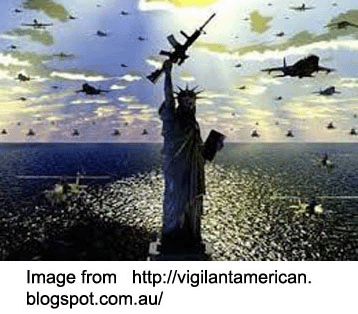
Senior US officials want Israel to strike Iran before Washington launches a renewed assault in order to build domestic backing for war. Advisers to President Donald Trump are “privately arguing that an Israeli attack would trigger Iran to retaliate, helping muster support from American voters for a U.S. strike,” the outlet writes, citing two people familiar with the discussions.
“The calculus is a political one – that more Americans would stomach a war with Iran if the United States or an ally were attacked first,” Politico continues.
The subtext here is that American troops would likely come under retaliation in whatever form such a serious escalation takes. Currently the US is drawing down troops from bases immediately in harm’s way, including reportedly in Qatar and Bahrain.
“There’s thinking in and around the administration that the politics are a lot better if the Israelis go first and alone and the Iranians retaliate against us, and give us more reason to take action,” one person familiar with the discussions said.
The mood in Washington is said to be that nuclear negotiations with Iran appear increasingly unlikely to succeed – despite some ‘positive’ headlines out of Geneva – and that “the primary question is becoming when and how the US attacks.”
The Politico report suggests Tucker Carlson has assessed it exactly right when days ago he complained, “What I really object to, what makes me mad, is when American leaders, whose job it is to represent Americans, are more loyal to a foreign country than they are to their own.”
Indeed the outlet goes so far as to emphasize that “There’s a high likelihood of American casualties. And that comes with lots of political risk” – according to the words of one of the officials interviewed for the story.
Once again the decision-makers are on the brink of throwing American troops under the bus for the sake of another bloody regime change war. They might heed the words of one soldier who over a decade ago expressed that the troops themselves are sick of the pointless ‘forever wars’..
Trump himself of course campaigned on starting no new wars, especially in the Middle East. Ironically he’s been bragging about ending seven conflicts globally, while standing on the brink of provoking and ordering a new large-scale war breaking out across the whole Mideast region.
A War With Iran Would Not Be a One-Off Event But a Disastrous Ongoing Rupture

Both U.S. officials and international partners have voiced concern over the likelihood of a war with Iran. The United Kingdom has reportedly said that the United States would not be allowed to use British airbases, including Diego Garcia and Royal Air Force Fairford, for strikes against Iran, citing concerns that such action would violate international law.
The 1973 War Powers Act grants Congress the authority to check President Trump’s ability and power to enter an armed conflict without legislative approval.
If Congress cedes its power to stop a war with Iran, it will fully erode any lingering promise of democratic restraint.
By Hanieh Jodat , Truthout, February 24, 2026
As the U.S. slowly continues its brokered negotiations with Iran over its nuclear program and ballistic missiles, it is also expanding its military posture across the Middle East — amounting to the biggest military buildup in the region since the 2003 invasion of Iraq.
Indirect talks between Iran and the U.S. took place in Geneva on February 17 with little progress and plenty of details left to discuss. According to U.S. officials, the Islamic Republic offered to come back within two weeks with a proposal which addresses some core issues and gaps in the positions by both parties. Meanwhile, Donald Trump’s actions play a different tune. On February 19, Trump announced he would give Iran 10 to 15 days to reach a deal, otherwise the U.S. claims to be fully prepared to take military action, the consequences of which could lead to a regional catastrophe. The next talks are set to take place on February 26.
Ahead of those talks, Donald Trump has deployed the USS Gerald R. Ford, the world’s largest aircraft carrier, which is set to join the Abraham Lincoln carrier strike group in the Arabian Sea. The United States has also significantly increased air power in the Middle East; according to open-source intelligence analysts and flight-tracking data, over 120 U.S. aircraft have deployed to the region. With each warship it repositions, each military personnel it places on alert, and all of the air power it has amassed in the region, the U.S. sends a message that diplomacy may no longer be on the table.
Both U.S. officials and international partners have voiced concern over the likelihood of a war with Iran. The United Kingdom has reportedly said that the United States would not be allowed to use British airbases, including Diego Garcia and Royal Air Force Fairford, for strikes against Iran, citing concerns that such action would violate international law.
Meanwhile, in Congress, Kentucky Republican Thomas Massie and California Democrat Ro Khanna have joined forces again to push a war powers resolution. The 1973 War Powers Act grants Congress the authority to check President Trump’s ability and power to enter an armed conflict without legislative approval……………………………………………………………………………………………..
A war with Iran will not stop at its borders and will not remain where it is aimed. Such impulsive and reckless military actions never do. The Middle East is an ecosystem of lives, alliances, and fragile balances that will draw in neighboring countries and global powers.
And while the momentum towards a war with Iran accelerates, we must be reminded of the invasion and occupation of Afghanistan in 2001, which accomplished little outside the brutalization of one of the most economically starved countries on earth. Similarly, we must remember the collapse of Iraq’s infrastructure and civil society alongside the imposition of a farcical democracy after the 2003 invasion — a collapse that was fueled in part by years of devastating sanctions that predated the invasion. …………………………………………………………………………………
Rather than a one-off strike or a clean operation, a war with Iran would almost certainly widen conflict in the region and produce consequences far beyond what could be intended or repaired.
This is why the War Powers Resolution exists, not as a symbolic gesture but as a bulwark to slow the rush towards catastrophe. The framers of the Constitution understood what modern politicians seem to ignore: that war is too consequential to be left in the hands of one person, one branch of the government, or an executive order. The power to start a war with another country was placed in the hands of Congress to ensure transparency, force dialogue, and demand accountability…………………………………………………………………………… https://truthout.org/articles/a-war-with-iran-would-not-be-a-one-off-event-but-a-disastrous-ongoing-rupture/?utm_source=Truthout&utm_campaign=3e2745821e-EMAIL_CAMPAIGN_2026_02_24_10_26&utm_medium=email&utm_term=0_bbb541a1db-3e2745821e-650192793
Zelenskyy says he’d accept nuclear weapons from UK, France ‘with pleasure’

TRT World, 28 Feb 26
Ukraine’s president said no such proposals had been made, but added he would consider the offer, after Moscow accused UK and France of seeking to equip Kiev with a nuclear bomb.
Ukrainian President Volodymyr Zelenskyy has said that he has not been offered nuclear weapons by the UK or France, but stressed that he would accept such an offer “with pleasure.”
“With pleasure, but I didn’t have propositions. But with pleasure,” Zelenskyy said in an interview with Sky News, an excerpt of which was shared by Ukrainian media outlets, including the RBC-Ukraine news agency, when asked about Russian claims that Ukraine is “trying to get a nuclear weapon via Britain and France.”
“No, it’s not happening,” Zelenskyy went on to say on Friday, commenting on if such a thing would take place.
Earlier this week, the Russian Foreign Intelligence Service accused the UK and France of actively working to provide Kiev with a nuclear bomb.
It claimed that Britain and France believe that, by possessing nuclear weapons, Ukraine would be able to secure more favourable terms for ending the war, which entered its fifth year on Tuesday……………………….https://www.trtworld.com/article/50ba4f9b6505
Trump Says ‘Heavy and Pinpoint Bombing’ of Iran Will Continue “As Long As Necessary”

February 28, 2026, Scheerpost Staff, https://scheerpost.com/2026/02/28/trump-says-heavy-and-pinpoint-bombing-of-iran-will-continue-as-long-as-necessary/
In rapidly escalating developments reported by Al Jazeera English, US President Donald Trump declared that US bombing operations inside Iran will continue “uninterrupted throughout the week or, as long as necessary.”
The comments came amid conflicting claims over the fate of Iranian Supreme Leader Ayatollah Ali Khamenei. Israeli officials and Trump have alleged that Khamenei was killed in the joint US-Israeli assault, while Iranian authorities have strongly denied the claim, with semi-official media insisting he remains “steadfast” and directing operations.
According to Al Jazeera’s live coverage, Trump wrote on Truth Social that Iran had been “very much destroyed and even, obliterated” in a single day of strikes. He further called on Iran’s Revolutionary Guard (IRGC) and national police forces to join what he described as “Iranian patriots” seeking regime change, suggesting “that process should soon be starting.”
“The heavy and pinpoint bombing,” Trump added, “will continue… as long as necessary to achieve our objective of PEACE THROUGHOUT THE MIDDLE EAST AND, INDEED, THE WORLD!”
Regional Fallout
Al Jazeera reported missile strikes in Tel Aviv following Iranian retaliation, as well as debris falling across Jordan from intercepted projectiles. In the United Arab Emirates, officials confirmed an “incident” at Zayed International Airport resulting in one fatality and multiple injuries, while a drone interception reportedly caused a limited fire at the Burj Al Arab hotel in Dubai.
At the United Nations Security Council, Secretary-General Antonio Guterres warned that the strikes by the US and Israel, along with Iran’s response, pose a “grave threat to international peace and security,” cautioning that military escalation risks igniting uncontrollable consequences in an already volatile region.
Iran’s UN ambassador, Amir-Saeid Iravani, said Tehran considers “all bases, facilities and assets” of US and Israeli forces in the region to be legitimate military targets under its right of self-defense. Meanwhile, Israel’s UN ambassador, Danny Danon, defended the joint operation as a necessary response to what he described as an existential threat.
Escalation and Uncertainty
Trump also told ABC News he has a “very good idea” of who should lead Iran if the current government falls — reinforcing suggestions that regime change may be an underlying objective of the operation.
The US military’s Central Command said there were no reported US casualties and that naval assets remain fully operational.
As Al Jazeera’s live blog continues to update, the situation remains fluid, with conflicting claims, mounting civilian impacts, and warnings from international officials that the widening conflict could destabilize the broader Middle East.
For live updates from Al Jazeera English here
Hegseth Demands Anthropic Let Military Use AI However It Wants—Even for Autonomous Killer Drones and Spying On Americans
Secretary of Defense Pete Hegseth said the company that owns the AI assistant Claude would be punished unless it drops all ethical guidelines.
Stephen Prager, Common Dreams, Feb 25, 2026
Defense Secretary Pete Hegseth has threatened to punish the artificial intelligence company Anthropic if it doesn’t let the Pentagon use its technology however it wants—apparently even to create autonomous killer drones or conduct surveillance of Americans.
Anthropic’s powerful AI model, Claude, is currently the only one permitted to handle classified military data, and the company was awarded a $200 million contract last year to develop AI capabilities for the Department of Defense to use alongside other AI firms.
However, the company’s usage policy prohibits its use for mass surveillance and for the development of autonomous weapons—such as drones that attack targets without a human operator.
These limitations have infuriated the Defense Department leadership. On Tuesday, Hegseth called Anthropic’s CEO, Dario Amodei, to a meeting at the Pentagon, where he demanded “unfettered” access to Claude without any guardrails.
This goal was outlined last month in the department’s “AI Strategy” memo, which called for the US to adopt an “AI-first warfighting force” and for companies to allow their technology to be deployed for “any lawful use,” free from ethical safeguards.
According to a senior defense official who spoke to Axios, Hegseth issued an ultimatum to Amodei on Tuesday: If he does not grant the Pentagon unrestricted use of Anthropic’s technology by 5:01 pm on Friday, the department would take measures to coerce the company.
It would either declare Anthropic a “supply chain risk,” effectively blacklisting it for military use and ending its contract, or it would invoke the Defense Production Act, which would force the company to tailor the product to the military’s needs.
While it would not be an unusual step for the Pentagon to cut ties with Anthropic, threats to declare it a supply chain risk have been described as extraordinary…………………………………………………………………
Last month, Amodei published an essay about how “AI-enabled autocracies” could use the technology to surveil and repress their citizens and wage war on less developed countries:
A swarm of millions or billions of fully automated armed drones, locally controlled by powerful AI and strategically coordinated across the world by an even more powerful AI, could be an unbeatable army, capable of both defeating any military in the world and suppressing dissent within a country by following around every citizen…
A powerful AI looking across billions of conversations from millions of people could gauge public sentiment, detect pockets of disloyalty forming, and stamp them out before they grow. This could lead to the imposition of a true panopticon on a scale that we don’t see today.
Amodei reportedly resisted Hegseth’s demands to lift restrictions at Tuesday’s meeting, refusing to budge on the two key issues of mass surveillance and autonomous weapons. Following reports of the meeting, the company has said it still wants to work with the government while also ensuring its models are used in line with what they could “reliably and responsibly do.”
A senior Pentagon spokesperson said the military must be free to use the technology how it sees fit. According to the Associated Press, the official argued that “the Pentagon has only issued lawful orders and stressed that using Anthropic’s tools legally would be the military’s responsibility.”……………………………………………………………..
While the Pentagon has not specified which restricted activities it wishes to pursue using Anthropic’s technology, Sen. Ruben Gallego (D-Ariz.) said that with his demands, Hegseth was essentially telling the company, “Let us use your AI for mass surveillance, or we’ll pull your contract.”
Under President Donald Trump, Gallego added, “corporations are punished for refusing to spy on American citizens.” https://www.commondreams.org/news/hegseth-jawbones-anthropic
‘Flagrant War Crime’: Investigation Recreates 2025 Israeli Massacre, Cover-Up of 15 Gaza Aid Workers
By Democracy Now!, SCHEERPOST, 27 Feb 26
It’s been almost one year since Israeli forces killed 15 Palestinian medics and aid workers in a brutal two-hour massacre on a vehicle convoy in southern Gaza. Israeli soldiers had attempted to cover it up by burying the bodies in a shallow mass grave, and crushing the rescue vehicles with heavy machinery, but a new investigation by Forensic Architecture and Earshot has recreated a minute-by-minute accounting of what took place. Director of Earshot Lawrence Abu Hamdan, who analyzed audio from video evidence alongside witness accounts, calls the Israeli response to the attack an “obstruction of justice.” He says “there is no reason why the Israeli army, with all of its GPS coordinates, its drones in the sky, couldn’t have done this internal investigation at a way higher resolution than we can have done.”
“We’ve been able to show that the attack continues for over two hours — until 7 a.m. in the morning, where we have the last recording of the night,” says Samaneh Moafi, assistant director of research at Forensic Architecture.
Transcript……………………………………………………………………………………………………………………………………………………………………………………. https://scheerpost.com/2026/02/27/flagrant-war-crime-investigation-recreates-2025-israeli-massacre-cover-up-of-15-gaza-aid-workers/
US and Israeli attack on Iran: At least 51 girls reported killed in strike on school
February 28, 2026 , by Joshua Scheer, https://scheerpost.com/2026/02/28/us-and-israeli-attack-on-iran-at-least-51-girls-reported-killed-in-strike-on-school/
In the latest escalation of the U.S.–Israel assault on Iran, at least 51 young girls were reportedly killed when an airstrike struck a primary school in the southern city of Minab. According to Iranian state media, the victims — between the ages of seven and twelve — were inside Shajareh Tayyebeh elementary school when the building was hit in broad daylight.
Footage circulating online appears to show civilians digging through the rubble as smoke rises over the surrounding neighborhood.
Washington says the strikes are aimed at “eliminating imminent threats.” Tehran calls it a massacre.
The truth — and the consequences — demand scrutiny.
Here is breakthrough news on the ground
In moments like this, journalism is not a matter of slogans — it is a matter of moral clarity.
If the reports from Minab are confirmed, the bombing of an elementary school filled with young girls is not a “strike on imminent threats.” It is the annihilation of children. It is the kind of act that shatters whatever remains of the language of precision warfare and exposes the brutality beneath it.
The United States and Israel insist they are acting defensively. Tehran calls it a massacre. The world is left with rubble, grieving families, and the now-familiar choreography of denial, justification and geopolitical spin.
But certain facts demand scrutiny regardless of allegiance: Why were negotiations underway if war was already being prepared? What intelligence justified striking a civilian school in broad daylight? Who will independently verify the casualty count? And most importantly — who will be held accountable if the worst fears are confirmed?
The pattern is not new. From the siege of Gaza to suffocating sanctions regimes, from covert operations to open bombardment, the language of “security” has too often masked policies that devastate civilian life. The human cost is absorbed by those with the least power: children in classrooms, families in apartment blocks, workers in cities far from decision-making centers.
We should resist both reflexive propaganda and reflexive dismissal. Iranian state media must be scrutinized. Pentagon briefings must be scrutinized. Viral footage must be verified. But skepticism cannot become moral paralysis. If dozens of schoolgirls have been killed, that reality outweighs every talking point.
Escalation with Iran is not a contained regional maneuver. It risks a wider war, global economic shock, environmental catastrophe, and a further erosion of international law. Once normalized, the bombing of civilian infrastructure becomes precedent.
The responsibility of independent media is not to amplify rage, but to insist on evidence, accountability, and humanity. If civilians are being killed in the name of “security,” the public deserves answers that go far beyond press releases.
The truth — and the consequences — demand scrutiny.
This tweet bears repeating again and again:
“Bombing Iran in the middle of negotiations, while starving Cuba, while genociding Palestinians, while threatening to invade Greenland… the U.S. and Israel are the single greatest threat to humanity — and it’s not even close. We are all forced to live in the nightmare they create.” https://x.com/jasonhickel
‘Bombs Will Be Dropping Everywhere’: Trump Launches Illegal Regime Change War Against Iran
February 28, 2026, By Jake Johnson for Common Dreams, https://scheerpost.com/2026/02/28/bombs-will-be-dropping-everywhere-trump-launches-illegal-regime-change-war-against-iran/
President Donald Trump announced in the early hours of Saturday morning that the US has launched a massive military operation aimed at toppling the Iranian government as blasts were reported in Tehran, including near the offices of Supreme Leader Ayatollah Ali Khamenei.
Israel, under the leadership of Prime Minister Benjamin Netanyahu, is taking part in the assault. Unnamed Israeli security sources told Channel 12 that Israel and the Trump administration are “going all in” against Iran as Trump instructed Iranians to “stay sheltered,” warning that “bombs will be dropping everywhere.” People were seen seeking cover in Tehran as the US and Israeli bombs began to fall.
The assault, dubbed “Operation Epic Fury” by the Pentagon, comes days after the US and Iran took part in talks in Geneva, which Trump’s envoys characterized as “positive.” In announcing military action on Saturday, Trump said falsely that the Iranian government has “rejected every opportunity to renounce their nuclear ambitions.”
The US and Israeli attacks—which both nations characterized as “preemptive”—are plainly illegal under international law, which prohibits the threat or use of force except in response to an armed attack. The Trump administration is also violating US law, which gives Congress the sole power to declare war.
“The term ‘preemptive’ is pure propaganda,” wrote Drop Site journalist Jeremy Scahill. “The US once again used the veneer of negotiations as a cover to bomb Iran. Tehran had just offered terms that went far beyond the 2015 nuclear deal. What was preempted was diplomacy. The same propaganda tactics used in the 2003 Iraq war.”
Trump, who ditched the 2015 nuclear deal during his first White House term, repeatedly made clear in his remarks Saturday that he does not intend the new assault on Iran to be limited in scope like his bombings of Iranian nuclear sites last year. In the weeks leading up to Saturday’s attack, the Trump administration carried out a massive military buildup in the Middle East even as the president publicly claimed he was open to a diplomatic resolution.
“We may have casualties,” the US president said of American troops. “That often happens in war. But we’re doing this not for now. We’re doing this for the future.”
Trump also urged the Iranian armed forces to surrender or “face certain death” as the US fired Tomahawk cruise missiles and other munitions at Iran.
The Iranian government’s immediate response to Saturday’s onslaught was a pledge of “crushing retaliation” and a wave of drone and missile attacks on Israel. The Associated Press reported that “hours after the strikes on Iran, explosions rocked northern Israel as the country worked to intercept incoming Iranian missiles.”
Iran’s foreign minister later informed his Iraqi counterpart that Iran would be targeting US military installations in the region in retaliation for Saturday’s attacks.
A spokesperson for the Iranian military declared that “we will teach Israel and America a lesson they have never experienced in their history.”
“Any base that helps America and Israel will be the target of the Iranian armed forces,” the official added.
Israeli troops fired 900+ rounds at Gaza medics – report

24 Feb, 2026, https://www.rt.com/news/632982-israel-gaza-medics-killing/
Hundreds of rounds were fired at aid workers during a March 2025 massacre at Tal as-Sultan, an independent investigation says
Israeli soldiers fired over 900 rounds at a convoy of clearly marked emergency vehicles in Rafah in 2025, killing 15 Palestinian aid workers, some of them shot at close range, an independent investigation has found.
The attack took place on March 18, 2025 in the Tal as-Sultan area of southern Gaza, where local responders had been dispatched to collect wounded civilians. Fifteen Palestinian aid workers were killed, including medics from the Palestine Red Crescent Society and members of the Civil Defense.
The victims were traveling in five ambulances and one fire truck, all clearly marked and operating with emergency lights, when they came under sustained gunfire, according to a report released on Monday by independent research agency Forensic Architecture and audio investigation group Earshot.
Investigators reconstructed the incident using audio recordings, satellite imagery, video footage, and witness testimony. Some of the victims were reportedly “shot ‘execution-style’ from close range.”
Investigators analyzed footage recovered from the phone of one of the slain paramedics and identified at least 910 gunshots during the attack, with 844 bullets fired over five and a half minutes. “During this time, at least five shooters fired simultaneously, and witness testimonies suggest as many as thirty soldiers were present in the area,” according to the report.
The report said Israeli forces later crushed the vehicles with heavy machinery and tried to bury them along with the bodies. The victims, all wearing identifying uniforms or volunteer vests, were recovered from a mass grave nearby, the researchers said.
One of the two survivors was abducted by Israeli forces, and were held without charge for 37 days at the Israeli Sde Teiman detention facility and released in poor health. He testified that soldiers confiscated and buried his phone. The other was used as a “human tool” at an Israeli military checkpoint near the site, the report added.
The Israel Defense Forces said the area was an active combat zone and that troops believed they were facing security risks. They later claimed that one vehicle may have been linked to Hamas, which was disputed by the survivors and humanitarian organizations. An internal Israeli inquiry launched in April 2025 cited “professional failures” but rejected allegations of deliberate killings or criminal conduct and recommended no criminal action against the units involved.
The UN, Red Cross, and a number of human rights groups condemned the killings.
Hundreds of medical and emergency personnel have been killed or injured since October 2023, when the IDF began its campaign in the enclave in response to a Hamas incursion into Israel that left at least 1,200 people dead and 250 taken hostage. According to the Palestinian Health Ministry, more than 72,000 people have been killed since the war began.
The Bombs Which Polish the Skulls of the Dead
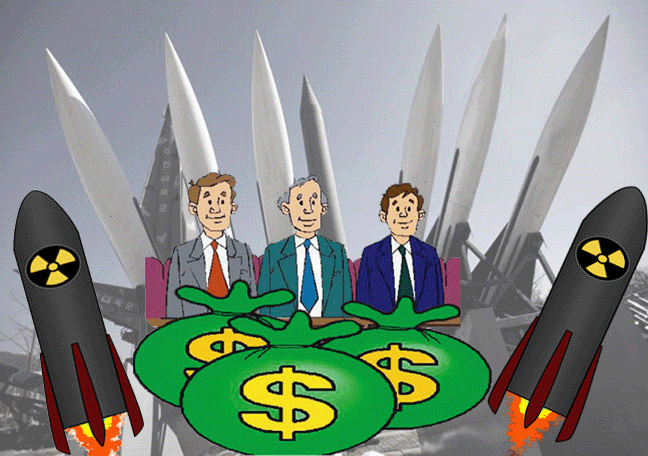
The madness behind these attitudes is fuelled by the enormous profits earned by the arms industry, which seeks to modernise nuclear systems around the counterforce doctrine. A 2025 report by PAX and the International Campaign to Abolish Nuclear Weapons (ICAN) titled At Great Cost: The Companies Building Nuclear Weapons and their Financiers found that, between January 2022 and August 2024, 260 global financial institutions (including pension funds, insurance companies, and asset managers) financed 24 nuclear weapons producers, with investors holding just under $514 billion in shares and bonds and with around $270 billion provided in loans and underwriting.
With New START now expired, the United States’ withdrawal from arms control treaties and its embrace of nuclear ‘warfighting’ doctrines are raising the risk of catastrophic conflict between nuclear powers.
19 February 2026, Tricontinental: Institute for Social Research, https://thetricontinental.org/newsletterissue/start-nuclear-weapons/
On 5 February 2026, the New Strategic Arms Reduction Treaty (New START) expired, ending the last surviving legal constraint on the strategic nuclear arsenals of the United States and the Russian Federation. New START, which was signed in 2010 and entered into force in 2011, should have been replaced by a successor agreement. The treaty limited strategic warheads and delivery vehicles deployed by each side and established a verification regime of inspection, notification, and information exchange. These measures were not cosmetic; they were thin threads that restrained the most destructive machinery ever assembled.
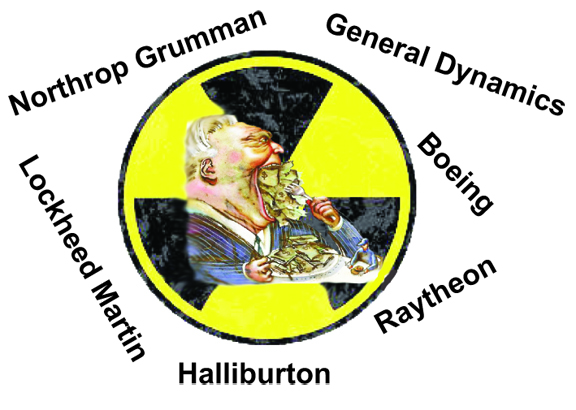
These companies include Airbus, BAE Systems, Bechtel, Boeing, General Dynamics, L3Harris Technologies, Northrop Grumman, and Rolls-Royce. ICAN’s 2025 report Hidden Costs: Nuclear Weapons Spending in 2024 estimates that the nine nuclear-armed states spent $100.2 billion on their nuclear arsenals in 2024, with the private sector earning at least $42.5 billion from nuclear weapons contracts. That sum could have paid the UN’s budget 28 times and fed 345 million people facing the most severe hunger for nearly two years. The nuclear weapons industry is a striking waste of human resources.
Despite the collapse of the bilateral arms control regime, the global nuclear deterrence and eradication system has not vanished. But what remains is irradiated by US domination over the architecture of nuclear policy:
- The Nuclear Non-Proliferation Treaty (NPT, 1970) remains in force even though it reinforces the system of nuclear apartheid (despite Article VI, which asks nuclear-armed countries to pursue disarmament). The expiration of New START deepens the NPT’s crisis of legitimacy and exposes the disarmament promise as perpetually deferred. India, Israel, and Pakistan never signed the NPT; the Democratic People’s Republic of Korea (DPRK) signed it in 1985 but withdrew in 2003.
The expiration of New START did not arrive suddenly. Due to the decade-long breakdown in US-Russia relations, on-site inspections were paused by both sides in March 2020 and never resumed. In February 2023, Russia suspended its participation in New START, and the US responded in kind (Russia has publicly said it intends to continue observing New START’s numerical limits, provided the US does the same). By the time the treaty formally lapsed, its verification spine had already been severed.
We now live in a world where the two largest nuclear powers are unrestrained by any binding treaty limits.
Since 2002, the United States has unilaterally exited one arms control treaty after another, eroding the architecture that helped stabilise deterrence. These treaties include the following:
- The Anti-Ballistic Missile Treaty of 1972 – US withdrawal, June 2002.
- The Intermediate-Range Nuclear Forces Treaty of 1987 – US withdrawal, August 2019.
- The Treaty on Open Skies of 1992 – US withdrawal, November 2020.
- The New START of 2011 – expired, February 2026.
The end of New START unfolds within a broader turn toward nuclear ‘warfighting’ doctrines, including a renewed emphasis on the diabolical idea of counterforce – the outlines of which appear in the 2018 US Nuclear Posture Review (NPR). The idea is simple: to attack an adversary’s nuclear forces and command systems rather than its cities. Such an attack is seen to be more rational and even more humane. In reality, an attack of this kind destabilises all deterrence systems. Counterforce doctrines reward speed, pre-emption, and first-strike advantage, thereby compressing decision-making time. The doctrine creates a use-it-or-lose-it pressure – the fear that you must launch before your forces are destroyed – that makes miscalculation structural, not accidental.
. As warfare technologies advance, this logic is amplified. Highly developed conventional strike systems, missile defences, hypersonic delivery systems, and integrated command-and-control networks (shared systems that link sensors, communications, and decision-making) blur the boundary between nuclear and non-nuclear war. A missile launched with conventional intent may be interpreted as a nuclear strike. Dual-use platforms – systems that can carry conventional or nuclear payloads – undermine signalling clarity by making it difficult to determine whether a launch is conventional or nuclear. Escalation ladders shorten. The margin for error narrows to seconds.
The counterforce doctrine is not merely an abstract debate but has materialised in government budgets and arms procurement contracts. The 2022 US NPR affirmed the modernisation of the nuclear triad: land-based intercontinental ballistic missiles, submarine-launched ballistic missiles, and nuclear-capable strategic bombers. Crucially, the 2022 NPR rejects ‘no first use’ and ‘sole purpose’ policies (‘no first use’ means committing not to use nuclear weapons first; ‘sole purpose’ means limiting their role to deterrence and, if necessary, for responding to nuclear attack). The current policy holds that the US would only consider the use of nuclear weapons, under ‘extreme circumstances’, to defend its vital interests or those of its allies and partners, but it does not foreclose first use, and leaves open a ‘narrow range of contingencies’ in which nuclear weapons may deter attacks with ‘strategic effect’. This posture preserves the option to target adversary military capabilities – including their strategic forces if necessary – without overtly committing to the counterforce doctrine.
The 2023 Congressional Commission on the Strategic Posture of the United States took this further, arguing that US nuclear planning should continue to target what adversaries ‘value most’. In these texts, nuclear weapons are not presented as tragic necessities of modern statecraft but as normal tools that can be used in certain circumstances.
The madness behind these attitudes is fuelled by the enormous profits earned by the arms industry, which seeks to modernise nuclear systems around the counterforce doctrine. A 2025 report by PAX and the International Campaign to Abolish Nuclear Weapons (ICAN) titled At Great Cost: The Companies Building Nuclear Weapons and their Financiers found that, between January 2022 and August 2024, 260 global financial institutions (including pension funds, insurance companies, and asset managers) financed 24 nuclear weapons producers, with investors holding just under $514 billion in shares and bonds and with around $270 billion provided in loans and underwriting.
- The International Atomic Energy Agency (IAEA, 1957) operates a safeguards regime of inspections, material accountancy, and monitoring. The 1997 Additional Protocol to the IAEA extends these capacities, yet this mechanism remains plagued by selective enforcement. The IAEA’s investigations of Iran, for instance, are not shaped by evidence but by the Global North’s hostility to the Iranian government.
- The Nuclear Suppliers Group (NSG, 1975) is an informal export-control regime for sensitive technologies and dual-use materials used in nuclear fuel-cycle and weapons-related programmes. While the purpose of the NSG is to constrain proliferation (reinforced by UN Security Council resolution 1540), it ends up reinforcing technological hierarchies. The nuclear-armed states dominate the informal institutions, exercising their authority while insisting on restraint from others.
Some tattered norms remain outside the full control of the United States, but they are fractured and unable to advance a comprehensive agenda. These include:
- The Treaty on the Prohibition of Nuclear Weapons (2017). This is a legally binding instrument that represents a categorical rejection of nuclear arms. As of late 2025, ninety-nine countries had either ratified or signed the treaty, but none of the world’s nine nuclear-armed states are among them. In Europe, only Austria, the Holy See (Vatican), Ireland, Malta, and San Marino have ratified the treaty. The treaty, which was driven by the International Campaign to Abolish Nuclear Weapons, is largely a Global South initiative.
- Nuclear Weapon Free Zones. Five regions of the world adopted treaties to make their territories free of nuclear weapons. These agreements are the Treaty of Tlatelolco (1967) covering Latin America and the Caribbean, the Treaty of Rarotonga (1985) covering the South Pacific, the Treaty of Bangkok (1995) covering Southeast Asia, the Treaty of Pelindaba (1996) covering Africa, and the Semipalatinsk Treaty (2006) covering Central Asia. These treaties are, in practice, among the most successful achievements in nuclear disarmament.
- The Comprehensive Nuclear-Test Ban Treaty (1996). This treaty has not been able to enter into force because several required states have not ratified it, yet it remains politically significant because it prohibits nuclear test explosions and has helped make nuclear testing internationally taboo. The treaty’s monitoring system functions daily, detecting seismic and atmospheric signals, making tests harder to hide.
The post-New START landscape contains some institutions and norms, but the central restraint on the largest nuclear arsenals has vanished. What we have now are three overlapping crises:
- A crisis of stability. With no transparency and verification on the largest nuclear weapons arsenals there is only suspicion between the major powers.
- A crisis of legitimacy. The countries with the largest arsenals demand obedience to non-proliferation while abandoning their own treaty commitment to disarmament.
- A crisis of conscience. Horrifyingly, nuclear weapons are now being spoken of as being usable, manageable, and necessary – as legitimate options on the battlefield.
A return to an arms control regime is necessary. But we need to consider a broader agenda. Even the best treaties only manage danger but do not eliminate it. The deeper contradiction remains intact: a world in which a few states claim the right to annihilate humanity in the name of security. The demise of New START strips away illusions to reveal a nuclear weapons order that preserves power and does not advance peace.
Libya abandoned its nuclear weapons programme in December 2003. Eight years later, a UN Security Council resolution (no. 1973) imposing an arms embargo and a no-fly zone was used by NATO to justify the military intervention that destroyed the Libyan state. It was logical, therefore, for the DPRK to test a nuclear weapon in 2006 and build a shield against the regime-change ambitions of the US and its East Asian allies. The counterforce doctrine of the US encourages countries to build such a shield, a painful reality in a world marinated in the anxieties provoked by hyper-imperialism.
In 2003, the British playwright Harold Pinter (1930–2008), exasperated by the Global War on Terror, wrote a powerful poem called ‘The Bombs’. I remember hearing Pinter read this poem in London, the cadence powerful, the hope in the ugliness clear. In his memory, here is the poem:
There are no more words to be said
All we have left are the bombs
Which burst out of our head
All that is left are the bombs
Which suck out the last of our blood
All we have left are the bombs
Which polish the skulls of the dead.
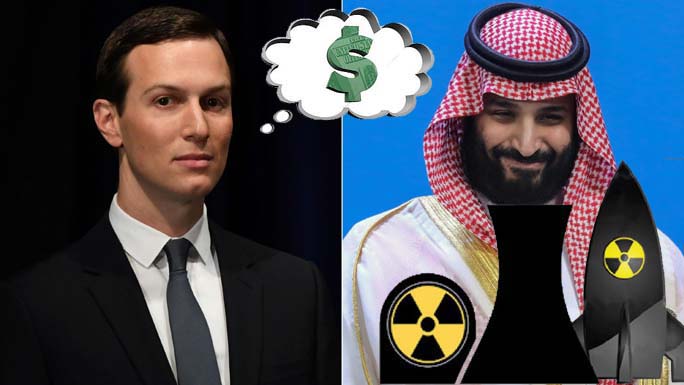
Proposed Saudi-U.S. deal could allow uranium enrichment, arms control experts warn
PBS News, Jon Gambrell, Associated Press, Feb 20, 2026
DUBAI, United Arab Emirates (AP) — Saudi Arabia could have some form of uranium enrichment within the kingdom under a proposed nuclear deal with the United States, congressional documents and an arms control group suggest, raising proliferation concerns as an atomic standoff between Iran and America continues.
U.S. Presidents Donald Trump and Joe Biden both tried to reach a nuclear deal with the kingdom to share American technology. Nonproliferation experts warn any spinning centrifuges within Saudi Arabia could open the door to a possible weapons program for the kingdom, something its assertive crown prince has suggested he could pursue if Tehran obtains an atomic bomb.
Already, Saudi Arabia and nuclear-armed Pakistan signed a mutual defense pact last year after Israel launched an attack on Qatar targeting Hamas officials. Pakistan’s defense minister then said his nation’s nuclear program “will be made available” to Saudi Arabia if needed, something seen as a warning for Israel, long believed to be the Middle East’s only nuclear-armed state.
“Nuclear cooperation can be a positive mechanism for upholding nonproliferation norms and increasing transparency, but the devil is in the details,” wrote Kelsey Davenport, the director for nonproliferation policy at the Washington-based Arms Control Association.
The documents raise “concerns that the Trump administration has not carefully considered the proliferation risks posed by its proposed nuclear cooperation agreement with Saudi Arabia or the precedent this agreement may set.”
Saudi Arabia did not respond to questions Friday from The Associated Press.
Congressional report outlines possible deal
The congressional document, also seen by the AP, shows the Trump administration aims to reach 20 nuclear business deals with nations around the world, including Saudi Arabia. The deal with Saudi Arabia could be worth billions of dollars, it adds.
The document contends that reaching a deal with the kingdom “will advance the national security interests of the United States, breaking with the failed policies of inaction and indecision that our competitors have capitalized on to disadvantage American industry and diminish the United States standing globally in this critical sector.” China, France, Russia and South Korea are among the leading nations that sell nuclear power plant technology abroad.
The draft deal would see America and Saudi Arabia enter safeguard agreements with the United Nations’ nuclear watchdog — the International Atomic Energy Agency or IAEA. That would include oversight of the “most proliferation-sensitive areas of potential nuclear cooperation,” it added. It listed enrichment, fuel fabrication and reprocessing as potential areas………………………………………………………………………………..
Saudi-U.S. proposal comes amid Iran tensions
The push for a Saudi-U.S. deal comes as Trump threatens military action against Iran if it doesn’t reach a deal over its nuclear program. The Trump military push follows nationwide protests in Iran that saw its theocratic government launch a bloody crackdown on dissent that killed thousands and saw tens of thousands more reportedly detained.
In Iran’s case, it long has insisted its nuclear enrichment program is peaceful. However, the West and the IAEA say Iran had an organized military nuclear program up until 2003. Tehran also had been enriching uranium up to 60% purity, a short, technical step from weapons-grade levels of 90% — making it the only country in the world to do so without a weapons program.
Iranian diplomats long have pointed to 86-year-old Supreme Leader Ayatollah Ali Khamenei’s comments as a binding fatwa, or religious edict, that Iran won’t build an atomic bomb. However, Iranian officials increasingly have made the threat they could seek the bomb as tensions have risen with the U.S.
Saudi Crown Prince Mohammed bin Salman, the kingdom’s day-to-day ruler, has said if Iran obtains the bomb, “we will have to get one.” https://www.pbs.org/newshour/amp/world/proposed-saudi-u-s-deal-could-allow-uranium-enrichment-arms-control-experts-warn
1 This Month


Tell the Ukrainian Government to Drop Prosecution of Peace Activist Yurii Sheliazhenko

Petition to revoke the licensing of the Near Surface Nuclear Disposal Facility (NSDF) at Chalk River. https://www.ourcommons.ca/petitions/en/Petition/Details?Petition=e-7247


of the week – STOP SMALL MODULAR REACTORS IN CANADA
To see nuclear-related stories in greater depth and intensity – go to https://nuclearinformation.wordpress.com
-
Archives
- March 2026 (204)
- February 2026 (268)
- January 2026 (308)
- December 2025 (358)
- November 2025 (359)
- October 2025 (376)
- September 2025 (258)
- August 2025 (319)
- July 2025 (230)
- June 2025 (348)
- May 2025 (261)
- April 2025 (305)
-
Categories
- 1
- 1 NUCLEAR ISSUES
- business and costs
- climate change
- culture and arts
- ENERGY
- environment
- health
- history
- indigenous issues
- Legal
- marketing of nuclear
- media
- opposition to nuclear
- PERSONAL STORIES
- politics
- politics international
- Religion and ethics
- safety
- secrets,lies and civil liberties
- spinbuster
- technology
- Uranium
- wastes
- weapons and war
- Women
- 2 WORLD
- ACTION
- AFRICA
- Atrocities
- AUSTRALIA
- Christina's notes
- Christina's themes
- culture and arts
- Events
- Fuk 2022
- Fuk 2023
- Fukushima 2017
- Fukushima 2018
- fukushima 2019
- Fukushima 2020
- Fukushima 2021
- general
- global warming
- Humour (God we need it)
- Nuclear
- RARE EARTHS
- Reference
- resources – print
- Resources -audiovicual
- Weekly Newsletter
- World
- World Nuclear
- YouTube
-
RSS
Entries RSS
Comments RSS
 nuclear-news