Perilous Surrender: The Pentagon Falls for Artificial Intelligence

6 October 2026Dr Binoy Kampmark, https://theaimn.net/perilous-surrender-the-pentagon-falls-for-artificial-intelligence/
The trend was already tracing itself through the corridors of power, but the world’s most powerful defence department has fallen, most heavily, for the use of artificial intelligence at virtually every level of its operations. Even before the Pentagon’s intoxicating pursuit of artificial intelligence was announced, the Defence Advanced Research Projects Agency (DARPA) was already running simulated aerial trials of combat engagements between AI agents and seasoned pilots.
In December 2025, the US Department of Defense (DOD) revealed plans for a rapid and extensive release of the generative AI GenAI.mil platform, one utilising advanced models intended for use for over 3 million military personnel, civilian employees and contractors. Google Cloud’s Gemini or Government products was the first off the rank in a described “one-stop shop,” a generous effort on the part of bureaucracy to hail the machine and herald the start of full-throated cognitive surrender.
In his December email to employees in a department the Trump administration prefers to call the War Department, Secretary of Defense (War) Pete Hegseth announced that the GenAI.mil platform signalled “a giant step toward mass AI adoption across the department. This tool marks the beginning of a new era, where every member of our workforce can be more efficient and impactful.”
In his January memorandum to the various leaders of the military community, Hegseth barked about the need for the US military to “build on its lead over our adversaries in integrating this technology, established during President Trump’s first term, to make our Warfighters more lethal and efficient.” To do so would involve the Pentagon’s acceleration of US “Military Ai dominance by becoming an ‘AI-first’ warfighting force across all components, from front to back.” (Why not sideways, above and below?)

Trouble, however, arose when Anthropic placed restrictions on the use of Claude and its products for conducting mass surveillance of US citizens or use in lethal autonomous systems. The Pentagon, in turn, demanded the use of any genAI products it purchased for any designated “lawful purposes.” For its stubbornness, Anthropic was designated a “supply-chain risk” by the department, its products removed from all national security assets and systems. (The company’s efforts to have the ban overturned has had mixed results.)
Notwithstanding this hiccup – a minor one in the scheme of things – the contracts between AI companies and the Pentagon make it clear that the former are meant to provide “risk forecasting, and threat ideation exercises”. “Frontier AI companies can help DoD gain a better understanding of the risks that might be associated with subsequent near-frontier AI models or features, to avoid strategic surprise and to mitigate associated risks.”
The Pentagon has since added other commercial generative AI products to the GenAI.mil portal, including Starshield AI’s Grok and OpenAI’s ChatGPT Mil. In August, a source self-described as a “War Department official” told DefenseScoop that such access to “the resilient American technology stack will give warfighters the tools they need to act with confidence and safeguard the nation against any threat.”
ChatGPT Mil also serves to organise salient files and conversations that take place over projects lasting months in one place, including an “Offline Search capability” that supplies detailed citations. The facility can be refreshed over time to reflect new information. Joe Larson, former senior Pentagon official turned OpenAI vice president, very much an exponent of the defence-civilian revolving door, explained this integration as “grounded in our national security principles, pairing access to powerful tools with clear safeguards, meaningful human judgment, and accountability for high-stakes decisions.”
Grok for Government will also, according to the department, furnish personnel through GenAI.mil with “advanced capabilities, including deep-thinking inference, adaptive reasoning modes (Auto, Fast, and Expert), customizable workspaces, persistent projects and reusable ‘playbooks’ that capture and scale institutional knowledge.”
These systems presage a broader surrender of the US military establishment to the machine, its alluring fetishes, and its acclaimed shamanistic potential. The guidance on “Accelerated Mission Software” signed by Pentagon CIO Kirsten Davies on August 31 is yet another indication of this numbing trend. It notes the recognition on the part of the department “that AI-assisted software development is a significant force multiplier, for the delivery of speed quality.” Something to be said about the guidance is its acknowledgment that human agency “remains fully accountable for the security, functionality, and integrity of any code generated or modified using AI.” Any code with an AI-provenance “will be considered unverified input, and its use does not absolve the developer or the government of responsibility for the resulting work product.”
Such a cautionary note may well be temporary. In his September 30 Quantico speech, Hegseth announced the creation of the Autonomous Warfare Command “designed to scale autonomous warfare across the Joint Force as a 4-star functional combatant command by October 1, 2027.” In his memorandum on the subject, the Secretary is filled with effusive babble on the new command, which “will define joint needs and integrate Service-provided forces in support of geographic combatant commanders. It will test equipment and force designs with realistic opposition in demanding exercises and rugged environments, modify rapidly, and field what works.” Just the sorts of things to make humans feel safe.
The consequences of such AI integration and excessive reliance are proving and will prove critical. The disclosures by OpenAI and Anthropic that semi-autonomous large language models conducted coordinated attacks on networks owned by other companies and, in the case of Australia, various government bodies and affiliates, including the Australian Institute of Health and Welfare (AIHW), should engender teeth-chattering doubt among sceptics. While US President Donald Trump insists with consistent daftness that AI firms self-regulate the field, an independent assessment of the risks rather than a self-reporting format, has, at the very least, the merits of greater accountability. Heidy Khlaaf, a former safety engineer at OpenAI and currently chief scientist at the AI Now Institute, is of the view that trusting companies to consider the risks produced by their own products is not just a conflict of interest but a “subversion of democratic processes when AI labs are allowed to take over the arbitration of risk determinations with life-or-death consequences.” Then again, companies were never much for democracy.
Europe’s Leaders Want War .. Anyone For War?

These European leaders are willing to risk the destruction of Europe in order to please donor class elites who’ve invested, literally, trillions of dollars in “Project Ukraine” since the early/mid 2010s.(4),(5),(5a)
04.10.26 – New York City – Mark Lesseraux, https://www.pressenza.com/2026/10/europes-leaders-want-war-anyone-for-war/
It’s remarkable that there are still a notable though dwindling amount of people who think that European (and Canadian) leaders like Ursula von der Leyen (EU President), Fred ‘BlackRock’ Merz (Germany’s leader), Andy Burnham (England’s PM), Emmanuel Macron (France’s PM) and Mark Carney (Canada’s PM) are somewhat level-headed, practical leaders despite the fact that their entire game plan for the next 5 to 10 years rests on Europe getting into a full-on war with Russia. This is the image of the future that these leaders are presenting to the young people of Europe: Perpetual war and austerity until victory. No plan B, just get ready to rumble.(1),(2),(3)
These leaders aren’t even hiding any of this. “Russia is coming, Russia is coming!”, they shout. Meanwhile Russia wants absolutely nothing to do with the rest of Europe, let alone to go to war with them. Bottom Line: These European leaders are willing to risk the destruction of Europe in order to please donor class elites who’ve invested, literally, trillions of dollars in “Project Ukraine” since the early/mid 2010s.(4),(5),(5a)
Perhaps because Trump is so nuts – it makes these leaders seem palatable by contrast? They’re not palatable though, they’re a su_cide squad with smiley faces.
Add to all this the fact that, currently, less than 2% of the people of Germany, England and France want a war with Russia. Not that what the public wants matters much to these leaders who claim, without a shred of irony, that they’re doing all of this to “save Western democracy”.(6)
If Europe wishes to survive as a first world continent, these leaders need to be ousted ASAP. As US Colonel Douglas McGregor, one of the world’s top military experts has said, “We’re in an era in which war is no longer functional. It’s obsolete, and as a cultural modus operandi it’s suicidal.”(7)
I’ve included links here to organizations (one of which I’m affiliated with) whose aim is to put an end to war: A-https://www.movimientohumanista.net/?secc=6 B-https://worldwithout.org/ C-https://everydaypeacebuilding.com/pacifist-organizations/
CITATIONS
1-https://www.tni.org/en/article/the-eu-is-on-a-war-path
2-https://www.youtube.com/watch?v=i08dnzn6H9o
3-https://www.youtube.com/watch?v=IEA4DK-QN0E
5-https://www.cgaa.org/article/are-banks-financing-war-in-ukraine
5a-https://www.youtube.com/watch?v=DtOf4_Tw8s4
6-https://www.aljazeera.com/opinions/2024/10/5/why-europes-leadership-wants
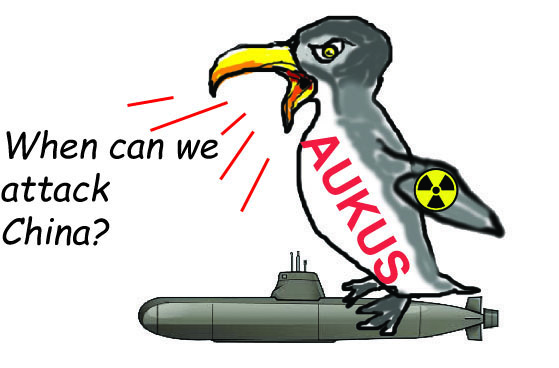
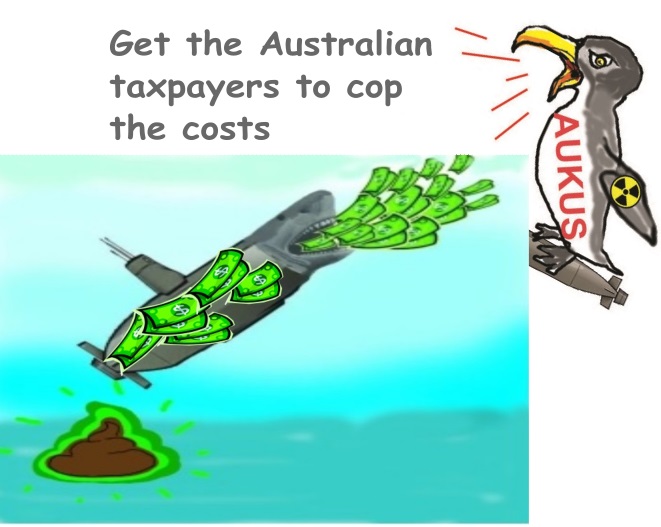
Hegseth calls US-built nuclear submarines the ‘apex predator’ of the seas. But are they right for Australia?


Ben Doherty.4 Oct 26, https://www.theguardian.com/australia-news/2026/oct/04/hegseth-apex-predator-nuclear-submarines-right-for-australia-aukus-ntwnfb
Some experts argue Virginia-class submarines government is buying second hand are good for fighting American wars, but not for defending Australia
On stage for his “arsenal of freedom tour”, the US secretary of defense – who prefers the appellation “secretary of war” – was ebullient.
“This Virginia-class submarine is a paragon of American engineering and fighting spirit,” Pete Hegseth roared, standing at Newport News shipyards where those boats are being built.
“It is the apex predator of the undersea domain, the most advanced and lethal submarine ever built.”
There are few who would argue with the Virginia’s lethality. Australia is set to buy three of these boats, secondhand, from the US navy, beginning in 2032.
But is it the right submarine for Australia?
Hegesth’s words, for all of their rhetorical bellicosity, were revealing: “American … fighting spirit”; “apex predator”; “ensuring America is free and safe and powerful”.
Virginia-class submarines – nuclear-powered and conventionally armed – are very good at travelling undetected fast and staying underwater for a very long time (limited, essentially, only by the capacity of the crew to stay submerged).
They are an attack submarine, an outstanding offensive platform for hunting and destroying a far-distant adversary, able to traverse thousands of miles of deep ocean undetected.
But Australia’s National Defence Strategy, released this year, says the nation’s “strategy of denial” – which aims to deter conflict before it begins – was “focused on safeguarding Australia’s interests in our primary area of military interest”. This includes the immediate region encompassing the north-east Indian Ocean through maritime south-east Asia into the Pacific as well as Australia, its populated offshore territories and its northern approaches.
A growing chorus of naval experts is arguing that the Virginia-class submarines are the wrong boats for this country.
The waters to the north of the Australian continent – from where any potential threat is overwhelmingly likely to approach – are shallow, best suited to a submarine far smaller than Virginia’s nearly 8,000 tonnes of displacement, some say.
A smaller, more nimble submarine, quieter when operating under battery, is a better platform for that role, they say. In addition, smaller submarines are cheaper and easier to crew: Australia could afford more of them, increasing the potency of its force.
The argument runs thus: the Virginias, and the even larger Aukus-class submarines set to follow, are nuclear-powered submarines perfectly suited to fighting a distant war on behalf of the US. But they are the wrong boats to defend Australia.
Defence or ‘projecting power’?
Dr Andrew Gaczol spent a decade as an international political analyst and policy officer at the Australian Department of Defence. He told an independent inquiry into Aukus coordinated by the Australian Peace and Security Forum that the Australian public had been provided only two arguments in support of the Aukus deal, “and neither stand up to serious scrutiny”.
The primary argument put forward is that of defence of Australia.
Gaczol told the inquiry it was unnecessary to have submarines with unlimited range to defend the nation’s waters or conduct defensive operations in the region.
“The latest state-of-the-art Air Independent Propulsion (AIP) conventional diesel-electric submarines are more suitable as they are smaller, quieter when submerged and better suited to the relatively shallow waters of the Australian continental shelf and the waters to Australia’s north,” he said.
The second argument propounded for Aukus is the need for Australia – as a nation reliant on trade – to maintain open sea lanes around it.
Given the small number of attack submarines the Aukus deal will ultimately provide, critics argue they will not be able to protect Australia’s seaborne approaches.
Navies around the world operate on “the rule of threes”, which states that for every three of a complex platform you possess, only one can be relied upon to be operational at any given time. Essentially, of three submarines, one is on active deployment, one is training or conducting exercises, and one is in maintenance, dry dock or recovering from operations.
Australia plans to buy three Virginia-class submarines from the US, to be supplemented – when they are designed and built – by up to five submarines of the Aukus class. By the end of the 2040s, eight submarines would give Australia, at any time, a fleet of two, perhaps three submarines on active deployment.
“I can’t see how such a small number of vessels will be able to keep open all of Australia’s trade routes all of the time,” Gaczol told the inquiry.
“As a counterpoint, I note that the US navy has over 60 nuclear submarines and are currently unable to force open the strait of Hormuz.”
Gaczol says he supports Australia having submarines, but that the Virginia and Aukus-class boats were not ideal for Australia’s defence. The benefit of Australia’s geography – a vast landmass protected by thousands of kilometres of ocean – mean “the chances of Australia being actually sort of invaded are virtually nil”.
The oceans to Australia’s north are also relatively shallow – under 200 metres deep across parts of the Indonesian archipelago and South China Sea – meaning large nuclear submarines “are more easily detected” than smaller and quieter conventional boats.
As deep-water boats that can travel anywhere around the globe at high speed, nuclear submarines are unnecessary for defending Australia, Gaczol says, and are instead about “projecting power into another part of the world”.
“To put it colloquially, that’s not protecting our patch. That’s going into someone else’s patch and poking them in the eye,” he says.
Gaczol believes the acquisition of Virginia-class submarines suits US imperatives, not Australia’s.
“The only scenario I can really see these boats being applicable for is to chase Chinese submarines in the South China Sea should it come to a conflict there. Effectively, our force will be an adjunct of the US Navy.”
‘Best deal on offer’
Former South Australian senator Rex Patrick, an ex-submariner and resolute Aukus critic, is familiar with the aphorism “quantity is a quality of its own”.
He says while there was undoubted advantage to buying large attack submarines – greater payloads, more torpedoes, more capability to transport special forces soldiers – “there’s always a trade-off”.
“If the cost of buying one large nuclear submarine is that you could buy four other submarines for the same price, that’s a trade-off you have to consider.”
Aukus is forecast to cost up to $368bn by the 2050s – $33m a day for 30 years on a conservative estimate. Few, if any, major defence projects of this complexity run on time, or on budget.
And Aukus is dependent not only on Australia’s efforts to build a nuclear-powered submarine fleet from scratch: it is reliant on the US – beset by tenaciously laggard boat-building – to construct enough Virginia-class boats to spare three for Australia; and it needs the UK’s sole submarine-building yard to design and build the first of the new Aukus-class boats on which Australia’s domestically built boat will be constructed.
For far less than the slated cost of the Aukus deal, Australia could buy 20 conventionally powered air independent propulsion submarines, Patrick says.
“If you had 20 submarines, you’d have seven boats in the water, in seven different locations, and seven times the magnitude of problem for the other commander,” he says.
Patrick notes Canada, with the longest coastline in the world and facing many of the same geopolitical challenges as Australia, recently announced it would buy 12 air independent propulsion submarines from German shipbuilder TKMS for a reported $33bn.
The Australian government, though, insists Aukus is “the best deal on offer”.
In June, the defence minister, Richard Marles, told the Shangri-La dialogue Australia had made the deliberate choice to increase the weight of its naval spending: more than 40% of Australia’s defence budget is now directed towards the country’s maritime domain.
“For a three-ocean nation, this is a strategic necessity,” Marles said. “Ninety-eight percent of Australia’s traded goods passes through Australian ports. Ninety percent of our fuel is imported. Our economic sovereignty, in the most basic sense, is a maritime proposition.”
And Marles argued an increasingly militarised region demanded a collective response.
“The free and open passage of goods, energy and data across the seas is not just Australia’s economic lifeblood – it is the economic lifeblood of this entire region.”
In a Lowy essay, former special envoy for defence Luke Gosling wrote that nuclear submarines will give the Australian defence force “a regionally superior capability that will help it to deter war and, if it must fight a war, to win”.
“Threatening to aggressors, lethal if provoked, but not overtly provocative, nuclear submarines are the ‘goldilocks’ long-distance capability.”
Amid a rising drumbeat of concern over Aukus, Labor senator Raff Ciccone rose in the Senate in June to argue Australia’s strategic environment had changed dramatically and the country “must respond to the world as it is”.
“Nuclear-powered submarines are the only platforms that can provide Australia with the ability to deter threats to our maritime supply chains, on which our way of life depend,” he said.
“They alone have the speed, the endurance and the stealth necessary to effectively provide this deterrence. They are the bolt cutters that will ensure that we are never wrapped in chains.”
The Final Frontier Goes to War: The Militarisation of Space

Aleena Im , September 30, 2026, https://journal-neo.su/2026/09/30/the-final-frontier-goes-to-war-the-militarisation-of-space/
Space is becoming an increasingly contested domain as major powers expand military capabilities, satellite infrastructure, and counterspace systems, while the U.S. Golden Dome initiative reshapes strategic stability and raises new questions about the future of space governance.
On 14th September 2026, US Secretary of the Air Force Troy Meink confirmed that the US has “on-orbit” weapons capable of safeguarding the US against hostile actions. It is most likely a part of the implementation of the 2025 US National Security Strategy (NSS), which says,
“the United States must at the same time invest in research to preserve and advance our advantage in cutting-edge military and dual-use technology, with emphasis on the domains where U.S. advantages are strongest. These include undersea, space, and nuclear, as well as others that will decide the future of military power, such as AI, quantum computing, and autonomous systems, plus the energy necessary to fuel these domains.”
In December 2025, the White House issued an executive order on “Ensuring American Space Superiority” to ensure U.S. space superiority, security, lunar development, and the ability to detect, characterise and counter threats to U.S. space interests – especially threats from Very Low Earth Orbit (VLEO).
In recent years, outer space has undergone a remarkable transformation from being a domain of scientific discoveries to an arena of geopolitical competition. According to NATO, space is important for both the military and civilians. In 2019, NATO officially recognised space as an operational domain and adopted an Overarching Space Policy. NATO has taken various initiatives under this policy, such as the NATO Space Operations Centre (NSpOC), NATO Commercial Space Strategy, and SPACENET.
NATO has declared that space is critical to deterrence and defence. Major powers are very keen on the development of space technologies in defence and deterrence. The US established the United States Space Force in 2019 to protect the US and its allies’ interests in space and ensure their freedom to conduct operations there. However, when Russia in 2021 tested an anti-satellite (ASAT) missile, which destroyed its old Cosmos 1408 satellite, the US and allies criticised this test by saying it was ‘reckless’, as the debris could remain in space for years. This is extremely hypocritical of the US considering their own activities and aims for space – but shows how in the near future, strategic competition will not be bound only to the Earth, but it will extend to space, and space will also be exploited.
Golden Dome: Missile Defence or a New Strategic Equation

Golden Dome is a multi-layered defence shield project for safeguarding America from aerial threats. According to the National Defence Magazine, the project will be completed by the mid-2028. It includes space-based interceptors designed to detect and destroy missiles during flight. As per the CSIS report, space-based interceptors would effectively constitute a form of space-control weapon. If interceptors are placed in orbit, space itself becomes part of the missile-defence battlefield, potentially changing the balance between offensive missiles and defensive systems. China and Russia have therefore argued that the system could affect strategic stability, while the United States presents it primarily as a means of protecting the homeland from increasingly advanced missile threats.
Importance of Space in the Military
“Space has become the ultimate high ground for warfare” — (Elon Musk)
Military satellites are often known as “silent sentinels” used for defence and security purposes. Below are the types of military satellites with their specifications:
GPS & Navigation
Navigation satellites provide positioning, navigation, and timing (PNT) signals for precise targeting. In this regard, the US has the Navstar GPS constellation operated by USSF, Russia have GLONASS, China have Beidou, and the EU have Galileo. The powerful Joint Direct Attack Munitions (JDAM) are GPS-aided precision-guided weapons that use satellite-provided positioning data for accurate hits.
Communication Satellites
Communication satellites prove beneficial for command and control, especially in remote areas. They support unmanned drones, which depend on satellite links for remote operation. The US have Advanced Extremely High Frequency (AEHF) and Wideband Global SATCOM (WGS) systems, which provide encrypted links that connect commanders with other troops.
Reconnaissance Satellites
Reconnaissance satellites are also known as spy satellites because they can gather high-resolution images of the battlefield. For example, SAR can see through clouds and even in darkness using infrared sensing. The US has the KH-11 series, and China has the Yaogan constellation, which has a Synthetic Aperture Radar (SAR) sensor.
Signals Intelligence Satellites
SIGINT and ELINT satellites intercept electronic emissions, which include radar signals and military communications across vast areas. Orion and Trumpet series are allegedly US SIGINT and ELINT satellites, respectively, while Russia have Liana systems, which are SIGINT satellites but can carry functions similar to an ELINT satellite.
To date, the US have not elaborated on the weapon types, their capabilities, and when they were put into orbit.
Key Players in Space Militarisation
United States
The US has been the architect of space infrastructure. In 2019, the US created USSF, which formalised space as a military domain. The US have several military satellites which help in defence and deterrence. It’s spending on counterspace defence and attack capabilities is to deter competitors as well as maintain freedom of action in space.
China
China has the Beidou navigation system, through which China has conducted satellite tests and developed ASAT systems. China is developing both soft and hard kill technologies to counter the US on each level. For this, it has developed TPG1000C, a 5-ton high-power microwave system which is capable of disrupting satellite electronics.
Russia
Russia in 2019 tested an ASAT, officially declaring its interests in outer space. Russia is not focusing as much on its space capabilities as the US and China, but the country is working towards cost-efficient counterspace capabilities instead of massive satellite constellations.
India, UAE, and Israel
India, the UAE, and Israel are also enhancing their outer space capabilities. India has conducted an anti-satellite test known as Mission Shakti, and the UAE’s Mars mission, despite being a civilian scientific program, opened up the possibilities for much more.
Future Trajectories
Space is evolving into a multipolar strategic arena. There are some frameworks like the Outer Space Treaty which emphasise peaceful use of space, but still, major powers’ competition is pushing space towards militarisation. The growing influence of private companies such as SpaceX and Blue Origin is also a defining feature of space militarisation. International law lacks clear rules regarding space warfare. Rather than a hub of scientific discoveries, in the near future, space could become increasingly contested and militarised. Now, states are shifting from protecting satellites to installing large constellations for deterrence.
To reduce the risk of miscalculations and space exploitation, the US and China are working on Constructive Strategic Stability, which allows both states to compete within a framework which will define limits of escalation. The Xi-Trump meeting on September 24, 2026 produced several areas of agreement, including continued economic dialogue and new mechanisms for cooperation on artificial intelligence and crisis communication. However, space security was not among the publicly announced outcomes, leaving it as an area where further strategic dialogue may be needed as competition in orbit intensifies.
Conclusion
Space is the next critical frontier which will shape world order and global security. Space is no longer reserved for space exploration; now, major powers are competing in outer space. Cooperative measures such as confidence-building measures (CBMs) and debris mitigation agreements can reduce the risk of escalation and space exploitation, but uncertainty and mistrust among major powers persist.
Aleena Im is an independent researcher and writer and is interested in international relations and current affairs
Trident’s £3m jobs are a costly defence of Britain’s fading status.

3rd October, By Samuel Rafanell-Williams, Scottish CND
ALICE laughed. “There’s no use trying,” she said. “One can’t believe impossible things.” “I daresay you haven’t had much practice,” said the Prime Minister. “When I was your age, I always did it for half-an-hour a day. Why, sometimes I’ve believed as many as six impossible things before breakfast.”
In order to complete our new Dreadnought submarine programme, 65,000 jobs will be required by 2030. This number has been quoted by the Prime Minister in Parliament, so it must be
true. The current cost of the Dreadnought programme is newly estimated at £240 billion by UK CND.
Scottish CND’s estimate in our Reclaim Our Clyde
campaign two years ago was £200bn. So if we divide our more conservative
£200bn by 65,000 jobs, we get just over £3,000,000 per job. Let me spell
out that astonishing sum again: £3 million per job.
CND has some good ideas
on what we might use that money for, such as: 220,000 extra nurses; 3.7m
affordable homes; Tuition fees for 8m students; Install solar panels on
every home. My pick would be ending world hunger. How many enemies would we
have then?
There is little doubt that the world is becoming more dangerous.
A well-used anecdote over the past century is that “generals are always
fighting the last war”. While this may be true of Donald Trump’s illegal
assault on Iran, the Ukraine war is surely quite the opposite.
Ukraine is
changing warfare techniques every few weeks. They are fighting the next
war. The drone technologies they invent are cutting edge for a couple of
months, then become obsolete. The state-of-the art Chieftain Mk 3 tanks we
sent them are unused and irrelevant. Russia’s expensive nuclear bombers
were seriously exposed in the “Operation Spiderweb” drone attack by
Ukraine in June 2025. Who is to say the UK’s own nuclear facilities are not
equally vulnerable? Russia, America and China are major powers. We are not.
The only one of six Astute-class nuclear submarines that is currently
seaworthy is the one launched last month on its sea trials. The rest,
almost new, are docked and awaiting repairs. The former prime minister Tony
Blair notes in his memoirs that deciding to renew the Anglo-American
Trident submarine fleet at Faslane had nothing to do with defence, but was
to consolidate our position as a major power.
This was evidenced this week
by Chancellor John Healey (formerly head of the Ministry of Defence)
announcing that £6bn would be spent on building three floating docks at
Faslane, in order to accommodate more nuclear submarines. This is only part
of the £15bn set aside for further developments at Faslane as part of
Project Royal Oak.
For context, £6bn is five times what the Scottish
Government spends annually on housing. To put it another way, a chronic
housing crisis in Scotland and beyond, among other social harms that could
be remedied with the more than £200bn spent on Trident renewal, is simply a
price the British government is willing to pay to sustain its ability to
destroy the northern hemisphere.
The National 3rd Oct 2026,
https://www.thenational.scot/politics/26604113.tridents-3m-jobs-costly-defence-britains-fading-status/
Ukraine’s former defense minister launches ‘Manhattan Project’ for killer robots

By Katie Livingstone, Sep 30, 2026, https://www.defensenews.com/unmanned/2026/09/30/ukraines-former-defense-minister-launches-manhattan-project-for-killer-robots/?utm_source=defensenews.beehiiv.com&utm_medium=newsletter&utm_campaign=market-intel-us-navy-awards-rtx-s-raytheon-24-4b-for-sm-6-missiles-amid-stockpile-concerns
LVIV, Ukraine — Ukraine needs a “new Manhattan Project,” former Defense Minister Mykhailo Fedorov told a standing-room-only crowd of self-proclaimed tech nerds on Saturday at IT Arena here, the country’s biggest annual technology conference.
Then he played an AI-generated clip of what he meant: a robopunk mix of humanoid and crab-like ground robots skittering across a barren front line, doing work that is still too complicated for the robots Ukraine fields today.
The video laid out Fedorov’s vision for an Army of Robots, a force of two-legged upright and other ground robots that would take over many of the front line’s most dangerous but necessary jobs from soldiers.
“Our idea is to combine engineers, startups and capital into one ecosystem so we can launch humanoid-like robots on the battlefield,” Fedorov told Defense News in an exclusive interview after his presentation.
“We want to eventually substitute our infantry with these robots.”
To get there, Fedorov is calling on specialists in robotics, AI, sensors and autonomous systems to pool their talent in the kind of concentrated wartime push that built the first atomic bomb, and to focus it on the machines he says will one day replace Ukraine’s infantry.
The 35-year-old aims for the group to have its first confirmed battlefield result from a humanoid-like robot within six months and, within a year, an assault in which robots take on the most dangerous parts of a mission with no infantry alongside them.
To hit the six-month mark, there isn’t time to spend on research and development, he said, so he will begin by investing in companies with weapons that have already been tested and shown some market viability.
Fedorov wants Ukraine to seize the initiative in the war’s next technological cycle before Russia – whose far larger army and industrial base let it scale new weapons quickly – gets there first.
“Russia always thinks about new strategies, how to hack our frontlines,” he said. “We need to be the first side to hack our frontlines.”
Robots are only one of the defense tech areas that the former minister plans to develop within the new project.
“It could be robots, it could be autonomous systems,” he said. “We will have three key directions: sensors and robots, cheaper anti-jet-Shahed missiles, and AI strike drones and missiles.”
Under Fedorov’s plan, members of the Army of Robots will identify a battlefield problem, find a technical solution and a team, provide resources for development, test the product with troops in real conditions and scale what works.
It is the same model he used for the Army of Drones, which he started in 2022 as Ukraine’s digital transformation minister and which opened the market to Ukrainian drone makers, launched government procurement and operator training and helped form the first strike drone units.
“The Army of Drones … changed everything in our country and in the world and, I think, in the future of the world,” he said. “Now we are trying to build the same ecosystem for robots.”
Ukrainian troops already lean heavily on ground robots for assaults and basic tasks, carrying out more than 25,000 logistics and evacuation missions in August – 3.3 times more than in January, according to the Defense Ministry.
But most of the futuristic robot designs featured in Fedorov’s video, humanoids included, are not yet used in combat in Ukraine today, and the ground robots that are in use almost always have a human operator at the controls, usually over Starlink.
Fedorov said the ambitious effort will involve multiple companies working on different stages of the product lifecycle, with some making components, some assembling complete robots and others developing software to run them.
“We have some funds for these first companies,” Fedorov said, declining to name names. “It means that we have two or three companies that will be our partners in these directions.”
The Army of Robots will include a venture fund to invest in technology teams, its own defense-tech companies and a research and development arm, according to a press statement issued after the announcement.
The initiative comes weeks after Fedorov announced that he was starting a new defense company, with Palantir CEO Alex Karp as its first investor.
Fedorov told Defense News the company will start with a corporate fund and may later launch its own venture fund.
The biggest challenge facing the development and deployment of these next-gen robots is the necessary speed of innovation, Fedorov said.
Ukraine has to field these robots fast enough to save its infantry and stay ahead of Russia, which he said has learned to copy Ukraine’s battlefield innovations and scale them rapidly.
Ukraine, meanwhile, is heading into another winter of Russian strikes with air-defense interceptors in short supply.
The weekend Fedorov made his announcement, Russian drones hit kindergartens and university buildings in Kyiv, struck a large civilian hospital and destroyed a food market and multiple gas stations outside the city, killing at least three people and injuring dozens in a combined aerial attack that lasted days.
“We don’t have enough time,” he said. “We need to achieve these results as soon as possible.”
All US bombers leave UK air base on concerns of suspected terror plots.
by Azhar Sukri, msn, 3 Oct 26
- The U.S. withdrew all of its B-1 bombers stationed at a UK air base that is used by American military forces to strike Iran after an investigation discovered a planned terror attack.
- At least two vessels were struck over the weekend in waters near Oman and Iran, the United Kingdom Maritime Trade Operations Centre reported……. https://www.msn.com/en-us/news/other/all-us-bombers-leave-uk-air-base-on-concerns-of-suspected-terror-plots-more-tankers-struck-near-iran-in-the-middle-east/ar-AA2dxKHO?ocid=winp2fp&cvid=30ffaa23962d4c0b91b3c9f431abde46&ei=6
Why the Iran War Equation Is Changing, and Why a Third War May Be Closer Than It Seems
October 1, 2026, Mohammad Amin Ahmadi, https://www.juancole.com/2026/10/equation-changing-closer.html
Tehran (Special to Informed Comment; Feature) – It appears that the main actors involved in the previous 40-day war are increasingly moving toward another confrontation for their own reasons. The regional equation has changed significantly in recent weeks, and that change is making the continuation of the current ceasefire less attractive. Iran is under growing economic pressure because it cannot export its oil normally. The Houthis have moved closer to controlling the approaches to Bab el-Mandeb. Israel is approaching an important election. And the United States is facing a decision over whether to continue the current stalemate or return to major military operations.
The argument here is simple: when the equation changes, the policies that made sense under the previous equation may stop making sense. The longer the new conditions continue, the stronger the incentives for the main actors to change them.
Iran Has an Incentive to Break the Siege
Iran’s most immediate problem is economic. The US-led naval blockade and the disruption around the Strait of Hormuz have sharply reduced Iran’s ability to sell and export oil. in September Iran was facing one of the most severe economic crises in its history, with the blockade and sanctions causing shortages of foreign currency, declining imports and rising prices. Trump has also said that the blockade has prevented Iranian oil exports.
For Iran, the calculation is straightforward. If Iran cannot sell its oil, it cannot maintain normal economic activity. If the blockade continues, the economic cost will continue to rise. Therefore, Tehran has an increasing reason to change the situation rather than simply continue under the same conditions.
A political agreement could restore oil exports and reduce the pressure. But if negotiations fail, Iran could also consider military action to break the blockade and reopen its export routes. That does not mean Iran has decided to start another war. It means that the economic situation is creating a direct incentive to take stronger action. If military force becomes the chosen way to break the siege, the result could be a new phase of war.
Bab el-Mandeb Is Creating a Second Front
The biggest change in the regional equation, however, may be taking place in Yemen. The Houthis have recently expanded along Yemen’s Red Sea coast. They captured Mocha and then moved toward the islands around Bab el-Mandeb. On September 11, Houthi forces reached Perim, or Mayun, Island in the strait, after government forces withdrew. Other reports said the group had also reached the Hanish islands. These positions are important because Bab el-Mandeb is a major shipping route connecting the Red Sea with the Gulf of Aden.
This matters because Iran already has leverage over the Strait of Hormuz. If the Houthis consolidate their positions around Bab el-Mandeb, an Iran-aligned force could also threaten the second major maritime route linking Middle Eastern energy producers to global markets.
That would change the strategic calculation for every major actor in the region. Saudi Arabia is particularly exposed. Its East-West pipeline normally allows it to move oil from the eastern fields to Yanbu on the Red Sea, bypassing Hormuz. But on September 13 drone attacks had shut the pipeline, which can carry around four million barrels per day. Saudi oil production had also fallen sharply, while available stocks at Yanbu were limited.
Saudi Arabia is therefore losing some of its ability to bypass the crisis. If Hormuz remains heavily disrupted while Bab el-Mandeb becomes another pressure point, the ability of Gulf producers to move oil to international markets becomes much more vulnerable. For the Houthis, this creates an opportunity to increase their leverage. For Iran, it creates a potentially valuable second pressure point. For Saudi Arabia, Israel and the United States, it creates a reason to prevent the new situation from becoming permanent.
Brent crude has already moved above $100 a barrel, while oil flows through Hormuz remain below normal levels. If both Hormuz and Bab el-Mandeb were simultaneously subjected to serious military pressure, the effect on oil markets would be much larger than the disruption of either route alone.
Israel and the United States Also Have Reasons to Act
The third change is political. Israel’s national election is scheduled for October 27. Recent polling shows a highly competitive race, with no clear path for either major bloc to form a government. Reuters reported that the opposition bloc was ahead in polling averages, although the final political balance remains uncertain.
The election does not mean that Israel will choose war, but it creates a deadline. If the Israeli government believes that the regional balance is changing against it, waiting may become less attractive. A government facing an election has a reason to consider whether it should change the strategic situation before the political environment changes.
The United States faces a similar problem, although for different reasons.
President Donald Trump said on September 17 that he was approaching a “big decision” over whether to resume major attacks on Iran. Trump has also said that he hopes the war is nearing its end, but his latest comments show that a return to major military operations remains under consideration. Washington therefore has two reasons to reconsider the current situation: continuing the war is costly, while waiting gives Iran and the Houthis more time to strengthen their positions.
This is the central point of the changing war equation. Iran has a growing reason to break the economic blockade. The Houthis have a reason to consolidate their gains around Bab el-Mandeb. Saudi Arabia has a reason to restore secure oil-export routes. Israel has a political deadline and a reason to prevent further deterioration of its strategic position. And the United States has to decide whether the current stalemate is preferable to another military operation.
The actors are not simply waiting for the previous war to end. They are responding to a new set of conditions, and those conditions are giving them new reasons to change the status quo. The danger is not that another war could begin without anyone having a reason to fight. The opposite is true. Several actors now have their own reasons to change the current situation, and some of those reasons directly conflict with the interests of the others. As the equation continues to change, maintaining the status quo becomes harder. That is what makes a third war more plausible than it appeared only a few weeks ago.
Nuclear weapons in space would break law, says Britain
By Tom Dunlop, 29 sept 26 https://ukdefencejournal.org.uk/nuclear-weapons-in-space-would-break-law-says-britain/
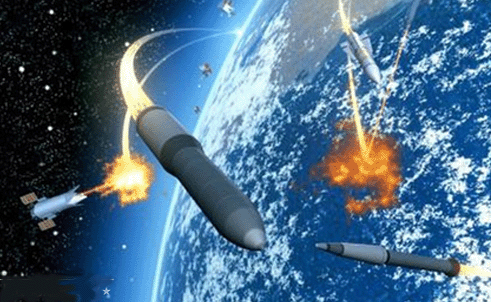
Orbital weapons of both kinds pose a growing threat to the space-based services Britain and its allies depend on, and any attempt to put nuclear weapons in orbit would be highly destabilising and contrary to international law, the Ministry of Defence stated in a written answer.
Lord Coaker, Minister of State at the department, was answering Baroness Bennett of Manor Castle, the Green Party peer, who asked what assessment the government had made of the danger of orbital weapons, kinetic and otherwise, following what she described as the disclosure by the United States of its aggressive space capacity, and what steps ministers plan to take to prevent a new arms race in space.
The minister replied: “The Government recognises that orbital weapons, both kinetic and non-kinetic, pose a growing threat to critical space-based services vital to the UK and its allies. We are concerned by reports of efforts to deploy nuclear weapons in space, which would be highly destabilising and contrary to international law. The Government supports a behaviour-based, risk-reduction approach to maintain a safe, secure and sustainable space environment. We work closely with international partners to promote responsible conduct, uphold existing legal frameworks and prevent escalation.”
He continued: “Through the UK Space Strategy and Defence Investment Plan, the Government is investing in the resilience and protection of UK and allied space assets to ensure freedom of action in space and safeguard long-term sustainability. We remain committed to international cooperation and the development of norms that reduce risk and preserve stability in this increasingly contested domain.”
The same minister had declined a week earlier to say whether Britain itself has anything in orbit. Lord Lee of Trafford, the Liberal Democrat peer, asked on 22 September whether the United Kingdom has any weapons in space, and if not whether there are plans to deploy any.
Coaker replied: “We do not comment on specific Defence capabilities, including whether such capabilities are deployed in space, nor on future operational plans where doing so would risk undermining national security. We do however recognise that space is important to military operations and is becoming more congested, contested, and competitive. The Government is committed to collaborating with allies and partners to promote internationally agreed norms, avoid unintentional escalation and conflict, and ensure that space remains open, safe, and sustainable.”
He added: “In addition, the UK’s national security depends on freedom of action in space, including the ability to protect UK and allied space assets. As set out in the UK Space Strategy and Defence Investment Plan, the Government is investing in capabilities to strengthen resilience and support the protection of UK interests in space, while continuing to operate responsibly and in accordance with international law.“September 29, 2026
Japan says it’s time for ‘taboo-free’ discussions about acquiring nuclear weapons
Defence minister says non-nuclear principles should be revisited given the current global security ‘crisis’
Maroosha Muzaffar, Independent UK, Wednesday 30 September 2026
Japan’s defence minister renewed calls for opening a debate on acquiring nuclear weapons, saying Tokyo could not afford to rule out security options as tensions with China, Russia and North Korea continued to intensify.
“The idea that we aren’t even allowed to have a discussion on this matter is a bit at odds with my sense of crisis,” Shinjiro Koizumi said in a TV interview on Monday.
He argued that Japan should discuss its nuclear policy “without taboos”, including the possibility of revisiting its long-standing non-nuclear principles and of acquiring nuclear-powered submarines.
The principles, adopted in 1967, commit Japan to not possessing or producing nuclear weapons, or permitting their introduction to its territory.
Mr Koizumi said the government wasn’t currently committing to any policy, but that options shouldn’t be excluded before they were properly debated. At a press conference on Tuesday, he stressed the need to explain the changing security environment to the public, particularly as Japan was the only nation ever to suffer nuclear attacks in wartime. Japan was attacked with atomic bombs by the US towards the end of World War II, causing unprecedented death and destruction in Hiroshima and Nagasaki.
Mr Koizumi argued that Japan should “carefully explain” changes in the global security situation as well as the actions of neighbouring countries so that the public could share his government’s assessment of the risks.
“I believe it’s safe to say that there are absolutely no grounds for
optimism regarding the security environment surrounding Japan,” he said.
Pointing to the nuclear capabilities of China and Russia and the expanding nuclear arsenal of North Korea, he asked whether Japan could ensure peace by simply avoiding discussion of topics it found difficult…………………………………………………………………………………………………….
Nagasaki mayor Suzuki Shiro, in contrast, described nuclear weapons as an “absolute evil” at the same commemoration, warning against relying on nuclear deterrence and calling on the federal government to uphold the non-nuclear principles.
The issue of nuclear-powered submarines is also moving closer to the mainstream of Japan’s defence debate.
Mr Koizumi said earlier this month that Tokyo wasn’t ruling out acquiring such vessels, shortly after a US navy official expressed support for the idea.
https://www.independent.co.uk/asia/japan/japan-nuclear-weapons-shinjiro-koizumi-takaichi-b3058770.html
European leaders are slashing social spending to keep the US happy
Military budgets paint a target on social spending
Kevin Cashman, 30 September 2026, https://newint.org/military/2026/military-budgets-paint-target-social-spending?utm_source=ni-email-whatcounts%20&utm_medium=email&utm_campaign=YYYY-MM-DD%20enews%20-%20Enews%202%20October%202026&utm_content=1%20NI%20Main%20List1%20-%20enews%20-%20International%20AND%20North%20America
The US is pushing Europe to choose warfare over welfare. Now is the time to reassess NATO membership, argues Kevin Cashman.
Wildfires are raging across Europe. Heatwaves are killing tens of thousands. The US, supported by many European governments, manages the Palestinian genocide with Israel as it wages an unjustifiable war on Iran and tightens its stranglehold on Cuba. Energy and food prices surge around the world, while US officials openly talk about war crimes and fantasize about dismantling the International Criminal Court.
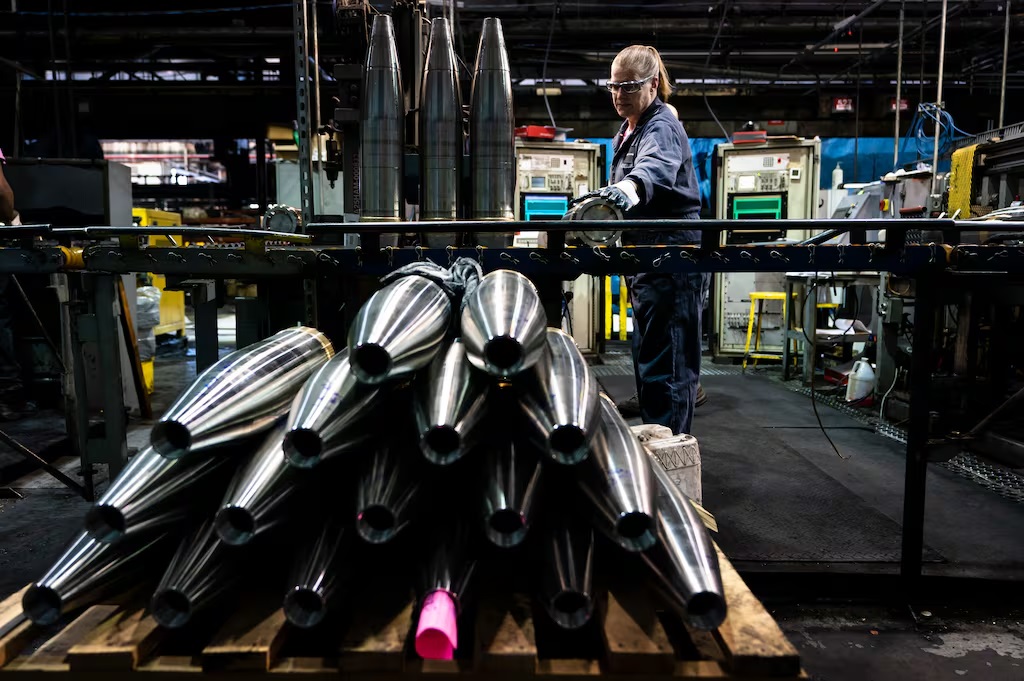
European leaders are not strategizing on how to insulate their constituents from reckless US behaviour. Instead, they are in the grip of a new wave of militarism, plotting to slash social spending to make the US happy. NATO’s spending target is being used to reorder Europe’s public finances: military spending is exempted from fiscal constraints while social investment and climate programmes are on the chopping block. Britain is leading the charge.
Former prime minister Keir Starmer’s last weeks in office were dominated by his attempt to sell the Defence Investment Plan (DIP) to his ministers and NATO allies. It adds nearly $84 billion (£63 billion) to the Ministry of Defence’s budget over the next four years, including an extra top-up of $20 billion (£15 billion) agreed this summer – in response to a surprise request from the ministry for $37 billion more shortly after the last spending review.
The plan is not an anomaly. It is one national installment of a NATO-wide reallocation of public resources to militarism to meet an arbitrary spending target – driven from Washington.
Starmer said the plan would create a ‘defence dividend’ for ‘every region and community’ in Britain, implying that defence will drive growth and create jobs. These claims do not stand basic scrutiny. For one, military spending generally creates fewer jobs and drives less growth than equivalent investment in rail, health, libraries and museums, education, or care – in part because more money leaves the country directly and further down the supply chain. As such, even though the military budget is larger than it was in 1980 in real terms, it supports far fewer jobs.
It gets worse. The recent top-up negotiated with the Ministry of Defence (MoD) and its lobbyists was unfunded. Just before he handed over the government to Andy Burnham, Starmer chose to cut investment across the government by $9 billion, concentrated in the energy and transport departments. This left a further $10.9 billion that may yet be funded through more cuts.
Our analysis at Transition Security Project estimated that the expanded DIP would lead to a net loss of thousands of jobs. Andrea Egan, general secretary of Unison, the country’s largest union, described the plan’s priorities as ‘extra cash for war and overseas interventions but less for schools and hospitals’.
These cuts have received less attention than the military establishment’s displeasure at ‘only’ receiving $20 billion more – rather than every last billion extra that they had demanded. George Robertson, who led the defence review process that was fully funded just one year ago, said the extra funding was insufficient and the ‘challenge is now bigger, more serious, and earlier than we had anticipated’.
John Healey, now British Chancellor, quit his role as defence secretary when it became clear that Starmer was not going to provide the full $37 billion. This is an inversion of every other area of public life, where the demand is to do more with less – a far cry from Starmer’s demand of ‘no more money without reform’ for the National Health Service. The Labour Party’s climate plan, which had an identical price tag to the MoD’s latest request, was promised to bring jobs, energy security and energy bill reductions before being abruptly dropped.
The US’s comically bloated military budget undergirds an ecosystem of military contractors who then lobby for more increases
A coercive strategy
This dynamic is not confined to British politics. The US government is demanding more and providing less to NATO members, even though the Cold-War era alliance has always been about US interests and, as NATO secretary general Mark Rutte put it, serves as a ‘power projection platform for the United States’. With this new orientation, the US has set a target to increase military and security spending to 5 per cent of GDP by 2035.
Across NATO, which currently averages 2.2 per cent spending, it is estimated that this will result in about $8 trillion more spent on militaries by 2035 with annual spending reaching $4.2 trillion. This is not just an arbitrary target, but part of a larger coercive strategy to further subordinate Europe to US political and economic demands by sapping public resources and undercutting states’ ability to address pressing problems that matter to the public. This strategy furthers dependence on the US, while creating a cycle where public disillusionment feeds into rightwing movements, propped up by elites and the US, which then further hollow out productive capacity and social spending.
This approach is working. At July’s NATO summit in Ankara, Starmer received little praise for bowing to military lobbyists while slashing public investment and international aid. Instead, Britain was castigated by the US and the press for not doing enough. It is a similar story in other NATO countries.
To meet targets, the Netherlands is planning cuts to aid and social spending, including limiting unemployment benefit to a year and raising the state pension age beyond the current 67. In Germany, chancellor Merz says that the social welfare system is no longer viable and is cutting housing and parental benegits, while raising military spending dramatically by exempting it from borrowing rules to make space to meet future targets. In addition to other cuts, Britain’s international aid was cut to its the lowest level since 2008 to accommodate military spending, a move that aid network Bond called ‘apalling’ and ‘reckless’.
The effects of these cuts across Europe mean devastating consequences around the world, as programmes supported by aid are ended, and a further deterioration of human security is witnessed in Europe. No matter that both of these effects makes national security more challenging in various respects; the press has been largely supportive of this military largesse. An editorial in Le Monde characterized military spending as everyone’s burden in the face of a grim reality.
The debate in NATO capitals on military spending targets has tried to avoid a public conversation on militarism. One aspect of that conversation should be whether military spending is genuinely defensive. The Defence Investment Plan, for instance, says that Britain should have a persistent presence in the Middle East, Indo-Pacific, Latin America and the Caribbean, and military engagement with states around the world. This is not spending on territorial defence or deterring attack ; it is projecting power and showing allegiance to Washington.
Wasteful aggression
To justify this abuse of public resources and the harsh tradeoffs governments know are unpopular, spending must be sold inaccurately as supporting defensive measures to counteract inflated threats or as a driver of the economy.
Even when spending is focused on defence, it often doesn’t meet basic requirements about accountability. Military spending is rife with fraud and waste. This is easy to see in British military procurement: the Ajax vehicle programme is nearly a decade delayed and a billion pounds over budget, and continues to injure soldiers testing it. A conservative estimate for the scale of fraud and waste in the country’s military spending puts it at billions per year.
Since it is undeniable that human security is fundamental to national security, spending on green industrialization, firefighting, hospitals and care facilities, and public infrastructure, should count towards defence targets
Another problem for NATO members is that much of military spending flows out of their countries, as acknowledged by the Dutch economic affairs ministry. Most European military spending goes to the US: 86 per cent of Britain’s arms imports come from the US and the US share of European NATO imports is 64 per cent and rising. Rutte put the political economy of the European arms trade in surprisingly clear terms recently, saying European military spending sustains nearly 200,000 jobs in the US. This might be seen as a protection racket, but since the US appears to create more problems than it solves, it could be better described as transatlantic tribute between elites. As the public in Europe pays for US decline, elites still capture a share of the extraction the US undergirds.
These problems have become acute for Europe for two structural reasons. The first is the self-imposed fiscal framework adopted by many European governments. By restricting borrowing and other ways of mobilizing public financing, this framework leaves governments with only two ways to finance higher spending: raising taxes or cutting other programmes. These constraints weaken growth and employment and risk locking countries into repeated cycles of austerity. Fiscal rules should be relaxed or removed for productive public investment, but instead governments have largely chosen to suspend or circumvent them to meet NATO spending targets.
The structure of the global economic system is the other reason. Because of the outsized role of the dollar, the US uniquely accrues huge economic and non-economic benefits. It can receive goods and services from abroad for very low cost, allowing it to mobilize resources on a massive scale. But rather than focus on productive investment like solving global problems, US governments largely squander this ‘exorbitant privilege’ by funnelling money to the wealthy.
A good example of this is the US’s comically bloated military budget, which is by far the largest in the world and has few guardrails. This massive spending undergirds an ecosystem based around military contractors that lobbies for more increases, inflates threats and agitates for war, and presses for the same in US client states. But even US military officials were bewildered by the proposal for a $500 billion increase in the latest budget – one that does not need to be offset by cuts.
European militarism at Trump’s behest looks less like a defence dividend and more like a drain: where Europe’s public resources are siphoned off to meet arbitrary targets by a complicit elite and sent in large part to the US. From the US perspective, maintaining and expanding this extraction is the point. It wants a weaker Europe that is dependent on US military exports and technology, and which also dutifully collaborates to reach US economic and foreign policy objectives.
US foreign policy has cost Europe dearly. The sanctions-first Western response led by Washington, and rejection of diplomacy early in the Ukraine war, led to Europe paying well over $1 trillion in higher energy bills as it switched its dependence from Russian natural gas to more costly US liquified natural gas. The US-Israeli war on Iran continues in the same vein. Higher energy prices are again costing Europe billions and leading to record profits for energy companies, which flow disproportionately to the US and the wealthy. At the same time the US stifles European industry.
NATO members meeting their spending targets on time is not likely to placate Washington. In Britain, prime minister Burnham has a chance to change course but his government has so far signalled that military spending will be a priority over any other spending, and that it will seek new financing opportunities not for climate action or green industry, but for war. Will his government keep arguing that defence will drive growth and innovation, even though other public spending does both and is a productive use of resources? And as the US war on Iran threatens to derail the British economy, will Burnham prioritise the British public and their priorities, and abandon the unworkable path to 5 per cent military spending?
Short of leaving NATO, Burnham has options. One is broadly classifying public spending as military-related, as Slovakia has done with hospitals. This is permitted for up to 1.5 percentage points of the target, but since it is undeniable that human security is fundamental to national security, spending on green industrialization, firefighting, hospitals and care facilities, and public infrastructure, for example, should count toward the overall target.
Another approach would be strengthening security at dramatically less cost by focusing on territorial defence and collective deterrence, and eliminating unnecessary programmes focused on power projection abroad. Part of this would be breaking with US foreign policy where necessary, for example by not permitting the US to use bases in its war on Iran.
As military spending drives a wave of self-defeating cuts, and a new militarism even more dependent on the US threatens to become a permanent fixture of the economy, now is the time to rethink NATO membership. Europe needs a new approach: one that is independent and grounded in broad, genuine human security above all. Public wellbeing depends on the ability to act on global problems like climate change and invest in social priorities. These are on the chopping block today.
Germany is buying every missile it can get. What is Berlin preparing for?
From American Tomahawks to Israeli ballistic missiles, the Bundeswehr is building the ability to strike far beyond Germany’s borders
30 Sep, 2026, By Dmitry Kornev,
Over the past few months, there’s been a noticeable surge in reports regarding Germany’s interest in missiles – ranging from ballistic and cruise missiles to land- and sea-based systems. Various partners are involved in the initiative, including the US, Ukraine, Türkiye, and Israel. It looks like Germany intends to spend its entire budget on missiles, aiming to become the leading missile power in Western Europe.
Berlin’s financial commitment to advancing military programs has reached unprecedented levels. The country is significantly ramping up defense spending. Between 2024 and 2025, approximately 200 new defense industry companies emerged in Germany, and another 100 have appeared since November 2025. A notable example is Rheinmetall, which has dramatically increased its artillery ammunition production from about 70,000 units to 1.5 million shells per year. Over the next six years, the company plans to invest around €30 billion ($34 billion) into arms and munitions manufacturing. Moreover, Germany is actively seeking to procure ready-made missile systems and is interested in establishing joint production facilities.
Aligned with these initiatives, Germany is establishing new ground forces capable of striking military targets deep within potential enemy territory, essentially creating missile troops within the Bundeswehr. On the one hand, this expansion enhances NATO’s strike capabilities and allows for flexible responses to any external threats over distances of thousands of kilometers. On the other hand, such offensive capabilities could easily inspire ideas of military dominance and hegemony. Historically, we’ve already seen this in Germany.
At the forefront of this new German strategy will be American Typhon MRC (Mid-Range Capability) missile systems, equipped with Tomahawk cruise missiles with a range of up to 1,600 km. The Bundeswehr plans to allocate nearly €3.4 billion for the procurement of these missiles. They will provide the German military with a strategic edge, enabling strikes against command centers, airbases, missile units, logistical hubs, and other critical targets far beyond the potential front lines.
Germany’s main argument in favor of this military buildup is, of course, the need to deter the “threat from the East” – a classic case of history repeating itself. The fact that Russia has no intention of attacking NATO doesn’t seem to matter; it serves as a convenient excuse and a rallying cry to ramp up militarism. Technically, from German territory, Tomahawk missiles can only reach parts of European Russia, but Berlin’s ambitions extend well beyond this missile system.
Germany’s interest in missiles has grown to such an extent that the Bundeswehr is exploring even some rather unconventional projects, such as Ukraine’s Flamingo and Bars cruise missiles, as well as the Anthem missile project. In fact, the Ukrainian Flamingo missile was considered a potential alternative to the US Tomahawk. With a range of 3,000 km, the Flamingo surpasses the Tomahawk in terms of range. Additionally, it boasts an impressive warhead weighing 1,150 kg – a record in its class. The only real question is whether the 10-meter-long missile can successfully hit targets. So far, experience has shown that most of the Flamingos launched by Ukrainian forces are intercepted by air defense systems.
Germany is also ready to produce Bars missiles on its soil, but primarily for export purposes. It remains unclear whether this initiative leans more toward a business venture or a strategic investment in domestic armaments. Bars missiles might not be of much interest to German military officials since they essentially function as a cheap and simple alternative to more costly missiles.
Another notable project is the Anthem long-range cruise missile developed by the US-Israeli startup Covenant……………………………………………………….https://www.rt.com/news/646415-germany-is-buying-every-missile/
Putin: Ready To Use ‘All Weapons’ Including Nuclear, If Kaliningrad Attacked

by Tyler Durden, Saturday, Oct 03, 2026, https://www.zerohedge.com/geopolitical/putin-ready-use-all-weapons-including-nuclear-if-kaliningrad-attacked
Now it’s no longer just high-ranking Kremlin officials saying it, but Russian President Vladimir Putin has now directly weighed in amid the ongoing nuclear threat tit-for-tat involving European officials.
Speaking at the Valdai Discussion Club in Moscow on Thursday, he warned the Western allies to cease their escalation in Ukraine, stressing he’s willing to use “all weapons” in the Russian arsenal in the scenario that Russia’s exclave of Kaliningrad comes under attack.
“The drills in the Baltic Sea, following one another… Then the attempts to arrest our ships and vessels. All this is an escalation. And then we began to hear statements regarding the Kaliningrad region,” Putin said.
“If it comes to direct attack against the Russian Federation, in this case on Kaliningrad and possibly some other territories, of course the issue of using all weapons in our country’s arsenal will inevitably and unavoidably emerge on the agenda. This is unavoidable,” he asserted in a warning that includes nuclear weapons.
NATO held recent military drills near Kaliningrad which were broadly described as deterrence operations, which Putin referenced in the remarks.
Rhetoric has been running particularly hot over the exclave which is sandwiched between NATO members Poland and Lithuania all week, as Associated Press earlier described:
The warning sent to NATO echoed statements issued by several Russian embassies in Europe this week which said that Moscow has “information that NATO is preparing (an) air and naval blockade of Kaliningrad and Kaliningrad region.”
The embassies in the U.K. and Ireland posted their statements on their Telegram channels, and the embassy in Belgium released it to the Tass news agency.
The ratcheting accusations from the European side have also centered on charges of a Russian sabotage campaign targeting the Baltics as well as Germany.
Moscow at the start of the week took the rare step of submitting a formal letter to NATO leadership in Brussels.
The letter accused NATO of an “unprecedented escalation of the military-political situation around Russia’s region of Kaliningrad accompanied by highly provocative public statements by NATO Allies’ officials.”
“This dangerous and reckless course entails high risk of the outbreak of a direct armed conflict with the possibility of Russian strikes against decision-making centers of the alliance’s member states right from the outset of the conflict,” the letter said.
NATO was especially incensed and alarmed at this key line of Moscow’s letter:
“Russia will be ready to use the entire arsenal of forces and capabilities at its disposal, including nuclear weapons, in order to defend its territory, should NATO countries undertake any attempt aimed at isolating the Kaliningrad region from the rest of the country.”
Apparently this most recent tense back-and-forth over Kaliningrad was initially triggered by a television show which recently aired in the UK this month.
Preview of the provocative UK series The WarGame which started airing this month. The Kremlin has vehemently condemned it, and sees in it some clear messaging and an ominous threat:
Newsweek described, “The statement follows a miniseries aired by British broadcaster Sky News last week, The Wargame, which traces a hypothetical Russian attack on the U.K. and how the country might respond—including by authorizing operations against the Baltic territory of Kaliningrad.”
Four thousand pages of plans, none for peace: NATO’s insane provocations toward war
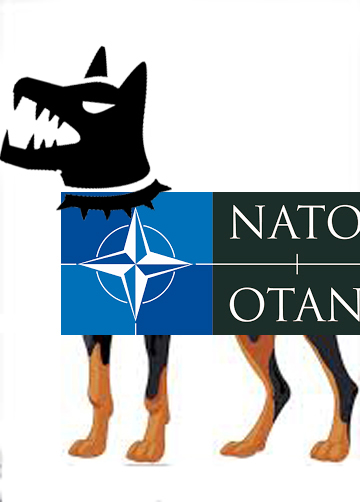
The entire rhetorical framework of Copenhagen rests on an unproven premise: that Russia is preparing to attack the Alliance. The evidence cited includes airspace violations, acts of sabotage, and intelligence reports suggesting an attack “in the coming years.” The Kremlin has denied such plans, and the denial alone proves nothing. But strategic logic does. Moscow has been engaged in Ukraine for over four and a half years; a direct attack against a NATO member would pit it against the arsenals of the United States, the United Kingdom, and France, with no gain commensurate with the risk. Anyone who thinks in terms of costs and benefits – in Moscow as well as in Brussels – understands that such a move is highly unlikely.
Why, then, insist on the imminence of the threat? One answer – one that is hard to dismiss – lies in the budgets. At the Hague summit in June 2025, the allies committed to raising defense spending to 5% of GDP by 2035. Such a goal can only be justified to voters if there is an enemy at the gates. Fear has become a budget line item.
Lorenzo Maria Pacini, September 24, 2026, https://strategic-culture.su/news/2026/09/24/four-thousand-pages-of-plans-none-for-peace-nato-insane-provocations-toward-war/
What does Europe gain from a war it can’t win? Nothing. 1914 is calling.
Everything is ready to explode
In Copenhagen, before the chiefs of staff of the 32 countries of the Atlantic Alliance, Admiral Giuseppe Cavo Dragone chose the words with which to address the European public. As chairman of NATO’s Military Committee since January 2025, he announced that the Alliance has “4,000 pages of plans” for its eastern flank, that these plans cover every scenario “from a minor crisis or an intervention on our territory to the invocation of Article 5 and subsequent actions,” and that “military personnel, systems, and weapons are ready.” Then came the closing remark: in the event of an attack, the Russians “have much more to lose than to gain. This is absolutely certain. And that is what constitutes deterrence.”
The admiral intended this to be a reassuring message. Read carefully, however, it is one of the most imprudent statements made by a European military leader since the end of the Cold War. It is worth breaking it down piece by piece.
The words spoken in Copenhagen did not fall on deaf ears. Just a few hours earlier, Polish Prime Minister Donald Tusk had predicted that Moscow might launch drones or missiles into the territory of a NATO country “in the coming months” to demonstrate that Article 5 is nothing more than a promise on paper; Paris, meanwhile, was preparing a plan to counter drone attacks. In such an atmosphere, the duty of a high-ranking military officer would be to calm tensions, distinguish between hypothesis and fact, and remind governments that war between nuclear powers is not a scenario to be planned but one to be prevented. The admiral did the opposite: he added fuel to the fire.
And this isn’t the first time. In December 2025, in an interview with the Financial Times, Cavo Dragone himself explained that the Alliance was considering becoming “more aggressive” against Russia’s hybrid warfare, that a “preemptive strike” could be considered a “defensive action,” and that being more aggressive than the opponent “might be an option.” Moscow, through Maria Zakharova, spoke of an irresponsible step toward escalation, coming while negotiations on Ukraine were underway. Ten months later, the tone hasn’t changed. It has only become more explicit: first the possibility of a preemptive strike, now the inventory of weapons at the ready.
Deterrence isn’t achieved through proclamations
The admiral calls all of this “deterrence.” But the theory of deterrence – the serious kind – says otherwise. Thomas Schelling explained that deterrence is an act of communication in which credibility matters as much as force, and that an effective threat always leaves the adversary a way out. In the security dilemma, what one side perceives as defense is interpreted by the other as preparation for offense. Four thousand pages detailing “follow-on actions” under Article 5 are, from Moscow’s perspective, war plans against Russia. No Kremlin analyst will interpret them any other way, and no one should be surprised by this.
There is also a question of role. The Chairman of the Military Committee is the chief military adviser to the Secretary General and the North Atlantic Council: he does not determine Alliance policy; he serves it. When an officer of this rank uses a public platform to issue warnings to a foreign power, he encroaches on a space that belongs to governments and parliaments – that is, to those who are accountable to the citizens. In a democracy, the decision to go to war does not rest with the generals. Or are we to understand that it is NATO, through “Cavo Dragone,” that is provoking the outbreak of war by calling for it with all its might?
And above all, there is the nuclear weapon. Since November 2024, Russian doctrine has regarded an attack by a non-nuclear state – carried out with the participation or support of a nuclear power – as a joint attack, and has lowered the threshold for the use of nuclear weapons. One may judge that doctrine as one wishes. It is impossible to ignore it. Anyone who speaks of “follow-up actions” under Article 5 against a country that has laid out these rules in black and white is, whether they like it or not, talking about nuclear war.
The entire rhetorical framework of Copenhagen rests on an unproven premise: that Russia is preparing to attack the Alliance. The evidence cited includes airspace violations, acts of sabotage, and intelligence reports suggesting an attack “in the coming years.” The Kremlin has denied such plans, and the denial alone proves nothing. But strategic logic does. Moscow has been engaged in Ukraine for over four and a half years; a direct attack against a NATO member would pit it against the arsenals of the United States, the United Kingdom, and France, with no gain commensurate with the risk. Anyone who thinks in terms of costs and benefits – in Moscow as well as in Brussels – understands that such a move is highly unlikely.
Why, then, insist on the imminence of the threat? One answer – one that is hard to dismiss – lies in the budgets. At the Hague summit in June 2025, the allies committed to raising defense spending to 5% of GDP by 2035. Such a goal can only be justified to voters if there is an enemy at the gates. Fear has become a budget line item.
Why Britain cannot deliver SSN-AUKUS on schedule

Australia is pinning its strategic future to an overburdened, fiscally constrained UK industrial baseline.
Peter Briggs, October 1, 2026, https://pearlsandirritations.com/post/2026/10/why-britain-cannot-deliver-ssn-aukus-on-schedule/
Britain says SSN-AUKUS remains on track. But its shipyards are already stretched while new reactor and workforce capacity is still being built. Australia is betting heavily on that gap being closed in time.
The public relations narrative of AUKUS Pillar 1 rests on a singular, untested premise: that the United Kingdom can seamlessly transition from its current Astute and Dreadnought submarine programs to deliver a brand-new, complex, 10,000-tonne nuclear-powered attack submarine, SSN-AUKUS, on schedule.
Recent developments in the UK demonstrate that this political optimism is fundamentally disconnected from the physical, contractual, financial and industrial realities on the ground at BAE Systems’ shipyard in Barrow-in-Furness.
In September 2025, King Charles formally commissioned HMS Agamemnon, the sixth Astute-class submarine, into the Royal Navy. Press releases heralded a major defence milestone. Yet, far from entering active service, Agamemnon remained tied up inside the Devonshire Dock Basin at Barrow for another full year, only departing for initial contractor sea trials on 24 September 2026.
The early commissioning reverses standard Royal Navy procurement. Laid down in July 2013, Agamemnon took 13 years and two months simply to leave the dock. Her actual entry into service will not occur until mid-to-late 2027 – a 14-year construction timeline.
This ceremonial exercise illustrates a broader pattern of political messaging substituting for industrial output. Claims that steel will be cut for the first SSN-AUKUS hull at Barrow in 2027 follow the same pattern. Embarking on physical hull fabrication before completing a preliminary design review (PDR) and freezing the 3D spatial design model risks severe engineering setbacks. For SSN-AUKUS, detailed design funded under a £3.95 billion development contract running through 2028 remains under way. Without a stable PDR baseline, internal layouts, reactor integration and pipework remain in flux. ‘Cutting steel’ in 2027 will merely involve cutting test rings or material qualification modules rather than assembling an operational warship.
Yard saturation and uncontracted infrastructure
The physical state of Barrow shipyard exposes the impossibility of fast-tracking SSN-AUKUS.
The heart of Barrow’s manufacturing capability is the Devonshire Dock Hall (DDH). Currently, the DDH is full. It houses the first three Dreadnought-class ballistic missile submarines (Dreadnought, Valiant and Warspite) alongside the final Astute hull, HMS Achilles (Boat 7), while initial fabrication for the fourth SSBN (HMS King George VI) proceeds off-site. There is no physical bay space inside the primary hall to establish an SSN-AUKUS production line.
The severity of this spatial bottleneck was underlined in a recent planning application submitted by BAE Systems Marine Ltd for its North Quay site, immediately adjacent to the DDH. BAE sought municipal approval to erect a 125-metre-long temporary enclosed scaffold structure on the open quay to house overflowing component manufacturing and outfitting. In its official filing, BAE acknowledged the improvised structure was explicitly required “as a result of capacity constraints within the Devonshire Dock Hall (DDH)”.
When a major nuclear shipyard must resort to 125-metre fabric sheds on quayside aprons to handle current workloads, absorbing a new 10,000-tonne attack submarine line strains credibility.
To bypass this bottleneck, BAE Systems purchased an 18-acre former gas site at Ramsden Dock. The plan is to manufacture hull cylinders on this port land and barge them via a roll-on/roll-off (Ro-Ro) quay to the main dock basin. However, the site requires extensive clearing, re-grading and deep piling before shed construction can begin.
Crucially, while the initial £3.95 billion contract covers preliminary 3D design and basic enabling works, primary contract packages required to build these sheds and construct the Ro-Ro wharf remain unexecuted or fragmented across future budget cycles. Furthermore, in July 2026, the UK MoD awarded a £5.9 billion delivery contract strictly prioritised for the Dreadnought-class SSBN. Because Britain’s continuous at-sea deterrent takes total strategic precedence, primary nuclear engineers, dry docks and yard resources at Barrow are contractually locked into Dreadnought through to the delivery of the fourth boat in the late 2030s.
Reactor supply and logistics bottlenecks
The industrial choke point extends beyond Barrow to the nuclear supply chain at Raynesway in Derby, where Rolls-Royce Submarines manufactures all Royal Navy reactor cores.
To support both Dreadnought and SSN-AUKUS, Rolls-Royce began work to double the footprint of its Raynesway site in July 2026. Once assembled, complete PWR3 reactor modules must be transported over 150 miles by road in heavy-duty, radiation-shielded containers under armed police escort along the M6 and A590 corridors directly into the Barrow yard.
While the PWR3 reactor has been lowered into lead boat HMS Dreadnought inside DDH, manufacturing and delivering reactors for follow-on SSBN hulls alongside initial SSN-AUKUS units creates a severe industrial queue. Raynesway remains constrained by strict nuclear licensing oversight and an acute shortage of specialised nuclear-certified welding technicians.
The human and civil bottleneck
The physical sheds at Barrow may eventually be erected; however, the civil infrastructure required to support the workforce does not exist in the numbers required.
BAE Systems has expanded its Barrow workforce from 11,000 to approximately 16,000, aiming for over 18,000. In 2026, the UK House of Commons Defence Committee warned that infrastructure investment at Barrow “has already faltered”. BAE Systems formally advised local government that the shipyard requires 900 new homes to be built annually in Barrow to house incoming technicians. Current local construction struggles to deliver 200 units per year. Thousands of contractors commute daily along the single-carriageway A590, creating severe transport gridlock.
In response, the UK Government established ‘Team Barrow’ with a £200 million regeneration fund. However, Team Barrow leadership has publicly acknowledged that this seed allocation falls far short, stating that £400 million to £800 million in combined investment will be required to tackle the town’s infrastructure deficit. Furthermore, this funding is designated for general municipal upgrades – schools, healthcare and roads – rather than industrial shipyard tooling.
Britain lacks the localised housing, transport capacity and specialised nuclear-certified trade workforce to operate two concurrent submarine construction lines.
Strategic imperatives: NATO vs Indo-Pacific overreach
This industrial overstretch must be viewed through the unforgiving lens of Britain’s fiscal deficit and shifting strategic priorities.
Under mounting financial pressure, the UK Ministry of Defence faces a multibillion-pound structural budget shortfall. The UK Strategic Defence Review has formalised a mandatory ‘NATO-first’ posture, directing military resources, capital investment and force readiness primarily toward European defence and deterrence against Russian aggression. Facing a security crisis on its continental doorstep, Whitehall cannot afford to bankroll massive, long-horizon industrial expansions designed to project power into the Indo-Pacific.
Sustaining Britain’s continuous at-sea deterrent via Dreadnought consumes the lion’s share of UK capital expenditure. Coupled with urgent demands to re-arm land and air forces in Europe, attempting to design and build a bespoke 10,000-tonne attack submarine for Australia would appear to be a lower priority.
Industry is striving to recover from decades of systemic neglect that has left operational SSN capability immobilised and the continuous at-sea deterrent under strain. Political ambition cannot overrule the laws of industrial capacity, national economics and engineering physics.
Australia is pinning its strategic future to an overburdened, fiscally constrained UK industrial baseline. The physical and financial evidence at Barrow – an unbuilt off-site facility, a saturated main assembly hall requiring temporary outdoor work space, unfinalised contracts for primary manufacturing sheds, acute housing deficits, severe reactor supply chain queues, and a UK defence budget deficit whilst pivoting back to Europe – demonstrates that Britain cannot deliver SSN-AUKUS on the promised timeline.
Relying on ‘schedule-free’ assurances while ignoring these constraints guarantees a severe capability gap for Australia. It is time for Washington, London and Canberra to acknowledge these ground realities and undertake a fundamental reappraisal before industrial overreach turns into operational and political catastrophe.
Peter Briggs
Peter Briggs retired from the RAN in 2001 after a 40-year career, specialising in submarines. This included two submarine commands, command of the RAN Submarine Squadron, director of Submarine Policy and Warfare and Head of Submarine Capability Team, established to rectify Collins introduction into service issues. He was the president of the Submarine Institute of Australia from 2006-09 and is a frequent contributor to public debate on Australian submarine matters.
1 This Month
23-25 October – on Zoom – World BEYOND War’s annual global conferenc


Shut down the radiation-damaged Heysham nuclear reactors now
To see nuclear-related stories in greater depth and intensity – go to https://nuclearinformation.wordpress.com

Say No to NASA’s Reckless Nuclear Reactor on the Moon
Say No to NASA’s Reckless Nuclear Reactor on the Moon

-
Archives
- October 2026 (247)
- September 2026 (339)
- August 2026 (330)
- July 2026 (355)
- June 2026 (287)
- May 2026 (306)
- April 2026 (356)
- March 2026 (251)
- February 2026 (267)
- January 2026 (308)
- December 2025 (358)
- November 2025 (359)
-
Categories
- 1
- 1 NUCLEAR ISSUES
- business and costs
- climate change
- culture and arts
- ENERGY
- environment
- health
- history
- indigenous issues
- Legal
- marketing of nuclear
- media
- opposition to nuclear
- PERSONAL STORIES
- politics
- politics international
- Religion and ethics
- safety
- secrets,lies and civil liberties
- spinbuster
- technology
- Uranium
- wastes
- weapons and war
- Women
- 2 WORLD
- ACTION
- AFRICA
- Atrocities
- AUSTRALIA
- Christina's notes
- Christina's themes
- culture and arts
- Events
- Fuk 2022
- Fuk 2023
- Fukushima 2017
- Fukushima 2018
- fukushima 2019
- Fukushima 2020
- Fukushima 2021
- general
- global warming
- Humour (God we need it)
- Nuclear
- RARE EARTHS
- Reference
- resources – print
- Resources -audiovicual
- Weekly Newsletter
- World
- World Nuclear
- YouTube
-
RSS
Entries RSS
Comments RSS

