Without any outcry, Donald Trump triggers a new arms race, promising $billions in new nuclear weapons contracts
Trump Quietly Promises Billions in New Nuke Contracts, This could trigger a new arms race with Russia  and China. The American Conservative By • September 1, 2017 “………Nuclear Armageddon was a pervasive reality during the Cold War, and America had an arsenal and doctrine to make it a reality. Again, flashbacks from my childhood make it all-too real: F-100 fighter-bombers carried nuclear bombs on air-strip alert at an air base in Turkey. F-106 fighter-interceptors armed with nuclear “Genie” air-to-air missiles were on constant air patrol over the skies of Michigan. My father told my mother how he never wanted to be assigned to Strategic Air Command because the “Chrome Dome” mission was insane—packs of nuclear-armed B-52 bombers constantly in the air, flying towards the Soviet Union only to be called back on a routine basis……..
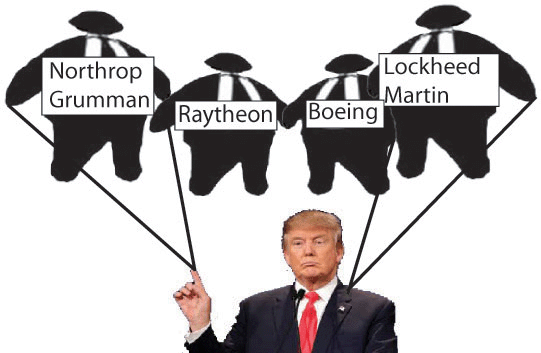 The Trump administration has just announced that it is moving ahead with an Obama-era plan to modernize America’s nuclear arsenal, sprucing up the nuclear Triad with a new fleet of land-based missiles, missile-carrying submarines, and air-delivered nuclear weapons that will cost the American taxpayer well over $1 trillion in the coming years. The ostensible purpose behind this modernization effort is to maintain America’s nuclear deterrence capability for decades to come. The harsh reality, however, is that through this nuclear upgrade, America is simply repeating the mistakes of the past, building weapons whose precision and speed will trigger a new arms race with Russia and China as they seek to match this new American capability with weapons designed to sustain their version of nuclear deterrence.
Mutually assured destruction (MAD), once relegated to the trash bin of history, has had new life breathed into it. This time there is no foundation of arms control in place to limit the insanity—the ABM treaty is a thing of the past, and America today hides behind the false promise of a missile-defense shield that has questionable utility against a North Korean madman armed with a handful of missiles, let alone a Russian or Chinese military armed with hundreds. Disarmament talks with Russia—once a hallmark of the Trump foreign-policy vision—are stillborn in the face of allegations of election meddling from Moscow.
American tanks patrol the Polish frontier opposite their Russian counterparts, while U.S. and Russian warplanes share the skies over Syria, and play cat and mouse over the Baltics. Into this volatile mix, President Trump now wants to deploy a new generation of nuclear weapons that any enemy possessing a modicum of strategic insight would have no choice but to view as possessing genuine first-strike capability. Given the enhanced performance of these weapons, there will be no “fail safe” mechanism to limit the scope and scale of inadvertent use. There won’t be time for military officers to call home with a furtive warning of impending doom, and “Bert the Turtles” lyrical admonitions to “duck and cover” will be rendered meaningless to a population who has long ago forgotten what it was like to live under the threat of imminent nuclear holocaust. Today Americans are unable or perhaps unwilling to hold their elected leaders responsible as they play nuclear Russian roulette—a game as avoidable as it is insane.
Scott Ritter is a former Marine Corps intelligence officer who served in the former Soviet Union implementing arms control treaties, in the Persian Gulf during Operation Desert Storm, and in Iraq overseeing the disarmament of WMD. He is the author of Deal of the Century: How Iran Blocked the West’s Road to War(Clarity Press, 2017). https://www.theamericanconservative.com/articles/trump-quietly-promises-billions-in-new-nuke-contracts/
As USA and South Korea run mock bombing drill, Putin warns on futility of pressuring North Korea
Putin says putting pressure on North Korea is a ‘dead-end road’, By James Griffiths, CNN , 1 Sept 17
Trump’s war planning advisors – billionaire private military contractors !
 White House Hires Billionaire War Profiteers To Aid In War Planning, Mint Press News, Blackwater founder Erik Prince and billionaire Stephen Feinberg reportedly “recruited” for war planning, by Jake Johnson July 11th, 2017[good tweets included on original]
Two of President Donald Trump’s closest aides have reportedly solicited advice from two wealthy private military contractors — Erik Prince, founder of Blackwater, and Stephen Feinberg, the billionaire owner of DynCorp International—on how to proceed with the sixteen-year-long war in Afghanistan.
According to the New York Times, White House Chief Strategist Steve Bannon and senior advisor Jared Kushner “recruited” the contractors, who have made a hefty sum from perpetual conflict in the Middle East, “to devise alternatives to the Pentagon’s plan to send thousands of additional troops to Afghanistan.”
Following a meeting with Bannon and Kushner, Prince and Feinberg have “developed proposals to rely on contractors instead of American troops in Afghanistan,” the Times notes.
“The highly unusual meeting dramatizes the divide between Mr. Trump’s generals and his political staff over Afghanistan, the lengths to which his aides will go to give their boss more options for dealing with it and the readiness of this White House to turn to business people for help with diplomatic and military problems,” the Times reports. “But it also raises a host of ethical issues, not least that both men could profit from their recommendations.”
As Common Dreams reported last month, Prince penned an op-ed in the Wall Street Journal in which he recommended a “viceroy approach” in Afghanistan that would rely heavily on private security forces.
Critics characterized Prince’s proposals as tantamount to “colonialism” and argued they exude “sheer 19th-century bloodlust and thirst for empire.”
Following the Times reporting on Monday, commentators denounced the attempt to give credence to the ideas of war profiteers as “lunacy.” http://www.mintpressnews.com/white-house-hires-billionaire-war-profiteers-aid-war-planning/229664/
Tactical nuclear weapons for South Korea: U.S. and South Korean defense leaders considering this



| Song, Mattis reportedly discuss redeployment of tactical nuclear weapons to South Korea, The Hankyoreh, Sep.1,2017 |
Most Americans would be fine with dropping a nuclear weapon on an Iranian city!
Americans Are a Little Too Relaxed About Nukes, A majority say they’d be fine with dropping a nuclear weapon on an Iranian city. What? Bloomberg ,By Faye Flam, August 31, 2017, North Korea’s advancing nuclear weapons program isn’t the only news to unnerve arms-control experts this summer. A new survey has revealed that Americans are surprisingly willing to make a first nuclear strike — and kill millions of civilians abroad.

The survey casts doubt on the power of what experts call the “nuclear taboo,” said Stanford University historian David Holloway, author of “Stalin and the Bomb.” The idea, or hope, behind the concept is that it’s not just luck that humans haven’t dropped any nuclear weapons for 70 years — that there’s a stigma that makes the use of nuclear weapons unthinkable.
But many Americans say it’s quite thinkable. The taboo may be eroding, or it may never have been the protective barrier people thought it was.
The survey’s designers sketched out a hypothetical conflict with Iran — a country without nuclear weapons. Around 60 percent of those polled said that if Iran provoked the U.S. with some non-nuclear aggression, they’d approve of blowing up 2 million Iranian civilians using nuclear weapons rather than sacrificing 20,000 American lives in a ground attack.
“That just means they haven’t thought about it,” said Brian Toon, a professor of atmospheric science at the University of Colorado. They think nuclear weapons are just big bombs that blow up lots of people, he said, without considering the way a nuclear conflict -– even a “small” one involving some 10 percent of the U.S. arsenal — might poison millions of men, women and children. and change the climate enough to starve hundreds of millions.
Today, it’s not Iran but North Korea that’s the focus of concern — with its continued testing of nuclear missiles despite Trump’s threat of “fire and fury.” Serious people are starting to consider the possibility of nuclear conflict. While the North is unlikely to be capable of sending nuclear missiles all the way to the U.S., at least for now, there are plenty of ways casualties could escalate. “There are nuclear reactors all over North Korea,” Toon said. So you might have Fukushima-type contamination all over the country.
Perhaps if people more clearly understood the destruction of human life that would result, the taboo would regain its power. In the early years of the Cold War, the power of nuclear weapons apparently surprised Daniel Ellsberg, a RAND Corporation analyst on loan to the Pentagon for the purpose of nuclear war planning.
“One day in the spring of 1961, soon after my 30th birthday, I was shown how our world would end,” he wrote in 2009. Ellsberg, who is famous for leaking the Pentagon Papers in 1971, has spent recent decades examining the potential for nuclear catastrophe. His latest book, “The Doomsday Machine: Confessions of a Nuclear War Planner,” will be released in December.
The end of the world was described in a highly classified document, Ellsberg recalled. While it didn’t necessarily spell extinction of the human race, it estimated a nuclear war would kill at least 600 million people — or as Ellsberg put it, “a hundred Holocausts.”……https://www.bloomberg.com/view/articles/2017-08-30/americans-are-a-little-too-relaxed-about-nukes
America;s new fuze nuclear weapons system threatens world stability
America’s Risky Nuclear Buildup https://www.nytimes.com/2017/08/31/opinion/america-nuclear-buildup.html, AUG. 31, 2017 “…….Pyongyang’s displays of its nuclear and missile technology are terrifying. But Washington’s development of new nuclear-weapon and missile technologies is also contributing to global instability. American nuclear advances threaten to start a new arms race and change the logic of mutually assured destruction, which has undergirded nuclear stability since the 1950s.
In recent years, the Pentagon has increased the overall offensive power of its nuclear arsenal. Those changes, along with further upgrading, will amount to more destructive power from all three legs of the American nuclear triad: sea, land and air-launched nuclear weapons.
From the sea, a nuclear missile “super fuze” timing element improves the accuracy of submarine-based warheads by allowing for detonation closer to targets. The United States began incorporating this new fuze system into the ballistic-missile submarine fleet in 2009, and some analysts believe the entire submarine force has already been equipped with the technology.

And last week, the Pentagon announced that it had awarded contracts for updated versions of both the ground-based nuclear intercontinental ballistic missile arsenal and the air-launched nuclear-tipped stealth cruise missile, designed to penetrate enemy territory undetected.
According to some nuclear weapons experts, enhancements like the super fuze have increased by up to threefold the destructive capacity of America’s nuclear arsenal. And Andrew C. Weber, a former assistant defense secretary, recently described the upgraded stealth cruise missiles as “a destabilizing system designed for nuclear war fighting,” rather than a necessary addition to the system of nuclear deterrence.
When initially planned during the Obama administration, the upgrades were paired with commitments to nuclear-arms reduction and a policy that narrowed the conditions under which the United States would use its nuclear weapons. The upgrades will continue under President Trump, but there is no sign that they will be accompanied by the kind of limitations on their use advocated by his predecessor.
Washington’s defensive capacity is centered on the deployment of batteries of missile interceptors — most notably the Terminal High Altitude Area Defense and the Aegis systems — and space-based technology to track incoming missiles in real time.
This missile shield is still in the early stages of development and has a mixed record of defending against missile attacks. It is incapable of stopping a full-scale missile barrage and is a long way off from attaining that ability.
But America’s commitment to missile defense, even to systems that have yet to work well, coupled with an aggressive improvement of offensive capacity, is worrisome to other nuclear-armed states, particularly Russia and China.
Both countries have already been working on building more modern nuclear weapons systems. Moscow is playing catch-up with the far superior United States forces, modernizing all three arms of its own nuclear triad. Beijing is upgrading and expanding its own ICBM-equipped nuclear submarine fleet, and seeking to ensure its access to strategic waters.
But we can count on Russia and China to accelerate their nuclear programs in the face of America’s strategy. Former Defense Secretary William J. Perry has argued that the enhanced stealth cruise missile will pressure Russia and China to bolster their systems. And President Vladimir Putin of Russia has cited America’s development of a missile shield as reason to build up his nation’s nuclear strike power.
We should indeed worry about the Kim regime’s nuclear weapons program and its cavalier references to nuclear war. But we should also be concerned by Washington’s expansion of a nuclear war machine under a commander in chief who has publicly questioned longstanding American nuclear policy.
One difference between Mr. Kim and Mr. Trump is that when the United States president threatens to unleash “fire and fury like the world has never seen,” he is actually able to do so. Stuart Rollo is a writer and researcher at the Sydney Democracy Network at the University of Sydney.
America’s Military Now Run by Military Industrial Complex Lobbyists?
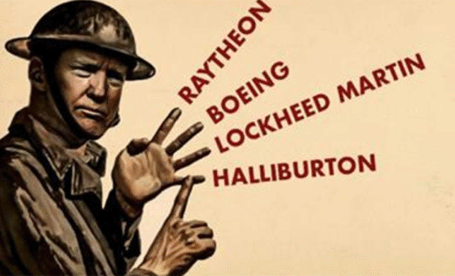 Fill the Swamp: Trump to Put Military Industrial Complex Lobbyist in Charge of the Army, Last Wednesday, it was reported that Donald Trump was moving to nominate Raytheon lobbyist Mark Esper for secretary of the Army. Raytheon is one of the “big five” defense contractors, and the president’s decision comes at a time when concerns are being raised over the idea of defense industry executives being placed in senior positions at the Pentagon.Daily Liberator, By: James Holbrooks, 29 Aug 17
 This article first appeared at ANTIMEDIA……
The Washington Examiner, which broke the news in an exclusive after speaking with unnamed D.C. sources, reported that Pentagon officials “privately expressed confidence that Esper, with his military, Pentagon and Capitol Hill experience, will win quick Senate confirmation.”
That would be a change of pace. Esper’s nomination is Trump’s third attempt to fill the position of Army secretary.
A ROCKY ROAD
Trump’s first choice, New York billionaire and owner of the Florida Panthers hockey team, Vincent Viola, withdrew back in February over concerns about financial conflicts of interest……..
Assuming Mark Esper hangs in there and keeps his name in the running for Army secretary, he’ll need to pass vetting by the Senate Armed Services Committee (SASC). That hearing isn’t expected to take place until September. But it was within that committee, back in June, that SASC chairman John McCain first voiced concern over members of the defense industry taking key positions at the Pentagon.
THE CHAIRMAN MAKES NOISE
In a hearing Defense News called “surprisingly contentious,” McCain threatened to block the SASC confirmation of Patrick Shanahan for deputy defense secretary, the number two spot at the Pentagon below defense secretary James Mattis. One of the reasons, the Arizona senator made clear, was Shanahan’s ties to industry contractors.
Shanahan had been with Boeing since 1986 before accepting Trump’s nomination. He was a member of the Boeing Executive Council and had even earned the nickname “Mr. Fix-it” within the corporation for his ability to turn around troubled projects.
At the hearing, McCain cited Shanahan’s industry past, saying he was “not overjoyed” that the would-be deputy secretary spent so much time at one of the big five defense contractors. He also said Shanahan’s ilk serving at the Pentagon was “not what our Founding Fathers had in mind.”
McCain, a Republican, went further weeks later, bluntly stating in a hallway interview in Congress that he “did not want people from the top five corporations” to fill positions at the Pentagon. Party politics aside, at least some lawmakers across the aisle appear to share his concern.
Senator Jack Reed, a Democrat who sits on the SASC, told Defense News in early July that “real concern about the concentration of these people” exists because decision-making processes may be “influenced by [their]prior employment.”
Similarly, Senator Richard Durbin, another Democrat, said the Trump administration has “turned a blind eye to the whole question of conflicts of interest from start to finish.”
Despite such criticisms, the SASC gave Shanahan the green light, and the Senate officially confirmed him last Tuesday. This means that right now, the two most powerful men at the Pentagon have significant past connections to the defense industry.
For those unaware, for years Secretary of Defense James Mattis was a board member of one of the big five contractors, General Dynamics, and up until the point of his nomination had nearly $600,000 in vested stock options with the corporation, according to Securities and Exchange Commission (SEC) filings.
LUCKY BREAK
In a convenient bit of timing, John McCain was absent at Shanahan’s full Senate confirmation on July 18, as he was recovering from surgery to remove a blood clot, which ultimately revealed a brain tumor. The same could be said for Ellen Lord, who went through SASC vetting relatively unscathed on the very same day and now awaits the committee’s nod to move on to a full Senate vote.
Lord has been CEO of Textron Systems, a global aerospace and defense conglomerate, since 2012. As with what happened to Shanahan, Lord likely would have faced a harsh grilling from McCain. Commenting on Lord’s smooth sail through her SASC hearing, Defense News wrote:
“That may have been due to the absence of Sen. John McCain, the Arizona Republican who chairs SASC. McCain, recuperating at home from a recent surgery, previously told Defense News he is concerned about the number of defense industry figures entering key Pentagon roles.”
The same good fortune was bestowed upon a former Lockheed Martin vice president on Thursday. Ryan McCarthy passed his SASC vetting for undersecretary of the Army, and if the Senate eventually confirms both him and Mark Esper, it would mean the top two Army positions at the Pentagon would be filled by defense industry executives.
It was speculated that former Lockheed Martin attorney David Ehrhart would come under heavy scrutiny at his SASC hearing for Air Force General Counsel, the department’s chief legal officer. The same would have surely gone for John Rood, Trump’s expected pick for undersecretary of defense for policy and current head of international sales at Lockheed.
But with the SASC confirming defense industry figures in McCain’s absence, it now appears the Arizona senator’s leeriness was the only substantive thing holding up the show.
DOWN A DARK PATH
Like Senator Richard Durbin and others in Congress who don’t like the emerging trend under Donald Trump, most in the mainstream media will only go so far as to highlight the myriad conflicts of interest between the Trump administration and the corporate world.
Right now, for example, Secretary of State Rex Tillerson is catching fire for being the CEO of ExxonMobil when it violated sanctions on Russia back in 2014. The U.S. Treasury Department just hit Exxon with a $2 million fine for that move, and Exxon promptly filed a lawsuit against the government in response………http://www.thedailyliberator.com/fill-swamp-trump-put-military-industrial-complex-lobbyist-charge-army/
As North Korea tensions escalate, USA tests most dangerous nuclear weapon ever produced’
World War 3? US tests ‘most dangerous nuclear weapon ever produced’ amid North Korea row, THE United States has carried out a second test of a nuclear bomb, described as the most dangerous nuclear weapon ever produced, as tensions with North Korea escalate. Express UK By JON ROGERS, Aug 29, 2017 US authorities confirmed the test was successful and the B61-12 gravity bomb is expected to go into production within three years.
B61-12 gravity bombs, without a nuclear warhead, were dropped from F-15E fighter jets at Tonopah Test Range in Nevada on August 8, the National Nuclear Security Administration said.
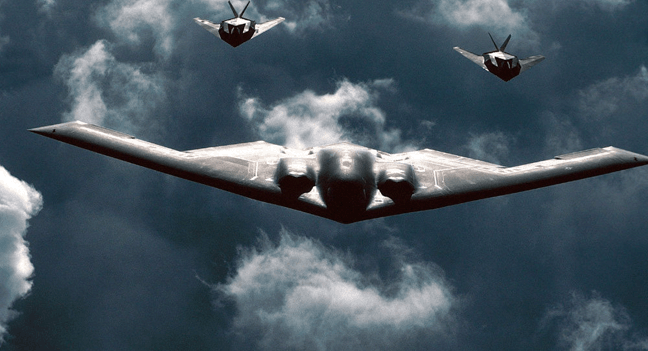
The tests were intended to check the bomb’s “non-nuclear functions and the aircraft’s capability to deliver the weapon.”
A statement from the NNSA said: “B61-12 gravity bombs, without a nuclear warhead, were dropped from F-15E fighter jets at Tonopah Test Range in Nevada on August 8. The tests were intended to check the bomb’s ‘non-nuclear functions and the aircraft’s capability to deliver the weapon.”
These tests are part of a series over the next three years to qualify the B61-12 for service. The first qualification flight test occurred in March.
The new weapon is scheduled for production in March 2020 and will replace the B61.
Military experts believe the weapon’s accuracy and variable power reduces the risk of collateral damage and potential widespread civilian casualties.
The B61-12 bomb features a tail kit from aircraft manufacturer Boeing which will enable a precision-guided trajectory………
The timing of the latest test comes amid heightened tensions between the US and North Korea whose latest missile launch occurred yesterday as the country sent a rocket over the north of Japan and sparking international condemnation.
Brian Becker, director of the anti-war Answer coalition told RT: “In order to placate his critics, in the media and in politics, Trump has given a blank check to his generals.
“So they are having a grand time right now, and they are testing all the weapons they’ve been wanting to test, but not been able to.” http://www.express.co.uk/news/world/847385/World-War-3-latest-US-nuclear-bomb-test-North-Korea-B61-12
Trump spending up big on nuclear weapons
Trump Forges Ahead on Costly Nuclear Overhaul, Sweeping Aside Doubts, AUG. 27, 2017 During his speech last week about Afghanistan, President Trump slipped in a line that had little to do with fighting the Taliban: “Vast amounts” are being spent on “our nuclear arsenal and missile defense,” he said, as the administration builds up the military.
Media ignores North Korea’s offers to negotiate, give up nuclear weapons

 NORTH KOREA KEEPS SAYING IT MIGHT GIVE UP ITS NUCLEAR WEAPONS — BUT MOST NEWS OUTLETS WON’T TELL YOU THAT, The Intercept Jon Schwarz, here’s what you don’t know, unless you’re an obsessive North Korea-watcher:
Also starting on July 4, North Korea has been saying over and over again that it might put its nuclear weapons and missiles on the negotiating table if the United States would end its own threatening posture.
This fact has been completely obscured by U.S. and other western media. For the most part, newspapers and television have simply ignored North Korea’s position. When they haven’t ignored it, they’ve usually mispresented it as its opposite – i.e., claiming that North Korea is saying that it will never surrender its nuclear weapons under any circumstances. And on the rare occasions when North Korea’s statements are mentioned accurately, they’re never given the prominence they deserve.
North Korea’s proclamations have been closely tracked by Robert Carlin, currently a visiting scholar at Stanford University’s Center for International Security and Cooperation and formerly head of the Northeast Asia Division in the State Department’s intelligence arm. Carlin has visited North Korea over 30 times.
Via email, Carlin described how it is difficult but critical to accurately decode North Korean communications. “Observers dismiss as unimportant what the North Koreans say,” Carlin writes, and “therefore don’t read it carefully, except of course if it is colorful, fiery language that makes for lovely headlines. Some of what the North says is simply propaganda and can be read with one eye closed. Other things are written and edited very carefully, and need to be read very carefully. And then, having been read, they need to be compared with past statements, and put in context.”
With that in mind, here’s Kim Jong-un’s statement on July 4:
[T]he DPRK would neither put its nukes and ballistic rockets on the table of negotiations in any case nor flinch even an inch from the road of bolstering the nuclear force chosen by itself unless the U.S. hostile policy and nuclear threat to the DPRK are definitely terminated. [emphasis added]
That formulation again appeared in an August 7 government statement after the United Nations Security Council passed new sanctions on North Korea. The same day, North Korean Foreign Minister Ri Yong Ho also said it during a speech at the Association of Southeast Asian Nations regional forum in the Philippines.
And on August 22 at the UN Conference on Disarmament in Switzerland, North Korean diplomat Ju Yong Chol made exactly the same point, stating, “As long as the U.S. hostile policy and nuclear threat remains unchallenged, the DPRK will never place its self-defensive nuclear deterrence on the negotiating table.”
In the past North Korea has pledged to renounce its nuclear weapons program. During the so-called Six-Party Talks in 2005, all the nations involved, including North Korea, affirmed that the North Korea was “committed to abandoning all nuclear weapons and existing nuclear programs.” Meanwhile, the United States and North Korea agreed to “respect each other’s sovereignty, exist peacefully together, and take steps to normalize their relations.”
Then the situation soured. Carlin writes that more recently “the routine formula in lower level media commentaries was that the nuclear deterrent was ‘not a mere bargaining chip to put on the table for negotiations with the United States.’”
So all of this seems quite clear and straightforward. North Korea is again telling the world that it is willing to consider renouncing its nuclear weapons program. Obviously Kim’s regime may not be telling the truth, especially given the fact that it has violated prior agreements. But the United States has flagrantly violated those agreements as well. The only way to find out whether there’s a path to North Korean disarmament is to honestly engage with them about it.
There are huge roadblocks to that happening, and one of the biggest is the failure of western media simply to inform their audience of the basics of what’s happening.
Since July 4, the New York Times and Washington Post have published hundreds of articles about North Korea. Both papers have informed their readers that Kim has called Americans “bastards.” But they’ve each only published one story quoting Kim’s key caveat, that North Korea will consider giving up its nukes if “the U.S. hostile policy and nuclear threat to the DPRK are definitely terminated.” And in both cases the Post and Times simply reprinted an AP story — in which Kim’s words appear in the 23rd paragraph – rather than running pieces of their own………
Coverage in other publications has tended to be, if anything, shoddier, with television coverage worst of all. The BBC World Service soberly explained on August 15 that “North Korea says its nuclear program can never be on the negotiating table and that’s where the stand-off is.” Other outlets have generally maintained a discreet silence about North Korea’s position.
Taken in total, the media’s performance on North Korea so far is an extremely ominous development. We know because of the Iraq War that newspapers and TV can provide a key assist in launching catastrophic U.S. wars. As things stand now, it’s by no means impossible that they will do it again. https://theintercept.com/2017/08/25/north-korea-keeps-saying-it-might-give-up-its-nuclear-weapons-but-most-news-outlets-wont-tell-you-that/
North Korea ramps up the sabre rattling
North Korea vows to ‘sharpen its nuclear sword’ in WORLD WAR 3 threat to USA, Express UK 27 Aug 17 NORTH Korea has sparked fears of all-out war with the USA after threatening to “sharpen its nuclear sword” as tensions continue to escalate., By JOEY MILLAR, Aug 27, 2017 North Korea has issued yet another sabre-rattling statement to its Western enemies, warning the US it would show “no mercy” in any conflict.
The statement, issued by a Pyongyang-based news agency which acts as a mouthpiece for despot Kim Jong-un, said the hermit state did not fear starting World War 3.
It comes amid ever-rising tensions on the Korean peninsula as Kim and US president Donald Trump both become increasingly determined not to blink first.
The propaganda agency even went so far as to say Kim was accelerating the country’s nuclear missile programme in order to reduce the threat of nuclear war. …..http://www.express.co.uk/news/world/846462/world-war-3-north-korea-latest-news-war-usa-attack
UK’s Atomic Weapons Establishment (AWE) upgrading Trident nuclear warhead to make it even more destructive
 UK Running ‘Secret’ Program to Develop Nuclear Weapons https://sputniknews.com/europe/201606071040916158-uk-trident-nuclear-proliferation/
A new report claims Britain’s Atomic Weapons Establishment (AWE) is ‘secretly’ working on a program to upgrade the current UK Trident warhead to give it more destructive power, despite the country’s long-term commitment to reduce nuclear proliferation.
According to the Nuclear Information Service (NIS) — an independent body which works to promote public awareness and foster debate on nuclear disarmament — AWE is currently working on a program to upgrade the current UK Trident warhead to the ‘Mark 4A’ modified warhead, which will have increased accuracy and destructive power and an extended lifetime.
Parliament has never been formally notified of the Mark 4A modification program and the costs and timetable for the program have never been disclosed. Nevertheless, the policy of successive UK governments has been to achieve a world without nuclear weapons, so it is incontrovertible that at some point in the future nuclear weapons production and maintenance at AWE must cease,” its latest report says. Transparency?
In May 2010, the government announced that it would reduce the overall size of the UK’s nuclear weapons stockpile to 225.
A government statement, updated in May 2015, stated: “Following a further review, in October 2010 the Prime Minister announced that by the mid-2020s the overall size of the UK nuclear weapons stockpile will reduce to no more than 180 warheads.
No more than 120 will be operationallyavailable.”
However, critics say that a reduction in the number of warheads, but with increased “destructive power,” is hardly in the spirit of non-nuclear proliferation.
Parliament should debate whether to replace the UK Trident warhead, given the questions over its necessity, cost, proliferation implications, and impact on the UK’s nuclear disarmament obligations,” the NIS report says.
Professor Martin Rees (Lord Rees of Ludlow), Astronomer Royal and a former President of the Royal Society, in the foreword to the report says:
“[There is] a need for AWE, a highly expensive institution, to be more politically accountable and more transparent. Parallel US institutions like Los Alamos are in a less ‘closed’ world; to a greater extent than at AWE their staff attend mainstream scientific conferences and contribute research on non-classified topics.”
According to the report, the program involves close collaboration with the US nuclear weapons laboratories through a joint US/UK Joint Re-entry System Working Group, and key components for the modified warhead are purchased from the US.
House Armed Services Committee member accuses Trump of rushing nuclear contracts
Armed Services Dem accuses Trump admin of rushing nuclear contracts, The Hill, BY ELLEN MITCHELL – 08/27/17 House Armed Services Committee ranking member Adam Smith (D-Wash.) on Sunday accused the Trump administration of rushing two major nuclear weapons programs.
“This week, the Air Force awarded four contracts worth nearly $2.5 billion to begin developing two new nuclear weapons. Yet this administration has not even completed its Nuclear Posture Review,” Smith said in a statement.
“We are rushing on autopilot to fund these programs.” The Pentagon in April officially began the nuclear posture review, which was ordered by President Trump in January. It’s the first review of the U.S. nuclear weapons policy since 2010, and won’t be done for several more months.
The Pentagon, however, has not waited for the review’s completion in moving ahead with two new nuclear weapons programs.
Last week the Defense Department awarded contracts for the Ground Based Strategic Deterrent, which will replace the current Minuteman III intercontinental ballistic missiles, and the Long Range Standoff (LRSO) weapon, the next nuclear-capable cruise missile to be fired from aircraft…..http://thehill.com/policy/defense/348197-armed-services-dem-accuses-trump-admin-of-rushing-nuclear-contracts
“Dirty radioactive bomb” planned for attack in Indonesia – using THORIUM
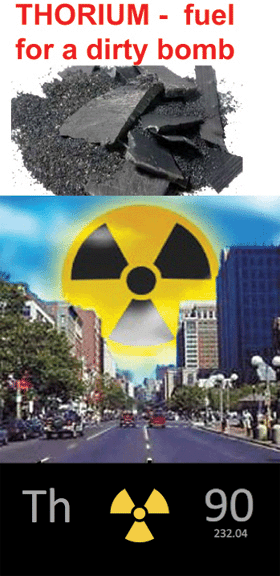 Indonesian militants planned ‘dirty bomb’ attack – sources, Yahoo 7 By Tom Allard and Agustinus Beo Da Costa, JAKARTA (Reuters) – Indonesian militants planned to detonate a radioactive dirty bomb, security sources said, highlighting the rising ambitions of extremists to wreak destruction in the world’s largest Muslim-majority nation.
But experts cast doubt on their expertise, equipment and chances of success.
The plot was foiled when police raided homes and arrested five suspects in Bandung, West Java, last week, the sources with direct knowledge of the plot said. After the raids, police spoke of a plan to explode a “chemical” bomb but provided no other details……
The three counter-terrorism sources, speaking on condition of anonymity, said the militants had hoped to transform low-grade radioactive Thorium 232 (Th-232) into deadly Uranium 233 (U-233).
The highly radioactive uranium would be combined with the powerful home-made explosive triacetone triperoxide (TATP) to create a “nuclear bomb”, according to an instruction manual used by the militants and reviewed by Reuters.
In fact, the device would be, at best, a radiological dispersal device or dirty bomb that could spray radioactive material when the conventional bomb exploded.
A spokesman for Indonesia’s national police, Inspector General Setyo Wasisto, declined to confirm or deny the plot to construct the device, but said it would have been more potent than the two bombs made from TATP that killed three police in Indonesia’s capital Jakarta in May.
“If this bomb was finished, it would have had a more destructive impact than the bomb made from ‘Mother of Satan’,” he said, using the nickname for TATP.
“It could burn anything and make it hard for people to breathe.”
Thorium-232 can be transformed into Uranium-233 but requires the Thorium to absorb a neutron, a process that needs powerful irradiation, generally from a nuclear reactor, according to three analysts contacted by Reuters and the website of the World Nuclear Association, which represents reactor vendors and nuclear engineers, among other industry stakeholders….
One senior Indonesian counter-terrorism source said the Bandung-based cell had bought a large amount of a household item and had begun to extract the Thorium. Reuters has chosen not to name the item.
“They needed three weeks. It was still only one week (into the process when police raided),” the source said…..
According to police, the suspected Bandung plotters were members of JAD and were considering targets like the presidential palace in Jakarta and police headquarters in Bandung and the capital….. (Reporting by Tom Allard and Agustinus Beo Da Costa Additional reporting by Stefanno Reinard; Editing by Ed Davies and Nick Macfie) https://au.news.yahoo.com/a/36844136/exclusive-indonesian-militants-planned-dirty-bomb-attack-sources/
As USA and South Korea hold military exercises on Korean peninsula, Russia flies nuclear bombers around the peninsula
Russian nuclear bombers fly near North Korea in rare show of force, http://www.reuters.com/article/us-russia-southkorea-bombers-idUSKCN1B40MP, Andrew Osborn, 25 Aug 17, Moscow, Reuters, Russian nuclear-capable strategic bombers have flown a rare mission around the Korean Peninsula at the same time as the United States and South Korea conduct joint military exercises that have infuriated Pyongyang.
Russia, which has said it is strongly against any unilateral U.S. military action on the peninsula, said Tupolev-95MS bombers, code named “Bears” by NATO, had flown over the Pacific Ocean, the Sea of Japan, the Yellow Sea and the East China Sea, prompting Japan and Seoul to scramble jets to escort them.
The flight, which also included planes with advanced intelligence gathering capabilities, was over international waters and was announced by the Russian Defence Ministry on the same day as Moscow complained about the U.S.-South Korean war games.
“The US and South Korea holding yet more large-scale military and naval exercises does not help reduce tensions on the Korean Peninsula,” Maria Zakharova, a spokeswoman for the foreign ministry, told a news briefing in Moscow.
“We urge all sides to exercise maximum caution. Given the arms build-up in the region, any rash move or even an unintended incident could spark a military conflict.”
1 This Month
23-25 October – on Zoom – World BEYOND War’s annual global conferenc

To see nuclear-related stories in greater depth and intensity – go to https://nuclearinformation.wordpress.com

Say No to NASA’s Reckless Nuclear Reactor on the Moon
Say No to NASA’s Reckless Nuclear Reactor on the Moon
-
Archives
- October 2026 (160)
- September 2026 (339)
- August 2026 (330)
- July 2026 (355)
- June 2026 (287)
- May 2026 (306)
- April 2026 (356)
- March 2026 (251)
- February 2026 (267)
- January 2026 (308)
- December 2025 (358)
- November 2025 (359)
-
Categories
- 1
- 1 NUCLEAR ISSUES
- business and costs
- climate change
- culture and arts
- ENERGY
- environment
- health
- history
- indigenous issues
- Legal
- marketing of nuclear
- media
- opposition to nuclear
- PERSONAL STORIES
- politics
- politics international
- Religion and ethics
- safety
- secrets,lies and civil liberties
- spinbuster
- technology
- Uranium
- wastes
- weapons and war
- Women
- 2 WORLD
- ACTION
- AFRICA
- Atrocities
- AUSTRALIA
- Christina's notes
- Christina's themes
- culture and arts
- Events
- Fuk 2022
- Fuk 2023
- Fukushima 2017
- Fukushima 2018
- fukushima 2019
- Fukushima 2020
- Fukushima 2021
- general
- global warming
- Humour (God we need it)
- Nuclear
- RARE EARTHS
- Reference
- resources – print
- Resources -audiovicual
- Weekly Newsletter
- World
- World Nuclear
- YouTube
-
RSS
Entries RSS
Comments RSS

