Electricity consumers ‘to fund nuclear weapons through Hinkley Point C’
Scientists tell MPs government is using expensive power project to cross-subsidise military by maintaining nuclear skills, Guardian, Holly Watt, 13 Oct 17, The government is using the “extremely expensive” Hinkley Point C nuclear power station to cross-subsidise Britain’s nuclear weapon arsenal, according to senior scientists.
In evidence submitted to the influential public accounts committee (PAC), which is currently investigating the nuclear plant deal, scientists from Sussex University state that the costs of the Trident programme could be “unsupportable” without “an effective subsidy from electricity consumers to military nuclear infrastructure”.
Prof Andy Stirling and Dr Phil Johnstone from the Science Policy Research Unit at the university write that the £19.6bn Hinkley Point project will “maintain a large-scale national base of nuclear-specific skills” without which there is concern “that the costs of UK nuclear submarine capabilities could be insupportable.”
Their evidence suggests that changes in the government’s policy on nuclear power in recent years will effectively allow Britain’s military nuclear industry to be supported by payments from electricity consumers.
Last June, MPs passed a motion in favour of replacing four submarines carrying Trident missiles at a cost of £40bn.
“What our research suggests is that British low-carbon energy strategies are more expensive than they need to be, in order to maintain UK military nuclear infrastructures,” said Stirling.
“And without assuming the continuation of an extremely expensive UK civil nuclear industry, it is likely that the costs of Trident would be significantly greater.”………
This week, the Green MP Caroline Lucas asked the government about the Ministry of Defence and the business department discussing the “relevance of UK civil nuclear industry skills and supply chains to the maintaining of UK nuclear submarine and wider nuclear weapons capabilities”.
Harriett Baldwin, the defence procurement minister, answered that “it is fully understood that civil and defence sectors must work together to make sure resource is prioritised appropriately for the protection and prosperity of the United Kingdom”.
Johnstone said the decision-making process behind Hinkley raised questions about transparency and accountability, saying: “In this ever more networked world, both civil and military nuclear technologies are increasingly recognised as obsolete. Yet it seems UK policymaking is quietly trying to further entrench the two – in ways that have been escaping democratic accountability.”
At a hearing held by the PAC in parliament on Monday, senior civil servants defended the Hinkley deal after a National Audit Office report concluded that it was “risky and expensive”.
The officials admitted that the economic case had become “more marginal” in recent years, as the costs of alternative technologies had fallen……
At the PAC hearing, the Labour MP Meg Hillier asked whether “Hinkley is a great opportunity to maintain our nuclear skills base”.
Lovegrove answered: “We are completing the build of the nuclear submarines which carry conventional weaponry. So somehow there is very definitely an opportunity here for the nation to grasp in terms of building up its nuclear skills. I don’t think that’s going to happen by accident. It is going to require concerted government action to make that happen.” https://www.theguardian.com/uk-news/2017/oct/12/electricity-consumers-to-fund-nuclear-weapons-through-hinkley-point-c
Russia’s high-tech combat suit, the Ratnik 3 has received an upgrade of a nuclear blast resistant watch. The suit reportedly includes 59 other high-tech features to create the most advanced body armor ever.
STORMTROOPER CHICRussia has a new battle suit that seems to be visually inspired by Star Wars’s Imperial Shadow Stormtroopers. While Russia’s version likely doesn’t come with a cloaking device, the high-tech armor does have a few tricks up its sleeves, including nuclear blast resistant tech.
The suit was developed by Rostec and is called the Ratnik-3. The latest upgrade to the new armor includes a reportedly nuclear blast resistant watch. According to a statement released by the press office, the Chief Designer for the Life Support System of the Soldier Combat Outfit at the Central Scientific Research Institute for Precision Machine Engineering, Oleg Faustov, says “The watch, which we have included in the Ratnik outfit, retains its properties upon the impact of radiation and electromagnetic impulses, for example, upon a nuclear blast.”
The watch also features a self-winding mechanism and operates under water.
Other perks of the 59 items Rostec has included in the suit include a powered exoskeleton, which is said to give soldiers greater strength and stamina; the latest in bulletproof body armor tech; and a full face-covering visor and helmet equipped with a video game-esque heads-up display (HUD). According to Russian state-owned media outlet Tass, the weight of the completed combat gear will be reduced by 30% when it is released for use in the field.
The Ratnik 3 is expected to be ready for use by 2022.
IN BRIEF
Russia’s high-tech combat suit, the Ratnik 3 has received an upgrade of a nuclear blast resistant watch. The suit reportedly includes 59 other high-tech features to create the most advanced body armor ever.
STORMTROOPER CHIC
Russia has a new battle suit that seems to be visually inspired by Star Wars’s Imperial Shadow Stormtroopers. While Russia’s version likely doesn’t come with a cloaking device, the high-tech armor does have a few tricks up its sleeves, including nuclear blast resistant tech.
The suit was developed by Rostec and is called the Ratnik-3. The latest upgrade to the new armor includes a reportedly nuclear blast resistant watch. According to a statement released by the press office, the Chief Designer for the Life Support System of the Soldier Combat Outfit at the Central Scientific Research Institute for Precision Machine Engineering, Oleg Faustov, says “The watch, which we have included in the Ratnik outfit, retains its properties upon the impact of radiation and electromagnetic impulses, for example, upon a nuclear blast.”
The watch also features a self-winding mechanism and operates under water.
Other perks of the 59 items Rostec has included in the suit include a powered exoskeleton, which is said to give soldiers greater strength and stamina; the latest in bulletproof body armor tech; and a full face-covering visor and helmet equipped with a video game-esque heads-up display (HUD). According to Russian state-owned media outlet Tass, the weight of the completed combat gear will be reduced by 30% when it is released for use in the field.
The Ratnik 3 is expected to be ready for use by 2022.
Weapons are also getting next-gen upgrades with laser weapons currently being deployed in various forms around the world. The United States Navy has the Laser Weapons System (LaWS) mounted on the USS Ponce, an amphibious naval transport dock, to defend against drone strikes and eventually incoming missiles. China has also previously given its soldiers laser weapons designed to blind opponents.
In the sky, killer drones the size of a quadcopter have been developed to carry weapons. The Air Force is even training soldiers to get the military ready for combat in space with extraterrestrials or other hostile interests.
Of course, with all these developments, it maybe good to be reminded what a nuclear showdown would do to the planet—and hope that these future technologies rarely have to be put to use.
NORTH Korea could conduct its latest nuclear missile test within days as satellite images revealed ongoing activity at a shipyard test site., By VICKIIE OLIPHANT, Oct 12, 2017
The commercial photographs of the infamous Sinpo South Shipyard suggest Kim Jong-un’smilitary are working on developing a submarine-launched ballistic missile.
Aerial snaps seem to show work on an experimental ballistic missile submarine is complete.
And the images, taken on September 21, also reveal a new shipbuilding program is underway with improvements being made to test stands.
Military experts have said North Korea led by Kim Jong-un, is looking to upgrade is sea-based nuclear fleet and its submarine’s launch system Pukguksong-1.
And the release of the images comes amid a period of heightened tensions between North Korea and the United States with both sides issuing threats and counter-threats.
Just this week, American bomber planes flew over the Korean peninsula and a “nuke sniffer” aircraft was deployed yesterday.
Although no military provocation materialised, the North’s state-run newspaper accused the White House of pushing them towards a nuclear war and vowed not to stand by in the face of “criminal actions of warmongers”.
Joseph Bermudez, a specialist in North Korean defence and intelligence affairs, posted the satellite photographs on the 38 North web journal of the US-Korea Institute at Johns Hopkins University.
He said: “The netting suspended over the SINPO-class submarine (SSBA) observed last month is no longer present, indicating that whatever work was being conducted on the vessel has been completed.
“The nature of such work is, however, unknown.
“Both the submarine and submersible missile test stand barge remain berthed at the same positions in the secure boast basin as noted in our August 7 report, suggesting, without offering real proof, that they have not left port.”
Although he said “the current imagery does not indicate an imminent test”, the photos come as North Koreans celebrate the anniversary of the ruling Workers Party – a day previously picked out by the regime to test new missiles.
Experts fear Kim could now be preparing a launch for next week, saying October 18 – the start of China’s Party Congress – would be another ideal opportunity.
Pyongyang is adamant on continuing Kim’s nuclear programme despite a string of increasingly volatile threats from Donald Trump.
Kim Jong-un has caused international outrage following months of missile tests – including a Hwasong 14 Intercontinental Ballistic Missile (ICBM) capable of reaching the USA.
Now Donald Trump has sent the USS Tuscon, one of the nation’s nuclear submarines, to the Korean peninsula in an apparent show of force against the young tyrant.
Officials have revealed the nuclear vessel made port on Saturday, arriving at Chinhae, South Korea. A statement from US Pacific Command said: “With a crew of approximately 150, Tucson can conduct a multitude of missions and maintain proficiencies of the latest capabilities of the submarine fleet.
“Tucson’s crew operates with a high state of readiness and is always prepared to tackle any mission that comes their way.”
http://www.sbs.com.au/news/article/2017/10/10/north-korea-has-ballistic-missile-range-3000km-russia : Russia North Korea’s leadership has told Russian lawmakers that it possesses a ballistic missile with a range of 3,000 kilometres that will be able to reach US territory after modernisation, the Interfax news agency reported on Tuesday. Interfax cited Anton Morozov, a lawmaker and member of the lower house of parliament’s international affairs committee, who visited Pyongyang from October 2 to 6.
North Korea aims to increase the range of its ballistic missiles to 9,000 kilometres, Morozov was quoted as saying.
“There was no talk about the deadline (for solving this task),” he said.
UN Treaty ‘beginning of the end for nuclear weapons,’ say Nobel Peace Prize winners http://www.un.org/apps/news/story.asp?NewsID=57844#.Wd0tKY-CzGg9 October 2017 – Speaking to journalists at the United Nations Headquarters, in New York, representatives of the 2017 Nobel Peace Prize winner – International Campaign to Abolish Nuclear Weapons (ICAN) – urged countries around the globe to eliminate nuclear weapons.
The award represents a special recognition for the efforts of the “new generation” of campaigners – “people who grew up after the Cold War and don’t understand why we still have the [nuclear] weapons,” said Beatrice Fihn, the Executive Director of ICAN.
In particular, she highlighted that it is also a huge recognition of the efforts of the Hibakusha(the Japanese word for the surviving victims of the 1945 atomic bombings of Hiroshima and Nagasaki) in realizing the Treaty on the Prohibition of Nuclear Weapons.
Adopted on 7 July at a UN conference in New York, the Treaty is the first multilateral legally-binding instrument for nuclear disarmament in two decades.
Quoting Setsuko Thurlow, a survivor of the Hiroshima atomic bomb, Ms. Fihn added: “7th of July marks the beginning of the end for nuclear weapons.”
Also at the press conference, which was sponsored by the Permanent Mission of Austria to the United Nations, was Ray Acheson of the Women’s International League for Peace and Freedom, an ICAN member organization, who said diplomacy for dialogue and cooperation is all the more necessary right now given rising tensions in many parts of the world.
“I think it’s more important than ever for us to be emphasizing the importance and the utility and the practicality of working together,” she said, recalling the partnership between the civil society, governments and the UN in the realizing the Treaty.
At the press conference, the speakers outlined the dangers of by nuclear weapons as well as the rising tensions, including due to the nuclear weapons development programme of the Democratic People’s Republic of Korea (DPRK) and the discussions over the Joint Comprehensive Plan of Action (JCPOA) concerning Iran’s nuclear programme.
Expressing that the Treaty on the Prohibition of Nuclear Weapons offered an alternative – a world without nuclear weapons – Tim Wright, the Asia-Pacific Director of ICAN, hoped that the Nobel Peace Prize win will help ICAN to get countries to sign and ratify the Treaty.
“We’ll be working over coming weeks and months to persuade governments to do just that,” he added.
University of Hawaii students and staff probably did a double take at the subject line of an email that arrived in their email inboxes Monday.”In the event of a nuclear attack,” it said.
The email is part of a broad state campaign to better prepare residents and visitors for the unlikely but not impossible threat of a nuclear missile attack that North Korea poses to the islands.
“In light of concerns about North Korea missile tests, state and federal agencies are providing information about nuclear threats and what to do in the unlikely event of a nuclear attack and radiation emergency,” the UH email said.
The email also told students and faculty to be aware of emergency sirens and to follow instructions on “sheltering in place.”
The informational message comes amid rising tensions with North Korea, and as the president indicates that diplomatic efforts may have stalled.
Recent news means we should change our perspective on nuclear weapons Independent UK , Robert Forsyth, 8 Oct 17Caroline Lucas spelled out on Saturday 7 October what the PM should now do about nuclear weapons. To which I would add that the PM’s first and immediate action should be to rescind her statement that she is prepared to carry out pre-emptive nuclear strikes.
Such an action, or even the threat of doing so, is in contravention of Nuremberg and Geneva Conventions, the UN Charter and a 1996 ruling by the International Court of Justice and therefore places our Trident submarine commanding officers in an impossible position as to whether they should carry out such an order, bearing in mind they are not absolved of responsibility by the military chain of command. http://www.independent.co.uk/voices/letters/recent-news-means-we-should-change-our-perspective-on-nuclear-weapons-a7988846.html
Colombo Gazette 7 Oct 17 The Government has issued a gazette against the use of nuclear, chemical and biological weapons and other related activities in line with United Nations regulations…….
Any person who or group or entity which manufactures, acquires, possesses, develops, transports, transfers or uses nuclear, chemical or biological weapons and their means of delivery within Sri Lanka, will be seen as committing an offence under these regulations and shall on conviction by the High Court, be liable to imprisonment of either description for a period not exceeding twenty years or a fine not exceeding five million rupees or both such fine and imprisonment.
Any person who or group or entity which participates in manufacturing, acquiring, developing, possessing, transporting, transferring or using nuclear chemical or biological weapons and their means of delivery as an accomplice or assists or finances them commits an offence under these regulations and shall on conviction by the High Court, be liable to imprisonment of either description for a period not exceeding five years or a fine not exceeding one million rupees or both such fine and imprisonment.
A person shall not make available any funds, other financial assets and economic resources and financial or other related services directly or indirectly to, or for the benefit of, a person, group or entity to manufacture, acquire, develop, possess, transport, transfer or use nuclear, chemical or biological weapons and their means of delivery or for the purposes to proliferate nuclear, chemical, and biological weapon related materials…….
A Victorian-born international group that was awarded this year’s Nobel Peace Prize says it’s a shame the Australian government has not signed the treaty banning nuclear weapons that led to its award.
The International Campaign to Abolish Nuclear Weapons (ICAN) was launched in Victoria’s Parliament House 10 years ago.
On Friday in Oslo the organisation was awarded the Nobel Peace Prize in recognition of its work to achieve a treaty-based ban on nuclear weapons.
It comes at a time when the world is watching the rising tensions on the Korean peninsula and the rhetoric of US President Donald Trump and North Korean leader Kim Jong Un, as well as the US threat to tear up the Iran nuclear deal.
ICAN describes itself as a coalition of non-government organisations in more than 100 countries. It was launched internationally in Vienna in 2007.
The organisation worked on negotiations for the Treaty on the United Nations Prohibition of Nuclear Weapons, which was adopted by 122 countries in July.
However, the treaty was shunned by nuclear powers the US, Britain, Russia and China. Australia also did not sign the treaty.
“It is a matter of deep regret that the Australian government has thus far refused to join the treaty, and boycotted the conference to negotiate it,” the group said in a statement on Saturday.
ICAN says Australia led a small group of nations who tried to derail efforts in 2016 to secure a UN mandate to launch treaty negotiations.
“Our government’s belief that nuclear weapons, for a select few, are a legitimate and essential source of security is not only misguided, but also dangerous, for it incites proliferation and undermines disarmament,” the group said.
ICAN hopes the federal government will change its stance on nuclear weapons given Australia’s commitment to other treaties prohibiting chemical and biological weapons, anti-personnel landmines and cluster munition.
“For the sake of our collective security, the government must now embrace the global ban on nuclear weapons.
“Greater public pressure is needed, along with enlightened leadership.”
ICAN founder Tilman Ruff AM says being awarded the Nobel Prize was “quite humbling” and “unbelievably joyful”.
Anti-war nuns to bring message of nuclear disarmament https://www.stripes.com/news/us/anti-war-nuns-to-bring-message-of-nuclear-disarmament-1.491495#.WdqS44-CzGgBy DEBBIE KELLEY | The Gazette | Associated Press October 7, 2017 COLORADO SPRINGS, Colo. — As political tensions mount over North Korea’s ballistic missile testing, two elderly Roman Catholic nuns who have spent decades sounding the plea for peace say they are more hopeful than ever that nuclear weapons — not the world — will be annihilated.
“We trust, we believe, we know that we are well on the way to a nuclear-free world and future,” said Sister Ardeth Platte, a Dominican nun.
Platte, 81, and Sister Carol Gilbert, 69, live at the Catholic Worker-affiliated Jonah House in Baltimore. They gained attention in Colorado in the past for pouring blood on a nuclear missile silo in Weld County and anti-war civil disobedience at Colorado Springs military bases.
Fifteen years later, they are returning to deliver the message that nuclear disarmament is at hand.
“We’re in an extremely dangerous time,” Platte said. “A strike could be launched from Colorado within 15 minutes and go 7,000 miles to its target within half an hour. It would be total devastation.”
At 3:30 p.m. on Oct. 9, they’ll present to Peterson Air Force Base personnel a copy of the new United Nations’ Treaty on the Prohibition of Nuclear Weapons.
They’ll repeat the action at 2:45 p.m. Oct. 10 at Schriever Air Force Base.
“We want the citizens of Colorado to know about this treaty,” Gilbert said. “The treaty would make nuclear weapons illegal.”
“We’re coming as peacemakers and peace advocates, to teach and show our concern,” Platte said. “Our politicians could be heroes of these times, if they start working with nations rather than against nations.”
Leading up to the Colorado Springs events, Platte and Gilbert will conduct a vigil at the N-8 missile silo in Weld County, where in October 2002 they poured blood on a Minuteman III missile loaded with a 20 kiloton nuclear bomb, one of 49 high-trigger nuclear weapons stored in Colorado. Their action symbolized taking it offline.
They were convicted of sabotage and received harsh sentences: 41 months for Platte and 33 for Gilbert.
In September 2000, Platte, Gilbert and three other Catholic nuns were arrested for civil disobedience at Peterson Air Force Base and jailed. The charges were subsequently dropped. They’ve also served time in other states for nonviolent acts of civil disobedience.
Prison provided the opportunity to do their best Christian ministry, Gilbert said. “We feel it is the closest that we can be with the poor of this country because jails and prisons are warehouses for the poor,” she said. “You learn people who have nothing are so generous in sharing, you learn what a waste the prison industrial complex is.”
The work of Platte and Gilbert has been “very significant,” said Bill Sulzman, founder of Colorado Springs-based Citizens for Peace in Space, an activist group that opposes the use of space for war-related activities.
“It’s unique in the sense that it’s primarily a moral argument against nuclear weapons and the phenomenon of modern-day war,” he said. “Not supporting it is one thing, actively opposing it is another.”
As part of a non-governmental organization, the International Campaign to Abolish Nuclear Weapons, the nuns attended a United Nations conference in New York, when on July 7, 122 countries — two-thirds of the 193-member states — adopted the Prohibition of Nuclear Weapons Treaty. It’s the first legally binding multilateral agreement for nuclear disarmament in 20 years.
The treaty came after months of negotiations, which the United States, Russia, Great Britain, France, North Korea and other nations did not attend.
To date, 53 countries have signed the treaty, and three ratified the document, which prohibits developing, testing, producing, manufacturing, acquiring, possessing and stockpiling nuclear weapons or other nuclear explosive devices, as well as the use or threat of use of such weapons.
The treaty opened for signatures at U.N. headquarters in New York on Sept. 20; the Vatican was the first to sign and ratify the treaty. The agreement would become law 90 days after at least 50 countries ratify it.
The sisters are optimistic that the treaty is the weapon needed to abolish nuclear capability.
“I’ve been working on this issue for 50 years, and this is the greatest hope I’ve had,” Platte said. “We finally have a tool, a treaty that declares criminality to the possession and threat of using nuclear weapons.”
Even if the United States, Russia and other countries with nuclear warheads never get on board, “it won’t matter because there will be great pressure by other nations,” Platte said. “People are much wiser as we come closer and closer to nuclear holocaust.”
The tactic has worked in the past, she said. At one time there were 70,000 weapons of mass destruction worldwide, now there are 15,000-16,000, due to disarmament.
“This is just the beginning of the implementation — we have gained real momentum,” Platte said.
The atomic bombs the United States dropped on Hiroshima and Nagasaki, Japan, in August 1945 were small compared to today’s weapons of mass destruction, the sisters said.
If a nuclear war were to happen now, “that is the elimination of the planet,” Platte said.
Nuclear weapons are the only weapons of mass destruction not universally prohibited. Biological weapons, chemical weapons, land mines and cluster munitions are banned under international law.
“We believe that the way to solve nations not having nuclear weapons is the total elimination,” Platte said. “It’s time to get rid of them.”
ground crews who washed down planes that flew through the cloud soon began falling sick and low levels of radiation were detected all over Australia.
In 2007 it was found nuclear veterans had the same DNA damage as Chernobyl survivors.
Wives had three times the normal numbers of miscarriage and children 10 times more birth defects.
The secrets behind Britain’s first atomic bomb – and the heartbreaking aftermath The detonation of the plutonium bomb in 1952 was hailed a national success, but many of the servicemen involved were left permanently damaged by the fallout BY SUSIE BONIFACE, MIRROR UK, 6 OCT 2017
A blinding flash, an eerie silence, and then the sky cracked.
The sound reached those watching at the same time as the blast – a scorching 600mph wind carrying with it the long, grumbling roar of the worst weapon known to humankind.
It was 65 years ago this week – 9.30am local time on October 3, 1952 – that Britain detonated its first nuclear bomb .
Winston Churchill was jubilant, the scientists bursting with pride. But on a tiny island off Australia the cost of the radioactive fallout from Operation Hurricane had yet to be counted.
Many of the servicemen present that day went on to suffer heartbreaking consequences.
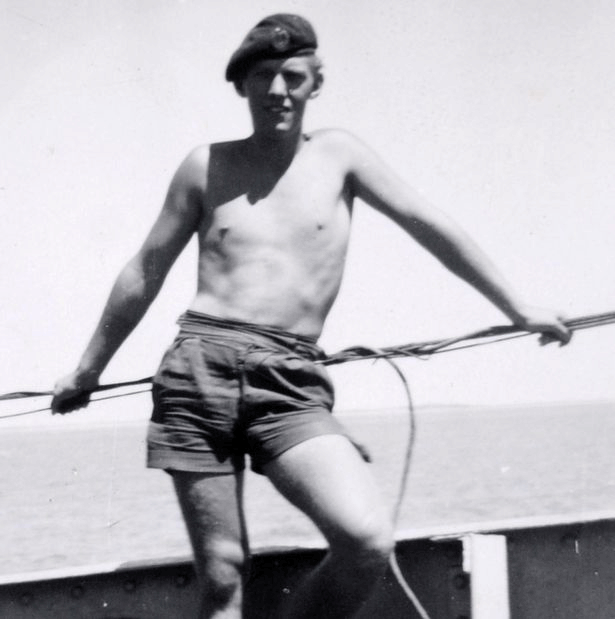
Royal Engineer Derek Hickman, now 84, was there. He says: “We had no protective clothing. You wore shorts and sandals and if you remembered your bush hat, that was all you had.” The blast took place on HMS Plym, an old frigate anchored 300 yards off Trimouille, one of the Monte Bello islands. Troops and scientists lived and worked for months on a small fleet that accompanied her on her final mission.
Derek remembers: “They ordered us to muster on deck – I was on HMS Zeebrugge – and turn our backs to the Plym. We put our hands over our eyes and they counted down over the Tannoy.
“There was a sharp flash and I could see the bones in my hands like an X-ray. Then the sound and the wind and they told us to turn and face it. We watched the mushroom cloud just melt away. They gave us five photos as a memento.
“All that was left of the Plym were a few pieces of metal that fell like rain and her outline scorched on the sea bed.”………
In 1951 Australia agreed the blast could take place at Monte Bello. ….
Thousands of UK and Aussie servicemen saw the mushroom cloud disperse before dozens of planes flew through it to collect dust samples.
The press had been given a viewing tower 55 miles away. The Mirror announced: “This bang has changed the world”.
No official statement was made until October 23 when PM Churchill told the Commons: “All concerned are to be warmly congratulated on the successful outcome of an historic episode.”
But ground crews who washed down planes that flew through the cloud soon began falling sick and low levels of radiation were detected all over Australia.
James Stephenson, 85,remembers being given an unexplained posting to Abergavenny. The former Royal Engineers soldier says: “We went for training and they started weeding us out, removing lads they thought were Communist sympathisers or not up to it.
“Nobody told us what it was about. When we embarked in Portsmouth we had to load machinery ourselves, they wouldn’t let the dockers do it.”James left with the first wave of vessels in January 1952. They were followed six months later by HMS Plym carrying the bomb.
Derek explains: “It was a plutonium bomb – the dirtiest. A few years later I went to the doctor and mentioned Monte Bello.
“He asked if I was married. I said ‘Yes’ and he replied ‘My advice is never have children’. He wouldn’t say why.”
It was a warning Derek, now living alone in Crediton, Devon, couldn’t ignore. He says: “My wife wanted children and in the end I walked away from the marriage.
“She never blamed me but it’s the worst thing I’ve ever done. Since then I’ve discovered my friends’ wives suffered many miscarriages and their children had deformities.
“It’s given me a small comfort that at least we avoided that.”
In 2007 it was found nuclear veterans had the same DNA damage as Chernobyl survivors.
Wives had three times the normal numbers of miscarriage and children 10 times more birth defects. James, from Taunton, Devon, had two healthy children. But he was lucky.
He says: “I know people whose children were born with organs outside their bodies. It made me worry about my grandchildren. Thank God they’re fine.”
Hurricane had an explosive yield of 25 kilotons – 15 kilotons had flattened Hiroshima and killed 126,000. But less than four weeks later the US detonated a hydrogen bomb 400 times more powerful than Hurricane.
The UK was back out in the cold and would not be accepted at the nuclear top table until 1958 when it finally developed its own H-bomb.
In all 22,000 servicemen took part in Britain’s nuclear tests which ended only in 1991. Derek and James are among the 2,000 or so who survive and are still coming to terms with the chain reaction unleashed at Monte Bello.
James says: “Nobody really knew what they were doing, not us or the scientists. It was just a job we had to do.”
The Monte Bello islands are now a wildlife park but visitors are warned not to stay for more than an hour or take home the fragments of metal that can still be found – radioactive pieces of a long-forgotten Royal Navy warship that unleashed a hurricane. http://www.mirror.co.uk/news/uk-news/secrets-behind-britains-first-atomic-11300935
Thousands of UK and Aussie servicemen saw the mushroom cloud disperse before dozens of planes flew through it to collect dust samples.
The press had been given a viewing tower 55 miles away. The Mirror announced: “This bang has changed the world”.
No official statement was made until October 23 when PM Churchill told the Commons: “All concerned are to be warmly congratulated on the successful outcome of an historic episode.”
OSLO/GENEVA (Reuters) – The Norwegian Nobel Committee, warning of a rising risk of nuclear war, awarded the 2017 Nobel Peace Prize on Friday to a little-known international campaign group advocating for a ban on nuclear weapons.
The International Campaign to Abolish Nuclear Weapons (ICAN) describes itself as a coalition of grassroots non-government groups in more than 100 nations. It began in Australia and was officially launched in Vienna in 2007.
“We live in a world where the risk of nuclear weapons being used is greater than it has been for a long time,” said Berit Reiss-Andersen, the leader of the Norwegian Nobel Committee.
In July, 122 nations adopted a U.N. Treaty on the Prohibition of Nuclear Weapons, although the agreement does not include nuclear-armed states such as the United States, Russia, China, Britain and France.
“This award shines a needed light on the path the ban treaty provides toward a world free of nuclear weapons. Before it is too late, we must take that path,” ICAN said in a statement on its Facebook page.
“This is a time of great global tension, when fiery rhetoric could all too easily lead us, inexorably, to unspeakable horror. The specter of nuclear conflict looms large once more. If ever there were a moment for nations to declare their unequivocal opposition to nuclear weapons, that moment is now.” (Graphics on ‘Nobel laureates’ – here)
The Nobel prize seeks to bolster the case of disarmament amid nuclear tensions between the United States and North Korea and uncertainty over the fate of a 2015 deal between Iran and major powers to limit Tehran’s nuclear program.
The Iran deal is seen as under threat after U.S. President Donald Trump called it the “worst deal ever negotiated”. A senior administration official said on Thursday that Trump is expected to announce soon that he will decertify the pact, a step toward potentially unwinding it.
The committee raised eyebrows with its decision to award the prize to an international campaign group with a relatively low profile, rather than giving it to the architects of the Iran deal, who had been widely seen as favorites after hammering out a complex agreement over years of high-stakes diplomacy.
“Norwegian Nobel Committee has its own ways, but the nuclear agreement with Iran achieved something real and would have deserved a prize,” tweeted Carl Bildt, a former Swedish prime minister who has held top posts as an international diplomat.
The leader of the Norwegian Nobel committee denied that the prize was “a kick in the leg” for Trump and said the prize was a call to states that have nuclear weapons to fulfill earlier pledges to work toward disarmament.
“The message is to remind them to the commitment they have already made that they have to work for a nuclear free world,” Reiss-Andersen told Reuters.
The United Nations said the award would help bolster efforts to get the 55 ratifications by countries for the U.N. Treaty on the Prohibition of Nuclear Weapons to come into force.
“I hope this prize will be conducive for the entry into force of this treaty,” U.N. Chief Spokeswoman Alessandra Vellucci told a news briefing.
The Norwegian Nobel Committee has decided to award the Nobel Peace Prize for 2017 to the International Campaign to Abolish Nuclear Weapons (ICAN).
The organization is receiving the award for its work to draw attention to the catastrophic humanitarian consequences of any use of nuclear weapons and for its ground-breaking efforts to achieve a treaty-based prohibition of such weapons.
We live in a world where the risk of nuclear weapons being used is greater than it has been for a long time. Some states are modernizing their nuclear arsenals, and there is a real danger that more countries will try to procure nuclear weapons, as exemplified by North Korea.
Nuclear weapons pose a constant threat to humanity and all life on earth. Through binding international agreements, the international community has previously adopted prohibitions against land mines, cluster munitions and biological and chemical weapons. Nuclear weapons are even more destructive, but have not yet been made the object of a similar international legal prohibition.
Through its work, ICAN has helped to fill this legal gap. An important argument in the rationale for prohibiting nuclear weapons is the unacceptable human suffering that a nuclear war will cause. ICAN is a coalition of non-governmental organizations from around 100 different countries around the globe.
The coalition has been a driving force in prevailing upon the world’s nations to pledge to cooperate with all relevant stakeholders in efforts to stigmatize, prohibit and eliminate nuclear weapons. To date, 108 states have made such a commitment, known as the Humanitarian Pledge.
Furthermore, ICAN has been the leading civil society actor in the endeavor to achieve a prohibition of nuclear weapons under international law. On 7 July 2017, 122 of the UN member states acceded to the Treaty on the Prohibition of Nuclear Weapons.
As soon as the treaty has been ratified by 50 states, the ban on nuclear weapons will enter into force and will be binding under international law for all the countries that are party to the treaty.
The Norwegian Nobel Committee is aware that an international legal prohibition will not in itself eliminate a single nuclear weapon, and that so far neither the states that already have nuclear weapons nor their closest allies support the nuclear weapon ban treaty.
The Committee wishes to emphasize that the next steps towards attaining a world free of nuclear weapons must involve the nuclear-armed states. This year’s Peace Prize is therefore also a call upon these states to initiate serious negotiations with a view to the gradual, balanced and carefully monitored elimination of the almost 15,000 nuclear weapons in the world.
Five of the states that currently have nuclear weapons – the USA, Russia, the United Kingdom, France and China – have already committed to this objective through their accession to the Treaty on the Non-Proliferation of Nuclear Weapons of 1970.
The Non-Proliferation Treaty will remain the primary international legal instrument for promoting nuclear disarmament and preventing the further spread of such weapons.
It is now 71 years since the UN General Assembly, in its very first resolution, advocated the importance of nuclear disarmament and a nuclear weapon-free world. With this year’s award, the Norwegian Nobel Committee wishes to pay tribute to ICAN for giving new momentum to the efforts to achieve this goal.
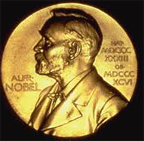
The decision to award the Nobel Peace Prize for 2017 to the International Campaign to Abolish Nuclear Weapons has a solid grounding in Alfred Nobel’s will.
The will specifies three different criteria for awarding the Peace Prize: the promotion of fraternity between nations, the advancement of disarmament and arms control and the holding and promotion of peace congresses. ICAN works vigorously to achieve nuclear disarmament.
ICAN and a majority of UN member states have contributed to fraternity between nations by supporting the Humanitarian Pledge. And through its inspiring and innovative support for the UN negotiations on a treaty banning nuclear weapons, ICAN has played a major part in bringing about what in our day and age is equivalent to an international peace congress.
It is the firm conviction of the Norwegian Nobel Committee that ICAN, more than anyone else, has in the past year given the efforts to achieve a world without nuclear weapons a new direction and new vigor.
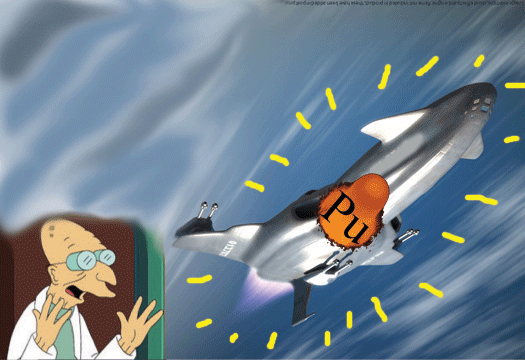
Why is it that the citizens of teh United States put up with their tax money going to produce toxic plutonium for useless dangerous space travel and even more useless dangerous and illegal nuclear weapons.?
What happens when a spacecraft powered by plutonium crashes into a city?
Report: It’s space travel power versus pits at Los Alamos By Mark Oswald / Journal Staff Writer, Thursday, October 5th, 2017 SANTA FE – At Los Alamos National Laboratory, a mandate to produce more of the plutonium triggers for nuclear weapons is bumping up against goals to produce power systems for NASA’s “long duration space missions.”
The U.S. Government Accountability Office reports that lab officials say that plutonium work for NASA systems “must compete with other priorities for facility space” at the LANL’s plutonium facility, specifically production of nuclear weapons “pits.”
The problem could significantly effect a key step in production of “radioisotope power systems” (RPS) and delay delivery of the systems for NASA’s missions, says the GAO report.
RPS produce power by converting heat from decay of plutonium-238 into electricity and can operate where solar panels or batteries would be ineffective and can operate for more than a decade, according to the report.
An RPS is currently used to power the roving Mars Science Laboratory, known as Curiosity, that has been exploring the Red Planet since 2012. Other missions in the coming years are slated to use the power systems, including another rover, Mars 2020.
The GAO was asked to review the situation in part because the National Academy of Sciences has expressed concern about future NASA missions because of a diminishing supply of plutonium-238. Until 2015, it hadn’t been made in the U.S. for more than 25 years. Various laboratories within the Department of Energy are involved. The GAO report says LANL maintains capability for producing Pu-238 and its work involves Pu-238 storage, chemical processing, analysis, fuel processing and encapsulation of Pu-238…..
LANL is also under orders to produce as many as 80 plutonium pits by 2030, as part of an expansive update of the nation’s nuclear arsenal. None have been made for several years.
The GAO report says the National Nuclear Security Administration, a semi-autonomous agency within DOE that includes LANL and the rest of the U.S. nuclear weapons complex, is currently “focused primarily” on making pits and has not coordinated with the Pu-238 program in connection with potential modifications of the Los Alamos plutonium facility…….https://www.abqjournal.com/1074021/report-its-space-travel-power-versus-pits-at-los-alamos.html