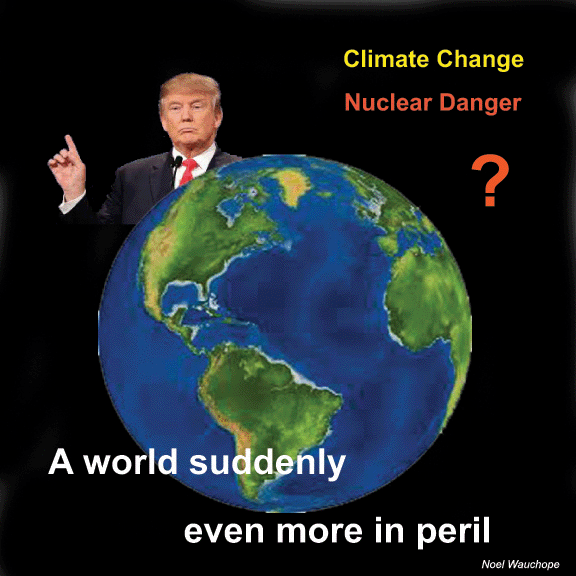
As award is announced for anti-nuclear group Ican, its head says US president ‘puts a spotlight’ on the weapons’ dangers, Guardian, Saeed Kamali Dehghan and Jon Henley, 7 Oct 17, The head of the anti-nuclear campaign group awarded the Nobel peace prize has chided Donald Trump for ramping up a nuclear standoff and said the US president has a track record of “not listening to expertise”.
Speaking in the hours after the Norwegian Nobel committee made the International Campaign to Abolish Nuclear Weapons (Ican) its 2017 laureate, Beatrice Fihn, the group’s executive director, said Trump “puts a spotlight” on the dangers of nuclear weapons.
“The election of President Donald Trump has made a lot of people feel very uncomfortable with the fact that he alone can authorise the use of nuclear weapons,” she told reporters in Geneva, adding that “there are no right hands for nuclear weapons”.
Fihn, who called Trump “a moron” in a Twitter post just two days before the peace prize announcement, said the award sent a message to all nuclear-armed states that “we can’t threaten to indiscriminately slaughter hundreds of thousands of civilians in the name of security”.
The chair of the Norwegian Nobel committee, Berit Reiss-Andersen, said the award had been made in recognition of Ican’s work “to draw attention to the catastrophic humanitarian consequences of any use of nuclear weapons and for its groundbreaking efforts to achieve a treaty-based prohibition of such weapons”.
The award underlines the mounting danger of nuclear conflict between the US and North Korea and the increasing vulnerability of the Iran nuclear deal. It also amounts to a reprimand to the world’s nine nuclear-armed powers – the US, Russia, Britain, China, France, India, Pakistan, North Korea and Israel – all of whom boycotted negotiations for a treaty banning nuclear weapons that was approved by 122 non-nuclear nations at the UN in July.
The Nobel committee said “the risk of nuclear weapons being used is greater than it has been for a long time” and there was “a real danger that more countries will try to procure nuclear weapons, as exemplified by North Korea”.
It said the peace prize was also a call to nuclear-armed states “to initiate serious negotiations with a view to the gradual, balanced and carefully monitored elimination of the almost 15,000 nuclear weapons in the world”.
The award is not the first time the peace prize has gone to anti-nuclear campaigners. Philip Noel-Baker received it in 1959 for his work on disarmament, and in 2005 the International Atomic Energy Agency and its former chief Mohamed ElBaradei were joint laureates “for their efforts to prevent nuclear energy from being used for military purposes”.
The Nobel committee’s decision comes just days before as Trump could carry out his threat to unravel the Iran nuclear deal, which could trigger a second nuclear standoff amid the North Korea crisis. The deal, concluded in 2015, settled a decade-long dispute over Tehran’s nuclear programme and averted the risk of another war in the Middle East.
Trump could decertify Iran’s compliance with the nuclear deal next week. He told a meeting of US military leaders on Thursday that Tehran was not living up to the “spirit of the agreement”, and added they were witnessing “the calm before the storm”.
Sir Richard Dalton, a former British ambassador to Iran, said the Nobel award was “a challenge to the international community, led by the UN security council, to protect this historic non-proliferation agreement [the Iran deal], which is vital for regional peace, from its detractors”.
Fihn said in her initial reaction that the group had received a phone call minutes before the official announcement and she had thought it was a prank. She said she did not believe it until she heard the name of the group during the announcement in Oslo.
Ican said in a statement: “This is a time of great global tension, when fiery rhetoric could all too easily lead us, inexorably, to unspeakable horror. The spectre of nuclear conflict looms large once more. If ever there were a moment for nations to declare their unequivocal opposition to nuclear weapons, that moment is now.”
The UN chief, António Guterres, tweeted his congratulations: [on original]
The EU foreign policy chief, Federica Mogherini, who was touted as a possible peace prize winner this year alongside the Iranian foreign minister for their work on the 2015 Iran nuclear deal, tweeted: [on original]
In Japan, survivors of the 1945 US atomic bombings of Hiroshima and Nagasaki during the second world war welcomed this year’s announcement. Sunao Tsuboi, who met with former US president Barack Obama during the latter’s historic visit to Hiroshima last year, congratulated Ican on its win. He endured serious burns and later developed cancer.
“I’m delighted that Ican, which has taken action to abolish nuclear weapons like us, won the Nobel peace prize,” the 92-year-old said, according to Agence France-Presse. “Together with Ican and many other people, we hikabusha will continue to seek a world without nuclear weapons as long as our lives last,” he said.
The first casualty of North Korean nuclear tests? The country’s environment, LA Times, Barbara Demick, 5 Oct 17
Mt Paektu is an active volcano that occupies a revered place in Korean legend as the birthplace of the Korean people. But it may be paying a price for their division.
Located on the border of North Korea and China, the volcano has been appropriated by Pyongyang as the “sacred mountain of the revolution.” Propagandists for the Communist state spin a tale, most likely apocryphal, that the late leader Kim Jong Il was born there while his father was a guerrilla fighting the Japanese.
The sacred mountain, however, is just 60 miles from the site where North Korea, now led by Kim’s son, Kim Jong Un, tested its sixth and most powerful nuclear weapon on Sept. 3.
Shortly afterward, Chinese authorities closed part of the tourist park on their side of the border because of rock slides. Chinese authorities would not say definitively whether the nuclear test was to blame, but seismologists think it is likely. The explosion registered as a 6.3 magnitude earthquake and was blamed for water bottles rolling off tables and furniture toppling in China, and apartment buildings rattling all the way to the Russian port city of Vladivostok.
It is just one example of the way that North Korea’s headlong rush to become a nuclear power is degrading the environment in and around the country’s borders.
The first casualty is inside North Korea itself, around the rugged, granite mountains of North Hamgyong province. All six of North Korea’s nuclear tests have taken place there at a site known as Punggye-Ri. Satellite images taken after the last test show numerous landslides around the site as well as water leaking from the entrance to one of the tunnels, according to 38 North, an academic website on Korea run by John Hopkins University.
“These disturbances are more numerous and widespread than seen after any of the North’s previous five tests, and include additional slippage in pre-existing landslide scars and a possible subsidence crater,’’ the report said.
Another analysis of satellite data found that Mt. Mantap, a 7,000-foot peak above the test site, actually lost a little elevation from the force of the underground explosion……
North Korea has conducted all six of its nuclear tests around the same site. The Sept. 3 test involved a device estimated at 250 kilotons — 17 times the force of the bomb that destroyed Hiroshima, Japan, in 1945.
“Every country that has developed a nuclear program has harmed its own people,” said Matthew McKinzie, director of the nuclear program at the Natural Resources Defense Council. He compares the situation to East Germany, where the extent of environmental degradation wasn’t known until after reunification in 1990.
The satellite photographs taken after the last test show water draining from the test site that was likely forced out from underground by explosion and could leach into the groundwater. A stream near the test site runs to the nearest sizable city, Kilju, some 25 miles away.
Even closer is the Hwasong labor camp, which is nestled next to Mt. Mantap and houses an estimated 20,000 political prisoners and their families. North Korean defectors in South Korea have said they believe prisoners were used to dig the tunnels of the nuclear test complex.
Satellite images also show that North Korea has failed to dispose safely of nuclear waste. In Pyongsan, north of the capital, Pyongyang, tailings are routinely dumped from North Korea’s largest uranium mine into an unlined pond, which is likely to contaminate the groundwater, 38 North has reported.
Defectors have complained as well about the environmental and safety risks of the nuclear program.
Asked for her message to the two leaders, ICAN’s Executive Director Beatrice Fihn told Reuters: “Nuclear weapons are illegal. Threatening to use nuclear weapons is illegal. Having nuclear weapons, possessing nuclear weapons, developing nuclear weapons, is illegal, and they need to stop.”
New research shows disastrous outcomes for nearby US allies if North Korea strikes
SEOUL• As United States President Donald Trump threatens to destroy North Korea, even some of his closest aides have warned of the potentially disastrous effects of a war.
New research published on the 38 North website points to just how catastrophic the impact might be on the regime’s neighbours.
If North Korean leader Kim Jong Un were to launch a nuclear attack on Seoul and Tokyo – both within striking distance of his weapons – as many as 2.1 million people could die and another 7.7 million could be injured, according to the 38 North report.
The analysis by Mr Michael Zagurek Jr, a consultant specialising in databases and computer modelling, is based on North Korea’s current estimated weapons technology and bomb strength.
Mr Zagurek assumes that Mr Kim has a baseline arsenal of 20 to 25 warheads and the capacity to put them on ballistic missiles.
Concerns about a nuclear conflict in North Asia have increased as Mr Kim accelerates his programme of acquiring weapons capable of hitting continental US, and as Mr Trump threatens preemptive military action.
While the chance of a direct attack on US allies Japan and South Korea remains slim, Mr Zagurek said history was replete with miscalculation by “rational actors” during crisis situations.
North Korean Foreign Minister Ri Yong Ho last month said the regime’s possible next steps include testing a hydrogen bomb over the Pacific Ocean.
According to Mr Zagurek, it is possible that another nuclear test, an intercontinental ballistic missile test, or a missile test that has the payload impact area too close to US bases in Guam might see Washington react with force.
US options could include attempting to shoot down the test missiles or possibly attacking the North’s missile testing, nuclear-related sites, missile deployment areas or the Kim regime itself. In turn, the North Korean leadership might perceive such an attack as an attempt to remove the Kim family from power and, as a result, could retaliate with nuclear weapons, he added.
North Korea’s older warheads have yields in the 15-25-kilotonne range, around the size of the bombs that devastated Hiroshima and Nagasaki in 1945.
Fatality estimates rise significantly if North Korea were able to strike with bombs similar to the one it tested on Sept 3, which had a likely yield of 108-205 kilotonnes, Mr Zagurek said.
New Zealand Educates Youth on Nuclear Disarmament, https://www3.nhk.or.jp/nhkworld/en/news/editors/5/nzeducatesyouthonnucleardisarmament/index.html– Hiromi Kurosaka, New Zealand is a staunch advocate of abolishing nuclear arms. Its policy coalesced in the 80s after strong opposition. And as a new generation grows up, the country is still committed to educating them about the horrors of nuclear weapons.
A commemoration of the victims of the atomic bombing of Hiroshima takes place annually in staunchly anti-nuclear New Zealand. The country adopted an anti-nuclear policy decades ago. Opposition had grown over the years as France repeatedly tested its nuclear weapons in the region’s waters. New Zealand’s policy bans the country from possessing nuclear arms or bringing them into its territory. Nuclear power isn’t used in the country either.
This year marks the 30th anniversary of the policy. A school focusing on teaching students the importance of disarmament invited survivors of the atomic bombing of Hiroshima to recount their painful experiences.
15-year-old Yasmin Clements-Levi, who heard the accounts of survivors for the first time, said “I’m really glad that I learned now, really exactly what they’ve gone through and how it affects them to this day.”
The school held a debate to help students think more deeply about the issue. Some of the students were against nuclear weapons. “It’s just horrible — the fact that so many people can die. It’s generally not worth it to have them in the world at all.” “If a terrorist group like ISIS were to get nukes, they could cause infinite destruction.”
Others maintained that they’re necessary. “If you talk about
The enormous cost of more nuclear weapons Is the expansion of our nuclear arsenal in America’s best interest, or is it just Trump’s latest boastful display? Salon, GUY T. SAPERSTEIN, KELSEY ABKIN 2017-10-05 This article originally appeared on AlterNet.
To put this into perspective, this number exceeds the combined total federal spending for education; training, employment, and social services; agriculture; natural resources and the environment; general science, space, and technology; community and regional development (including disaster relief); law enforcement; and energy production and regulation.
As long as other countries continue to harbor nuclear weapons, we will do the same. And vise versa. As Donald Trump said at the start of his campaign, “If countries are going to have nukes, we’re going to be at the top of the pack.”
This sentiment followed him into his presidency. The Trump administration just last week considered proposing additional, smaller, more tactical nuclear weapons that would cause less damage than traditional thermonuclear bombs. However, these mini-nukes are not some new, profound proposal. We have had nuclear weapons capable of being dialed down to the power of “mini nukes” since the 80’s. The 15-kiloton bomb dropped on Hiroshima would now be classified as a “mini-nuke” yet its destruction was monumental. Adding more, smaller nukes is an unnecessary, potentially dangerous addition. Proponents of the proposal claim these “mini-nukes” would give military commanders more options; critics, however, contend that it will also make the use of atomic arms more likely. Christine Parthemore, International Affairs Fellow at the Council on Foreign Relations, says, “Our investments should be careful lowering our threshold of use.” Further, the proposed addition will only add trouble to the already fraught international conversation opposing nuclear weapons.
As former Secretary of State George Shultz so eloquently put it, “proliferation begets proliferation.” One state’s nuclear acquisitions only drive its adversaries to follow suit. The reality is adding to our nuclear arsenal will only force our international opponents to defensively order a mad dash for the bomb.
In today’s political arena, as Russia remains volatile and North Korea’s threat grows, is funding the expansion of our nuclear arsenal in the country’s best interest or just Trump’s latest boastful display of American power?
Having a nuclear arsenal is supposed to ensure the raw principle behind nuclear deterrence: You won’t destroy us because we can destroy you. As Andrew Weber, Former Assistant Secretary of Defense & former Director of the Nuclear Weapons Council, says, “The sole purpose of having a nuclear arsenal is to deter an attack on the United States of America.”
This cold war era mindset relies on the relationship between acting and reacting. With the recognition that retaliation is likely, if not guaranteed, nuclear weapons are supposed to restrain the possibility of action on behalf of nuclear leaders. They are supposed to make them cautious, regardless of which states we are talking about or how many weapons they might possess.
According to a 2017 report by the Arms Control Association, The United States currently maintains an arsenal of about 1,650 strategic nuclear warheads deployed on Intercontinental Ballistic Missiles (ICBMs), Submarine-Launched Ballistic Missiles (SLBMs), and Strategic Bombers and some 180 tactical nuclear weapons at bomber bases in five European countries.
The ICBM is arguably the most controversial piece of America’s nuclear triad, yet in August, the Air Force announced major new contracts for a revamp of the American nuclear force: $1.8 billion for initial development of a highly stealthy nuclear cruise missile, and nearly $700 million to begin replacing the 40-year-old Minuteman missiles in silos across the United States.
This plan was born from the Obama administration but enthusiastically hightailed by Trump. Obama’s reasoning was that as our weapons became increasingly safe, their numbers could be reduced.
However, Trump’s reasoning has proven to be different. His threat that North Korea will be met with “fury and fire” combined with his proposals of mini-nukes only propel the notion that he is not following past leaders in enforcing a no first strike policy.
Report Advertisement
The danger of revamping this shaky leg of the nuclear triad is in part due to Trump’s demonstrated impulsiveness. As Andrew Weber explains, “There is a 2-3 minute threat of the land-based missiles and it is impossible for the target to determine whether the weapon has a nuclear or conventional tip.” An impulsive president with nuclear codes capable of starting a nuclear war in 2-3 minutes using a weapon that must fly over Russia and has the possibility of mistaken identity, is essentially a recipe for disaster………
Ultimately, there is no military option that would not entail a mind-bogging gamble with the lives of millions of Americans, Japanese and especially South Koreans……
Now is not the time to build up our nuclear arsenal and respond to threats with military action, especially as we face an already threatened North Korea. It is crucial now more than ever not to proliferate the use of nuclear weapons. The goal is to deter and when it comes to deterrence, more is not better, especially when it is so incredibly expensive. https://www.salon.com/2017/10/05/the-enormous-cost-of-more-nuclear-weapons_partner/
A Hypothetical Nuclear Attack on Seoul and Tokyo: The Human Cost of War on the Korean Peninsula [excellent charts and aerial photographs] 38 North, BY: MICHAEL J. ZAGUREK JR., OCTOBER 4, 2017 At various times over the past few weeks, US President Donald Trump and other members of his administration have threatened to use military force to prevent North Korea from conducting additional nuclear or ballistic missile tests. The US carrying out any military option raises a significant risk of military escalation by the North, including the use of nuclear weapons against South Korea and Japan. According to the calculations presented below, if the “unthinkable” happened, nuclear detonations over Seoul and Tokyo with North Korea’s current estimated weapon yields could result in as many as 2.1 million fatalities and 7.7 million injuries……….
If the status quo is unacceptable and diplomacy has been ineffective, then at what point do military responses become probable? The tension between North Korea, its neighbors and the United States are now extremely high, antagonized further by bombastic exchanges between the US and DPRK during the United Nations General Assembly meetings and continued tweets from Trump. History is replete with “rational actors” grossly miscalculating, especially in crisis situations. It is possible that another North Korean nuclear test—especially if detonated in air or under water—an ICBM test, or a missile test that has the payload impact area too close to US bases in Guam for example, might see Washington react with force. This could include such options as attempting to shoot down the test missiles or possibly attacking North Korea’s missile testing, nuclear related sites, missile deployment areas or the Kim Regime itself. The North Korean leadership might perceive such an attack as an effort to remove the Kim family from power and, as a result, could retaliate with nuclear weapons as a last gasp reaction before annihilation. Therefore, it is worth reviewing the consequences if the “unthinkable” happened.
A Hypothetical Attack Let us assume that North Korea has 25 operational nuclear weapons and that when under attack, it decides to launch its entire arsenal against both Seoul and Tokyo. The warhead yield ranges from 15 to 250 kilotons (current and possible future capabilities) and are timed for airburst at optimal altitude. Based on these assumptions, seven scenarios were run, one for each of the seven different warhead yields.
There are dozens of variables in calculating the potential effects of nuclear detonations on population centers. One can run countless simulations with many combinations of these variables with a wide range of results [12]. For simplification purposes, the calculations in this simulation are based on traditional population vulnerability due to blast overpressure [13]. The blast areas for the seven weapon yields were calculated using the Nuclear Bomb Effects Computer [14].
Current estimated population, area, and population density for Seoul and Tokyo [chart on original]
The population density at the center of both Seoul and Tokyo is significantly higher. For example, the population density of Seoul Special City is 17,002/km2 [16], the population density of Tokyo’s Special Wards is 14,950/km2 [17]. Moreover, the population density levels of these special areas can significantly increase during the work week.
Casualty Estimates
Based on these assumptions, the number of casualties expected from a single reliable 250 kt warhead airburst over the centers of Seoul and Tokyo is as follows [18]: [chart on original – total over 6 million] ……. [excellent references] morehttp://www.38north.org/2017/10/mzagurek100417/
U.S. PREPARES NEW MISSILES FOR JAPAN AFTER NORTH KOREA THREATENS NUCLEAR WAR, newsweek BY TOM O’CONNORThe U.S. has moved closer to selling dozens of state-of-the-art missiles to Japan as part of President Donald Trump’s pledge to boost military support for Pacific allies opposed to nuclear-armed North Korea.
The State Department’s Defense Security Cooperation Agency said Wednesday it would back the Japanese government’s request for up to 56 AIM 120C-7 Advanced Medium Range Air-to-Air Missiles (AMRAAMs). The sale, which is estimated at $113 million and requires congressional approval, would also reportedly include various logistical, technical, engineering and weapons support services. It comes as Japan reconsiders its traditionally pacifist post-World War II stance on defense in the face of threats from North Korea, which has shot two missiles over Japanese territory in the past two months.
The proposed sale will provide Japan a critical air defense capability to assist in defending the Japanese homeland and U.S. personnel stationed there,” the agency said in a statement.
“Japan will have no difficulty absorbing these additional munitions into the Japan Air Self-Defense Force,” it added…….
ENGULFED IN FLAMES’ Kim Jong-un warns of ‘nuclear clouds over suicidal Japan’ as he brands the country’s Prime Minister a ‘headless chicken’ North Korea’s state media said ‘the Japanese archipelago will be engulfed in flames in a moment’ The Sun UK, By Jon Lockett, 3rd October 2017,
NORTH Korea has threatened “suicidal” Japan with “nuclear clouds” as it blasted Prime Minister Shinzo Abe’s call for the world to pile more pressure onto the rogue state.
Kim Jong-un’s state media ripped into Abe accusing him of “running around the UN stage like a headless chicken” and pushing the region into a nuclear war.
Japan’s such rackets inciting the tension of the Korean Peninsula is a suicidal deed that will bring nuclear clouds to the Japanese archipelago,” said KCNA.
“No one knows when the touch-and-go situation will lead to a nuclear war, but if so, the Japanese archipelago will be engulfed in flames in a moment.”…….
North Korea has conducted a flurry of missile tests recently amid growing international unease.
After the mass shooting in Las Vegas, the NRA is pulling ads supporting Republican candidates in Virginia, but not for long. The NRA is cynically pulling campaign ads in the wake of the mass shooting in Las Vegas — but only temporarily.
The gun extremists appear to believe that the country only needs eight days to forget about the worst mass shooting in modern American history, allowing them to exploit the gun issue to assist an ally.
According to Medium Buying, a firm that tracks ad spending, the NRA’s Political Victory Fund has postponed running ads that it planned to run in Virginia. Instead, the NRA will begin running its advertising on Oct. 10.
The group has endorsed Republican Ed Gillespie for Governor, along with his running mate Jill Vogel. The NRA is also backing John D. Adams, the Republican candidate for Attorney General.
The NRA praised Gillespie in an endorsement release in August, hailing him as “a leader in the growing national movement to expand our Second Amendment freedoms.”
Ralph Northam, the Democrat in the governor’s race, is an Army veteran and a hunter who has described himself as “a staunch advocate for commonsense gun safety laws.”
The NRA has often gone silent after mass shootings, as it has this time, with the hopes that it can wait out grief after the tragedy. Then, when the conditions are more favorable for its violent messages, the NRA promotes advertising that calls on gun owners to confront protesters with a “clenched fist.”
As the NRA cowers and tries to wait out the situation, groups like Moms Demand Action for Gun Sense In America are stepping up. Founder Shannon Watts released a statement on the shooting.
“I am sickened and heartbroken that, once again, American families will be torn apart by gun violence,” she said. “My thoughts are with the victims and their loved ones, whose lives will never be the same.”
She added, “While details are still unfolding, one thing is for sure: It doesn’t have to be this way. Americans should be able to go to concerts, to night clubs, to elementary schools and movie theaters without worrying about the threat of gun violence. While we grieve for the 50 people shot and killed and the more than 400 who are hospitalized, we must also act in their honor. Gun violence is preventable.”
The NRA doesn’t want anything done about gun violence in America because their ideal world is one in which the country is awash in firearms, no matter the risk to children and families. They go silent while still intending to back candidates who will enact their agenda unquestioningly.
But millions of Americans want something to be done, to stop attacks like the ones in Las Vegas, Charleston, Newtown, and so many other American cities and towns. And they will not be silenced.
Canada is missing its chance to shut the gate on nuclear weapons everywhere The Conversation, MV Ramana, Simons Chair in Disarmament, Global and Human Security at the Liu Institute for Global Issues, University of British Columbia, Lauren Borja, Incoming post-doctoral fellow, School of Public Policy and Global Affairs, University of British Columbia, University of British Columbia, Last month, the Treaty on the Prohibition of Nuclear Weapons (or the Ban Treaty) opened for signatures to all member states at the United Nations. The treaty is a product of sustained activism by civil society and key non-nuclear weapon states.
As researchers who study nuclear policy, we see this development as a landmark in the struggle to eliminate nuclear weapons.
The Ban Treaty would make it illegal for signatories to develop, produce, test, possess, use, threaten to use, or transfer nuclear weapons, among other restrictions.
Within days of being opened for signature, 53 countries have signed the treaty, and three have ratified. After signature and ratification by at least 50 countries, it comes into force.
The Ban Treaty was motivated by a clear recognition that the humanitarian impacts of nuclear weapons use and testing should be at the forefront of all discussions about these weapons. Dr. Tilman Ruff, co-president of International Physicians for the Prevention of Nuclear Wartestified at the United Nations in March: “An understanding of what nuclear weapons do invalidates all arguments for continued possession of these weapons and requires that they urgently be prohibited and eliminated as the only course of action commensurate with the existential danger they pose.”
The Ban Treaty, therefore, represents a shift in nuclear arms control, away from talking about nuclear weapons in terms of security and deterrence to focusing on the horrendous consequences of nuclear warfare.
This shift is reflected in the language of the Preamble of the Treaty which highlights concerns that the “catastrophic consequences of nuclear weapons” would “transcend national borders” and “pose grave implications for human survival.” The Treaty also posits that “complete” elimination “remains the only way to guarantee that nuclear weapons are never used again under any circumstances.”
Canada abandons traditional arms control emphasis
An emphasis on the humanitarian consequences, however, is not unique within arms control. Other forms of warfare, such as land mines, biological and chemical weapons, have also been outlawed because of such concerns. And such humanitarian concerns have often guided Canada’s diplomacy in the past, as illustrated by its leading role in the appropriately named Ottawa Convention to ban landmines……….
Looking ahead on nuclear disarmament
There has been widespread political support within Canada for being more active in furthering nuclear disarmament. In 2010, both the Senate and House of Commons unanimously adopted a resolution encouraging the Government of Canada “to engage in negotiations for a nuclear weapons convention” and “deploy a major worldwide Canadian diplomatic initiative in support of preventing nuclear proliferation and increasing the rate of nuclear disarmament.” The dynamic set off by the Ban Treaty offers a suitable opening for launching such an initiative.
In April of this year, Chrystia Freeland issued the following statement to mark the 20th anniversary of the entry into force of the Chemical Weapons Convention: “Twenty years ago today, the international community was united in denouncing the use of chemical weapons by anyone, anywhere, under any circumstance.”
When did nuclear disarmament become such a dirty word for the Tories? Guardian, Emily ThornberryUnlike her Conservative predecessors Theresa May won’t commit to the principle of a nuclear-free world – just so she can attack Jeremy Corbyn’s position
On this day, 65 years ago, near a remote island off the Australian west coast, a bomb was exploded in the hull of the empty navy frigate HMS Plym, its blast two-thirds more powerful than the one that destroyed Hiroshima. At that moment, Britain officially became the world’s third nuclear power.
Both Winston Churchill, who authorised the test, and Clement Attlee, who initiated it, believed its true significance lay not in increasing Britain’s military capabilities, but in further deterring the threat of nuclear war between Russia and the west, and ultimately in eradicating that threat.
Since that day in October 1952, 17 general elections have been held in Britain, and – while debates have often raged about a unilateral versus multilateral approach – the principle that the British government should always be working towards global disarmament has never seemed in doubt.
Until now, that is. Theresa May’s manifesto earlier this year was only the third by a sitting government since Britain got the bomb that made no mention at all of nuclear proliferation and the importance of arms control. And – unlike the two others – she had no excuse.
The previous exceptions to the rule were in February 1974, when Ted Heath tried to reduce his snap election to the single question “Who governs Britain?”; and 1997, when a fag-end Tory administration was barely going through the motions against New Labour.
But in every other case, the prime minister and government of the day treated it as almost a moral responsibility to make clear their long-term commitment to disarmament, often alongside a statement of their short-term plans to retain and renew Britain’s nuclear arsenal…….
So the question for the prime minister and her party is: “When did disarmament become such a dirty word?” Why are Jeremy Corbyn and the Labour party now derided for advocating policies that Tory governments once considered perfectly commonplace?……..
Look at the situation today, especially this summer’s volatile and unresolved standoff between Kim Jong-un and Donald Trump, and it is clear that the threat of nuclear conflict is definitely no less severe than in previous decades, and is arguably at its highest level since the early 1980s.
For past governments of all parties in Britain, that was the cue to step up their efforts on nuclear diplomacy, and commit to progress on disarmament. But from May, Boris Johnson and Michael Fallon, we hear the opposite, and the explanation is as depressing as it is straightforward.
They know that Corbyn – along with me and others – is a long-standing proponent of disarmament. They know that this issue has caused tension in the Labour party over the past two years. And they therefore regard any discussion of nuclear weapons simply as a chance to misrepresent Labour as soft and divided on defence.
In that context, the silence of the last Tory manifesto makes total sense; any commitment to make progress on arms control would have made it impossible for May’s attack dogs to tear holes in Labour for saying the same.
So this most unprincipled of prime ministers chooses to ignore the issue of disarmament simply for short-term political gain, something no sitting government has done since that massive blast 65 years ago on HMS Plym………
at least up until now, every government since Churchill’s has believed that – whatever the arguments that nuclear weapons are a necessary short-term deterrent – the only long-term and absolute guarantee of safety is to eliminate them entirely from the planet.
It should hardly be a surprise therefore for Labour’s leader to state that as his ambition, just as it was for Churchill, Macmillan, Thatcher, Major and Cameron. Indeed, the fact that Theresa May continues to attack Jeremy Corbyn for holding that principle is not just a massive departure from the standards of her postwar predecessors, but one of the many reasons she is not fit to stand in their – or his – company.
North Korean leader Kim Jong Un provides guidance on a nuclear weapons program in this undated photo released by North Korea’s Korean Central News Agency (KCNA) in Pyongyang September 3, 2017. KCNA via REUTERS
North Korea vows to become a ‘state nuclear force’, Aljazeera, 1 Oct 17
Pyongyang calls sanctions and pressure ‘futile’ in halting its development of nuclear weapons. North Korea’s state news agency has called the US-led effort to impose sanctions over its weapons programme futile, vowing the country inevitably will become a “state nuclear force”.
The comments on Sunday came from the Korean Central News Agency’s website Uriminzokkiri after US Secretary of State Rex Tillerson met for talks with China’s top diplomats and President Xi Jinping in Beijing on the Korean nuclear crisis.
Tillerson has been a proponent of a campaign of “peaceful pressure”, using US and UNsanctions and working with China to turn the screw on the regime.
In this documentary, Motherboard explores the life and legacy of the father of the hydrogen bomb. According to North Korea’s Foreign Minister, Kim Jong-un is considering testing its hydrogen bomb in the Pacific Ocean in response to rising tensions with President Trump. But in order to understand the significance of the hydrogen bomb, you need to understand the people who created it.
In a 2013 video documentary, Motherboard explored the life of Edward Teller: the father of the hydrogen bomb, and the inspiration for Stanley Kubrick’s character Dr. Strangelove.
According to Ralph Moir, Teller’s student and eventual colleague, Teller believed that scientists bear no responsibility for the use of their creations.
“He wanted to make a contribution to mankind, but he’s also very interested in science and anything new,” Moir told Motherboard in 2013. “It was patriotic to have a strong defense. But also, it was fascinating science.”
However, not everyone agreed with Teller. In the 1940s, this gave way to an ethical debate that split the world into two groups: Those who sided with Robert Oppenheimer, creator of the atom bomb, believed that a stronger successor to the atom bomb was dangerous and unnecessary. Those who sided with Teller believed in a benefit to building a weapon so destructive that it exists only in obsolescence.
The scientific community almost entirely sided with Oppenheimer, but President Truman sided with Teller. In 1952, the US successfully detonated the first hydrogen bomb.
Later in his life, Teller would help launch Plowshare, a US experiment for nuclear weapons use in building and construction. Teller also believed the US should invest in geoengineering, nuclear engines for spacecrafts, nuclear testing in space, and nuclear reactors powered by thorium rather than uranium. None of these ideas have yet come to fruition.
It’s been over a decade since his death, but Teller’s name remains controversial.
Trump Threatens Genocide, Crimes Against Humanity in North Korea, http://www.truth-out.org/news/item/42101-trump-threatens-genocide-crimes-against-humanity-in-north-korea, September 29,2017, By Marjorie Cohn, Truthout | News Analysis Donald Trump threatened to “totally destroy North Korea” in his address to the United Nations General Assembly on September 19. That threat violates the UN Charter, and indicates an intent to commit genocide, crimes against humanity, the war crime of collective punishment and international humanitarian law. Moreover, a first-strike use of nuclear weapons would violate international law.
By threatening to attack North Korea, Trump is endangering the lives of countless people. In the past, he has indicated his willingness to use nuclear weapons and Kim Jong-un has threatened to retaliate. The rapidly escalating rhetoric and provocative maneuvers on both sides has taken us to the brink of war.
Trump’s threat prompted North Korean foreign minister Ri Yong-ho to state, “Given the fact that this [threat] came from someone who holds the seat of the US presidency, this is clearly a declaration of war.”
Ri added, “Since the United States declared war on our country, we will have every right to make counter-measures, including the right to shoot down United States strategic bombers even when they are not inside the airspace border of our country.”
Such a move by North Korea would violate international law. But that does not justify US law-breaking. Two wrongs do not make a right. Moreover, the use of military force by either country would prove disastrous.
The UN Charter Requires Peaceful Dispute Resolution
After two world wars claimed millions of lives, the UN Charter was adopted in 1945 “to save succeeding generations from the scourge of war.”
The Charter mandates the peaceful resolution of international disputes and forbids the use of force except in self-defense or with Security Council authorization.
Article 2 requires that UN members “settle their international disputes by peaceful means in such a manner that international peace and security, and justice, are not endangered.” Peaceful means are spelled out in Article 33: Parties to a dispute likely to endanger international peace and security must “first of all, seek a solution by negotiation, enquiry, mediation, conciliation, arbitration, judicial settlement, resort to regional agencies or arrangements, or other peaceful means of their own choice.”
In 1953, after one-third of North Korea’s population was decimated, the United States and North Korea signed an armistice agreement. But the US never allowed a peace treaty to be adopted. North Korea has repeatedly advocated the signing of a peace treaty to formally end the Korean War. To this day, 30,000 US troops continue to occupy South Korea.
The US has also refused to pursue the “freeze-for-freeze” strategy suggested by China and Russia. Under this plan, North Korea would freeze its nuclear and missile testing, and the US and South Korea would end their annual, provocative joint military exercises. Vassily Nebenzya, Russia’s ambassador to the UN, said this path would offer “a way out” of the current situation.
Instead, the US has engineered punitive sanctions against North Korea, which have only strengthened the latter’s resolve to develop usable nuclear weapons. Since 1953, North Koreans have lived in fear of annihilation by the United States.
In his speech to the General Assembly, on top of his threats toward North Korea, Trump also issued a veiled threat to pull out of the Iran nuclear deal. That sends a dangerous message to North Korea that the US cannot be trusted to abide by its agreements.
The UN Charter Prohibits Threats and Preemptive Use of Force
Article 2 of the Charter states that all members “shall refrain in their international relations from the threat or use of force against the territorial integrity or political independence of any state.” Trump’s threat to totally destroy North Korea violates that mandate. In addition, the preemptive use of force violates the Charter.
The only exceptions to the Charter’s prohibition of the use of force are self-defense or approval by the Security Council.
Self-defense, under Article 51 of the Charter, is a narrow exception to the Charter’s prohibition of the use of force. Countries may engage in individual or collective self-defense only in the face of an armed attack. In order to act in lawful self-defense, there must exist “a necessity of self-defense, instant, overwhelming, leaving no choice of means, and no moment for deliberation,” under the well-established Caroline Case.
North Korea has not attacked the United States or another UN member country, nor is such an attack imminent.
Moreover, the Security Council has not authorized any country to use military force against North Korea The council resolutions that establish sanctions against North Korea end by stating the Council “decides to remain seized of the matter.” That means that the Council, and only the Council, has the authority to approve military action.
Both Trump’s threat to use military force against North Korea and the mounting of a preemptive strike would violate the Charter.
The Crime of Genocide
By stating the intention to totally destroy North Korea, Trump has threatened genocide.
The crime of “genocide,” as defined in the Rome Statute for the International Criminal Court, is committed when, with the intent to destroy, in whole or in part, a national, ethnical, racial or religious group, any of the following acts are committed: killing members of the group, causing serious bodily or mental harm to members of the group, or deliberately inflicting on the group conditions of life calculated to bring about its destruction in whole or in part.
Trump’s threat to totally destroy North Korea, if carried out, would destroy, in whole, the national group of North Koreans. That would amount to genocide.
Crimes Against Humanity
Under the Rome Statute, “crimes against humanity” include: the commission of murder as part of a widespread or systematic attack against any civilian population; or persecution against a group or collectivity based on its political, racial, national, ethnic or religious character, as part of a widespread or systematic attack against any civilian population.
Trump’s threat to totally destroy North Korea, if realized, would constitute a widespread and systematic attack against the civilian population of North Korea, which would amount to a crime against humanity.
The War Crime of Collective Punishment
The crime of “collective punishment” is a grave breach of the Fourth Geneva Convention, which is considered a war crime. Collective punishment means punishing a civilian for an offense he or she has not personally committed.
If Trump were to make good on his threat to totally destroy North Korea, he would be punishing the civilian population for offenses committed by the North Korean government. This would constitute the war crime of collective punishment.
Destroying North Korea Would Violate Distinction and Proportionality
The United States has a legal obligation to comply with the requirements of proportionality and distinction, two bedrock principles of international humanitarian law, as delineated in the First Protocol Additional to the Geneva Conventions.
“Proportionality” means an attack cannot be excessive in relation to the anticipated military advantage sought. “Distinction” requires that the attack be directed only at a legitimate military target.
The total destruction of North Korea would violate the principles of proportionality and distinction.
First-Strike Use of Nuclear Weapons Violates International Law
In its 1996 advisory opinion, “Legality of the Threat or Use of Nuclear Weapons,” the International Court of Justice (ICJ) determined that “the threat or use of nuclear weapons would generally be contrary to the rules of international law applicable in armed conflict, and in particular the principles and rules of humanitarian law.”
The ICJ went on to say, “However … the Court cannot conclude definitively whether the threat or use of nuclear weapons would be lawful or unlawful in an extreme circumstance of self-defence, in which the very survival of a State would be at stake.” That means that while the use of nuclear weapons might be lawful when used in self-defense if the survival of the nation were at stake, a first-strike use would not be.
Donald Trump’s apocalyptic threat against North Korea violates international law. It also imperils the lives of untold numbers of people. We must urge Congress to prevent Trump from launching a catastrophic war.
Copyright, Truthout. May not be reprinted without permission.
Marjorie Cohn is professor emerita at Thomas Jefferson School of Law, former president of the National Lawyers Guild and deputy secretary general of the International Association of Democratic Lawyers. Her books include The United States and Torture: Interrogation, Incarceration, and Abuse; Cowboy Republic: Six Ways the Bush Gang Has Defied the Law and Drones and Targeted Killing: Legal, Moral, and Geopolitical Issues. Visit her website: MarjorieCohn.com. Follow her on Twitter: @MarjorieCohn.



 NRA pulls attack ads, hopes everyone forgets about mass slaughter in 8 days https://shareblue.com/nra-pulls-attack-ads-hopes-everyone-forgets-about-mass-slaughter-in-8-days/