Hawaii to test nuclear attack siren
The “without alarm” part gets harder Friday.
That is when the government is set to bring back a statewide nuclear attack siren, a relic of the Cold War that will notify islanders that a missile is headed toward them. Officials will test the system for the first time just before lunchtime Friday, according to the Honolulu Star-Advertiser.
If the alarm goes off at any other time, by the way, it means that residents have 15 minutes before a nuclear bomb destroys Hawaii as we know it. The tests will be conducted on the first business day of every month for the foreseeable future……. https://www.washingtonpost.com/news/post-nation/wp/2017/11/27/hawaii-brings-back-cold-war-era-nuclear-warning-sirens-amid-fears-of-north-korea-strike/?utm_term=.bd5f
Gaol for Australian anti-war protestors at USA’s secret base in theAustralian desert
An American Spy Base Hidden in Australia’s Outback, NYT The trials — and the Australian government’s uncompromising prosecution of the protesters — has put a spotlight on a facility that the United States would prefer remain in the shadows.

— Margaret Pestorius arrived at court last week in her wedding dress, a bright orange-and-cream creation painted with doves, peace signs and suns with faces. “It’s the colors of Easter, so I always think of it as being a resurrection dress,” said Ms. Pestorius, a 53-year-old antiwar activist and devout Catholic, who on Friday was convicted of trespassing at a top-secret military base operated by the United States and hidden in the Australian outback.
From the base, known as the Joint Defense Facility Pine Gap, the United States controls satellites that gather information used to pinpoint airstrikes around the world and target nuclear weapons, among other military and intelligence tasks, according to experts and leaked National Security Agency documents.

As a result, the facility, dotted with satellite dishes and isolated in the desert, has become a magnet for Australian antiwar protesters. ….Over the past two weeks, Ms. Pestorius and five other Christian demonstrators were convicted in two separate trials of breaching the site’s security perimeter last year. They could face seven years in prison……..
Born at the height of the Cold War, Pine Gap was presented to the Australian public in 1966 as a space research facility. But behind the scenes, the station was run by the C.I.A. to collect information from American spy satellites about the Soviet Union’s missile program……Photos taken from the air show a sprawling campus punctuated by white geodesic domes that look like giant golf balls. Inside these spheres, called radomes, are antenna systems that send and receive information from satellites in constant orbit above the earth…..Today, more than 800 people from both countries are believed to work at the base. But the United States is firmly in control.
“Pine Gap has changed and developed enormously,” said Richard Tanter, a senior research associate at the Nautilus Institute and honorary Melbourne University professor who has investigated and criticized the base for years.
In documents leaked by Edward Snowden, the American intelligence contractor turned whistle-blower, Pine Gap is described as playing “a significant role in supporting both intelligence activities and military operations What that actually means, Professor Tanter said, is that the station is involved in real-time contributions to the United States’ global military operations in Afghanistan, Iraq and Syria.
Pine Gap, he added, also “contributes data for C.I.A. drone operations in countries in which the United States is not at war — Yemen, Somalia, Pakistan and so forth. It is also critically important in whatever the United States is going to do on the Korean Peninsula.”
Professor Tanter has gleaned information about the secret site from unexpected public records, including the LinkedIn profiles of Pine Gap contractors and satellite photos that reveal new construction at the site.
Professor Tanter, who is president of the Australian board of the International Campaign for the Abolition of Nuclear Weapons, said he wanted the government to “make a very clearheaded assessment” of whether it is in Australia’s best interest to contribute data for drone assassinations and targeting nuclear weapons..”….. Last year, in the early hours of a cold, dark September morning, Ms. Pestorius, Mr. Dowling and three other “peace pilgrims,” as they call themselves, breached Pine Gap’s security perimeter.
As the activists scrambled up a rocky hill to get closer to the base, and with the police moving in, Ms. Pestorius picked up her viola. Another protester strummed his guitar. As they played a lament for those killed in war, Mr. Dowling held up a large, laminated photograph showing a bloodied young woman with her foot missing.
A sixth activist, Paul Christie, 44, carried out his own protest at Pine Gap days later; he was tried separately and convicted last week, charged, like the others, with entering a prohibited area. During the activists’ back-to-back trials this month, a modest band of supporters gathered at the courthouse. Many were members of the country’s antiwar movement, parts of which are religion-infused.
A Quaker knitted flower brooches. A Buddhist brewed coffee from the back of his van. A collection of colorful banners tied to fences read “Close Pine Gap” and “End the U.S. Alliance and Pine Gap Terror Base.” Mr. Dowling, who said he had been arrested between 50 and 100 times, was found guilty once before of trespassing at Pine Gap, in 2005. The conviction was later overturned.
One of his co-defendants this time was his 20-year-old son Franz, the guitar player at the protest last year. The younger Mr. Dowling and two other defendants — Andrew Paine, 31, and Timothy Webb, 23 — live together in a Dorothy Day Catholic Worker House in Brisbane, where they regularly take in homeless people.
All five were found guilty of entering a prohibited area, and Mr. Paine was convicted of an additional charge of possessing a photographic device.
During their trial, the five — who acted as their own attorneys — tried to argue that they had acted in the defense of others, but Justice John Reeves did not allow it.
Pine Gap has “to bear a big responsibility for all the murder and mayhem that has taken place in Iraq and Afghanistan,” said Jim Dowling….. https://www.nytimes.com/2017/11/23/world/australia/pine-gap-spy-base-protests.html?smid=li-share
A new arms race underway, as USA, then Russia, modernise their nuclear weapons

Special Report: In modernizing nuclear arsenal, U.S. stokes new arms race, Scot Paltrow WASHINGTON (Reuters), 21 Nov 17 – President Barack Obama rode into office in 2009 with promises to work toward a nuclear-free world. His vow helped win him the Nobel Peace Prize that year.
The next year, while warning that Washington would retain the ability to retaliate against a nuclear strike, he promised that America would develop no new types of atomic weapons. Within 16 months of his inauguration, the United States and Russia negotiated the New Strategic Arms Reduction Treaty, known as New START, meant to build trust and cut the risk of nuclear war. It limited each side to what the treaty counts as 1,550 strategic nuclear warheads.
By the time Obama left office in January 2017, the risk of Armageddon hadn’t receded. Instead, Washington was well along in a modernization program that is making nearly all of its nuclear weapons more accurate and deadly.
And Russia was doing the same: Its weapons badly degraded from neglect after the Cold War, Moscow had begun its own modernization years earlier under President Vladimir Putin. It built new, more powerful ICBMs, and developed a series of tactical nuclear weapons.
The United States under Obama transformed its main hydrogen bomb into a guided smart weapon, made its submarine-launched nuclear missiles five times more accurate, and gave its land-based long-range missiles so many added features that the Air Force in 2012 described them as “basically new.” To deliver these more lethal weapons, military contractors are building fleets of new heavy bombers and submarines.
President Donald Trump has worked hard to undo much of Obama’s legacy, but he has embraced the modernization program enthusiastically. Trump has ordered the Defense Department to complete a review of the U.S. nuclear arsenal by the end of this year.
Reuters reported in February that in a phone conversation with Russian President Vladimir Putin, Trump denounced the New START treaty and rejected Putin’s suggestion that talks begin about extending it once it expires in 2021.
Some former senior U.S. government officials, legislators and arms-control specialists – many of whom once backed a strong nuclear arsenal — are now warning that the modernization push poses grave dangers.
“REALLY DANGEROUS THINKING”
They argue that the upgrades contradict the rationales for New START – to ratchet down the level of mistrust and reduce risk of intentional or accidental nuclear war. The latest improvements, they say, make the U.S. and Russian arsenals both more destructive and more tempting to deploy. The United States, for instance, has a “dial down” bomb that can be adjusted to act like a tactical weapon, and others are planned.
“The idea that we could somehow fine tune a nuclear conflict is really dangerous thinking,” says Kingston Reif, director of disarmament and threat reduction policy at the Arms Control Association, a Washington-based think tank.
One leader of this group, William Perry, who served as defense secretary under President Bill Clinton, said recently in a Q&A on YouTube that “the danger of a nuclear catastrophe today is greater than it was during the Cold War.”
Perry told Reuters that both the United States and Russia have upgraded their arsenals in ways that make the use of nuclear weapons likelier. The U.S. upgrade, he said, has occurred almost exclusively behind closed doors. “It is happening without any basic public discussion,” he said. “We’re just doing it.”
………. A BUDGET BUSTER?
The U.S. modernization effort is not coming cheap. This year the Congressional Budget Office estimated the program will cost at least $1.25 trillion over 30 years. The amount could grow significantly, as the Pentagon has a history of major cost overruns on large acquisition projects.
As defense secretary under Obama, Leon Panetta backed modernization. Now he questions the price tag.
“We are in a new chapter of the Cold War with Putin,” he told Reuters in an interview, blaming the struggle’s resumption on the Russian president. Panetta says he doubts the United States will be able to fund the modernization program. “We have defense, entitlements and taxes to deal with at the same time there are record deficits,” he said.
New START is leading to significant reductions in the two rival arsenals, a process that began with the disintegration of the USSR. But reduced numbers do not necessarily mean reduced danger……….. https://www.reuters.com/article/us-usa-nuclear-modernize-specialreport/special-report-in-modernizing-nuclear-arsenal-u-s-stokes-new-arms-race-idUSKBN1DL1AH
THE MOST EXPENSIVE BOMB EVER – USA’s new B61 nuclear hydrogen bomb
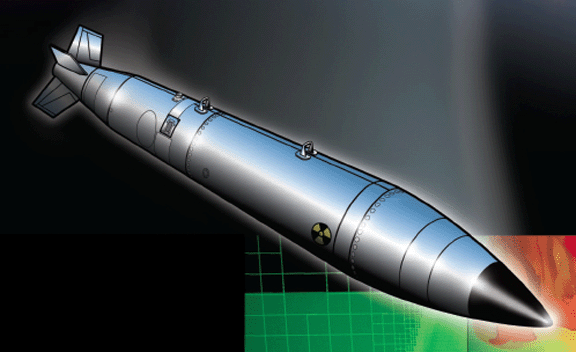
Special Report: In modernizing nuclear arsenal, U.S. stokes new arms race, Scot Paltrow, WASHINGTON (Reuters), 21 Nov 17 “………..One example of an old weapon transformed into a more dangerous new one is America’s main hydrogen bomb. The Air Force has deployed the B61 bomb on heavy bombers since the mid-1960s. Until recently, the B61 was an old-fashioned gravity bomb, dropped by a plane and free-falling to its target.
THE MOST EXPENSIVE BOMB EVER
Now, the Air Force has transformed it into a controllable smart bomb. The new model has adjustable tail fins and a guidance system which lets bomber crews direct it to its target. Recent models of the bomb had already incorporated a unique “dial-down capacity”: The Air Force can adjust the explosion. The bomb can be set to use against enemy troops, with a 0.3 kiloton detonation, a tiny fraction of the Hiroshima bomb, or it can level cities with a 340-kiloton blast with 23 times the force of Hiroshima’s. Similar controls are planned for new cruise missiles.
The new B61 is the most expensive bomb ever built. At $20.8 million per bomb, each costs nearly one-third more than its weight in 24 karat gold. The estimated price of the planned total of 480 bombs is almost $10 billion.
……… RUSSIA‘S DIRTY DRONE
Russia, too, is hard at work making deadlier strategic weapons. Ploughshares estimates that both sides are working on at least two dozen new or enhanced strategic weapons.
……… A Russian military official in 2015 disclosed a sort of doomsday weapon, taking the idea of a “dirty bomb” to a new level. Many U.S. analysts believe the disclosure was a bluff; others say they believe the weapon has been deployed.
The purported device is an unmanned submarine drone, able to cruise at a fast 56 knots and travel 6,200 miles. The concept of a dirty bomb, never used to date, is that terrorists would spread harmful radioactive material by detonating a conventional explosive such as dynamite. In the case of the Russian drone, a big amount of deadly radioactive material would be dispersed by a nuclear bomb.
The bomb would be heavily “salted” with radioactive cobalt, which emits deadly gamma rays for years. The explosion and wind would spread the cobalt for hundreds of miles, making much of the U.S. East Coast uninhabitable.
A documentary shown on Russian state TV said the drone is meant to create “areas of wide radioactive contamination that would be unsuitable for military, economic, or other activity for long periods of time.”
Reif of the Arms Control Association says that even if the concept is only on the drawing board, the device represents “really outlandish thinking” by the Russian government. “It makes no sense strategically,” he said, “and reflects a really egregiously twisted conception about what’s necessary for nuclear deterrence.” https://www.reuters.com/article/us-usa-nuclear-modernize-specialreport/special-report-in-modernizing-nuclear-arsenal-u-s-stokes-new-arms-race-idUSKBN1DL1AH
Grave threat that Trump may be seriously considering a first strike on North Korea
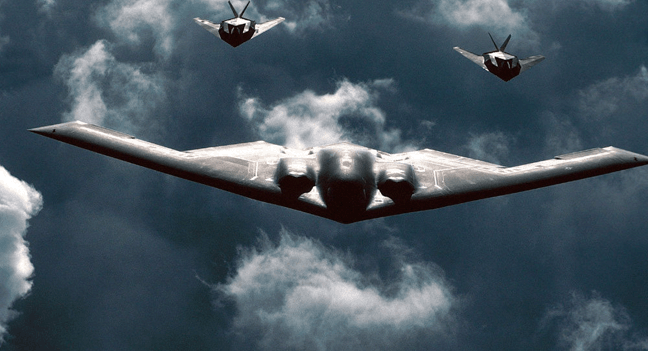 Is the Trump Administration Planning a First Strike on North Korea? Saturday, November 18, 2017 By Gareth Porter, Truthout | News Analysis Ever since the Trump administration began a few months ago to threaten a first strike against North Korea over its continued missile tests, the question of whether it is seriously ready to wage war has loomed over other crises in US foreign policy.
The news media have avoided any serious effort to answer that question, for an obvious reason: The administration has an overriding interest in convincing the North Korean regime of Kim Jong-un that Trump would indeed order a first strike if the regime continues to test nuclear weapons and an intercontinental ballistic missile (ICBM). Therefore, most media have shied away from digging too deeply into the distinction between an actual policy of a first strike and a political ruse intended to put pressure on Pyongyang.
The use of military threat for “diplomatic coercion” is such a basic tool of US policy in dealing with weaker adversaries that it is almost taken for granted in Washington. Even diplomats who have been deeply involved in negotiating with North Korea are supportive of using that threat as part of a broader diplomatic strategy. Robert Gallucci, the State Department official who negotiated the “Agreed Framework” with North Korean officials in 1994, noted in an email to Truthout, “We do want the North to understand that their actions could lead the US to a preventive strike — wise or not.”
The linkage between the Trump administration’s threat of a “military option” and US diplomatic pressure on North Korea was clear from its first suggestion that it might carry out a first strike. That suggestion came on April 13, immediately upon the completion of the administration’s policy review on North Korea, when NBC News reported that “multiple senior intelligence officials” had said that the administration was “prepared to launch a preemptive strike” if officials “became convinced that North Korea is about to follow through with a nuclear weapon test.” A story in the Washington Post published the following day offered a slightly different version: The administration was “prepared to respond to another North Korean nuclear test” and had “a range of options at its disposal” but would not “telegraph its response in advance.”
However, an unnamed military official told the Associated Press that same day that the policy that had been approved by the National Security Council did not envision the use of force in response to a nuclear or missile test, thus revealing that the leaks involving the threat of a preemptive or retaliatory attack over North Korean testing were part of a clumsy effort at “coercive diplomacy.”……
The Trump administration could seek to increase the pressure on North Korea still further by making one or more moves preparing for — but short of — war. For example, it could bring more US ground troops into South Korea or Japan. However, the North Korean regime might well interpret that move as a signal that the US intends to attack and invade the North, since that would seem to be precisely the purpose of moving reinforcements into the theater. In fact, according to Jackson, the North Koreans told US diplomats during the 1994 crisis that they had studied carefully the US large-scale troop movements in preparation for the first Gulf War in 1990-91, and warned that they would respond to a move like that one in their region by launching their own preemptive attack.
It isn’t yet possible to know definitely whether the Trump administration intends to strike first against North Korea. The official threats of such a strike can be discounted as obviously related to an elaborate — if somewhat crude — psychological warfare campaign. But more twists and turns in US policy can be expected in the coming months, and the desperate desire to coerce Pyongyang may also have given rise to wishful thinking on the part of McMaster and, more dangerously, Trump himself, about deterring that regime’s response to a US first strike. That in turn could still pose a grave threat of yet another unnecessary and terrible war. http://www.truth-out.org/news/item/42640-is-the-trump-administration-planning-a-first-strike-on-north-korea
Reassurance from USA top nuclear general that he would resist an ‘illegal’ Trump strike order
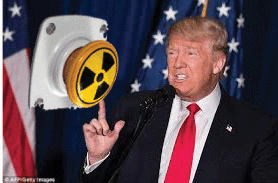 US nuclear general says would resist ‘illegal’ Trump strike order, CNBC, 19 Nov 17 The top U.S. nuclear commander said on Saturday that he would resist President Donald Trump if he ordered an “illegal” launch of nuclear weapons.
Air Force General John Hyten, commander of the U.S. Strategic Command (STRATCOM), told an audience at the Halifax International Security Forum in Nova Scotia, Canada that he had given a lot of thought to what he would say if he received such an order.
“I think some people think we’re stupid,” Hyten said in response to a question about such a scenario. “We’re not stupid people. We think about these things a lot. When you have this responsibility, how do you not think about it?”
As head of STRATCOM “I provide advice to the president, he will tell me what to do,” he said in his remarks, retransmitted in a video posted on the forum’s Facebook page.
“And if it’s illegal, guess what’s going to happen? I’m going to say, ‘Mr. President, that’s illegal.’ And guess what he’s going to do? He’s going to say, ‘What would be legal?’ And we’ll come up with options, of a mix of capabilities to respond to whatever the situation is, and that’s the way it works. It’s not that complicated.”……. https://www.cnbc.com/2017/11/19/us-nuclear-general-says-would-resist-illegal-trump-strike-order.html
The hellish reality: what a ‘preventive war’ against North Korea would be like
Ultimately, the larger problem is that President Trump’s policy objectives are unattainable.
Denuclearization is a non-starter from North Korea’s perspective because Kim believes – not without reason – that nuclear weapons are a matter of regime survival, having seen what happens to leaders in countries like Libya when they give up their nuclear programs.
As long as President Trump insists on “complete, verifiable and total denuclearization,” Washington is walking America down a path that leads to (likely nuclear) military conflict
A ‘preventive’ war with North Korea would be total hell. Here’s why http://www.foxnews.com/opinion/2017/11/17/preventive-war-with-north-korea-would-be-total-hell-heres-why.html By Harry J. Kazianis | As the Trump administration continues to rattle sabers at North Korea with rhetoric eerily similar to the run-up to the U.S. invasion of Iraq in 2003, the possibility of a preventive U.S. war with North Korea may be more real than foreign and defense policy experts recognize.
It would be both foolish and naïve to think that all the tough talk coming out of the Trump administration is simply meant to intimidate North Korean dictator Kim Jong Un into giving up his nuclear weapons and long-range missiles.
The three so-called “adults in the room” who are apparently the strongest voices influencing President Trump’s foreign policy are National Security Advisor H.R. McMaster, Secretary of Defense James Mattis and White House Chief of Staff John Kelly.
Mattis is an active duty lieutenant general in the Army. Mattis and Kelly are retired Marine Corps generals. Their common experience is commanding ground forces in the Iraq War. If they are shaping the Trump administration’s North Korea policy, it stands to reason that their views would have a decidedly military tilt.
If President Trump decides to take military action, what might it look like?
Any unprovoked U.S. military action would be a preventive strike. That is, a military strike intended to prevent North Korea from acquiring a future capability to attack the U.S. That is different from a preemptive strike that is launched to stop an imminent military attack from an adversary.
So what military options are truly available to President Trump?
Option 1: Preventive nuclear strikes.
It’s impossible to completely rule out the possibility – however remote – that the U.S. might use nuclear weapons in a preventive strike against North Korea.
If North Korea’s nuclear program and weapons are in deeply buried and hardened bunkers, nuclear weapons might be the only way to destroy them with a high rate of confidence. A relatively little-known fact is that the United States has a nuclear bunker buster: the B61-11 low- yield nuclear gravity bomb.
About 50 B61-11 bombs are believed to be deployed. Theoretically, the B61-11 could be mated with GPS guidance to make it a precision strike weapon. Also, the B61-11 could theoretically be outfitted with the BLU-113 hardened steel-tipped warhead to penetrate more than 30 feet of concrete.
But wouldn’t using nuclear weapons be beyond the pale?
Under ordinary circumstances, yes. But the Trump administration may not believe these are ordinary circumstances. If the administration assumes military conflict with North Korea is inevitable and views North Korea as 1945 Japan, the rationale would be very similar: Using nuclear weapons would bring about a quick resolution and would save thousands of lives that would otherwise be lost in a conventional conflict. As a point of reference, more than 30,000 U.S. soldiers died in the Korean War.
Needless to say, the nuclear option would be a big gamble. If we were not 100 percent successful, we would have to expect that North Korea would retaliate with its full range of conventional and nuclear weapons.
While the U.S. homeland would not be threatened, both South Korea and Japan would be. And the nearly 35,000 U.S. military personnel stationed in South Korea would certainly be at risk – as would the estimated 200,000 or more U.S. citizens living in South Korea.
Option 2: Decapitation strikes by bombers or submarines.
Another big gamble would be a decapitating air and missile strike. This would be military action based on the belief that if North Korea’s leadership – Kim Jong Un and his most loyal top military and civilian leaders – could be killed, the regime would implode and collapse.
Success would depend on near-perfect intelligence about all the targets’ whereabouts. Moreover, we would have to assume that many of them – including Kim himself – would be in deeply buried and hardened bunkers that would be difficult to destroy, even with precision conventional missiles and bombs.
And we know from experience that we were not able to immediately take out Saddam Hussein and the other 54 “most wanted Iraqis” when we invaded Iraq in 2003.
If a decapitating strike failed, we would have to assume that North Korea would retaliate and we would be drawn into a protracted ground war.
At a minimum, North Korea would likely unleash a conventional artillery barrage on Seoul, which has a population of 10 million. While such an attack might not level Seoul, it would still cause significant damage and extract untold casualties. Kim might launch his nuclear weapons, believing he had nothing to lose.
Option 3: Conventional ground attack with hundreds of thousands troops.
So that leaves a conventional ground attack, which would likely be preceded and backed up by air and missile strikes.
Given the experience of McMaster, Mattis, and Kelly – as well as the fact that the chairman of the Joint Chiefs of Staff, Gen. Joseph Dunford, is a Marine – such an option makes sense and seems more likely. After all, expeditionary war is exactly what these generals know how to do.
However, almost all the experts believe that any such war would be drawn out and costly –perhaps as many as 20,000 deaths per day in South Korea.
And remember, Kim Jong Un would have the nuclear option at his disposal, along with his chemical and biological weapons. Such is the risk of any military action against a nuclear-armed country.
Option 4: Deterrence.
But the U.S. does have another military option. It just doesn’t involve the actual use of military force. It’s called deterrence.
North Korea has had nuclear weapons for at least a decade and has not used them against either South Korea or Japan. Presumably this is because of the threat of a U.S. nuclear response looms over Pyongyang’s head. If that’s the case, even in the worst case scenario of North Korea having the ability to launch a missile at the continental United States, deterrence would still hold.
Deterrence worked when America and the Soviet Union had thousands of warheads pointed at each other. Supposedly crazy or irrational leaders with nuclear weapons – such as Josef Stalin in the Soviet Union and Mao Zedong in China – were successfully deterred.
Indeed, Kim Jong Un would have to be suicidal to actually attack the U.S., knowing that we could respond with utterly devastating force that could result in his death and the total annihilation of his country. However, the Kim dynasty has repeatedly demonstrated its larger interest is its own survival and perpetuating the regime.
Ultimately, the larger problem is that President Trump’s policy objectives are unattainable.
Denuclearization is a non-starter from North Korea’s perspective because Kim believes – not without reason – that nuclear weapons are a matter of regime survival, having seen what happens to leaders in countries like Libya when they give up their nuclear programs.
As long as President Trump insists on “complete, verifiable and total denuclearization,” Washington is walking America down a path that leads to (likely nuclear) military conflict
USA govt now spending $billions on cyberweapons and armed drones, in plans against North Korea
 Buried in an emergency funding request to Congress lie hints of new ways to confront Pyongyang, like cyberweapons and armed drones. NYT , WASHINGTON — Concerned that the missile defense system designed to protect American cities is insufficient by itself to deter a North Korean attack, the Trump administration is expanding its strategy to also try to stop Pyongyang’s missiles before they get far from Korean airspace.
North Korea building ballistic missile submarine, rejects Trump’s stand on negotiation
North Korea rejects Donald Trump’s call for nuclear talks, as images emerge of ‘ballistic submarine’ under construction, Telegraph, Reuters News Agency 17 NOVEMBER 2017
North Korea has rejected Donald Trump’s call for talks over its nuclear programme just days after the US president completed his high-profile to Asia.
Han Tae Song, North Korea’s ambassador to the United Nations in Geneva, said that negotiations would not happen while America continued “war games” in the region.
The snub occurred as new satellite images suggested North Korea is pursuing an “aggressive schedule” to build its first operational ballistic missile submarine.
The developments mark a double setback for Mr Trump, who is seeking a breakthrough in the stand-off over North Korea after rallying support for his approach in Asia.
During a five-nation tour of the region Mr Trump surprised commentators with a call for North Korea to “come to the table and make a deal” over its nuclear programme.
However speaking to Reuters, Mr Han rejected the proposal and criticised America for carrying out joint military practices with South Korea.
“As long as there is continuous hostile policy against my country by the US and as long as there are continued war games at our doorstep, then there will not be negotiations,” Mr Han said.
“There are continued military exercises using nuclear assets as well as aircraft carriers, and strategic bombers and then…raising such kinds of military exercises against my country.”
Mr Han said North Korea’s nuclear programme was about protection, saying: “This is the deterrent, the nuclear deterrent to cope with the nuclear threat from America.”
He also claimed Mr Trump drive for tighter sanctions was to “overthrow” the regime by “isolating” it and creating a “humanitarian disaster”.
China has contested Mr Trump’s claim that a “freeze for freeze” proposal – where North Korea stops its nuclear development and America ends its military war games – was off the table.
Meanwhile 38 North, a Washington-based project that monitors North Korea, said that satellite images indicate the regime is aggressively pursuing a ballistic missile submarine. ……http://www.telegraph.co.uk/news/2017/11/17/satellite-images-suggest-north-korea-aggressive-work-ballistic/
Dismantling our nuclear weapons is the safest course of action
 We should dismantle our nuclear stash, not expand it, WHYY, Aaron Kase,
Congress sends Trump $700 billion defense bill that includes MOX funding
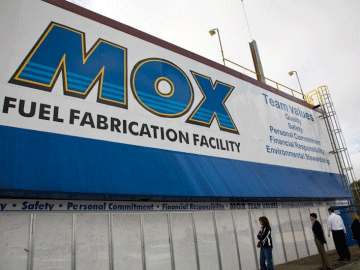
Associated Press Augusta Chronicle, 17 Nov 17 WASHINGTON — Congress on Thursday sent President Donald Trump a sweeping defense policy bill authorizing a $700 billion budget for the military, including $340 million for MOX at Savannah River Site. The defense authorization bill for 2018 sailed through the Senate by voice vote. The House had approved the measure earlier this week.
The Trump administration and former President Obama both asked for the nuclear fuel project to be de-funded, but Congress funded it anyway……. http://chronicle.augusta.com/news/2017-11-16/congress-sends-trump-700-billion-defense-bill-includes-mox-funding
China tries to cool dangerous situation – asks USA to stop military exercises off North Korea
 World War 3: China orders the US to STOP carrying out military exercises off North Korea https://www.express.co.uk/news/world/880506/World-War-3-military-USA-North-Korea-China-Donald-Trump-Kim-Jong-Un-Xi-Jinping
CHINA has demanded the US military stops carrying out exercises on the Korean peninsula in a bid to cool off tensions between North Korea state and the Trump administration.By VINCENT WOODOfficials from Xi Jinping’s government have told their US and South Korean counterparts to stop carrying out joint drills in the region – exercises that are often used as a show of force in response to military tests carried out by Kim Jong-un’s nuclear cronies.
In return they believe they can negotiate a stop to the tyrant’s nuclear and missile provocations amid fears tensions could trigger the start of World War 3 on the Korean peninsula.
Geng Shuang, China’s foreign ministry spokesman, claims freezing military drills in exchange for a freeze on North Korean missile testing was the best means of achieving peace in the region.
He said: “China sees the freeze-for-freeze scheme is the most reasonable way.”
The official’s comments follow a 12-day tour of Asia by President Trump, in which the Republican firebrand met with China’s newly emboldened leader Xi Jinping to discuss bringing an end to the North Korean threat.
However, on Wednesday the US President claimed he “would not accept” freeze for freeze plans “like those that have consistently failed in the past”.
Mr Geng added: ”The freeze-for-freeze move is just for a breakthrough and the first step.
“The final objective is to peacefully resolve the North’s nuclear problem and realise long-term stability on the Korean Peninsula.”
It comes as the United States deploys 14,000 troops on aircraft carriers and destroyers off the coast of North Korea for a series of war games with Japan in drills likely to infuriate Kim Jong-un.
More than 14,000 servicemen will take part in the ten-day exercise, which will see US and Japanese troops performing war games in the waters off Okinawa.
The US Navy said the drills, which began on Thursday, are “designed to increase the defensive readiness and interoperability of Japanese and American forces through training in air and sea operations”.
And they also include aircraft carrier the USS Ronald Reagan, and the guided-missile destroyers USS Stethem, USS Chafee and USS Mustin, among others – the first such deployment of three US carriers since 2007.
A US Navy spokesman: “The exercise follows more than a week of scenario-based training ashore.”
The display of military force is meant to pressure North Korea and make it clear to Pyongyang the US can rapidly mobilise a potent military force.
USA-Japan escalate tensions, with naval drills off Korean Peninsula

In a show of power, Japan, US begin joint naval drills off Korean Peninsula Trump’s harsh rhetoric, coupled with the North Korean regime’s ongoing weapons tests, have escalated regional tension to unprecedented levels
IANS | Tokyo Business Standard, November 16, 2017Japan and the US on Thursday began joint naval drills south of the Korean Peninsula in a show of power against North Korea.
Union of Concerned Scientists urge Congress to pass Bill Establishing Policy that US Will Not Use Nuclear Weapons First
Congress Should Pass Bill Establishing Policy that US Will Not Use Nuclear Weapons First, Statement by Lisbeth Gronlund, Union of Concerned Scientists http://www.ucsusa.org/press/2017/congress-should-pass-bill-establishing-policy-us-will-not-use-nuclear-weapons-first#.Wg34BNKWbGg WASHINGTON (November 15, 2017)—Ranking member of the House Armed Services Committee Rep. Adam Smith (D-Wash.) introduced a bill today that would establish a policy that the United States will not use nuclear weapons first.
Below is a statement by Lisbeth Gronlund, senior scientist and co-director of the Global Security Program at the Union of Concerned Scientists.
“I strongly support this effort to change U.S. nuclear weapons policy. The United States should take all steps possible to prevent a nuclear war—by increasing the threshold for deliberate use and reducing the risk of accidental use.
“Under current policy, the United States would consider using nuclear weapons first against Russia, China and North Korea. Deliberately starting a nuclear war with any of these countries would be disastrous. The United States would increase its own security and that of the rest of the world by eliminating the option of using nuclear weapons first and declaring that the only purpose of its nuclear weapons is to deter—and, if necessary, respond to—nuclear attacks on itself and its allies.”
If war breaks out on Korean peninsula, Japan must be ready for influx of evacuees
North Korea nuclear crisis: Japan bracing itself for influx of evacuees if war erupts
Coast Guard readies plans to escort boats from peninsula to designated ports as brinkmanship continues between Pyongyang and Washington The Independent, 16 Nov 17 Japan is studying plans to cope with an influx of perhaps tens of thousands of North Korean evacuees if a military or other crisis breaks out on the peninsula, including ways to weed out spies and terrorists, a domestic newspaper said.
The Japan Coast Guard would escort boats fleeing North Korea to designated ports, where police would screen them by checking their identity and possible criminal records and expel those deemed a threat, The Yomiuri newspaper said on Thursday.
It did not say where those people would be sent, however.
Evacuees granted temporary entrance would be transferred to emergency detention centres, probably in southern Japan, after completing quarantine and other procedures.
Officials would then decide whether they were eligible to remain in Japan, The Yomiuri said.
Regional tension over Pyongyang’s missile and nuclear arms programmes remain high.
A senior Chinese diplomat was to visit the North from Friday as a special envoy of Chinese President Xi Jinping, just a week after US President Donald Trump met Xi in Beijing and pressed for greater action to rein in Pyongyang……..http://www.independent.co.uk/news/world/asia/north-korea-crisis-latest-japan-evacuees-influx-nuclear-war-shinzo-abe-kim-jong-un-missile-tests-a8058151.html
1 This Month
23-25 October – on Zoom – World BEYOND War’s annual global conferenc

To see nuclear-related stories in greater depth and intensity – go to https://nuclearinformation.wordpress.com

Say No to NASA’s Reckless Nuclear Reactor on the Moon
Say No to NASA’s Reckless Nuclear Reactor on the Moon
-
Archives
- October 2026 (160)
- September 2026 (339)
- August 2026 (330)
- July 2026 (355)
- June 2026 (287)
- May 2026 (306)
- April 2026 (356)
- March 2026 (251)
- February 2026 (267)
- January 2026 (308)
- December 2025 (358)
- November 2025 (359)
-
Categories
- 1
- 1 NUCLEAR ISSUES
- business and costs
- climate change
- culture and arts
- ENERGY
- environment
- health
- history
- indigenous issues
- Legal
- marketing of nuclear
- media
- opposition to nuclear
- PERSONAL STORIES
- politics
- politics international
- Religion and ethics
- safety
- secrets,lies and civil liberties
- spinbuster
- technology
- Uranium
- wastes
- weapons and war
- Women
- 2 WORLD
- ACTION
- AFRICA
- Atrocities
- AUSTRALIA
- Christina's notes
- Christina's themes
- culture and arts
- Events
- Fuk 2022
- Fuk 2023
- Fukushima 2017
- Fukushima 2018
- fukushima 2019
- Fukushima 2020
- Fukushima 2021
- general
- global warming
- Humour (God we need it)
- Nuclear
- RARE EARTHS
- Reference
- resources – print
- Resources -audiovicual
- Weekly Newsletter
- World
- World Nuclear
- YouTube
-
RSS
Entries RSS
Comments RSS

