Trump May Consider Preemptive Strike on North Korea – CIA Director
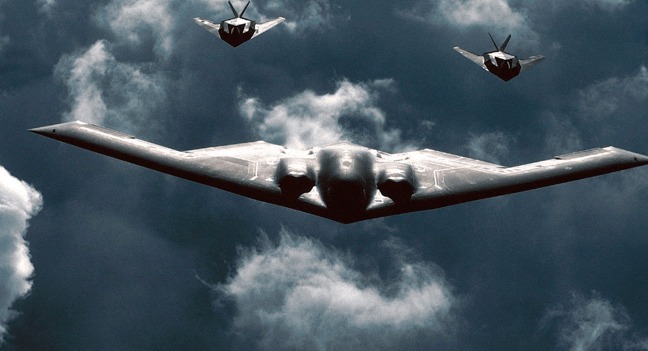 CIA Boss Gives Latest Indication Trump May Consider Preemptive Strike on North Korea, Daily Beast The spy agency is briefing the president about military options on North Korea, which outside analysts warn could escalate to nuclear war. SPENCER ACKERMAN, 01.23.18 THE CENTRAL INTELLIGENCE AGENCY IS BRIEFING President Donald Trump on the risks and opportunities of a limited attack on North Korea, its director suggested on Tuesday.
CIA Director Mike Pompeo would not discuss the “wisdom of a preemptive strike” on Pyongyang or its nuclear weapons program, he told an audience at the conservative American Enterprise Institute. But in rare public remarks, Pompeo portrayed North Korea as an urgent priority for the agency, and disclosed aspects of its role in setting back Kim Jong Un’s nuclear program during his first year at Langley……..
A former North Korean spy, Kim Hyon-hui, indicated to NBC News that Trump’s goal of denuclearizing a country that has been a nuclear state for over a decade is not achievable diplomatically: “North Korea won’t give up its nuclear weapons. They’re its lifeline.”……….
Trump has given reason to doubt Pompeo’s statement that he is looking to resolve the Korea nuclear crisis peacefully. In October, he said Secretary of State Rex Tillerson was “wasting his time” attempting negotiations with Kim. After Tillerson stated publicly last month that he was willing to talk with North Korea without any precondition, the White House again shut him down. All that followed Trump’s infamous August declaration that North Korean provocations would be “met with fire and fury like the world has never seen.”……. https://www.thedailybeast.com/cia-director-mike-pompeo-gives-latest-indication-trump-is-considering-preemptive-strike-on-north-korea
Scientists aim to limit Trump’s power to launch nuclear vweapons
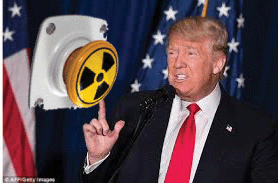 A group of scientists is trying to limit Trump’s nuclear authority, CNBC 25 Jan 18
- A plan pushed by group of scientists would cut presidential authority to unilaterally order nuclear strikes.
- As commander in chief, the U.S. president currently has the authority to order the military to launch nuclear missiles.
- This proposal would require the vice president and speaker of the House to also approve any nuclear strike.
- “No one person should be able to order a nuclear attack,” wrote one of the scientists proposing the plan.
The plan would require that the president first obtain approval from the next two officials in the presidential succession chain — the vice president and speaker of the House, according to a paper in the Bulletin of the Atomic Scientists, a global disarmament advocacy.
As commander in chief, the U.S. president currently has the authority to order the U.S. military to launch nuclear missiles.
Back in November, there was discussion in the Senate Foreign Relations Committee about limiting the president’s nuclear strike authority after some Democratic lawmakers cited Trump’s “unstable” behavior.
“No one person should be able to order a nuclear attack,” said paper co-author Lisbeth Gronlund, a senior scientist and co-director of the Global Security Program at the Union of Concerned Scientists (UCS). “There’s no reason to maintain this dangerous policy, since there are viable alternatives that would allow other officials to take part in any decision to use nuclear weapons, whether it’s a first use or a launch responding to a nuclear attack.”
According to the paper, “the risks are not hypothetical. During the Watergate scandal, President [Richard] Nixon was drinking heavily and many advisers considered him unstable. During the 1974 impeachment hearings, Nixon told reporters that ‘I can go back into my office and pick up the telephone and in 25 minutes 70 million people will be dead.'”
The paper was co-authored by David Wright, a UCS senior scientist, and University of Maryland professor Steve Fetter.
The authors of the paper said the “proposal applies to any use of nuclear weapons, regardless of whether it would be the first use of nuclear weapons or in response to a nuclear attack or warning of an attack.”………
military generals can essentially refuse to follow what they consider “illegal orders,” retired Gen. Robert Kehler testified at the Senate Foreign Relations Committee hearing in November. Kehler is the former commander of the U.S. Strategic Command. https://www.cnbc.com/2018/01/24/scientists-seek-to-limit-trumps-power-in-ordering-a-nuclear-strike.html
Poll shows that Americans fear Trump’s ability to launch nuclear weapons, and doubt his mental stability
The majority of Americans are afraid of Trump’s ability to launch nuclear missiles. They also don’t have a lot of faith in his mental stability. Vox, By We may no longer be teaching American schoolchildren how to “duck and cover,” but a new Washington Post/ABC News poll shows the threat of nuclear war is once again on the minds of the American populace. A new poll finds most Americans don’t trust President Trump with the power to launch nuclear weapons, and a majority are at least “somewhat” concerned that he’ll launch an unjustified attack.
The poll comes less than a month after Trump’s tweet comparing the size of his “nuclear button” to North Korean leader Kim Jong Un’s.
Democrats are far more likely than Republicans to report fear, for example, with almost six in 10 Democrats saying they are “very concerned” about Trump ordering an unjustified nuclear attack, compared to about three in 10 independents and fewer than one in 10 Republicans.
Gender also plays a role, with twice as many women as men saying they are “very” concerned Trump could launch a nuclear attack — 42 percent versus 22 percent.
Those who are most concerned about him launching a nuclear attack without justification are also those who have the least confidence in his mental stability. Only 48 percent of respondents said they thought Trump was mentally stable when asked about the president’s description of himself as a “very stable genius.” Forty-seven percent, meanwhile, don’t think he’s mentally stable.
Eighty-four percent of those who say Trump is not mentally stable are at least somewhat concerned that he could launch an unwarranted nuclear attack, while 72 percent of those who say Trump is stable trust him to handle nuclear weapons……… https://www.vox.com/policy-and-politics/2018/1/23/16923020/americans-afraid-trump-nuclear-missiles-launch-mental-stability
World close to nuclear annihilation, but in denial – Dr Helen Caldicott
 Helen Caldicott on Our Denial of the Threat of Nuclear Armageddon http://www.truth-out.org/progressivepicks/item/42494-helen-caldicott-on-our-denial-of-the-threat-of-nuclear-armageddon November 05, 2017 By Mark Karlin, Truthout | Interview Since the corporate media give short shrift to the peril of nuclear weapons, most world residents are unaware of how close we are to nuclear annihilation. So argues advocate and physician Dr. Helen Caldicott, editor of Sleepwalking to Armageddon: The Threat of Nuclear Annihilation, in this interview with Truthout.
Mark Karlin: Despite Donald Trump’s insinuation that he might launch a first-strike nuclear attack on North Korea, the anti-nuclear weapons movement is still relatively quiescent. Do you have thoughts as to why most people on the Earth are “sleepwalking to Armageddon”?
Helen Caldicott: Yes. It’s because the US media has totally failed in its duty to educate and inform the American people about the current state of world affairs, including the current US plans for a winnable nuclear war and the huge nuclear arsenals still being maintained by Russia and America. As Thomas Jefferson said so long ago, “An informed democracy will behave in a responsible fashion.” Of the 16,400 nuclear bombs in the world, Russia and the US own 94 percent — only they can destroy most life on Earth, so in reality, these two nations are today’s real terrorists.
Do you think the fact that the 2017 Nobel Peace Prize was awarded to the International Campaign to Abolish Nuclear Weapons will bring the issue more to the forefront?
No I don’t. However, their strategy is wise and relatively subliminal. Already, 122 nations have committed to the pledge of nuclear abolition. This massive support will no doubt place pressure upon the NATO countries that harbor US tactical nuclear weapons — the Netherlands, Turkey, Germany, Italy and Belgium — to forgo these commitments. This, then, will place further pressure upon other nuclear armed nations to abolish their nuclear stocks, including India, Pakistan, France, Britain, China, North Korea and Israel. Only then will international condemnation be so great that Russia and the US will be forced to contemplate abandoning their nuclear arsenals once and for all. Whether we have time before all hell breaks loose, nobody knows.
You state that the United States will spend $1 trillion over the next 30 years modernizing its nuclear arsenal. What exactly does that mean?
It means exactly that. In order for the New Strategic Arms Reduction Treaty (New START) to pass the Senate, Obama promised then-Senator Jon Kyl that he would authorize the spending of $1 trillion over the next 30 years to replace every single nuclear weapon, missile, aircraft carrier, submarine, ship and plane.
How are corporations stirring the pot of militarizing international relations? Clearly, the military corporations have huge influence upon the House and Senate by funding the campaigns of the representatives, so in effect, most Congress people and senators … in a fundamental sense do not represent the health, well-being and lives of their constituents.
You comment that “an order to launch [nuclear weapons] in US missile silos is the length of a tweet.” How long does it take to launch a nuclear weapon?
Three minutes once the presidential order has been received. This is why the men in the missile silos are called Minutemen. [As described by former Minuteman ICBM launch control officer Bruce Blair here.]
What are some of the promising forms of resistance to nuclear weapons that are taking shape?
There are young people in many countries involved in the UN ban treaty; however, I see very little awareness in the general public about the fact that we are closer to nuclear war than we have ever been, and this according to former Secretary of Defense William Perry, retired Gen. James Cartwright and others highly knowledgeable and experienced in this area. Most people are in fact practicing psychic numbing and denial.
Quiet preparations for war with North Korea – USA manouvres
The US appears to be quietly preparing for nuclear war with North Korea. https://www.businessinsider.com.au/us-appears-quietly-preparing-nuclear-war-north-korea-2018-1?r=US&IR=T, ALEX LOCKIE– JAN 20, 2018,
Daniel Ellsberg – we can dismantle the “dizzyingly insane and immoral” Doomsday Machine
From the beginning of the Atomic Age, says Ellsberg, the true purpose of our nuclear arsenal, the whole terrifying array of warheads and delivery systems in all their vast numbers and varieties, has not been the “defense” of our country. It has not been, as trumpeted by politicians and generals (and as believed by citizens and schoolchildren), to “deter” an adversary from launching a nuclear attack against the U.S. It is the maintenance of a first-strike nuclear force —not so much for the purpose of launching a deliberate surprise attack on anyone else, but to be ready to respond instantly
 Dismantling Doomsday: Daniel Ellsberg on the Risk of Nuclear Apocalypse https://undark.org/article/book-review-ellsberg-doomsday-machine/ The whistleblower who gave us the Pentagon Papers unveils another secret history — this one ‘dizzyingly insane and immoral.’01.19.2018 Mark Wolverton
DANIEL ELLSBERG is perhaps the premier whistleblower of all time, the man who in 1971 dragged the Pentagon Papers out of top-secret darkness into the light. Yet even as excerpts from the papers’ 7,000 pages were being published by The New York Times, The Washington Post, and other newspapers, Ellsberg was sitting on an entire second set of secrets, having nothing to do with Vietnam: all his material on nuclear policy, such as the operational plans for general nuclear war that he had drafted for the Joint Chiefs of Staff in his job as a RAND Corporation defense analyst.
Ellsberg’s new book, “The Doomsday Machine: Confessions of a Nuclear War Planner,” is his revelation of what was in those lost papers, made possible not only by his prodigious memory and note-keeping but also the declassification and release of much of the material through official channels and Freedom of Information Act requests (many filed by Ellsberg himself). Speaking with the authority of an insider who was intimately involved with nuclear strategy and policymaking at the highest levels, he reveals that practically everything the American public believes about nuclear war and nuclear weapons is, quite simply, a “deliberate deception.” Continue reading
Threat from weapons of mass destruction “seems to be gathering force.” – UN Secretary General
 U.N. chief: Threat from nuclear and other weapons gathers force, Asahi Shimbun, THE ASSOCIATED PRESS, January 19, 2018 UNITED NATIONS–Russia’s foreign minister warned Thursday that a failure of the Iran nuclear deal, especially as a result of action by the Trump administration, would send “an alarming message” to North Korea and impact all international agreements.
Sergey Lavrov took aim at U.S. President Donald Trump at a U.N. Security Council meeting on confidence-building measures to tackle the proliferation of weapons of mass destruction, saying that “we cannot for the benefit of political agendas of certain countries abandon a genuine achievement of international diplomacy.”
Last Friday, Trump kept alive the Iran agreement, which has won international praise including from U.S. allies, by extending sanctions waivers. But the president warned that the United States would pull out in a few months unless “terrible flaws” in the deal are fixed.
Lavrov and others worry that a U.S. pullout from the 2015 deal could mean that Washington cannot be trusted to keep agreements, which could harm any future efforts to get North Korea to abandon nuclear weapons.
Secretary-General Antonio Guterres opened Thursday’s meeting warning that the threat from weapons of mass destruction “seems to be gathering force.”
He urged expanded diplomatic efforts to tackle what he called the greatest security challenge in the world today–North Korea.
The international community must build on the “small signs of hope” from the recent contacts between the two Koreas to pursue diplomacy and denuclearize the Korean Peninsula, the U.N. chief said.
“Global anxieties about nuclear weapons are the highest since the Cold War,” Guterres said. “I remain deeply concerned over the growing risk of military confrontation and the unimaginable consequences that would result.”
China’s deputy U.N. ambassador, Wu Haitao, urged all countries to “reject Cold War mentality” and commit to peaceful solutions, including on the Korean Peninsula where he pointed to “some positive changes” emerging.
“All parties should make concerted efforts to extend this hard-won momentum of reduced tension, create conditions for relaunching dialogue and negotiation and return the nuclear issue of the Korean Peninsula to the correct track of dialogue and negotiation,” Wu said…….. http://www.asahi.com/ajw/articles/AJ201801190018.html
The absurdity of underground bunkers to save us all in nuclear war
The team has really outdone itself with the Fallout-esque teaser video.
The Lavish Bunkers Where U.S and Russian Leaders (still) Plan to Fight A Nuclear War
As NTI explains:
Russia to Decommission Two Largest Nuclear Subs in the World – Source
Sputnik News, 19 Jan 18 The submarines have already been withdrawn from operational status in the Russian Navy as their further use is unprofitable.
The two largest nuclear-powered submarines of Project 941 (the Akula code) Arkhangelsk and Severstal are planned to be decommissioned, a source in the shipbuilding industry told RIA Novosti.
“Their further operation is unprofitable: they have already been withdrawn from the Navy, Rosatom is to decommission them after 2020,” the source said.
Now the only Project 941U submarine remaining in the Navy is Dmitry Donskoy, used to test the Bulava ballistic missile……..https://sputniknews.com/military/201801191060883176-nuclear-submarines-utilization-russia/
British defence spending – better directed at training professional military force
British defence spending and capabilities are in the middle of a bitter review in which the potential threat from Russia is frequently invoked, whether that means cutting ocean-bottom internet cables, flying bombers into our airspace, or invading Nato territory.
Russia is – to use a word of the day – being weaponised in the name of particular service interests and justifying big-ticket new systems. Nonetheless, given that Russia is the most serious aggressor the UK might have to face, it is striking how little discussion there has been about what kind of British military capabilities genuinely concern Russian soldiers and planners.
Insofar as one can glean lessons from their military writings, and courtesy of my own conversations with Russian officers, both serving and retired, I can see three definite concerns of theirs and one glaring omission.
The suggestion that the UK merges and shrinks its special and intervention forces would no doubt be roundly cheered in the Russian general staff’s massive building on Znamenka Street, Moscow. As a recently retired officer from its planning directorate once said to me, with more enthusiasm than originality: “Britain has always had the best light infantry in the world, and the bastards get places faster than we would like.”…….
In a way, the Russians have a similar perspective on the Royal Navy. What bothers them is not our massive new aircraft carrier, which one naval officer said would make a great “missile magnet” in time of war. Rather, the concern is about smaller, lighter forces. …..
Thirdly, it is not just specific forces and units that the Russians believe gives the UK its edge, but training and morale. Russian successes in Crimea and Syria partly represent an unfamiliar new emphasis on the human side of their military. Britain’s problems of having to scrimp on training and overstretch its forces have not gone unnoticed…….
if deterring the Russians is a major concern, then it is worth paying attention to what might really deter them: a flexible, fast-moving and versatile force of true professionals. Not necessarily with the heaviest kit, the biggest ships or the priciest aircraft, but able to get where they are needed, when they are needed. Dr Mark Galeotti is a senior researcher at the Institute of International Relations Prague and head of its Centre for European Security. https://www.theguardian.com/commentisfree/2018/jan/19/nuclear-weapons-uk-defence-review-russia
End nuclear weapons and nuclear power – we owe this to our children

We owe it to our children to end the nuclear age http://thehill.com/opinion/energy-environment/369535-we-owe-it-to-our-children-to-end-the-nuclear-age BY ANDREAS NIDECKER, EMILIE GAILLARD AND ALYN WARE, — 01/18/18 As nuclear tensions increase, dangerous times have raised legally-loaded questions about nuclear weapons. Should the U.S. violate or undermine the Iran nuclear deal? Does the president have unfettered power to launch a preemptive nuclear strike on North Korea? What’s the legal status of the Trump administration’s intention, telegraphed in the newly leaked Nuclear Posture Review, to expand U.S. nuclear capabilities and arsenals when the Nuclear Non-Proliferation Treaty supposedly commits us to cutting and eventually eliminating them?
But there’s an even broader legal dilemma looming over production, testing and threatened use of nuclear weapons: how they affect the human rights of future generations. Those threats to the future are also compounded by nuclear energy, which generates radioactive waste we’re manifestly unable to control, and by destabilizing the climate that has enabled and sustained human civilization.
Can such crimes against the future be legal? How can we respect the human rights of future generations in view of them? International symposia at the University of Basel (Switzerland), University of Caen (France) and Charles University in Prague (Czech Republic) recently grappled with those questions. The Basel conference produced a declaration on human rights and trans-generational crimes resulting from nuclear weapons and nuclear energy.
Protecting future generations from the threat of nuclear weapons was an important consideration in the International Court of Justice’s 1996 affirmation that threat or use of nuclear weapons is generally illegal, given their long-term and indiscriminate impact. But despite the Court’s decision, most nuclear-armed states retain (illegal) policies to use nuclear weapons, including in a first, pre-emptive strike.
In general, current law fails to safeguard the rights of future generations. But that doesn’t make failure defensible, sustainable or in accord with legal principles. Evolution of this area of law is necessary and inevitable.
Some 2000 nuclear weapons were detonated for “testing” since 1945, releasing millions of curies of radiation. This impacted human health globally, and will continue to do so for generations. Most nuclear testing victims live in remote areas like the Pacific islands, the Kazakhstan steppe, or the North African Sahara. They have largely been forgotten; today’s younger generations are unaware of their sacrifice. Yet forgetting is perilous, because today’s youth will be tomorrow’s victims unless the cycle is broken.
There are some legal efforts to break it. For example, the 2017 Treaty on the Prohibition of Nuclear Weapons obligates signatories to provide environmental remediation and assistance for nuclear testing victims. But the provision is unenforceable, because none of the nine nuclear weapons states signed the treaty.
Like nuclear weapons, nuclear energy also poses enduring threats to human health. The Chernobyl explosion caused widespread contamination across the region and the whole European continent. High volumes of radiologically contaminated water from Fukushima continue to leak into the Pacific.
These, too, are crimes against the future. Some lethal isotopes in nuclear waste have half-lives of thousands of years. Waste repositories will need to be guarded for unimaginable time periods, with associated financial, logistical and security implications for future societies, an enormous burden we leave to our descendants.
Like the Treaty on the Prohibition of Nuclear Weapons, the International Covenant on Economic, Social and Cultural Rights (ICESCR) asserts a human right to health, applicable to nuclear contamination. But in practice that right isn’t respected.
For example, Japan ratified the covenant, and the Japanese constitution even defends the trans-generational principle of human rights in articles 11 and 97. But despite those legal principles being articulated, the Japanese media is still prevented from reporting on current events in Fukushima, and medical research on the effects of the meltdown is still restricted. The Japanese government maintains that small amounts of radiation are harmless, so limits for public radiation exposure could be increased from 1 to 20 millisieverts per year, the same as for radiation workers.
That’s unconscionable and untenable, not to mention discriminatory against young women and children who are much more susceptible to radiation exposure than men, with higher risks of cancer and non-cancerous diseases. Radiation exposure may present mutations and diseases in their offspring decades later. That’s why Japan’s handling of the Fukushima fails to accord with its own constitution as well as the ICESCR.
Failing to combat climate change effectively is also a crime against the future. The chances of meeting the Paris goal of limiting global warming to 2°C are receding since the U.S. withdrew and financial contributions of many signatories remain out of scale with the problem. Greenhouse gas emissions have risen in the two years since the Paris accord. If we stay on this too-little, too-late trajectory, we’ll not only fail to protect human rights, but much of life on earth.
Can all this be considered legal? Not for long. The dawn of the nuclear age marked the acquisition of unprecedented human power over the earth and all forms of life, as the Caen symposium pointed out. Many legal experts believe that in this new anthropocene era, a new code of medical and legal ethics is necessary. Trans-generational impacts of nuclear war, nuclear catastrophes and climate change must now be seriously considered, and require a paradigm shift in our legal thinking about the future.
The District Court of Hague took a step in that direction in 2015 when it affirmed in Urgenda Foundation v. the Dutch State that the government had a responsibility to protect future generations by limiting greenhouse gas emissions. A similar case in the United States — People v Climate Change — was granted jurisdiction and is proceeding to consideration of its merits.
There remains a long way to go to adapt the current legal framework to the realities of nuclear threats and climate change. Current laws need better implementation, and new laws need to be established. But those changes are vital to protecting the human rights of future generations.
Emilie Gaillard is an Assoc. Professor of law and a researcher at the University of Caen Normandy (France). She is a member of the Pôle Risques, Qualité et Environnement Durable at Maison de la recherché et des Sciences de l’Homme (Caen).
Andreas Nidecker MD is a Professor Emeritus of Radiology at the University of Basel, Switzerland. Board member and past president of PSR / IPPNW Switzerland and member of the organizing Committees of the symposium “Human Rights, Future Generations & Crimes in the Nuclear Age.”
Alyn Ware is a member of the World Future Council and consultant for the International Association of Lawyers Against Nuclear Arms.
Nuclear weapons a poor choice for defense against cyber attacks
 Nuclear weapons are a risky defence against cyber attacks https://www.ft.com/content/d2241b68-fc31-11e7-9b32-d7d59aace167The new US policy risks increasing the chance of a conflict, writes GIDEON RACHMAN
The world has been living with the threat of a nuclear apocalypse since the 1950s. Over the past decade, intelligence experts have increasingly warned about the threat of a catastrophic cyber attack. Now the two fears appear to have merged, with the US on the point of revising its defence policy — to allow the use of nuclear weapons, in retaliation for a devastating cyber attack. The Trump administration has not yet released America’s revised, “Nuclear Posture Review”. But the draft document has leaked to the press. According to the New York Times, it would change US policy to allow the first use of nuclear weapons, in response to “attempts to destroy wide-reaching infrastructure, like a country’s power grid or communications, that would be most vulnerable to cyberweapons”.
Pentagon suggests nuclear weapons to counter cyber attacks
Pentagon Suggests Countering Devastating Cyberattacks With Nuclear Arms, NYT,
查看简体中文版 查看繁體中文版 By DAVID E. SANGER and WILLIAM J. BROAD JAN. 16, 2018 WASHINGTON — A newly drafted United States nuclear strategy that has been sent to President Trump for approval would permit the use of nuclear weapons to respond to a wide range of devastating but non-nuclear attacks on American infrastructure, including what current and former government officials described as the most crippling kind of cyberattacks.
For decades, American presidents have threatened “first use” of nuclear weapons against enemies in only very narrow and limited circumstances, such as in response to the use of biological weapons against the United States. But the new document is the first to expand that to include attempts to destroy wide-reaching infrastructure, like a country’s power grid or communications, that would be most vulnerable to cyberweapons.
The draft document, called the Nuclear Posture Review, was written at the Pentagon and is being reviewed by the White House. Its final release is expected in the coming weeks and represents a new look at the United States’ nuclear strategy. The draft was first published last week by HuffPost.
It called the strategic picture facing the United States quite bleak, citing not only Russian and Chinese nuclear advances but advances made by North Korea and, potentially, Iran.
………the biggest difference lies in new wording about what constitutes “extreme circumstances.”
In the Trump administration’s draft, those “circumstances could include significant non-nuclear strategic attacks.” It said that could include “attacks on the U.S., allied, or partner civilian population or infrastructure, and attacks on U.S. or allied nuclear forces, their command and control, or warning and attack assessment capabilities.”
The draft does not explicitly say that a crippling cyberattack against the United States would be among the extreme circumstances. But experts called a cyberattack one of the most efficient ways to paralyze systems like the power grid, cellphone networks and the backbone of the internet without using nuclear weapons.
……….It is relatively easy for presidents to change the country’s declaratory policy on the use of nuclear arms and quite difficult for them to reshape its nuclear arsenal, which takes not only vast sums of money but many years and sometimes decades of planning and implementation.
The price tag for a 30-year makeover of the United States’ nuclear arsenal was put last year at $1.2 trillion. Analysts said the expanded Trump administration plan would push the bill much higher, noting that firm estimates will have to wait until the proposed federal budget for the 2019 fiscal year is made public.
“Almost everything about this radical new policy will blur the line between nuclear and conventional,” said Andrew C. Weber, an assistant defense secretary during the Obama administration who directed an interagency panel that oversaw the country’s nuclear arsenal.
If adopted, he added, the new policy “will make nuclear war a lot more likely.”
One of the document’s edgiest conclusions involves the existence of a deadly new class of Russian nuclear torpedo — a cigar-shaped underwater missile meant to be fired from a submarine……..https://www.nytimes.com/2018/01/16/us/politics/pentagon-nuclear-review-cyberattack-trump.html
See what a nuclear bomb would do to your city – example Bellevue USA

Here’s What A Nuclear Bomb Would Do To Your City https://patch.com/washington/bellevue/heres-what-nuclear-bomb-would-do-your-city Would you survive a nuclear attack? A new tool lets you see what a nuclear bomb would do to your city. By Neal McNamara , Patch Staff | BELLEVUE, WA – With the unfortunate nuclear false-alarm in Hawaii still fresh in our minds, aren’t you a little curious to see what would happen if a real nuclear weapon did strike the U.S.? A professor at the Stevens Institute of Technology has created a pretty scary tool that shows you the blast radius and an estimate of deaths in the event of an attack.
For a demonstration, we used the tool to look at what a nuke would do if it landed in downtown Bellevue. According to professor Alex Wellerstein’s “Nuke Map,” a 150 kiloton nuke – about the size most recently tested by North Korea – would kill about 56,000 people and leave 175,000 people injured.
The area in a 1,500-foot radius around the impact site would be incinerated by a fireball, while anyone within a 3-1/2 mile radius would suffer third-degree thermal radiation burns. The thermal radius includes residents of Mercer Island, Kirkland, Redmond, and Medina. And that doesn’t include nuclear fallout, which would affect a significantly larger area.
Find out what a nuclear bomb would do to your city here
But take the “Nuke Map” with a grain of salt because it’s just a model. And take heart that nuclear confrontation with a country like North Korea is extremely, highly unlikely.
India again test-fires a nuclear-capable intercontinental ballistic missile
- The nuclear-capable Agni-V ICBM was fired from Abdul Kalam island off the coast of the eastern state of Odisha at around 9:53 a.m. local time (11:23 p.m. ET on Wednesday)
- The same missile has been tested five times over the past six years, with the most recent test prior to Thursday’s launch coming in December 2016
- Relations between China and India deteriorated significantly in 2017, following a protracted border dispute in the western Himalayas
The nuclear-capable Agni-V ICBM was fired from Abdul Kalam island off the coast of the eastern state of Odisha at around 9:53 a.m. local time (11:23 p.m. ET on Wednesday).
India’s Defense Ministry said the test was a “major boost” to the country’s defense capabilities. The same missile has been tested five times over the past six years, with the most recent test prior to Thursday’s launch coming in December 2016. That test prompted exasperation from two of New Delhi’s most important continental rivals, China and Pakistan.
Relations between China and India deteriorated significantly in 2017, following a protracted border dispute in the western Himalayas. And given the world’s two biggest emerging economies are both equipped with nuclear weapons, observers were fearful of escalating geopolitical tensions……….https://www.cnbc.com/2018/01/18/india-missile-new-delhi-successfully-tests-a-nuclear-capable-icbm.html
1 This Month
23-25 October – on Zoom – World BEYOND War’s annual global conferenc

To see nuclear-related stories in greater depth and intensity – go to https://nuclearinformation.wordpress.com

Say No to NASA’s Reckless Nuclear Reactor on the Moon
Say No to NASA’s Reckless Nuclear Reactor on the Moon
-
Archives
- October 2026 (149)
- September 2026 (339)
- August 2026 (330)
- July 2026 (355)
- June 2026 (287)
- May 2026 (306)
- April 2026 (356)
- March 2026 (251)
- February 2026 (267)
- January 2026 (308)
- December 2025 (358)
- November 2025 (359)
-
Categories
- 1
- 1 NUCLEAR ISSUES
- business and costs
- climate change
- culture and arts
- ENERGY
- environment
- health
- history
- indigenous issues
- Legal
- marketing of nuclear
- media
- opposition to nuclear
- PERSONAL STORIES
- politics
- politics international
- Religion and ethics
- safety
- secrets,lies and civil liberties
- spinbuster
- technology
- Uranium
- wastes
- weapons and war
- Women
- 2 WORLD
- ACTION
- AFRICA
- Atrocities
- AUSTRALIA
- Christina's notes
- Christina's themes
- culture and arts
- Events
- Fuk 2022
- Fuk 2023
- Fukushima 2017
- Fukushima 2018
- fukushima 2019
- Fukushima 2020
- Fukushima 2021
- general
- global warming
- Humour (God we need it)
- Nuclear
- RARE EARTHS
- Reference
- resources – print
- Resources -audiovicual
- Weekly Newsletter
- World
- World Nuclear
- YouTube
-
RSS
Entries RSS
Comments RSS

