Michigan organises plans for the possibility of a nuclear attack
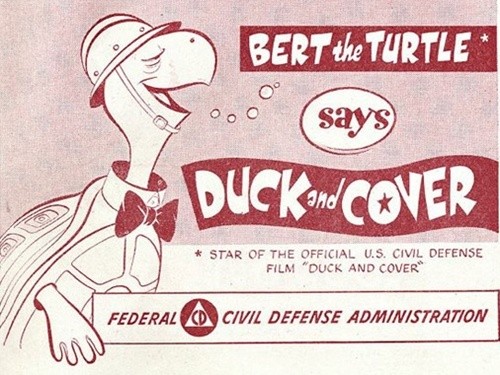 Michigan dusts off nuclear plans amid war of words Michigan’s response to a nuclear attack is spelled out in its 342-page Emergency Management Plan that covers everything from floods to infrastructure failures to riots. The State Police plan for satellites falling out of the sky and meteor strikes, Kelenske said.
Is safety from nuclear attack a State or a Federal responsibility?
 Federal responsibility in nuclear attack alerts is unclear, AP, By CALEB JONES, HONOLULU (AP) 18 Jan 18, — A timeline shows Hawaii officials botched efforts to immediately correct a false missile alert over the weekend, taking more than 20 minutes to contact federal authorities for approval they didn’t need and then taking another 15 minutes to cancel the alert that was sent to mobile devices statewide.
The astonishing error and dismal response has prompted both state and federal investigations and left one of the state’s U.S. senators wondering aloud if top brass at the Hawaii Emergency Management Agency should be replaced.
“I think (Gov.) David Ige has a tough decision in front of him, and it’s his call,” Sen. Brian Schatz told reporters Wednesday. Either way, the state has a long road ahead in restoring the public’s confidence in the alert system, the Democrat said.
Nearly 40 minutes passed between the time Hawaii officials fired off the bogus alert about an incoming missile over the weekend and the moment the notice was canceled.
The confusion raises questions about whether any state should be solely responsible for notifying the public of such an event. The debate comes as North Korea claims it is testing weapons that could deliver a nuclear-tipped ballistic missile to Hawaii, Guam and even the U.S. mainland.
Hawaii is the only state in the nation with a pre-programmed alert that can be quickly sent to wireless devices if a ballistic missile is heading toward the U.S. FEMA said Hawaii did not require its approval to cancel the alert on Saturday.
U.S. Reps. Colleen Hanabusa and Tulsi Gabbard, both of Hawaii, have asked the House Armed Services Committee to hold a hearing on the issue.
They said in a letter to the committee Tuesday that it’s understandable for states to have primary jurisdiction over warnings for floods, hurricanes and other natural disasters.
“However, when it comes to matters of national security, including whether a ballistic missile has been launched against the United States, one must question whether any state emergency management agency is best suited for that role,” the letter says………
President Donald Trump did not make any public comments about the false alert on Saturday. He was at his golf club in West Palm Beach, accompanied by House Majority Leader Kevin McCarthy.
Asked about the alert on Sunday, the president said it was “a state thing.”…….https://apnews.com/81a377f739c64036afd035e2d95c4576
USA jet -with 4 nuclear bombs on board – crashed in Greenland 50 years ago
Director of the Health Physics and Radiation Protection Graduate Program and Associate Professor of Radiation Medicine, Georgetown University January 18, 2018 Fifty years ago, on Jan. 21, 1968, the Cold War grew significantly colder. It was on this day that an American B-52G Stratofortress bomber, carrying four nuclear bombs, crashed onto the sea ice of Wolstenholme Fjord in the northwest corner of Greenland, one of the coldest places on Earth. Greenland is part of the Kingdom of Denmark, and the Danes were not pleased.
The radioactivity was released because the nuclear warheads had been compromised. The impact from the crash and the subsequent fire had broken open the weapons and released their radioactive contents, but luckily, there was no nuclear detonation.
To be specific, HOBO 28’s nuclear weapons were actually hydrogen bombs. As I explain in my book, “Strange Glow: The Story of Radiation,” a hydrogen bomb (or H-bomb) is a second-generation type of nuclear weapon that is much more powerful than the two atomic bombsdropped on Hiroshima and Nagasaki. Those two bombs were “fission” bombs – bombs that get their energy from the splitting (fission) of very large atoms (such as uranium and plutonium) into smaller atoms.
In contrast, HOBO 28’s bombs were fusion bombs – bombs that get their energy from the union (fusion) of the very small nuclei of hydrogen atoms. Each of the four Mark 28 F1 hydrogen bombs that HOBO 28 carried were nearly 100 times more powerful than the bomb dropped on Hiroshima (1,400 kilotons versus 15 kilotons).
Fusion bombs release so much more energy than fission bombs that it’s hard to comprehend. For example, if a fission bomb like Hiroshima’s were dropped on the Capitol building in Washington, D.C., it’s likely that the White House (about 1.5 miles away) would suffer little direct damage. In contrast, if just one of the Mark 28 F1 hydrogen bombs were dropped on the Capitol building, it would destroy the White House as well as everything else in Washington, D.C. (a destructive radius of about 7.5 miles). It is for this reason that North Korea’s recent claim of achieving hydrogen bomb capabilities is so very worrisome.
Nuclear Explosion Power Comparison
After the crash, the United States and Denmark had very different ideas about how to deal with HOBO 28’s wreckage and radioactivity. The U.S. wanted to just let the bomber wreckage sink into the fjord and remain there, but Denmark wouldn’t allow that. Denmark wanted all the wreckage gathered up immediately and moved, along with all of the radioactively contaminated ice, to the United States. Since the fate of the Thule Air Base hung in the balance, the U.S. agreed to Denmark’s demands……… https://theconversation.com/50-years-ago-a-us-military-jet-crashed-in-greenland-with-4-nuclear-bombs-on-board-87155
North Korean people have good reason to hate the American government
Why Do North Koreans Hate The American Government, http://www.ronpaullibertyreport.com/archives/why-do-north-koreans-hate-the-american-government, By Liberty Report Staff,5 May 2017
Could it (maybe) be that the North Koreans hate the American government’s foreign policy?
The Intercept has provided some startling facts about America’s terrible unconstitutional entry into a foreign Civil War on the other side of the globe in 1950:
How many Americans, for example, are aware of the fact that U.S. planes dropped on the Korean peninsula more bombs — 635,000 tons — and napalm — 32,557 tons — than during the entire Pacific campaign against the Japanese during World War II?
How many Americans know that “over a period of three years or so,” to quote Air Force Gen. Curtis LeMay, head of the Strategic Air Command during the Korean War, “we killed off … 20 percent of the population”?
Twenty. Percent. For a point of comparison, the Nazis exterminated 20 percent of Poland’s pre-World War II population. According to LeMay, “We went over there and fought the war and eventually burned down every town in North Korea.”
Every. Town. More than 3 million civilians are believed to have been killed in the fighting, the vast majority of them in the north.
How many Americans are familiar with the statements of Secretary of State Dean Rusk or Supreme Court Justice William O. Douglas? Rusk, who was a State Department official in charge of Far Eastern affairs during the Korean War, would later admit that the United States bombed “every brick that was standing on top of another, everything that moved.” American pilots, he noted, “were just bombing the heck out of North Korea.”
Douglas visited Korea in the summer of 1952 and was stunned by the “misery, disease, pain and suffering, starvation” that had been “compounded” by air strikes. U.S. warplanes, having run out of military targets, had bombed farms, dams, factories, and hospitals. “I had seen the war-battered cities of Europe,” the Supreme Court justice confessed, “but I had not seen devastation until I had seen Korea.”
How many Americans have ever come across Gen. Douglas MacArthur’s unhinged plan to win the war against North Korea in just 10 days? MacArthur, who led the United Nations Command during the conflict, wanted to drop “between 30 and 50 atomic bombs … strung across the neck of Manchuria” that would have “spread behind us … a belt of radioactive cobalt.”
Read the whole thing at The Intercept.
Amid North Korea tensions, America revs up nuclear bomber deployments to Guam
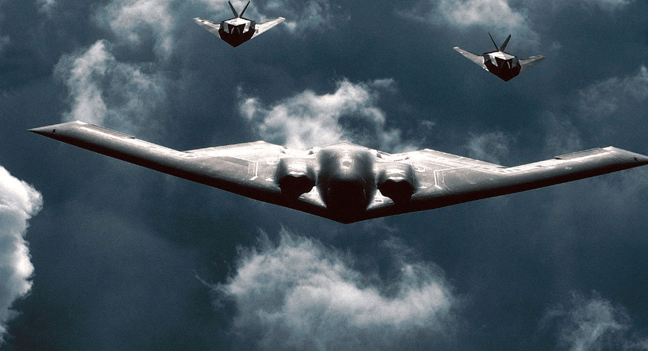 The US just majorly stepped up nuclear bomber deployments to Guam amid soaring North Korea tensions http://www.businessinsider.com/us-deploys-nuclear-capable-bombers-guam-north-korea-tensions-b-1-b-2-b-522018-1/?r=AU&IR=T Alex Lockie 17 Jan 18
Russia’s new underwater drone – a ‘doomsday’ weapon
Pentagon confirms existence of Russian ‘doomsday’ weapon, A NEW weapon of immense destructive power is now in Russia’s hands — and the rest of the world should be worried, particularly the United States. News.com.au, James Law@JournoLawJ 17 Jan 18
THE Pentagon has confirmed that Russia has developed an unmanned underwater nuclear drone that has the potential to devastate US ports and harbours, according to a leaked government report.
The revelation is one of many alarming findings in a draft version of the US’s Nuclear Posture Review due for release next month.
The paper, published by the Huffington Post, argues that America has been left exposed because Russia has continued to develop nukes since the end of the Cold War, while the US has reduced their role in its security strategy.
The US Defence Department cites this risk — combined with growing military threats from China, North Korea and Iran — to argue for increased spending on nuclear weapons.
Russia has embarked on a “comprehensive modernisation” of its nuclear arsenal, the paper says.
“Russia’s strategic nuclear modernisation has increased and will continue to increase its warhead delivery capacity, and provides Russia with the ability to rapidly expand its deployed warhead numbers,” the draft paper states.
“In addition to modernising ‘legacy’ Soviet nuclear systems, Russia is developing and deploying new nuclear warheads and launchers.
“These efforts include multiple upgrades for every leg of the Russian nuclear triad of strategic bombers, sea-based missiles, and land-based missiles.
“Russia is also developing at least two new intercontinental range systems, a hypersonic glide vehicle and a new intercontinental nuclear-armed undersea autonomous torpedo.”
The mention of the “torpedo” is the first time the Pentagon has publicly confirmed the existence of the weapon, referred to elsewhere in the document as a “AUV”, or autonomous underwater vehicle.
Russia first teased that it was working on the weapon in 2015 when blueprints of the drone were filmed over the shoulder of general during a meeting with President Vladimir Putin and broadcast on state television.
Experts argued at the time that the exposure of the plans wasn’t an accident; it was a deliberate warning to Washington and the rest of the West.
The Russian blueprint claims that the weapon, known officially as Ocean Multipurpose System Status-6, has a range of 10,000km, can descend 1km below sea level and can reach a top speed faster than 56 knots. It is designed to carry a 100-megaton nuclear warhead.
According to a BBC translation of the plans, the drone is designed to “destroy important economic installations of the enemy in coastal areas and cause guaranteed devastating damage to the country’s territory by creating wide areas of radioactive contamination, rendering them unusable for military, economic or other activity for a long time”.
While the Pentagon has admitted the risks of the Russians having this technology, there is no mention in the Nuclear Posture Review of the US developing a similar nuclear-tipped weapon.
US intelligence agencies detected that Russia tested the drone when it was launched from a Sarov-class submarine in 2016, The Washington Free Beacon reported.
“Status-6 is designed to kill civilians by massive blast and fallout,” former Pentagon official Mark Schneider told the Free Beacon at the time.
“The Russian government daily Rossiyskaya Gazeta reported that to achieve ‘extensive radioactive contamination’ the weapon ‘could envisage using the so-called cobalt bomb, a nuclear weapon designed to produce enhanced amounts of radioactive fallout compared to a regular atomic warhead.
“A cobalt bomb is a ‘doomsday’ weapons concept conceived during the Cold War, but apparently never actually developed.”
The weapon could be used to threaten the US’s two nuclear missile submarine bases in Georgia and Washington state………
The paper ultimately argues for increased investment in the US’s nuclear triad — which consists of land-based intercontinental ballistic missiles (ICBMs), strategic bombers and submarine-launched ballistic missiles.
The Defence Department’s “top priority” is to secure an additional 3 to 4 per cent of its budget to maintain its nuclear arsenal, which it says is essential to deter attacks from enemies.
“Our goal is to convince adversaries they have nothing to gain and everything to lose from the use of nuclear weapons,” Mr Mattis writes.
He suggests continuing the weapons modernisation program started by the Obama administration to replace nuclear ballistic missile submarines, strategic bombers, nuclear air-launched cruise missiles and ICBMs. He also expresses the aim to boost investment in nuclear weapons laboratories, fighter bombers and F-35A fighter jets.
This aim fits with reports last year that US President Donald Trump told military chiefs he wanted a nearly tenfold increase in the country’s nuclear arsenal. http://www.news.com.au/technology/pentagon-confirms-existence-of-russian-doomsday-weapon/news-story/16ef0f8642b1699f805f324489942345
What if there were a real attack on Hawaii?
Hawaii: Here’s what would happen if there was a real nuclear attack, ABC News
By Anne Barker, 16 Jan 18, Consider the following scenario: a nuclear missile is launched from North Korea on a direct path for Honolulu.
For at least five minutes, Hawaiians are blissfully unaware of the danger.
Suddenly, the US Pacific Command detects the missile in mid-air and sends an alert to Hawaii’s State Warning Point, which instantly activates its public warning system.
Sirens begin blaring across the state and an alert is sent to mobile phones, radio and television.
Panicked residents and visitors have no more than 15 minutes to find somewhere to find cover — but there are no public fallout shelters.
Twenty minutes after launch, a nuclear bomb detonates 1,000 feet above the Hawaiian capital, and thousands are killed and many more are left with burns and radiation poison.
That exact scenario is being seriously considered
It’s the very real scenario Hawaiian authorities are preparing for, laid out in a document about the US state’s preparedness for a nuclear attack.
Although Saturday’s missile warning was a false alarm, US authorities believe there’s a very high likelihood that Hawaii — particularly Honolulu and the island of Oahu — would be the primary target of a North Korean nuclear attack.
The “Emergency Preparedness” document, published in November by Hawaii’s Emergency Management Authority, warns that Hawaiian residents and visitors would have “less than 12 to 15 minutes” to seek shelter in the event of a real nuclear missile threat.
Such an attack would “likely occur without prior warning”, it warns.
What would the toll be?
It says that a single-kiloton range nuclear weapon detonated at 1,000 feet could kill almost 18,000 people and cause 50,000 to 120,000 trauma and burn casualties.
As well as widespread building collapses and structural fires, up to 30 per cent of survivors would suffer acute radiation syndrome.
The document, while offering advice to residents on how to survive a nuclear attack, also confirms that Hawaii has no public fallout shelters or shelter supply caches.
Instead, it advises people to seek shelter in a building away from windows, or lie flat on the ground.
Hawaiians are unprepared
The actions of many panicked residents after Saturday’s false alarm were a far cry from what authorities recommend, and show just how unprepared Hawaii is for a North Korean nuclear missile attack……. http://www.abc.net.au/news/2018-01-15/hawaii-what-would-happen-if-there-was-a-real-nuke/9330162
China’s Fissile Material Production and Stockpile
IPFM 12th Jan 2018, IPFM’s new research report “China’s Fissile Material Production and
Stockpile” (PDF copy) by Hui Zhang uses information from newly available
Chinese public sources to provide a more detailed and documented
reconstruction of China’s production of highly enriched uranium (HEU) and
plutonium for nuclear weapons.
The report provides new evidence to constrain the operating histories for China’s Lanzhou and Heping gaseous
diffusion enrichment plants. Lanzhou stopped HEU production for weapons in 1980 and shifted to making low enriched uranium (LEU) for civilian power reactors and possibly for naval reactors. It was shut down on 31 December
2000 and in 2017 was demolished.
The Heping plant may still be operating but not producing HEU for weapons. China also has centrifuge enrichment
plants but they are believed not to produce HEU for weapons. The new report also offers new details on the operational experience of the Jiuquan and Guangyuan weapon plutonium production reactors. China also used these
reactors to produce tritium for weapons. The reactors were closed in the 1980s and have been undergoing decommissioning.
http://fissilematerials.org/blog/2018/01/chinas_fissile_material_p.html
Russian nuclear torpedo is ‘threat to coastal cities’
Tom Parfitt, Moscow, January 16 2018, Russia is developing an underwater “nuclear drone” that could be used to devastate coastal cities, according to a leaked Pentagon document.
Hawaii false alarm dramatically highlights nuclear war risk with Trump
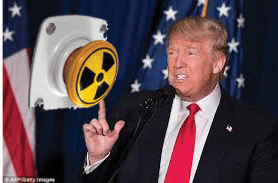 False Alarm Adds to Real Alarm About Trump’s Nuclear Risk , NYT, By THE EDITORIAL BOARD, JAN. 13, 2018 It was the sort of nightmare that had only ever been real for most people’s parents or grandparents — the fear of an impending nuclear attack. “Ballistic missile threat inbound to Hawaii,” read the emergency alert that residents of the Aloha State received on Saturday morning. “Seek immediate shelter. This is not a drill.”
The authorities quickly announced that the alert was a mistake. But it made tangible the growing fears that after decades of leaders trying to more safely control the world’s nuclear arsenals, President Trump has increased the possibility of those weapons being used.
At a time when many are questioning whether Mr. Trump ought to be allowed anywhere near the nuclear “button,” he is moving ahead with plans to develop new nuclear weapons and expanding the circumstances in which they’d be used. Such actions break with years of American nuclear policy. They also make it harder to persuade other nations to curb their nuclear ambitions or forgo them entirely.
Mr. Trump has boasted about the size and power of America’s nuclear arsenal, threatened to “totally destroy” North Korea, pushed for a massive buildup of an arsenal that already has too many — 4,000 — warheads and wondered aloud why the United States possesses such weapons if it isn’t prepared to use them.
Now, as he tries to force North Korea to abandon its nuclear weapons capability and ensure that Iran never acquires one, Mr. Trump is poised to make public a new policy that commits America to an increasing investment in those very weapons, according to a draft document made public by HuffPost and confirmed by The Times.
…….. The proposed nuclear policy says a more aggressive nuclear posture is warranted because the world is more dangerous, with China, North Korea and Iran cited as concerns. Yet blowing up the Iran deal would free Tehran to resume its nuclear activities and make the world less safe. In other words, Mr. Trump’s approach makes no sense.
Under the Nuclear Nonproliferation Treaty, signed in 1968, the United States and Russia promised to reduce the role and number of nuclear weapons. They made significant, although insufficient, progress. After reductions under a succession of past presidents, the American stockpile is 85 percent smaller than it was at the height of the Cold War. Negotiations on further reductions have stalled in recent years as Russia, threatened by America’s superior conventional arsenal, became more reliant on nuclear weapons, and there is no serious sign that Mr. Trump wants to revive the talks.
President Barack Obama made a down payment on a saner policy by narrowing to “extreme circumstances” the conditions under which nuclear weapons would be used and ruling out their use against most non-nuclear countries. Mr. Trump’s policy also talks about “extreme circumstances, ” but it dangerously broadens the definition to include “significant non-nuclear strategic attacks,” which could mean using nuclear weapons to respond to cyber, biological and chemical weapon attacks.
Until Mr. Trump, no one could imagine the United States ever using a nuclear weapon again. America’s conventional military is more than strong enough to defend against most threats. But Mr. Trump has so shaken this orthodoxy that Congress has begun debating limits on his unilateral authority to launch nuclear weapons. Expanding the instances when America might use nuclear weapons could also make it easier for other nuclear-armed countries to justify using their own arsenals against adversaries.
As the residents of Hawaii can tell you, it’s a risk the world cannot afford. https://www.nytimes.com/2018/01/13/opinion/sunday/trump-nuclear-weapons-war.html?smid=li-share
Possibility of first strike, and increased nuclear role in USA weapons – leaked draft of USA policy document
 New Trump policy could strengthen role of nuclear weapons, Phil Stewart WASHINGTON (Reuters) 13 Jan 18,- President Donald Trump’s administration could pursue development of new nuclear weaponry and explicitly leave open the possibility of nuclear retaliation for major non-nuclear attacks, if a leaked draft policy document becomes reality.
The Pentagon did not comment on the document, which was published by the Huffington Post website and prompted sharp criticism from arms control experts, who voiced concerns it could raise the risks of nuclear war.
The Defense Department said on Friday it did not discuss “pre-decision, draft copies of strategies and reviews.”
“The Nuclear Posture Review has not been completed and will ultimately be reviewed and approved by the President and the Secretary of Defense,” the Pentagon said in a statement.
One source familiar with the document told Reuters the draft was authentic, but did not say whether it was the same version that will be presented to Trump for approval.
The Republican Trump’s predecessor, Democrat Barack Obama, declared his intent to reduce the role of nuclear weapons in his Nuclear Posture Review in 2010, the last time the policy document was crafted.
The Trump administration’s draft document, said, however, that Obama-era assumptions of a world where nuclear weapons were less relevant proved incorrect.
“The world is more dangerous, not less,” it said.
It more readily embraces the role of nuclear weapons as a deterrent to adversaries, and, as expected, backs a costly modernization of the aging U.S. nuclear arsenal.
The Congressional Budget Office has estimated that modernizing and maintaining the U.S. nuclear arsenal over the next 30 years will cost more than $1.2 trillion.
…….. Kingston Reif, director for disarmament research at the Arms Control Association advocacy group, said the draft document was a departure from long-standing U.S. policy.
“It expands the scenarios under which the United States might use nuclear weapons and therefore increases the risk of nuclear weapons use,” Rief said.
Although it reaffirmed an Obama-era pledge not to use or threaten to use nuclear weapons against non-nuclear weapons states if they joined and adhered to the nuclear Non-Proliferation Treaty, the draft introduced a caveat. The United States reserved the right to alter that assurance, given the evolving threat from non-nuclear technologies…… https://www.reuters.com/article/us-usa-nuclear/new-trump-policy-could-strengthen-role-of-nuclear-weapons-idUSKBN1F202N
Nuclear submarines left to rot at Devonport for nearly 30 years.

Plymouth Herald 14th Jan 2018, 13 former Royal Navy subs are awaiting disposal in Plymouth – with a further seven in
Rosyth. The MoD says the submarines are “safely stored” and subject to
rigorous checks. It adds that there has been “no measurable increase in
exposure for local people”.
But the cost of storing and maintaining the laid-up vessels is vast. Over five years – between 2010 and 2015- the total
bill for storing the vessels at the two sites, both owned by Plymouth-based engineering firm Babcock, reached more than £16million.
The estimated cost of the MoD’s submarine dismantling programme, which started in December 2016 and is due to take more than 25 years to complete, have not been released. The MoD says this is due to ongoing commercial negotiations withBabcock – it’s main contractor for the programme – and other key suppliers.
http://www.plymouthherald.co.uk/news/plymouth-news/nuclear-submarines-left-rot-devonport-1043977
2018 – a lovely year ahead for America’s bonanza of weapon sales abroad
the global deregulation of American firearms which could, in turn, according to critics, put such weaponry ever more easily in the hands of both criminal gangs and extremist groups
As Donald Trump might put it, major weapons contractors like Boeing, Raytheon, and Lockheed Martin cashed in “bigly” in his first year in office.
This year will undoubtedly be a banner year for arms companies. The only question is: Might it also mark the beginning of a future movement to roll back unconstrained weapons expenditures?
Tomgram: William D. Hartung, 2018 Looks Like an Arms Bonanza OpEd News.com, By Tom Engelhardt 11 Jan 18 This article originally appeared at TomDispatch.com.
 Here’s a cheery note for you: the last mass killing of 2017 took place moments before midnight on New Year’s Eve. A 16-year-old New Jersey boy picked up a semi-automatic rifle, “lawfully acquired” by a member of his family, and killed his father, mother, sister, and a family friend. In doing so, he helped ensure that 2017 would be the deadliest year for mass killings in our modern history. (There is now, on average, slightly more than one mass killing a day in this country.) Nonetheless, guns of all sorts, including military-style assault rifles and even bump stocks like the 12 Stephen Paddock evidently used to turn his semi-automatics into functional automatics and slaughter 58 people from a hotel window in Las Vegas, are still readily available. Nowhere on Earth, not even in ravaged Yemen (which takes second place in gun ownership), is more weaponry available to more types of people. As the years go by here, such weapons are more easily and openly carried with only the most minimal of background checks (or less than that). Think about this: Americans, 4.4% of the people on this planet, own 42% of the guns and commit 31% of the mass killings.
Oh, and I did promise you that there was something cheery in all this, didn’t I? So here it is: the Trump administration, knowing a good thing when it sees it, is now hard at work ensuring that American weapons makers will make it a remarkably similar world. Its officials are intent, it seems, on recreating the planet in an American image. Keep in mind that U.S. arms makers like Lockheed, Raytheon, and General Dynamics already monopolize the global arms market in a way that should (but in this country regularly doesn’t) stagger the imagination. Continue reading
Former nuclear weapons launch officers call for restricting Trump’s access to ‘nuclear button’
Nuclear launch officers write open letter about President Trump, amid claims cyberhacks could lead to ‘unintended’ nuclear launch http://www.news.com.au/world/europe/nuclear-launch-officers-write-open-letter-about-president-trump-amid-claims-cyberhacks-could-lead-to-unintended-nuclear-launch/news-story/31e82d4451a4d398a7fce3b7e785dbde SEVENTEEN people once responsible for launching the US’s nuclear weapons have revealed a fatal flaw in the launch system. Victoria Craw@Victoria_Craw12 Jan 18 SEVENTEEN former nuclear launch officers have signed an open letter calling for President Trump’s access to the “proverbial red button” be restricted amid fears his “petulant mood swings” could lead to a nuclear strike.
It follows a similar letter calling for restrictions on the nuclear chain of command written while Trump was on the campaign trail. One year into the presidency, the nuclear officers say “the reality of this presidency is worse than we feared.”
“The president has had ample opportunity to educate and humble himself to the grave responsibilities of his office. Instead, he consistently shows himself to be easily baited, stubborn in his ignorance of world politics and diplomacy, and quick to brandish nuclear threats,” the group states.
They claim rising rhetoric against North Korea highlights the clear flaw in the process that could endanger millions around the world — that there are no checks on the President should he decide to order a nuclear strike.
“As former nuclear launch control officers, it was our job to fire nuclear missiles if the president so directed. Once the president orders a launch, we could have missiles leaving their silos in several minutes. They cannot be recalled.
“The missiles would reach their destination — whether Russia, China or North Korea — within 30 minutes. There is no act of greater consequence, and it should not rest in the hands of any one person.”
We and our nation cannot abide being hostages to the mood swings of a petulant and foolish commander-in-chief. No individual, especially Donald Trump, should hold the absolute power to destroy nations. That is a clear lesson of this presidency and one that we, as former stewards of the launch keys, embrace with full conviction,” the group said.
It comes following a warning from UK think tank Chatham House that an “unintended” nuclear strike is possible given heightened tensions and the vulnerability of many systems to cyber attack.
The International Security Department’s Dr Patricia Lewis and Dr Beyza Unalpublished the paper, Cybersecurity Of Nuclear Weapons Systems, which said the nine countries that have nuclear weapons often rely on strategic systems developed at a time when computers were “in their infancy”.
“The most severe consequence of a cyber attack on one or more nuclear weapons systems would be the inadvertent launch of missiles and/or the inadvertent detonation of a warhead that lead to a significant loss of life,” it said.
“Further consequences of such a cyber attack include sector-level impacts, such as in the medical sector, which may have to deal with casualties; disruption of workforces and operations of defence companies or vendors; as well as economic and reputational costs to countries and private companies. Such an event would also increase the likelihood of crisis and conflict.”
The report notes a mind-boggling number of ways cyber attackers could infiltrate a nuclear weapons system without a country being aware of it for years or until it’s too late.
The result could lead to confusion as countries try to ascertain whether they have been subject to a cyber attack or not, how to respond and which weapons to use. The authors claim it could lead to “inadvertent nuclear launches” based on an “unwitting reliance” on false information.
Making the problem worse is the sheer scale of digital infrastructure used to control everything from layouts of facilities to personnel, operational information, communication links, and weather and target information. Data hacks could be used to disrupt missiles once launched and take over nuclear armed submarines, the report claimed.
It comes during a state of heightened nuclear tension following heated rhetoric between the US and North Korea as well as greater Russian military activity and a build-up of NATO forces in Eastern Europe.
Trump supporters claim his refusal to rule out military options has helped achive an about face from North Korea, who is now engaged in a dialogue with the South and is subject to tough UN economic.
However veteran nuclear launch officer, Dr. Bruce Blair, who founded Global Zero to eliminate nuclear weapons said he could no longer watch as President Trump “holds us all hostage to his petulant mood swings.”
“Our weapons have the power to destroy entire nations, including our own nation if he initiates a nuclear war. As a former steward of the nuclear launch keys, I’ve learned about the stability, competence and temperament it takes to hold such a responsibility, and Donald Trump has shown us all he possesses none of those qualities,” he said.
Donald Trump’s national security adviser, H.R. McMaster thinks it’s about time to bomb North Korea
Why Trump’s national security adviser thinks it might soon be time to bomb North Korea, Business Insider, Australia , ALEX LOCKIE, JAN 11, 2018
1 This Month
23-25 October – on Zoom – World BEYOND War’s annual global conferenc

To see nuclear-related stories in greater depth and intensity – go to https://nuclearinformation.wordpress.com

Say No to NASA’s Reckless Nuclear Reactor on the Moon
Say No to NASA’s Reckless Nuclear Reactor on the Moon
-
Archives
- October 2026 (149)
- September 2026 (339)
- August 2026 (330)
- July 2026 (355)
- June 2026 (287)
- May 2026 (306)
- April 2026 (356)
- March 2026 (251)
- February 2026 (267)
- January 2026 (308)
- December 2025 (358)
- November 2025 (359)
-
Categories
- 1
- 1 NUCLEAR ISSUES
- business and costs
- climate change
- culture and arts
- ENERGY
- environment
- health
- history
- indigenous issues
- Legal
- marketing of nuclear
- media
- opposition to nuclear
- PERSONAL STORIES
- politics
- politics international
- Religion and ethics
- safety
- secrets,lies and civil liberties
- spinbuster
- technology
- Uranium
- wastes
- weapons and war
- Women
- 2 WORLD
- ACTION
- AFRICA
- Atrocities
- AUSTRALIA
- Christina's notes
- Christina's themes
- culture and arts
- Events
- Fuk 2022
- Fuk 2023
- Fukushima 2017
- Fukushima 2018
- fukushima 2019
- Fukushima 2020
- Fukushima 2021
- general
- global warming
- Humour (God we need it)
- Nuclear
- RARE EARTHS
- Reference
- resources – print
- Resources -audiovicual
- Weekly Newsletter
- World
- World Nuclear
- YouTube
-
RSS
Entries RSS
Comments RSS

