US and South Korea to announce plans for military manoeuvres with more than 320,000 troops, Express UK. 20 Feb 18
SOUTH KOREA and the United States will announce plans before April for a postponed joint military drill, South Korea’s defence minister said today. Seoul and Washington had agreed to postpone the regular joint military exercise until after the Winter Olympics being hosted in South Korea, which end on March 18.
After the decision to delay the joint exercise, North Korea agreed to hold the first official talks with South Korea in more than two years and send athletes to the Winter Games, easing a standoff over Pyongyang’s nuclear and missile programmes.
Asked when the two countries will hold the postponed drill, Song Young-moo told parliament he and his US counterpart, Jim Mattis, would make an announcement between March 18 and the start of April.
“The exercise was postponed according to the spirit of the Olympics,” Song said.
MUNICH, Germany, Feb. 17 (Xinhua) — A senior Chinese diplomat said Saturday that China is committed to the principle of non-first-use of nuclear weapon, expressing concerns about the danger of nuclear development at present at the ongoing Munich Security Conference (MSC).
“China maintains a very small nuclear arsenal, and China follows the policy of self-defense and minimum deterrence,” said Fu Ying, a veteran diplomat and now chairperson of the Foreign Affairs Committee of the National People’s Congress (NPC), China’s top legislature.
“China is also committed to the principle of non-first-use of nuclear weapon, and no-use of nuclear weapon against any nuclear state at any circumstances and no-use of nuclear weapon against nuclear-free zones,” she added.
Fu made the remarks at an MSC panel discussion about the nuclear security, on which some participants expressed their concerns over nuclear proliferation at present.
“I share and express the concern about the danger, about the risk of the nuclear development,” said Fu, who added that so far after many decades, the world has managed to prevent a major nuclear war, but obviously the challenges and dangers are growing.
She noted that it is important that the five permanent members of the UN Security Council, namely China, United States, Russia, Britain and France, should continue their efforts and continue to take responsibility to maintain global strategic stability, to safeguard non-proliferation regime, and to continue the nuclear disarmament.
China is also in support of the Comprehensive Nuclear-Test-Ban Treaty (CTBT), added Fu.
She also called for efforts to upgrade global security governance.
“We need to think about how to upgrade global security governance to reflect that highly integrated global economy,” said Fu.
“China supports and advocates the idea of common securities for all,” she said, stressing that China proposes and is committed to building a community with shared future for mankind.
60 years ago, the Campaign for Nuclear Disarmament was founded. Here’s what we’ve achieved over the decades
Our core objective of UK nuclear disarmament remains as yet unfulfilled. But it is clear in retrospect how CND’s campaigning – and that of its international partners – has affected government policy and decision-making The Independent, UK, Kate Hudson@CNDuk 17 Feb 18, “………From its origins in local anti-testing groups – largely run by women concerned about hugely increased levels of radioactive strontium-90 in their children’s milk – CND burst onto the political scene 17 February 1958. Attempts to move Labour to an anti-nuclear position had failed in 1957, leading intellectuals and campaigners to take matters into their own hands, calling for a mass movement to defeat Britain’s bomb. The result was a meeting of thousands of people at Central Hall in Westminster, London, filled to overflowing………
The context of CND’s campaigns has changed continually: from the Cuban missile crisis to the war on Vietnam; from the height of the Cold War to détente; from the “evil empire” of Ronald Reagan to the end of the Cold War; from the aggression of Bush and Blair through to the great dangers presented by Trump and his plans for “usable” nuclear weapons.
Our work throughout has focused on changing government policy, using diverse – but always peaceful – methods: from the mass protests at Aldermaston and Greenham Common, to our central role in post 9/11 anti-war campaigning, to today’s struggle to prevent Trident replacement and win support for the United Nations’ global nuclear ban treaty.
Our core objective of UK nuclear disarmament remains as yet unfulfilled. But it is clear in retrospect how CND’s campaigning – and that of its international partners – has affected government policy and decision-making, both at home and internationally. Reading government documents and diaries years later, one can see how the pressure of public opinion and mass mobilisation really does have an impact, and each generation of CND has played a part in that. The banning of nuclear tests in the atmosphere is one very important example; another is the abandoning of the neutron bomb (designed to kill people while leaving property intact) or Nixon’s pulling back from using nukes on Vietnam.
AN experiment backed by the Chinese government has raised concerns about its ambitions to reboot a devastating bomb dreamt up during the Cold War.
Nick Whigham @NWWHIGHAMSTATE-sponsored experiments at an ion research facility in China have raised questions about the potential they could be used to build a devastating bomb dreamt up during the Cold War but never seen.
The Chinese Academy of Sciences recently announced that scientists had successfully fired superheated beams of a radioactive isotope of tantalum, a rare metal that can be added to warheads with potentially devastating consequences.
The experiment was carried out at the Institute of Modern Physics in Lanzhou in the north of the country, in part to “meet a critical strategic demand of China’s national defence,” researchers said.
Those responsible reportedly confirmed the project had potential military applications but would not elaborate.
At the centre of the physics experiment tantalum. The rare metal is used as a minor component in alloys and electronics but when you learn it’s named after Tantalus, a villain from Greek mythology, you know it must have some potentially nasty uses.
It is part of a group of heavy metals that could theoretically be added to a nuclear warhead to increase the release of radioactive fallout, causing lasting environmental contamination and rendering a large area uninhabitable in the near future.
Such a thing is known as a “salted bomb”.
These bombs can use elements like gold, cobalt or tantalum to produce a radioactive isotope that maximises the fallout hazard from the weapon rather than generating additional explosive force.
The term refers to the way such bombs are manufactured but also takes its name from the phrase “to salt the earth”, meaning to render the soil unable to host life for years to come.
No salted bomb has ever been atmospherically tested, and as far as is publicly known none have ever been built, according to the online Nuclear Weapon Archive.
But some believe the new research by Chinese scientists could be applied to make such a bomb, or at least be used for other military applications such as shooting the tantalum beam at China’s own military equipment to test its durability in extreme events.
This potential prompted Hong Kong newspaper, the South China Morning Post, to hypothesise that China could be “rebooting a nuclear doomsday device”.
It’s highly unlikely that a salted bomb is the end goal of its latest experiment, but two experts told the Post that they believe the experiments could be used for future military applications such as a laser-like device to achieve targeted damage.
Han Dejun, a professor of nuclear science and technology at Beijing Normal University, said of the tantalum accelerator experiment: “The most likely application that I can think of is in nuclear research.
“By generating a powerful beam of tantalum ions we can observe how the metal interacts with other elements and change form in high-speed collisions. It simulates what will happen in a real nuclear reaction.”
Beijing National Space Science Centre associate researcher Cai Minghui said: “In theory, the particle beam of a heavy element such as tantalum can be used as a directed energy weapon.”
Meanwhile a third expert from China’s Arms Control and Disarmament Association said the likelihood the research could lead to the Chinese Communist Party stockpiling salted bombs was “very low”.
“These are highly immoral weapons,” he said.
A COLD WAR CREATION
The idea of a salted bomb was initially proposed by Hungarian-American physicist Leo Szilard during the Cold War.
The scientist was instrumental in the beginning of the Manhattan Project. Along with Albert Einstein, he helped write a letter to US president Franklin D. Roosevelt encouraging him to begin building the atomic bomb.
The British did test a kind of salted bomb that used cobalt as an experimental radiochemical tracer in September 1957. The device was exploded underground in the Maralinga range in Australia, however the experiment was regarded as a failure and not repeated.
The US also tested a dirty bomb in an open field in 1953. While dirty bombs use conventional explosives rather than nuclear devices, the weapon was loaded with 30kg of the same isotope used in the Chinese test, releasing a lethal dose of gamma rays over the target area, according to a declassified US Defence Technical Information Centre document.
China doesn’t want to fall behind in nuclear technology and research. But given the serious environmental consequences and the threat of the spread of contamination from the detonation of salted bombs, it is highly unlikely it would seek to resurrect such devices.
A NEW NUCLEAR MINDSET
Compared to the United States and Russia, China has a maintained a relatively small nuclear arsenal since its first nuclear test in 1964.
At last count, the Communist Party was estimated to contain just 270 warheads, compared to the 6800 held by the US and Russia’s 7000, according to the International Campaign to Abolish Nuclear Weapons.
However the Asian superpower has stepped up the quantity and quality of its nuclear arsenals in recent years.
According to Science and Global Security website, Beijing is estimated to have between 14 and 18 tons of highly enriched uranium and 1.3—2.3 tons of weapon-grade plutonium stockpiled. This enough for anywhere between 750 and 1600 nuclear weapons
In November, China unveiled a next-generation nuclear weapon that is said to be able to strike “anywhere in the world”.
The nuclear warhead, called the Dongfeng-41, will be capable of reaching distances of at least 12,000km — putting the US well into the line of target. With a speed of up to Mach 10 (around 12,000kp/h), it can carry up to 10 nuclear warheads.
The weapon is scheduled to enter China’s arsenal this year.
The sentence revealed that the Trump administration had ordered the Department of Energy to be ready to conduct a nuclear test at the Nevada National Security Site in as little as six months. Time reporter W.J. Hennigan went on to write that the White House was considering conducting a nuclear test as a show of force.
“The point, this and other sources say, would be to show Russia’s Vladimir Putin, North Korea’s Kim Jong Un, Iran’s Ayatullah Ali Khamenei and other adversaries what they are up against,” Hennigan reported.
For a megaton of reasons, this test absolutely must not happen.
First and foremost, there’s simply no need to stage this kind of demented theater, because the nation’s adversaries are well aware “what they’re up against.” It’s annihilation. There are nearly 7,000 warheads in the U.S. nuclear arsenal, deliverable across the globe at a moment’s notice by missile, aircraft and submarine. The biggest nuke is the B83 bomb, which at 1.2 megatons is 80 times more powerful than the World War II bomb that wiped out Hiroshima and killed at least 90,000 people.
Triggering a U.S. nuclear strike would be suicide. That’s not in question.
So it’s no more necessary to prove that point with a nuclear test in the Nevada desert than it is to stage a military parade, yet another stupid idea that has spun out of the White House during President Donald Trump’s 13 months in office.
It demonstrates an astonishing lack of understanding about the nation’s military and the world’s perception of the U.S. More than anything, it proves that Trump’s feelings of inadequacy and inferiority know no bounds.
To be clear, Trump hasn’t ordered a nuclear test. But the fact that the administration has even considered it is chilling. A U.S. test would almost certainly provoke other nations into following suit and building up their own arsenals.
And for what? It’s not as if there’s any question that nuclear weapons work. The U.S. conducted more than 1,000 tests, many at the test site 90 miles north of Las Vegas, during an arms race that culminated when the former Soviet Union unleashed a 50-megaton monster of a bomb in 1961.
For Nevadans to allow a new test would be to disrespect generations of heroic state residents who fought to stop the testing. That fight led to George H.W. Bush imposing a self-imposed moratorium in 1992, and there hasn’t been a U.S. test since then.
The door should remain closed.
The good news is that Gov. Brian Sandoval says he has received “100 percent confirmation” that the Trump administration isn’t planning to test a nuclear device in the Nevada desert.
But just in case Trump or anybody on his team is wondering whether Nevadans want him to set off one of his oversized firecrackers in our state, the answer is a loud hell no.
It’s bad enough that Trump’s new budget contains funding for the Yucca Mountain nuclear waste repository, a project that would lead to high-level nuclear waste being transported through the heart of Las Vegas.
That project should be buried and forgotten, and so should any notion of testing a nuclear devicein the Nevada desert.
Trump should stop treating our state like enemy territory.
‘Atomic Homefront’ unboxes the cruel consequences of Missouri’s radioactive landfill, The Daily Dot Kahron Spearman—Feb 18
The film takes a human look into a St. Louis-area radioactive landfill that dates back to the Manhattan Project. Cammisa runs down the intertwining and harrowing paths of Bridgeton, Missouri, residents, and those living near the Coldwater Creek floodplain, which flows downstream from the nuclear landfill……..
Because there isn’t any official evidence—or any that the government will admit to—supporting a causal relationship between the radiation and the extraordinary rates of various cancers, pulmonary di – wepons before peopleseases, and multiple sclerosis, the residents exist on a shifting plate, tottering white-hot anger and unparalleled astonishment toward the federal authorities. The film is well-researched given that there’s an open, yet silent antagonism toward those seeking purpose by pushing back on the government’s “science” about the radiation exposure. …..
In the end, the critical takeaway remains the government’s dark submission to weapons. The human impact in the film is maddening and undeniable, begging for some exploration into the awful self-evidence of our defense apparatus: We need these weapons, so whatever collateral damage arises is for the good of the country. Yes, even your cancer.
Decades ago they witnessed nuclear weapons tests in the South Pacific. Now some veterans hope new DNA testing will prove it was responsible for their subsequent ill health, which they say ruined their lives.
“It was awe-inspiring, like another sun hanging in the sky. The blast bowled people over. A few men were on the ground screaming.”
(Picture is not of Bob Fleming. It is of Gomer Hickman)
Bob Fleming was wearing a T-shirt, khaki shorts and flip flops when the bomb went off.
At just 24, he had just witnessed one of the most powerful weapons on earth detonate on Christmas Island in the Pacific Ocean.
It was 1956 and the Cold War threat was growing.
The RAF serviceman was one of around 22,000 British service personnel who witnessed nuclear weapons tests on mainland Australia, the Montebello Islands off Western Australia and Christmas Island in the South Pacific between 1952 and 1958.
With their backs to the bomb, they felt the intense heat from the explosion first.
Then, after the countdown, they were ordered to turn round and look directly at the huge mushroom cloud in front of them.
“We had no protective clothing,” said Bob, who’s from Downham Market in Norfolk.
“We were guinea pigs. It was so bright I could see the bones in my hands with my eyes closed. It was like an X-ray.”
‘Genetic curse’
The veterans say the nuclear tests ruined their lives, causing cancers, fertility problems and birth defects passed down the generations.
Now 83, the great-grandfather believes that three generations of his family are living with the “genetic curse” of those explosions. Sixteen out of 21 of his descendants have had birth defects or health problems.
His youngest daughter, Susanne Ward, has thyroid problems and severe breathing difficulties, and her teeth fell out prematurely.
“It just gets worse as the next generation comes along. Our grandchildren have similar problems,” Suzanne said.
“My dad blames himself, but it isn’t his fault.”
The Fleming family now hope new DNA testing could end decades of uncertainty.Last week, the UK’s first Centre for Health Effects of Radiological and Chemical Agents was launched at Brunel University in London.One of its projects is a three-year genetic study looking for any possible damage to the veterans’ DNA caused by the tests.
Blood samples will be taken from 50 veterans who were stationed at nuclear test sites, and compared with a control group of 50 veterans who served elsewhere.
Blood will also be taken from their wives and any children they have together.
Dr Rhona Anderson, who is leading the study, said a major question to answer is whether “there is a genetic legacy of taking part at these nuclear tests”.
“If no differences (in the DNA) are seen between test and control groups then this will be reassuring for the nuclear community.”
‘No valid evidence link’
Fewer than 3,000 nuclear veterans are still alive today.
They cannot volunteer for the study, as that might lead to bias in the results.
Veterans will be selected using military service records and information available about those who were most at risk of exposure to radiation.
The Ministry of Defence says it is grateful to Britain’s nuclear test veterans for their service, but maintains there is no valid evidence to link participation in these tests to ill health.
The UK is the only nuclear power to deny special recognition and compensation to its bomb test veterans.
The veterans took their case for compensation to the highest court in the land and lost in 2012.
The Supreme Court Justices said the veterans would face great difficulty proving a link between their illnesses and the tests.
In 2015 the Aged Veterans’ Fund was set up by the government using bank industry fines. It will help to fund a series of social and scientific projects.
Doug Hern, who’s 81, and his wife Sandie, from Lincolnshire have been campaigning tirelessly for years.
When Doug was 21 he saw five nuclear explosions on Christmas Island and has suffered ill health ever since.
He said is skeleton is “crumbling”. He has skin problems and bone spurs.
His daughter died, aged 13, from a cancer so rare it did not have a name. He believes this was a consequence of her inheriting his “corrupted genes”.
Sandie Hern is vice-chair of the British Nuclear Test Veterans’ Association (BNTVA)
“The veterans have been treated abominably. They’ve been forgotten. We need this research to see if anything can be done to help their children,” she said.
The overall aim of the new centre at Brunel is to work closely with the veteran community to improve their health and well-being in the future.
After years of personal suffering, the Flemings want to have their DNA tested and are waiting to hear if they have been selected.
Six decades on, nuclear families are still living in the aftermath of the bomb tests, and searching for answers.
Nuclear Weapons: an Absolute Evil, The Citizen, ANNE BARING | 16 FEBRUARY, 2018Review of John Scales Avery’s book “……. Most of the planet’s inhabitants, even those who are highly educated and working in governments and organizations like the United Nations have very little awareness of what an exchange of nuclear weapons would be like or what its immediate and long-term effects would be in terms of the massive numbers of civilian deaths and the rapid deterioration of the planetary environment. This is the lacuna that Professor Avery’s book sets out to fill in an admirably clear and comprehensive way, enriching it with photographs and quotations from men who have, from the outset, expressed their opposition to nuclear weapons.
The book is an education in itself on the many facets of this complex subject including how these weapons first came into being in first five, then nine nuclear nations. It addresses both the amorality and the illegality of nuclear weapons. Many people like myself who are appalled by the existence of nuclear weapons but insufficiently informed of their history and the threat they pose to the planetary biosphere, could benefit by reading its highly informative chapters.
The first chapter, “The Threat of Nuclear War”, explores the important subject of how existing ethical principles about avoiding the bombing of civilians were eroded during the Second World War with the carpet bombing of cities by German and British air forces, culminating in the incendiary raids on Coventry, Hamburg and Dresden that destroyed those and other German cities and many thousands of their helpless inhabitants.
Not long after these, in August 1945, came the horrific obliteration of the cities of Hiroshima and Nagasaki by the first atom bombs, together with most of their civilian inhabitants. It is noteworthy that the First and Second World Wars cost the lives of 26 million soldiers but 64 million civilians. We live, Professor Avery comments, in an age of space-age science but stone-age politics.
Instead of drawing back in horror from the evil it had unleashed, America and then the Soviet Union embarked on an arms race that has led, step by step, to the current existence of nine nuclear nations and some 17,000 nuclear weapons, with the greater part of these situated in the United States and Russia.
Thousands of these are kept on permanent “hair-trigger” alert. 200 of these nuclear bombs are situated in Belgium, Germany, Italy, and the Netherlands, as well as Turkey, available for use by NATO and placed there by the United States principally to deter a Russian attack. The danger of the launch of one of these weapons in error is a constant possibility and would precipitate a genocidal catastrophe.
His first chapter also addresses the important concept of nuclear deterrence and shows how, according to the historic 1996 decision by the International Court of Justice in the Hague, this was declared to be not only unacceptable from the standpoint of ethics but also contrary to International Law as well as the principles of democracy. The latter have been reflected in the pattern of voting at the United Nations (originally founded to abolish the Institution of War) which has consistently shown that the overwhelming majority of the world’s people wish to be rid of nuclear weapons.
The basic premise of this chapter and indeed, the entire book, is that nuclear weapons are an absolute evil and that no defence can be offered for them, particularly the defence that they act as a deterrent. He brings evidence to show that the effects of even a small nuclear war would be global and all the nations of the world would suffer. Because of its devastating effects on global agriculture, even a small nuclear war could result in a ‘nuclear winter’ and in an estimated billion deaths from famine.
A large-scale nuclear war would completely destroy all agriculture for a period of ten years. Large areas of the world would be rendered permanently uninhabitable because of the ‘nuclear winter’ and the radioactive contamination affecting plants, animals and humans.
Summarising at the end of this chapter Professor Avery writes: “In the world as it is, the nuclear weapons now stockpiled are sufficient to kill everyone on earth several times over. Nuclear technology is spreading, and many politically unstable countries have recently acquired nuclear weapons or may acquire them soon. Even terrorist groups or organized criminals may acquire such weapons, and there is an increasing danger that they will be used.”
To believe that deterrence is a preventive to their being used is to live in a fool’s paradise. It only needs one inadvertent mistake, one mis-reading of a computer, one terrorist nuclear bomb to unleash unimaginable horror on the world. There have already been several near disasters. Governments claim to protect their populations by holding these weapons. Instead, they offer them as hostages to the greed and will to power of the giant corporations, of arms manufacturers such as BAE and the Military-Industrial Complex in general. Professor Avery refers to the greed for power that drives each of these as “The Devil’s Dynamo”.
As an example of this will to power, concealed beneath the mask of deterrence, there is the existence of a Trident submarine which is on patrol at all times, armed with an estimated eight missiles, each of which can carry up to five warheads. In total, that makes 40 warheads, each with an explosive power of up to 100 kilotons of conventional high explosive—eight times the power of the atomic bomb dropped on Hiroshima in 1945 which killed an estimated 240,000 people from blast and radiation. One nuclear submarine can incinerate more than 40 million human beings. This capacity for mass murder is presented as essential for our defence but it begs the question: ‘How many people are we prepared to exterminate in order to ensure our security?’ We would have no protection against a reciprocally fired nuclear missile directed at us. The concept of deterrence puts us at risk of instant annihilation.
Many people are not aware that the illegality of war was established in 1946 when the United Nations General Assembly unanimously affirmed “The principles of international law recognized by the Charter of the Nuremberg Tribunal and the judgment of the Tribunal.” These set out the crimes that henceforth were punishable under international law. It is obvious that the nine nuclear nations, in developing and holding their weapons, have ignored and violated these principles.
Professor Avery draws attention to the significant fact that NATO’s nuclear weapons policy violates both the spirit and the text of the NPT. An estimated one hundred and eighty US nuclear weapons, all of them B-61 hydrogen bombs, are still on European soil with the air forces of the nations in which they are based regularly trained to deliver the US weapons.
These nations are Belgium, Germany, Italy and the Netherlands as well as the United Kingdom with its Trident submarines. Turkey, one of the 29 nations that have joined NATO holds about 50 hydrogen bombs at a US base at Incirlik. The aim of all these weapons is to intimidate Russia. This “nuclear sharing” as he points out, “violates Articles 1 and 11 of the NPT, which forbid the transfer of nuclear weapons to non-nuclear-weapon states.”
In another most important chapter “Against Nuclear Proliferation” Professor Avery draws attention to the danger of nuclear reactors, a danger that is very rarely reflected on by the governments who have committed vast sums to building them and is virtually unknown to the general public. ……….
Summing up the effects on the world of a nuclear war, Professor Avery writes:
The danger of a catastrophic nuclear war casts a dark shadow over the future of our species. It also casts a very black shadow over the future of the global environment. The environmental consequences of a massive exchange of nuclear weapons have been treated in a number of studies by meteorologists and other experts from both East and West. They predict that a large-scale use of nuclear weapons would result in fire storms with very high winds and high temperatures [similar to what happened in Hamburg and Dresden]… The resulting smoke and dust would block out sunlight for a period of many months, at first only in the northern hemisphere but later also in the southern hemisphere. Temperatures in many places would fall far below freezing, and much of the earth’s plant life would be killed. Animals and humans would then die of starvation.
I cannot recommend this book too highly. It has given me what I wanted to know and what I had no immediate access to: the complete picture of how we have lost our humanity and how we could regain it by ridding the Earth of these demonic weapons. ………
(Professor Avery is Associate Professor Emeritus at the University of Copenhagen.
Daily Mail UK, 17 Feb 18 A ‘salted bomb’ is a type of nuclear weapon that has been branded ‘highly immoral’ by some experts. The device aims to spread deadly radioactive fallout as far as possible rather than maximise explosive force.
The result is lasting environmental damage and vast areas of land left uninhabitable for decades.
Salted bombs take their name from the phrase ‘to salt the earth’, meaning to render soil unable to host life.
They are able to contaminate a much larger area than a traditional ‘dirty’ atomic bomb, like those used on Hiroshima and Nagasaki in 1945.To increase the radioactive destruction of salted bombs, certain radioactive isotopes are added to the device.
Heavy metals like gold, cobalt or tantalum can be used. Incorporating these metals into an atomic bomb would send high-energy neutrons at the stable element and turn it into a highly radioactive version. The radioactive isotope would then contaminate huge swathes of land.
A salted bomb is believed to be of lesser energy than other bombs due to these changes but could cause more long-term damage.
The idea of a salted bomb was first proposed by Hungarian-American physicist Leo Szilard during the Cold War.
Along with Albert Einstein, the scientist was instrumental in the beginning of the Manhattan Project.
On February 13, 1960, France carried out its first nuclear test in Algeria’s southern Reggane region. According to official statistics, 17 nuclear tests were carried out in total over the next 6 years. The area remains affected, and local scientists say that radioactive contamination has caused genetic mutations and irreversibly changed the region.
There are no official statistics on the number of victims. The only figures can be found in the records kept by the French representative of the local church, which lists 42,000 victims of nuclear tests. Three years ago, the French Ministry of Defense issued a statement, putting the number at 27,000 people. The victims include French soldiers as well as local Algerians who lived in the surrounding areas.
However, these figures do not take into account the untimely deaths of the descendants of these people, who were affected by cancer and other nuclear radiation-related illnesses. To this day, the contaminated areas pose a danger to life and health.
A representative of the ‘Desert Detainees’ (a community of people who served sentences in prisons located in the desert regions of Algeria from 1992 to 1996), Nureddin Mauhub, said that many prisoners were exposed to radiation while serving their sentences in jails in the desert.
Nuclear engineer Ammar Mansuri told the newspaper Arabi al-Jadid, that in fact, there were more nuclear tests carried out in Algeria.
“France conducted 13 underground nuclear tests, 4 ground tests, 4 plutonium tests and 35 other tests,” he said.
According to him, the nuclear tests documentation was passed on to the Algerian government only 10 years ago.
Some of the documents are still classified. For these reasons, no systematic observations or studies have been conducted in the area in the past century. Therefore, no timely measures were taken to reduce the negative impact on the environment. It is difficult to say how the level of contamination has changed over the past decades and what to expect in the future.
The Algerian government claims that the contaminated area is more than 100 square km, according to the Al-Arabi al-Jadid website. However, problems aren’t limited to this exclusion zone. The desert winds carry contaminated particles to formally clean areas. There’s now a need to study the level of radiation in the desert to accurately determine the boundaries of the contaminated area.
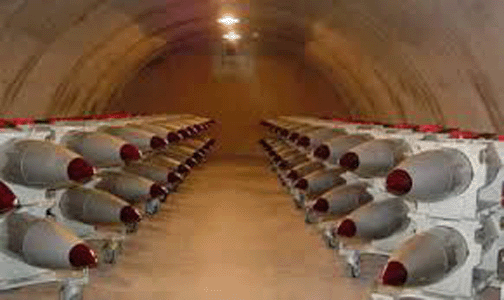
The US is to spend billions of dollars upgrading 150 nuclear bombs positioned in Europe, although the weapons may be useless as a deterrent and a potentially catastrophic security liability, according to a new report by arms experts.
A third of the B61 bombs in Europe under joint US and Nato control are thought to be kept at Incirlik base in Turkey, 70 miles from the Syrian border, which has been the subject of serious concerns.
The threat to the base posed by Islamic State militants was considered serious enough in March 2016 to evacuate the families of military officers.During a coup attempt four months later, Turkish authorities locked down the base and cut its electricity. The Turkish commanding officer at Incirlik was arrested for his alleged role in the plot.
A report on the future of the B61 bombs by arms control advocacy group the Nuclear Threat Initiative (NTI) , and made available to the Guardian, said the 2016 events “shows just how quickly assumptions about the safety and security of US nuclear weapons stored abroad can change.”
Since then US-Turkish relations have soured further, largely over Washington’s support for Kurd forces in Syria. The national security adviser, HR McMaster, and secretary of state, Rex Tillerson, have both made trips to Turkey this week to try to heal the rift.
There have been reports that the bombs have been quietly moved out because of safety concerns, but that has not been confirmed.
The remaining B61 bombs are stored at five other locations in four countries: Italy, the Netherlands, Belgium and Germany, according to the Federation of American Scientists, which tracks the weapons. The NTI report said it “should be assumed that they are targets for terrorism and theft”.
The bombs are the remnants of a much larger cold war nuclear arsenal in Europe, and critics have said they serve no military purpose, as the nuclear deterrent against Russia relies largely on the overwhelming US strategic missile arsenal.
Using the B61s in any conflict would involve an agreement between the US and the host country in consultation with other Nato members.
“It is hard to envision the circumstances under which a US president would initiate nuclear use for the first time in more than 70 years with a Nato [dual-capable aircraft] flown by non-US pilots delivering a US B61 bomb,” said the NTI report, titled Building a Safe, Secure and Credible Nato Nuclear Posture.
Since the cold war, the B61 has played a symbolic role, as reassurance for some Nato members of US commitment to defending Europe. They are also considered potential bargaining chips against Russia’s much greater arsenal of nearly 2,000 tactical nuclear weapons.
However, the NTI report argues they are also serious liabilities, because of the threat of terrorism or accident, and because they could become targets in the early stages of any conflict with Russia.
“Forward-deployed US nuclear weapons in Europe increase the risk of accidents, blunders, or catastrophic terrorism and invite pre-emption. Given these added risks, it is past time to revisit whether these forward-based weapons are essential for military deterrence and political reassurance” the Obama administration’s energy secretary Ernest Moniz and former Democratic senator Sam Nunn, both NTI co-chairmen, argue in the preface to the report.
The Obama administration considered withdrawing the B61s from Europe as part of the president’s nuclear disarmament initiative but the idea lost support as relations with Russia deteriorated. Instead, the administration approved a Pentagon programme to upgrade the bombs over the next decade with a tailfin assembly to make them more accurate.
The plan has been embraced by the Trump administration’s nuclear posture review, despite the fact that the estimated cost of the 460 new model bombs, the B61-12, has doubled in recent years to $10bin, a part of a huge increase of overall defence spending.
Is Japan About to Hit Its Nuclear Tipping Point? Tokyo almost built a bomb in 1945 and now has enough plutonium stockpiled for 5,000 nukes. North Korea may give its hawkish government an excuse to build them. The Daily Beast, JAKE ADELSTEIN 02.15.18 TOKYO—“Don’t be fooled by North Korea’s smiley-face diplomacy,” Japan’s foreign minister, Taro Kono, warned last week in the middle of the Winter Olympics’ warm fuzzy photo ops with Hermit Kingdom emissaries.
Kono’s skepticism was quite serious, as is the confrontation he sees looming. Earlier this month he shocked Japan by broaching the idea that the Japanese should gain access to “usable” nuclear weapons, and he lavished praise on U.S. President Donald Trump’s Nuclear Posture Review.
While much of the rest of the world was entranced by North Korean cheerleaders and Kim Jong Un’s baby sister, Japan was quietly considering if and when to build its own nuclear missiles to discourage North Korea from so much as contemplating a missile strike.
The hawkish government of Prime Minister Shinzo Abe and his ruling coalition are exploiting real and unreal fears of a North Korean nuclear attack to drum up support for a Japan that can wage war, and possibly as a prelude to pushing harder for nuclear weapons development.
At a minimum, it should be apparent to the world that this administration has no interest in nuclear disarmament, and is preparing for a possible showdown.
This week, The Ministry of Culture, Education and Science announced that in the Risk Management manual distributed to schools nationwide, it would be urging teachers to conduct missile evacuation drills. That should ratchet up the paranoia a few notches.
North Korean leader Kim Jong Un announced last year that his country’s nuclear program is now complete, after the “successful” launch of a new missile that threatens all of the continental United States. But Japan has been in the crosshairs of the hermit kingdom for some time, and the storm over Kim’s atomic posturing has reignited a simmering, almost taboo, debate about nuclear weapons here.
The question isn’t whether Japan could become a nuclear weapons power. There’s really no doubt about that. But should it? And when? And if so, politically, how?
Japan As A Nuclear Power
Japan’s consumer nuclear energy industry has generated enough plutonium to make an estimated 5,000 nuclear warheads, this has long stood as an implicit threat. As former Defense Minister Satoshi Morimoto once declared, Japan’s commercial nuclear power reactors have “very great defensive deterrent functions.” He was implying that the plants Japan has built to make reactor fuel could be used to make fuel for nuclear arms, if Japan ever decides to do so.
President Trump’s $4.4 Trillions Budget Features Soaring Deficits 2 News 13 Feb 18
President Donald Trump is sending Congress a $4.4 trillion spending planthat provides a huge increase in defense spending while cutting taxes by $1.5 trillion over the next decade. The result is soaring budget deficits.
Trump’s first budget last year projected that the government would achieve a small surplus by 2027. But the new budget never gets to balance. It proposes $7.1 trillion in red ink over the next decade, basically doubling last year’s forecast……..
Trump last week signed a $300 billion measure to boost defense and domestic spending, negating many of the cuts in his new budget plan. …..
Meanwhile, the Trump administration wants NASA out of the International Space Station by 2025, and private businesses running the place instead.
Under the proposed budget released, U.S. government funding for the space station would cease by 2025. The government would set aside $150 million to encourage commercial development…..
Altogether, the budget seeks to increase NASA’s budget slightly to $19.6 billion.
And – the Pentagon is proposing to spend hundreds of millions more in 2019 on missile defense.
The budget calls for increasing the number of strategic missile interceptors from 44 to 64. The additional 20 interceptors would be based at Fort Greely, Alaska. Critics question the reliability of the interceptors, arguing that years of testing have yet to prove them effective against sophisticated threats.
The Pentagon also would invest more heavily in the ship-based Aegis system and the Army’s Patriot air and missile defense system. Both are designed to defend against missiles with ranges shorter than the intercontinental ballistic missile that is of greatest U.S. concern in the context of North Korea.
Trump’s proposed 2019 budget calls for slashing funding for the Environmental Protection Agency by more than one third, including ending the Climate Change Research and Partnership Programs.
The president’s budget would also make deep cuts to funding for cleaning up the nation’s most polluted sites, even as EPA Administrator Scott Pruitt says that’s one of his top priorities. Trump’s budget would allocate just $762 million for the Hazardous Substance Superfund Account, a reduction of more than 30%.
Current spending for Superfund is down to about half of what it was in the 1990s. Despite the cut, the White House says the administration plans to “accelerate” site cleanups by bringing “more private funding to the table for redevelopment.”
……Congressman Ruben J. Kihuen issued the statement after the release of President Trump’s 2019 budget proposal which supports plans for an interim storage program and the licensing of the Yucca Mountain geologic repository:
“I am disappointed that President Trump’s latest budget request dedicates $120 million to revive the long-dead nuclear waste repository at Yucca Mountain, money that would be much better spent on research and development of the renewable energy technology that we need to power our clean-energy future. Rather than pursue a realistic attempt to develop a substantive nuclear waste management program, this is a colossal waste of funding that goes directly against the will of Nevadans. I have been proud to help lead the fight against dumping nuclear waste in Nevadans’ backyards, and I will continue working to ensure this project remains dead.”
U.S. Senator Dean Heller released this statement:
“Despite Congress’ refusal to fund the Yucca Mountain project, the Administration is once again prioritizing it. Whether it’s the threat that Yucca Mountain poses to the people of southern Nevada or its potentially catastrophic effect on our tourism economy, I’ve made it clear why Nevada does not want to turn into the nation’s nuclear waste dump,” said Heller. “Under my leadership Congress has not appropriated funding for licensing activities at Yucca Mountain as requested in the last budget, and I’m going to continue to fight to make sure that this project doesn’t see the light of day.”
U.S. Senator Catherine Cortez Masto said in a statement:
“It’s a disgrace that president trump and some members of congress find it acceptable to continue throwing away tax payer money on a failed project.”
We need to revive momentum for reducing nuclear weapons, not for “modernizing” them.
By Katrina vanden Heuvel 13 Feb 18EDITOR’S NOTE: Each week we cross-post an excerpt from Katrina vanden Heuvel’s column at the WashingtonPost.com. Read the full text of Katrina’s column here.
On Friday, the Pentagon released its 2018 Nuclear Posture Review. Its debut demands more attention, because it announced a renewed round in the nuclear-arms race, one inevitably bringing us ever closer to the unthinkable—a nuclear war of catastrophic consequences.
The review clearly seeks to calm fears about President Trump’s finger on the nuclear trigger. Ignoring the many accidents and close calls during the Cold War, the review asserts that the United States has “measures and protocols” to ensure that intercontinental ballistic missiles are “safe, secure and under constant control.” Furthermore, the Pentagon says that “any U.S. decision to employ nuclear weapons would follow a deliberative process.” Despite these assurances, the review’s plans for the nuclear arsenal and nuclear strategy should rouse alarms and spark congressional hearings and public debate.
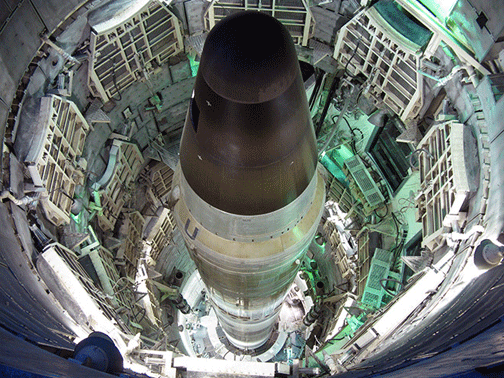
The United States has an active stockpile of more than 4,000 nuclear weapons, arrayed in the triad of land-based launch sites, nuclear submarines, and strategic bombers, including nuclear-armed ICBMs, air- and sea-launched cruise missiles, and gravity bombs. More than enough to destroy the world several times over, the arsenal’s “credibility” is not in issue. Yet the review reaffirms the Obama administration’s commitment to a new generation of missiles, nuclear submarines, strategic bombers, and nuclear bombs. It warns of a “rapid deterioration of the threat environment,” making it imperative not to “delay modernization of our nuclear forces if we are to preserve a credible nuclear deterrent.” Read the full text of Katrina’s column here.