Can you think of a more innocuous word for a machine that could eradicate a city in seconds, incinerating humans and buildings for miles?
From that explosion onward, the ways that Americans have talked about nuclear war have been more “Gadget” than “destroyer of worlds.” We’ve adopted a language that is detached and sterilized from the reality of what a nuclear bomb actually does. Our nuclear linguistics allows us to consider “winning” nuclear wars and other impossibilities.
Phrases like “nuclear exchange” dehumanized what could be the death of millions. Terms like “BAMBI” were coined to describe weapons in the nuclear world; BAMBI was a “Ballistic Missile Boost Intercept” system that envisioned using giant nets deployed from missiles to foil Soviet attacks. (Never mind that it didn’t work.)
We should consider whether the way we talk about nuclear bombs makes us more likely to launch one.
Originally, this coded language was part of the secrecy of the Cold War. There was the policy called “containment,” by which communism would be sort of “fenced in” by nuclear threats. Later there was “deterrence,” whereby the pain we would inflict on an adversary if they did something we didn’t like was assurance that they wouldn’t do said thing.
Once nuclear-armed missiles and later nuclear-armed submarines joined the mix, there was no defense against nuclear attack. The approaches to avoid the very catastrophe these weapons were built to unleash were described and conveyed in language that often had dark, absurdist undertones. Mutual Assured Destruction, or MAD, is the most famous, and perhaps most honest.
While nuclear weapons inspired widespread public concern, psychologists also discovered that people could at once be terrified about nukes and mollified into a weird acceptance of them. Nuclear war is so terrible and awesome that the very thought of it stymies people from doing anything about it. That dynamic was aided by the continuous generation of phrases that distanced people even further from reality — nuclear bombs were “stockpiles” and nuclear became “ladder of escalation” or “proportionate response.”
Schiappa wrote: “The moral and practical implications of nuclear war are ignored or underestimated by Nukespeak users, and nuclear policy issues are rendered trivial or less accessible to the public.”
The language surrounding nuclear weapons and war has not changed, despite the advent of instantaneous communications and massive social media platforms. If anything, it now combines the worst elements of trivializing the realities of nuclear war with the hubris and testosterone-laden schoolyard taunts that almost dare us to use them.
Consider our own National Nuclear Security Administration (NNSA). (Notice the word “security” rather than “weapons”?) The NNSA has an ongoing program to upgrade and prolong the operation of U.S. nuclear weapons. It’s called the “Life Extension Programs.” How’s that for Orwellian doublespeak? The first bomb to get this facelift is a gravity bomb carried on aircraft. Known as the B-61, it is categorized as a “tactical nuclear weapon. But this bomb has a “yield” of up to 170 kilotons, roughly 15 times more powerful than the bomb that devastated Hiroshima.
President Donald Trump’s imminent “Nuclear Posture Review” is expected to have elements that would support building so-called “mini-nukes.” These are said to be more “usable” in a conflict. But the very idea of a usable nuke undermines the entire premise of nuclear deterrence and the special status of nuclear weapons that is supposed to draw a bright line between them and all other weapons.
Lest you think that this is just Trump being Trump, the fact is that our current military and national security leaders have been gaming out a military attack on North Korea. The belief is that we can attack them in such a way that they understand it’s just a “bloody nose” — not a full-scale war.
We needn’t succumb to this Nukespeak. While we do not yet have the access or policies to dismantle the nuclear bombs ourselves, we can dismantle the language that has made them possible.
Social media is one place to fight with memes and words. There we can reveal the lie that turned the “destroyer of worlds,” into “proportionate responses.” And we can explain loud and clear that there is no ice pack big enough for a nuclear bloody nose.
Paul Carroll is a senior adviser at N Square, a funders initiative to attract innovation and collaboration to reduce and eliminate the threats from nuclear weapons and materials. He has spent more than 25 years in government and non-profit roles as a policy expert supporting such efforts. He wrote this for Zocalo Public Square.
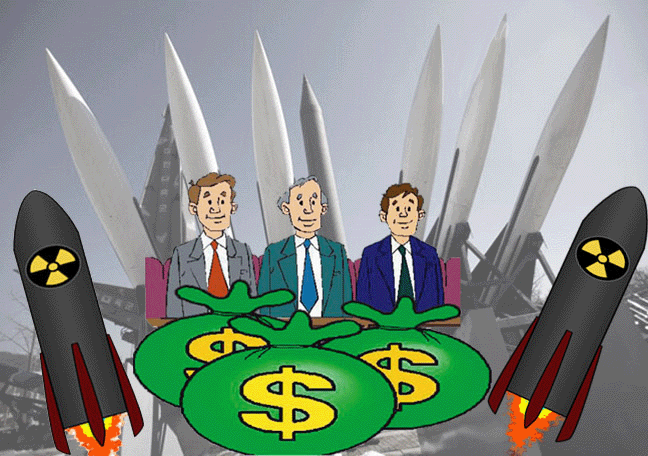
You would not have these arsenals, in the US or elsewhere, if it were not the case that it was highly profitable to the military-industrial complex, to the aerospace industry, to the electronics industry, and to the weapons design labs to keep modernizing these weapons, improving accuracy, improving launch time, all that. The military–industrial complex that Eisenhower talked about is a very powerful influence. We’ve talked about unwarranted influence. We’ve had that for more than half a century.
………. What’s it all for? It is for [military] service share of the budget. Lockheed Martin, Boeing, Grumman, Northrop. Jobs, jobs, jobs, jobs, as one after another official has put it, from James Baker to others. Profits, as I say, jobs, and campaign donations.
Daniel Ellsberg on dismantling the doomsday machine, Bulletin of Atomic Scientists, John Mecklin , 26 FEBRUARY 2018
More than 45 years after he became famous for leaking the Pentagon Papers and earning the wrath of President Richard Nixon and his plumbers, Daniel Ellsberg is again a focus of public consciousness. The hit movie The Postreprises part of the Pentagon Papers story, reminding older Americans (and explaining to younger viewers) how Ellsberg’s decision to reveal a top-secret history of duplicitous US policy in Indochina changed the course of the Vietnam War and American history.
In the book, Ellsberg chronicles his early career as a RAND Corporation analyst deeply involved in the crafting of American nuclear war plans in the 1960s—plans that were meant to be more controlled and discriminating than earlier versions but, he came eventually to understand, were actually blueprints for the obliteration of civilization.
“Working, conscientiously, obsessively, on a wrong problem, countering an illusory threat, I and my colleagues at RAND had distracted ourselves and helped distract others from dealing with the real dangers posed by the mutual superpower pursuit of nuclear weapons—dangers which we were helping make worse—and from real opportunities to make the world more secure,” Ellsberg writes. “Unintentionally, yet inexcusably, we made our country and the world less safe.”
Since the 1970s, Ellsberg has been deeply involved in efforts to reduce world nuclear arsenals and eventually eliminate them altogether. He and I spoke at length earlier this year about how the danger of nuclear weapons might be conveyed more effectively to the general public. What follows is an edited transcript of parts of that wide-ranging conversation……….
John Mecklin: The major media tend to almost never actually confront or describe the actual effects of a major nuclear war. Why do you think that is?
Daniel Ellsberg: That’s hard for me to say, really. I certainly agree with you. I would say they have been shockingly derelict in reporting this. I can’t give an answer. I haven’t been able to ask their editors what’s going on
But it’s a very interesting question. My speculative answer would have to be that the major media have always supported basically—until quite recently perhaps—our basic nuclear arsenals. Insane as they are; they’re unjustifiable, if you really look at them critically. And yet they’re treated as though they are reasonable responses to the nuclear era, which they are not. Nothing reasonable about them at all.
You would not have these arsenals, in the US or elsewhere, if it were not the case that it was highly profitable to the military-industrial complex, to the aerospace industry, to the electronics industry, and to the weapons design labs to keep modernizing these weapons, improving accuracy, improving launch time, all that. The military–industrial complex that Eisenhower talked about is a very powerful influence. We’ve talked about unwarranted influence. We’ve had that for more than half a century.
………. What’s it all for? It is for [military] service share of the budget. Lockheed Martin, Boeing, Grumman, Northrop. Jobs, jobs, jobs, jobs, as one after another official has put it, from James Baker to others. Profits, as I say, jobs, and campaign donations. It’s embedded in all 50 states of the union, one way or another, in the various expenditures, and very hard to get rid of. Almost impossible. I just don’t see that you can say it’s impossible……….I would also say that no significant change has occurred at all, and we are maintaining this mad policy. But it is being done, again, in the absence of almost any public awareness or debate. In the last several elections—but let’s take the last one in particular—nuclear winter, of course is not mentioned. But there’s really no dispute that came up significantly about the arms budget, about the nuclear budget, or any of the rest of it. That’s hardly an excuse, but it’s an explanation in a way for no media discussion of it, except in the Bulletin of Atomic Scientists, thanks a lot. Your role is essential but not sufficient, it would seem. ………. https://thebulletin.org/daniel-ellsberg-dismantling-doomsday-machine11539
Defense News, By: Mike Yeo , 2 Mar 18 MELBOURNE, Australia— One of China’s largest shipbuilders has revealed plans to speed up the development of China’s first nuclear-powered aircraft carrier, as part of China’s ambition to transform its navy into a blue-water force by the middle of the next decade.
In a since-amended news release outlining the company’s future strategic direction in all of its business areas, the state-owned China Shipbuilding Industry Corporation, or CSIC, said the shipbuilding group will redouble efforts to achieve technological breakthroughs in nuclear-powered aircraft carriers, new nuclear-powered submarines, quieter conventionally powered submarines, underwater artificial intelligence-based combat systems and integrated networked communications systems………https://www.defensenews.com/naval/2018/03/01/china-to-develop-its-first-nuclear-powered-aircraft-carrier/
With tensions high between the United States and North Korea, there is the possibility that the U.S. would launch a “tactical” nuclear strike in the Korean peninsula. There would be consequences far beyond damage to military sites proposed in such an attack.
There is, of course, the danger that North Korea would retaliate and that tensions would escalate. That’s serious political fallout. As a physician scientist who has has worked with radiation for more than 30 years, I am also concerned about a cancer epidemic that would result from such an attack’s nuclear fallout.
Even without a nuclear war, the incidence of cancer is already rising around the world, up by 33 percent worldwide in the past decade. This is largely due to aging of the population and environmental and behavioral patterns such as cigarette smoking. The last thing we need is more of this dreadful disease.
In my research laboratory, we use extremely small doses of radiation to image very small molecules in order to understand how the body works. All of us who work with radiation know about the lethal effects of large doses, but the radiation exposure to the scientists in my laboratory is monitored very closely. Strict federal guidelines define how much radiation is considered “safe.”
During early morning walks in Seoul last year, while on sabbatical at Yonsei University, I could sense the city’s vulnerability as I heard target practice from the top of nearby hills. Seoul, with a population of 22 million, is a mere 35 miles from the North Korean border and would be affected by nuclear fallout. Indeed, it is a medical likelihood that cancer rates in Seoul and the Korean peninsula would be increased for decades following a nuclear attack.
Putin unveils ‘invincible’ nuclear weapons to counter West , SMH, By Andrew Osborn, 2 March 18 Moscow: President Vladimir Putin unveiled an array of new nuclear weapons on Thursday, in one of his most bellicose speeches in years, saying they could hit almost any point in the world and evade a US-built missile shield.
Putin was speaking ahead of an election on March 18 that polls indicate he should win easily. He said a nuclear attack on any of Moscow’s allies would be regarded as an attack on Russia itself and draw an immediate response.
It was unclear if he had a particular Russian ally, such as Syria, in mind, but his comments looked like a warning to Washington not to use tactical battlefield nuclear weapons.
His remarks were greeted with scepticism in Washington, where officials cast doubt on whether Russia has added any new capabilities to its nuclear arsenal beyond those already known to the US military and intelligence agencies.
……. On Thursday, he sought to back his rhetoric with video clips of what he said were some of the new missiles. The images were projected onto a giant screen behind him at a conference hall in central Moscow where he was addressing Russia’s political elite.
Among weapons that Putin said were either in development or ready was a new intercontinental ballistic missile “with a practically unlimited range” able to attack via the North and South Poles and bypass any missile defence systems.
Putin also spoke of a small nuclear-powered engine that could be fitted to what he said were low-flying, highly manoeuvrable cruise missiles, giving them a practically unlimited range.
The new engine meant Russia was able to make a new type of weapon – nuclear missiles powered by nuclear rather than conventional fuel.
…….. Other new super weapons he listed included underwater nuclear drones, a supersonic weapon and a laser weapon.
…..Putin also voiced concerns about a new US nuclear doctrine, saying Russia’s own doctrine was defensive and only envisaged the use of nuclear weapons in response to an attack.Russia has repeatedly said it is keen to hold talks with the United States about the balance of strategic nuclear power and Putin put Washington and other nuclear powers on notice.
The Zumwalt-class stealth destroyers could get low-yield nuclear Sea-Launched Cruise Missiles added to its arsenal, according to the Nuclear Posture Review.
The chief of US Strategic Command said that the development of the missiles and their placement on the destroyers was necessary to enhance deterrence against Russia and China.The Nuclear Posture Review (NPR) includes a long-term plan that could put nuclear cruise missiles aboard the new Zumwalt class (DDG 1000) of stealthy Navy destroyers, according to the commander of U.S. Strategic Command.
She may be very smart, and even have a bit of integrity. I hope so. But are we here seeing the macho nuclear weapons lobby copying the “new nukes” gimmick of appointing a good-looking young woman to front their dangerous operation?
First woman in history takes helm of US nuclear weapons arsenal, Washington Examiner by John Siciliano | Energy Secretary Rick Perry on Thursday swore in the first woman in history as head of the nation’s nuclear weapons arsenal.
Lisa E. Gordon-Hagerty was sworn in as administrator of the National Nuclear Security Administration, which under President Trump’s fiscal 2019 budget proposal would comprise nearly half of the Energy Department’s funding.
“The selection of Gordon-Hagerty, who [came] to USEC without any experience operating a company, surprised some enrichment industry analysts,” USEC Watch commented December 22, 2003. “But some sources suggested that the new COO [would] concentrate on improving USEC’s relationships with DOE and with the national security community. https://www.sourcewatch.org/index.php/Lisa_E._Gordon-Hagerty
North Korea says it’s deploying nuclear missiles https://www3.nhk.or.jp/nhkworld/en/news/20180223_18/ North Korea’s ruling party newspaper says the country’s military is pushing forward with its deployment of nuclear warheads and ballistic missiles.
The Rodong Sinmun made the comment in an editorial on Friday.
The article says the country possesses intercontinental ballistic missiles, submarine-launched ballistic missiles, and hydrogen bombs. It insists that it has made all preparations for a possible nuclear attack on the United States.
The editorial also says that wishing for the denuclearization of North Korea is more foolish than waiting for the ocean to dry up.
North Korea has been fostering a reconciliatory mood with South Korea during the ongoing PyeongChang Winter Olympics.
But the North staged a military parade on February 8th, the eve of the Games’ opening ceremony, displaying the new ICBM-class missile known as the Hwasong-15.
No to a permissive US-Saudi nuclear deal, Bulletin of the Atomic Scientists, Victor Gilinsky, Henry Sokolski , 22 Feb 18,
A US-Saudi nuclear agreement is said to be in the works. The reported deal would allow Saudi Arabia to buy US nuclear power reactors and—because of Saudi resistance to stricter terms—would be “flexible” on Saudi uranium enrichment and on reprocessing of spent reactor fuel. The trouble with flexibility regarding these critical technologies is that it leaves the door open to production of nuclear explosives.
More disappointing, although perhaps not surprising, is that the proposed agreement has the support of more than a few nuclear policy experts outside government. They make a familiar argument regarding nuclear exports: If the United States insists on stricter terms—terms that bar enrichment and reprocessing—the Saudis will turn to Russia or China for nuclear technology, granting these countries greater influence in the Middle East. The United States has been down this road before, in the cases of Iran and India, and it didn’t turn out well. A permissive US-Saudi nuclear agreement would be strategically dangerous for the United States and the region. Congress should not approve such a deal.
What’s driving the administration to cut such an agreement? Let’s set aside the Energy Department’s claims that the Saudis need nuclear power plants and that Westinghouse has a chance to get the business for the United States. First, the Saudis have cheaper energy options—natural gas and renewables. This is clear from the decision of the similarly situated United Arab Emirates not to build more nuclear plants beyond four reactors already planned or under construction. Second, Westinghouse—now bankrupt—has no chance to get the business, and in any case it is no longer a US-owned company. The Saudis, if they did go forward with developing nuclear energy, would do business with the South Koreans, who are successfully completing a proven reactor design next door in the United Arab Emirates.
If buying American is not the key driver of this deal, what is? The Saudis, to maintain theoption of using in its plants US parts whose export is controlled by law, want an umbrella agreement. But they obviously have more in mind than nuclear energy. They compete with Iran for influence in the Middle East, and they are obsessed with this rivalry. They are convinced that they need to match Iran’s nuclear potential. That means being within arm’s reach of a Bomb. These circumstances shouldn’t surprise anyone, and in fact one of the main reasons to restrain Iran is precisely to avoid such a scenario. If Saudi Arabia opts for nuclear weapons, Turkey and Egypt may be close behind. Taking into account Israel’s nuclear arsenal, the Middle East could turn into a nuclear cauldron.
One must also consider the longer-term consequences of allowing “flexibility” in a nuclear deal with Saudi Arabia. Nuclear plants proposed for the Middle East, or now being built, will last many decades. But will governments in the region last that long? The Saudi kingdom—despite recent, overhyped steps toward modernity such as allowing women to drive—is an anachronism. However firmly entrenched the kingdom appears in the person of Crown Prince Mohammad bin Salman, it could disappear overnight, as almost happened in the fundamentalist attack on the Grand Mosque in 1979.
The US Air Force is reportedly planning to develop an advanced satellite that will continue to provide communications for the top brass US Government officials in times of nuclear or space wars. To ensure effective communication, the US Air Force relies on what they call Advanced Extremely High Frequency satellites that sit in geostationary orbit.
US Air Force preparing for the worst day in human history
The Advanced Extremely High Frequency (AEHF) satellite is specially designed to keep the military and US administration in a proper working order during times of emergencies. It should be also noted that these satellites cannot be hacked or jammed.
“We need systems that work on the worst day in the history of the world,” said Todd Harrison, director of the Aerospace Security Project at the Center for Strategic and International Studies, Popular Mechanics reports.
There are four AEHF satellites already in the geostationary orbit. The US Government is now planning to launch two more, one in 2019 and another in 2020. The proposed US Air Force 2019 budget has allocated $29.8 million for this upcoming project. Air Force staffers have reportedly said that more money has been set aside in 2019 for the development of software used for running the satellites.
The US Air Force considers these AHEF satellites as a part of its new focus on advancing the country’s nuclear abilities.
“We must concurrently modernize the entire nuclear triad and the command and control systems that enable its effectiveness,” said Heather Wilson, the Air Force secretary.
The US Government is also planning to pour in a whopping sum for the development of jam-resistant GPS satellites.
How AEHF satellites work?
If a nuclear war breaks out, the atmosphere will be completely filled with charged particles that emit energy across the electromagnetic spectrum. In these times, ordinary signals will find it difficult to cut through this clutter, and as a result, all the communication means will be cut off.
During these moments, the only way of communication will be using AEHF satellites. Unlike traditional communication satellites, AEHF satellites send multiple beams to the ground, and it will increase the chances of getting through the clutters. Just like a car moving between lanes to avoid stagnant traffic, signals from AEHF satellites will reach the ground.
Pentagon’s New Nuclear Strategy Is Unsustainable And A Handout To Defense Industry Considering the arsenal we have is extremely costly to maintain not to mention update, expanding it will be fiscally unsustainable in the long run. The Drive, BY TYLER ROGO, WAYFEBRUARY 21, 2018
I had high hopes that the Pentagon’s Nuclear Posture Review would lay out a creative new strategy that would save money when it comes to sustaining and modernizing America’s hideously expensive nuclear arsenal. It ended up doing just the opposite.
Basically an “and the kitchen sink too” document, it not only maintains and modernizes the current nuclear triad, but also expands upon it with calling for new iterations of established delivery systems as well as a developing a whole new one as well. Most controversially it looks to field more “usable” nuclear weapons in some nebulous attempt to deter an enemy’s own use of low-yield tactical nukes during a limited conflict. This is sometimes referred to as “escalate to de-escalate,” but regardless of the tactics involved, really this document represents a handout to defense contractors of monumental proportions and above all else, a unsustainable and highly expensive strategy overall.
Just modernizing the nuclear arsenal we have today was slated to cost roughly $1.5T with inflation over the next 30 years and that is without the new initiatives laid out by the Strategic Posture Review. These include the introduction of low-yield warheads for the D5 Trident submarine-launched ballistic missile, the reintroduction of a nuclear-tipped naval cruise missile, and the development of nuclear-armed hypersonic weapons that will become a whole new medium of delivery in the coming decades. ……….
In the end, substantially increasing the number of America’s nuclear delivery systems and making nuclear weapons “easier to use” is a reckless and extremely costly path to go down, especially without giving up something in return. And the cold hard truth is that $700B defense budgets are notsustainable. As America is forced to confront its reckless spending habits in the years to come, sustaining the nuclear arsenal we already have will become fiscally challenging—doing so with an expanded arsenal will be all but impossible. ……….
So who wins in all this? Defense contractors, and in a huge way. Nuclear weapons contracts are extremely expensive and the secrecy surrounding them helps with limiting public ridicule and even congressional oversight.
But don’t blame the contractors, blame those who are making these decisions. Just going on a nuclear shopping spree while the dollars are many sets the Pentagon up for some tough, if not embarrassing triaging of fiscal priorities down the road. As such, the chances are very high that these initiatives will end up being viewed as highly wasteful and nearsighted in the not so distant future, and even integrating them into existing arms treaties is a whole other issue altogether.
Former US Secretary of State John Kerry said the late Saudi King, Abdullah Bin Abdulaziz, and ousted Egyptian President, Hosni Mubarak, asked the United States to bomb Iran.
Speaking at a panel discussion at the Munich Security Conference yesterday, Kerry said Mubarak personally told him that “the only thing to do with Iran is to bomb it”.
According to the former US official, the discussion took place in September 2013 when a number of countries in the region were increasingly concerned over Iran’s nuclear programme.
Kerry added that Washington responded at the time that Tehran had already begun enriching nuclear fuel, and that a military strike will not stop this development.
As US Secretary of State in former President Barack Obama’s administration, Kerry was one of the main drafters of the nuclear deal between Iran and the P5+1 countries which in July 2015. The deal allows for the lifting of decades of sanctions imposed on Tehran in exchange for it ceasing its nuclear programme.
Earlier in January, US President Donald Trump gave the deal’s European partners four months to “either fix the deal’s disastrous flaws or the United States will withdraw”. However, European allies along with other signatories to the agreement, Iran, China and Russia categorically rejected the request.
US preparing ‘bloody nose’ cyber attacks on North Korea, Telegraph, UK, Julian Ryall, Tokyo Danielle DemetriouThe United States is drawing up plans for cyber attacks on North Korea in an effort to bring the regime of Kim Jong-Un to heel, according to intelligence sources, as Pyongyang says it is ready for “both dialogue and war” as the Winter Olympics draws to a close.
A cyber assault could cripple Pyongyang’s online communications and ability to control its military, causing huge disruption but avoiding the loss of life. It may also assuage concerns that a conventional attack against missile sites or nuclear facilities by the US could trigger a massive counter-strike by Kim Jong-Un.
In the last six months, the US has been covertly laying the groundwork for cyber attacks that would be routed through South Korea and Japan, where the US has extensive military facilities. The preparations include
installing fibre cables into the region and setting up remote bases and listening posts from where hackers will attempt to gain access to North Korea’s version of the Internet, which is walled off from the rest of the world.
Another official told the magazine that a large part of the US spying and cyber warfare capability is being refocused on North Korea, including analysis of signals intelligence, overhead imagery and geospatial intelligence
………. North Korea has reportedly set up a 6,000-strong hacking unit and is strongly suspected of being behind a number of cyberattacks on South Korean banks, media companies and infrastructure, including nuclear power plants, in recent years
As well as gathering intelligence on military, scientific and political developments in the North, US cyber warfare experts are likely to be tasked with accessing the regime’s command-and-control structure in order to interfere with Pyongyang’s ability to communicate with its military and launch counterattacks.
A North Korean cyberspy group known as “Reaper” is rapidly expanding its operations and scope of capability posing a global threat to overseas networks, according to a new report from the California cybersecurity firm FireEye Inc.
The group is also identified by FireEye as APT37 and has been active since at least 2012, focusing primarily on the public and private sectors in South Korea. In 2017, the group began attacks on Japan, Vietnam, and the Middle East, according to the report.
FireEye said it had “high confidence” the activities carried out by APT37 are on behalf of the North Korean government and include use of wiper malware and zero-day vulnerabilities, where hackers exploit vulnerabilities in computer software on the same day those vulnerabilities become known, preventing developers from the opportunity to fix problems before they occur.
“Our concern is that this could be used for a disruptive attack rather than a classic espionage mission, which we already know that the North Koreans are regularly carrying out,” FireEye Director of Intelligence Analysis John Hultquist said to the Washington Post.
APT37 joins North Korean leader Kim Jong Un’s growing list of hacking units that have been accused of being behind massive cyberattacks in the past, including the group “Lazarus’” hack on Sony Pictures in 2014.
. U.S. officials also blamed the Kim regime for the WannaCry virus last year.
“Ignored, these threats enjoy the benefit of surprise, allowing them to extract significant losses on their victims, many of whom have never previously heard of the actor,” FireEye said in an emailed statement to Bloomberg.
Is China Really Threatening America with Nuclear Weapons? , National Interest, Asia Times, 20 Feb 18China, according to the Federation of American Scientists, has 270 warheads in its nuclear arsenal.
The Washington-based research group’s estimate has never been challenged by the Pentagon. It compares with an official tally of 4,480 nuclear warheads for the US. Unlike the American side, China also renounces “first use” of nuclear weapons and holds that its ability to retaliate is sufficient to deter attack.
Why, then, is Beijing’s modernization of its nuclear arsenal — something that Washington is also doing — considered a major security threat requiring a sharp turn in US policy regarding the use of nuclear weapons?
That’s part of the reasoning behind the Pentagon’s 2018 Nuclear Posture Review(NPR) issued on February 2. The document is a benchmark US statement on nuclear policy and is drawn up by new presidents. The Trump administration’s first policy position on the issue focuses on creating new nuclear deterrents to Russia and China, while addressing North Korean and Iranian nuclear ambitions.
…….. critics contend the latest NPR reverses years of bipartisan consensus on the use of US nuclear weapons. The review also gives the go-ahead to develop low-yield tactical nukes and sub-launched cruise missiles in the first roll-out of new US nuclear weapons since the end of the Cold War. It also expands the circumstances under which the US would consider using nukes to include “non-nuclear strategic attacks” such as cyberattacks.
……….Chinese not on nuclear ‘alert’
Gregory Kulacki, the China project manager for the Union of Concerned Scientists (UCS), a Washington-based science advocacy group, argues that Trump’s NPR is surfacing at a time when China isn’t preparing to fight a nuclear war with the US. He says his talks with Chinese nuclear strategists indicate they don’t believe such an attack from the US is possible because the Americans know a sufficient number of Chinese missiles would survive to launch a nuclear counter-strike.
……… China, for its part, has urged the US to drop its “Cold War mentality” and not misread its intentions in modernizing its nuclear forces following the NPR’s release.
Miscalculation leading to war
Kulacki notes in his article that Chinese strategists have one worry: they fear the US might miscalculate by thinking it could escape full nuclear retaliation by using a massive first strike along with an anti-missile shield that can down any Chinese missiles that a pre-emptive attack would miss.
US negotiators, he says, are exacerbating such fears by declining to assure their Chinese counterparts that a US first strike is “off the table.”
China’s relatively modest nuclear modernization efforts, according to Kulacki, are designed to ensure that enough of its intercontinental ballistic missiles (ICBMs) can survive a pre-emptive US attack and penetrate US missile defenses.