Paul Waldon Fight To Stop Nuclear Waste Dump In Flinders Ranges SA, 15 Mar 18Today the 15th of March is another red letter day in the nuclear arena with the 56th anniversary of the death of Arthur Holly Compton, surprisingly (very surprisingly) the only one of the “Big Four” with the Manhattan project who did NOT die of cancer due to his reported time exposed to radioactivity.
However the other three Robert J Oppenheimer, Ernest Orlando Lawrence, and Enrico Fermi went to their graves, victims of cancer fueled by their exposure to radiation in a nuclear industry despite all precautions taken. The commonality of nuclear death doesn’t discriminate between engineers, scientists, physicists and the grunts at the front line, though its the grunts that fall short of compensation, acknowledgement, or appreciation of their service.
We have all heard of the death of Marie Curie, physicist and her lead lined coffin and radioactive grave site, Harry K Daghnian Jr, and Louis Slotin who both died of acute radiation sickness from exposure while serving on the Manhattan project, the death of Los Alamos chemical operator Cecil Kelley, and seven engineering crew aboard the K-19 sub from radioactive exposure, only to name but a few, however the nuclear industry spends time and money debunking the rights of people afflicted by hard to prove nuclear contamination in this dangerous industry. Nuclear fueled brigandage of the planet does NOT have a conscience.https://www.facebook.com/groups/344452605899556/
An Albuquerque-based nonprofit that advocates for nuclear disarmament filed a lawsuit this week asking a U.S. District Court judge to order the release of federal documents detailing the costs and risks of plutonium work planned at Los Alamos National Laboratory.
In its lawsuit, filed Wednesday in the federal District Court in Albuquerque, the Los Alamos Study Group accuses the National Nuclear Security Administration of improperly withholding a study that it says should be released upon request under the federal Freedom of Information Act.
While congressional staff members and some lab officials have been briefed on the document, argues the nonprofit — a longtime critic of the lab and the U.S. Department of Energy — the unclassified study has not been released to the public and has not been provided to the group, despite a request made under the public records law more than three months ago.
The National Nuclear Security Administration in November completed the roughly 400-page study comparing the potential costs, time frame and risks of creating a proposed assembly-line factory for plutonium pit production at various Energy Department sites.
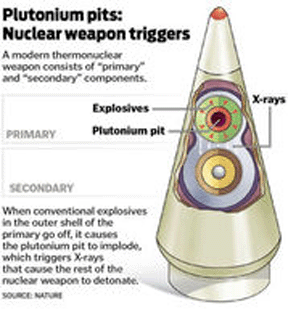
The Los Alamos lab has been producing pits — the grapefruit-size fission triggers that ignite nuclear weapons — on a smaller scale for decades, and New Mexico’s congressional delegation has been pushing to keep that work in the state as the nation’s mission to modernize its nuclear weapons arsenal ramps up.
A summary of the National Nuclear Security Administration’s study, leaked in December, shows that Los Alamos and the Savannah River Site in South Carolina are the final contenders for the pit factory, expected to cost up to $7.5 billion and take 10 to 20 years to complete.
According to the leaked material, which was reviewed by The New Mexican, the work would take longer to complete in Los Alamos and costs would be higher there.
The Los Alamos Study Group also contends the risks of pit production at Los Alamos are significant and should be disclosed to the public.
The nonprofit’s director, Greg Mello, said in a statement Thursday, “We believe [pit production] is proceeding ‘under cover of darkness’ on purely ideological grounds, and not on any defensible managerial basis. … It is a vast waste of resources, though lucrative for a few contractors.”
The organization believes the U.S. already has an excess of pits in its weapons stockpile and that future production would present a grave risk to the public while wasting public funds. The U.S. arsenal contains 23,000 pits, the group says in its suit, at least a third of which its says are viable and would last through 2063.
Los Alamos began producing plutonium pits after the Rocky Flats Plant in Colorado was shut down in the early 1990s, following a federal raid that found the plant rife with environmental contamination and nuclear safety violations.
Residents in the Rocky Flats area spent more than two decades entangled in a lawsuit with the plant’s operators after plutonium was found to have traveled to thousands of homes.
Los Alamos has had its share of nuclear safety violations, as well.
The lab’s plutonium facility, which restarted pit production in 2015 following a yearslong pause over safety concerns, was cited for a series of violations in the last year alone. Several workers were contaminated with radiation in 2017, and a small fire burned one worker. The lab was fined several million dollars for mishandling an out-of-state shipment of plutonium, and federal inspectors raised concerns recently about how the lab manages the toxic metal beryllium.
Britain Sends Nuclear Sub Under Arctic Ice As Tensions With Russia Heat Up, Sputnik News, 16 Mar 18,One British and two US nuclear submarines are taking part in a joint naval exercise currently underway in the icy waters of the Arctic Ocean.
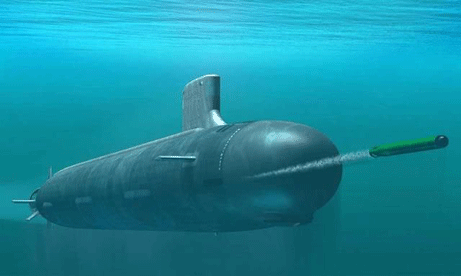
Armed with Tomahawk cruise missiles and Spearfish heavy torpedoes, the HMS Trenchant is the first British nuclear sub to be deployed under the Arctic ice in a decade.
Queen Elizabeth’s WWIII speech revealed, AS RELATIONS between the UK and Russia plummet and talk of a new Cold War spreads, these are the chilling words we hope are never said.News.com.au, 15 Mar 18, Alexis Carey alexis.carey@news.com.auQUEEN Elizabeth has a pre-written speech prepared for the outbreak of World War 3.
And as tensions between the UK and Russia continue to escalate, some believe the threat of nuclear war is more real than it has been since the Cold War.
The current crisis began on March 4, when former Russian spy Sergei Skripal and his daughter Yulia were found slumped on a bench in Salisbury, England.
UK Prime Minister Theresa May said they had been poisoned by a nerve agent called Novichok, one of the world’s deadliest.
While the pair remain in hospital, their prognosis is grim.
Novichok has been made in Russia for many years, and Ms May said it was “highly likely” Russia was involved in the poisoning. She demanded that Russia explain what happened, but when the country didn’t comply, she said: “There is no alternative conclusion other than that the Russian State was culpable for the attempted murder of Mr Skripal and his daughter — and for threatening the lives of other British citizens.”
As a result, the government has ordered 23 Russian diplomats to leave UK soil by next Wednesday, which is the UK’s biggest removal of foreign representatives in three decades.
UK government ministers and members of the Royal Family will also not attend the World Cup in Russia in June in a further show of retaliation.
As the dispute grows, UK media have republished Queen Elizabeth’s speech, which she will deliver if a nuclear war is ever declared.
The monarch’s speech was initially written in 1983 during the peak of the Cold War.
It had previously been kept a strict secret under the National Archives’ 30-year rule.
The sombre speech was written as if it was delivered at midday on Friday, March 4, 1983 — and while some aspects are now outdated, such as the reference to Queen Elizabeth’s son Prince Andrew serving in the Royal navy, the majority remains relevant.
The speech begins by referencing Queen Elizabeth’s recent Christmas message, before detailing her childhood during World War II.
It goes on to encourage British citizens to “fight off the new evil”.
The speech was previously published by the BBC and has been reproduced here in full:
Dahr Jamail | Washington State’s Deep Political and Economic Alliance With the Pentagon, Truthout, March 12, 2018, By Dahr Jamail, Truthout | Report “…….what if you learned Washington State was allocating millions of dollars of its taxpayers’ money to fund an institution set up to do nothing more than lobby for a larger military presence?
Additionally, what if you found out that one of your elected representatives, who you were led to believe was a liberal Democrat, had positioned herself atop said institution, and had actively sponsored a bill aimed at allowing the military free reign to do what it wants — wherever it wants to do it — within the state, with little or no recourse for the citizens it could impact?
In supposedly “blue” Washington State, this is exactly what is happening.
“Kristine Reeves is double dipping, although it might be legal, [by] being the executive director for the Washington Military Alliance while proposing laws that advance the objectives of the WMA as a Washington State legislator,” Glen Milner, a researcher with the Ground Zero Center for Nonviolent Action, told Truthout.
“In addition, the Washington Military Alliance gets its grants from the DOD,” added Milner, who has been tracking the expanding militarism across Washington State for decades. “I suppose this is just corruption at work.”
While Reeves might be progressive on many issues, she’s clearly doing the military’s bidding, according to Milner.
And while HB 2341 failed, for now, to make it out of committee — thanks to committed grassroots efforts by citizens concerned about their state becoming a wider-scale military training area — Reeves’ efforts run far deeper than just that bill.
“Washington State residents should be concerned because the WMA sees at least some parts of the state as a ‘power projection platform’ for the military,” Milner warned Truthout.
In fact, “power projection platform” are not Milner’s words, they are Rep. Reeves’ words. The lawmaker used the exact same phrase in an email to members of Washington State’s Department of Commerce. In the January 2016 email obtained by Truthout, Rep. Reeves discussed her efforts to help generate a graphic for the deputy chief of staff at Joint Base Lewis-McCord (JBLM) in Washington, a massive military installation south of Tacoma, to show “the value of the strategic placement of JBLM and its dependence on the ‘outside the fence’ infrastructure that creates the designation of power projection platform.”
Her rough graphic shows four arrows emanating from Washington State and pointing across the Pacific toward North Korea and other locations.
A “power projection platform,” a term used by both the military and the WMA, is a hub for the combined elements of national power — political, economic, informational and military — that facilitates a country’s ability to rapidly and effectively deploy and sustain forces around the world.
Reeves is far from alone in her efforts. Jay Inslee, Washington’s so-called “green governor,” along with his Department of Commerce, appears to have been, for years, acting as a strong proponent for military activity in Washington State. By actively supporting the WMA and other similar efforts, as well as signing off on documents like the Retaining and Expanding Military Missions: Increasing Defense Spending and Investment, Inslee has sought to increase military personnel and training across Washington.
“This is all about who controls Washington State,” Milner warned. “Does our state government follow the wishes of state citizens, or the Department of Defense?”
A Truthout investigation points toward powerful forces in the state government actively collaborating with the Department of Defense.
Washington State’s Not-So-Secretive Collusion With the WMA
Founded in 2012 under then Washington Gov. Christine Gregoire, the WMA was made operational under Governor Inslee in 2014, with a $4.3 million grant from the DOD’s Office of Economic Adjustment (OEA).
The OEA has provided other grants for Washington State and counties, such as funding for Joint Land Use Studies, which are supposedly planning efforts between active military installations and their surrounding jurisdictions, state and federal agencies, and other affected stakeholders aimed at addressing compatibility around military installations and military operations. In 2016, the OEA provided a $585,000 grant to the Department of Commerce (which includes the WMA) to create a legislative report for military issues and for 2017 program funding.
“As you might expect, all of this creates nothing more than propaganda for the Department of Defense,” Milner explained. “Whenever the WMA addresses anything, the first thing mentioned is jobs, jobs, jobs — without any analysis of how the civilian sector could use huge areas of real estate in Washington State that are now military bases. The various Joint Land Use Studies and the legislative report are all propaganda with no input that might stand against military objectives.”
Documents show that, via the Washington Military Alliance, Washington’s Department of Commerce hired The Spectrum Group as their go-to beltway consulting group to assist in making all of Washington State “more compatible” with military activities.
Unfortunately, the taxpayer funded WMA/Department of Commerce reports appear to have been accepted as fact by Reeves and some other members of the legislature, as evidenced by the egregious nature of failed-HB 2341.
All of this has serious practical implications for residents of Washington State……….
Resistance
Charles Knutila is a retired Command Sergeant Major in the Army who lives on Whidbey Island in Puget Sound. Just before HB 2341 went into committee, Knutila reached out to his state representatives to express his outrage over their collaboration with the DOD.
In an email he wrote to his representatives which he provided to Truthout, Knutila wrote, “The executive director of the WMA, Representative Reeves, although a member of the House of Representatives, is functioning as a lobbyist for the Department of Defense in obtaining Economic Adjustment dollars in order to put together a lobbying organization to protect the military/industrial sectors interests.”
Knutila questioned whether a person could represent both the military and the people.
“Is Representative Reeves registered as a lobbyist?” he wrote. “Who does Representative Reeves, the house sponsor of this bill, similar to the Senate version, work for? The defense industry, the Department of Commerce, or actually the citizens of the State of Washington?”
Knutila told Truthout that he “strongly objects” to Washington’s Department of Commerce “funneling DOD dollars into a military-industrial complex lobbying group for the purpose of influencing state and local business matters.” ……..
Given that the US is, at least in theory a democracy, advocates say that what is missing in this equation is civilian opinion — especially since, ultimately, it is civilian lives that will be most affected.
Mikhail Gorbachev was the president of the Soviet Union and is the author of The New Russia.
When I became the leader of the Soviet Union in 1985, I felt during my very first meetings with people that what worried them the most was the problem of war and peace. Do everything in order to prevent war, they said.
By that time, the superpowers had accumulated mountains of weapons; military build-up plans called for “space combat stations,” “nuclear-powered lasers,” “kinetic space weapons” and similar inventions. Thank God, in the end none of them were built. What is more, negotiations between the U.S.S.R. and the United States opened the way to ending the nuclear arms race. We reached agreement with one of the most hawkish U.S. presidents, Ronald Reagan, to radically reduce the arsenals.
Today, those achievements are in jeopardy. More and more, defense planning looks like preparation for real war amid continued militarization of politics, thinking and rhetoric.
The National Security Strategy and Nuclear Posture Review published by U.S. President Donald Trump’s administration in February orients U.S. foreign policy toward “political, economic, and military competitions around the world” and calls for the development of new, “more flexible” nuclear weapons. This means lowering the threshold for the use of nuclear weapons even further.
The Bulletin of Atomic Scientists, published in Chicago, set the symbolic Doomsday Clock half a minute closer to “Midnight” in January. As the scientists see it, we are now within two minutes of a global catastrophe. The last time this level of danger was recorded in 1953.
The alarm that people feel today is fully justified.
How should we respond to this new round of militarization?
Above all, we must not give up; we must demand that world leaders return to the path of dialogue and negotiations.
The primary responsibility for ending the current dangerous deadlock lies with the leaders of the United States and Russia. This is a responsibility they must not evade, since the two powers’ arsenals are still outsize compared to those of other countries.
But we should not place all our hopes on the presidents. Two persons cannot undo all the roadblocks that it took years to pile up. We need dialog at all levels, including mobilization of the efforts of both nations’ expert communities. They represent an enormous pool of knowledge that should be used in the interest of peace.
Things have come to a point where we must ask: Where is the United Nations? Where is its Security Council, its Secretary General? Isn’t it time to convene an emergency session of the General Assembly or a meeting of the Security Council at the level of heads of state? I am convinced that the world is waiting for such an initiative.
There is no doubt in my mind that the vast majority of people both in Russia and in the United States will agree that war cannot be a solution to problems. Can weapons solve the problems of the environment, terrorism or poverty? Can they solve domestic economic problems?
We must remind the leaders of all nuclear powers of their commitment under the Nuclear Non-Proliferation Treaty to negotiate reductions and eventually the elimination of nuclear weapons. Their predecessors signed that obligation, and it was ratified by the highest levels of their government. A world without nuclear weapons: There can be no other final goal.
However dismal the current situation, however depressing and hopeless the atmosphere may seem, we must act to prevent the ultimate catastrophe. What we need is not the race to the abyss but a common victory over the demons of war.
But understanding exactly which companies your funds invest in – and how those entities make money for you – is anything but straightforward.
A new financial report, titled “Don’t Bank on the Bomb,” hopes to shed light on one pervasive and profitable industry that’s powered in part by 401(k)s, pensions, individual retirement accounts, and other private funds: nuclear weapons.
“Financial institutions have a choice, either to contribute to the end of nuclear weapons, or to provide the financing that will allow nuclear weapons to end us,” said the authors of the 2018 report, which was provided to Business Insider in advance of its publication.
Peace organisations have assembled the report each year since 2013. This year, the report covers publicly disclosed investments made by financial institutions from January 2014 through October 2017, and it excludes those “made by governments, universities, or churches.”
About $US525 billion was managed by “329 significant investors” that include “banks, insurance companies, pension funds and asset managers from 24 countries” – all of which, according to the report, “invest significantly in the top 20 nuclear weapon producers.”
What the report found
Below is the report’s list of companies that perform nuclear-weapons work, and how much investment they received over about 3.75 years.
“The research includes all outstanding loans and credit facilities during the research period, not only new loans issued,” the report said.
“Don’t Bank on the Bomb” also includes a “Hall of Shame” list that covers the hundreds of investors which contributed to these 20 companies.
The chart below – created by Business Insider using report data – highlights the top 20 of these financial institutions and their total contributions.
These total amounts, in the tens of billions, are impressive. But the nuclear-weapons-producing companies listed above dabble in all sorts of industries, so they use the money to create everything from air conditioners and aeroplanes to rockets and satellites.
The 2018 “Don’t Bank on the Bomb” report does not specify how much of the investments it listed specifically went toward the business of nuclear weapons – work that includes research,development, and maintenance. Similarly, details on the investing side also weren’t provided, and some investors listed above manage trillions of dollars in assets per year.
Business Insider contacted the top three companies and top-three financial institutions listed above to determine funding allocations. Most did not return our calls or respond to our emails in time for publication.
A Honeywell representative did respond, though he declined to comment and instead directed us to the company’s latest financial report. Along with the financial statements of other companies, it does not provide a detailed ledger of business related to work on nuclear weapons.
Beatrice Fihn, the executive director of the International Campaign to Abolish Nuclear Weapons (ICAN) and 2017 Nobel Peace Prize winner, wrote a forward to the “Don’t Bank on the Bomb” report.
“Nuclear weapons, like other weapons of mass destruction, are now forbidden by international treaty,” Fihn said
Fihn’s comment refers to the Treaty on the Prohibition of Nuclear Weapons – a legally-binding ban that she helped the United Nations pass in July 2017. (The US and eight other nuclear-armed nations have yet to sign or ratify the treaty.)
“By divesting from nuclear weapon producers,” she added, “we can make it harder for those that profit from weapons of mass destruction and encourage them to cut the production of nuclear weapons from their business strategies.”
Yet lack of government investment data is notable in terms of an effort to ban nuclear weapons. That’s because US taxpayers fund a significant amount of the work: about $US16-$US25 billion a year through the Department of Defence’s enormous and growing budget.
President Donald Trump also plans to modify and expand a Obama-era nuclear weapons modernisation program that may cost US taxpayers more than $US1.7 trillion over 30 years.
The report also excludes government investments made by China, Israel, Pakistan, North Korea, and Russia – the latter of which recently claimed that it has created “invincible” nuclear armaments.
Congress’s failure to debate and vote on our current wars has led to a total abdication of its duties to declare war. As a result, many Americans are unclear about our objectives, and the 2001 authorization following 9/11 has been used to justify military operations in 14 different countries at least 37 times. Questions surrounding U.S. actions in Yemen—currently being challenged in Congress by Senators Mike Lee (R-UT), Bernie Sanders (I-VT), and Chris Murphy (D-CT)—are raising additional questions about how the White House and the Department of Defense are using that authorization for endless war. “The blank check just got bigger,” Center for Defense Information Military Advisory Board Member and Defense Priorities Senior Fellow Lt. Col. Daniel Davis, USA (Ret.) recently told Members of Congress.
Leadership in both parties have continually resisted calls to hold a vote on our current wars. The Senate Foreign Relations Committee held a hearing on the need to revise the authority for our current wars—known as the Authorization for the Use of Military Force (AUMF)—last year, but there’s been no similar debate in House. So for the first time that I can remember the Progressive Caucus and the Liberty Caucus, led by Representatives Barbara Lee (D-CA) and Justin Amash (R-MI) respectively, held a joint ad-hoc hearing on whether the 2001 AUMF needs to repealed or revised.
Lt. Col. Davis was deployed into combat zones four times in his career, beginning with Operation Desert Storm in 1991, and then to Iraq in 2009 and Afghanistan twice (2005, 2011). In 2012 he published a report showing that military leaders were misleading Congress and the American public about conditions on the ground in Afghanistan. His testimony about the need for Congress to have the integrity to do their job and vote on our current wars is compelling, and I hope you’ll watch it in full below.
Davis, opening remarks 27 February 2018 before members of Congress
BY DAVID KRIEGER,OPINION CONTRIBUTOR — 03/03/18In Secretary of Defense Jim Mattis’ preface to the 2018 U.S. Nuclear Posture Review (NPR), he describes its purpose as “to ensure a safe, secure, and effective nuclear deterrent that protects the homeland, assures allies and, above all, deters adversaries.” These are worthy goals, but likely impossible to achieve so long as nuclear weapons exist.
Of course, it is preferable that nuclear weapons be safe in the sense that they will not detonate accidentally, and that they be secure in the sense that they cannot be stolen by others or triggered by a cyber attack. These are basically physical problems which can be engineered and guarded against, although surely not perfectly.
Despite the desire to achieve perfection, it is not possible for humans to do so, as demonstrated through the years of the Nuclear Age by many accidents, miscalculations and close calls.
The nuclear deterrent force of a country relies instead on creating psychological barriers. If a nuclear deterrent force is effective in protecting a country and its allies, an adversary would refrain from attacking due to fear of retaliation. Since nuclear deterrence operates at the psychological level, one can never be sure it is effective. Or, it may only appear to be effective until it fails and failure could be catastrophic.
Mattis also refers to a “credible” nuclear deterrent. Presumably, to be effective, a nuclear deterrent force would need to be credible to an adversary, but credibility is also a psychological term. It encompasses not only the size and power of a nuclear arsenal, but a belief in a particular leader’s willingness to actually use the nuclear weapons should deterrence fail.
It is interesting that in the 2018 NPR (the Trump NPR), as with previous NPRs, there is allowance for the possible failure of nuclear deterrence. This should not be reassuring to anyone. Mattis ties the need to modernize the U.S. nuclear arsenal to the credibility of the nuclear deterrent force. He also ties credibility to “ensuring that our diplomats continue to speak from a position of strength on matters of war and peace.”
The 2018 NPR points the finger at Russia, China, North Korea and Iran. Russia and China are accused of modernizing their nuclear arsenals, making it necessary for the U.S. to do the same. It points out that Russia, in addition to its seizure of Crimea, has military strategies reliant on nuclear escalation. It talks about China “expanding its already considerable forces,” but fails to mention that China has a policy of minimum deterrence and has made a pledge of No First Use of nuclear weapons.
Nor does the 2018 NPR mention that both Russia and China have reacted to the U.S. placing missile defense installations strategically near their borders, or that this has only been possible due to the 2002 U.S. unilateral withdrawal from the 1972 Anti-Ballistic Missile (ABM) Treaty, which severely limited ABM deployments.
Despite the promising interactions between North and South Korean athletes at the 2018 Winter Olympics, Trump has imposed tough sanctions on North Korea and upped his threats toward the country. Personalizing his message, Trump menacingly stated, “If the sanctions don’t work, we’ll have to go to Phase 2. Phase 2 may be a very rough thing. May be very, very unfortunate for the world.” This is the dangerous and threatening rhetoric of a madman.
Trump has also failed to certify Iran’s compliance with the nuclear deal, leaving open the possibility of killing the deal and increasing the odds of yet another war and Iran’s return to its previous nuclear program.
Mattis concludes his preface to the Trump NPR by acknowledging the vital role played by U.S. servicemen and civilians “in maintaining a safe, secure, and ready nuclear force.” The fact that the U.S. nuclear deterrent force is “ready” is not necessarily a blessing and should be of little comfort to Americans or anyone else. We are all part of “the world” that Trump is threatening to punish if North Korea does not submit to his will. He should be impeached now, before he does something “very, very unfortunate for the world.”
The 2018 NPR calls for new and smaller nuclear weapons, those that would make it easier to cross the barrier into nuclear war. The NPR also chooses to keep all three legs of the nuclear triad: intercontinental ballistic missiles, bomber aircraft and submarine launched ballistic missiles.
There can be little doubt that the U.S. nuclear posture will spur other nuclear-armed countries to do the same, thus assuring new arms races and increased nuclear dangers ahead. One has to wonder if the expensive and provocative technological modernization of the U.S. nuclear arsenal and other nuclear policies set forth in the 2018 NPR will be what takes us from the Nuclear Age back to the dark ages.
The biggest problem with a nuclear deterrent force arises from any attempt to determine its effectiveness. How can possessors of nuclear weapons assure that their nuclear weapons are effective in providing a deterrent to another nuclear-armed country? The answer is that they cannot do so in any physical sense.
Under the law, when a foreign government buys U.S. weapon systems through the Department of Defense those governments are required to reimburse the Department for research, development, and other one-time costs for those systems. A recent audit by the Government Accountability Office (GAO) found the Department has waived $16 billion it could have recovered for taxpayers on $250 billion worth of weapons sold under the Foreign Military Sales program from 2012 to 2017.
Under the law, foreign governments can request a waiver from repaying these costs, which the Department can grant for factors like interoperability or to avoid the loss of a sale. Defense contractors argued this requirement for foreign governments to repay the U.S. taxpayers raises the price of our weapon systems, making it more difficult to complete a sale. When the Department waives these repayments, that usually gives a competitive edge that defense contractors benefit from enormously.
The contractors invest very little of their own money in research and development—those costs are generally paid by the taxpayers as part of the original acquisition process. The contractors are then able to sell these weapons, developed at taxpayer expense, to foreign governments at a significant profit and only a minimal corporate investment. Allowing foreign governments to skate on the legally required repayments is little more than welfare for defense contractors, and this audit makes a compelling case for why Congress should close this loophole.
Under the Arms Export Control Act the Defense Security Cooperation Agency (DSCA), the Pentagon’s “point person” for all foreign military sales, evaluates waivers. As Bill Hartung, the Director of the Arms and Security Project at the Center for International Policy explains, that office has perverse financial incentives to prioritize sales over what’s best for taxpayers or U.S. national security:
In a typical sale, the US government is involved every step of the way. The Pentagon often does assessments of an allied nation’s armed forces in order to tell them what they “need”—and of course what they always need is billions of dollars in new US-supplied equipment. Then the Pentagon helps negotiate the terms of the deal, notifies Congress of its details, and collects the funds from the foreign buyer, which it then gives to the US supplier in the form of a defense contract. In most deals, the Pentagon is also the point of contact for maintenance and spare parts for any US-supplied system. The bureaucracy that helps make all of this happen, the Defense Security Cooperation Agency, is funded from a 3.5 percent surcharge on the deals it negotiates. This gives it all the more incentive to sell, sell, sell.
Given DSCA’s incentives to promote foreign military sales, it’s unsurprising DSCA approved 810 of the 813 waivers it reviewed from 2012 to 2017—an approval rate of 99 percent. When it came to waivers for loss of sale, the GAO found “none included any additional information on competing offers or spending limits” as evidence that the sale would be lost if the payment wasn’t waived. As Hartung notes, the Obama Administration brokered more weapons sales than any other administration since World War II.
For most of the duration of the GAO’s audit, the head of DSCA was Vice Admiral Joseph Rixey. Before he left that position, The Intercept reported he was the guest of honor at a reception co-hosted by the Senate Aerospace Caucus and the Aerospace Industries Association, the latter representing contractors like Lockheed Martin, Boeing, Northrop Grumman, and Raytheon. “Thank you admiral for all that you do…in helping us to sell our products,” Lockheed Martin CEO Marilyn Hewson said at the event. Perhaps unsurprisingly, shortly after his retirement Rixey joined Lockheed Martin as Vice President for International Program Support for Lockheed Government Affairs.
The Trump Administration may be on track to increasing foreign military sales even more. The Security Assistance Monitor found that foreign military sales in the first year of the Trump Administration slightly surpassed sales in the last year of the Obama Administration. Waivers cost taxpayers approximately $1.3 billion in 2016 and $6 billion in 2017.
Costs to taxpayers may increase further without more oversight. In January Reutersreported plans to increase the role of diplomats and military attaches to promote U.S. weapons sales. As part of that effort the State Department sent Ambassador Tina Kaidanow, Principal Deputy Assistant Secretary of State for Political-Military Affairs and the top diplomat for overseeing arms sales, to the Singapore Airshow to promote U.S. weapons, including the F-35 Joint Strike Fighter.
Congress shares plenty of blame for betraying taxpayers, as well, by continually revising the Arms Export Control Act to further subsidize weapon sales. For instance, the law didn’t always allow loss-of-sale waivers from recouping research and development costs. But in 1996—at the urging of the Aerospace Industries Association—the law was changed to allow such waivers if not recouping those costs could result in the loss of a sale. The Project On Government Oversight fought the change and other efforts to get rid of recoupment payments, calling it “corporate welfare at its worst.” The GAO found that change alone resulted in substantial losses for taxpayers, since 338 loss-of-sale waivers totaling almost $9.2 billion were given under that authority between 2012 and 2017.
In POGO’s 2017 Baker’s Dozen of recommendations to Congress we noted more must be done to make the Pentagon financially accountable. Reimbursing taxpayers must be part of the equation. Taxpayers invest a lot of money in the research and development of weapon systems—the Pentagon’s most recent budget request asks for $92.4 billion for research, development, test, and evaluation—and they deserve a fair return on their investment. It’s time to revise the Arms Export Control Act to get rid of this multi-billion crony-capitalism loophole.
Iran will not negotiate over its ballistic missiles until the United States and Europe dismantle their nuclear weapons, a top Iranian military official said on Saturday.
While Iran has accepted curbs on its nuclear work — which it says is for purely peaceful purposes — it has repeatedly refused to discuss its missile program.
Iran says its nuclear program is defensive because of its deterrent nature.
THE MIDDLE EAST’S NUCLEAR TECHNOLOGY CLOCK STARTS TICKING, INTERNATIONAL POLICY DIGEST JAMES DORSEY, 04 MAR 2018
The Middle East’s nuclear technology clock is ticking as nations pursue peaceful capabilities that potentially leave the door open to future military options.
Concern about a nuclear arms race is fuelled by uncertainty over the future of Iran’s 2015 nuclear agreement, a seeming US willingness to weaken its strict export safeguards in pursuit of economic advantage, and a willingness by suppliers such as Russia and China to ignore risks involved in weaker controls.
The Trump administration was mulling loosening controls to facilitate a possible deal with Saudi Arabia as Israeli Prime Minister Benyamin Netanyahu prepared, in an address this week to a powerful Israeli lobby group in Washington, to urge US President Donald J. Trump to scrap the Iranian nuclear deal unless the Islamic republic agrees to further military restrictions and makes additional political concessions.
In putting forward demands for parity with Iran by getting the right to controlled enrichment of uranium and the reprocessing of spent fuel into plutonium, potential building blocks for nuclear weapons, Saudi Arabia was backing away from a 2009 memorandum of understanding with the United States in which it pledged to acquire nuclear fuel from international markets.
“The trouble with flexibility regarding these critical technologies is that it leaves the door open to production of nuclear explosives,” warned nuclear experts Victor Gilinsky and Henry Sokolski in an article in the Bulletin of the Atomic Scientists.
Dispelling Claim 3: Thorium use has hardly any proliferation risk Thorium ‒ a better fuel for nuclear technology? Nuclear Monitor, by Dr. Rainer Moormann 1 March 2018
The proliferation problem of Th / U-233 needs a differentiated analysis ‒ general answers are easily misleading. First of all, one has to assess the weapon capability of U-233. Criteria for good suitability are a low critical mass and a low rate of spontaneous fission. The critical mass of U-233 is only 40% of that of U-235, the critical mass of plutonium-239 is around 15% smaller than for U-233. A relatively easy to construct nuclear explosive needs around 20 to 25 kg U-233.
The spontaneous fission rate is important, because the neutrons from spontaneous fission act as a starter of the chain reaction; for an efficient nuclear explosion, the fissile material needs to have a super-criticality of at least 2.5 (criticality is the amount of new fissions produced by the neutrons of each fission.)
When, because of spontaneous fissions, a noticeable chain reaction already starts during the initial conventional explosion trigger mechanism in the criticality phase between 1 and 2.5, undesired weak nuclear explosions would end the super-criticality before a significant part of the fissile material has reacted. This largely depends on how fast the criticality phase of 1 to 2.5 is passed. Weapon plutonium (largely Pu-239) and moreover reactor plutonium have – different from the mentioned uranium fission materials U-235 and U-233 – a high spontaneous fission rate, which excludes their use in easy to build bombs.
More specifically, plutonium cannot be caused to explode in a so-called gun-type fission weapon, but both uranium isotopes can. Plutonium needs the far more complex implosion bomb design, which we will not go into further here. A gun-type fission weapon was used in Hiroshima – a cannon barrel set-up, in which a fission projectile is shot into a fission block of a suitable form so that they together form a highly super-critical arrangement. Here, the criticality phase from 1 to 2.5 is in the order of magnitude of milliseconds – a relatively long time, in which a plutonium explosive would destroy itself with weak nuclear explosions caused by spontaneous fission.
One cannot find such uranium gun-type fission weapons in modern weapon arsenals any longer (South Africa’s apartheid regime built 7 gun-type fission weapons using uranium-235): their efficiency (at most a few percent) is rather low, they are bulky (the Hiroshima bomb: 3.6 metric tons, 3.2 meters long), inflexible, and not really suitable for carriers like intercontinental rockets.
On the other hand, gun-type designs are highly reliable and relatively easy to build. Also, the International Atomic Energy Agency (IAEA) reckons that larger terror groups would be capable of constructing a nuclear explosive on the basis of the gun-type fission design provided they got hold of a sufficient amount of suitable fissile material.1
Bombs with a force of at most 2 to 2.5 times that of the Hiroshima bomb (13 kt TNT) are conceivable. For that reason, the USA and Russia have tried intensively for decades to repatriate their world-wide delivered highly enriched uranium (HEU).
A draw-back of U-233 in weapon technology is that – when it is produced only for energy generation purposes – it is contaminated with maximally 250 parts per million (ppm) U-232 (half-life 70 years).2 That does not impair the nuclear explosion capability, but the uranium-232 turns in the thorium decay chain, which means ‒ as mentioned above ‒ emission of the highly penetrating radiation of Tl-208. A strongly radiating bomb is undesirable in a military environment – from the point of view of handling, and because the radiation intervenes with the bomb’s electronics.
In the USA, there exists a limit of 50 ppm U-232 above which U-233 is no longer considered suitable for weapons.
Nevertheless, U-232 does not really diminish all proliferation problems around U-233. First of all, simple gun-type designs do not need any electronics; furthermore, radiation safety arguments during bomb construction will hardly play a role for terrorist organisations that use suicide bombers.
Besides that, Tl-208 only appears in the end of the decay chain of U-232: freshly produced or purified U-233/U-232 will radiate little for weeks and is easier to handle.2 It is also possible to suppress the build-up of uranium-232 to a large extent, when during the breeding process of U-233 fast neutrons with energies larger than 0.5 MeV are filtered out (for instance by arranging the thorium in the reactor behind a moderating layer) and thorium is used from ore that contains as little uranium as possible.
A very elegant way to harvest highly pure U-233 is offered by the proposed molten salt reactors with integrated reprocessing (MSR): During the breeding of U-233 from thorium, the intermediate protactinium-233 (Pa-233) is produced, which has a half-life of around one month. When this intermediate is isolated – as is intended in some molten salt reactors – and let decay outside the reactor, pure U-233 is obtained that is optimally suited for nuclear weapons.
An advantage of U-233 in comparison with Pu-239 in military use is that under neutron irradiation during the production in the reactor, it tends to turn a lot less into nuclides that negatively influence the explosion capability. U-233 can (like U-235) be made unsuitable for use in weapons by adding U-238: When depleted uranium is already mixed with thorium during the feed-in into the reactor, the resulting mix of nuclides is virtually unusable for weapons.
However, for MSRs with integrated reprocessing this is not a sufficient remedy. One would have to prevent separation of protactinium-233.9
The conclusion has to be that the use of thorium contains severe proliferation risks. These are less in the risk that highly developed states would find it easier to lay their hands on high-tech weapons, than that the bar for the construction of simple but highly effective nuclear explosives for terror organisations or unstable states will be a lot lower.
Azer News, 5 Mar 18 On the day of the 26th anniversary of Kazakhstan’s accession to the United Nations, an official ceremony was held at the UN Headquarters for signing the Treaty on the Prohibition of Nuclear Weapons by the Republic of Kazakhstan, Kazinform to the Foreign Office’s press service reports.
The agreement was signed by the Permanent Representative of Kazakhstan to the United Nations, Ambassador Kairat Umarov, in accordance with the authority granted to him by Decree, No617 of 9 January 2018, of the President of Kazakhstan Nursultan Nazarbayev.
Kazakhstan had participated actively in the elaboration and adoption of the Treaty, which became the first legally binding document in the history of nuclear disarmament. Its main provisions are in line with the principled position of Kazakhstan, which has taken an ambitious path of becoming a leader in nuclear disarmament and non-proliferation after being a one-time holder of the world’s fourth nuclear arsenal. This was inspired by the historical decisions of President Nursultan Nazarbayev, in particular, on the closure of the second largest nuclear test site and renunciation of the nuclear legacy of the Cold War. Our country’s denuclearization was not an accidental decision, but a well-considered and thoughtful act by a responsible state that had learned the horrors of nuclear tests which have resulted in the suffering with worst possible consequences, subsequently even in the third generation.
Despite the unwillingness of some states, including the leading ones, to pursue disarmament, President of Kazakhstan continues to tirelessly urge the international community to achieve a world free of nuclear weapons……..
As is known, among the three types of WMDs – nuclear, chemical and biological – nuclear weapons are the only ones not prohibited by law. In this regard, the core of the Treaty is Article 1 “Prohibitions”, which contains provisions on the comprehensive ban of nuclear weapons. The Treaty is designed to remove this glaring gap in existing international legal instruments and is the first step towards eliminating nuclear weapons.
The Treaty on the Prohibition of Nuclear Weapons was adopted on 7 July 2017 with the support of 122 UN Member States. It was the outcome of two sessions of a UN Conference to negotiate a legally binding instrument to prohibit nuclear weapons, leading towards their total elimination. The conference took place on March and June-July 2017 in New York. It was open to the participation of all UN member states. However, nine de facto and de jure nuclear weapons possessing states, and their allies boycotted these talks.
To date, the Treaty has been signed by 56 states, five of which have ratified it. Kazakhstan has become the 57th signatory state. The Treaty shall enter into force 90 days after the fiftieth instrument of ratification has been deposited. https://www.azernews.az/region/128206.html
The Olympics are over, and the high-stakes Trump-Kim showdown is no closer to resolution. By FRED KAPLAN, FEB 27, 2018
The Winter Games in South Korea are over, so the winter-is-coming games now resume. I refer, of course, to the storm clouds of bluff, brawn, and blind global terror swirling around the faceoff between Donald Trump and Kim Jong-un and the stupefyingly real chance that it could spark a nuclear war.
Trump’s latest maneuver came late last week, after he imposed new sanctions on North Korea and on companies that do business with the regime. “If the sanctions don’t work,” he said at a joint news conference with the Australian prime minister on Friday, “we’ll have to go to phase two. Phase two may be a very rough thing. Maybe very, very unfortunate for the world. But hopefully the sanctions will work.”
It might have been useful if Trump had spelled out what it means for the sanctions to “work”—that is, what the North Koreans need to do to avoid the dreaded phase two. Strategic ambiguity is one thing, and sometimes has its place in international discourse; vague threats rarely bear fruit and usually just spawn confusion and aggravate tensions.
One job of diplomats is to clean up such messes and to clarify, in backroom whispers, a president’s—particularly this president’s—random eruptions. But our nation is shedding its diplomats by the week, especially those with expertise in Asia, which Trump’s foreign policy triumvirate—Defense Secretary James Mattis, Secretary of State Rex Tillerson, and national security adviser H.R. McMaster—utterly lacks.
The latest casualty is Joseph Yun, a 30-year veteran of the foreign service and the State Department’s point of contact for back-channel talks with North Korea. Yun has been the main advocate for solving the problem through diplomacy, not military action.
His departure follows, by just one month, the scuttling of Victor Cha as the prospective ambassador to South Korea. Cha, who was President George W. Bush’s top adviser on North Korea, had raised objections to the growing support within Trump’s White House for pre-emptive military strikes against Kim’s regime.
Now come reports that North Korea might be willing to hold talks with the United States and South Korea. On the one hand, such overtures should be received with a cocked eyebrow; even South Korean President Moon Jae-in, who is desperate for a peaceful way out of the crisis, realizes that Kim’s main motive is to drive a wedge between Seoul, South Korea, and Washington, splintering their military alliance. For that reason, Moon politely declined an invitation, offered in person by Kim’s sister during the Olympics, for him to travel to Pyongyang, North Korea, for talks. On the other hand, given that there are no good military options, there can’t be much harm in talking, as long as all eyes are wide open.
“There are many reasons to have talks,” Kurt Campbell, CEO of the Asia Group and a former assistant secretary of state for East Asian and Pacific Affairs, said in a phone conversation. “Everybody in Asia expects these talks to happen, so it’s important for us to try to make them happen. Whether or not they accomplish anything as far as North Korean nuclear weapons are concerned, they’ll help cement our alliances, help weave the U.S. into the geopolitical fabric of Asia.”
But who’s going to do the talking on our side? There’s no one left who’s been there before. Meanwhile, the Trump administration is so divided on the main issues that those officials who do show up at the table will arrive with uncertain guidance, unless someone hammers together a basic strategy in the meantime—and there’s no sign of that happening any time soon.
The games of war whooping began in August, when Trump warned that “North Korea best not make any more threats to the United States” or it would “be met with fire and fury like the world has never seen.” It is standard practice for presidents to tell foes that they’ll meet fire and fury (though not in such colorful language) if they dare attack the United States or its homeland. But it is something else to promise the unleashing of cataclysmic powers if a foe merely makes threats against us—whether through belligerent statements or, say, the testingof a long-range missile.
But who’s going to do the talking on our side? There’s no one left who’s been there before. Meanwhile, the Trump administration is so divided on the main issues that those officials who do show up at the table will arrive with uncertain guidance, unless someone hammers together a basic strategy in the meantime—and there’s no sign of that happening any time soon.
The games of war whooping began in August, when Trump warned that “North Korea best not make any more threats to the United States” or it would “be met with fire and fury like the world has never seen.” It is standard practice for presidents to tell foes that they’ll meet fire and fury (though not in such colorful language) if they dare attack the United States or its homeland. But it is something else to promise the unleashing of cataclysmic powers if a foe merely makes threats against us—whether through belligerent statements or, say, the testingof a long-range missile.
But how does the madman theory work if the president really is a madman, or seems to be? It might have some effect. But to the extent it does, the outcome depends on what the madman puts on the table as an alternative to crazy war—it depends on the rewards as well as the punishments. If Trump won’t hold talks unless North Korea dismantles its nuclear machine as a precondition, then the talks aren’t going to happen. The nukes are Kim’s only asset, his only bargaining chip. Why should he give them up at the start—or at any point in the talks, unless he’s given something amazingly tempting in exchange?
In fact, Trump’s reckless talk about “fire and fury” probably makes Kim more determined to hang on to his nukes. He’s not an idiot. He looks around the world. Saddam Hussein dismantled his nascent WMD program after the first Gulf War; he’s dead. Muammar Qaddafi gave up his nuclear program; he’s dead. The Iranians agreed to give up their nukes, international inspectors affirm that they’re in compliance with the deal—and yet Trump wants to scuttle it. Under the circumstances, if the most rational person in the world were leader of North Korea, he or she would assemble a decent-size nuclear arsenal as quickly as possible.
If Trump is bluffing about war, it’s quite the gamble. What if Kim calls the bluff—doesn’t agree to dismantle his nukes, maybe test launch an intercontinental ballistic missile or two? Will Trump really unleash fire and fury? Will he back down and thus risk appearing weak (his deepest fear)? We are all teetering on a tightrope, and the managers of the circus are clowns.