In 1989, Russia Left a Nuclear Submarine Dead in the Ocean (Armed with Nuclear Weapons) National Interest , Kyle Mizokami , 27 Mar 18
Komsomolets sank in 5,250 feet of water, complete with its nuclear reactor and two nuclear-armed Shkval torpedoes. Between 1989 and 1998 seven expeditions were carried out to secure the reactor against radioactive release and seal the torpedo tubes. Russian sources allege that during these visits, evidence of “unauthorized visits to the sunken submarine by foreign agents” were discovered.
In the mid-1980s, the Soviet Union constructed a super submarine unlike any other. Fast and capable of astounding depths for a combat submersible, the submarine Komsomolets was introduced in 1984, heralded as a new direction for the Soviet Navy.
Five years later, Komsomolets and its nuclear weapons were on the bottom of the ocean, two-thirds of its crew killed by what was considered yet another example of Soviet incompetence.
The history of the Komsomolets goes as far back as 1966. A team at the Rubin Design Bureau under N. A. Klimov and head designer Y. N. Kormilitsin was instructed to begin research into a Project 685, a deep-diving submarine. The research effort dragged on for eight years, likely due to a lack of a suitable metal that could withstand the immense pressures of the deep. In 1974, however, the double-hulled design was completed, with a titanium alloy chosen for the inner hull.
Project 685, also known as K-278, was to be a prototype boat to test future deep-diving Soviet submarines. The Sevmash shipyard began construction on April 22, 1978 and the ship was officially completed on May 30, 1983. The difficulty in machining titanium contributed to the unusually long construction period.
K-278 was 360 feet long and forty feet wide, with the inner hull approximately twenty-four feet wide. It had a submerged displacement of 6,500 tons, and the use of titanium instead of steel made it notably lighter. It had a unique double hull, with the inner hull made of titanium, that gave it its deep-diving capability. The inner hull was further divided into seven compartments, two of which were reinforced to create a safe zone for the crew, and an escape capsule was built into the sail to allow the crew to abandon ship while submerged at depths of up to 1,500 meters.
……….On April 7, 1989, while operating a depth of 1266 feet, Komsomolets ran into trouble in the middle of the Norwegian Sea. According to Norman Polmar and Kenneth Moore, it was the submarine’s second crew, newly trained in operating the ship. Furthermore, its origins as a test ship meant it lacked a damage-control party.
A fire broke out in the seventh aft chamber, and the flames burned out an air supply valve, which fed pressurized air into the fire. Fire suppression measures failed. The reactor was scrammed and the ballast tanks were blown to surface the submarine. The fire continued to spread, and the crew fought the fire for six hours before the order to abandon ship was given.
………. Only four men had been killed in the incident so far, but after the submarine sank many men succumbed to the thirty-six-degree (Fahrenheit) water temperatures. After an hour the fishing boats Alexi Khlobystov and Oma arrived and rescued thirty men, some of whom later succumbed to their injuries. Of the original sixty-nine men on board the submarine when disaster struck, forty-two died, including Captain First Rank Vanin.
Komsomolets sank in 5,250 feet of water, complete with its nuclear reactor and two nuclear-armed Shkval torpedoes. Between 1989 and 1998 seven expeditions were carried out to secure the reactor against radioactive release and seal the torpedo tubes. Russian sources allege that during these visits, evidence of “unauthorized visits to the sunken submarine by foreign agents” were discovered.
Kyle Mizokami is a defense and national security writer based in San Francisco who has appeared in the Diplomat, Foreign Policy, War is Boring and the Daily Beast. In 2009 he cofounded the defense and security blog Japan Security Watch. You can follow him on Twitter: @KyleMizokami.
Some cities and states are taking their own initiative to protect the world from a U.S. trigger finger. And they’re mostly led by women.
Dropping an atomic bomb doesn’t happen as fast as it does in the movies. There’s no room with a red, shiny “nuclear button” primed for the pressing. But in the U.S., launching a nuclear weapon does depend on just one trigger finger: The President’s.
Peace builders, activists, and congressional leaders have tried unsuccessfully to take away this unilateral ability since the Cold War, when nuclear war with Russia felt imminent daily. Now, the threat looms again, as tensions between North Korea and the U.S. simmer—and a new group of local legislators are taking the lead.
A broad coalition of representatives, delegates, and state senators from eight states (California, Georgia, Vermont, Maryland, Illinois, Massachusetts, Minnesota and Iowa) have begun pushing resolutionsthat put additional pressure on Congress to stop the president’s first-strike powers. And cities such as Northampton, Massachusetts; San Francisco, California; Santa Fe, New Mexico; and counties across Washington State have drafted local resolutions of their own.
ONCE a conventionally armed attack submarine, the US navy’s Virginia-class underwater vessels will now be capable of firing nuclear-armed cruise missiles.
US navy director of undersea warfare Rear Admiral John Tammen said the enhancement would see the submarine shifting into a nuclear deterrence role, reports The Maven.
“While Virginia-class submarines can use conventional deterrence to keep adversaries in check, a sub-launched cruise missile with a nuclear warhead would be incorporated into Virginias and give national command authority additional escalation control,” he said.
The current administration called for the weapon in the Nuclear Posture Review, with hopes it would benefit the Pentagon’s current nuclear weapons deterrence range. Currently only larger ballistic missile submarines are equipped to fire nuclear weapons.
As it stands, Virginia-class attack submarines are armed with tomahawks, which are long-range, all-weather, subsonic cruise missiles, and torpedoes, which are self-propelled weapons with explosive warheads.
US nuclear stockpile decreasing in size, but not capability, Defense News, By: Daniel Cebu , 27 Mar 18 WASHINGTON — The number of nuclear warheads kept in U.S. stockpiles decreased by nearly 200 since the end of the Obama administration, according to information released by the Defense Department in response to a Freedom of Information Act request from the Federation of American Scientists. This reduction brings the total number of warheads down to 3,822 as of September 2017.
Yes, John Bolton Really Is That Dangerous, NYT By THE EDITORIAL BOARD, MARCH 23, 2018
The good thing about John Bolton, President Trump’s new national security adviser, is that he says what he thinks.
The bad thing is what he thinks.
There are few people more likely than Mr. Bolton is to lead the country into war. His selection is a decision that is as alarming as any Mr. Trump has made. His selection, along with the nomination of the hard-line C.I.A. director, Mike Pompeo, as secretary of state, shows the degree to which Mr. Trump is indulging his worst nationalistic instincts.
Mr. Bolton, in particular, believes the United States can do what it wants without regard to international law, treaties or the political commitments of previous administrations.
He has argued for attacking North Korea to neutralize the threat of its nuclear weapons, which could set off a horrific war costing tens of thousands of lives. At the same time, he has disparaged diplomatic efforts, including the talks planned in late May between Mr. Trump and the North Korean leader, Kim Jong-un. He not only wants to abrogate the six-party deal that, since 2015, has significantly limited Iran’s nuclear program; he has called for bombing Iran instead. He has also maligned the United Nations and other multilateral conventions, as Mr. Trump has done, favoring unilateral solutions.
Over a 30-year career in which he served three Republican presidents, including as United Nations ambassador and the State Department’s top arms control official, Mr. Bolton has largely disdained diplomacy and arms control in favor of military solutions; no one worked harder to blow up the 1994 agreement under which North Korea’s plutonium program was frozen for nearly eight years in exchange for heavy fuel oil and other assistance. The collapse of that agreement helped bring us to the crisis today, where North Korea is believed to have 20 or more nuclear weapons. ……….
Mr. Bolton is certain to accelerate American alienation from its allies and the rest of the world. Congress may not be able to stop his appointment, but it should speak out against it and reassert its responsibilities under the Constitution to authorize when the nation goes to war.https://www.nytimes.com/2018/03/23/opinion/john-bolton-trump-national-security-adviser.html
Saudi Prince’s Nuclear Bomb Comment May Scuttle Reactor Deal, Bloomberg By Ari Natter
Fresh scrutiny for plan to build U.S. reactors in Saudi Arabia
Lawmakers say Saudis shouldn’t be allowed to enrich uranium
Opposition to a deal for the U.S. to provide nuclear power technology to Saudi Arabia is growing after Crown Prince Mohammed Bin Salman said the kingdom would develop a nuclear weapon if Iran did.
The potential for U.S. companies to participate in the construction of as many as 16 nuclear reactors sought by the kingdom has been seen as a potential lifeline to Westinghouse Electric Co. and others suffering from the flagging nuclear industry at home.
To further that effort, the Trump administration is said to be considering allowing the Saudis the right to enrich uranium, a break from the so-called “gold standard” included in the nuclear-sharing agreement with the United Arab Emirates, which allows power generation but prohibits the enrichment and reprocessing of uranium.
But that idea ran into a buzzsaw during a House hearing on Wednesday, with lawmakers from both parties saying prince’s admission that his country might seek to build nuclear weapons was cause to halt negotiations between the two nations. Energy Secretary Rick Perry met with Saudi officials earlier this month in London to begin talks on the deal. …….https://www.bloomberg.com/news/articles/2018-03-21/saudi-prince-s-nuclear-bomb-comment-may-scuttle-reactor-deal
State Department Approves $1 Billion Arms Sale With Saudi Arabia , Daily Caller HENRY RODGERS Political Reporter 24 Mar 18
The State Department announced it had approved the sales of more than $1 billion in arms to Saudi Arabia Thursday, which includes 6,700 missiles.
The announcement comes two days after President Donald Trump met with Saudi Arabia’s Crown Prince Mohammed bin Salman as part of a three week trip in the U.S. The Saudi Arabian government requested to purchase 6,700 U.S. built anti-tank missiles as well as supplies and parts for old tanks and helicopters, which the State Department approved.
The sale will “support U.S. foreign policy and national security objectives by improving the security of a friendly country, which has been and continues to be an important force for political stability and economic growth in the Middle East,” the Defense Security Cooperation Agency (DSCA) said in a statementThursday, adding it “will not alter the basic military balance in the region.”
The U.S. military wants more plutonium triggers for nuclear warheads WP, By Paul SonneMarch 22 Email the author
The U.S. military is concerned that the government isn’t moving quickly enough to ramp up American production of the plutonium cores that trigger nuclear warheads, as the Trump administration proceeds with a $1 trillion overhaul of the nation’s nuclear force.
Questioning about production of the warhead cores is likely to figure into a testimony that Energy Secretary Rick Perry is slated to give Thursday to the Senate Armed Services Committee, a rare appearance by the top energy official at the Senate body that oversees the military.
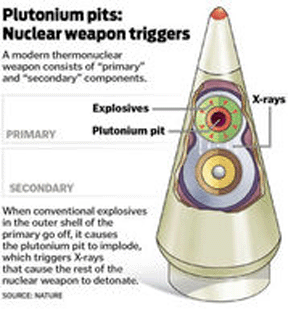
Plutonium cores are often called plutonium pits because they rest inside nuclear bombs like pits inside stone fruits.
At issue is the Pentagon’s demand that the National Nuclear Security Administration — overseen by the Department of Energy — be able to produce 80 plutonium pits a year by 2030 to sustain the military’s nuclear weapons. Roughly the size of a grapefruit, plutonium pits that trigger warheads sometimes need to be replaced as they degrade or end up destroyed during evaluation……….
Since the fall of the Soviet Union, the United States has discontinued many of the nuclear weapons capabilities the nation built up during the Cold War. The United States began to rely largely on dismantling existing nuclear weapons for plutonium pits and stockpile management, as defense spending priorities diverted to the global war against terrorism.
Now the United States is facing a reckoning as Russia and China also race to advance their nuclear arsenals and much of the infrastructure the military relies on to support its nuclear capabilities ages out. The U.S. no longer operates the full range of facilities capable of producing new nuclear weapons.
……….Now the NNSA must decide how to expand production of plutonium pits to meet the Pentagon’s requirements by 2030. Under one option being considered, less ambitious “module” buildings would be constructed at the existing Los Alamos site.
An alternative would include repurposing one of the most problematic projects the Department of Energy has ever undertaken, the Mixed Oxide Fuel Fabrication Facility in South Carolina, to make pits.
Originally designed to turn weapons grade plutonium into commercial reactor fuel, the MOX facility is billions of dollars over budget and still only partially built.
Both the Obama and Trump administrations have tried to kill the project, but Congress has declined to discontinue construction owing primarily to political support from powerful members of the South Carolina delegation. Some have suggested transforming it to produce plutonium pits.
Best bad idea ever? Why Putin’s nuclear-powered missile is possible… and awful, Nuclear-powered cruise missiles? The US worked on them in the 1950s. Ars Technica, SEAN GALLAGHER–In a March 1, 2018 speech before Russia’s Federal Assembly, Russian President Vladimir Putin discussed new strategic weapons being developed to counter United States ballistic missile defenses. Two of these weapons are allegedly nuclear powered: a previously revealed intercontinental-range nuclear torpedo and a cruise missile. As Putin described them:
Russia’s advanced arms are based on the cutting-edge, unique achievements of our scientists, designers, and engineers. One of them is a small-scale, heavy-duty nuclear energy unit that can be installed in a missile like our latest X-101 air-launched missile or the American Tomahawk missile—a similar type but with a range dozens of times longer, dozens—basically an unlimited range. It is a low-flying stealth missile carrying a nuclear warhead, with almost an unlimited range, unpredictable trajectory and ability to bypass interception boundaries. It is invincible against all existing and prospective missile defense and counter-air defense systems.
Defense and nuclear disarmament experts did a double take. “I’m still kind of in shock,” Edward Geist, a Rand Corporation researcher specializing in Russia, told NPR. “My guess is they’re not bluffing, that they’ve flight-tested this thing. But that’s incredible.”
This is not the first time a government has worked on a nuclear-powered strategic weapon. Decades ago, the US developed engines first for a proposed nuclear-powered bomber and then for a hypersonic nuclear cruise missile. The US has also examined nuclear-powered rockets for space flight (that crazy Project Orion thing is a story for another time). These programs were all dropped, not because they didn’t work but because they were deemed impractical.
Oh… and there was always that small problem of radiation spewing from the engine exhaust.
So when Putin announced that Russia has tested the cruise missile engine successfully, it got us thinking about those past experiments in nuclear propulsion. Is it actually possible to create a nuclear reactor small enough and powerful enough to propel a cruise missile? We broke out our calculators, checked some engine ratings, and asked some experts in the field of nuclear physics.
Not everyone is sure that Russia is really this far along in developing a nuclear-powered cruise missile. But there’s plenty of evidence that they’re trying hard. An unnamed Defense Department source told Fox News recently that Russia had already crashed several test missiles in the Arctic. Other sources have suggested that the engines are still in testing and have thus far only been run with electric power.
Nuclear-powered flight is certainly possible, but it’s a terrible idea for all sorts of reasons. To understand how possible, yet horrible, it is, let’s consider the history of this absolutely insane but perfectly workable idea.
Blame Enrico FermiThe whole adventure into flying nuclear reactors began in 1942……………
The doomsday route
But even as nuclear-powered crewed aircraft were being abandoned, another bizarre chapter in nuclear aircraft propulsion was just getting started: Project Pluto…………….
At the same time Kennedy was scrapping the ANP program, the Livermore crew was finishing construction of a $1.2 million (in 1961 dollars) test facility at Jackass Flats, Nevada—Area 25 of the Nevada National Security Site. Jackass Flats has been home to all sorts of open-air testing of nuclear and ballistic missile systems, as well as depleted uranium weapons; it was also the proposed launch site for another bit of nuclear mad science, Project Orion—the idea of launching something into space using nuclear bombs as “pulse” propulsion.
Working with Vought, the aircraft company that built some of the US military’s earliest cruise missiles, Livermore researchers determined the requirements for the Pluto engine reactor:………..
The Soviet route
As with the US defense industry, the Soviets had competing design bureaus attempting to create nuclear aircraft. And just as with the US programs, the Soviets tried two different routes to nuclear-powered bombers. Neither design ever flew……….The only place the M-60 ever flew was on the pages of Aviation Week in 1958, where diagrams of the aircraft were run with an article claiming that a nuclear-powered supersonic bomber was being tested in the Soviet Union. It was an elaborate hoax………
Crawl out of the fallout
That wasn’t the end of nuclear-powered flight ideas, of course. NASA funded research into nuclear-powered thermal rockets in the 1960s and 1970s, and discussion of that sort of technology continues today as an option for interplanetary missions. But most people agreed that the risks of flying radiation-powered vehicles inside Earth’s atmosphere was too high even to consider testing them—that is, until the Russian Federation’s leadership decided the US was pushing the nuclear balance too far in its own favor.
It’s not clear whether the nuclear cruise missile engine Putin mentioned in his speech has been tested yet. Russian news outlet Vedomosti quoted a source in Russia’s military industry as saying that tests thus far have used “an electrical layout” to test the missile’s engine and not an actual nuclear reactor. But Russia does not appear to have been working hard on miniaturizing nuclear reactors.
Small-reactor technology has been advancing rapidly over the past decade. The US military has looked into using small modular reactors to power high-energy weapons and bases overseas. Other countries, including Russia, have continued research into molten-metal cooled reactors; it is rumored that the “Status-6” nuclear-powered “torpedo” Putin discussed in his speech is powered by a lead-bismuth reactor.
Putin said that the “innovative nuclear power unit” of Status-6 completed testing in December 2017 after a “test cycle that lasted many years.” Russia has been developing new reactors with lead-bismuth coolant for naval applications. Soviet “Alfa” class attack submarines were powered by lead-bismuth reactors, which are very tricky to maintain but deliver high power-to-weight ratios; the original test reactor for the “Alfa” class design (KM-1 in Sosnovy Bor) was decommissioned a year ago, and a new type of reactor was installed in its place.
A lead-bismuth reactor’s power-to-weight ratio may be perfect for a small drone submarine, but it may not be the ideal form for a missile’s engine. However, the thrust required to keep a cruise missile in flight is nowhere near what would be needed for a hypersonic missile or even a subsonic bomber.
The Williams F107 turbofan that powers the Tomahawk cruise missile puts out a thrust of 3.1 kiloNewtons (700 pounds). To fly the Tomahawk at its cruising speed of 550 mph (890 km/h), that means generating about 766 kilowatts of power. That’s well within the potential power range of a small modern nuclear reactor, according to Jeff Terry, professor of physics at Illinois Institute of Technology and an energy researcher. “One megawatt is certainly doable,” Terry said, since the core of the 85-megawatt High Flux Isotope Reactor at Oak Ridge National Laboratory is “the size of a beer keg.”
If the Russian designers of the engine for the as-of-yet-unnamed nuclear-powered cruise missile did not have any concerns about radiation shielding for anything other than the avionics, a small nuclear reactor could be incorporated into a cruise missile design. The missile could be launched with a booster and wait until it is at speed to take its reactor critical, as was planned with the SLAM.
From a deterrence standpoint, a nuclear-powered cruise missile is a destabilizing weapon. Its launch would not necessarily set off US early warning systems, and its flight path is unpredictable and long. It could be launched days or weeks before an intended attack, purposely avoiding areas where it could be detected and coming from directions that the US doesn’t watch for nuclear attacks. And if the missile uses a “direct” system like SLAM, it would spend that time spewing fallout wherever it flew, regardless of whether it ever executed its mission. In other words, just as US military planners in the 1960s found out, a nuclear cruise missile is a provocative weapon better suited to first strike than to deterrence.
When the US entered the nuclear age, it did so recklessly. New research suggests that the hidden cost of developing nuclear weapons were far larger than previous estimates, with radioactive fallout responsible for 340,000 to 690,000American deaths from 1951 to 1973.
From 1951 to 1963, the US tested nuclear weapons above ground in Nevada. Weapons researchers, not understanding the risks—or simply ignoring them—exposed thousands of workers to radioactive fallout. The emissions from nuclear reactions are deadly to humans in high doses, and can cause cancer even in low doses. At one point, researchers had volunteers stand underneath an airburst nuclear weapon to prove how safe it was:
The emissions, however, did not just stay at the test site, and drifted in the atmosphere. Cancer rates spiked in nearby communities, and the US government could no longer pretend that fallout was anything but a silent killer.
The cost in dollars and lives
Congress eventually paid more than $2 billion to residents of nearby areas that were particularly exposed to radiation, as well as uranium miners. But attempts to measure the full extent of the test fallout were very uncertain, since they relied on extrapolating effects from the hardest-hit communities to the national level. One national estimate found the testing caused 49,000 cancer deaths.
Those measurements, however, did not capture the full range of effects over time and geography. Meyers created a broader picture by way of a macabre insight: When cows consumed radioactive fallout spread by atmospheric winds, their milk became a key channel to transmit radiation sickness to humans. Most milk production during this time was local, with cows eating at pasture and their milk being delivered to nearby communities, giving Meyers a way to trace radioactivity across the country.
The National Cancer Institute has records of the amount of Iodine 131—a dangerous isotope released in the Nevada tests—in milk, as well as broader data about radiation exposure. By comparing this data with county-level mortality records, Meyers came across a significant finding: “Exposure to fallout through milk leads to immediate and sustained increases in the crude death rate.” What’s more, these results were sustained over time. US nuclear testing likely killed seven to 14 times more people than we had thought, mostly in the midwest and northeast.
A weapon against its own people
When the US used nuclear weapons during World War II, bombing the Japanese cities of Hiroshima and Nagasaki, conservative estimates suggest 250,000 people died in immediate aftermath. Even those horrified by the bombing didn’t realize that the US would deploy similar weapons against its own people, accidentally, and on a comparable scale.
And the cessation of nuclear testing helped save US lives—”the Partial Nuclear Test Ban Treaty might have saved between 11.7 and 24.0 million American lives,” Meyers estimates. There was also some blind luck involved in reducing the number of poisoned people: The Nevada Test Site, compared to other potential testing facilities the US government considered at the time, produced the lowest atmospheric dispersal.
The lingering effects of these tests remain, as silent and as troublesome as the isotopes themselves. Millions of Americans who were exposed to fallout likely suffer illnesses related to these tests even today, as they retire and rely on the US government to fund their health care.
“This paper reveals that there are more casualties of the Cold War than previously thought, but the extent to which society still bears the costs of the Cold War remains an open question,” Meyers concludes.
This earthquake expert dodged Russian surveillance to try to halt nuclear testing , How a scientist studying earthquakes spent his career working to prevent nuclear explosions, The Verge By Rachel Becker@RA_Becks
At 5AM on a June morning in 1974, seismologist Lynn Sykes awoke to a phone call from the Department of Defense. The voice on the other end of the line asked Sykes to be ready to leave for Moscow that evening. The DoD needed his help to negotiate a treaty that would cap the size of the US and Russia’s underground nuclear explosions.
Sykes, now a professor emeritus at Columbia University’s Lamont-Doherty Earth Observatory, was invited because of his unusual expertise. Sure, he was an expert on earthquakes. But he was also an expert on underground nuclear explosions, which — like earthquakes — can send vibrations ringing through the Earth. So the same devices that monitor and measure quakes can do double duty as secret nuclear test sensors.
But there was an ongoing debate about whether it was possible to tell the size of an underground nuclear explosion from the seismic wiggles picked up by monitoring stations. If there were no sure way to check if someone was cheating on the deal, then neither the US nor Russia wanted to stop underground tests altogether. That’s why Sykes was in Russia: to confirm that detecting underground tests was scientifically possible, and to help negotiate a treaty that would limit underground nuclear tests to 150 kilotons or less.
The negotiations were a success, and President Richard Nixon and Soviet premier Leonid Brezhnev signed the treaty about a month later. But the quest for a complete ban on nuclear testing continues. The Comprehensive Test Ban Treaty, which would ban all nuclear tests of all sizes, was finalized in 1996. But the US, China, Iran, and North Korea still need to ratify it in order for the treaty to enter into force.
Saudi energy deal push sparks nuclear weapon concerns,The Hill, BY REBECCA KHEEL – 03/18/18 Nuclear nonproliferation advocates are sounding the alarm about a potential nuclear energy deal between Saudi Arabia and the United States, saying the exceptions the kingdom is seeking could lead to nuclear proliferation in a volatile region.
At issue is a deal that would allow the United States to sell nuclear reactors to Saudi Arabia. The Trump administration has already started negotiations, with Energy Secretary Rick Perry reportedly meeting with senior Saudi officials in London last month.
Such deals, known as “123 agreements” after the section of the law that requires them, allow for transfers of nuclear material, equipment or components from the United States to another nation if the other country commits to a set of nine nonproliferation criteria.Saudi Crown Prince Mohammed bin Salman is visiting Washington next week and is sure to press President Trump on the issue.
But comments the crown prince made this week that Saudi Arabia would develop a nuclear bomb “as soon as possible” if Iran does are raising red flags for lawmakers who were already skeptical of the kingdom’s intentions.
“Saudi Arabia’s crown prince has confirmed what many have long suspected — nuclear energy in Saudi Arabia is about more than just electrical power, it’s about geopolitical power,” Sen. Ed Markey (D-Mass.) said in a statement. “The United States must not compromise on nonproliferation standards in any 123 agreement it concludes with Saudi Arabia.”
When the United States entered into a 123 agreement with the United Arab Emirates (UAE) in 2009, the UAE voluntarily agreed to prohibitions on enriching uranium or reprocessing spent fuel to produce plutonium — essential steps in producing nuclear weapons.
Such deals, known as “123 agreements” after the section of the law that requires them, allow for transfers of nuclear material, equipment or components from the United States to another nation if the other country commits to a set of nine nonproliferation criteria.
Saudi Crown Prince Mohammed bin Salman is visiting Washington next week and is sure to press President Trump on the issue.
That agreement has become known as the “gold standard” that nonproliferation advocates say should be part of all 123 agreements. …….
A House Foreign Affairs subcommittee is scheduled to hold a hearing on the potential agreement Wednesday, while Mohammed is still in town. Outside experts are slated to testify.
Rep. Ileana Ros-Lehtinen (R-Fla.), chairwoman of the subcommittee, said she expects the hearing to cover the status of Saudi Arabia’s nuclear plans, the implications of a deal without the gold standard and legislative options to increase congressional oversight “so that the U.S. can ensure national security interests always take precedence over political or commercial considerations in any future nuclear agreement.”
“The administration has been moving full speed ahead on its negotiations with Saudi Arabia regarding a potential 123 nuclear cooperation agreement, and unfortunately, Congress has been left mostly in the dark,” she said in a statement Friday. “The potential ramifications, including proliferation and the easing of enrichment and reprocessing restrictions, highlight the need for long-needed reforms to the outdated congressional review process.” http://thehill.com/policy/defense/378868-saudi-energy-deal-push-sparks-nuclear-weapon-concerns
Iraq, 15 years On: A Toxic US Legacy,March 18, 2018, by Middle East EyeFifteen years ago this month, the United States spearheaded a fantastically bloody war on Iraq as part of its ongoing effort to ensure the Iraqi nation’s perpetual misery. Common Dreams, by Belén Fernández, Fifteen years ago this month, the United States spearheaded a fantastically bloody war on Iraq ….
Increasing rates of cancer and birth defects …..
Consider, for instance, Cockburn’s 2010 article for The Independent, headlined “Toxic legacy of US assault on Fallujah ‘worse than Hiroshima'”. In it, he outlined the results of a study by British scientist Chris Busby and colleagues Malak Hamdan and Entesar Ariabi on the increase in reports of cancer, birth defects, infant mortality and other forms of suffering in the Iraqi city of Fallujah, the focus of a particularly vicious US assault.
To be sure, as one of the top polluters on the entire planet, the US military has never been thrilled about acknowledging what would appear to be obvious: that saturating the environment with toxic materials will have repercussions on both environmental and human health, including the health of the United States’ own warriors, as underlined by the afflictions affecting veterans of the Vietnam War and first Gulf War, among other imperial escapades.
According to Mozhgan Savabieasfahani, an award-winning toxicologist based in Michigan, “around six billion bullets were expended into the Iraqi environment” between 2002 and 2005 alone – which, along with bombs, have led to “public contamination with … toxic metals”.
Depleted uranium: a long-term hazard
But the US military arsenal extends far beyond traditional guns and bombs. In 2012, Robert Fisk wrote about a 14-month-old Iraqi named Sayef who had a severely enlarged head, was blind, paralysed and unable to swallow. Noting that much blame for the rise in congenital birth defects in Fallujah had been directed at the United States’ use of white phosphorus there, Fisk was nonetheless forced to include the caveat: “No one, of course, can produce cast-iron evidence that American munitions have caused the tragedy of Fallujah’s children.”
Yet the possibility of a cause-and-effect relationship becomes more and more difficult to deny. Already in 2009, the Guardian had reported that doctors in Fallujah were “dealing with up to 15 times as many chronic deformities in infants” as the previous year, such as a baby born with two heads.
In 2013, Al Jazeera quoted Sharif al-Alwachi of the Babil Cancer Centre in southern Iraq, who attributed escalating cancer rates since 2003 on the US military’s use of depleted uranium (DU) weapons. Al Jazeera also threw in the following uplifting note: “The remaining traces of DU in Iraq represent a formidable long-term environmental hazard, as they will remain radioactive for more than 4.5 billion years.”
Indeed, DU constitutes a can of worms unto itself. A 2016 Washington Spectator essay titled “Irradiated Iraq,” by Washington, DC-based investigative journalist Barbara Koeppel, remarks on the convenient US classification of its own uranium weapons as “conventional” when in fact “they are radioactive and chemically toxic”.
Destructive capacity
This is the same US, of course, that goes into warmongering hissy-fits each and every time the word “radioactive” comes up in the context of Iran while also engaging in countless other varieties of hypocritical rampage.
Koeppel cites former United Nations weapons inspector Scott Ritter‘s observation: “The irony is we invaded Iraq in 2003 to destroy its non-existent WMD [weapons of mass destruction]. To do it, we fired these new weapons, causing radioactive casualties.”
Luckily for the US, there are plenty of members of the national media and wider domestic landscape willing to succumb to the notion that DU is simply Something We Don’t Talk About; you might even say the issue itself is radioactive.
Others, however, have wholeheartedly embraced the destructive wonders of DU, as was the case with a US special operations soldier I spoke with earlier this year. This young man had just completed tours of duty in Iraq and Syria, where the US recently came under criticism for its renewed use of DU; he expressed dismay that sectors of the international community had failed to appreciate the effectiveness of the weaponry in question.
Back in 2001, the International Committee of the Red Cross offered some watered-down thoughts on DU, gently suggesting that international humanitarian law “prohibit[s] weapons, means or methods of warfare of a nature to cause superfluous injury or unnecessary suffering, which have indiscriminate effects or which cause widespread, long-term and severe damage to the natural environment”…..https://www.commondreams.org/views/2018/03/18/iraq-15-years-toxic-us-legacy
New US nuclear submarines come with $128b price tag, 9 news, By Richard Wood
The total cost of the US navy’s new ballistic missile submarine fleet will be an “eye-watering” $US100 billion ($128b).
Earlier this week, Navy Secretary Richard V. Spencer said deep under the ocean remains the best best place to hide a nuclear deterrent – but it comes at a price.
The US Navy is seeking to build a fleet of 12 Colombia-class nuclear-powered ballistic missile submarines (SSBN), reports The Diplomat.
“All of sudden you’re talking about the submarines and there is a number that will make your eyes water. Columbia will be a $100 billion program for its lifetime.
“We have to do it. I think we have to have big discussions about it,” Spencer added.
Underwater has proved to date the most elusive environment for detecting an SSBN, he explained.
However, “it comes at a price,” the Navy secretary added.
Construction of the first Columbia-class sub is scheduled to start in 2021, with the US navy taking delivery from 2028.
Australian maritime warfare expert James Goldrick told nine.com.au the US is determined to keep its edge in submarine technology.
Despite recent developments in underwater detection, submarines remain difficult to pinpoint, he said.
“The sea is a very complex medium. It remains the most impenetrable environment, and I think the US is banking on this continuing.”
And Rear Admiral Goldrick said despite Russia and China unveiling new planned nuclear weapons, the US maintains an advantage in submarine technology.
Putin claims new weapons could strike ‘anywhere in the world’
“The Americans are well ahead of the Chinese. The Russians, however, have become well advanced in modernising their submarine fleet.”
The Columbia-class vessels are due to replace the US navy’s current Ohio-class SSBN fleet.
Technical details of the new vessels remain sketchy, but they are set to be the biggest sub the US navy has ever commissioned, The Diplomat reports.
Designed by General Dynamics Electric Boat, they measure 171m and have a beam of 13m.
“Saudi Arabia does not want to acquire any nuclear bomb, but without a doubt if Iran developed a nuclear bomb, we will follow suit as soon as possible,” Prince Mohammed bin Salman told CBS in a 60 Minutes interview that will air in the United States on Sunday.
He also reiterated previous comments he has made likening Iran’s supreme leader Ayatollah Ali Khamenei to Hitler.
“He wants to create his own project in the Middle East very much like Hitler, who wanted to expand at the time,” the prince says in the interview.
“Many countries around the world and in Europe did not realise how dangerous Hitler was until what happened, happened. I don’t want to see the same events happening in the Middle East.”
The Sunni Muslim kingdom has been at loggerheads with revolutionary Shi’ite Iran for decades. The countries have fought a long-running proxy war in the Middle East and beyond, backing rival sides in armed conflicts and political crises including in Iraq, Syria, Lebanon and Yemen.
Prince Mohammed, who also serves as Saudi defence minister, said last year that the kingdom would make sure any future struggle between the two countries “is waged in Iran”, prompting Iranian threats to hit back at most of Saudi Arabia except the holy cities of Mecca and Medina.
Riyadh has criticised the 2015 deal between world powers and Tehran under which economic sanctions on Iran were lifted in return for the Islamic Republic curbing its nuclear energy program. US sanctions will resume unless President Donald Trump issues fresh “waivers” to suspend them on May 12.
The comments by Prince Mohammed, who at 32 is heir to the throne, also have implications for Israel, another US ally which neither confirms nor denies the widespread assumption that it controls the Middle East’s only nuclear arsenal.
Israel has long argued that, should Iran develop nuclear weapons, it would trigger similar projects among the Persian power’s Arab rivals and further destabilise the region.
It has never joined the 1970 nuclear Non-Proliferation Treaty (NPT) and has said it would consider inspections and controls under the NPT only if was at peace with its Arab neighbours and Iran.
Civilian projects
Saudi Arabia is stepping up plans to develop a civilian nuclear energy capability as part of a reform plan led by Prince Mohammed to reduce the economy’s dependence on oil.
The world’s top oil exporter has previously said it wants nuclear technology only for peaceful uses but has left unclear whether it also wants to enrich uranium to produce nuclear fuel, a process which can also be used in the production of atomic weapons.
The United States, South Korea, Russia, France and China are bidding on a multi-billion dollar tender to build the country’s first two nuclear reactors.
Prince Mohammed’s comments, ahead of a trip to the United States next week, could impact the bid by a consortium that includes Toshiba-owned Westinghouse.
US companies can usually transfer nuclear technology to another country only if the United States has signed an agreement with that country ruling out domestic uranium enrichment and the preprocessing of spent nuclear fuel — steps that can have military uses.
In previous talks, Saudi Arabia has refused to sign up to any agreement that would deprive it of the possibility of one day enriching uranium.
Reactors need uranium enriched to around five percent purity but the same technology in this process can also be used to enrich the heavy metal to a higher, weapons-grade level. This has been at the heart of Western and regional concerns over the nuclear work of Iran, Saudi Arabia’s arch-rival which enriches uranium domestically.
Riyadh approved a national policy for its atomic energy programme on Tuesday, including limiting all nuclear activities to peaceful purposes, within the limits defined by international treaties.