Japanese Foreign Minister’s Reports of Tunneling at Punggye-ri: What Commercial Satellite Imagery Shows [excellent photos] BY: 38 NORTH, APRIL 2, 2018A Analysis by Frank V. Pabian, Joseph S. Bermudez Jr., and Jack Liu.
On March 31, 2018, Japan’s Foreign Minister, Taro Kono, in a lecture in Kochi city, is reported to have said that North Korea appears to be “working hard to get ready for the next nuclear test,” and the associated reporting claims that he had added that soil had been “removed from the tunnel at the nuclear test site where past tests were conducted.” The reporting also suggested that his remarks “may be based on satellite imagery provided by the United States.”
While it is unclear whether the Foreign Minister was referring to activity observed over the last few days or from earlier work conducted after North Korea’s September 2017 nuclear test, commercial satellite imagery from March 23 shows quite a different picture: namely, that activity at the test site has been significantly reduced compared to previous months. Tunneling at the West Portal, a site not associated with any of North Korea’s previous tests, had been active earlier this year but has slowed down significantly as has other personnel and vehicular movement around the site. (It appears that only a small amount of new spoil has been excavated from the tunnel recently).[1]
Nevertheless, it is highly likely that the North Koreans continue to maintain the readiness of the nuclear test facility—one indication is recent roadwork—to allow nuclear testing in the future should Pyongyang decide to do so.
1. Precise determination of the extent of new spoil accumulation is made difficult from March 17 to 23 due to variations in the imagery deriving from different sensors on different satellites from different vendors having different look angles and slightly different amounts of melted snow together with vegetative shadowing.
India and Pakistan are quietly making nuclear war more likely, Both countries are arming their submarines with nukes. Vox, By Tom Hundley Apr 2, 2018 “……….The audacity of a bloody attack inside one of the most heavily secured naval facilities in Pakistan was jarring enough. Even more jarring was the source of the attack: al-Qaeda, which claimed responsibility for the strike and praised the dead men as “martyrs.” Five more naval officers implicated in the plot were later arrested, charged with mutiny, and sentenced to death.
The Zulfiqarincident is the most serious in a long string of deadly security breaches at Pakistani military installations, from multiple attacks on nuclear facilities near Dera Ghazi Khan (2003 and 2006) and on the air force bases at Sargodha and Kamra (2007 and 2012) to the the gruesome 2014 attack on a school for the children of military officers in Peshawar that left more than 140 people dead, including 132 children.
But even if Pakistani bases have been hit before, the Zulfiqarstrike is particularly alarming. That’s because Pakistan is preparing to arm its submarines and possibly some of its surface ships with nuclear weapons — which means terrorists who successfully fight their way into a Pakistani naval base in the future could potentially get their hands on some of the most dangerous weapons on earth.
The Pakistan navy is likely to soon place nuclear-tipped cruise missiles on up to three of its five French-built diesel-electric submarines. It has also reached a deal with China to buy eight more diesel-electric attack submarines that can be equipped with nuclear weapons. These are scheduled for delivery in 2028. Even more disturbing, Pakistani military authorities say they are considering the possibility of putting nuclear-tipped cruise missiles on surface vessels like the Zulfiqar.
Pakistan says its decision to add nuclear weapons to its navy is a direct response to India’s August 2016 deployment of its first nuclear submarine, the Arihant. A second, even more advanced Indian nuclear submarine, the Arighat, began sea trials last November, and four more boats are scheduled to join the fleet by 2025. That will give India a complete “nuclear triad,” which means the country will havethe ability to deliver a nuclear strike by land-based missiles, by warplanes, and by submarines.
The submarine is the key component. It’s considered the most “survivable” in the event of a devastating first strike by an enemy, and thus able to deliver a retaliatory second strike. In the theology of nuclear deterrence, the point of this unholy trinity is to make nuclear war unwinnable and, therefore, pointless.
When it comes to India and Pakistan, by contrast, the new generation of nuclear submarines could increase the risk of a devastating war between the two longstanding enemies, not make it less likely. ……..
……. India and Pakistan are mortal enemies that have dozens of nuclear warheads aimed at each other. That was scary when those nukes were only on land. It’s a much scarier situation now that those nukes have been put onto submarines that move deep underwater, holding the deadliest payloads imaginable.
Russia Almost Brought Back a Terrifying Weapon: Nuclear ICBM’s on Trains, National Interest Robert Beckhusen, 3 Apr 18,
In October 1987, the first rail ICBM became operational in the form of the “Moldets,” a train armed with a 77-foot-long RT-23 — a type of ICBM which was also stored in silos — carrying 10 multiple-reentry warheads with 550 kilotons of explosive power each. In the 1990s and 2000s after the START II treaty, Russia decommissioned these missiles, which NATO referred to as the SS-23 Scalpel. The Kremlin produced 12 of these trains.
In 2013, the Russian military announced it would bring back rail-mobile intercontinental ballistic missiles. In other words, trains with big nukes crammed inside, capable of darting around Russia, raising their launchers and firing at a moment’s notice. It was called Barguzin and would begin testing in 2019.
That was the idea. In December 2017, the Russian government put the Barguzin project on hiatus, saving the world from the specter of doomsday trains roaming Siberia. The ostensible reason — the weapon is too expensive, according to Rossiyskaya Gazeta, the government’s paper of record.
The Barguzin project was a revival of a retired leg of the Soviet Union’s ground-based nuclear “triad.” While the Soviets had nuke-equipped submarines and nuclear-armed bombers, its ground-based component had nuclear missiles mounted on huge trucks, inside underground silos and on trains. The Soviet military first signed the order for the creation of rail-mobile ICBMs in 1969, but the launchers came later.
In October 1987, the first rail ICBM became operational in the form of the “Moldets,” a train armed with a 77-foot-long RT-23 — a type of ICBM which was also stored in silos — carrying 10 multiple-reentry warheads with 550 kilotons of explosive power each. In the 1990s and 2000s after the START II treaty, Russia decommissioned these missiles, which NATO referred to as the SS-23 Scalpel. The Kremlin produced 12 of these trains.
And that was the end of Russia’s rail-mobile missiles until the Kremlin announced in 2013 that it would create a new nuke-armed train under the moniker Barguzin, or BZhRK, this time equipped with the more advanced RS-24 Yars ICBM.
The RS-24 has a similar range to the RT-23 but is three meters shorter and weighs half as much — a considerable advantage for mobile missiles. The RS-24 is also, by the way, road-mobile.
……….During peacetime they require a network of bases for storage and maintenance, where international treaties require them to stay, and extensive security detachments to protect the missiles when they move during wartime. And they’re still stuck on railroad tracks — so U.S. spies have a general idea of where to look.
Which also begs the question as to whether the nuclear-war trains could even make it out of their bases in time before incoming missiles hit in the opening minutes of a nuclear war. Sure enough, the Pentagon studied the issue during the Cold War, and even built two prototype train cars intended for the Peacekeeper ICBM, but found them to be not worth the cost and rather vulnerable……. http://nationalinterest.org/blog/the-buzz/russia-almost-brought-back-terrifying-weapon-nuclear-icbms-25193
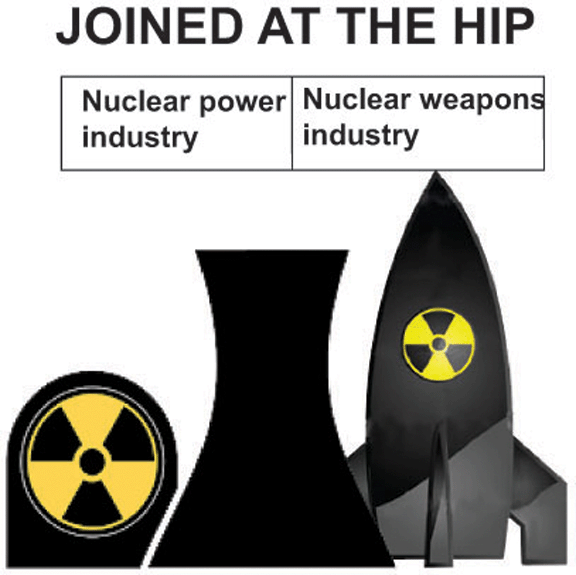
Should Nuclear Energy Be a U.S. National Security Concern?Inside Sources March 29, 2018 by Erin Mundahl Sixty years ago, nuclear power was the energy of the future, promising a nearly limitless supply of clean, cheaper power. That future has yet to arrive. In fact, today, utilities are increasingly transitioning out of nuclear generation, shuttering aging reactors and shelving plans to reinvest in new technology. This is more than just a shift from one fuel to another, says David Gattie, an associate professor of environmental engineering at the University of Georgia. The decline in interest in nuclear energy has significant impacts on America’s national security.
“Nuclear energy is a unique resource because of its unmatched energy density and dual-purpose utility for electric power generation and nuclear weaponry,” Gattie writes in a recently published paper………. Although American scientists began the atomic age, more recently, research and development in nuclear technology, including civilian nuclear, has decreased to a level that threatens American primacy and, by extension, national security….
The U.S. is running the risk of falling behind the rest of the world in terms of nuclear technology, rather than maintaining its position of global leader.
To combat this trend, Gattie advocates specific legislative action to provide fixed support for nuclear research and development. For the purposes of longevity, this would optimally be a legislative, rather than executive action. This space to resurrect research in technologies like molten salt and breeder reactors would signal that the U.S. is committed to the future of nuclear energy. http://www.insidesources.com/nuclear-energy-should-be-a-us-national-security-concern/
NORTH Korea is gearing up for a new nuclear test by digging an underground tunnel, Japan has warned.
The country’s Foreign Minister Taro Kono said: “[North Korea] is doing everything possible to prepare for the next nuclear test: it is currently extracting earth from an underground tunnel where the previous test was carried out.”
The minister said previously the secretive state “does not reveal its intentions to the outside world in terms of denuclearisation”.
The claim comes just days after Kim Jong-un promised to bin his beloved nuclear weapons if he could be guaranteed security and US military threats against North Korea were to stop.
At the end of last year the tyrant declared his country a fully fledged nuclear power after launching a new missile he claimed was capable of hitting anywhere on the planet.
Nuclear devices are often tested underground to prevent radioactive material released in the explosion reaching the surface and contaminating the environment — this method also ensures a degree of secrecy.
The release of radiation from an underground nuclear explosion — an effect known as “venting” — would give away clues to the technical composition and size of a country’s device.
A test site is carefully geologically surveyed to ensure suitability — usually in a place well away from population centres.
The nuclear device is placed into a drilled hole or tunnel usually between 200-800m below the surface, and several metres wide. Last year a tunnel at an underground North Korean nuclear site was said to have collapsed.
Up to 200 people were thought to have died at the Punggye-ri nuclear test site in the northeast of the country.
The accident was believed to have been caused by Kim Jong-un’s sixth nuclear test which weakened the mountain, according to the report.
Former British Defence Secretary Sir Michael Fallon previously warned that Britain is at risk from North Korea’s long-range nuclear missile program as some cities are closer than American targets.
Revised estimates suggest the total number of missiles the rogue state has is believed to be between 13 and 21.
And the regime is estimated to have at least four nuclear warheads.
Satellite images of Jong-un’s main missile test site in August revealed North Korea’s weapons were more powerful than initially thought.
Careful analysis of North Korean tests sites, using images from Planet, reveal the regime has been gradually building up the size of its missiles.
In a more peaceful universe, the fact that the United States possesses almost 4,000 weapons that can destroy entire cities would be horrifying.
But in our universe, it is actually an encouraging sign of how much America’s nuclear arsenal has declined since the Cold War.
As of 2017, the U.S. had 3,822 nuclear weapons, according to data just declassified by the Department of Energy. That’s down from 4,018 in 2016. That number does not include weapons that have been retired but have yet to be dismantled by the Department of Energy.
The figures show just how deep America’s nuclear arsenal has been cut since the height of the Cold War. In 1962, the year of the Cuban Missile Crisis, the United States had 25,540 nuclear weapons. That number grew to a peak of 31,255 nuclear weapons in 1967.
From 1967 on, that number gradually declines. In the 1970s, the stockpile ranged from 24,000 to 28,000 weapons. In the 1980s, it hovered around 23,000.
It wasn’t until the fall of the Soviet Union that the nuclear arsenal noticeably shrank. From 19,008 weapons in 1991, the number dropped to 13,708 in 1992 and 10,685 by 1999.
The Federation of American Scientists put the total number of U.S. nuclear weapons as of January 2017 at about 6,800, of which about 4,000 are active. The active stockpile included 1,367 deployed strategic warheads, 2,471 nondeployed warheads and around 200 deployed tactical warheads.
The Department of Energy also reported dismantling 10,972 nuclear weapons from 1994 to 2017, with the largest numbers occurring in the 1990s. From 648 weapons dismantled in 2008, the number plummeted to 109 in 2015, before rising to 354 in 2017.
As a footnote, there are an estimated 14,200 nuclear weapons in the world, according to the Federation of American Scientists. Russia has the largest number at 6,600 active and retired warheads, just slightly larger than the American total. The rest of the world (France, China, Britain, Pakistan, India, Israel and North Korea) have a little over a thousand.
As Winston Churchill said, “If you go on with this nuclear arms race, all you are going to do is make the rubble bounce.
Michael Peck is a contributing writer for the National Interest. He can be found on Twitter and Facebook.
Nuclear Weapons Transport, Nukewatch 29th March 2018
A nuclear weapons convoy left AWE Burghfield on Thursday March 22. It was
later seen on the A1 at junction 49 near Dishforth (15 miles north of
Wetherby).
The following day it was spotted crossing over to the west on
the A66 and then on the M74 just south of Lesmahagow. It then continued
around the east of Glasgow on the M73 and past Cumbernauld on the M80 to
take a break at DSG Stirling mid-afternoon.
It then took the M9, A811 andA82 to RNAD Coulport. On Monday March 26 this convoy left Coulport to
return south. Taking a route through Balloch and Stirling then onto the M9
and M8 to the Edinburgh bypass it then took a break at Glencorse Barracks
in Penicuik.
After continuing south on the A1 passing Berwick on Tweed it
passed through Newcastle and after an overnight stop it then continued down
the A1. It crossed country to the A34 travelling around Oxford and getting
back to Burghfield around 5pm. http://www.nukewatch.org.uk/?p=809
During this dangerous time, women are leading the charge to eradicate weapons of mass destruction and forestall nuclear war. We saw this most recently in the 2017 U.N. Treaty to Prohibit the Use of Nuclear Weapons. Approved with 122 states voting for, and one against, it is the first legally binding global ban on nuclear weapons, with the intention of moving toward their complete elimination. The preamble to the treaty recognizes the maltreatment suffered as a result of nuclear weapons, including the disproportionate impact on women and girls, and on indigenous peoples around the world. The treaty has been predominantly championed and promoted by women.
My interest in nuclear issues began nearly 10 years ago when I first uncovered my mother’s work as an antinuclear activist with a group called Women Strike for Peace. I have been following women doing nuclear activism all over the world—writing about them, protesting with them, teaching about them in my university classes—and I often bring my daughter with me. My mother’s story is being passed down through an intergenerational maternal line, and with it, the activism that may help save the world, or at least help shift its view on disastrous weapons. Learning about my mother’s work radically changed my perception of her. It also changed my life.
Between 1945 and 1963, more than 200 atmospheric, underwater, and space nuclear bomb tests were conducted by the U.S., primarily in the Nevada desert and the Marshall Islands. Hundreds more took place around the world. In many instances citizens were not informed of the tests, nor were they warned of their effects. The negative health impacts of the testing and exposure to ionizing radiation turned out to be vast: early death, cancer, heart disease, and a range of other incurable illnesses, including neurological disabilities, weakened immune systems, infertility, and miscarriage. Ionizing radiation damages genes (it is mutagenic), so the health ramifications of exposures are passed down through the generations.
In the 1950s, scientists concerned with the health impacts of bomb testing and the spread of ionizing radiation conducted the St. Louis Baby Tooth Survey. The survey showed that radioactive fallout had traveled far and wide. Cow and breast milk contaminated with the isotope strontium 90 had entered children’s teeth. Strontium 90 metabolizes as calcium and these isotopes remain active in the body for many years. When Dagmar Wilson and Bella Abzug—who went on to become a Congresswoman and co-founder of the National Women’s Political Caucus with Gloria Steinem and Betty Friedan—learned the results of the Baby Tooth Survey, they formed Women Strike for Peace. The group brought together concerned mothers from across the U.S. The women organized. First within their communities. And then, 50,000 mothers protested across the country, and 15,000 descended on Washington, D.C. for Women’s Strike for Peace Lobbying Day on November 1, 1961. My mother was one of those 15,000 protestors. The group’s efforts brought vast political attention to the dire health consequences of radioactive fallout and led to the banning of atmospheric bomb testing by the U.S., Great Britain, and the former Soviet Union in 1963, with the signing of the Limited Nuclear Test Ban Treaty.
Women Strike for Peace reflects a cultural nuclear gender binary—with women constructed as peaceful antinuclear protectors of children and the nation, and men positioned as perpetrators of nuclear war—the designers, planners, and regulators of weapons of mass destruction.
Has this exclusion of women from nuclear decision-making led to our current crisis—a host of locations worldwide contaminated with radioactive waste, and the great potential for nuclear war? Leading anti-nuclear activists seem to think so.
Since the dawn of the nuclear age men have dominated and controlled nuclear weapons design and policy. As Benjamin A. Valentino, Associate Professor of Government, and Coordinator, War and Peace Studies Program, Dickey Center for International Understanding at Dartmouth College says, it is only recently that women have had access to positions of power in the military sphere. This is true in weapons’ sciences and engineering as well. While many women worked on the Manhattan Project, most held administrative roles. Has this exclusion of women from nuclear decision-making led to our current crisis—a host of locations worldwide contaminated with radioactive waste, and the great potential for nuclear war? Leading anti-nuclear activists seem to think so.
Carol Cohn, founding director of the Consortium on Gender, Security and Human Rights at the University of Massachusetts-Boston suggests that nuclear-weapons discourse is deeply rooted in hegemonic patriarchy. In nuclear techno-language metaphors of male sexual activity are used to describe nuclear violence. Nuclear missiles are referred to in phallic terms. The violence of nuclear war is described in abstract and impersonal terms, such as “collateral damage.” In her recent New York Times op-ed, Cohn finds it unsurprising that hypermasculine nuclear language has surfaced so blatantly today with Trump’s tweets about the size of his nuclear button and his overall muscular championing of expanding the nuclear weapons complex.
Following the Women Strike for Peace model, legions of anti-nuclear NGOs worldwide are predominantly led by women, including Women’s Action for Nuclear Disarmament, Women’s International League for Peace and Freedom, Reaching Critical Will, the German Green Party, Mothers for Peace, Just Moms (St. Louis), International Campaign to Abolish Nuclear Weapons (ICAN), Greenham Common Women’s Peace Camp, Green Action Japan, the women of Koondakulam in India, the antinuclear nuns Megan Rice, Ardeth Platte, Carol Gilbert, and many more.
At the U.N. conference to ban nuclear weapons in 2017, I asked Civil Society experts and participants about the importance of women as leaders in the antinuclear movement, and about the hegemony of masculinity in the nuclear weapons complex.
“Of course many men support disarmament and have participated in the treaty and current anti-nuclear efforts in general, but women overwhelmingly lead,” said Tim Wright, of the Australian branch of ICAN. ICAN won the 2017 Nobel Prize for their work on The Treaty to Prohibit the Use of Nuclear Weapons.
Ray Acheson, of Reaching Critical Will, said the proliferation of nuclear weapons is deeply embedded in “a misogynist and hegemonic culture of violence.” She stated this culture is oppressive to women, LGBTQ, the poor, and people of color, and, “we must smash patriarchy.” Such is the feminist cry heard around the world, but in this case, it might actually save us.
Beatrice Fihn, director of ICAN, explained that men are raised to be violent, to think it’s necessary to resolve differences through force, while “women, conversely, are socially trained to negotiate and compromise.”
According to Fihn, the problem in a patriarchal world is that peaceful negotiations are viewed as weak. The U.S. misogynist-in-chief feels we must drop nuclear bombs, expand our nuclear arsenal, and strong-arm competing nations, such as North Korea and Russia. The very act of supporting disarmament efforts in a patriarchal framework places “you in a feminine category,” Fihn stressed. “Those in favor of abolishing nuclear weapons, whether male or female, are characterized in negative, feminized terms. This characterization must be changed. It is not weak to abolish weapons of mass destruction. It is life-affirming.”
Women better understand this because they are the ones in charge of improving quality of life for all. Women most often function as caretakers of children and the elderly, they are aware of the human cost of war and radioactive disaster. When thinking about nuclear war, they wonder, if war breaks out, “How will we feed our children, how will we feed our sick? What will happen to our communities?” Fihn says she fears nuclear violence in respect to the safety of her own children. Fihn’s concern for her children echoes the concerns of my mother and her antinuclear cohort in the 1950s and ’60s. Like Fihn, they worked to save their children—all children—from radiation contamination and nuclear war. I hope I can carry on that legacy, and that my daughter chooses to pick up the cause as well.
For the 2017 UN Treaty to Prohibit the Use of Nuclear Weapons, women helped prepare key elements of the document and gave vital health testimony. Particularly poignant were tales from Australian Indigenous, Marshallese, and Hibakusha (Hiroshima and Nagasaki survivors) women. I interviewed many of these women. Abacca Anjain-Madison, a former Senator of the Republic of the Marshall Islands, told me that between 1946 and 1958, the U.S. conducted 67 nuclear bomb tests on the Atoll Islands. Many babies born during the testing period resembled jellyfish and died quickly after their births. The Marshallese developed very high rates of cancer (and other diseases) as a result of ionizing radiation exposures. Now, with climate change, the radioactive dangers persist. Rising sea levels threaten the Runit Dome—a sealed space that contains large amounts of radioactive contamination. The dome has also begun to crack, and the U.S. has no plans to assist Marshallese with this crisis. They finished the cleanup and sealed the dome in 1979. Abacca Anjain-Madison asserts the clean up was not sufficient and the dome was never meant to be permanent. The Marshallese to do not have the means to protect themselves from the impending disaster.
Mary Olson, Southeast Director of the Nuclear Information and Resource Service, gave a presentation at the UN on the unequal health impacts of radiation exposures. Women remain unaccounted for in nuclear regulatory safety standards. Based on the data set from the BEIR VII report that both Olson and Dr. Arjun Makhijani, President of the Institute for Energy and Environmental Research have studied, women are twice as likely to get cancer, and nearly twice as likely than men to die from cancer associated with ionizing radiation exposures. Children are five to 10 times more likely to develop cancer in their lifetimes from radiation exposures than adult males, and girls are most vulnerable of all. Scientists do not yet understand why there is an age and gender disparity. The standard “reference man” by which radiation safety regulations are set are based on a white adult male. Olson and Makhijani argue that safety regulations must change to account for age and gender disparities. Further studies are needed to assess how people of different races are impacted by radiation exposures. To date, no such completed studies exist.
At the closing of the conference and signing of the 2017 UN Treaty to Prohibit the Use of Nuclear Weapons, two speeches were made—one by Setsuko Thurlow, a Hiroshima survivor, Nobel Peace Prize winner, and leading campaigner for the prohibition of nuclear weapons. Abacca Anjain-Madison of the Marshall Islands also spoke.
Setsuko Thurlow told her story of beholding the bomb dropping on her city in 1945. She described how, as an 13-year-old child, she witnessed the death of her brother, and “unthinkable” violence thrust upon on her people. For Thurlow, the signing of the UN Treaty to ban nuclear weapons is a miracle, but she believes we must rid the world of weapons entirely. She will not give up her efforts until that day comes. Neither will I.
Heidi Hutner is a writer and professor at Stony Brook University in New York. She teaches and writes about ecofeminism, literature, film and environmental studies. Currently, Hutner is working on a narrative nonfiction book manuscript titled, “Accidents Can Happen: Women and Nuclear Disaster Stories From the Field.” Find her @HeidiHutner
Russia just tested its ‘Satan’ nuclear missile amid Putin and Trump taunting an arms race, Business Insider, ALEX LOCKIEMAR 30, 2018, Russia says it has tested a new nuclear-capable intercontinental ballistic missile; Russian President Vladimir Putin has said the missile can defeat any US missile defences.
Russia on Friday said it had tested a new type of nuclear-capable intercontinental ballistic missile known by NATO as the “Satan 2.”
The country’s president, Vladimir Putin, has said the missile can defeat any US missile defences amid growing talk of an arms race with the US and President Donald Trump.
And the feeling of nuclear inadequacy may be mutual.
This is how you get an arms race Putin’s nuclear chest-thumping “really got under the president’s skin,” according to a White House official cited by NBC News on Thursday.
On a recent phone call between the two leaders, which made headlines for Trump’s decision to congratulate Putin on his less-than-democratic reelection, Trump and Putin reportedly butted heads.
“If you want to have an arms race, we can do that, but I’ll win,” Trump told him, according to NBC.
Putin said in his address that Russia was working on more and more-varied nuclear weapon delivery systems than the US. Trump has also planned a few new nuclear weapons for the US, but they show a very different philosophy.
But together, the Kim-Moon meeting serves more as a prelude to the Trump-Kim summit. And if those talks fail, Harry Kazianis, an Asia security expert at the Center for the National Interest think tank, thinks the chances of war might increase.
“We are putting all of our eggs in the summit basket,” he told me. “This is the ultimate Hail Mary.”
The North Korea nuclear standoff: how we went from “fire and fury” to talks in under a yearVox, “North Korea has 100 percent changed its tactics.” By Alex Ward@AlexWardVoxalex.ward@vox.com
Last year, it seemed like war between the United States and North Korea was a real possibility.
“The United States has great strength and patience, but if it is forced to defend itself or its allies, we will have no choice but to totally destroy North Korea,” President Donald Trumpsaid at the United Nations on September 19, 2017. “Rocket Man is on a suicide mission for himself and for his regime,” he continued, using his favored nickname for North Korean leader Kim Jong Un.
Flash-forward to March 29, 2018, when Pyongyang and Seoul announced that Kim and South Korean President Moon Jae-in will meet face to face in April for talks. It’ll be only the third in-person meeting between the heads of both countries, and the first since 2007. But that’s not all: The Kim-Moon summit will lay the groundwork for an even more historic meeting between Kim and Trump sometime in either May or June, although it remains unscheduled.
How did we get here? How did North Korea and the US go from talk of potential nuclear warto actual, well, talks? Here’s one explanation: Experts tell me the war threats may have actually scared leaders like Trump.
“I’d like to believe that while President Trump talks tough,” Leon Panetta, the former defense secretary and CIA director, told me, “deep down, he also is concerned about involving this country in another war that is going to cost thousands of lives.”
But others simply give credit to North Korea. “North Korea has 100 percent changed its tactics,” Sue Mi Terry, a North Korea expert at the Center for Strategic and International Studies think tank, told me. “I think this is all North Korea actually driving this.”
Whatever the reason, top officials want to take advantage of this moment. “We must not let this historic opportunity for diplomacy go to waste,” Sen. Ed Markey (D-MA), a member of the Senate Foreign Relations committee, told me.
What follows is a guide to how the two countries went from a nuclear standoff to a rare moment of cautious optimism.
Kim pivots from bombs to talks………..
The coming Trump-Kim summit made the South Korea meeting possible
On March 8, South Korean envoys who had just met with Kim Jong Un relayed a message to Trump: The North Korean leader wanted to meet with him. Trump reportedly accepted the offer on the spot.
Moon, the South Korean president, seemed relieved by the news. He campaigned in part on easing tensions with North Korea and continually advocated for a diplomatic solution to the US-North Korea standoff. After Trump agreed to meet with Kim, Moon offered three-way talks between him and the other two leaders.
That, however, is not in the works. Instead, Moon and Kim finally set a date for their face-to-face meeting in April. But Terry, the North Korea expert, told me she doesn’t expect much from the Kim-Moon summit. Instead, she said “South Korea’s chief goal is to set up that [the] Trump-Kim meeting goes well.”
As for Kim, he likely wants a greater sense of how badly Moon wants to strike some sort of deal.
Kim is already preparing for both encounters. This week, he took a secret trip to Beijing to meet with Chinese President Xi Jinping. Oriana Skylar Mastro, a China expert at Georgetown University, told me in an interview that Kim wanted to ensure he had China’s support ahead of talks with the US. Having Beijing’s backing could help Kim not concede too much in talks with Moon and Trump.
Kim needs the help. Trump will want Kim to give up his nuclear weapons, but experts are unanimous that Kim won’t agree to do so. Having China’s support allows the North Korean leader to feel more comfortable defying the American president.
“I think the North Korean leader made some very smart moves and has put himself in a good position,” Panetta, the former Obama Cabinet official, told me. “He has given himself greater leverage ahead of these meetings.”
Put together, the Kim-Moon meeting serves more as a prelude to the Trump-Kim summit. And if those talks fail, Harry Kazianis, an Asia security expert at the Center for the National Interest think tank, thinks the chances of war might increase.
Mohammed bin Salman (commonly referred to as MBS) is on a historic visit – the first in nearly 75 years – to Saudi Arabia’s closest ally, the US. In an interview with The Wall Street Journal this week, he called for restrictions that would “create more pressure” on Tehran.
“If we don’t succeed in what we are trying to do [imposing sanctions on Iran], we will likely have war with Iran in 10-15 years,” MBS, who has become the true power behind his aging father, King Salman, said.
Tehran and Riyadh have clashed over various issues in recent years. The Syrian crisis – especially the future of Syria’s government under President Bashar Assad – remains one of the major stumbling blocks.
The trip to the US of the prince’s entourage and meeting with Donald Trump only added fuel to the fire amid already strained relations. Iran sees the whole tour as a cynical exercise in self-promotion ahead of Bin Salman’s assumed ascension to the Saudi throne.
Prior to his coast-to-coast US trip, in which he rubbed shoulders with top politicians and Silicon Valley executives, the 32-year-old Saudi prince said that his country would enter the nuclear arms race if Iran is ever successful in developing a weapon of mass destruction. He also called Iran’s supreme leader the “new Hitler.”
The Iranian Foreign Ministry described MBS as “delusional” and “naïve,” following his allegations that Iran is hosting Al-Qaeda leaders.
The oil-rich kingdom and the US – under President Trump – have repeatedly slammed the landmark 2015 Iranian nuclear deal. Trump seems to be advancing a plan to confront Saudi Arabia’s number 1enemy in the region.
According to Vladimir Sazhin, a senior research associate at the Institute of Oriental Studies of the Russian Academy of Sciences, by withdrawing from the Iranian nuclear agreement, “the US would become a pariah,” since the international community largely approves of the deal and confirms that Tehran is sticking to its obligations.
As the nuclear option looks less and less sensible, it becomes harder to explain Whitehall’s enthusiasm. Might it be to do with the military? Guardian, Andy Stirling and Phil Johnstone, 29 Mar 18,
The depth of this Whitehall bias creates a challenging environment for reasoned debate over British energy policy. To many, it seems scarcely believable that UK plans are so massively out of sync with current trends. The sheer weight of UK nuclear incumbency has successfully marginalised the entirely reasonable understanding that – like many technologies before it – nuclear power is simply going obsolete.
With direct reasons for the UK’s eccentric national position still unstated, we should pay attention to body language. Here, clues may be found in the work of the National Audit Office (NAO). Its 2017 report of 2017 points out serious flaws in the economic case for new nuclear – highlighting “unquantified”, “strategic” reasons why the UK still prioritises new nuclear despite the setbacks and increasingly attractive alternatives. Yet the NAO remains uncharacteristically unclear as to what these reasons might be.
An earlier NAO report may shed more light. Their 2008 costing of military nuclear activities states: “One assumption of the future deterrent programme is that the United Kingdom submarine industry will be sustainable and that the costs of supporting it will not fall directly on the future deterrent programme.” If the costs of keeping the national nuclear submarine industry in business must fall elsewhere, what could that other budget be?
So why does the UK debate on these issues remain so muted? It is now beyond serious dispute that nuclear power has been overtaken by the extraordinary pace of progress in renewables. But – for those so minded – the military case for nuclear power remains. In a democracy, it might be expected that these arguments at least be tested in public. So, the real irrationality is that an entire policy arena should so comprehensively fail to debate such crucial issues. In the end, all technologies become obsolete. If we are not honest about UK civil nuclear policy, the danger is that British democracy may go the same way.
Renewed activity at North Korean nuclear site sparks fears, UNNERVING satellite images of a North Korean nuclear site suggest that Kim Jong-un may be expanding his nuclear program. Eric Talmadge, news.com.auAPMARCH 29, 2018
INCREASED activity at a North Korean nuclear site has once again caught the attention of analysts and renewed concerns about the complexities of denuclearisation talks.
The satallite imagery, taken last month, were released as United States President Donald Trump prepares for a summit with Kim Jong-un in the coming weeks.
Yesterday, Xinhua News revealed that during a secret visit to China, Mr Kim had told Chinese President Xi Jinping that he was ready for talks with the US about nuclear weapons, promising to give up his nuclear arsenal.
But observers believe these images suggest the North has begun preliminary testing of an experimental light water reactor and possibly brought another reactor online at its Yongbyon Nuclear Research Centre.
Both could be used to produce the fissile materials needed for nuclear bombs.
The findings come at a particularly sensitive time.
Views on nuclear issues are voiced strongly in Japan, where nuclear devastation has had a direct impact on thousands of lives not only in Hiroshima, Nagasaki, and Fukushima, but also in cases such as the Daigo Fukuryū Maru, the Number Five Lucky Dragon fishing boat whose story inspired the Godzilla movies.
The importance of raising awareness of issues surrounding nuclear weapons and energy has increased in recent years as the hibakusha or nuclear bomb survivors age and the number of survivors decline.
At the Social Book Café Hachidorisha (2F, 2-43-2 Dohashi-cho, Naka-ku, Hiroshima-shi) close to the Hiroshima Peace Memorial Museum, there are three events every month—on the 6th, 16th, and 26th—at which customers can speak to hibakusha. The testimonials allow listeners to hear from those with first-hand experience of the atrocities, including the one that occurred in Hiroshima on August 6, 1945……….
Patrons can also share their own experience and ask questions in order to open the discussion on difficult topics relevant to Japan and the rest of the world. The small scale of these events allows the audience to connect on a more emotional level, which in turn provides them with a greater appreciation of this tragic moment in history.
The Shocking Story of How One Country Built Nuclear Weapons (And Gave Them Up), National Interest, Dave Majumdar, 28 Mar 18,
The region and the world are undoubtedly safer because of the decisions made in the 1990s to relinquish South Africa’s nuclear program. Moreover, the dismantling of the relatively small program provided a template for how other nuclear powers could think about eliminating their own programs. However, with the exception of the Soviet successor states (which faced dramatically different constraints) no other states have yet taken up South Africa’s example. With the apparent increase in global tensions over the past few years, it seems unlikely that anyone will join South Africa in the post-nuclear club anytime soon.
The Republic of South Africa is the only country in the world to build a nuclear weapons program, then unbuild that program after domestic and international conditions changed. Why did South Africa decide to build nukes, how did it build them and why did it decide to give them up? The answers are largely idiosyncratic, although they may hold some lessons for the future of nuclear weapons development on the Korean Peninsula and elsewhere……..http://nationalinterest.org/blog/the-buzz/the-shocking-story-how-one-country-built-nuclear-weapons-25110