There’s an app for that.
Trump and CIA planning war on Iran?
Trump’s CIA Is Laying the Groundwork for a Devastating War on Iran, with Help from Neocon Think Tank, By Ben Norton, Global Research, AlterNet 10 November 2017
An ex-CIA analyst has raised suspicions about the CIA’s release of bin Laden documents and apparent collaboration with the hard-right organization Foundation for Defense of Democracies. The Central Intelligence Agency appears to have collaborated with the neoconservative think tank Foundation for Defense of Democracies to try to link Iran to the Salafi-jihadist group al-Qaeda.
Ned Price, a former CIA analyst and spokesman, has suggested that the move may be part of a wider campaign by the Trump administration’s new CIA director to establish “a rationale for regime change” in Tehran.
In the lead-up to the illegal 2003 U.S. invasion of Iraq, the effort to link Baghdad to al-Qaeda was “a key element of the march to war,” Price explained, implying that the Trump administration might be doing something similar with Iran.
President Donald Trump has, since the beginning of his term, made aggressive opposition to Iran a key feature of his foreign policy. He has surrounded himself with anti-Iran hawks in the White House, and pledged to unilaterally “tear up” the nuclear deal agreed to by major world powers.
Saudi Arabia, a key U.S. proxy in the Middle East, has in recent weeks escalated its campaign against Iran. The Saudi monarchy pressured Lebanese Prime Minister Saad Hariri to resign, and has been accused of holding him hostage. The kingdom then effectively declared war on Lebanon, in the name of countering Iran and its ally Hezbollah.
President Trump has praised Saudi Arabia’s belligerent intervention and foreign meddling, even while accusing Tehran of doing exactly what Riyadh is doing. The U.S. government is working very closely with the Saudi monarchy and Israel to, in Trump’s words, “counter the regime’s destabilizing activity.”
Supposed Al Qaeda links
To justify these aggressive actions, the Trump administration has tried to link Iran to al-Qaeda.
The neoconservative think tank Foundation for Defense of Democracies published an article November 1 that aimed to highlight the alleged connections between the two. In order to do so, the staunch right-wing organization cited previously unreleased CIA documents that had allegedly been collected in the May 2011 U.S. raid on Osama bin Laden’s compound in Abbottabad, Pakistan.
The Foundation for Defense of Democracies (FDD) indicated in the post, “The CIA provided FDD’s Long War Journal with an advance copy of many of the files.”
The right-wing think tank’s Long War Journal project subsequently stressed that the documents purportedly “show Iran facilitated AQ at times.” The Long War Journal also claimed that several al-Qaeda leaders lived in Iran, where they were allegedly detained at the time.
Next, Long War Journal editors Thomas Joscelyn and Bill Roggio conducted a lengthy interview with conservative radio host John Batchelor, in which they hammered on bin Laden’s supposed connections to Iran.
FDD has for years advocated for aggressive U.S. action, including military options, against Iran. It is one of the leading anti-Iran voices in the Beltway’s constellation of neoconservative think tanks. Funded in the past by the billionaire Sheldon Adelson, a confidant of Donald Trump and Benjamin Netanyahu, FDD has been on the front lines of the campaign to undermine the Iran nuclear deal, which the far-right U.S. president has promised to “tear up.”
Suspicious bin Laden leaks
Former CIA analyst Ned Price has spoken out about the agency’s apparent collaboration with FDD, highlighting the anxiety that is consuming a wing of the foreign policy establishment over Trump’s hostile moves against Iran……….https://www.globalresearch.ca/trumps-cia-is-laying-the-groundwork-for-a-devastating-war-on-iran-with-help-from-neocon-think-tank/5617886
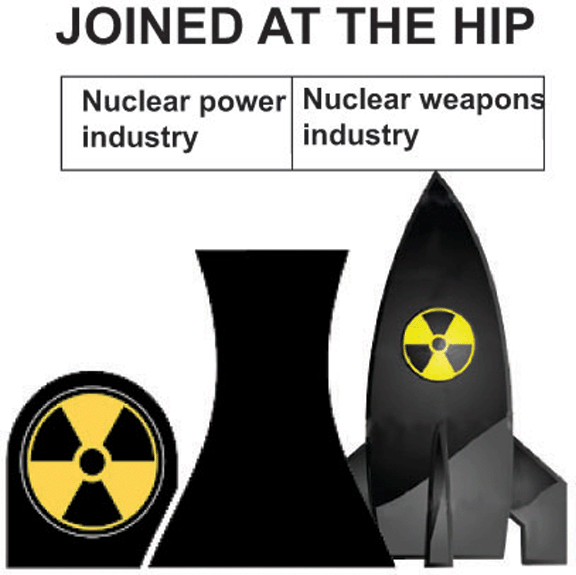
Nuclear Weapons industry relies on Nuclear Power industry, which obviously subsidises it.
The Real Nuclear Triad: Energy, Weapons and Waste NOVEMBER 7, 2017 Clear and Present Danger
Never before has the unbreakable connection between nuclear energy, weapons and waste been so blatantly obvious to the public eye…yet, with so little notice.
Although President Trump has threatened to obliterate North Korea and its 25 million people ‘with fire and fury the like of which the world has never seen,’ the NYT is reporting that America’s Asian allies doubt Washington’s ‘resolve’ to defend them with nuclear weapons and they want their own – an idea recently also floated by Trump himself.
In a new twist on the last century’s discredited ‘Atoms for Peace’ meme, the new nuclear delusion seems to be that the more countries that have nuclear weapons (Iran and North Korea excepted), the more ‘secure’ the world will become.
Speaking recently at Minot Air Force Base in North Dakota, Trump’s VP Mike Pence, a self-declared devout Christian who ‘gave my life to Jesus,’ declared “… there’s no greater force for peace in the world than the United States nuclear arsenal.”
Implication: every country should feel safer if they have a nuclear arsenal of their own. That seems precisely Kim Jong-Un’s own calculus, given his country’s previous horrific carpet-bombing experience with the US – “we… eventually burned down every town in North Korea,” Gen. Curtis LeMay told Congress – not to mention the recent history of Iraq, Libya and Syria.
Nuclear Circular Firing Squad
As agitation reportedly builds in South Korea and Japan for building their own nuclear arsenals, the Times reveals that, as a result of the radioactive waste output of their already existing nuclear energy reactor fleets, each of these tiny countries has accumulated enough weapons-grade plutonium to produce – respectively – 4,600 and 6,000 nuclear bombs.
How about that? Nations without their own ‘commercial power’ nukes must certainly take note.
Never mind the fact that such a triangle of nuclear-armed, mutually hostile, neighboring states would be like, say, New York, New Jersey and Connecticut each having their own nuclear arsenals, all pointing at each other. Talk about a circular firing squad. It’s the very definition of an ‘everybody loses’ situation.
Nuclear Triplets Joined at the Hip
But, while this is clearly an illustration of a new epidemic of nuclear crackpot madness spreading around the world, it is also the latest of several clear illustrations – and blatant, though veiled, public admissions – that the DNA-destroying nuclear triplets of energy, weapons and radioactive waste are inseparably joined-at-the-hip.
In the UK:
“Military Nuclear Industry to be Supported by Payments from Electricity Consumers”
In Britian, reports the Guardian, “The government is using the “extremely expensive” Hinkley Point C nuclear power station to cross-subsidize Britain’s nuclear weapon arsenal, according to senior scientists.”
The Guardian story continues,
In evidence submitted to the influential public accounts committee (PAC), which is currently investigating the nuclear plant deal, scientists from Sussex University state that the costs of the Trident programme could be “unsupportable” without “an effective subsidy from electricity consumers to military nuclear infrastructure.”
Prof Andy Stirling and Dr Phil Johnstone from the Science Policy Research Unit at the university write that the £19.6bn Hinkley Point project will “maintain a large-scale national base of nuclear-specific skills” without which there is concern “that the costs of UK nuclear submarine capabilities could be insupportable.”
Their evidence suggests that changes in the government’s policy on nuclear power in recent years will effectively allow Britain’s military nuclear industry to be supported by payments from electricity consumers…….https://www.counterpunch.org/2017/11/07/the-real-nuclear-triad-energy-weapons-and-waste/
Hibakusha Masako Wada speaks out at the Vatican for the abolition of nuclear weapons
Nuclear weapons are “an injustice that must be abolished by the responsibility of the humans that made them,” Masako Wada, 74, assistant secretary-general of the Japan Confederation of A- and H-Bomb Sufferers Organizations, or Nihon Hidankyo, addressed the conference.
Wada was exposed to radiation from the atomic bomb that the United States dropped on the city of Nagasaki on Aug. 9, 1945, when she was one year old.
Windows and walls of her house 2.9 km (almost 2 miles) from the epicenter of the explosion were shattered due to the blast, Wada said, citing a story she heard from her mother. Her mother told her that everybody lost feelings at the time as so many dead bodies were cremated day after day………https://www.japantimes.co.jp/news/2017/11/12/national/hibakusha-calls-abolition-nuclear-weapons-vatican-speech/#.Wgiv1tKWbGg
Now you can get an app to show you your town as if obliterated by nuclear bomb – what fun!
Nuclear Detonation App Lets You Target Your Own Hometown US News, By RUSTY MARKS, The Exponent Telegram CHARLESTON, W.Va. (AP) 12 Nov 17, — With current talk of the threat of nuclear war with North Korea, did you ever wonder what would happen if someone dropped a nuclear weapon on your hometown?
American nuclear proponents now openly admitting the connection between “peaceful” nukes and nuclear weapons
The Real Nuclear Triad: Energy, Weapons and Waste NOVEMBER 7, 2017 “……….Chasing Nuclear Market Share In a recent piece in Foreign Affairs, entitled Will the West Let Russia Dominate the Nuclear Market? – What the Westinghouse Bankruptcy Means for the Future, born-again ‘new environmentalists’ and new nukes enthusiasts Nick Gallucci and Michael Shellenberger argue that US taxpayers should
bail out the once-powerful, now bankrupt and Japanese-owned nuclear giant Westinghouse, or risk losing both global commercial and military nuclear primacy.
In the face of documented world-wide nuclear industry collapse, these guys want to revive what they call Eisenhower’s ‘humanitarian dream’ of Atoms for Peace (which spread deadly US nuclear technology around the world in the first place ) in order to, as Ike promised, “provide abundant electrical energy in the power-starved areas of the world.”
Now, according to nuclear true-believers Nick and Mike, with the added benefit of saving civilization from climate change with new, ‘clean’ nuclear energy will be run on what they call ‘accident tolerant fuels’ – still a completely untested ‘nukes-for-ever’ concept.
The core element in their misguided pitch is that the decline of the civilian nuclear industry in the USA “would significantly undermine U.S. and Western national security interests.”
This, despite statistics showing that global investments in non-hydro renewables are now greater than the global investments in nuclear, hydro and fossil fuels combined.
Nuclear Policy Group-Think Adrift in a Sea of Delusion
Elsewhere in the news, a report by the pro-nuclear Energy Innovation Reform Project on the future costs of new nuclear in the USA notes that: “A sustained decline in the commercial industry could also have a negative impact on the U.S. nuclear naval program.”
A 2017 report entitled The U.S. Nuclear Energy Enterprise: A Key National Security Enabler by the Energy Futures Initiative – another pro-nuke shop established by former Energy Secretary Ernest J. Moniz – clearly highlights the risks posed by US civilian nuclear decline to US naval supply chains………https://www.counterpunch.org/2017/11/07/the-real-nuclear-triad-energy-weapons-and-waste/
The Vatican calls for integral nuclear disarmament
http://en.radiovaticana.va/news/2017/11/12/the_vatican_calls_for_integral_nuclear_disarmament_/1348481 The Vatican is calling for integral nuclear disarmament. According to the preliminary conclusions of a just-ended high level symposium entitled “Prospects for a World Free of Nuclear Weapons and for Integral Disarmament”, integral disarmament is both an urgent immediate need and a long-term process.
The symposium, organized by the Dicastery for Promoting Integral Human Development got underway as tensions escalated between the US and North Korea.
It saw the participation of eleven Nobel peace laureates, top United Nations and NATO officials, leading experts, heads of major foundations and of civil society organizations, as well representatives of bishops conferences, Christian denominations and other faiths. Pope Francis addressed the gathering on Friday.
Wrapping up the symposium on Saturday, Cardinal Peter Turkson, President of the Dicastery for Promoting Integral Human Development, read out the following preliminary conclusions:
The Dicastery brought together religious leaders and representatives of civil society, officials of States and international organizations, noted academics and Nobel Laureates and students, to illuminate the connections between integral disarmament and integral development, and to explore the links among development, disarmament and peace. As our Holy Father, Pope Francis, repeatedly reminds us, “everything is connected.”
Nuclear deterrence is no longer acceptable: Pope Francis
Pope Francis: the possession of nuclear weapons should be firmly condemned http://catholicherald.co.uk/news/2017/11/11/pope-francis-the-possession-of-nuclear-weapons-should-be-firmly-condemned/ Pope Francis indicated that deterrence is no longer acceptable
The existence of nuclear weapons creates a false sense of security that holds international relations hostage and stifles peaceful coexistence, Pope Francis said.
“The threat of their use as well as their very possession is to be firmly condemned,” the pope told participants at a conference on nuclear disarmament hosted by the Vatican.
For years, popes and Catholic leaders had said the policy of nuclear deterrence could be morally acceptable as long as real work was underway on a complete ban of the weapons. In condemning possession of the weapons, Pope Francis seemed to indicate that deterrence is no longer acceptable.
Nuclear weapons “exist in the service of a mentality of fear that affects not only the parties in conflict but the entire human race,” he said.
The conference, sponsored by the Vatican Dicastery for Promoting Integral Human Development, brought together 11 Nobel laureates, top officials from the United Nations and NATO, diplomats from around the world and experts in nuclear weapons and the disarmament process. They were joined by scholars, activists and representatives of bishops’ conferences, including Stephen Colecchi, director of the U.S. bishops’ Office of International Justice and Peace.
Several speakers, including Masako Wada, one of the last survivors of the U.S. atomic bombing of Hiroshima in 1945, were to discuss the suffering wrought by nuclear arms.
Pope Francis told the group that the “essential” witness of survivors of the bombings in Japan as well as those suffering the effects of nuclear weapons testing are prophetic voices that serve “as a warning, above all for coming generations.”
In his speech, the pope said that when it comes to the ideal of a nuclear-free world, a “certain pessimism” exists and brings with it “considerable expense” as nations modernize their nuclear arsenals.
“As a result, the real priorities facing our human family, such as the fight against poverty, the promotion of peace, the undertaking of educational, ecological and health care projects, and the development of human rights, are relegated to second place,” he said.
Pope Francis said the existence of weapons whose use would result in the destruction of humanity “are senseless even from a tactical standpoint.”
What is more, he said, there is the growing danger that the weapons or weapon technology could fall into the wrong hands.
“The resulting scenarios are deeply disturbing if we consider the challenges of contemporary geopolitics, like terrorism or asymmetric warfare,” he said.
With the ongoing tensions surrounding North Korea’s nuclear ambitions, the Vatican conference came at a time Pope Francis described as one of “instability and conflict.”
But despite the troubling global scenario, he continued, initiatives such as the U.N. Treaty on the Prohibition of Nuclear Weapons, provide a dose of “healthy realism” that “continues to shine a light of hope in our unruly world.”
The treaty, which would enter into force 90 days after at least 50 countries both sign and ratify it, bans efforts to develop, produce, test, manufacture, acquire, possess or stockpile nuclear weapons or other nuclear explosive devices.
Although as of Sept. 20 the treaty had been signed by more than 40 countries, including the Holy See, the United States and other countries possessing nuclear weapons did not take part in the negotiations and do not plan to sign it.
Nevertheless, Pope Francis urged the international community “to reject the culture of waste” and place care for people suffering “painful disparities “over “selfish and contingent interests.”
Progress, he said, “that is both effective and inclusive can achieve the utopia of a world free of deadly instruments of aggression, contrary to the criticism of those who consider idealistic any process of dismantling arsenals.”
At a pre-conference event in Rome Nov. 9, Jesuit Father Drew Christiansen, professor of ethics and global human development at Georgetown University, and Carole Sargent, director of the university’s Office of Scholarly Publications, outlined what they saw as major progress in 2017 toward a ban on nuclear weapons.
The work of grass-roots movements and organizations, including the International Campaign to Abolish Nuclear Weapons, which won the Nobel Peace Prize, has been particularly important, Father Christiansen said. And not to be ignored are hundreds of Catholic women religious who have engaged in major protests, but also dedicated lobbying efforts. Sargent has been researching the grassroots involvement of women religious, especially in Japan, the United States and Great Britain.
The Vatican conference, Father Christiansen said, could be a major push in getting the new U.N. Treaty on the Prohibition of Nuclear Weapons “supported around the world.”
Speaking to journalists before the start of the conference, Mohamed ElBaradei, Nobel laureate and former director general of the International Atomic Energy Agency, commented on tensions between U.S. President Donald Trump and North Korea’s leader, Kim Jong Un, and the threat of nuclear war.
In August, Trump threatened to unleash “fire and fury like the world has never seen” in response to North Korea’s announcement that it had created a nuclear warhead small enough to fit on an intercontinental ballistic missile. Kim responded to Trump’s “fire and fury” talk by saying his country was preparing to fire missiles into the waters around Guam, a U.S. territory in the western Pacific Ocean with two military bases.
When asked for his response on the possibility of a U.S.-North Korea nuclear conflict, ElBaradei had few words.
“I go to pray,” he said.
UK’s “Hidden Subsidy” for Nuclear Weapons

The Real Nuclear Triad: Energy, Weapons and Waste NOVEMBER 7, 2017 “……..“Hidden Subsidy” for Nuclear Weapons
In their report, entitled Some Queries over Neglected Strategic Factors in Public Accounting for UK Nuclear Power: evidence to the House of Commons Public Accounts Committee Inquiry on Hinkley Point C (HPC), Stirling and Johnstone state that their “evidence submits that an undetermined part of the full costs of this expensive, controversial – but officially highly-prioritized – military infrastructure are in effect (without clear public acknowledgement or justification), being loaded into electricity prices. With costs of alternative large-scale domestic low-carbon energy resources like offshore wind power confirmed as significantly more favorable than HPC, it seems a hidden subsidy is being imposed on electricity consumers.”
They point out that, “If UK pursuit of uncompetitive nuclear power is partly justified as a means to sustain these shared civil-military specialized nuclear capacities, then availability of lower cost domestic low-carbon power means electricity prices are higher than would otherwise be the case…. It is this that would amount to an effective subsidy from electricity consumers to military nuclear infrastructures.”
They conclude, “Remarkably, this civil-military link is well documented in defense debates, but entirely neglected in energy policy discussion.” (emphasis added.)…..
NORTH Korea has threatened to destroy the Unites States with a “barrage of concentrated strikes”
North Korea threatens ‘barrage of concentrated nuclear strikes’ on US mainland
NORTH Korea has threatened to destroy the Unites States with a “barrage of concentrated strikes” in an astonishing rant in which they accuse Donald Trump of seeking to trigger World War 3. Express UK, By LAURA MOWAT North Korean newspaper, Rodung Sinmum, said Washington was trying to spark nuclear warfare by conducting military exercises on the doorstep of the rogue nation.
Tensions between the US and North Korea have reached boiling point in recent months and Pope Francis has stepped in to try and save the planet from nuclear war.
There are fears of another world war after the hermit nation continued its internationally condemned nuclear missile testing programme. ……http://www.express.co.uk/news/world/877996/World-War-3-North-Korea-latest-news-Trump-nuclear-strikes-United-States
Why North Korea wants nuclear weapons – the lesson from Libya
Libya: The Forgotten Reason North Korea Desperately Wants Nuclear Weapons, http://nationalinterest.org/blog/the-skeptics/libya-the-forgotten-reason-north-korea-desperately-wants-23129
Unfortunately, there are ample reasons for such distrust. North Korean leaders have witnessed how the United States treats nonnuclear adversaries such asSerbia and Iraq. But it was the U.S.-led intervention in Libya in 2011 that underscored to Pyongyang why achieving and retaining a nuclear-weapons capability might be the only reliable way to prevent a regime-change war directed against the DPRK.
Partially in response to Washington’s war that ousted Iraqi dictator Saddam Hussein in the spring of 2003, ostensibly because of a threat posed by Baghdad’s “weapons of mass destruction,” Libyan leader Muammar el-Qaddafi seemed to capitulate regarding such matters. He signed the Nuclear Nonproliferation Treaty in December of that year and agreed to abandon his country’s embryonic nuclear program. In exchange, the United States and its allies lifted economic sanctions and pledged that they no longer sought to isolate Libya. Qaddafi was welcomed back into the international community once he relinquished his nuclear ambitions.
That reconciliation lasted less than a decade. When one of the periodic domestic revolts against Qaddafi’s rule erupted again in 2011, Washington and its NATO partners argued that a humanitarian catastrophe was imminent (despite meager evidence of that scenario), and initiated a military intervention. It soon became apparent that the official justification to protect innocent civilians was a cynical pretext, and that another regime-change war was underway. The Western powers launched devastating air strikes and cruise-missile attacks against Libyan government forces. NATO also armed rebel units and assisted the insurgency in other ways.
Although all previous revolts had fizzled, extensive Western military involvement produced a very different result this time. The insurgents not only overthrew Qaddafi, they captured, tortured and executed him in an especially grisly fashion. Washington’s response was astonishingly flippant. Secretary of State Hillary Clinton quipped: “We came, we saw, he died.”
The behavior of Washington and its allies in Libya certainly did not give any incentive to North Korea or other would-be nuclear powers to abandon such ambitions in exchange for U.S. paper promises for normal relations. Indeed, North Korea promptly cited the Libya episode as a reason why it needed a deterrent capability—a point that Pyongyang has reiterated several times in the years since Muammar el-Qaddafi ouster. There is little doubt that the West’s betrayal of Qaddafi has made an agreement with the DPRK to denuclearize even less attainable than it might have been otherwise. Even some U.S. officials concede that the Libya episode convinced North Korean leaders that nuclear weapons were necessary for regime survival.
The foundation for successful diplomacy is a country’s reputation for credibility and reliability. U.S. leaders fret that autocratic regimes—such as those in Iran and North Korea—might well violate agreements they sign. There are legitimate reasons for wariness, although in Iran’s case, the government appears to becomplying with its obligations under the Joint Comprehensive Plan of Action that Tehran signed with the United States and other major powers in 2015—despite allegations from U.S. hawks about violations.
When it comes to problems with credibility, though, U.S. leaders also need to look in the mirror. Washington’s conduct in Libya was a case of brazen duplicity. It is hardly a surprise if North Korea (or other countries) now regard the United States as an untrustworthy negotiating partner. Because of Pyongyang’s other reasons for wanting a nuclear capability, a denuclearization accord was always a long shot. But U.S. actions in Libya reduced prospects to the vanishing point. American leaders have only themselves to blame for that situation.
Ted Galen Carpenter, a senior fellow in defense and foreign-policy studies at the Cato Institute and a contributing editor at the National Interest, is the author or coauthor of ten books, including The Korean Conundrum: America’s Troubled Relations with North and South Korea. He also is the author of more than seven hundred articles and policy studies on international affairs.
Senate hearing to examine Trump’s ‘authority to use nuclear weapons’
Corker announces Senate hearing to examine Trump’s ‘authority to use nuclear weapons’ https://www.cnbc.com/2017/11/09/senate-hearing-to-probe-trumps-authority-to-use-nuclear-weapons.html Christina Wilkie | @christinawilkie 8 Nov 17
- Sen. Bob Corker, R-Tenn., announced Wednesday that the Senate Foreign Relations Committee will hold a hearing Nov. 14 to examine the president’s “authority to use nuclear weapons.”
- Corker is one of Trump’s fiercest critics within his own party. The hearing represents a significant escalation of Corker’s concerns about the president’s temperament and fitness for office.
- The hearing was announced less than a day after Trump delivered a speech in which he called the nuclear-armed North Korean dictatorship a “dark fantasy” and a “military cult.”
After months of questioning President Donald Trump’s temperament and fitness for office, Sen. Bob Corker, R-Tenn., announced Wednesday that he would convene a hearing to examine the president’s authority to use nuclear weapons.
The announcement of the Nov.14 hearing before the Senate Foreign Relations Committee, which Corker chairs, amounts to a significant escalation of what has so far been a war of merely words between the powerful Republican and his party’s standard-bearer.
“A number of members both on and off our committee have raised questions about the authorities of the legislative and executive branches with respect to war making, the use of nuclear weapons, and conducting foreign policy overall,”Corker said in a statement Wednesday.
After months of questioning President Donald Trump’s temperament and fitness for office, Sen. Bob Corker, R-Tenn., announced Wednesday that he would convene a hearing to examine the president’s authority to use nuclear weapons.
The announcement of the Nov.14 hearing before the Senate Foreign Relations Committee, which Corker chairs, amounts to a significant escalation of what has so far been a war of merely words between the powerful Republican and his party’s standard-bearer.
“A number of members both on and off our committee have raised questions about the authorities of the legislative and executive branches with respect to war making, the use of nuclear weapons, and conducting foreign policy overall,” Corker said in a statement Wednesday.
“This continues a series of hearings to examine those issues and will be the first time since 1976 that this committee or our House counterparts have looked specifically at the authority and process for using U.S. nuclear weapons. This discussion is long overdue, and we look forward to examining this critical issue,” Corker said.
The announcement came less than a day after Trump delivered a combative speech aimed at North Korean leader Kim Jong-Un, in which the president called North Korea a “dark fantasy” and a “military cult.” Speaking in South Korea, Trump accused the hermit kingdom of being founded on “a deranged belief in the leader’s destiny to rule as parent-protector over a conquered Korean Peninsula and an enslaved Korean people.”
Trump’s insistence on engaging in brinkmanship with the nuclear-armed dictator has stunned many military and foreign policy professionals, who fear the president’s ego could lead the country down a path to war.
Some of those professionals are scheduled to testify at Tuesday’s hearing. One, Brian McKeon, is the former Acting Under Secretary for Policy at the Department of Defense under President Barack Obama, and a critic of Trump’s approach to nuclear-armed North Korea.
Another witness is retired Air Force General Robert Kehler, a former commander of the U.S. Strategic Command and an expert in nuclear weapons and the capabilities of America’s nuclear arsenal.
The third witness is Peter Feaver, a former director for Defense Policy and Arms Control at the National Security Council during the George W. Bush administration. In 2016, Feaver was one of nearly 50 Republican national security officials who signed a letter opposing Trump’s candidacy for president. Since then, Feaver has made no secret of the fact that he views Trump as a potential threat to national security.
“In a crisis, for instance with a nuclear-armed North Korea, Trump’s temperament could be problematic and could lead to dangerous escalation, whereas another President with better self-control might be able to manage it more safely,” Feaver told the Duke University Chronicle in August of last year.
A White House spokesman did not immediately respond late Wednesday to a request for comment on the hearing.
Feaver’s view is one that Corker has expressed repeatedly, not least when he called the White House “an adult day care center” last month in response to attacks from Trump.
Hawaii prepares for nuclear attack
commercials drilled the “duck and cover” mantra into the minds of Americans, and the possibility of a Soviet attack was always around the corner.But after the Cold War, most places abandoned their sirens. Fears of terrorism grew more urgent and, for many younger Americans, being on notice for nuclear war became a relic of the past.
That’s no longer the case in Hawaii.
Amid increasing North Korean threats against the U.S., Hawaii has launched the most aggressive effort in the country to prepare for attack. TV commercials warn the state’s 1.4 million residents to “get inside, stay inside” if a bomb drops. State officials are holding online forums and flying between islands for town halls to field questions from residents.
On Dec. 1, the nuclear attack warning siren will be heard in the state for the first time in more than three decades.
A North Korean bomb is “a major, major concern,” Vern Miyagi, the administrator of the Hawaii Emergency Management Agency, said recently during a seminar he held for residents in a packed meeting room at the state’s Department of Defense offices in Honolulu. He painted a stark picture of what emergency officials expect if a nuclear missile was to reach Oahu.
“We are talking about 50,000 to 120,000 trauma and burn causalities together with nearly 18,000 fatalities,” Miyagi, the state’s chief expert on natural disasters and the North Korean threat, explained. The expected target: Pearl Harbor.
More accustomed to educating residents about hurricanes and tsunamis than atomic and hydrogen bombs, Miyagi displayed slides illustrating potential impact to the island from a 100-kiloton nuclear bomb detonated 1,000 feet above Honolulu. The explosion would hit an area about eight miles in diameter, he said. Ninety percent of people would survive the direct impact but could be hit by nuclear fallout and would have to navigate a crippled island…….. http://www.latimes.com/nation/la-na-hawaii-nuke-2017-story.html
Japan will continue to reject nuclear weapons
Three reasons why Japan will likely continue to reject nuclear weapons, WP, President Trump is visiting Tokyo on Monday at a time of renewed national security debates within Japan. North Korea’s recent missile launches and nuclear tests have again prompted discussion in Tokyo on Japan’s policy against becoming a nuclear state.
Although Japan has long had the technical ability to develop nuclear weapons — its “nuclear hedge” — it has refrained from doing so. Japan instead remains firmly committed to its 1967 Three Non-Nuclear Principles of not developing, not possessing and not introducing nuclear weapons.
This is not the first time that Japan has reexamined those principles. Similar debates transpired after China’s hydrogen bomb test in 1967, the Soviet Union’s deployment of medium-range nuclear missiles in Siberia during the 1980s and North Korea’s first nuclear test in 2006.
Is this time different? Reacting to North Korea’s threatening behavior, former Japanese defense minister Shigeru Ishiba stated in September that Japan should at least debate the decision not to permit the introduction of nuclear weapons on Japanese territory. Ishiba implied that Tokyo should consider asking Washington to deploy tactical nuclear weapons in Japan.
This latest debate is likely to end in the same way as previous debates, however. Japan will continue to adhere to its Three Non-Nuclear Principles and forswear nuclear weapons. Here are three reasons for that:
1) Staying non-nuclear is part of Japan’s national identity
The Three Non-Nuclear Principles are a clear part of Japan’s national identity, not simply a policy preference. Repeated polls indicate overwhelming popular support for the three principles in Japan. A 2014 Asahi newspaper poll revealed that support for the principles had risen to 82 percent, compared with 78 percent in a 1988 poll. Despite growing concerns about North Korea’s nuclear program and China’s military power during this period, Japanese support for remaining non-nuclear actually increased…….
2) Powerful players in Japanese politics can block nuclear acquisition
In addition to public opposition to nuclear weapons, Japan has significant “veto players” — crucial political or economic actors that are likely to block efforts to develop nuclear weapons.
Japan has a robust nuclear energy industry. But public acceptance of nuclear energy in the 1950s resulted from a fundamental political bargain: nuclear energy, but no nuclear weapons……
3) Japan has good national security reasons to stay non-nuclear
There’s also a realist security calculation to consider. North Korean nuclearization is alarming, but it does not pose such an acute danger that Japanese leaders will be motivated to pay the high political costs necessary to weaken, much less revoke, the Three Non-Nuclear Principles.
North Korea acquiring the ability to deliver a nuclear weapon against the United States may weaken the protective U.S. nuclear umbrella somewhat, but U.S. nuclear and conventional military capabilities should be adequate to deter a North Korean nuclear attack on Japan……
And there’s a final consideration: A Japanese bomb would probably destabilize the country’s relations with China and South Korea. At a time when North Korea is making the international politics of the region complicated, Japan is likely to stay its non-nuclear course rather than make a disruptive nuclear move of its own. https://www.washingtonpost.com/news/monkey-cage/wp/2017/11/06/japan-is-likely-to-retain-its-non-nuclear-principles-heres-why/
Nuclear Disarmament Conference hosted by the Vatican
Vatican to host nuclear disarmament conference, CNA, By Hannah Brockhaus, .– The Vatican is preparing for a conference on nuclear disarmament this week in the wake of an international effort to ban nuclear weapons.
Hosted by the Dicastery for the Promotion of Integral Human Development, the Nov. 10-11 conference will explore solutions and prospects for a world free of nuclear weapons and integral disarmament, in cohesion with Pope Francis’ emphasis on promoting peace.
In a Nov. 7 Vatican communique Cardinal Peter Turkson, prefect of the dicastery, said the event “responds to the priorities of Pope Francis to take action for world peace and to use the resources of creation for a sustainable development and to improve the quality of life for all, individuals and countries, without discrimination.”
At the International Atomic Energy Agency conference in Vienna in September, department secretary Msgr. Bruno Marie Duffé also emphasized the importance of the “moral responsibility of the States” and the challenge of a “common strategy of dialogue” invoked by Pope Francis.
The international symposium represents “the first global gathering on Atomic Disarmament” after the approval of the Treaty on the Prohibition of Nuclear Weapons was passed in New York July 7.
Until the treaty, nuclear weapons were the only weapons of mass destruction not explicitly banned by any international document.
The treaty passed with 122 votes in favor and one abstention, Singapore. However, 69 countries – all the nuclear weapon states and NATO members except the Netherlands – did not take part in the vote.
One of the conference’s speakers Saturday will be Masako Wada, one of the last survivors of the Hiroshima nuclear attack and an assistant secretary general of Nihon Hidankyo, a confederation of nuclear weapons and experiments victims.
Other attendees include 11 Nobel Peace Laureates, representatives from the United Nations and NATO, diplomats from Russia, the United States, South Korea, and Iran, experts on armaments and weapons and leaders from foundations engaged in the topic……. https://www.catholicnewsagency.com/news/vatican-to-host-nuclear-disarmament-conference-55175
Invasion is ‘only way’ to destroy Kim Jong-un’s military threat, Pentagon official says
North Korea: Invasion is ‘only way’ to destroy Kim Jong-un’s military threat, Pentagon official says http://www.abc.net.au/news/2017-11-06/north-korea-pentagon-joint-chiefs-invasion-only-way-to-disarm/9121092 A ground invasion of North Korea is “the only way” to locate and destroy with complete certainty Kim Jong-un’s nuclear weapons program, the Pentagon Joint Chiefs of Staff have said.
Key points:
- US officials requested a detailed assessment of the consequences of a North Korean war
- The assessment says an invasion is the only way to disarm North Korea with certainty
- The statement says millions could die in days and that chemical weapons may be used
- The Joint Chief of Staffs directly advise the US President on military matters
In a letter to the Pentagon, two House Democrats had asked about casualty assessments in a possible conflict with North Korea, and Rear Admiral Michael J Dumont of the Joint Staff responded on behalf of the Defence Department.
“It is our intent to have a full public accounting of the potential cost of war, so the American people understand the commitment we would be making as a nation if we were to pursue military action,” the representatives’ letter said.
“We have not heard detailed analysis of expected US or allied force casualties, expected civilian casualties, what plans exist for the aftermath of a strike — including continuity of the South Korean Government.”
In his response, Mr Dumont noted that the United States’ military and intelligence agencies are evaluating North Korea’s ability to target heavily populated areas of South Korea with long-range artillery, rockets and ballistic missiles.
“A classified briefing would be the best place to discuss in detail the capability of the US and its allies,” Mr Dumont’s letter said.
“[And] to discuss capabilities to counter North Korea’s ability to respond with a nuclear weapon and eliminate North Korea’s nuclear weapons located in deeply buried, underground facilities.”
In his response, Mr Dumont highlighted that Seoul, the South Korean capital with a population of 25 million, was just 55 kilometres from the demilitarised zone(DMZ) that separates the two Koreas. The amount of casualties would differ depending on the advance warning and the ability of US and South Korea forces to counter these attacks.
Mr Dumont also highlighted the possibility that chemical and biological weapons might be used by the North in case of a conflict.
In the US military the Joint Chiefs of Staff directly advise the President on military matters.
Responding in a joint statement, 15 Democratic officials and one Republican — all military veterans — called Mr Dumont’s assessment that a ground invasion would be required to destroy the North’s nuclear arsenal “chilling” and “deeply disturbing”.
“The Joint Chiefs of Staff has now confirmed that the only way to destroy North Korea’s nuclear arsenal is through a ground invasion,” the joint statement said. That is deeply disturbing and could result in hundreds of thousands, or even millions of deaths in just the first few days of fighting.
“Their assessment underscores what we’ve known all along: there are no good military options for North Korea.”
They also noted that the Trump administration “has failed to articulate any plans to prevent the military conflict from expanding beyond the Korean Peninsula and to manage what happens after the conflict is over”.
“With that in mind, the thought of sending troops into harm’s way and expending resources on another potentially unwinnable war is chilling,” they said.
“The President needs to stop making provocative statements that hinder diplomatic options and put American troops further at risk.”
Speaking to CNN overnight, Senator Dianne Feinstein, a member of the Senate Intelligence Committee, called the assessment “bleak”, but added that she was pleased that Secretary of State Rex Tillerson was accompanying President Donald Trump during his trip to Asia, where North Korea is the main issue on the agenda.
“I think if he will stay the course and use diplomacy the way diplomacy can be used, then it might be possible to work something out,” Ms Feinstein said.
“The worst alternative is a war which could become nuclear.”
-
Archives
- June 2026 (193)
- May 2026 (306)
- April 2026 (356)
- March 2026 (251)
- February 2026 (268)
- January 2026 (308)
- December 2025 (358)
- November 2025 (359)
- October 2025 (376)
- September 2025 (257)
- August 2025 (319)
- July 2025 (230)
-
Categories
- 1
- 1 NUCLEAR ISSUES
- business and costs
- climate change
- culture and arts
- ENERGY
- environment
- health
- history
- indigenous issues
- Legal
- marketing of nuclear
- media
- opposition to nuclear
- PERSONAL STORIES
- politics
- politics international
- Religion and ethics
- safety
- secrets,lies and civil liberties
- spinbuster
- technology
- Uranium
- wastes
- weapons and war
- Women
- 2 WORLD
- ACTION
- AFRICA
- Atrocities
- AUSTRALIA
- Christina's notes
- Christina's themes
- culture and arts
- Events
- Fuk 2022
- Fuk 2023
- Fukushima 2017
- Fukushima 2018
- fukushima 2019
- Fukushima 2020
- Fukushima 2021
- general
- global warming
- Humour (God we need it)
- Nuclear
- RARE EARTHS
- Reference
- resources – print
- Resources -audiovicual
- Weekly Newsletter
- World
- World Nuclear
- YouTube
-
RSS
Entries RSS
Comments RSS