Trump’s plan for new low-yield nuclear weapon – superfluous and dangerous
Trump Wants a New Low-Yield Nuclear Weapon. But the US Has Plenty Already. UCS
ERYN MACDONALD, ANALYST | JUNE 18, 2018, The Trump administration’s Nuclear Posture Review (NPR), released in February of this year, calls attention to the composition of the US nuclear arsenal and its adequacy as a deterrent. The NPRcalls for a new lower-yield submarine-launched nuclear warhead, arguing that it is needed to “counter any mistaken perception of an exploitable ‘gap’ in U.S. regional deterrence capabilities.” We decided to put together the chart in Fig. 1 to illustrate the range of nuclear weapons alreadyavailable in the US arsenal.
One thing that this visual immediately makes clear is that it would be difficult to perceive any real gap in US capabilities—the existing arsenal certainly does not lack for nuclear options for any occasion……….Labeling such deadly and destructive weapons “low-yield” may give leaders the dangerous impression that using them is not as serious as using a nuclear weapon with a larger yield, and that their use would not lead to full-scale nuclear war. But in reality, no one knows what would happen if a nuclear weapon—of any size—were once again used in war. As Defense Secretary James Mattis has said,
“I don’t think there’s any such thing as a tactical nuclear weapon. Any nuclear weapon used at any time is a strategic game changer.”
The administration’s choice of language in the NPR rationale for the new warhead is also interesting. It does not argue that such a gap actually exists, but that it is concerned that an adversary might mistakenly perceive one. While perceptions are always an important consideration in deterrence, it’s useful to keep in mind the fact that 1) we don’t actually know what our adversaries are thinking, and we’ve been dangerously wrong in past guesses; and 2) trying to ensure that no country could ever possibly perceive that it might have any type of military advantage is how arms races happen. Most relevant in the current situation, it is how the US and Soviet Union ended the Cold War with arsenals of tens of thousands of nuclear weapons each. This type of thinking is not about deterrence, but about “escalation dominance” and “nuclear warfighting,” both of which are even more unstable and dangerous.
Recognition of the particular dangers of low-yield nuclear weapons has, until recently, been widespread and bipartisan among US military and political leaders. Over the past several decades, the United States has eliminated much of its arsenal of low-yield nuclear weapons for this and other reasons. The Trump administration’s new move to develop more of these weapons is a step in the wrong direction that is both unnecessary and dangerous. https://allthingsnuclear.org/emacdonald/trump-wants-a-new-low-yield-nuclear-weapon
New Zealand’s Antarctic veterans are advised on effects of their exposure to nuclear radiation
New Zealand warns its Antarctic veterans about radiation risks from leaky US Navy reactor https://www.stripes.com/news/new-zealand-warns-its-antarctic-veterans-about-radiation-risks-from-leaky-us-navy-reactor-1.533546 By SETH ROBSON | STARS AND STRIPES June 19, 2018
The New Zealand government is warning personnel who worked in Antarctica in the 1960s and ‘70s about radiation from a leaky U.S. Navy reactor.
Alerts were posted online by the New Zealand Defence Force, Antarctica New Zealand and other government entities in January and reported by local media last month.
They advise people to contact the New Zealand Office of Radiation Safety or their doctor if they think they may have been exposed to radiation from the reactor used to power McMurdo Station, Antarctica, from 1962 to 1979.
The U.S. Department of Defense has assessed the risk of radiation exposure for those who worked near the power plant as low.
However, the Department of Veterans Affairs ruled in November that retired Navy veteran James Landy’s “esophageal, stomach, liver, and brain and spine cancers, [were] incurred in active duty service.”
Landy worked at McMurdo as a C-130 flight engineer from 1970 to 1974 and from 1977 to 1981 before dying at age 63 in 2012, said his widow, Pam Landy.
He had pain in his kidneys and went to the doctor and they sent him to an oncologist who said he had cancer from radiation exposure,” she said in a phone interview Monday from her home in Pensacola, Fla.
Veterans who served in Antarctica should have been warned about the radiation risk, Pam Landy said.
“The government knew that thing was there. If they had given people a heads up he could have been diagnosed early and might have a shot at being alive,” she said. “I got a payout from the VA, but it’s a pittance compared to a life.”
The McMurdo reactor had many malfunctions, but personnel might also have been exposed during its decommissioning when soil and rock from the site was trucked through the base to be shipped off the continent, she said.
Peter Breen, 64, was a New Zealand Army mechanic about 2 miles from McMurdo at Scott Base from 1981 to 1982. Rock and soil from the reactor site was taken to a wharf in open trucks, and Breen fears he could have been exposed to contaminated dust blown by the wind or on ice harvested from nearby cliffs.
He’s campaigning for New Zealand Antarctic veterans to be recognized with a medal and offered health checks.
“It is not compensation that guys are after,” he said in a phone interview from his home in Tauranga, New Zealand. “They want a health-check program.”
robson.seth@stripes.com
Twitter: @SethRobson1
Satellite photo indicates that Russia is upgrading a key nuclear weapons storage site
Is Russia upgrading nuclear bunker? Nine News,
For a nation that attacks another with nuclear weapons, the consequences will be fatal TO ITSELF
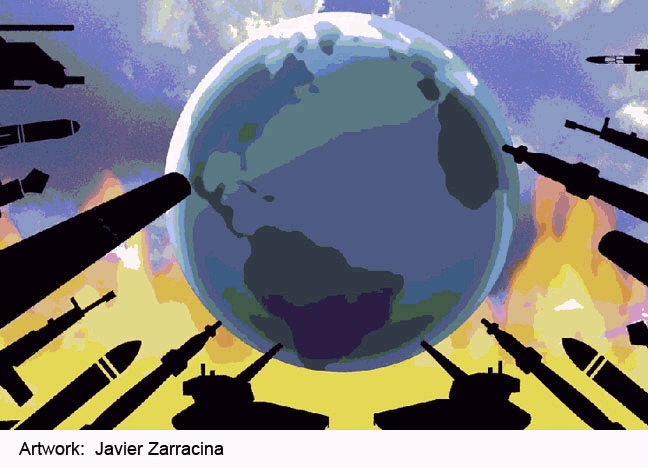 Paper Reveals Amount Of Nuclear Weapons Fatal To Own Citizens Of The Firing Nation http://www.techtimes.com/articles/230423/20180617/paper-reveals-amount-of-nuclear-weapons-fatal-to-own-citizens-of-the-firing-nation.htm By Athena Yenko Tech Times
In a scenario where the United States launches a nuclear attack against a country, Americans won’t be spared from the fatal consequences of that same strike.
The first thing that comes to mind when discussing a nuclear war is how it could obliterate the target country. A new paper, therefore, examined the consequences of a nuclear strike on the very nation firing the weapons.
The Consequences Of A Nuclear Strike
The repercussions were imagined in “best-case scenario,” where the target nation would not engage in any counterattack. For example, if the United States fired a nuclear weapon, its very own people would suffer an effect called “nuclear autumn” or environmental blowback.
There would be a drastic drop in temperature because of the “soot” or chemical remnants from nuclear blasts that would block the sun from reaching the Earth’s surface. A decreased in precipitation would follow.
As days go by, there would be an increased ultraviolet radiation because of the damaged atmosphere. Eventually, starvation would happen as a result of non-functioning supply chains.
“If we use 1,000 nuclear warheads against an enemy and no one retaliates, we will see about 50 times more Americans die than did on 9/11 due to the after-effects of our own weapons,” reads one example given by Joshua Pearce, one of the authors of the paper.
The paper essentially warned that any nation who plans to launch a nuclear war must first assess whether it could survive the problems of its own making.
A Nuclear War Perspective
According to the paper, Americans would only be saved from the nuclear autumn if the United States would limit its strike to a use of 100 nuclear missiles. The problem, however, is that countries such as the United States and Russia possess thousands of nuclear arsenals.
In its calculation, the paper assumed that the United States would launch nuclear bombs with yields amounting to 15 kilotons. This would just be the same amount of explosive dropped over Hiroshima and Nagasaki.
However, the nuclear bombs owned by the countries at present are five to 25 times more lethal than what was used during the World War II. The explosive yields of nuclear weapons at present range from 100 to 500 kilotons.
The largest, however, has an explosive yield of 5,000 kilotons. The United States, in fact, has one with an explosive yield of roughly 1,400 kilotons.
Amount Fatal To Americans If The US Initiates Nuclear Attack
The paper published in the journal Safety on June 14 calculated the potential damage if the United States were to fire 7,000 nuclear missiles, 1,000 nuclear missiles, and 100 nuclear missiles. The nuclear attacks were imagined to be launched against China.
The 7,000 warheads would produce 30 trillion grams of soot. It could result in a nuclear autumn on a worldwide level and, later on, could starve as much as 5 million Americans. The 1,000 nuclear arsenal fired would produce 12 trillion grams of soot, which could starve 140,000 Americans.
Meanwhile, Americans would be saved from starvation if the United States were to fire 100 nuclear missiles. On the other hand, it could kill as much as 30 million people in China, which in return, could set off a counterattack.
An Appeal To Department Of Defense
The authors of the study argued that there would be no logical reason for any country to maintain nuclear arsenals greater than 100. They now call for the U.S. Department of Defense to include the potential environmental blowback to the American people when designing its nuclear policies
“The U.S. government should greatly increase focus on producing alternative food to provide for survivors in the case of nuclear war,” said David Denkenberger, one of the authors of the paper.
More importantly, the authors of the paper call for worldwide country leaders to reduce the nuclear weapon arsenals they keep in their possessions.
How the use of nuclear weapons would drastically reshape the Earth
Why having over 100 nuclear weapons could do more harm than good to a country, The Journal, Órla Ryan@orlaryan orla@thejournal.ie
Experts have looked into the impact using such weapons would have on a nation’s population and resources.
HAVING MORE THAN 100 nuclear weapons in a nation’s arsenal could cause more harm than good for the country itself, according to a new study.
Researchers have said that while countries tend to believe that having access to more weapons is intimidating and makes other countries think twice before attacking them, using such weapons can destabilise the country itself.
The US and Russia, for example, each have thousands of nuclear weapons.
Joshua Pearce, professor at Michigan Technological University, and David Denkenberger, assistant professor at Tennessee State University and director of Alliance to Feed the Earth in Disasters (Allfed), co-authored an article published this week in the journal Safety.
Pearce and Denkenberger examined direct negative physical consequences of the use of nuclear weapons to the nation firing them, including impacts such as starvation and global supply chain disruption as well as the cost to maintain an extensive arsenal.
They found that a country willing to use nuclear weapons against another nation must determine whether it has the ability to survive the problems this will create.
There are nine nuclear-weaponised nations: the US, Russia, the UK, France, China, India, Pakistan, Israel and North Korea. There are approximately 15,000 nuclear weapons globally. Under the disarmament proposed in this research, this number would drop to 900 or fewer.
“With 100 nuclear weapons, you still get nuclear deterrence, but avoid the probable blowback from nuclear autumn that kills your own people,” Pearce said.
He added that defence expenditure post-9/11 shows that the US cares about “protecting Americans”.
If we use 1,000 nuclear warheads against an enemy and no one retaliates, we will see about 50 times more Americans die than did on 9/11 due to the after-effects of our own weapons.
Pearce said that this is the first study to quantitatively demonstrate just how dangerous the use of nuclear weapons is even for the aggressor nation.
……….. Starvation and violence
The consequences of environmental blow-back include a significant drop in global temperature because of soot from nuclear blasts blocking the sunlight from reaching Earth’s surface, decreased precipitation, a drop in food production because of blocked sunlight and less moisture, increased ultraviolet radiation resulting from a badly damaged atmosphere, and non-functioning supply chains.
“We should be clear this analysis represents a severe underestimate on the number of dead Americans,” Pearce said.
We assume severe rationing, which is the best way to keep the most people alive when there is this level of food shortage. It means anyone who would die of starvation is immediately cut off from food.
“I don’t think rationing would go overly smoothly — a lot more people would die in violence internally than what we estimated based on lack of calories.”
100, 1,000 or 7,000 weapons
Pearce and Denkenberger examined the threat-potential of a 7,000-weapon arsenal, a 1,000-weapon arsenal and a 100-weapon arsenal.
Playing out a hypothetical scenario, the researchers explained that if the US used 100 nuclear weapons against China’s most populous cities, for example, initial blasts would likely kill more than 30 million people.
This would kill a higher fraction of the population than even severe pandemics. Sunlight would decrease by 10 to 20% and precipitation by 19% or more.
Pearce and Denkenberger, based on previous work, built a model of the burnable material in cities, how much would burn in a nuclear attack, how much of that would turn into smoke, and how much of that smoke would make it into the upper atmosphere.
Food supply
Then they used the result of climate and crop simulations to predict the impact on food supply. They coupled this with food storage to predict how many people would starve.
The agricultural loss from this so-called ‘nuclear autumn’ would range from 10-20%, enough to cause widespread food shortages in wealthier nations and mass starvation in poorer nations, researchers said.
Starvation could result because nuclear weapons would cause cities to burn, putting smoke into the upper atmosphere and blocking sunlight for years.
This could cause lower rainfall and lower temperatures, potentially causing winter-like weather in the summer, so-called ‘nuclear winter’. Less severe reduction in sunlight, which is called ‘nuclear autumn’, could still cause millions of people to starve.
It is clear that even 100 nuclear weapons is more than enough to dramatically reshape the globe, and Pearce and Denkenberger argue it’s also more than enough to deter other countries.
Maintaining more than that number, the authors state, is not only against the best interest of a nation to protect its people, but also costs a significant amount to maintain.
Denkenberger said the US government “should greatly increase focus on producing alternative food to provide for survivors in the case of nuclear war; with supply chains cut-off, all food Americans eat will have to come from within the nation’s borders”.
Pearse added that it’s “not rational to spend billions of dollars maintaining a nuclear arsenal that would destabilise your country if they were ever used”.
“Other countries are far worse off. Even if they fired off relatively few nuclear weapons and were not hit by any of them and did not suffer retaliation, North Korea or Israel would be committing national suicide,” he said.
100 nuclear weapons is the “pragmatic limit” for any country to have in its arsenal.

The study was published in the journal Safety on Thursday; it was co-authored by Michigan Technological University professor Joshua Pearce and David Denkenberger, assistant professor at Tennessee State University and director of Alliance to Feed the Earth in Disasters.
“The results found that 100 nuclear warheads is adequate for nuclear deterrence in the worst case scenario, while using more than 100 nuclear weapons by any aggressor nation (including the best positioned strategically to handle the unintended consequences) even with optimistic assumptions (including no retaliation) would cause unacceptable damage to their own society,” the scientists wrote.
There are approximately 15,000 nuclear weapons globally, according to the research, with the US and Russia accounting for nearly 90 percent of that total. With nine nuclear weaponized countries, the paper argues for a disarmament proposal that would reduce the number of nuclear weapons in the world to 900 or less.
“100 nuclear warheads is the pragmatic limit and use of government funds to maintain more than 100 nuclear weapons does not appear to be rational,” the paper argues.
The scientists discuss the devastating global environmental impact that would occur when a country deploys more than 100 nuclear weapons.
This “environmental blowback” would involve a significant drop in global temperatures as soot from nuclear blasts prevents sunlight from reaching Earth’s surface. This, combined with reduced precipitation, could severely impact food production, experts warn, potentially resulting in mass starvation.
“If the agricultural productivity reverts to preindustrial yields because of a nuclear strike, most countries would not be able to feed themselves,” the study says.
Researchers also cite conservative estimates that 34 million people would die if 100 nuclear bombs were unleashed on China, the world’s most populous nation.
Completely ignored in nuclear summit talks – the forgotten North Korean victims of 1945 atomic bombs
 Trump–Kim: an agenda for forgotten nuclear victims, ps://www.lowyinstitute.org/the-interpreter/trump-kim-agenda-forgotten-nuclear-victimsThe Interpreter, BY Lauren Richardson, @Lauren_ANU 14 June 18
Like most Korea observers, in the lead-up to the Trump–Kim summit I have been inundated with questions from journalists and friends alike. Does Kim Jong-un have any actual intention to denuclearise? Would Donald Trump settle for anything less than complete, verifiable, irreversible disarmament (CVID) of North Korea’s nuclear program? Will North Korea’s human rights abuses be on the agenda? And, in that vein, will Trump raise the issue of North Korean abductions of Japanese citizens?
There is, however, one question that no one is asking. And it is a crucial one.
What about the North Korean A-bomb victims, the only survivors of the US nuclear attacks on Japan, who have never had recourse to monetary redress? Will they be on the summit agenda?
The absence of this question in the summit discussions is unsurprising. North Koreans are the forgotten victims of the atomic bombs and represent a gap in global memory of nuclear issues. It is not commonly known that when the US dropped atomic bombs over Nagasaki and Hiroshima in August 1945, roughly 10% of the victims of these attacks were of Korean descent.
Koreans were residing in the A-bomb target cities in large numbers under colonial auspices: in many cases they had been brought there against their will, forced to perform labour in Japan’s military industrial factories.
And it is a virtually unknown fact that when Koreans were repatriated to their newly divided homeland in the years following Japan’s surrender, approximately 2000 of the A-bomb survivors wound up north of the 38th parallel, suffering from the unrelenting effects of the radiation blast. Many of them are still alive and ailing today. In a further twist of fate, owing to the lack of diplomatic relations between Pyongyang and Tokyo, North Korean victims were precluded from financial assistance provided by the Japanese government to overseas A-bomb survivors, including South Koreans, in later decades. This was premised on a belief that “the money would likely never reach them”.
The plight of the North Koreans would never have come to light at all were it not for an activist named Lee Sil-gun. I have sat with Lee in Hiroshima on a number of occasions to interview him about his advocacy efforts. He was born in Japan in 1929 to Korean parents, and became an atomic bomb victim by virtue of exposure to residual radiation in Hiroshima.
In the post-war years, as the plight of A-bomb victims became politicised in Japan and the redress movement launched by South Korean victims gradually gained traction, he was dismayed to find that the voiceless North Koreans had been left out of the discourse:
I knew that there were victims in the North because I farewelled them at the port when they were shipped off from Japan after the Second World War.
Lee began embarking on annual visits to Pyongyang in the 1990s in an attempt to reach out to the victims there. He was supported in this endeavour by a small group of dedicated Japanese anti-nuclear activists.
They found the North Koreans in a terrible predicament: without recourse to adequate medical care, the victims were resorting to various primitive methods to treat their radiation-related maladies. They were burning sulphur, for instance, and using the smoke to sterilise recurrent wounds.
On discovering this, Lee and his supporters arranged a dispatch of Japanese medical practitioners to the DPRK to train local doctors in the treatment of A-bomb illness; they then organised a converse delegation of victims and doctors from North Korea to Japan, to respectively undergo treatment and be familiarised with advanced medical equipment.
North Korean officials were appreciative of and inspired by Lee’s efforts, and in 1997 issued him with an astonishing request. They asked Lee if he would organise a photo exhibition in North Korea depicting the destructive impact of nuclear weapons. Lee happily obliged, and this exhibit came to fruition two years later: 77 photos were displayed in the Grand People’s Study House in central Pyongyang from 13–18 August 1999.
I found a newspaper article about this event in an archive in Seoul. When I asked Lee how he managed to pull it off, he became choked with emotion. Through tears, he said:
I went to the Hiroshima Peace Memorial Museum and asked if I could borrow some of their posters and photos. At first they were reluctant, but eventually they let them have them for a month. I was so happy.
Four reasons make plain why this issue should be part of the Trump–Kim summit and any ongoing US–DPRK talks.
First, for Trump to acknowledge North Korea’s long-ailing A-bomb victims would be the best way to set the scene for talks on denuclearisation. Consider Barack Obama’s playbook, for instance. When he made an historic visit to the Hiroshima Peace Memorial in 2016, paying homage to the nuclear victims, it did wonders for US–Japan relations. Paying tribute to the North Korean victims at the summit would serve to frame the negotiations in such a way that Pyongyang was not the only party with adverse nuclear potential at the table.
Second, the issue of North Korean A-bomb victims would be a reminder that the devastating potential of nuclear weapons is embedded in the memory of North Korea. This should factor into Trump’s strategic calculus of Kim’s intentions for his nuclear program.
To be sure, Kim is young and did not experience first-hand the turmoil in Northeast in the aftermath of the US atomic bombings. But his grandfather did. And his own father permitted the efforts of activists from Japan to advocate on behalf of North Korean A-bomb victims – the same victims that live among Kim Jong-un’s populace today. Thus, if Trump does not manage to achieve the grand CVID bargain that he hopes for at the summit, he shouldn’t jump to the conclusion that Kim intends to use his nukes in the near future.
Third, any settlement regarding the “denuclearisation” of the Korean Peninsula should reasonably entail the establishment of a specialist treatment facility for A-bomb victims in the North. Two years ago, I visited a nursing home that offers round-the-clock treatment to the South Korean victims in Hapcheon County; the patients reported to me that they were still having tiny shards of glass surgically removed from their faces all these decades down the track.
While I don’t wish to suggest that the South Koreans are better off – in fact, they are still suffering immensely – the North Koreans have been left without any such facility. If the 1945 chapter of nuclear history has still not been settled, how can we expect to settle the current one with North Korea?
Lastly, raising the North Korean A-bomb victims issue would serve as a stark reminder at the summit that there is still only one government that has deployed nuclear weapons in conflict, and it is not Pyongyang. To the contrary, (the now) North and South Koreans were the collateral damage of that historic conflict, and many are still awaiting redress.
* This piece is based on a forthcoming journal article.
The huge danger to Americans of keeping hundreds of nuclear weapons on hair-trigger alert

The US still keeps hundreds of nuclear weapons on hair-trigger alert — here’s what it means and why it’s a huge risk https://www.businessinsider.com.au/trump-kim-nuclear-summit-hair-trigger-alert-2018-6?r=US&IR=T, LEANNA GARFIELD
USA Federal nuclear weapons facilities are getting systems to disable drones
Federal nuclear weapons plants getting capability to disable drones,https://www.knoxnews.com/story/news/local/tennessee/2018/06/14/federal-nuclear-weapons-plants-getting-capability-disable-drones/702654002/
ALL the nuclear weapons countries pose a peril, not just North Korea
The big picture: The world’s other nuclear weapons hot spots https://www.axios.com/north-korea-countries-nuclear-weapons-programs-f09c202a-e776-4f89-8588-b035af517eb7.html
For all the attention North Korea is getting, there’s a web of nuclear threats around the world that risk setting off an arms race all on their own — even if the North Korean threat goes away.
The big picture: It’s worth taking the time to focus on the other standoffs. Heightened risk is not a certainty that nuclear conflict breaks out, but the web is tangled enough that a spark of conflict could have wide-ranging global consequences.
Iran
Iran began increasing its uranium enrichment following the U.S. withdrawal from the nuclear deal, and it may not remain in the deal with other countries much longer. Most of the incentive to remain in the deal came from economic benefits of doing business with the United States — and Europe alone will have trouble enticing Iran to stay in the deal.
Saudi Arabia
The Saudis have said they would consider making nuclear weapons if Iran restarts its nuclear weapons program. And Saudi Arabia has been seeking U.S. help in starting a nuclear program, even though Riyadh hasn’t accepted terms of uranium enrichment that would prevent the program from escalating beyond peaceful aims. Israel has gotten involved in the conversation in an attempt to prevent a potential arms race in the region.
China
Its nuclear policy states that it would only use nuclear weapons in response to an attack — but analysts close to the Chinese government fear that the U.S. National Security Strategy and Nuclear Posture Review frame China as a potential target for the U.S. as a primary rival on the world stage. And China has been working to catch up to the U.S. in the meantime.
India, Israel, and Pakistan
These three countries never signed the nuclear Nonproliferation Treaty (NPT), which was drawn up as a way to stop the spread of nuclear weapons. And they each have nuclear arsenals.
- Pakistan and India’s nuclear tension and arms race goes all the way back to the signing of the NPT in 1968‚ and their rivalry goes back even farther, to the partition of British India in 1947. According to the Brookings Institution, the cascade of geopolitical influence is dizzying in this case, too: Pakistan responds to India’s moves in the nuclear realm, and India responds to both Pakistan and China. And China in turn, responds to India and the U.S. This circle of tension has kept the region nearly on the brink of nuclear conflict since the 1960s.
- Israel has maintained its nuclear weapons arsenal to keep up with the possibility that Saudi Arabia and Iran could become nuclear states, although it has kept a “strategic ambiguity” about it, neither confirming nor denying its existence. It’s believed that Israel began its program in the 1950s and that its weapons can reach Libya, Iran, and Russia, creating potential flash points there.
A few other powers…
- Russia has a nuclear stockpile, too, and it’s the largest in the world. However, Russia, like China, is still working to catch up to the U.S. in terms of nuclear capability.
- France‘s nuclear arsenal relies on the nuclear deterrence doctrine as a way to assert its sovereignty.
- The U.K. is viewed as adept at building a nuclear weapons state while using a minimal deterrent — although it does not rule out using nuclear weapons in a first strike, per the Nuclear Threat Initiative.
Countries that had nuclear weapons/programs
- Libya gave up its nuclear weapons in 2003. Many analysts believe Libya’s experience giving up nuclear weapons and Muammar Gadhafi’s downfall following the abandonment is scaring North Korea’s Kim Jong-un away from denuclearization.
- Belarus, Kazakhstan, and Ukraine had nuclear weapons at one time following the collapse of the Soviet Union, but returned them to Russia.
- Argentina, Brazil, South Korea, and Taiwan all also abandoned nuclear weapons programs.
- South Africa developed nuclear warheads but dismantled them before joining the NPT in the 1990s.
- Iraq dismantled its nuclear weapons program for UN inspectors after the Persian Gulf War.
International co-operation can prevent nuclear annihilation – not Donald Trump with his “I alone can fix it”
Next week’s summit between President Kim Jong-un and President Donald Trump will help determine the fate of a decades- long international effort to stop the spread of nuclear weapons – and prevent the sort of nuclear annihilation that the inventors of the atomic bomb greatly feared.
“I alone can fix it,” Mr. Trump declared two summers ago at the Republican National Convention. Applied to nuclear weapons, that belief is delusional and potentially catastrophic. International co-operation, through mechanisms like the NPT, offers the only real hope of survival.
Ban the bomb: How the Treaty on the Non-Proliferation of Nuclear Weapons helped prevent annihilation https://www.theglobeandmail.com/opinion/article-ban-the-bomb-how-the-treaty-on-the-non-proliferation-of-nuclear/ ERIC SCHLOSSER, 9 JUNE 18
Eric Schlosser’s books include Command and Control: Nuclear Weapons, the Damascus Accident, and the Illusion of Safety.
At first, the destruction of Hiroshima and Nagasaki by atomic bombs in August, 1945, was celebrated in the United States. The new weapon had seemingly ended the war with Japan, eliminating the need for a protracted and bloody invasion. But the celebratory feeling was short-lived. That same month, General Henry H. Arnold, commander of the United States Army Air Forces, publicly warned that nuclear weapons might soon be placed atop missiles and aimed at American cities. Once launched, such weapons would be impossible to stop and “destructive beyond the wildest nightmares of the imagination.” Nuclear proliferation – the spread of this lethal technology to other countries – could lead to nuclear wars that threatened the survival of mankind. A few months later, J. Robert Oppenheimer, the “father of the atomic bomb,” gave a farewell speech to his fellow Los Alamos scientists that described how easily proliferation might occur. Nuclear weapons “are going to be very cheap if anyone wants to make them,” he said, “they are not too hard to make … they will be universal if people wish to make them universal.” The invention of the atomic bomb, Oppenheimer thought, marked no less than “a change in the nature of the world.”
Almost 73 years have passed since Oppenheimer’s speech – and a great many apocalyptic predictions have proven wrong. No other cities have been destroyed by a nuclear weapon. No nuclear wars have been fought. And only nine countries now possess nuclear arsenals, not dozens. The absence of nuclear catastrophes has multiple causes, among them: sober national leadership, wise crisis management, military professionalism, technical expertise and a remarkable amount of good luck. The Treaty on the Non-Proliferation of Nuclear Weapons (NPT) and the guiding spirit behind it also deserve a prominent place on that list. The NPT is essentially a bargain struck between nations that have nuclear weapons and those that don’t. Former president Barack Obama once explained its three pillars: “Countries with nuclear weapons will move toward disarmament, countries without nuclear weapons will not acquire them and all countries can access peaceful nuclear energy.” But as the NPT approaches its 50th anniversary next month, the treaty faces unprecedented assaults and the prospect of nuclear arms races in Asia and the Middle East. Of the 190 countries that have signed the NPT, North Korea is the only one that’s withdrawn from it and developed nuclear weapons. Next week’s summit between President Kim Jong-un and President Donald Trump will help determine the fate of a decades-long international effort to stop the spread of nuclear weapons – and prevent the sort of nuclear annihilation that the inventors of the atomic bomb greatly feared.
During the next quarter-century, the NPT was more successful at preventing the spread of nuclear weapons than at achieving disarmament. The five nuclear-weapon states recognized by the treaty (the United States, Britain, France, China and the Soviet Union) had promised to seek “cessation of the nuclear arms race at an early date … and complete disarmament under strict and effective international control.” And yet, none of those things happened during the 1970s and ‘80s. Meanwhile, the other NPT signatories had kept their side of the bargain and forsworn nuclear weapons. The four additional countries that eventually did obtain them – Israel, India, Pakistan and South Africa – had never signed the treaty.
During the early 1990s, the threat of nuclear war finally seemed to be diminishing. South Africa not only gave up its nuclear weapons but also signed the NPT. After the collapse of the Soviet Union, the Ukraine had the world’s third-largest nuclear arsenal. Nevertheless, it surrendered the weapons, as did Belarus and Kazakhstan, two other former Soviet republics with nuclear stockpiles, and all three signed the NPT. The end of the Cold War led the United States and Russia to make enormous cuts in their nuclear arsenals, reducing the number of weapons by about 80 per cent. But grand hopes that the 21st century would see the end of the nuclear threat were illusory.
One of the compromises that made the NPT possible now threatens to make it irrelevant. Article IV of the treaty guarantees its signatories “the inalienable right” to obtain nuclear technology for peaceful uses. Without strict monitoring and enforcement, however, the possession of civilian nuclear-power facilities can enable the development of military nuclear technology. Weapons-grade uranium and plutonium can be made at enrichment and reprocessing plants ostensibly built to make fuel for nuclear reactors. India developed its atomic bomb with civilian nuclear technology obtained from Canada and the United States; Israel got its bomb with civilian technology from France. Despite having signed the NPT, Iran, Iraq, Libya, North Korea and Syria secretly launched nuclear-weapon programs under the guise of seeking the peaceful use of nuclear energy.
Today, all three pillars of the NPT are in grave jeopardy. Instead of disarming, the five nuclear states recognized by the treaty are modernizing their arsenals. The renewed arms race between the United States and Russia is especially dangerous. Thanks to the “inalienable right” to civilian nuclear power, perhaps 20 to 30 NPT signatories have the latent ability to develop nuclear weapons. Japan has stockpiled about 10 tonnes of plutonium, enough to produce thousands of nuclear warheads, and could probably manufacture some within a year. The nuclear threat posed by North Korea may encourage South Korea, as well as Japan, to become a nuclear weapon state. Last year, an opinion poll found that about 60 per cent of South Koreans would like their country to have its own nuclear weapons. Henry Sokolski, executive director of the Nonproliferation Policy Education Center in Washington, thinks that the Middle East now stands on the brink of a volatile and chaotic nuclear arms race. “If Iran resumes its nuclear weapons program,” Mr. Sokolski recently wrote in Foreign Policy, “the Saudis will certainly pursue their own – and Algeria, Egypt and Turkey might well follow.” Given the large petroleum and natural-gas supplies in Saudi Arabia, as well as the ample sunlight available there for solar power, the current Saudi proposal to spend more than $80-billion on nuclear technology suggests that future energy needs aren’t the sole reason for the investment.
To ensure that a treaty written to halt the proliferation of nuclear weapons isn’t transformed into one that facilitates their spread, a number of important steps can still be taken. The United States and Russia possess about 90 per cent of the world’s nuclear weapons, and those two countries must be pressured to reduce the size of their arsenals and minimize the risk of nuclear war. Frustrated with the slow pace of disarmament by the NPT’s five nuclear states, a few years ago the International Campaign to Abolish Nuclear Weapons (ICAN) began to seek a treaty to ban nuclear weapons. The Treaty on the Prohibition of Nuclear Weapons was adopted by the United Nations last year, and ICAN was subsequently awarded the Nobel Peace Prize. Ray Acheson, a Canadian who serves on ICAN’s steering committee, supports the goal of non-proliferation but strongly defends the group’s strategy of focusing their criticism on the NPT’s five nuclear states. “The nuclear weapons that already exist are more dangerous,” she says, “than the ones that don’t.”
As for the other NPT signatories, Scott Sagan, a nuclear-weapon expert who’s a professor of political science at Stanford University, thinks that an “unalienable right” to the peaceful use of nuclear energy doesn’t mean the right to hedge your bets and develop a latent nuclear-weapon capability. The NPT allows a country to leave the treaty simply by giving 90 days notice. Prof. Sagan argues that violating the treaty should lead to much stronger punishments by the United Nations and that leaving the treaty should be made more difficult. Contracts for the sale of civilian nuclear facilities and technology should have a “return to sender” clause – a requirement that any country that leaves the NPT must return all the nuclear equipment it bought.
The issue of nuclear proliferation is hardly inconsequential for Canada. Although Canada has never formally been a nuclear weapon state, its deployment of American weapons during the Cold War was precisely the sort of arrangement that inspired Ireland to seek a non-proliferation treaty. Between 1963 and 1984, hundreds of American nuclear weapons were assigned to Canadian forces. Two squadrons of BOMARC anti-aircraft missiles, carrying a total of 56 warheads, were based at North Bay, Ont., and La Macaza, Que. About 100 Genie anti-aircraft rockets with nuclear warheads were stationed at Royal Canadian Air Force bases, and Canadian fighter planes assigned to NATO carried low-yield Mark 28 hydrogen bombs. The weapons were technically in the custody of the United States, but Canadian officers were granted the authority to turn one of the two keys that launched the BOMARC missiles – and sole control over firing the Genies and dropping the Mark 28s. A Soviet bomber attack on the United States would have prompted nuclear warfare in the skies over Canada, as BOMARCS and Genies sought their targets. And the three nuclear-weapon systems operated by Canadian forces had serious safety defects that could have caused accidental nuclear detonations. Canada, like the United States, was fortunate to survive the Cold War without nuclear devastation. The effects of nuclear blasts, the electromagnetic pulses and deadly fallout, show little regard for national borders. Even if you don’t have nuclear weapons, having a neighbour who does can pose a considerable threat.
Some academics have argued that nuclear proliferation might make the world safer, suggesting that countries with nuclear weapons are less likely to fight one another. That argument makes about as much sense as the contention that having more guns will reduce the number of people killed by gunfire. A single switch prevented the accidental detonation of an American hydrogen bomb in North Carolina during January, 1961. The following year the vote of a single officer on a Soviet submarine prevented the launch of a nuclear torpedo that would have turned the Cuban Missile Crisis into a thermonuclear war. The number of close calls during the arms race between the United States and the Soviet Union is terrifying. Multiply that number by multiple arms races and, short of divine intervention, you have a recipe for disaster.
Mr. Trump has an extraordinary opportunity in Singapore to reassert the principles guiding the NPT. If North Korea can be persuaded to give up its nuclear weapons, it will be a tremendous victory for the cause of non-proliferation. But lasting success will never be attained by the kind of unilateral American action that has lately started a trade war with longstanding allies, pulled out of the Iran deal and withdrawn from the Paris agreement on climate change. “I alone can fix it,” Mr. Trump declared two summers ago at the Republican National Convention. Applied to nuclear weapons, that belief is delusional and potentially catastrophic. International co-operation, through mechanisms like the NPT, offers the only real hope of survival. Robert Oppenheimer recognized that fact in his farewell speech to the Los Alamos scientists, at the dawn of the nuclear age. He told them: “I think it is true to say that atomic weapons are a peril which affect everyone in the world, and in that sense a completely common problem.”
Barbara Lee Condemns GOP for Embracing Mini Nuclear Weapons
 ‘No Such Thing as a Small Nuclear Weapon’: Barbara Lee Condemns GOP for Embracing Mini-Nukes https://www.commondreams.org/news/2018/06/08/no-such-thing-small-nuclear-weapon-barbara-lee-condemns-gop-embracing-mini-nukes
“Given the instability in the world and in this White House, provoking nuclear brinksmanship is beyond reckless.”Jon Queally, staff writer
USA Congress should decide on controversial nuclear weapons – not let that be decided by Rick Perry all on his own
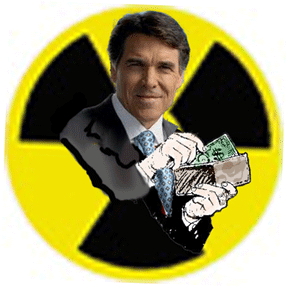 If the change is made, members of Congress will unburden themselves of a controversial vote and escape accountability for the potentially grave consequences. Instead, the matter will be unilaterally decided by Secretary of Energy Rick Perry, who can draw on whatever expertise he gained as … governor of Texas.
We also fundamentally disagree with the Board’s belief in the utility of limited nuclear use. There is no such thing as a limited nuclear war, and the United States should be seeking to raise the threshold for nuclear use, not blur that threshold by building additional so-called low-yield weapons.
Now the Senate is all that stands in the way of letting Rick Perry decide whether or not to fundamentally change the geopolitical balance of nuclear weapons.
A Decision Too Important for Rick Perry https://www.theatlantic.com/politics/archive/2018/06/a-decision-too-important-for-rick-perry/562280/ The Trump administration and its allies in Congress want the secretary of energy to determine whether to develop a new class of low-yield nuclear weapons. CONOR FRIEDERSDORF
India and Pakistan – growing risk of nuclear war there should not be ignored
 Another nuclear crisis in the making? Great power competition and the risk of war in South Asia, BAS, Moeed Yusuf 5 June 18, In May 1998, India and, later, Pakistan conducted multiple nuclear tests to become the first pair to go nuclear in the post-Cold War era. Two decades on, these South Asian rivals remain locked in a deeply antagonistic relationship that constantly threatens to boil over.
America wasting $billions on unnecessary and dangerous plutonium pits for nuclear weapons
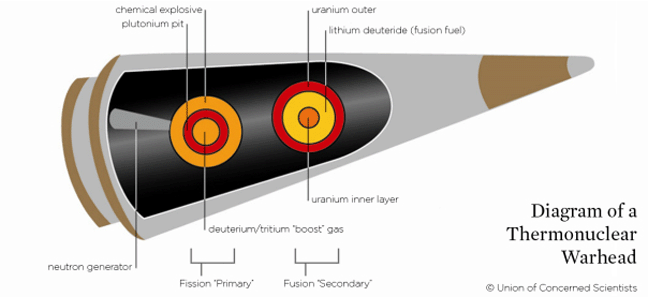 Editorial: Wasting billions in federal tax dollars just the pits https://www.abqjournal.com/1180661/wasting-billions-in-federal-tax-dollars-just-the-pits.html,By Albuquerque Journal Editorial BoardJune 5th, 2018
1 This Month
15 October. Joint Appeal for Nuclear Abolition Day -presentation to the UN on October 15 will be live on UNWebTV
Endorse the Nuclear Abolition Day Appeal
23-25 October – on Zoom – World BEYOND War’s annual global conference

To see nuclear-related stories in greater depth and intensity – go to https://nuclearinformation.wordpress.com
-
Archives
- October 2026 (149)
- September 2026 (339)
- August 2026 (330)
- July 2026 (355)
- June 2026 (287)
- May 2026 (306)
- April 2026 (356)
- March 2026 (251)
- February 2026 (267)
- January 2026 (308)
- December 2025 (358)
- November 2025 (359)
-
Categories
- 1
- 1 NUCLEAR ISSUES
- business and costs
- climate change
- culture and arts
- ENERGY
- environment
- health
- history
- indigenous issues
- Legal
- marketing of nuclear
- media
- opposition to nuclear
- PERSONAL STORIES
- politics
- politics international
- Religion and ethics
- safety
- secrets,lies and civil liberties
- spinbuster
- technology
- Uranium
- wastes
- weapons and war
- Women
- 2 WORLD
- ACTION
- AFRICA
- Atrocities
- AUSTRALIA
- Christina's notes
- Christina's themes
- culture and arts
- Events
- Fuk 2022
- Fuk 2023
- Fukushima 2017
- Fukushima 2018
- fukushima 2019
- Fukushima 2020
- Fukushima 2021
- general
- global warming
- Humour (God we need it)
- Nuclear
- RARE EARTHS
- Reference
- resources – print
- Resources -audiovicual
- Weekly Newsletter
- World
- World Nuclear
- YouTube
-
RSS
Entries RSS
Comments RSS

