“A Space Force is not an aspiration unique to the Trump administration, of course,” she continued on the Beyond Nuclear International website of the Takoma Park, Maryland group, “but it feels worse in his reckless hands.”
Marshall Islands atomic bombing – the devastation, thde cancer toll
 HELL ON HIGH SEAS https://www.thesun.co.uk/news/6626017/us-cold-war-nuclear-tests-bikini-atoll-pacific-ocean-video/ EXCELLENT PHOTOS. Pacific death zone where nuke tests caused thousands of cancer fatalities 60 years after spreading radiation around the world
The US detonated dozens of nuclear bombs in the Marshall Islands between 1946 and 1958 including a thermonuclear weapon 1,100 times more powerful than Hiroshima
By Mark Hodge, 26th June 2018
TERRIFYING footage shows a series of nuclear bomb tests unleashing the fires of hell on an idyllic Pacific Ocean paradise.
The video clips, recently released by the US government, give a glimpse into the horror caused by 67 nuke explosions detonated in Bikini Atoll and Enewetak Atoll in the Marshall Islands between 1946 and 1958.
Carried out in the early days of the Cold War, the tests included the 1954 Castle Bravo bomb which remains the most powerful thermonuclear weapon America has ever detonated.
The civilisation-wrecking 15-megatonne explosive, which exploded near Bikini, was 1,100 times bigger than the atomic bomb used to massacre thousands in Hiroshima in 1945.
Bravo – nearly three times its predicted power – exposed thousands in neighbouring islands to the radioactive fallout despite the 167 residents in Bikini Atoll being evacuated before the first test in 1946.
Fallout from the unprecedented explosion – including radioactive particles – spread around the world.
US government scientists declared Bikini safe for resettlement in the early 1970s but residents were removed in 1978 when it became clear that they were ingesting dangerously high levels of radiation from the contaminated fish, plants and water.
To this day, the small community remain exiled from their home.
Dubbed the Pacific Proving Grounds, the Marshall Island sites were used to carry out atmospheric nuclear tests – meaning the bombs were dropped from planes or detonated while underwater.
During the first test on July 1, 1946, military scientists wanted to see the impact of the bombs on naval warships and even filled the boats with animals such as pigs and rats to study the effects of nuclear fallout on livestock, reports Atomic Heritage Foundation.
Among the tests carried out in Enewetak was the world’s first hydrogen bomb, nicknamed Mike, which was detonated on November 1, 1952.
Between, 1977 and 1979, 4,000 American troops were taken to the former island paradise to clean up the contaminated remnants of the 43 nuke tests there.
Hundreds of the soldiers sent now complain of health problems including cancer, brittle bones and birth defects in their children while many of the them are already dead, reports The New York Times.
Speaking with ABC, Michael Gerrard, the director of the Earth Institute at Columbia University, explained that one of the explosions on Enewetak “didn’t work” causing devastating damage to the environment.
He said: “The plutonium was just broken apart by the conventional explosion, leading to about 400 little chunks of plutonium that were spread around the atoll.”
The troops sent to Enewetak collected and dumped 85,000 cubic metres of radioactive material – while wearing only shorts and t-shirts.
According to ABC, the plutonium in the area has a radioactive half-life of more than 24,000 years.
Islanders started to show signs of cancer in the 1960s, while residents further afield showed elevated risk of thyroid tumours and leukaemia, according to Georgetown University professor Timothy J. Jorgenson.
Former residents of Bikini Atoll and their relatives were awarded more than £1.5billion by the Marshall Islands Nuclear Claims Tribunal which was established in 1988.
But despite being permanently displaced from their home, the US stopped paying compensation in 2011 after Congress refused to provide additional funds.
Remarkably, marine life in Bikini has flourished, a Stanford University study last year.
Hundreds of schools of fish including tuna and sharks have thrived while swimming around coral as big as “cars”, reports The Guardian.
Professor Steve Palumbi’s team said Bikini’s marine life looks normal and healthy and do not have mutations like animals found at the Chernobyl nuke site, despite the island being declared a nuclear wasteland.
Palumbi believes that the absence of humans has in fact benefited the local wildlife.
He said: “The fish populations are better than in some other places because they have been left alone, the sharks are more abundant and the coral are big.
“It is a remarkable environment, quite odd.”
He added: “This is the most destructive thing we have ever done to the ocean, dropping 23 atomic bombs on it, yet the ocean is really striving to come back to life.”
The scientists believe that the worst-affected fish died off decades ago and the current marine life are only exposed to low radiation levels because they frequently swim in and out of the atoll
However, a 2012 United Nations reports found that the Bikini remains uninhabitable to humans because of “near-irreversible environmental contamination”.
The fish cannot be eaten, the plants cannot be farmed because of the contaminated soil and consuming water would be dangerous.
In his paper Professor Jorgensen writes: “What happened to the Marshall Islanders next is a sad story of their constant relocation from island to island, trying to avoid the radioactivity that lingered for decades.
“Over the years following the testing, the Marshall Islanders living on the fallout-contaminated islands ended up breathing, absorbing, drinking and eating considerable amounts of radioactivity.”
Between 1945 and 1963, the US and the Soviet Union carried hundreds of atmospheric nuclear tests.
Gases and “radioactive particles” from those detonations have been spread worldwide, according to a study carried out by the Centers for Disease Control and Prevention (CDC).
At least one CDC report claims that radiation deposits from these tests could eventually be responsible for 11,000 cancer deaths in the US alone.
The organs and tissue of anyone who has lived in the US – which carried out atmospheric nuke tests in Nevada – since 1951, shows signs of being exposed to nuclear fallout.
The fallout from 2,000 nuclear explosions in the 20th Century dispersed into weather systems which slightly raised the risk of cancer worldwide, according to the International Physicians for the Prevention of Nuclear War (IPPNW).
A 1991 IPPNW study claimed that particles from all nuclear explosions could be responsible for up to 430,000 cancer deaths globally.
Scrap Trident or risk a “nuclear annihilation abyss”- former nuclear sub commander warns UK govt
 Former nuclear sub commander pleads with Government to scrap Trident or risk a “nuclear annihilation abyss”, Sunday Herald, Rob Edwards, 24 June 18
Why is nobody blaming Trump for the obscene level of bombing, and the runaway extravagance of the Pentagon’s spending?
 Trump’s Military Drops a Bomb Every 12 Minutes, and No One Is Talking About It, TruthDig, Lee Camp, 24 June 18 We live in a state of perpetual war, and we never feel it. While you get your gelato at the hip place where they put those cute little mint leaves on the side, someone is being bombed in your name. While you argue with the 17-year-old at the movie theater who gave you a small popcorn when you paid for a large, someone is being obliterated in your name. While we sleep and eat and make love and shield our eyes on a sunny day, someone’s home, family, life and body are being blown into a thousand pieces in our names.
Once every 12 minutes.
The United States military drops an explosive with a strength you can hardly comprehend once every 12 minutes. And that’s odd, because we’re technically at war with—let me think—zero countries. So that should mean zero bombs are being dropped, right?
Hell no! You’ve made the common mistake of confusing our world with some sort of rational, cogent world in which our military-industrial complex is under control, the music industry is based on merit and talent, Legos have gently rounded edges (so when you step on them barefoot, it doesn’t feel like an armor-piercing bullet just shot straight up your sphincter), and humans are dealing with climate change like adults rather than burying our heads in the sand while trying to convince ourselves that the sand around our heads isn’t getting really, really hot.
You’re thinking of a rational world. We do not live there.
Instead, we live in a world where the Pentagon is completely and utterly out of control. A few weeks ago, I wrote about the $21 trillion (that’s not a typo) that has gone unaccounted for at the Pentagon. But I didn’t get into the number of bombs that ridiculous amount of money buys us. President George W. Bush’s military dropped 70,000 bombs on five countries. But of that outrageous number, only 57 of those bombs really upset the international community.
Because there were 57 strikes in Pakistan, Somalia and Yemen—countries the U.S. was neither at war with nor had ongoing conflicts with. And the world was kind of horrified. There was a lot of talk that went something like, “Wait a second. We’re bombing in countries outside of war zones? Is it possible that’s a slippery slope ending in us just bombing all the goddamn time? (Awkward pause.) … Nah. Whichever president follows Bush will be a normal adult person (with a functional brain stem of some sort) and will therefore stop this madness.”
We were so cute and naive back then, like a kitten when it’s first waking up in the morning.
The Bureau of Investigative Journalism reported that under President Barack Obama there were “563 strikes, largely by drones, that targeted Pakistan, Somalia and Yemen.”
It’s not just the fact that bombing outside of a war zone is a horrific violation of international law and global norms. It’s also the morally reprehensible targeting of people for pre-crime, which is what we’re doing and what the Tom Cruise movie “Minority Report” warned us about. (Humans are very bad at taking the advice of sci-fi dystopias. If we’d listened to “1984,” we wouldn’t have allowed the existence of the National Security Agency. If we listened to “The Terminator,” we wouldn’t have allowed the existence of drone warfare. And if we’d listened to “The Matrix,” we wouldn’t have allowed the vast majority of humans to get lost in a virtual reality of spectacle and vapid nonsense while the oceans die in a swamp of plastic waste. … But you know, who’s counting?)
There was basically a media blackout while Obama was president.
……. we now know that Donald Trump’s administration puts all previous presidents to shame. The Pentagon’s numbers show that during George W. Bush’s eight years he averaged 24 bombs dropped per day, which is 8,750 per year. Over the course of Obama’s time in office, his military dropped 34 bombs per day, 12,500 per year. And in Trump’s first year in office, he averaged 121 bombs dropped per day, for an annual total of 44,096.
Trump’s military dropped 44,000 bombs in his first year in office.
He has basically taken the gloves off the Pentagon, taken the leash off an already rabid dog………
Under Trump, five bombs are dropped per hour—every hour of every day. That averages out to a bomb every 12 minutes.
And which is more outrageous—the crazy amount of death and destruction we are creating around the world, or the fact that your mainstream corporate media basically NEVER investigates it? They talk about Trump’s flaws. They say he’s a racist, bulbous-headed, self-centered idiot (which is totally accurate)—but they don’t criticize the perpetual Amityville massacre our military perpetrates by dropping a bomb every 12 minutes, most of them killing 98 percent non-targets.
When you have a Department of War with a completely unaccountable budget—as we saw with the $21 trillion—and you have a president with no interest in overseeing how much death the Department of War is responsible for, then you end up dropping so many bombs that the Pentagon has reported we are running out of bombs.
……….This is about a runaway military-industrial complex that our ruling elite are more than happy to let loose. Almost no one in Congress or the presidency tries to restrain our 121 bombs a day. Almost no one in a mainstream outlet tries to get people to care about this.
Recently, the hashtag #21Trillion for the unaccounted Pentagon money has gained some traction. Let’s get another one started: #121BombsADay.
One every 12 minutes…….. We are a rogue nation with a rogue military and a completely unaccountable ruling elite. The government and military you and I support by being a part of this society are murdering people every 12 minutes, and in response, there’s nothing but a ghostly silence. It is beneath us as a people and a species to give this topic nothing but silence. It is a crime against humanity. https://www.truthdig.com/articles/trumps-military-drops-a-bomb-every-12-minutes-and-no-one-is-talking-about-it/
Despite the Outer Space Treaty to prevent this, USA has a long history of planning for nuclear weapons in space
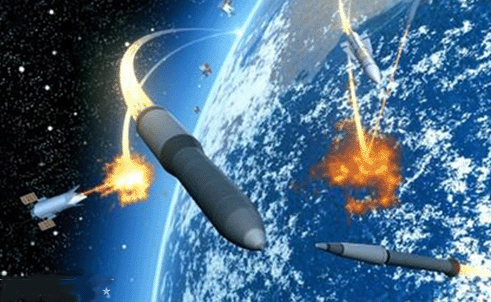 Star Wars Redux: Trump’s Space Force, Counter Punch Craig Eisendrath, who had been a U.S. State Department officer involved in its creation, notes that the Soviet Union launched the first space satellite, Sputnik, in 1957 and “we sought to de-weaponize space before it got weaponized…to keep war out of space.”
Adopted by the UN General Assembly in 1966, The Outer Space Treaty entered into force in 1967. It has been ratified or signed by 123 nations.
It provides that nations “undertake not to place in orbit around the Earth any objects carrying nuclear weapons or any other kinds of weapons of mass destruction, install such weapons on celestial bodies, or station such weapons in space in any other manner.”
Atomic physicist Edward Teller, the main figure in developing the hydrogen bomb and instrumental in founding Lawrence Livermore National Laboratory in California, pitched to Ronald Reagan, when he was governor of California visiting the lab, a plan of orbiting hydrogen bombs which became the initial basis for Reagan’s “Star Wars.” The bombs were to energize X-ray lasers. “As the bomb at the core of an X-ray battle station exploded, multiple beams would flash out to strike multiple targets before the entire station consumed itself in in a ball of nuclear fire,” explained New York Times journalist William Broad in his 1986 book Star Warriors.
Subsequently there was a shift in “Star Wars” to orbiting battle platforms with nuclear reactors or “super” plutonium-fueled radioisotope thermoelectric generators on board that would provide the power for hypervelocity guns, particle beams and laser weapons.
The rapid boil of “Star Wars” under Reagan picked up again under the administrations George H. W. Bush and son George W. Bush. And all along the U.S. military has been gung-ho on space warfare.
A U.S. Space Command was formed in 1982.
“US Space Command—dominating the space dimension of military operations to protect US interests and investment. Integrating Space Forces into war-fighting capabilities across the full spectrum of conflict,” it trumpeted in its 1998 report Vision for 2020. It laid out these words to resemble the crawl at the start of the Star Warsmovies. The U.S. Space Command was set up by the Pentagon to “help institutionalize the use of space.” Or, as the motto of one of its units declares, to be “Master of Space.”
Vision for 2020states, “Historically, military forces have evolved to protect national interests and investments-both military and economic.” Nations built navies “to protect and enhance their commercial interests” and during “the westward expansion of the United States, military outposts and the cavalry emerged to protect our wagon trains, settlements and railroads. The emergence of space power follows both of these models. During the early portion of the 2lst Century, space power will also evolve into a separate and equal medium of warfare.”
“It’s politically sensitive, but it’s going to happen,” remarked U.S. Space Command Commander-in-Chief Joseph W. Ashy in Aviation Week and Space Technology (8/9/96):
“Some people don’t want to hear this, and it sure isn’t in vogue, but—absolutely—we’re going to fight in space. We’re going to fight fromspace and we’re going to fight intospace…. We will engage terrestrial targets someday—ships, airplanes, land targets—from space.”
Or as Assistant Secretary of the Air Force for Space Keith R. Hall told the National Space Club in 1997: “With regard to space dominance, we have it, we like it and we’re going to keep it.”
The basic concept of the Pentagon’s approach to space is contained in The Future of War: Power, Technology & American World Dominance in the 2lst Century. Written by “arms experts” George and Meredith Friedman, the 1996 book concludes: “Just as by the year 1500 it was apparent that the European experience of power would be its domination of the global seas, it does not take much to see that the American experience of power will rest on the domination of space. Just as Europe expanded war and its power to the global oceans, the United States is expanding war and its power into space and to the planets. Just as Europe shaped the world for a half a millennium [by dominating the oceans with fleets], so too the United States will shape the world for at least that length of time.”
Or as a 2001 report of the U.S. Space Commission led by then U.S. Secretary of Defense Donald Rumsfeld asserted: “In the coming period the U.S. will conduct operations to, from, in and through space in support of its national interests both on the earth and in space.”……. https://www.counterpunch.org/2018/06/22/star-wars-redux-trumps-space-force/
The total world nuclear weapons count, as of today
 World Nuke Count: 14,465 Bombs https://www.ladailypost.com/content/world-nuke-count-14465-bombs, by Carol A. Clark June 23, 2018 HSNW News:
International Law is now challenged by the “normalisation” of nuclear weapons

 Amid Nuclear Entanglement, International Law May Well Have to Ban the Weapons Altogether https://thewire.in/law/amid-nuclear-entanglement-international-law-may-well-have-to-ban-the-weapons-altogether
As long as the conventionalisation of nuclear weapons is taking place, no binding treaties will be able to stop the proliferation of or regulate nuclear weapons. Olha Bozhenko, 22/JUN/2018
Nuclear weapons enjoy a separate and unique regime under international law. The majority of states struggle to establish a complete prohibition of nuclear weapons, as in the case of other categories of Weapons of Mass Destruction (WMD). In fact, in its only authoritative pronouncement on the matter, the International Court of Justice (ICJ) stressed ‘the unique characteristics of nuclear weapons, and in particular their destructive capacity’.
Yet in view of some recent developments, to be discussed below, this distinction has been gradually disappearing, with the line between nuclear and conventional weapons becoming blurred. This means that nuclear weapons are not stigmatised as their WMD counterparts, but rather conventionalised.
This piece is an attempt to, first, ascertain the progressing conventionalisation among the current trends related to nuclear weapons and, second, delineate its consequences for the international legal regulation of armaments.
Paths of conventionalisation
Nuclear weapons conventionalisation has been referred to as ‘nuclear entanglement’, which essentially means the merger of nuclear and conventional weapons. Broadly understood, it manifests itself in the following ways.
Increased reliance on non-strategic (tactical) nuclear weapons:
As early as in his Dissenting Opinion to the Nuclear Weapons Advisory Opinion, Mohamed Shahabuddeen, a judge of the ICJ suggested that assuming tactical nuclear weapons could be no more destructive than conventional weapons, they should not be less lawful than the latter. Hence, placing nonstrategic nuclear weapons (NSNW) at the top of ‘conventionalisation agenda’ is not a brand-new idea. Besides, it has recently been emphasised in national strategies.
The most striking example is, of course, the US 2018 Nuclear Posture Review (NPR), which radically departs from its predecessor in mandating the development of a range of nonstrategic low-yield nuclear options. The Trump administration considers this departure necessary as a response to Russia’s substantial reliance on and expansion of non-strategic nuclear arsenal, which considerably outstrips that of the US. At face value, this means that the two most powerful nuclear-weapon states have embarked upon the rapid expansion of their non-strategic nuclear options.
Such an approach depicting NSNW as quite a usable tool to advance military and non-military goals significantly lowers the threshold for the actual use. Such reliance on a limited nuclear strike can well lead to the full-blown nuclear escalation, which the ICJ considered among the possible consequences of using low yield nuclear weapons.
Integration of nuclear and conventional planning and operations:
The integration of nuclear and conventional capabilities also contributes to the conventionalisation. This is ‘nuclear entanglement’ in the original meaning of the term. The integration includes equipping dual use means of delivery with nuclear and non-nuclear warheads, merging nuclear and conventional support facilities, as well as integrating planning and training for both nuclear and non-nuclear forces. China and Russia are said to pursue this strategy whether deliberately or as a matter of historical legacy. Furthermore, US’s NPR specifically mandates ensuring ‘the ability to integrate nuclear and non-nuclear military planning and operations’ to ‘deter limited nuclear escalation and nonnuclear strategic attacks’.
These developments are frowned upon for a number of reasons. They tend to erode the line between nuclear and conventional forces in the most palpable manner. They also increase the risk of adversary’s misinterpretation of the nature of an attack, which can simultaneously target ‘entangled’ capabilities.
Expanding range of scenarios for the use of nuclear weapons:
Much has been said on the expanded range of scenarios where US contemplates first use of nuclear weapons, also in response to non-nuclear threats. Although the US strategy is most widely discussed owing to its considerable departure from the previous pattern, other nuclear-weapon states either preserve deliberate ambiguity with regard to the possible use of nuclear weapons (eg UK and France) or explicitly declare their readiness to balance an adversary’s conventional superiority with a nuclear strike (eg Russia and Pakistan).
Expanding the role of nuclear weapons beyond deterring nuclear threats alludes to an increased rationality and military utility of a nuclear strike. This further undermines the arguments that there exists opinio juris (an opinion of law) prohibiting recourse to nuclear weapons, except for the purposes of deterrence. In view of such developments, it is understandable why the ICJ refused to acknowledge that the non-recourse to nuclear weapons since 1945 had been due to such opinio juris rather than the absence of military necessity.
Nuclear saber rattling:
Finally, never before has it been so common for political leaders to boast of their states’ nuclear capacities. One may recall Vladimir Putin’s threats to deploy nuclear weapons in the course of Crimea crisis and against Baltic states, or his most recent brandishing cutting-edge nuclear technology with animated nukes striking Florida in an address to the parliament. Along the same lines, Donald Trump publicly threatened North Korea with ‘fire and fury’ and even with ‘total destruction’.
Although the ICJ refused to differentiate between nuclear and conventional weapons, when assessing the legality of the threat of nuclear weapons use (para 48), the state practice seems to have accepted a special standard for nuclear threats which is measured against the strategy of deterrence. For instance, UK’s High Court of Justiciary stated that ‘deployment of nuclear weapons in time of peace … is utterly different from the kind of specific ‘threat’ which is equated with actual use’ . Under this approach, states would only cross the line of nuclear deterrence and resort to the threat of using nuclear weapons if such a threat is specific enough, i.e. directed against a specific target.
Considering that the arbitral tribunal went so far as to equate the phrase ‘to face consequences’ to a threat of the use of force in Guyana vs Suriname, it is doubtful that states are still within the safe harbour of deterrence when directing their nuclear threats explicitly and specifically against other states.
Consequences for international law
Driven by analogy with other types of WMD, international law seeks to raise the threshold for using of nuclear weapons (or even contemplating such use) as high as possible. The adoption of the Treaty on the Prohibition of Nuclear Weapons (TPNW) is among the most notable developments to this end. Still, there is an observable tension between the movement towards nuclear weapons ban as enshrined in the TPNW and the trends described above.
International legal instruments like the TPNW are grounded on humanitarian considerations. In this particular case, the TPNW is meant to stigmatise nuclear weapons to the extent of their total abandonment by nuclear-weapon states. Considering that nuclear-weapon states refused to take any part in the ‘ban campaign’ leading to the adoption of the TPNW, it is reasonable to assume that such progressive stigmatisation (which can eventually generate a parallel customary prohibition) is the only way to endow the TPNW with pragmatic force. Analogy may be drawn with other disarmament treaties such as Convention on Anti-Personnel Mines Ban and Convention on Cluster Munitions: they contributed to the establishment of the customary prohibition of respective armaments even without directly binding all states possessing them.
However, when nuclear weapons are postured to be as usable as conventional ones, the normative boundary between the two is not hardened at all. No stigma is likely to appear for weapons possessing which is dictated and justified by strong military utility. As long as the conventionalisation of nuclear weapons is taking place, no binding obligations will probably proceed from the newly established TPNW regime, either as treaty rules or as a crystallising custom.
Along with the TPNW, the Treaty on the Non-Proliferation of Nuclear Weapons (NPT) is to bear a major part in the ramifications. The core obligation of non-proliferation under Article II is likely to be affected, since nuclear weapons, if conventionalised, make their acquisition by non-nuclear-weapon states more conceivable. Additionally, the deployment of tactical nuclear devices makes nuclear weapons more accessible and ‘proliferable’ in the technical sense, spurring their acquisition by non-state actors, particularly, by terrorist groups. This is an alarming possibility considering that the non-proliferation to non-state actors still constitutes a legal gap largely left to Security Council Resolution 1540.
Besides, the conventionalisation of nuclear weapons invites their advancement, which is hardly in line with the (allegedly customary) obligation of nuclear disarmament under Article VI of the NPT. States are not in compliance with their disarmament obligation ‘to achieve a precise result – nuclear disarmament in all its aspects’ when they engage in the ‘vertical proliferation’ (i.e. modernising their nuclear arsenals or expand the range of scenarios to deploy nuclear weapons).
Should the described trends gain traction, their impact will in no way be limited to nuclear weapons regulation, but extend to the whole set of rules on the use of force. In particular, the gradually vanishing line between the threat of use of force and nuclear deterrence will further blur. It is questionable whether teetering on the brink of threats to use nuclear weapons is still justifiable under the concept of nuclear deterrence, which the ICJ was careful to characterise as practice ‘adhered to by states’. Consequently, it is doubtful whether nuclear deterrence should enjoy such leniency with respect to the standard of the threat of use of force.
The jus ad bellum (right to war) requirements for self-defence may also be affected by nuclear entanglement. For instance, it is highly questionable whether a limited strike with tactical nuclear weapons to preclude a massive conventional attack fails to meet the standard of proportionality. Similarly, it is not that clear whether anticipatory nuclear strike against a missile equipped with non-nuclear warhead is unlawful, since a state intercepting such a missile can be misled by its dual-use capacity in view of nuclear entanglement.
The questions of similar nature will arise with respect to jus in bello (laws of war). With the gap between nuclear and conventional weapons narrowing, there is less room to assert that employing nuclear weapons should be contrary to the proportionality principle. Correspondingly, what concerns the lawfulness of belligerent reprisals conducted with the use of nuclear weapons, a pre-defined approach exclusively based on the ‘nuclear element’ is likely to give ground to the qualification irrespective of the type of weapons. To put it bluntly, the ICJ’s reasoning that the legality of the use of nuclear weapons shall be considered on the basis of case-to-case compliance with jus in bello seems to be regaining relevance.
Conclusions
While any radical transformation of the international legal regime governing nuclear weapons is still unlikely, there is definitely room for considering its adequacy for current challenges. In the near future we should be ready to make a choice of either raising the bar on the conventionalisation of nuclear weapons or easing this process. Simply put, international law may find itself in need of deciding whether it is better to ban nuclear weapons altogether rather than to regulate them.
This article originally appeared on Arms Control Law.
Trump administration getting ready for nuclear war in space
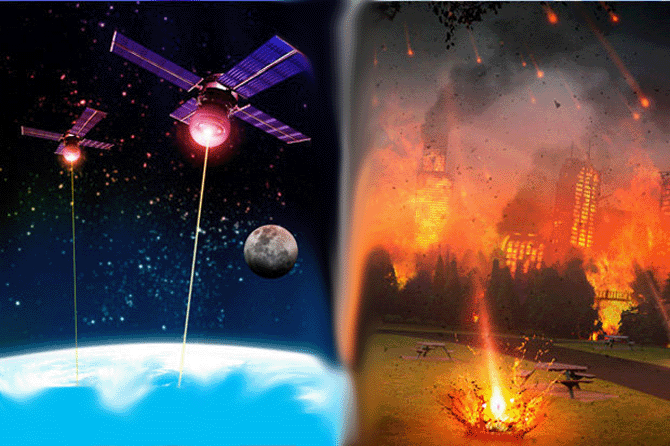
Star Wars Redux: Trump’s Space Force, Counter Punch
If Donald Trump gets his way on formation of a Space Force, the heavens would become a war zone. Inevitably, there would be military conflict in space.
The Outer Space Treaty of 1967 which designates space as the global commons to be used for peaceful purposes—and of which Russia and China, as well as the United States, are parties—and the years of work facilitating the treaty since would be wasted.
If the U.S. goes up into space with weapons, Russia and China, and then India and Pakistan and other countries, will follow.
Moreover space weaponry, as I have detailed through the years in my writings and TV programs, would be nuclear-powered—as Reagan’s Star Wars scheme was to be with nuclear reactors and plutonium systems on orbiting battle platforms providing the power for hypervelocity guns, particle beams and laser weapons.
This is what would be above our heads.
Amid the many horrible things being done by the Trump administration, this would be the most terribly destructive. “It is not enough to merely have an American presence in space, we must have American dominance in space,” Trump said at a meeting of the National Space Council this week.
“Very importantly, I’m hereby directing the Department of Defense and Pentagon,” he went on Monday, “to immediately begin the process necessary to establish a Space Force as the sixth branch of the armed forces; that is a big statement. We are going to have the Air Force and we are going to have the Space Force, separate but equal, it is going to be something.”
The notion of the U.S. moving into space with weaponry isn’t new…………..
With the Trump administration, there is more than non-support of the PAROS treaty but now a drive by the U.S. to weaponize space.
It could be seen—and read about—coming.
Star wars returns – Free speech tv. 1 of 3
“Under Trump, GOP to Give Space Weapons Close Look,” was the headline of an article in 2016 in Washington-based Roll Call. It said “Trump’s thinking on missile defense and military space programs have gotten next to no attention, as compared to the president-elect’s other defense proposals….But experts expect such programs to account for a significant share of what is likely to be a defense budget boost, potentially amounting to $500 billion or more in the coming decade.”
Intense support for the plan was anticipated from the GOP-dominated Congress. Roll Call mentionedthat Representative Trent Franks, a member of the House Armed Services Committee and an Arizona Republican, “said the GOP’s newly strengthened hand in Washington means a big payday is coming for programs aimed at developing weapons that can be deployed in space.”
In a speech in March at the U.S. Marine Corps Air Station near San Diego, Trump declared: “My new national strategy for space recognizes that space is a war-fighting domain, just like the land, air, and sea. We may even have a Space Force—develop another one, Space Force. We have the Air Force; we’ll have the Space Force.”
Bruce Gagnon, coordinator of the Global Network Against Weapons and Nuclear Power in Space, notes that Trump cannot establish a Space Force on his own—that Congressional authorization and approval is needed. And last year, Gagnon points out, an attempt to establish what was called a Space Corps within the Air Force passed in the House but “stalled in the Senate.”
“Thus at this point it is only a suggestion,” said Gagnon of the Maine-based Global Network.
“I think though,” Gagnon went on, “his proposal indicates that the aerospace industry has taken full control of the White House and we can be sure that Trump will use all his ‘Twitter powers’ to push this hard in the coming months.”
Meanwhile, relates Gagnon, there is the “steadily mounting” U.S. “fiscal crisis…Some years ago one aerospace industry publication editorialized that they needed a ‘dedicated funding source’ to pay for space plans and indicated that it had come up with it—the entitlement programs. That means the industry is now working to destroy Social Security, Medicare, Medicaid and what little is left of the welfare program. You want to help stop Star Wars and Trump’s new Space Force. Fight for Social Security and social progress in America. Trump and the aerospace industry can’t have it both ways—it’s going to be social progress or war in space.”
As Robert Anderson of New Mexico, a board member of the Global Network, puts it: “There is no money for water in Flint, Michigan or a power grid in Puerto Rico, but there is money to wage war in space.”
Or as another Global Network director, J. Narayana Rao of India, comments: “President Donald Trump has formally inaugurated weaponization of space in announcing that the U.S. should establish a Space Force which will lead to an arms race in outer space.”
Russian officials are protesting the Trump Space Force plan, “Militarization of space is a way to disaster,”Viktor Bondarev, the head of the Russian Federation Council’s Defense and Security Committee, told the RIA news agency the day after the announcement. This Space Force would be operating in “forbidden skies.” He said Moscow is ready to “strongly retaliate” if the US violates the Outer Space Treaty by putting weapons of mass destruction in space.
And opposition among legislators in Washington has begun. “Thankfully the president cannot do it without Congress because now is NOT the time to rip the Air Force apart,” tweeted Senator Bill Nelson of Florida.
“Space as a warfighting domain is the latest obscenity in a long list of vile actions by a vile administration,” writes Linda Pentz Gunter, who specializes in international nuclear issues for the organization Beyond Nuclear, this week. “Space is for wonder. It’s where we live. We are a small dot in the midst of enormity, floating in a dark vastness about which we know a surprising amount, and yet with so much more still mysteriously unknown.”
Donald Trump says North Korean leader Kim Jong Un had committed to destroy a western North Korea missile site: USA names it
U.S. identifies North Korea missile test site it says Kim committed to destroy , Matt Spetalnick,
WASHINGTON (Reuters) 21June 18- The missile engine test site that President Donald Trump said North Korean leader Kim Jong Un had committed to destroy is a major facility in the western part of the country that has been used for testing engines for long-range missiles, according to a U.S. official.
Trump told reporters after their June 12 summit that Kim had pledged to dismantle one of his missile installations, which would be North Korea’s most concrete concession at the landmark meeting in Singapore.
However, the president at the time did not name the site.
A U.S. official identified it on Wednesday as the Sohae Satellite Launching Ground, saying North Korea “has used this site to test liquid-propellant engines for its long-range ballistic missiles.”
Pyongyang has said its missiles can reach the United States.
“Chairman Kim promised that North Korea would destroy a missile engine test stand soon,” the official told Reuters, speaking on condition of anonymity.
There was no immediate word on the exact timetable, and North Korea has not publicly confirmed that Kim made such a commitment.
CBS News was the first to identify the site, which is the newest of North Korea’s known major missile testing facilities.
Although Trump has hailed the Singapore summit as a success, skeptics have questioned whether he achieved anything, given that Pyongyang, which has rejected unilateral nuclear disarmament, appeared to make no new tangible commitments in a joint written declaration.
The U.S.-based North Korea monitoring group 38 North said in an analysis at the end of last week there had been no sign of any activity toward dismantling Sohae or any other missile test site.
Movements grow to ban humanity’s ultimate threat – nuclear weapons
 Nuclear Weapons Pose the Ultimate Threat to Mankind, A growing number of movements are dedicated to making sure they’re banned. The Nation By Betsy Taylor , 21 June 18
Time For Israel To Drop Nuclear Ambiguity
 Time for Israel to Drop Nuclear Ambiguity https://www.haaretz.com/opinion/.premium-time-for-israel-to-drop-nuclear-ambiguity-1.6198606 Today, almost 50 years after the original Richard Nixon-Golda Meir understandings, Israel’s nuclear capability – declared or not – is a solid fact recognized by all, Avner Cohen, Jun 21, 2018
Today, Almost 50 Years After The Original Richard Nixon-Golda Meir Understandings, Israel’s Nuclear Capability – Declared Or Not – Is A Solid Fact Recognized By All
-
To Understand The Ritual Of Presidential Letters, We Must Go Back To The Starting Point. In 1991, Aluf Benn Was The Reporter Who Revealed In Haaretz The Existence Of These Nuclear Understandings Going Back Years, Between Richard Nixon And Golda Meir.
In September 1969, When Meir Made Her First Visit To The U.S. As Prime Minister, She Reached An Array Of Understandings With Nixon That Removed Any Dispute Over The Nuclear Issue From The Agenda Between The Two Countries. The Understandings Concluded A Decade Of Cat-And-Mouse Between Them On This Issue.
Per The Understandings, The United States Accepts Israel’s Unique Nuclear Status, Will Not Press It To Join The Nuclear Non-Proliferation Pact And Will Defend It In International Forums. For Its Part, Israel Will Continue To Refer To Its Nuclear Capability As If Hidden; It Will Continue To Assert That It Will Not Be The First In The Region To Introduce A Nuclear Weapon.
The Nixon-Meir Understandings Were A Practical Arrangement That Solved Concrete Problems Weighing On Relations Between The Countries At The Time. The U.S. Already Knew That Israel Had Crossed Or Was Crossing The Nuclear Threshold, It Knew That Its Own Policy Of Trying To Stop This Had Failed, And It Recognized That It Had To Adjust Its Attitude Given The New Reality.
The U.S. Needed The Understandings So It Could Deliver Phantom Jets To Israel, And The Delivery Began That Same Month, After Negotiations The Year Before Over The Sale Had Involved A Harsh Confrontation Over The Nuclear Issue. Also, It Was Necessary To End The Yearly Visits By American Nuclear Inspectors To Dimona; By 1969, The Americans Realized They Couldn’t Reverse The New Nuclear Reality And That The Only Way To Minimize The Damage Was To Keep It Hidden.
Today, Almost 50 Years After The Original Understandings, Israel’s Nuclear Capability – Declared Or Not – Is A Solid Fact Recognized By All. Paradoxically, The Leaders Of This Nuclear Power Still Feel That They Need A Presidential Piece Of Paper To Confirm This.
Entous’ Revelations Illustrate Yet Again How Outdated The Nuclear Ambiguity Policy Is, Including The Israeli Ploy Whereby It’s Permissible For Anything To Be Written About Israel’s Nuclear Arsenal As Long As It’s Attributed To “Foreign Sources.” The Time Has Come For The Israeli Nuclear Issue To Be Handled Differently, Both At Home And Abroad. The Time Has Come For Post-Ambiguity.
The Writer Is A Professor Of Nonproliferation And Terrorism Studies At The Middlebury Institute Of International Studies.
USA’s nuclear weapons companies need the nuclear weapons race to continue
Eric Sirotkin speaks to RT Int 08012018
North Korea Agreed to Denuclearize, but When Will the US? Marjorie Cohn, Truthout 18 June 18

 A powerful economic incentive continues to drive the nuclear arms race. After the Singapore Summit, the stock values of all major defense contractors — including Raytheon, Lockheed Martin, Northrop Grumman, Boeing and General Dynamics — declined.
Given his allegiance to boosting corporate profits, it’s no surprise that Donald Trump is counterbalancing the effects of the Singapore Summit’s steps toward denuclearization with a Nuclear Posture Review that steers the US toward developing leaner and meaner nukes and lowers the threshold for using them.
The United States has allocated $1.7 trillion to streamline our nuclear arsenal, despite having agreed in the Nuclear Non-Proliferation Treaty in 1968 to work toward nuclear disarmament.
Meanwhile, the US maintains a stockpile of 7,000 nuclear weapons, some 900 of them on “hair trigger alert,” according to the Union of Concerned Scientists.
“If weapons are used they need to be replaced,” Brand McMillan, chief investment officer for Commonwealth Financial Network has argued. “That makes war a growth story for these stocks, and one of the big potential growth stories recently has been North Korea. What the agreement does, at least for a while, is take military conflict off the table.”
Moreover, economic incentives surrounding conventional weapons also cut against the promise of peace on the Korean Peninsula. Eric Sirotkin, founder of Lawyers for Demilitarization and Peace in Korea, has pointed out that South Korea is one of the largest importers of conventional weapons from the United States. If North and South Korea achieve “a lasting and stable peace regime on the Korean Peninsula,” as envisioned by the agreement between Trump and Kim Jong Un, the market for US weapons could dry up, according to Sirotkin.
Even so, US defense spending will continue to increase, according to Bloomberg Intelligence aerospace expert George Ferguson. “If North Korea turns from a pariah state to being welcomed in the world community, there are still enough trouble spots that require strong defense spending, supporting revenue and profit growth at prime defense contractors.”
The US Lags Behind on DenuclearizationLast year, more than 120 countries approved the Treaty on the Prohibition of Nuclear Weapons, which requires ratifying countries “never under any circumstances to develop, test, produce, manufacture, otherwise acquire, possess or stockpile nuclear weapons or other nuclear explosive devices.” It also prohibits the transfer of, use of, or threat to use nuclear weapons or nuclear explosive devices.
Since the treaty opened for signature on September 20, 2017, 58 countries have signed and 10 have ratified it. Fifty countries must ratify the treaty for it to enter into force, hopefully in 2019.
The five original nuclear-armed nations — the United States, Britain, France, Russia and China — boycotted the treaty negotiations and the voting. North Korea, Israel, Pakistan and India, which also have nuclear weapons, refrained from participating in the final vote
During negotiations, in October 2016, North Korea had voted for the treaty.
In advance of the Singapore Summit, dozens of Korean American organizations and allies signed a statement of unity,which says:
Denuclearization of the Korean Peninsula means not only eliminating North Korea’s nuclear weapons but also denuclearizing the land, air, and seas of the entire peninsula. This is not North Korea’s obligation alone. South Korea and the United States, which has in the past introduced and deployed close to one thousand tactical nuclear weapons in the southern half of the peninsula, also need to take concrete steps to create a nuclear-free peninsula. ………https://truthout.org/articles/north-korea-agreed-to-denuclearize-but-when-will-the-us/
India and Pakistan have increased their stockpiles of nuclear weapons
India, Pakistan expanding their new nuclear weapons stockpiles: SIPRI https://www.moneycontrol.com/news/india/india-pakistan-expanding-their-new-nuclear-weapons-stockpiles-sipri-2605161.html There are nine countries which have nuclear warheads. They include Russia, the US, the UK, France, China, Israel, India, Pakistan and North Korea, Moneycontrol News@moneycontrolcom , 19 June 18
The Stockholm International Peace Research Institute in its 2018 edition of the yearly report on the current state of armaments, disarmament and international security said despite the overall decrease in global nuclear weapons year-on-year, India and Pakistan have increased their stockpiles.
India, which had an estimated 120-130 nuclear warheads as per 2017 report, now has 130-140 warheads. Similarly, Pakistan, which had 130-140 warheads now has increased to 140-150 warheads. Both countries are also developing new land, sea and air-based missile delivery systems.
Another nuclear country in Asia, China continues to modernise its nuclear weapon delivery systems and is slowly increasing the size of its nuclear arsenal. The country now has an estimated 280 nuclear warheads. In 2017 report, the number was 270.
The US and Russia still constitute a major share of approximately 14,465 nuclear weapons that exist in the world. Both together account for nearly 92 percent of all nuclear weapons despite reducing their strategic nuclear forces pursuant to the implementation of the 2010 Treaty on Measures for the Further Reduction and Limitation of Strategic Offensive Arms.
Moreover, the cold war-era rivals also have long-term programmes underway to replace and modernise their nuclear warheads, missile and aircraft delivery systems, and nuclear weapon production facilities.
“The renewed focus on the strategic importance of nuclear deterrence and capacity is a very worrying trend,” says Ambassador Jan Eliasson, Chair of the SIPRI Governing Board.
“The world needs a clear commitment from the nuclear weapon states to an effective, legally binding process towards nuclear disarmament.”
Other countries which are a nuclear state include the UK (215 warheads), France (300 warheads), Israel (80 warheads) and North Korea (10-20 warheads). The figures for North Korea are uncertain, the report said, however, there was no doubt that it has nuclear weapons.
In 2017, North Korea has made technical progress in developing its nuclear weapon capabilities, including the test of—what was claimed to be—a thermonuclear weapon, in September. North Korea also demonstrated unexpected rapid progress in the testing of two new types of long-range ballistic missile delivery systems. These testing led to a crisis in the Korean peninsula.
However, in a meeting with US president Donald Trump, North Korean supreme leader Kim Jong-un vowed to work towards the complete denuclearisation of the Koran peninsula.
A nuclear bomb terrorist attack on New York – the sequence of events
 What a nuclear attack in New York would look like This Is What a Nuclear Bomb Looks Like (picture of a somewhat rusting ordinary van) Ny Mag. 12 June 18
If America is attacked, the strike probably won’t come from North Korea. And it will be even scarier than we imagine. …….
There are currently at least 2,000 tons of weapons-grade nuclear material stored in some 40 countries — enough to make more than 40,000 bombs approximately the size of the one that devastated Hiroshima. Stealing the material would be challenging but far from impossible. Russia stockpiles numerous bombs built before the use of electronic locks that disable the weapons in the event of tampering. Universities that handle uranium often have lax security. And insiders at military compounds sometimes steal radioactive material and sell it on the black market. Since 1993, there have been 762 known instances in which radioactive materials were lost or stolen, and more than 2,000 cases of trafficking and other criminal activities.
Once terrorists obtained the uranium, they would need only a small team of sympathetic engineers and physicists to build what is known as a gun-type nuclear bomb, like the one dropped on Hiroshima. A gun-type nuke uses traditional explosives to fire a slug of uranium through a tube directly into another chunk of uranium, fracturing huge numbers of atoms and unleashing a massive amount of energy. Compared to modern nuclear missiles, which are far more powerful and complex, constructing a crude gun-type nuke is fairly straightforward. …..
The last step in the process — smuggling the weapon into the United States — would be even easier. A ten-kiloton bomb, which would release as much energy as 10,000 tons of TNT, would be only seven feet long and weigh about 1,000 pounds. It would be simple to transport such a device to America aboard a container ship, just another unseen object in a giant metal box among millions of other metal boxes floating on the ocean. Even a moderate amount of shielding would be enough to hide its radioactive signature from most detectors at shipping hubs. Given all the naturally radioactive items that frequently trigger false alarms — bananas, ceramics, Brazil nuts, pet deodorizers — a terrorist group could even bury the bomb in bags of Fresh Step or Tidy Cats to fool inspectors if a security sensor was tripped.
In 1946, a senator asked J. Robert Oppenheimer, the physicist who played a key role in the Manhattan Project, what instrument he would use to detect a nuclear bomb smuggled into the United States. Oppenheimer’s answer: “A screwdriver.” Amazingly, our detection systems have still not caught up to this threat: One would essentially have to open and visually inspect every single crate and container arriving on America’s shores. Once the container ship reached a port like Newark, terrorists would have no trouble loading the concealed bomb into the back of an unassuming white van and driving it through the Lincoln Tunnel directly into Times Square.
The Blast
One of the greatest misconceptions about nuclear bombs is that they annihilate everything in sight, leaving nothing but a barren flatland devoid of shape and life. In truth, the physical destruction inflicted by a nuclear explosion resembles that of a combined hurricane and firestorm of unprecedented proportion. Consider one example: A ten-kiloton nuclear bomb detonated on the ground in Times Square would explode with a white flash brighter than the sun. It would be seen for hundreds of miles, briefly blinding people as far away as Queens and Newark. In the same moment, a wave of searing heat would radiate outward from the explosion, followed by a massive fireball, the core of which would reach tens of millions of degrees, as hot as the center of the sun.
When such a bomb explodes, everyone within 100 feet of ground zero is instantaneously reduced to a spray of atoms. There are photos from Hiroshima and Nagasaki showing eerie silhouettes of people cast against a flat surface, such as a wall or floor. These are not, as is sometimes claimed, the remains of vaporized individuals, but rather a kind of morbid nuclear photograph. The heat of the nuclear explosion bleaches or darkens the background surface, except for the spot blocked by the person, leaving a corresponding outline. In some cases the heat released by the explosion will also burn the patterns of clothing onto people’s skin.
Near the center of the blast, the suffering and devastation most closely conform to the fictional apocalypse of our imaginations. This is what it would look like within a half-mile of Times Square: Few buildings would remain standing. Mountains of rubble would soar as high as 30 feet. As fires raged, smoke and ash would loft into the air. The New York Public Library’s stone guardians would be reduced to pebble and dust. Rockefeller Center would be an unrecognizable snarl of steel and concrete, its titanic statue of Prometheus — eight tons of bronze and plaster clad in gold — completely incinerated.
Within a half-mile radius of the blast, there would be few survivors. Those closest to the atomic bombings on Hiroshima and Nagasaki have described the horrors they witnessed: People with ripped sheets of skin hanging from their bodies; people whose brains were visible through their shattered skulls; people with holes for eyes. Sakue Shimohira watched her mother’s charred body crumble into ash as she tried to wake her. Shigeko Sasamori’s father cut off the blackened husk of skin all over her face, revealing pools of pus beneath.
As the fireball travels outward from the blast, people, buildings, and trees within a one-mile radius would be severely burned or charred. Metal, fabric, plastic, and clay would ignite, melt, or blister. The intense heat would set gas lines, fuel tanks, and power lines on fire, and an electromagnetic pulse created by the explosion would knock out most computers, cell phones, and communication towers within several miles.
Traveling much farther than the fireball, a colossal pressure wave would hurtle forth faster than the speed of sound, generating winds up to 500 miles per hour. The shock wave would demolish the flimsiest buildings and strip the walls and roofs off stronger structures, leaving only their naked and warped scaffolding. It would snap utility poles like toothpicks and rip through trees, fling people through the air, and turn brick, glass, wood, and metal into deadly projectiles. A blast in Times Square, combined with the fireball, would carve a crater 50 feet deep at the center of the explosion. The shock wave would reach a diameter of nearly 3.2 miles, shattering windows as far as Gramercy Park and the American Museum of Natural History.
All this would happen within a few seconds.
From Van to Tsunami
Five different nukes, and what they would do if unleashed on Times Square.……….http://nymag.com/daily/intelligencer/2018/06/what-a-nuclear-attack-in-new-york-would-look-like.html
Middle East has 80 nuclear weapons, and they’re all owned by Israel
All 80 nuclear warheads in Mideast owned by Israel: Zarif http://www.tehrantimes.com/news/424573/All-80-nuclear-warheads-in-Mideast-owned-by-Israel-Zarif– June 19, 2018
TEHRAN – Referring to recent statistics released by a Stockholm-based research institute, Foreign Minister Mohammad Javad Zarif said all proven nuclear warheads stationed in the Middle East are entirely owned by the Zionist regime of Israel.
In a message in his Twitter account, Zarif denounced the Israeli regime for “howling incessantly” about Iran’s activities, while the regime itself owns all the 80 nuclear warheads in the Middle East.
“There are at least 80 nuclear warheads stationed in the Middle East. None are in Iran; rather, they’re at the fingertips of a warmonger who howls incessantly about fabricated Iranian ‘ambitions’,” Zarif said.
Donald Trump pledges Israel that he’ll ignore their nuclear weapons
| Report: Trump pledges not to pressure Israel on nuclear issue |
Donald Trump becomes fourth U.S. president to sign letter saying U.S. will not pressure Israel to forfeit its rumored nuclear capabilities, New Yorker reports • Obama aides failed to brief Trump officials on letter during transition, report says.
Israel Hayom StaffIsrael has managed to secure a written pledge from four successive U.S. presidents to safeguard its presumed nuclear deterrent, The New Yorker magazine reported on Monday.
According to uncorroborated reports in the foreign media, Israel has as many as 200 nuclear warheads as part of a presumed military nuclear program dating back to the 1960s. Israel has never publicly acknowledged these reports.
Israel has also pledged not to be the first nation to introduce nuclear weapons in the region.
According to Monday’s report, in the wake of the first Gulf War in the early 1990s, Israel felt that the unwritten understanding struck between President Richard Nixon and Prime Minister Golda Meir in the early 1970s to ensure Israel would never be compelled to denuclearize was insufficient.
Eventually, Israeli policymakers convinced President Bill Clinton to put the Nixon-Meir understandings into writing.
“The first iteration of the secret letter was drafted during the Clinton administration as part of an agreement for Israel’s participation in the 1998 Wye River negotiations with the Palestinians,” said the report, by The New Yorker’s Adam Entous.
“In the letter, according to former officials, President Bill Clinton assured the Jewish state that no future American arms-control initiative would detract from Israel’s deterrent capabilities, an oblique but clear reference to its [alleged] nuclear arsenal.”
The letter was later signed by President George W. Bush. But when President Barack Obama won office in 2008, Israel was concerned he would hold off on renewing the pledge.
“With Obama, we were all crazy,” an Israeli official was quoted in the report. A former U.S. official is quoted as saying that Obama’s advisers believed Israeli Prime Minister Benjamin Netanyahu was “paranoid” that the U.S. would try to take away Israel’s presumed nuclear weapons, but that “wasn’t our intent.”
Ultimately, Obama signed “an updated version of the letter.”
According to the report, efforts to renew the pledge when President Donald Trump assumed office initially stalled, when Israeli Ambassador to the United States Ron Dermer made the request in a surprise move in February 2017. When he came to the White House, the Trump officials said they needed more time, but the Israelis “wanted to limit who could take part in discussions of the letter, citing the need for secrecy.”
According to the report, part of the tensions then arose because the White House was not aware of the letters.
“The very existence of the letters had been a closely held secret. Only a select group of senior American officials, in three previous administrations, knew of the letters,” the report said.
When Trump became president, his aides “didn’t find any copies of the previous letters left behind by their predecessors. The documents had been sent to the archives.”
1 This Month
15 October. Joint Appeal for Nuclear Abolition Day -presentation to the UN on October 15 will be live on UNWebTV
Endorse the Nuclear Abolition Day Appeal
23-25 October – on Zoom – World BEYOND War’s annual global conference

To see nuclear-related stories in greater depth and intensity – go to https://nuclearinformation.wordpress.com
-
Archives
- October 2026 (149)
- September 2026 (339)
- August 2026 (330)
- July 2026 (355)
- June 2026 (287)
- May 2026 (306)
- April 2026 (356)
- March 2026 (251)
- February 2026 (267)
- January 2026 (308)
- December 2025 (358)
- November 2025 (359)
-
Categories
- 1
- 1 NUCLEAR ISSUES
- business and costs
- climate change
- culture and arts
- ENERGY
- environment
- health
- history
- indigenous issues
- Legal
- marketing of nuclear
- media
- opposition to nuclear
- PERSONAL STORIES
- politics
- politics international
- Religion and ethics
- safety
- secrets,lies and civil liberties
- spinbuster
- technology
- Uranium
- wastes
- weapons and war
- Women
- 2 WORLD
- ACTION
- AFRICA
- Atrocities
- AUSTRALIA
- Christina's notes
- Christina's themes
- culture and arts
- Events
- Fuk 2022
- Fuk 2023
- Fukushima 2017
- Fukushima 2018
- fukushima 2019
- Fukushima 2020
- Fukushima 2021
- general
- global warming
- Humour (God we need it)
- Nuclear
- RARE EARTHS
- Reference
- resources – print
- Resources -audiovicual
- Weekly Newsletter
- World
- World Nuclear
- YouTube
-
RSS
Entries RSS
Comments RSS

