Russia may revive its Perimeter” or “Dead Hand” automatic nuclear missile system
This comes after the Trump administration announced that the United States is withdrawing from the 1987 Intermediate-Range Nuclear Forces Treaty, which eliminated the once-massive American and Russian stockpiles of short- and medium-range missiles. Donald Trump alleges that Russia has violated the treaty by developing and deploying new, prohibited cruise missiles.
This has left Moscow furious and fearful that America will once again, as it did during the Cold War, deploy nuclear missiles in Europe. Because of geographic fate, Russia needs ICBMs launched from Russian soil, or launched from submarines, to strike the continental United States. But shorter-range U.S. missiles based in, say, Germany or Poland could reach the Russian heartland.
Viktor Yesin, who commanded Russia’s Strategic Rocket Forces in the 1990s, spoke of Perimeter/Dead Hand during an interview last month in the Russian newspaper Zvezda [Google English translation here]. Yesin said that if the United States starts deploying intermediate-range missiles in Europe, Russia will consider adopting a doctrine of a preemptive nuclear strike. ……..
What is unmistakable is that Perimeter is a fear-based solution. Fear of a U.S. first-strike that would decapitate the Russian leadership before it could give the order to retaliate. Fear that a Russian leader might lose his nerve and not give the order.
And if Russia is now discussing Perimeter publicly, that’s reason for the rest of us to worry.
Michael Peck is a contributing writer for the National Interest. He can be found on Twitter and Facebook. https://nationalinterest.org/blog/buzz/russias-dead-hand-nuclear-doomsday-weapon-back-38492
Chinese military is building a test facility to simulate thermonuclear explosions
|
Operation Z machine: China’s next big weapon in the nuclear ‘arms race’ could create clean fuel – or deadly bombs
The Chinese military is building a test facility to simulate thermonuclear explosions on a much greater scale than comparable US centres It’s been described as a Chinese version of America’s “Z machine” – formally known as the Z Pulsed Power Facility – a giant wheel-like device developed by the United States to see how particles react under extreme radiation and magnetic pressure. Z machines have been used in the development of nuclear weapons, from conventional warheads to the pure fusion bomb – a hydrogen bomb that can in theory be made in any size, cost a fraction of today’s nuclear stockpile and burn “cleanly” without producing radioactive fallout. And for decades, the Z machine at Sandia National Laboratories in Albuquerque, New Mexico, has led the way in the field. But now Chinese researchers are trying to build a machine that will produce much more electricity to create much more extreme environments for testing weapons, allowing scientists to delve deeper into the nuclear unknown……….. Lei Yuan, a nuclear physicist at Peking University’s school of physics, said the project team should prepare for massive challenges. Lei said there had been costly failures in developing the technology in the US and Chinese scientists faced equal if not greater uncertainties because of their much more ambitious goals. For instance, fusion could produce a large number of fast flying neutrons that will weaken or damage critical components. While the equipment was durable, researchers had not yet been able to solve the neutron problem, Lei said. He warned the development of a pure fusion bomb would meant international nuclear weapons treaties would have to be rewritten. “But I don’t think we need to worry about this, not until we see a real new bomb. The technology is so difficult, it remains more fantasy than real threat.” https://www.scmp.com/news/china/science/article/2177652/operation-z-machine-chinas-next-big-weapon-nuclear-arms-race |
|
France, Hungary Conclude Military, Nuclear Energy Agreements
Hungarian Foreign Minister Péter Szijjártó announced the deals on Tuesday after meeting his French counterpart Jean-Yves Le Drian.
Hungary’s armed forces have ordered twenty Airbus helicopters from France.
Meanwhile, two French companies, including a state-owned company, will have a major role in operating the current Paks nuclear power plant and in manufacturing turbines for the expanded Paks plant.
“We will continue to strengthen the French-Hungarian alliance that has emerged in the peaceful use of nuclear energy,” Szijjártó said, adding that France and Hungary both adhere to the principle that the national energy mix must remain a national competence…….https://hungarytoday.hu/france-hungary-conclude-military-nuclear-energy-agreements/
Swiss Government under pressure to sign nuclear ban treaty
Supporters said failure to sign the accord sent a negative message to the international community and undermined Switzerland’s credibility as a champion of humanitarian law………
The TPNW will enter into force when at least 50 countries ratify it. Signatories have obligations not to develop, test, produce, acquire, possess, stockpile, use or threaten to use nuclear weapons. The agreement also prohibits the deployment of nuclear weapons on national territory and assistance to any country involved in prohibited activities.
So far, 67 countries have approved the treaty and another 19 have ratified it. https://www.swissinfo.ch/eng/parliament_government-under-pressure-to-sign-nuclear-ban-treaty/44613098
Russia sends 2 nuclear-capable bombers to Venezuela
Russian Defense Minister Sergei Shoigu said at last week’s meeting with his Venezuelan counterpart Vladimir Padrino Lopez that Russia would continue to send its military aircraft and warships to visit Venezuela as part of bilateral military cooperation. ….
Russia-US relations are currently at post-Cold War lows over Ukraine, the war in Syria and allegations of Russian meddling in the 2016 US election. Russia has bristled at US and other NATO allies deploying their troops and weapons near its borders. https://www.canberratimes.com.au/world/south-america/russia-sends-2-nuclear-capable-bombers-to-venezuela-20181211-p50lea.html?ref=rss&utm_medium=rss&utm_source=rss_feed
Cold war efforts to provide bunker protection against nuclear bombing
|
America’s Nuclear Battle Plan if Russia Went to War: Massive Bunkers Under U.S. Cities, National Interest, |
Depleted uranium – the cancer-causing weapon still taking its toll in Iraq
Cancer as Weapon: Poppy Bush’s Radioactive War on Iraq Counter Punch, by JEFFREY ST. CLAIR , DECEMBER 7, 
 2018, At the close of the first Gulf War, Saddam Hussein was denounced as a ferocious villain for ordering his retreating troops to destroy Kuwaiti oil fields, clotting the air with poisonous clouds of black smoke and saturating the ground with swamps of crude. It was justly called an environmental war crime.
But months of bombing of Iraq by US and British planes and cruise missiles has left behind an even more deadly and insidious legacy: tons of shell casings, bullets and bomb fragments laced with depleted uranium. In all, the US hit Iraqi targets with more than 970 radioactive bombs and missiles.
It took less than a decade for the health consequences from this radioactive bombing campaign to begin to coming into focus. And they are dire, indeed. Iraqi physicians call it “the white death”-leukemia. Since 1990, the incident rate of leukemia in Iraq has grown by more than 600 percent. The situation is compounded by Iraq’s forced isolations and the sadistic sanctions regime, recently described by UN secretary general Kofi Annan as “a humanitarian crisis”, that makes detection and treatment of the cancers all the more difficult.
“We have proof of traces of DU in samples taken for analysis and that is really bad for those who assert that cancer cases have grown for other reasons,” said Dr. Umid Mubarak, Iraq’s health minister.
Mubarak contends that the US’s fear of facing the health and environmental consequences of its DU bombing campaign is partly behind its failure to follow through on its commitments under a deal allowing Iraq to sell some of its vast oil reserves in return for food and medical supplies.
“The desert dust carries death,” said Dr. Jawad Al-Ali, an oncologist and member England’s Royal Society of Physicians. “Our studies indicate that more than forty percent of the population around Basra will get cancer. We are living through another Hiroshima.”
Most of the leukemia and cancer victims aren’t soldiers. They are civilians. And many of them are children. The US-dominated Iraqi Sanctions Committee in New York has denied Iraq’s repeated requests for cancer treatment equipment and drugs, even painkillers such as morphine. As a result, the overflowing hospitals in towns such as Basra are left to treat the cancer-stricken with aspirin.
This is part of a larger horror inflicted on Iraq that sees as many as 180 children dying every day, according to mortality figures compiled by UNICEF, from a catalogue of diseases from the 19th century: cholera, dysentery, tuberculosis, e. coli, mumps, measles, influenza.
Iraqis and Kuwaitis aren’t the only ones showing signs of uranium contamination and sickness. Gulf War veterans, plagued by a variety of illnesses, have been found to have traces of uranium in their blood, feces, urine and semen.
Depleted uranium is a rather benign sounding name for uranium-238, the trace elements left behind when the fissionable material is extracted from uranium-235 for use in nuclear reactors and weapons. For decades, this waste was a radioactive nuisance, piling up at plutonium processing plants across the country. By the late 1980s there was nearly a billion tons of the material.
Then weapons designers at the Pentagon came up with a use for the tailings: they could be molded into bullets and bombs. The material was free and there was plenty at hand. Also uranium is a heavy metal, denser than lead. This makes it perfect for use in armor-penetrating weapons, designed to destroy tanks, armored-personnel carriers and bunkers.
When the tank-busting bombs explode, the depleted uranium oxidizes into microscopic fragments that float through the air like carcinogenic dust, carried on the desert winds for decades. The lethal dust is inhaled, sticks to the fibers of the lungs, and eventually begins to wreck havoc on the body: tumors, hemorrhages, ravaged immune systems, leukemias.
In 1943, the doomsday men associated with the Manhattan Project speculated that uranium and other radioactive materials could be spread across wide swaths of land to contain opposing armies. Gen. Leslie Grove, head of the project, asserted that uranium weapons could be expected to cause “permanent lung damage.” In the late, 1950s Al Gore’s father, the senator from Tennessee, proposed dousing the demilitarized zone in Korea with uranium as a cheap failsafe against an attack from the North Koreans.
After the Gulf War, Pentagon war planners were so delighted with the performance of their radioactive weapons that ordered a new arsenal and under Bill Clinton’s orders fired them at Serb positions in Bosnia, Kosovo and Serbia. More than a 100 of the DU bombs have been used in the Balkans over the last six years.
Already medical teams in the region have detected cancer clusters near the bomb sites. The leukemia rate in Sarajevo, pummeled by American bombs in 1996, has tripled in the last five years. But it’s not just the Serbs who are ill and dying. NATO and UN peacekeepers in the region are also coming down with cancer. As of January 23, eight Italian soldiers who served in the region have died of leukemia.
The Pentagon has shuffled through a variety of rationales and excuses. First, the Defense Department shrugged off concerns about Depleted Uranium as wild conspiracy theories by peace activists, environmentalists and Iraqi propagandists. When the US’s NATO allies demanded that the US disclose the chemical and metallic properties of its munitions, the Pentagon refused. It has also refused to order testing of US soldiers stationed in the Gulf and the Balkans.
If the US has kept silent, the Brits haven’t. A 1991 study by the UK Atomic Energy Authority predicted that if less than 10 percent of the particles released by depleted uranium weapons used in Iraq and Kuwait were inhaled it could result in as many as “300,000 probable deaths.”
The British estimate assumed that the only radioactive ingredient in the bombs dropped on Iraq was depleted uranium. It wasn’t. A new study of the materials inside these weapons describes them as a “nuclear cocktail,” containing a mix of radioactive elements, including plutonium and the highly radioactive isotope uranium-236. These elements are 100,000 times more dangerous than depleted uranium.
Typically, the Pentagon has tried to dump the blame on the Department of Energy’s sloppy handling of its weapons production plants. This is how Pentagon spokesman Craig Quigley described the situation in chop-logic worthy of the pen of Joseph Heller.: “The source of the contamination as best we can understand it now was the plants themselves that produced the Depleted uranium during the 20 some year time frame when the DU was produced.”
Indeed, the problems at DoE nuclear sites and the contamination of its workers and contractors have been well-known since the 1980s. A 1991 Energy Department memo reports: “during the process of making fuel for nuclear reactors and elements for nuclear weapons, the Paducah gaseous diffusion plant… created depleted uranium potentially containing neptunium and plutonium”
But such excuses in the absence of any action to address the situation are growing very thin indeed. Doug Rokke, the health physicist for the US Army who oversaw the partial clean up of depleted uranium bomb fragments in Kuwait, is now sick. His body registers 5,000 times the level of radiation considered “safe”. He knows where to place the blame. “There can be no reasonable doubt about this,” Rokke told Australian journalist John Pilger. “As a result of heavy metal and radiological poison of DU, people in southern Iraq are experiencing respiratory problems, kidney problems, cancers. Members of my own team have died or are dying from cancer.”
Depleted uranium has a half-life of more than 4 billion years, approximately the age of the Earth. Thousand of acres of land in the Balkans, Kuwait and southern Iraq have been contaminated forever. If George Bush Sr., Dick Cheney, Colin Powell and Bill Clinton are still casting about for a legacy, there’s a grim one that will stay around for an eternity.
This article is adapted from Been Brown So Long, It Looked Like Green to Me. https://www.counterpunch.org/2018/12/07/cancer-as-weapon-of-mass-destruction-poppy-bushs-radioactive-war-on-iraq/
U.S. preparing to wreck the Strategic Arms Reduction Treaty (START)?
U.S. Preparing Grounds to Scrap Key Nuclear Treaty, Lavrov Says, Bloomberg, By Stepan Kravchenko, December 7, 2018, NATO rejected Russian offer to discuss INF accord, Lavrov says. Huawei official’s arrest shows U.S. ‘arrogance,’ minister says
The U.S. is preparing to wreck the Strategic Arms Reduction Treaty (START), a key accord with Russia on limiting nuclear weapons, Russian Foreign Minister Sergei Lavrov said.
“I have the impression that they are preparing the ground to destroy this document as well,” following the U.S. decision to withdraw from another nuclear accord, the Intermediate-Range Nuclear Forces Treaty, Lavrov told a televised press conference in Milan on Friday after a meeting of OSCE foreign ministers. Russia has repeatedly sent proposals to the U.S. to begin talks on extending the START agreement but has received no response so far, he said.
The New START treaty signed in 2010, which followed on from a 1991 agreement, is due to expire in 2021. Under the accord, Russian and U.S. arsenals are restricted to no more than 1,550 strategic warheads on no more than 700 deployed strategic missiles and bombers. U.S. National Security Adviser John Bolton said during a visit to Moscow in October that Washington “does not have a position that we’re prepared to negotiate” on a new START treaty, adding that there’s “plenty of time” before the deal expires…….https://www.bloomberg.com/news/articles/2018-12-07/u-s-preparing-grounds-to-scrap-key-nuclear-treaty-lavrov-says
If USA dumps the Intermediate-Range Nuclear Forces Treaty (INF) – Putin threatens arms race
Putin threatens arms race if US dumps nuclear treaty https://www.theguardian.com/world/2018/dec/05/putin-threatens-arms-race-if-us-dumps-nuclear-treaty – Andrew Roth in Moscow
Russia would also build new medium-range missiles if the US were to do so, says president
Vladimir Putin has threatened that Russia will develop new missiles banned by the intermediate-range nuclear forces treaty if the US exits the pact and pursues an arms buildup of its own.
The Russian president’s remarks came one day after the US secretary of state, Mike Pompeo, said Moscow was in “material breach” of the cold war-era treaty and issued a 60-day ultimatum for Russia to correct the alleged violations. Otherwise, he said, the US would quit the 1987 accord, considered a milestone in reducing the threat of a nuclear war in Europe.
In Moscow on Wednesday, Putin told journalists the US had provided “no evidence” of Russian violations, and threatened an arms race if the US sought to develop new medium-range missiles after exiting the treaty.
“Apparently, our American partners believe that the situation has changed so drastically that the US should also have such weapons,” Putin said in remarks carried by the Interfax news service. “What response is our side to give? A simple one: then we’ll do the same.”
The arms treaty, signed by Ronald Reagan and Mikhail Gorbachev, banned ground-launched missiles with a range between 500-5,500km. The US and Nato have said that tests of a new Russian cruise missile, designated 9M729, violate the treaty.
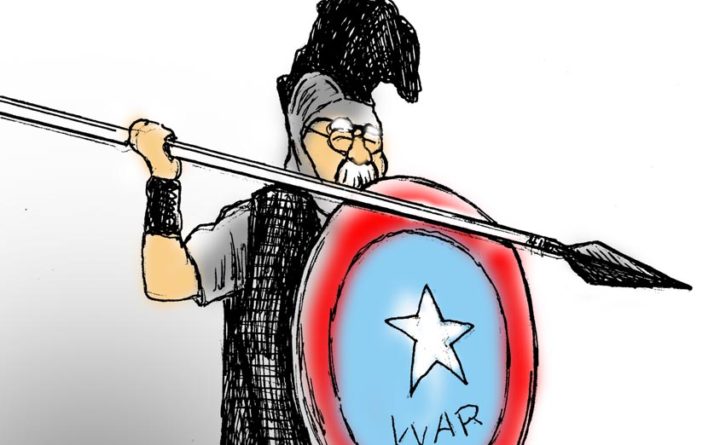 The US effort to exit the treaty was spearheaded by John Bolton, Donald Trump’s hawkish national security adviser.
According to a leaked memo published by the Washington Post, Bolton has ordered the Pentagon to “develop and deploy ground-launched missiles at the earliest possible date”.
While it would take a substantial length of time to develop an entirely new missile, existing medium-range weapons in the US arsenal, such as sea-launched Tomahawk cruise missiles, could be adapted for ground launch more quickly, arms experts said.
However, Nato allies would have to agree unanimously to have any new missile deployed in Europe.
The standoff comes amid a buildup of Russian and Nato forces in Europe, including nuclear forces. Nato claims that Russia has deployed nuclear-capable missiles to Kaliningrad, and on Wednesday the Russian military confirmed it had deployed powerful new anti-ship missiles to Crimea following last month’s maritime clash with Ukraine.
Molten salt nuclear reactors not commercially viable, but useful for military
 the decision to pursue Molten Salt Nuclear Reactors (MSRs )may not be based on market laws. For MSRs to succeed, they will likely be developed with appropriate political support and military funding.
If a nation wants an unlimited power supply for cutting-edge military technologies, then the MSR is indeed a very good candidate.
small modular reactors fitted with MSR technology could effectively supply electricity at remote military bases.
When a technology has some potential, the military sector can provide appropriate funding to quickly prototype products, which won’t necessarily have commercially viable features
Molten Salt Reactors: Military Applications Behind the Energy Promises, POWER,12/02/2018 | Jean-Baptiste Peu-Duvallon The commercial nuclear power sector has evolved with great help from the military-industrial complex. Research and development funded for the purpose of national defense has resulted in advances directly applicable to the power industry. For molten salt reactor designs to succeed, political support and military dollars may again be necessary.
Observers of the energy sector have likely noticed a growing interest worldwide in small modular molten salt reactor (MSR) concepts. North American companies such as Terrestrial Energy, Southern Company, and TerraPower are working to industrialize designs (Figure 1), while the Shanghai Institute of Applied Physics recently received $3.3 billion from the Chinese central government to build an MSR complex in the Gobi Desert.
……… under the leadership of its director Alvin M. Weinberg, the Oak Ridge Laboratory pursued the concept for civilian applications with the construction of a 7.4-MWth MSR, which operated for five years before being permanently shutdown in 1969. The reason testing was stopped was mainly political, as the MSR experiment in Oak Ridge wasn’t providing enough workload to other laboratories, while at the same time research on fast-breeding reactors was ramping up, requiring the engagement of more and more resources .
It was not only political, however. While the MSR concept is quite simple on paper, its industrialization is quite complex. Because the coolant is a mixture of chemicals rather than water, it provokes the release of significant quantities of tritium, which must be removed continuously. It generates other issues too, such as speedy corrosion of standard alloys, and also core lifetime issues when the coolant is moderated with graphite.
Because no MSRs have operated after the early 1970s, none of the technical solutions currently proposed to solve the outstanding issues have actually been tested. Still, new MSR projects are suddenly popping up for two main reasons: the Fukushima events and re-emerging military needs. …….
Nuclear Power in the New Weapons Race. MSRs have also gotten renewed interest following significant evolutions in military affairs. Indeed, since 2010, the U.S. military has started to deploy effective defense systems against ballistic missiles. In turn, it encourages rival powers to develop alternatives for their deterrence such as extreme-range hypersonic vehicles and low-altitude supersonic missiles.
During a speech to the nation on March 1, 2018, President Vladimir Putin revealed to the world the Russian ambition of extreme endurance. “We’ve started the development of new types of strategic weapons that do not use ballistic flight paths on the way to the target,” he said. “One of them is creation of a small-size highly powerful nuclear power plant that can be planted inside the hull of a cruise missile identical to our air-launched X-101 or the United States’ Tomahawk, but at the same time is capable of guaranteeing a flight range that is dozens of times greater, which is practically unlimited,” Putin added.
Beyond postures and statements, however, it seems there is still some work to be done. It has been reported that all flight tests of this new cruise missile resulted in short-term crashes.
Also, since the emergence of China as a military power, the probability of a high-intensity conflict in the Asia-Pacific region is growing. In such a case, the control over the vastness of the Pacific Ocean will be the aim of each party. Extreme ranges and endurance would be a key advantage for a potential winner.
If a nation wants an unlimited power supply for cutting-edge military technologies, then the MSR is indeed a very good candidate. As previously explained, the high temperature generated by an MSR makes it well-suited for airborne operations, while much more compact than a PWR for other applications. The advent of unmanned vehicles also makes the use of MSR technology easier, because radiation shielding requirements become far less stringent with no crew.
To counter the threat of new hypersonic vehicles currently under development, armies are again launching research for directed-energy weapons, such as high-energy lasers, which require huge power supplies to run efficiently. Finally, small modular reactors fitted with MSR technology could effectively supply electricity at remote military bases.
Although these military applications may sound like science fiction, one past example demonstrates the definitive military advantage procured by a high-temperature reactor over a PWR: the development of Alfa class submarines (Figure 4) in the Soviet Union in the 1960s. The Alfa-class submarine is still today considered the fastest, deepest, and most-agile nuclear submarine ever built. Its deployment resulted in the urgent design and manufacture of faster NATO torpedoes, like the U.S. Mark 48 Advanced Capability (ADCAP) or British Spearfish, to counter something that was virtually invulnerable when first put in service.
What made the Alfa possible? A lead-bismuth-cooled fast reactor, which shares the same main feature of the MSR: high temperature delivery, resulting in a high-power-density design, enabling a small, light, and powerful reactor for the submarine. However, as at ambient temperature the high-density lead-bismuth would freeze, the quayside maintenance operations aimed at preventing any irremediable core damage due to coolant freezing were very complicated and costly. While lead-bismuth and molten-salt reactors share many common points, MSRs are less costly and more easily maintainable.
Developing Viable MSR Designs
In France, the energy sector has not shown interest in MSR technology, as its current PWR fleet delivers competitive energy while achieving a very high level of safety. Furthermore, new PWR designs (EPRs) are intrinsically much safer than the Fukushima GE Mark I, which was designed in the 1960s.
MSRs are not just a different design, however; they are a different sector. MSR developers must essentially start from scratch with dedicated codes and regulations, dedicated licensing processes, dedicated fuel production facilities, dedicated reactors with dedicated highly trained operators, and dedicated waste reprocessing plants. Nonetheless, the decision to pursue MSRs may not be based on market laws. For MSRs to succeed, they will likely be developed with appropriate political support and military funding.
When a technology has some potential, the military sector can provide appropriate funding to quickly prototype products, which won’t necessarily have commercially viable features but will provide the groundwork for further refinement. Then, step by step, the remaining short-comings will be overcome to make a practical product for commercial operation. ■
—Jean-Baptiste Peu-Duvallon is a French nuclear energy professional with nearly 15 years of experience on several major construction projects. correct https://www.powermag.com/molten-salt-reactors-military-applications-behind-the-energy-promises/?pagenum=1
UK’s Atomic Weapons Establishment (AWE) failure to deal with its high level nuclear waste – now sending it to Sellafield

 NIS 28th Nov 2018 The Atomic Weapons Establishment (AWE) plan to send up to 5,000 barrels of Higher Activity Waste to Sellafield for treatment and storage. Since the year 2000 AWE has been under pressure from its regulators to take action to reduce its holdings of radioactive waste, some of which dates back to the 1983 moratorium on waste being dumped at sea.
This culminated in an improvement notice in 2015 from the Office for Nuclear Regulation (ONR) which required AWE to produce a plan for dealing with its waste holdings.
Earlier efforts to deal with the waste floundered when a plan to procure a super-compactor and build a waste treatment centre at AWE Aldermaston. The building originally intended to house the super-compactor was unable to meet modern seismic resilience standards and the plan was abandoned when the Ministry of Defence (MoD) refused to spend the £78m required to build a new facility. The plan produced by AWE to satisfy the 2015 improvement notice concluded that sending the waste to be treated and stored at Sellafield would be preferable to building an on-site waste facility.
https://www.nuclearinfo.org/article/waste-awe-aldermaston-other/awe%E2%80%99s-nuclear-waste-plan-send-it-sellafield
Exposing The Pentagon’s Massive Accounting Fraud

The danger of nuclear war through irrational decision-making by Donald Trump
 America’s greatest danger: Nuclear war decision-making by Donald Trump https://thehill.com/opinion/white-house/418509-americas-greatest-danger-nuclear-war-decision-making-by-donald-trump America’s greatest danger: Nuclear war decision-making by Donald Trump https://thehill.com/opinion/white-house/418509-americas-greatest-danger-nuclear-war-decision-making-by-donald-trump
BY LOUIS RENÉ BERES, OPINION CONTRIBUTOR — 11/28/18 An inappropriate or irrational nuclear command decision by President Donald Trump is plainly conceivable. Nothing accurate can ever be said about the true probability of such a scenario, but it is not an unfounded worry.
Might this American president become subject to various forms of psychological debility? On 14 March 1976, in response to my specific query, I received a letter from General (USA/ret.) Maxwell Taylor, a former Chairman of the U.S. Joint Chiefs of Staff, concerning nuclear risks of U.S. presidential decisional irrationality. Most noteworthy, in this handwritten response, is the straightforward warning contained in the closing paragraph. Ideally, cautioned Taylor, presidential irrationality is a problem that should be dealt with during an election, and not later on: “As to dangers arising from an irrational American president, the best protection is not to elect one.” There are assorted structural protections built into any presidential order to use nuclear weapons, including substantial redundancy. Nonetheless, virtually all of these reassuring and mutually reinforcing safeguards could become operative only at the lower or sub-presidential nuclear command levels. The safeguards do not apply to the Commander-in-Chief. This means there likely exist no permissible legal grounds to disobey any presidential order to use nuclear weapons. In principle, certain very senior individuals in the designated military chain of command could sometime choose to invoke applicable “Nuremberg Obligations,” but any such last-minute invocation would almost surely need to yield to considerations of U.S. domestic law. Should an American president operating within a bewildering chaos of his own making issue an irrational or seemingly irrational nuclear command, the only way for the Secretary of Defense, the Chairman of the Joint Chiefs, the National Security Adviser, and several possible others to effectively obstruct this order would be illegal “on its face.” Under the very best of circumstances, such informal safeguards might somehow manage to work for a time, but accepting the unrealistic assumption of “best case scenario” is hardly a rational or sensible path to nuclear security. It follows that we Americans ought to ask for more predictable and promising institutional impediments to any debilitated president. The United States is already navigating in uncharted waters. While President Kennedy did engage in personal nuclear brinkmanship with the Soviet Union back in October 1962, he had calculated his own odds of a consequent nuclear war as “between one out of three and even.” This seemingly precise calculation, corroborated both by JFK biographer Theodore Sorensen, and by my own later private conversations with former JCS Chair Admiral Arleigh Burke (my colleague and roommate at the Naval Academy’s Foreign Affairs Conference of 1977) suggests that President Kennedy was either irrational in imposing his Cuban “quarantine” or that he was wittingly acting out certain untested principles of “pretended irrationality.” JFK operated with serious and manifestly capable strategic advisors. The most urgent threat of a mistaken or irrational presidential order to use nuclear weapons flows not from any “bolt-from-the-blue” nuclear attack – whether Russian, North Korean, or American – but from an uncontrollable escalatory process. Back in 1962, Soviet premier Nikita Khrushchev “blinked” early on in the “game,” thereby preventing mutual and irrecoverable nuclear harms. Now, however, any escalatory initiatives undertaken by President Trump could express very unstable decision-making processes. Donald Trump should understand the unprecedented risks of being locked into an escalatory dynamic. Although this president might be well advised to seek escalation dominance in selected crisis negotiations with determined adversaries, he would also need to avoid catastrophic miscalculations. Whether we like it or not, and at one time or another, nuclear strategy is a bewildering game that President Donald Trump will have to play. To best ensure that this easily-distracted president’s strategic moves will be rational, thoughtful, and cumulatively cost-effective, it will first be necessary to enhance the formal decisional authority of his most senior military and defense subordinates. At a minimum, the Secretary of Defense, Chairman of the Joint Chiefs of Staff, the National Security Advisor, and one or two others in appropriate nuclear command positions should immediately prepare to assume more broadly collaborative and secure judgments in extremis atomicum. The only time for clarifying such indispensable preparations is now. Louis René Beres, Ph.D. Princeton, is emeritus professor of international law at Purdue University. He is the author of 12 books and several hundred articles dealing with nuclear strategy and nuclear war. His newest book is “Surviving Amid Chaos: Israel’s Nuclear Strategy” (Rowman & Littlefield, 2016; 2nd ed. 2018) |
|
U.S. Congress could stop the endless wars
Sen. Bernie Sanders of Vermont, who introduced the resolution back in February, said the legislation is certainly about addressing famine, bloodshed and Trump’s troubling embrace of Saudi monarchs. It’s also about Congress reasserting its constitutional authority over when and where the US makes war overseas. This has major implications for the peace movement, which is calling on Sanders to become a leading voice against US militarism.
The US military supplies the Saudi coalition with military equipment, intelligence and targeting assistance, and only recently agreed to stop refueling the Saudi warplanes bombarding Yemen. Congress never authorized participation in the civil war, even as the Obama administration began leveraging military assistance to the Saudis back in 2015. Speaking on the Senate floor on Wednesday, Sanders made this clear as he urged his colleagues to bring the resolution out of committee.
“It is a vote … that says that the United States Senate respects the Constitution … and understands that the issue of war making, of going to war, putting young men and women’s lives at stake, is something determined by the US Congress, not the president of the United States,” Sanders said.
The Senate voted 63-37 to advance the resolution on Wednesday, just months after tabling the measure with a solid majority that included several Democrats. The resolution invokes the War Powers Resolution of 1973, which compels the president to remove US forces from overseas military operations that are not authorized by Congress. A vote to pass the legislation is expected next week, and the antiwar movement now has a hard-fought victory in its sights.
“It’s enormous. This is the first time in the Senate’s history that they have ever gotten this far in invoking the War Powers Resolution,” said Hassan El-Tayyab, a peace activist and co-director of Just Foreign Policy who lobbied Congress on Yemen, in an interview.
The Constitution places the power to declare war with Congress, not the White House, but Congress has not declared war since World War II. From Vietnam to Afghanistan and Iraq, a succession of presidents led US troops into major foreign wars and a long list of other conflicts, rapidly expanding the size of the military and the power of the Oval Office along the way. Each time, these presidents sidestepped Congress. Today, the US has an estimated 800 military bases outside the 50 states, and US troops have regularly engaged in military operations in a long list of countries across the world. ……… https://truthout.org/articles/will-congress-stop-the-endless-wars/
USA Senate votes to advance Yemen War Powers resolution to end US complicity in Saudi Assault on Yemen
 Senate Advances War Powers Resolution to End US Complicity in Saudi Assault on Yemen https://portside.org/2018-11-28/senate-advances-war-powers-resolution-end-us-complicity-saudi-assault-yemen
“Today’s victory is a testament to the power of grassroots activism across the country to bring about change. This vote sets a historic precedent for future action Congress can take to reclaim its constitutional authority over war.”
“I’ve been at this for three years, and I am blown away by this,” wrote Sen. Chris Murphy (D-Conn.), who sponsored the resolution alongside Sanders and Sen. Mike Lee (R-Utah.). “The Senate just voted, for the first time, to move forward with a debate on ending American involvement in the Yemen war.”
According to Sanders communications director Josh Miller-Lewis, Wednesday marks “the first time the Senate has voted to advance a War Powers resolution.” Every single Democratic senator joined 14 Republicans in voting to move the measure forward.
“Cutting off military aid to Saudi Arabia is the right choice for Yemen, the right choice for our national security, and the right choice for upholding the Constitution,” Paul Kawika Martin, senior director for policy and political affairs at Peace Action, declared in a statement. “Three years ago, the notion of Congress voting to cut off military support for Saudi Arabia would have been politically laughable.”
While applauding the unprecedented rebuke of Saudi Arabia’s vicious, years-long assault on Yemen—which has been carried out with the help of U.S. weaponry and intelligence—anti-war advocates warned that there is still a long road ahead, with debate and a final vote on the measure expected as early as next week.
“Today’s victory is a testament to the power of grassroots activism across the country to bring about change,” said Diane Randall, executive secretary of the Friends Committee on National Legislation (FCNL). “This vote sets a historic precedent for future action Congress can take to reclaim its constitutional authority over war and end American involvement in wars around the world.”
This work is licensed under a Creative Commons Attribution-Share Alike 3.0 License
Jake Johnson is a staff writer for Common Dreams. Follow him on Twitter: @johnsonjakep
1 This Month
15 October. Joint Appeal for Nuclear Abolition Day -presentation to the UN on October 15 will be live on UNWebTV
Endorse the Nuclear Abolition Day Appeal
23-25 October – on Zoom – World BEYOND War’s annual global conference

To see nuclear-related stories in greater depth and intensity – go to https://nuclearinformation.wordpress.com
-
Archives
- October 2026 (139)
- September 2026 (339)
- August 2026 (330)
- July 2026 (355)
- June 2026 (287)
- May 2026 (306)
- April 2026 (356)
- March 2026 (251)
- February 2026 (267)
- January 2026 (308)
- December 2025 (358)
- November 2025 (359)
-
Categories
- 1
- 1 NUCLEAR ISSUES
- business and costs
- climate change
- culture and arts
- ENERGY
- environment
- health
- history
- indigenous issues
- Legal
- marketing of nuclear
- media
- opposition to nuclear
- PERSONAL STORIES
- politics
- politics international
- Religion and ethics
- safety
- secrets,lies and civil liberties
- spinbuster
- technology
- Uranium
- wastes
- weapons and war
- Women
- 2 WORLD
- ACTION
- AFRICA
- Atrocities
- AUSTRALIA
- Christina's notes
- Christina's themes
- culture and arts
- Events
- Fuk 2022
- Fuk 2023
- Fukushima 2017
- Fukushima 2018
- fukushima 2019
- Fukushima 2020
- Fukushima 2021
- general
- global warming
- Humour (God we need it)
- Nuclear
- RARE EARTHS
- Reference
- resources – print
- Resources -audiovicual
- Weekly Newsletter
- World
- World Nuclear
- YouTube
-
RSS
Entries RSS
Comments RSS

