Chinese state media boasts nuclear weapons escalation, in response to Trump
Between USA’s John Bolton, and Russia’s nuclear hawks – the fragmentation of nuclear arms control spells global danger
 Fragmenting nuclear arms controls leave world in a more dangerous place https://www.theguardian.com/world/2019/jan/03/fragmenting-nuclear-arms-controls-leave-world-in-a-more-dangerous-place Andrew Roth in Moscow 3 Jan 2019 Fragmenting nuclear arms controls leave world in a more dangerous place https://www.theguardian.com/world/2019/jan/03/fragmenting-nuclear-arms-controls-leave-world-in-a-more-dangerous-place Andrew Roth in Moscow 3 Jan 2019 US could withdraw from a second treaty while Vladimir Putin’s Russia promises a new generation of nuclear weapons The decision on whether or not to destroy the world came down to a humble Soviet duty officer early one morning in 1983. Stanislav Petrov was told by his computer that the United States had launched at least five intercontinental ballistic missiles at the Soviet Union, and that they would strike in just 25 minutes.Rather than send the alarm up the chain of command, the lieutenant colonel did nothing and averted a nuclear clash over what turned out to be a systems malfunction. For his troubles, Petrov was reprimanded for failing to keep careful notes during the incident and left the service the following year. He died at 77 just last year, on the cusp of the collapse of the architecture that has governed nuclear arms control for the last two generations. Potential nuclear clashes may seem the stuff of Cold War lore, but the framework to prevent them is recent and increasingly endangered.
The next pillar to fall could be the New Start treaty, signed by Barack Obama and Dmitri Medvedev in 2010, which reduced strategic missile launchers by half. That treaty will expire in 2021 unless it is extended, and President Trump has called it a “bad deal” in a telephone call with Vladimir Putin. Russia’s foreign minister has said he believes the United States is “preparing the soil to dismantle this deal.” Putin also threatened the United States with a new line of nuclear-capable weapons earlier this year, blaming the United States’ decision to exit the 1972 anti-ballistic missile treaty for a new arms race. His state of the nation speech, usually a staid affair, was accompanied by a low-resolution animation of a nuclear-powered cruise missile sailing from the Atlantic Ocean, around Cape Horn and then northward toward California. “You didn’t listen to our country then,” Putin said of the US leaving the ABM in 2001. “Listen to us now.” Taken together, these treaties are the bulk of the nuclear arms control framework that the United States and Russia inherited from the Cold War or have developed since. Experts from both sides note that the treaties weren’t perfect but warn that brokering deals is far more difficult than breaking them. The probability of an arms buildup is growing. “The INF decision and failure to get into real discussions about extending New START has us sleepwalking into a new nuclear arms race,” said Richard Burt, a former ambassador who served as chief negotiator for the United States on the Strategic Arms Reduction Treaty, during an Atlantic Council event earlier this year. Viktor Yesin, the former chief of staff of the Russian Federation Strategic Missile Force, said that the US decision to exit the INF was largely with an eye to military developments in China and other countries not bound by the treaty. But the decision could lead to deployments of missiles in Europe, he said, unless the United States and Russia take steps to avoid it. Only “political measures” could avert “the worst outcome for Russia and Europe in the development of a ‘missile crisis,’ which will unavoidably arise after the United States exits the INF,” he said. Those warnings appear to be apt. A leaked memo published by the Washington Post showed that Bolton had ordered the Pentagon to “develop and deploy ground-launched missiles at the earliest possible date.” The order was tabled only after European allies intervened to prevent an immediate US pullout from the INF. Washington has issued Moscow a 60-day ultimatum, after which it will exit the treaty. Russia, which has not admitted to violating the treaty, has signalled it won’t change its behaviour. The driving force behind the pullout is seen as Bolton, who has spoken fervently against similar arms control treaties and presided over the demolition of both the anti-ballistic missile treaty in 2001 and now the INF. Determined individuals can change the course of history. In 1983, Petrov’s decision not to alert his superiors came down to a “funny feeling in my gut.” Now, Bolton appears resolved to finally see a United States released from the bonds of missile treaties and nuclear arms control. |
|
Earthquakes still being set off due to North Korea’s September 2017 nuclear test
 September 2017 nuclear test triggers 2019 earthquake in North Korea https://edition.cnn.com/2019/01/01/asia/north-korea-earthquake-intl/index.html, By Jake Kwon and Joshua Berlinger, CNN January 2, 2019 North Korea’s sixth nuclear test was so powerful that it’s still triggering earthquakes more than a year later.
Disputes between Democrats and Republicans over nuclear weapons policy and procurement –
 Nuclear Winter Is Coming: Nuclear ‘War’ To Hit Washington In 2019, Investor’s Business Daily , GILLIAN RICH, 12/18/2018
During the Obama administration, a deal was brokered under which Republicans supported the New START treaty to reduce nuclear weapons while Democrats backed the modernization of the U.S.’ nuclear arsenal, he said.
All-out partisan warfare on the issue would come at a bad time for the Pentagon. In 2017, the Congressional Budget Office put the price tag of sustaining and modernizing the full nuclear triad of land-, air- and sea-based weapons at $1.2 trillion in constant dollars through 2046.
But, like other things that happened under Obama, the Republican-Democratic deal on nuclear weapons is starting to unravel under Trump.
Nuclear Weapons Treaties
In early December, the Trump administration gave Russia 60 days to come into compliance with the INF treaty or the U.S. will leave.
Trump’s threat raises questions about whether he will renew the New START treaty, which expires in 2021. Without the arms-control treaties, Democrats could block the funding of nuclear weapons in the 2020 budget with their new majority in the House.
“They can’t build a consensus to do something new or different — the Senate or president might not go along — but they can stop things from happening,” Tom Collina, director of policy at the Ploughshares Fund, which is focused on reducing nuclear weapons. “The power of ‘no’ is a significant force.”……….
Nuclear Weapons That May Go Boom Or Bust
To modernize the air-based leg of the nuclear weapons triad, the Air Force awarded the B-21 contract to Northrop Grumman (NOC) in 2015 to replace Cold War-era Boeing (BA) B-52s. The eventual procurement price tag is estimated at $80 billion.
Cancian believes that this new stealth bomber will survive upcoming procurement battles because of its ability to deliver conventional munitions as well.
New Columbia-class ballistic missile submarines will modernize the sea-based leg of the nuclear triad and replace Ohio-class “boomers.” General Dynamics’ (GD) Electric Boat is building them with total acquisition costs expected to hit $128 billion.
Cancian also believes that the Columbia-class submarine program will continue, saying ballistic subs are most likely to survive a nuclear attack because they are hidden underwater.
Then there are two missile programs without contract awards yet that have been more controversial. Lockheed and Raytheon (RTN) are competing for the Long-Range Standoff weapon (LRSO), a nuclear cruise missile to be launched from strategic bombers.
Northrop and Boeing are competing to build the Ground-Based Strategic Deterrent (GBSD) program to replace Boeing’s aging land-based Minuteman III intercontinental ballistic missile system.
Former Defense Secretary William Perry and retired Gen. James Cartwright, former vice chair of the Joint Chiefs, argued last year that ICBMs and nuclear cruise missiles carry greater risks of accidentally setting off a nuclear war because they can’t be recalled once launched.
Canceling them would also save billions of dollars that could be used for other pressing national security needs, they said. ………
High Anxiety Over Low-Yield Nuclear Weapons
The U.S. already has about 500 low-yield airdropped nuclear weapons in its arsenal. And Smith is extremely critical of the low-yield warheads for Lockheed’s Trident D5 submarine-launched ballistic missile.
“It makes no sense for us to build low-yield nuclear weapons,” Smith said at a Ploughshares conference in November. “It brings us no advantage and it is dangerously escalating. It just begins a new nuclear arms race with people just building nuclear weapons all across the board in a way that I think places us at greater danger.”……….
Pentagon Budget Uncertainty
Amid the policy and procurement debates, another source of uncertainty on defense spending is coming from Trump himself.
He blasted the current $716 billion Pentagon budget, tweeting earlier this month that it was “crazy.” But days later he reportedly said he wanted to give the Pentagon $750 billion, above the $733 billion the DOD requested…….https://www.investors.com/news/nuclear-weapons-upgrades-nuclear-treaties-inf-new-start/
North Koreans very proud of ” nuclear weapons program completion”
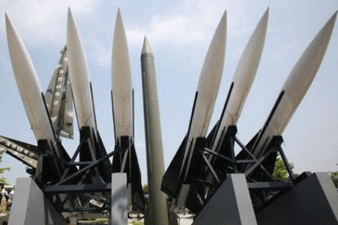
 [Photo] North Korea marks one-year anniversary of alleged nuclear weapons program completion, Daily NK, By Mun Dong Hui, 28 Dec 18,
 Australian Labor Party in a progressive move, plans to sign and ratify UN Nuclear Weapons Ban Treaty
 The cold war is back. Labor is right to support a nuclear ban treaty https://www.theguardian.com/commentisfree/2018/dec/28/the-cold-war-is-back-labor-is-right-to-support-a-nuclear-ban-treaty
Labor’s pledge to commit to nuclear disarmament puts the alternative party of government on the right side of history.
The gulf between the shenanigans of way too many politicians, and the growing urgency of grave and looming threats has rarely seemed wider. Action on crucial issues languishes while parliamentarians make naked grabs for power, acting in the interests only of themselves. Poor personal behaviour seems endemic. On the two unprecedented dangers looming over all humanity – nuclear war and climate disruption – Australia has been not just missing in action, but actively on the wrong side of history, part of the problem rather than the solution.
The government’s own figures demonstrate that our country, awash with renewable sun and wind, is way off track to meet even a third of its greenhouse gas emissions reduction target by 2030 – itself nowhere near enough.
Not only is nuclear disarmament stalled, but one by one, the agreements that reduced and constrained nuclear weapons, hard-won fruit of the end of the first cold war, are being trashed. All the nuclear-armed states are investing massively not simply in keeping their weapons indefinitely, but developing new ones that are more accurate, more deadly and more “usable”. The cold war is back, and irresponsible and explicit threats to use nuclear weapons have proliferated. Any positive effect that Australia might have on reducing nuclear weapons dangers from the supposed influence afforded us by our uncritical obsequiousness to the US is nowhere in sight. Our government has been incapable of asserting any independence even from the current most extreme, dysfunctional and unfit US administration. The US has recently renounced its previous commitments under the nuclear non-proliferation treaty (NPT); we have said nothing.
The one bright light in this gathering gloom is the 2017 UN treaty on the prohibition of nuclear weapons. For its role in helping to bring this historic treaty into being, the International Campaign to Abolish Nuclear Weapons (Ican) was awarded the Nobel peace prize for 2017 – the first to an entity born in Australia. This treaty provides the first comprehensive and categorical prohibition of nuclear weapons. It sets zero nuclear weapons as the clear and consistent standard for all countries and will help drive elimination of these worst weapons of mass destruction, just as the treaties banning biological and chemical weapons, landmines and cluster munitions have played a decisive role in progressing the elimination of those other indiscriminate and inhumane weapons. The treaty lays out a clear pathway for all states, with and without nuclear weapons, to fulfil their binding legal obligation to accomplish nuclear disarmament. It is currently the only such pathway.
Regrettably, the Australian government was the most active “weasel” in opposing the treaty’s development at every step and was one of the first to say it would not sign, even though we have signed every other treaty banning an unacceptable weapon.
Hence the Labor party’s commitment at its recent national conference in Adelaide that “Labor in government will sign and ratify the Ban Treaty” is an important and welcome step. It is a clear commitment, allowing no room for weaselling.
The considerations articulated alongside this commitment are fairly straightforward and consistent with the commitment. First, recognition of the need for “an effective verification and enforcement architecture” for nuclear disarmament. The treaty itself embodies this. Governments joining the treaty must designate a competent international authority “to negotiate and verify the irreversible elimination of nuclear weapons” and nuclear weapons programmes, “including the elimination or irreversible conversion of all nuclear-weapons-related facilities”. Australia should also push for the same standard for any nuclear disarmament that happens outside the treaty.
Second, the Labor resolution prioritises “the interaction of the Ban Treaty with the longstanding Nuclear Non-Proliferation Treaty”. The treaty has been carefully crafted to be entirely compatible with the NPT and explicitly reaffirms that the NPT “serves as a cornerstone of the nuclear disarmament and non-proliferation regime”, and that its full and effective implementation “has a vital role to play in promoting international peace and security”. All the governments supporting the treaty support the NPT, and the NPT itself enshrines a commitment for all its members to “pursue negotiations in good faith on effective measures relating to cessation of the nuclear arms race at an early date and to nuclear disarmament”. The UN secretary general, Antonio Guterres, and the International Committee of the Red Cross are among those who have affirmed that the treaty and the NPT are entirely consistent, complementary and mutually reinforcing. Even opponents of the treaty recognise that prohibition is an essential part of achieving and sustaining a world free of nuclear weapons.
Third, the Labor resolution refers to “Work to achieve universal support for the Ban Treaty.” This too is mirrored in one of the commitments governments take on in joining the treaty, to encourage other states to join, “with the goal of universal adherence of all States to the Treaty.”
An Australian government joining the treaty would enjoy wide popular support in doing so – an Ipsos poll last month found that 79% of Australians (and 83% of Labor voters) support, and less than 8% oppose, Australia joining the treaty.
Australia would also stop sticking out like a sore thumb among our southeast Asian and Pacific Island neighbours and be able to work more effectively with them. Brunei, Cook Islands, Fiji, Indonesia, Kiribati, Laos, New Zealand, Malaysia, Myanmar, Palau, Philippines, Samoa, Thailand, Timor-Leste, Tuvalu, Vanuatu and Vietnam have already signed the treaty.
Most importantly, joining the treaty and renouncing nuclear weapons would mean that Australia would become part of the solution rather than the problem of the acute existential peril that hangs over all of us while nuclear weapons exist, ready to be launched within minutes. Time is not on our side. Of course this crucial humanitarian issue should be above party politics. The commitment from the alternative party of government to join the treaty and get on the right side of history when Labor next forms government is to be warmly welcomed. It is to be hoped that the 78% of federal parliamentary Labor members who have put on record their support for Australia joining the treaty by signing Ican’s parliamentary pledge will help ensure Labor keeps this landmark promise.
• Dr Tilman Ruff is co-founder of the International Campaign to Abolish Nuclear Weapons (Ican) and Nobel peace prize winner (2017)
George H.W. Bush’s shameful involvement in the Regime Change in Nuclear-Free Palau
|
George H.W. Bush: Dirty Tricks and Regime Change in Nuclear-Free Palau, LA Progressive 29 Dec 18 Amidst all the presidential pomp, on Dec. 5 George H.W. Bush’s casket was lifted off the black-shrouded bier that had carried Abraham Lincoln after the 16th president’s assassination and driven from the U.S. Capitol to the Washington National Cathedral. But as far as I’m concerned George H.W. Bush went from lying for the state to lying in state. ………..
Much was made about “regime change” in Iraq because of Saddam’s purported WMDs by Pres. Bush 43. But scant attention has been paid to the tragic tale of regime change in a Pacific Island of 15,000 indigenous people who dared oppose U.S. nukes – and to Bush 41’s connection to Palau. George W. Bush may ballyhoo “spreading democracy”, but while Bush Sr. was in the Executive Branch, Palauans were compelled to vote about 15 times in around as many years on self-rule and their nuclear free status. Palauans could vote – but their vote didn’t count unless it favored U.S. policy. Palauans had to keep casting their ballots until Washington attained its desired result: Rescinding the Palau constitution’s antinuclear clauses. It was a unique form of voter suppression.
During this display democracy, Palau was gripped by a reign of terror. On June 30, 1985, Pres. Haruo Remeliik was assassinated, which reopened the then-deadlocked treaty negotiations. Shortly after the liquidation, then-Vice Pres. Bush personally flew to Saipan in the Northern Marianas, located north of Palau and where the Trust Territory administration was HQ-ed, to reopen stalled status parleys, and struck a new deal.
However, antinuclear activists defeated the treaty in a tribunal, where Palau’s High Court ruled a 75% vote favoring a proposed Compact of Free Association was required in order to override the small nation’s antinuclear laws. In 1987, terrorists firebombed and shot Pacific pacifists, and besieged Palau’s congress. A U.S. Congressional General Accounting Office investigation found a $2 million U.S.–derived slush fund financed political violence. In 1988, Palau’s second elected president, pro-U.S. puppet Lazarus Salii, also mysteriously had his head blown off. Although this was officially declared a suicide, the elimination of Salii – who was unable to pass the Compact – untied the Gordian knot that led to the elimination of Palau’s nuclear bans. Other high ranking U.S. officials during the Reagan-Bush era with links to Palau include: Secretary of State George Shultz, who secured Palauan beachheads as a Marine sergeant during WWII. Shultz returned to Palau in 1986 during the Compact re-negotiation process. In the late 1970s, Admiral William Crowe surveyed land in Palau for U.S. bases, and became CINCPAC Commander and Joint Chiefs of Staff Chairman 1985-1989. President Bush Sr. appointed Brent Scowcroft – who’d arranged the Kissinger-ordered surveillance of Micronesian status negotiations – National Security Adviser. Black Ops in ParadiseParis was Washington’s colonial partner in Oceania, and in the 1960s Moruroa atoll, at French-occupied Polynesia, became France’s South Pacific nuclear testing site for atmospheric and underwater N-blasts. On Jan. 12, 1985, Eloi Machoro, a militant leader of the Kanak indigenous people fighting for independence from France was killed by French police snipers. On March 2, 1985, shortly after he’d returned from meeting anti-nuke activists at Auckland, New Zealand, Tahitian activist Charlie Ching was arrested walking to a pro-independence, antinuclear rally in Papeete, Tahiti. On June 30, 1985 the first president of the world’s first national nuclear free zone was gunned down in Palau. Ten days later French General Directorate for External Security secret agents bombed the Rainbow Warrior at nuclear free New Zealand on July 10, 1985, as Greenpeace prepared to protest France’s nuclear testing near Tahiti. The DGSE saboteurs of the Rainbow Warrior were captured and convicted; the implicated chiefs of France’s military and intelligence services resigned. The above appear to be part of a coordinated counterinsurgency program to defeat the nuclear free and independent Pacific movement. French state terrorism was indisputably responsible for bombing Greenpeace’s ship. Is it farfetched to think the assassination of Palau’s president(s) and reign of terror was American state terrorism? Inquiring minds want to know. As former CIA chief, Bush headed what LBJ called “Murder, Inc.,” and, as mobsters say: “The fish stinks from the head down.” The Pentagon had motive: relocating bases from the Philippines (closed after Marcos’ overthrow) to Palau – but the world’s first nuclear free constitution thwarted this aspiration. To find out who commits a crime, see who benefits from it: The IPSECO debt and political violence finally wore Palauans down; in the 1990s their antinuclear framed rules lost at the polls. Palau was, in effect, annexed by Uncle Sam, as was the rest of Micronesia – which, as Bush knew from his WWII days, had vital strategic value. ………. If MSM spent 1% of the time investigating Bush’s ties to the covert actions in Palau as they did extolling his virtues during their funereal coverage, the case of who shot Pres. Remeliik might actually get solved. Instead of ballyhooing and worshipping a golden calf, MSM should mobilize at least some resources to look behind the curtain at the real record of George H.W. Bush and investigate what role, if any, he played in whacking the president of nuclear free Palau and subsequent events in the remote isles of Micronesia. Ed Rampell Ed Rampell covered Palau during Bush’s vice presidency for AP, Reuters, Newsweek, Radio New Zealand, Radio Australia, Gannett Press, Pacific Islands Monthly, etc. He initiated and was the investigative reporter for ABC News’ “20/20” segment, “The Puzzle of Palau,” which aired in July 1987 and proved three young men related to the opposition leader convicted of assassinating President Remeliik were framed political prisoners. Within two weeks of the Barbara Walters-introduced report, they were fully exonerated of the murder by Palau’s Supreme Court. Rampell went on to report for the Australian Broadcasting Corp.’s “Background Briefing” two-part expose that directly resulted in the conviction of Palau’s pro-Washington Minister of State for soliciting the homicide of President Remeliik. The newest books Rampell co-authored are “The Hawaii Movie and Television Book” and “Conversations with W.S. Merwin.” https://www.laprogressive.com/george-bush-dirty-tricks/ |
|
Israel has the World’s Most Secretive Nuclear Weapons Program
Introducing the World’s Most Secretive Nuclear Weapons Program (Not North Korea) Who could that be? National Interest, by Kyle Mizokami 24 Dec 18
That can only mean one nation…
In a private email leaked to the public in September of 2016, former secretary of state and retired U.S. Army general Colin Powell alluded to Israel having an arsenal of “200 nuclear weapons.” While this number appears to be an exaggeration, there is no doubt that Israel does have a small but powerful nuclear stockpile, spread out among its armed forces. Israeli nuclear weapons guard against everything from defeat in conventional warfare to serving to deter hostile states from launching nuclear, chemical and biological warfare attacks against the tiny country. …….
Not much is known about early Israeli weapons, particularly their yield and the size of the stockpile. The strategic situation, in which Israel was outnumbered in conventional weapons but had no nuclear adversaries, meant Israel likely had smaller tactical nuclear weapons to destroy masses of attacking Arab tanks, military bases and military airfields. Still, the relatively short ranges between Israel and its neighbors meant that the Jericho missile, with only a three-hundred-mile range, could still hit Cairo and Damascus from the Negev desert.
Israel does not confirm nor deny having nuclear weapons. Experts generally assess the country as currently having approximately eighty nuclear weapons, fewer than countries such as France, China and the United Kingdom, but still a sizeable number considering its adversaries have none. These weapons are spread out among Israel’s version of a nuclear “triad” of land-, air- and sea-based forces scattered in a way that they deter surprise nuclear attack.
…….. Israel’s first land-based nuclear weapons were based on Jericho I missiles developed in cooperation with France. Jericho I is believed to have been retired, replaced by Jericho II and -III ballistic missiles. Jericho II has a range of 932 miles, while Jericho III, designed to hold Iran and other distant states at risk, has a range of at least 3,106 miles. The total number of Israeli ballistic missiles is unknown, but estimated by experts to number at least two dozen.
Like other nuclear-armed nations, the Israeli Navy has reportedly deployed nukes to what is generally agreed to as the most survivable seagoing platform: submarines. Israel has five German-built Dolphin-class submarines, which experts believe are equipped with nuclear-tipped cruise missiles. The cruise missiles are reportedly based off the Popeye air-to-ground missile or the Gabriel antiship missile. This ensures a so-called “second-strike capability”—as long as one submarine is on patrol, some portion of Israel’s nuclear deterrent remains invulnerable to a nuclear first strike, guaranteeing the ability to launch a nuclear counterattack.
The establishment of a nuclear triad demonstrates how seriously Israel takes the idea of nuclear deterrence. The country will likely not declare itself a nuclear power any time soon; ambiguity over ownership of nukes has served the country very well. The 2015 Joint Comprehensive Plan of Action and general instability across the Middle East has ensured that Israel will likely remain the only nuclear-armed state in the region for the foreseeable future, but a collapse of the agreement or some new nuclear program could easily change that.https://nationalinterest.org/blog/buzz/introducing-worlds-most-secretive-nuclear-weapons-program-not-north-korea-39722
Bizarre way in which Britain planned to kill their allies! – Russian soldiers during World War 2
Blue Peacock was designed to be buried on German soil along likely Soviet routes of advance. As the British were pushed back, the Soviet Army would advance, and probably would set up things like headquarters, supply depots, and other units directly above a buried Blue Peacock mine. Once the bomb went off, a ten-kiloton atomic explosion would made a significant dent in the Soviet invasion force.
The weapon could go off in one of three ways: an 8-day timer, remote control, or if someone tampered with it. One proposed arming mechanism was placing chickens in the bomb along with just enough food for the chickens to die of starvation after eight days. Seriously. https://www.popularmechanics.com/military/weapons/a25645798/blue-peacock-land-mine/
Donald Trump can launch nuclear weapons anytime: even Secretary of Defense Jim Mattis (now sacked) could not have stopped him.
 Trump can launch nuclear weapons whenever he wants, with or without Mattis Trump can launch nuclear weapons whenever he wants, with or without Mattis
Mattis’ departure seems to be provoking unease, especially considering how dangerous our nuclear-command arrangements are. The notion that Mattis, a former four-star Marine Corps general, could have blocked or defied a move by Trump to impulsively launch nuclear weapons may have seemed comforting, but it shouldn’t have been. The secretary of defense has no legal position in the nuclear chain of command, and any attempts by a secretary of defense to prevent the president from exercising the authority to use nuclear weapons would be undemocratic and illegal. With or without Mattis, the president has unchecked and complete authority to launch nuclear weapons based on his sole discretion. The reaction to Mattis’ resignation, however, could open the door for the new Congress to create long-overdue legal barriers preventing the president from initiating a nuclear strike. Such a step could be implemented without any negative impact on U.S. security or that of our allies. Every day, the U.S. nuclear early warning system is triggered by some event or another, mostly civilian and military rocket launches by one or more of a dozen countries with ballistic missiles. When such launches appear to threaten North America, the head of U.S. Strategic Command is alerted, and sometimes these alerts warrant the urgent notification of the president. That alert comes by way of a direct call from the Strategic Command or via the White House Situation Room, the emergency-operations bunker beneath the East Wing, or the national security adviser. Partly a remnant of the Cold War, this system remains in place today to ensure the president can be notified quickly of any direct threat to the United States’ nuclear arsenal and the facilities that control it. That way, he can launch nuclear missiles before they are destroyed or the U.S. government is incapacitated by incoming weapons. n normal times, this system is precarious, and it can pressure even experienced leaders to consider nuclear weapons in a crisis sooner than warranted. Alerts stemming from ambiguous ballistic nuclear missile threats occurred multiple times during the administrations of George W. Bush and Barack Obama, and some alerts went directly to those presidents. Yet, this system seems especially ill-suited to a president who has demonstrated time and again that he can be provoked into taking rash action, and who, as a candidate, openly questioned why the United States could not use the nuclear weapons it possesses. This is a dangerous set of instincts for a commander in chief with sole and unchecked authority over almost 4,000 nuclear weapons, nearly 1,000 of which could be fired within a few minutes. For over a year, Mattis has been trying to reassure congressional leaders that he could help check some of Trump’s impulses, in part by intervening in the nuclear chain of command. In a break with normal procedures, Mattis reportedly told the commander of the Strategic Command to keep him directly informed of any event that might lead to a nuclear alert being sent to the president. He even told the Strategic Command “not to put on a pot of coffee without letting him know.” Congressional leaders interpreted this to mean that Mattis would either deal with a possible threat before it reached Trump or ensure he was present to advise Trump when such an alert arrived. This assurance may have helped ease concerns about our nuclear weapons for some members of Congress, but only if they were unfamiliar with how the command and control structure truly works. Personal relationships and back channels are no way to manage a nuclear arsenal. Even informed observers are surprised to learn the president can order the use of nuclear weapons without the input – or consent – of the secretaries of Defense or State, the chairman of the Joint Chiefs of Staff or the vice president. They only have a role in the presidential launch protocol if the president has given prior approval for them to be notified and solicits their advice. Otherwise, none of these people would need to be involved or informed that the president has decided to use a nuclear weapon. Under standard procedure, an attempt would be made to contact key national security officials, but in some real-world and exercise scenarios, it has proven impossible to tie them into a quickly convened emergency teleconference. Should he wish, the president could exclude all of them, and even bypass the primary designated adviser – the four-star general in charge of U.S. strategic forces – by ordering a low-ranking on-duty emergency operations officer at the Pentagon or elsewhere to transmit a launch order directly to the executing commanders of strategic U.S. submarines, silo-based missiles and bombers. Trump could have learned all this in a briefing about nuclear weapons shortly after he took office, and his military aide, ever at his side, could explain and assist in issuing a direct order to a lower-level officer at any time. Even if Mattis had been with Trump at a time of nuclear crisis, his resignation letter drives home the fact that Trump might very well have simply ignored his counsel. Trump, as he is proving in stark terms, listens only to himself. And any attempt by another person to physically block the president from issuing a launch order would probably result in his or her removal by the Secret Service. It is delusional and fundamentally undemocratic to think that our strongest check on a president bent on initiating nuclear war without justifiable cause might be a defense secretary trying to keep the president from communicating his launch authority using the so-called Gold Codes. When the United States faced the prospect of sudden nuclear attack from the Soviet Union, this system helped reinforce deterrence based on a balance of nuclear terror. But since the demise of the U.S.S.R., and even with a more aggressive Russia, the whole arrangement raises questions about its necessity, risks and consistency with democratic values. It is well past time for the system to be reformed to ensure that it hews to our Constitution and mitigates as much as possible the very real risks associated with a renewed arms competition with Russia. One key issue is whether Trump – or any president – should have the legal ability to independently initiate the use of nuclear weapons. It seems reasonable that the president needs to be able to quickly order a nuclear response if an adversary employs nuclear weapons first against us, and that he would not have time to consult with Congress or the Cabinet if nuclear missiles were headed here. (The flight time of ballistic missiles over intercontinental distances is 30 minutes or less, and the president would have only about five to seven minutes to decide whether and how to respond.) |
|
|
Amazon planning to run a “global brain” for the Pentagon.
To understand the implications of JEDI, we must realize that the information being gathered and sorted will inevitably be used for the targeting and killing of not only opposing government-based military forces, but also nongovernmental individuals and groups who are viewed as political or potential military threats by the US.
The transfer of a massive amount of military information into a privately owned and built cloud, as will happen with the creation of JEDI, raises the possibility that the owner or owners of that cloud will — because of their knowledge of the cloud structure, capabilities and content — become more powerful than military and elected officials.
 “Alexa, Drop a Bomb”: Amazon Wants in on US Warfare, Nick Mottern, Truthout https://truthout.org/articles/alexa-drop-a-bomb-amazon-wants-in-on-us-warfare/December 16, 2018
Amazon is seeking to build a global “brain” for the Pentagon called JEDI, a weapon of unprecedented surveillance and killing power, a profoundly aggressive weapon that should not be allowed to be created.
Founded in 1994 as an online book seller, Amazon is now the world’s largest online retailer, with more than 300 million customers worldwide, and net sales of $178 billion in 2017.
Amazon has built a vast, globally distributed data storage capacity and sophisticated artificial intelligence programs to propel its retail business that it hopes to use to win a $10 billion Pentagon contract to create the aforementioned “brain” that goes by the project name Joint Enterprise Defense Infrastructure, a moniker obviously concocted to yield the Star Wars acronym — JEDI.
As of the October 12, 2018, deadline for submitting proposals for JEDI, Amazon is the betting favorite for the contract, which will go to just one bidder, in spite of protests by competitors, chief among them Microsoft and IBM. The Pentagon appears likely to select a winner for the contract in 2019.
Jedi Powers? Continue reading
Radioactive fallout killed up to 690,000 Americans from 1951 to 1973.
In the 1950s, the U.S. government downplayed the danger of radioactive fallout, asserting that all radioactivity was confined to the Nevada test site. Despite this, a national estimate attributed 49,000 cancer deaths to nuclear testing in the area.
But the results of new research suggest that this number is woefully inaccurate. Using a novel method, and today’s improved understanding of radioactive fallout, Keith Meyers from the University of Arizona discovered that U.S. nuclear testing was responsible for the deaths of at least as many — and likely more — as those killed by the nuclear bombs in Hiroshima and Nagasaki.
Specifically, between 340,000 and 690,000 Americans died from radioactive fallout from 1951 to 1973.
 At least 340,000 Americans died from radioactive fallout between 1951
  and 1973 https://bigthink.com/politics-current-affairs/new-estimate-deaths-from-us-nuclear-tests?rebelltitem=2#rebelltitem2 Domestic nuclear testing wreaked havoc on thousands of families. MATTHEW DAVIS 14 December, 2018
- Hiroshima and Nagasaki resulted in the deaths of hundreds of thousands. But new research shows that domestic U.S. nuclear tests likely killed more.
- The new research tracked an unlikely vector for radioactive transmission: dairy cows.
- The study serves as a reminder of the insidious and deadly nature of nuclear weapons.
When we think of nuclear disasters, a few names probably come to mind. There’s the Chernobyl disaster, which killed around 27,000 people, although estimates are fuzzy. After Fukushima, there were no deaths due to radiation poisoning, but this event occurred relatively recently, and radiation poisoning often kills slowly over decades. When the U.S. dropped atomic bombs on Hiroshima and Nagasaki, estimates put the death toll at around 200,000 people, but again, exact numbers are difficult to calculate.
One name that almost certainly didn’t come to mind is Nevada. When the Soviet Union detonated their first atomic bomb in 1949, the U.S. was shocked into action. America’s prior nuclear testing had been carried out in the Pacific, but it was logistically slow and costly to conduct tests there. In order to maintain dominance over the growing Soviet threat, the U.S. selected a 1,375 square-mile area in Nye County, Nevada.
This was an ideal spot for several reasons. It was closer than Bikini Atoll. The weather was predictable and very dry, reducing the risk that radioactive fallout would be dispersed by rainstorms. It was sparsely populated. There was an understanding that there would be some amount of risk posed to nearby civilians, but it was deemed acceptable at the time. The trouble is, our understanding of radioactive fallout was still in its infancy. It was a catch-22; the only way to learn more was to test nuclear weapons.
In the 1950s, the U.S. government downplayed the danger of radioactive fallout, asserting that all radioactivity was confined to the Nevada test site. Despite this, a national estimate attributed 49,000 cancer deaths to nuclear testing in the area.
But the results of new research suggest that this number is woefully inaccurate. Using a novel method, and today’s improved understanding of radioactive fallout, Keith Meyers from the University of Arizona discovered that U.S. nuclear testing was responsible for the deaths of at least as many — and likely more — as those killed by the nuclear bombs in Hiroshima and Nagasaki. Specifically, between 340,000 and 690,000 Americans died from radioactive fallout from 1951 to 1973.
Prior studies generally looked at the areas surrounded the Nevada test site and estimated the deaths caused by fallout from the area. This number was relatively low, owing to the dry, predictable weather mentioned earlier. However, the bulk of the deaths were actually dispersed throughout the country, primarily in the Midwest and Northeast regions. These deaths were caused by an unfortunate synergy between meteorology, radiation, and — perhaps oddly enough — cows.
Out of all the radioactive elements produced by a nuclear explosion, iodine-131 was the biggest killer. I-131 has an eight-day half-life, tends to accumulate in the thyroid gland, and emits beta and gamma radiation. While alpha radiation is generally weak and doesn’t penetrate material very well, beta and gamma radiation are highly energetic and shoot through clothing and flesh, ripping up DNA as it goes along.
Prior studies had examined the radioactive fallout dispersed by low-altitude winds, which would generally settle around the Nevada test site. However, a significant amount of I-131 was caught up in high-altitude winds. These winds carried the radioactive particles to other regions of the U.S., where it mixed with rain clouds.
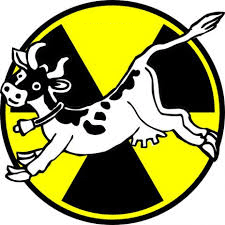 The now-radioactive rain fell onto the grasslands in the Midwest and Northeast. Then, cows ate the now-radioactive grass. The cows then produced radioactive milk. Dairy practices during the study period were different than they are today — most people drank milk that had recently been extracted from local cows.
Thanks to a National Cancer Institute database that contains broad data on radiation exposure, Meyers was able to track the amount of I-131 found in local milk and compare this with the number and nature of deaths on a county level. In this way, Meyers was able to determine that a significant number of these deaths were due to drinking poisoned milk. These civilians would have had no idea that the milk they were drinking had been irradiated by nuclear explosions hundreds of miles away.
Ironically, the area around the Nevada test site didn’t have this problem. Although they too drank fresh milk from local cows, they imported hay from other parts of the country. Since their cows weren’t eating irradiated hay, the local Nevadans took in significantly less radioactive material than their less-fortunate, distant countrymen.
Although our understanding of radiation and nuclear fallout is much improved since the dawn of the nuclear age, the study serves as a warning of the insidious nature of nuclear weapons. Containing nuclear fallout is challenging, even when you know where all of the vectors of radioactive transmission are. The complexity and intertwining nature of our ecological and social systems means that words like “clean,” “precise,” or “surgical” will likely never apply to nuclear weapons.
Trump and Putin could save The Intermediate-Range Nuclear Force Treaty, and it’s worth saving
Landmark nuclear treaty can still benefit US, NATO and Russia security. They should delay action for six months and negotiate ways to show compliance. The Intermediate-Range Nuclear Force Treaty — a key part of the post cold war nuclear system of controls and restraint — is on life support. President Donald Trump announced his desire to withdraw from the 1987 INF pact in October, citing Russian cheating and a desire to deploy missiles against China as motives. German Chancellor Angela Merkel reportedly convinced Trump this month to hold off on withdrawal for at least two months so the NATO alliance could act in a more united fashion to either bring Russia back into compliance or show it was trying.
As officials who helped negotiate the last two major strategic arms control agreements, we believe there is a deal to save the treaty and ensure its benefits can continue. This will require creative, serious and genuine negotiations by Washington and Moscow. We know firsthand, however, that negotiating with Russia can lead to surprising and positive results. Such engagement is desperately needed now, and could save a critical part of the post-Cold War arms control system that benefits American security
There’s no doubt that Russia violated INF Treaty The INF Treaty signed by President Ronald Reagan and General Secretary Mikhail Gorbachev bans the US and Russia from having land-based missiles with ranges from 500-5500 kilometers. The Treaty helped end the cold war and paved the way for reductions in strategic nuclear weapons. Banning these weapons gave leaders in Russia, Europe and America more time to make decisions in a crisis, and the treaty is worth saving if all sides can show there are fully complying with the deal.
There is no real question that Russia has violated the INF treaty. The United States has been sure of this since 2013 and has been increasingly clear about how Russia has violated the deal. Russia tested its 9M729 cruise missiles from a mobile fixed launcher to a distance of over 500 KM — something allowed by the treaty — and then later tested the same system from a ground-mobile launcher, making the missile a ground-launched system under the terms of INF.
Russia denies the 9M729 missile violates INF and instead accuses the United States of violating the INF by deploying the Mark-41 missile launcher as part of NATO missile defenses in Europe. The Mk-41 on shore is used to launch missile defense interceptors, but is used by the U.S. Navy on ships to launch offensive missiles. Russia claims this violates INF. Washington says the Mk-41 launcher for NATO’s defense is physically capable of holding canisters to launch offensive missiles like the Tomahawk cruise missile, but the land-based variant deployed in NATO is not equipped with firing software. Washington claims this makes the launcher legal, but this explanation gives Moscow little comfort.
For five years, the two countries have tried to get the other to admit their violation. That approach has failed and the treaty is now at risk of disappearing. The only way to save it — something both countries say they want — is for both to go beyond what the treaty requires to assure the other that it is in compliance.
Over the last year, former officials and experts from Russia and the United States have met privately to explore what an extra transparency regime might look like. Russian former military officials have said that the 9M729 should be made available for both inspection and even taken apart for American inspectors to determine if it can travel over 500km. While not an official Russia government offer, it seems unlikely that former officials would suggest such a thing without a sense that it might be possible.
The INF Treaty is beneficial and worth saving
Former American officials, for their part, have said NATO missile defense sites could be made available for visits by Russian officials to show no offensive missiles deployed on site. Other more extreme steps might be to modify the Mk-41 launcher so that it cannot physically hold or launch offensive missiles.
This deal is worth official exploration. Trump and Russian President Vladimir Putin should pledge not to take any unilateral steps on the INF Treaty — including withdrawal — for at least six months. They should send senior officials from their militaries, the State and Defense departments, and the White House and Kremlin to negotiate on a continual basis to see if such a deal is technically feasible. The teams should be directed to produce a draft deal for both presidents and for NATO — whose security is most at risk and whose members will need to agree to steps providing transparency over NATO missile defense sites — in three months for official consideration.
Trying to save the INF treaty can have important benefits for the United States and its NATO allies. Now that the US has publicly released details of Russia violations, European NATO states may be able to bring more pressure on Russia to come back into compliance. If in the end, Russia’s violations cannot be reversed, making these efforts will show it is a lack of political will, and not technical problems, that led to the treaty’s demise. This will in itself help NATO allies as they wrestle with how to manage security and stability in a post-INF world.
Treaties should only remain in force if they benefit American and allied security, and sometimes treaties outlive their usefulness. But the INF still can protect these interests, and Russian security as well, if all sides are prepared to show that they remain in compliance.
Richard Burt is for the former ambassador to Germany and led the 1991 START Agreement talks. Ellen Tauscher is the former undersecretary of state for arms control and international security and oversaw negotiation of the New START Treaty. Both are members of the Nuclear Crisis Group based in Washington.
Russia woos China to join nuclear framework with US
Moscow sees new opportunities as Cold War deal crumbles https://asia.nikkei.com/Politics/International-Relations/Russia-woos-China-to-join-nuclear-framework-with-US
The U.S. and Russia are currently bound by the Intermediate-Range Nuclear Forces Treaty, which prohibits ground-launched ballistic and cruise missiles with ranges of 500 km to 5,500 km. But U.S. President Donald Trump in October announced plans to withdraw over what he publicly painted as Russian violations.
On Dec. 4, Secretary of State Mike Pompeo gave Russia 60 days to return to compliance before Washington begins the process of leaving. Moscow says it has not violated the treaty and points an accusing finger at the U.S. for its missile defense hardware in Eastern Europe.
The two sides are believed to be working out a new framework behind closed doors to replace the INF Treaty. “I am certain that, at some time in the future, President Xi [Jinping of China] and I, together with President [Vladimir] Putin of Russia, will start talking about a meaningful halt to what has become a major and uncontrollable Arms Race,” Trump tweeted on Dec. 3.
Putin may have touched on a joint framework with China when he briefly spoke with Trump in Buenos Aires on Dec. 1, a source close to the Russian government said.
Putin said on Dec. 5 that Russia will follow suit if the U.S. starts developing missiles now banned by the INF treaty. “This is actually true,” he said of the argument that they are the only two nations that do not produce such arms. “Many other countries — probably about a dozen already — make such weapons, while Russia and the United States have limited themselves bilaterally.”
Russia likely sees the INF as essentially dead. Significantly outgunned by NATO in conventional arms, the country has been thought to even welcome the American decision as an excuse to strengthen its own nuclear posture.
“The United States is primarily focused on Asia where it would like to compensate for the ‘unfair’ lack of intermediate- and shorter-range weapons there,” Russian Foreign Minister Sergey Lavrov said in October. Moscow hopes that Beijing would take its side against strengthened missile defenses by the U.S. in Asia.
Meanwhile, the nuclear issue is one of the few Trump can meet with Putin on amid the ongoing probe into Russian involvement in the 2016 U.S. presidential election. It remains to be seen whether more hawkish members of his administration, like National Security Adviser John Bolton, will be open to adding China to the mix.
India has 140 Nuclear Warheads – And More Are Coming
Should we worry? National Interest ndia has 130 to 140 nuclear warheads—and more are coming, according to a new report.“India is estimated to have produced enough military plutonium for 150 to 200 nuclear warheads, but has likely produced only 130 to 140,” according to Hans Kristensen and Matt Korda of the Nuclear Information Project at the Federation of American Scientists. “Nonetheless, additional plutonium will be required to produce warheads for missiles now under development, and India is reportedly building several new plutonium production facilities.”
In addition, “India continues to modernize its nuclear arsenal, with at least five new weapon systems now under development to complement or replace existing nuclear-capable aircraft, land-based delivery systems, and sea-based systems.”…….https://nationalinterest.org/blog/buzz/india-has-140-nuclear-warheads-%E2%80%93-and-more-are-coming-38612
1 This Month
15 October. Joint Appeal for Nuclear Abolition Day -presentation to the UN on October 15 will be live on UNWebTV
Endorse the Nuclear Abolition Day Appeal
23-25 October – on Zoom – World BEYOND War’s annual global conference

To see nuclear-related stories in greater depth and intensity – go to https://nuclearinformation.wordpress.com
-
Archives
- October 2026 (139)
- September 2026 (339)
- August 2026 (330)
- July 2026 (355)
- June 2026 (287)
- May 2026 (306)
- April 2026 (356)
- March 2026 (251)
- February 2026 (267)
- January 2026 (308)
- December 2025 (358)
- November 2025 (359)
-
Categories
- 1
- 1 NUCLEAR ISSUES
- business and costs
- climate change
- culture and arts
- ENERGY
- environment
- health
- history
- indigenous issues
- Legal
- marketing of nuclear
- media
- opposition to nuclear
- PERSONAL STORIES
- politics
- politics international
- Religion and ethics
- safety
- secrets,lies and civil liberties
- spinbuster
- technology
- Uranium
- wastes
- weapons and war
- Women
- 2 WORLD
- ACTION
- AFRICA
- Atrocities
- AUSTRALIA
- Christina's notes
- Christina's themes
- culture and arts
- Events
- Fuk 2022
- Fuk 2023
- Fukushima 2017
- Fukushima 2018
- fukushima 2019
- Fukushima 2020
- Fukushima 2021
- general
- global warming
- Humour (God we need it)
- Nuclear
- RARE EARTHS
- Reference
- resources – print
- Resources -audiovicual
- Weekly Newsletter
- World
- World Nuclear
- YouTube
-
RSS
Entries RSS
Comments RSS

