US to begin nuclear treaty pullout next month after Russia missile talks fail, Guardian, Julian Borger in Washington, 17 Jan 2019
Officials reject Russian offer to inspect new missile
US says it will suspend observance of INF treaty on 2 February
The US has rejected Moscow’s offer to inspect a new Russian missile suspected of violating a key cold war-era nuclear weapons treaty, and warned that it would suspend observance of the agreement on 2 February, giving six-months’ notice of a complete withdrawal. The under secretary of state for arms control and international security, Andrea Thompson, confirmed the US intention to withdraw from the treaty after a meeting with a Russian delegation in Geneva, which both sides described as a failure.
Donald Trump took US allies by surprise when he announced his intention to leave the 1987 Intermediate-range Nuclear Forces (INF) treaty in October. The agreement led to the destruction of thousands of US and Soviet weapons, and has kept nuclear missiles out of Europe for three decades.
The Russian foreign minister, Sergei Lavrov, accused the US of intransigence, saying Moscow had offered to allow US experts to inspect the suspect missile, which it insists does not infringe the limits laid down in the treaty.
“However, US representatives arrived with a prepared position that was based on an ultimatum and centred on a demand for us to destroy this rocket, its launchers and all related equipment under US supervision,” Lavrov said.
Thompson noted that the US had been demanding Russian transparency over the missile for more than five years. She confirmed that the offer of inspections was not enough and that the US was demanding the destruction of the missile system, known as the 9M729……..
She said that there were currently no plans for follow-up talks on the INF before the 2 February deadline laid down by the Trump administration, though US and Russian diplomats would be meeting, including at a summit of the Nato-Russian council next week.
Thompson said that if Russia did not show willingness to comply with the treaty by the deadline, the US would suspend its own obligations, meaning that the US defense department could start research and development on missiles with ranges currently banned by the INF, from 500 to 5,500km.
At the same time, she told reporters, the US would formally give notice of its withdrawal from the treaty, which could come into effect on 2 August.
After that, there would be no restrictions on deployment of medium-range missiles in Europe or the Pacific………..
The Trump administration was criticised by former officials and arms control advocates for not pursuing the Russian offer of inspections.
“We’ve spent years trying to get something – anything – out of the Russians on INF. The Russian offer of an exhibition of the 9M729 is not enough, but it is something,” Alexandra Bell, a former senior state department official who is now senior policy director at the Centre for Arms Control and Non-Proliferation.
“Perhaps it is a foundation on which to build. Not trying to take advantage of this opportunity is to leave diplomatic options on the table and that’s just foolish.”
Daryl Kimball, the head of the Arms Control Association said: “If the INF is terminated on 2 August, there will be nothing to prevent Russia from deploying nuclear missiles that threaten Europe and the Trump administration will have no hesitation in pursuing the deployment of INF-prohibited weapons in Europe.” https://www.theguardian.com/world/2019/jan/16/us-russia-inf-treaty-nuclear-missile
Ground Zero Nagasaki: Living the nuclear past – and future, Asia Times, By SUSAN SOUTHARDJANUARY 18, 2019 “…………….Hibakusha stories
It’s essential for us to remember such grim details, not just for the sake of history, but for our future, because nuclear weapons far more powerful and devastating than the Nagasaki bomb are now commonplace.
In a small area of Nagasaki that includes Hypocenter Park, the Nagasaki Atomic Bomb Museum, and Peace Park, dedicated teams of Japanese men and women still work tirelessly to counter the world’s inclination to forget what happened. For the past 35 years, one organization, the Nagasaki Foundation for the Promotion of Peace, has assembled cadres of hibakusha speakers – typically about 40 at any time – willing to tell their stories. They are now aging women and men with unique memories of the day of that bombing and the weeks, months and years that followed.
Sixteen-year-old Taniguchi Sumiteru was delivering mail on his bicycle about a kilometer and a half from the hypocenter when, a split-second after the bomb detonated, its tremendous force and searing heat blew him off his bicycle and slammed him face-down on to the road. His entire back was burned off. By all rights, he should never have survived. Three months later, he finally received medical treatment. Still in constant pain 10 years after the bombing, he became one of Nagasaki’s earliest anti-nuclear activists.
Wada Koichi, an 18-year-old streetcar driver at the time of the bombing, decided to speak out when he held his first grandchild and flashed back to the charred corpse of a baby he’d stepped over as he searched for his missing colleagues.
Do-oh Mineko, then 15, suffered critical injuries to her head and lingered near death for months. Though those injuries eventually healed, radiation exposure had caused all her hair to fall out. For nearly a decade, she hid in her house until her hair finally grew back. As an adult, she kept her identity as a hibakusha secret until, in her late 60s, she found new meaning for her life by telling her story to schoolchildren.
Yoshida Katsuji, only 13, was looking up in the direction of the bomb at the moment it exploded. His entire face was scorched. Years later, as friends and colleagues told their stories publicly, he remained silent, afraid of looks of disgust from audiences due to his disfigurement. He finally began speaking out in his late 60s after deciding that being shy was not a good reason to keep silent when it came to the terrorizing impact of nuclear weapons.
These four and many others dared to cross boundaries in Japanese culture to tell their personal stories of suffering and help others grasp what nuclear war would mean for the world. Unfortunately, most hibakusha – at least those who were old enough to have vivid memories of the bombing and its aftermath – have died or are reaching the end of their lives. They are the only people capable of telling us first-hand about the experience of nuclear war, and each year their numbers diminish. ………….. http://www.atimes.com/ground-zero-nagasaki-living-the-nuclear-past-and-future/
The Pentagon Believes China Is Likely Developing A Long-Range Nuclear Bomber, Task and Purpose, Tony Capaccio, Bloomberg News, January 17, 2019 WASHINGTON — China is likely developing a long-range bomber capable of delivering nuclear weapons and a space-based early warning system it could use to more quickly respond to an attack, according to a new report from the U.S. Defense Intelligence Agency.
The development of the bomber, when combined with China’s land-based nuclear weapons program and a deployed submarine with intercontinental ballistic missile technology, would give Beijing a “triad” of nuclear delivery systems similar to the U.S. and Russia, according to the report published Tuesday.
“China is building a robust, lethal force with capabilities spanning the air, maritime, space and information domains which will enable China to impose its will in the region,” the report’s author, Lt. Gen. Robert Ashley, said in the introduction.
The report comes as President Donald Trump’s administration focuses on the potential for “great power” conflict with countries like China and Russia as part of its national defense strategy. It also comes amid heightened trade tensions between Washington and Beijing, and continuing disputes about China’s posture in the South China Sea.
……… The DIA assessment released Tuesday underscores that China maintains a “no first-use” nuclear policy but adds that there is “some ambiguity, however, over the conditions under which China’s NFU policy would apply.”
Despite a slew of disputes over Taiwan, the South China Sea and global trade, the review also says there is no indication in Chinese military strategic documents that Beijing views war with the U.S. as looming.
Moreover, while China’s defense spending climbed an average of 10 percent per year from 2000 to 2016, total spending remains “significantly below” the U.S., the report said. Spending was about 1.3 percent of gross domestic product from 2014-2018, compared to more than 3 percent of GDP for the U.S. over the same period.
China is trying to strike a balance between expanding its capabilities and reach without “alarming the international community about China’s rise or provoking the United States, its allies and partners, or others in the Asia-Pacific region into military conflict or an anti-China coalition,” the report adds.
Underlying China’s concerns are its view that the U.S.-led security architecture in Asia seeks to constrain its rise and interfere with its sovereignty, particularly in a Taiwan conflict scenario and in the East and South China Seas, said DIA.
Missile Defense Review: North Korea remains ‘extraordinary threat’ to US
Thomas Maresca, USA TODAY, 18 Jan 19 SEOUL – A Pentagon report released Thursday described North Korea’s missile and nuclear program as an “extraordinary threat” to the United States, warning that the U.S. must “remain vigilant” despite ongoing diplomatic engagement with the North.
Tomgram: Nick Turse, One Down, Who Knows How Many to Go?, Tom Dispatch by Nick Turse , January 8, 2019. Follow TomDispatch on Twitter @TomDispatch.
The U.S. military is finally withdrawing (or not) from its base at al-Tanf. You know, the place that the Syrian government long claimed was a training ground for Islamic State (ISIS) fighters; the land corridor just inside Syria, near both the Iraqi and Jordanian borders, that Russia has called a terrorist hotbed (while floating the idea of jointly administering it with the United States); the location of a camp where hundreds of U.S. Marines joined Special Operations forces last year; an outpost that U.S. officials claimed was the key not only to defeating ISIS, but also, according to General Joseph Votel, the commander of U.S. forces in the Middle East, to countering “the malign activities that Iran and their various proxies and surrogates would like to pursue.” You know, that al-Tanf.
Within hours of President Trump’s announcement of a withdrawal of U.S. forces from Syria, equipment at that base was already being inventoried for removal. And just like that, arguably the most important American garrison in Syria was (maybe) being struck from the Pentagon’s books — except, as it happens, al-Tanf was never actually on the Pentagon’s books. Opened in 2015and, until recently, home to hundreds of U.S. troops, it was one of the many military bases that exist somewhere between light and shadow, an acknowledged foreign outpost that somehow never actually made it onto the Pentagon’s official inventory of bases.
Officially, the Department of Defense (DoD) maintains 4,775 “sites,” spread across all 50 states, eight U.S. territories, and 45 foreign countries. A total of 514 of these outposts are located overseas, according to the Pentagon’s worldwide property portfolio. Just to start down a long list, these include bases on the Indian Ocean island of Diego Garcia, in Djibouti on the Horn of Africa, as well as in Peru and Portugal, the United Arab Emirates, and the United Kingdom. But the most recent version of that portfolio, issued in early 2018 and known as the Base Structure Report (BSR), doesn’t include any mention of al-Tanf. Or, for that matter, any other base in Syria. Or Iraq. Or Afghanistan. Or Niger. Or Tunisia. Or Cameroon. Or Somalia. Or any number of locales where such military outposts are known to exist and even, unlike in Syria, to be expanding.
According to David Vine, author of Base Nation: How U.S. Military Bases Abroad Harm America and the World, there could be hundreds of similar off-the-books bases around the world. “The missing sites are a reflection of the lack of transparency involved in the system of what I still estimate to be around 800 U.S. bases outside the 50 states and Washington, D.C., that have been encircling the globe since World War II,” says Vine, who is also a founding member of the recently established Overseas Base Realignment and Closure Coalition, a group of military analysts from across the ideological spectrum who advocate shrinking the U.S. military’s global “footprint.”
Such off-the-books bases are off the books for a reason. The Pentagon doesn’t want to talk about them. “I spoke to the press officer who is responsible for the Base Structure Report and she has nothing to add and no one available to discuss further at this time,” Pentagon spokesperson Lieutenant Colonel Michelle Baldanza told TomDispatch when asked about the Defense Department’s many mystery bases.
“Undocumented bases are immune to oversight by the public and often even Congress,” Vine explains. “Bases are a physical manifestation of U.S. foreign and military policy, so off-the-books bases mean the military and executive branch are deciding such policy without public debate, frequently spending hundreds of millions or billions of dollars and potentially getting the U.S. involved in wars and conflicts about which most of the country knows nothing.”Where Are They?
The Overseas Base Realignment and Closure Coalition notes that the United Statespossesses up to 95% of the world’s foreign military bases, while countries like France, Russia, and the United Kingdom have perhaps 10-20 foreign outposts each. China has just one.
The Department of Defense even boasts that its “locations” include 164 countries. Put another way, it has a military presence of some sort in approximately 84% of the nations on this planet — or at least the DoD briefly claimed this………
In the most literal sense, the Base Structure Report does indeed have the latest numbers — but their accuracy is another matter. “The number of bases listed in the BSR has long born little relation to the actual number of U.S. bases outside the United States,” says Vine. “Many, many well-known and secretive bases have long been left off the list.”
One prime example is the constellation of outposts that the U.S. has built across Africa. The official BSR inventory lists only a handful of sites there — on Ascension Island as well as in Djibouti, Egypt, and Kenya. In reality, though, there are many more outposts in many more African countries………..
According to Vine, keeping America’s African bases secret is advantageous to Washington. It protects allies on that continent from possible domestic opposition to the presence of American troops, he points out, while helping to ensure that there will be no domestic debate in the U.S. over such spending and the military commitments involved. “It’s important for U.S. citizens to know where their troops are based in Africa and elsewhere around the world,” he told TomDispatch, “because that troop presence costs the U.S. billions of dollars every year and because the U.S. is involved, or potentially involved, in wars and conflicts that could spiral out of control.”
Those Missing Bases
Africa is hardly the only place where the Pentagon’s official list doesn’t match up well with reality. ……..
If stifling domestic debate through information control is the Pentagon’s aim, it’s been doing a fine job for years of deflecting questions about its global posture, or what the late TomDispatch regular Chalmers Johnson called America’s “empire of bases.”………. Nick Turse is the managing editor of TomDispatchand a contributing writer for the Intercept. His latest book is Next Time They’ll Come to Count the Dead: War and Survival in South Sudan.His website is NickTurse.com. http://www.tomdispatch.com/blog/176513/
ANGLES AND DANGLES: ARIHANT AND THE DILEMMA OF INDIA’S UNDERSEA NUCLEAR WEAPONS, YOGESH JOSHI, War on the Rocks, JANUARY 14, 2019, SPECIAL SERIES – SOUTHERN (DIS)COMFORTEditor’s Note: This is the 24th installment of “Southern (Dis)Comfort,” a series from War on the Rocks and the Stimson Center. The series seeks to unpack the dynamics of intensifying competition — military, economic, diplomatic — in Southern Asia, principally between China, India, Pakistan, and the United States. Catch up on the rest of the series.
After INS Arihant, India’s first ballistic missile submarine (SSBN), finished its maiden deterrent patrol in November 2018, Prime Minister Narendra Modi emphatically declared India’s nuclear triad complete. Arihant’s operationalization has catapulted India into a select group of states with an underwater nuclear launch capability. It has also raised alarm over the safety and security of India’s nuclear arsenal because a sea-based deterrent may entail a ready-to-use arsenal and less restrictive command and control procedures, increasing probability of their accidental use. For Pakistan, India’s nuclear force modernization endangers the balance of strategic forces in the region and could intensify the nuclear arms race on the subcontinent……….
Arihant’s operationalization is an opportunity for New Delhi to reflect upon its nuclear trajectory. With China and Pakistan as nuclear adversaries, India confronts a unique challenge. It has to build up its nuclear capability enough to ensure that Chinese decision-makers fear it, without sending Islamabad into panic and undermining regional stability. This “Goldilocks dilemma” will be difficult to resolve, and India should not leave it to chance — especially as the United States, once South Asia’s chief crisis manager, loses both interest and influence in the region. India should reassure Pakistan by reaffirming its policy of no first use of nuclear weapons and a retaliation-only nuclear doctrine. More importantly, India should rethink its deterrence requirements vis-à-vis China.
Ultimately, the risk is that India will fail to achieve its aim of deterring China while unintentionally provoking its smaller rival……………..
To increase stability, India should publicly reaffirm its policy of no first use and adopt a retaliation-only nuclear posture, particularly since prominent voices in India’s strategic community have questioned these principles in the recent past. It should clarify that it has no intentions to use its nuclear forces in a preemptive mode. One Strategic Forces Command official told me that Arihant will only be used for countervalue strikes — that is, retaliatory strikes against Pakistani cities. Such declarations ought to be made at the highest levels of the Indian government. Arihant’s job — and, for that matter, the job of India’s entire nuclear arsenal — is to not create “fearlessness” in the Indian mind, as Modi’s office claimed. Rather, it is to ensure that India’s nuclear adversaries fear the consequences of their actions. A nuclear dialogue with Pakistan should therefore be reopened and shielded from the vagaries of domestic politics.
The nuclear competition between China, India, and Pakistan is a classic case of a triangular security dilemma. As India pursues deterrence stability vis-à-vis one adversary, it makes another adversary feel increasingly vulnerable……..
SMOL: Remembering Canada’s dangerous foray into nuclear weapons BY ROBERT SMOL Toronto Sun, 13 Jan 19, During the 1960s and ’70s, the prosperous bedroom community north of Montreal where I lived a carefree childhood had a dirty little secret.
One that, thankfully, never came to haunt me.
Fifty-five years ago — on Dec. 31, 1963 — the Liberal government of Lester Pearson formally acquired American-controlled nuclear weapons for use by the Canadian military.
Among the RCAF Squadrons stood up specifically for this purpose was RCAF 447 Surface to Air (SAM) Squadron at LaMacaza near Mont Tremblant, a mere hour and change drive from my childhood home.
This and its sister squadron, 446 SAM at North Bay, Ont., combined housed 56 Canadian BOMARC missiles — each carrying a 10-kiloton nuclear warhead maintained, armed and jealously guarded by in-house American servicemen.
Their mission, in layman terms, was to get the BOMARC warhead to detonate in the air close enough to the incoming Soviet bombers so as to destroy, avert or at least delay their further progress on their targets.
But the Canadian and American officers and NCOs who guarded, serviced and stood by ready to launch these U.S manufactured and nuclear-tipped Canadian BOMARCS were by no means alone. RCAF and Army bases, across Canada and into Europe, served as multi-faceted purveyors of U.S nuclear weapons………..
Though actual delivery systems were to change and consolidate over time, the Canadian Armed Forces continued to use tactical nuclear weapons until 1984, which, ironically, happened to be the same year Pierre Trudeau finally, left office. To put it another way, only when Conservative Brian Mulroney took office did the Canadian Armed Forces officially become “nuke-free” again. ………https://torontosun.com/opinion/columnists/guest-column-remembering-canadas-dangerous-foray-into-nuclear-weapons
The Biggest Nuclear Threats of 2018 Will Follow Us into the New Year , Defense One, BY JOE CIRINCIONE, DECEMBER 29, 2018 WE WHISTLED PAST THE GRAVEYARD THIS YEAR. LET’S BE SMARTER IN 2019.
There was some positive news this year — most importantly the decreased possibility of war in Korea — but, overall it was bleak. Let’s get right to it.
1. The New Nuclear Arms Race is the clear winner as the greatest global nuclear threat of 2018. Each of the nine nuclear-armed states is building new weapons and the United States, instead of strengthening the global nuclear safety net, is actively shredding it.
In March, Russian President Vladimir Putin announced five new nuclear weapons he said Russia was building in response to the U.S. decision to abrogate the Anti-Ballistic Missile treaty. All are designed to circumvent defenses. Russia has also deployed a small number of ground-based cruise missiles whose range exceed that permitted by the Intermediate Nuclear Forces (INF) Treaty that President Ronald Reagan negotiated. In October, President Donald Trump said he would pull out of this arms elimination pact, despite the objections of NATO allies.
Destruction of the INF Treaty is likely a prelude to allowing the New START treaty to die. This pact, negotiated by President Barack Obama, limits long-range strategic forces. If both go, it will be the first time since 1972 that U.S. and Russian nuclear forces have been completely unconstrained.
“The untimely death of these two agreements would add fuel to a new arms race and further undermine stability and predictability between Washington and Moscow,” warned former National Security Council senior director Jon Wolfsthal.
In mid-December, 26 Democratic senators wrote Trump “out of deep concern that your administration is now abandoning generations of bipartisan U.S. leadership.” They feared that Trump and his administration wanted “to double down on new, unnecessary nuclear weapons while scraping mutually beneficial treaties.” This, they said, “risks the United States sliding into another arms race with Russia and erodes U.S. nonproliferation efforts around the world.”
Some countries, perhaps many of them, may see the building of new arsenals and the killing of restraining treaties as a material breach of the U.S. and Russian pledges in the nuclear Non-Proliferation Treaty, up for review in 2020. “Today, pessimism about the future of the nuclear nonproliferation regime is again on the rise,” writes Harvard professor Rebecca Davis Gibbons. More countries, armed with more nuclear weapons would likely encourage greater risk-taking, leading to more conventional conflicts and the great risks of escalation.
2. President Trump remains a unique global nuclear threat. The danger comes from the combination of his nuclear policies, his ability to command the launch of a nuclear weapon at anytime, for any reason, and his intensifying domestic political crises.
Any president in this period would face the problems of restraining nuclear-armed adversaries, maintaining a U.S. nuclear deterrent, and rolling back the nuclear programs in North Korea and Iran. But Trump’s policies have made several of these problems worse. His Nuclear Posture Review would build new, and more usable, nuclear weapons at a price tag of almost $2 trillion while abandoning any effort to restrain global arsenals. This not only fuels an arms race, it breaks the deal with the Senate that “investments in the U.S. nuclear weapons deterrent…must be accompanied by pursuit of continued arms control measures,” as the 26 senators wrote.
More than 65 years since the UK began conducting secret nuclear weapons testing in the Australian Outback, scores of files about the program have been withdrawn from the country’s National Archives without explanation.
The unannounced move came as a shock to many researchers and historians who rely on the files and have been campaigning to unseal the small number which remain classified.
“Many relevant UK documents have remained secret since the time of the tests, well past the conventional 30 years that government documents are normally withheld,” said expert Elizabeth Tynan, author of “Atomic Thunder: The Maralinga Story”.
“To now withdraw previously available documents is extremely unfortunate and hints at an attempted cover-up.”
Dark legacy The UK conducted 12 nuclear weapons tests in Australia in the 1950s and 1960s, mostly in the sparsely populated Outback of South Australia.
Information about the tests remained a tightly held secret for decades. It wasn’t until a Royal Commission was formed in 1984 — in the wake of several damning press reports — that the damage done to indigenous people and the Australian servicemen and women who worked on the testing grounds became widely known.
Indigenous people living nearby had long complained of the effects they suffered, including after a “black mist” settled over one camp near Maralinga in the wake of the Totem I test in October 1953. The mist caused stinging eyes and skin rashes. Others vomited and suffered from diarrhea.
These claims were dismissed and ridiculed by officials for decades — until, in the wake of the Royal Commission report, the UK agreed to pay the Australian government and the traditional owners of the Maralinga lands about AU$46 million ($30 million). The Australian authorities also paid indigenous Maralinga communities a settlement of AU$13.5 million ($9 million).
While the damage done to indigenous communities was acknowledged, much about the Totem I test — and other tests at Maralinga and later at Emu Field — remained secret, even before the recent withdrawal of archive documents.
“The British atomic tests in Australia did considerable harm to indigenous populations, to military and other personnel and to large parts of the country’s territory. This country has every right to know exactly what the tests entailed,” Tynan said. “Mysteries remain about the British nuclear tests in Australia, and these mysteries have become harder to bring to light with the closure of files by the British government.”
Alan Owen, chairman of the British Nuclear Test Veterans Association, which campaigns on behalf of former servicemen, said “the removal of these documents affects not only our campaign, but affects the many academic organizations that rely on this material.”
“We are very concerned that the documents will not be republished and the (Ministry of Defense) will again deny any responsibility for the effects the tests have had on our membership,” Owen told CNN.
Unclear motives Responding to a request for comment from CNN, a spokeswoman for the National Archives said the withdrawal of the Australian nuclear test files was done at the request of the Nuclear Decommissioning Authority (NDA), which has ultimate responsibility over them.
The NDA said that “a collection of records has been temporarily withdrawn from general access via The National Archive at Kew as part of a review process.”
“It is unclear, at this time, how long the review will take, however NDA anticipates that many of the documents will be restored to the public archive in due course,” a spokeswoman said.
Jon Agar, a professor of science and technology at University College London, said the withdrawal “is not just several records but two whole classes of files, many of which had previously been open to researchers at the National Archives.”
“These files are essential to any historian of the UK nuclear projects — which of course included tests in Australia. They have been closed without proper communication or consultation,” he added.
Agar shared correspondence he had with the NDA in which a spokeswoman said some files would be moved to a new archive — Nucleus — in the far north of Scotland. However the Nucleus archivesfocus on the British civil nuclear industry, and it is unclear why files on military testing would be moved there, or why those files would need to be withdrawn to do so.
Nucleus also does not offer the type of online access to its records as the National Archives does.
“Why not just copy the files if the nuclear industry needs them at Nucleus for administrative reasons? Why take them all out of public view?” Agar wrote on Twitter.
Information freedom In correspondence with both CNN and Agar, the NDA suggested those interested in the files could file freedom of information (FOI) requests for them.
Under the 2000 Freedom of Information Act, British citizens and concerned parties are granted the “right to access recorded information held by public sector organizations.”
FOI requests can be turned down if the government deems the information too sensitive or the request too expensive to process. Under a separate rule, the UK government should also declassify documents between 20 and 30 years after they were created.
According to the BBC, multiple UK government departments — including the Home Office and Cabinet Office — have been repeatedly condemned by auditors for their “poor,” “disappointing” and “unacceptable” treatment of FOI applications.
Commenting on the nuclear documents, Maurice Frankel, director of the Campaign for Freedom of Information, a UK-based NGO, said it was “worrying that properly released records can suddenly be removed from public access without notice or explanation.”
“It suggests that the historical record is fragile and transient and liable to be snatched away at any time, with or without good reason,” he added.
John Mecklin, 07 Jan 2019 The military is a prime breeding-ground for euphemism. During the Vietnam War, “pacification” often meant the shelling and bombing of villages and forced relocation of entire populations. The Reagan administration championed a fearsome, 10-nuclear-warhead intercontinental ballistic missile. Its name? “Peacekeeper.” Russia did not invade or annex Crimea, according to President Putin; it “enhanced” its forces there.
“Nuclear modernization” is a euphemism covering a wide range of activities that constitute, in the view of many experts, a new and dangerous global nuclear arms race. And an expensive one. In the United States, the 30-year cost of the plethora of programs under the nuclear modernization umbrella – including new nuclear-capable bombers, land-based nuclear missiles, and nuclear submarines – has been estimated at $1.2 to $1.7 trillion. Observers who remember the $640 toilet seats and $437 tape measures of Defense Department history11. See http://articles.latimes.com/1986-07-30/news/vw-18804_1_nutView all notes believe that if the entire modernization program were actually funded and carried out, the cost would be much higher than these estimates.
In this issue, Bob Rosner of the University of Chicago and Stanford University’s Lynn Eden – leading nuclear experts who sit on the Bulletin’s Science and Security Board – give an overview of the astonishing complexities of the US modernization program and try to answer the core question: What does the United States need to do – and what could it reasonably not do – to ensure the reliability of its nuclear arsenal but reduce the cost of maintaining it? Another Science and Security Board member – former Obama administration arms control adviser Jon Wolfsthal – suggests that the first step in responsibly managing the US nuclear budget would require the Trump administration to actually develop a nuclear strategy. Andy Weber and Christine Parthemore of the Council on Strategic Risks, meanwhile, look at once-discarded nuclear weapon capabilities that the Trump administration has resurrected – particularly a proposed low-yield warhead for submarine-launched nuclear missiles and other “small nuke” options – and find them unnecessary and destabilizing.
The nuclear modernization craze is hardly restricted to the United States. As Carnegie Moscow Center director Dmitri Trenin notes, Russian leaders have always been keen observers of US nuclear policy, and as Russia nears the end of its own nuclear modernization cycle, strained East-West relations have created a dangerous situation.
“Against a backdrop of deep mistrust,” Trenin writes, “the coming US withdrawal from the Intermediate-Range Nuclear Forces Treaty and the new US emphasis on tactical [nuclear] systems revive the specter of a nuclear war in Europe.” And because the US-China competition is turning “increasingly serious and even hostile,” Tong Zhao of the Carnegie–Tsinghua Center for Global Policy argues, the United States should take a number of steps to ease tensions. After all, Zhao notes, the United States is the most important external influencer of Chinese nuclear policy, and as such could prevent a “more negative cycle of action-and-reaction” involving both nations’ nuclear arsenals.
As Trenin and Zhao explain, United States nuclear policy often drives the nuclear policies of Russia and China. Of course, US officials often suggest the obverse: American nuclear policy initiatives are responses to Russian and Chinese defense policies and programs.
There are reasonable and practical ways to short-circuit the new, self-reinforcing worldwide nuclear arms race that is euphemized as “modernization.” As Rosner and Eden point out, the United States could save a lot of money without sacrificing security by taking the “hard decision” to eliminate one of the three legs in its nuclear triad, most likely its land-based nuclear ballistic missiles. As Wolfsthal notes, the United States could adequately deter any adversary with a nuclear arsenal and array of delivery platforms that is significantly smaller (and less expensive) than the Trump administration proposes.
The mere official contemplation of such down-sizing moves in the United States would send a global signal. It’s a signal that could well lead to negotiations on slowing or even halting the 21st century modernization sequel to the bad arms race movie the world watched throughout the Cold War. The next Congress should begin contemplating immediately. The world has seen more than enough of this ritual squandering of national resources on weapons of horror that can never reasonably be used.
Perhaps the most terrifying was a Cold War doomsday system that would automatically launch missiles—without the need for a human to push the button—during a nuclear attack. But the system, known as “Perimeter” or “Dead Hand,” may be back and deadlier than ever, byMichael Peck , 9 Jan 19, If Russia is now discussing Perimeter publicly, that’s reason for the rest of us to worry.
Russia has a knack for developing weapons that—at least on paper—are terrifying: nuclear-powered cruise missiles, robot subs with 100-megaton warheads .
Perhaps the most terrifying was a Cold War doomsday system that would automatically launch missiles—without the need for a human to push the button—during a nuclear attack.
But the system, known as “Perimeter” or “Dead Hand,” may be back and deadlier than ever.
This comes after the Trump administration announced that the United States is withdrawing from the 1987 Intermediate-Range Nuclear Forces Treaty, which eliminated the once-massive American and Russian stockpiles of short- and medium-range missiles. Donald Trump alleges that Russia has violated the treaty by developing and deploying new, prohibited cruise missiles.
This has left Moscow furious and fearful that America will once again, as it did during the Cold War, deploy nuclear missiles in Europe. Because of geographic fate, Russia needs ICBMs launched from Russian soil, or launched from submarines, to strike the continental United States. But shorter-range U.S. missiles based in, say, Germany or Poland could reach the Russian heartland.
Viktor Yesin, who commanded Russia’s Strategic Rocket Forces in the 1990s, spoke of Perimeter/Dead Hand during an interview last month in the Russian newspaper Zvezda [Google English translation here]. Yesin said that if the United States starts deploying intermediate-range missiles in Europe, Russia will consider adopting a doctrine of a preemptive nuclear strike. But he also added this:
Zvezda: “Will we have time to answer if the flight time is reduced to two to three minutes when deploying medium-range missiles near our borders? In this version, all hope is only on Perimeter. And for a retaliatory strike. Or was Perimeter also disassembled for parts?
It is not clear what Yesin meant when he said the system has been “improved,” or even exactly what he meant by “functioning.” Perimeter works by launching specially modified SS-17 ICBMs, which transmit a launch signal to regular nuclear-tipped ICBMs in their silos.
David Hoffman, author of “The Dead Hand,” the definitive book on Perimeter, describes Perimeter in this way:
“Higher authority” would flip the switch if they feared they were under nuclear attack. This was to give the “permission sanction.” Duty officers would rush to their deep underground bunkers, the hardened concrete globes, the shariki. If the permission sanction were given ahead of time, if there were seismic evidence of nuclear strikes hitting the ground, and if all communications were lost, then the duty officers in the bunker could launch the command rockets. If so ordered, the command rockets would zoom across the country, broadcasting the signal “launch” to the intercontinental ballistic missiles. The big missiles would then fly and carry out their retaliatory mission.
There have been cryptic clues over the years that Perimeter still exists.
Which illustrates one of the curiosities of this system, which is that the Soviet Union kept its existence secret from the American enemy whom it was supposed to deter.What is unmistakable is that Perimeter is a fear-based solution. Fear of a U.S. first-strike that would decapitate the Russian leadership before it could give the order to retaliate. Fear that a Russian leader might lose his nerve and not give the order.
And if Russia is now discussing Perimeter publicly, that’s reason for the rest of us to worry.
Michael Peck is a contributing writer for the National Interest. He can be found on Twitter and Facebook.
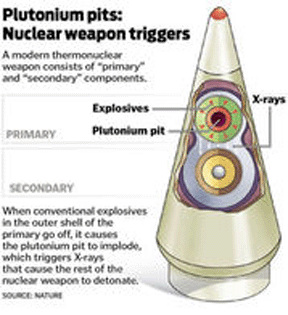
In a document filed Jan. 4 in Nevada district court, the DOE explained 1 metric ton of plutonium — in pit form at SRS — will eventually be sent to Los Alamos National Laboratory in New Mexico where it will be remanufactured into “new pits.”
Doing so will further the National Nuclear Security Administration‘s longterm stockpile work, according to the same court document. Plutonium pits are nuclear weapon cores, often referred to as triggers.
NNSA Chief of Staff William “Ike” White in a Nov. 20 letter, which was made public via other court filings, described the weapons-grade plutonium stored at SRS as “mission-essential” and integral to nation’s defense enterprise.
“This material will ultimately be used for vital national security missions and is not waste,” White wrote, later adding: “We will keep you updated on our progress as the pit production mission moves forward.” White’s letter was sent to Nevada government officials. Before the plutonium is relocated to Los Alamos, the nation’s plutonium science and production center of excellence, it will be staged at either the Nevada National Security Site or the Pantex Plant in Texas, according to the NNSA.
The shipments between Nevada and New Mexico would take place over “a period of years,” according to the Jan. 4 filing.
The DOE is removing 1 metric ton of weapons-grade plutonium from SRS — South Carolina, more broadly — to comply with a Dec. 20, 2017, court order. The plutonium must be out of the state no later than 2020, according to the order, which was issued by U.S. District Court Judge J. Michelle Childs.
The prospective weapons use of the SRS plutonium was first fully documented in an NNSA environmental assessment issued last year.
China has tested one of the most powerful non-nuclear weapons in existence, according to state media. Video released by the Xinhua news agency shows the testing of the massive bomb, dubbed the Chinese ‘Mother of All Bombs’.
The Nuclear Ban Treaty was adopted by two-thirds of U.N. members in July 2017. By year’s end, 69 states had signed and 19 had ratified it. It will come into effect after 50 ratifications. There are reasonable prospects of this happening in 2019, at which point there will be two international treaties for setting global nuclear policy directions and norms. All nine nuclear-armed states and allies sheltering under their nuclear umbrella had strenuously opposed the treaty. Yet once in force, it will form part of the new international institutional reality.
There are signs of discomfort in some umbrella states at having been exposed as lip-service adherents of the cause of nuclear disarmament. The Norwegian sovereign wealth fund and the largest Dutch pension fund have decided not to invest in nuclear-weapon-producing companies. The Australian Labor Party conference in December unanimously approved a resolution committing a future Labor government to sign and ratify the ban treaty.
There was little improvement during 2018. There is no sign that New START, which regulates U.S. and Russian strategic force numbers and deployments, might be extended by five years to 2026. China is upgrading its considerably smaller nuclear arsenal. India and Pakistan are enlarging, modernizing and upgrading stockpiles, while investing in battlefield tactical nuclear weapons (Pakistan) and systems to counter them (India).
U.S. President Donald Trump’s disdain for international institutions and rules established him as the disrupter in chief of the global nuclear order. U.S. nuclear policies reflect and fuel the fraying regimes, provoking countermeasures by adversaries, sowing doubts in allies and stiffening support among the non-nuclear states for banning the bomb. Expanding U.S. and Russian nuclear weapon developments and deployments lead to the normalization of the discourse of nuclear weapon use. They also embolden calls for nuclear-weapon acquisition by some others. Continue reading →
RUSSIAN ministry of defence officials have hinted that a new underwater nuclear warhead-carrying drone is impossible to detect. By Douglas Patient/ 5th January 2019 Dubbed President Vladimir Putin‘s new secret weapon – it’s even more deadly than originally thought according to Russia. The navy will be armed with Poseydon drones as soon as 2027.
It carries nuclear warheads and was created in order to obliterate enemy ports. But being equipped with warheads of 100 megatons, it can also be used against coastal cities.
Attacks would involve detonating the warhead underwater, creating huge tidal waves up to 1,640ft high.
At the same time it would contaminate enemy territory with radiation.
Unlike conventional nuclear weapons it would also be immune to being hit by missiles, lasers and railguns.
The concept of the strategic underwater drone named Poseydon was first put forward in 2015 and mentioned by Putin in March last year during his state-of-the-nation speech.
It was initially believed that the Poseydon will be able to travel up to 70 knots, which is about 80mph, while underwater.
But now it has been confirmed that the sample actually be capable of travelling as fast as 125mph (more than 110 knots).
In an official statement ministry said: “The drone will travel to its destination at a speed of 200 kph (125mph) and a depth of 1km (0.6 miles). The drone will be moving in a so-called ‘air-cavern’ (a process in which a steam filled bubble forms around the drone, which reduces the resistance of the water and allows it to move so fast).
“The drone will constantly be performing different manoeuvres and will not stay on one trajectory, which together with its high speed will make it impossible to intercept.”
Officials also released a video showing the computer presentation of Poseydon drones from the Russian Ministry of Defence.