Nuclear disarmament, non proliferation, “peaceful use” on the agenda as France, Russia, Britain and the United States meet in China
 World’s nuclear weapons club to meet in China as trade talks and Meng Wanzhou extradition deadline loom
Eyes will be on Beijing, Washington and Vancouver in week of high-stakes diplomatic meetings, SCMP, Lee Jeong-ho Liu Zhen, 26 January, 2019 China will host a key nuclear weapons meeting in Beijing next week, the outcome of which could affect efforts to stop the spread of nuclear arms around the globe.
The meeting on Wednesday of five major nuclear powers – China, France, Russia, Britain and the United States – will coincide with the start of a new round of high-stakes trade talks between China and the US in Washington.
In Beijing on Thursday, Chinese foreign ministry spokeswoman Hua Chunying confirmed “nuclear disarmament, nuclear non-proliferation and peaceful uses of nuclear energy” would be on the agenda of the nuclear club known as the “P5”.
“The theme will be strengthening coordination of the five nuclear-weapon states and safeguarding the Treaty on the Non-proliferation of Nuclear Weapons mechanism,” Hua said.
……..Zhao Tong, from the Carnegie-Tsinghua Centre for Global Policy’s nuclear policy programme, said the Beijing gathering would also lay the groundwork for a five-yearly conference in 2020 to review the non-proliferation treaty.
At the last review conference in New York in 2015, member countries failed to reach agreement on how to advance the treaty. …….
Zhao said Hua’s remarks suggested that next week’s meeting would also be a crucial chance for the US and Russia to discuss their differences over the Intermediate-Range Nuclear Forces Treaty (INF), which US President Donald Trump said the US would withdraw from.
“The US and Russia should take this important opportunity to discuss ways to ease the INF dispute. If INF is abandoned, the New START that remains between them will also suffer … which will be a very dangerous trend,” Zhao said.
New START is a nuclear arms reduction treaty Moscow and Washington signed in 2010. The INF Treaty was signed by the US and the then Soviet Union to eliminate short and intermediate-range missiles.
Meanwhile in Washington, all eyes will be watching to see whether US Trade Representative Robert Lighthizer and US Treasury Secretary Steve Mnuchin can reach a trade deal with the Chinese delegation led by Vice-Premier Liu He. …….. https://www.scmp.com/news/china/diplomacy/article/2183726/worlds-nuclear-weapons-club-meet-china-trade-talks-and-meng
Doomsday Clock at 2 minutes to midnight – “The New Abnormal”
 Welcome to “The New Abnormal” Bulletin of the Atomic Scientists By Bulletin Staff, January 24, 2019 A new abnormal: It is still 2 minutes to midnight Humanity now faces two simultaneous existential threats, either of which would be cause for extreme concern and immediate attention. These major threats—nuclear weapons and climate change—were exacerbated this past year by the increased use of information warfare to undermine democracy around the world, amplifying risk from these and other threats and putting the future of civilization in extraordinary danger. Welcome to “The New Abnormal” Bulletin of the Atomic Scientists By Bulletin Staff, January 24, 2019 A new abnormal: It is still 2 minutes to midnight Humanity now faces two simultaneous existential threats, either of which would be cause for extreme concern and immediate attention. These major threats—nuclear weapons and climate change—were exacerbated this past year by the increased use of information warfare to undermine democracy around the world, amplifying risk from these and other threats and putting the future of civilization in extraordinary danger.
There is nothing normal about the complex and frightening reality just described. WASHINGTON, D.C. – January 24, 2019 – Citing lack of progress on nuclear risks and climate change dangers as “the new abnormal,” the Doomsday Clock remains at 2 minutes to midnight, as close to the symbolic point of annihilation that the iconic Clock has been since 1953 at the height of the Cold War. The decision announced today to keep the Doomsday Clock at two minutes before midnight was made by the Bulletin of the Atomic Scientists’ Science and Security Board in consultation with the Board of Sponsors, which includes 14 Nobel Laureates. The full text of the Doomsday Clock statement is available at http://www.thebulletin.org. The statement includes key recommendations about how to #RewindtheDoomsdayClock. Video from the Doomsday Clock announcement at the National Press Club in Washington, D.C., is available at http://clock.thebulletin.org/and on the Bulletin of the Atomic Scientists’Facebook page at https://www.facebook.com/BulletinOfTheAtomicScientists/. …….https://thebulletin.org/2019/01/press-release-welcome-to-the-new-abnormal/ |
|
Tiny mobile nuclear reactors for U.S. military – a plan fraught with dangers

The U.S. Military Wants Tiny Road Mobile Nuclear Reactors That Can Fit In A C-17
The power demands to sustain American military operations are only increasing, but small nuclear power plants could present new problems.The Drive, BY JOSEPH TREVITHICK, JANUARY 24, 2019 The U.S. military’s secretive Strategic Capabilities Office, or SCO, is asking for potential vendors to submit proposals for small mobile nuclear reactors to help meet ever-growing demands for power during operations in remote and austere locations. This request for information comes as the U.S. Army, in particular, is looking to extend the amount of time its units can operate independent of established supply chains, but portable nuclear power could introduce new risks to the battlefield.
The goal is to develop a system that personnel can set up in three days or less and shut down and pack up in less than a week. The reactor itself would remain functional for at least three years without needing new fuel.
SCO is hoping to consider up to three designs under the first phase of the project, which would be an in-depth design study that would last between nine and 12 months. The plan is to then down select to a single design for Phase II, in which the winning contractor would build and demonstrate their prototype reactor.
There are a number of potential concepts already in various stages of development that could meet SCO’s requirements. The U.S. Department of Energy’s own Los Alamos National Laboratory (LANL), in cooperation with the Westinghouse power company, has been working on one design called MegaPower for some time now. Westinghouse is separately working on its own eVinci micro reactor design……….
There is no fixed timeline yet for when Phase I might begin, but as the request for information notes, there is already significant demand for this kind of miniaturized portable power plant. …….
The Army is certainly watching the SCO’s Project Dithulium, if it isn’t involved in it directly. In October 2018, the service put out its own report on the potential uses of nuclear power on the battlefield………
The other branches of the U.S. military have their own requirements for this kind of portable power, as well. The Air Force and the Marine Corps are both actively exploring new concepts for rapidly establishing bases that could benefit from the addition of power from small nuclear reactors.
But this is hardly the first time the U.S. military has explored using mobile nuclear reactors to meet its power needs. The Army experimented with a host of land-based designs between the 1950s and 1970s, before shelving the concept………
However, one of the biggest potential problems with battlefield nuclear power continues to be safety. There are obvious concerns about what happens when you begin deploying dozens, if not hundreds of small nuclear reactors into areas that are, by definition, full of hostile threats……
even if the reactor itself cannot catastrophically fail, something that may be a tall order to ensure in austere conditions regardless of the design, powering remote and austere bases with nuclear power could run other risks. If hostile forces end up destroying the reactor, it could potentially lead to the hazardous dispersal of radioactive material.
This, in turn, could produce short- and long-term health and safety concerns for U.S. forces and innocent civilians in the surrounding area. Even if the risk is minor, the perception of those dangers could impact public opinion about American military activities ….
There’s also a proliferation issue in building a large number of mobile reactors and placing them in war zones. There is also a matter of disposing of the nuclear waste material they’ll produce. …..
A reactor that is by design mobile would almost certainly be an attractive target for terrorists or militants looking to build a so-called “dirty bomb” that mixes radiological material and conventional explosives. ….
On top of that, unlike existing portable generators, any mobile nuclear reactor would require much more robust control systems to ensure its safe and reliable operation. Depending on the reactor’s exact configuration, there is the possibility that a cyber attack might be able to shut it down or otherwise hamper its operation at a critical point.
In October 2018, the Government Accountability Office released a report that slammed the Department of Defense’s existing protections against cyber attacks and said that the U.S. military did not have a good grasp of the extent of the potential threat. Nuclear reactors spread across an area of operations would only increase the potential vectors for such an attack. …… http://www.thedrive.com/the-war-zone/26152/the-u-s-military-wants-tiny-road-mobile-nuclear-reactors-that-can-fit-in-a-c-17
Nuclear, climate threats keep Doomsday Clock close to apocalypse

Time’s running out
A renewed nuclear arms race, rising greenhouse gas emissions and the emergence of state-sponsored disinformation campaigns have left the modern world as close to annihilation as it was at the height of the Cold War, atomic scientists said on Thursday.
What is the Doomsday Clock?
The Doomsday Clock, created by the Bulletin of the Atomic Scientists as an indicator of the world’s susceptibility to apocalypse, remained at two minutes to midnight for a second year running in what the scientists called a dangerous “new abnormal.”
“Though unchanged from 2018, this setting should be taken not as a sign of stability but as a stark warning to leaders and citizens around the world,” the Chicago-based group said in a statement.
Two main factors
Humanity’s two simultaneous existential threats of nuclear war and climate change were exacerbated during the past year by the “increased use of information warfare to undermine democracy around the world,” the group said.
“In many forums, including particularly social media, nationalist leaders and their surrogates lied shamelessly, insisting that their lies were truth, and the truth ‘fake news,'” it said.
Nuclear threat
Since the election of US President Donald Trump in 2016, the clock has closed in on midnight in successive 30-second moves in 2017 and 2018, in part because of escalating tensions with North Korea over its nuclear program.
The last time the clock was as close to midnight as it has been in the past two years was in 1953, when the US-Soviet arms race escalated as Moscow tested a hydrogen bomb in August after the detonation of an American H-bomb the previous November.
Despite a softening of barbed rhetoric between Trump and North Korean leader Kim Jong Un over the past year, the group saw rising threats in nuclear-armed nations’ programs of “‘nuclear modernisation’ that are all but indistinguishable from a worldwide arms race.”
On climate, the group said carbon dioxide emissions resumed an upward climb in the past two years.
Clocking out
To turn back the clock, it recommended steps including fortifying and extending US-Russian nuclear treaties with limits on modernisation programs, adopting safeguards to prevent peacetime military incidents along NATO countries’ borders, citizen demands for action on climate change and multilateral talks to discourage the misuse of information technology.
The bulletin was founded by scientists who helped develop the United States’ first atomic weapons. When the clock was created in 1947, it was set at seven minutes to midnight.
USA’s nuclear weapons modernisation plan to cost $494 billion over the next decade
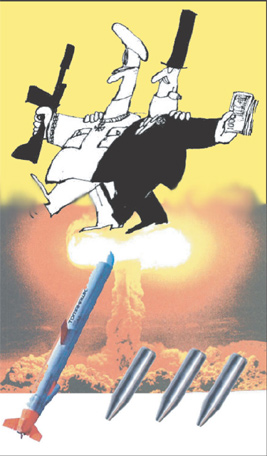 Here’s how many billions the US will spend on nuclear weapons over the next decade, Defense News
Saudi Arabia could be planning for nuclear wrapons
 World War 3 fears SURGE as experts warn Saudi Arabia could be seeking ‘NUCLEAR weapons’
FEARS Saudi Arabia could be seeking to build nuclear weapons have surged following reports the Kingdom has launched a domestic ballistic missile programme. Express UK By JAMES BICKERTON, Jan 25, 2019 According to a report published in The Washington Post, Saudi Arabia appears to have constructed a ballistic missile factory, which could threaten to trigger a new Middle Eastern arms race. Saudi Arabia already owns foreign-brought ballistic missiles but has yet to construct its own. A number of experts have warned this could signal a Saudi desire to become nuclear armed.
Satellite images taken in November appear to show a ballistic missile factory near the town of Al-Watah, according to the report.
The site is situated next to an existing Saudi Arabian missile base.
A team led by nuclear expert Jeffrey Lewis, from the Middlebury Institute of International Studies, uncovered the pictures.
Mr Lewis said the images raise “the possibility that Saudi Arabia is going to build longer-range missiles and seek nuclear weapons”…..https://www.express.co.uk/news/world/1077486/World-War-3-Saudi-Arabia-nuclear-weapons-Middle-East-arms-race
America may be overspending on unnecessary nuclear weapons – the nuclear triad now obsolete?
| Does America Still Need the Nuclear Triad? The U.S. can deliver nuclear weapons from air, land, and sea. That could change. Jan 24, 2019 Popular Mechanics, By Kyle Mizokami
“……..Because the U.S. can launch nukes from the air, land, or sea, it would be practically impossible for another country to knock out America’s offensive capabilities and prevent the counterstrike. The U.S. is currently working on replacing all three legs of the triad: bombers, intercontinental ballistic missiles, and submarine-launched missiles. It’s an overhaul that will cost hundreds of billions of dollars, and no doubt overshoot the Pentagon’s price estimates when all is said and done. But before we spend all that money, one must look around and ask the question: Is this still the best way? In the 21st century, does America really need three ways to launch nukes?……… During the Cold War, each arm of the triad justified its existence by doing something better than the other two. Strategic heavy bombers such as today’s B-2 Spirit and the longstanding B-52H Stratofortress could carry many nuclear bombs and strike multiple geographically distinct targets …….. Intercontinental ballistic missiles (ICBMs) loft nuclear warheads into space on ballistic trajectories. They are buried by the hundreds in underground concrete silos scattered across America…… The third arm of the triad was nuclear-powered submarines carrying their own nuclear-tipped ballistic missiles…… But as the second decade of the 21st century draws to a close, the nuclear triad is showing its age. The B-2 Spirit bomber was introduced in the 1990s, while the B-52H has been flying since the early 1960s and may keep working for decades to come. The Minuteman III ICBM was first deployed in the early 1970s. The U.S. Navy’s Ohio-class ballistic missile submarines date to the 1980s and 1990s. After decades of pushing back plans to replace all three arms, the U.S. is now faced with a situation where it needs to replace all three at once. The new B-21 Raider bomber, which will replace the B-2 bomber, will cost an estimated $97 billion dollars. The new ICBM, Ground Based Strategic Deterrent (GBSD), will cost around $100 billion. Finally, new ballistic missile submarines will cost $128 billion. That adds up to a serious bill. The cost is about the equivalent of running the entire U.S. Armed Forces for five months. And the price tag could rise substantially if any of the programs run into expensive technical problems. If history is any guide, then at least one of them will. Could the U.S. thrive in 21st century without a nuclear triad? To see a possible way forward, just look at the emerging colossus of China. The world’s most populous nation is building more aircraft carriers, more amphibious ships, and more modern combat aircraft than ever before. What China is not doing is significantly expanding its nuclear arsenal. China has approximately 280 nuclear weapons, a number we can deduce from the amount of fissile material it has produced. That total represents about one sixth the number of deployed U.S. and Russian nuclear weapons. China’s nukes are spread between land-based ballistic missiles and submarine-launched missiles. It has no air-delivered nuclear weapons for its modest bomber force. In other words, China has a diad. China is a “no first use” country, meaning it has vowed to never use nuclear weapons first. It also bother with advanced nuclear technologies such as anti-ballistic missile systems or placing multiple warheads on a single missile. Why not? China’s entire nuclear philosophy boils down to this: The country may very well be destroyed by a surprise nuclear attack, but enough Chinese nuclear weapons will survive to make the attack simply not worth it. Essentially, China’s nuclear doctrine is assured destruction, but stripped of unnecessary complexities. China doesn’t lose any sleep over Russia or America’s overwhelming advantage in nuclear arms. As long as China can hit back and nuke at least a handful of American (or Russian) cities, the balance of terror remains. Does China’s nuclear posture work? Even a strike against tiny North Korea runs the risk of a nuclear counterstrike by China, and the loss of just one American city would be a catastrophe. ……. it’s hard to ignore the stripped-down logic of the Chinese model, which says the only credibility necessary is the ability to strike back after an attack—the rest is just overthinking the issue. If that’s truly the case, then what use is a triad? Could the U.S. get rid of one or two arms of the triad, spending that money elsewhere in the defense budget to enhance conventional capabilities? ………Could the U.S. cut ICBMs and rely on a force of submarines and bombers, or submarines alone? These are important questions the American people need to ask before spending $300 billion replicating the weapons of the Cold War. Perhaps the U.S. should stick with the nuclear triad—but at the very least, America needs a national conversation about what nuclear security means and how to achieve it. https://www.popularmechanics.com/military/weapons/a25983826/us-nuclear-triad/
|
Soviet Union’s secret nuclear weapons bunkers in Poland
Secret Soviet Bunkers in Poland Hid Nuclear Weapons, Live Science, By | January 21, 2019 In the 1960s, the Soviet Union built massive bunkers in Poland. These bunkers didn’t appear on maps, and were carefully concealed to be invisible to spies from the air.
But now, these long-abandoned buildings are revealing some of the secrets of Russian military strategy during the Cold War.
Soviet documents from that time period described the sites as communications centers, though the buildings vanished from official records soon after they were built. Indeed, at the time, the Soviet Union denied having nuclear weapons cached anywhere in Poland.
But researchers are finally taking up the investigation of these secret sites, and uncovered the bunkers’ primary purpose: storehouses for nuclear weapons. [In Photos: Soviets Hid Nuclear Bunkers in Poland’s Forests]
Archaeologist Grzegorz Kiarszys, an adjunct professor at the Institute of History and International Relations in Poland, has conducted the first in-depth exploration of three of these nuclear warhead storage facilities. By delving into archives of declassified satellite images and analyzing building scans, Kiarszys is piecing together the role that these secret sites played on the global chessboard, at a time when the threat of nuclear war between the world’s biggest superpowers was all too real.
His findings were published online today (Jan. 21) in First View, a preview of the journal Antiquity‘s February 2019 issue.
Tactical storage
For the study, Kiarszys looked at three abandoned top-secret facilities that stored nuclear weapons and housed military personnel:…….. https://www.livescience.com/64553-soviet-nuclear-bunkers-poland.html
Facing fallout: How Duke prepared for nuclear disaster in the 1960s
The Chronicle – Duke University By | 01/21/2019 At the height of the Berlin Crisis of 1961, a University committee developed plans to house nearly 50,000 Duke and Durham community members in shelters across campus. …….
Nuclear disaster planning was based on the worst-case scenario—the use of a nuclear weapon on Greensboro, N.C. The committee’s report stated that prevailing winds would send more fallout toward the Durham community than a similar nuclear strike on Raleigh, N.C., despite its proximity.
In order to prepare for such an event, the Fallout Committee also organized community-wide presentations on the dangers of nuclear fallout, plans for fallout protection and housekeeping in shelters……..
A shelter for Durham?
Chief among the committee’s responsibilities was a plan to house University community members in on-campus fallout shelters in the event of a nuclear disaster.
By 1966, the committee has identified more than 100,000 approved spaces for fallout shelters in Duke buildings and had supplied more than 80,000 of them with fallout survival supplies, including nonperishable food, fresh water, medical supplies and bedding.
Along with standard medical supplies, each shelter would include a clergy member, a licensed physician and two nurses, according to a letter from Robert Cushman, dean of the Divinity School in 1962.
The thousands of shelters included room for 800 people in the basement of the Chapel and more than 1,000 across two floors of Page Auditorium. These spaces were mostly on West Campus or in the Duke Medical Center.
Students on East Campus were expected to walk to West Campus to seek shelter, according to shelter assignments released by the committee. ……. https://www.dukechronicle.com/article/2019/01/facing-fallout-how-duke-prepared-for-nuclear-disaster-in-the-1960s
UK government waits for nuclear test veterans to die, covers up research on genetic effects
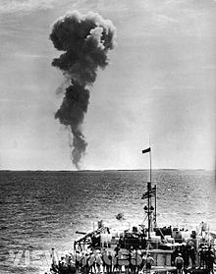 Tory Defence Secretary breaks promise and refuses study on nuclear test guinea pigs’ families https://www.mirror.co.uk/news/politics/tories-break-promise-refuse-tests-13876749
Gavin Williamson has been accused of betrayal just six months after promising campaigners he’d help, Susie Boniface,19 JAN 2019, The Tories have refused to order a study into genetic damage suffered by children of servicemen in the British nuclear tests.
Defence Secretary Gavin Williamson’s decision came days after his department finally admitted it never warned the men used in Cold War radiation experiments that their families might have been harmed.
Shirley Denson, 84, who told the minister her husband Eric was ordered to fly through the mushroom cloud of a massive H-bomb, said: “I’m disgusted the man who seemed to listen so carefully has let us down so badly.
“A fifth of the children and grandchildren Eric and I had have deformities, including missing and extra teeth. Our family is just one of thousands and Williamson knows this.”
Eric killed himself after years of crippling headaches, and Shirley later uncovered proof he had been exposed to 165 years’ worth of background radiation to his brain in just 6 minutes.
Campaigners and cross-party MPs had asked for research into all the children’s health problems, but instead Williamson has spent a six-figure sum on repeating an old study into the veterans’ cancer rates.
It is expected to take a year to report back, and in the meantime veterans, who are mostly in their 80s, are dying at the rate of one a week.
Labour deputy leader Tom Watson, who is backing the vets’ campaign for justice, said: “The earlier study failed to note the miscarriages, ill health, infant mortality and childhood illness which so many veteran families experienced. As a result it showed few problems, when the veterans’ experience was very different.
“By raising their hopes then dashing them with science designed to fail, the Defence Secretary has shown scant regard for the survivors, widows and children he promised to help.”
The announcement followed an admission in Parliament the MoD had never warned the men that exposure to radiation might damage their DNA.
Junior minister Tobias Ellwood confessed after a search of the archives that he was “unable to locate” any proof servicemen were made aware of the dangers.
Yet there are documents showing those in charge knew of the risks.
The Medical Research Council reported in 1947 that “even the smallest doses of radiation produce a genetic effect.”
A 1953 memo stated chiefs of staff wanted to “discover the detailed effect of various types of explosion on equipment, stores and men, with and without various types of protection”.
Another states Downing Street considered how “to limit the genetic hazards”.
And a No10 letter discovered in the archives proves that in 1955, when warned about the genetic dangers, PM Anthony Eden responded: “A pity, but we cannot help it.”
When he met campaigners Mr Williamson also promised them a speedy review into a medal for the veterans’ exceptional service.
But 6 months later, a medal review committee has yet to be formed and neither the MoD nor Cabinet Office, which is in charge of honours, can give a timescale for when it will meet to hear the veterans’ evidence.
Just before Christmas, thousands of bomb test documents were removed from the National Archives without explanation.
Some had been scheduled for immediate release under Freedom of Information requests by campaigners.
Super Weapon: Israel Could Arm Stealth F-35s with Nuclear Weapons
National Interest, by Zachary Keck 20 Jan 19, There is no reason to think that Israel doesn’t have the technical capability to make its new F-35s nuclear capable
By the end of this year, Israel is expected to become the second country after the United States to declare Initial Operational Capability for its F-35s. Already, Tel Aviv has taken possession of five of the multirole fighters,and following an agreement late last month to buy an additional seventeen planes, will ultimately purchase fifty planes. All fifty F-35s are scheduled to be delivered by the end of 2024.
(This first appeared in 2017.)
Israeli officials typically describe the F-35s purpose as ensuring the country’s continued air superiority in the region. In particular, they focus on how the plane’s stealth capabilities will allow them to evade Iran’s increasingly capable, Russian-built air defense systems. One mission that is not being discussed is that Israel will likely use its F-35s as a nuclear delivery system.
Although the government refuses to officially acknowledge it, Israel is known to have a nuclear arsenal with as many as 100 warheads. The Jewish State is also believed to possess a nuclear triad, consisting of ground-based Jericho missiles, Dolphin-class submarines equipped with sea-launched cruise missiles and some combination of nuclear-capable aircraft.
It’s likely that the F-35 will be the newest addition to the air leg of Israel’s triad……….At the same time, Israel also assured the United States that it would not “introduce” nuclear weapons in the Middle East, which Israel interpreted to mean it could build a nuclear arsenal as long as it didn’t publicly acknowledge its existence. ……https://nationalinterest.org/blog/buzz/super-weapon-israel-could-arm-stealth-f-35s-nuclear-weapons-42097
How US and China’s African nuclear mission could provide model for disarming North KoreaSC
- The recent joint operation to remove uranium from Nigeria could provide a template for denuclearisation on the Korean peninsula
- Although the two countries have proved they can still work together, the challenges posed by North Korea are likely to prove far more challenging
This week it emerged that Chinese and American nuclear experts had cooperated on a project to remove highly enriched uranium (HEU) from a reactor in Nigeria to prevent the material falling into the hands of terrorists.
The mission last year, which also involved British and Norwegian experts along with contractors from Russia and the Czech Republic, was completed within a day despite violent clashes in Kaduna province where the reactor was located, according to Defensenews.com.
US and China team up to keep nuclear material from terrorists
The Nigerian operation was not the first time the two countries had worked together to prevent nuclear proliferation in West Africa; a similar operation to remove HEU to China was carried out in Ghana in 2017.
Miles Pomper, a senior fellow at the James Martin centre for non-proliferation studies at the Middlebury Institute of International Studies at Monterey, said: “It is conceivable in the case of denuclearisation that North Korea’s nuclear weapons or material could be taken to China.
“Given the fact that China already has nuclear weapons, the US could likely accept that although the US would likely then push for their disassembly.”
Bruce Bennett, a senior defence researcher at the Rand Corporation, said the two countries would continue to cooperate on dismantling nuclear weapons.
“If instability developed in North Korea, China may well be at greater risk from terrorists or Chinese dissident groups seizing North Korean nuclear weapons and using them against China,” he said……… https://www.scmp.com/news/china/diplomacy/article/2182564/how-us-and-chinas-african-nuclear-mission-could-provide-model
Russia’s plans for nuclear-powered unmanned underwater weapons
“Two Poseidon-carrying submarines are expected to enter service with the Northern Fleet and the other two will join the Pacific Fleet. Each of the submarines will carry a maximum of eight drones and, therefore, the total number of Poseidons on combat duty may reach 32 vehicles,” tass.comreported.
Doubts about the program were raised in thediplomat.com: “ “The UUV is being designed a weapon of last resort to strengthen Russia’s nuclear deterrence posture vis-à-vis the United States and NATO. Torpedoes equipped with a nuclear propulsion system and fitted with a nuclear warhead for use over long distances were first conceived in the Soviet Union back in the 1950s but were considered impractical and unreliable at the time. There are still questions whether Russia will be capable of building a reliable miniaturized nuclear reactor for the UUV [next to other technical challenges].”
Sea trials of the Poseidon commenced in December 2018. The ongoing tests are part of experimental design work rather than full-fledged sea trials, according to a Russian defense industry source.
Nagasaki: Life after Nuclear War – the past and the future
 Ground Zero Nagasaki: Living the nuclear past – and future, Asia Times, By SUSAN SOUTHARD JANUARY 18, 2019 “………. Much of Nagasaki and the world have, of course, moved on from that terrible morning when a 5-ton plutonium bomb plunged at a thousand kilometers an hour toward the city of 240,000 people. Forty-three seconds later, it detonated half a kilometer above Nagasaki’s Urakami Valley. A super-brilliant blue-white flash lit the sky, followed by a thunderous explosion equal to the power of 21,000 tons of TNT. The entire city convulsed
Based on my book Nagasaki: Life after Nuclear War, I often give talks in the US about that unforgettable (or now often-too-forgettable) day when, for only the second time in history, human beings deemed it right to assault their own species with apocalyptic power. At these book talks, I’ve learned to be prepared for someone in the audience to say that the Japanese deserved what they got. It’s still hard to hear.
At its “burst point,” the Nagasaki blast reached temperatures higher than at the center of the sun, and the velocity of its shock wave exceeded the speed of sound. Within three seconds, the ground below had reached an estimated 3,000 to 4,000 degrees Celsius. Directly beneath the bomb, infrared heat rays instantly carbonized human and animal flesh and vaporized internal organs. Did the men, women, and children of Nagasaki really deserve that?
As the mushroom cloud rapidly ascended 3km over the city and eclipsed the sun, the bomb’s vertical blast pressure crushed much of the Urakami Valley. Horizontal blast winds tore through the region at two and a half times the speed of a Category 5 hurricane, pulverizing buildings, trees, animals, and thousands of people.
The blazing heat twisted iron, disintegrated vegetation, ignited clothing, and melted human skin. Fires broke out across the city, burning thousands of civilians alive.
And though no one knew it yet, larger doses of radiation than any human had ever received penetrated deeply into the bodies of people and animals.
…………. the United States bombed and incinerated all or parts of 66 Japanese cities, killing, maiming or irradiating more than 668,000 civilians. In Nagasaki alone, by the end of 1945 when a first count was possible, 74,000 men, women and children were dead. Of those, only 150 were military personnel. Seventy-five thousand more civilians were injured or irradiated.
Today, this kind of indiscriminate killing and harm to civilians would be called “terrorism.”
Despite the history most Americans have learned – that the atomic bombings of Hiroshima and Nagasaki were military necessities that ended World War II and saved a million American lives by obviating the need for an invasion of Japan’s home islands – there is no historical evidence that the Nagasaki bombing had any impact on Japan’s decision to surrender.
What we aren’t taught are the political and military complexities of the last few months of the war or how, in the postwar years, the US government crafted this end-of-war narrative to silence public opposition to the atomic bombings and build support for America’s fast-expanding nuclear-weapons program.
What many don’t realize is that this misleading version of history allows us to turn away from what happened in Hiroshima and Nagasaki and continue to support the development and proliferation of nuclear weapons without ever having to think about what those weapons do.
Still, so many decades later, in a world in which the Trump administration is preparing to withdraw from a key Cold War nuclear agreement with Russia and the US nuclear arsenal is being modernized to the tune of up to $1.6 trillion, it’s worth recalling the other side of the story, the kind of suffering the Hiroshima and Nagasaki bombings caused in August 1945 and long after.
Within weeks, people in both cities began experiencing mysterious symptoms: vomiting, fever, dizziness, bleeding gums, and hair loss from what doctors would later understand as radiation-related sickness. Purple spots appeared all over their bodies. Many died in excruciating pain within a week of the first appearance of such symptoms. Fear gripped Nagasaki. From one day to the next, no one knew when his or her time might come.
In those first nine months, pregnant women suffered spontaneous abortions, stillbirths, or the deaths of their newborn infants. Many of the babies who survived would later develop physical and mental disabilities.
Five years after the bombings, thousands more began dying from leukemia and other illnesses caused by high-dose radiation exposure, initiating cycles of higher than normal cancer rates that would last for decades. The bombs had, from the survivors’ perspective, burned their bodies from the inside out. Parents exposed to radiation feared possible genetic defects in their children and hovered over them year after year, terrified that what looked like a simple cold or stomach ache would lead to severe illness or death.
Even today, radiation scientists are still studying second- and third-generation hibakusha (atomic-bomb-affected people) for genetic effects passed down from their parents and grandparents, reminding us how much we still don’t understand about the insidious nature of radiation exposure to the human body…….. http://www.atimes.com/ground-zero-nagasaki-living-the-nuclear-past-and-future/
Germany urges Russia to destroy missile to save nuclear treaty
http://www.digitaljournal.com/news/world/germany-urges-russia-to-destroy-missile-to-save-nuclear-treaty/article/541215 German Foreign Minister Heiko Maas on Friday called on Russia to destroy a controversial missile system Washington says breaches a key arms control treaty.
“We believe Russia can save this treaty,” Maas said after talks with Russia’s top diplomat Sergei Lavrov, referring to the Intermediate-Range Nuclear Forces treaty (INF).
“It affects our security interests in a fundamental way.”
Tensions have raged between Russia and the United States over the fate of the INF agreement signed in 1987 by then US president Ronald Reagan and Soviet leader Mikhail Gorbachev.
US President Donald Trump has promised to walk away from the agreement and Russian leader Vladimir Putin threatened a new arms race, saying Europe would be its main victim.
Washington says Moscow’s 9M729 missile system violates the treaty and warned it would withdraw from the agreement if Russia does not get rid of it.
Russia denies the claim, accusing the United States of violating the treaty which forbids ground-launched short- and intermediate-range missiles.
“Like other NATO members, we believe that there is a missile violating this treaty and it should be destroyed in a verifiable manner to get back to the implementation of this agreement,” Germany’s Maas told reporters.
Maas commended Moscow for trying to salvage the agreement and expressed hope that talks between Russian and US negotiators would resume in the near future.
Last month Washington gave Russia a 60-day deadline to dismantle missiles that it claims breach the INF treaty or the US would begin the six-month process of formally withdrawing from the deal.
Lavrov for his part said Washington provided no evidence that Russia’s tests of the missile violated the INF treaty.
He said Washington’s demands to destroy the missiles and have regular access to Russian sites were just “a pretext to exit the treaty.”
“During official contacts on arms control and disarmament issues back in October the United States said the decision is definitive and their announcement of the withdrawal from the INF treaty is not an invitation to dialogue. This is a quote.”
Earlier this week, talks between US and Russian officials in Geneva to salvage the deal led nowhere. Moscow said Washington did not appear to be in the mood for more talks while a US official said Russia was just paying “lip service” to transparency.
Russian officials said US representatives had confirmed Washington’s intention to begin withdrawing from the treaty from February 2.
1 This Month
15 October. Joint Appeal for Nuclear Abolition Day -presentation to the UN on October 15 will be live on UNWebTV
Endorse the Nuclear Abolition Day Appeal
23-25 October – on Zoom – World BEYOND War’s annual global conference

To see nuclear-related stories in greater depth and intensity – go to https://nuclearinformation.wordpress.com
-
Archives
- October 2026 (139)
- September 2026 (339)
- August 2026 (330)
- July 2026 (355)
- June 2026 (287)
- May 2026 (306)
- April 2026 (356)
- March 2026 (251)
- February 2026 (267)
- January 2026 (308)
- December 2025 (358)
- November 2025 (359)
-
Categories
- 1
- 1 NUCLEAR ISSUES
- business and costs
- climate change
- culture and arts
- ENERGY
- environment
- health
- history
- indigenous issues
- Legal
- marketing of nuclear
- media
- opposition to nuclear
- PERSONAL STORIES
- politics
- politics international
- Religion and ethics
- safety
- secrets,lies and civil liberties
- spinbuster
- technology
- Uranium
- wastes
- weapons and war
- Women
- 2 WORLD
- ACTION
- AFRICA
- Atrocities
- AUSTRALIA
- Christina's notes
- Christina's themes
- culture and arts
- Events
- Fuk 2022
- Fuk 2023
- Fukushima 2017
- Fukushima 2018
- fukushima 2019
- Fukushima 2020
- Fukushima 2021
- general
- global warming
- Humour (God we need it)
- Nuclear
- RARE EARTHS
- Reference
- resources – print
- Resources -audiovicual
- Weekly Newsletter
- World
- World Nuclear
- YouTube
-
RSS
Entries RSS
Comments RSS

