Nuclear Gravity Bomb Completes First Qual Tests on B-2 Bomber ,Military.com 30 Jun 2018 By Oriana Pawlyk
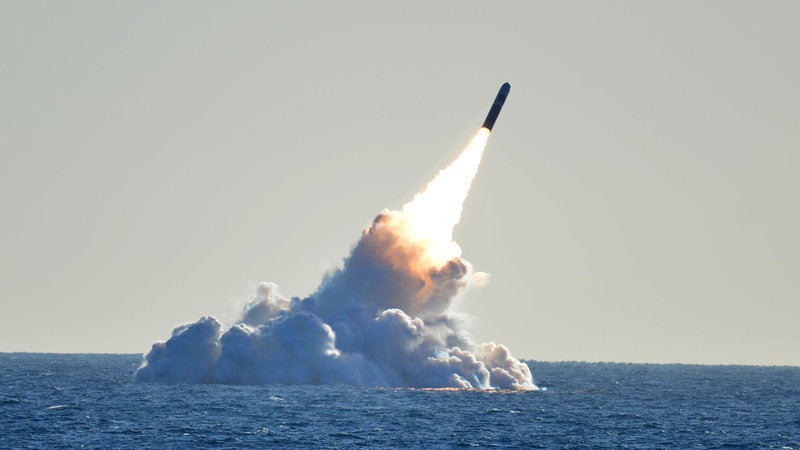
The B61-12 guided nuclear gravity bomb has gone through its first series of tests on the B-2 Spirit stealth bomber.
The Air Force, together with the Department of Energy’s National Nuclear Security Administration, earlier this month released a B61-12 non-nuclear test assembly from the Spirit. The kit included a NNSA-designed bomb assembly and the Air Force’s acquired tail-kit to be used on the B61-12 variant of the bomb, according to a Department of Energy release……….
Using the B61-12 will help consolidate and replace the existing B61 bomb variants in the U.S.’s nuclear stockpile, the release said. The first completed bomb kits are scheduled to debut sometime in fiscal 2020.
In May, top Air Force officials announced trials with the B61-12 were progressing successfully.
“We’ve already conducted 26 engineering, development and guided flight tests,” said Lt. Gen. Jack Weinstein, deputy chief of staff for strategic deterrence and nuclear integration. “The program’s doing extremely well.”
The B61-12 modification program, which has been in the works for at least seven years, is slated to be carried by the B-2, as well as the future B-21 Long Range Strategic Bomber, known as the Raider.
The F-35 Lightning II Joint Program Office has also been working on integrating the latest modification into its weapons arsenal.
The F-35 was designed with a requirement to carry a nuclear payload. In 2015, an F-35 flew with the B61-12 to measure its vibration in the aircraft’s weapons bay.
Nuclear-free world unlikely as UN treaty turns 50, DW, 1 July 18 Fifty years after countries signed the UN Nuclear Non-Proliferation Treaty, there are still nearly 15,000 nuclear weapons spread around the world. Experts today believe that complete nuclear disarmament remains unlikely.
If it weren’t the site of a historical anachronism, hardly anyone would take any notice of Büchel, a small town west of Frankfurt, between Koblenz and Trier. Büchel is home to the last remaining atomic bombs in Germany, which have been stored here since the end of the Cold War. The air force base here allegedly houses around 20 B61 bombs, although the exact number is secret. But one thing is certain: each of them is many times more destructive than the bombs that wiped out Hiroshima and Nagasaki.
The atomic bombs in Büchel belong to the US, but in an emergency they would be flown to a target and dropped by German Tornado fighter-bombers. Pilots from the Tactical Air Force Wing 33 have been regularly practicing with dummy bombs for decades. The squadron is the main employer in the area, but the existence of these nuclear weapons doesn’t show up anywhere on Büchel’s website.
This strategy, in which other NATO states also participate, is called “nuclear sharing.” Belgium, the Netherlands, Italy and Turkey also have US nuclear weapons on their territory. The concept of nuclear deterrence which underlies this strategy is still in great demand. As recently as 2012, it was confirmed by NATO as a “core element of collective defense.”
Original goal: Nuclear disarmament
The mood was very different 50 years ago. In the UN’s Nuclear Non-Proliferation Treaty, signed by the US, Great Britain and the Soviet Union on July 1, 1968, the signatory states undertook to prevent the proliferation of nuclear weapons. They were also striving for complete nuclear disarmament. Germany joined the treaty in 1975, and it has since been signed by more than 190 states.
For a long time, the treaty was regarded as the cornerstone of global disarmament efforts. Today, it appears to be little more than a toothless tiger. The Stockholm International Peace Research Institute (SIPRI) estimates there are still nearly 15,000 nuclear weapons worldwide. According to their research, the majority are held by the US (6,800) and Russia (7,000).
According to theologian Eberhard Schockenhoff, a professor at the Albert Ludwigs University of Freiburg and long-standing member of the German Ethics Council, the nuclear strategies of both sides are based on maintaining this residual stock, at least at its current level.
“This is ethically unacceptable,” he said. The nuclear powers have “written off” the goal of nuclear disarmament — if not in public, at least behind closed doors.
The clock is ticking…
Tom Sauer, a political scientist and disarmament expert at the University of Antwerp, believes the treaty is “in total crisis.” The last review conference in 2015 broke down, and he fears this will also be the case for the next one in 2020.
He believes that this state of affairs will continue until the signatory countries finally fulfil their obligations, which include a massive reduction of warheads down to zero, he says. “They promised that in 1968, but they’re not doing it.”
But instead of reducing their stockpiles, nuclear weapon states have been modernizing their weapons and incorporating new technology, such as sophisticated guidance systems. Experts say the danger of nuclear war is greater today than it has been for decades.
In January, a panel of scientists, including 17 Nobel Prize winners, set the symbolic Doomsday Clock— which measures how close the planet could be to catastrophe — at 11:58 p.m.. The readjustment put the clock at the closest it’s been to midnight since the height of the Cold War…..
New UN attempt
Has the danger posed by the continued existence of nuclear weapons been misjudged, 50 years after the signing of the non-proliferation treaty? Sauer fears this might be the case. He remains concerned that disarmament talks between the US and Russia are currently on hold, and that other countries, in particular Iran and Saudi Arabia, may be striving for nuclear weapons of their own.
Sauer hopes the United Nations will eventually support a complete ban on nuclear weapons, as outlined in a treaty adopted in July 2017 by 122 votes from its 193 member states. Once 50 countries ratify this treaty, it will become legally binding. To date, only 10 countries have done so — none of them major world powers.
If and when that happens, all the signatory countries would then consider nuclear weapons illegal, said Sauer. “The wind is changing, and nuclear powers are on the defensive.”……
Parliament 19th June 2018 Neglected Large-Scale Value for Money Issues in Public Accounting for Costs
of the Defence Nuclear Enterprise :Written evidence a review of issues that
are of direct relevance to the core topic of the National Audit Office
(NAO) report of 2018 concerning ‘the Defence Nuclear Enterprise’
(henceforth ‘NAO Report’). The material summarized here supplements and
updates evidence published by the PAC Inquiry of October 2017. The authors
believe on grounds of many years of research at the Science Policy Research
Unit at the University of Sussex that the matters documented here raise
large-scale, long-run value for money issues of pressing national
importance, which remain seriously neglected in work to date either by the
NAO, the PAC or any other official bodies – and which are therefore
gravely under-scrutinized by Parliament or wider UK policy debates
Palestinians and Nuclear Weapons, The National Interest,
The unresolved Israel-Palestinian conflict is one of the major factors preventing an effective region-wide prohibition of nuclear weapons.,by Paul R. Pillar , June 29, 2018
The Palestinians
“……… Consider the issue of nuclear weapons. Most of the states of the region have actively supported diplomacy aimed at making the Middle East a nuclear weapons-free zone. Israel, backed by the United States and now especially by the Trump administration, has opposed this diplomacy and looked for ways to impede it. These lines of contention were apparent this spring at a preparatory meeting for the next quinquennial review conference of the Nuclear Nonproliferation Treaty. Israel argues that restrictions on nuclear weapons cannot be considered in isolation from other regional security issues. On the face of it, that is a valid argument, given the possible role of nuclear weapons as a deterrent against perceived non-nuclear threats. But Israel and its U.S. backer define the stumbling block in more Israel-specific terms. The Trump administration’s representative at the preparatory committee meeting spoke of many ostensible and mostly vaguely worded reasons to slow-roll diplomacy on a regional nuclear weapons-free zone, but the specific problem he singled out was “the non-recognition of Israel by some regional states.”
Any talk of recognition or non-recognition of Israel should immediately evoke the Arab League peace initiative , which has been on the table since 2002 and commits all the Arab states to recognition of, and peace with, the state of Israel contingent on a withdrawal from occupied territories and a just settlement of the Palestinian refugee problem.
Subsequent modification of the initiative has made clear the Arabs’ acceptance of land swaps that would not require rigid adherence to boundaries that existed prior to the 1967 war. Saudi Arabia took the lead in constructing this peace proposal. The initiative is still on the table. Despite the dalliance with Israel of de facto Saudi ruler Mohammed bin Salman and reports that he is willing to throw Palestinians under the bus as he pursues his own agenda, his government still subscribes to the terms of the initiative.
……… Full recognition requires the players in question to recognize the national rights of all other players and not to occupy someone else’s territory indefinitely. Also fair: amid much talk about recognizing Israel’s right to exist, it surely is just as reasonable to insist on recognition of the Palestinians’ right to exist. The conclusion: the unresolved Israel-Palestinian conflict is one of the major factors preventing an effective region-wide prohibition of nuclear weapons.
That the Trump administration has gone all in with the Israeli government’s wishes while continuing to claim for itself the principal mediator’s role in the Israeli-Palestinian dispute augurs very badly for any settlement of the conflict in the foreseeable future. The pessimism is only accentuated when taking into account the personal and financial interests of would-be U.S. mediators that make it understandable for Palestinian leaders to reject them as hopelessly biased. The kind of suffering that has played out in Gaza and along the Gaza fence is one reason to regret the dim prospects for peace on this issue. http://nationalinterest.org/blog/paul-pillar/palestinians-and-nuclear-weapons-24752
Analysis: Israeli regime backs Saudi nuclear ambitions: Tactic or Strategy?, July 1, 2018 – (AhlulBayt News Agency) – On Tuesday, the Israeli Energy Minister Yuval Steinitz said that Tel Aviv will support Saudi Arabia’s entry to the club of nuclear states if Riyadh signs the treaty preventing nuclear weapons proliferation, NPT.
Steinitz, addressing World Gas Conference in Washington, said that the Israeli regime supports the development of nuclear power in the Arab kingdom if it includes the gold standard protections and if the kingdom purchases uranium from the US.
The remarks on the Saudi nuclear ambitions on the one hand signal the sensitivity and significance of a nuclear Saudi Arabia in the Israeli security strategy and on the other hand carry hallmarks of an eased tone of Tel Aviv on Riyadh’s nuclear ambitions after the Arab monarchy showed a will to support Arab-Israeli diplomatic normalization efforts. Saudis are winning the Israeli positive stance as they are deeply engaged in an endeavor to pave the way for the “deal of the century” on al-Quds (Jerusalem) through putting strains on the Palestinians to bow.
The oil-rich Arab monarchy has designed ambitious plans to develop the nuclear energy as part of a futuristic roadmap. A royal decree issued in 2010 by then-King Abdullah led to setting up a nuclear power and renewable energies research center, dubbed (KA-Care), in the capital Riyadh. The facility was meant to suggest solutions to address energy and water needs of the country in the future. A year later, the center announced the kingdom aims to build 16 nuclear reactors to produce about 20 percent of its electricity by 2032.
The nuclear roadmap resulted in nuclear cooperation agreements with a series of nuclear technology holders, including France, Argentina, South Korea, and Kazakhstan. According to the deals, Saudi Arabia will see its nuclear industry fully operational and production-ready by 2040. In June 2017, Prince Mohammed bin Salman replaced Prince Mohammad bin Nayef as crown prince. The young crown prince very soon started his motion to get the US green light and technology allowing the Saudis to enrich the uranium on their soil. Media reports suggested that nuclear cycle acquisition was a top case in the prince’s negotiations with the American officials during his March visit to the US.
Despite the Saudi show of desire to become a nuclear state, some factors affect the nuclear technology acquisition possibility: The argument on the type of nuclear power use, Tel Aviv’s role-playing in this course, and the Israeli insistence on keeping its military superiority in the region through nuclear weapons monopoly.
Now a question presents itself: Is the Israeli compromise to the Saudi nuclear ambitions a fruit of Prince Mohammed-led pro-normalization policy, concession to the Israelis, and turning a blind eye to US embassy relocation to al-Quds at the price of the Palestinian cause?
…….. Another reason for Saudi Arabia to move towards developing nuclear arms is its military weakness and vulnerability caused by its geopolitical position. With its 2.15 million square kilometers of area size, Saudi Arabia is a big country. The capital is in the center, but the income sources and facilities, like oil facilities, are located on the Persian Gulf and the Red Sea coasts, hence being an easy target for military action from air and sea. The failure to win a war waged against Yemen in 2015 after three years has exhibited the Saudi military weakness.
In early May, as the world held its breath in anticipation of the nuclear disarmament discussions between US President Donald Trump and North Korean dictator Kim Jong Un and struggled to digest Trump’s decision to pull the United States out of the Iran nuclear deal, an international meeting on the subject was winding up in Geneva. Over several days, representatives of dozens of states discussed preparations for the fifth review conference of the Nuclear Non-Proliferation Treaty (NPT) scheduled to take place in 2020.
As always, the Egyptian representative attacked Israel for refusing to sign the treaty. The Iranian ambassador to the International Atomic Energy Agency (IAEA), Raza Najafi, took the opportunity to take a dig at the United States for its nuclear cooperation with the “Zionist regime.” The Iranian news agency reported that Najafi stressed his country’s full commitment to the treaty.
Also as always, Israel observed the scene from the sidelines, just as it did last July when 122 states signed a treaty banning a series of nuclear weapons-related activity such as attempts to develop, test, produce, spread and stockpile such weapons. Obviously, the world’s nine nuclear states did not append their signatures to the document. Israel, which is not a member of this club, was also absent from the list of signatories. Iran signed.
For over five decades, Israel has been playing both sides. Despite numerous and persistent indications that not all of its nuclear reactors are designed for peaceful use, Israel does not admit to having a bomb. In fact, for years, it has maintained a policy of ambiguity, neither denying nor admitting possession of a nuclear bomb. Last week, The New Yorker reported that shortly after assuming office, Trump agreed to a request by Prime Minister Benjamin Netanyahu to sign a letter promising not to press Israel to give up its nuclear weapons. According to the report, three previous residents of the White House had signed similar commitments.
The presidential commitment has a caveat. According to The New Yorker, there is an unwritten understanding on Israel maintaining its longstanding nuclear policy. In other words, Israel cannot admit to having nuclear weapons. This ambiguity enables the United States to provide Israel with a diplomatic umbrella and to repel pressure on it to join the NPT. It also requires Israel to keep IAEA inspectors away from its reactors. As a result, Israelis know nothing about thecondition of the aging nuclear reactorin the southern town of Dimona and the extent of its compliance with international safety standards.
In order to maintain its policy, Israel’s military censors prohibit Israeli journalists from referring directly to Israel’s nuclear capability. They are obliged to hide behind the absurd phrasing “according to foreign sources” when referring to the matter. Over time, the policy of ambiguity has turned into a policy of deception. In 1976, former defense minister and then-Knesset member Moshe Dayan admitted in an interview with a French TV station that Israel had the capacity to manufacture a nuclear bomb. If the Arabs introduce a nuclear bomb into the Middle East at some point in the future, argued Dayan, it is incumbent on Israel to have a bomb first — but not in order to use it first, of course. In 1996, Prime Minister Shimon Peres said in an interview with the Israeli Maariv newspaper, “Give me peace and I will give up the nuclear [program].”
Talking to journalists in 1998, Peres boasted that Israel “built a nuclear option, not in order to have Hiroshima, but an Oslo,” a reference to the 1993 Israeli-Palestinian peace agreement known as the Oslo Accord. In 2006, incoming US Defense Secretary Robert Gates, the former CIA director under President H. W. George Bush, told a Senate confirmation hearing that Iran was “surrounded by powers with nuclear weapons — Pakistan to their east, the Russians to the north, the Israelis to the west and us in the Persian Gulf.”
That is how Israel managed both to create nuclear deterrence and to prevent inspection of all its nuclear facilities.
Explaining its support for Israel’s nuclear ambiguity in position papers it presented at the recent Geneva conference, the United States said countries in the region were trying to obtain weapons of mass destruction in violation of their NPT commitments. In order to clarify that it was not pointing at Israel, the United States argued that these states refuse “to recognize and engage Israel as a sovereign state … [and] instead pursue divisive actions to isolate Israel.” More so; since a dig at Trump’s predecessor is always de rigeur, the position papers claim that international discussions on the matter between 2010 and 2015 (during the Barack Obama administration) illustrated the limitations of focusing on nuclear weapons without addressing the underlying political and security issues in the region.
Indeed, the vision of a denuclearized Middle East cannot be realized without addressing the region’s political and security issues. However, these issues cannot be addressed without dealing with the prolonged Israeli occupation of Palestinian territory and breathing life into the long dormant 2002 Arab Peace Initiative, which foresees Arab states normalizing ties with Israel in return for its withdrawal from the occupied territories. To avoid background noise that could disrupt the on-again, off-again Israeli-Palestinian diplomatic negotiations over the years, the American partners in what is known as the Middle East Quartet (which also includes Russia, the UN and the European Union) have been ignoring Israel’s refusal to join the NPT. The US withdrawal from the nuclear deal with Iran as well as the relocation of its embassy in Israel to Jerusalem, its boycott of UNESCO and its recently launched trade war are all weakening the Trump administration’s leverage in the international diplomatic arena. The bear hug between Israel and Trump might prove the beginning of the end of Israel’s nuclear ambiguity policy and the opening shot of a wild nuclear weapons race in the Middle East.
,In order to remove 1 metric ton of defense plutonium from South Carolina within two years, as a federal court has required, the U.S. Department of Energy is considering the plutonium’s nuclear weapon uses.
According to a June 13 progress report, the DOE and its National Nuclear Security Administration are re-examining the possibility of repurposing some Savannah River Site plutonium for “future defense programs.”
“Approximately 1 metric ton was identified for possible use by the weapons production program,” the report reads. “The amount of candidate programmatic material at SRS is limited; most of the surplus material is not suitable for weapons program use.”
The DOE’s prospective plan would shift the plutonium from SRS to another site, either for interim storage or plutonium pit production.
Plutonium pits are nuclear weapon cores, often referred to as triggers.
Potential out-of-state relocation sites for the 1 metric ton of plutonium have been identified, according to the DOE.
The June report did not specify where. Site studies concluded in April.
Environmental impact assessments for moving the plutonium, required by the National Environmental Policy Act, are already underway and could be completed by the end of 2018, the report notes.
In 2017, a U.S. District Court judge ordered the DOE to remove 1 metric ton of plutonium from the state within two years, the result of a lawsuit launched by S.C. Attorney General Alan Wilson. At the time, Wilson celebrated the ruling as a major win.
The DOE has stated disposing 1 ton of plutonium via downblending, also known as dilute-and-dispose, would take until fiscal year 2025 to complete at current funding and operation levels. A court-received declaration made by Henry Allen Gunter, then a plutonium program manager and technical adviser at SRS, reinforced the DOE’s claim.
More funding and more trained personnel, according to the June report, would speed things up.
But planning related to dilute-and-dispose – mixing plutonium with inert material for burial at the Waste Isolation Pilot Plant in New Mexico – ceased in June due to another court order that protected the Mixed Oxide Fuel Fabrication Facility.
The defense- and weapons-use option, according to the DOE’s report, vastly undercuts the 2025 estimate: “Indeed, the department believes that it is possible that, if successful, this option might allow the department to meet the current two-year timeline imposed by the district court,” the report reads.
According to the DOE, the plutonium is “safe and secure in its present location.” Moving it costs money and poses radiological, safety and security concerns, all of which are listed at the end of the report.
Eventually, the plutonium would have to be moved to Los Alamos National Laboratory or back to SRS for pit production.
On May 10, the DOE and the U.S. Department of Defense recommended a pit production mission for SRS, which muddies the waters a bit. Those plans have not yet been finalized.
Los Alamos currently does not have enough room for the 1 metric ton, the DOE report states. Holding it at an interim location incurs additional costs.
More information and detail, including timing, will be made available in December, the June report states.
Nuclear testing during the Cold War sent radioactive fallout far away from the actual test sites. Politicians are moving to expand who can be compensated by the government for getting sick after exposure to that fallout.
The tests mostly happened in Nevada but winds sent radioactive materials far and wide. Idaho Sen. Mike Crapo said one detonation in 1952 was particularly memorable to his constituents.
“Idahoans that I’ve spoken to in Emmett and elsewhere have shared their memories of waking to find their pastures and orchards covered with a fine grey-white dust that seemingly appeared out of nowhere. It looked like frost, yet it was not cold to touch,” Crapo said in a Senate Committee on the Judiciary hearing Wednesday.
In 1990 Congress created a program to compensate people who became seriously ill after radiation exposure.
According to the Department of Justice, since the programstarted more than $2 billion has been given in compensation. People like miners who worked directly with radioactive materials can get $100,000, people who were on site during nuclear tests get $75,000 and people who lived downwind of a major test site in Nevada get $50,000. So-called “downwinders” have to have lived in certain counties within Utah, Nevada and Arizona at the time of testing to be considered eligible.
“Unfortunately, the science at the time failed to recognize that radioactive fallout is not restricted by state lines,” said Crapo.
According to the National Cancer Institute, some of that fallout landed on fields across the country and especially in the Mountain West. It was consumed by animals like cows and eventually made it into milk cartons. Because of that, people who were milk-drinking children at the time are considered to have a higher risk of thyroid cancer.
Senators, including Crapo, have sponsored a bill that would expand the group of eligible “downwinders” to people who lived in parts of Idaho, Colorado, Montana, New Mexico and Guam at the time that tests were conducted.
The bill would also establish a grant program for further research into the health impacts of uranium mining and would extend the deadline for filing claims from 2022 to the late 2030s.
This story was produced by the Mountain West News Bureau, a collaboration between Wyoming Public Media, Boise State Public Radio in Idaho, Yellowstone Public Radio in Montana, KUER in Salt Lake City and KRCC and KUNC in Colorado.
A global nuclear threat, The News CN, Muhammad Umar , 27 June 18, India’s nuclear weapons now pose a potential threat to the world. The Agni-V, India’s longest-range intercontinental ballistic missile (ICBM), can travel 6,000 kilometres.
The country conducted its launch test on June 3 from a canister on a mobile launcher platform from the coast of Odisha. This test flight was the missile’s sixth, and its success suggests that it will soon be put into service.
Keep in mind that the Agni-V ICBM is capable of carrying a nuclear warhead to almost anywhere in Asia and to parts of Europe and Africa. Because it can be fired from a mobile launcher, essentially a canister mounted on a truck, instead of a hard concrete launch-pad, it gives the Indian armed forces operational flexibility. They now have the ability to launch the missile against any adversary, almost guaranteeing to take them by surprise by offering a shorter period of time to react. But the Agni-V is not the real danger and is only being seen as a stepping stone towards completing the Agni-VI ICBM, which is rumoured to be in its final phase of development.
The Agni-VI can potentially travel 12,000 kilometres or more, and is supposed to have MIRV capability – the ability to carry several independent nuclear warheads – and a manoeuvrable re-entry vehicle (MaRV) capability, the warhead of which is capable of autonomously tracking ground targets. Because of these capabilities, this missile will be unstoppable by the current anti-missile defence systems. Once completed, the Agni-VI will put the whole world within the range of India’s nuclear warheads.
India has taken advantage of the fact that the world has been distracted by North Korea’s nuclear capabilities and the threat they pose that they have entirely ignored the growing threat of India’s nuclear capabilities, its global ambitions, and its threat to international and regional security.
……….By investing on building up its nuclear and conventional forces, PM Modi hopes to project his country as a global power, standing shoulder to shoulder with the likes of the US and China. But, in fact, India is causing a massive headache for the South Asian region by threatening to destabilise the fragile strategic balance with its actions. If India’s ambitions are not kept in check, its growing capabilities are guaranteed to turn into a global threat. Instead of trying to impress the international community by investing so heavily on its defences (and causing havoc), PM Modi should perhaps first invest in his people, which include the more than 330 million Indians living in poverty – nearly a quarter of the country’s total population.There has been very little outcry in the West, particularly in the US, because American presidents in the past have turned a blind eye towards India’s dangerous global nuclear ambitions, hoping to create a new strategic partner capable of taking on China. This has provided India with a situation that it has taken, and continues to take, advantage of by growing its military’s conventional and nuclear capabilities………https://www.thenews.com.pk/print/334105-a-global-nuclear-threat
Thanks, Muhammad Umar, for this insightful article. But that last paragraph? Have you forgotten who President Trump is? He is a ruthless and not terribly intelligent salesman and attention-seeker. His over-riding aim would be to SELL NUCLEAR TECHNOLOGY to India – quite the opposite of “curbing the country’s massive and extremely dangerous military nuclear weapons programme”
Putin says new Russian nuclear weapons are decades ahead of foreign rivals, 58 WGJT Milwaukeee, By: Justin Thompson-Gee , 28 June 18 MOSCOW (AP) — Russian President Vladimir Putin boasted about his country’s prospective nuclear weapons Thursday, saying they are years and even decades ahead of foreign designs.
Speaking before the graduates of Russian military academies, Putin said the new weapons represent a quantum leap in the nation’s military capability.
“A number of our weapons systems are years, and, perhaps, decades ahead of foreign analogues,” Putin told young military officers who gathered in an ornate Kremlin hall. “Modern weapons contribute to a multifold increase in the Russian military potential.”
The tough statement comes as Putin is preparing for a summit with U.S. President Donald Trump set for July 16 in Helsinki, Finland. Russia-U.S. relations have plunged to post-Cold War lows over the Ukrainian crisis, the war in Syria, the allegations of Russian meddling in the 2016 U.S. presidential election and differences over nuclear arms control issues.
“We have achieve a real breakthrough thanks to the colossal efforts by science and design bureaus and industries, a real feat by workers, engineers and scientists,” Putin told the officers.
The Russian leader singled out the new Avangard hypersonic vehicle and the new Sarmat intercontinental ballistic missile, which are set to enter service in the next few years. Putin also mentioned the Kinzhal hypersonic missile that has already been put on duty with the units of Russia’s Southern Military District.
Stuff, LAURA WALTERS , June 28 2018, When the United States dropped the atomic bomb on Hiroshima in 1945, Taeko Yoshioka Braid watched from the second-floor window of herclassroom, 60 kilometres away.
Braid, who moved to New Zealand in 1956 and now lives in Hastings, travelled to Hiroshima the next day with classmates to look for her family members and take supplies to the victims.
Yoshioka Braid said it was hard to talk about the horrors she saw as a 13-year-old in Hiroshima, including children separated from their parents, and people dying from burns from the blast and the radiated water.
On her second trip to the town at the epicentre, she felt something sticking to her shoes. She eventually realised it was human skin, which had melted off, following the blast.
…….. At a time when the international rules-based order is being challenged, and nuclear weapons remain a global issue, Prime Minister Jacinda Ardern has reinstated the Cabinet portfolio of disarmament and arms control. Ardern announced Winston Peters would take up the ministerial role, during her first foreign policy speech in February. In September last year, New Zealand was one of the first countries to sign the Treaty on the Prohibition of Nuclear Weapons at a ceremony during the United Nations General Assembly.
The treaty is a landmark legally-binding international instrument prohibiting the use of nuclear weapons and related activities.
In July last year, it was adopted by the United Nations Conference to Negotiate a Legally Binding Instrument to Prohibit Nuclear Weapons, Leading Towards their Total Elimination.
Yoshioka Braid’s comments came during the international treaty examination, at a Foreign Affairs, Defence and Trade Select Committee hearing on Thursday. Something that needed to take place before New Zealand ratified the treaty.
“If anyone went there the day the bombed dropped, I’m sure they would all think like me: never again…
“I don’t want those same sorts of things to happen anywhere in the world; anywhere in the world.”
Alternative NZ submission by stuffnewsroom on Scribd….(included on original) ..
It was difficult to describe the experience, she said, adding that the bomb was so strong, some people died instantly, others were alive but too injured to move or talk.
Her daughter, Jacky Yoshioka Braid said New Zealand needed to take a leadership role in the elimination of nuclear weapons.
“We need to stop the fighting, and stop this fantasy around a nuclear war that we possibly could survive – it won’t happen.
“We saw what happened in Hiroshima, we’ve seen the after effects of what happened there and in Nagasaki. They were tiny compared to what could happen today.”
New Zealand created a world-leading anti-nuclear policy in 1984, after seeing what happened in Hiroshima, Nagasaki and the cold war years.
Hiroshima witness urges NZ to lead nuclear weapons elimination, Stuff, LAURA WALTERS , June 28 2018 “………Last month, former Green party candidate, and disarmament campaigner, Thomas Nash said “for technology that hasn’t been used in conflict since 1945, nuclear weapons sure have a knack of getting on to the global agenda”.
But it wasn’t surprising given they posed the greatest existential threat to humanity next to climate change, he said.
Nash also spoke to the select committee on Thursday, urging New Zealand to take a leadership role in eliminating nuclear weapons and global disarmament, in general.
“This treaty has a humanitarian purpose, this is rather distinct from previous international deliberations on nuclear weapons, which have tended to be about big power politics between countries weighing up the grand game and the balance,” he said.
Nash painted a picture of “Cambridge grads, strutting around in operations rooms, thinking about deterrents and game theory, missile silos and sleek nuclear submarines”.
“I think it’s important to think about bringing back this human element of the impact of nuclear weapons, because violence, militarism, relies on a dehumanisation of violence; abstracting it away from us.
“And I think if we’re going to move away from that, we have to acknowledge the human face.”
On behalf of New Zealand Alternative, Nash recommended New Zealand ratify the treaty next month, adding that early ratification would signal New Zealand’s commitment to eliminating nuclear weapons and to making genuine progress on international disarmament work.
Nash was part of the International Campaign to Abolish Nuclear Weapons, which was awarded a Nobel Peace Prize last year after the group of Geneva-based activists was recognised for its role in pushing for a United Nations treaty declaring the weapons illegal.
ABOUT THE TREATY
The Treaty on the Prohibition of Nuclear Weapons is a landmark legally-binding international instrument prohibiting the use of nuclear weapons and related activities.
In July last year, it was adopted by the United Nations Conference to Negotiate a Legally Binding Instrument to Prohibit Nuclear Weapons, Leading Towards their Total Elimination.
In September last year, New Zealand was one of the first countries to sign the treaty, at a ceremony during the United Nations General Assembly.
At the time, then-foreign minister Gerry Brownlee said it represented an important step towards a nuclear-free world, despite no countries that currently hold nuclear weapons signing the treaty.
New Zealand’s signing of the treaty was consistent with the country’s long-standing commitment to international nuclear disarmament efforts.
“It establishes the first global prohibition on nuclear weapons and provides the international legal framework for a world without these weapons,” Brownlee said at the time.
New Zealand joined over 120 other states in supporting the adoption of the treaty at a United Nations conference in July last year.
Israel Boosting Defense of Nuclear Reactors Fearing Iranian Missile Attack Despite precautionary measures against a targeted attack, the Israel Atomic Energy Commission believes a missile strike could be a propaganda achievement for enemy, but wouldn’t endanger Israelis, Haaretz, 28 June 18, Chaim Levinson
Congresswoman Madeleine Bordallo urges the U.S. Senate Judiciary Committee to pass a bill that compensates those affected by nuclear radiation exposure due to nuclear testing in the western Pacific Ocean in the mid-1900s and later.
The Radiation Exposure Compensation Trust fundcompensates individuals who contracted cancer or other diseases as a result of radiation during nuclear testing undertaken by the United States during the Cold War.
Celestial, founder and president of the nonprofit corporation Pacific Association for Radiation Survivors, which advocates for downwinders exposed to radiation from nuclear weapons testing, spoke about his experience.
“The people of Guam were exposed to nuclear fallout from the Pacific Nuclear Testing in the Marshall Islands from 1946 to 1962 when 66 Nuclear and Hydrogen bombs were detonated,” Celestial said in a testimony in front of the committee.
He added that throughout those years, they were exposed to ionizing radiation, without their knowledge and consent.
Should the senate bill 197 pass, it would allow those who resided in Guam between those times to apply for compensation that would include free medical care up to $150,000 from the remaining funds of the trust fund, according to a press release from the nonprofit corporation.
“I was proud to support my constituent and friend, Robert Celestial, during his testimony before the Senate Judiciary Committee today,” Bordallo said. “Robert has been a tireless advocate, ensuring downwinders on Guam, from across the Pacific, and our veterans exposed to radiation get the compensation and care they are owed.”
Bordallo, along with Celestial and Vice Speaker Therese Terlaje, urged the committee to pass bills that would amend federal law to:
Increase the compensation individuals exposed to radiation from nuclear weapons testing or site cleanup may receive.
Expand the eligible affected areas of known radiation exposure to include downwind sites like Guam and nuclear weapons testing cleanup sites in the western Pacific like Enewetak Atoll.
Provide specific relief for those affected living on Guam during nuclear weapons testing radiation exposure and veterans ordered to clean up contaminated sites.
“I continuing working with my House and Senate colleagues to see these bills passed into law. Congress must not ignore the victims of nuclear testing in the western Pacific any longer,” Bordallo said. “I will not give up on our Guam downwinders and atomic veterans, until they get the recognition they deserve.”
Veteran’s affected in Enewetak Atoll
Later in the day, Bordallo led meetings with leadership of House Veterans’ Affairs Committee, Chairman Phil Roe, R-TN, and vice-ranking member Mark Takano, D-CA, on the Atomic Veterans Healthcare Parity Act, which would fund healthcare expenses for veterans who participated in the cleanup of Enewetak Atoll after nuclear testing during the 1960’s.
https://apnews.com/dc5e3c60042741c696dd062462a03cca– 28 June 18, ALBUQUERQUE, N.M. (AP) — Advocates for New Mexicans who many believe were sickened by U.S. uranium mining and nuclear weapons testing have urged Congress to acknowledge their sacrifice and authorize compensation for them.
Navajo Nation Vice President Jonathan Nez and the co-founder of the Tularosa Basin Downwinders Consortium testified during a hearing Wednesday in Washington on a compensation measure.
Sponsored by U.S. Sen. Tom Udall, it proposes expanding eligibility for payouts under the Radiation Exposure and Compensation Act of 1990, which currently covers claims from areas in Nevada, Arizona and Utah that are downwind from a different test site.
Tina Cordova, co-founder of the Tularosa consortium, said many who lived in the area weren’t told about the dangers of the Trinity Test on generations of residents.
They could benefit from the proposal, along with post-1971 uranium mine workers in Northwestern New Mexico.
7pm Central Time (8pm ET, 6pm MT, 5pm PT) UTC – 5 From NRC & DOE Deregulation to Techno-Fascist Billionaires Going Nuclear, Plus a Few Songs from Atomic Cabaret REGISTER