India’s irresponsible behaviour in its pursuit of nuclear weapons supremacy
Indian Irresponsible Behavior as Nuclear Power, Modern Diplomacy, 23 Apr 19, South Asia is termed as one of the volatile regions of the world, where nuclear brinkmanship is probable because of the longstanding historical animosity between India and Pakistan. The onus of instability and volatility in the region rests with India’s inspiration for regional hegemon, which seeks domination through coercion and use of power. Its ambitions to join global cartels such as Nuclear Suppliers Group (NSG) without meeting the criteria is self-explanatory of its coercive yet illegitimate policies.
How a nuclear apocalypse could be launched: how a president’s power to do this could be restrained
|
PRESSING THE BUTTON: HOW NUCLEAR-ARMED COUNTRIES PLAN TO LAUNCH ARMAGEDDON (AND WHAT TO DO ABOUT THE U.S.) War on the Rocks, By ANDY CHOW 24 Apr 19, “What would happen if the president of the U.S.A. went stark-raving mad?”That question appeared on the cover of Fletcher Knebel’s bestselling 1965 novel, Night of Camp David. Knebel, who also wrote Seven Days in May, described a president succumbing to paranoia as those around him struggled to keep him from starting a nuclear war. For obvious reasons, the book was re-released in 2018 in a new edition.
The presidency of Donald Trump has renewed a lingering debate about how much of the terrible responsibility to inflict large-scale nuclear destruction nuclear-armed countries should invest in a single person. The question is not only about Trump, of course. He is a member of a club that also includes Russia’s Vladimir Putin, China’s Xi Jinping and North Korea’s Kim Jong Un — “Rocketman” himself. It is a club that is far more exclusive than the Mar-a-Lago. The terms of this debate are well-known and relate to the specific requirements of nuclear deterrence. On the one hand, there is a broad desire to retain political control over the use of nuclear weapons and to ensure that nuclear weapons are never used by accident or by an unauthorized person. On the other hand, it is typically thought that the credibility of deterrence relies on the certainty of retaliation under all circumstances, even in difficult ones, such as in response to a surprise attack. These twin goals are in tension, a situation that Peter Feaver famously termed the “always/never” dilemma — the weapons should “always” launch when ordered by a legitimate authority, but “never” if no legal order has been given. Each nuclear-armed state has struck a slightly different balance at different points in time, with states shifting “back and forth between delegative and assertive postures” depending on the importance placed on the urgency of response and the general state of civil-military relations and domestic politics. A preference for “always” — certainty that any lawful launch order will be executed — may lead a state to accept a greater risk that nuclear weapons could be used without proper authorization. The preference for “always” could, in extreme cases, lead to so-called “dead hand” systems that would ensure the launch of nuclear-armed missiles even if political leaders were dead. A common procedure to manage the always/never dilemma is to require two or more persons at various links in the chain of command to agree on a step involving nuclear weapons (the so-called “two-man” rule.) The two-person rule may differ greatly in practice across states……. Neither of us is terribly convinced by recent proposals from Congress to insert itself into the process and usurp, in part, the president’s authority to order a nuclear strike. The president is the commander in chief. Once Congress appropriates the funds for military forces, it has little to say about how these forces might be used beyond the power to declare war. Congress has consistently avoided even this responsibility, as the failure to revise the 2001 Authorization for the Use of Military Force demonstrates. Nevertheless, Congress could attempt to compel the president, time and circumstances permitting, to confer with at least the vice president, secretary of defense, and the chairman of the Joint Chiefs of Staff regarding any decision to use nuclear weapons and especially a decision to initiate the use of nuclear weapons. These individuals need not be given a veto in the process, but each must be offered a chance to give advice. There would be little downside to such an approach. In our work, we find no evidence that states requiring a collective decision are seen by potential adversaries as less credible than single-person models that favor speed and legitimacy. In NATO, the collective use of nuclear weapons requires consensus of all members of the North Atlantic Council, although the United States, the United Kingdom, and France retain the ability to use nuclear weapons on their own. Whatever doubts we might have about the certainty of retaliation in the most extreme scenarios, those doubts pale in comparison to the ones we have about the wisdom of allowing a single individual unfettered authority to order the use of nuclear weapons. Jeffrey Lewis is a scholar at the Middlebury Institute of International Studies at Monterey. Bruno Tertrais is Deputy Director at the Fondation pour la recherche stratégique in Paris. https://warontherocks.com/2019/04/pressing-the-button-how-nuclear-armed-countries-plan-to-launch-armageddon-and-what-to-do-about-the-u-s/ |
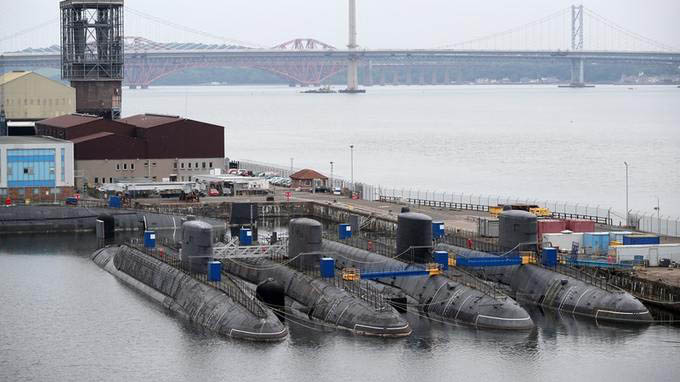
UK is stuck with 20 dead nuclear submarines – what to do with them?
|
How do you scrap a nuclear submarine? https://www.chemistryworld.com/news/how-do-you-scrap-a-nuclear-submarine/3010405.article, The UK is facing a £7.5 billion bill to dismantle its 20 defunct vessels
What is a nuclear submarine?A ‘nuclear’ submarine can refer to a submarine that carries nuclear warheads, one that is powered using nuclear energy, or both. In the UK, the Vanguard, Astute and Trafalgar class submarines are all powered using a nuclear reactor, but only the four Vanguard class submarines carry nuclear warheads – Astute and Trafalgar submarines are ‘hunter-killers’ designed to sink other ships. The UK’s current fleet relies on a reactor typically seen in power stations across the world – the pressurised water reactor (PWR). These compact power plants produce vast amounts of heat through the splitting of uranium-235 (235U). This fissile isotope exists in very small quantities (less than 1%) in natural uranium, which mainly consists of uranium-238 (238U). To use it as fuel, the 235U is increased relative to the 238U in a process known as enrichment. In the PWR, waste fission products are made, such as caesium, xenon and krypton, as neutrons split the 235U fuel, with 238U also absorbing neutrons to form plutonium. These fission products can damage the ceramic fuel and reduce the reactor’s efficiency. The vessel that contains this whole process is also bombarded with high levels of radiation over its operational life. What happens to a nuclear submarine once it is removed from service?Once a nuclear-powered submarine is decommissioned, it is placed into long-term storage. Only after monitoring the vessel will engineers begin to defuel and dismantle it. However, over the past four decades, this second part hasn’t happened in the UK.
Since 1980, the UK Ministry of Defence has taken 20 nuclear-powered submarines out of service. Of these 20 subs, the UK has not fully disposed any of them and nine still contain highly radioactive nuclear fuel. The vessels have languished at dockyards in Plymouth and Rosyth.
This is not a sustainable solution, but it is in stark contrast with other countries’ past policies. During the Cold War, the Soviet Union dumped 19 ships containing nuclear waste in the Kara Sea, as well as 14 reactors and the K-27 nuclear submarine. With such vessels continuing to rust on the seabed, there are concerns these sites could harbour a potential environmental crisis. However, the subs stored in the UK are constantly monitored in a controlled environment. Although a far cry from the Arctic submarine graveyards, the UK fleet still lies exposed to salty water, with the vessels rusting in the dockyards.
Why are the submarines still in storage?It is an incredibly complex situation, but the government stopped defueling its disbanded fleet back in 2004. The UK’s nuclear regulator deemed that the facilities were not up to standards, and the UK has been working to improve them ever since. Mired in delays and inflating budgets, the defueling may not restart until 2023 – the original start date was 2012. Even when the subs are ready for their next voyage through the disposal process, it is a journey fraught with complexity.
What is the plan for the nuclear waste?Once defueling starts, the sub will be moved to a ‘reactor access house’ on rails. In this facility, engineers will remove the spent nuclear fuel from the sub, which contains various actinides and radionuclides. The fuel is highly radioactive and generates heat, so needs to be cooled in water before any further work can begin. To cool the fuel rods, the waste is sent to a specialised plant at Sellafield, where it is stored in vast water ponds. The water acts as both an efficient coolant and radiation barrier. Historically, this spent fuel would have then been recycled to form new nuclear fuel.
During reprocessing, the fissile uranium and plutonium is separated through solvent extraction, before converting the remaining liquid waste into a glass for long-term storage. However, it is now unclear whether this will still happen. It is more likely that the spent nuclear fuel will be stored indefinitely after cooling. The current UK strategy is to bury this waste in a highly-engineered geological disposal facility, which would see more than 650,000m3 of waste stored in an underground cavern, according to recent government estimates. But plans are still ongoing and a facility is yet to be built.
What happens to the submarine after defueling?After defueling, the sub will return to the ‘wet’ dock for another period of storage and monitoring. Following this, the submarine is dismantled. Components such as pipes and pumps exposed to radiation are taken away and the reactor vessel removed. However, engineers do not simply remove the reactor. In many countries, the reactor is lifted out with the two empty compartments either side of it and then sealed off to minimise the risk of exposure. After removing this ‘three-compartment unit’, the submarine is cast off for its final voyage to a commercial shipyard for recycling. But it will be a costly endeavour. The UK may face costs of up to £7.5bn if it wants to take the entire fleet through this voyage of defueling and disposal. It remains unclear whether the plans will stay on course, but the defence department has committed to dismantling the fleet ‘as soon as reasonably practicable’.
|
|
|
PM Narendra Mo di , at election rallies, repeatedly boasts of India’s nuclear weapons
|
At Indian General Election Rallies, Modi Beats the Nuclear Drums
The Indian prime minister touts New Delhi’s nuclear capabilities. The Diplomat |
|
Putin’s new super-dooper longest submarine packed with nuclear torpedoes
Putin reveals world’s longest submarine packed with nuclear torpedoes capable of destroying an entire city The super sub’s weapons can dodge Nato’s underwater defences to hit cities, naval bases or aircraft carriers anywhere in Europe or on America’s eastern coast The Irish Sun, By Patrick Knox 21st April 2019, A GIANT Russian submarine which measures a staggering 604ft is due to be moved out of its secret construction shed as it nears completion.
The 14,700-ton Belgorod, which is twice the size of the Royal Navy’s Astute-class attack submarines, bristles with nuclear-tipped underwater drone torpedoes which are guided by artificial intelligence.
Russia’s president Vladimir Putin has boasted these “Poseidon” drones can completely destroy coastal targets 6,000 miles away.
They are specifically designed to thwart Nato underwater defences as it heads to targets in cities, naval bases or aircraft carriers anywhere in Europe or on America’s eastern coast.
The sub is also fitted with an underwater dock.
This allows it to launch a 180ft mini-sub and intelligence gathering drones……. https://www.thesun.ie/news/4009866/putin-reveals-worlds-longest-submarine-packed-with-nuclear-torpedoes-capable-of-destroying-an-entire-city/
in the 1980s entrepreneurs jumped on the nuclear bunker selling campaign
|
|
Pentagon’s strange and dangerous plan for small nuclear reactors at the battle scene

|
A New Kind of Nuclear War; The Pentagon pushes for fission for fighting, POGO,BY MARK THOMPSON 19 Apr19 “…… the Pentagon wants to build flyable and truckable nuclear-power plants to generate the power U.S. troops need to wage war deep in hostile territory.The concept of micro-nuclear power plants on the battlefield is both inspired and insane. The idea of landing portable nuclear reactors inside a war zone is as outlandish—economically and environmentally—as it sounds.
Yet the Pentagon’s nuclear push didn’t “go critical”—achieve a self-sustaining atomic reaction—on its own. “It is the culmination of a patient, decade-long effort by nuclear lobbyists to interest Defense and its congressional overseers in a costly product—small nuclear reactors—that few in the private sector seem to want,” Edwin Lyman, a senior scientist at the Union of Concerned Scientists, wrote in the Bulletin of the Atomic Scientists in February. “The Pentagon is precisely the savior small nuclear reactor vendors need: deep-pocketed and unbeholden to return-seeking investors.” Beyond that, the Pentagon’s nuclear advocates argue that battlefield nuclear reactors would improve the environment and help jump-start the nuclear-reactor business, creating thousands of well-paying jobs in the process. That meshes with the U.S. nuclear industry’s push to peddle more civilian reactors abroad, including a meeting with President Trump in February. “He really wanted to hear from us on what our views are on how we win the global nuclear energy technology race,” said J. Clay Sell, head of Maryland-based X-energy, an advanced nuclear-reactor company seeking business in Jordan. …. it should come as no surprise that the nuclear industry is pulling out all the stops as it sees climate-change concerns giving it a second lease on life, even as renewable energy (wind, solar, hydroelectric) is now producing more power in the United States. The NEI spends about $2 million annually seeking favors from the federal government. Conveniently, the Trump Administration is seeking to bail out the nuclear industry. The nuclear industry’s push isn’t only in Washington, DC. It’s gaining traction with state legislatures as well, most notably in Pennsylvania, home to Three Mile Island, the site of the most serious nuclear-power plant accident in U.S. history. In the last three years, Exelon, which operates Three Mile Island, has ramped up its lobbying efforts in Pennsylvania, in hopes of boosting taxpayer subsidies. The Pentagon has had a long-standing romance with nuclear power, dating back to Hiroshima and Nagasaki……. the Pentagon is trying to build support for the plan by noting that mini-nukes have heart-warming peaceful uses, too. “A small mobile nuclear reactor would enable a more rapid response during Humanitarian Assistance and Disaster Relief (HADR) operations,” it said earlier this year in a “request for information” seeking outside help to develop portable atomic reactors for war zones……. The Pentagon wants a reactor capable of generating between 1 and 10 megawatts (enough for a base housing at least 1,000 troops for three years without refueling. Weighing no more than 40 tons, it must be “sized for transportability by truck, ship, and C-17 aircraft.” And to avoid the problems posed by water-cooled reactors, it needs to be cooled by “ambient air,” just like the original VW Beetle and its distinctive putt-putt engine…….. The unit will be “semiautonomous—Not requiring manned control by operators to ensure safe operation,” the Pentagon says. Starting it up should take less than three days, and shutting it down should take no more than a week. Their basic design is as simple as nuclear power gets: as the reactor fuel decays, it generates heat that is then turned into electricity. The Pentagon plans on funding up to three designs before tapping a winner from among them. Other nations—Canada, China, and the United Kingdom—are also exploring such small reactors……. Lyman of the Union of Concerned Scientists says the “lobbying push” to build micro-nukes for the U.S. military comes from the U.S. Nuclear Industry Council. The Washington-based trade group says it is “composed of over 80 companies” and “represents the ‘Who’s Who’ of the nuclear energy supply chain community, including key utility movers, technology developers, fuel cycle companies, construction engineers, manufacturers and service providers.” But nuclear insiders also are playing a critical role. Among the authors of that key Defense Science Board report were some atomic heavyweights, including co-chairman Michael Anastasio, the only person to ever run two of the nation’s nuclear labs (he is the former head of Los Alamos in New Mexico, and Lawrence Livermore in California), and William Madia, who served as director of the Oak Ridge National Laboratory in Tennessee, and Pacific Northwest National Laboratory in Washington state. …… There are proliferation risks associated with deploying nuclear reactors amid wars. The 2016 Defense Science Board report suggested that portable nuclear reactors be fueled only with low-enriched uranium that couldn’t be turned into nuclear weapons, although it conceded they would represent “a lucrative target to become a dirty bomb if breached.” The Pentagon’s January 2019 solicitation said that “technology, engineering, and operations must demonstrate minimization of added proliferation risk.” Of course, the U.S. government has been through this before, dating back to President Eisenhower’s “Atoms for Peace” initiative. That led to the first nuclear reactors in Iran and Pakistan. Harnessing nuclear power on the battlefield would require changes in U.S. military training, nuclear regulation and licensing, as well as convincing foreign governments to let them on their soil. …….. Training soldiers to deploy and operate portable nuclear power plants would be challenging, although the Army said in the report, “this requirement is not anticipated to be as demanding as that of a nuclear weapon.” Any Army port-a-nuke “must prevent the reactor from going critical when it should not, such as during movement/transport.” While such a reactor “is not expected to survive a direct kinetic attack,” the Army said it would be designed “for the protection of personnel who may be adversely affected by the system or threats to the system.” Outsiders are dubious. “Even a reactor as small as 1 megawatt-electric would contain a large quantity of highly radioactive, long-lived isotopes such as cesium-137—a potential dirty bomb far bigger than the medical radiation sources that have caused much concern among security experts,” the Union of Concerned Scientists’ Lyman warned in the Bulletin of the Atomic Scientists. “At best a release of radioactivity would be a costly disruption, and at worst it would cause immediate harm to personnel, render the base unusable for years, and alienate the host country.” Any radiation leakage would be far more vexing than the cleanup after dumping about 20 million gallons of Agent Orange and other herbicides on Vietnam from 1961 to 1971. “While design simplification and damage-resistant fuel choices help, detailed planning for cleanup and removal of battle-damaged reactors or reactor components will be expensive and pose some technical challenges to resolve,” the Army report said, likely requiring changes to “existing treaties, international agreements, and policies.” At the end of the day, of course, the big bugaboo is what to do with all that spent, but still dangerous, nuclear fuel. But not to worry: the Army has figured that out, too. “Nuclear fuel is a DOE [Department of Energy] responsibility,” the Army notes. “Issues such as recycling of nuclear fuel or long-term disposal are not DOD’s business.” Perfect. Of course, the Energy Department hasn’t figured out what to do with the 80,000 metric tonsof spent nuclear-reactor fuel created by U.S. commercial reactors over the past half-century. Bottom line: thinking about sending portable nuclear reactors off to war is kind of like invading a country with no plan for how to get out. https://www.pogo.org/analysis/2019/04/a-new-kind-of-nuclear-war/ |
|
USA’s new proposal “Creating an Environment for Nuclear Disarmament”
The name change is important because it points to the initiative’s key problem: the risk that the United States and other nuclear weapon states will use the process of Creating an Environment for Nuclear Disarmament to deflect pressures to take concrete action on disarmament. ……
What’s in a name? Shifting from conditions to progress. While the shift from “creating the conditions” to “creating the environment” suggests a willingness to listen (at least, to allies and P5 states), a closer comparison between Ford’s Geneva remarks and his earlier statements on the subject leads one to be sceptical. The Geneva speech does not substantively move beyond the conditions narrative. Ford consistently and repeatedly argues that disarmament can only move forward when and if the prevailing security conditions are improving. This focus is problematic for a number of reasons.
First, it is conservative and unimaginative; it highlights the barriers to disarmament, rather than exploring ways to make progress…..
nuclear weapon states often highlight the “conditions” for nuclear disarmament, mainly to argue that others are responsible for the fact that these conditions are “not ripe” yet….
the “conditions” narrative is perceived by many as a stepping away from Nuclear Non-Proliferation Treaty (NPT) disarmament commitments, including specifically the disarmament Action Plan agreed by NPT states parties at the 2010 Review Conference. The United States and other nuclear weapon states have been trying to diminish the importance of such commitments by arguing that they were concluded under different, arguably “better” circumstances. …….
The core challenge remains mobilizing the collective political will to take practical steps forward and working out effective measures that could precipitate a deeper transformation of global nuclear politics. In this regard, the issue of how the CEND working group relates to the Treaty on the Prohibition of Nuclear Weapons (often called the ban treaty) will be important.
The United States and other nuclear-armed states have not engaged with the ban treaty. …… the CEND working group will itself lack legitimacy if it sets itself up in opposition to the ban treaty. .. the group of ban treaty supporters is now so large that its voice will have to be heard in the CEND process. …..
for the time being, the Creating the Environment for Nuclear Disarmament working group is only an idea, but it could offer a new opportunity for states to engage on progress towards nuclear disarmament. It could be a serious, honest, and open forum to discuss the responsibilities of all states, including the nuclear weapon states, in helping create the conditions for nuclear disarmament and taking specific steps in that direction. For that to happen, however, participating states must have shared ownership, including financial buy-in as appropriate, to make sure that they have an equal say in the make-up and functioning of the group and the conclusions it reaches over time. https://thebulletin.org/2019/04/sidetrack-or-kickstart-how-to-respond-to-the-us-proposal-on-nuclear-disarmament/
History of Israel getting nuclear weapons
|
The Crazy Story of How Israel Became a Military Giant (Thanks to Nuclear Weapons) And they will never admit it. National Interest, Although Israel doesn’t officially acknowledge it, it is well understood that the country possesses a nuclear weapon arsenal (although the exact number of warheads are in dispute). It is similarly well understood that the United States opposed Israel’s nuclear weapons program during the John F. Kennedy and, to a lesser extent, Lyndon B. Johnson administrations. One part of the history that is less well known is that much of the funding for Israel’s nuclear weapons program came from private Americans in an effort that was spearheaded by, Abraham Feinberg, a prominent American who served as an unofficial advisor to both President Kennedy and President Johnson.
|
|
U.S. Ignored Russia’s Nuclear War Prevention Pact – Reports
“Nuclear war cannot be won and it must never be unleashed,” Kommersant quotedRussia’s draft joint declaration, which was sent to the U.S. in October 2018, as stating.
Similar declarations have been adopted between the U.S. and the Soviet Union in the early 1970s. Russian Foreign Minister Sergei Lavrov reportedly suggested a revival of the nuclear war avoidance pact ahead of U.S. national security adviser John Bolton’s visit to Russia in October 2018.
Andrea Kalan, spokeswoman for the U.S. Embassy in Moscow, told the publication that Washington adheres to arms control systems with partners “that honor their commitments responsibly.”
Kremlin spokesman Dmitry Peskov accused the U.S. of routinely ignoring Russia’s inroads on Friday.
Russia’s proposals to the U.S. included “strategic security and stability, cooperation in the fight against cybercrime, and so on,” Peskov said.
“All these Russian initiatives and proposals were in effect left unanswered,” he was quoted as saying to reporters by Kommersant.
Trump administration stops govt practice of disclosing numbers of nuclear weapons
As recently as last year, the Trump administration had disclosed that the stockpile consisted of 3,822 nuclear warheads as of Sept. 30, 2017, down 196 warheads from the year before. The 2017 figure was made public in response to a request by the scientists group, which asked for a 2018 update last October.
“After careful consideration … it was determined that the requested information cannot be declassified at this time,” the Energy Department wrote in an April 5 letter responding to the federation’s request. The department provided no explanation for the decision, which it said was made by the Formerly Restricted Data Declassification Working Group, consisting of officials from the departments of Defense and Energy.
“Formerly Restricted Data” is a category of classification that pertains to information such as nuclear stockpile quantities, warhead yields and locations.
The Russian government does not disclose its nuclear stockpile total. The Federation of American Scientists estimates Russia has about 4,350.
Nuclear warheads are attached to bombs and missiles, such as those carried by strategic bomber aircraft, ballistic missile submarines and land-based intercontinental ballistic missiles, which form the U.S. nuclear arsenal.
Hans M. Kristensen, director of the federation’s Nuclear Information Project, wrote in an analysis Wednesday that the decision against disclosing the 2018 nuclear stockpile number was “unnecessary and counterproductive.” In his view there is no national security rationale for keeping the number secret.
“The decision walks back nearly a decade of U.S. nuclear weapons transparency policy — in fact, longer if including stockpile transparency initiatives in the late-1990s,” Kristensen wrote.
“With this decision,” he added, “the Trump administration surrenders any pressure on other nuclear-armed states to be more transparent about the size of their nuclear weapon stockpiles. This is curious since the Trump administration had repeatedly complained about secrecy in the Russian and Chinese arsenals. Instead, it now appears to endorse their secrecy.”
The Pentagon did not respond Wednesday to a request for comment.
Will the Japanese people agree to their government welcoming American nuclear weapons inside Japan?
The Pain and Politics of Hiroshima
Nuclear Weapons in the Reiwa Era https://allthingsnuclear.org/gkulacki/nuclear-weapons-in-the-reiwa-era, GREGORY KULACKI, CHINA PROJECT MANAGER AND SENIOR ANALYST | APRIL 11, 2019 Japan will soon have a new emperor and a new dynastic name to mark the traditional Japanese calender: Reiwa (令和). Interminable commentary on the significance of the name is just beginning, but in the end it will be defined not by words but by deeds. One of the most important acts the Japanese people may be compelled to take as the new era begins is to decide whether to allow their government to introduce US nuclear weapons into Japan. They may have to choose between continuing to honor the LEGACY OF HIROSHIMA and the warnings of the HIBAKUSHA or abandoning Japan’s longstanding role as a leading voice for peace and nuclear disarmament.
UCS obtained a document that contains a detailed description of the Japanese foreign ministry’s requirements for US nuclear weapons. Multiple conversations with the Japanese official who presented this document to his US counterparts not only confirmed its content, they also revealed this small group of hawkish officials wants to train Japanese military personnel to deliver US nuclear weapons. They would even like the United States to grant Japanese leaders the authority to decide when to use them. Japanese officials refer to this arrangement as “nuclear sharing.”
Public opinion polls indicate many Japanese people would like to make the use or threat to use nuclear weapons illegal, which is the purpose of the recently adopted UN Treaty on the Prohibition of Nuclear Weapons (TPNW). A large majority of their elected representatives, even within Abe’s ruling LDP, want to uphold Japan’s Three Non-Nuclear Principles, which forbid “nuclear sharing.” Many Japanese people take pride in the belief that their country plays a leading role in advancing nuclear disarmament.
Abe appears to have injected his nationalist agenda into the selection of the name for the new era. Press reports highlight that Reiwa (令和) is the first Japanese dynastic name not taken from the Chinese classics. The collection of Japanese poetry that inspired Abe’s selection was popular among the military officers of Imperial Japan who led their nation into World War II. Critics panned Reiwa as a cold expression of Abe’s authoritarian tendencies, but it seemed to be well-received and gave an immediate lift to the popularity of a man on track to become the longest serving prime minister in Japanese history.
Only time will tell. Japanese attitudes towards nuclear weapons may be the most important window into the ultimate meaning of Reiwa. Making sure the Japanese people know what their government is saying and doing about nuclear weapons may be the best way to ensure that window is clear.
Protect and Survive – 1970’s UK Public infommercials On Nuclear War Preparation
RADIOACTIVE FALLOUT & FALLOUT IN THE AFFECTED AREA BRITISH CIVIL DEFENSE FILM 72592 https://www.youtube.com/watch?v=1xjX_aoRUTQ
BRITONS were told to “stay indoors” as “no place in the United Kingdom is safe” from the deadly threat of a nuclear bomb striking the nation during a broadcast intended to educate the population.
Chilling video footage reveals how the UK was seriously preparing for a nuclear attack from the Soviet Union more than 40 years ago. It came as part of the “Protect and Survive” guide that was handed out during Margaret Thatcher’s Government during the Cold War in the late Seventies and early Eighties. Its purpose was to advise the public on how to act in the event of an imminent nuclear threat.
One part of a video, which was broadcasted on state TV, discussed nuclear fallout – the residual radioactive material propelled into the upper atmosphere following a nuclear blast. It explained how this toxic dust and ash can be carried by the wind and therefore poses a threat to everyone in the UK. The narrator says: “Fallout is dust that is sucked up from the ground by the explosion
Fallout can kill and since it can be carried for great distances by the wind, it can settle anywhere – so no place in the United Kingdom is safe.
“The risk is as great in the countryside as in the towns, nobody can tell where the safest place will be.”
The documentary went on to reveal the Government’s safest advice of “stay at home” in the event of an attack.
It added: “You are just as safe in your own home as anywhere else.
“In fact, you are far better off in your home because it is the place you know and are known. So stay where you are – if you leave, your local authority may take it over for homeless families.
“And if you move, the authorities in the new place will not help you with food, accommodation or other essentials.”
The “Protect and Survive” campaign was released at a time when tensions between the Soviet Union and the Western Bloc were at an all-time high.
US President Ronald Reagan’s election victory in 1980 brought the world the closest it had been to nuclear war since the Cuban Missile Crisis of 1962, as his “evil empire” narrative proved to be particularly antagonising to the Soviet Politburo.
The Soviets racked up their defence and placed SS-30 missiles across eastern Europe as a show of force.
However, the US retaliated by convincing its allies in Europe to host its Pershing 2 ballistic missiles and ground-launched cruise missiles.
The fate of the world hung in the balance and Mrs Thatcher’s determination to make sure Britons were prepared for the worst is a testament to how seriously the situation was taken at the time.
The guide also taught families how to create a fallout room and, within that, an inner refuge.
It said families may have to stay inside there for at least two weeks, so stocking up on food and supplies was essential. Britons were urged to store three-and-a-half gallons of water each, keeping it in the bath or basins.
They were also given advice should they not be at home when a nuclear bomb struck.
The public was advised to “lie flat in a ditch and cover exposed skin”.
In the event of someone dying in a fallout room, their family should “place the body in another room and cover it as securely as possible”.
PAKISTAN’S Prime Minister Imran Khan issues warning on conflict with India, the nuclear danger
Pakistan PM Khan: Kashmir issue ‘cannot keep boiling’ – BBC News
India Pakistan CONFLICT: Imran Khan issues India nuclear WARNING – ‘no one can predict’
PAKISTAN’S Prime Minister Imran Khan issued a dire warning to his neighbouring country as he branded India’s attack on his “nuclear-armed” country as “irresponsible” and warned Pakistan “would have no choice” but to strike back in the future.
“And there is only one difference, which is Kashmir. It has to be settled.
“The Kashmir issue cannot keep on boiling like it is because anything happening in Kashmir – through a reaction to the oppression which is taking place in Kashmir – it would be palmed off n Pakistan.
“We would be blamed and tensions would rise as they have risen in the past.
“So if we can settle Kashmir, the benefits of peace are tremendous in the subcontinent.”
But speaking about the dangers of confrontation escalating between the two countries, Mr Khan warned: “Once you respond, no-one can predict where it can go from there.”……. https://www.express.co.uk/news/world/1112264/India-Pakistan-news-Kashmir-Imran-Khan-nuclear-weapons-india-election
-
Archives
- October 2026 (120)
- September 2026 (339)
- August 2026 (330)
- July 2026 (355)
- June 2026 (287)
- May 2026 (306)
- April 2026 (356)
- March 2026 (251)
- February 2026 (267)
- January 2026 (308)
- December 2025 (358)
- November 2025 (359)
-
Categories
- 1
- 1 NUCLEAR ISSUES
- business and costs
- climate change
- culture and arts
- ENERGY
- environment
- health
- history
- indigenous issues
- Legal
- marketing of nuclear
- media
- opposition to nuclear
- PERSONAL STORIES
- politics
- politics international
- Religion and ethics
- safety
- secrets,lies and civil liberties
- spinbuster
- technology
- Uranium
- wastes
- weapons and war
- Women
- 2 WORLD
- ACTION
- AFRICA
- Atrocities
- AUSTRALIA
- Christina's notes
- Christina's themes
- culture and arts
- Events
- Fuk 2022
- Fuk 2023
- Fukushima 2017
- Fukushima 2018
- fukushima 2019
- Fukushima 2020
- Fukushima 2021
- general
- global warming
- Humour (God we need it)
- Nuclear
- RARE EARTHS
- Reference
- resources – print
- Resources -audiovicual
- Weekly Newsletter
- World
- World Nuclear
- YouTube
-
RSS
Entries RSS
Comments RSS

