
As we might have expected, the de facto abandon of the Intermediate-Range Nuclear Forces Treaty (INF Treaty) – concluded between Washington and Moscow at the end of the Cold War – has now rebooted the competition. Except that this time, it’s even more complicated, since the United States violated the Treaty first, while they were already violating the Non-Proliferation Treaty (NPT). Meanwhile, Russia has discreetly forged ahead with its technological progress while pretending to allow the problem to drag on.
Russia threatens to develop intermediate-range nuclear weapons in response to USA’s nuclear move
 CIS:E.1512-2004 Russia fires back after Donald Trump threatens to ditch nuclear arms treaty https://www.news.com.au/world/middle-east/russia-fires-back-after-donald-trump-threatens-to-ditch-nuclear-arms-treaty/news-story/57fe67ef8b643c4d828d05bc2d7aaee2 RUSSIA has issued a bellicose threat to the US after Donald Trump made public his plan to increase his country’s nuclear arsenal. AAP, staff writers, News Corp Australia Network, OCTOBER 23, 2018 A US withdrawal from the Intermediate-range Nuclear Forces (INF) Treaty would require Russia to undertake measures to ensure its security, the Kremlin has warned. If the US develops intermediate-range nuclear weapons, then Russia would have to follow suit, to “restore the balance”, Kremlin spokesman Dmitry Peskov said in comments carried by media on Monday. US President Donald Trump announced over the weekend the US was pulling out of the deal amid accusations Russia had violated it. The US has said Russia breached the treaty by developing the Novator 9M729 cruise missile, estimated to have a range of 2600 kilometres. The treaty, signed between the United States and the then-Soviet Union in 1987, had sought to restrict nuclear-armed missiles with a range up to 5500km. Mr Peskov rejected accusations that Russia could have violated the deal. “Russia has been and remains committed to the provisions of this agreement,” he said, according to state news agency TASS. Mr Trump’s announcement could herald fresh tensions between the former Cold War rivals. While the US president has repeatedly praised Mr Putin, his administration has taken a tough line against Russia, repeatedly imposing sanctions on it. US National Security Advisor John Bolton and his Russian counterpart, Security Council chairman Nikolai Patrushev, discussed arms control agreements, Syria, Iran, North Korea and the fight against terrorism in Monday’s meeting, according to the Security Council, as Russia sought clarification on the issue. Russia hoped “to hear more details and clarifications on what steps the US side is planning to take,” Russian Deputy Foreign Minister Sergei Ryabkov said in comments carried by state media. The European Union called upon the US and Russia to preserve the agreement, calling it a “cornerstone” of European security. Thanks to the INF treaty, which contributed to the end of the Cold War, almost 3000 missiles with nuclear and conventional warheads have been destroyed, EU foreign policy spokeswoman Maja Kocijancic told reporters in Brussels. NATO backed up the US claim that Russia could have violated the treaty, saying a “pattern of behaviour over many years has led to widespread doubts about Russian compliance”. The Russian 9M729 missile system, unveiled earlier this year, raises serious concerns, NATO spokeswoman Oana Lungescu said in a statement. “In the absence of any credible answer from Russia on this new missile, allies believe that the most plausible assessment would be that Russia is in violation of the INF Treaty,” the spokeswoman said. The US has also said the treaty limited US defence capabilities in response to potential Chinese medium-range missiles. China’s Foreign Ministry said it was “completely wrong to involve the Chinese side into the withdrawal from the treaty”. “This treaty has played an important role in easing international relations, advancing the process of nuclear disarmament, and even maintaining a global strategic balance and stability,” Chinese Foreign Ministry spokeswoman Hua Chunying said. Last week, former Soviet leader Mikhail Gorbachev has said he thinks Mr Trump is making a “mistake” by leaving its nuclear weapons treaty with Russia. Mr Gorbachev was one of the original signatories to the Intermediate-Range Nuclear Forces (INF) Treaty, signed originally in 1987 with then-US President Ronald Reagan. “Under no circumstances should we tear up old disarmament agreements. … Do they really not understand in Washington what this could lead to?” Mr Gorbachev said to Interfax news agency.
|
PEACE BOAT AND GREENPEACE STILL CAMPAIGNING FOR FUKUSHIMA
|
https://metropolisjapan.com/peace-boat-and-greenpeace-still-campaigning-for-fukushima/
Metropolis interviews NGO leaders at the forefront of the recovery effort, BY SARAJEAN ROSSITTO OCTOBER 18, 2018 This past summer, while beaches in Fukushima were re-opening, UN experts were assessing how the nuclear disaster impacted people’s physical and mental health. The ending of government housing provision and living stipends for people from Fukushima in April 2017 greatly reduced the official numbers of disaster evacuees. Whatsmore, by making people from Fukushima invisible it gave the impression that problems were solved. I spoke with several NGO leaders about their work and the issues people from Fukushima face today. Meri Joyce, International Coordinator at Peace Boat, has been working on international programs and campaigns such as nuclear disarmament and Kazue Suzuki is an Energy Campaigner at Greenpeace Japan. The impossible choice of returning to areas too contaminated to safely live or face economic hardship only exacerbates the victimization of the displaced in Fukushima. The lack of support systems, Suzuki said, resulted in people falling into poverty. Joyce further explained that it is hard for people to put down roots even if more areas are designated as “safe” because hard and soft infrastructure were lacking. Even if school buildings are safe, who will work in those schools? If businesses get up and running, are there any customers? Greenpeace has served as witness to environmental risks in more than 55 nations for 47 years using non-violent direct action, advocacy and public education. Within days of 3/11, Amsterdam-based Greenpeace International dispatched experts to assist Greenpeace Japan with ocean radiation monitoring from a ship off the coast of Fukushima while other staff assessed terrestrial effects. Concerned that government radiation estimates were too conservative, they shared their radiation readings with governments, media and general public. To keep Fukushima visible, they release annual reports on radiation levels, the nuclear power industry and the socio-economic and health impacts the disaster on communities that depend on the nuclear power industry. Their 2017 report spotlighted rights’ violations — particularly those of women and children. A 2018 study shows that Fukushima radiation risks are expected to last into 2050 in some exclusion zone towns. Since its founding, about 35 years ago, Peace Boat has been trying to stimulate public discussion on energy, nuclear weapons and development at the local, national and international levels. Joyce shared examples of how issues have impacted their ship programs. Since 2008 they have invited Hiroshima and Nagasaki hibakusha (people who experienced atomic/nuclear bombings) to join Peace Boat cruises where they share their experiences at ports of call. Students on board learn from these elders while also engaging in dialogue about what should be done to build a nuclear-free future. Since 2011, voyages have included sessions on learning from Fukushima and, in 2014, they launched the Fukushima Youth Ambassadors program. This provides youth the opportunity to leave social pressures behind and learn about struggles people face all over the world, while also discovering more opportunities for their future. Students who joined as junior high students after the disaster are now in university and mentoring younger students. n January of 2012, in partnership with Greenpeace Japan (and others), Peace Boat organised the Global Conference on a Nuclear-Free World in Yokohama, to create a platform for a nuclear-free future and to build bridges between activists and ordinary citizens. An outcome of the Global Conference was the close collaboration between Peace Boat and the Fukushima Action Project (FAP), a local citizens’ group made up of residents and community leaders who have activated public engagement with government officials. The contents of the local nuclear power education center opened for school visits has been a focus point for dialogue. Some feedback has been incorporated, but given the gap in perspectives about nuclear power, FAP still works directly with the public. According to Joyce, an ongoing Peace Boat priority is to connect the local community to Tokyo and the international global community, so they support FAP by sharing access to the general public, international organizations and donors. The “Lessons from Fukushima” booklet, created by a group of organizations, including Peace Boat, has been translated into 14 languages. Reaching people in countries such as Turkey and Poland where the Japanese government has been promoting nuclear power is part of their global strategy. While the official stance is that Japan can provide the safest power due to the Fukushima experience, the booklet illustrates real experiences and impacts. Greenpeace Japan has been working with organizations such as Save the Children, Human Rights Now! and the Japan Bar Association to make the plight of people from Fukushima understood and have the voices of the people heard. They put pressure on the government by utilizing existing processes under international treaties and UN Human Rights systems. They have suggested new legislation in support of the victims such as free medical check-ups and treatment, radiation protection systems, establishment of the right to evacuate, dissemination of radiation protection information, participation of victims in decision making processes and the adaptation of UN principles for internally displaced persons. Both organisations have directly engaged policymakers and bureaucrats in dialogue on energy policy, but activating the public remains necessary. Suzuki explained that local activism has been important for keeping the restarts of power plants at bay. Joyce added that decisions to restart plants are at the local government levels, but they need our support here in the capital where the media is based and where national policy decisions are made. As this summer has shown, we do not know when the next disaster will strike and how our own lives may be affected, so we all need to get involved and not be under the false impression that everything is alright due to a lack of information. |
|
|
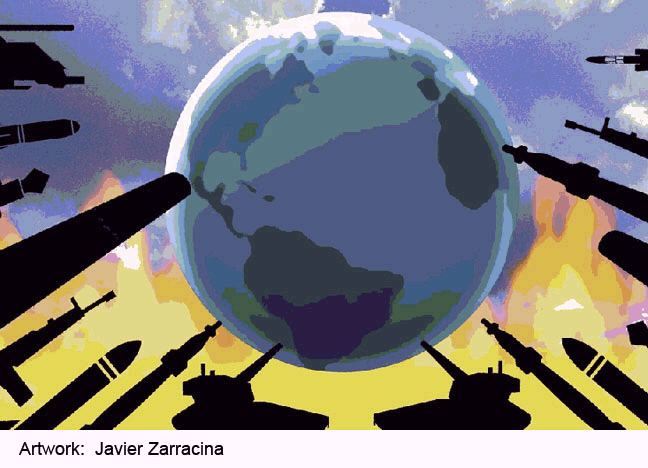
5 things to know about threatened US-Russia nuclear weapons deal
 https://www.aljazeera.com/news/2018/10/5-threatened-russia-nuclear-weapons-deal-181021140208661.html https://www.aljazeera.com/news/2018/10/5-threatened-russia-nuclear-weapons-deal-181021140208661.html
Trump wants to withdraw from the INF treaty that was signed over three decades ago by the US and Soviet leaders. US President Donald Trump has said Washington will withdraw from a 31-year-old nuclear weaponsagreement with Moscow, accusing Russia of violating the treaty and demanding the inclusion of China. Here are five things to know about the Intermediate-Range Nuclear Forces Treaty (also known as the INF treaty: 1. How did the agreement come about? The INF treaty was signed in December 1987 by the then-US President Ronald Reagan and Soviet leader Mikhail Gorbachev. It resolved a crisis that had begun in the 1980s with the deployment of Soviet SS-20 nuclear-tipped, intermediate-range ballistic missiles targeting Western capitals. By signing the agreement, Washington and Moscow swore off from possessing, producing or test-flying a ground-launched cruise missile with a range between 500 and 5,500km. 2. Why is the US withdrawing from the treaty?US officials believe Moscow is developing and has deployed a ground-launched system in breach of the INF treaty that could allow it to launch a nuclear strike on Europe at short notice. Russia has consistently denied any such violation. Trump said on Saturday that it was only fair for US to develop the weapons since Russia and China (not a signatory of the treaty) were already doing it. 3. How does Russia feel about the INF deal?Moscow has long been accusing the US of violating the nuclear agreement, pointing to a NATO missile shield in Romania that could launch nuclear missiles at any time. In 2007, Russia even threatened to withdraw from the INF treaty. On Sunday, an unnamed Russian foreign ministry official told state news agencies that Washington has been “deliberately and step-by-step destroying the basis for the agreement” for many years. 4. What can the US withdrawal from the nuclear treaty lead to?The move will end the prospect of the renewal of the New Start agreement between Moscow and Washington which is set to expire in 2021, as the INF treaty is its backbone. Signed in 2010, New Start requires both nations to cut their deployed strategic nuclear warheads to no more than 1,550. Russian Senator Alexei Pushkov wrote on Twitter that the move was “the second powerful blow against the whole system of strategic stability in the world” after Washington’s 2001 withdrawal from the Anti-Ballistic Missile treaty. Gorbachev, the co-signatory of the INF treaty, said on Sunday it would be a mistake for Washington to quit the deal, and that it would undermine work he and US counterparts did to end the arms race. 5. Can the nuclear deal be saved? John Bolton, Trump’s national security adviser, is scheduled to meet Russian leaders, including Foreign Minister Sergey Lavrov and Security Council Secretary Nikolai Patrushev, this week in Moscow. The trip is likely to show whether there is a chance for the deal to be saved. Trump’s announcement on Saturday suggested that he hoped for the re-negotiation of the terms. Last week, The Guardian reported Bolton, a long-standing opponent of arms control treaties, was pushing for the US withdrawal over alleged Russian violations. US Defence Secretary James Mattis has previously suggested that a Trump administration proposal to add a sea-launched cruise missile to Washington’s nuclear arsenal could provide the US with leverage to try to persuade Russia to come back in line on the arms treaty.
|
|
Genetic effects on UK soldiers – ‘guinea pigs’ at nuclear bomb tests in Australia in 1950s
 UK to probe poisonous genetic legacy of nuclear test ‘guinea pigs’ SMH, By Nick Miller, 19 October 2018 London: The UK government is considering a new study into the health of the children of British veterans used as guinea pigs in its Australian and Pacific nuclear weapons tests, to test fears of a poisonous genetic legacy.
If a link can be found it may form the basis of a claim for compensation from the UK government, despite courts previously turning down such claims from the veterans themselves.
Defence Secretary Gavin Williamson has told officials in the Ministry of Defence to look at the feasibility of a study into the health and well-being of the children of nuclear test veterans, an MOD spokesman said.
Decades ago, around 22,000 British military personnel witnessed nuclear weapons tests in South Australia, on the Montebello Islands off Western Australia, and on Kiribati’s Christmas Island in the Pacific.
Some felt the heat of the explosion on their backs and were ordered to turn around and observe the mushroom cloud. One veteran told the BBC in February the tests “bowled people over” and left them on the ground screaming. He had watched “another sun hanging in the sky”, dressed only in a t-shirt, shorts and thongs.
“We were guinea pigs,” Bob Fleming, 83, said. He said 16 of his 21 children, grandchildren and great-grandchildren had birth defects or health problems: his youngest daughter has thyroid problems and severe breathing difficulties.
The family believe it is a result of the radiation Mr Fleming was exposed to during the test.
Another veteran, RAF sergeant Roy Kirkland, slept a half a mile from Ground Zero and was ordered to collect dead seabirds from the Christmas Island test site.
His grandson, Wayne, was diagnosed with cancer of the nervous system at age three and died before he was 10. Wayne’s aunt told the Daily Mirror “the biggest health issue for these veterans now is their descendants”.
The new feasibility study follows a campaign by the Mirrorand Labour deputy leader Tom Watson, who have been pushing for recognition and compensation for the veterans who were exposed to radiation during the tests in the region between 1952 and 1967 – and their families.
In 2007 a study of New Zealand nuclear test veteransfound they had more than double the expected amount of genetic damage for men of the same age – even higher than that detected in workers close to the Chernobyl nuclear accident or involved in the clean-up.
The study by researchers from Massey University found the genetic damage was most likely attributable to the veterans having been on board NZ navy frigates observing nuclear tests at Christmas Island.
Britain’s Health Protection Agency reviewed the Massey research and agreed with their conclusions. Earlier this year the UK’s Centre for Health Effects of Radiological and Chemical Agents at Brunel University in London announced a three-year genetic study looking for any possible damage to the veterans’ DNA caused by the tests.
In 2014 a study by European researchers found a “significant excess” of infant mortality and congenital illnesses in nuclear test veterans’ children. The veterans’ wives had five times as many stillbirths, and 57 children of veterans had congenital conditions – ten times the rate in the control group and eight times the national average. There were also significantly higher congenital illnesses – and cancer – among the veterans’ grandchildren. The researchers said their results were “highly statistically significant”. …….. https://www.smh.com.au/world/europe/uk-to-probe-poisonous-genetic-legacy-of-nuclear-test-guinea-pigs-20181019-p50alz.html
US nuclear missiles in Italy, as well as their bombs?
VOLTAIRE NETWORK | ROME (ITALY) | 19 OCTOBER 2018 he B61-12, the new US nuclear bomb which replaces the B-61 deployed in Italy and other European countries, will begin production in less than a year. The announcement was made officially by the National Nuclear Security Administration (NNSA). It reveals that the revision of the final project has now been completed with success, and the qualification stage will begin this month at the Pantex Plant in Texas. Production will be authorised to begin in September 2019.
In March 2020, the first unit of production will begin fabricating a series of 500 bombs. As from that time, in other words in about a year and a half, the United States will begin the anti-Russian deployment in Italy, Germany, Belgium, Holland and probably certain other European countries, of the first nuclear bomb in their arsenal with a precision guidance system. The B61-12 is designed with penetrating capacity, built to explode underground in order to destroy bunkers housing command centres.
Since Italy and the other countries, in violation of the Non-Proliferation Treaty, are offering the USA the bases, the pilots and the aircraft for the deployment of the B61-12, Europe will soon be exposed to a greater risk as the front line of the developing nuclear confrontation with Russia.
An even more dangerous situation appears at the same moment – the return of the Euromissiles, meaning the nuclear missiles which are similar to those deployed in Europe in the 1980’s by the USA, with the official aim of defending against Soviet missiles. This category of ground-based nuclear missiles of intermediate range (between 500 and 5,500 km) were eliminated with the INF Treaty of 1987. But in 2014, the Obama administration accused Russia of having experimented with a cruise missile (# 9M729) whose category was forbidden by the Treaty. Moscow denied that the missile violated the INF Treaty and, in turn, accused Washington of having installed in Poland and Romania launch ramps for interceptor missiles (elements of the « shield »), which could be used to launch cruise missiles bearing nuclear warheads.
The accusation aimed by Washington at Moscow, which is not supported by any evidence, enabled the USA to launch a plan aimed at once again deploying in Europe ground-based intermediate-range nuclear missiles. The Obama administration had already announced in 2015 that « faced with the violation of the INF Treaty by Russia, the United States are considering the deployment of ground-based missiles in Europe ». This plan was confirmed by the Trump administration – in fiscal year 2018, Congress authorised the financing of a « programme of research and development for a cruise missile which could be launched from a mobile road base ».
The plan is supported by the European allies of NATO. The recent North-Atlantic Council, at the level of Europe’s Defence Ministers, which was attended for Italy by Elisabetta Trenta (M5S), declared that the « INF Treaty is in danger because of the actions of Russia », which it accused of deploying « a disturbing missile system which constitutes a serious risk for our security ». Hence the necessity that « NATO must maintain nuclear forces which are stable, trust-worthy and efficient » (which explains why the members of the Alliance rejected en bloc the United Nations Treaty for the prohibition of nuclear weapons).
So the grounds are being laid for a European deployment, on the borders of Russian territory, of ground-based intermediate-range US nuclear missiles. It’s as if Russia were deploying in Mexico nuclear missiles pointed at the United States. Manlio Dinucci
Translation
Pete Kimberley
Source
Il Manifesto (Italy)
Risk of nuclear war between USA and China “not as implausible” no, as it was in the past
|
Newsweek 17th Oct 2018, It is more likely than in the past that China and the U.S. could enter into
a military conflict, and the possibility of such a battle going nuclear is higher than many analysts believe, a security expert from Georgetown University has warned. Caitlin Talmadge, who is an associate professor of
security studies at the Walsh School of Foreign Service, laid out a grim picture of how military escalation could play out between Washington and Beijing in an article for Foreign Affairs’ November-December issue.
“The odds of such a confrontation going nuclear are higher than most
policymakers and analysts think,” she wrote. However, she also pointed out that “a war between the two countries remains unlikely, but…no longer seems as implausible as it once did.” https://www.newsweek.com/us-china-nuclear-war-threat-greater-most-people-realize-expert-warns-1175610 |
|
Jobs Are No Excuse for Arming a Murderous Regime
 Portside, October 16, 2018 LOBE LOG Regardless of what ultimately happened to Khashoggi, continuing U.S. arms sales and military support to Saudi Arabia under current circumstances is immoral. Jobs should not be an excuse to arm a murderous regime. If indeed the Saudi government is indeed behind the murder of journalist Jamal Khashoggi there should be consequences—political, military, economic, and reputational.
Unfortunately, President Trump begs to differ. His reaction to questions about whether the United States would cut off arms sales to Saudi Arabia if Riyadh is proven to be behind the killing of Khashoggi has been to say that he does not want to jeopardize the alleged $110 billion in arms deals his administration has struck with the Saudi regime, and the U.S. jobs that come with them.
In his recent interview with CBS 60 Minutes, Trump specifically cites the needs of U.S. weapons manufacturers as reasons to keep U.S. arms flowing to the Saudi regime, even if it ends up being responsible for the murder of Khashoggi:
They are ordering military equipment. Everybody in the world wanted that order. Russia wanted it, China wanted it, we wanted it…I tell you what I don’t wanna do. Boeing, Lockheed, Raytheon, all these [companies]…I don’t wanna hurt jobs. I don’t wanna lose an order like that.
Trump tells CBS’s Leslie Stahl that “there are other ways of punishing” Saudi Arabia without cutting of U.S. arms sales, but he fails to specify what those might be.
Regardless of what ultimately happened to Khashoggi, continuing U.S. arms sales and military support to Saudi Arabia under current circumstances is immoral. Jobs should not be an excuse to arm a murderous regime that not only may be behind the assassination of a U.S. resident and respected commentator but is responsible for thousands of civilian casualties in its three-and-one-half-year military intervention in Yemen—the majority killed with U.S-supplied bombs and combat aircraft and U.S. refueling and targeting assistance.
The Khashoggi case merely underscores the approach of Saudi Crown Prince Mohammed bin Salman, the power behind the throne in Riyadh who is the most ruthless and reckless leader in Saudi history……https://portside.org/2018-10-16/jobs-are-no-excuse-arming-murderous-regime,
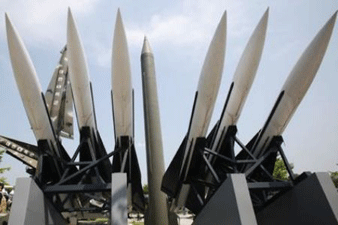
New “low yield” nuclear weapon increases the likelihood of war
 New proposal makes
nuclear war more likely https://www.mercurynews.com/2018/10/17/letter-new-proposal-makes-nuclear-war-more-likely/–Jo Ann Frisch, Pleasanton, 17 Oct 18Donald Trump said he doesn’t understand why we have nuclear weapons if we can’t use them.
The administration’s fiscal 2019 budget took a step in that direction by proposing to create a warhead more likely to be used in war: a low-yield nuclear variant to sit atop Trident D5 missiles. Trump says it will make a U.S. strike more “credible.” The smaller-yield weapon will not be distinguishable from high-yield ones thus lowering the threshold for nuclear use and making nuclear war more likely.
A bill introduced by Reps. Smith, Lieu, Garamendi and Blumenauer called Hold the LYNE (Low-Yield Nuclear Explosive) Act, HR 6840 would prohibit funds for research, development, production or deployment of this warhead…..For more information, go to trivalleycares.org.
U.S. Military Leaders silent on Saudin Arabia political situation
US Military Leaders Keep Quiet on Saudi Arabia Amid Khashoggi Outrage, Defense One 16 Oct 18 Defense Secretary Jim Mattis and Joint Chiefs Chairman Gen. Joseph Dunford this week have declined to say much on Saudi Arabia. Both leaders, in previously scheduled meetings with reporters, were asked about the kingdom and what effect the killing of Khashoggi may have on U.S.-Saudi relations. Both men deferred to Secretary of State Mike Pompeo and said they were waiting for him to return to the U.S. with more “facts.” And they both implied that any related changes to Trump administration foreign policy would be given to them, not made by them. …….
Speaking to reporters traveling with him in Brussels, Pompeo said: “I do think it’s important that everyone keep in their mind that we have lots of important relationships – financial relationships between U.S. and Saudi companies, governmental relationships, things we work on together all across the world – efforts to reduce the risk to the United States of America from the world’s largest state sponsor of terror, Iran. The Saudis have been great partners in working alongside us on those issues. I could go on about places where the Saudis and the Americans are working together. Those are important elements of the U.S. national policy that are for – are in Americans’ best interests. We just need to make sure that we are mindful of that as we approach decisions that the United States Government will take when we learn all of the facts associated with whatever may have taken place.”
President Trump, meanwhile, has been giving the Saudis as much cover as humanly possible, Over the weekend, he floated the idea that “rogue killers” dispatched Khashoggi, and on Tuesday, he told the Associated Press, “Here we go again with, you know, you’re guilty until proven innocent. I don’t like that. We just went through that with Justice Kavanaugh and he was innocent all the way as far as I’m concerned.”………
Is the Saudi partnership still a matter of necessity? Should it be? That’s not likely the question Mattis and Dunford are asking for the near term. For them, the answer is yes. But for the long term, it’s a question for them, Pompeo,and Trump. It’s a question of whether “Saudi interests” under bin Salman still align with American interests, or just with American military and intelligence interests.
This week, national security press has been inundated with commentaries asking if the U.S.-Saudi relationship has been worth the cost. At the Pentagon, no matter the outcome of the Pompeo fact-finding trip or the Khashoggi investigation, the answer is most likely going to be a resounding yes. https://www.defenseone.com/politics/2018/10/us-military-leaders-keep-quiet-saudi-arabia-amid-khashoggi-outrage/152082/?oref=site-defenseone-flyin-sailthru
A plan to get Nuclear-Weapons Treaties happening again
|
How To Get Nuclear-Weapons Treaties Back on Track, Defense one BY DARYL G. KIMBALL, EXECUTIVE DIRECTOR, ARMS CONTROL ASSOCIATION, 16 Oct 18, Back in March, President Trump told reporters at the White House in March that he wanted to meet with Putin in large part “to discuss the arms race, which is getting out of control” and has characterized the costly nuclear weapons upgrade programs being pursued by each side as “a very, very bad policy.”Three months have elapsed since the July summit between Trump and Putin in Helsinki – after which the U.S. president said, “Perhaps the most important issue we discussed at our meeting…was the reduction of nuclear weapons throughout the world.” But since the summit, there has been no apparent progress. The long-running dispute over Russia’s violation of the 1987 Intermediate-Range Nuclear Forces Treaty remains. The two sides have not begun to discuss the future of the successful 2010 New START agreement, which limits each side to 1,550 deployed strategic warheads. That treaty will expire on Feb. 5, 2021, unless Trump and Putin agree to extend it. Without these treaties in place, the door will be opened to an unconstrained nuclear arms race. The already abysmal U.S.-Russian relationship will become even more complicated and dangerous. Next week, National Security Advisor John Bolton will travel to Moscow to meet with his counterpart in the Kremlin, Nikolai Patrushev. It is past time for both sides to get serious about resolving the INF compliance crisis, to agree to discuss the extension of New START, and to resume regular talks on “strategic stability.” INF Woes: U.S. and Russian officials both say they support the 1987 INF Treaty, which led to the elimination all U.S. and Soviet ground-launched ballistic and cruise missiles with ranges between 500 and 5,500 kilometers. But the treaty is now at risk because Russia has tested and deployed a prohibited ground-launched cruise missile: the 9M729. Moscow, for its part, alleges, far less credibly, that Washington is deploying missile defense systems in Europe that could be used to launch offensive missiles. Contrary to what some observers may want to believe, the arms control community has been working hard to raise the alarm belland put advance serious options to put out the INF fire. Since Russia’s INF violation became known in early 2014, the Arms Control Association has steadfastly reported on and published expert analyses on the problem in our monthly journal Arms Control Today. We have convened U.S. and European and Russian experts from inside and outside government on the INFissue, and met with U.S. lawmakers and staff to exchange views on the problem. We have confronted senior Russian officials in private consultations Washington and in Moscow and, along with a number of experts and former U.S. officials, we have put forward options for resolving the dispute. ……… The Future of New START: New START remains one of the few bright spots in an otherwise broken U.S.-Russian relationship. Ratified in 2011, the Treaty limits the number of deployed strategic warheads to a maximum of 1,550 on each side, a target each met earlier this year, and which is far below the tens of thousands we pointed at each other during the Cold War. The Treaty imposes important bounds on strategic nuclear competition as long as it is in force. As allowed in Article XIV of the treaty, it can be extended by up to five years by agreement by the two Presidents, without requiring further action by the Congress or the Duma. Before and after the Helsinki summit, Russian officials have reiterated their interest in talks designed to extend the treaty. But after his first post-Helsinki meeting with Patrushev, in Geneva on Aug. 23, Bolton said the administration remains in the “early stages” of an interagency review about whether to extend, replace, or jettison New START or to pursue a different type of approach. Unfortunately, some elements in the Trump administration want to hold New START hostage until Russia acknowledges its INFviolation—an extremely unlikely possibility. Sacrificing New START, given the transparency it provides, would only create a bigger nuclear headache and do nothing to bring Russia back into compliance with INF. Key Senate Democrats have called for an extension of New START so long as Russia remains in compliance with it, and several leading Senate Republicans have also voiced their support for New START. U.S. military leaders continue to see value in New START; for example, Gen. John Hyten, commander of U.S. Strategic Command, told Congress last March that “bilateral, verifiable arms control agreements are essential to our ability to provide an effective deterrent.” If New START is not extended, there will be no legally binding limits on the world’s two largest strategic arsenals for the first time since 1972. In its absence, each side could quickly increase the number of warheads deployed on their strategic delivery systems. Unconstrained U.S.-Russian nuclear competition—in both numbers and technology—could spark an arms race as dangerous as that of the 1950s and 1960s. That would add scores of billions in additional costs to an already unrealistic U.S.nuclear upgrade plan. An extension of New START, on the other hand, would buy time for the two sides to discuss agreements on new strategic systems, including the ones under development by Russia, and provide a solid baseline for talks on further reductions of each side’s strategic and tactical nuclear stockpiles……..https://www.defenseone.com/ideas/2018/10/how-get-nuclear-weapons-treaties-back-track/152095/ |
|
Russia’s nuclear torpedoes trapped5,000 Feet Below the Waves on a Dead Submarine
Russia Lost Two Nuclear Weapons. Why? They are Trapped 5,000 Feet Below the Waves on a Dead Submarine.
Komsomolets sank in 5,250 feet of water, complete with its nuclear reactor and two nuclear-armed Shkval torpedoes. Between 1989 and 1998 seven expeditions were carried out to secure the reactor against radioactive release and seal the torpedo tubes, omsomolets sank in 5,250 feet of water, complete with its nuclear reactor and two nuclear-armed Shkval torpedoes. Between 1989 and 1998 seven expeditions were carried out to secure the reactor against radioactive release and seal the torpedo tubes. Russian sources allege that during these visits, evidence of “unauthorized visits to the sunken submarine by foreign agents” were discovered.
In the mid-1980s, the Soviet Union constructed a super submarine unlike any other. Fast and capable of astounding depths for a combat submersible, the submarine Komsomoletswas introduced in 1984, heralded as a new direction for the Soviet Navy.
Donald Trump DOES have the opportunity to end the diplomatic nuclear crisis, promote disarmamament
The Nuclear Trump Card, The American Conservative, The Donald has the best shot at nuclear disarmament of any president over the last 20 years. By • October 15, 2018 There is no greater issue facing America today than that of war and peace. Marginal changes in the corporate tax rate, the precise number of visas provided to foreign workers, minor adjustments to the Social Security retirement age—all are peripheral when compared to the immense weight of foreign policy decisions. Using military force, deciding what’s in the national interest, and setting geopolitical strategy all have consequences that can affect whole nations, regions, even the world.It is the responsibility of statesmen to be as judicious as possible when it comes to military force, to act realistically and practice restraint. This prevents unwarranted infrastructure destruction, unforeseen blowback, and criminal loss of life. This carries over into a duty to work towards mutually beneficial arms control agreements and non-proliferation treaties to rein in the most destructive weapons ever created by man.
Unfortunately, outside the post-retirement advocacy of former secretary of defense William Perry and whistleblower Daniel Ellsberg, very few public figures seem to realize the dangers of nuclear brinksmanship and the importance of disarmament.
Currently, an exchange of 100 atomic bombs would kick up enough dust and debris to blot out part of the sun and starve one third of the earth’s population. Eight countries have the capability to carry out such a mass genocide. Further down the line, if 100 hydrogen weapons (H-bombs) were used, the planet would experience a nuclear winter and up to seven billion people would starve to death. Ellsberg terms this “omnicide”: the murder of everyone. Russia and the United States, as the only countries possessing H-bombs, are especially obligated to reduce their nuclear stockpiles and lessen the danger of nuclear war. The cost of not doing so could be the world itself.
……….Politically, Trump is in a better position than either of his predecessors on nuclear issues. His presidency is not dominated by ideological neoconservatives who buck any tactical diplomacy, and as a Republican his hawkish right flank has been partly neutered. Some of President Obama’s better intentioned efforts, like the nuclear agreement with Iran, were hindered by domestic politics and hawkish Republicans, always adversarial to Democratic-led peace initiatives. Trump, as a Republican, is not encumbered by such political restraints, a la “only Nixon can go to China.”
Thus far, Trump has squandered his opportunity. Jumping feet-first into Obama’s trillion dollar nuclear modernization plan launched in 2016, Trump has not made nuclear discussions with Russia a first-tier, or even fourth tier, issue. And when he has commented on it, it’s with his typical pugnaciousness. This attitude contradicts his efforts with North Korea, and isn’t the first contradiction in “Trumpism.” Meanwhile, pulling out of the nuclear agreement with Iran has exacerbated diplomatic tensions, but from Trump’s point of view, he sees the abrogation as a step in the direction of his vaunted “better deal.” His offer of new negotiations without preconditions shows that his goal is resolution, albeit in a tactically poor way. The administration should crystallize a consistent outlook on nuclear de-escalation, even if it’s only out of selfish motivations………
Most Americans support the Korean peace initiative. In the 2000, 2008, and 2016 presidential elections, voters chose the less hawkish candidate. Peace is popular, especially when the consequences of a possible nuclear fallout are explained. Hypothetically, if Trump were to invite Russian President Vladimir Putin to Washington, D.C. to initiate negotiations on nuclear weapons, he would do so from a position of political strength.
Some analysts postulate that a world power needs no more than a couple hundred nuclear weapons to achieve a deterrence factor as envisioned by MAD (mutually-assured destruction). This makes the United States’ and Russia’s combined 13,500 warheads (active and decommissioned) more than a little overkill. It’s within both countries’ interest to reduce their stockpiles to make accidents less likely and lessen the chance of death on a scale not since the extinction of the dinosaurs. Since the United States and Russia possess over 90 percent of the world’s nuclear weapons, this one diplomatic overture could, over years, end the nuclear crisis on our planet. Donald Trump could make all the difference.
Hunter DeRensis is an editorial assistant at The American Conservative and a student at George Mason University. Follow him on Twitter @HunterDeRensis. nhttps://www.theamericanconservative.com/articles/the-nuclear-trump-card/
65 years later, the toxic legacy continues – of British nuclear bomb tests in Australia
Menzies “immediately agreed to the proposal,” without consulting any of his cabinet colleagues or the Australian parliament. Indeed, until weeks before the first test was carried out, only three government ministers knew about it.
The most devastating effects were suffered by two groups: Australian and British soldiers working on the tests themselves, and the Indigenous populations local to Emu Field and the later testing site of Maralinga.
One prominent member of the testing team, Sir Ernest Titterton, later said that if Indigenous people had a problem with the government, they should vote it out, ignoring that Indigenous Australians did not have full political rights until 1967.
an Australian defense ministry report was leaked to the press, warning that large amounts of plutonium left at Maralinga could potentially be a target of terrorists.
those wrongs have not been fully addressed. Health problems stemming from the tests continue for those still living, and while the veracity of Lester and other victims’ stories has been acknowledged, what exactly happened to them remains unclear, the details of the nuclear test still kept top secret.
“To this day we don’t know what Totem I did, those records are still classified by the British,
|
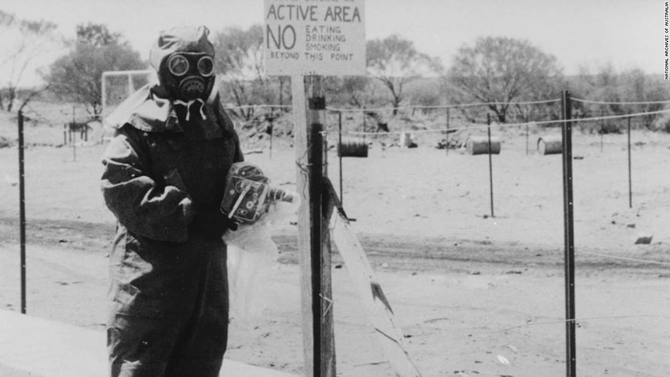
Australia is still dealing with the legacy of the UK’s nuclear bomb tests, 65 years on https://edition.cnn.com/2018/10/14/australia/australia-uk-nuclear-tests-anniversary-intl/index.html By James Griffiths, CNN October 15, 2018 (
Yami Lester was 12 years old when the black mist came to Walatinna.
Early on the morning of October 15, 1953, Lester heard a “big bang” in the distance. This was followed by a dark, ominous-looking cloud which drifted low over the ground like a slow-moving dust storm, bringing with it an unpleasant smell.
A tiny speck in the vast South Australian outback, the area around Walatinna was regarded as “depressingly inhospitable to Europeans” by early colonizers, few of whom settled there. But Indigenous people had a long history in the region, including Lester’s tribe.
As the dark cloud settled over the Walatinna camp, the tribal elders attempted to ward it off, thinking it was a malevolent spirit. In many ways they were right.
As those exposed to it later told investigators, the black mist caused their eyes to sting and their skin to break out in rashes. Others vomited and suffered from diarrhea.
It took almost three decades until the cause of the mist was acknowledged as the Totem I nuclear bomb test, as Indigenous people had been claiming for years.
That test was one of a number conducted in the 1950s and ’60s, not by the Australian government, but by its former colonial master, the UK. Today, 65 years after the Totem I test, the effects are still being felt in South Australia and beyond.
British bombAustralia was not the UK’s first choice of nuclear testing site. British scientists had been intimately involved in the Manhattan Project during World War II, and fully expected to be able to follow the US in testing their own nuclear weapon on American soil.
“Ultimately, they settled on Australia, which had many benefits,” said Elizabeth Tynan, author of “Atomic Thunder: The Maralinga story,” a book about the tests. These includes a sympathetic, compliant government under the recently elected Anglophile Prime Minister Robert Menzies, and wide open spaces in which to carry out the detonations themselves.
In September 1950, British leader Clement Attlee sent Menzies a secret message asking whether his government “would be prepared in principle to agree that the first United Kingdom atomic weapon should be tested in Australian territory.”
According to a later Australian Royal Commission investigation, Menzies “immediately agreed to the proposal,” without consulting any of his cabinet colleagues or the Australian parliament. Indeed, until weeks before the first test was carried out, only three government ministers knew about it.
Menzies’ enthusiasm for the British bomb “wasn’t all sycophantism, it wasn’t all sucking up to his colonial masters,” said Tynan, though this was definitely a factor. The Australian leader also saw in the atomic age an advantage for his country, which was one of the few to have large stocks of uranium, a previously largely unwanted material.
The UK’s first atomic bomb was detonated in the waters off the Montebello Islands, a small archipelago in north western Australia, in the early hours of October 3, 1952, officially making London the third member of the nuclear club, after the US and the Soviet Union.
Emu FieldWhile the Montebello Islands were used for the first test, British planners were never totally happy with the location, and even before the bomb was set off they began looking for a site on the Australian mainland where they could be granted greater secrecy and autonomy.
They settled on a location in the Great Victoria Desert, about 480 kilometers (300 miles) from the nearest town, Woomera, which they named Emu Field.
Plans were soon set in motion for a second test, and on October 15, 1953, the first of the Totem devices was detonated.
Unlike the Montebello test, which went off largely as planned, the 9.1 kiloton Totem I sent a cloud of debris and smoke some 15,000 feet (4,500 meters) into the air, spreading fallout far higher and farther than originally expected.
The Royal Commission later found the test was carried out in inappropriate wind conditions and without proper consideration for people living nearby, examples of the often staggering lack of care taken by British officials overseeing the nuclear program, who frequently ignored or did not bother to seek out vital information about the potential effects of their tests on the host country.
Black mistThe most devastating effects were suffered by two groups: Australian and British soldiers working on the tests themselves, and the Indigenous populations local to Emu Field and the later testing site of Maralinga.
While some concern was paid to their safety during the tests, it was often cursory at best. A single “native patrol officer” given the thankless task of having to try and inform Indigenous residents of the potential dangers had a 100,000 square kilometer (38,610 square mile) region to cover.
Nor did the British much seem to care. One prominent member of the testing team, Sir Ernest Titterton, later said that if Indigenous people had a problem with the government, they should vote it out, ignoring that Indigenous Australians did not have full political rights until 1967.
Another senior official, in a letter to his superiors, complained that W. B. MacDougall, the man with the dubious task of trying to protect the local Indigenous populations, was “placing the affairs of a handful of natives above those of the British Commonwealth of Nations.”
“The harm done to the Aboriginal people is one of the most shameful aspects (of the tests),” Tynan said. “Nowhere in the British records is there a sign of even the slightest concern for the Aboriginal people.”
This lack of concern is likely what led to the situation at Walatinna. Around 40 people were in the camp when the Totem I blast sent clouds of radiated material miles into the sky.
“It rumbled, the ground shook, it was frightening,” Lalli Lennon told investigators. Some time later, a large black cloud passed low over the settlement. Her husband Stan described it as “sort of hazy, like a fog or something.” Lalli and her children developed fevers, headaches, vomiting and diarrhea, and two of them suffered rashes and sore eyes from the smoke.
But just as they had paid little attention to the wellbeing of Indigenous people prior to the test, the British and Australian authorities did not concern themselves with such matters afterwards.
This was reflected by and large by Australian public opinion, which Tynan said was initially “quite jubilant” about the tests, and remained broadly supportive until the 1970s and ’80s, when a host of revelations about the British nuclear program exposed its lackluster safety procedures — even by the standards of the time — and the disdain of those overseeing it for Australian democratic oversight.
Maralinga messThis shift began when an Australian defense ministry report was leaked to the press, warning that large amounts of plutonium left at Maralinga could potentially be a target of terrorists.
This ran contrary to a 1968 report prepared by British official Noah Pearce which assured the Australian government the plutonium had been properly buried and did not present a significant risk.
Indeed, that year the Australians agreed to release the UK from nearly all “liabilities and responsibilities” regarding the tests, in the belief the British had “completed decontamination and debris clearance … to the satisfaction of the Australian government.”
When Canberra finally carried out its own survey of the site, scientists were shocked by what they found.
“They still thought the Pearce Report was accurate until their geiger counter went crazy,” said Tynan, who has interviewed several of the inspectors. “They weren’t wearing protective gear (and) were kicking plutonium soaked rocks with their boots.”
The Royal Commission report said later that there were between “25,000 and 50,000 plutonium- contaminated fragments in the (Maralinga) area, although the number might need to be doubled if missed and buried fragments were included.” Emu Field and the Montebello Islands were also found to be more dangerous than expected.
“In addition to British scientific and military personnel, thousands of Australians were exposed to radiation produced by the tests,” according to a report by the Australian Institute of Criminology. “These included not only those involved in supporting the British testing program, but also Aboriginal people living downwind of the test sites, and other Australians more distant who came into contact with airborne radioactivity.”
Final hearingThe Royal Commission hearings marked the end to any lingering approval of the tests among the Australian public, exposing fully the ongoing harm done to the local environment, Indigenous people, and the soldiers who worked on the tests.
While many disorders are difficult to link directly to the nuclear tests, veterans of the program have complained of numerous cancers, autoimmune diseases, and other ailments — including among their children — which they put down to their lack of protective clothing and other precautions at the time.
Last year, the Australian government expanded medical benefits for members of the nuclear testing program, but most are now in their late 80s and one told the ABC the move was “too bloody late.”
The harm done to Indigenous people has also been recognized in the decades since the Royal Commission, including by the black mist — which a British official once said investigating would be a “complete waste of money and time.”
In 1993, the British agreed to pay the Australian government and the traditional owners of the Maralinga lands around 46 million AUD ($30 million). The Australian authorities also paid Indigenous Maralinga communities a settlement of 13.5 million AUD ($9 million).
“Everyone became friends again after that,” said Tynan, adding that the issue, which had dominated Australian media and public attention for years, slowly slipped away, becoming a “great Australian secret.”
Today, she said she often meets young Australians who are unaware of the tests, and even many people who were alive at the time of the Royal Commission who only have a hazy idea of the issues.
“It was one of those things that, because it was not really written into the history books … just dropped off the radar,” she said, even as veterans and Indigenous people affected by the tests continue to suffer health repercussions and shortened lifespans because of their exposure to radiation.
Yami Lester died on July 21, 2017. He was remembered in parliament by then Prime Minister Malcolm Turnbull as a “man of wonderful intelligence and insight, as an elder of great standing and as a champion of Aboriginal rights and dignity.”
“He will be revered for rising from personal tragedy to serve his community and to lead his people to ensure that they were recognized and their wrongs addressed,” Turnbull added.
But as Tynan and others have pointed out, those wrongs have not been fully addressed. Health problems stemming from the tests continue for those still living, and while the veracity of Lester and other victims’ stories has been acknowledged, what exactly happened to them remains unclear, the details of the nuclear test still kept top secret.
“To this day we don’t know what Totem I did, those records are still classified by the British,” Tynan said. “It remains one of the great mysteries.”
|
USA-Russia relations at a low ebb: nuclear treaties are under threat
WORLD WAR 3: Russian minister warns nuclear treaties under threat as relations plunge
SKY-HIGH tensions between the US and Russia are putting critical treaties designed to prevent a nuclear arms race in jeopardy as relations sink to an all-time low, a senior Russian official has warned.
He said: “We could lose several elements on arms control infrastructure. The building is shaky.”
Mr Rybakov warned another round of sanctions intruded by Donald Trump in the summer were “dangerous” and getting in the way of negotiations over renewing the New Strategic Arms Reduction Treaty “New START” which saw both sides agree to reduce their deployed nuclear arms by half but is set to expire in 2021.
He said: “If there is no progress then risk of a real backfire grows.
Mr Ryabkov was speaking as negotiators from the two countries met in Geneva to discuss a Cold War era treaty that was supposed to keep expansion of long-range nuclear-capable missiles in check.
Moscow and Washington have repeatedly accused each other of breaching the Intermediate-Range Nuclear Forces (INF) Treaty, a 1987 pact which bans firing land-based missiles with a range of up to 5,500km.
The US ambassador to NATO warned Moscow against developing a new cruise missile that could be armed with nuclear warheads, arguing that it was in breach of the INF and could be used against members of the Western military alliance.
Kay Bailey Hutchison said: “Counter measures by the United States would be to take out the missiles that are in development by Russia in violation of the treaty. They are on notice.”
The US government took a more aggressive line against Russia this year, when Mr Trump unveiled a new nuclear strategy that revolved around countering Russia and called for the development of small tactical nuclear weapons that were cheaper to maintain and could be used in more realistic scenarios.
Washington has also accelerated long-running US military plans to develop new intercontinental ballistic missiles (ICBMs) and nuclear-capable cruise missiles and has just confirmed hypersonic weapons testing is well underway……..https://www.express.co.uk/news/world/1030089/world-war-3-russian-minister-sergei-ryabkov-nuclear-treaties-moscow-washington-cold-war
Trump administration’s unreasonable tolerance for Saudi Arabia’s war crimes in Yemen
|
In Yemen, Trump Is Taking Tolerance for War Crimes to a New Level, Truthout, BY Khury Petersen-Smith
Truthout, October 11, 2018 Twenty days after Saudi Arabia and the United Arab Emirates (UAE) bombed a school bus full of children in Yemen this August, Defense Secretary James N. Mattis hosted officials from the two US allies at the Pentagon. They were all gathered as part of a meeting of representatives from the Gulf Cooperation Council, at which Mattis thanked them for their “regional leadership and years of close cooperation with the United States.”…….. In this war, the Saudi and Emirati militaries are dropping the bombs, and the United States plays a critical role in every step of the operations. The coalition’s munitions are made in the US, as are the planes dropping them — all of which were sold to Saudi Arabia and the UAE in deals brokered by the US government. ……..
It is remarkable that — despite the international spotlight on the war in Yemen resulting from the highly publicized school bus bombing — Trump administration officials continue to embrace Saudi Arabia, the United Arab Emirates, and their operations. The killing of dozens of children and wounding of dozens more in the bombing was not itself an aberration from the daily operations of the war — which have involved the coalition targeting weddings, funerals and markets with alarming regularity. What stood out about the attack however, was the level of attention that it received in the US. Both The Washington Post and The New York Times editorialized against US involvement in the war. In a move that may be unprecedented, CNN not only covered the atrocity extensively, but also reported on the US weapons manufacturers who made the bombs for that and other attacks. …….. The United States has long flouted international law. But Trump is taking its defiance of any notions of accountability whatsoever, and its tolerance for blatant war crimes, to a new level. It is openly assisting those crimes in Yemen. After all, the US is enthusiastically supplying weapons to countries that demonstrate a clear pattern of targeting civilians. The coalition has also committed the crime of targeting medical facilities and civilian infrastructure, and has only received affirmation, weapons and other support from the United States. ……..https://truthout.org/articles/in-yemen-trump-is-taking-tolerance-for-war-crimes-to-a-new-level/
|
|
|
1 This Month

Protect Sazan Island from the Trump family! https://secure.avaaz.org/campaign/en/protect_sazan_island_from_the_trump_family_loc/?bqFCVab&v=174511&cl=22707147157&_checksum=5e9dde668860e8231c33699735e16a1fbf22ab2cb01da50c999fe8732b9775ef&utm_source=email&utm_medium=blast_email&utm_campaign=174511


Cuba Is Not a Failed State – It Is a Besieged State
PETITION: “Global Appeal to Endorse Palestinian Right of Return of Refugees”
To see nuclear-related stories in greater depth and intensity – go to https://nuclearinformation.wordpress.com
-
Archives
- June 2026 (129)
- May 2026 (306)
- April 2026 (356)
- March 2026 (251)
- February 2026 (268)
- January 2026 (308)
- December 2025 (358)
- November 2025 (359)
- October 2025 (376)
- September 2025 (257)
- August 2025 (319)
- July 2025 (230)
-
Categories
- 1
- 1 NUCLEAR ISSUES
- business and costs
- climate change
- culture and arts
- ENERGY
- environment
- health
- history
- indigenous issues
- Legal
- marketing of nuclear
- media
- opposition to nuclear
- PERSONAL STORIES
- politics
- politics international
- Religion and ethics
- safety
- secrets,lies and civil liberties
- spinbuster
- technology
- Uranium
- wastes
- weapons and war
- Women
- 2 WORLD
- ACTION
- AFRICA
- Atrocities
- AUSTRALIA
- Christina's notes
- Christina's themes
- culture and arts
- Events
- Fuk 2022
- Fuk 2023
- Fukushima 2017
- Fukushima 2018
- fukushima 2019
- Fukushima 2020
- Fukushima 2021
- general
- global warming
- Humour (God we need it)
- Nuclear
- RARE EARTHS
- Reference
- resources – print
- Resources -audiovicual
- Weekly Newsletter
- World
- World Nuclear
- YouTube
-
RSS
Entries RSS
Comments RSS
 nuclear-news