nuclear-news

The News That Matters about the Nuclear Industry Fukushima Chernobyl Mayak Three Mile Island Atomic Testing Radiation Isotope

Revisiting the Treaty on the Prohibition of Nuclear Weapons

December 1, 2018 Posted by | 2 WORLD, weapons and war | Leave a comment

Manchester City support’s for the U.N Nuclear Weapons Ban Treaty is welcomed by Nuclear Free Local Authorities (NFLA)

NFLA 28th Nov 2018 , The Nuclear Free Local Authorities (NFLA) welcomes the unanimous decision
made today by Manchester City Council to formally support the International
Treaty for the Prohibition of Nuclear Weapons (TPNW). NFLA calls on the UK
Government to engage with the majority will of United Nations (UN) member
states by engaging in a process they have currently boycotted. The TPNW was
agreed at the UN by 122 countries (including the Republic of Ireland) in
July 2017 and is currently being ratified, a process that is expected to
conclude in 2019. The Treaty is a concerted attempt to move forward with
multilateral nuclear disarmament, but it has been opposed at every stage by
the nuclear weapon states, including the United Kingdom. NATO members, and
states like Australia and Japan who are linked to American security
policies, have also opposed this process.
http://www.nuclearpolicy.info/news/nfla-welcomes-manchester-city-council-becoming-first-european-city-formally-support-treaty-prohibition-nuclear-weapons/

December 1, 2018 Posted by | UK, weapons and war | Leave a comment

Saudi Arabia’s Crown Prince Mohammad Bin Salman (MbS) and his goal of a nuclear kingdom

The Crown Prince May Build Himself a Nuclear Kingdom https://nationalinterest.org/blog/middle-east-watch/crown-prince-may-build-himself-nuclear-kingdom-37292 The Trump administration should keep a close eye on Saudi Arabia’s nuclear connections and activities. by Ronen Dangoor, 28 Nov 18

The horrific murder of Jamal Khashoggi shed light on the reckless and dangerous decisionmaking process of Saudi Arabia’s Crown Prince Mohammad Bin Salman (MbS). In addition to the latest crisis The New York Times recently published a story about how the prince’s closest security personnel sought to hire private foreign companies to assassinate senior Iranian officials—an act that could have trigger a regional military conflict. This conduct follows a string of other bizarre events in the last few months, initiated by MbS.

The crown prince has demonstrated arrogant, cruel, amateur and capricious behavior. His aggression has been left almost unmonitored by checks and balances inside the Saudi hierarchy. Indeed, MbS has constrained all his potential rivals and has taken full controlof Saudi Arabia’s security and intelligence bodies. As the Khashoggi scandal has proven—such power enables dictators to secretly execute dangerous operations. In parallel, he managed to become the darling of the West after he initiated economic reforms and launched his so called modern 2030 vision .

Now add Saudi’s long history of nuclear ambitions to the mix. For years, Saudi officials have warned that Saudi Arabia will not curb its nuclear ambitions if it will sense a threat to its national security, or if Iran advances in its nuclear program. Rumors were that Pakistan was obliged to provide the Saudis a ready-for-use nuclear weapon if and when the time comes. Things only got more complicated once the nuclear agreement (JCPOA) with Iran was signed in 2015, practically legitimizing Iran’s rights to maintain and develop its uranium enrichment capabilities. At the beginning of November 2018, the crown prince participated in the opening ceremony marking the launch of construction of Riyadh’s first research reactor . It’s still early days and only a symbolic act—the Saudis lack knowhow, technicians, infrastructure and academic expertise—but the country has both enough ambition and funds to advance anyway. Shortly after that the Saudi energy minister said the kingdom launches uranium exploration program.

Over the last decade, purchasing sixteen nuclear power reactors—later scaled back to two reactors—plus uranium enrichment capabilities preferably from the United States, has

featured prominently on the Saudi agenda. The official rationale is the country’s future needs to supply energy —with self-sufficient nuclear materials. While having enrichment capabilities can serve to counterbalance Iran, it may also constitute a future military nuclear program. During previous negotiations with Saudi officials, the Obama administration insisted that Saudi Arabia must comply with the “ gold standard ,” reflective of the conditions imposed on the UAE when it agreed to buy U.S. reactors in 2009. This standard requires a commitment not to enrich uranium or to produce plutonium as a strict condition for any agreement to sell nuclear reactors. According to current Secretary of State Mike Pompeo, the Trump administration has maintained this policy . In an interview with CBS in March 2018, MbS maintained that “without a doubt, if Iran developed a nuclear bomb, we would follow suit as soon as possible.”

Following the murder of Khashoggi, Senate members urged the Trump administration to curb any intention to sell nuclear reactors to the Saudi regime. This move is certainly necessary, but not nearly enough. An American refusal to his demands can push the prince to seek an alternative option elsewhere, with producers that will be all too happy to assist—for the right price.

Much of MbS’s current conduct lies parallel to previous experience with three other Middle East tyrants: former Iraqi president Saddam Hussein, Libya’s leader Muammar el-Qaddafi, and Syrian president Bashar al-Assad. These cynical dictators have a common denominator in their infinite ambitions, which ultimately led them to secretly promote a nuclear weapons program. They all relied heavily on their security systems in initiating these plans. Libya and Syria had no sufficient nuclear infrastructure, so they bought a turnkey nuclear project from Pakistan’s A.Q. Khan Network, and in the Syrian case from North Korea .

The Saudi nuclear issue has placed a challenge before the administration. If the prince is successful in surviving the current crisis, then that could prompt him to make even riskier decisions, including taking the nuclear path. Much like in Iraq, Libya and Syria, all the necessary components for that are now in place: A de facto dictator with delusions of grandeur and poor judgment, full control over the security services, unlimited funds for the purpose, a national sense of isolation, an acute threat, and a long-term nuclear vision. As Iran seems to be complying with the JCPOA, a Saudi move could instigate a nuclear arms race in the Middle East. To avoid this, the Trump administration should warn and restrict the Saudi heir. It should also keep a very close eye on Saudi Arabia’s nuclear connections and activities.

Ronen Dangoor is the former deputy head of the research and analysis division at the Israeli prime minister’s office.


November 29, 2018 Posted by | politics, Saudi Arabia, weapons and war | 1 Comment

Tensions rise as Russia prepares for USA to deploy nuclear weapons to Europe after ban treaty abandoned

Russia says it’s planning for the US to deploy nuclear weapons to Europe after ban treaty abandoned, Business Insider, Andrew Osborn and Tom Balmforth, Reuters, 26 Nov 18

November 27, 2018 Posted by | politics international, Russia, USA, weapons and war | Leave a comment

Saudi Arabia’s crown prince Mohammed bin Salman – wanting a nuclear bomb?

November 24, 2018 Posted by | politics international, Saudi Arabia, weapons and war | Leave a comment

Russia to give up its policy of ‘no first use’ of nuclear weapons

Russia rewrites nuclear rule book to fire first, The Times, 23 Nov 18 President Putin would have the power to launch nuclear first strikes under plans approved by the Russian parliament.

Senators in the Federation Council, the upper house, have recommended tearing up the military doctrine that forbids initial use of weapons of mass destruction. It comes after Mr Putin said that Moscow would retaliate if the United States withdrew from a landmark Cold War missile treaty.
Russia
The revision would allow the president to order nuclear strikes in response to enemy use of conventional weapons, a significant departure from the military doctrine that prohibits first use unless Russia is threatened by weapons of mass destruction or if its “very existence is in jeopardy” ……. (subscribers only) https://www.thetimes.co.uk/article/russia-rewrites-nuclear-rule-book-to-fire-first-r9gg2mpqm

November 24, 2018 Posted by | politics international, Russia, weapons and war | Leave a comment

USA’s endless cycle of weapons spending is set to get more extreme

Trump’s Defense Spending Is Out of Control, and Poised to Get Worse https://www.rollingstone.com/politics/politics-features/trump-defense-spending-757028/  15 Nov 18, 

Using a time-honored trick, a bipartisan congressional panel argues we should boost the president’s record defense bill even more

November 22, 2018 Posted by | politics, secrets,lies and civil liberties, USA, weapons and war | 1 Comment

The East Yorkshire village almost wiped out by a nuclear bomb

 https://www.hulldailymail.co.uk/news/hull-east-yorkshire-news/nuclear-bomb-threat-yorkshire-village-2228206

It was, understandably, opposed by residents By Alex Grove 18 NOV 2018 

It is a quaint rural hamlet on the coast of East Yorkshire with around 600 people and a few small amenities.

Life in Skipsea is peaceful, sleepy and quiet, but a controversial proposal put forward by scientists 65 years ago threatened to effectively wipe out the village from existence and change the face of the seaside village forever.

In 1953, almost 240 miles away from Skipsea in another similarly small Berkshire village called Aldermaston, scientists at the Atomic Research Establishment seriously considered detonating a nuclear weapon next to Skipsea.

At the time it had a medieval church and the remains of a Norman castle but not much else, and its close proximity to the RAF base at Hull made it an ideal spot to explode an atomic bomb.

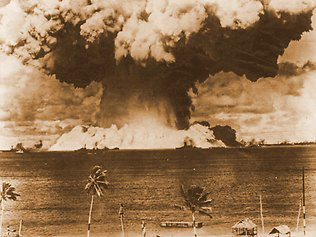
In the midst of the Cold War, the UK wanted to find a coastal site for an above-ground atomic bomb explosion after detonating under the sea off a group of islands near Australia in 1952.

They first opted for a Scottish beauty spot called Duncansby Wick near Caithness in the Highlands of Scotland, but this plan was halted by the damp.

They turned their attention to Donna Nook in Lincolnshire before settling on Skipsea.

However, the people of the small East Riding village were not going to relinquish their hamlet without a fight. Unsurprisingly, community leaders rallied to protest against the idea arguing the site chosen was too close to bungalows and beach huts. The area’s MPs encouraged the government to reconsider the radical plan and with opposition to the idea too fierce, the government backed down and secured Skipsea’s future with the bomb test carried out at Emu Field – a desert area in South Australia.

The village was still used later on by The Royal Observer Corps as a site for a Cold War observation post on the east coast of England. The site remained active from October 1959 until its decommissioning in September 1991. It gathered dust for years before being restored by an enthusiast ten years ago.

People may not think there is much to do in Skipsea with the village home to a couple of churches and post offices, a village hall a pub and a few shops.

However, this tale of old will just make you appreciate the fact that this quiet, sleepy village even exists at all.

November 19, 2018 Posted by | history, UK, weapons and war | Leave a comment

How the USA gave up on protecting its citizens against nuclear attack, and settled for just elite shelters

How the U.S. Government Might Have Survived a Nuclear War,  Yes, this is the real Deep State, National Interest, by Steve Weintz, 18 Nov 18 

With the arrival of the Bomb and its immense destructive power, the efforts to protect elites and commoners alike from swift destruction assumed novel and at times grotesque forms. Civil defense foundered in America upon the sheer scale of the problem—getting tens of millions of urbanites out of cities and into shelters before enemy nukes arrived. Ultimately the United States quietly gave up on protecting the majority of its residents from nuclear attack via shelter, and opted for a grand technological fix in missile defense.

Elite shelter concepts, however, had better success. Ostensibly, this makes sense; targeting the enemy leadership can sometimes win a struggle. The assassination of Admiral Yamamoto by the U.S. Navy in 1943, for example, derailed Japan’s defense of its island conquests. But such a policy opens a door into a very dark room, as many leaders instinctively know.

Tofrom early on in the Nuclear Age the U.S. government explored numerous ways to keep itself safe during and after Armageddon.

The Greenbriar Resort in West Virginia, a grand old vacation destination abounding in stately elegance, now includes a Cold War extra amongst a tour of its premises: the congressional bunker built in the late 1950s under the guise of a resort expansion. The Greenbriar bunker is a true time capsule, its rotary-dial phones and fusty office chairs ready for the cast of a period movie.

The Greenbriar bunker was never used for its intended purpose and was decommissioned in 1992 after a news expose. When members of Congress evacuated the Capitol on September 11, 2001, they flew to the Mount Weather emergency command facility in the Blue Ridge Mountains. Now run by FEMA, Mount Weather can shelter several hundred people from all three branches of government for months.

Along with Congress agencies such as the Federal Reserve made accommodations for apocalypse, including giant vaults full of currency . As Strangelovian as it sounds, the work of returning American society to some semblance of pre-war routine would depend on cash and banking.

As aircraft became faster and missiles faster still the warning times for nuclear attack shrank from hours to minutes. Even as Greenbriar and Mount Weather were conceived and built,  the evolving threat demanded more urgent safety measures. As Mark, the author of Atomic Skies blog writes:

“Two solutions were considered: mobility and hardness. Mobility meant keeping the president on the move, on plane or train or ship, so that the Soviets could not find and kill him. Hardness meant burying the president, deep underground, deeper than even a nuclear weapon could reach.” ………

So are there deep bunkers carved into the American soil still hiding in the dark? Vast sums have been spent since 9/11 and much is unaccounted for. But the same concerns that kept super bunkers from being built – cost, capacity and effectiveness—mitigate against any grand caverns of doom.

Yes, this is the real Deep State.https://nationalinterest.org/blog/buzz/how-us-government-might-have-survived-nuclear-war-36357

November 19, 2018 Posted by | history, USA, weapons and war | 1 Comment

Rocky Flats still radioactively polluted

CNN Planet Earth: Poisoned Earth – Rocky Mountain Arsenal


The Dangers of Rocky Flats Are Forgotten but Not Gone, Westword,  | NOVEMBER 17, 2018 “……..After nearly forty years of producing plutonium triggers for nuclear bombs, Rocky Flats was closed in 1992 after an endless series of fires, leaking storage containers and other accidents. At that time, it was said that Rocky Flats was likely to become a “national sacrifice zone” — a place so toxic it would never be fit for human habitation.

November 19, 2018 Posted by | environment, USA, wastes, weapons and war | Leave a comment

President of French Polynesia admits that leaders lied, over 3 decades, about dangerous radioactivity from French nuclear tests

French Polynesian president acknowledges nuclear test lies https://www.princegeorgecitizen.com/french-polynesian-president-acknowledges-nuclear-test-lies-1.23500250, Thomas Adamson / The Associated Press, NOVEMBER 16, 2018 PARIS —French Polynesian President Edouard Fritch has said the leaders of the French collectivity of islands in the South Pacific lied to the population for three decades over the dangers of nuclear testing.

November 17, 2018 Posted by | environment, OCEANIA, weapons and war | Leave a comment

France gives Tahiti site for nuclear memorial

 https://www.radionz.co.nz/international/pacific-news/376007/france-gives-tahiti-site-for-nuclear-memorial 15 November 2018  The French National Assembly has voted to give French Polynesia a building in Papeete for a memorial site of the French nuclear weapons tests. The decision means that the site of the former command complex of the French Navy in Papeete will be made available for this new centre.

The public accounts minister Gerald Darmanin said this reflected a wish by the French Polynesian people to remember the tests.

France carried out 193 tests between 1966 and 1996.

The site is being given at no cost to French Polynesia provided it will build a memorial within five years.

Otherwise the site will revert to French ownership.

November 17, 2018 Posted by | OCEANIA, weapons and war | Leave a comment

North Korea tests new ‘ultramodern tactical weapon’ amid stalled nuclear diplomacy

It didn’t appear to be a test of a nuclear device or a long-range missile with the potential to target the U.S. NBC News,  Nov. 16, 2018, By Associated Press

SEOUL, South Korea — North Korean leader Kim Jong Un observed the successful test of an unspecified “newly developed ultramodern tactical weapon,” state media reported Friday.

It didn’t appear to be a test of a nuclear device or a long-range missile with the potential to target the U.S. A string of such tests last year had many fearing war before the North turned to engagement and diplomacy.

Still, any mention of weapons testing could influence the direction of stalled diplomatic efforts spearheaded by Washington and aimed at ridding the North of its nuclear weapons.

The North hasn’t publicly tested any weapons since November 2017, but in recent days Pyongyang reportedly expressed anger at U.S.-led international sanctions and ongoing small-scale military drills between South Korea and the United States.

Earlier this month, North Korea’s Foreign Ministry warned it could bring back its policy of bolstering its nuclear arsenal if it doesn’t receive sanctions relief.

Diplomacy has stalled since a summit between Kim and President Donald Trump in June, with Washington pushing for more action on nuclear disarmament and the North insisting that the U.S. first approve a peace declaration formally ending the Korean War and lift sanctions.

On Thursday, Vice President Mike Pence told NBC News the U.S. will not require North Korea to provide a complete list of its nuclear weapons and missile sites before Trump and Kim meet for a second time………

https://www.nbcnews.com/news/world/north-korea-tests-new-weapon-amid-stalled-nuclear-diplomacy-n937066

November 17, 2018 Posted by | North Korea, weapons and war | Leave a comment

For the first time, a full account of the horror results of UK’s nuclear bomb experiments

Britain’s nuclear bomb test legacy of early deaths and deformed children, Mirror, By Susie Boniface 14 NOV 2018

The horrific story behind the UK’s nuclear experiments have been told in full for the first time. After the horrors of the Second World War, it was deemed necessary for Britain to have a weapon that could unleash hell.

When atom bombs were dropped on Japan in 1945, LIFE magazine reported: “People’s bodies were terribly squeezed, then their internal organs ruptured…….

Of the 22,000 scientists and servicemen who took part in radioactive experiments in Australia and the South Pacific, just a handful are alive.

Their families report cancers, rare medical problems, high rates of miscarriage – and deformities, disability and death for their children – and their grandchildren.

Now, the full story of Britain’s nuclear experiments has been told for the first time in a new Mirror website that details not only the scientific, military and political battles, but the human fallout.

DAMNED features top-secret documents, eyewitness accounts and searing testimonies.

The site takes its name from an editorial written in 2002 by Mirror editor Richard Stott, who thundered: “How many more generations of the damned will our politicians allow to suffer before they accept the calamities of their predecessors and the consequences of their own cowardice?”

In May, the Mirror called for an award for the veterans and Defence Secretary Gavin Williamson has ordered a medal review.

DAMNED begins with Operation Hurricane in 1952, when Britain exploded its first atomic bomb, covers the Minor Trials in South Australia, which left the landscape littered with plutonium debris for decades, and reports on Operation Grapple in 1958 when the UK detonated its biggest weapon.

It also details the human cost and shows how every other nuclear nation on Earth came to accept and recognise their nuclear heroes – leaving Britain the only one to deny a duty of care………

In May, the Mirror called for an award for the veterans and Defence Secretary Gavin Williamson has ordered a medal review……….

DAMNED has a memorial section with the pictures and health problems of every veteran from our archives. Some of their stories can be read here: …… https://www.mirror.co.uk/news/uk-news/britains-nuclear-bomb-test-legacy-13590455

November 15, 2018 Posted by | health, UK, weapons and war | Leave a comment

USA’s next chairman of the House Armed Services Committee aims to scrap Trump’s nuclear weapons policy

Smith aims to scrap Trump’s nuclear weapons policy, Defense News , Joe Gould,   13 Nov 18WASHINGTON — Rep. Adam Smith — set to become the next chairman of the House Armed Services Committee in the new Congress — and other Democratic lawmakers said Wednesday they hope to use their party’s takeover of the House to check the Trump administration’s expansive policies toward nuclear weapons.

November 15, 2018 Posted by | politics, USA, weapons and war | Leave a comment