USA war crimes – mass deaths in Fallujah, depleted uranium effects linger
there is no credible official figure for civilian casualties because the U.S. commanders and the Pentagon played down the killing of civilians in the Iraq conflict, though some estimates place deaths in the Mideast country at between a half-million and 1  million.
 it was the widespread deployment of depleted uranium (DU) munitions that was to have lasting human damage.
The British scientific report entitled “Cancer, Infant Mortality, and Birth-Sex Ratio in Fallujah, Iraq 2005-2009” confirmed that DU was in shells and also in bullets that were fired in large, unreported quantities, causing radiation contamination. DU’s effects can last for a long period and resulted over time in physical deformities among children.
Ghosts of Fallujah Haunting America http://americanfreepress.net/ghosts-of-fallujah-haunting-america/
By Richard Walker
The admission by Rep. Duncan Hunter (R-Calif.) that his Marine Corps unit may have killed hundreds of civilians, including women and children, in the city of Fallujah in Iraq in April 2004 once again raises the question of whether U.S. forces committed war crimes and used chemical and other unnamed weapons during major battles in Iraq that year.
Hunter was an artillery officer in what became known as the First Battle of Fallujah in April 2004, a city known for its beautiful, ancient mosques 30 miles from Baghdad. It was transformed into a war zone when protesters killed four Blackwater contractors and hung their bodies from a bridge. An operation was launched to find those responsible, but it developed into a full scale engagement. What is remarkable about this First Battle of Fallujah is that it did not last long, so the revelation by Hunter encourages additional scrutiny since it was not the battle that garnered the most controversy. Nevertheless, we have now learned that one artillery unit, by Hunter’s reckoning, may have killed hundreds of innocent civilians.
It is worth noting that there is no credible official figure for civilian casualties because the U.S. commanders and the Pentagon played down the killing of civilians in the Iraq conflict, though some estimates place deaths in the Mideast country at between a half-million and 1 million.
While the first battle was bloody, the Second Battle of Fallujah, in November 2004, was the one that we at American Free Press focused on most, believing correctly that the mainstream media was relying too much on official accounts of what transpired and was being denied the truth. AFP followed the story conscientiously, and we continued to do so in succeeding years. We were confident our reporting would be proved accurate and that new facts would emerge to confirm the claims we made that Marines used chemical weapons and depleted uranium munitions.
The U.S. military suffered 71 dead and over 250 injured in the Fallujah battles, leading to comparisons being made with some of the major exchanges of the Vietnam War.
In November 2004, Fallujah was sealed off from the outside world and quickly became a free-fire zone. This would be the Second Battle of Fallujah. There were many Iraqi fighters in the city, but there were civilians, too, who did not want to leave or had been unable to escape.
The battle was akin to what one might associate with the Second World War battle for Leningrad, with many snipers on both sides. In Fallujah, however, Marine Corp commanders had more firepower than the Iraqi fighters and used it to devastating effect. Some might argue that they used it with abandon.
Within a month, in what was dubbed Operation Phantom Fury, 36,000 homes were leveled, as well as 60 schools and 65 mosques. The city resembled a wasteland. At the time, and later, AFP reported that the Marines used white phosphorus bombs similar to ones the Israelis used later in Gaza, but it was the widespread deployment of depleted uranium (DU) munitions that was to have lasting human damage.
In 2004, and for several years afterwards, the Pentagon admitted having used white phosphorus, a chemical weapon that should not be used against civilians but denied that DU munitions were on the battlefield.
The truth emerged in 2010, however, when a British scientist and his team revealed that levels of radiation illnesses in Fallujah were comparable to, if not higher, than those found in Hiroshima and Nagasaki after the atoms bombs were detonated there in 1945.
It is still believed that other chemical weapons were used in Fallujah by the Marine Corps, but never identified. For example, aside from evidence of radiation, traces of mercury and other poisonous substances were found that could not be linked to known weapons.
The British scientific report entitled “Cancer, Infant Mortality, and Birth-Sex Ratio in Fallujah, Iraq 2005-2009” confirmed that DU was in shells and also in bullets that were fired in large, unreported quantities, causing radiation contamination. DU’s effects can last for a long period and resulted over time in physical deformities among children. The DU bullets were reported to have cut through walls like a hot knife through butter. The Pentagon has been reluctant to confirm whether experimental weapons were used on that battlefield.
Daniel DePetris, a conservative columnist, believes America has learned little from the Iraq War even though most Americans believe it was a disaster that caused thousands of American lives and tens of thousands of casualties.
He offers opinions on what our leaders should do before going to war, but perhaps his best piece of advice to them is “. . . deliver a case to the American people about why military action is appropriate and make them fully aware of what can go wrong.”
He knows, like the rest of us, that in Iraq everything that could go wrong did go wrong, especially in Fallujah.
Richard Walker is the pen name of a former N.Y. news producer.
Pre-emptive Nuclear War: The Role of Israel in Triggering an Attack on Iran
http://www.globalresearch.ca/pre-emptive-nuclear-war-role-israel-attack-iran/5677025/amp, Global Research (contributed  by Amel Polarte ) Prof Michel Chossudovsky 14 June 19
The text below is Chapter III of Michel Chossudovsky’s book entitled: The Globalization of War. America’s Long War against Humanity, Global Research Publishers, Montreal, 2015.
This chapter provides a historical perspective of US war plans directed against Iran, including the use of a preemptive nuclear attack, using low yield, “more usable” tactical nuclear weapons.
While one can conceptualize the loss of life and destruction resulting from present-day wars including Iraq and Afghanistan, it is impossible to fully comprehend the devastation which might result from a Third World War, using “new technologies” and advanced weapons, until it occurs and becomes a reality. The international community has endorsed nuclear war in the name of world peace. “Making the world safer” is the justification for launching a military operation which could potentially result in a nuclear holocaust.”
The stockpiling and deployment of advanced weapons systems directed against Iran started in the immediate wake of the 2003 bombing and invasion of Iraq. From the outset, these war plans were led by the U.S. in liaison with NATO and Israel.
Following the 2003 invasion of Iraq, the Bush administration identified Iran and Syria as the next stage of “the road map to war”. U.S. military sources intimated at the time that an aerial attack on Iran could involve a large scale deployment comparable to the U.S. “shock and awe” bombing raids on Iraq in March 2003:
American air strikes on Iran would vastly exceed the scope of the 1981 Israeli attack on the Osiraq nuclear center in Iraq, and would more resemble the opening days of the 2003 air campaign against Iraq.1
“Theater Iran Near Term” (TIRANNT)
Code named by U.S. military planners as TIRANNT, “Theater Iran Near Term”, simulations of an attack on Iran were initiated in May 2003 “when modelers and intelligence specialists pulled together the data needed for theater-level (meaning large-scale) scenario analysis for Iran.”2
The scenarios identified several thousand targets inside Iran as part of a “Shock and Awe” Blitzkrieg:
The analysis, called TIRANNT, for “Theater Iran Near Term,” was coupled with a mock scenario for a Marine Corps invasion and a simulation of the Iranian missile force. U.S. and British planners conducted a Caspian Sea war game around the same time. And Bush directed the U.S. Strategic Command to draw up a global strike war plan for an attack against Iranian weapons of mass destruction. All of this will ultimately feed into a new war plan for “major combat operations” against Iran that military sources confirm now [April 2006] exists in draft form.
… Under TIRANNT, Army and U.S. Central Command planners have been examining both near-term and out-year scenarios for war with Iran, including all aspects of a major combat operation, from mobilization and deployment of forces through postwar stability operations after regime change.3
Different “theater scenarios” for an all-out attack on Iran had been contemplated:
The U.S. army, navy, air force and marines have all prepared battle plans and spent four years building bases and training for “Operation Iranian Freedom”. Admiral Fallon, the new head of U.S. Central Command, has inherited computerized plans under the name TIRANNT (Theatre Iran Near Term).4
In 2004, drawing upon the initial war scenarios under TIRANNT, Vice President Dick Cheney instructed U.S. Strategic Command (U.S.STRATCOM) to draw up a “contingency plan” of a large scale military operation directed against Iran “to be employed in response to another 9/11-type terrorist attack on the United States” on the presumption that the government in Tehran would be behind the terrorist plot. The plan included the pre-emptive use of nuclear weapons against a non-nuclear state:
The plan includes a large-scale air assault on Iran employing both conventional and tactical nuclear weapons. Within Iran there are more than four hundred fifty major strategic targets, including numerous suspected nuclear-weapons-program development sites. Many of the targets are hardened or are deep underground and could not be taken out by conventional weapons, hence the nuclear option. As in the case of Iraq, the response is not conditional on Iran actually being involved in the act of terrorism directed against the United States. Several senior Air Force officers involved in the planning are reportedly appalled at the implications of what they are doing –that Iran is being set up for an unprovoked nuclear attack– but no one is prepared to damage his career by posing any objections.
By 2029, America Will Have a New ICBM That Can LAUNCH a NUCLEAR WAR – oh goody!

 take advantage of the Navy progress on its Trident II D5 nuclear armed submarine launched missile. National Interest,
The Air Force plans to fire off new prototype ICBMs in the early 2020s, assessing new ICBMs with improved range, durability, targeting technology and overall lethality when compared to the existing arsenal. The new arsenal of ICBMs will serve well into the 2070s – called Ground Based Strategic Deterrent, or GBSD. The service has at times been discussing the progress of the program, but is now specifying when the new weapons will be ready.
No justice for Marshall islands, with rising seas and nuclear trash
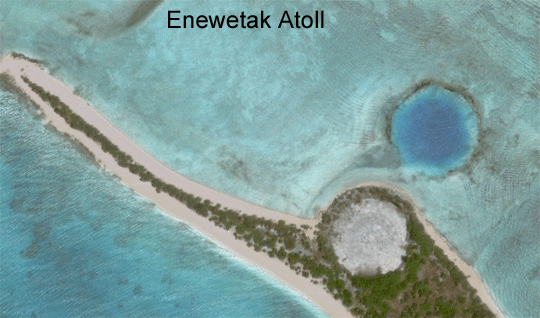
Nuclear waste, rising seas and Trump: Marshall Islands struggles to stay above water, Yahoo News, Marshall Islands President Heine speaks with Reuters in Geneva By Tom Miles, 21 June 19, GENEVA (Reuters) – The Marshall Islands is literally struggling to stay above water but its President Hilda Heine told Reuters she had saved her breath rather than try to persuade U.S. President Donald Trump to hear its climate change message.
Heine met Trump at the White House last month, along with the presidents of Palau and the Federated States of Micronesia, both of which are also under threat from rising sea levels.
But they did not talk about climate change.
“We made a conscious decision to discuss those things that we think we could accomplish, rather than spend time talking about something that we know is not going to happen,” she said.
“We know that we’re not going to be able to change his mind in 30 minutes about climate change.”
The Marshall Islands, comprising 31 tropical atolls between Australia and Hawaii, risks being underwater in 10-20 years.
“If that’s not scary enough, I don’t know what is. For us, it’s of course an existential issue,” said Heine, who was in Geneva to open a diplomatic mission, address the International Labour Organization and press her country’s case for a seat on the U.N. Human Rights Council.
The scene of massive U.S. nuclear tests in the 1950s, it is also at risk of disaster from radioactive debris the U.S. military left behind.
Her government has put a line item in its budget to cope with environmental costs, with about 5% of spending set aside to fund sea walls to save at least its two most populated areas.
On climate change, Heine said she had a simple message for the world: “Get real. Climate change is here. It’s not anything to just talk about and think, that is going to happen. It’s happening.”
The official statement from the White House meeting cited “the region’s most pressing issues, including responding to natural disasters”, but not climate change or rising sea levels.
The main topic was renewal of U.S. financial grants and the rollover of a Cold War-era defence and security agreement.
The Marshall Islands was occupied by Allied forces in 1944 and placed under U.S. administration in 1947. Between 1946 and 1958, the United States detonated 23 atomic and hydrogen bombs on Bikini and Enewetak atolls, debris from which was left buried under a shallow concrete dome on Enewetak.
“We’re told it’s seeping into the lagoon,” Heine said, adding that the government wanted help to assess the damage and impact on marine life and potential costs of making it safe.
Asked if it was potentially a nuclear disaster on top of a climate emergency, she said: “It could be.”
NUCLEAR JUSTICE
The Marshall Islands gained independence in 1986 and later tried in vain to sue nuclear powers in a David-and-Goliath case at the International Court of Justice.
It now has a “nuclear justice strategy” to cope with displacement and higher cancer rates, but cannot back a treaty banning nuclear weapons because of one provision that would force it to take care of its own clean-up, Heine said.
“The United States would be … off the hook.”…… https://news.yahoo.com/nuclear-waste-rising-seas-trump-120225579.html
Why India’s Hypersonic Missile Could Trigger A Nuclear War
 New missile, new threats? National Interest, by Michael Peck, 21 June 19 1ndia’s test of a hypersonic missile signifies more than the advance of Indian weapons technology.
It also is one step closer to triggering a nuclear war with Pakistan.
Ironically, the first launch of the Hypersonic Technology Demonstrator Vehicle, or HSTDV, was a failure. The HSTDV, which is shaped almost like a sailing ship, is supposed to be a testbed for developing future hypersonic weapons such as cruise missiles. It is launched atop an Agni 1, an Indian ballistic missile…….
While that doesn’t necessarily mean the HSTDV has a problem, it’s not good news for India’s strategic nuclear deterrent. “The Agni 1 is a nuclear-capable missile that is in service with the strategic forces and has been successfully tested several times in the past,” noted the Economic Times. “Its failure to reach the desired altitude is a reason for concern and is being studied.”
Yet unproven or not, the existence of an Indian hypersonic project is an ominous step for India’s cold war with its neighbor Pakistan. Hypersonic missiles—defined as rockets with a velocity of at least Mach 5, though Russia and America are developing Mach 20 weapons—are dangerous because of their speed. Though the weapons have yet to be tested in combat, the U.S. military is concerned that Russian and Chinese hypersonic weapons may travel so fast that they can’t be intercepted. At the tactical level, this means that aircraft carriers and air bases could be destroyed by a salvo of missiles.
But on the strategic level, hypersonic weapons are truly frightening. A hypersonic missile can deliver a nuclear warhead more quickly than a ballistic missile. Or, a hypersonic missile armed with a conventional warhead might be able to destroy an opponent’s nuclear missiles in a first strike, but without the attacker having to resort to nuclear weapons.
Whether or not such a strike would be successful, or whether anyone would be confident enough to risk a nuclear exchange by using hypersonics, isn’t the point. Unlike the United States versus Russia and China, whose homelands are separated by thousands of miles of ocean, the distance between New Delhi and Islamabad is just over 400 miles. A Mach 5 or 10 weapon missile launched from India or Pakistan could hit its target in minutes (Russia’s Avangard hypersonic glider reportedly has a speed of Mach 20, with the United States working on a weapon equally as fast).
Pentagon ‘s new ‘war-fighting’ doctrine alarms nuclear weapons experts
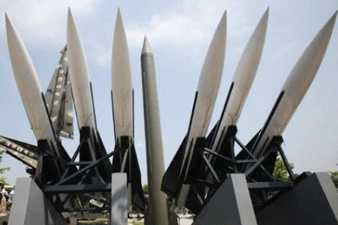 Nuclear weapons: experts alarmed by new Pentagon ‘war-fighting’ doctrine, Guardian, Julian Borger in Washington 20 Jun 2019
The document, entitled Nuclear Operations, was published on 11 June, and was the first such doctrine paper for 14 years. Arms control experts say it marks a shift in US military thinking towards the idea of fighting and winning a nuclear war – which they believe is a highly dangerous mindset.
“Using nuclear weapons could create conditions for decisive results and the restoration of strategic stability,” the joint chiefs’ document says. “Specifically, the use of a nuclear weapon will fundamentally change the scope of a battle and create conditions that affect how commanders will prevail in conflict.”
At the start of a chapter on nuclear planning and targeting, the document quotes a cold war theorist, Herman Kahn, as saying: “My guess is that nuclear weapons will be used sometime in the next hundred years, but that their use is much more likely to be small and limited than widespread and unconstrained.”
Kahn was a controversial figure. He argued that a nuclear war could be “winnable” and is reported to have provided part of the inspiration for Stanley Kubrick’s film Dr Strangelove.
The Nuclear Operations document was taken down from the Pentagon online site after a week, and is now only available through a restricted access electronic library. But before it was withdrawn it was downloaded by Steven Aftergood, who directs the project on government secrecy for the Federation of American Scientists.
A spokesman for the joint chiefs of staff said the document was removed from the publicly accessible defence department website “because it was determined that this publication, as is with other joint staff publications, should be for official use only”.
In an emailed statement the spokesman did not say why the document was on the public website for the first week after publication.
Aftergood said the new document “is very much conceived as a war-fighting doctrine – not simply a deterrence doctrine, and that’s unsettling”……..
The doctrine has been published in the wake of the Trump administration’s withdrawal from two nuclear agreements: the 2015 joint comprehensive programme of action with Iran, and the 1987 Intermediate-range Nuclear Forces treaty with Russia. The administration is also sceptical about a third: the New Start accord that limits US and Russian forces strategic nuclear weapons and delivery systems, which is due to expire in 2021.
Meanwhile, the US and Russia are engaged in multibillion-dollar nuclear weapon modernisation programmes. As part of the US programme, the Trump administration is developing a low-yield ballistic missile, which arms control advocates have said risks lowering the nuclear threshold, making conceivable that a nuclear war could be “limited”, rather than inevitably lead to a global cataclysm.
The last nuclear operations doctrine, published during the George W Bush administration in 2005, also caused alarm. It envisaged pre-emptive nuclear strikes and the use of the US nuclear arsenal against all weapons of mass destruction, not just nuclear.
The Obama administration did not publish a nuclear operations doctrine but in its 2010 nuclear posture review it sought to downgrade the role of nuclear weapons in US military planning.
It renounced the Bush-era plan to build nuclear “bunker-buster” bombs, and ruled out nuclear attack against non-nuclear-weapon states, but it did not go as far towards disarmament as arms control activists had wanted or expected.https://www.theguardian.com/world/2019/jun/19/nuclear-weapons-pentagon-us-military-doctrine
World’s nuclear weapons – fewer in number, but not safer
|
Fewer but newer nuclear weapons in world arsenals https://www.9news.com.au/world/nuclear-weapons-why-there-are-fewer-warheads-held-by-world-powers/8bd8aacf-2b7c-4f58-a66e-d6ed291d2539
Jun 19, 2019 There are fewer nuclear weapons today but it’s far from clear if the world is a safer place. Over the past year, the total number of warheads has declined but countries are modernising their arms, a report by the Stockholm International Peace Research Institute says.
Russia, the US, China, Britain, France, India, Pakistan, Israel and North Korea held about 13,865 nuclear weapons at the start of 2019.
Compared with early 2018, the figure represents a drop of 600 nukes.
But defence and security expert Sam Roggeveen told nine.com.au it was unclear if the world is safer.
He noted that India, Pakistan and China are expanding their nuclear arsenals.
“China is on the cusp of having a permanent sea-borne nuclear deterrence. This would be in the form of ballistic missile submarines, like the US, Russia, France and Great Britain already have.”
Dr Roggeveen also said India was moving towards a powerful ‘nuclear triad’ – the three-pronged military structure of land-based nuclear warheads, submarines carrying nuclear missiles and aircraft armed with nuclear missiles and bombs.
“There are early indications Pakistan may also do that,” he said.
The reduction in nuclear weapons is largely due to the US and Russia carrying out their obligations under the new START treaty. Both superpowers in 2010 signed the accord, which puts a cap on the number of deployed warheads and stipulates they must take obsolete weapons out of service.
But the START treaty expires in 2021 and it’s unclear if it will be extended.
The number of nuclear weapons was highest in the mid-1980s when there were 70,000 warheads around the world.
|
|
|
USA’s National Nuclear Security Administration finds 3 problems with modernising nuclear arsenal
Government watchdog finds 3 issues disrupting US nuclear modernization efforts, Defense News 20 June 19, WASHINGTON — The U.S. agency responsible for making explosive materials used in nuclear weapons is facing challenges that could impact the country’s planned modernization of its nuclear arsenal, according to a report by the Government Accountability Office.
U.S. military intelligence agency increases accusations against Russia about nuclear testing
U.S. military intelligence steps up accusation against Russia over nuclear testing, WP, By Paul Sonne, 14 June 19 The U.S. military intelligence agency stepped up its accusations against Russia over low-yield nuclear testing on Thursday, saying that the country has conducted nuclear weapons tests that resulted in nuclear yield.
The new statement from the Defense Intelligence Agency amounted to a more direct accusation against Russia, compared to hedged comments about Russian nuclear testing that DIA Director Lt. Gen. Robert P. Ashley Jr. made in a speech in Washington in late May.
“The U.S. Government, including the Intelligence Community, has assessed that Russia has conducted nuclear weapons tests that have created nuclear yield,” the DIA statement released Thursday said. The agency didn’t give any details about the alleged tests or release any evidence backing the accusation.
Previously, the agency’s director said that Russia “probably” was not adhering to the “zero-yield” standard the United States applies for nuclear testing. He suggested that Russia was probably conducting tests with explosions above a subcritical yield as part of its development of a suite of more-sophisticated nuclear weapons.
Russia has vehemently rejected Washington’s accusations, with Russian Foreign Minister Sergei Lavrov describing them as delusional.
“We consider claims that Russia may be conducting very low-yield nuclear tests as a crude provocation,” Russia’s Foreign Ministry said in a statement after the DIA first aired the allegations. “This accusation is absolutely groundless and is no more than another attempt to smear Russia’s image.”
DIA’s latest accusation came a day after Under Secretary of State for Arms Control and International Security Andrea L. Thompson met with Russian Deputy Foreign Minister Sergei Ryabkov in Prague to discuss arms control.
The meeting didn’t result in any significant decisions. After the meeting, Thompson said in a message on Twitter that she raised a range of issues on which the United States would like to engage in a more constructive dialogue with Russia. …… https://www.washingtonpost.com/world/national-security/us-military-intelligence-steps-up-accusation-against-russia-over-nuclear-testing/2019/06/13/2dadf2e2-8e26-11e9-b162-8f6f41ec3c04_story.html?utm_term=.9b2400d2dfbe
Multibillion dollar plutonium pit factory – jobs, jobs – yeah – but is it safe, or even necessary?
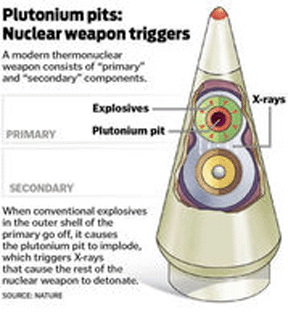
Atomic bomb factory could produce more than 1,000 jobs for SC. But how safe is it? https://www.charlotteobserver.com/news/state/south-carolina/article231568153.html, BY SAMMY FRETWELL. JUNE 14, 2019 Anti-nuclear activists fired away Friday at what they said is a dangerous and little known plan to produce deadly atomic weapons components at the Savannah River Site near Aiken.
The federal government has proposed a multibillion dollar plutonium pit factory that could create as many as 1,700 jobs as part of an effort to make fresh plutonium, a major ingredient in atomic bombs.
But the proposed factory is raising concerns about its risk to the environment and the public, in addition to how it would be viewed by world leaders. Critics say the government may use the pits in a new type of nuclear weapon, instead of only replenishing the existing stockpile with fresh plutonium.
Savannah River Site Watch, a nuclear watchdog organization that tracks SRS, planned a public meeting Friday night in Aiken County to brief people on the government’s plan at SRS, a 310-square-mile complex in western South Carolina.
“We don’t think people are really aware of what is going on: that this new mission is fraught with risk that could come to SRS,’’ Savannah River Site Watch director Tom Clements told The State.
Nuclear watchdog groups from New Mexico and California joined SRS Watch for the forum in Aiken County, where many SRS workers live. Before the Friday meeting, the groups held a news conference to voice concerns. The U.S. Department of Energy plans its own forum on the proposal June 27 in North Augusta.
The Energy Department is proposing to convert its failed and unfinished mixed oxide fuel plant at SRS for use as a plutonium pit plant. The cost to convert the plant could be up to $5 billion, nuclear watchdogs said.
Federal records show the new SRS plant would produce at least 50 pits for nuclear weapons each year. A federal site in Los Alamos, N.M., would produce another 30 pits, according to the government’s plan. Part of the reason for needing more pits is to refresh the nation’s aging stockpile of atomic weapons, federal officials have said.
Officials with the U.S. Department of Energy were not immediately available Friday for comment, but a public notice this week said the pits it wants to replace were made from 1978-89. Most plutonium cores were produced at the Rocky Flats, Colo., nuclear site decades ago, but that site has since closed.
“Today, the United States’ capability to produce plutonium pits is limited,’’ according to a DOE public notice. The notice said producing 80 pits per year, beginning in 2030, would “mitigate the risk of plutonium aging.’’
“The security policies of the United States require the maintenance of a safe, secure and reliable nuclear weapons stockpile,’’ the public notice said.
Pro-nuclear groups say the pit plant is a good replacement for the MOX facility. Not only will it provide jobs, but it will help keep the United States safe, they say.
“We are 100 percent supportive,’’ said Jim Marra, director of Citizens for Nuclear Technology Awareness. ‘’From a national defense standpoint, it is vitally important. Quite frankly, there’s no better place to do it, at least part of it, than Savannah River Site. The expertise in dealing with plutonium, and the existing work now going on with plutonium, is huge.’’
Clements and Jay Coghlan, who directs Nuclear Watch New Mexico, don’t see it that way.
“It will be a great waste of taxpayer’s money,’’ Coghlan said. “There also is a long history of chronic safety problems and environmental or waste problems associated with pit production.’’
Clements said plutonium, one of the most dangerous parts of a nuclear weapon, is toxic and a potential threat to the environment. Workers would be exposed to plutonium at SRS, and the public could be exposed to plutonium if an accident occurs, he said.
SRS was a vital cog in Cold War weapons production. Built in the early 1950s, it produced materials, such as tritium, that were used for nuclear weapons. It has been largely in a cleanup mode and looking for new missions since the early 1990s. More than 10,000 people work there.
One of the biggest questions raised by pit project critics is whether the pits are needed as badly as the DOE contends.
Existing plutonium pits, essentially the cores of nuclear bombs, have a longer shelf life than the government has recently said they have, said Marylia Kelley, executive director of Tri-Valley CARES in California. She said past government studies have shown that. One study shows that plutonium pits can last 85- 100 years, about 25-40 years longer than previously thought.
But the government today is working on a new type of nuclear weapon the pits could be used in — and nuclear proliferation is a bad idea, critics say.
“If you don’t design new nuclear weapons, you will need to do very few pits every year,’’ Kelley said. “This enterprise is not necessary, and I would argue that we need a very robust discussion here.’’
She said if the U.S. develops a new weapon and tests it, other countries may do the same, potentially leading to an escalation of nuclear arms.
Marra said he’s not opposed to plutonium pits being used for new weapons.
“’If that includes new weapons systems, I think that’s the right thing to do,’’ he said. “Our adversaries are not standing still in this regard. China and Russia are continuing to modernize their nuclear weapons, and we all know about North Korea.’’
Plans to develop the plutonium pit factory are not final. A bill in the U.S. House of Representatives, discussed recently in a key committee, would derail the plan.
The Department of Energy plans to conduct an environmental impact statement on how the plant would affect the environment and human health. The current proposal isn’t the first time the DOE has brought up the matter of a new pit plant. The agency proposed a pit factory more than 17 years ago, but the plan never went anywhere.
Reach Fretwell at 803-771-8537. @sfretwell83
In US House, Democrats stop Republicans’ push for low-yield nuclear weapons
 Democrats rebuff GOP push for low-yield nuclear weapons, By SUSANNAH GEORGE, 12 June 19, WASHINGTON (AP) — House Democrats rebuffed attempts by Republicans Wednesday to authorize funding for so-called low-yield nuclear weapons that the Trump administration says are key to deterring Russia.
Republicans put forward two amendments to fund the weapons in a defense bill, but both were rejected in a voice vote Wednesday. A formal roll-call vote on the amendments was planned for later.
Armed Services Committee Chairman Adam Smith, D-Wash., eliminated funding in the legislation for low-yield nuclear weapons that could be placed on submarines. He said the weapons increase the likelihood of nuclear conflict. …..
Nuclear policy issues will likely reemerge in the Republican-controlled Senate. The House and Senate will have to negotiate a final version of the annual policy bill before it becomes law……
Republicans and Democrats also disagree over the total amount of money needed to properly fund the Pentagon and nuclear elements of the Energy Department. The White House requested a $750 billion budget, but Smith said a slightly smaller budget of $733 billion would promote efficiency…..https://www.apnews.com/d04a6f8f5edb4c4490013aa32e78417f
Danger in Trump’s decision to keep nuclear weapons data classified
|
Decision to keep nuclear weapons data classified hurts US national security, Bulletin if the Atomic Scientists By Heather Wuest, June 11, 2019 The Trump administration’s decision to classify the total number of nuclear weapons that the United States possesses and the number of nuclear warheads dismantled in 2018 marks an abrupt change from the recent norm. Every year since 2010, the United States has chosen to declassify its nuclear stockpile and disarmament figures as part of an effort to encourage nuclear diplomacy and openness. But this year when the Federation of American Scientists asked the Pentagon for the figures to check its work in the Nuclear Notebook (a collection of world nuclear stockpile and disarmament information), the administration chose not to declassify.
Hans Kristensen—the director of the Federation of American Scientists Nuclear Information Project and a longtime author of the authoritative Nuclear Notebook column on world nuclear arsenals the Bulletin has published since 1987—is particularly vocal about the classification setback. The decision not to declassify the stockpile and decommissioned numbers, he says, “surrenders any pressure on other nuclear-armed states to be more transparent about the size of their nuclear weapon stockpiles” and is an “unnecessary and counterproductive reversal of nuclear policy.” This decision to classify comes at a time when the Trump administration says it is looking to ramp up talks with Russia and China on arms control, a negotiation that would be easier for United States diplomats if they could go in backed by the official numbers. In a short conversation with Kristensen, I asked about the future of the Nuclear Notebook and if the Federation of American Scientists would continue to push for declassification. He made it clear how the government’s simple denial of one information request can affect many aspects of an open and honest nuclear debate……….https://thebulletin.org/2019/06/hans-kristensen-on-how-the-tump-administrations-decision-to-keep-nuclear-weapons-data-classified-hurts-us-national-security/ |
|
|
Contentious debate expected as USA House debates annual Defense Bill
|
House defense bill sets stage for contentious nuclear debate, The Hill BY REBECCA KHEEL – 06/10/19 The House version of the annual defense policy would require an independent study on the United States adopting a “no first use” policy on nuclear weapons.Nuclear issues are shaping up to be among the most contentious issues as Congress debates this year’s National Defense Authorization Act (NDAA), with Republicans already coming out strongly against what’s in the bill.
The bill, a summary of which was released Monday morning, does not go as far as Chairman Adam Smith (D-Wash.) has opined about in the past. But it does seek to “start that debate” about the appropriate size and cost of the nuclear arsenal, staffers told reporters ahead of the bill’s release. “The chairman feels strongly that the nuclear arsenal is too large, that we spend too much money on legacy weapons systems when we have emerging requirements like cyber, like [artificial intelligence], like space, which aren’t getting the kind of focus that’s required, and he wants to reevaluate where we’re spending money, if we’re going to have another money to spend on these emerging things that are coming out,” a staffer said. Smith, who has long lambasted the price tag for nuclear modernization, pledged to make the issue a priority when he took control of the gavel after Democrats won back the House. In hearings and speeches, he has questioned the need for the nuclear triad, said he wants to “kill” the low-yield warhead and blasted Trump for casting aside nuclear treaties. n late January, Smith also reintroduced his No First Use Act that would make it U.S. policy not to use nuclear weapons first. Right now, U.S. policy leaves open the possibility of being the first to use a nuclear weapon in a conflict. Rather than incorporating that bill, the NDAA requires the independent study on the implications of adopting such a policy. Staffers also stressed the bill would not eliminate a leg of the triad, which refers to the three methods of delivering nuclear warheads. …….. Every Republican on the subcommittee voted against the bill last week over the low-yield warhead provision and three other issues. ……. https://thehill.com/policy/defense/447664-house-defense-bill-sets-stage-for-contentious-nuclear-debate |
|
Western governments in denial of Chronic Radiation Syndrome affecting nuclear test veterans
The concept of a Chronic Radiation Syndrome was first reported by Japanese doctors who observed survivors of the atomic bombs dropped upon Japan in 1945. There, the name for the syndrome is Bura Bura disease. It is not accepted by the West.
the USA was in possession of the 1971 Soviet description of Chronic Radiation Syndrome in 1973 at the latest.
In 1994 the US Armed Forces Radiobiology Research Institute Bethesda, Maryland, published “Analysis of Chronic Radiation Sickness Cases in the Population of the Southern Urals”.
From the 1950s, nuclear veterans and civilian Downwinders reported syndromes of ill health similar to Chronic Radiation Syndrome to their governments. This includes the government of the USA and the government of Australia. These reports certainly did not result in Chronic Radiation Syndrome entering the Western medical lexicon.
During the 40-year period of operations at Mayak, all studies on radiation exposure of personnel at the plant and of the off-site population, the doses of exposure, and the possible health effects from radiation exposure were classified for national security reasons”.
anyone who spoke of the reality of disease and disablement suffered by those afflicted by the nuclear weapons tests in Australia were subject to threats of imprisonment by government and to attempts of censorship by the British and Australian authorities (Marsden, cited in Cross). It took 3 decades for the Australian government to release nuclear veterans from the threat of legal action and imprisonment if they spoke.
 Chronic Radiation Syndrome, https://nuclearexhaust.wordpress.com/2014/05/01/chronic-radiation-syndrome/ Paul Langley, 9 June 19 The claim that Australian
  nuclear veterans suffer enhanced risk of cancer has been confirmed by the Australian Government only as recently as 2006. The official government position is that the enhanced risk suffered by the nuclear test veterans is shown in health survey results. However the Australian government refuses to acknowledge that radiation exposures due to the testing of nuclear weapons as the cause of this increased risk.
Scientists under contract to the Australian government located at Adelaide performed the analysis of the 2006 health survey results. These scientists initially suggested that exposure to petrol fumes in the Australian desert might be the cause of the increased cancer risk suffered by nuclear veterans.
This suggestion, present in the Health Survey draft report, did not make it into the final report. Instead, we are presented with a mystery. Though the scientists claim certainty in their position that the nuclear veterans’ exposure to nuclear weapons detonations was not the cause of their increased cancer risk, the scientists are unable to find any other cause.
It’s a mystery, apparently, to Australian science in the service of the State. Not that this is uniquely Australian. It is universal among the Nuclear Powers. (It is all the more perplexing given Dr. P. Couch’s compassionate and detailed submission to a Senate inquiry examining the impact of the British Nuclear Tests in Australia on the personnel involved. Dr. Couch’s submission described the suffering endured by Commonwealth Police personnel who guarded the Maralinga Nuclear Test Site after military activity had ceased. One would have logically thought that if personnel were affected by service at Maralinga in times after the cessation of weapons testing, then so were the military personnel who actually saw the bombs explode, and who saw the plutonium dust disperse during the “minor trials”. )
The report states:
“The cancer incidence study showed an overall increase in the number of cancers in test participants, similar to that found in the mortality study. The number of cancer cases found among participants was 2456, which was 23% higher than expected. A significant increase in both the number of deaths and the number of cases was found for (figures in
brackets show increase in mortality and incidence):
A mistake for USA to deploy the low-yield Trident nuclear warhead
The Trump administration’s 2018 Nuclear Posture Review called for a low-yield warhead on some Trident D5 submarine-launched ballistic missiles (SLBMs). The plan modifies a W76-1 warhead, which has an explosive yield of 100 kilotons — seven times the size of the weapon used against Hiroshima — to produce the W76-2, reportedly with a yield of “just” five-seven kilotons.
Adding this weapon to the arsenal would risk lowering the nuclear threshold. To be sure, Pentagon officials assert that new low-yield weapons would not lower the threshold.
Yet the Nuclear Posture Review argued for low-yield weapons out of concern that Russia might feel it could use its “small” nuclear weapons free of concern about U.S. retaliation because the United States arsenal consists mainly of large-yield weapons.
So, at a minimum, the goal of new U.S. low-yield nuclear weapons would appear to be to persuade Moscow that the United States is more likely to go nuclear.
It is in the U.S. interest to maintain the highest possible threshold against the use of any nuclear arms. We should avoid steps that might signal, even inadvertently, that the use of “small” nukes is somehow acceptable………
SLBMs on submarines at sea constitute the most important and most survivable leg of the U.S. strategic triad, because the submarines can hide underwater and have lots of ocean in which to roam. Each submarine at sea carries a significant portion of the survivable U.S. nuclear deterrent.
The problem with launching an SLBM with a W76-2 is that it would reveal the submarine’s location. The submarine could maneuver away from the launch point, but it still would have compromised its general position, putting at risk the boat and the other 80-90 warheads it carried. Would the U.S. military run that risk, particularly given the availability of other low-yield options?
A bigger problem is discrimination. The Russians could not tell whether a launched SLBM carried a W76-2 or a W76-1 (100 kilotons) or, for that matter, a W88 (450 kilotons) until the weapon (or weapons) detonated………
The problem is that a launch from many parts of the Atlantic toward the Baltics would also appear, at least initially, to be a launch against Moscow.
Would the U.S. leadership launch a W76-2 — and run the risk that the Russians misread it as larger warhead intended to flatten Moscow in a decapitation strike — when F-35s and B61-12 bombs are available in Europe (as they will be in the early 2020s)?
The W76-2 makes little strategic sense, could inadvertently lower the nuclear threshold and likely would never be used, even in the most dire circumstances.
The Trump administration made a mistake by deciding to produce it. Congress should use the 2020 National Defense Authorization Act to correct that mistake and prohibit its deployment.
Steven Pifer is a William Perry fellow at Stanford University’s Center for International Security and Cooperation. https://thehill.com/opinion/national-security/447514-stop-the-low-yield-trident-nuclear-warhead
-
Archives
- October 2026 (120)
- September 2026 (339)
- August 2026 (330)
- July 2026 (355)
- June 2026 (287)
- May 2026 (306)
- April 2026 (356)
- March 2026 (251)
- February 2026 (267)
- January 2026 (308)
- December 2025 (358)
- November 2025 (359)
-
Categories
- 1
- 1 NUCLEAR ISSUES
- business and costs
- climate change
- culture and arts
- ENERGY
- environment
- health
- history
- indigenous issues
- Legal
- marketing of nuclear
- media
- opposition to nuclear
- PERSONAL STORIES
- politics
- politics international
- Religion and ethics
- safety
- secrets,lies and civil liberties
- spinbuster
- technology
- Uranium
- wastes
- weapons and war
- Women
- 2 WORLD
- ACTION
- AFRICA
- Atrocities
- AUSTRALIA
- Christina's notes
- Christina's themes
- culture and arts
- Events
- Fuk 2022
- Fuk 2023
- Fukushima 2017
- Fukushima 2018
- fukushima 2019
- Fukushima 2020
- Fukushima 2021
- general
- global warming
- Humour (God we need it)
- Nuclear
- RARE EARTHS
- Reference
- resources – print
- Resources -audiovicual
- Weekly Newsletter
- World
- World Nuclear
- YouTube
-
RSS
Entries RSS
Comments RSS

