Gaps revealed in nuclear convoy crash preparations, A series of shortfalls in Scotland’s emergency arrangements for coping with a nuclear bomb convoy crash have been exposed by a Scottish Government review. The Ferret, Rob Edwards on June 28, 2019
Leaking radioactivity from an accident would put “strains” on the resources for monitoring the contamination of people, food and the environment, it says. Monitoring may be required “at scale” because of the large number of people involved.
The review reveals that the fire service hasn’t finalised its emergency procedures for convoy crashes, the police need to be better briefed and vetted, while the ambulance service is not told about convoy movements.
The emergency services have also failed to properly record the lessons they learn from emergency exercises, it adds.
Convoys comprising up to 20 or more military vehicles transport Trident nuclear warheads by road at least six times a year between the Royal Naval Armaments Depot at Coulport on Loch Long, near Glasgow, and the bomb factory at Burghfield in Berkshire. The warheads have to be regularly maintained at Burghfield.
Though the Ministry of Defence attempts to keep them secret, the convoys are often photographed, filmed and followed on social media. They travel close to major centres of population such as Glasgow, Edinburgh, Newcastle, Manchester and Birmingham.
The Ferret revealed on 23 June 2019 that an emergency exercise in Scotland called Astral Climb in 2016 had suffered communication breakdowns that could have put people at risk.
A report by campaigners in August 2017 warned that Scotland was “wholly unprepared” to deal with an accident or an attack on a convoy. When the issue was raised in the Scottish Parliament in May 2018, Scottish ministers promised to ask the police and fire inspectorates to conduct a review. ……..
According to the review, the hazards from a bomb convoy crash come from the “explosive, radioactive and toxic materials” that are transported. “The explosive hazard is the same as that which is associated with any chemical high explosive,” it said.
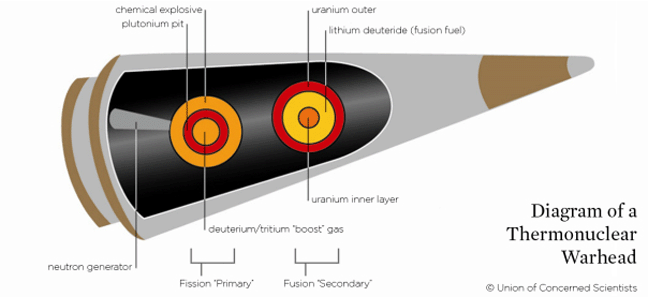
“The main radioactive materials are plutonium and uranium. Plutonium and uranium are both toxic and radioactive. The convoy may also contain other toxic (but not radioactive) materials such as beryllium and lithium. Beyond the immediate hazard area, the potential dispersion of airborne plutonium particles represents the dominant radioactive hazard.”The Scottish Government’s review listed five emergency procedures that have still to be “finalised” by the Scottish Fire and Rescue Service, including operational guidance and intelligence sharing. They should be completed “as a matter of priority”, the review concluded.
Police Scotland were criticised for only conducting a “verbal briefing” for officers prior to convoy movements. “There would be merit in considering a more formal process to provide a record of the information given to officers,” the review said.
“We found that Police Scotland uses appropriate measures to secure information but there was a lack of clarity regarding vetting and which staff and officers have access to sensitive information.”
Time to Downsize the Nuclear Attack Sub, The Maritime Executive BY CIMSEC 2019-06-28 [By Duane J. Truitt]
It is clear that U.S. Naval Sea Systems Command (NAVSEA) needs to re-engineer the next generation of SSNs. The bloated SSN(X) (now “New SSN”) concept should be rejected entirely because it is more of the same, but bigger and more expensive. Instead, the Navy should go for a new class of SSN that is far smaller and cheaper than the current Block 5 Virginias. …….. https://www.maritime-executive.com/editorials/op-ed-time-to-downsize-the-nuclear-attack-sub
World War 3: The secret underground nuclear bunkers hiding below forest revealed
TWO bunkers leading to a secret underground city were discovered in the former Soviet state of Moldova, which were built for high ranking officers to pull the strings from should World War 3 break out, an explorer revealed. Express UK By CALLUM HOARE, Jun 28, Known to the British and US spies as “Object 1180” these two structures were built in 1985 – at the height of the Cold War. As the threat of a nuclear strike from either side seemed more than likely, high-ranking officers needed somewhere to orchestrate their retaliation and prepare for a second strike. As a result, the cylinders were built with thick walls to withstand a direct nuclear hit and an entire city was concealed below with shops, hospitals and a vast amount of supplies to provide the generals with everything they needed.They were only discovered when spy planes and satellites noticed increased activity heading towards the forests of Moldova and were soon abandoned following the fall of the Soviet Union in 1991.
However, YouTube star Benjamin Rich, the man behind popular exploration channel “Bald and Bankrupt” treated fans to a history lesson when he visited earlier this month. He explained: “In 1985, western satellites picked up some strange activity in the rural countryside of what was then the Moldavia Soviet Socialist Republic.
“They didn’t know what it was at the time and they named them Object 1180.
“It was only years later, with the fall of the Soviet Union, that they discovered that it was an underground nuclear bunker.”
Mr Rich, who treats his 800,000 subscribers to visits all over the former Soviet Union, explained why leaders in Moscow thought the construction was necessary.
He added: “The Eighties were quite a scary time for people in England and in the Soviet Union.
“It seemed at one point there was a real possibility of a nuclear war between the Soviet Union and the West.
“So the Soviet Union built about four of these giant nuclear bunkers dotted around the former nation for the high command to hide in and command the forces should, what seemed like the inevitable, happen.
“They started construction in 1985, but as the Soviet Empire came to an end, there was no need for [them] anymore.
“The West and East were friends so these monoliths were just left as reminders of how close we came to a war between our nations. ”
Finally, taking a look inside the dark abandoned remains, Mr Rich then revealed how things would have looked more than 30 years ago.
Opinions on nuclear project at SC plant clash at public forum, Post and Courier, By Colin Demarest cdemarest@aikenstandard.com, Jun 28, 2019 NORTH AUGUSTA — Vocal support for producing nuclear weapon cores at the Savannah River Site sharply contrasted with questions, criticism and pushback Thursday night at a government-led public forum.
The U.S. Department of Energy’s National Nuclear Security Administration wants to produce 50 of the weapon components each year at the sprawling complex near Aiken. The cores, known as plutonium pits, use one of the world’s most dangerous substances to trigger a series of explosions that unleash the deadly potential of nuclear weapons.
Supporters tout the economic benefits of the project, which would create about 1,000 jobs and provide a new anchor for SRS after the government abandoned its long-delayed efforts to finish a facility designed to turn weapons-grade plutonium into fuel for nuclear power plants.
Critics, however, remain skeptical of the proposed mission and worry about the potential risks to the environment and workers’ health.
A slew of officials, including Aiken Mayor Rick Osbon, Aiken County Council Chairman Gary Bunker and Jim Marra of Citizens for Nuclear Technology Awareness, voiced support for the effort, offering their takes on why SRS is the correct fit for the looming weapons-oriented mission.
Encouragement also came from several chambers of commerce, University of South Carolina Aiken, and state and federal lawmakers.
……… Nuclear watchers and other groups, however, took aim at the effort’s multibillion-dollar projected cost, as well as potential dangers from exposing the environment and workers to plutonium.
“What is the environmental impact of a nuclear weapon?” Glenn Carroll, with Nuclear Watch South, said Thursday. “The absolute and wholesale destruction of the environment. Every human, every animal. Every plant.”
The anticipated costs of pit production have raised eyebrows in Washington, D.C. A congressional budget report published this year estimated pit production would cost $9 billion over the next decade.
Among other things, SRS Watch Director Tom Clements said the pit production process was off to a “rocky start.”
“The project is not funded by Congress, it’s not authorized by Congress,” he said.
Clements, alongside Tri-Valley CAREs and Nuclear Watch New Mexico, hosted a pit production forum earlier this month at the Aiken Municipal Building. He and others urged opponents to push back against the plan.
The public “can be effective against bad Department of Energy ideas, like the pit production one,” Clements said at the time.
One Aiken resident on Thursday described the pit production effort at SRS as hurried, and a woman representing The Human Family organization expressed concerns about earthquakes and becoming a target of terrorism.
………. The NNSA terminated the MOX project — which was over-budget and congressionally controversial — on Oct. 10, 2018. The government had shoveled almost $8 billion into the effort by that point, but it remained years and billions of dollars away from completion.
Clements on Thursday told the audience the Energy Department and others are attempting to “sweep the MOX debacle under the rug.”
Trump is quietly leading us closer to nuclear disaster, WP, By Steven Andreasen, June 26 2019 Steven Andreasen, director for defense policy and arms control on the National Security Council staff from 1993 to 2001, is a national security consultant who teaches at the University of Minnesota.
Quietly and under a shadow of unease at home and abroad, the Trump administration is opening the door to U.S. resumption of underground nuclear explosive testing. If the president follows his national security team into this dark room, it could shatter the 50-year international consensus behind preventing the spread of nuclear weapons and launch a new nuclear arms race that shakes both the Nevada desert and one of the last remaining pillars of arms control.
The 1996 Comprehensive Nuclear-Test-Ban Treaty (CTBT) prohibits “any nuclear weapon test explosion or any other nuclear explosion” in the atmosphere, in space, underwater or underground. During the negotiations, the United States, Russia, China, Britain and France also agreed on a “not all-inclusive, but illustrative” list of activities not prohibited by the CTBT, recorded by President Bill Clinton in a 1997 directive and given to the Senate. As the U.S. negotiatortold the Senatein 1999, “the zero line, between what would be prohibited to all under the treaty and what would not be prohibited, would be precisely defined by the question of nuclear yield” — that is, whether the activity produced a self-sustaining nuclear reaction. “If what you did produced any yield whatsoever, it was not allowed. If it didn’t, it was allowed.”
The CTBT, unratified though it is by the United States, but with 184 signatories, created a near-universal norm against nuclear explosive testing. (Only North Korea has tested since 1998.) Beyond this benefit, the commitment by the five nuclear weapon states to conclude the treaty by 1996 was crucial to achieving the indefinite extensionin 1995 of the existing nuclear Non-Proliferation Treaty. Today, the Non-Proliferation Treaty remains central to limiting the spread of nuclear weapons. Any action that weakens the test-ban treaty weakens the Non-Proliferation Treaty.
So why would the Trump administration seek to restart nuclear testing? In March, four Republican senators wrote the president asking whether he would consider “unsigning” the CTBT, calling the pact a “deeply flawed treaty that purports to ban all nuclear weapons tests.” In late May, the director of the Defense Intelligence Agency stated Russia “probably” is not adhering to its nuclear testing moratorium. The word “probably” prompted more queries and a new DIA statement: “The U.S. government, including the Intelligence Community, has assessed that Russia has conducted nuclear weapons tests that have created nuclear yield.”
Are the Russians cheating? Russia’s nuclear test site has been under close scrutiny for years. But in the absence of more public information — information that if it exists would probably be highly classified and unlikely to be made public — we have little choice but to assess the administration’s charge based on its motivations and methods.
National security adviser John Bolton and other administration officials are fervent test-ban treaty opponents. The seemingly out-of-the-blue letter from Republican senators and the DIA director’s public remarks had the look of an orchestrated campaign — significantly with no apparent effort to engage with Moscow.
……… The move to “unsign” the CTBT could lead to more destructive nuclear capabilities in the hands of potential U.S. adversaries and be perceived by non-nuclear-weapon states as the ultimate “bait and switch” two decades after the Non-Proliferation Treaty was extended indefinitely. It would fuel uncertainty bordering on chaos for the future of nuclear nonproliferation. And it would generate controversy around our own weapons laboratories, which play a vital role in our security. It would be a high price to pay for fulfilling the dreams of those who seek to destroy another treaty.https://www.washingtonpost.com/opinions/trump-is-quietly-leading-us-closer-to-nuclear-disaster/2019/06/26/3348ca5e-9445-11e9-aadb-74e6b2b46f6a_story.html?utm_term=.375b76b382e7
NATO has said Russia’s SSC-8 missile violates terms of a 1987 missile treaty.
The alliance has said it will act to mitigate the Russian threat.
Russia has in turn said it would take “countervailing military measures.”Moscow has said it will take “countervailing military measures” should NATO fulfil any threat related to Russia’s nuclear-ready cruise missile system.
NATO Secretary-General Jens Stoltenberg said Tuesday that Russia must dismantle the short-range system, or the alliance will be forced to respond, adding that NATO-member defense ministers would now look at next steps “in the event that Russia does not comply.”
No detail is yet known over what NATO might do although Stoltenberg said the alliance would not engage in any arms race.
According to the Kremlin-owned news agency TASS, Russian Deputy Foreign Minister Sergei Ryabkov told reporters Wednesday that NATO’s comments “reek of propaganda” and were falsely attempting to portray NATO’s threat as a “military and political response to Russia’s actions.”
The translation of Ryabkov, provided by TASS, added that Russia would respond to any military action from the 29-nation alliance.
“When these threats begin to materialize into real action, we will have to take countervailing military measures,” he said.
Earlier this year, the U.S. said it would quit a decades-old missile treaty with Russia if the latter failed to destroy the missile, labeled the SSC-8 by NATO.
Russia’s short and medium range missiles are viewed as a particular threat to neighboring countries as they can be quickly launched, leaving the target country or region with almost no response time.
The 1987 INF Treaty between the U.S. and Russia sought to eliminate nuclear and conventional missiles, as well as their launchers, with short ranges (310–620 miles) and intermediate ranges (620–3,420 miles).
NATO has said Russia’s SSC-8 violates those terms and that Moscow has been deploying the system at locations which threatens countries across Europe.
Russia has been given until the end of August to just five weeks to scrap the system and save the treaty.
NATO has said Russia’s SSC-8 missile violates terms of a 1987 missile treaty.
The U.S. says it will exit the treaty unless Russia stops their production.
But Russia has continued to develop and site the missiles within range of Europe.
NATO said Russia must destroy its short-range nuclear-ready cruise missile system, or the alliance will be forced to respond.
The U.S. has previously said it will quit a decades-old missile treaty with Russia if the latter fails to destroy the missile, labeled the SSC-8 by NATO.
The 1987 INF Treaty between the U.S. and Russia sought to eliminate nuclear and conventional missiles, as well as their launchers, with short ranges (310–620 miles) and intermediate ranges (620–3,420 miles).
NATO has said the SSC-8 violates those terms and that Russia has been deploying the system at locations which could threaten countries across Europe.
Speaking at a press conference in Brussels Tuesday, NATO Secretary-General Jens Stoltenberg said Russia had just five weeks to scrap the system and save the treaty.
“We call on Russia to take the responsible path. Unfortunately, we have seen no indication that Russia intends to do so,” he said.
Stoltenberg will chair a meeting of NATO member defense ministers which is due to begin Wednesday. He said that gathering, which will include U.S. acting Defense Secretary Mark Esper, would look at NATO’s next steps “in the event that Russia does not comply.”
The NATO chief said the response would be “defensive, measured and co-ordinated,” but would not result in the deployment of land-based nuclear missiles.
“As Russia is deploying new missiles we must ensure our deterrent is effective. This is NATO’s job.”
At the same press conference, Stoltenberg outlined the breakdown of individual country contributions to defense among member nations.
The NATO guideline sits at 2% of gross domestic product but only around seven of the 29 countries are expected to satisfy that target by 2019.
Those countries are Latvia, Poland, Romania, the U.K., Estonia, Greece and the United States. The U.S. is by far the biggest spender on defense, routing around 3.5 percent of its GDP total toward the sector.
NATO said that its estimate for 2019 would see the levels of NATO member cash spent on defense rise by about 3.9 % from 2018 levels
Iran says it will never build a nuclear weapon, Minister says Islam forbids such a move as country prepares to breach nuclear deal, Guardian Patrick Wintour Diplomatic editor, 26 June 2019
Iran will never pursue a nuclear weapon, its foreign minister has claimed, saying Islam prevented the country from doing so.
Iran has previously said it is ideologically opposed to acquiring nuclear weapons and seeks nuclear power only for civilian purposes. But in the current unpredictable climate it is possible Donald Trump could pick up Javad Zarif’s remarks as a signal to talk.
The White House is pursuing a twin-track strategy of seeking talks while trying to throttle the Iranian economy through sanctions that block trade with Europe and oil sales, and freeze the assets of political and diplomatic leaders.
Iran has said it will breach the uranium enrichment limits set out in the 2015 nuclear deal on Thursday, but that does not imply the country is on the path to building a nuclear weapon…….
The US president again threatened Iran with “obliteration” in a Twitter tirade in which he also accused the country’s leaders of killing 2,000 Americans. …..
The angry tweets came after Iran said the US’s decision to impose sanctionson its supreme leader and other top officials was “idiotic” and had permanently closed the path to diplomacy between Tehran and Washington.
Trump imposed fresh sanctions on Monday against the supreme leader, Ayatollah Ali Khamenei, and military chiefs, in an unprecedented step designed to increase pressure on Iran after Tehran’s downing of an unmanned American drone. Khamenei is Iran’s utmost authority, who has the last say on all state matters.
Washington said it would also impose sanctions this week on Zarif, who negotiated the 2015 nuclear deal with the US and other major powers and has spearheaded Iranian diplomacy since.
Iran’s president, Hassan Rouhani, described the White House as “afflicted by a mental disability” and said the sanctions against Khamenei were “outrageous and idiotic”, especially as the 80-year-old cleric has no overseas assets and no plans to ever travel to the US.
Tehran said the US had spent weeks demanding that Iran match America’s diplomacy with its own diplomacy, rather than military responses, but was now trying to immobilise its chief diplomat.
ONE-THIRD OF U.S. SUPPORTS NUCLEAR WAR ON NORTH KOREA, KNOWING IT WOULD KILL ONE MILLION, REPORT SHOWS, NewsWeek, BY TOM O’CONNORON 6/24/19 One-third of the United States population would support a preemptive attack on North Korea, even in a nuclear scenario, knowing it would kill one million innocent people, according to a recent survey.
The Bulletin of the Atomic Scientists, in collaboration with U.K.-based research firm YouGov, published a new study Monday detailing U.S. public opinion on military conflict with North Korea at a time when the pace of a historic peace process between the longtime rivals appeared to slow. Among the most “disturbing” results discovered was that “a large hawkish minority lurks within the U.S. public; over a third of respondents approve of a US preventive strike across the scenarios and appear insensitive to informational cues that most security experts would expect to reduce such levels of support.”
Little changed when the U.S. first-strike was switched from conventional to nuclear as “33 percent preferred.” In fact, “there is no significant change in the percentage who would prefer or approve of a U.S. nuclear strike when the number of estimated North Korean fatalities increases from 15,000 to 1.1 million, including 1 million civilians.”
The researchers said these results actually demonstrated a previously-established pattern among the U.S. public, which “exhibits only limited aversion to nuclear weapons use and a shocking willingness to support the killing of enemy civilians.”……….
Answers were also influenced by political beliefs. While most respondents overall opposed military action against North Korea, the “majority of Trump supporters prefer the US strike in every scenario, except when confidence in the effectiveness of the US conventional strike is 50 percent”—and even then it remained at 44 percent as opposed to a mere 8 percent for non-supporters. Separately, those who backed the death penalty were actually more eager to inflict a higher death toll among North Korean civilians. ….. https://www.newsweek.com/us-support-north-korea-nuclear-war-one-million-dead-1445578
There is a small group of scientists that have proposed replacing 100% of the world’s fossil fuel power plants with nuclear reactors as a way to solve climate change. Many others propose nuclear grow to satisfy up to 20 percent of all our energy (not just electricity) needs. They advocate that nuclear is a “clean” carbon-free source of power, but they don’t look at the human impacts of these scenarios. Let’s do the math…
One nuclear power plant takes on average about 14-1/2 years to build, from the planning phase all the way to operation. According to the World Health Organization, about 7.1 million people die from air pollution each year, with more than 90% of these deaths from energy-related combustion. So switching out our energy system to nuclear would result in about 93 million people dying, as we wait for all the new nuclear plants to be built in the all-nuclear scenario.
Utility-scale wind and solar farms, on the other hand, take on average only 2 to 5 years, from the planning phase to operation. Rooftop solar PV projects are down to only a 6-month timeline. So transitioning to 100% renewables as soon as possible would result in tens of millions fewer deaths.
This illustrates a major problem with nuclear power and why renewable energy — in particular Wind, Water, and Solar (WWS)– avoids this problem. Nuclear, though, doesn’t just have one problem. It has seven. Here are the seven major problems with nuclear energy:
1. Long Time Lag Between Planning and Operation
The time lag between planning and operation of a nuclear reactor includes the times to identify a site, obtain a site permit, purchase or lease the land, obtain a construction permit, obtain financing and insurance for construction, install transmission, negotiate a power purchase agreement, obtain permits, build the plant, connect it to transmission, and obtain a final operating license.
The planning-to-operation (PTO) times of all nuclear plants ever built have been 10-19 years or more. For example, the Olkiluoto 3 reactor in Finland was proposed to the Finnish cabinet in December 2000 to be added to an existing nuclear power plant. Its latest estimated completion date is 2020, giving it a PTO time of 20 years.
The Hinkley Point nuclear plant was planned to start in 2008. It has an estimated completion year of 2025 to 2027, giving it a PTO time of 17 to 19 years. The Vogtle 3 and 4 reactors in Georgia were first proposed in August 2006 to be added to an existing site. The anticipated completion dates are November 2021 and November 2022, respectively, given them PTO times of 15 and 16 years, respectively.
The Haiyang 1 and 2 reactors in China were planned to start in 2005. Haiyang 1 began commercial operation on October 22, 2018. Haiyang 2 began operation on January 9, 2019, giving them PTO times of 13 and 14 years, respectively. The Taishan 1 and 2 reactors in China were bid in 2006. Taishan 1 began commercial operation on December 13, 2018. Taishan 2 is not expected to be connected until 2019, giving them PTO times of 12 and 13 years, respectively. Planning and procurement for four reactors in Ringhals, Sweden started in 1965. One took 10 years, the second took 11 years, the third took 16 years, and the fourth took 18 years to complete.
Many claim that France’s 1974 Messmer plan resulted in the building of its 58 reactors in 15 years. This is not true. The planning for several of these nuclear reactors began long before. For example, the Fessenheim reactor obtained its construction permit in 1967 and was planned starting years before. In addition, 10 of the reactors were completed between 1991-2000. As such, the whole planning-to-operation time for these reactors was at least 32 years, not 15. That of any individual reactor was 10 to 19 years.
2. Cost
The levelized cost of energy (LCOE) for a new nuclear plant in 2018, based on Lazard, is $151 (112 to 189)/MWh. This compares with $43 (29 to 56)/MWh for onshore wind and $41 (36 to 46)/MWh for utility-scale solar PV from the same source.
This nuclear LCOE is an underestimate for several reasons. First, Lazard assumes a construction time for nuclear of 5.75 years. However, the Vogtle 3 and 4 reactors, though will take at least 8.5 to 9 years to finish construction. This additional delay alone results in an estimated LCOE for nuclear of about $172 (128 to 215)/MWh, or a cost 2.3 to 7.4 times that of an onshore wind farm (or utility PV farm).
Next, the LCOE does not include the cost of the major nuclear meltdowns in history. For example, the estimated cost to clean up the damage from three Fukushima Dai-ichi nuclear reactor core meltdowns was $460 to $640 billion. This is $1.2 billion, or 10 to 18.5 percent of the capital cost, of every nuclear reactor worldwide.
In addition, the LCOE does not include the cost of storing nuclear waste for hundreds of thousands of years. In the U.S. alone, about $500 million is spent yearly to safeguard nuclear waste from about 100 civilian nuclear energy plants. This amount will only increase as waste continues to accumulate. After the plants retire, the spending must continue for hundreds of thousands of years with no revenue stream from electricity sales to pay for the storage.
3. Weapons Proliferation Risk
The growth of nuclear energy has historically increased the ability of nations to obtain or harvest plutonium or enrich uranium to manufacture nuclear weapons. The Intergovernmental Panel on Climate Change (IPCC) recognizes this fact. They concluded in the Executive Summary of their 2014 report on energy, with “robust evidence and high agreement” that nuclear weapons proliferation concern is a barrier and risk to the increasing development of nuclear energy:
Barriers to and risks associated with an increasing use of nuclear energy include operational risks and the associated safety concerns, uranium mining risks, financial and regulatory risks, unresolved waste management issues, nuclear weapons proliferation concerns, and adverse public opinion.The building of a nuclear reactor for energy in a country that does not currently have a reactor allows the country to import uranium for use in the nuclear energy facility. If the country so chooses, it can secretly enrich the uranium to create weapons grade uranium and harvest plutonium from uranium fuel rods for use in nuclear weapons. This does not mean any or every country will do this, but historically some have and the risk is high, as noted by IPCC. The building and spreading of Small Modular Reactors (SMRs) may increase this risk further.
4. Meltdown Risk
To date, 1.5% of all nuclear power plants ever built have melted down to some degree. Meltdowns have been either catastrophic (Chernobyl, Russia in 1986; three reactors at Fukushima Dai-ichi, Japan in 2011) or damaging (Three-Mile Island, Pennsylvania in 1979; Saint-Laurent France in 1980). The nuclear industry has proposed new reactor designs that they suggest are safer. However, these designs are generally untested, and there is no guarantee that the reactors will be designed, built and operated correctly or that a natural disaster or act of terrorism, such as an airplane flown into a reactor, will not cause the reactor to fail, resulting in a major disaster.
5. Mining Lung Cancer Risk
Uranium mining causes lung cancer in large numbers of miners because uranium mines contain natural radon gas, some of whose decay products are carcinogenic. A study https://www.cdc.gov/niosh/pgms/worknotify/uranium.html of 4,000 uranium miners between 1950 and 2000 found that 405 (10 percent) died of lung cancer, a rate six times that expected based on smoking rates alone. 61 others died of mining related lung diseases. Clean, renewable energy does not have this risk because (a) it does not require the continuous mining of any material, only one-time mining to produce the energy generators; and (b) the mining does not carry the same lung cancer risk that uranium mining does.
6. Carbon-Equivalent Emissions and Air Pollution
There is no such thing as a zero- or close-to-zero emission nuclear power plant. Even existing plants emit due to the continuous mining and refining of uranium needed for the plant. Emissions from new nuclear are 78 to 178 g-CO2/kWh, not close to 0. Of this, 64 to 102 g-CO2/kWh over 100 years are emissions from the background grid while consumers wait 10 to 19 years for nuclear to come online or be refurbished, relative to 2 to 5 years for wind or solar. In addition, all nuclear plants emit 4.4 g-CO2e/kWh from the water vapor and heat they release. This contrasts with solar panels and wind turbines, which reduce heat or water vapor fluxes to the air by about 2.2 g-CO2e/kWh for a net difference from this factor alone of 6.6 g-CO2e/kWh.
In fact, China’s investment in nuclear plants that take so long between planning and operation instead of wind or solar resulted in China’s CO2 emissions increasing 1.3 percent from 2016 to 2017 rather than declining by an estimated average of 3 percent. The resulting difference in air pollution emissions may have caused 69,000 additional air pollution deaths in China in 2016 alone, with additional deaths in years prior and since.
7. Waste Risk
Last but not least, consumed fuel rods from nuclear plants are radioactive waste. Most fuel rods are stored at the same site as the reactor that consumed them. This has given rise to hundreds of radioactive waste sites in many countries that must be maintained and funded for at least 200,000 years, far beyond the lifetimes of any nuclear power plant. The more nuclear waste that accumulates, the greater the risk of radioactive leaks, which can damage water supply, crops, animals, and humans.
Summary
To recap, new nuclear power costs about 5 times more than onshore wind power
per kWh (between 2.3 to 7.4 times depending upon location and integration issues). Nuclear takes 5 to 17 years longer between planning and operation and produces on average 23 times the emissions per unit electricity generated (between 9 to 37 times depending upon plant size and construction schedule). In addition, it creates risk and cost associated with weapons proliferation, meltdown, mining lung cancer, and waste risks. Clean, renewables avoid all such risks.
Nuclear advocates claim nuclear is still needed because renewables are intermittent and need natural gas for backup. However, nuclear itself never matches power demand so it needs backup. Even in France with one of the most advanced nuclear energy programs, the maximum ramp rate is 1 to 5 % per minute, which means they need natural gas, hydropower, or batteries, which ramp up 5 to 100 times faster, to meet peaks in demand. Today, in fact, batteries are beating natural gas for wind and solar backup needs throughout the world. A dozen independent scientific groups have further found that it is possible to match intermittent power demand with clean, renewable energy supply and storage, without nuclear, at low cost. Finally, many existing nuclear plants are so costly that their owners are demanding subsidies to stay open. For example, in 2016, three existing upstate New York nuclear plants requested and received subsidies to stay open using the argument that the plants were needed to keep emissions low. However, subsidizing such plants may increase carbon emissions and costs relative to replacing the plants with wind or solar as soon as possible. Thus, subsidizing nuclear would result in higher emissions and costs over the long term than replacing nuclear with renewables.
Washington’s mindset sliding back to ‘limited nuclear war’ says Russian Foreign Ministry, https://tass.com/politics/106511823 June 19.
Statements by the US officials are clearly designed to justify expanding the Pentagon’s arsenal of nuclear weapons to support the projection of military force around the world,” the diplomat said
MOSCOW, In its approaches to the use of nuclear weapons, the United States is returning to the concept of “limited nuclear war” and for this they could be planning to abandon the Comprehensive Nuclear-Test-Ban Treaty (CTBT), Deputy Director of the Information and Press Department of the Russian Foreign Ministry Artem Kozhin said on Saturday in a statement.
“It causes great concern to reiterate that the United States is going 60 years back in its approaches to nuclear planning, when the ‘limited nuclear war’ between superpowers seemed acceptable to them and seemed to give a chance to win,” Kozhin said. “This, apparently, is connected to the growing signs of Washington’s desire to renounce its obligations under the Comprehensive Nuclear-Test-Ban Treaty,” the diplomat said.
The United States is ready to make low-yield nuclear warheads a means of blackmailing states for global projection of US military power, Kozhin said. “Statements by the US officials are clearly designed to justify expanding the Pentagon’s arsenal of nuclear weapons to support the projection of military force around the world,” the diplomat said. With such actions, the United States reduces the threshold for the use of nuclear weapons, the statement said.
Dear Trump (and the US Media): Iran Doesn’t Have a Nuclear Weapons Program, Common Dreams, by Juan Cole, 23 June 19 “…….Trump is now citing Iran’s non-existent bomb-making as the reason for his breach of the treaty and not mentioning any of the things the hawks mind.
Iran isn’t making a bomb and gave up 80% of its civilian nuclear enrichment program in the JCPOA.
In fact, there have been no US intelligence assessments that Iran had decided to try to make a bomb since Tehran admitted in early 2003 that it had an enrichment program (it was supposed to report the program to the UN under the terms of the Non-Proliferation Treaty, which Iran had signed).
Uranium comes in nature in two isotopes, U-238 (very common and relatively inert) and U-235 (rarer and much more volatile). In order to use uranium to fuel a nuclear reactor, it has to be enriched to roughly 3.5% of U-235. If it is enriched to 95% U-235, it can be made to blow up in a thermonuclear explosion, as the US did at Hiroshima and Nagasaki in 1945.
Iran knows how to enrich uranium, but has never enriched to levels above what is considered “Low Enriched Uranium.” The cut-off is above 20% U-235. It has a medical reactor that uses 19.5% enriched uranium.
Although the US CIA has not assessed that Iran has during the past decade and a half had a nuclear weapons program, its civilian enrichment capacities were potentially dual use, so that there was always a chance Tehran might decide to militarize.
I can’t get anybody to believe me on this, but Iran is a Shiite theocracy led by an Ayatollah, and Ali Khamenei has given several fatwas (fatwas or considered legal rulings can be oral) in which he has forbidden the making, stockpiling or use of nuclear weapons. Khamenei rules according to Islamic law, which disallows the deliberate infliction of mass casualties on civilian noncombatants in war. Nuclear weapons obviously target the populations of whole cities and so the ayatollahs consider them tools of Satan.
On the other hand, having the world know that you could whip up a nuclear bomb in short order is a form of deterrence against invasion. Japan has that capability. Iran probably had that capability before 2015.
The 2015 agreement attempted to forestall any move by Iran to develop a nuclear weapons enrichment program (again, it has never done so and says it never would).
Still, for the suspicious, the JCPOA took away the option of quick militarization with four steps:
1. Regular UN inspections of sites for signatures of high-enriched uranium or for plutonium
2. Reduction of number of centrifuges to 6,000, which would take a year to make bomb-grade uranium even if they were turned to that purpose
3. The bricking in and abandonment of a proposed heavy water nuclear reactor at Arak. Heavy water reactors can accumulate fissile material for a bomb faster and easier than light water reactors, so Obama and the UN teamp insisted on this step for Iran.
4. The stockpiles of low-enriched-Uranium (LEU) built up for the medical reactor (and which had come to much exceed the actual needs of that reactor) were cast in a form that prevented further enrichment, and much of it was exported.
Under these circumstances, there is no way Iran can make a bomb without everybody knowing it is trying. It would have to kick out the UN inspectors, build thousands more centrifuges under the gaze of US satellites, etc., etc.
So if what Trump wanted was no Iranian nuke, he had that when he was sworn into office in 2017. By breaching the treaty and refusing to reward Iran’s good behavior by ceasing sanctions, Trump put the US on a war footing with Iran.
He has stopped Iran from selling its oil, a form of blockade that probably amounts to an act of war. He is also stopping European concerns from investing in Iran.
Safety risks exposed by nuclear bomb convoy exercise in Scotland, The Ferret, Rob Edwards on June 23, 2019 An emergency exercise imagining an explosion spreading radioactive contamination from a nuclear bomb convoy crash in East Lothian was hampered by communication breakdowns that would have put people at risk.
An official assessment of the exercise by the Ministry of Defence (MoD) has been passed to The Ferret. It reveals that paper masks worn by the emergency services would have failed to protect them from radioactivity leaking from a damaged nuclear warhead.
During the exercise police could not hear the convoy commander over the radio because he was wearing a respirator. Police also missed vital safety information because they failed to invite the commander to briefing meetings, and were criticised by the MoD for being “unfamiliar” with emergency procedures.
Campaigners condemned the exercise, codenamed Astral Climb, for not testing measures for protecting the public. They accused the MoD of failing to learn from mistakes made in previous nuclear bomb convoy exercises. …….
Though they are meant to be secret, the convoys are often photographed, filmed and followed on social media. They travel close to major centres of population such as Glasgow, Edinburgh, Newcastle, Manchester and Birmingham.
In May 2018 The Ferret revealed that safety problems plaguing the convoys had risen to a record high, with 44 incidents logged in 2017. A report by campaignershas warned that Scotland was “wholly unprepared” to deal with an accident or an attack on a convoy……..
It took more than two years for the MoD to release the report on Astral Climb in response to a freedom of information request by the campaign group, Nukewatch. The MoD apologised for such a “severe delay” and redacted sections of the report to protect “national security” and “personal information”.
The Scottish co-ordinator of Nukewatch, Jane Tallents, accused the MoD of failing to safeguard the public. “The MoD is now conducting convoy accident exercises which don’t even pretend to test any measures to protect the public from a radiation release,” she said.
“In the past more realistic exercise scenarios still stopped short of actual evacuation and sheltering of the public but at least played out on paper how that might be done. For Astral Climb 2016 the MoD imagined a convoy on a back road it never uses nowhere near any population centres.”
She added: “Nukewatch can only conclude that the MoD itself realises that a robust test of emergency procedures would always show that the public would be put at risk. Therefore they have moved to an annual box ticking exercise with the minimum of information being released to the public.”
Tallents urged the Scottish Government and emergency services to demand more transparency. “The scenarios for future exercises should be set by the regulators and civil emergency services to ensure that they are realistic and challenging,” she told The Ferret.
“Of course the best way to protect the public is to stop transporting nuclear warheads on our roads altogether.”…….
The Scottish Campaign for Nuclear Disarmament (SCND) described the MoD report on Astral Climb as a “massive cause for concern”. Nuclear weapons were a “major threat” to the health and safety of local communities, it warned……
The Scottish Government pointed out that the transportation of defence nuclear material in Scotland was a reserved matter for the MoD. “The Scottish Government expects any such transportation to be carried out safely and securely and has made this expectation clear to the UK government,” said a spokesperson……..https://theferret.scot/astral-climb-nuclear-bomb-convoy-exercise/
Inside the Russian Woodpecker, the top secret military facility in the shadow of Chernobyl, We all know about the Chernobyl nuclear disaster but few have heard of the nearby secret military facility whose purpose is shrouded in mystery. News.com.au, Benedict Brook@BenedictBrook 23 June 19
“…….in the highest echelons of the Soviet military, Chernobyl had long been known for something else: an ominous top secret Cold War facility buried deep in the forest just a few kilometres from the notorious power plant.
To the USSR military it was known as the Duga array. To those who discovered its existence in the West it was dubbed the “Russian Woodpecker.” A cheery name that belied the fear and mystery that surrounded the facility.
When Chernobyl blew, it wasn’t just the city of Pripyat which disappeared off the map; so did the enormous military installation. It became bathed in radioactive dust and was left to rust in the exclusion zone, where it remains to this day.
Not that Duga was on any maps. It was marked, instead, as a children’s camp. But there were no kids here. Secret it may have been but come anywhere near it and it was hard to miss.
Built in 1976, from afar it looks like a giant wall towering over the forest. But get closer and it’s far more porous — a massive metal lattice work that stands some 50 stories tall and stretches for 500 meters long.
Despite its size, few outside of Chernobyl knew of its existence. Few of the West knew of it either — but then they began to hear it.
From the mid 1970s onwards a strange rapidly repeating interference began to be noticed on some radio frequencies. The incessant tapping was reminiscent of a woodpecker. Now and then, the signal would stray off little used frequencies and interrupt radio stations around the world.
THE RUSSIAN WOODPECKER’S ROLE
Ham radio enthusiasts, as well military experts, deduced the signal was coming from somewhere north of Kiev, now in Ukraine but at the time part of Moscow ruled USSR. The Duga array had successfully given away its own secret location.
Luke Johnson, who took a tour of the Duga for Atlas Obscura magazine, said it wasn’t just the west that was picking up the eerie signal from Chernobyl.
“Higher-end Soviet television sets were sold with a special ‘woodpecker jamming’ device built in. More alarmingly, the mysterious signal began to interfere with emergency frequencies for aircraft,” he wrote.
But what exactly was the purpose of the Russian Woodpecker? Speculation in the West was rife with some theories that it could control the weather or even that the huge structure transmitted some kind of mind control power.
At the time the US and USSR were at the height of the Cold War with thousands of nuclear tipped missiles ready to be launched at a moment’s notice.
The Duga’s main role was as a huge radar receiver, part of a network of facilities designed to detect the launch of missiles headed towards the USSR.
…….. THREE MINUTE WARNING
While most visitors to Chernobyl make a beeline for the power station and abandoned town of Pripyat, the Duga array remains off the beaten track.
“During the Cold War, even approaching this spot would have had dire consequences, but today there is just one guard, near a dilapidated guard house with wood smoke rising from the chimney,” writes Mr Johnson.
…… Masses of discarded computer terminals, that once would have provided the USSR with the three minute warning, now lie broken and battered in the snow.
“While the nuclear reactor remains a nexus of international concern, the Russian Woodpecker stands largely forgotten,” said Mr Nazarayan.
….. The distinctive tapping sound was last heard sometime around 1989. And with that, the Russian Woodpecker fell silent.
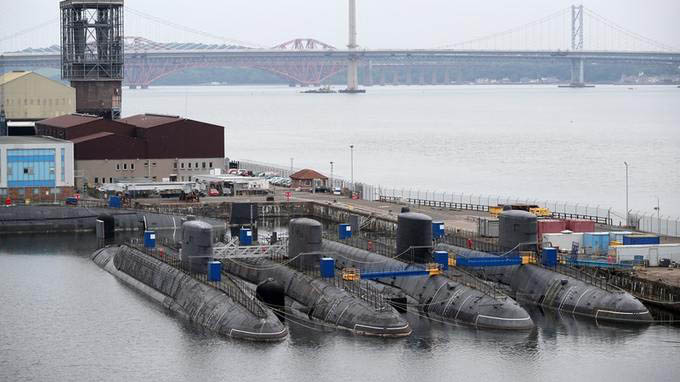
Plymouth Live 22nd June 2019, Devonport is home to 13 retired Royal Navy submarines – some of which
were removed from service almost 30 years ago. Now the MoD wants to get
permission to store four more unwanted nuclear subs in the city. Dubbed
Plymouth’s nuclear graveyard, this week Plymouth MP Luke Pollard warned the
taxpayer is spending £30 million a year to maintain sites such as these,
including the one in Devonport, and another one in Rosyth, Scotland.