New report on Iraqi babies, deformed due to thorium and uranium from U.S. military actions and bases
IRAQI CHILDREN BORN NEAR U.S. MILITARY BASE SHOW ELEVATED RATES OF “SERIOUS CONGENITAL DEFORMITIES,” STUDY FINDS https://theintercept.com/2019/11/25/iraq-children-birth-defects-military/ Murtaza Hussain, November 26 2019, MORE THAN A decade and a half after the 2003 U.S. invasion of Iraq, a new study found that babies are being born today with gruesome birth defects connected to the ongoing American military presence there. The report, issued by a team of independent medical researchers and published in the journal Environmental Pollution, examined congenital anomalies recorded in Iraqi babies born near Tallil Air Base, a base operated by the U.S.-led foreign military coalition. According to the study, babies showing severe birth defects — including neurological problems, congenital heart disease, and paralyzed or missing limbs — also had corresponding elevated levels of a radioactive compound known as thorium in their bodies.
The suffering of Iraqis has been particularly acute. The results of the new study added to a laundry list of negative impacts of the U.S.’s long war there to the long-term health of the country’s population. Previous studies, including some contributed by a team led by Savabieasfahani, have pointed to elevated rates of cancer, miscarriages, and radiological poisoning in places like Fallujah, where the U.S. military carried out major assaults during its occupation of the country.
SOME OF THESE negative health effects of the American war in Iraq can be put down to U.S. forces’ frequent use of munitions containing depleted uranium. Depleted uranium, a byproduct of the enriched uranium used to power nuclear reactors, makes bullets and shells more effective in destroying armored vehicles, owing to its extreme density. But it has been acknowledged to be hazardous to the environment and the long-term health of people living in places where the munitions are used.
“Uranium and thorium were the main focus of this study,” the authors note. “Epidemiological evidence is consistent with an increased risk of congenital anomalies in the offspring of persons exposed to uranium and its depleted forms.” In other words: The researchers found that the more you were around these American weapons, the more likely you were to bear children with deformities and other health problems.
In response to an outcry over its effects, the U.S. military pledged to not use depleted uranium rounds in its bombing campaigns against the Islamic State group in Iraq and Syria, but, despite this pledge, a 2017 investigation by the independent research group AirWars and Foreign Policy magazine found that the military had continued to regularly use rounds containing the toxic compound.
These depleted-uranium munitions are among the causes of hazards not only to the civilians in the foreign lands where the U.S. fights its wars, but also to American service members who took part in these conflicts. The chronic illnesses suffered by U.S. soldiers during the 1991 war in Iraq — often from exposure to uranium munitions and other toxic chemicals — have already been categorized as a condition known as “Gulf War syndrome.” The U.S. government has been less interested into the effects of the American military’s chemical footprint on Iraqis. The use of “burn pits” — toxic open-air fires used to dispose military waste — along with other contaminants has had a lasting impact on the health of current and future Iraqi generations.
Researchers conducting the latest study said that a broader study is needed to get definitive results about these health impacts. The images of babies born with defects at the hospital where the study was conducted, Bint Al-Huda Maternity Hospital, about 10 kilometers from Tallil Air Base, are gruesome and harrowing. Savabieasfahani, the lead researcher, said that without an effort by the U.S. military to clean up its radioactive footprint, babies will continue to be born with deformities that her study and others have documented.
“The radioactive footprint of the military could be cleaned up if we had officials who wanted to do so,” said Savabieasfahani. “Unfortunately, even research into the problem of Iraqi birth defects has to be done by independent toxicologists, because the U.S. military and other institutions are not even interested in this issue.”
Nuclear deterrence is weakened by the absence of diplomacy, and the demise of arms control.
 Trump’s Track Record Of Nuclear Deterrence Without Reassurance Is Dangerous, Forbes, Michael Krepon, 25 Nov 19, The first time President Ronald Reagan announced that “A nuclear war can never be won and must never be fought” was before the Japanese Diet on November 11, 1983. Reagan was sensitive to public concerns over the rocky state of U.S.-Soviet relations. His speech came nine days before the airing of an ABC movie, “The Day After,” depicting the impact on Lawrence, Kansas, of a nuclear strike against nearby Kansas City. The “Day After” was watched by 100 million viewers. Reagan had an advance screening. It’s hard to identify a television program that has had a more dramatic impact on public and presidential consciousness of nuclear danger.
There is only one sane policy, for your country and mine, to preserve our civilization in this modern age: A nuclear war cannot be won and must never be fought. The only value in our two nations possessing nuclear weapons is to make sure they will never be used.”
When Reagan and Mikhail Gorbachev jointly repeated this formulation at their Geneva summit in 1985, skeptics began to take notice. The canonical affirmation by then had congealed into “A nuclear war cannot be won and must never be fought.” When Reagan and Gorbachev began to act in accordance with this belief, scales fell from before our eyes. Defenders of deterrence orthodoxy became alarmed. Both men meant what they said.
UK’s embarrassing, expensive, intractable trouble with dead nuclear submarines

Key point: Britain isn’t the only nation that has problems disposing of nuclear warships. When you need to dispose of an old car, you can take it to a junkyard.
But what do you do with a nuclear submarine whose reactor can make people glow in a most unpleasant way?
Britain has retired twenty nuclear submarines since 1980. None have been disposed of, and nine still contain radioactive fuel in their reactors, according to an audit by Britain’s National Audit Office. These subs spent an average of twenty-six years on active service—and nineteen years out of service.
“Because of this, the Department [Ministry of Defense] now stores twice as many submarines as it operates, with seven of them having been in storage for longer than they were in service,” the audit states.
Even worse is the price tag. Britain has spent 500 million pounds ($646.4 million) maintaining those decommissioned subs between 1980 and 2017. Full disposal of a nuclear sub would cost 96 million pounds ($112.1 million). As a result, the total cost for disposing of the Royal Navy’s ten active subs and twenty retired vessels would be 7.5 billion pounds ($9.7 billion), NAO calculated…….
The plan is to begin defueling subs, beginning with HMS Swiftsure, in 2023. But even then, the Ministry of Defense will have to deal with different subs that have different disposal requirements. “At present, the Department does not have a fully developed plan to dispose of Vanguard, Astute and Dreadnought-class submarines, which have different types of nuclear reactor,” NAO pointed out. “For the Vanguard and Astute-class it has identified suitable dock space which, if used, will need to be maintained.”
Interestingly, the British military gets an exemption when it comes to nuclear waste. “Within the civil nuclear sector, organizations must consider nuclear waste disposal during the design stage of power stations and nuclear infrastructure. The Department does not have a similar obligation.”
Scottish National Party will press Jeremy Corbyn to scrap UK’s nuclear deterrent
 Nicola Sturgeon to press Corbyn to scrap UK’s nuclear deterrent
Abandoning Trident would be key issue in SNP support for a minority Labour government, Guardian Severin Carrell Scotland editor
@severincarrell, Mon 25 Nov 2019
|
Nicola Sturgeon will press Jeremy Corbyn to scrap the UK’s nuclear deterrent in any talks on Scottish National party support for a minority Labour government. The SNP leader said abandoning Trident would a key issue in any post-election talks with Labour, alongside supporting a second independence referendum, abolishing the universal credit benefits system and devolving immigration policy to Holyrood. In an article for the Guardian Sturgeon attacked Corbyn for abandoning his longstanding opposition to nuclear weapons in favour of supporting Trident and its replacement by a new system, based at Faslane submarine base on the Clyde. “Like many other Scots, I’ve always been appalled that Britain’s nuclear arsenal has been kept in my back yard,” Sturgeon wrote. “Corbyn, a longtime supporter of the Campaign for Nuclear Disarmament, is now fully signed up to renewing Trident. While I have my differences with Jeremy, on this issue – in his heart of hearts – I believe he still feels the same as I do. Yet, in attempting to become prime minister, he feels the need to sell out his principled opposition to Trident and promise to keep them on the Clyde.”….. Corbyn and Jo Swinson, the Liberal Democrat leader, have both been asked during the election campaign whether they would use nuclear weapons. Corbyn refused to say; Swinson quickly said yes. Corbyn has also repeatedly insisted Labour will not negotiate with other parties to ensure it can govern. …… https://www.theguardian.com/politics/2019/nov/24/nicola-sturgeon-to-press-corbyn-to-scrap-uks-nuclear-deterrent |
|
What possible excuse is there for such monstrous, nation-destroying weaponry?
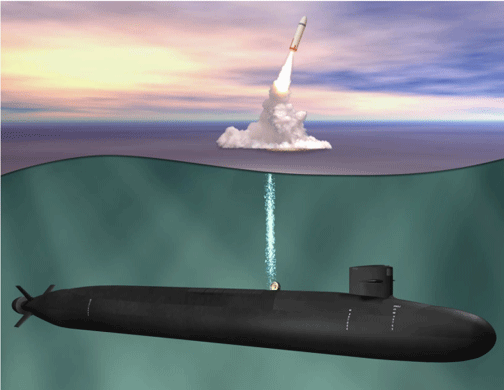 The U.S. Submarine That Could Bring Nuclear Doomsday With It, One sub to end a country. National Interest by Sebastien Roblin– 22 Nov 19 The U.S. Submarine That Could Bring Nuclear Doomsday With It, One sub to end a country. National Interest by Sebastien Roblin– 22 Nov 19
Key Point: The Ohio-class could pull it off. “…… The most deadly of the real-life kaiju prowling the oceans today are the fourteen Ohio-class ballistic-missile submarines, which carry upwards of half of the United States’ nuclear arsenal onboard. If you do the math, the Ohio-class boats may be the most destructive weapon system created by humankind. Each of the 170-meter-long vessels can carry twenty-four Trident II submarine-launched ballistic missiles (SLBMs) which can be fired from underwater to strike at targets more than seven thousand miles away depending on the load. As a Trident II reenters the atmosphere at speeds of up to Mach 24, it splits into up to eight independent reentry vehicles, each with a 100- or 475-kiloton nuclear warhead. In short, a full salvo from an Ohio-class submarine—which can be launched in less than one minute—could unleash up to 192 nuclear warheads to wipe twenty-four cities off the map. This is a nightmarish weapon of the apocalypse. The closest competitor to the Ohio-class submarine is the Russia’s sole remaining Typhoon-class submarine, a larger vessel with twenty ballistic-missile launch tubes. However, China, Russia, India, England and France all operate multiple ballistic-missile submarines with varying missile armaments—and even a few such submarines would suffice to annihilate the major cities in a developed nation………..
the New START treaty which came into effect in 2011 imposes additional limits on the number of deployed nuclear weapons. The current plan is to keep twelve Ohio-class subs active at time with twenty Trident IIs each, while two more boomers remain in overhaul, keeping a total of 240 missiles active at a time with 1,090 warheads between them. Don’t worry, restless hawks: that’s still enough to destroy the world several times over! ………. https://nationalinterest.org/blog/buzz/us-submarine-could-bring-nuclear-doomsday-it-98332
What possible excuse is there for such monstrous, nation-destroying weaponry?
|
|
A new dangerous period of nuclear weapons rivalry
 The Coming Nuclear Crises, https://www.project-syndicate.org/commentary/coming-nuclear-arms-races-and-crises-by-richard-n-haass-2019-11 Nov 18, 2019 RICHARD N. HAASS We are entering a new and dangerous period in which nuclear competition or even use of nuclear weapons could again become the greatest threat to global stability. Less certain is whether today’s leaders are up to meeting this emerging challenge.
This past summer, however, the US withdrew from the 1987 Intermediate-Range Nuclear Forces Treaty after it concluded Russia had violated the INF’s terms. The treaty limiting longer-range US and Russian nuclear weapons will expire in 2021 unless it is extended, and it is not clear that it will be: both countries are committing substantial resources to modernize their existing arsenals.
Now, however, Iran has begun a slow but steady process of getting out from under many of the agreement’s limits. It may be doing this to persuade the US and Europe to ease economic sanctions. It may also be calculating that these steps could dramatically reduce the time it would need to produce nuclear weapons without being attacked. But it is at least as likely that Iran’s actions will lead the US, or more probably Israel, to undertake a preventive strike designed to destroy a significant part of its program.
Confusion in UK over Jeremy Corbyn’s nuclear weapons policy
 What is Jeremy Corbyn’s nuclear weapons policy? The Week, Nov 18, 2019 Labour leader has been quizzed again on future of Trident. Jeremy Corbyn’s position on nuclear weapons is back in the headlines after he refused to rule out scrapping Trident as part of a post-election deal with the Scottish National Party.
Asked on The Andrew Marr Show whether he would scrap Trident, the Labour leader said: “I think the SNP would actually agree with me… that the priority has to be giving realism to the nuclear non-proliferation treaty, giving realism to the six-party talks in Korea, giving realism to the whole question of non-proliferation of nuclear weapons.”
Pressed further on the matter, he replied: “Obviously if you went into non-proliferation treaty discussions then clearly every country’s nuclear weapons go into that equation.” ……. https://www.theweek.co.uk/104380/what-is-jeremy-corbyn-s-nuclear-weapons-policy
The “Plutocene” danger – nuclear war, radioactive pollution, global heating
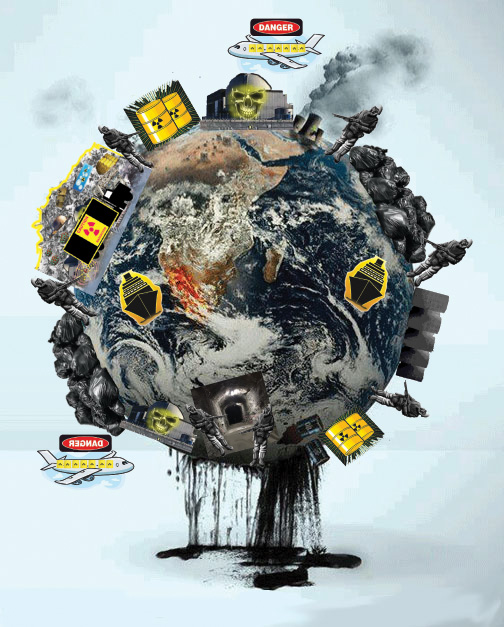
Why are these two facts related? Because they illustrate the two factors that could transport us beyond the Anthropocene—the geological epoch marked by humankind’s fingerprint on the planet—and into yet another new, even more hostile era of our own making.
My new book, titled The Plutocene: Blueprints for a post-Anthropocene Greenhouse Earth, describes the future world we are on course to inhabit, now that it has become clear that we are still busy building nuclear weapons rather than working together to defend our planet.
have coined the term Plutocene to describe a post-Anthropocene period marked by a plutonium-rich sedimentary layer in the oceans. The Anthropocene is very short, having begun (depending on your definition) either with the Industrial Revolution in about 1750, or with the onset of nuclear weapons and sharply rising greenhouse emissions in the mid-20th century. The future length of the Plutocene would depend on two factors: the half-life of radioactive plutonium-239 of 24,100 years, and how long our CO2 will stay in the atmosphere—potentially up to 20,000 years.
During the Plutocene, temperatures would be much higher than today. Perhaps they would be similar to those during the Pliocene (2.6 million to 5.3 million years ago), when average temperatures were about 2℃ above those of pre-industrial times, or the Miocene (roughly 5.3 million to 23 million years ago), when average temperatures were another 2℃ warmer than that, and sea levels were 20 to 40 meters (65-131ft) higher than today.
Under these conditions, population and farming centres in low coastal zones and river valleys would be inundated, and humans would be forced to seek higher latitudes and altitudes to survive—as well as potentially having to contend with the fallout of nuclear conflict. The most extreme scenario is that evolution takes a new turn—one that favors animals best equipped to withstand heat and radiation.
Climates past
While we have a range of tools for studying prehistoric climates, including ice cores and tree rings, these methods do not of course tell us what the future holds.
However, the basic laws of physics, the principles of climate science, and the lessons from past and current climate trends, help us work out the factors that will dictate our future climate.
Broadly speaking, the climate is shaped by three broad factors: trends in solar cycles; the concentration of atmospheric greenhouse gases; and intermittent events such as volcanic eruptions or asteroid impacts.
Solar cycles are readily predicted, and indeed can be seen in the geological record, whereas intermittent events are harder to account for. The factor over which we have the most control is our own greenhouse emissions.
CO2 levels have previously climbed as high as 2,000 parts per million (ppm), most recently during the early Eocene, roughly 55-45 million years ago. The subsequent decline of CO2 levels to just a few hundred parts per million then cooled the planet, creating the conditions that allowed Earth’s current inhabitants (much later including humans) to flourish.
But what of the future? Based on these observations, as reported by the Intergovernmental Panel on Climate Change (IPCC), several projections of future climates indicate an extension of the current interglacial period by about 30,000 years, consistent with the longevity of atmospheric CO2.
If global warming were to reach 4℃, as suggested by Hans Joachim Schellnhuber, chief climate advisor to the German government, the resulting amplification effects on the climate would pose an existential threat both to nature and human civilization.
Barring effective sequestration of carbon gases, and given amplifying feedback effects from the melting of ice sheets, warming of oceans, and drying out of land surfaces, Earth is bound to reach an average of 4℃ above pre-industrial levels within a time frame to which numerous species, including humans, may hardly be able to adapt. The increase in evaporation from the oceans and thereby water vapor contents of the atmosphere leads to mega-cyclones, mega-floods and super-tropical terrestrial environments. Arid and semi-arid regions would become overheated, severely affecting flora and fauna habitats.
The transition to such conditions is unlikely to be smooth and gradual, but may instead feature sharp transient cool intervals called “stadials.” Increasingly, signs of a possible stadial are being seen south of Greenland.
A close analogy can be drawn between future events and the Eocene-Paleocene Thermal Maximum about 55 million years ago, when release of methane from Earth’s crust resulted in extreme rise in temperature. But as shown below, [ diagram on original] the current rate of temperature rise is far more rapid—and more akin to the planet-heating effects of an asteroid strike.
Mounting our defense
Defending ourselves from global warming and nuclear disaster requires us to do two things: stop fighting destructive wars, and start fighting to save our planet. There is a range of tactics we can use to help achieve the second goal, including large-scale seagrass cultivation, extensive biochar development, and restoring huge swathes of the world’s forests.
Space exploration is wonderful, but we still only know of one planet that supports life (bacteria possibly excepted). This is our home, and there is currently little prospect of realising science fiction’s visions of an escape from a scorched Earth to some other world.
Yet still we waver. Many media outlets operate in apparent denial of the connection between global warming and extreme weather. Meanwhile, despite diplomatic progress on nuclear weapons, the Sword of Damocles continues to hang over our heads, as 14,900 nuclear warheads sit aimed at one another, waiting for accidental or deliberate release.
If the clock does strike nuclear midnight, and if we don’t take urgent action to defend our planet, life as we know it will not be able to continue. Humans will survive in relatively cold high latitudes and altitudes. A new cycle would begin.
Andrew Glikson is an Earth and paleo-climate scientist at the Australian National University.
Jeremy Corbyn could scrap UK’s nuclear weapons, in deal with Scottish National Party
 Jeremy Corbyn suggests he could SCRAP Britain’s nuclear weapons as the SNP demands he ‘gets rid’ of Trident missiles to win its backing in a government coalition, Daily Mail Labour leader said he wanted to add ‘realism’ to nuclear non-proliferation treaty Jeremy Corbyn suggests he could SCRAP Britain’s nuclear weapons as the SNP demands he ‘gets rid’ of Trident missiles to win its backing in a government coalition, Daily Mail Labour leader said he wanted to add ‘realism’ to nuclear non-proliferation treaty
By DAVID WILCOCK, WHITEHALL CORRESPONDENT FOR MAILONLINE 18 November 2019 Jeremy Corbyn today suggested he would be prepared to give up the UK’s nuclear weapons after the SNP signalled it would be part of their price for propping up his future government. The Labour leader said he wanted to add ‘realism’ to the nuclear non-proliferation treaty (NNPT), with discussions about ‘every country’s nuclear weapons’. He also had a dig at Nato, disagreeing with a claim last week by General Sir Nick Carter, the professional head of the British Army, that the alliance was the most successful in history. His BBC interview came after the Scottish National Party’s Westminster leader Ian Blackford had said the upcoming election was ‘an opportunity to get rid of Trident’ – the UK’s atomic missile system…… The SNP has made removing Britain’s nuclear submarine fleet – based on the Clyde – out of Scotland a mainstay of its party policy. And Mr Corbyn, a former chairman of the Stop the War Coalition, has long opposed Britain’s nuclear weapons programme…. https://www.dailymail.co.uk/news/article-7694603/Now-SNP-demands-Jeremy-Corbyn-scrap-Britains-NUCLEAR-WEAPONS-win-votes-coalition.html |
|
49 USA universities get lots of money for helping to develop nuclear weapons
 ‘Schools of Mass Destruction’: Report Details 49 US Universities Abetting Nuclear Weapons Complex https://www.commondreams.org/news/2019/11/13/schools-mass-destruction-report-details-49-us-universities-abetting-nuclear-weapons “Why would an institution of higher learning support weapons that cause terrible humanitarian consequences?”
That’s according to a new report released Wednesday by the International Campaign to Abolish Nuclear Weapons (ICAN), “Schools of Mass Destruction: American Universities in the U.S. Nuclear Weapons Complex.” The report calls out 49 educational institutions, describes their direct and indirect involvement, and recommends steps the universities, students, and faculty can take to address the issue.
The report names prestigious universities including Stanford, Georgetown, and MIT. The cited universities have reportedly engaged in four different avenues of complicity in nuclear weapons production, defying their own mission statements and international law.
In return, the report says, “universities receive funding, access to research facilities, and specific career opportunities for students.”
The complicity, according to ICAN, falls into one of four categories: direct management, institutional partnerships, research programs and partnerships, and workforce development programs.
From the report’s profiles on Georgetown University and the University of Nevada – Reno:
In return, the report says, “universities receive funding, access to research facilities, and specific career opportunities for students.”
The complicity, according to ICAN, falls into one of four categories: direct management, institutional partnerships, research programs and partnerships, and workforce development programs.
From the report’s profiles on Georgetown University and the University of Nevada – Reno:
- Georgetown is listed as a university partner on the website of Lawrence Livermore National Laboratory. According to administration at Georgetown, the university has a formal agreement with the laboratory and collaborates in the areas of neuroscience, physics and cancer, with the lab hosting graduate students for summer internships. The Lawrence Livermore lab provides design and engineering for several nuclear warhead types and conducts simulated experiments to evaluate warheads.
- The University of Nevada – Reno developed a new Graduate Certificate in Nuclear Packaging in partnership with the Department of Energy. A Nevada National Security Site engineer was the first to complete the program. The Nevada National Security Site is the location of nearly 1,000 tests of nuclear weapons in past decades, leading to serious health impacts for nearby residents and participating military personnel. Currently, staff at the site conduct simulated experiments to test the reliability and performance of nuclear weapons. The site also hosts “subcritical experiments” that allow for the evaluation of nuclear weapons materials under certain conditions, but do not cause a “self-sustaining nuclear chain reaction.”
Those universities are not the “most complicit.” That dubious honor goes to the University of California, Texas A&M University, Johns Hopkins University, and University of New Mexico. In a Twitter thread, ICAN highlighted those schools’ involvement:
#1 The state of California supports a ban of #nuclearweaponshttp://bit.ly/2pbn7OT,but the @UofCalifornia has continuously managed the primary #nuclearweapons labs for the US since WWII. When will UC stop supporting weapons that pose a catastrophic threat to our existence?
#2 @TAMU administration has publicly stated its “commitment to the #nuclearweapons industry.”http://bit.ly/2CyVbau Why would an institution of higher learning support weapons that cause terrible humanitarian consequences?#3 @JohnsHopkins’ applied physics lab is directly involved in #nuclearweapons production. It receives more than twice as much funding from the US @DeptofDefense than any other U.S. university. @JHUPress @JHUNewsLetter
#4 More than 3,800 New Mexicans have suffered serious illness or death as a result of US nuclear weapons tests http://bit.ly/33IL4vS So why does the @UNM University of New Mexico wants its faculty and students to collaborate with #nuclearweapons lab scientists?The report comes as Trump administration policies have given rise to fears of a new arms race. As the report notes,
In the United States, the Trump administration has expanded plans to upgrade the nation’s nuclear weapons arsenal. Over the next ten years, the Congressional Budget Office estimates U.S. taxpayers will pay nearly $500 billion to maintain and modernize its country’s nuclear weapons arsenal, or almost $100,000 per minute.
Also noted in the publication is the administration’s withdrawal earlier this year from the Intermediate-Range Nuclear Forces Treaty with Russia and its 2018 Nuclear Posture Review (NPR), which calls for “diversifying” the country’s nuclear arsenal.
That gives greater urgency to the call for the schools to sever their partnerships—and the clear support for the United Nations Treaty on the Prohibition of Nuclear Weapons, ICAN says, should be seen as an opportunity for action.
U.S. universities must reconsider connections to the nuclear weapons complex due to the devastating humanitarian and environmental impacts of nuclear weapons and because current U.S. policies make their use more likely,” says the report.
A first step is for schools to be more transparent about their involvement in the nuclear weapons complex but that’s not enough. “Universities would not willingly participate today in research enabling the production of chemical and biological weapons. Nuclear weapons are morally equivalent to these other weapons of mass destruction.”
Students and faculty can take action as well. ICAN suggests sharing the report to increase awareness, demanding the institutions make their research transparent, and calling on the schools to become part of the effort to ban nuclear weapons by dropping their involvement.
A long-term continuing resolution -damaging to America’s nuclear weapons development
|
Here’s how a CR could hurt America’s nuclear weapons modernization. https://www.defensenews.com/smr/nuclear-arsenal/2019/11/12/heres-how-a-cr-could-hurt-americas-nuclear-weapons-modernization/
By: Aaron Mehta WASHINGTON — A long-term continuing resolution will result in delays for modernizing America’s nuclear warheads, while putting at risk an already challenging plan to build plutonium pits needed for the next generation of U.S. intercontinental ballistic missiles, nuclear officials are warning.
The National Nuclear Security Administration is a semiautonomous agency under the Department of Energy that handles the manufacturing and maintenance of America’s nuclear warheads. Like other government agencies, NNSA would be limited to fiscal 2019 funding limits under a continuing resolution, and it would be unable to start new contracts. The current continuing resolution, or CR, is set to end Nov. 21, but there is little expectation that regular budgeting will then resume. Congress is debating the merits of pushing the CR through December, but analysts are concerned the CR could extend into next year. “We are in a situation right now where we have single-point failures throughout our enterprise,” Lisa Gordon-Hagerty, the NNSA administrator, said during a Defense Writers Group breakfast earlier this month. “It’s necessary for us, for the NNSA and for the nuclear security enterprise to receive consistent and robust funding to modernize our infrastructure as well as continue ongoing operations.” “We’re looking at where we can move funding insofar as CRs will allow us to do so,” she added. “We’re working very closely with OMB and the administration to see what we can do to continue our important programs to modernize the infrastructure as well as the stockpile and our workforce initiatives and our endeavors.” Gordon-Hagerty did not go into detail about specific CR-related worries, but according to an NNSA source, the agency has identified three main areas of concern under a longer CR. The first is, broadly, keeping the warhead modernization efforts on schedule. Two of those modernization programs — the B61-12 gravity bomb and W88 submarine-launched ballistic missile warhead — already face program delays thanks to an issue with a commercial part that has to be redesigned. Gordon-Hagerty said a CR should not impact that particular issue, as the funding for a solution is coming from a realignment of other warhead modernization programs. But a delay to one program caused by a CR “does affect all of the other modernization programs and all of the other work that we have ongoing throughout our nuclear security enterprise,” she said. The second major area of concern is the surplus plutonium disposition program, which is supposed to dispose of 34 metric tons of excess plutonium at a South Carolina facility. That program emerged as the successor to the controversial MOX program, and has faced opposition from South Carolina Sen. Lindsey Graham. Construction on that facility could be delayed under a CR. The NNSA source said that the agency requested extra funding for the surplus plutonium disposition program through the budget anomaly process, but was not given the resources it requested. The third area of concern is a 10-year plan to develop a native plutonium pit in the United States. The NNSA has been charged with producing 80 plutonium pits a year by 2030, a target that Gordon-Hagerty acknowledged is a tight window for the agency to hit, even with stable funding. “We are again rebalancing, looking at our budget across the entire enterprise to see what it is we need to do to meet the scope and schedule of that 2030,” she said. “Am I confident we can get there? Yes. Is it fraught with — probably a bad way of saying it — land mines? It is.” Construction costs Construction featuring prominently on this list should not be a huge surprise; NNSA officials are quick to point out in public events that they are still using some buildings that date back to the Manhattan Project. According to Gordon-Hagerty, more than 50 percent of NNSA facilities are more than 40 years old, and over a third of those are about 70 years of age. The looming CR extension comes as the agency launches a number of construction projects, and a CR could lead to major delays in standing up those facilities. While that’s an issue for every agency under a CR, the NNSA is concerned that the specialty construction talent needed to build those facilities may not available if a contract is frozen and then picked up again later. There could also be high-dollar costs. Responding to a lawsuit by environmental groups trying to halt the construction of the Y-12 facility in Tennessee, NNSA said a six- to 12-month delay in construction at that location could result in almost $1 billion in extra costs for taxpayers and the agency may have to lay off 1,000 construction personnel. Those numbers, first reported by the Exchange Monitor, likely have resonance with other potential delays at construction sites caused by a CR — meaning construction delays at one or more sites could quickly become costly for an agency whose facilities and construction needs have traditionally been underfunded. “It’s been on schedule and on budget for the last six years. It will be finished in 2025 for approximately $6.5 billion,” Gordon-Hagerty said of the Y-12 facility. “If that funding somehow fails to materialize, then we’ve got over 1,000 crafts [personnel] working at the site right now. Crafts personnel are hard to come by, especially those that are qualified. So if they see a question about funding or funding gets pulled back, they’re going to find positions elsewhere.”
|
|

The United States’ Nuclear and Non-Nuclear Weapons Are Dangerously Entangled
|
New evidence from the Yom Kippur War shows how such knots can lead to nuclear annihilation.
BY JAMES M. ACTON, NICK BLANCHETTE
NOVEMBER 12, 2019, In October 1973, an unreliable radiation detector could have caused the end of the world. The setting was the Yom Kippur War between Israel and a coalition of Arab states, and the superpowers found themselves being sucked into the conflict. In the war’s febrile final days, the United States detected what appeared to be radiation from a Soviet freighter headed for Egypt and concluded—almost certainly incorrectly—that Moscow was transferring nuclear warheads to Cairo. Partly in response, on Oct. 24, Washington placed its nuclear forces on a global alert for only the fourth time in history—a step it has taken only twice since. The U.S. alert prompted the Soviet Union to reportedly issue a preliminary order to begin the alerting of its own nuclear forces. This chain of events, which could have culminated in a nuclear war, provides a timely warning. The United States’ ability to detect and track nuclear warheads has improved immeasurably over the last 46 years, making an exact replay of 1973 unlikely. However, growing entanglement between nuclear and nonnuclear weapons is exacerbating closely related dangers. In particular, nuclear-armed states are relying ever more heavily on dual-use weapons, which can accommodate nuclear or nonnuclear warheads, thus exacerbating the risk that one side might wrongly conclude that another had deployed nuclear weapons. In a crisis or conflict, the result could be an escalation spiral that, unlike in 1973, spins all the way to nuclear devastation. ……(subscribers only) https://foreignpolicy.com/2019/11/12/the-united-states-nuclear-and-non-nuclear-weapons-are-dangerously-entangled/
|
|
The climate crisis is tied up in the dangers of nuclear weapons in ways that nobody predicted
The Climate Crisis Just Went Nuclear https://www.esquire.com/news-politics/politics/a29760935/marshall-islands-nuclear-waste-climate-change/ In the Marshall Islands, local residents are reaping what the United States sowed—which includes tons and tons of nuclear and biological waste from Cold War testing.BY CHARLES P. PIERCE
The climate crisis is the one issue that touches all the other issues. For example, the climate crisis is tied up in the dangers of nuclear weapons in ways that nobody predicted, but that the Los Angeles Times spent some time and money examining. Back in the 1950s and 1960s, the United States set off 67 nuclear bombs in and around the Marshall Islands. This had predictable results: there were now lagoons where there were none before; some islands simply aren’t there any more, and there was a lot of deadly stuff left behind. Which brings us to the climate crisis.
Here in the Marshall Islands, Runit Dome holds more than 3.1 million cubic feet — or 35 Olympic-sized swimming pools — of U.S.-produced radioactive soil and debris, including lethal amounts of plutonium. Nowhere else has the United States saddled another country with so much of its nuclear waste, a product of its Cold War atomic testing program.
U.S. authorities later cleaned up contaminated soil on Enewetak Atoll, where the United States not only detonated the bulk of its weapons tests but, as The Times has learned, also conducted a dozen biological weapons tests and dumped 130 tons of soil from an irradiated Nevada testing site. It then deposited the atoll’s most lethal debris and soil into the dome. Now the concrete coffin, which locals call “the Tomb,” is at risk of collapsing from rising seas and other effects of climate change. Tides are creeping up its sides, advancing higher every year as distant glaciers melt and ocean waters rise.
When people talk about environmental justice, this is what they’re talking about.
Officials in the Marshall Islands have lobbied the U.S. government for help, but American officials have declined, saying the dome is on Marshallese land and therefore the responsibility of the Marshallese government. “I’m like, how can it [the dome] be ours?” Hilda Heine, the president of the Republic of the Marshall Islands, said in an interview in her presidential office in September. “We don’t want it. We didn’t build it. The garbage inside is not ours. It’s theirs.” … They blame the United States and other industrialized countries for global climate change and sea level rise, which threaten to submerge vast swaths of this island nation’s 29 low-lying atolls.
The history behind all this is as tawdry as you might have expected it to be—an endless litany of lies, deception, and bureaucratic three-card monte, all of it designed to dodge any responsibility for the nightmares past, present, and future.
Over the last 15 months, a reporting team from the Los Angeles Times and Columbia University’s Graduate School of Journalism made five trips to the Marshall Islands, where they documented extensive coral bleaching, fish kills and algae blooms — as well as major disease outbreaks, including the nation’s largest recorded epidemic of dengue fever. They interviewed folk singers who lost their voices to thyroid cancers and spent time in Arkansas, Washington and Oregon, where tens of thousands of Marshallese have migrated to escape poverty and an uncertain future.
Over the last 15 months, a reporting team from the Los Angeles Times and Columbia University’s Graduate School of Journalism made five trips to the Marshall Islands, where they documented extensive coral bleaching, fish kills and algae blooms — as well as major disease outbreaks, including the nation’s largest recorded epidemic of dengue fever. They interviewed folk singers who lost their voices to thyroid cancers and spent time in Arkansas, Washington and Oregon, where tens of thousands of Marshallese have migrated to escape poverty and an uncertain future.
One example: The United States did not tell the Marshallese that in 1958, it shipped 130 tons of soil from its atomic testing grounds in Nevada to the Marshall Islands. U.S. authorities also didn’t inform people in Enewetak, where the waste site is located, that they’d conducted a dozen biological weapons tests in the atoll, including experiments with an aerosolized bacteria designed to kill enemy troops. U.S. Department of Energy experts are encouraging the Marshallese to move back to other parts of Enewetak, where 650 now live, after being relocated during the U.S. nuclear tests during the Cold War. But many Marshallese leaders no longer trust U.S. assurances of safety.
Can’t imagine why they’d think that.
Adding to the alarm is a study published this year by a team of Columbia University scientists showing levels of radiation in some spots in Enewetak and other parts of the Marshall Islands that rival those found near Chernobyl and Fukushima. Such discoveries could give Marshallese leaders fresh ammunition to challenge the 1986 compact, which is up for renegotiation in 2023, and also to press the United States to honor property and
health claims ordered by an international tribunal. The tribunal, established by the two countries in 1988, concluded the United States should pay $2.3 billion in claims, but Congress and U.S courts have refused. Documents show the U.S. paid just $4 million.
And what in the hell was this?
A decade later, in 1968, teams from the Department of Defense set up a new experiment. This time, they were testing biological weapons — bombs and missiles filled with bacteria designed to fell enemy troops. According to a 2002 military fact sheet and Ed Regis, the author of “The Biology of Doom,” U.S. government scientists came to Enewetak with “their boats and monkeys, space suits and jet fighter planes” and then sprayed clouds of biologically enhanced staphylococcal enterotoxin B, an incapacitating biological agent known to cause toxic shock and food poisoning and considered “one of the most potent bacterial superantigens.” The bacteria were sprayed over much of the atoll — with ground zero at Lojwa Island, where U.S. troops were stationed 10 years later for the cleanup of the atoll.
I don’t know what happens when the dome gives way, but I feel confident in saying a) it won’t be good, and b) we won’t hear about it for a couple of years, at least.
A UK Labour govt would make ‘collective’ decision over use of nuclear weapons?
|
General election: Labour government would make ‘collective’ decision over use of nuclear weaponsEmily Thornberry, the shadow foreign secretary, says Labour would maintain ‘ambiguity’ over circumstances in which Trident deterrent might be used , Independent Andrew WoodcockPolitical Editor @andywoodcock, 11 Nov 19
A Jeremy Corbyn-led Labour government would make a “collective” decision on whether to use nuclear weapons in response to an imminent threat, the party’s shadow foreign secretary has said. Emily Thornberry came under fire from Conservatives after suggesting that Mr Corbyn would share the decision on whether to press the nuclear button with senior colleagues. Labour’s official policy is to retain the UK’s independent Trident deterrent, but the party leader has previously said that he would not be willing to use nuclear weapons…… https://www.independent.co.uk/news/uk/politics/general-election-labour-nuclear-weapons-trident-corbyn-thornberry-deterrent-a9198881.html |
|
Entire world wants nuclear weapons-free Middle East — except for USA and Israel
US and Israel were lone votes against UN resolutions opposing space arms race, nuclear Middle East, Cuba embargo, The United States and Israel were the only countries that voted against UN General Assembly draft resolutions calling for a nuclear weapons-free Middle East, measures to stop an arms race in outer space, and an end to the blockade of Cuba. THE GRAYZONE, By Ben Norton, 11 Nov 19,
Important breakthroughs have arrived at the United Nations seeking to prevent an arms race in outer space and create a nuclear weapons-free Middle East. There are just two main obstacles: the United States and Israel.
While Washington and corporate media outlets portray China and Russia as aggressive warmongering rogue states, their votes at the UN show which nations are actually expanding dangerous militarism into new frontiers.
China and Russia joined dozens of other countries in sponsoring resolutions at the UN General Assembly (UNGA) that sought to prevent armed conflict in space. Most of the international community supported these historic peace measures. The only consistent outliers were the US and Israel.
Beijing and Moscow have been leading global efforts to stop the use of weapons in space. Meanwhile, Washington has unilaterally blocked the international consensus on preventing the deadly space race.
Moreover, as nearly all UN member states have united in calling for a Middle East free of nuclear weapons, the US and Israel have singlehandedly undermined their peace efforts.
This roguish behavior predates the election of President Donald Trump.
At the UNGA on November 7, almost every country in the world also voted to end the US embargo against Cuba. This was the 28th year in row that the international community united in calling for the American noose to be taken off the neck of the Cuban people.
While 187 member states supported the resolution demanding an end to the blockade, the US, Israel, and Brazil’s far-right government were the lone nations to oppose it. American allies Colombia and Ukraine abstained.
Washington’s UN votes show who truly is a rogue state.
Entire world wants nuclear weapons-free Middle East — except for USA and Israel
The UNGA’s First Committee, which oversees disarmament and international security, voted on November 1 to overwhelmingly approve a draft resolution entitled “Establishment of a nuclear-weapon-free zone in the region of the Middle East.”
A staggering 172 countries voted in support of this resolution. Only two nations voted against it: the US and Israel. Just two more countries abstained: the United Kingdom and Cameroon.
At the same meeting, the First Committee approved a draft resolution on “The risk of nuclear proliferation in the Middle East,” which called for the region to abide by the Treaty on the Non-Proliferation of Nuclear Weapons (NPT).
Given Israel is the only country in the Middle East with nuclear weapons, the UNGA resolution called on Tel Aviv to join the NPT (Israel has long refused to sign the treaty), and demanded that Israeli nuclear facilities be overseen by International Atomic Energy Agency (IAEA) safeguards.
The draft resolution was also overwhelmingly approved, with 151 votes in support and a mere six votes against — from the US, Israel, and Canada, along with the tiny island nations of Palau, Micronesia, and the Marshall Islands, which function as vassals of Washington at the UN.
American and Israeli votes against resolutions to prevent an arms race in outer space…….https://thegrayzone.com/2019/11/08/us-israel-un-resolutions-space-arms-race-nuclear/
-
Archives
- October 2026 (112)
- September 2026 (339)
- August 2026 (330)
- July 2026 (355)
- June 2026 (287)
- May 2026 (306)
- April 2026 (356)
- March 2026 (251)
- February 2026 (267)
- January 2026 (308)
- December 2025 (358)
- November 2025 (359)
-
Categories
- 1
- 1 NUCLEAR ISSUES
- business and costs
- climate change
- culture and arts
- ENERGY
- environment
- health
- history
- indigenous issues
- Legal
- marketing of nuclear
- media
- opposition to nuclear
- PERSONAL STORIES
- politics
- politics international
- Religion and ethics
- safety
- secrets,lies and civil liberties
- spinbuster
- technology
- Uranium
- wastes
- weapons and war
- Women
- 2 WORLD
- ACTION
- AFRICA
- Atrocities
- AUSTRALIA
- Christina's notes
- Christina's themes
- culture and arts
- Events
- Fuk 2022
- Fuk 2023
- Fukushima 2017
- Fukushima 2018
- fukushima 2019
- Fukushima 2020
- Fukushima 2021
- general
- global warming
- Humour (God we need it)
- Nuclear
- RARE EARTHS
- Reference
- resources – print
- Resources -audiovicual
- Weekly Newsletter
- World
- World Nuclear
- YouTube
-
RSS
Entries RSS
Comments RSS

