The hazards of nuclear submarines
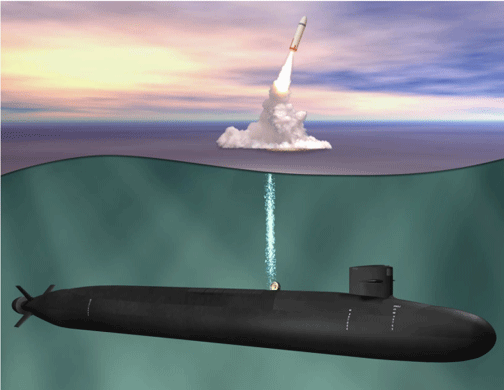
In 2019, a new set of nuclear dangers emerged for Southasia. The growing danger was underscored during the military crisis between India and Pakistan in February 2019, when India put one or more of its nuclear submarines on “operational deployment mode.” During the crisis, the Pakistani Navy claimed to intercept an Indian submarine. No one has confirmed if this interception involved an Indian submarine carrying nuclear weapons. With India and Pakistan on an accelerated programme of acquiring and developing nuclear submarines, Southasia needs to pay urgent attention to the risks of nuclear accidents at sea.
The expansion of nuclear operations to the sea also raises issues about who has the ability to authorise the use of these weapons, especially in a crisis. This is of particular concern in the case of India because it has already deployed such weapons. According to a November 2018 announcement by Prime Minister Narendra Modi, the Arihant nuclear-powered submarine successfully completed its maiden “patrol”.
A further source of concern is the August 2019 announcement by India’s defence minister to the effect that the country’s ‘No First Use’ (NFU) policy – which pledges not to attack with nuclear weapon unless attacked first – “would depend on the circumstances.” His comments, made during a period of increased tension between India and Pakistan following the amendment to Article 370 of India’s Constitution conferring special status to Jammu & Kashmir, underscore these risks.
India’s nuclear submarines……… Strategic competition with China in the Indian Ocean may be another factor. Serving and retired members of India’s Navy publicly express concerns about the deployment of Chinese submarines, warships and tankers in the Indian Ocean.
India’s growing arsenal also makes it a more valuable ally for the United States in its efforts to deal with the growth in China’s political and military power. For some time now, the US and India have been conducting joint naval exercises.
Pakistan’s naval force
Pakistan, for its part, announced the setting up of a Naval Strategic Force Command in 2012. Pakistan’s Navy has started preparing to put nuclear-armed cruise missiles on conventional submarines. The cruise missile is expected to be the 450-kilometer range Babur, which had a successful underwater test launch in 2018. There are reports that Pakistan is seeking to develop or acquire a nuclear-powered submarine…..
Submarine accidents
Almost all the countries operating nuclear-powered or nuclear-armed submarines have experienced accidents, often with significant loss of life and the spread of radioactivity in the environment. There have been over 40 accidents involving nuclear-powered submarines, claiming a total of over 650 lives. Of these accidents, more than half involved Soviet/Russian submarines resulting in over 400 deaths. The United States comes next, with at least a dozen submarine accidents leading to well over 200 deaths.
Two accidents have involved India’s nuclear submarines. …….
It would be unreasonable to expect that no more accidents involving nuclear submarines would ever take place. Nuclear submarines involve many technologies that are susceptible to a range of accidents affecting the submarine, nuclear reactor, missiles and nuclear weapons. All of these are operating under challenging conditions: deep under water, with limited supplies of air and water, possibly under attack. None of these factors is likely to change…….. Should a naval nuclear-reactor accident occur, especially at or near a naval base, coastal city or town the consequences could extend far beyond the vessel and its crew……
Pathways to war
The introduction of nuclear armed submarines, whether diesel or nuclear-fuelled, increases the likelihood of conventional conflicts escalating to a nuclear one. Any use of nuclear weapons would have devastating consequences, especially if the use of nuclear weapons by one country sets off a nuclear response from the other side.
In a military crisis, nuclear armed submarines increase the potential for nuclear war because they open up new risk pathways. The Australian strategist Desmond Ball pointed out in 1985 that “the sea is the only area where nuclear weapon platforms [of adversary states] … actually come into physical contact” and this contact can lead to accidents from several kinds of what seem to be typical naval operations.
There have already been incidents of Indian and Pakistani naval platforms coming into physical contact, for example in 2011, when the Pakistani vessel PNS Babur brushed past India’s INS Godavari. Contact between Navy forces from India and Pakistan might also result from deliberate attempts to attack submarines. Both countries are known to be acquiring anti-submarine warfare capabilities.The consequences of such events could be worse if submarines come into contact with each other during periods of heightened tensions or crises.
During a crisis, there may be inadvertent attacks on submarines carrying nuclear weapons, because these are intermingled with submarines carrying only conventional weapons. One notable instance occurred during the Cuban Missile Crisis, when US ships used practice depth charges against Soviet nuclear-armed submarines. This almost led to the use of nuclear weapons by the Soviet submarine.
Challenges to controlling nuclear weapons
A significant new challenge resulting from the deployment of nuclear weapons at sea is managing command and control. To the extent that such things are publicly known, India and Pakistan were believed to keep their nuclear weapons on land separate from the delivery vehicles, be they missiles or aircraft. This separation makes it harder for the weapons to be used without proper authorisation. With submarines armed with nuclear weapons at sea, this separation may not be possible and so the risk of unauthorised use is greater.
At the same time, one purpose of the nuclear-armed submarine is to be a final fail-safe means of nuclear attack even if a country’s political leadership is killed and its cities destroyed. To serve this role, the nuclear weapons on the submarine cannot rely on timely launch orders from political authorities. A further problem for submarines is that they are supposed to remain hidden from the enemy. Constant communication from the submarine to the military or civilian leadership may make it easier to detect. All of this means that during the time of a crisis, the personnel in a nuclear submarine might be the ones making decisions on whether or not to use nuclear weapons.
Southasians need to consider how they feel about trusting their lives in some future crisis to the restraint of Indian or Pakistani submariners far from home and fearful that their vessel is under attack, trying to decide about launching their nuclear missiles in a ‘use them or lose them’ scenario. The consequences would be devastating.
~Zia Mian is co-director of Princeton University’s Program on Science and Global Security, where he also directs the Project on Peace and Security in South Asia.
~M V Ramana is the Simons Chair in Disarmament, Global and Human Security at the Liu Institute for Global Issues in the School of Public Policy and Global Affairs at the University of British Columbia in Vancouver, Canada.
~Abdul H Nayyar is a physicist and a founder and former President of the Pakistan Peace Coalition, a national network of peace and justice groups. https://himalmag.com/nuclear-dangers-of-the-naval-kind-2019/?fbclid=IwAR0G8NZSV5ANg7Ag7KcuJU_80iv3pNJiqb6E_T12sylV9BaJWIvcZ3Vb_j0
 |
ReplyForward
|
China Rejects Policy of Nuclear Launch on Warning of an Incoming Attack
Cong also asked nuclear weapons states to take additional steps to diminish the role of nuclear weapons in their national security doctrines, including joining China in publicly committing to never use nuclear weapons first.
The Chinese Foreign Ministry’s criticism of launch on warning comes less than two weeks after Russian president Vladimir Putin announced China was cooperating with Russia “to model a national early warning system.” At present only the United States and Russia have systems that allow them to detect missile launches.
Those systems give both nuclear-armed nations the option to launch a retaliatory response as soon as the system warns them of an incoming missile attack. Russia and the United States keep their missiles on high alert so they are ready for rapid launch on warning.
Both the Russian and the US early warning systems have a history of generating false warnings. The practice of combining those systems with preparations for rapid launch creates the danger that either country could start a nuclear war by mistake.
China’s current policy is to wait to retaliate until after being struck first. It protects its small nuclear force of several hundred nuclear capable missiles from an enemy first strike by hiding them in a large network of underground tunnels. The missiles are kept off alert and the warheads are stored separately. They would be brought together and mated with the missiles only after the Chinese leadership gave the order to prepare for a launch.
Some Chinese officials are concerned recent improvements to US satellite reconnaissance, forward-based radars, precision guidance systems and ballistic missile defenses might lead US decision makers to believe China’s nuclear forces could be neutralized, allowing the United States to strike China first without fear of nuclear retaliation. Recent improvements to Chinese nuclear forces, in particular the development of a longer range intercontinental ballistic missile that can carry multiple warheads, are intended to convince US decision-makers not to take that risk.
Several years ago researchers at the Chinese Academy of Military Science (AMS) suggested China could eliminate concerns about the vulnerability of its nuclear forces by moving to a launch on warning posture. Fu Cong responded to a question about the AMS suggestion by stating that in his view a launch on warning posture would be incompatible with China’s long-standing promise not to use nuclear weapons first under any circumstances.
Cong also said he was unaware of Putin’s statement on cooperation on an early warning system, but that the existence of such a project did not imply that China would change its nuclear policy and shift to a launch on warning posture. Such a change would also require China to keep its missiles on constant alert with warheads attached so that they could be launched quickly. A former director of China’s nuclear weapons lab told me privately that the cooperative project with Russia on warning technology would increase China’s overall situational awareness but would not lead to a change China’s nuclear doctrine, policy or practice.
Jury finds Catholic anti nuclear activists guilty on all charges

The seven defendants, known together as the Kings Bay Plowshares 7, are Elizabeth McAlister, 79; Jesuit Fr. Stephen Kelly, 70; Martha Hennessy, 64; Patrick O’Neill, 63; Clare Grady, 60; Mark Colville, 58; and Carmen Trotta, 57. Five of the seven — all but Hennessy and McAlister — represented themselves.
Bill Quigley, who represented McAlister and is a law professor at Loyola University New Orleans, said in a statement outside the courthouse that it was an “honor to be with these seven brave, courageous, faithful people.”
“They have told the truth despite the cost. They have taken their actions despite the risks. And they still have more consequences to go in their efforts to try and save all of our lives, and the lives of all of our children and grandchildren, and the lives of everybody around the world,” Quigley said.
The group was arrested in the early morning hours of April 5, 2018, on Kings Bay Naval Base where they broke in to perform a non-violent protest known as a “plowshares action,” taking its name from a verse in the book of Isaiah that says “nations will beat swords into plowshares.” The protest included symbolically hammering on statues of nuclear missiles, pouring human blood around the base and hanging banners with messages denouncing nuclear weapons.
In August 2019, a federal judge denied the activists’ request to dismiss charges under the Religious Freedom Restoration Act
During the trial, O’Neill told the jury that a dramatic protest was necessary to alert the world to the dangers of nuclear weapons.
Evidence presented by the prosecution suggested the protestors did a total of around $30,000 worth of damage to government property.
Following the verdict, the defendants remained positive and continued to pronounce their message of peace as they gathered with friends and family at a press conference outside the courthouse. They thanked their supporters, told stories, sang hymns and even danced around the sidewalk to profess their continued belief in their mission.
“It’s been an incredible experience and it’s not over yet,” said Hennessy. “The efficiency of the state can never be underestimated yet we proceed in humility. The weapons are still there, the treaties are being knocked down one after the next, but we are called to keep trying and we will do this together. We have no other choice.”
Judge Lisa Godbey Wood, who tried the case, ruled Oct. 18 that the defendants would not be allowed to bring in expert witnesses to speak to the dangers of nuclear weapons or the motivations of the defendants.
owever, following the verdict, O’Neill expressed gratitude that he and his co-defendants were able to testify about their beliefs concerning the immorality of nuclear weapons.
“I think collectively we said what needed to be said,” O’Neill said.
With the exception of Kelly — who remains in custody for outstanding charges in another state — all defendants were allowed to leave the courthouse on bond while they await their sentencing hearing.
Multiple defendants, all of whom are white, connected their case to issues with the criminal justice system and mass incarceration.
“The Pentagon has many installations and we just walked out of one of them,” said Colville. “It’s a place where they weaponize the law and they wield it mostly against the poor. … Once in a while people of privilege like us get a taste of it, and when we do, we should hear the word ‘guilty’ as a blessing on us because it gives us an opportunity to stand with people who hear ‘guilty’ all the time, every day.”
After the verdict was announced, Wood told the defendants they have 14 days to file a motion for a new trial, acquittal or any other motion they see fit.
[Jesse Remedios is an NCR Bertelesen intern. His email address is jremedios@ncronline.org.]
Over 300 financial institutions put $748 billion in to nuclear weapons companies
Of the 325 investors, eight are Japanese lenders with a total investment of $25.5 billion, says the Netherlands-based PAX. The eight include Mitsubishi UFJ Financial Group Inc., Mizuho Financial Group Inc. and Sumitomo Mitsui Financial Group Inc.
The 18 recipients, which PAX calls “the top 18 nuclear weapon producing companies,” include Boeing Co. and Lockheed Martin Corp. a U.S. defense giant involved in the manufacturing of the long-range nuclear Minuteman intercontinental ballistic missile.
The total investment was up 42 percent from the tally in the previous report, which covered 20 companies in a period between January 2014 and October 2017, according to Susi Snyder, a PAX member who is the main author of the new report.
She attributed the increase to a 192 percent jump by Boeing and a 300 percent surge by French defense company Thales SA.
Snyder, however, said the number of investors “continues to drop” amid rising criticism against investment in inhumane weapons such as nuclear bombs.
She cited a provision in the nuclear weapons ban treaty banning “to assist” developing nuclear weapons or other nuclear explosive devises. The treaty was adopted in 2017 at the U.N. General Assembly.
Snyder praised Resona Holdings Inc. for not providing loans to borrowers that are involved in the development of nuclear weapons.
Such a policy is “a really positive step” toward reducing — and eventually eliminating — nuclear weapons, she said.
Of the eight Japanese lenders listed in the report, Fuyo General Lease Co. said it has not invested in nuclear weapon producing companies, although a company that had business dealings with a Fuyo subsidiary in the United States was acquired by a nuclear weapons-related company.
Sumitomo Mitsui Trust Holdings Inc. said it invests in the given companies through some index funds handled by a group company.
Six other lenders — Mitsubishi UFJ, Mizuho, Sumitomo Mitsui, Orix Corp., Nomura Holdings Inc. and the Development Bank of Japan — said they do not comment on individual dealings.
PAX focused on all financial institutions involved in underwritings of share and bond issuances for one or more of the 18 companies since January 2017 and own at least 0.5 percent of the outstanding shares or bonds of at least one of the companies based on the latest data available through June last year.
Seven Peace Activists Found Guilty of “Conspiracy” for Anti-Nuclear Protest
 Seven Peace Activists Found Guilty of “Conspiracy” for Anti-Nuclear Protest, https://truthout.org/video/seven-peace-activists-found-guilty-of-conspiracy-for-anti-nuclear-protest/, BY Amy Goodman, Democracy Now!, October 25, 2019
In Georgia, a federal grand jury on Thursday found seven Catholic peace activists guilty on three felony counts and a misdemeanor charge for breaking into the Kings Bay Naval Submarine Base on April 4, 2018. The activists, known as the Kings Bay Plowshares 7, entered the base armed with hammers, crime scene tape, baby bottles containing their own blood, and an indictment charging the U.S. government with crimes against peace. The base is home to at least six nuclear ballistic missile submarines, each of which carries 20 Trident thermonuclear weapons.
AMY GOODMAN: The activists will be sentenced within the next 90 days. They face more than 20 years in prison. This is Plowshares activist Martha Hennessy.
National nuclear commission strategy for Marshall Islands
Marshalls endorses nuclear commission strategy, https://www.rnz.co.nz/international/pacific-news/401921/marshalls-endorses-nuclear-commission-strategy The Marshall Islands government has endorsed the adoption of a national nuclear commission strategy for the next three years.
The strategy honours the legacy of Marshallese nuclear heroes and heroines who fought and continue to demand accountability for their communities.
The strategy was mandated in the Marshall Islands parliament, or Nitijela, as part of the National Nuclear Commission Act of 2017.
It focuses on five broad themes for nuclear justice: compensation, health care, the environment, national capacity, and education and awareness.
From 1946 to 1958, the US used the Marshall Islands to test its nuclear weapons.
The commission also aims to establish an independent panel of scientists and specialists in fields related to radiation exposure, to provide the republic’s citizens access to trusted, independent science.
The commission’s chair, Rhea Moss-Christian, said the NNC strategy was a tool for all Marshallese, whether living in the islands or overseas, to use in their individual and collective efforts to respond to the devastation resulting from the US nuclear weapons testing program in the Marshall Islands.
“It is also a resource for our partners and friends outside the Marshall Islands to understand the nuclear testing impacts that persist today and how they can support the Marshallese people,” Ms Moss-Christian said.
$85B Nuclear Missile Competition Gets Messier as Feds Investigate Northrop,
GLOBAL BUSINESS EDITOR, 27 Oct 19, Boeing is breaking up its ICBM team — just as the Federal Trade Commission begins looking into the company’s allegations that Northrop wasn’t playing fair.
The Pentagon’s effort to build a new ICBM just took another step toward a no-competition sole-source award — and the prospective lone bidder just came under federal investigation for anti-competitive behavior.
Two pieces of news broke late this week concerning the U.S. Air Force’s Ground Based Strategic Deterrent program, whose total value has been estimated at $85 billion. First, the service stopped paying Boeing for ICBM-related technology-development work that began in 2017. In response, the company has begun to break up the specialized team of engineers it brought together to create a replacement for the Cold War-era Minuteman III, according to a Boeing source close to the project.
Second, a Northrop Grumman filing revealed that the Federal Trade Commission is looking into allegations that the company is not abiding by an agreement that allowed its 2018 acquisition of Orbital ATK, one of just two U.S. makers of solid rocket motors. Those terms required the company to sell rocket motors “on a non-discriminatory basis to all competitors for missile contracts.”
Until July, Boeing and Northrop had both been planning to bid on the ICBM contract. Then Boeing announced that it would withdraw, charging that it had been unfairly handicapped in the competition because Northrop had slow-rolled an agreement that would have paved the way for Boeing to buy rocket motors from Orbital ATK……. https://www.defenseone.com/business/2019/10/usaf-puts-its-icbm-chips-northrop-feds-launch-investigation/160888/
Nuclear power and nuclear weapons always inextricably bound together
 RICHARD BELL: Nuclear power heightens peril of nuclear weapons, RICHARD BELL https://www.thechronicleherald.ca/opinion/local-perspectives/richard-bell-nuclear-power-heightens-peril-of-nuclear-weapons-367646/In his Oct. 12 column, “Four parties’ climate change platforms blowing smoke; nuclear power offers way forward,” Bill Black says he wants to “have an honest conversation about climate change after the election.”
We could start by having an honest conversation about nuclear power.
I don’t disagree for a second that climate change poses an existential threat to the survival of the human species. But in his enumeration of a few of the problems with nuclear power, Black leaves out the biggest one: nuclear weapons. They are an existential threat to the survival of the human species right now.
The problem here is that the atoms don’t know the difference between war and peace. When you train nuclear physicists, there’s not one textbook on atoms for peace and a different textbook on atoms for war. Giving people the knowledge and technology to build and operate nuclear power plants gives them almost all the knowledge they need to make at least crude nuclear weapons.
Once you know the physics, the only real limitation is getting your hands on enough fissile material to make a weapon. The world has been very fortunate thus far that making large enough quantities of fissile material is extremely expensive, something that only nation states have managed to finance, so far.
If you want to see how peaceful nuclear power leads directly to nuclear weapons, you have only to look at Canada’s role in India’s nuclear weapons program. India exploded its first nuclear weapon on May 18, 1974, using plutonium from a 40-megawatt CIRUS research reactor that Canada had donated under a plan to promote development. A condition of the donation was that it be used for peaceful purposes only — a condition that the Indians claimed to have met by declaring the blast a “peaceful nuclear explosive.”
The last thing we should be doing is spreading nuclear technology more broadly, since, in the end, such a policy will only increase the number of nations with nuclear weapons and make the threat of a nuclear war even more serious.
Black could also spend some time reading the history of attempts to rein in the dangers of nuclear proliferation caused by the spread of nuclear power plants.
He mentions, for example, that we could reduce the risk of proliferation by “providing a safe facility for other countries’ handling of spent fuel.” (Countries bent on going nuclear can extract plutonium from spent fuel.) There have been efforts to internationalize the control of nuclear materials, like having spent fuel handled in one place, since the United States floated the Baruch Plan at the United Nations in 1946. Every effort to establish such a “safe facility” has failed. There is nothing on the horizon to suggest that a new effort would succeed.
Nuclear power is a technology that has never matured. Each plant is a one-off, with construction cost overruns soaring into the billions in some of the most recent reactors, like the French one at Flamanville that was originally priced at $5.5 billion, and a few days ago reached $20.8 billion.
From the 1950s onward, nuclear power proponents have insisted that the “next generation” of nuclear power plants would finally solve all the problems that had bedevilled the industry thus far. But with each passing decade, the “next generation” has failed to deliver. Nuclear power turns out to be a fiendishly demanding and difficult way to boil water.
There is also plenty of evidence that the rapid drop in the price of renewable electricity from wind and solar is already competitive, if not cheaper, than new nuclear. As noted energy analyst Amory Lovins concluded in a 2017 paper published in The Electricity Journal, “Subsidizing distressed nuclear plants typically saves less carbon than closing them and reinvesting their saved operating cost into several fold-cheaper efficiency.”
Richard Bell lives in Musquodoboit Harbour. He is editor of the monthly newspaper, the Eastern Shore Cooperator. He is also co-author of the Sierra Club Book, Nukespeak: Nuclear Language, Myths, and Mindset, originally issued in 1982. Sierra Club Books commissioned an electronic update of the book on its 30th anniversary.
Russian nuclear submarine aborts ballistic missile test
|
Russian nuclear submarine aborts ballistic missile test, MOSCOW (Reuters) 21 Oct 19, – A Russian nuclear submarine aborted the test firing of an intercontinental ballistic missile during a military exercise overseen by President Vladimir Putin last week, the Ministry of Defence said on Monday.The nuclear submarine, K-44 Ryazan, part of Russia’s Pacific Fleet, was meant to launch two R-29R ballistic missiles from the Sea of Okhotsk on Oct. 17, but fired only one successfully with the other remaining in its tube onboard the submarine, the Vedomosti daily reported earlier on Monday.
The incident occurred on the same day as Putin oversaw the drills from a command center at the Defence Ministry in Moscow. The aborted drill was part of wider war games for Russia’s armed forces, known as ‘Thunder 2019,’ which were designed to test the readiness of the country’s strategic forces for a nuclear conflict. ….Reporting by Alexander Marrow; Editing by Andrew Osborn https://www.reuters.com/article/us-russia-missiles-drills/russian-nuclear-submarine-fails-to-test-fire-ballistic-missile-vedomosti-idUSKBN1X010P |
|
India keeps increasing its nuclear weaponry – aimed at Pakistan and China
“India is estimated to have produced enough military plutonium for 150 to 200 nuclear warheads, but has likely produced only 130 to 140,” according to Hans Kristensen and Matt Korda of the Nuclear Information Project at the Federation of American Scientists. “Nonetheless, additional plutonium will be required to produce warheads for missiles now under development, and India is reportedly building several new plutonium production facilities.”
In addition, “India continues to modernize its nuclear arsenal, with at least five new weapon systems now under development to complement or replace existing nuclear-capable aircraft, land-based delivery systems, and sea-based systems.”……https://news.yahoo.com/indias-nuclear-weapons-arsenal-keeps-183000277.html
How America was prepared to kill billions with nuclear weapons on Russia and China
America Would Have Killed Billions Nuking Russia and China in Nuclear War https://nationalinterest.org/blog/buzz/america-would-have-killed-billions-nuking-russia-and-china-nuclear-war-89731
A very real cold war horror story.
But it turns out that had global nuclear war erupted during the early 1960s, it would have been the Russians and Chinese who would have reverted to living like the Flintstones.
The report included questions and answers regarding the various nuclear targeting options. These ranged from attacks on enemy nuclear and conventional forces while minimizing collateral damage to enemy cities, to attacking cities as well as military forces on purpose. This latter option would have been “in order to destroy the will and ability of the Sino-Soviet Bloc to wage war, remove the enemy from the category of a major industrial power, and assure a post-war balance of power favorable to the United States.”
The answer was that Pentagon war plans already included the destruction of cities as a way to destroy the urban and industrial backbone. “This should result in greater population casualties in that a larger portion of the urban population may be placed at risk.”
This was because of China’s rural society at the time. “Thus, the attack of a large number of place names [towns] would destroy only a small fraction of the total population of China. The rate of return for a [nuclear] weapon expended diminishes after accounting for the 30 top priority cities.”
Note that while annihilating one-third of China’s population was deemed uneconomical, the U.S. military took it for granted that the Soviet Union and China would be destroyed as viable societies.
Interestingly, Russia and China would be reduced to the level of Conan the Barbarian—but not Albania. “Should there be capability to withhold all attacks in Albania, Bulgaria and Romania?” asks the document.
The answer was that “the capability should exist to withhold attacks against Soviet satellites (either individually or collectively).” Other documents state that potential nuclear targets included the Sino-Soviet bloc—but not Yugoslavia.
Michael Peck is a contributing writer for the National Interest. He can be found on Twitter and Facebook. This first appeared in September 2018.
Turkey isn’t “holding 50 US nuclear weapons ‘hostage”
|
Is Turkey Holding 50 US Nuclear Weapons ‘Hostage’? A metaphorical reference has been taken literally by some. Snopes,
the long-standing concern that some 50 nuclear weapons are stored at the U.S. air base in Incirlik, just dozens of miles from the Syrian border. Some have for years expressed concerns about the security of those weapons, citing instability in the region. …….
he potentially disastrous specter of the Turkish government taking hold of American nukes. It’s not an impossible scenario, but it’s unlikely, said Jeffrey Lewis, director of the East Asia Nonproliferation Program at the James Martin Center for Nonproliferation Studies at the Middlebury Institute of International Studies at Monterey, a private graduate school in Vermont. And describing the weapons as “hostages” is metaphorical. The weapons are not literally being held “hostage” by Erdogan in that the U.S. can take them out of Incirlik any time it chooses. “The U.S. could take them out tomorrow if they wanted,” Lewis said. But the problem is that “some people don’t want to take them out, because if they do, they’ll never be able to put them back in.” Lewis added that he doesn’t believe it would end diplomatic relations between the U.S. and Turkey if the U.S. decided to remove the weapons, although he noted it would be tricky amid the tense situation involving the Kurds. He also raised doubts about how much the Turks prioritize the weapons, noting the weapons stored at Incirlik are gravity bombs — they can only be delivered via aircraft, and no Turkish aircraft certified to deliver nuclear weapons exist. The United States also doesn’t keep an aircraft that can deliver nukes permanently parked at Incirlik, either. In other words, Lewis said, “it’s basically a storage depot.” Although it’s true there are about 50 American nuclear weapons being stored at Incirlik Air Base in Turkey, the weapons are in the possession of the U.S. military. Erdogan is not literally holding them “hostage” so much as new developments in Turkey have made it more complicated for the U.S. to move them out. However, the weapons remain under U.S. control, and as it stands, the U.S. retains the power to move them out of Turkey at will. https://www.snopes.com/fact-check/turkey-50-us-nuclear-weapons/ |
|
|
Hiroshima residents exposed to A-bomb ‘black rain’ developed health problems: lawyers
October 16, 2019 (Mainichi Japan) HIROSHIMA — Nearly all of the 85 plaintiffs in a class action lawsuit who claim to have been exposed to radioactive “black rain” that fell on Hiroshima and surrounding areas in the immediate aftermath of the U.S. atomic bombing of the city in 1945 have been diagnosed with health problems that could be related to radiation, their lawyers said.
The plaintiffs, of whom eight have already died, and their representatives have brought the case to the Hiroshima District Court, demanding the Hiroshima prefectural and municipal governments provide them health care benefits on the basis that they were exposed to the radioactive rain outside the designated area set by the central government. Research by the legal team representing the plaintiffs have revealed that almost all of the plaintiffs have been diagnosed with health issues that “radiation cannot be ruled out” as their causes.
The state has issued certificates for A-bomb survivors who were in the designated area near the epicenter. These certificates enable them to receive free medical care. As the actual health damage caused by the radioactive black rain remains unclear, however, the central government in 1976 named a 19-kilometer by 11-kilometer area northwest from the state-designated radiation exposure area “a special health checkup zone.” Those who were in this zone are subject to free health checkups, and if they develop illnesses involving at least one of 11 kinds of disorders that the government lists as potentially radiation-related, such as cardiovascular diseases, they are given the certificates…….https://mainichi.jp/english/articles/20191016/p2a/00m/0na/006000c
China Calls for Maintaining Global Strategic Stability and Reducing Nuclear Conflicts Risks
|
China Calls for Maintaining Global Strategic Stability and Reducing Nuclear Conflicts Risks https://www.fmprc.gov.cn/mfa_eng/wjbxw/t1708327.shtml–2019/10/16 The 16th PIIC Beijing Seminar on International Security was held in Shenzhen, China on the 16th October, 2019. It is organised by China Arms Control and Disarmament Association (CACDA), Program for Science and National Security Studies (PSNSS),and Nuclear Threat Initiative (NTI). Scholars and experts from China, the U.S., Russia, the U.K.,Germany, Italy, Belgium, Japan, South Korea, Mongolia and other countries participated in this seminar. The Director-General of the Department of Arms Control of the Foreign Ministry Fu Cong attended the opening ceremony and made a keynote speech, calling for maintaining global strategic stability and reducing risks of nuclear conflicts. Fu Cong said that the global strategic security situation has dramatically worsened over the past few years. Unilateralism and hegemonism is rising in international relations, posing major threats to the international order based upon international law. Returning to the cold war mentality, the U.S. has withdrawn from or renegaded on a host of multilateral arms control agreements, with the aim of seeking unilateral and overwhelming military superiority. With these actions, mutual trust and cooperation between major powers have been severely eroded, the global strategic stability is being seriously undermined, the international norms and multilateral regimes are under severe stress, and the deficit of global security governance is becoming more prominent. Fu Cong emphasized that continued erosion of global strategic stability would inevitably lead to a relapse of nuclear arms race. And the risks of nuclear conflicts would increase. All nuclear-weapon States should take measures to diminish the role of nuclear weapons in their national security doctrines. Nuclear-weapon States should provide unconditional and unambiguous security assurances to non-nuclear-weapon States. Countries should exercise restraint in building and deploying strategic capabilities. Nuclear disarmament should be pursued in a reasonable and pragmatic manner. Nuclear-weapon States should enhance dialogue on nuclear doctrines and strategies. Nuclear non-proliferation issues should be resolved through political and diplomatic means. And the challenges created by emerging technologies should be properly addressed. Fu Cong said that China expresses its deep regret over the U.S.’s withdrawal from the INF Treaty. It is of China’s view that the U.S. withdrawal will have a direct negative impact on global strategic stability, on peace and security in Europe and Asia-Pacific region, as well as the international arms control regime. The fact that the U.S. has conducted a ground-based intermediate-range cruise missile test less than three weeks after its withdrawal from the Treaty shows that its withdrawal was meant to free its hands in developing advanced weaponry in order to seek unilateral military advantage. . China firmly opposes the U.S. deployment of ground-based intermediate-range missiles in the Asia-Pacific region. The U.S. missiles, if deployed in the region against others’ expectations, would be virtually on China’s doorsteps. Should that happen, China would have no choice but to take necessary countermeasures in defence of its national security. China urges the U.S. and other countries concerned to exercise restraint and prudence on this matter. Fu Cong also briefed on China’s efforts in maintaining global strategic stability, including China’s “no first use” policy, and stressed that China has shown maximum transparency in its nuclear strategy, exercised the utmost restraint on the development of its nuclear force, and adopted an extremely prudent attitude toward the use of nuclear weapons. China will remain committed to peaceful development and continue to advocate for multilateralism. And China will always be a positive force for international arms control and disarmament efforts and a contributor to the lofty cause of safeguarding peace and security of the mankind. |
|
Marshall Islands’ nuclear clean-up workers concerned about radiation leaking
|
Nuclear warning: Toxic waste equivalent to 2,000 Hiroshima bombs could be leaking in sea https://www.express.co.uk/news/science/1191538/nuclear-waste-cold-war-cleanup-hiroshima-us-news-nuclear-bomb
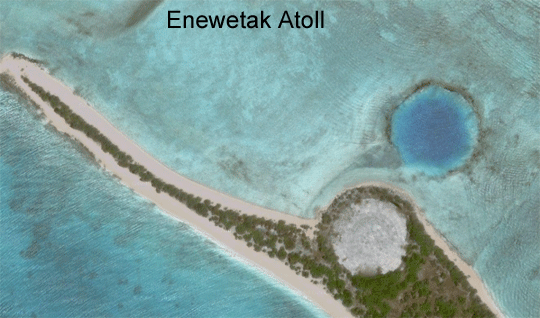
A CONCRETE dome filled with nuclear waste could be leaking into the ocean, with experts urging the US government to act urgently as humans “cannot wait”.By SEAN MARTIN, Wed, Oct 16, 2019 |Enewetak Atoll is a series of small islands in the South Pacific which the US government used to test its nuclear weapons following World War 2 from 1948 to 1958. Over a ten year period, 30 megatons of weapons – equivalent to 2,000 Hiroshima bombs – were dropped on the islands during the Cold War. When the US had finished its testing, it built a concrete barrier known as the Runit dome to store the debris of 43 nuclear explosions in a clean-up operation lasting from 1977 to 1980.
However, employees who worked on the clean-up believe the dome could be leaking radioactive waste into to the ocean.
In response, the US has invested $1,689,000 (£1.32m) in a mission to analyse the dome, but there are claims that it could be too late as the waste could have seeped into the ocean, which would have an effect on the marine ecosystem.
Paul Griego, a former radiochemist who worked on the cleanup operation from June 1977 to October 1978, said: “We need the very same funding and for the very same analysis – the dome can wait for radiochemical analysis but we are human and we cannot wait.
While the US government said staff were subjected to just low-levels of radiation and wore all the necessary protective gear, Mr Griego has said this was not the case. The 62-year old added: “We are certain we have the very same radionuclides in our bodies that that would be found in the dome. “We were bombarded with radiation while building the dome, we drank the contaminated water, inhaled the dust-filled air, absorbed contaminates though our skin, ate the fish we caught and more. “We are not only denied the diagnostic resources, we are denied healthcare to cover our radiation and toxin-related illnesses.
“The government’s refusal to provide radiochemical resources is malicious and feeds into the status quo. “It places the burden of proof of an illness on the individual rather than the moral responsibility of our government.” The mission saw more than 1,000 employees tasked with collecting contaminated soil and radioactive debris, which was then mixed with concrete and placed in a nuclear test crater, which was sealed in a concrete dome.
However, people who were on the scene said that the dome was not lined with concrete, and warn it could be seeping into the ocean. For this reason, the US will embark on an 18 month mission to analyse the dome to see if needs to be reinforced or perhaps completely removed. Doug Domenech, Assistant US Secretary of the Interior for Insular and International Affairs, said: “The US Departments of the Interior and Energy are partnering on this important analysis of Runit Dome so that we can be responsive to both Congress and concerns expressed by the Enewetak community in the Marshall Islands.”
|
|
1 This Month

Protect Sazan Island from the Trump family! https://secure.avaaz.org/campaign/en/protect_sazan_island_from_the_trump_family_loc/?bqFCVab&v=174511&cl=22707147157&_checksum=5e9dde668860e8231c33699735e16a1fbf22ab2cb01da50c999fe8732b9775ef&utm_source=email&utm_medium=blast_email&utm_campaign=174511
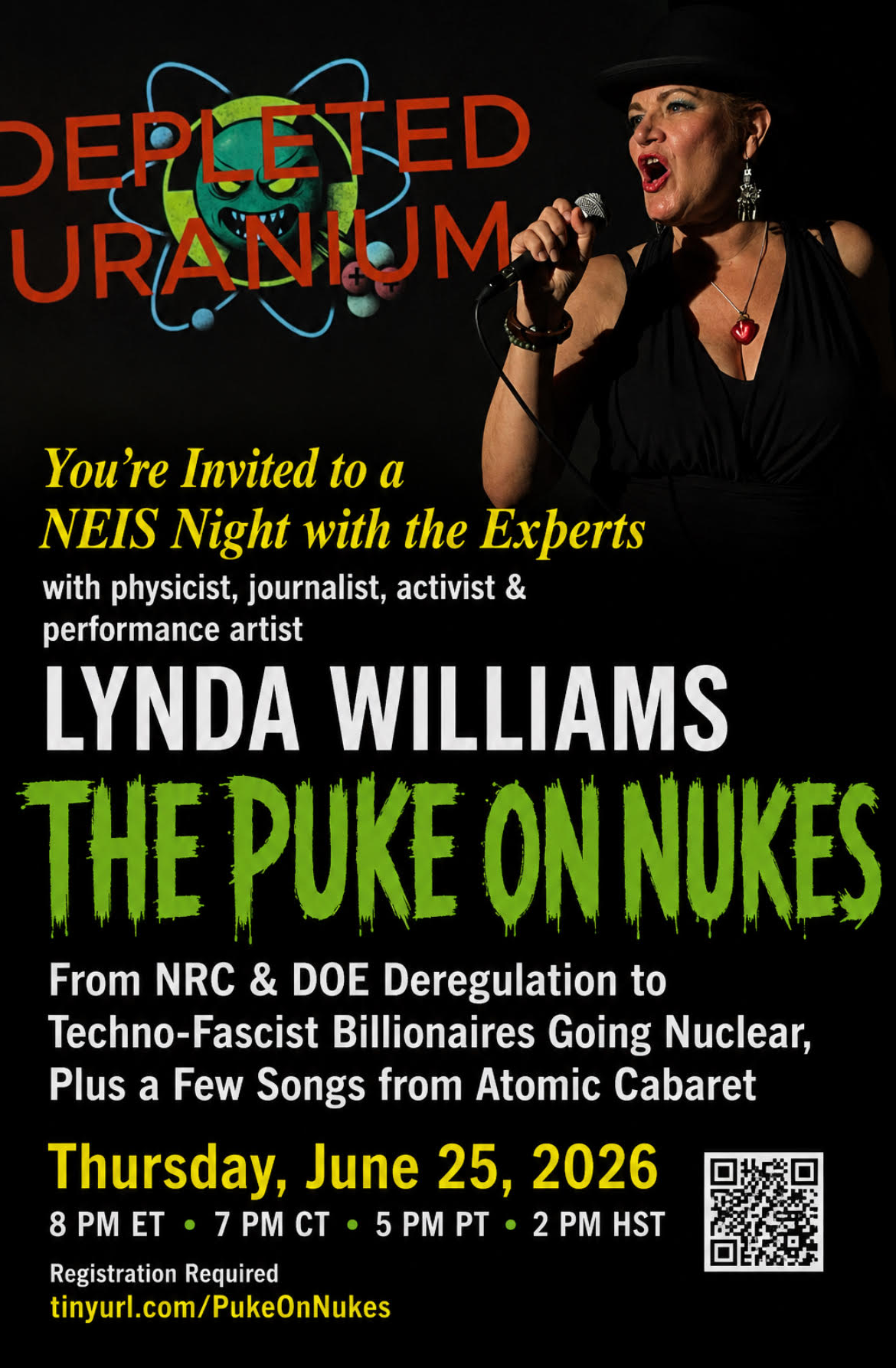
25 June- THE PUKE ON NUKES
Thursday, June 25, 2026
7pm Central Time (8pm ET, 6pm MT, 5pm PT) UTC – 5
From NRC & DOE Deregulation to Techno-Fascist Billionaires Going Nuclear, Plus a Few Songs from Atomic Cabaret REGISTER
26 June – Radiation Trainwreck at the NRC / Join the Protect Better Campaign – https://us02web.zoom.us/meeting/register/4ZlZ5_qLSHGiLSCg8FF6Bg#/registration

Cuba Is Not a Failed State – It Is a Besieged State
PETITION: “Global Appeal to Endorse Palestinian Right of Return of Refugees”
To see nuclear-related stories in greater depth and intensity – go to https://nuclearinformation.wordpress.com
-
Archives
- June 2026 (142)
- May 2026 (306)
- April 2026 (356)
- March 2026 (251)
- February 2026 (268)
- January 2026 (308)
- December 2025 (358)
- November 2025 (359)
- October 2025 (376)
- September 2025 (257)
- August 2025 (319)
- July 2025 (230)
-
Categories
- 1
- 1 NUCLEAR ISSUES
- business and costs
- climate change
- culture and arts
- ENERGY
- environment
- health
- history
- indigenous issues
- Legal
- marketing of nuclear
- media
- opposition to nuclear
- PERSONAL STORIES
- politics
- politics international
- Religion and ethics
- safety
- secrets,lies and civil liberties
- spinbuster
- technology
- Uranium
- wastes
- weapons and war
- Women
- 2 WORLD
- ACTION
- AFRICA
- Atrocities
- AUSTRALIA
- Christina's notes
- Christina's themes
- culture and arts
- Events
- Fuk 2022
- Fuk 2023
- Fukushima 2017
- Fukushima 2018
- fukushima 2019
- Fukushima 2020
- Fukushima 2021
- general
- global warming
- Humour (God we need it)
- Nuclear
- RARE EARTHS
- Reference
- resources – print
- Resources -audiovicual
- Weekly Newsletter
- World
- World Nuclear
- YouTube
-
RSS
Entries RSS
Comments RSS
 nuclear-news