The danger in deploying new US nuclear warhead on a submarine
|
Deployment of new US nuclear warhead on submarine a dangerous step, critics say
First submarine to go on patrol armed with the W76-2 warhead makes a nuclear launch more likely, arm control advocates warn, Guardian Julian Borger in WashingtonThu 30 Jan 2020 The US has deployed its first low-yield Trident nuclear warhead on a submarine that is currently patrolling the Atlantic Ocean, it has been reported, in what arms control advocates warn is a dangerous step towards making a nuclear launch more likely. According to the Federation of American Scientists, the USS Tennessee – which left port in Georgia at the end of last year – is the first submarine to go on patrol armed with the W76-2 warhead, commissioned by Donald Trump two years ago. It has an explosive yield of five kilotons, a third of the power of the “Little Boy” bomb dropped on Hiroshima and considerably lower than the 90- and 455-kiloton warheads on other US submarine-launched ballistic missiles. Advocates of W76-2 argued that the US had no effective deterrent against Russian tactical weapons because Moscow assumed Washington would not risk using the overwhelming power of its intercontinental ballistic missiles in response, for fear of escalating from a regional conflict to a civilian-destroying war. Critics of the warhead say it accelerates a drift towards thinking of nuclear weapons as a means to fight and win wars, rather than as purely a deterrent of last resort. And the fielding of a tactical nuclear weapon, they warn, gives US political and military leaders a dangerous new option in confronting adversaries other than Russia…… https://www.theguardian.com/world/2020/jan/29/us-submarine-trident-nuclear-warhead-patrols-atlantic-ocean The Trump administration’s nuclear posture review (NPR) in February 2018, portrays this warhead as a counter to a perceived Russian threat to use its own “tactical” nuclear weapons to win a quick victory on the battlefield. |
|
Does the USA arsenal REALLY need costly new plutonium weapons cores?
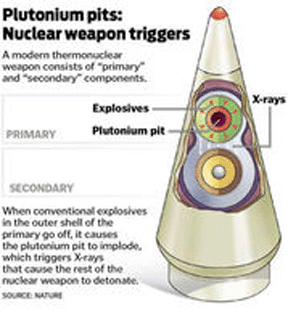 An Unanswered Question at the Heart of the U.S.’s Nuclear Arsenal. Nobody knows how long the plutonium “pits” in the cores of bombs last, and the answer could cost—or save—billions https://blogs.scientificamerican.com/observations/an-unanswered-question-at-the-heart-of-americas-nuclear-arsenal/, By Stephen Young on January 28, 2020 An Unanswered Question at the Heart of the U.S.’s Nuclear Arsenal. Nobody knows how long the plutonium “pits” in the cores of bombs last, and the answer could cost—or save—billions https://blogs.scientificamerican.com/observations/an-unanswered-question-at-the-heart-of-americas-nuclear-arsenal/, By Stephen Young on January 28, 2020
The United States has an arsenal of some 3,800 nuclear weapons, about half of which are deployed, with the rest in storage. The Department of Energy’s National Nuclear Security Agency (NNSA) and the nuclear weapons laboratories it oversees are concerned that the performance of the weapons will degrade over time. Most of the components can be—and are being—replaced with new versions, so the main concern is the behavior of aging plutonium “pits” at the core of all U.S. weapons. Plutonium essentially doesn’t exist in nature but is produced in nuclear reactors. It was first produced during World War II, and the U.S. government didn’t care about pit aging because it constantly replaced pits with newly built ones as it upgraded its arsenal during the Cold War. So, no one in the weapons labs knew what the lifetime of a pit was. Instead, the NNSA simply assumed it was 45–60 years. And during the Cold War, the U.S. produced a lot of pits, tens of thousands. It stopped in 1989 when the production plant was shut down by the FBI and the EPA due to pervasive environmental damage. Los Alamos National Laboratory in New Mexico manufactured 31 pits between 2007 and 2013, but none since. That means virtually all the pits in today’s arsenal were made 30–40 years ago, which would have meant serious problems for the stockpile starting in 2025 if the NNSA’s assumption were correct. So, what is the lifetime of a pit? In 2005, Congress tasked JASON, the independent science advisory group, with answering this question. Their groundbreaking 2007 report examined the data the weapons labs had produced and concluded that most weapons system types in the stockpile “have credible minimum [emphasis added] lifetimes in excess of 100 years as regards aging of plutonium.” Moreover, this minimum age would also apply to the remaining types once straightforward adjustments were made. This finding significantly reduced pressure to resume large-scale production of pits for some time. Last year, Congress—led by Sen. Dianne Feinstein (D–Calif.)—sensibly asked JASON to update its earlier work. Unfortunately, JASON’s new, very brief “letter report” contains zero new information on pit lifetimes. What went wrong? Did JASON fail to do its job? Or was the group unable to do it? When asked this question, an NNSA official confirmed that it was a lack of data, not a failure by JASON, that prevented an update on the 2007 estimates. JASON’s report states: “A focused program of experiments, theory, and simulations is required to determine the timescales over which Pu [plutonium] aging may lead to unacceptable degradation in primary performance.” JASON lays the blame for this failure squarely on the NNSA, declaring that “in general, studies on Pu aging and its impacts on the performance of nuclear-weapon primaries have not been sufficiently prioritized over the past decade.” It seems entirely possible that this was not an oversight on the part of NNSA but reflects that the agency does not want to know the answer. The NNSA wants to produce new types of warheads, not just refurbish existing ones. That requires the ability to produce new pits in bulk. If minimum pit lifetimes were 200 years, then there would be no need for new pit production to maintain existing weapons. The cost of pit production would then be entirely attributed to new weapons and the price tag for those would increase substantially, making it less likely that Congress will give NNSA the go-ahead. Instead of studying pit lifetimes, the NNSA has focused on major upgrades for three existing nuclear weapons, a new uranium processing facility and, notably, one all-new nuclear weapon—the first since the end of the Cold War—that will require production of new plutonium pits. And, not coincidentally, the Trump administration and many in Congress are pushing a plan to produce at least 80 pits per year by 2030. The rationale they offer is disarmingly simple: if the U.S. has roughly 4,000 nuclear weapons and pits last 100 years, then the NNSA needs to produce 80 pits per year starting in 2030 to be able to replace the entire stockpile by 2080. But what if plutonium pits last longer than 100 years? Deferring production of new pits would significantly reduce the stress on the NNSA’s infrastructure, already struggling under a workload many times heavier than at any time since the end of the Cold War. It would also save tens of billions of dollars. However, the all-new warhead, known as the W87-1, would need new plutonium pits. The NNSA estimates the W87-1 will cost $11–16 billion, not including the money needed to produce the new pits, which adds another $14–28 billion. Moreover, another recent independent study mandated by Congress found that the current timeline and cost estimate for pit production are not realistic. The May 2019 study by the Institute for Defense Analyses concluded that the 80 pits per year goal was “potentially achievable given sufficient time, resources, and management focus, although not on the schedules or budgets currently forecasted…. Put more sharply, eventual success of the strategy to reconstitute plutonium pit production is far from certain.” (Emphasis added.) In other words, producing 80 pits per year may be possible, but it will not happen by 2030 and it will cost more than current projections. This makes an updated estimate on pit lifetime even more important. Congress should put the NNSA’S feet to the fire. Sen. Feinstein, sponsor of the JASON study, is the ranking member of the Senate committee that oversees the NNSA. She should push the committee to direct the NNSA to undertake the “focused program” that JASON recommends, now. The answer will determine whether the U.S. needs to spend tens of billions of dollars in a rush to produce pits, or whether it can sensibly and safely postpone that decision. |
|
|
Doomsday clock now closest ever to midnight, due to climate and nuclear dangers
|
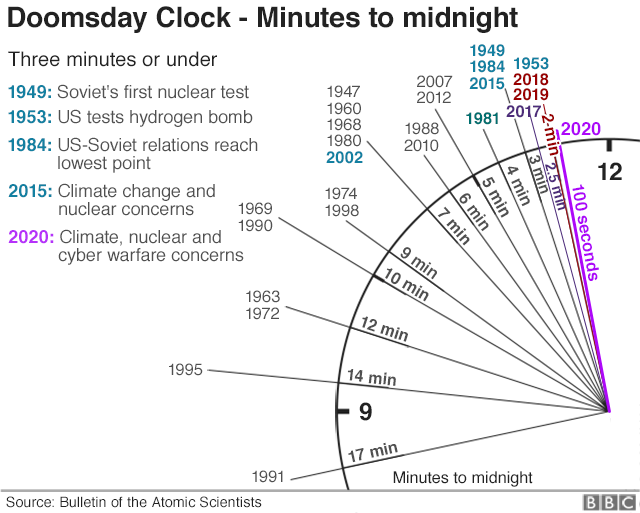
Doomsday Clock nears apocalypse over climate and nuclear fears, BBC, 23 Jan 2020, The symbolic Doomsday Clock, which indicates how close our planet is to complete annihilation, is now only 100 seconds away from midnight.The Bulletin of the Atomic Scientists (BAS) said on Thursday that the change was made due to nuclear proliferation, failure to tackle climate change and “cyber-based disinformation”.
The clock now stands at its closest to doomsday since it began ticking. Last year the clock was set at two minutes to midnight – midnight symbolises the end of the world – the same place it was wound to in 2018…….. The idea began in 1947 to warn humanity of the dangers of nuclear war……….. https://www.bbc.com/news/world-us-canada-51213185 |
|
USA’s National Nuclear Security Administration (NNSA) spurns environmental assessment for plutonium cores
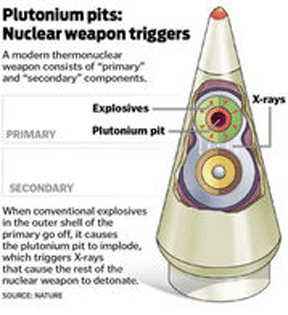
 NNSA Says No EIS Needed to Expand LANL Pit Production, http://nuclearactive.org/ January 24th, 2020 The Department of Energy’s semi-autonomous agency, the National Nuclear Security Administration (NNSA), has determined that a full environmental impact statement is not needed to increase the number of triggers for nuclear weapons manufactured at Los Alamos National Laboratory (LANL) by 50 percent – from 20 to 30. Since 1997, DOE has limited production to 20 triggers, or plutonium pits, per year. Nevertheless, since that time, LANL has not produced anything near 20 pits per year – the most in one year was six. Safety and seismic issues have shut down production for years. Even so, LANL is the only U.S. location for such work. Critics oppose the decision and have stated that litigation may result. NNSA Says No EIS Needed to Expand LANL Pit Production, http://nuclearactive.org/ January 24th, 2020 The Department of Energy’s semi-autonomous agency, the National Nuclear Security Administration (NNSA), has determined that a full environmental impact statement is not needed to increase the number of triggers for nuclear weapons manufactured at Los Alamos National Laboratory (LANL) by 50 percent – from 20 to 30. Since 1997, DOE has limited production to 20 triggers, or plutonium pits, per year. Nevertheless, since that time, LANL has not produced anything near 20 pits per year – the most in one year was six. Safety and seismic issues have shut down production for years. Even so, LANL is the only U.S. location for such work. Critics oppose the decision and have stated that litigation may result.
In 2018, the current administration determined that the U.S. would increase pit production at LANL and begin production at the Savannah River Site, located in South Carolina. Savannah River has never produced plutonium pits, let alone the planned 50 per year. For Savannah River, NNSA has determined that it would follow the National Environmental Policy Act (NEPA) and issue a full environmental impact statement for public review and comment. The federal agencies have refused to conduct a programmatic environmental impact statement for operations at both facilities, including the transportation of nuclear materials between them. For LANL, NNSA said it would produce a supplemental analysis to the 2008 environmental impact statement. A supplemental analysis may not address the impacts of the 2011 Las Conchas fire, increased hexavalent chromium in the regional aquifer, and increased seismic danger on the Pajarito Plateau, which LANL occupies. The 1997 decision to limit the number of pits to 20 is the result of citizen litigation. The Natural Resources Defense Council (NRDC), based in Washington, DC, represented 39 citizens groups from around the country against DOE. CCNS was one of the citizen plaintiffs, along with Tri-Valley Communities Against a Radioactive Environment, or Tri-Valley CARES, located in Livermore, California, where the Lawrence Livermore National Laboratory, LANL’s “sister” nuclear weapons laboratory, is located. Marylia Kelley, Executive Director of Tri-Valley CAREs, said, “NNSA’s refusal to complete programmatic environmental review before plunging ahead with plans to more than quadruple the production authorization for plutonium bomb cores flies in the face of our country’s foundational environmental law, the [NEPA], and a standing federal court order mandating that the government conduct such a review. The order was obtained in prior litigation by [NRDC] on behalf of itself, Tri-Valley CAREs, and additional plaintiffs. Today, I find myself shocked but not surprised that NNSA would so flagrantly flout the law. [] My group stands ready to uphold NEPA and the specific court order.” http://www.trivalleycares.org/ For more information, please see the following documents [links provided by Nuclear Watch New Mexico]: NNSA’s Federal Register Notice of Availability for the final Supplement Analysis is available at https://www.govinfo.gov/content/pkg/FR-2020-01-08/pdf/2020-00102.pdf It provides succinct background. NNSA’s final Supplement Analysis is available at https://www.energy.gov/sites/prod/files/2020/01/f70/final-supplement-analysis-eis-0236-s4-sa-02-complex-transformation-12-2019.pdf The 1998 court order that requires DOE to prepare a supplemental PEIS when it plans to produce more than 80 pits per year is available as Natural Resources Defense Council v. Pena, 20 F.Supp.2d 45, 50 (D.D.C. 1998), https://law.justia.com/cases/federal/district-courts/FSupp2/20/45/2423390/ |
|
No clear explanation of USA’s rush to produce more plutonium cores for nuclear weapons
The U.S. is Boosting Production of Nuclear Bomb Cores (For More Nuclear Weapons) https://nationalinterest.org/blog/buzz/us-boosting-production-nuclear-bomb-cores-more-nuclear-weapons-115826 Thanks, arms race. by Michael Peck, 22 Jan 2020,
In another sign that the nuclear arms race is heating up, the U.S. is ramping up production of nuclear bomb cores.
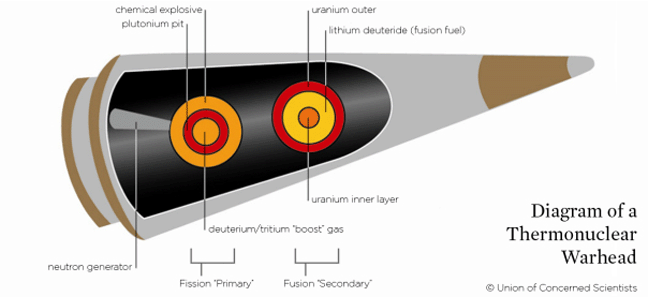
The National Nuclear Security Administration (NNSA) has announced that it plans to increase the production of plutonium pits to 80 per year. The grapefruit-sized pits contain the fissile material that give nuclear weapons such tremendous power.
Production will center on the Mixed-Oxide Fuel Fabrication Facility at Savannah River site in North Carolina, which would be modified to manufacture at least 50 pits per year, and Los Alamos National Laboratory in New Mexico, which would generate at least 30, by 2030.
America’s nuclear weapons cores are aging, with some pits dating back to the 1970s, leading to concerns about the reliability of the U.S. nuclear stockpile.
“The U.S. lost its ability to produce pits in large numbers in 1989, when the Rocky Flats Plant near Denver, Colorado, was shut down after the Federal Bureau of Investigation and Environmental Protection Agency investigated environmental violations at the site,” noted Physics Today magazine in 2018. Up to 1,200 pits per year had been manufactured there.
“Since then, only 30 pits for weapons have been fabricated—all at LANL [Los Alamos National Laboratory], the sole U.S. facility with production capability. Weapons-quality pit production ceased in 2012, when LANL began modernizing its 40-year-old facilities, although several practice pits have since been fabricated. The oldest pits in the stockpile—which now numbers 3,882, according to DOE’s National Nuclear Security Administration (NNSA)—date to 1978.”
In its 2018 Nuclear Policy Review, the Trump administration called for 80 new plutonium pits per year. Congress has also allocated large sums, with $4.7 billion alone allocated in FY 2019 for maintenance and life extension of the nuclear stockpile. The NNSA says it is legally mandated to ensure a capacity of at least 80 pits per year.
Though the production of nuclear cores has been an issue for years, a looming U.S.-Russia arms race makes the situation even more sensitive. Russia is fielding a new generation of strategic nuclear weapons, including a hypersonic nuclear-armed glider and an air-launched ballistic missile. The Trump administration has withdrawn from the 1987 Intermediate-Range Nuclear Forces treaty with Russia, alleging Russian violations, leading to fears that a new competition will beget the return of nuclear-armed, medium-range ballistic and cruise missiles.
Anti-nuclear groups are furious. “Expanded pit production will cost at least $43 billion over the next 30 years,” argues the Natural Resources Defense Council and other groups.Yet the Defense Department and NNSA have never explained why expanded plutonium pit production is necessary. More than 15,000 plutonium pits are stored at NNSA’s Pantex Plant near Amarillo, Texas. Independent experts have concluded that plutonium pits have reliable lifetimes of at least 100 years (the average pit age is less than 40 years). Crucially, there is no pit production scheduled to maintain the safety and reliability of the existing nuclear weapons stockpile. Instead, proposed future pit production is for speculative new-design nuclear weapons, but those designs have been canceled.”
Introducing a new generation of nuclear weapons “could adversely impact national security because newly produced plutonium pits cannot be full-scale tested without violating the global nuclear weapons testing moratorium.”
Michael Peck is a contributing writer for the National Interest. He can be found on Twitter and Facebook.
”Plutonium pits” not only unnecessary, but also very dangerous for the environment
“They want as much dirty warhead manufacturing as possible for Los Alamos, and they don’t want anybody to know or discuss the predictable problems and impacts on our communities and environment,”
|
Lawmakers assured review of nuclear weapons work to be open https://apnews.com/5d500281694f4bbae30dc5356d18244d
By SUSAN MONTOYA BRYAN, ALBUQUERQUE, N.M. (AP) 22 Jan 2020 — A review of a proposal to ramp up production of key components for the United States’ nuclear arsenal will be open and transparent, according to members of New Mexico’s congressional delegation.
Sens. Tom Udall and Martin Heinrich and Rep. Ben Ray Lujan said in a joint statement to The Associated Press that they received assurances from federal officials that the review process also will include an opportunity for public comment. The Democrats were briefed last week by federal officials after the National Nuclear Security Administration announced it did not need to do a more expansive nationwide review of the impacts of building plutonium cores at federal installations in New Mexico and South Carolina. As supporters of bringing more defense-related spending to New Mexico, the lawmakers initially refrained from commenting on whether they would support an expanded review, saying they needed more information. Watchdog groups have argued that federal officials are violating national environmental laws by not doing a more in-depth analysis. The lawmakers said as the U.S. Energy Department, Los Alamos National Laboratory and its contractors move forward with plutonium core production, they have a responsibility to take precautions to protect employees, the community and the environment. “Furthermore, we expect that the Defense Nuclear Facilities Safety Board will continue to conduct thorough oversight of lab plans and operations and their recommendations will be taken seriously by DOE and Los Alamos leadership,” the lawmakers said in the statement. Watchdogs say the federal government already has tried to limit the oversight of the safety board and that a site-specific review at Los Alamos lab would fall short of what’s needed to understand the affects of such a major undertaking. They also point to the lab’s history of safety and security lapses. Greg Mello of the Albuquerque-based Los Alamos Study Group said he’s disappointed the delegation “wants to remain the dark about the environmental impacts” of what he likened to a new Rocky Flats-type plutonium warhead factory in northern New Mexico. With a long history of leaks, fires and environmental violations, the Rocky Flats facility in Colorado underwent a $7 billion cleanup that was finished in 2005. “They want as much dirty warhead manufacturing as possible for Los Alamos, and they don’t want anybody to know or discuss the predictable problems and impacts on our communities and environment,” Mello said. Watchdogs also have concerns about the waste that would be generated by plutonium core production, saying it could take up valuable space at the Waste Isolation Pilot Plant in southern New Mexico, where the federal government sends tons of Cold War-era waste from decades of bomb-making and nuclear research as part of a multibillion-dollar cleanup effort. “Our politicos should explicitly support nationwide public review of expanded plutonium pit production instead of condoning NNSA’s stove-piped approach that is designed to suppress citizen opposition,” said Jay Coghlan, executive director of Nuclear Watch New Mexico. A draft supplemental analysis of the work planned for Los Alamos is expected to be released in the coming months. However, a few of the concerned groups are considering legal action to force a broader analysis. Federal officials have set a deadline of 2030 for increased core production, with work being split between Los Alamos lab and the Savannah River Site in South Carolina. At stake are jobs and billions of dollars to revamp existing buildings or construct new factories. The mission of producing the plutonium cores has been based at Los Alamos for years but none have been made since 2011 as the lab has been dogged by a string of safety problems and concerns about a lack of accountability. Officials for years have pushed for production to resume, saying the U.S. needs to ensure the stability and reliance of its nuclear arsenal. The National Nuclear Security Administration has said most of the cores in the stockpile were produced in the 1970s and 1980s. |
|
Iran will never seek nuclear weapons – P.M Rouhani
|
Iran’s Rouhani: nation ‘will never seek nuclear weapons’, with or without 2015 deal in place, https://www.france24.com/en/20200122-iran-s-rouhani-nation-will-never-seek-nuclear-weapons-2015-nuclear-deal-europe-washington Iran will never seek nuclear weapons with or without a nuclear deal, Iranian President Hassan Rouhani said on Wednesday, calling on the European powers to avoid Washington’s mistake of violating Tehran’s 2015 nuclear deal with major powers.
We have never sought nuclear weapons … With or without the nuclear deal we will never seek nuclear weapons … The European powers will be responsible for the consequences of violating the pact,” said Rouhani, according to his website President.Ir. In reaction to Washington’s withdrawal from the deal in 2018 and the reimposition of sanctions, Iran has gradually rolled back on its commitments. Rouhani said Iran remained committed to the deal and could reverse its steps away from compliance if other parties fulfilled their obligations. |
|
History of U.S. missiles testing atomic, bacterial and viral weapons in Utah
 from anonymous contributor, 22 Jan 2020, Some of What The USA Military , Corporations and government did to us on top of detonating several open air nuclear bombs on us.
My government had a missile base 60 miles from Uranium and downwinder hell in Utah. My governemt also detonated four atomic bombs under the river that went through my town, in the llate 1960s..
My government and military contractors launched hundreds of single and multistage missiles from Green River Utah to White Sands new mexico from 1965 to 1970. The missiles went to white sands New Mexico, which is approximately 900 miles from Green River Utah. Their trajectory took them over southern Utah National parks, the navajo, zuni, ute hopi and pueblo nativ,e reservations, and most of north and central New Mexico. White sands New Mexico is 925 miles from Green river utah. White sands new mexico is 50 miles from alamagordo New Mexico . Alamagorgo is where the fist Atomic bomb, in the world was detonated. The cold war, multibillion dollar Missile project tested single and multistage rockets and biological warfare payloads.
They tested payloads
The Green-White sands missile project was to test missile paylods over the south west usa. You can find sections of missiles that failed in the 900 mile stretch, from Green ricver to white sands nm. They launched hundreds of missiles and rockets Some of the missile-rockets failed and crashed into the desert, long before reaching their south central New Mexico destination clasw to the mexico usa border. There are missile carcasses and stages from southern utah to in the Canuyonlands national Park, The Grand Gulch National Nation Monument, in The Four Corners Area of the USA where Utah, Colorado and Arizona intersect. Missile parts and from failed missiles can also be found in the New Mexico and Utah Navajo reservations. There detritus of missiles can found by Farminton New Mexico , west of Santa Fe New Mexico, east of demming New mexico and by Socorro nm . The initial stages of multistage rockets are mostly in utah.
The military and government tested several biological weapon payloads, in the missiles-rockets that went from Utah to white sands new mexico.The army , and corporate contractors, put Biological Warfare payloads on missiles. with viruses and bacteria in them. They tested the a weaponized version of the Hanta Virus. They tested Hearty bacterial spores, like anthrax as well. They launched the biological warfare payloads with viruses and bacteria in special mediums to test the stability of the most Hearty virus and bacterial spore-systems in missile carrier systems.
The biological warfare medium-containing–payloads were on rockets that went from Green River Utah to White sands new mexico from 1965 to 1970.
Hannta virus did not exist in the United States of America in Humans, until 1990. It was weaponized by the United States government and corporations in the 1960s. The first Hanta Virus casualties recorded in the USA were a family of Navajos in New Mexico, in 1992. Hanta virus is has now apread to mice vectors in all parts of the United States of america. It is epidemic in the USA . I know because I once worked for an agency that treated and tracked it.
The 1993 Four Corners hantavirus outbreak was an outbreak of hantavirus that caused the first known human cases of hantavirus disease in the United States. It occurred within the Four Corners region – the geographic intersection of the U.S. states of Utah, Colorado, New Mexico, and Arizona – of the southwestern part of the country in the spring of 1993. This region is largely occupied by Native American tribal lands, including the Hopi, Ute, Zuni, and Navajo reservations, from which many of the cases were reported.
“The Discovery of Hantaan Virus: Comparative Biology and …
by KM Johnson · 2004 · Cited by 10 · Related articles
Nov 1, 2004 · They became infected by tissues of antigen-positive wild mice of that single species. … Dr. Lee named it “Hantaan,” after a small river near the border between the 2 Koreas, where human infection was isolated and endemic in the 1950s”
FROM “Brief Histories of Three Federal Military Installations in Utah: Kearns Army Air Base, Hurricane Mesa, and Green River Test Complex” (PDF). Utah Historical Quarterly. Utah State Historical Society. 34 (2). Spring 1966. Archived from the original (PDF) on October 29, 2013. Retrieved September 12, 2013. More than 100 employees of the [Atlantic Research]
The Utah Launch Complex was a Cold War military subinstallation of White Sands Missile Range for USAF and US Army rocket launches. In addition to firing Pershing missiles, the complex launched Athena RTV missiles with subscale warheads of the Advanced Ballistic Re-entry System to reentry speeds and impact at the New Mexico range. From 1964 to 1975 there were 244 Green River launches, including 141 Athena launches and a Pershing to 281 kilometers altitude. “Utah State Route 19 runs through the Green River Launch Complex, which is south of the town and eponym of Green River.”
Report shows that most young adults fear a nuclear attack this decade
 More than half the world’s millennials fear a nuclear attack this decade More than half the world’s millennials fear a nuclear attack this decadeThe International Committee of the Red Cross released an astounding report. Vox, By Alex Ward@AlexWardVoxalex.ward@vox.com Jan 20, 2020 A majority of millennials around the world believe it’s more likely than not that a nuclear attack will happen sometime in the next 10 years — a sign that younger adults’ views on global affairs is exceedingly bleak. The International Committee of the Red Cross, a worldwide humanitarian organization, surveyed 16,000 millennials — adults between the ages of 20 and 35 — in 16 countries and territories last year: Afghanistan, Colombia, France, Indonesia, Israel, Malaysia, Mexico, Nigeria, Palestinian Territories, Russia, South Africa, Syria, Switzerland, the United Kingdom, Ukraine, and the United States. Half of those nations are experiencing conflict right now, while the other half are fortunately in peace. Based on the results released last week, this demographic is worried about what the future holds. “More than half of millennials — 54 percent — believe it is likely that a nuclear attack will occur in the next decade,” reads the report. Those questioned in Malaysia are the most likely to fear a nuclear device going off soon, while Syrians are the least likely to worry about that. However, respondents said that nuclear weapons were the least concerning of the 12 different issues they were asked to rank, with corruption topping the list followed by unemployment and increasing poverty. Still, the fear of a nuclear attack seems to be a trend. A January 2018 World Economic Forum survey of 1,000 leaders from government, business, and other industries, for example, identified nuclear war as a top threat. The worldwide shudder is understandable. The chance of a nuclear conflict between the US and North Korea isn’t entirely gone. India and Pakistan, two nuclear-armed enemies, could rekindle their decades-long squabble at any time. And the US and Russia — the world’s foremost nuclear powers — have had warheads pointed at each other since the earliest days of the Cold War……… https://www.vox.com/2020/1/20/21070621/millennials-survey-nuclear-world-war-3-red-cross |
|
U.S. cities near nuclear weapons stations realise they are targets
 Cities in the crosshairs are pushing back against nuclear weapons
“We forget that all power is local. And by forgetting to act locally, we are giving away all the power.” Salon.com JON LETMAN, JANUARY 19, 2020 This article originally appeared on Truthout. Two years after a mistakenly sent text alert warning of an inbound ballistic missile threat caused widespread panic and confusion across Hawaii, cities remain potential targets and nuclear jitters continue to grow around the world.
Panicked responses to the erroneous text alert — which read “BALLISTIC MISSILE THREAT INBOUND TO HAWAII. SEEK IMMEDIATE SHELTER. THIS IS NOT A DRILL” and was accidentally issued on January 13, 2018, to Hawaii residents via the Emergency Alert System and Commercial Mobile Alert System — revealed how believably close nuclear fears hover to our everyday life
And now two years later, at the beginning of 2020, those fears have grown even stronger following a year in which talks aimed at denuclearizing the Korean peninsula faltered, fears of a nuclear clash between India and Pakistan spiked, and Russia announced it had deployed its first hypersonic nuclear-capable missiles.
Meanwhile, the U.S. abandoned the Intermediate Nuclear Forces treaty and continued to undermine the Joint Comprehensive Plan of Action (Iran nuclear deal) after it unilaterally withdrew in 2018. Now, many fear the U.S. will likely withdraw from the Open Skies and New START treaties.
As the U.S. modernizes its nuclear arsenal at a cost that could exceed $1.5 trillion and the other eight nuclear armed states upgrade their own nuclear weapons, ordinary citizens and the leaders of cities, towns, and municipalities around the world are resisting nuclear weapons through efforts like the Back from the Brink campaign and the International Campaign to Abolish Nuclear Weapons’ #ICANSave Cities appeal.
Across the U.S., cities like Seattle, Albuquerque, Colorado Springs and others are located near key military installations, which some see as a good reason to oppose nuclear policies. Today, more than 40 U.S. cities including, Philadelphia, Salt Lake City, Los Angeles and Honolulu have adopted a Back from the Brink resolution, which puts forward five policy goals aimed at reducing the threat of nuclear war: no first use of nuclear weapons, end sole authority to launch a nuclear attack, take U.S. nuclear weapons off hair-trigger alert, cancel modernization/replacement of the U.S. nuclear arsenal, and ultimately seek the elimination of nuclear weapons.
Back from the Brink aims to prompt cities, counties, and local governments to pressure Congress and the Trump administration to adopt the above five points.
Dozens of smaller cities from Portsmouth, New Hampshire, to Arcata, California, have adopted the resolution, as have local and state governments across the U.S. More than a dozen more cities (Little Rock, Chicago, Madison) and states (New York, Vermont, Washington) have proposed resolutions.
In a joint article, three council members representing Washington, D.C., Baltimore, and Montgomery County, Maryland, wrote, “As leaders of the Greater Washington area, home to the seat of our federal government and headquarters of its military — we are particularly at risk. We are living in the crosshairs of America’s enemies, both hostile governments and terrorists.” That risk, and the financial costs associated with nuclear weapons, led all three communities to adopt Back from the Brink resolutions…………
Based in Geneva, Switzerland, the International Campaign to Abolish Nuclear Weapons (ICAN) launched its #ICANSAVE cities appeal in 2018, calling on cities large and small around the world to formally support the 2017 U.N. Treaty on the Prohibition of Nuclear Weapons. The ban treaty, currently ratified by 34 nations, will enter into legal force once 50 nations have done so.
ICAN Executive Director Beatrice Fihn says that while, for many people, nuclear weapons can feel abstract and theoretical, it’s important to remain focused on their fundamental purpose.
“What these weapons really are made for is to wipe out whole cities. These are not precision guidance that will take out a specific military facility,” Fihn told Truthout. “We are so obsessed by staring at these world leaders, we forget that all power is local. And by forgetting to act locally, we are giving away all the power.”……….. https://www.salon.com/2020/01/19/cities-in-the-crosshairs-are-pushing-back-against-nuclear-weapons_partner/
Belgium lawmakers narrowly agree to keep U.S. nuclear weapons, Belgian public overwhelmingly opposes this
Belgium debates phase-out of US nuclear weapons on its soil, By Alexandra Brzozowski | EURACTIV.com Jan 17, 2020 It’s one of Belgium’s worst kept secrets. Lawmakers on Thursday (16 January) narrowly rejected a resolution asking for the removal of US nuclear weapons stationed in the country and joining the UN Treaty on the Prohibition of Nuclear Weapons (TPNW).
66 MPs voted in favour of the resolution while 74 rejected it.
Those in favour included the Socialists, Greens, centrists (cdH), the workers party (PVDA) and the francophone party DéFI. The 74 that voted against included the nationalist Flemish party N-VA, the Flemish Christian Democrats (CD&V), the far-right Vlaams Belang and both Flemish and francophone Liberals.
Just before the Christmas recess, the parliament’s Foreign Affairs Committee approved a motion calling for the withdrawal of nuclear weapons from Belgian territory and the accession of Belgium to the International Treaty on the Prohibition of Nuclear Weapons. The resolution was led by Flemish socialist John Crombez (sp.a).
With this resolution, the chamber requested the Belgian government “to draw up, as soon as possible, a roadmap aiming at the withdrawal of nuclear weapons on Belgian territory”.
The December resolution was voted in the absence of two liberal MPs, even though the text was already watered down.
According to Flemish daily De Morgen, the American ambassador to Belgium was “particularly worried” about the resolution before Thursday’s vote and a number of MPs were approached by the US embassy for a discussion.
The controversy was sparked by a debate to replace the US-made F-16 fighter aircraft in the Belgian army with American F-35s, a more advanced plane capable of carrying nuclear weapons…….
Although the Belgian government had so far adopted a policy of “to neither confirm, nor deny” their presence on Belgian soil, military officials have called it one of Belgium’s “most poorly kept secrets”.
According to De Morgen, which obtained a leaked copy of the document before its final paragraph was replaced, the report stated:
“In the context of NATO, the United States is deploying around 150 nuclear weapons in Europe, in particular B61 free-bombs, which can be deployed by both US and Allied planes. These bombs are stored in six American and European bases: Kleine Brogel in Belgium, Büchel in Germany, Aviano and Ghedi-Torre in Italy, Volkel in the Netherlands and Inçirlik in Turkey……..
Belgium, as a NATO country, so far has not supported the 2017 UN Treaty on the Prohibition of Nuclear Weapons (TPNW), the first legally binding international agreement to comprehensively prohibit nuclear weapons, with the goal of leading towards their total elimination.
However, the resolution voted on Thursday was meant to change that. A public opinion poll conducted by YouGov in April 2019 found that 64% of Belgians believe that their government should sign the treaty, with only 17% opposed to signing. https://www.euractiv.com/section/defence-and-security/news/belgium-debates-phase-out-of-us-nuclear-weapons-on-its-soil/
Australian bushfire smoke across the Pacific shows how French nuclear tests spread radiation
fallout from nuclear tests affected islands such as Tahiti. Smoke from Australia this month drifted over the south of French Polynesia after crossing New Zealand.
Mr Temaru said this was more than proof that fallout from France’s atmospheric nuclear weapons tests at Moruroa spread while France maintained they didn’t affect Tahiti.
He again called on France to tell the full truth about this dark chapter of history.
Until 1974 France detonated 46 atomic bombs over Moruroa and Fangataufa before continuing the tests with underground blasts.
France maintained until a decade ago that its nuclear tests were clean and posed no risk to human health.
A law brought in in 2010 offered compensation but its criteria were widely seen as too narrow because most applications by those suffering poor health were thrown out.
Its revision was changed again, leaving veterans organisations still dismayed. Mr Temaru made the comments as his Tavini Huiraatira party campaigned for the March municipal election.
However, Mr Temaru is yet to say whether he will seek re-election to the mayoralty of Faaa which he has held since 1983.
Among the candidates known so far are two assembly members of the ruling Tapura Huiraatira party.
The B-52 Stratofortress will no longer carry the B61-7 and B83-1 nuclear gravity bombs
|
The B-52 Will No Longer Carry Certain Nuclear Weapons. Here’s Why, 18 Jan 2020, Military.com | By Oriana Pawlyk
The B-52 Stratofortress will no longer carry the B61-7 and B83-1 nuclear gravity bombs as it prepares to carry the new long-range standoff weapon, known as LRSO. Following reports that the bomb variants had been removed from the Cold War-era aircraft’s inventory, officials at Air Force Global Strike Command confirmed the move is in line with the bomber’s transition into an era of modern warfare………. …….. Hans Kristensen, director of the nuclear information project at the Federation of American Scientists, first pointed out the change, which went into effect in September, according to Air Force Instruction 91-111, “Safety Rules for U.S. Strategic Bomber Aircraft.”
“It’s official: B-52 bombers are no longer authorized to carry nuclear gravity bombs,” Kristensen said in a tweet earlier this week. “New Air Force instruction describes ‘removal of B61-7 and B83-1 from B-52H approved weapons configuration.'” Command officials pointed out that the move actually preceded the AFI. “The removal of nuclear gravity weapons like the B-61 and B-83 from the B-52 platform has been in effect for several years,” said Justin Oakes, public affairs director for the Eighth Air Force and Joint-Global Strike Operations Center. “The B-52 remains the premier stand-off weapons platform utilizing the air-launched cruise missile as the main nuclear deterrent. While B61s and B83s are no longer equipped on the B-52, the weapons remain in the [B-2 Spirit] inventory,” he added. Eventually, the LRSO — a nuclear cruise missile that provides an air-launched capability as part of the nuclear triad — will replace the AGM-86B ALCM, developed in the early 1980s. The command said the LRSO, expected by the early 2030s, is one of many investments to keep the B-52, known as the Big Ugly Fat Fellow, flying into the foreseeable future……..https://www.military.com/daily-news/2020/01/18/b-52-will-no-longer-carry-certain-nuclear-weapons-heres-why.html |
|
Power creates hubris; and the United States of America is one of nine nations inflicted with nuclear hubris
If an attack of any sort kills “hundreds of thousands or even millions” of people—their deaths are instantly belittled if they aren’t Americans. Common Dreams, by Robert C. Koehler, 17 Jan 2020
When I do so, an internal distress signal starts beeping and won’t stop, especially when the issue under discussion is war and mass destruction, i.e., suicide by nukes, which has a freshly intense relevance these days as Team Trump plays war with Iran.
What doesn’t matter, apparently, is any awareness that we live in one world, connected at the core: that the problems confronting this planet transcend the fragmentary “interests” of single, sovereign entities, even if the primary interest is survival itself.
The question for me goes well beyond democracy—the right of the public to have a say in what “we” do as a nation—and penetrates the decision-making process itself and the prevailing definition of what matters . . . and what doesn’t. What doesn’t matter, apparently, is any awareness that we live in one world, connected at the core: that the problems confronting this planet transcend the fragmentary “interests” of single, sovereign entities, even if the primary interest is survival itself.
I fear that this country’s geopolitical thinking and decision-making are incapable of stepping beyond the concept of violent (including thermonuclear) self-defense, or even, indeed, acknowledging that consequences emerge from such actions that go well beyond the strategic considerations that summon them.
Recently, for instance, the Bulletin of the Atomic Scientists, keeper of the annually updated Doomsday Clock, which serves as an international warning signal on the state of global danger from nuclear war and climate change, published an essay by James N. Miller, former undersecretary of Defense for Policy in the Obama administration, defending the fact that the U.S. government maintains a policy that allows “first use” of nuclear weapons under certain circumstances. ……..
Miller’s essay, titled “No to No First Use—for Now,” set off, as I say, an internal distress signal that wouldn’t shut up, beginning with the fact that the essay addressed simply this country’s self-granted permission to use nuclear weapons first, before the other guy did, under “extreme circumstances,” if it so chose. What was missing from this essay was any suggestion that nuclear disarmament—no use ever—deserved consideration. This was not up for discussion. ……..
let me make an introduction. James Miller, meet Beatrice Fihn, executive director of the International Campaign to Abolish Nuclear Weapons, the organization that won the Nobel Peace Prize in 2017.
“At dozens of locations around the world—in missile silos buried in our earth, on submarines navigating through our oceans, and aboard planes flying high in our sky—lie 15,000 objects of humankind’s destruction,” Fihn said during her acceptance speech. “Perhaps it is the enormity of this fact, perhaps it is the unimaginable scale of the consequences, that leads many to simply accept this grim reality. To go about our daily lives with no thought to the instruments of insanity all around us. . . .
“As fellow Nobel Peace Laureate, Martin Luther King Jr, called them from this very stage in 1964, these weapons are ‘both genocidal and suicidal.’ They are the madman’s gun held permanently to our temple. These weapons were supposed to keep us free, but they deny us our freedoms.
“It’s an affront to democracy to be ruled by these weapons. But they are just weapons. They are just tools. And just as they were created by geopolitical context, they can just as easily be destroyed by placing them in a humanitarian context.”
And I return to that question I posed earlier: Why?
Why is this level of thinking not present at the highest levels of our government? Power is an enormous paradox. We’re the greatest military superpower on the planet, and this fact is consuming our ability to think and act in a rational and humane manner. Power creates hubris; and the United States of America is one of nine nations inflicted with nuclear hubris. We can tell other nations (e.g., Iran) what to do, but we’re not about to do it ourselves.
Feel safe yet? https://www.commondreams.org/views/2020/01/16/nuclear-hubris
 |
ReplyForward
|
U.S. Senate must reaffirm that the power to make war rests with Congress, NOT the President
 The U.S. Public Doesn’t Want War With Iran. The U.S. Public Doesn’t Want War With Iran.  TheSenate Must Reaffirm That. Hassan El-Tayyab, Truthout, January 12, 2020 As early as this coming week, the U.S. Senate may vote on whether to join the House of Representatives in asserting the rightful role of the U.S. Congress in deciding whether the president is authorized to wage war against Iran. TheSenate Must Reaffirm That. Hassan El-Tayyab, Truthout, January 12, 2020 As early as this coming week, the U.S. Senate may vote on whether to join the House of Representatives in asserting the rightful role of the U.S. Congress in deciding whether the president is authorized to wage war against Iran.
It’s not looking likely that the Senate will vote on the same bill passed by a bipartisan majority of 224-194 in the House on Thursday because Republicans leadership may not allow this bill to get out of committee. The passage of that bill, H.Con.Res.83, which was introduced by Rep. Elissa Slotkin, was a critical move by Congress at this moment of escalating tensions, making clear that the House doesn’t want more military aggression against Iran. Senate Republicans should obey the law and bring this up for a vote, as the War Powers Act of 1973 explicitly states that this concurrent resolution is privileged and must be brought to the floor. If not, the Senate will have the chance to vote on Senator Tim Kaine’s Iran War Powers Resolution, S.J.Res.68, regardless. A Symbolic Victory in the House or Something More?The bill passed by the House on Thursday invoked the War Powers Act of 1973 to limit the president’s ability to launch unauthorized war against Iran by forcing him to obtain congressional authorization before taking further military action. Three Republicans voted in favor of the resolution, including Republicans Reps. Matt Gaetz and Francis Rooney of Florida as well as Rep. Thomas Massie of Kentucky. It was less than many supporters of the bill had hoped for, as a similar provision to the FY2020 Defense policy bill had 27 Republicans vote in support, but it was still a significant statement of bipartisanship in support for congressional war powers……….. The Senate Vote AheadNow that the House has spoken out, the question of Iran War Powers goes to the Senate, which is expected to vote on Sen. Kaine’s Iran War Powers Resolution either this week or next. Kaine’s resolution was structured as a joint resolution and will not face the same legal criticisms as Rep. Slotkin’s concurrent resolution, since there is no question that a joint resolution can be enacted into law……… A Momentous Moment While we wait for the Senate to act, it’s important to reflect on the importance of this House vote and this moment. The War Powers Act reaffirms what’s already in Article 1, Section 8 of the Constitution and makes explicitly clear where war powers reside – Congress. The law was passed in 1973, not just as a rebuke to President Nixon for bombing Cambodia in secret and the unpopular Vietnam war, but to also ensure that Congress going forward had a mechanism to force votes and debates on where and when we go to war. It’s a welcome sign to see members reasserting a constitutional power that has been left on the shelf to gather dust for decades without use. The House has made it clear that Trump does not have the authority to attack Iran. The House vote also showed that members of Congress are with the American people, who according to recent polling, overwhelmingly want no war with Iran and a diplomacy-based approach for easing tensions. …….https://truthout.org/articles/the-u-s-public-doesnt-want-war-with-iran-the-senate-must-reaffirm-that/?eType=EmailBlastContent&eId=fb6a8c04-9558-40e1-acbf-c48a6b025c64 |
|
1 This Month

Protect Sazan Island from the Trump family! https://secure.avaaz.org/campaign/en/protect_sazan_island_from_the_trump_family_loc/?bqFCVab&v=174511&cl=22707147157&_checksum=5e9dde668860e8231c33699735e16a1fbf22ab2cb01da50c999fe8732b9775ef&utm_source=email&utm_medium=blast_email&utm_campaign=174511
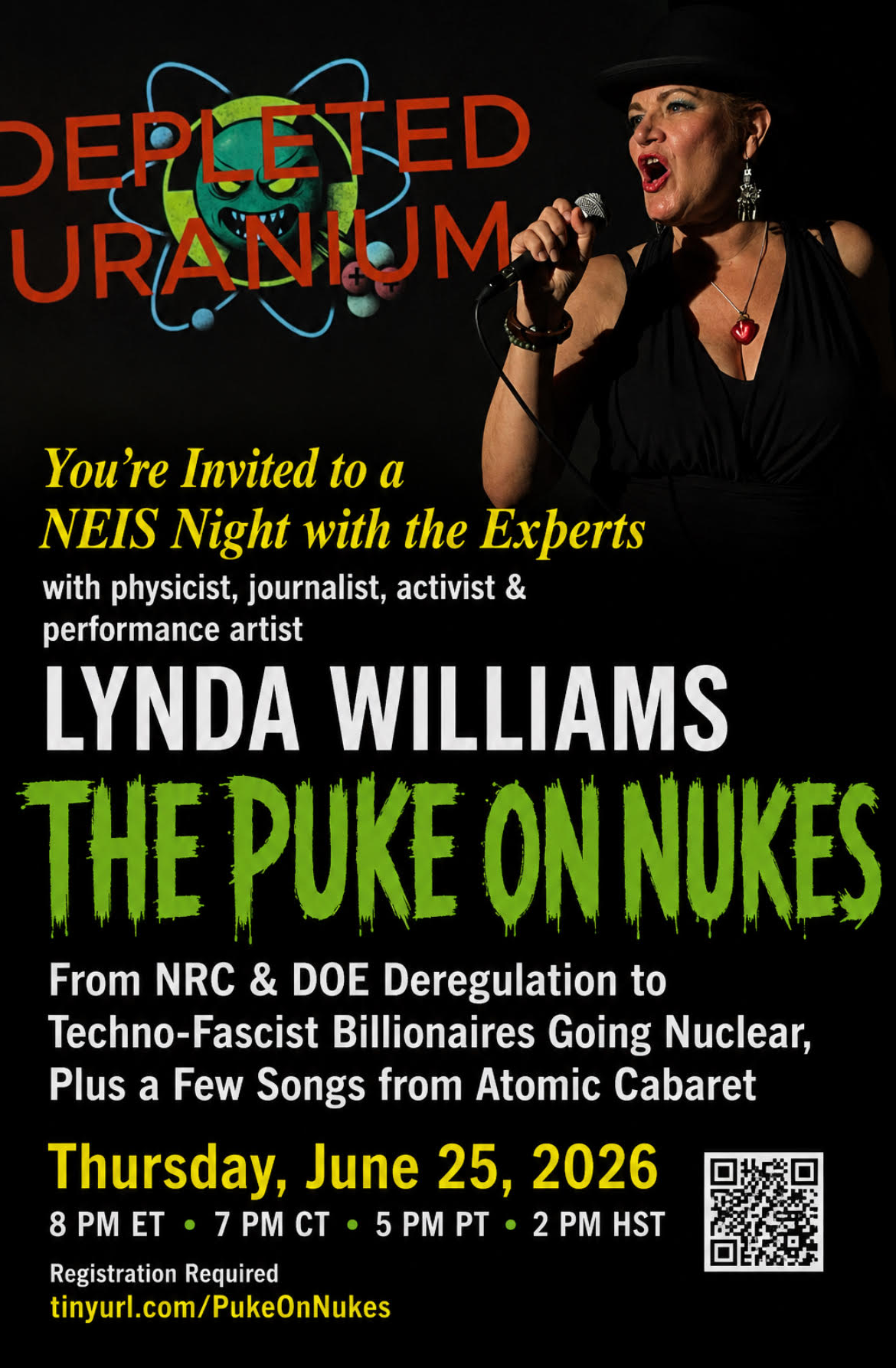
25 June- THE PUKE ON NUKES
Thursday, June 25, 2026
7pm Central Time (8pm ET, 6pm MT, 5pm PT) UTC – 5
From NRC & DOE Deregulation to Techno-Fascist Billionaires Going Nuclear, Plus a Few Songs from Atomic Cabaret REGISTER
26 June – Radiation Trainwreck at the NRC / Join the Protect Better Campaign – https://us02web.zoom.us/meeting/register/4ZlZ5_qLSHGiLSCg8FF6Bg#/registration


Cuba Is Not a Failed State – It Is a Besieged State
PETITION: “Global Appeal to Endorse Palestinian Right of Return of Refugees”
To see nuclear-related stories in greater depth and intensity – go to https://nuclearinformation.wordpress.com
-
Archives
- June 2026 (142)
- May 2026 (306)
- April 2026 (356)
- March 2026 (251)
- February 2026 (268)
- January 2026 (308)
- December 2025 (358)
- November 2025 (359)
- October 2025 (376)
- September 2025 (257)
- August 2025 (319)
- July 2025 (230)
-
Categories
- 1
- 1 NUCLEAR ISSUES
- business and costs
- climate change
- culture and arts
- ENERGY
- environment
- health
- history
- indigenous issues
- Legal
- marketing of nuclear
- media
- opposition to nuclear
- PERSONAL STORIES
- politics
- politics international
- Religion and ethics
- safety
- secrets,lies and civil liberties
- spinbuster
- technology
- Uranium
- wastes
- weapons and war
- Women
- 2 WORLD
- ACTION
- AFRICA
- Atrocities
- AUSTRALIA
- Christina's notes
- Christina's themes
- culture and arts
- Events
- Fuk 2022
- Fuk 2023
- Fukushima 2017
- Fukushima 2018
- fukushima 2019
- Fukushima 2020
- Fukushima 2021
- general
- global warming
- Humour (God we need it)
- Nuclear
- RARE EARTHS
- Reference
- resources – print
- Resources -audiovicual
- Weekly Newsletter
- World
- World Nuclear
- YouTube
-
RSS
Entries RSS
Comments RSS
 nuclear-news