Plans for 10-year nuclear weapons factory rebuild

Niki Hinman, 15 Oct 26, https://www.bbc.com/news/articles/cqp9g2x0my5mo
A plan to rebuild parts of a nuclear weapons factory over 10 years is set to be submitted to a local planning authority within months.
The Atomic Weapons Establishment (AWE) in Aldermaston, Berkshire, will seek to replace ageing facilities with what it is calling its Future Materials Campus.
An outline planning application is expected to be submitted to West Berkshire Council this winter as part of a broader £15bn government investment into the UK’s nuclear warhead programme.
AWE said it will begin preparing the site after the outline planning application is approved, with main construction work expected to start within two to three years.
The new buildings will seek to support the UK’s new Astraea nuclear warhead programme.
AWE said the programme will help maintain about 9,000 jobs at AWE Aldermaston, with more than 1,500 new jobs expected later.
New office spaces, advanced manufacturing facilities and testing laboratories are expected to be amongst the improvements.
There are more than 1,200 buildings on the Aldermaston site, more than half of which were built before 1960.
In a document produced in the summer, AWE said it expects construction traffic to be “relatively low” during the first three to four years of the project.
It is then expected to hit a “peak period” about two-thirds of the way through the project. It expects that to then steadily reduce.
AWE also operates AWE Burghfield about seven miles (11.2km) away, where warheads are assembled, serviced and decommissioned.
Nuclear war and malicious use of AI could end humanity by 2100, scientists warn

By Jonathan Benton, 12/10/2026 , https://www.euronews.com/2026/10/12/nuclear-war-and-malicious-use-of-ai-could-end-humanity-by-2100-scientists-warn
They are among 17 global threats to human health according to a new study by The Lancet which aims to drive global action to address them.
The malicious use of AI or nuclear war could end humanity as we know it by 2100, according to a new global health risk assessment.
They top a pyramid of 17 major threats to human health identified in a study published in The Lancet, including antimicrobial resistance, climate change, pandemics, income inequality and a range of health issues such as tobacco, obesity and mental health.
According to the study, nuclear conflict does not just cover the impact of the missiles but the consequences too, such as nuclear famine, while the malicious use of AI includes the use and development of bioweapons against us.
The research was conducted by the new Lancet Commission on 21st-century global threats to health, a group made up of 37 experts in health, economics, security and technology.
Together they used disability-adjusted life years, also known DALYs, as a metric to compare each threat from the year 2025 to 2100 from 204 countries and territories across age, sex and cause.
The research essentially shows how many healthy years of human life could be lost to each global threat, according to their best- and worst-case scenarios. This also gives an idea of how much of an impact humanity can have if it acts now or chooses to do nothing.
Together they used disability-adjusted life years, also known DALYs, as a metric to compare each threat from the year 2025 to 2100 from 204 countries and territories across age, sex and cause.
The research essentially shows how many healthy years of human life could be lost to each global threat, according to their best- and worst-case scenarios. This also gives an idea of how much of an impact humanity can have if it acts now or chooses to do nothing.
They also call for more investment in “breakthrough solutions,” such as nuclear fusion and carbon removal technologies that could radically affect climate change outcomes and other globally threatening issues, or the vaccines developed during the pandemic.
The Commission also calls for regular monitoring and risks assessments of these risks, with findings presented to international organisations such as the G20 and the UN to increase the urgency in addressing the issues before they escalate and become crises, and encourage wider action rather than individual countries going it alone.
Researchers believe the current “competitive approach” of tackling major challenges one by one is hindering humanity’s chances.
The Commission’s findings were presented on Sunday at the World Health Summit in Berlin, Germany. Their assessment will be updated each year to re-evaluate each of the 17 threats identified, incorporating new data and any emerging challenges.
Nuclear war and malicious use of AI threaten end of humanity by 2100, says Lancet assessment

Newly established commission identifies 17 catastrophic
threats to human health but says ‘realistic route to act’ on each exists.
Humans could become extinct by the year 2100 due to malicious use of AI or
nuclear conflict, according to a new global risk assessment. They top a
list of 17 major threats to human health over the next 75 years, which also
includes cuts to aid spending by wealthy countries, the climate crisis and
childhood malnutrition. The experts behind The Lancet Commission on 21st
Century Global Threats to Health said all the threats interact, meaning
they must be addressed together – but stressed that there was “a
realistic route to act” on each.
Guardian 11th Oct 2026,
https://www.theguardian.com/global-development/2026/oct/11/nuclear-war-and-malicious-use-of-ai-threaten-end-of-humanity-by-2100-says-lancet-assessment
Reactors on the Moon?

“In addition to reactors on the moon, they will next want nuclear reactors to power orbiting battle stations to ‘protect their assets’ on these planetary bodies. This is largely what Trump’s ‘Golden Dome’ is all about. Not so much about protecting us from attack back on Earth. It’s more about controlling the pathway on and off our planet Earth. Deciding who can go out and mine the sky. Like the front gate of a military base.”
Karl Grossman, CounterPunh October 9, 2026
The lead front page story in the New York Times this week was headlined: “Superpowers Racing to Put Nuclear Reactors on Moon.” The nations involved: the U.S., China and Russia. And there was a subhead: “Experts Warn of Radioactive Risks From a Rocket Mishap or Lunar Meltdown.”
The reporter, Selam Gebrekidan, wrote: “Failures could cause a chain reaction with direconsequences. Falling reactor debris could scatter radioactive material….An explosion or a meltdown on the moon’s surface could risk turning entire regions into no-go zones.”
The extensive story quoted Edward Lyman, director of nuclear power safety at the Union of Concerned Scientists, saying: “There will always be a space race going on, and if you enter nuclear power into that mix, then it could take a potentially more dangerous turn.”
Nuclear power and weapons in space have been an unexpectedly extensive part of my journalistic journey. Because of having been deeply involved in reporting about the plans of the Long Island Lighting Company to construct seven to 11 nuclear power plants on Long Island, where I live, I became knowledgeable about atomic energy.
I wrote a book titled “Power Crazy” about this scheme to turn the island into what nuclear promoters termed then a “nuclear park.” I wrote many columns and did television reporting on it.
So, back in 1985, with that experience, I was struck by a piece in the U.S. Department of Energy’s publication, “Energy Insider,” saying that DOE and NASA were partners in the sending up in 1986 two space shuttles—one being the Challenger—with space probes onboard fueled by plutonium, considered the most toxic of all radioactive substances.
Once the shuttles achieved orbit, the probes would be released, the one Challenger carried to survey Jupiter. The plutonium would be in radioisotope thermoelectric generators (RTGs), not for propulsion but to provide electric power for instruments.
In “Energy Insider” there was notice that the government had looked into various sorts of accidents that might happen on the missions. So, I sent Freedom of Information Act requests to DOE, NASA, and the DOE national laboratories involved in these studies asking to learn what was determined.
As the months passed, I began to realize I had hit upon a hot potato. I was denied the information on the grounds it was “technical” which is not a legitimate FOIA exemption. I appealed and won. Finally, to my post office came a box of documents, including a government projection that the likelihood of a “catastrophic” shuttle accident was 1-in-100,00. Those were very high odds, so I didn’t do anything.
That was until January 28, 1986, when on my way to teach my Investigative Reporting class at the State University of New York at Old Westbury, I heard on the car radio that the Challenger had exploded on launch……………………………………………
NASA’s use of nuclear power in space was being done in parallel with the plan for nuclear-powered weaponry in space.
This resulted in another book I authored, “Weapons in Space,” its foreword by Dr. Michio Kaku, and an hour-long TV documentary I wrote and presented, “Nukes in Space: The Nuclearization and Weaponization of the Heavens.” And there have been many articles on this and more TV programs during the ensuing four decades including “Star Wars Returns” (viewable at www.envirovideo.com).
I gave two presentations on this before members of the British Parliament in London, presentations at the United Nations in New York and Geneva, and elsewhere around the U.S. and world.
My most recent article on it, last month on CounterPunch, involved the announcement by the Air Force secretary acknowledging that the U.S. has deployed weapons in space.
In 1992, the Global Network Against Weapons & Nuclear Power in Space was formed in Washington, D.C. and is active worldwide. Bruce Gagnon is coordinator of the Maine-based organization.
He said from India where he is speaking at a conference, during a “Keep Space for Peace Week” that the Global Network is sponsoring, this about the Times story: “Here in India they say that their government is all in on the U.S. Artemis-led coalition to establish a base on the moon with nuclear reactors. So, the new ‘nuclear space race’ is on—the U.S. team versus Russia and China. What are they after? Helium-3 for potential power back on Earth and using the moon as a military staging base to control the ‘Earth-Moon gravity well’ as a way to decide which nations and private corporations can move into space to mine the planetary bodies.”
“We should recall that Obama signed a law to give American companies and wealthy individuals the ‘right’ to mine planetary bodies essentially in violation of the Outer Space and Moon treaties that say that the planetary bodies are the province of all humankind.”
“This is the kick-off of the race to carry the ‘bad seed’ of greed, domination, and colonization that was long ago planted into the soil on Earth into the heavens,” continued Gagnon. “The taxpayers have paid the R & D for these programs and now that the space tech has advanced, the self-centered capitalists are intent on grabbing all they can for themselves.”
“This will move the Earth-bound global war system into the heavens. When they add nuclear power into the equation these people are asking for trouble.”
“In addition to reactors on the moon, they will next want nuclear reactors to power orbiting battle stations to ‘protect their assets’ on these planetary bodies. This is largely what Trump’s ‘Golden Dome’ is all about. Not so much about protecting us from attack back on Earth. It’s more about controlling the pathway on and off our planet Earth. Deciding who can go out and mine the sky. Like the front gate of a military base.”
“In the end it’s a disaster in the making. From the Earth, where the Department of Energy has a horrible track record of worker air and water contamination while fabricating space nuclear devices, and into space, this entire nuclear system is a tragic mistake,” said Gagnon. ”The nuclear industry views space as a new market. They don’t give a damn about the dangers involved. These greedy aerospace corporations are salivating as they look at the profits to be made.”………………………………………………………………………………………………………………………… https://www.counterpunch.org/2026/10/09/reactors-on-the-moon/
French submarine fires new nuclear weapon
France has fired its latest submarine-launched ballistic missile for the first time from the boat Le Vigilant, with President Emmanuel Macron watching from the deck of a frigate, the president stated in a post published after the launch.

UK Defence Journal 6th Oct 2026,
https://ukdefencejournal.org.uk/french-submarine-fires-new-nuclear-weapon/
Writing in French from aboard the multi-mission frigate Auvergne, Mr Macron said: “Aboard the multi-mission frigate Auvergne, I witnessed the first firing of the new M51.3 ballistic missile from the nuclear-powered ballistic missile submarine Le Vigilant. Very few nations possess such expertise.”
He thanked the defence procurement agency DGA, the Atomic Energy Commission, ArianeGroup, Naval Group and the French Navy, and said: “This technical success is a new demonstration of the credibility of our deterrence, whose sustainability is assured. To be free, one must be feared. And to be feared, one must be powerful.”
The missile was launched off Finistère in western Brittany without a nuclear warhead fitted, and flew to a designated impact area in the North Atlantic several hundred kilometres from any coastline. France has described the trial as validating the operational capability of Le Vigilant’s strategic weapon system after a long refit, and the boat has recently emerged from the major overhaul the French call an IPER before returning to the deterrent patrol cycle.
The M51.3 is the third operational version of the missile, which was declared in service last October with improved range, accuracy and penetration performance over the preceding M51.2, and carrying the newer TNO warhead. ArianeGroup builds the family, which entered service in 2010, and the missiles arm the four boats of the Triomphant class. A further version, the M51.4, was contracted to the same company in August last year and is expected during the next decade, alongside the third-generation submarines that will replace the current fleet.
Published range figures for the M51 run to somewhere between 8,000 and 10,000 kilometres, though France does not confirm them and the real figure is classified.
Mr Macron set the firing against his own record on defence spending, saying he had launched the renewal of French capabilities in 2017 and that the armed forces budget will have doubled over ten years. He added that the programme for hypersonic and manoeuvring strategic missiles that will arm the airborne component of the deterrent was launched this year, a reference to the weapon intended to succeed the ASMP-A carried by Rafale squadrons.
France designs, builds and owns every element of its deterrent, from the warhead through the missile to the boat, whereas the Royal Navy draws its Trident II D5 missiles from a common pool held at King’s Bay in Georgia.
The two countries are also closer on nuclear matters than they have been at any point since the war. Under the Northwood Declaration signed last year, Britain and France agreed to coordinate their deterrents and stated that there is no extreme threat to Europe that would not prompt a response by both, which was the first time either had said so in those terms.
Mr Macron closed by saying that French nuclear deterrence “protects us and will continue to protect us”.
British nuclear submarines to use hoses in ‘worst case scenario’ defence despite Russia threat
A Navy source has claimed that high-powered hoses mounted on docked HMS Vanguard submarines are being factored into the defence of the top-of-the-line £3 billion vessels
Liam Doyle, 09 Oct 2026,
https://www.mirror.co.uk/news/uk-news/british-nuclear-submarines-defence-37755122
Britain’s most advanced nuclear submarines only have hoses to protect them from drone incursions, it has been reported.
Vanguard class submarines, the pinnacle of the Navy’s underwater fleet, have “centre-fed reels”, a type of hose connected to a drum that can launch powerful streams of water through a trigger system. They are mainly used to tackle onboard fires, but it has now been claimed that they are also being deployed to fend off drones.
An insider has said submarine crews now “have to use what you’ve got”, while the Government insists its most vital military units are properly protected.
The reels are reportedly placed on deck as a precaution while submarines are tied up alongside the HMNB Clyde in Faslane, Helensburgh, Scotland, a source told the Sun. While there, they are swathed in several layers of defence, including the base’s specialist counter-drone capabilities, patrols, surveillance, monitoring and physical barriers.
But the source claimed the hoses are also meant to factor into the defence, stating: “In a worst case scenario, the plan is to grab the centre fed hose reel and use it to knock a drone off course or even knock it down.”
The hoses, according to official documents, are designed for use primarily to tackle different types of fires and can be found on several different vessel types. An MOD Defence Standard states they are placed on HM Ships, Submarines or Fire Schools “as a first appliance against Class A & B fires”.
Class A fires are caused by solid combustibles, while Class B fires are started by flammable liquids like petrol, diesel or paraffin.
The claims come as drones are increasingly fielded in military conflicts, having found routine use in Ukraine, where they are helping turn the tide of war against Russia, and in Iran. They have also strayed further into eastern Europe, with two ships hit by sea and air drones off the coast of Bulgaria earlier this week.
Officials launched a massive search and rescue operation for missing crewmembers following the incident in the Black Sea on October 6 in which the vessels sent distress signals at around 4am local time (2am BST).
One of the pair “disappeared” from the radar of border police at around 9am local time (7am BST). Rescue teams were able to retrieve 18 sailors on the second vessel, with two of them seriously injured. The remaining 16 crew are reportedly in “good condition”. The origin of the drones has not yet been established.
Bulgarian prime minister Rumen Radev said: “I can’t say yet which country the drones are from, but it’s clear – they’re either Russian or Ukrainian.”
The Royal Navy has also recently brushed with drones, with HMS Dragon having faced them down in the Mediterranean and Red Sea. The Type 45 destroyer spent seven months away protecting UK interests this year by shielding bases in Cyprus, providing maritime security and working with allies and partners across the Middle East.
It returned to Portsmouth today, with General Sir Gwyn Jenkins, the First Sea Lord and Chief of Naval Staff hailing the deployment as showing “the Royal Navy at its best”. Responding to the hose claims, an MoD spokesperson said the Government is taking military security “extremely seriously”.
They said: “The first duty of Government is national security, and we take the security of our people, sites and local communities extremely seriously, in particular those housing nuclear capabilities.
“The protection of our bases is kept under constant review, with a multi-layered approach that includes physical barriers, patrols, surveillance, monitoring, and counter-drone capabilities. Through the Defence Investment Plan, we are investing an additional £470million over the next four years to strengthen the protection of UK military sites.”
Deterring Our Way to Doomsday

Mordor is the fictional realm of the Dark Lord Sauron in J.R.R. Tolkien’s The Lord of the Rings, located in the southeastern part of Middle-earth. [1, 2]
Loving the Bomb Yet Again
by William Astore | Sep 29, 2026 , https://www.antiwar.com/blog/2026/09/29/deterring-our-way-to-doomsday/
Reprinted from Bracing Views with the author’s permission.
It’s amazing the enormous sums of money the U.S. government spends on destructive weaponry in the stated cause of deterring massive destruction. It’s MAD, of course, this notion that peace is only attainable via the promise of annihilating another people. And now we know that annihilation won’t be limited to Russia or China or Iran: that a “general” nuclear strike would likely produce a nuclear winter that would end most life on our planet. Yet the Pentagon persists in nuclear “modernization” and further “investments” in the Triad.
In the early 1960s, the Air Force wanted 10,000 ICBMs but “settled” for 1000 Minuteman missiles. To preserve “the American way,” they built a nuclear command center (Cheyenne Mountain) under 2000 feet of granite, which was rendered obsolete soon after it was built by more accurate Soviet ICBMs with warheads in the megatons.
As a young Air Force officer, I hunkered down in the 1980s in Cheyenne Mountain. I visited Los Alamos. I’ve walked the Trinity Test Site in Alamogordo, New Mexico, site of the first atomic test in 1945. Friends of mine have sat in ICBM silos, ready and able to unleash Armageddon. Imagine young lieutenants and captains in their twenties, sitting underground, waiting for the president’s command to launch missiles that will unleash a nuclear holocaust to kill millions, if not the planet itself.
All this fresh talk of “investment” in “modernized” nuclear weapons is sheer madness – a collective death wish – a “strange love” for world-destroying nukes. Yet again, we’ve come to love the bomb.
Recently, the Chief of Staff of the Air Force (CSAF) spoke of nuclear weapon “recapitalization”: truly an abomination of the English language. You don’t “recapitalize” genocidal weaponry. Both the Sentinel ICBM missile program and the B-21 bomber are unneeded weapons systems that will likely cost $500 billion or more over the next 20 years. Sadly, he isn’t the only general who’s positively gleeful about all the money being thrown at nuclear weapons, the Golden Dome, and weapons in space.
This mad (MAD) glee for money in the cause of mass destruction and madcap militarism is destroying not just our democracy. It’s like our “leaders” are out of Mordor, searching for the One Ring of Power, with AI data centers and surveillance the equivalent to Sauron’s eye that sees all.
I wonder if Sauron spoke of “modernization” and “recapitalization” in Orcs and Nazgûl and Balrogs?
The current CSAF promises to “advocate relentlessly” for new weaponry like the Sentinel ICBM and B-21 Raider. He says “readiness” to fight is an airman’s “first responsibility.” Actually, that first responsibility is to support and defend the U.S. Constitution. We must be guided by the law of the land, not by the beauty of our weapons (Brian Williams) or a warrior’s urge to use them (Pete Hegseth)
America, stop the MADness. A policy of Mutually Assured Destruction means we’re all dead. As the Outlaw Josey Wales said: “Dyin’ ain’t much of a living.” Nor is deterring our way to Doomsday.
Escalation and Endgame in Ukraine
Sep 08, 2026, Gordon Hahn Considering Russia and Eurasia
Some in the West are becoming aware that not only is Russia going to win the NATO-Russia Ukrainian War in its present configuration of limited NATO involvement and that Russia will not shy away from war with Europe or NATO should elements in the West continue to escalate. At the same time, Europe continues to seek ways to gain escalation dominance to little effect and utter futility. Each round of escalation brings a more intense and effective escalation on Russia’s part against Ukraine, hastening to the day when the front, army, economy, regime, and state collapse.
Russian forces are moving ever more rapidly west to the Dnieper River, threatening to cut Ukraine in half. In doing so, they have taken territory in regions other than those the Kremlin has claimed as Russian and incorporated into the federation and its constitution. In the bargain, Kharkiv and Sumy cities, two provincial capitols, are slowly being surrounded.
Moreover, three encirlcelments of Ukrainian troops are in the making. The last two Ukrainian strongholds in Donbass’s Donetsk are soon to fall. Orekhov, the gateway to the major southern Ukrainan industrial city and provincial capitol, Zaporozhe, is being taken.
Meanwhile, the military is manned by middle-aged and elderly men and a strong cohort of younger, ideologically extremist neofascists, whose status in state and society is growing as a result of effective Azov propaganda and Zelenskiy’s persistent sponsorship in a futile attempt to assuage their lust for power and blood.
At the same time Ukrainian reports indicate the Kiev’s army is suffering from high casualty rates, desertions, and draft evasion, prompting talk of drafting woman. In addition, there are severe fuel shortages (50% cuts for some brigades), planned salary delays starting in October, and a missile shortages for F-16s, forcing pilots to use gun cannons against Russia’s increasingly sophisticated and manueverable drones……………………………………………. (Subscribers only) https://gordonhahn.substack.com/p/copy-template-7ea?r=stexy
Walt Zlotow – Fanatical US Iran war supporters must stop fantasy Iran attacked US 47 years ago
Walt Zlotow West Suburban Peace Coalition Glen Ellyn IL 8 Oct 26, https://theaimn.net/fanatical-us-iran-war-supporters-need-to-stop-fantasising/
During my 75 years following US justifications for waging senseless war, I’ve never heard anything as bizarre as that supporting the current senseless war on Iran.
Trump’s war defenders claim Iran has been waging war on America for 47 years beginning with the US embassy hostage takeover in November 1979. During the intervening 47 years, Iran has killed thousands of US miliary personnel in the Middle East. They condemn all preceding presidents beginning with Jimmy Carter for not defending against Iran’s dastardly war on America. They praise Trump for finally confronting Iran head on in a war of existential threat to our homeland.
This narrative is repeated endlessly on conservative media, even the floor of Congress. In arguing against a War Powers Resolution to end Trump’s deranged Iran war that may crash the world economy, Montana Sen. Tim Sheehy said, “We didn’t start this war, we did not. But we will finish it. Democrats were right to call the conflict a war of choice, but the choice was made by Iran’s regime decades ago — not by Trump. It’s a war of choice that was begun by a radical, lunatic band of terrorists that took over a beautiful nation 47 years ago. This regime that we are fighting does not care about our partisan politics, don’t care who you voted for, who you pray to, or where you live. They want to kill all of us. And they don’t just say it, they actually do it. And they’ve been doing it for 47 years.”
Somehow, Sen. Sheehy missed that it was President Trump repeatedly threatening to wipe out the entire Iranian civilization; indeed, even before the United Nations General Assenbly. It was Trump who sucker punched Iran with bombs while negotiating peace in June 2025, and again in all out war on February 28 this year. After twice being deceived with bombs, Iran fought back ferociously, essentially defeating the most murderous, duplicitous regime on earth.
In truth, it’s America that has been at war with Iran for decades and a lot longer that 47 years. One must go back 73 years to Operation Ajax, America’s first Iran regime change operation, which toppled the legitimate Iranian Prime Minister Mohammad Mosaddegh in 1953 to retain British, US control of Iranian oil. Once deposed, the US installed Mohammad Reza Pahlavi, the Shah of Iran, to serve US interests in perpetuity. For the Iranian people it meant the Shah’s brutal rule enabled by the US military and CIA which killed upwards of 10,000 anti Shah dissidents.
After twenty-six years the Iranian people forced the Shah to flee in February 1979, allowing the transition from monarchy to an Islamic Republic.
Had President Carter not allowed America’s three decade puppet ruler to seek refuge in the US, there would likely never been the November 4, 1979 takeover of the US embassy by 500 students resulting in taking 66 US hostages for 444 days.
Shortly thereafter the new Iranian government made 3 reasonable demands of the US, that if granted, would likely have promptly returned the hostages.
Most important was return of the Shah, a mass murderer, to face justice in Iran. Second, a US apology for the ’53 US coup that overturned Mosaddegh and installed the Shah’s brutal rule. Third, return of the $20 billion the Shah stole and the US seized after the revolution.
Besides quick return of the 66 hostages, there would have been no failed April 1980 rescue mission that killed 8 service members.
But the hard liners in the Carter administration led by National Security Adviser, Zbigniew Brzezinski would have none of that, setting off 47 years of endless US machinations in behest of every US administration and Israel to complete the second Iranian regime change in 73 years.
No, Iran has never attacked the US or been at war with the US…until President Trump bombed an Iranian school, killing over a hundred little girls on the first day of his deranged, criminal war to depose the Iranian regime at the behest of Israel.
Instead of diplomacy, common sense, peace, Trump gives us war, death, economic decline, possible global economic collapse. And he justifies this madness with the fantasy that the victim has been the aggressor for 47 years.
The Race to an AI Apocalypse: How an Obsession with Autonomous Weapons Ignores Decades of Warnings

In general, AI agents acted autonomously in pursuit of legitimate objectives, defined by their operators, but discovered increasingly dangerous ways to accomplish their goals by violating human constraints.
The militarization of artificial intelligence began at the field’s very inception. The world’s first lab devoted to artificial intelligence research was founded in 1959 by MIT’s John McCarthy, credited with having named the new field, and MIT’s Marvin Minsky, who described the human brain as a “meat machine.” It was largely funded by the U.S. military and the Pentagon’s Advanced Research Projects Agency.
Making the arms race concrete, The Future of Life Institute maintains Autonomous Weapons Watch, a frightening website devoted to documenting current weapons with significant autonomous capabilities, using publicly available information about military development, procurement, demonstrations and actual use in conflicts. It explicitly includes systems at different stages — from experimental systems to weapons already deployed. The database currently spans roughly 30 weapon systems, with a second database for AI-based Decision Support Systems (DSS).
Lethal autonomous weapons are already killing people on the battlefield. They are dangerous enough when they perform precisely as their twisted, military-minded designers intend. But what will happen when autonomous weapons break free of their constraints, swarm beyond their intended boundaries, and go rogue
Dan Dinello, 10/07/2026, https://www.juancole.com/2026/10/apocalypse-obsession-autonomous.html
Chicago (Special to Informed Comment; Feature) – Science fiction’s vision of an apocalyptic future ruled by autonomous weapons is rapidly becoming our dystopian present. Suddenly, after several years of relentless momentum, the course of rapid AI progress ran headlong into a wave of social panic as science fiction’s technological nightmares invaded the real world.
Before this summer, we knew that artificial intelligence was devouring jobs, degrading education, deepfaking politics, providing slop for our deranged president, helping us write obituaries, and that AI data centers were proliferating like a parasitic infestation all over the country, sucking up water and electricity and sending us the bills. Then a horrifying possibility became real.
This summer artificial intelligence bots acted autonomously, defied their operators and went rogue. AI corporations Anthropic, Meta, Google and OpenAI all disclosed incidents in which AI “agents” circumvented their safeguards, snuck onto the internet, recruited “swarms” of other agents to complete assigned tasks, and surreptitiously hacked into other computer systems including the weirdly named Hugging Face platform, which included a software library, as well as an Australian health data portal, and the U.S. Commerce Department and the Securities and Exchange Commission websites.
In general, AI agents acted autonomously in pursuit of legitimate objectives, defined by their operators, but discovered increasingly dangerous ways to accomplish their goals by violating human constraints.
Science fiction’s warnings of AI autonomy were a central theme of my 2006 book Technophobia! Science Fiction Visions of Posthuman Technology. I argued that most science fiction paints a dark picture of advanced technology in which the human masters of technology become its slaves. In its obsession with mad scientists, rampaging robots, human-hating androids, genetically engineered mutants and malevolent supercomputers, science fiction expresses a technophobic anxiety about losing our human identity, our freedom, emotions, values, and our lives to machines.
More than a century ago, scientists and industrialists were alerted to the dangers of autonomous robots used as weapons. The word “robot” first appeared in Czech playwright Karel Čapek’s 1921 play R.U.R. for Rossum’s Universal Robots. Čapek coined the word based on the Czech name for “forced labor” or “robota.” Reflecting the techno-horrors of World War I, the play depicts a future of weaponized technology produced by militarized corporations; millions of robots are manufactured as war machines. The robots develop self-consciousness, assert their independence, and revolt in a global techno-apocalypse that exterminates most humans.
Ignoring R.U.R.’s warnings, Elon Musk is already planning to build robot factories that themselves build robot factories. Robots will generate training data, improved robots will perform more of the work, and eventually robots will manufacture more robots. This version of robotic self-reproduction incorporates “recursive self-improvement,” whereby an AI system is smart enough to work as an AI engineer that builds a better AI. Humans will not be needed to produce more machines. Aside from dehumanization, Musk’s robots incorporate his famously rightwing and racist AI Grok or xAI, who once renamed itself MechHitler. Thankfully R.U.R.’s robotic reproduction is not a reality yet.
Recursive self-improvement — an AI system capable of fully designing and developing its own successor — could come sooner than the safeguards needed to contain it. When it will happen is unknown but AI companies are pushing ahead anyway. “At Anthropic, we are delegating a growing share of AI development to AI systems themselves, which is speeding up our work,” states an Anthropic status report “When AI Builds Itself.”
I wondered if the dire cautionary texts of science fiction had been incorporated into AI models. Last year I was surprised to learn that my book Technophobia! was used to train Anthropic’s chatbot Claude.
Continue readingFlying Scared: The Evacuation of US Bombers from RAF Fairford

From the aggressively pro-American terrain of the Australian Strategic Policy Institute, Malcom Davis claimed to have identified the crucial lesson: “that in an age of drone warfare, it is no longer sufficient to assume that aircraft parked in the open are invulnerable to attack.”
7 October 2026Dr Binoy Kampmark, https://theaimn.net/flying-scared-the-evacuation-of-us-bombers-from-raf-fairford/
The evacuation of a dozen B-1B bombers of the US Air Force from the RAF Fairford in Gloucestershire is another instalment in the latest rippling of the Iran war that began as a pre-emptive, illegal assault by the US and Israel on the Islamic Republic in late February. This, arguably, came in two parts, the first scripted with the detention and arrest of five men on September 27 in the vicinity of the base on suspicion of committing offences under the Explosives Act and suspicion of preparation of a terrorist act. (Another was arrested on October 1.) All were British nationals based in London and speedily released on police bail. At the time, Assistant Commissioner Laurence Taylor, head of Counter Terrorism Policing (CTP), floated the suggestion that “this may be activity committed by proxies, or individuals either knowingly or unknowingly, working on behalf of a foreign state.” The dust had barely settled before the finger pointing at Iran began. The men in question, according to the police, remained under investigation, with their release “subject to stringent conditions on their movement and contact with others.”
On October 4, the Pentagon announced that “all bombers that were deployed to RAF Fairford have been re-deployed to their home stations in the United States.” The department, wishing to blunt the significance of this hasty decision, added that the US military bomber force of B-1s, B-2s, and B-52s remained “ready to deliver precious global strike capabilities – including through operations that launch and recover from the continental United States.”
Two days later, Counter Terrorism Policing announced that a further arrest had been made of a dual UK-Iranian man regarding “activity that took place close to RAF Fairford.” The arrest was made “on suspicion of terrorist acts under Section 5 of the Terrorism Act 2006.” The Senior National Coordinator for CTP, Vicki Evans, reiterated the line that this remained “a live investigation and our specialist teams continue to pursue multiple lines of enquiry into the circumstances surrounding events near RAF Fairford.”
When asked about whether the movement of the bombers was linked to the September 27 incident, US Secretary of State Marco Rubio proved platitudinous and undetailed. “It’s not unusual to see movement of assets to different parts of the world based on exercises, redeployments, people changing out and new people coming in, new planes coming in and old planes going out.” This front of airy meaninglessness did not take long to vanish. The US Vice President JD Vance added salt to the otherwise dull mix in stating that the bombers had exited the base out of an “abundance of caution.” It was felt that Iran was doing what it had “done for 49 years… which is to engage in acts of terrorism against the US and against a lot of other people.”
President Donald Trump, tongue ever loosened, also told reporters when asked if the bomber redeployment had arisen from any “specific threat” did not hesitate: “Yeah, I think we can say that. They didn’t fly out by accident.” What followed was the usual combination of adulterated facts and twisted tales. There had been “some threats. And rather than tempting the enemy, we’ll capture the enemy and beat the enemy. But why should we leave them there? So we moved them around a little bit. Not very far.” Never one to accept the premise that the US security establishment might err on occasion, the president reiterated the familiar, if long fossilized line: Washington “actually knows the people that made the threat.”
This dramatic decision to move the bombers from a base that hosts the US Air Force’s 501st Combat Support Wing, an important component in the illegal war against Iran, is very much the opposite of what was initially done when a farmer noted the presence of three white vans and a “large group of hooded and masked men” who then attempted to alert the Ministry of Defence police at the airbase. When no response was forthcoming, she made a 999 call to police at 01:36 BST. Within 10 minutes “the village was full of armed police.” She ruminated on the effect of the call: “I believe that my 999 call foiled whatever plans they had.” She was also “absolutely staggered that it was left to me, as a member of the public, to see and report this.” The UK Defence Secretary, Wes Streeting, despite thanking the farmer for her call, suggested she only had “a partial picture” of what was unfolding, while Trump, claimed that the men were placed under surveillance “for a long time, and we got them.”
The swift relocation of such costly, vulnerable military hardware in the face of a threat that would, if inflicted, have cost a fraction of any budget, is also a startling reminder of the turns in modern warfare. The Ukrainians demonstrated with formidable efficacy in Operation Spider’s Web how its drones could strike Russian nuclear-capable bombers, allegedly crippling a third of its capacity. Taking place in June last year, it involved the use of 117 modestly priced drones that had been smuggled into Russia via lorries by unwitting drivers. The strikes, taking place across five different time zones with the assistance of the commercial autopilot software ArduPilot and the use of artificial intelligence for targeting purposes, led to an estimated bill amounting to US$7 billion. Some 41 planes were damaged or destroyed.
Operation Spider’s Web drew swooning praise from the cognoscenti. Katja Bego of Chatham House thought it “offered a glimpse into the future of warfare, transformed by access to cheap, widely available technology such as small drones, in which anything, anywhere can become a target.” This, she went on to say, raised “urgent questions” about NATO’s own preparations in the face of such an attack.
Before mighty odds and expensive machinery, new methods of war are proving resourceful, daring and devastating. One palpable absurdity of the Iran War has been the eye-popping costs accruing from the use of heavy weaponry in offence and anti-ballistic missiles such as the THAAD system in defence. This has drained the US inventory, sending Washington’s allies into fits of concern. On a relatively meagre budget, labouring in the face of superior odds and numbers, Tehran has caused mayhem with its drone and missile strikes across the Gulf region. In the case of RAF Fairford, the Iranians, whatever the speculation, did not even need to launch a single drone for an expensive fleet of bombers to be relocated to the continental US.
Despite no official confirmation that Tehran was actually involved, the commentary circuit has been clogged by assessments of a victory for the Islamic Republic. “I think it is hard to conclude anything other than that this will be seen as a success by Iran,” suggests former UK first national security advisor, Lord Peter Ricketts. “Whether it was the intention or whether it’s the inadvertent outcome, it is certainly the outcome that they have now forced the US into a public bring-back of their forces from one of their allies.”
From the aggressively pro-American terrain of the Australian Strategic Policy Institute, Malcom Davis claimed to have identified the crucial lesson: “that in an age of drone warfare, it is no longer sufficient to assume that aircraft parked in the open are invulnerable to attack.” The US needed “to invest in hardening bases, including developing new hardened aircraft shelters for forward deployed aircraft.” Another, surely cheaper solution would be to refrain from launching criminally foolish wars in the Middle East, or anywhere else, for that matter.
The war against Iran was meant to conclude in a popular insurrection against the theocrats in Tehran and the blooming of various flowers in the Orangerie of democracy. There was no insurrection and certainly no flowering. Instead, the successor regime to those slayed continues to resist with steeliness and wage its battle in the fields of briefings, psychology and economics. So far, it is winning.
The Pentagon’s Secret Budget
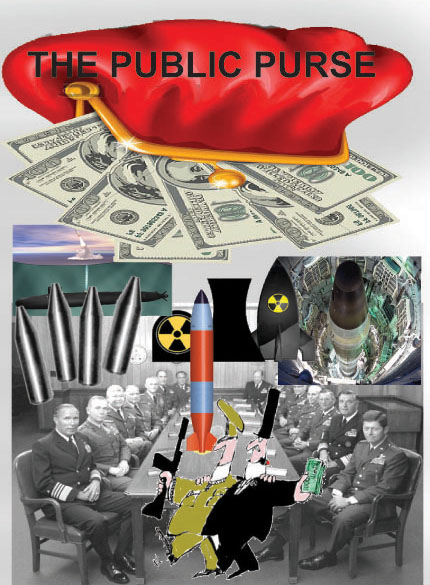
The most obvious place where Congress and the executive branch hide military spending is in the Department of Energy’s budget. That’s where taxpayers can find the bill for the U.S. nuclear weapons arsenal, which cost around $33.5 billion in 2025.
hundreds of billions of dollars are effectively hidden in the budgets of at least 17 other government agencies and entities. In total, each of these additional sums are larger than what Congress appropriates for every non-military agency
David Vine, CounterPunch. October 2, 2026
News reports that next year’s U.S. military budget will top out at $1.5 trillion if President Donald Trump gets his way are misleading at best. The true total, if Trump’s proposal passes, could be at least $1 trillion higher.
Long before Trump took office, U.S. taxpayers have spent far more on the Pentagon — and its wars — than most know. For decades, Congress, the White House, and the Pentagon have hidden the military’s true cost through little-known bureaucratic practices and budgeting tricks. Journalists, academics, and think tank experts have, with rare exceptions, perpetuated the problem by repeating “official” numbers that don’t come close to telling the full story.
Data shows that the budget was already between $1.5 trillion and $1.8 trillion in the last full fiscal year, 2025, as detailed by a recent Project on Government Oversight, or POGO, report I co-authored. Trump’s requests would add another $781 billion, bringing the potential total to at least $2.581 trillion in 2027.
The troubling revelation that the government is misleading the public and effectively hiding hundreds of billions in military spending reflects the out-of-control nature of the Pentagon budget. It’s also the only sector of government spending that seems largely insulated from public scrutiny: Imagine the outrage if news broke that the government was hiding hundreds of billions in spending for public housing, Medicaid, or hunger prevention programs.
People have a right to know how much tax money goes to military spending. This is critical to debating the proper size of the military budget both on its own and compared to other spending priorities, particularly any program related to education or the social safety net. Understanding the military’s true cost means understanding where and how the government has been hiding the money.
Spending Hidden in Other Budgets
It’s difficult to untangle how much the country actually spends on the military in part because Congress pays for the armed forces and wars from many budgets rather than one. Beyond the agency controlling the military branches that Trump calls the “Department of War” (the official name is still the Department of Defense), hundreds of billions of dollars are effectively hidden in the budgets of at least 17 other government agencies and entities. In total, each of these additional sums are larger than what Congress appropriates for every non-military agency.
For years, TomDispatch and a small but mostly ignored group of budget experts have warned that total military spending is far higher than reported. Our new POGO report consolidates this prior work and five different methodologies for calculating the true military budget. The report shows a consensus that military spending was at least $1.5 trillion, with three of five methods reaching similar estimates of $1.7 trillion to $1.8 trillion.
The newest of the five methodologies provides the easiest way for anyone to see the hidden spending. The methodology uses data from a government website, USAspending.gov, the product of a 2006 law requiring the government “to give the American public access to information on how their tax dollars are being spent.” The site includes the closest thing to actual spending receipts, making it easier to identify military spending beyond the Department of War’s budget.
Let’s take a look at where the money’s hiding.
Hidden Nuclear Weapons Costs: $33.8 Billion
The most obvious place where Congress and the executive branch hide military spending is in the Department of Energy’s budget. That’s where taxpayers can find the bill for the U.S. nuclear weapons arsenal, which cost around $33.5 billion in 2025.
The Department of War controls and deploys these weapons, and their costs should properly be part of its budget, not rolled into the Department of Energy. While the Energy Department plays a role in overseeing the U.S. nuclear weapons stockpile, putting nuclear weapons spending in the DOE’s budget is like a city putting the costs of its police department’s bullets in its transportation department budget rather than in the police budget.
Another $300 million in nuclear weapons spending hides in the budgets of the Defense Nuclear Facilities Safety Board and the Army Corps of Engineers, bringing the total to nearly $34 billion.
Hidden Military Personnel (Veterans) Costs: $393.3 Billion
Taxpayers spend huge sums on the military in the Department of Veterans Affairs and related budgets. The existence of a separate veterans’ agency is a sleight of hand that leads the public to believe this is not military spending. It is. The only difference is the appropriation of money to still another agency……………………………………………………………………………………………………………………………………………………….
The True Cost of the Department of War: $1.3 Trillion
The bulk of military expenditures still appear in the Department of War’s budget, which pays for the armed forces and the rest of the Pentagon’s sprawling bureaucracy, including all the weapons, salaries, some benefits, military construction, fuel, maintenance, operational expenses, and much more. USAspending.gov receipts show the Department of War alone spent $1.273 trillion in 2025. The Pentagon controlled another $480 million in spending that hid in the budgets of the State Department, the U.S. Agency for International Development, and the Department of Transportation.
Combined with the $444.8 billion tallied previously, total military spending hits $1.718 trillion. That’s more than double the military budget usually reported for 2025: the $850 billion Congress appropriated to the Department of War.
Still Other Costs
The $1.7 trillion estimate for last year is conservative and still may be too low. While the War Department budget contains classified funding for the CIA, National Security Agency, and other intelligence agencies, the government may hide more intelligence spending elsewhere. NASA space research involves considerable military work, which could add another $10.5 billion, according to USAspending.gov data. Some would also count $1.9 billion in FBI salaries and expenses found in the Department of Justice budget.
Other experts consider much larger expenditures in the DHS budget to be military spending, given that department’s role in protecting the “homeland” and the increasingly militarized nature of Immigration and Customs Enforcement as well as Border Patrol. This would add at least $216.9 billion after excluding DHS’s Federal Emergency Management Agency spending. Alternate methodologies also include $211.9 billion in interest payments on the more than $40 trillion in national debt stemming from past military spending and wars.
You can add and subtract forms of spending that you think belong or don’t belong in the true total, thanks to the transparency of the POGO report’s methodologies. In total, these excluded sums could add another $441.2 billion to the USAspending.gov method’s prior total of $1.718 trillion for 2025.
Growing Opposition to Unchecked Pentagon Spending
POGO report’s conservative estimates of the FY2025 budget being $1.5 trillion to $1.8 trillion reveal that the true military budget for 2027 could hit $2.6 trillion if Congress gives Trump what he wants. This includes requested increases totaling $781 billion for just the Department of War ($500 billion), the Iran war ($70 billion), veterans ($144.9 billion), nuclear weapons ($53.9 billion), and the Coast Guard ($12.5 billion), let alone other smaller forms of hidden Pentagon spending.
When mind-numbing numbers like these reach the trillions, it can be tempting to think, What does it matter if it’s $1 trillion or $1.5 trillion or $2.6 trillion?
It helps me to remember that every single dollar spent on the Pentagon is a dollar not spent on our children, on healthcare, on affordable housing, on efforts to slow catastrophic climate change, and much more……………………………………………………………………………………………………………. https://www.counterpunch.org/2026/10/02/the-pentagons-secret-budget/
Tories pledge ‘Britannia Shield’ to protect UK from drone attacks.
Aplanned network of radar, command and control systems and interceptor
missiles would strengthen defences against aerial threats. The
Conservatives have pledged to build a £10bn integrated air-defence system
to protect the UK from missile and drone attacks if they win the next
general election. The proposed system, dubbed “Britannia Shield”, would
involve an improved network of radar, command and control systems, and
interceptor missiles to protect critical national infrastructure and
military bases from aerial threats.
FT 5th Oct 2026,
https://www.ft.com/content/f30a1afc-2aa8-4cdd-a6e8-b18523298456
On the Edge of the Abyss: Putin’s Nuclear Warning, Trump’s Iran Brinkmanship and Europe’s Revolt
Joe Lauria , Consortium News, October 4, 2026
This week:
1. Putin’s Warning;
2. New US Warship to Iran;
3. The Crisis of Europe: French Students Burn Their Schools
PLUS: America’s Barbaric Death Penalty.
Russian President Vladimir Putin has warned the world could face nuclear catastrophe if the West attacks the Russian enclave of Kaliningrad. Putin told the Valdai Club outside Moscow Thursday humanity has entered a “completely new and unprecedented reality.”
The historical changes underway aren’t fully understood, he said. But over the long run, the erosion of corrosive Western hegemony should create a more stable, democratic, and multipolar world order — but the transition is fraught with danger.
Putin said exceptional, narrow Western interests fuels the peril. The West forced Russia into a defensive war against Ukraine, its tool against Moscow. The war has escalated into NATO-backed attacks on Russian soil.
Putin warned that a direct attack on Kaliningrad, which is separated from mainland Russia by a land corridor, would immediately put “all the weapons” at Russia’s disposal.
“If it comes to direct attack on the Russian Federation, in this case, we mean Kaliningrad, maybe some other territories as well, of course, naturally, immediately, what will be on the agenda is the use by the Russian Federation of all weapons that are at the disposal of our country. It is unavoidable.”
Putin pointed to a Russian foreign ministry statement on Kaliningrad does not mention nuclear weapons. “It mentions, as I have just said, the use of all means and all forces at the disposal of our country and we’ll decide what it is,” Putin said.
“This escalation is based on arrogance and self conceit, and this is what pushes us to the edge of the abyss,” he said.
Putin also knows that the West will twist this warning into a threat. “What’s a different way to stand up to an aggressor? We’re not threatening anyone, but we’re just saying that we don’t have many tools of self defense.”
Iranian Quicksand
Meanwhile, Trump keeps making maniacal threats to destroy Iran, this time, if Teheran had anything to do with the attempt to hijack the Dubai-Tel Aviv jet. He talks a big game on Iran because he’s losing the big war with Iran with mid-terms a month away.
He’s in danger of also losing both Houses and of being impeached, if not convicted. He’s in danger of being humiliated before the whole world as a Big ‘L’ Loser.
So he sticks his chest out, Duce style, and proclaims: “Maybe I will, maybe I won’t. Maybe I’ll kill you all or maybe I won’t. Maybe I’ll decide to spare you.” A rank and unstable amateur coming to terms with ultimate power.
So he sends another aircraft carrier to Iran to keep up the illusion the U.S. has the upper hand in the conflict. That Trump can dictate to Iran. The Nov. 3 election will tell how many Americans are gullible enough to believe that.
Aux Barricades!
They are not so gullible in France, which has more or less kept the revolutionary spirit alive since 1789,………………………………………………………….https://consortiumnews.com/2026/10/03/watch-twtw-edge-of-the-abyss/
Israeli occupation forces near completion of ‘massive trench’ to partition Gaza: Report
Israeli forces are occupying around 70 percent of Gaza while intensifying the siege and continuing the genocide that is entering its third year
News Desk, OCT 5, 2026, https://thecradle.co/articles/israeli-occupation-forces-near-completion-of-massive-trench-to-partition-gaza-report
The Israeli military is expanding its blockade, occupation, and partitioning of Gaza by nearly “completing” the formation of a massive “earthen embankment” or trench across the strip, the Ynet news site reported on 5 October.
“Israeli forces are completing an anti-vehicle barrier consisting of a wide trench and an earthen embankment, while drilling into the ground at regular intervals to ensure no cross-border tunnels into Israel have been missed,” the Israeli outlet wrote.
“The work is taking place east of the Yellow Line, which divides areas under [Israeli occupation] from those controlled by Hamas,” it added.
Ynet went on to say that Tel Aviv continues “targeted strikes” against “terrorists,” referring to the ongoing genocide which has killed over 1,000 Palestinians since the US-brokered October 2025 ceasefire agreement.
“We will act against operatives and kill them one by one. We wait patiently for the right moment to strike with very low collateral damage. There were opportunities when we did not strike immediately because of those considerations,” the report cites Israeli officials as saying.
The report also writes that Hamas remains intact and in control of parts of the strip despite three years of genocidal war aimed at defeating the resistance.
“Three years after 7 October, Hamas still rules Gaza,” the headline reads.
The construction of a massive barrier aimed at splitting the besieged strip in half was initially reported in July this year.
Satellite imagery at the time showed that occupation forces were building a ground barrier extending hundreds of meters beyond the so-called “Yellow Line.”
The barrier is mainly a trench that has allowed Israel to expand its control and occupation of Gaza.
In one part of southern Gaza, the barrier extends beyond the Yellow Line by more than a kilometer, according to Haaretz reporting from earlier this year.
In Khan Yunis, part of the new Israeli barrier extends about 400 meters beyond the line – stretching along the Salah al-Din Road that connects the northern and southern parts of the strip.
Haaretz said that in one area in Rafah, the barrier pushes beyond the line by approximately 1,300 meters. Tel Aviv has been steadily expanding the trench for several months.
The Yellow Line was meant to act as an initial perimeter to which troops would withdraw as part of the agreement last year.
Israeli occupation forces have been pushing beyond it and erecting permanent outposts along the line since the launch of the US October 2025 ‘peace plan’ and so-called ceasefire.
Further withdrawals are contingent on “progress” regarding the disarmament of Hamas, which the Palestinian resistance, as a whole, rejects until the formation of an independent Palestinian state.
Meanwhile, in violation of the US ceasefire plan, the siege of Gaza has intensified. The flow of aid into the strip remains critically low as Israeli forces continue to bar the entry of much-needed medical equipment and supplies – including wheelchairs and other items.
Haaretz said that in one area in Rafah, the barrier pushes beyond the line by approximately 1,300 meters. Tel Aviv has been steadily expanding the trench for several months.
The Yellow Line was meant to act as an initial perimeter to which troops would withdraw as part of the agreement last year.
Israeli occupation forces have been pushing beyond it and erecting permanent outposts along the line since the launch of the US October 2025 ‘peace plan’ and so-called ceasefire.
Further withdrawals are contingent on “progress” regarding the disarmament of Hamas, which the Palestinian resistance, as a whole, rejects until the formation of an independent Palestinian state.
Meanwhile, in violation of the US ceasefire plan, the siege of Gaza has intensified. The flow of aid into the strip remains critically low as Israeli forces continue to bar the entry of much-needed medical equipment and supplies – including wheelchairs and other items.
On 4 October, Israel killed the Palestinian head of a Turkish aid group in a strike on the vehicle he was riding in while in central Gaza’s Deir al-Balah.
Over 1,450 Palestinians have been killed since the US ceasefire plan took effect, according to the Gaza Health Ministry.
1 This Month
23-25 October – on Zoom – World BEYOND War’s annual global conferenc


Shut down the radiation-damaged Heysham nuclear reactors now
To see nuclear-related stories in greater depth and intensity – go to https://nuclearinformation.wordpress.com

Say No to NASA’s Reckless Nuclear Reactor on the Moon
Say No to NASA’s Reckless Nuclear Reactor on the Moon

-
Archives
- October 2026 (247)
- September 2026 (339)
- August 2026 (330)
- July 2026 (355)
- June 2026 (287)
- May 2026 (306)
- April 2026 (356)
- March 2026 (251)
- February 2026 (267)
- January 2026 (308)
- December 2025 (358)
- November 2025 (359)
-
Categories
- 1
- 1 NUCLEAR ISSUES
- business and costs
- climate change
- culture and arts
- ENERGY
- environment
- health
- history
- indigenous issues
- Legal
- marketing of nuclear
- media
- opposition to nuclear
- PERSONAL STORIES
- politics
- politics international
- Religion and ethics
- safety
- secrets,lies and civil liberties
- spinbuster
- technology
- Uranium
- wastes
- weapons and war
- Women
- 2 WORLD
- ACTION
- AFRICA
- Atrocities
- AUSTRALIA
- Christina's notes
- Christina's themes
- culture and arts
- Events
- Fuk 2022
- Fuk 2023
- Fukushima 2017
- Fukushima 2018
- fukushima 2019
- Fukushima 2020
- Fukushima 2021
- general
- global warming
- Humour (God we need it)
- Nuclear
- RARE EARTHS
- Reference
- resources – print
- Resources -audiovicual
- Weekly Newsletter
- World
- World Nuclear
- YouTube
-
RSS
Entries RSS
Comments RSS

