USA should accept Russia’s offer of a one-year extension of the Strategic Arms Reduction Treaty
 Russia and the U.S. Need a Timeout on Nuclear Weapons, With New START about to expire, the U.S. should accept Moscow’s offer of a one-year extension. Bloombeerg By James Stavridis, 31 October 2020, “…….. The stakes are vastly higher when it comes to negotiations involving the possible use of strategic nuclear weapons, such as those on intercontinental ballistic missiles, which have the potential to end civilization as we know it. In my final military job, as supreme allied commander at NATO, I argued contentiously with senior Russian officials that U.S. Aegis missile systems in Eastern Europe — which are intended primarily to avert an Iranian attack on the continent — could not threaten their strategic nuclear force. It was a debate that went around and around in circles.
The administration’s goals are overambitious for now — particularly given that Trump may not be in office in three months — so it would be smart to take up Russia’s offer.
A tiny group built the momentum for the Treaty on the Prohibition of Nuclear Weapons
 Nuclear weapons treaty backed by 50 nations to become international law https://independentaustralia.net/politics/politics-display/nuclear-weapons-treaty-backed-by-50-nations-to-become-international-law,14455
2020 HAS BEEN a very tough year with fires, pestilence and massive economic and human disruption but amid the difficulties, an Australian-born initiative is steadily growing global support and offers our shared planet its best way to get rid of its worst weapons.
In October 2017, the International Campaign to Abolish Nuclear Weapons (ICAN), an initiative born in Melbourne and adopted, adapted and applied around the world, was awarded the 2017 Nobel Peace Prize.
This was in recognition of its:
“…work to draw attention to the catastrophic humanitarian consequences of any use of nuclear weapons and for its ground-breaking efforts to achieve a treaty-based prohibition of such weapons.”
Fast forward to October 2020 and the Treaty on the Prohibition on Nuclear Weapons has just cleared a big hurdle. Despite strong pressure from the nuclear weapons states, especially the U.S., 50 nations have now ratified the ban treaty. It will enter into force and become part of international humanitarian law on 22 January 2021.
At a time when the threat of nuclear war is more explicit than it has been in decades, the ICAN story is timely and shows the power of both the individual and the idea. When ICAN started in 2007, its founders could have fitted in a minibus. Ten years later, there are over 500 ICAN groups and formal partners in more than 100 nations. And a treaty. Continue reading
U.S. Senate unanimously passes resolution supporting nuclear weapons workers made ill by radiation
 Senate Unanimously Passes Udall, Heinrich Resolution Honoring Nation’s Nuclear Weapons Workers, Declares National Day of Remembrance Daily Post by Carol A. Clark November 1, 2020, WASHINGTON D.C. – U.S. Senators Tom Udall (D-N.M.) and Martin Heinrich (D-N.M.) announced Thursday that the Senate unanimously passed a bipartisan resolution to designate Oct. 30, 2020, as National Day of Remembrance for workers who helped develop and support the nation’s nuclear weapons program…….. Senate Unanimously Passes Udall, Heinrich Resolution Honoring Nation’s Nuclear Weapons Workers, Declares National Day of Remembrance Daily Post by Carol A. Clark November 1, 2020, WASHINGTON D.C. – U.S. Senators Tom Udall (D-N.M.) and Martin Heinrich (D-N.M.) announced Thursday that the Senate unanimously passed a bipartisan resolution to designate Oct. 30, 2020, as National Day of Remembrance for workers who helped develop and support the nation’s nuclear weapons program……..“Today, we honor the thousands of miners, millers, maintenance workers, scientists, support staff, and families in New Mexico and across the country whose sacrifice has too often gone unrecognized,” Udall said. “During the Cold War, thousands of New Mexicans made tremendous sacrifices to build the country’s first nuclear weapons and mine the uranium to protect our national defense. Many of these brave Americans have been left out of programs Congress has designated to care for and compensate nuclear workers including the Radiation Exposure Compensation Act program and the Energy Employees Occupational Illness Compensation Program. While we can never take away the years of pain and suffering these families have endured as a result of their service, we can take action to make them whole. We will never stop fighting to expand these laws until those affected by this nation’s nuclear weapons activities are fairly compensated.”
……… I also recognize the many atomic workers who are coping with serious health problems due to their exposure to hazardous and radioactive material. I will never stop fighting for the justice and compensation that these atomic workers deserve for their service to our nation.”
Tens of thousands of Americans have worked in the nuclear weapons programs since World War II at the Department of Energy’s (DOE) Los Alamos and Sandia National Labs in New Mexico. Many of these workers became sick due to exposure from toxic or radioactive materials before proper workplace protections and scientific understanding were established. Congress has since enacted the Energy Employees Occupational Illness Compensation Program Act (EEOICPA) in October 2000. This resolution additionally provides compensation to those who were exposed in uranium mines and mills during the Cold War, some of whom are covered separately by the Radiation Exposure Compensation Act (RECA). Udall and Heinrich have long pushed to expand the RECA law to compensate not only the workers affected, but those suffering from the effects of radiation during the Cold War by these nuclear weapons facilities. https://ladailypost.com/senate-unanimously-passes-udall-heinrich-resolution-honoring-nations-nuclear-weapons-workers-declares-national-day-of-remembrance/
|
|
Expert guidance for the next President to head off a nuclear catastrophe
 5 Steps for the Next President to Head Off a Nuclear Catastrophe
To the horror of experts, 30 years after the Cold War, the global risk from nuclear weapons is actually getting worse. Here’s how a new administration can turn that around. Politico, By EDMUND G. BROWN JR. , REP. RO KHANNA and WILLIAM J. PERRY, 10/30/2020
Edmund G. Brown Jr. is the former governor of California and executive chair of the Bulletin of the Atomic Scientists.
Rep. Ro Khanna (D-Calif.) represents Silicon Valley in the House of Representatives.
William J. Perry was the 19th United States Secretary of Defense.
As fires rage across the West and the coronavirus continues its deadly march, President Donald Trump tweets and fulminates but refuses to take charge. He denies climate change; on the pandemic, he leaves to the states his clear responsibility to protect the people of America.
Tragically, his incompetence extends beyond Covid-19 and climate change to another existential danger, rarely debated in Washington or covered by the media: the chance of a nuclear blunder.
The Cold War may have ended in 1989, but the United States and Russia together still possess more than 12,000 nuclear weapons, 90 percent of the world’s arsenal, nearly 2,000 of which are programmed to launch in minutes at the command of either countries’ president. The risk of a real nuclear catastrophe is not a bugbear from a past decade. It is a current threat, and becoming more serious because of Trump’s policies—and because the public has largely stopped paying attention.
How can we change course? That starts with the election of a new president, one who will have the courage to restore nuclear sanity. This is precisely what President Ronald Reagan did when he joined Mikhail Gorbachev in 1985, declaring that “a nuclear war can never be won and must never be fought.”
Third, the next president should immediately extend the New START Treaty with Russia and begin follow-on negotiations to reduce deployed strategic nuclear forces by one-third, something Obama himself had planned to do.
The next president should reflect deeply on our existential predicament and chart a new and wiser path for America. https://www.politico.com/news/magazine/2020/10/30/5-steps-for-the-next-president-to-head-off-a-nuclear-catastrophe-433695
A Joe Biden administration would re-examine the U.S. nuclear strategy and arsenal.
 Biden White House Seen Revamping Strategy for Nuclear Weapons Biden White House Seen Revamping Strategy for Nuclear Weapons
Rep. Adam Smith (D-Wash.), who’s questioned and criticized the need to boost the nuclear arsenal, said Thursday he’s “quite confident,” a new administration would reassess plans. Boosting and overhauling nuclear weapons has been an issue that has split—sometimes acrimoniously—Democrats and Republicans on the Armed Services panel. Current plans call for modernizing the capacity to deliver nuclear weapons via land-based missile systems, nuclear submarines, and strategic bombers—the “nuclear triad.” The Congressional Budget Office estimates such an effort could cost as much as $1.2 trillion through 2046 for development, purchasing and long-term support. If a triad is necessary for that deterrence, I can see that argument; I am skeptical about it,” Smith said at an event hosted by the Center for a New American Security. The intercontinental ballistic missile (ICBM) fleet “right now, is driven as much about politics as it is by policy and necessity,” Smith added. Few DetailsWhile not offering details, Democratic presidential nominee Biden has indicated that he would place smaller emphasis on the role that nuclear weapons would play in a defense strategy. Biden’s campaign website says he believes the “sole purpose” of the U.S. nuclear arsenal is for deterrence or, if necessary, for retaliation against an atomic attack…….. https://about.bgov.com/news/biden-white-house-seen-revamping-strategy-for-nuclear-weapons/ |
|
Russia’s nuclear doctrine – both Russia an USA benefit from nuclear weapons control agreements
A Closer Look At Russia’s Nuclear Doctrine, https://www.globalzero.org/updates/a-closer-look-at-russias-nuclear-doctrine/ June 4, 2020 Emma Claire Foley On June 1, Russia released a document detailing its nuclear doctrine. Though the 7-page document is much shorter than U.S. Nuclear Posture Reviews, it plays a similar role as a publicly available statement of the situations under which a country would use its nuclear weapons.
In some ways, this release is unprecedented. Though Russia has released information about its nuclear posture before, this is the longest and most comprehensive public statement of that posture to date. A similar document, signed in 2010, was classified.
Until now, much of what is publicly known about Russia’s nuclear doctrine was drawn from its 2014 Military Doctrine. The new document draws heavily from the sections of the 2014 document that dealt with nuclear weapons, but sheds new light on some issues, particularly having to do with Russia’s weapons developed after its withdrawal from New START.
The document confirms Russia’s adherence to a launch-on-warning posture, as discussed by President Putin in 2018. That means Russia would launch a nuclear strike once it received information that another country had launched missiles at Russia, leaving open the possibility that a technical failure or mistaken intelligence could lead to an unintended first strike.
It also leaves open a broad range of situations in which Russia could respond to an attack with nuclear weapons, including “critical state or military facilities of the Russian Federation, the failure of which will lead to the disruption of the retaliatory action of nuclear forces,” an attack with a nuclear weapon or other weapon of mass destruction, or a conventional attack that threatens “the existence of the state.” Though this largely corresponds with what experts had gathered from previous statements, it leaves open to interpretation the definition of “critical state or military facilities.”
The document’s release must be viewed in context. It articulates a launch-on-warning posture as part of a larger defensive role for nuclear weapons, yet history has shown that nuclear “false alarms” that might compel Russia to launch an inadvertent first-strike are not only possible—they’re relatively common. A global No-First-Use agreement, accompanied by changes to nuclear force structure so that nuclear weapons are not kept ready to launch at a moment’s notice, would eliminate this very real risk.
In recent months, Russia has repeatedly, explicitly conveyed its willingness to extend the New Strategic Arms Reduction Treaty (New START), which expires in 2021 and would leave the world without key limits on the two largest nuclear arsenals. These overtures seem to have fallen on deaf ears in the Trump administration, which has expressed its intention to replace the treaty with a trilateral agreement with China despite China’s persistent rejections of the idea. In light of U.S. withdrawals from the Intermediate-Range Nuclear Forces (INF) Treaty and the Open Skies Treaty, the prospects for a New START renewal look dim.
Despite the lack of U.S. participation in international arms control efforts, however, it’s clear that the rest of the world sees the value in maintaining these hard-won agreements. Other signatories have worked hard to maintain the Iran Deal’s frameworks, even after the U.S. withdrew and in the face of its ongoing attempts to start a conflict with Iran. The Trump administration’s knee-jerk rejection to any international agreement reveals a fundamental inability to understand that an international agreement could be in the interest of all of its signatories.
Russia’s step to increase transparency while remaining clear about its faith in its nuclear deterrent, on the other hand, may be another acknowledgment that both countries stand to win from a return to arms control. The only way to make sure that nuclear weapons are never used is to eliminate them. But extending New START maintains progress made by earlier generations and leaves the door open for more ambitious negotiations in the future. It’s a key next step toward making sure nuclear weapons are never used again.
The tangled web – well-being of communities has become dependent on the nuclear weapons industry

Nuclear disarmers can’t forget the communities that rely on military spending https://thebulletin.org/2020/10/nuclear-disarmers-cant-forget-the-communities-that-rely-on-military-spending/By Tricia White, Matt Korda | October 28, 2020 If Russia were to launch a nuclear attack against the United States, what would the targets be? You might guess the most likely targets would be major cities like Washington D.C. or New York City, and you wouldn’t be wrong. But would you have also guessed Great Falls, Montana (population: 58,505) and Cheyenne, Wyoming (population: 65,165)? These small communities are part of the United States’ “nuclear sponge”—areas in Colorado, Montana, Nebraska, North Dakota, and Wyoming that house the US arsenal of intercontinental ballistic missiles (ICBMs) and that are supposed to “soak up” hundreds of incoming nuclear warheads. Should an attack on the United States ever occur, these Midwestern states would be the first to go. And, somewhat counterintuitively, the majority of residents in these communities want to keep it that way.
It is difficult to overstate the degree to which ICBM-hosting communities rely on retaining their missiles. Missile bases like Minot in North Dakota, F. E. Warren in Wyoming, and Malmstrom in Montana are directly responsible for between eight and thirteen percent of their respective local labor forces. Additionally, the indirect economic benefits—a by-product of everyday activities like grocery shopping or school registration—certainly boost those numbers even further.
Recognizing that ICBMs could function as an economic insurance policy for local communities, politicians jockeyed to bring nuclear missiles to their states during the early stages of deployment in the 1960s.
In one particularly infamous case, Missouri Sen. Stuart Symington wrote to General Thomas Power, head of Strategic Air Command to ask, “Dear Tommy, why can’t we have one of the missile bases in Missouri?” Symington, previously the first Secretary of the Air Force, was heavily tied to weapons contractors, and his then-unique position at the intersection of business, politics, and the military prompted President Eisenhower to issue his prescient warning about the dangers of the “military-industrial complex.”
Today, this type of politicking has organized itself into the Congressional ICBM Coalition—a bipartisan collective of lawmakers from the three ICBM host states plus Utah, where ICBM sustainment and replacement activities are headquartered at Hill Air Force Base. The coalition’s members are extremely well-funded by contractors like Northrop Grumman, which spent more than $162 million on lobbying from 2008 to 2018. In a fantastic return on investment, Northrop Grumman was recently awarded a $13.3 billion contract to manufacture a replacement for the aging Minuteman III, the only land-based, nuclear-armed missile in the US arsenal.
These weapons contractors are not just funding politicians, however. They also work in concert with local community leaders to sustain and modernize the ICBM force ad infinitum. In response to potential base closures throughout the 1990s, many ICBM communities formed coalitions via their Chambers of Commerce to advocate for their neighboring bases to stay open. Today, community-led organizations like Task Force 21 (Minot), the Montana Defense Alliance (Malmstrom), and the Wyoming Wranglers Committee (F. E. Warren) meet with Pentagon officials, weapons contractors, and their Congressional representatives to advocate on behalf of their respective bases.
It’s especially notable just how integrated these groups are with their local communities: they offer career opportunities in schools, allow weapons contractors to host community events when new project bids are occurring, and guide local businesses through the ins-and-outs of subcontracting for Northrop Grumman, Boeing, or Lockheed Martin. Since many of the organizations’ activities are in turn sponsored by these corporations, it’s effectively a win-win for everyone involved.
However, these intimate relationships between local communities, corporations, and politicians come with serious ramifications. In a cruel twist of irony, it means that in order to protect their livelihoods, community leaders are encouraged to ensure that their respective cities remain—now and forever—ground zero for a future nuclear attack.
These communities are also expected to lobby on behalf of an ICBM replacement program that is dangerous, unnecessary, and very expensive. Not only do ICBMs serve little strategic purpose in a post-Cold War environment, but they are also the only weapons in the US nuclear arsenal that force the president to make potentially catastrophic decisions within mere minutes. For these reasons, as well as their astounding $264 billion estimated life-cycle costs, several nuclear experts—and a majority of both Democrats and Republicans—agree that the Pentagon should hit pause on the ICBM replacement program while officials examine cheaper life-extension options for the current arsenal. Many even argue the United States should eliminate the ICBM leg of the nuclear triad altogether.
Additionally, as Gretchen Heefner, a professor at Northeastern University, articulates in her book The Missile Next Door, “By insisting that new missions be found for old bases, that more money be spent to upgrade facilities and fortify defenses, Americans [have] long stopped resisting militarism and instead embraced it as an economic necessity.” And who could blame them? If the Minuteman ICBMs were to be phased out, the futures of Minot, Malmstrom, and F. E. Warren Air Force Bases—and the communities that serve them—would be thrown into jeopardy. Heefner quotes one ICBM community’s Chamber of Commerce president on the indirect impacts of such closures: “A lot of people probably won’t realize the impact until their soccer coach is gone and their Bible teacher is not here or their teacher’s aide is gone.” “Nothing so aptly demonstrates the dependency of American municipalities on the military,” Heefner concludes, “as the threat of its abandonment.” To that end, organizing to keep their nuclear ICBMs is a form of community self-defense, albeit one with far-reaching consequences.
This presents a challenging conundrum for the nuclear expert community. It is easy to advocate for the phaseout of the ICBM force by only examining the costs and benefits on paper. In fact, such a phaseout is a realistic and worthwhile security goal, but it may come at the cost of American jobs and rural towns.
If disarmament advocates really want to push for the retirement of the US ICBM force, we need to come prepared with answers to the economic problems it would have on these “nuclear sponge” communities. Is Congress willing to offer a guaranteed income to the constituents who will lose their jobs? Will there be an equivalent of the Paycheck Protection Program? How does a community that loses its predominant industry rebuild its economy, especially in the aftermath of a devastating pandemic? Without answers to these questions, disarmament could be the very thing that destroys them—long before a nuclear missile ever strikes American soil.
The new Nuclear Weapons Ban Treaty supports existing agreements, and in no way conflicts with them
This will take hard work, creativity and patience as well as political will, but it is a legitimate and universally-pursued goal ever since nuclear weapons, as well as other weapons of mass destruction, came into being. The objective of prohibiting them was already present in the very first resolution of the General Assembly, unanimously adopted in 1946.
 Soon Nuclear Weapons Will Be Prohibited, Viewpoint by Sergio Duarte The writer is President of Pugwash. Former UN High Representative for Disarmament Affairs. NEW YORK (IDN) 28 Oct 20, – The 50th instrument of ratification of the Treaty on the Prohibition of Nuclear Weapons (TPNW) was deposited on October 24 – coinciding with the 75th anniversary of the United Nations Charter. In accordance with its Article 15, the Treaty will enter automatically into force 90 days after that date. When in force, the TPNW will become part of the corpus of positive international law as the first multilateral agreement that comprehensively prohibits nuclear weapons and also addresses the humanitarian consequences of nuclear weapon use and testing, including assistance to victims. Besides, it is the first treaty that explicitly forbids its members from hosting nuclear weapons belonging to other states.Efforts to develop an effective multilateral instrument to directly outlaw nuclear weapons spans several decades. Continue reading Soon Nuclear Weapons Will Be Prohibited, Viewpoint by Sergio Duarte The writer is President of Pugwash. Former UN High Representative for Disarmament Affairs. NEW YORK (IDN) 28 Oct 20, – The 50th instrument of ratification of the Treaty on the Prohibition of Nuclear Weapons (TPNW) was deposited on October 24 – coinciding with the 75th anniversary of the United Nations Charter. In accordance with its Article 15, the Treaty will enter automatically into force 90 days after that date. When in force, the TPNW will become part of the corpus of positive international law as the first multilateral agreement that comprehensively prohibits nuclear weapons and also addresses the humanitarian consequences of nuclear weapon use and testing, including assistance to victims. Besides, it is the first treaty that explicitly forbids its members from hosting nuclear weapons belonging to other states.Efforts to develop an effective multilateral instrument to directly outlaw nuclear weapons spans several decades. Continue reading |
Space exploration – to lead to dangerous nuclear-armed totalitarian societies
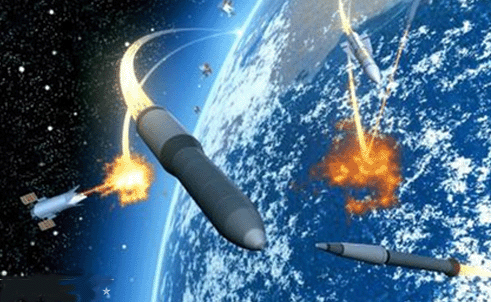
Professor warns space exploration will give rise to totalitarian societies equipped with nuclear weapons – but some say his forecast is too pessimistic
- Daniel Deudney is a political science professor at Johns Hopkins University
- He recently published a book titled ‘Dark Skies’ that talks about space expansion
- The text warns that space settlements could become totalitarian societies
- Populations and resources will need to be controlled for survival
- Deudney notes that nuclear weapons will become the gold standard in space
- He fears that the cosmic battles will eventually make their way to Earth
By STACY LIBERATORE FOR DAILYMAIL.COM, 28 October 2020 Space agencies across the world are working tirelessly to design the best ships and technologies for the chance to claim a stake of the final frontier for their country.
Although it may seem like an act of national pride, a professor from Johns Hopkins University warns that space expansion may lead to the extinction of humanity, suggesting it should not be attempted at all.
Daniel Deudney recently published a book titled ‘Dark Skies’ that examines space expansionism through geopolitics revealing cosmic habitats could spark totalitarian empires.
The political science professor also notes that if these settlements stretch across the solar system, nuclear weapons will become the gold standard in war, along with using asteroids to destroy enemy planets – but other experts feel these arguments are ‘too pessimistic.’
‘I argue that the consequences of what has actually happened in space are much less positive than space enthusiasts and many others believe,’ reads ‘Dark Skies.’
‘My case for this darker net assessment of actual space activities centers on the role of space activities in making nuclear war more likely.’
‘In sum, this book argues that the large-scale expansion of human activities into space, past and future, should join the lengthening list of catastrophic and existential threats to humanity, and that the ambitious core of space expansionism should be explicitly relinquished.’
The book’s release comes at a time when many countries are muscling up to head into space.
The US announced a new branch of its armed forces called the US Space Force in 2019, which ‘is designed to protect the interests of the United States in space, deter aggression in the final frontier and conduct prompt and sustained space operations.’
However, Deudney’s concludes that these countries’ efforts will come with serious consequences.
The professor used geopolitics for this work, which studies ‘the practice of states controlling and competing for territory’ – and in this case, space.
Deudeny also explains that he is not opposed to using space in ways that will benefit Earth and is not on a mission to ‘defund space’ by eliminating the many robots and satellites that currently patrol the area.
He is looked at ‘the political and military potential of a system-spanning human civilization only increases the chances of totalitarianism and the deliberate or accidental extinction of human society,’……..
Along with using objects in space, governments have revealed details over the past years for launching nuclear weapons into the final frontier.
NASA is working on a method that would send a nuclear bomb into space aboard a rocket to destroy an asteroid heading towards Earth.
Earlier this year, the US raised concerns that China or Russia may soon detonate a nuclear weapon in space ‘to fry the electronics’ of spacecraft and ‘indiscriminately’ take out satellite.
Although neither of these are a reality, the technology may be in the works and could be used to wage space war…… https://www.dailymail.co.uk/sciencetech/article-8885599/Professor-warns-space-exploration-spark-totalitarian-societies-equipped-nuclear-weapons.html
Archbishop Tomasi has led the Vatican’s fight against nuclear weapons
|
Archbishop Tomasi has led the Vatican’s fight against nuclear weapons. Pope Francis is making him a Cardinal. America the Jesuit Review , Drew Christiansen, October 28, 2020 Sunday Oct. 25 was a double red-letter day for Silvano Maria Tomasi, C.S. Honduras had ratified the Treaty on Prohibition of Nuclear Weapons the day before, hastening a global nuclear weapons ban into force in January 2021. Helping shepherd that treaty through the United Nations had been one of the highlights of Archbishop Tomasi’s diplomatic career.Then at his noon Angelus meeting, Pope Francis announced the elevation of Archbishop Tomasi and 12 others as cardinals. Cardinal-elect Tomasi, a naturalized American citizen, was one of two Americans added to the college of cardinals, with Cardinal-elect Wilton Gregory of Washington. That announcement in combination with the treaty’s advancement was a moment of serendipity, the crowning of a rich career.
Among many international bodies joined by Archbishop Tomasi in a varied and vigorous career in diplomatic service to the Holy See were the United Nations Human Rights Council and the Conference on Disarmament. The U.N. Human Rights Council was the scene of many of the nuncio’s most important interventions on behalf of the rights of children and indigenous and migrant people, the right to development, in condemnation of human trafficking and in defense of a safe and healthy environment. The council was also the site of the most difficult moments of his tenure as the Holy See’s permanent observer to the United Nations and other international agencies in Geneva, addressing the church’s flawed response to the sex abuse crisis and facing the harsh judgments of the council and its members. It was with his colleagues in disarmament dialogues that he found the signature issue of his last years in diplomatic service, nuclear weapons abolition. Beginning in 2013, Archbishop Tomasi led the Holy See delegations to a series of international meetings on the humanitarian consequences of nuclear weapons that prepared the way for “the ban treaty.” After the U.N. conference had adopted the treaty, he worked with Cardinal Peter Turkson to prepare a Vatican conference to mark its passage. Before an audience of Nobel Peace Prize laureates, diplomats, civil society leaders and church peace activists, Pope Francis declared of nuclear weapons, “the threat of their use, as well as their very possession, is to be firmly condemned.”…….https://www.americamagazine.org/faith/2020/10/28/archbishop-tomasi-united-nations-vatican-nuclear-weapons-pope-francis-cardinal |
|
Britain, and other countries, got nuclear weapons for reasons of status and pride
|
We’re nuclear because of the kudos, https://www.heraldscotland.com/news/18818883.letters-nuclear-kudos/ Ian W Thomson, Lenzie. 23 Oct 20 DAVID Crawford asks a question about why the UK Government allows a large element of UK tax revenue to be spent with the US facilities to support the UK nuclear weapon submarine resource. He answers his question by saying “money”, because the UK itself is a substantial supplier of weapons
I believe that there is more to it than he suggests. The Labour Government at the end of the Second World War could have decided not to have nuclear weapons. It initially took the option to have them largely because of status and pride. Ernest Bevin, then the Foreign Secretary, stated: “We’ve got to have the bloody Union Jack on top of it.” The costs of maintaining that status have become more and more expensive over the years, which has led to the UK becoming more and more reliant upon the US for technical support at a cost. The theory must be that it is better to have a nuclear deterrent sort of independent rather than not have such deterrent at all. I also believe that status still has a large part to play in the UK’s position today, albeit we are far removed from the circumstances prevailing at the end of the Second World War. It is interesting that all five permanent members of the UN Security Council are nuclear powers: China, France, Russia, the UK and the US. The UK, no doubt, places great value upon that status and is likely to regard being a nuclear power as helping to sustain it. The original idea was that the five would progressively disarm in exchange for other states not acquiring nuclear weapon facilities. That idea has gone well, hasn’t it? Look at India and Pakistan and the likelihood of some others. |
|
Hope for nuclear arms control with Russia?
|
Hope for nuclear arms control with Russia? Brookings Steven Pifer, Monday, October 26, 2020 Editor’s Note: The U.S.-Russia nuclear arms treaty, New START, is set to expire in February 2021. Little progress was made during the summer and it was unclear if the two countries would reach an agreement. However, a breakthrough has given the arms control treaty a new lease on life, albeit with a lot of questions, writes Steven Pifer. This piece originally published by the Freeman Spogli Institute’s Center for International Security and Cooperation at Stanford University.
While concern had grown over the past several weeks about a breakdown in U.S.-Russian arms control, it appears the 2010 New Strategic Arms Reduction Treaty and nuclear arms control more broadly may have a new lease on life, albeit with lots of questions. Washington’s negotiation with Moscow on New START hit a roadblock on October 16. President Putin said Russia would agree to a one-year extension, which U.S. negotiators had proposed instead of five years, but without the conditions sought by the American side. National Security Advisor O’Brien summarily rejected the Russian position because it ignored the U.S. demand for a freeze on all nuclear warhead numbers.
Things changed recently. The Russians announced that they would agree to a one-year extension of New START and said they are “ready to assume a political obligation together with the United States to freeze the sides’ existing arsenals of nuclear warheads during this period.” The Russian statement added that this presumed no additional U.S. conditions. The Department of State spokesperson quickly and positively reacted, saying U.S. negotiators are “prepared to meet immediately to finalize a verifiable agreement.” New START constrains U.S. and Russian strategic nuclear forces to their lowest levels since the 1960s. However, when it comes to nuclear warheads as opposed to delivery systems, the treaty limits only “deployed” strategic warheads—that is, warheads on deployed intercontinental ballistic missiles (ICBMs) or submarine-launched ballistic missiles (SLBMs). The treaty does not cover reserve strategic warheads or any non-strategic (tactical) nuclear weapons. If Russian acceptance of a one-year freeze means that the Trump administration has succeeded in persuading Moscow to negotiate a treaty limiting all U.S. and Russian nuclear weapons, that is a commendable breakthrough. Indeed, a treaty covering all the two sides’ nuclear arms has long seemed the logical next step after New START (President Obama proposed such a negotiation in 2010). Questions remain, however. The Russian statement indicates that Moscow is ready to undertake, as a political obligation, a one-year freeze on nuclear warhead numbers. It remains unclear whether Russian officials, beyond that freeze, are prepared to negotiate a legally-binding and verifiable treaty constraining all nuclear warheads that would be in effect for a number of years (New START is in force for 10 years, with the possibility of its extension for an additional five years). ……
it appears that U.S. and Russian negotiators still have issues to resolve. Irrespective of the freeze, New START is worth saving and extending to 2026 (the treaty’s terms provide that there could be multiple extensions). Extension to 2026 would mean five more years of limits on Russian strategic nuclear forces. It would mean five more years of information about those forces provided by the treaty’s verification measures, including data exchanges, notifications and on-site inspections. And extending the treaty would require no change in U.S. strategic modernization plans, as those plans were designed to fit within the treaty’s limits. One last observation: New START requires that, if a side wishes to withdraw from the treaty, it must give the other three months’ notice before doing so. It is now October 21, which means that, if negotiations with the Russians do not go well and the Trump administration were to give notice, the United States could not actually withdraw from the treaty until after January 20, 2021—when Donald Trump will be starting his second term or Joe Biden will have become the 46th U.S. president. Mr. Biden is on record as supporting New START’s extension for five years, with no conditions. https://www.brookings.edu/blog/order-from-chaos/2020/10/26/hope-for-nuclear-arms-control/ |
|
495 local assemblies demand Japan government ratify the Treaty on the Prohibition of Nuclear Weapons
 495 local assemblies demand Japan gov’t ratify nuclear ban treaty in written statement, October 24, 2020 Mainichi Japan
 The nuclear arms prohibition treaty was adopted in July 2017 by 122 countries and regions — over 60% of the United Nation’s membership. The treaty bans the development, test, manufacture, possession or use of atomic weapons, as well as the threat of their use — the basis of nuclear deterrent. Japan did not participate in negotiations nor signed the pact, along with the five nuclear powers of the United States, Russia, Britain, France and China. Tokyo stayed out of the pact for fear of appearing to denounce nuclear deterrence and thereby deepening conflict between nuclear have and have-not nations.
According to Gensuikyo, the prefectural assemblies of Iwate, Nagano, Mie, Tottori, and Okinawa, as well as 490 municipal assemblies — 28% of all local assemblies nationwide — had adopted the written statement as of Oct. 23, 2020. The tally includes assemblies that have adopted the objective of the written statement, as they agree with it but are uncertain of its feasibility. A total of 34 assemblies in Iwate, including the prefectural assembly, adopted the statement. The statement was initially turned down twice in the municipal assembly of Ofunato, Iwate Prefecture, but finally gathered a majority in March 2020 after Gensuikyo explained persistently about damage resulting from nuclear weapons.
Sixteen municipal assemblies in Hiroshima Prefecture, including the Hiroshima city assembly, have adopted the statement, with authorities saying, “Our country, the only nation that has experienced atomic bombing, has a special role and responsibility to strive to abolish nuclear weapons.” However, Hiroshima Prefectural Assembly lawmakers did not even submit a proposal to adopt the statement.
There are also local assemblies that reject adopting the statement as it is not legally binding, and by claiming that national defense and security are exclusively under central government jurisdiction. Soji Kanno, deputy secretariat head at Gensuikyo’s Iwate branch, who approached Iwate Prefecture assemblies with the statement, commented, “Abolishing nuclear weapons is not a political request, but the wish of the Japanese public. I’d like for all local assemblies to raise their voices towards the Japanese government.”
Pacific islands demand truth on the decades of nuclear testing, now that nuclear weapons are becoming illegal
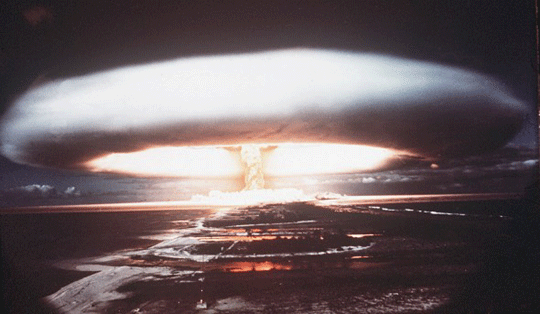
Guardian 25th Oct 2020, Now that nuclear weapons are illegal, the Pacific demands truth on decades of testing. Nuclear weapons will soon be illegal. Just over 75 years since their devastation was first unleashed on the world, the global community has rallied to bring into force a ban through the Treaty on the Prohibition of Nuclear Weapons.
Late on Saturday night in New York, the 50th country – the central American nation of Honduras – ratified the treaty. It will become international law in 90 days. For many across the Pacific region, this is a momentous achievement and one that has been long called
for. Over the second half of the 20th century 315 nuclear weapons tests were conducted by so-called “friendly” or colonising forces in the Marshall Islands, Kiribati, Australia and Maohi Nui (French Polynesia).
The United States, Britain and France used largely colonised lands to testtheir nuclear weapons, leaving behind not only harmful physical legacies but psychological and political scars as well. Survivors of these tests and their descendants have continued to raise their voices against these weapons. They are vocal resisters and educators, the reluctant but intense knowledge holders of the nuclear reality of our region.
-
Archives
- October 2026 (104)
- September 2026 (339)
- August 2026 (330)
- July 2026 (355)
- June 2026 (287)
- May 2026 (306)
- April 2026 (356)
- March 2026 (251)
- February 2026 (267)
- January 2026 (308)
- December 2025 (358)
- November 2025 (359)
-
Categories
- 1
- 1 NUCLEAR ISSUES
- business and costs
- climate change
- culture and arts
- ENERGY
- environment
- health
- history
- indigenous issues
- Legal
- marketing of nuclear
- media
- opposition to nuclear
- PERSONAL STORIES
- politics
- politics international
- Religion and ethics
- safety
- secrets,lies and civil liberties
- spinbuster
- technology
- Uranium
- wastes
- weapons and war
- Women
- 2 WORLD
- ACTION
- AFRICA
- Atrocities
- AUSTRALIA
- Christina's notes
- Christina's themes
- culture and arts
- Events
- Fuk 2022
- Fuk 2023
- Fukushima 2017
- Fukushima 2018
- fukushima 2019
- Fukushima 2020
- Fukushima 2021
- general
- global warming
- Humour (God we need it)
- Nuclear
- RARE EARTHS
- Reference
- resources – print
- Resources -audiovicual
- Weekly Newsletter
- World
- World Nuclear
- YouTube
-
RSS
Entries RSS
Comments RSS

