Russia: commentary on its nuclear deterrence principles
The only public statement on nuclear deterrence was a standard sentence repeated in Russia’s military doctrine and other documents stating that Russia would only resort to nuclear weapons if it was attacked by weapons of mass destruction, or if an attack threatened the very existence of the state. …..
While the existence of such an ‘escalate to de-escalate’ doctrine and other details on Russia’s potential use of nuclear weapons was contested in the past, the final sentence of Article 4 of the doctrine comes closest to answering this question. It states that, once a war has started, nuclear deterrence policy is to seek to prevent it from escalating further, or from being terminated on terms unfavourable to Moscow. This is a short version of what in Russian military literature is termed ‘escalation control’. Escalation control implies that threats, demonstrations of strike capabilities, and inflicting “calibrated damage” on the enemy (which may, but does not have to, include nuclear weapons) should contain, localise, and if possible terminate a war on Moscow’s terms. …..
Article 19 deliberates on the conditions under which nuclear weapons could be released. It explicitly mentions a ‘launch on warning’ posture. This is a signal to the US that conventional or low-yield re-entry vehicles (the latter are in development) of intercontinental missiles would be treated as a full-scale attack and that Washington should therefore not think of employing them in a tactical or limited attack close to Russia’s borders. ……….
The Russian decree does not contain any detailed provisions on force structure, weapons systems (future or present), force modernisation, or references to other nuclear powers. Much detail is lacking from what one might normally expect to see in a nuclear doctrine. Article 15 states merely that nuclear deterrence needs to be adaptable, and should leave the enemy guessing about the time, scale, and manner of the use of nuclear weapons. It also says that Russia intends to maintain the minimal force required to achieve its tasks………
Taken together, all these provisions seem surprisingly minimalist. It may well be that Russia intends to signal to the United States that, if the American-Chinese arms race takes off, Moscow does not intend to follow suit and “spend itself into oblivion”, as US assistant secretary for terrorist financing in the Treasury, Marshall Billingslea, put it. Russia is hardly likely to publicly admit that in the 21st century it will most probably be a secondary nuclear power. But, in fact, it does seem to be adapting to this role.
Finally, Article 3 notes that Russia’s nuclear deterrence is flanked by other state measures to achieve its goals, including diplomatic and “information policies” (propaganda). The publication of the doctrine and the content of Article 3 effectively represent the firing of the starting pistol on a new ‘information campaign’ in the West: expect to soon see an information operation that aims to inflate the purported capabilities of Russia’s nuclear forces and induce fear (such as the new “Wunderwaffen”, presented in March 2018), and new diplomatic overtures in the fields of arms control, in particular designed to split the alliance. At least on the latter, Putin may get assistance from the White House: Trump’s clumsy and undiplomatic handling of the INF and Open Skies issues provide more opportunities to exploit than any Russian diplomat would have ever dreamed of creating. ……… https://www.ecfr.eu/article/commentary_russias_nuclear_deterrence_principles_what_they_imply_and_what_n
USA’s reckless nuclear spending as coronovirus hits the nation
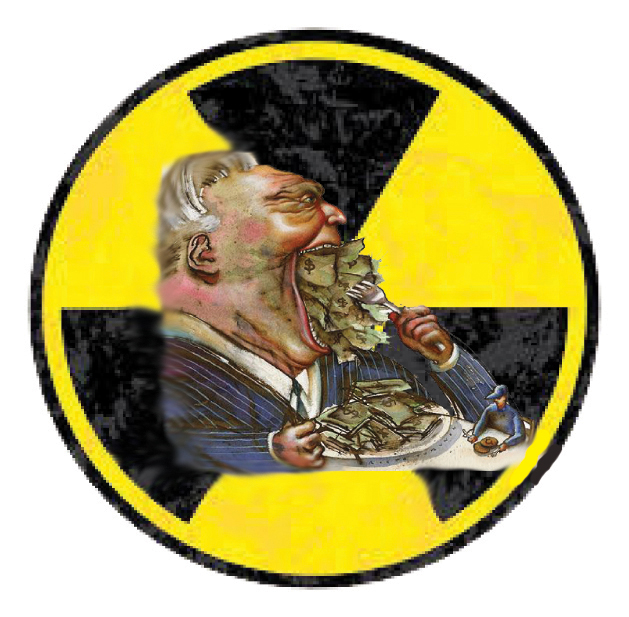 Debating US nuclear spending in the age of the coronavirus, Bulletin of the Atomic Scientists Debating US nuclear spending in the age of the coronavirus, Bulletin of the Atomic Scientists  By Kingston Reif, June 10, 2020 As the novel coronavirus pandemic continues to exact a terrible human and economic toll on the United States, Americans are adjusting how they view national security. There also appears to be agreement, even within the senior leadership of the Defense Department, that the military budget, which has seen significant growth during the Trump administration, is likely to be pared back in the coming years as federal deficits soar. By Kingston Reif, June 10, 2020 As the novel coronavirus pandemic continues to exact a terrible human and economic toll on the United States, Americans are adjusting how they view national security. There also appears to be agreement, even within the senior leadership of the Defense Department, that the military budget, which has seen significant growth during the Trump administration, is likely to be pared back in the coming years as federal deficits soar.
So it should be no surprise that the havoc wrought by the virus has also fanned the flames of an ongoing debate about the Trump administration’s aggressive and costly plans to sustain and upgrade the US nuclear arsenal……. The unsustainable nuclear budget. At the Arms Control Association, where I am the director for disarmament and threat reduction policy, we have long argued that the administration’s approach is unnecessary, unsustainable, and unsafe. The financial and opportunity costs have steadily grown and the biggest nuclear weapons modernization bills are just beginning to arrive. Government officials in charge of the nuclear weapons enterprise warn about the “pervasive and overwhelming risk” facing the current nuclear modernization program………. The danger posed by the plans is on full display in the administration’s fiscal year 2021 budget request. The Defense and Energy Departments are requesting $44.5 billion for next year to sustain and modernize US nuclear delivery systems and warheads and their supporting infrastructure, a larger-than-anticipated increase of about $7.3 billion, or 19 percent, from the fiscal year 2020 level. Meanwhile, the administration is recommending a lower overall national defense budget than Congress provided last year. The combination of a decreased topline budget but an increased nuclear budget means that other defense programs would have to be cut. Some programs on the chopping block include the Navy’s planned second Virginia class submarine, the Energy Department’s efforts to clean up nuclear waste leftover from US nuclear weapons production during the Cold War, and the Pentagon’s Cooperative Threat Reduction program, which supports global efforts to detect and secure dangerous pathogens such as the coronavirus. And this was all before the coronavirus began its deadly march across the country and before Congress spent several trillion dollars trying to save the US economy from complete collapse. Although Pentagon officials insist that nuclear weapons should be shielded from possible future defense budget cuts, the pressure on the federal budget imposed by the response to the virus is likely to exacerbate the affordability and execution challenges confronting the administration’s nuclear spending plans. If great power competition with China is the Pentagon’s top priority, is it prudent to sacrifice a Virginia class submarine every year for the next 10 to 15 years to attempt to keep an excessive and overburdened nuclear modernization effort on track? The answer should be no, especially in light of the quantitative and qualitative superiority of the US nuclear arsenal over China’s. In the view of many, the Trump administration’s proposal to expand spending on nuclear weapons is a sad and dangerous illustration of wildly misplaced federal spending priorities. As it proposed a 19 percent increase for nuclear weapons next year, the White House initially planned to slash the budgets for the Centers for Disease Control by 19 percent and the National Institutes of Health by 7 percent. The Pentagon’s proposal to cut the budget for the Cooperative Threat Reduction program in order to fund weapons modernization amid a global pandemic is shockingly reckless…… Inexplicably, the unprecedented economic crisis facing the nation hasn’t stopped some Trump administration officials from raising the prospect of even greater spending on nuclear weapons above and beyond what is already planned. Marshall Billingslea, President Trump’s special envoy for arms control, said recently that if Russia and China don’t agree to US demands for talks on new trilateral arms control to replace the 2010 New Strategic Arms Reduction Treaty (New START), Washington could win a new arms race if necessary. “We know how to win these races, and we know how to spend the adversary into oblivion,” he said. More US spending on nuclear weapons won’t force the current Russian and Chinese leadership to capitulate and would be fraught with peril. The administration’s desire to pursue a more ambitious arms control agreement is the right goal, but it can’t be achieved before New START is slated to expire next February. A new quantitative arms race that could follow the collapse of New START would further undermine stability between the United States and Russia, the health of the global nonproliferation regime, and the US military’s emphasis on competition with China. Our new post-pandemic reality should make it all the more obvious that the current modernization plans need to be reconsidered in a way that eliminates the most excessive and destabilizing elements, saves taxpayer dollars for other pressing national and health security needs, and is in sync with a revitalized and realistic strategy to cap and reduce global nuclear stockpiles…….. Lisa Gordon Hagerty, head of the National Nuclear Security Administration, was asked to explain the rationale for such a large unplanned increase at a Congressional hearing in March, but her attempt at an answer hardly cleared up the situation. Perhaps there is a clearer explanation for why the agency so badly misjudged its funding needs for 2021, but if so the agency has yet to provide it…. (lengthy rebuttal of Frank Miller’s claims about nuclear weapons spending) ……. https://thebulletin.org/2020/06/debating-us-nuclear-spending-in-the-age-of-the-coronavirus/# |
|
|
USA – resuming nuclear tests would wreck the Nuclear Non-Proliferation Treaty (NPT), with no military or strategic benefit
 The Trump Administration’s Nuclear Test Delusions, Just Security, by Ambassador Thomas Graham Jr. June 10, 2020 Even as the Trump administration continued to struggle to contain the coronavirus in mid-May, White House officials preoccupied themselves with manufacturing a wholly unnecessary threat. On May 15, senior national security officials at an interagency meeting reportedly discussed the possibility of abandoning the longstanding U.S. moratorium on nuclear-weapons testing that has been in place for nearly three decades and is now accepted by the entire world, even North Korea. According to a May 22 report in the Washington Post, the proponents of ending the moratorium argued in the meeting that the United States should resume testing because Russia and China were conducting low-level nuclear-weapons tests, allegations that appear to be based on no evidence.Such tests would bring no military or strategic benefit to the United States. Instead, they would undermine the foundational global agreement that has curbed the spread of nuclear weapons worldwide for more than 50 years, the Nuclear Non-Proliferation Treaty (NPT). The Trump Administration’s Nuclear Test Delusions, Just Security, by Ambassador Thomas Graham Jr. June 10, 2020 Even as the Trump administration continued to struggle to contain the coronavirus in mid-May, White House officials preoccupied themselves with manufacturing a wholly unnecessary threat. On May 15, senior national security officials at an interagency meeting reportedly discussed the possibility of abandoning the longstanding U.S. moratorium on nuclear-weapons testing that has been in place for nearly three decades and is now accepted by the entire world, even North Korea. According to a May 22 report in the Washington Post, the proponents of ending the moratorium argued in the meeting that the United States should resume testing because Russia and China were conducting low-level nuclear-weapons tests, allegations that appear to be based on no evidence.Such tests would bring no military or strategic benefit to the United States. Instead, they would undermine the foundational global agreement that has curbed the spread of nuclear weapons worldwide for more than 50 years, the Nuclear Non-Proliferation Treaty (NPT).
Such low-level tests would be of little military benefit to Russia and China either, as there is scant information for them to gain that they do not already possess. Thus, even if such tests occurred, they would not represent any kind of significant security threat to the United States. The only conceivable benefit for the United States of resuming a nuclear-weapons testing program would be to create an opportunity for President Donald Trump to somehow distort the value of it and use it as another meaningless political ploy to bolster his campaign for re-election in November……. In 1961, the United Nations unanimously passed the “Irish” Resolution (introduced by Ireland), which called on all states to conclude an international agreement prohibiting the proliferation of nuclear weapons to additional countries. In 1965, another resolution was passed by the U.N. General Assembly calling on nations to negotiate an international treaty to prevent the further proliferation of nuclear weapons, which became the Nuclear Non-Proliferation Treaty (NPT). China had just completed an initial nuclear-weapons test program, bringing the number of declared nuclear weapon states to five: the United States, the Soviet Union, the United Kingdom, France, and China. This new treaty would be based on five principles, among them a commitment to ultimately abolish nuclear weapons and, in the interim, a balance of obligations among the five nuclear-weapons states and other state parties that thus far had no nuclear weapons. This balance required interim steps toward nuclear disarmament, short of elimination — seen in the depths of the Cold War as a distant objective — in exchange for a commitment that all parties would be permitted to pursue peaceful uses of nuclear energy. The principal interim step was considered to be the worldwide termination of nuclear-weapons tests. (Although the Limited Test Ban Treaty had been negotiated in 1962, led by President John F. Kennedy, and nuclear-weapon tests were prohibited everywhere except underground, by 1968, many tests were being conducted underground.) The NPT was signed in 1968. It was to last for 25 years, after which on a one-time basis, the parties would decide by majority vote how much longer it would exist. The non-nuclear-weapons states in the treaty negotiations had urged the inclusion of a reference to interim steps in the agreement, especially an accord to ban nuclear testing, which became the Comprehensive Nuclear-Test-Ban Treaty (CTBT). The CTBT was looked upon by the non-nuclear-weapons states as the price to be paid by the five states holding nuclear weapons for the others giving up their rights to develop such armaments. Thus, a ban on nuclear testing was essential to the strategic bargain of the NPT. The United States and the Soviet Union would not agree to any interim step in the text of the NPT, with one exception: a reference to the CTBT in the preamble. The two nations also promised that interim steps, including the CTBT, would be negotiated at the treaty review conferences that were required under the agreement every five years……. U.S. President Bill Clinton was the first to sign, and ultimately, the CTBT was signed by 184 states, of which 168 have ratified it. But the Treaty requires that all 44 of those states that had nuclear facilities of any kind on their territories in 1996, called Annex 2 states, must ratify the treaty before it enters into force. Of these Annex 2 states, 36 have ratified—states such as Germany, Japan, Britain, France, and Russia. The eight that have not ratified are the United States and seven others that are more or less waiting for the United States to move forward. Despite having led the negotiations, the United States has been unable to ratify the treaty. The reason is that the Republican Party turned against arms control and disarmament and, ultimately, against peace and diplomacy themselves. . This from a party that once stood at the forefront of arms control and disarmament, with major initiatives such as President Ronald Reagan agreeing with Soviet President Mikhail Gorbachev at Reykjavik to eliminate all nuclear weapons and President George H.W. Bush concluding four such agreements, more than any other president. The Clinton administration submitted the CTBT to the Senate for advice and consent to ratification in 1997. Two years later, in 1999, it was rejected by the Republican-led Senate—led by two senators from the right—Senators Jesse Helms (R-NC) and Jon Kyl (R-AZ). Ever since, Republicans in the Senate have blocked ratification, but the Clinton, Bush, and Obama administrations informally observed the treaty’s terms. The United States also has abided by Article 18 of the Vienna Convention on the Law of Treaties, which obligates a state not to defeat the object and purpose of a treaty that it has signed and that is pending ratification unless and until such state has made its intention clear not to become a party. The United States is not a party to the convention, but has recognized its authority. Thus, it is obligated not to do nuclear-weapons testing of any kind unless it clearly states its intention not to ratify. Doing such a test would certainly defeat the object and purpose of the CTBT, and the United States has made no indication that it intends never to ratify the CTBT. Republican Party, Once Leading on Arms Control, Backs Away In the last decade, elements in the Republican Party have tried to promote the elimination of this obligation and reopen the door to an underground nuclear-weapons testing program. First, Republicans made an argument for years that the United States was observing a CTBT standard of not testing weapons of any yield even though Russia and China never agreed to do the same. But the negotiating record showed Russia and China stating clearly that they recognize the CTBT is a “zero-yield treaty,” and the strength of that record wore down this argument. ……. Now Republicans are back again with a similar argument, only this time adding China. They allege — once again without evidence — that both Russia and China are doing low-level nuclear-weapons tests and benefiting from doing so. Perhaps someone will also bring up again the non-argument that Russia and China have the capability to do this. Apparently one senior official at the recent White House meeting asserted that a demonstration by the United States that it could “rapid test” could be useful in a trilateral nuclear negotiation with Russia and China, a seemingly fruitless position that Trump is trying to pursue in withholding an extension of the New START agreement between the United States and Russia that expires early next year. China has made it clear that it will not participate in such a negotiation. Biden found the idea “delusional.” Notably, the reaction to the report that the Trump administration is considering a resumption of testing was not positive in significant domestic circles either. In its editorial, the Las Vegas Sun also said, “The state endured four decades of nuclear tests – more than 1,000 in all, before testing ceased in 1992 via an international moratorium. We and our downwind neighbors in Utah endured nuclear fallout in above-ground tests during the 1950s and 1960s, and our desert remains irradiated by underground tests conducted later. “We will fight any effort to reopen the door to that dark era…” It is difficult to imagine a greater threat to U.S. national security than for the United States to pursue a nuclear-weapons test program at the present time. Such action would defeat the object and purpose of the CTBT, which means the United States would be turning its back on the essential glue that holds the NPT together. The likely result would be that the NPT would gradually come apart. Other states such as Iran, Saudi Arabia, Brazil, Turkey, and Egypt would use the U.S. tests as an excuse to develop their own test programs and to acquire nuclear weapons for a national arsenal. Eventually, in an era when many countries may feel less and less secure as climate change erodes their remaining national assets such as arable land and fresh water, they might see nuclear weapons as more and more attractive. Once the door kept closed by the NPT is opened, we would enter a nightmare world, a risk foreseen by past American statesmen. https://www.justsecurity.org/70654/the-trump-administrations-nuclear-test-delusions/ |
|
The last major treaty for nuclear weapons control now hangs in the balance
|
Nuclear might crux of push for new pact. Treaty expiration would end caps on arms; U.S. envoy says Russia meeting set Northwest Arkansas Democrat Gazette by PAUL SONNE AND ROBYN DIXON, 10 June 20, THE WASHINGTON POST The last major treaty limiting U.S. and Russian nuclear might hangs in the balance as the Trump administration pushes to replace it with an arms-control pact that also includes China five months before the U.S. presidential election.The New START accord, which restricts the number of deployed strategic nuclear warheads and certain launch platforms, is set to expire in February. If the Trump administration declines to extend it and the caps disappear, the United States and Russia will be left without any significant limits on their nuclear forces for the first time in decades.
Russia has said it is willing to extend the New START pact unconditionally. But the Trump administration has balked, saying the treaty signed by former President Barack Obama in 2010 is outdated, insufficient and overly advantageous for Moscow. …….. The result is a game of nuclear brinkmanship in the waning days of the Trump administration’s first term…… https://www.nwaonline.com/news/2020/jun/10/nuclear-might-crux-of-push-for-new-pact/ |
|
Trump’s dangerous idea on nuclear testing – top Democrats demand answers
 Top Democrats demand answers on Trump administration’s ‘unfathomable’ consideration of nuclear testing The Hill BY REBECCA KHEEL – 06/08/20 A group of top House Democrats is demanding answers from the Trump administration on reported conversations within the administration on whether to resume nuclear testing.“It is unfathomable that the administration is considering something so short-sighted and dangerous, and that directly contradicts its own 2018 Nuclear Posture Review,” the lawmakers wrote in a letter Monday to Energy Secretary Dan Brouillette and Defense Secretary Mark Esper
The posture review, the lawmakers wrote, “which this administration often cites as inviolable, makes clear that ‘the United States will not resume nuclear explosive testing unless necessary to ensure the safety and effectiveness of the U.S. nuclear arsenal.’
The letter was signed by House Armed Services Committee Chairman Adam Smith (D-Wash.) and House Appropriations Committee Chairwoman Nita Lowey (D-N.Y.), along with Reps. Jim Cooper (D-Tenn.), chairman of the Armed Services Subcommittee on Strategic Forces; Marcy Kaptur (D-Ohio), chairwoman of the Appropriations subcommittee on energy and water; and Pete Visclosky (D-Ind.), chairman of the Appropriations Subcommittee on Defense.
The Pentagon declined to comment………
The lawmakers demanded answers to questions by June 22, as well as a briefing by June 25. Questions include under what legal authority and funding testing is being considered, whether the intelligence community is analyzing what the effects of a test would be on U.S. allies and adversaries, and whether there has been any independent assessment requested by the Energy or Defense departments on the need, cost and effect of resuming nuclear testing. https://thehill.com/policy/defense/501687-top-democrats-demand-answers-on-trump-administrations-unfathomable
Nuclear testing ban to be introduced in U.S. Congress

 Reps. Steven Horsford and Dina Titus announce nuclear testing ban legislation, 8 NewsNow by: Kaitlyn Olvera Jun 8, 2020, LAS VEGAS (KLAS) — Congressman Steven Horsford and Congresswoman Dina Titus have introduced a nuclear testing ban. The Preserving Leadership Against Nuclear Explosives Testing (PLANET) Act, introduced Monday, would prevent President Donald Trump from restarting nuclear weapons testing in Nevada.
This legislation “would prevent the Trump administration from restarting explosive nuclear weapons testing by restricting funds for fiscal year 2021 and all previous years from being used for such a purpose,” a release about the legislation stated.
The Washington Post reported the Trump administration had a discussion about conducting a nuclear test with top security officials on May 15, in response to accusations that Russia and China were performing low-yield nuclear tests. This is a claim both countries have denied.
Specifically, the PLANET Act would, according to Rep. Horsford’s office:
- Prohibit the use of funds appropriated in Fiscal Year 2021 or from any previous year to prepare for or to conduct an explosive nuclear test that produces any yield
- Allow for stockpile stewardship activities that are consistent with U.S. law – such as certifying the safety, security and reliability of the U.S. nuclear stockpile – so long as those activities are consistent with the “zero-yield” scope of the Comprehensive Test Ban Treaty (CTBT)…… https://www.8newsnow.com/news/local-news/reps-steven-horsford-and-dina-titus-announce-nuclear-testing-ban-legislation/
Nuclear arms meeting planned, USA and Russia, – arms control expert is not enthusiastic
 US and Russia to meet for nuclear arms negotiations this month Jennifer Hansler, CNN June 8, 2020 Washington US and Russian officials will meet later this month for nuclear arms negotiations, a top US arms control official announced Monday.
 |
ReplyForward
|
Top Democrats promote bill to ban live nuclear tests
 Lead Dems back bill to ban live nuclear tests, Defense News, By: Joe Gould 5 June 20, WASHINGTON ― The Senate’s top Democrat, Sen. Chuck Schumer, is co-sponsoring legislation meant to prevent the Trump administration from restarting explosive nuclear weapons testing.
The Preserving Leadership Against Nuclear Explosives Testing, or PLANET, Act, announced Thursday, would bar any funds from being used for such tests. It follows a Washington Post report of high-level discussions around the possibility of doing a “rapid test” ― potentially America’s first live nuclear test since 1992.
The bill is led by Sen. Ed Markey, D-Mass., and a longtime arms control advocate on the Senate Foreign Relations Committee. While a key administration official has said tests could begin within months if ordered by the president for technical or geopolitical reasons, critics say it could incentivize Russia and China to openly test with little valuable data to show for U.S. tests…….. https://www.defensenews.com/congress/2020/06/04/lead-dems-back-bill-to-ban-live-nuclear-tests/
Many $billions for U.S. Air Force’s new nuclear weapons
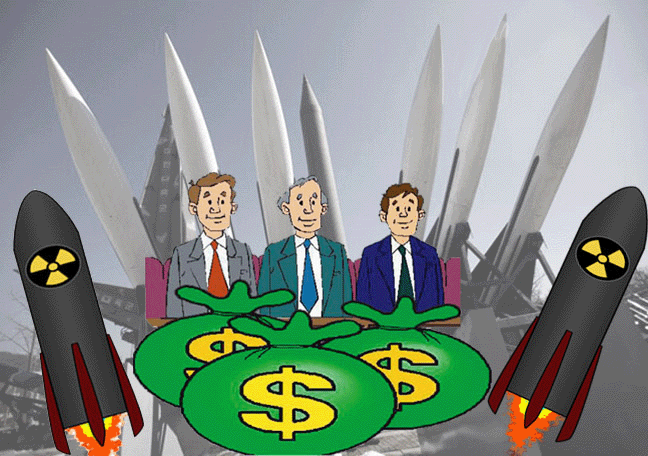 The Air Force Is Getting Ready To Receive New Nuclear Weapons, National Interest, David Axe, 5 June 20, Here’s What You Need To Remember: Now the command is in the beginning of a modernization effort costing tens of billions of dollars. New B-21 stealth bombers are slated to supplant the B-1s and B-2s starting in the mid-2020s. The Ground-Based Strategic Deterrent rocket, a replacement for the 1960s-vintage Minuteman, is in development.
The U.S. Air Force’s nuclear command says it’s about to undergo a major reorganization as it prepares to field new bombs, missiles, bombers and rockets.
Air Force Global Strike Command stood up in 2009 as the successor to Strategic Air Command, which maintained around-the-clock nuclear alerts during the Cold War.
Today the command’s 34,000 personnel oversee 20 B-2 stealth bombers, 76 B-52 bombers and 450 Minuteman III intercontinental ballistic missiles together capable of delivering thousands of nuclear warheads.
It also operates 62 B-1 bombers that do not have a nuclear mission.
AFGSC’s forces comprise the aerial and ground “legs” of the United States’s atomic triad, which also includes the U.S. Navy’s submarine-launched Trident ballistic missiles.
The command’s forces are capable of extinguishing essentially all life on Earth within a matter of hours.
Accidents and misbehavior marred AFGSC’s early years. In 2014 ICBM crews got caught cheating on tests. In 2018 security forces at Minot Air Force Base, home to a portion of the Minuteman fleet, lost track of some of their weapons. The suicide rate is high in the atomic force.
Now the command is in the beginning of a modernization effort costing tens of billions of dollars. New B-21 stealth bombers are slated to supplant the B-1s and B-2s starting in the mid-2020s. The Ground-Based Strategic Deterrent rocket, a replacement for the 1960s-vintage Minuteman, is in development.
The new Long-Range Stand-Off Weapon, a nuclear-tipped cruise missile, will replace the B-52’s current nuclear cruise missiles. The bomber fleet is getting a refurbished model of its main atomic gravity bomb, the B-61. The missile wings’ security forces are swapping out their five-decade-old UH-1 helicopters for new MH-139s……….https://news.yahoo.com/air-force-getting-ready-receive-060000340.html
Trump wants a nuclear test – adding to the sickness of the world
Trump apparently wants a nuclear test. It could be bad for your health. https://thebulletin.org/2020/06/trump-apparently-wants-a-nuclear-test-it-could-be-bad-for-your-health/#Sara Z. Kutchesfahani
June 5, 2020 In recent weeks, the Trump administration reportedly discussed the possibility of doing something the United States has not done since 1992: resuming explosive testing of nuclear weapons. Since the creation of the nuclear bomb, at least eight nations have detonated 2,056 nuclear test explosions at test sites around the world. Ten years ago, Japanese artist Isao Hashimoto created an informative but scary time-lapse map depicting all of these explosions. In it, each nation gets a flashing dot on the map whenever it detonates a nuclear weapon, with a running tally kept on the top and bottom bars of the screen.
While the story begins in 1945 with the first ever nuclear weapon test (code-named Trinity), the real action comes in 1962, when there were 178 tests globally, more than in any other year. Not only is the rapid rate alarming, but where they happened—mainly on the lands of indigenous people—is also shocking.
A US resumption of nuclear tests would send a bad signal to other countries and prompt them to test and create their own nuclear weapons. Moreover, innocent bystanders could be exposed to the radioactive fallout from a nuclear explosion. Tens of thousands of people have been afflicted by leukemia, thyroid cancer, miscarriages, and severe birth defects as a result of past nuclear testing in the United States alone.
Half of the 2,056 nuclear tests were conducted by one country alone: the United States. Yes, that’s right: the total number of US-conducted tests stands at 1,030, which is more than the number of tests done by the other seven nuclear testing countries combined. Most of the explosions took place at the height of the Cold War in a series of tit-for-tat exchanges between the United States and the Soviet Union.
Even before the banner year of 1962, nuclear testing was already out of control. In 1954, the United States carried out Castle Bravo, the most powerful US nuclear weapon test (and its first thermonuclear weapon, also known as an H-bomb). The 1961 Soviet Tsar Bomba (“King of Bombs”) detonation, though, remains the most powerful human-made explosion in history. Tsar Bomba created an explosion equivalent to 50 megatons of TNT. Let’s pause for a moment for a mathematical intermission to put this yield into perspective.
1 ton = 1,000 kilograms, or 2,200 pounds of explosives
1 kiloton = 1,000 tons, or about 2,200,000 pounds
1 megaton = 1,000,000 tons, or about 2,200,000,000 pounds
The biggest conventional bomb in the US arsenal = 11 tons of TNT
Little Boy (Hiroshima) = 16 kilotons of TNT
Fat Man (Nagasaki) = 20 kilotons of TNT
Castle Bravo = 15 megatons of TNT (roughly 1,000 times more powerful than the Little Boy bomb)
Tsar Bomba = 50 megatons of TNT (roughly 10 times the total explosive power unleashed in all of World War Two, including both the Little Boy and Fat Man bombs that destroyed Hiroshima and Nagasaki)
Each and every above-ground nuclear explosion spread radioactive materials throughout the atmosphere. Once the Partial Nuclear Test Ban Treaty took effect in 1963, many of the tests moved underground, but those still sometimes leaked radioactive materials into the atmosphere. The overall effect was the contamination of the air and soil where people live and work—some of which is still around today.
While testing continued throughout the Cold War, it came to a gradual halt by 1992, such that by 1993, negotiations for a Comprehensive Nuclear Test Ban Treaty began. The Comprehensive Test Ban Treaty is an international treaty banning all nuclear explosions for both civilian and military purposes, in all environments, but it has yet to enter into force. Although the United States has not ratified the treaty, it and all other nuclear weapon states (apart from North Korea), have honored the test ban. Perhaps maybe until now.
Why should the average person care about all this? Well, because there was and is an enormous human cost of nuclear weapons testing. If you go back and watch the Hashimoto video, you’ll notice none of the 1,030 US tests were conducted anywhere near Washington, DC. Likewise, none of the Soviet, French, or British tests were carried out around Moscow, Paris, or London. Instead, the explosions took place mainly on the lands of indigenous people, such as in the Marshall Islands, or in some cases, in the country’s own backyard, such as in New Mexico, Colorado, and Nevada.
Nuclear testing ignores the voices of those who are tangibly affected by it. The human cost of nuclear weapons testing, from environmental contamination to the exploitation of powerless communities, has largely been overlooked. When the United Sates opened a nuclear testing site near Las Vegas, the people who lived downwind of the test site were assured that only a safe level of radiation could reach them. Yet, sheep started getting sick. They had burns on their faces and lips and blisters on their bodies. Ewes miscarried. Many lambs were born deformed or too weak to nurse. Around 20,000 sheep in total—a quarter of the herds in southern Utah and Nevada—died.
If that was the effect on sheep, imagine the effect on humans. Cancers associated with radiation exposure (including leukemia and thyroid cancer) were all too common. Women suffered from miscarriages. Those who didn’t miscarry gave birth to babies with severe birth defects, some of which were so severe that the infants didn’t look human. In 1990, US Congress created the Radiation Exposure Compensation Act to help rectify these injustices. To date, over 36,000 people have claimed benefits from the fund, giving a sense of the scale of the harm. But this is a lower limit. An independent study has estimated that radiation from testing caused more than 340,000 excess American deaths between 1951 and 1973.
The harms are not just a thing of the past: Utah “downwinders” are still suffering and dying as a result of health effects from nuclear tests conducted upwind in Nevada decades ago. One such downwinder is Mary Dickson, who has seen friends and family die of cancer, and has even had her own battles with it. In 2007, she wrote Exposed—an unpublished screenplay based on a true story about her sister, a fellow downwinder, and her deteriorating health due to the effects of the above-ground nuclear tests.
I’ve had the privilege of reading Exposed, and it is superb. Dickson pieces together the historical nuclear nuggets in such a compelling way that it not only deserves a thorough and careful read, but also a viewing, with tissues at hand. It is extremely powerful and personal, so much that anyone reading or watching it would be outraged by the Trump administration’s latest proclamations to resume nuclear testing. (The Players Club in New York had planned to stage a reading of the play in May 2020 on the sidelines of the Nuclear Non-Proliferation Treaty Review Conference, but unfortunately these plans were put on hold due to the coronavirus pandemic.) One of the most dramatic lines of the play reads, “The hardest thing is not the dying. It’s that the dead are so easily forgotten. We’re fighting for all of them. So their lives will serve as a warning. So it won’t happen again.”
Russia will now allow use of atomic weapons against non-nuclear strike
By including a non-nuclear attack as a possible trigger for Russian nuclear retaliation, the document appears to send a warning signal to the U.S. The new expanded wording reflects Russian concerns about the development of prospective weapons that could give Washington the capability to knock out key military assets and government facilities without resorting to atomic weapons.
In line with Russian military doctrine, the new document reaffirms that the country could use nuclear weapons in response to a nuclear attack or an aggression involving conventional weapons that “threatens the very existence of the state.”
But the policy document now also offers a detailed description of situations that could trigger the use of nuclear weapons. They include the use of nuclear weapons or other weapons of mass destruction against Russia or its allies and an enemy attack with conventional weapons that threatens the country’s existence.
U.S.-Russia relations are at post-Cold War lows over the Ukrainian crisis, the accusations of Russian meddling in the U.S. 2016 presidential election and other differences.
Last year, both Moscow and Washington withdrew from the 1987 Intermediate-range Nuclear Forces Treaty. The only U.S.-Russia nuclear arms control agreement still standing is the New START treaty, which was signed in 2010 by U.S. President Barack Obama and then-Russian President Dmitry Medvedev. The pact limits each country to no more than 1,550 deployed nuclear warheads and 700 deployed missiles and bombers and envisages sweeping on-site inspections to verify compliance.
High rate of cancers among Mururoa nuclear veterans’ families
|
Research confirms high rate of cancers among Mururoa nuclear veterans’ families https://www.stuff.co.nz/national/121726358/research-confirms-high-rate-of-cancers-among-mururoa-nuclear-veterans-families 5 June 20, A navy veteran who saw his own finger bones in the flash of a nuclear blast says families should be compensated for suffering health problems linked to the military service of their relatives.And he now has evidence to prove the link.
Gavin Smith, 69, served in the navy in 1973 when Prime Minister Norman Kirk sent two frigates and 500 men on a sea-borne protest to nuclear testing at a French Polynesian atoll. It was at Mururoa that he and his colleagues were exposed to harmful radiation while observing two nuclear explosions by the French on board HMNZS Canterbury. Smith, also president of the Mururoa Veterans Group, was one of 83 sailors and 65 children included in a University of Otago study, which was published in the New Zealand Medical Journal in May. The research proves they have a higher risk of transferring genetic illnesses. It shows 30 per cent of veterans suffer a cocktail of cancers, including prostate, non-Hodgkin lymphoma, leukaemia and skin conditions. Thirty-one per cent also suffer joint problems. Forty per cent of veterans’ children reported fertility problems, including endometriosis, miscarriages and polycystic ovarian syndrome. Some had taken more than 12 months to conceive children, while others chose not to have kids because of their fathers’ exposure to radiation. Smith said the next step was to create a registry for veterans and their families. He had contacted Minister of Defence Ron Mark about the study and hoped to gain funding for further genetic studies. This would detect heritable change, where scientists could look at specific changes in genetic code. Smith said the cost of veterans’ health problems were covered by Veterans Affairs, however the plight of their descendents were not. “We’re pleased to have the cold facts, because we’ve been fighting for this for 40 years,” he said. “It proves what we’ve been saying all along – that there is a problem and it needs addressing. “We now know [the rate of cancer] is higher among veterans and their descendents than the average rate, but further genetic studies will confirm the link.” The university’s director of veterans’ health research David McBride conducted the study, alongside a team of trainee doctors. McBride said only 21 veterans in the study were receiving Government support. “Ionising radiation can cause changes in the chromosomes carrying the genetic code, but we know neither if these changes result in disease nor whether they can be passed on by fathers to offspring.” McBride said more genetic testing was required to show the way genes express themselves through decoding. This would involve establishing a registry of veterans and their families, and storing tissue samples for analysis. |
|
Kim Jong Un unlikely to use nuclear weapons – an alternative leader of N Korea might be worse
Kim Jong-un: Terrifying reason behind North Korean leader’s nuclear obsession exposed, Express UK By JOSH SAUNDERS, Jun 5, 2020
KIM JONG-UN is considered one of North Korea’s most feared leaders because he has successfully produced a stockpile of nuclear missiles – but one expert claims the hermit state head would not use them and instead there is a more chilling reason behind his obsession with world-ending weapons……….
Mr Mikul told Express.co.uk: “He essentially became westernised, so you can see why there is a big difference between him and the other leaders of North Korea.
“while no one likes to see the continued success of a brutal dictator” things could be a lot worse if he had died – as was believed in April and May.
Despite the threat perceived by the US Department of the Defence, Mr Mikul believes the weapons may be more symbolic and a way to secure their regime.
If Kim Jong-un was to die, he fears there would more risk from the hermit state due to “no clear successor” being named.
He believes – if it happened – that there could be a “fight at the top” among the inner circle, which in turn could collapse the regime.
Most UK pension providers are investing in nuclear weapons companies
“The UN Treaty on the Prohibition of Nuclear Weapons (TPNW) was agreed in 2017.
“Once this is ratified by 50 states and comes into effect as a new piece of international law, the implications will be significant for nuclear armed states and financial institutions alike.
“The biggest banking corporations have a global reach and cannot disregard international law.”
|
Concerns raised over pension investments in nuclear weapons,
https://www.pensionsage.com/pa/Most-pension-providers-investing-in-nuclear-weapons.php By Sophie Smith 03/6/20 A report by the UK Nuclear Weapons Financing Research Group has raised concerns about the number of pension providers investing in companies that are producing nuclear weapons.
The report, Banks, Pensions and Nuclear Weapons: Investing in Change, found that among pension providers, policy on restricting investment in nuclear weapons is generally limited to ethical funds. Continue reading |
The world is sleepwalking toward a period free of nuclear arms control
Nuclear arms control: What happens when US and Russia let it lapse? WHY WE WROTE THIS
In less than a year, the world could enter a period free of nuclear arms control treaties for the first time in more than a half-century. Is such a state of affairs sustainable? Christian Science Monitor By Fred Weir Correspondent, 2 June 20, MOSCOW
The world is sleepwalking toward a period free of nuclear arms control, as New START, the last remaining nuclear weapons treaty, is set to expire next February.
Arms control waning
Several U.S. presidents added their own contributions to the network of accords. As recently as a decade ago Barack Obama inked New START, the deal that made the deepest-ever reductions to strategic nuclear arsenals, with his Russian counterpart Dmitry Medvedev.
Things have been shaky ever since, though arms control experts on both sides have insisted until recently that the system might be revived if leaders wanted it. But the Trump administration, which seems averse to any limitations on U.S. power, has buried the whole idea by tearing up quite a few international treaties. Specifically, it recently pulled out of the 1987 Intermediate Nuclear Forces treaty, which had banned an entire class of nuclear missiles and was dubbed “the treaty that ended the Cold War.”
No choice but to come back to the table
Andrei Kortunov, head of the Russian International Affairs Council, which is affiliated with the Foreign Ministry, says new forms of arms control will undoubtedly be needed in the future. The most dangerous thing about the present moment is that the old tried-and-true framework is being destroyed before any new controls have been even envisioned. The dangers of miscalculation or misunderstanding will multiply amid that vacuum, he says.
If that common culture, all the mechanisms of dialogue, trust-building, and verification are lost, Russia will probably not try to match the U.S. missile for missile as the USSR did in the past, he adds.
“In the absence of any arms control, it will become almost impossible for the U.S. to know what we really have or what we may be able to do. Russia is likely to follow a policy of ‘strategic ambiguity,’ to keep them guessing as a means of deterrence. That would be a very dangerous state of affairs, one that nobody would wish for,” Mr. Kortunov says……..https://www.csmonitor.com/World/Europe/2020/0601/Nuclear-arms-control-What-happens-when-US-and-Russia-let-it-lapse
1 This Month
22 June – Virtual Event –Climate Change: New Data, New Debate

Monday, June 22, 2026 2:30 p.m. – 3:15 p.m. CT
YouTube. Register here

Protect Sazan Island from the Trump family! https://secure.avaaz.org/campaign/en/protect_sazan_island_from_the_trump_family_loc/?bqFCVab&v=174511&cl=22707147157&_checksum=5e9dde668860e8231c33699735e16a1fbf22ab2cb01da50c999fe8732b9775ef&utm_source=email&utm_medium=blast_email&utm_campaign=174511
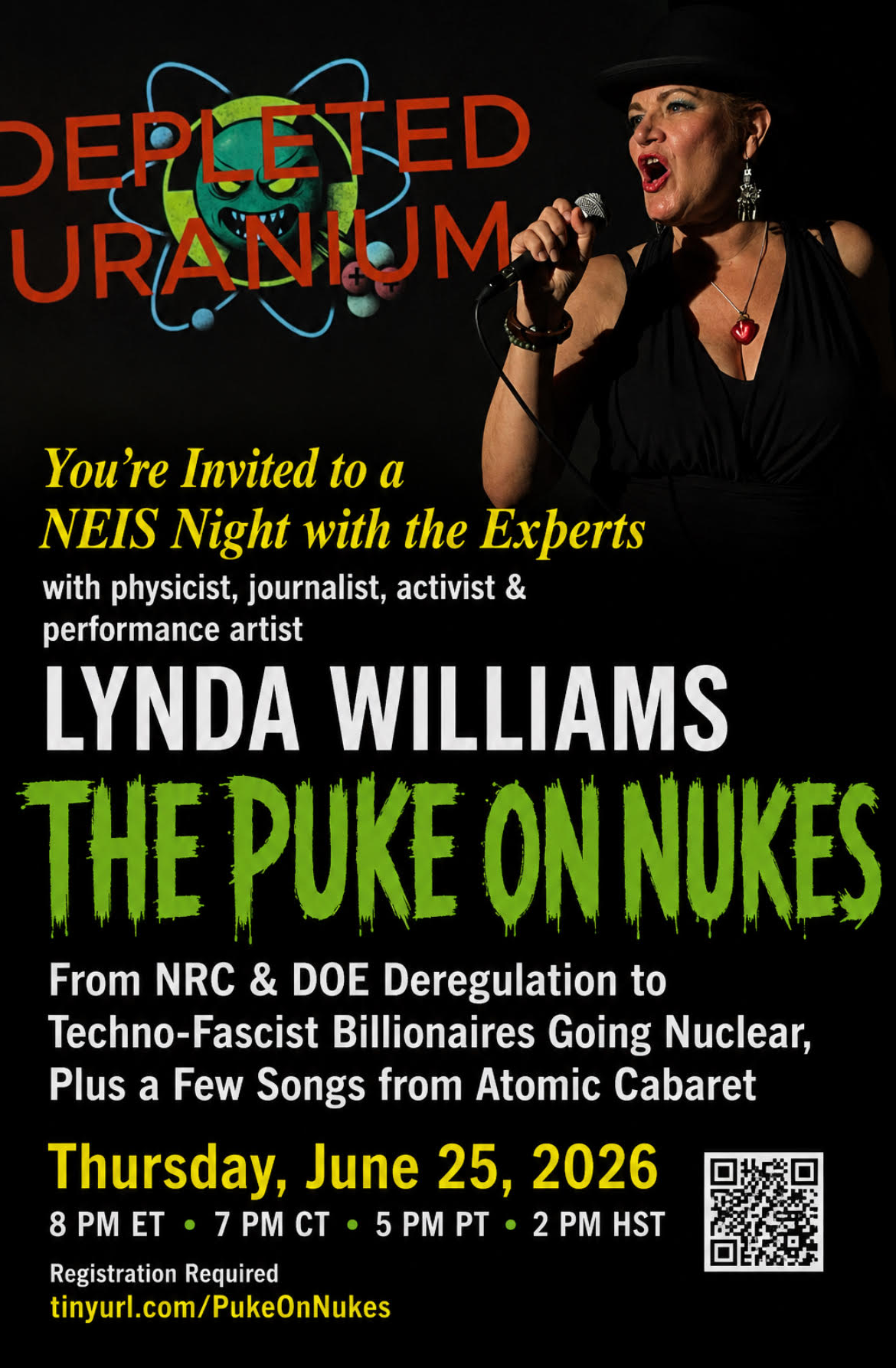
25 June- THE PUKE ON NUKES
Thursday, June 25, 2026
7pm Central Time (8pm ET, 6pm MT, 5pm PT) UTC – 5
From NRC & DOE Deregulation to Techno-Fascist Billionaires Going Nuclear, Plus a Few Songs from Atomic Cabaret REGISTER
26 June – Radiation Trainwreck at the NRC / Join the Protect Better Campaign – https://us02web.zoom.us/meeting/register/4ZlZ5_qLSHGiLSCg8FF6Bg#/registration


Cuba Is Not a Failed State – It Is a Besieged State
PETITION: “Global Appeal to Endorse Palestinian Right of Return of Refugees”
To see nuclear-related stories in greater depth and intensity – go to https://nuclearinformation.wordpress.com
-
Archives
- June 2026 (193)
- May 2026 (306)
- April 2026 (356)
- March 2026 (251)
- February 2026 (268)
- January 2026 (308)
- December 2025 (358)
- November 2025 (359)
- October 2025 (376)
- September 2025 (257)
- August 2025 (319)
- July 2025 (230)
-
Categories
- 1
- 1 NUCLEAR ISSUES
- business and costs
- climate change
- culture and arts
- ENERGY
- environment
- health
- history
- indigenous issues
- Legal
- marketing of nuclear
- media
- opposition to nuclear
- PERSONAL STORIES
- politics
- politics international
- Religion and ethics
- safety
- secrets,lies and civil liberties
- spinbuster
- technology
- Uranium
- wastes
- weapons and war
- Women
- 2 WORLD
- ACTION
- AFRICA
- Atrocities
- AUSTRALIA
- Christina's notes
- Christina's themes
- culture and arts
- Events
- Fuk 2022
- Fuk 2023
- Fukushima 2017
- Fukushima 2018
- fukushima 2019
- Fukushima 2020
- Fukushima 2021
- general
- global warming
- Humour (God we need it)
- Nuclear
- RARE EARTHS
- Reference
- resources – print
- Resources -audiovicual
- Weekly Newsletter
- World
- World Nuclear
- YouTube
-
RSS
Entries RSS
Comments RSS
 nuclear-news