Russian hackers evaded layers of U.S. security to attack America’s military and intelligence agencies
 New York Times 14th Dec 2020, The scope of a hack engineered by one of Russia’s premier intelligence agencies became clearer on Monday, when some Trump administration officials acknowledged that other federal agencies — the State Department, the Department of Homeland Security and parts of the Pentagon — had been compromised. Investigators were struggling to determine the extent to which the military, intelligence community and nuclear laboratories were affected by the highly sophisticated attack.
https://www.nytimes.com/2020/12/14/us/politics/russia-hack-nsa-homeland-security-pentagon.html
USA House Armed Servcies Chairman very sceptical of New Plutonium “Pit” Plans for Nuclear Warheads
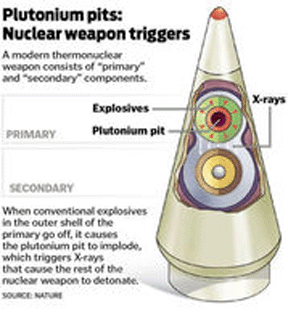 New Plutonium “Pit” Plans for Nuclear Warheads Questioned by House Armed Servcies Chairman, Doubts NNSA Competency, EIN Presswire, NEWS PROVIDED BY Savannah River Site Watch, December 14, 2020, 1Chairman of the powerful House Armed Services Committee, Rep. Adam Smith, casts doubt on plans for expanding plutonium pit production for nuclear weapons at SRS
COLUMBIA, SC, US, December 14, 2020 /EINPresswire.com/ — Chairman of House Armed Services Committee Reveals Great Skepticism in NNSA’s Ability to Covert Terminated Plutonium Fuel (MOX) Facility at DOE’s Savannah River Site into Plutonium Bomb Plant (PBP), Refers to $6 Billion Project as Potential “Rat Hole”
Representative Adam Smith Asserts that Failed Plutonium Fuel (MOX) Project at SRS is “Pretty Close to White Collar Crime”. The powerful chairman of the House Armed Services Committee, Representation Adam Smith, has raised great doubt about the U.S. Department of Energy’s ability to pull off the project at the Savannah River Site (SRS) in South Carolina to produce plutonium “pits,” or cores, for nuclear warheads.
In an on-line presentation on December 11 with the Center for Strategic and International Studies, Rep. Smith (D-WA) expressed deep concern in the ability of the DOE’s National Nuclear Security Administration (NNSA) to pull off the project to convert the partially finished plutonium fuel (MOX) plant, halted in 2017, into the proposed Plutonium Bomb Plant (PBP) at SRS. The event featured Rep. Smith talking about nuclear weapons matters coming before Congress in 2021. The transcript of the event was released late in the afternoon of December 11.
The skepticism of Rep. Smith about pit production at SRS was based in part on his continued concern about NNSA’s role in the failed MOX project at SRS: “Because the thing that really sticks in my craw on this basic competency issue is the Savannah River Site and the MOX facility. OK, that is pretty close to white collar crime, all right?” The public interest group Savannah River Site Watch believes Congress should follow through and conduct investigations into the MOX debacle.
Smith’s comments on pit production at SRS were harsh and, noting the mismanaged construction of the MOX building, said “So I am highly skeptical that they’re going to be able to turn that building into an effective pit production facility – highly skeptical.” He reiterated skepticism in NNSA’s ability and said “I am highly skeptical of the level of competence within the NNSA.”
Concerning the potential monetary waste on the pit project at SRS, Rep. Smith recognized parochial financial interests near SRS pushing for the pit project at the site and said “But if they’re going to have that say, they’d better not use that say to take $6 billion and dump it down a rat hole in South Carolina. That’s what I would argue.”…..
Los Alamos, which has not been able to produce its mandated 20 pits per year, is slated to make 30 or more pits per year by 2026 and SRS, which has zero pit experience and little recent experience handling plutonium, is being presented with the daunting challenge to produce 50 or more pits per year by 2030……. https://www.einnews.com/pr_news/532745444/new-plutonium-pit-plans-for-nuclear-warheads-questioned-by-house-armed-servcies-chariman-doubts-nnsa-competency
China has 350 nuclear warheads, compared to USA and Russia’s many thousands of them
The report, written by Hans Kristensen, the director at the Nuclear Information Project at the Federation of American Scientists, and Matt Korda, a research associate at FAS, arrived at the number by counting both operational warheads and newer weapons “still in development.”…….
the report noted that the size of the Chinese nuclear stockpile is still significantly below that of the United States and Russia, which have thousands of nuclear weapons in their respective stockpiles. The authors wrote that claims by the Trump administration’s special envoy for arms control, Marshall Billingslea, that China is striving for a form of “nuclear parity” with the U.S. and Russia “appears to have little basis in reality.”
It also added that China has traditionally maintained a low alert level for its nuclear forces, with most warheads at a central storage facility and smaller numbers kept in regional equivalents…….
China refers to its nuclear posture as at a “moderate state of alert,” with the report suggesting that in peacetime this “might involve designated units to be deployed in high combat-ready condition with nuclear warheads in nearby storage sites under control of the Central Military Commission that could be released to the unit quickly if necessary.” https://www.defensenews.com/global/asia-pacific/2020/12/14/report-estimates-chinese-nuclear-stockpile-at-350-warheads/
The continuing tragedy and nuclear abomination of U.S. tests on the Marshall Islands
The lingering legacy of US nuclear testing in the Marshall Islands, https://www.nzherald.co.nz/world/the-lingering-legacy-of-us-nuclear-testing-in-the-marshall-islands/NTHZG3PJNS6NXV4SZLPTHCANNY/13 Dec, 2020, By RNZ.
The US detonated its largest nuclear bombs around the Marshall Islands in the 1940s and 50s – but the Marshallese are still campaigning for adequate compensation.
The Marshall Islands are two chains of 29 coral atolls in the middle of the Pacific Ocean between Papua New Guinea and Hawaii.
Following the tests, whole islands ceased to exist, hundreds of native Marshallese had to be relocated off their home islands and many were affected by fallout from the testing.
In 1977, US authorities put the most contaminated debris and soil into a huge concrete dome called the Runit Dome, which sits on Enewetak Atoll and houses 88,000 square metres of contaminated soil and debris.It has recently received media attention as it appears to be leaking, due to cracking and the threat from rising sea levels, while some Marshallese have fears it may eventually collapse.
However, American officials have said it’s not their problem and responsbility falls on the Marshallese, as it is their land.
The US has cited a 1986 compact of free association, which released the US goverment from further liability, which will go up for renegotiation in 2023.
Meanwhile, the Marshallese continue to campaign for adequate compensation from the US.
While he said that suggestions that the Rumit Dome – nicknamed “The Tomb” by locals – was about to collapse were alarmist, there were still major concerns surrouding it.
“The issue is it’s got plutonium, which has a half-life of 24,000 years, and how long does concrete last?”
Describing the structure as a “symbol of the nuclear legacy here”, Johnson said that US government scientists had reported there was already so much contamination in the area that it would be difficult to find what leakage from the dome had added.
The United States has continued to refuse to accept responsibility for the Runit Dome’s condition, despite its history of nuclear testing in the country.
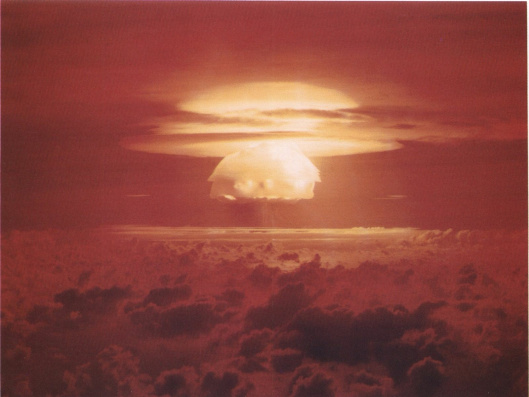
“The nuclear weapons test legacy is the overriding issue in the Marshall Islands with the United States and it remains a festering problem, because US compensation and medical care and so forth was only partial for what was needed,” Johnson said.
The first compact to free association between the Marshall Islands and the US contained a compensation agreement, including the establishment of a nuclear claims tribunal to adjudicate all claims. While it determined there was a large amount of compensation due to Marshallese on various atolls, this has never been paid out, apart from funding of $150 million in 1986.
Since then, the US has accepted no more liability on nuclear compensation, as the compact resulted in the Marshall Islands being an independent country, able to join the United Nations.
However, Johnson said the United States Congress had taken a different position on this.
There have also been big differences in the treatment of Marshallese nuclear victims and those in the United States
“The US used Bikini and Enewetak to test its biggest hydrogen bombs,” Johnson said. “While it maintained a nuclear test site in Nevada, it only tested relatively small nuclear devices there, because it simply could not test hydrogen bombs in the continental United States – Americans wouldn’t have stood for it.”
Not long after the 1986 free association compact ended American responsibility for nuclear compensation in the Marshall Islands, the US Congress enacted a radiation compensation act for Americans – which Johnson said really emphasised the unfairness of the situation.
“Long story short, they appropriated $100 million and then they ran out, the US congress appropriated more, again ran out, appropriated more and fast-forward to 2020 and they’re over $2 billion in compensation awarded to American nuclear victims.
Johnson also had concerns about the lack of a baseline epidemiological study by the US, following the tests. Studies on the affects of radiation centred around thyroid issues, but many islanders have reported cancer, miscarriages and stillbirths in the years following.
His wife Darlene Keju died of breast cancer, which also affected her mother and father – she grew up on one of the islands in the downwind zone of the tests.
The US had never looked at rates of cancer, or studied the differences between low fallout and high fallout areas, he said.
Johnson hoped the nuclear legacy between the countries could be worked out amicably, but he wasn’t too optimistic.
Despite this tension, Johnson said the Marshallese did not harbour anti-American sentiment and the compensation issues were a “black mark on an otherwise good relationship” between the two countries.
He said around 30 to 40 percent of all Marshallese were living in the US.
“The Marshall Islands, since WWII, has a very long standing high regard and strong relationship with the US that came out of the end of the Japanese period of militarism and the execution of many islanders and privation, into a period where the US fostered democratic institutions, created opportunities for education, providing scholarships, opening the door to people going to the US and the unpacked treaty really put this together, in terms of the relationship that’s of benefit to both sides.”
However, ongoing tensions between the US and China may help the Marshall Islands in their push for further compensation.
“Possibly the changing geopolitical situation out here might offer an opening to get some interest to try to amicably do something to resolve the whole thing,” Johnson said.
But the nuclear legacy is not the only issue affecting the island – climate change is looming large and reports by US scientists have said that the Marshall Islands could be uninhabitable by the 2030s, due to rising sea levels.
Dr Helen Caldicott on the nuclear lessons of the past – time to take note of them

HELEN CALDICOTT: Time to learn lessons of the past on nuclear, Independent Australia, 13 Dec 20, By Helen Caldicott | 13 December 2020
“………What rained down on those two Japanese cities seventy-five years ago was destruction on a scale never seen before or since. People exposed within half a mile of the atomic fireball were seared to piles of smoking char in a fraction of a second as their internal organs boiled away. The small black bundles stuck to the streets and bridges and sidewalks of Hiroshima numbered in the thousands.
A little boy was reaching up to catch a red dragonfly with his hand against the blue sky when there was a blinding flash and he disappeared. He turned into gas and left his shadow behind on the pavement, a haunting relic later moved to the Hiroshima Museum. A woman was running while holding her baby; she and the baby were turned into a charcoal statue.
In all, about 120,000 people were killed immediately by the two bombs and tens of thousands more died later due to radiation exposure………..
in medical school I learned about radiation biology — the classic experiments of Hermann J. Muller, who in the 1920s irradiated Drosophila fruit flies inducing genetic mutations and morphological abnormalities. Concurrently, the United States and the Soviet Union were testing nuclear weapons in the atmosphere, bombarding huge populations with radioactive fallout.
In my naiveté, I couldn’t understand what these men thought they were doing because the mutagenic and carcinogenic effects of ionizing radiation were well known in scientific circles. Madame Curie had died of aplastic anaemia secondary to radium, an alpha emitter polluting her bones; her daughter died of leukemia, and many of the early radiologists who exposed themselves randomly to X-rays died from malignancies.
Einstein wrote:‘The unleashed power of the atom has changed everything save our modes of thinking and we thus drift toward unparalleled catastrophe.’
Robert Oppenheimer, watching the world’s first nuclear explosion in Alamogordo, New Mexico, in 1945, muttered to himself: “I am become death, the destroyer of worlds” from the Hindu scripture, the Bhagavad Gita.
The scientists knew that they had discovered the seeds of human destruction.
So, in full awareness of its newfound ability to destroy the human race, what did the world do next?
The United States and the Soviet Union decided to outdo each other by conducting a nuclear arms race, building tens of thousands of nuclear weapons. Between 1945 and 1998, the United States conducted more than 1,000 nuclear tests, producing cancer in tens of thousands of people. It has built more than 70,000 atomic and hydrogen bombs; the Soviets and later the Russian Federation had tried to keep up, building at least 55,000 of their own.
Arms control agreements over the years have managed to reduce stockpiles to about 14,000 nuclear weapons today, in the possession of nine nations: the United States, Russia, the United Kingdom, France, China, India, Pakistan, Israel and North Korea. The United States and Russia still lead the pack, each with more than 6,000 total weapons, including about 1,600 each that are actively deployed.
A nuclear “exchange” between these two superpowers would take little over one hour to complete. A twenty-megaton bomb (the equivalent of twenty million tons of TNT) would excavate a hole three-quarters of a mile wide and 800 feet deep, converting all buildings and people into radioactive fallout that would be shot up in the mushroom cloud.
Within six miles in all directions, every living thing would be vaporised. Twenty miles from the epicentre, huge fires would erupt, as winds of up to 500 miles per hour would suck people out of buildings and turn them into missiles travelling at 100 miles per hour. The fires would coalesce, incinerating much of the United States and causing most nuclear power plants to melt down, greatly exacerbating radioactive fallout.
Potentially billions of people would die hideously from acute radiation sickness, vomiting and bleeding to death. As thick black radioactive smoke engulfed the stratosphere, the Earth would, over time, be plunged into another ice age — a “nuclear winter,” annihilating almost all living organisms.
Seventy-five years after the dawn of the nuclear age, we are as ready as ever to extinguish ourselves. The human race is clearly an evolutionary aberrant on a suicidal mission. Our planet is in the intensive care unit, approaching several terminal events.
Will we gradually burn and shrivel life on our wondrous Earth by emitting the ancient carbon stored over billions of years to drive our cars and power our industries, or will we end it suddenly by creating a global gas oven?
The International Energy Agency said recently that we only have six months left to avert the effects of global warming before it is too late. Earlier this year, the Bulletin of the Atomic Scientists moved its Doomsday Clock to 100 seconds to midnight, the closest it’s ever been.
Australia’s coal and nuclear lobbies have just recruited a new puppet, Mining Council CEO Tania Constable has been championing nuclear power at a time when we should be discussing renewables.
In truth, the U.S. Department of Defense is a misnomer; it is actually the Department of War, Death and Suicide. Hundreds of billions of dollars of U.S. taxpayer money are spent annually by corporations such as Lockheed Martin, Boeing, BAE Systems and Raytheon Technologies Corporation to create and build the most hideous weapons of destruction.
Brilliant people employed by these massive corporations, mostly men, are deploying their brainpower to devise better and more hideous ways of killing.
President Donald Trump is right when he says we need to make friends with the Russians, for it is Russian bombs that might well annihilate the United States. Indeed, we need to foster friendship with all nations and reinvest the trillions of dollars spent on war, killing and death, saving the ecosphere by powering the world with renewable energy including solar, wind, and geothermal and planting trillions of trees.
Such a move would also free up billions of dollars that could be reallocated to such purposes as providing free medical care for all U.S. citizens, along with free education, housing for the homeless and care for those with mental illness.
The United States needs to rise to its full moral and spiritual height and lead the world to sanity and survival. I know this is possible because, in the 1980s, millions of wonderful people rose up, nationally and internationally, in opposition to the arms race and the Cold War.
But what is the present reality in the United States?
There are 450 Minuteman III missiles operational on the Great Plains — in Montana, North Dakota and Wyoming. In each missile silo are two missileers, who control and launch the missiles which contain one or two hydrogen bombs. Planes armed with hydrogen bombs stand ready to take off at any moment, and nuclear submarines silently plough the oceans ready to launch.
Both the United States and Russia have nuclear weapons targeted at military facilities and population centres. Nuclear war could happen at any time, by accident or design. The late Stephen Hawking warned in 2014 that artificial intelligence, now being deployed by the military, could become so autonomous that it could start a nuclear war by itself.
This threat is largely ignored by politicians and the mainstream media, who continue to practice psychic numbing as we stumble blindly toward our demise.
How come the physicists, engineers and military personnel who have laced the world with nuclear weapons ready to launch never factored into their equations the probability that an immature, petulant man-baby could hold the trigger for our destruction in his hands? https://independentaustralia.net/article-display/helen-caldicott-time-to-learn-lessons-of-the-past-on-nuclear,14614
You can follow Dr Caldicott on Twitter @DrHCaldicott. Click here for Dr Caldicott’s complete curriculum vitae.
Biden’s opportunity to make much needed changes on nuclear weapons policy
|
Biden’s First Move on Nuclear Weapons, https://www.defenseone.com/ideas/2020/12/bidens-first-move-nuclear-weapons/170652/
When Putin calls to congratulate the new U.S. president, Biden should seize the opportunity. By GLENN NYE and JAMES KITFIELD, At some point in the coming weeks President-elect Joe Biden will likely receive a call from Russian President Vladimir Putin congratulating him on his election victory. Biden should seize the opportunity to provide an overdue reality check on nuclear weapons.Tensions between the two nations that possess roughly 90 percent of the world’s nuclear warheads are reaching levels not seen since the darkest days of the Cold War, even as the edifice of arms control agreements that kept Cold War dangers in check teeters on the verge of collapse. Under the guise of weapons modernization both nations are also engaged in an incipient nuclear arms race. Little wonder that the Bulletin of Atomic Scientists has reset its Doomsday Clock to just one hundred seconds to midnight, the closest it’s ever been to Armageddon. When he takes office on Jan. 20, Biden can help arrest that dangerous spiral by fulfilling his campaign pledge to extend the New START Treaty before it expires in early February, and to use it as a foundation to pursue new arms control agreements. Recent jockeying between U.S. and Russian negotiators on a one-year extension of New START highlight just how complex and difficult arms control negotiations have become. In an era of renewed major power competition, destabilizing new technologies, and rising international tensions and distrust, managing U.S.-Russian relations already are difficult. They only will become more so as Moscow comes to terms with a new Biden administration unwilling to overlook, as President Donald Trump has, Russia’s history of cyber and disinformation attacks on the American political system. Before the election, talks between U.S. and Russian negotiators on extending New START bogged down over the Trump administration’s insistence that a one-year extension include a freeze on strategic nuclear weapons that are currently covered by the treaty, as well as tactical nuclear weapons that are not. As is often the case in arms control talks the devil was in the details of a verification regime to monitor such a “freeze.” But the goal of constraining shorter-range tactical nuclear weapons was laudable and should be pursued in follow-on talks. |
|
U.S. House Armed Service Committee calls for new National Defense Strategy, including “no first use” nuclear policy.
HASC Chair Smith Calls For New National Defense Strategy, Nuclear Policy Review, USNI News, By: John Grady
As part of that strategy, “I think we should have a no-first-use policy” because “nuclear weapons are a special case. They are “weapons that could destroy the planet.” Rep. Adam Smith, (D-Wash.) said while speaking at a Center for Strategic and International Studies online forum Friday said he also wants the United States to maintain “robust deterrence” but delivered with “a more cost-effective approach.”
mith recognized the strong opposition he has from progressives in the Democratic Party and also among some Republicans to spending on military projects, modernization, basing and operations. Left-leaning Democrats see these efforts “as pivoting to a new Cold War” that will “come into conflict with Russia and China.”
Smith said later that “there are plenty of other ways of deterring our adversaries” other than engaging them in war.
He said three questions needed to be asked when building a “robust” and “cost-effective” defense:
What is the goal; what is the objective; and what are the tools you need to get there.
mith recognized the strong opposition he has from progressives in the Democratic Party and also among some Republicans to spending on military projects, modernization, basing and operations. Left-leaning Democrats see these efforts “as pivoting to a new Cold War” that will “come into conflict with Russia and China.”
Smith said later that “there are plenty of other ways of deterring our adversaries” other than engaging them in war.
He said three questions needed to be asked when building a “robust” and “cost-effective” defense:
What is the goal; what is the objective; and what are the tools you need to get there………… https://news.usni.org/2020/12/11/hasc-chair-smith-calls-for-new-national-defense-strategy-nuclear-policy-review
The new way to hide the money splurged on nuclear weapons – via Small Nuclear Reactors

|
A military bromance: SMRs to support and cross-subsidize the UK nuclear weapons program, Industry and government in the UK openly promote SMRs on the grounds that an SMR industry would support the nuclear weapons program (in particular the submarine program) by providing a pool of trained nuclear experts, and that in so doing an SMR industry will cross-subsidize the weapons program. Such arguments are problematic for several reasons. Firstly, the weapons program is problematic and the UK’s compliance with its Nuclear Non-Proliferation Treaty obligations is questionable. Secondly, why subsidize an SMR industry to subsidize the weapons program ‒ why not simply invest more in the weapons program directly? Thirdly, there are strong reasons to firewall civil nuclear programs from military programs yet there is no longer any pretense of a firewall. The arguments are clearly stated in a 2017 report by Rolls-Royce.1 The company trumpets its role in powering and maintaining the UK Royal Navy submarine fleet. But its recent interest in civil SMRs isn’t a case of swords-to-ploughshares … it’s ploughshares-supporting-swords. The report states:1 “The indigenous UK supply chain that supports defence nuclear programmes requires significant ongoing support to retain talent and develop and maintain capability between major programmes. Opportunities for the supply chain to invest in new capability are restricted by the limited size and scope of the defence nuclear programme. A UK SMR programme would increase the security, size and scope of opportunities for the UK supply chain significantly, enabling long-term sustainable investment in people, technology and capability. “Expanding the talent pool from which defence nuclear programmes can draw from would bring a double benefit. First, additional talent means more competition for senior technical and managerial positions, driving excellence and performance. Second, the expansion of a nuclear-capable skilled workforce through a civil nuclear UK SMR programme would relieve the Ministry of Defence of the burden of developing and retaining skills and capability. This would free up valuable resources for other investments.” So SMRs will relieve the Ministry of Defence of the “burden” of paying for its own WMD programs! Andy Stirling and Phil Johnstone have carefully studied the links between the UK’s nuclear power program and the weapons program.2 They wrote in The Guardian in March 2018:
“Although unstated, by far the most likely source for such support is a continuing national civil nuclear programme. And this where the burgeoning hype around UK development of SMRs comes in. Leading designs for these reactors are derived directly from submarine propulsion. British nuclear submarine reactor manufacturer Rolls-Royce is their most enthusiastic champion. But, amid intense media choreography, links between SMRs and submarines remain (aside from reports of our own work) barely discussed in the UK press. “This neglect is odd, because the issues are very clear. Regretting that military programmes are no longer underwritten by civil nuclear research, a heavily redacted 2014 MoD report expresses serious concerns over the continued viability of the UK nuclear submarine industry. And Rolls-Royce itself is clear that success in securing government investment for SMRs would “relieve the Ministry of Defence of the burden of developing and retaining skills and capability” for the UK’s military nuclear sector. Other defence sources are also unambiguous that survival of the British nuclear submarine industry depends on continuation of UK civil nuclear power. Many new government initiatives focus intently on realising the military and civil synergies. “Some nuclear enthusiasts have called this analysis a conspiracy theory, but these links are now becoming visible. In response to our own recent evidence to the UK Public Accounts Committee, a senior civil servant briefly acknowledged the connections. And with US civil nuclear programmes collapsing, the submarine links are also strongly emphasised by a former US energy secretary. Nuclear submarines are evidently crucial to Britain’s cherished identity as a “global power”. It seems that Whitehall’s infatuation with civil nuclear energy is in fact a military romance.” |
|
|
With Small Nuclear Reactors (SMRs) Canada is back in the nuclear weapons business
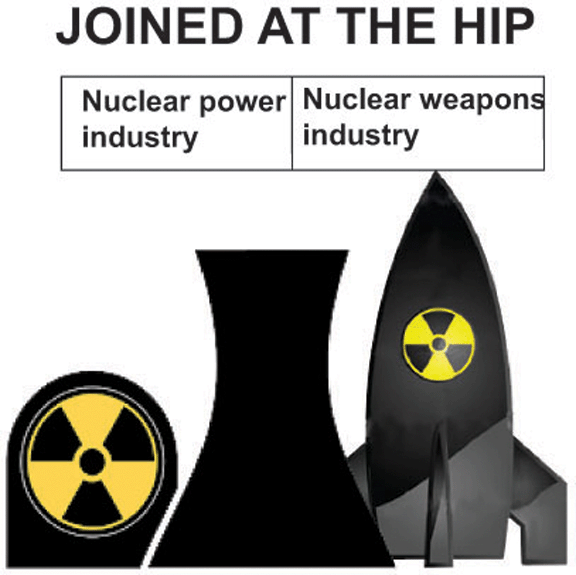 Canada re-engages in the Nuclear Weapons Business with SMRs, December 3, 2020, WWW.HILLTIMES.COM/2020/12/03/CANADA-RE-ENTERS-NUCLEAR-WEAPONS-BUSINESS-WITH-SMALL-MODULAR-REACTORS/274591
Natural Resources Minister Seamus O’Regan is expected to announce within weeks his government’s action plan for development of “small modular” nuclear reactors (SMRs).
SMR developers already control the federally-subsidized Chalk River Laboratories and other facilities owned by the crown corporation, Atomic Energy of Canada Limited (AECL). Canada is now poised to play a supporting role in the global nuclear weapons business, much as it did during World War II.
Canada was part of the Manhattan project with the U.S. and U.K. to produce atomic bombs. In 1943 the three countries agreed to build a facility in Canada to produce plutonium for nuclear weapons. Researchers who trained at the Chalk River Laboratories went on to launch weapons programs in the U.K. and France. Chalk River provided plutonium for U.S. weapons until the 1960s.
Canada’s Nuclear Schizophrenia describes a long tradition of nuclear cooperation with the United States: “For example, in the early 1950s, the U.S. Navy used Canadian technology to design a small reactor for powering its nuclear submarines.” C.D. Howe, after creating AECL in 1952 to develop nuclear reactors and sell weapons plutonium, remarked that “we in Canada are not engaged in military development, but the work that we are doing at Chalk River is of importance to military developments.”
The uranium used in the 1945 Hiroshima bomb may have been mined and refined in Canada. According to Jim Harding’s book Canada’s Deadly Secret: Saskatchewan Uranium and the Global Nuclear System, from 1953 to 1969, all the uranium mined in Saskatchewan went to make U.S. nuclear weapons. Canada remains the world’s second-largest producer of uranium. North America’s only currently operating uranium processing facility is owned by Cameco in Port Hope, Ontario.
Canada built India’s CIRUS reactor, which started up in 1960 and produced the plutonium for India’s first nuclear explosion in 1974. Canada also built Pakistan’s first nuclear reactor, which started up in 1972. Although this reactor was not used to make weapons plutonium, it helped train the engineers who eventually exploded Pakistan’s first nuclear weapons in 1998.
In 2015 the Harper Government contracted a multi-national consortium called Canadian National Energy Alliance – now comprised of two U.S. companies, Fluor and Jacobs, along with Canada’s SNC-Lavalin – to operate AECL’s nuclear sites, the main one being at Chalk River. Fluor operates the Savannah River Site, a South Carolina nuclear weapons facility, under contract to the U.S. Department of Energy (DOE). Jacobs also has contracts at DOE weapons facilities and is part of a consortium that operates the U.K. Atomic Weapons Establishment.
Joe McBrearty, the president of the consortium’s subsidiary that operates Chalk River and other federal nuclear sites, was a U.S. Navy nuclear submarine commander and then chief operating officer for the DOE’s nuclear laboratories between 2010 and 2019.
All three consortium partners have investments in SMRs and are ramping up research and development at AECL’s Chalk River facility. Some SMR designs would use uranium enriched to levels well beyond those in current reactors; others would use plutonium fuel; others would use fuel dissolved in molten salt. All of these pose new and problematic weapons proliferation risks.
Rolls Royce, an original consortium partner that makes reactors for the U.K.’s nuclear submarines, is lead partner in a U.K. consortium (including SNC-Lavalin) that was recently funded by the U.K. government to advance that country’s SMR program.
A military bromance: SMRs to support and cross-subsidize the UK nuclear weapons program, says “Industry and government in the UK openly promote SMRs on the grounds that an SMR industry would support the nuclear weapons program (in particular the submarine program) by providing a pool of trained nuclear experts, and that in so doing an SMR industry will cross-subsidize the weapons program.”
The article quotes a 2017 Rolls Royce study as follows: “expansion of a nuclear-capable skilled workforce through a civil nuclear UK SMR programme would relieve the Ministry of Defence of the burden of developing and retaining skills and capability.”
The SMR connection to weapons and submarines could hardly be clearer – without SMRs, the U.S. and U.K. will experience a shortage of trained engineers to maintain their nuclear weapons programs.
With the takeover of AECL’s Chalk River Laboratories by SMR developers, and growing federal government support for SMRs, Canada has become part of a global regime linking nuclear power and nuclear weapons.
Significant problems for UK’s Trident nuclear deterrent ,if U.S. Congress refuses to fund a next-generation warhead.
   Guardian 8th Dec 2020, Britain’s most senior defence official admitted there would be “very significant implications” for the future of the Trident nuclear deterrent if Democrats in the US Congress refused to fund a next-generation warhead. Sir Stephen Lovegrove, permanent secretary at the Ministry of Defence, saidthat the UK was monitoring the US standoff closely but could not say what impact a refusal to start work on the new W93 warhead would have – or how many billions it would cost. Guardian 8th Dec 2020, Britain’s most senior defence official admitted there would be “very significant implications” for the future of the Trident nuclear deterrent if Democrats in the US Congress refused to fund a next-generation warhead. Sir Stephen Lovegrove, permanent secretary at the Ministry of Defence, saidthat the UK was monitoring the US standoff closely but could not say what impact a refusal to start work on the new W93 warhead would have – or how many billions it would cost.British politicians and officials have, until now, had little to say about the long-running US row over the W93, crudely estimated to be twice as explosive as the ageing Trident warhead now usedby the UK. Prior to the US presidential election, Democrats in the House ofRepresentatives had refused to fund a $53m (£40m) development programme for the first year of the W93 despite lobbying from both the White House and the UK.
|
Russian Ambassador to U.S. Sees Hope for Nuclear Arms Treaty Extension
He said several times during the forum that the Kremlin has been pushing the White House on an extension of its terms but has not received a formal answer.
The whole world depends on the United States-Russia relationship.”
On START, he added, “we need time to work out new security agreements” that cover a range of issues from missile defense, intermediate-range missiles, hypersonics and potential space weapons. For this reason, Russia has offered to extend the treaty’s term for up to five years “without pre-conditions.”
The United States wants China to be part of any new START negotiations, but Antonov said Beijing is “not happy with such an invitation.” The ambassador said Moscow wants the United Kingdom and France, both nuclear powers and NATO members, to be involved if the talks are broadened……. https://news.usni.org/2020/12/07/russian-ambassador-to-u-s-sees-hope-for-nuclear-arms-treaty-extension
USA Republicans and Democrats can’t agree on funding to help Covid-9 victims, but there’s always money for war.
|
by
The annual approval of the gargantuan U.S. military budget is one of the most reliable rituals in Congress. It is so ordinary and overwhelmingly bipartisan, it’s barely considered newsworthy, and few outlets follow the details of exactly how much the government is allocating to a nuclear weapons buildup, or deployments to the Asia Pacific, or the steady creep of U.S. military bases across the continent of Africa. Even under President Trump, when the Democratic leadership claims to have struck a more confrontational posture, those same leaders have repeatedly handed him bloated military budgets, as we saw Wednesday with Congress’ bicameral approval of a roughly $740 billion military budget for 2021. ,,,,,,,,,,,,, this is no ordinary year. As Congress races to pass the NDAA for 2021, it does so in a country that is hurtling toward months that could be among “the most difficult in the public health history of this nation,” according to Dr. Robert Redfield, the director of the Centers for Disease Control and Prevention. Along with this health crisis, whose scale in the United States was entirely preventable, comes economic devastation: Lines for food banks are stretching for miles and, according to one study, one in six people is food insecure. As of September, one in six adults said they live in a house that’s behind on rent. ………. As the pandemic was raging, Congress had no problem passing legislation to continue U.S. military violence. The Senate version of the NDAA passed on July 23 in a vote of 86 – 14, while the House version was approved July 21 by 295 – 125. This defense bill was then approved December 2 by both chambers of Congress. …………
While entirely routine at this point, it’s useful to highlight on the eve of yet another massive Pentagon handout how the budget for war could instead go toward life-preserving social goods. This is useful, not to buy into austerity notions of scarcity, but simply to show the profound immorality of where our public resources go. When it comes to military spending, the sky is the limit. Space Force? Sure. Roughly $21.9 billion for nuclear weapons programs? No problem. But when it comes to keeping people alive, U.S. political imagination is significantly more constrained. Right off the bat in March, Democratic leader Rep. Nancy Pelosi (Calif.) shot down universal, robust cash payments to keep people afloat, even as high-profile figures like Sen. Bernie Sanders (I‑Vt.) and Rep. Rashida Tlaib (D‑Mich.) called for such measures. ………
we should not allow bipartisan agreement on military spending to simply fade into the background, as an unremarkable and immutable fact of U.S. politics. That we can find the money for war but not for coronavirus relief exposes the moral rot at the center of U.S. politics, a rot that must be dug out and expunged if we are to get through this crisis. https://www.commondreams.org/views/2020/12/04/congress-deadlocked-covid-relief-came-together-fund-pentagon-740-billion?utm_campaign=shareaholic&utm_medium=Social&utm_source=twitter
|
|


China’s changing aims for nuclear weapons
MYTHS OR MOVING TARGETS? CONTINUITY AND CHANGE IN CHINA’S NUCLEAR FORCES,War on the Rocks, AUSTIN LONG 6 Dec 20, The nuclear arsenal of the People’s Republic of China and its plans to use it are in the middle of an unprecedented shift. Just over a decade ago, China’s long-range nuclear force structure consisted of a handful of inaccurate, silo-based intercontinental ballistic missiles (ICBMs) that were kept at low readiness with nuclear warheads stored separately. Chinese posture was demonstrably one of retaliation, with a clearly articulated policy of “no-first-use” of nuclear weapons, while force readiness and command and control of those forces were both poorly suited for anything else.
In 2020, China’s nuclear posture and force structure has changed dramatically. Its arsenal has grown and diversified even as readiness and command and control have improved. By 2030, the country’s force structure and posture will be similar to America’s and Russia’s in many ways (albeit probably not at parity). Yet, in a recent article in these virtual pages, David Logan dismisses claims that China is reconsidering the fundamental role of nuclear weapons in its strategy as “dangerous myths.” He argues that China’s policy of no-first-use “is still intact” and dismisses as fiction the claim “that China has developed and deployed an array of nuclear war-fighting capabilities, including tactical nuclear weapons.” While the ultimate destination of China’s nuclear posture remains uncertain, the trajectory is clear. Changes to China’s nuclear war-fighting capabilities and policies are not myths. Instead, they are moving targets, evolving as Chinese leaders reflect on China’s role in the world and the requirements that role places on the country’s nuclear arsenal. In this article, I review what is publicly known about these moving targets. First, it briefly traces the post-Cold War trajectory of China’s nuclear posture. Second, it addresses the role of the DF-26 intermediate range missile in Chinese posture for “tactical” nuclear weapons. Third, it reviews China’s no-first-use policy. Fourth, it presents evidence on the last time an authoritarian state declared a policy of no-first use — the Soviet Union in the 1980s. It concludes with observations on the possible consequences of change in Chinese nuclear posture for U.S. strategy and nuclear posture…………………. https://warontherocks.com/2020/12/myths-or-moving-targets-continuity-and-change-in-chinas-nuclear-forces/ |
|
||||||||||

UK’s Ministry of Defence keeping seret most of the unsatisfactor report on safety of nuclear bomb sites
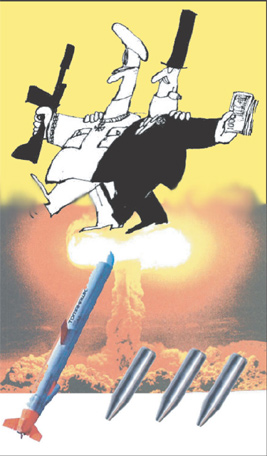 REVEALED: Nuclear bomb sites hit by fire safety problems and staff shortages, The National, By Rob Edwards 5 Dec 20, NUCLEAR bomb sites across the UK have fire safety problems as well as shortages of safety regulators and engineers, according to a new report from the Ministry of Defence (MoD).
But most of the MoD’s latest internal assessment of the safety of nuclear weapons has been kept secret for “national security” reasons – prompting fury from politicians and campaigners. They have attacked the nuclear secrecy as “deeply alarming” and “completely unacceptable”. The official attitude to nuclear safety was a “disgrace”, they said.
Previous nuclear safety assessments, revealed by The Ferret, have highlighted “regulatory risks” 86 times. Many involved the Trident warheads and nuclear submarines based on the Clyde.
The new MoD report also disclosed “significant weaknesses” on safety at non-nuclear sites. These included “serious deficiencies” on fire safety and “significant risk” from old fuel facilities – particularly on the Falkland Islands in the South Atlantic.
The MoD accepted that there were “infrastructure issues”, but insisted that they were being addressed. Defence nuclear programmes were “fully accountable” to UK ministers, it said.
The MoD has posted online the 2019-20 report from the Defence Safety Authority, which brings together seven regulators, a safety team and an accident investigation unit operating within the MoD. They are overseen by the authority’s director general, air marshal Sue Gray.
But the report said that the entire section from the Defence Nuclear Safety Regulator (DNSR), which is responsible for ensuring safety of the nuclear weapons programme, has been “marked SECRET” and given only “limited distribution”.
The MoD has previously released 10 annual DNSR reports following a challenge under freedom of information law in 2010. They flagged up risks of accidents, ageing submarine reactors, spending cuts and much else.
But in 2017 the MoD abruptly ceased publishing the reports, insisting that they had to be kept under wraps to protect national security. In 2019 that decision was challenged by campaigners at a UK information tribunal, whose verdict is still awaited.
he latest safety authority report, however, does contain a few details of nuclear risks buried in its 80 pages. It doesn’t specify which bases were affected, but they are likely to include the two major nuclear weapons sites, at Faslane on the Clyde and at Aldermaston in Berkshire.
In a discussion of problems with “fire safety assurance” across all MoD sites, the report said: “Particular issues have been noted at defence nuclear sites, where discussions continue between defence and statutory regulators.”
Between April 2019 and March 2020 as many as 374 fires were reported on all MoD sites. Although there had been some improvements “there is still more to do to reinforce the capability of defence to manage fire safety,” the report said.
A section on the “maturity” of the DNSR as a nuclear safety regulator disclosed that it was facing an 11 per cent shortage of staff in 2020-21. Shortfalls had been mitigated by the secondment of two senior staff from the UK Government’s nuclear power watchdog, the Office for Nuclear Regulation, and from the nuclear weapons company, AWE.
This had been supplemented by “making full use of partial retirees, graduate placements and development posts during 2019-20,” the report said. But these stopgap measures were failing………………
The Scottish National Party expressed concern about “a pattern of failure” on MoD safety. “Worryingly, the findings of this report reflect significant non-compliance with security and safety regulations at sensitive sites, including those where there are nuclear materials,” said the party’s defence spokesperson, Stewart McDonald MP.
“Not only is nuclear power and weaponry not safe, it is expensive, and not being handled properly under this Tory Government’s watch. The UK Government needs to transition away from nuclear entirely.”
MCDONALD described the nuclear safety failures as “alarming” and accused the MoD of “a lack of regard for public safety and transparency”. He pointed out that the UK Government’s civil nuclear watchdog, the Office for Nuclear Regulation, had criticised MoD secrecy.
The Scottish Green MSP for the west of Scotland, Ross Greer, called for nuclear weapons to be completely scrapped. “It is deeply alarming that the MoD continues to shroud so much secrecy over the safety issues with Britain’s weapons of mass destruction,” he said.
“We’ve known for years of significant issues at sites like Faslane and on the submarines themselves, so continued attempts to hold information back from the public are totally out of order.”
Lynn Jamieson, chair of the Scottish Campaign for Nuclear Disarmament, said: “The MoD’s tolerance of unsafe regimes is a disgrace for an organisation supposedly overseeing our protection. This adds to the urgency of nuclear disarmament.”
According to the Ministry of Defence, the annual assurance report and recommendations were currently being reviewed. Information that “could compromise national security” would not be published, the MoD said.,,,,,,,,,,,, https://www.thenational.scot/news/18923905.revealed-nuclear-bomb-sites-hit-fire-safety-problems-staff-shortages/
1 This Month





PLEASE OPPOSE HR 8255 AND S.3639 – bills would accelerate satellite deployment, with no environmental review or safeguards – https://ncstd5li.quorum.us/campaign/169331/
To see nuclear-related stories in greater depth and intensity – go to https://nuclearinformation.wordpress.com
-
Archives
- October 2026 (81)
- September 2026 (339)
- August 2026 (330)
- July 2026 (355)
- June 2026 (287)
- May 2026 (306)
- April 2026 (356)
- March 2026 (251)
- February 2026 (267)
- January 2026 (308)
- December 2025 (358)
- November 2025 (359)
-
Categories
- 1
- 1 NUCLEAR ISSUES
- business and costs
- climate change
- culture and arts
- ENERGY
- environment
- health
- history
- indigenous issues
- Legal
- marketing of nuclear
- media
- opposition to nuclear
- PERSONAL STORIES
- politics
- politics international
- Religion and ethics
- safety
- secrets,lies and civil liberties
- spinbuster
- technology
- Uranium
- wastes
- weapons and war
- Women
- 2 WORLD
- ACTION
- AFRICA
- Atrocities
- AUSTRALIA
- Christina's notes
- Christina's themes
- culture and arts
- Events
- Fuk 2022
- Fuk 2023
- Fukushima 2017
- Fukushima 2018
- fukushima 2019
- Fukushima 2020
- Fukushima 2021
- general
- global warming
- Humour (God we need it)
- Nuclear
- RARE EARTHS
- Reference
- resources – print
- Resources -audiovicual
- Weekly Newsletter
- World
- World Nuclear
- YouTube
-
RSS
Entries RSS
Comments RSS

