Reject Michele Flournoy as U.S. Defense Secretary – too close to military-industrial-complex

|
Rejecting Michèle Flournoy, Progressives Demand Biden Pick Pentagon Chief ‘Untethered’ From Military-Industrial Complex
“We urge President-elect Joe Biden and U.S. senators to choose a secretary of defense who is unencumbered by a history of advocating for bellicose military policies and is free of financial ties to the weapons industry.” Common Dreams, Jake Johnson, staff writer-4 Dec 20, |
|
Analysis: why Michèle Flournoy should not be U.S. Secretary of Defense
|
Keep in mind Flournoy‘s extensive defense industry ties. In 2002 she went from positions in the Pentagon and the National Defense University to the mainstream but hawkish Center for Strategic and International Studies, which is largely funded by industry and Pentagon contributions. Five years later, she co-founded the second-most heavily contractor-funded think tank in Washington, the highly influential Center for a New American Security (CNAS). That became a stepping stone to her role as under secretary of defense for policy in the Obama administration. From there she rotated to the Boston Consulting Group, after which the firm’s military contracts expanded from $1.6 million to $32 million in three years. She also joined the board of Booz Allen Hamilton, a consulting firm laden with defense contracts. In 2017 she co-founded WestExec Advisors, helping defense corporations market their products to the Pentagon and other agencies. Though WestExec Advisors does not reveal its clients, Flournoy has stated, “Building bridges between Silicon Valley and the U.S. government is really, really important,” even a “labor of love.” WestExec is also careful not to designate Flournoy as a lobbyist, which could run afoul of Biden’s likely prohibitions against appointing “lobbyists” to senior positions. But a WestExec source did tell an interviewer, “We’ll tell you who to go talk to” and what to tell them. This simply circumvents the legalities; it is lobbying by remote control. In a CNAS article this July, Flournoy laid out a plan embraced by candidate Biden and other Democrats, “Sharpening the U.S. Military’s Edge: Critical Steps for the Next Administration.” The piece reveals Flournoy’s corporate outlook and outlines how the next secretary of defense should manage the Pentagon. The nature of any Pentagon administration stems from the quality of the people selected to run it. Addressing this central question, Flournoy states:
Nowhere does she list ethics, character, objectivity, or independence from contractor, service, or political biases, all qualities stunningly missing from Trump’s Pentagon as well as earlier ones………….. Pork, unmentioned by name, also rears its head in the Flournoy article. She advocates various funds, organizations, and a “center of excellence” to monetize technology. Again, history counts. In 2010 the House initiated a Rapid Innovation Fund to support technology development, just as Flournoy proposes. In actuality, it turned out to be an earmarking slush fund so members of Congress could satisfy local interests and circumvent new rules in Congress to pretend to end earmarks. Flournoy would likely expand this contractor self-funding process inside the Defense Department. Once it shows up in a Pentagon spending bill, the congressional add-ons will proliferate, given how voraciously today’s Congress stuffs earmarks into defense bills. Another word that does not appear in the Flournoy article is “audit.” The Defense Department is the only major federal agency that has never passed an audit, despite statutory and constitutional mandates. Some feeble progress has been made in recent years, but without far stronger action, it will be many years before the department delivers to Congress and the public clean audits of contractor spending and profits, much less routine audits of agency and contractor fraud. Under an uninterested Flournoy, it would be an even longer time…………… None of the Biden/Flournoy/Clinton thinking is new. Recall slogans from the George W. Bush and Clinton administrations like “transformation” and “revolution in military affairs” that promised modernized forces for affordable costs. In reality, the outcome of those promises has been shrinking combat forces, more program failures, weapon fleets growing steadily older, and troops training less—all at ever-growing cost. To explain, we need to examine some Pentagon budget history. Defense spending is now at an all-time post-World War II high no matter how you adjust for inflation—barring three years, 2010 to 2012, of even higher spending under President Barack Obama. Looking at yearly appropriations since the Korean War (unadjusted for inflation in order to avoid the Pentagon’s doctored inflation indices), the figure below reveals that the Pentagon budget has never fallen below a steady 5% growth curve, except for a brief departure in the late Obama and early Trump years. This 65 years’ worth of inexorable spending growth has been unaffected by dramatic changes in America’s actual national security needs, revisions of U.S. national strategies, the rise or collapse of perceived enemies, or—for the most part—who is president or whether we are at war or peace. Second, throughout this perpetual budget expansion, the Army, Air Force, and Navy have been shrinking—with the shrinkage accelerating during the period of highest spending growth: the period since 9/11. Moreover, the added money and smaller forces have not resulted in overall modernization. Our smaller inventories of armored vehicles, ships and aircraft are all today dramatically older, on average, than at any time in modern history. Nor are these forces better trained, nor their equipment better maintained. Indeed, all of these measures have been declining significantly, especially now. How can so much more money lead to smaller, older, less effective forces? ………….. Beyond hardware and technology, we need to do a far more intelligent job of understanding the never-ending evolution of tactics and forms of warfare……….. Mercenary parties have no part in that process. We need to listen to military leaders who have experienced both defeat and victory on the battlefield while remaining free of industry influence and careerism; engineers and scientists who have developed proven, useful technologies; and industry leaders who have delivered successful, affordable products and eschewed self- and corporate-interest. The Flournoy plan proposes no such rigorous evaluation or evaluators of new ideas and new weapons. Under her plan, the students wouldn’t just grade their own exams; they would write them and then demand we reward them handsomely for doing so. Instead of this toxic plan, we need to select, nominate, and confirm a new generation of defense leaders who have demonstrated the ethics, competence, independence, and spine to produce a stronger national defense and a more honest system for delivering it. The president-elect should be asking who those people are. https://www.pogo.org/analysis/2020/11/should-michele-flournoy-be-secretary-of-defense/ |
|
Trump’s Support for Israel’s Killing of Iranian Nuclear Scientist Could Lead to War
 Trump’s Support for Israel’s Killing of Iranian Scientist Could Lead to War, Trump’s Support for Israel’s Killing of Iranian Scientist Could Lead to War, Marjorie Cohn, Truthout– December 1, 2020,
On November 27, Israel assassinated Mohsen Fakhrizadeh, Iran’s top nuclear scientist. International law expert Richard Falk called it “an outrageous act of state terrorism.” Although the Israeli government has not claimed credit for the illegal killing, there is little doubt of its culpability. Trump implicitly praised the assassination, retweeting a comment by Israeli journalist and intelligence expert Yossi Melman that the killing was a “major psychological and professional blow” to Iran. This was an “implicit approval if there ever was one,” according to Sina Toossi, a senior research analyst at the National Iranian American Council. The Israel Defense Forces have been ordered to prepare for a possible U.S. military attack on Iran before Trump’s term ends, senior Israeli officials told Axios. They expect “a very sensitive period” leading up to Biden’s inauguration. In mid-November, Trump requested plans to attack Iran’s Natanz nuclear power facility but was reportedly talked out of it. Israeli Prime Minister Benjamin Netanyahu met with Crown Prince Mohammed bin Salman in Saudi Arabia and strategized about Iran. Secretary of State Mike Pompeo visited Israel, the West Bank, the Golan Heights and several countries in the Gulf to discuss Iran. During Pompeo’s visit to the Gulf, the U.S. Central Command announced that B-52 strategic bombers carried out a “short-notice, long-range mission into the Middle East to deter aggression and reassure U.S. partners and allies.” And in an unusual move, the U.S. military sent the aircraft carrier the U.S.S. Nimitz back to the Gulf region following the assassination of Fakhrizadeh. “All options are on the table,” State Department officials who were traveling with Pompeo told reporters. Trump Appears to Have Outsourced His Iran Policy to IsraelIsraeli leaders think Iran poses an existential threat to Israel’s existence, in spite of the fact that Iran has never attacked Israel or any other country in the last 200 years. In fact, Israel is the only Middle East country that has nuclear weapons and it refuses to join the new UN International Treaty on the Non-Proliferation of Nuclear Weapons. At Netanyahu’s urging, Trump pulled the United States out of the Iran nuclear deal, which was preventing Iran from developing nuclear weapons. And in January, the Trump administration illegally assassinated Iran’s top general, Qassim Suleimani. Shortly before that assassination, Pompeo followed the same pattern — traveling and meetings with U.S. allies in the region, according to Iranian American journalist Negar Mortazavi. The Iran nuclear agreement is embodied in the 2015 Joint Comprehensive Plan of Action (JCPOA), negotiated during the Obama administration between Iran, the U.S., France, U.K., Russia, China, Germany and the European Union. Iran, which has consistently maintained that its nuclear program is only intended for peaceful purposes, agreed to restrict its uranium enrichment and other nuclear activities. In return, it received relief from the punishing U.S. sanctions. The UN International Atomic Energy Agency certified several times that Iran was complying with its obligations under the agreement. Nevertheless, Trump withdrew from the JCPOA in 2018 and reimposed the sanctions against Iran. One year after the U.S. withdrawal, Iran began to pull back from its commitments under the JCPOA, which allows a party to abandon its obligations if another party is in noncompliance. Trump intensified the sanctions that have devastated Iran’s economy, impoverished 82 million Iranians and hindered its ability to respond to the pandemic. With his campaign of “maximum pressure” on Iran, Trump has waged economic warfare against the Iranian people…….. It is becoming clear that Trump aims to cater to Israel’s agenda until he leaves office. U.S. and Israel Try to Bait Iran to Retaliate and Lead to Middle East WarHopefully, Iran will resist the apparent U.S.-Israeli attempt to provoke it into retaliating for Fakhrizadeh’s assassination and thereby provide Trump with a pretext to launch a retaliatory strike, which would ignite a war in the Middle East. The U.S. military already has more than 40,000 troops in the region on high alert. Iranian President Hassan Rouhani pledged to respond to the assassination of Fakhrizadeh at the “proper time.” Rouhani said, “The Iranian nation is smarter than falling into the trap of the Zionists. They are thinking to create chaos.” The day after the assassination, Iran’s parliament unanimously voted to end future UN inspections of Iran’s nuclear sites. The inspections had confirmed that Iran was in compliance with the JCPOA. Terminating them could spell an end to the nuclear deal……. It is up to Congress, as well as civil society, to prevent the Biden administration from continuing the U.S. policy of caving to Israel’s demands — a practice that not only deepens the oppression of the Palestinians but could also actively imperil the national security of the United States. Meanwhile, we must pressure Congress to prevent Trump from attacking Iran. The consequences to the Middle East and the entire world would be catastrophic. https://truthout.org/articles/trumps-support-for-israels-killing-of-iranian-scientist-could-lead-to-war/?eType=EmailBlastContent&eId=1a5fde20-0879-45fe-9c19-50ff3b76e37e |
|
Armenian paper urges use of a nuclear ”dirty bomb” on Azerbaijan
 paper urges use of nuclear bomb on Azerbaijan, Writer urges Armenia to use nukes against Azerbaijani population, turn capital into ‘wasteland for next 5,000 years’ AA 2020 Vakkas Doğantekin |01.12.0 ANKARA
An Armenian newspaper in the US published an opinion piece that urges the use of universally banned weapons of mass destruction (WMDs) against Azerbaijan and its civilian population.
The piece by Stepan Altounian called on the Armenian government to use any nuclear weapon available to turn the Azerbaijani capital Baku into a “wasteland for the next 5,000 years.”
“I, as probably all Armenians, was devastated but not necessarily surprised over the news that Armenia lost to the Azeris,” Altounian wrote, referring to Armenia’s Nov. 10 surrender to Azerbaijan in the conflict over the Nagorno-Karabakh region, also known as Upper Karabakh.
Intense fighting that erupted on Sept. 27 ended weeks later when the Armenian occupiers retreated from territories internationally recognized as part of Azerbaijan.
In the controversial piece, endorsed and published by the Armenian media group Asbarez, Altounian asked “Where was the nuclear option?” at a time when governments and the UN are urging nuclear disarmament.
“Why not take the nuclear waste from Metzamor and manufacture dirty bombs?” he wrote. …….. https://www.aa.com.tr/en/azerbaijan-front-line/armenian-paper-urges-use-of-nuclear-bomb-on-azerbaijan/2062187
Australia and USA to develop hypersonic missiles
|
Australia to help develop hypersonic missiles, AFR
Andrew Tillett, Political correspondent , 30 Nov 20, The Australian and US militaries will develop a new hypersonic missile capable of flying the distance between Sydney and Melbourne in seven minutes, amid an arms race with China and Russia.
The two governments will sign an agreement on Tuesday to collaborate on research, build and test hypersonic cruise missiles that can fly at five times the speed of sound and are able to sink an aircraft carrier. Missiles the Royal Australian Air Force is helping to develop under the Southern Cross Integrated Flight Research Experiment Local defence companies, particularly in the small and medium enterprises field, will be tapped to contribute to the project, which is expected to take between five and 10 years to bring a precision-guided missile to fruition. Defence Minister Linda Reynolds said the experiment would culminate in flight tests to see how the weapon performed in operational conditions to guide on future acquisitions. As part of the Morrison government’s 2020 force structure plan, $9.3 billion was allocated for high-speed, long-range strike and missile defence including hypersonic development, in a bid to keep adversaries away from Australian shores. ….. https://www.afr.com/politics/federal/australia-to-help-develop-hypersonic-missiles-20201130-p56j75 |
|
Assassination of top scientist may push Iran closer to nuclear bomb
|
Assassination of top scientist may push Iran closer to nuclear bomb, The Strategist
1 Dec 2020| Connor Dilleen Media speculation has gone into overdrive since the assassination of Iran’s top nuclear scientist on Friday. Mohsen Fakhrizadeh was an important albeit little-known figure in the Iranian government and was the head of research and innovation in Iran’s defence ministry.
Fakhrizadeh was also an integral figure in Iran’s pre-2004 nuclear weapons work, and his role in Iran’s Amad program in the early 2000s had long made him a person of interest to those seeking to unravel Iran’s historical weapons program. Fakhrizadeh’s role in Iran’s defence establishment also raised questions about the nature of his ongoing research, including whether there were any elements that related to nuclear weapons……… Israel has, unsurprisingly, emerged as the most likely culprit behind Fakhrizadeh’s killing. As noted by Trita Parsi in Responsible Statecraft, Tel Aviv had the expertise, capacity and motive to conduct the attack, and it has carried out similar assassinations before. Israel has been identified as being likely behind the murder of four other Iranian scientists between 2010 and 2012, and the attempted murder of several others. It’s also likely that the US was complicit in the attack, at a minimum providing Tel Aviv with a green light to conduct the attack. ……… The assassination of Fakhrizadeh was clearly symbolic. It was the first known assassination of a figure associated with Iran’s nuclear program in over eight years. It also occurred at a time when political transition in the US has raised hopes of a renewal of the Joint Comprehensive Plan of Action (JCPOA) on Iran’s nuclear program, given President-elect Joe Biden has committed to resurrecting the deal. It is also likely to be more than coincidental that US Secretary of State Mike Pompeo reportedly met with Israeli Prime Minister Benjamin Netanyahu and Saudi Crown Prince Mohammed bin Salman in Saudi Arabia on 22 November, possibly to advance elements of an anti-Iranian coalition in the dying stages of the Trump presidency. In the absence of any publicly available evidence indicating that Iran has undertaken any substantive research related to nuclear weaponisation since 2003, it appears Fakhrizadeh was targeted because of his historical role, not because of any contemporary work that he was undertaking…… it appears likely that the perpetrators of Fakhrizadeh’s assassination intended to do more than just spoil any chance for a renewal of cooperation with Iran on its nuclear program and the reinstatement of US participation in the JCPOA. It’s likely that they are also seeking to provoke a response from Tehran that would legitimise further punitive action against Iran by Israel or the US. The implications of this could prove catastrophic……. Fortunately, despite the killing of Fakhrizadeh being arguably a de facto declaration of war, Tehran appears set to continue the policy of strategic patience that it adhered to after the assassination of Soleimani. It also followed this approach after the apparent attack on the Natanz nuclear facility and possibly other industrial sites in the middle of the year. ……. The assassination of Fakhrizadeh may not only fail to achieve its core objectives, but may also prove disastrously counterproductive by providing the catalyst to convince policymakers in Tehran that they need the strategic deterrent capability that only a nuclear weapon can provide. https://www.aspistrategist.org.au/assassination-of-top-scientist-may-push-iran-closer-to-nuclear-bomb/ |
|
Australia’s Defence Minister Linda Reynolds announces hypersonic missiles for Australia

Australia to begin testing hypersonic missiles within months, The Age, By Anthony Galloway, December 1, 2020 Australia will begin testing hypersonic missiles that can travel at least five times the speed of sound within months under a new agreement with the United States to develop prototypes of the next-generation weapons…….
The Australian government will now begin talking with Australian industry about rolling out a range of technologies to bring the hypersonic missiles from the testing phase to the production line for the Royal Australian Air Force.
Defence will not reveal the estimated cost of developing the new hypersonic missiles but it is expected to run into billions of dollars. A total of $9.3 billion was earmarked in this year’s Force Structure Plan for high-speed long-range missile defences.
Under the plan, the hypersonic missiles would be carried by the RAAF’s existing arsenal of aircraft including the Growlers, Super Hornets, Joint Strike Fighters and Poseidon surveillance planes. The missiles could also be attached to unmanned aircraft such as the new Loyal Wingman drones.
The Australian Defence Minister said the experiments with the US would include demonstrations to show how the weapon performs in operational conditions, which would then inform future purchases.
“Developing this game-changing capability with the United States from an early stage is providing opportunities for Australian industry,” she said…..
Michael Kratsios, the Acting Under Secretary for Research and Engineering for the US’s Department of Defence, said the agreement was “essential to the future of hypersonic research and development, ensuring the US and our allies lead the world in the advancement of this transformational war-fighting capability”. ….. https://www.theage.com.au/politics/federal/australia-to-begin-testing-hypersonic-missiles-within-months-20201130-p56j5a.html
Hypersonic Missiles- ‘we program weapons that don’t work to meet threats that don’t exist.’

Like a Ball of Fire, London Review of Books, Andrew Cockburn on hypersonic weaponry, Vol. 42 No. 5 · 5 March 2020 “………. Putin’s bellicose claim – two weeks before the presidential election in which he was running for a fourth term – and the more recent official announcement that Avangard had now entered service, drew alarmed and unquestioning attention in the West. ‘Russia Deploys Hypersonic Weapon, Potentially Renewing Arms Race’ the New York Times blared. ‘The new Russian weapon system flies at superfast speeds and can evade traditional missile defence systems. The United States is trying to catch up.’
The ease with which the chimerical menace of hypersonic weapons has been launched into the budgetary stratosphere by the arms lobby suggests that their luck will hold for a long time yet. https://www.lrb.co.uk/the-paper/v42/n05/andrew-cockburn/like-a-ball-of-fire
With independence, Scotland will remove allnuclear weapons from the Clyde
The National 29th Nov 2020, EVERY single nuclear weapon will be removed from the Clyde once Scotland
becomes independent, according to Ian Blackford. The SNP Westminster leader
was unequivocal as he opened the second day of his party’s conference via
video link from Skye.
Closer to nuclear war – as USA tests ICBM intercept
US’ successful ICBM intercept test brings us closer to a nuclear war and proves Moscow’s concerns were well grounded, 17 Nov 20, Rt.com, Scott Ritter – is a former US Marine Corps intelligence officer and author of ‘SCORPION KING: America’s Suicidal Embrace of Nuclear Weapons from FDR to Trump.’ He served in the Soviet Union as an inspector implementing the INF Treaty, in General Schwarzkopf’s staff during the Gulf War, and from 1991-1998 as a UN weapons inspector. Follow him on Twitter @RealScottRitter
On Tuesday, the US Missile Defense Agency (MDA) announced it conducted a test of an Aegis Ballistic Missile Defense (BMD) System-equipped Arleigh Burke-class destroyer, the USS John Finn, against what was termed a “threat-representative Intercontinental Ballistic Missile (ICBM) target” using a Standard Missile-3 (SM-3) Block IIA interceptor. The test object was launched from Kwajalein Atoll, in the Republic of the Marshall Islands, toward an area of the Pacific Ocean northeast of Hawaii. According to the MDA, the SM-3 Block IIA missile successfully intercepted its target.
The successful test is but the latest in a series intended to prepare the SM-3 Block IIA missile and its associated systems–the Aegis Baseline-9 Weapons System and Command and Control Battle Management Communications (C2BMC) network–for operational duty as America’s frontline missile defense capability……..
Russia has long held that the deployment of anti-ballistic missile systems in Europe represented a major alteration of the strategic balance of power, insofar as it empowered a potential US/NATO nuclear first strike scenario, in which US nuclear-armed missiles would be launched against Russian strategic nuclear forces in an effort to preemptively destroy them. Europe would then avoid the certainty of mutually assured destruction by hiding behind the US missile defense shield, which in theory would be capable of shooting down the handful of Russian missiles that might survive such an attack. ………..
The combination of low-yield nuclear weapons on board US submarines lurking off Russia’s coast with US destroyers equipped to shoot down Russian ICBMs is the stuff of any Russian nuclear planner’s worst nightmare. Russia will most likely be compelled to reexamine its alert posture to account for the increased possibility that the US may seek to launch a preemptive decapitation attack using low-yield nuclear weapons.
This means that Russia will be compelled to react quickly to any detection event suggestive of such a strike, reducing the time for leaders to consider the possibility of error before giving the order to launch. In short, while the US may claim that the SM-3 Block IIA is a defensive weapon that creates stability in regional and global security, the exact opposite is the case–the SM-3 Block IIA increases the chance for inadvertent nuclear war between the US and Russia. This is never a good outcome. https://www.rt.com/op-ed/507015-icbm-intercept-aegis-russia/
Resuming nuclear testing is unnecessary — and unsafe
Resuming nuclear testing is unnecessary — and unsafe https://www.deseret.com/opinion/2020/11/29/21720975/letter-resuming-nuclear-testing-is-unnecessary-and-unsafe, By Marc Coles-Ritchie, Salt Lake City , Nov 29, 2020,
Our beautiful state of Utah should not again have to suffer the consequence of being downwind of nuclear testing. Over 1,000 nuclear weapons tests were conducted by the U.S. government in the latter half of the 1900s, which had devastating health and environmental consequences. We cannot risk harming more people with new nuclear testing.
There is no military or technical need to resume nuclear testing now. Our government affirms every year through the Stockpile Stewardship Program that our nuclear arsenal is safe and reliable and that testing is not needed.
Any new U.S. testing would likely lead other nuclear weapons states to resume their own nuclear weapons testing — or worse, the use of such destructive weapons. Funding nuclear testing in the U.S. sends a dangerous message to the rest of the world.
Russia claims to have successfully tested an “unstoppable” nuclear missile
Russia tests ‘unstoppable’ nuclear missile after worrying threat to the US
Russia claims to have successfully tested an “unstoppable” nuclear missile, with state media saying it has the ability to hit US cities in minutes. news.com.auAlly Fosterallyjfoster 27 Nov 20,
The Russian military has claimed to have successfully tested an “unstoppable” nuclear missile, with the weapon almost reaching speeds of 10,000km/h.
The hypersonic weapon, known as the Mach 8 Zircon or Tsirkon, has been touted as President Vladimir Putin’s “weapon of choice”, with Russian media even claiming it could destroy prominent US locations within five minutes.
The Russian Ministry of Defence recently performed a test launch of the nuke in the White Sea, with officials claiming to have successfully hit a target located 450km away in the Barents Sea.
In a statement, the Russian Ministry of Defence claimed the missile reached speeds of more than 8 March, or about 9878 km/h.
It reportedly took just over four minutes to reach its target.
Though Russia has continually claimed success in testing and creating these nuclear missiles, the country has also recently been reminded of the dangers such weapons can pose if something goes wrong.
On August 8, 2019, an explosion at a weapons testing range in Nyonoksa killed seven people and injured multiple others.
Intelligence officials quickly came up with multiple theories about the cause of the deadly explosion, with some believing a test of a new nuclear powered missile had gone wrong and others claiming a nuclear reactor blew up.
………Russian officials remained tight lipped about the incident, simply claiming the explosion was the result of a failed test of an “isotope power source for a liquid-fuelled rocket engine”.
The country’s weather agency later confirmed the blast ejected radioactive material into the air.
Reports claimed radiation levels temporarily soared to 20 times above the normal level in Severodvinsk, a city about 30 km from the weapons testing site in Nyonoksa. https://www.news.com.au/technology/innovation/military/russia-tests-unstoppable-nuclear-missile-after-worrying-threat-to-the-us/news-story/6dfc0365ac9fcd29d22c3bb5157455e1
A mock B61-12 nuclear bomb dropped for the first time.

Christina Macpherson’s websites & blogs
n.b This will be illegal under international law, as of January 22
By Greg Waldron27 November 2020 The Lockheed Martin F-35A has operated a flight test involving the dropping of a mock B61-12 nuclear bomb.The work took place at the Tonopah Test Range, and was conducted by Sandia National Laboratories. It was the first in a series of tests to assess the type’s ability to drop the weapon.
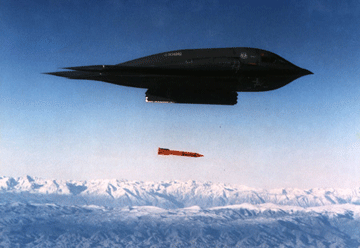
The aircraft, travelling faster than the speed of sound, dropped the inert weapon from 10,500ft. The weapon hit the designated target area 42s later.
“We’re showing the B61-12’s larger compatibility and broader versatility for the country’s nuclear deterrent, and we’re doing it in the world of Covid-19,” says Sandia executive Steven Samuels.
“We’re not slowing down. We’re still moving forward with the B61-12 compatibility activities on different platforms.”
This was the first time a B61-12 was dropped from the internal weapons bay of a fighter. It was also the first time the weapon was released at a speed greater than Mach 1.
The work follows other tests involving the Boeing F-15E Strike Eagle and Northrop Grumman B-2 Spirit stealth bomber.
Sandia designs and produces non-nuclear components for the USA’s nuclear stock pile.
“The latest test is a critical piece in the F-35A and B61-12 programme,” adds Samuels. “Aboard the newest fighter, the B61-12 provides a strong piece of the overall nuclear deterrence strategy for our country and our allies.”
Beware the “madness of militarism” – Biden likely to appoint war-loving Michèle Flournoy as Defense Secretary
 Hey Joe, Where You Going With That Pentagon in Your Hands? https://www.commondreams.org/views/2020/11/23/hey-joe-where-you-going-pentagon-your-hands
The pernicious and lucrative aspects of military madness are personified in the favorite to be Biden’s Defense Secretary. by Norman Solomon,
Warning and petitioning Biden to dissuade him from a Flournoy nomination probably have scant chances of success. But if Biden puts her name forward, activists should quickly launch an all-out effort to block Senate confirmation.
As the Biden administration takes office, progressives have an opportunity to affirm and amplify the position that Martin Luther King Jr. boldly articulated when he insisted that “I never intend to adjust myself to the madness of militarism.” In the present day, the pernicious and lucrative aspects of that madness are personified in the favorite to be Biden’s Defense Secretary.
Days ago, the Project On Government Oversight (POGO) published a detailed analysis under the headline “Should Michèle Flournoy Be Secretary of Defense?” The well-documented answer: No.
Citing “extensive defense industry ties,” POGO provided an overview of Flournoy’s revolving-door career. When she wasn’t oiling the war machine in the Clinton and Obama administrations, Flournoy was profiteering from servicing that machine:
- “In 2002 she went from positions in the Pentagon and the National Defense University to the mainstream but hawkish Center for Strategic and International Studies, which is largely funded by industry and Pentagon contributions.”
- “Five years later, she co-founded the second-most heavily contractor-funded think tank in Washington, the highly influential Center for a New American Security. That became a stepping stone to her role as under secretary of defense for policy in the Obama administration.”
- “From there she rotated to the Boston Consulting Group, after which the firm’s military contracts expanded from $1.6 million to $32 million in three years. She also joined the board of Booz Allen Hamilton, a consulting firm laden with defense contracts. In 2017 she co-founded WestExec Advisors, helping defense corporations market their products to the Pentagon and other agencies.”
Running parallel to Flournoy’s financial conflicts of interest was her long record of advocacy for military conflicts.
“Flournoy was widely considered to have been one of Obama’s more hawkish advisers and helped mastermind the escalation of the disastrous war in Afghanistan,” Arwa Mahdawi pointed out in a Nov. 21 Guardian piece. “She has called for increased defense spending, arguing in a 2017 Washington Post op-ed that Trump was ‘right to raise the need for more defense dollars.’ She has complained that Obama didn’t use military force enough, particularly in Syria. She supported the wars in Iraq and Libya. . .”
The president-elect is hardly in a position to hold such a record against prospective appointees. He has never fully acknowledged, much less renounced, his own roles in advocating for disastrous U.S. wars — most notably and tragically, the war in Iraq.
Biden hasn’t gotten his story straight or come clean about supporting the U.S.-led invasion of Iraq in 2003. His specious claims that he didn’t really support the invasion have been gross misrepresentations of the historical record. Actually, Biden was the Democrat in the Senate who exerted the most leverage in support of the Iraq invasion, and he did so with public enthusiasm.
The foreseeable dangers of picking Flournoy to run the Pentagon are compounded by Biden’s selection of Antony Blinken to be Secretary of State. It was Blinken who, 18 years ago, served as staff director for the Senate Foreign Relations Committee while its chairman, Joe Biden, oversaw the pivotal and badly skewed two-day hearing in summer 2002 that greased the congressional skids for approving an invasion of Iraq.
Blinken, along with Flournoy, co-founded WestExec Advisors, which the Washington Post’s breaking-news coverage of the Blinken nomination gingerly described as “a political strategy firm.” It was a nice euphemism, in contrast to how POGO describes the WestExec Advisors mission — “helping defense corporations market their products to the Pentagon and other agencies.” The term “war profiteering” would be even more apt.
If past behavior is the best predictor of future behavior, there are ample reasons for apprehension about the top of the military and foreign-policy team that Biden has begun to install for his presidency. But realism should not lead to fatalism or passivity.
Extricating the United States from the grip of the military-industrial complex will require massive and sustained organizing. With that goal in mind, a grassroots campaign to prevent Michèle Flournoy from becoming Secretary of Defense would be wise.
President Joe Biden will have just 16 days from Inauguration Day to rescue the New START Treaty
 Biden May Have 16 Days to Stave Off a Nuclear Arms Race, Preserving the New START treaty with Russia will be one of his earliest missions, Bloomberg, By Peter Coy , 25 Nov 20,
If New START is allowed to expire, a nuclear arms race could break out. Retired Navy Admiral James Stavridis, the former supreme allied commander of NATO, wrote in a Bloomberg Opinion column on Oct. 30, that a stop to New START would allow both sides to deploy more nukes of current designs as well as make more advanced systems, “all of which would be very destabilizing.”
Some pressure, right? For insight into what Biden and his team will do, I interviewed Jon Wolfsthal, who served from 2014 to 2017 as a special assistant to President Barack Obama and as senior director for arms control and nonproliferation at the National Security Council. He was also a senior adviser to Vice President Biden on nuclear security and nonproliferation from 2009 to 2012.
Some pressure, right? For insight into what Biden and his team will do, I interviewed Jon Wolfsthal, who served from 2014 to 2017 as a special assistant to President Barack Obama and as senior director for arms control and nonproliferation at the National Security Council. He was also a senior adviser to Vice President Biden on nuclear security and nonproliferation from 2009 to 2012.
Wolfsthal says he’s optimistic about Biden’s chances of staving off a fresh nuclear arms race……….
Biden and his team will have a long list of nuclear weapons problems to deal with, including the rapid growth of China’s
………… Wolfsthal says New START, which went into effect in 2011, is flawed but shouldn’t be left to expire, because
Nuclear arms control doesn’t get as much attention as other priorities for Biden’s first 100 days, but nothing is more
1 This Month





PLEASE OPPOSE HR 8255 AND S.3639 – bills would accelerate satellite deployment, with no environmental review or safeguards – https://ncstd5li.quorum.us/campaign/169331/
To see nuclear-related stories in greater depth and intensity – go to https://nuclearinformation.wordpress.com
-
Archives
- October 2026 (81)
- September 2026 (339)
- August 2026 (330)
- July 2026 (355)
- June 2026 (287)
- May 2026 (306)
- April 2026 (356)
- March 2026 (251)
- February 2026 (267)
- January 2026 (308)
- December 2025 (358)
- November 2025 (359)
-
Categories
- 1
- 1 NUCLEAR ISSUES
- business and costs
- climate change
- culture and arts
- ENERGY
- environment
- health
- history
- indigenous issues
- Legal
- marketing of nuclear
- media
- opposition to nuclear
- PERSONAL STORIES
- politics
- politics international
- Religion and ethics
- safety
- secrets,lies and civil liberties
- spinbuster
- technology
- Uranium
- wastes
- weapons and war
- Women
- 2 WORLD
- ACTION
- AFRICA
- Atrocities
- AUSTRALIA
- Christina's notes
- Christina's themes
- culture and arts
- Events
- Fuk 2022
- Fuk 2023
- Fukushima 2017
- Fukushima 2018
- fukushima 2019
- Fukushima 2020
- Fukushima 2021
- general
- global warming
- Humour (God we need it)
- Nuclear
- RARE EARTHS
- Reference
- resources – print
- Resources -audiovicual
- Weekly Newsletter
- World
- World Nuclear
- YouTube
-
RSS
Entries RSS
Comments RSS

