Joe Biden administration might consider cutting nuclear weapons spending

 Biden to Review U.S. Nuclear-Weapons Programs, With Eye Toward Cuts
President-elect promised to reduce ‘excessive’ spending on nuclear arsenal and shrink its role in strategy, but critics say updates are overdue, WSJ, By Michael R. Gordon, Dec. 24, 2020 WASHINGTON—The incoming Biden administration is planning a review of the nation’s $1.2 trillion nuclear-modernization program with an eye toward trimming funding for nuclear weapons and reducing their role in Pentagon strategy
President-elect Joe Biden promised during the campaign to reduce the U.S.’s “excessive expenditure” on nuclear arms and criticized President Trump’s decision to develop new sea-based weapons, including a submarine-launched cruise missile.
The new administration is also likely to review the Pentagon’s decision to develop a new land-based intercontinental ballistic missile, which is estimated to cost more than $100 billion when its warhead is included, some former officials said.
“We have to modernize our deterrent,” said one former official. “But we cannot spend the amount of money that is currently being allocated.”
The expectation that Mr. Biden will take a fresh look at the modernization programs has spurred a debate over the future of the U.S. nuclear deterrent……. (subscribers only) https://www.wsj.com/articles/biden-to-review-u-s-nuclear-weapons-programs-with-eye-toward-cuts-11608805800
A scary reality, Trump still has the nuclear codes
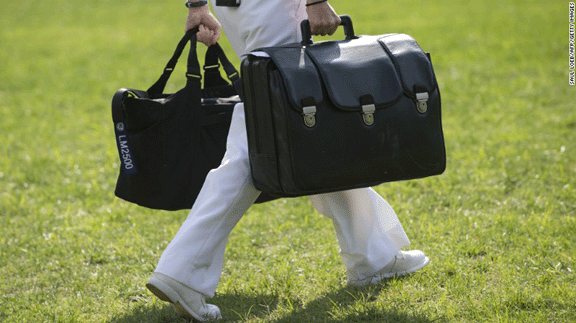
Former Reagan aide: Trump still has the nuclear codes. And that’s genuinely  scary. https://www.nj.com/opinion/2020/12/former-reagan-aide-trump-still-has-the-nuclear-codes-and-thats-genuinely-scary-opinion.html By Star-Ledger Guest Columnist By Mark Weinberg, 24 Dec 20
Almost anything Donald Trump does in his last weeks as president can be undone by Joe Biden. Executive Orders can be reversed, regulations can be changed, unnecessary commissions can be disbanded, and (some) political appointees can be removed from their positions. Unfortunately, a few will remain after Trump leaves because of how terms are structured, but their ability and probably their willingness to cause mischief will be severely limited when their man is out of the White House. At least one hopes so.
That’s the good news.
The bad news is that until noon on January 20th Trump will have access to the codes necessary to authorize a nuclear war. That is genuinely scary.
The size, scale and influence of the United States’ economy notwithstanding, what makes the president of the United States the most powerful person in the world is control of our nuclear weapons.
Our two most threatening adversaries, Russia and China, both have significant nuclear arsenals. Vladimir Putin and Xi Jinping are aware that Trump is a wounded and weakened president and will be so until he leaves office next month. Whether they sense that translates into an opening for them to outright attack us — or at least threaten to — is an open question. No doubt they are watching closely for opportunities to enhance their world domination campaigns at our expense, which means we must be super-vigilant. Nuclear war is no joke. It is as serious as it gets. What animated Ronald Reagan most in his efforts to engage the Soviet Union to reduce both country’s nuclear stockpiles was that each nation had the ability to destroy each other. Reagan called this the “MAD” – Mutually Assured Destruction – policy, which he rightly thought was unacceptably dangerous and worked hard to eliminate. He famously said: “a nuclear war cannot be won and must never be fought.” Contrary to opponents’ depictions, Reagan was not a trigger-happy warmonger. Indeed, he was the opposite. A World War II veteran, he knew well of, and worried about, the indescribably deadly potential of nuclear weapons and took very seriously his duties as president in either responding to — or initiating — a nuclear strike.
As with all modern-day presidents, elaborate steps were taken to make certain Reagan always had access to the nuclear codes wherever he was. There was never a time during Reagan’s presidency when his stability or suitability to have the nuclear codes was in question.
So what to do until he is replaced by a more stable, sensible, and sane president?
Tempting and legitimate as it may be, invoking the 25th Amendment to declare Trump “unable to discharge the powers and duties of his office” is not a realistic possibility at this point. For reasons they will have to explain later, most members of Trump’s Cabinet, including Vice President Michael Pence, are either unable or unwilling to recognize Trump’s instability and unsuitability for office and fear that doing anything to upset him could be professional suicide.
In USA’s economic and health crisis – nuclear weapons spending is booming
Roughly 50,000 Americans are now involved in making nuclear warheads at eight principal sites stretching from California to South Carolina. And the three principal U.S. nuclear weapons laboratories — located in Los Alamos and Albuquerque, N.M., and Livermore, Calif. — have said they are adding thousands of new workers at a time when the overall federal workforce is shrinking.
“the insane idea that after a pandemic and dealing with climate change and in an economic crisis in which people are struggling with massive inequality that we are going to spend this much money modernizing every last piece of our nuclear infrastructure — that would be a failure, a failure of policy and a failure of imagination.”
But major defense contractors and their employees — including many of those making nuclear weapons or running the national laboratories where they are designed — have long influenced budget choices by helping to finance elections of the members of Congress who approve spending for that work. The industry’s donations in the current election cycle to members of the House and Senate Armed Services committees alone had reached $9.4 million as of mid-October; of that amount, the two chairmen took in a total of at least $802,000, according to the Center for Responsive Politics, a nonpartisan research group. These tallies don’t include separate donations by lawyers or lobbyists.
|
While the country has been preoccupied with the COVID-19 pandemic, economic decline and the election, President Trump’s administration quietly and steadily steered America’s nuclear weapons industry to its largest expansion since the end of the Cold War, increasing spending on such arms by billions of dollars with bipartisan congressional support.
President-elect Joe Biden may embrace other priorities as he confronts the pandemic, tries to steer the country out of a recession, and is pressured to address social programs neglected under the Trump administration, as well as a ballooning deficit created by the 2017 Trump tax cuts and COVID-19 stimulus spending. But the creation of a larger and more modern nuclear warhead complex of factories, laboratories and related businesses is already playing out around the country, despite slowdowns in other federal projects due to the pandemic Four factories in Texas, South Carolina, Tennessee and New Mexico dedicated to producing warheads are being modernized. Four existing warheads are being substantially rebuilt with modern parts, on top of another such upgrade — costing $3.5 billion — that was completed last year. This pace compares with an average modernization of one type of warhead at a time during the Obama administration. “Over the next five years, the [nuclear weapons-related] costs start going up dramatically,” Continue reading |

USA’s $128 billion next-generation submarine program at risk of cost overruns
|
Next-Generation U.S. Nuclear Sub Facing Cost Overruns, Delays, Bloomberg, Anthony Capaccio December 24 2020, — The U.S. Navy’s plan to deliver the first vessel in its $128 billion next-generation submarine program on time is at risk by a dependence on inexperienced contractors with spotty quality control track records, according to a congressional watchdog.
The Government Accountability Office, in a restricted Nov. 6 report to the Pentagon and congressional defense committees, said the design contract for the first vessel in the Columbia-class sub fleet being built by General Dynamics Corp. could have a cost overrun of as much as 14%, or $384 million.
The GAO report outlines in detail the myriad challenges facing contractors and the Navy in the design and construction of a 12-vessel program that advocates say is most survivable leg of the U.S. nuclear triad, comprising land, air and sea-based warheads. Trump’s 5-Year Budget Plan for Navy Would Add 82 New Vessels (2) As an example, the report says that General Dynamics “continues to identify problems with non-destructive testing and welding across the supplier base, including suppliers responsible for piping, valves and large mechanical equipment.” More broadly, the report signals the difficulties the Navy will face in trying to carry out the Trump administration’s vision for a 355-to-500 vessel fleet by 2045 up from 297 today.
Those difficulties will be one of the first defense-procurement challenges confronting the Biden administration when it takes office next month amid a U.S. economy hobbled by the Covid-19 pandemic. The Columbia’s five-year plan envisions $30 billion being spent on the program through 2026, increasing from $4.7 billion planned for next year to $8.2 billion in 2026.
But first, several quality-control issues have to be addressed………….. https://www.bloombergquint.com/business/next-generation-u-s-nuclear-sub-facing-cost-overruns-delays : https://www.bloombergquint.com/business/next-generation-u-s-nuclear-sub-facing-cost-overruns-delays
|
|
Nuclear weapons agency updates Congress on hacking attempt
|
Nuclear weapons agency updates Congress on hacking attempt
Officials from the Department of Energy told Hill staffers this week that they don’t believe their systems were compromised. Politico, By NATASHA BERTRAND, 12/22/2020 The Department of Energy and the National Nuclear Security Administration, which maintains the U.S. nuclear weapons stockpile, told congressional staffers in several briefings this week that there is currently no known impact to its classified systems from a massive hack that targeted its networks, according to an official with direct knowledge of the briefings. The officials told staffers, however, that the incident has proven how difficult it is to monitor the Energy Department’s unclassified systems, and acknowledged that an issue with a network extension within the Office of Secure Transportation — which specializes in the secure transportation of nuclear weapons and materials — had been discovered………. The internal investigation has been complex and time-consuming because the compromised SolarWinds software was used widely throughout the nuclear security administration, officials told the staffers — including at the Los Alamos, Lawrence Livermore, and Sandia national labs; NNSA headquarters; NNSA’s Emergency Communication Network; NNSA’s Mixed Oxide Fuel Fabrication Facility, where fuel is made for reactors; the Nevada National Security Site, a disposal site; and Naval Reactors, which provides propulsion plants for nuclear powered ships. …….https://www.politico.com/news/2020/12/22/nuclear-weapons-agency-congress-hacking-450184 |
|
“Mutual admiration society” -between civilian and military nuclear experts
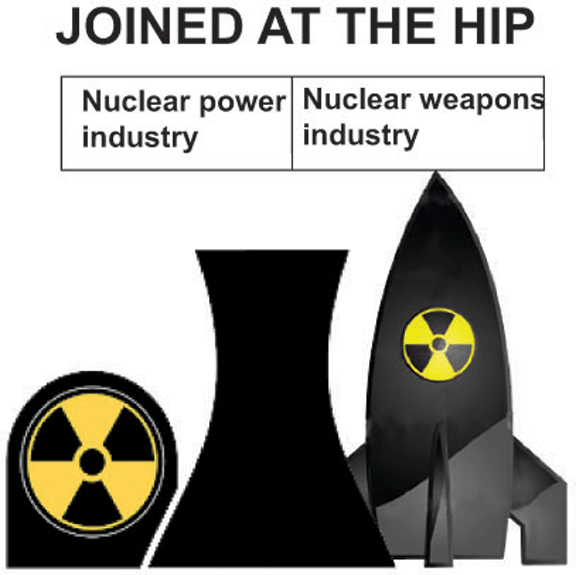 Civilian nuclear and military nuclear members of a “mutual admiration society” ~
  Dr. Gordon Edwards, https://concernedcitizens.net/2020/12/19/civilian-nuclear-and-military-nuclear-members-of-a-mutual-admiration-society/ Dr. Gordon Edwards, President of the Canadian Coalition for Nuclear Responsibility, December 19, 2020
Civilian nuclear and military nuclear have always been friendly room-mates, members of a “mutual admiration” society. In today’s announcement of an SMR Action Plan, Natural Resources Minister Seamus O’Regan said that nuclear power in Canada is a “home-grown” technology and referred to C. D. Howe’s role in this connection. In fact C.D. Howe arranged for all Canadian uranium extracted from Canadian mines to be sold to the US military for use in tens of thousands of nuclear weapons from 1945 to 1965. C D Howe was also on the Committee that met in Washington DC in 1944 to approve the first nuclear reactors to be built in Canada (at Chalk River) as part of the ongoing effort to produce plutonium for use as a nuclear explosive. Mr. Howe approved of the policy of selling plutonium produced at Chalk River to the US military for weapons use, a practice that continued until 1975 and beyond. Plutonium from Chalk River was sent to Britain (it was the first sample of plutonium that Britain had ever obtained) just a few months before Britain detonated its first A-Bomb in the Monte Bello Islands off Australia.
To the best of my knowledge, no civilian nuclear power agency – not the Canadian Nuclear Association, nor the Canadian Nuclear Society, nor the Canadian Nuclear Safety Commission, nor Atomic Energy of Canada Limited, nor Canadian Nuclear Laboratories, NOBODY – has ever issued a clear statement denouncing nuclear weapons or even calling for a nuclear weapons free world. Most nuclear scientists and engineers feel a strong kinship and camaraderie with those who are in the nuclear weapons business. The same goes for those in the nuclear division of Natural Resources Canada. I remember on one occasion (prior to the exchange of nuclear tests between India and Pakistan) I expressed alarm at the fact that both neighbours are developing a nuclear war-fighting capability and a couple of senior civil servants said “Would that be so bad? Maybe that’s just what the world needs. More deterrence. Creates stability”
Despite regular denials from our puppet masters that civilian nuclear has nothing to do with military nuclear, it is clear that civilian nuclear (including the frankly discriminatory provisions of the NPT) has adopted an appeasement policy that will never succeed in bringing about a nuclear weapons free world. Why does Canada continue to sell uranium to countries that are in the process of investing hundreds of billions to improve and modernize the nuclear arsenals in utter defiance of the NPT, knowing that the vast bulk of Canadian uranium that is rejected from enrichment plants as DU end up as the raw material for producing plutonium for Bombs, and that the lion’s share of the explosive power – and the overwhelming share of the radioactive fallout – of every H-bomb comes from the fissioning of DU atoms that are freely accessed by the military even if they are the leftovers of “peaceful” fuel production for nuclear power plants?
“See ‘The Nuclear Fudge’ at https://www.youtube.com/watch?v=0lK65S5eHRQ&feature=youtu.be“. This 16-minute W5 segment from the Regan era is very informative.
75% of the Japanese public want Japan to join the Treaty on the Prohibition of Nuclear Weapons
 Japanese Public Opinion, Political Persuasion, and the Treaty on the Prohibition of Nuclear Weapons, Taylor Francis Online, Jonathon Baronb,Rebecca Davis Gibbons &Stephen Herzog– 21 Dec 20, Japanese Public Opinion, Political Persuasion, and the Treaty on the Prohibition of Nuclear Weapons, Taylor Francis Online, Jonathon Baronb,Rebecca Davis Gibbons &Stephen Herzog– 21 Dec 20, ABSTRACT
The Treaty on the Prohibition of Nuclear Weapons (TPNW) poses a challenge to decades of Japanese nuclear policy. While Japan has relied on the US nuclear umbrella since the aftermath of World War II, numerous pro-disarmament groups – including the Hibakusha – are calling for Tokyo to join the Treaty. We contribute to these discussions with commentary on a new national survey we conducted in Japan (N = 1,333). Our results indicate that baseline support for the Prime Minister signing and the Diet ratifying the TPNW stands at approximately 75% of the Japanese public. Only 17.7% of the population is opposed, and 7.3% is undecided. Moreover, this support is cross-cutting, with a wide majority of every demographic group in the country favoring nuclear disarmament. Most strikingly, an embedded survey experiment demonstrates that the Japanese government cannot shift public opinion to oppose the Ban through the use of policy arguments or social pressure. Such broad support for the TPNW indicates that the Japanese government will not be able to hide from the Treaty and must take action to restore its credibility as a leader on nuclear disarmament………… https://www.tandfonline.com/doi/full/10.1080/25751654.2020.1834961?src=& |
|
US Navy nuclear-powered guided-missile submarine and 2 warships sail through Strait of Hormuz, (Persian Gulf-Gulf of Oman)
|
“The nuclear-power Ohio-class guided-missile submarine USS Georgia (SSGN 729), along with the guided-missile cruisers USS Port Royal (CG 73) and USS Philippine Sea (CG 58), transited the Strait of Hormuz entering the Arabian Gulf, Dec. 21,” the Navy said in a statement using an alternative name for the Persian Gulf.
The vessels’ entrance into the area comes amid heightened tensions with Iran, with Secretary of State Mike Pompeo blaming Iranian backed militias for a rocket attack on the US Embassy compound in Baghdad, on Sunday.
Some US officials have expressed concern that Iran may use the anniversary of the killing of General Qasem Solemani to carry out a strike on the US.
The US Navy rarely discusses the movement of its submarines, but Monday’s announcement also included details on the vessel’s capabilities, including its “ability to carry up to 154 Tomahawk land-attack cruise missiles.”……………… https://edition.cnn.com/2020/12/21/politics/us-nuclear-sub-hormuz/index.html
|
|

Major Japan life insurers shun investing in nuclear weapons-linked firms
 Major Japan life insurers shun investing in nuclear weapons-linked firms, https://www.japantimes.co.jp/news/2020/12/14/national/major-japan-life-insurers-investing-nuclear-weapons-linked-firms/ 14 Dec 20, Four major Japanese life insurers do not invest in or extend loans to producers of nuclear weapons or companies related to them, Kyodo News learned Saturday, as part of their efforts toward socially responsible investing.The revelation comes as various lenders in Japan, Europe and the United States have refrained from investing in companies involved in the nuclear weapons industry.It also precedes the entry into force in January of a United Nations treaty that will ban such weapons. Major Japan life insurers shun investing in nuclear weapons-linked firms, https://www.japantimes.co.jp/news/2020/12/14/national/major-japan-life-insurers-investing-nuclear-weapons-linked-firms/ 14 Dec 20, Four major Japanese life insurers do not invest in or extend loans to producers of nuclear weapons or companies related to them, Kyodo News learned Saturday, as part of their efforts toward socially responsible investing.The revelation comes as various lenders in Japan, Europe and the United States have refrained from investing in companies involved in the nuclear weapons industry.It also precedes the entry into force in January of a United Nations treaty that will ban such weapons.
The four life insurers which managed a combined ¥151 trillion in assets in fiscal 2019 — Nippon Life Insurance Co., Dai-ichi Life Insurance Co., Meiji Yasuda Life Insurance Co. and Fukoku Mutual Life Insurance Co. — did not disclose lists of targeted companies. The restraint shown by the life insurers reflects a growing trend toward valuing environmental, social and governance (ESG) factors in making investment decisions. It is believed that such investing strategies will give a boost to the advancement of green technologies while cutting funding for developing nuclear weapons. Three of the insurers, with Nippon Life being an exception, say they do not invest in companies involved in the maintenance of nuclear warheads or manufacturing of ballistic missiles, in addition to those making nuclear weapons. According to PAX, an international nongovernmental organization for peace, U.S. Lockheed Martin Corp., which develops the long-range Minuteman intercontinental ballistic missile, is among such companies. More than 300 lenders including major Japanese banks invested a total of $748 billion in companies involved in the nuclear weapons industry between January 2017 and January 2019, according to the NGO. In April, Dai-ichi Life published a basic policy that excludes weapons producers from its portfolio. The company told Kyodo News that companies linked to nuclear weapons raise concerns from the viewpoint of ESG. Meiji Yasuda said it does not invest in or extend loans to companies that are found to have links to nuclear and other inhumane weapons based on undisclosed internal rules. Categorizing companies related to nuclear weapons as “socially problematic,” Fukoku has excluded them from its investible universe in line with its own guidelines adopted in February 2019. Nippon Life, meanwhile, said it does not invest in shares or bonds of nuclear weapons producers. The Treaty on the Prohibition of Nuclear Weapons will become the first international pact outlawing the development, testing, possession and use of nuclear weapons, though the world’s major nuclear powers have not joined it. Japan, the only country to have suffered a nuclear attack, has not taken part, to the disappointment of many atomic bomb survivors in Hiroshima and Nagasaki, as it is protected under the U.S. nuclear umbrella. Sumitomo Life Insurance Co., which does not have guidelines on investing in nuclear weapons companies, said it will consider exercising restraint as investing in such companies would hurt its reputation once the nuclear ban treaty takes effect. |
|
The real reason for “civil” Small Nuclear Reactors- to supply expertise and technology for the nuclear weapons industry
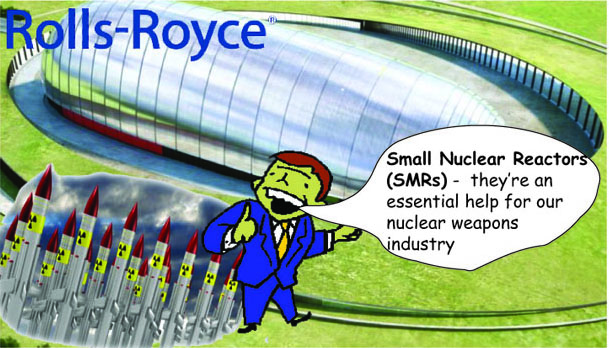
 How investment in SMRs supports “defense nuclear programs” https://concernedcitizens.net/2020/12/19/how-investment-in-smrs-supports-defense-nuclear-programs/comment-page-1/?unapproved=2198&moderation-hash=3219adce054494626a5ee71e323fef71#comment-2198 How investment in SMRs supports “defense nuclear programs” https://concernedcitizens.net/2020/12/19/how-investment-in-smrs-supports-defense-nuclear-programs/comment-page-1/?unapproved=2198&moderation-hash=3219adce054494626a5ee71e323fef71#comment-2198
1. Rolls-Royce, 2017, ‘UK SMR: A National Endeavour’, https://www.uknuclearsmr.org/wp-content/uploads/2017/09/V2088-Rolls-Royc… “The indigenous UK supply chain that supports defence nuclear programmes requires significant ongoing support to retain talent and develop and maintain capability between major programmes. Opportunities for the supply chain to invest in new capability are restricted by the limited size and scope of the defence nuclear programme. A UK SMR programme would increase the security, size and scope of opportunities for the UK supply chain significantly, enabling long-term sustainable investment in people, technology and capability. “Expanding the talent pool from which defence nuclear programmes can draw from would bring a double benefit. First, additional talent means more competition for senior technical and managerial positions, driving excellence and performance. Second, the expansion of a nuclear-capable skilled workforce through a civil nuclear UK SMR programme would relieve the Ministry of Defence of the burden of developing and retaining skills and capability. This would free up valuable resources for other investments.” |
|
USA to turn the moon into a nuclear weapons site
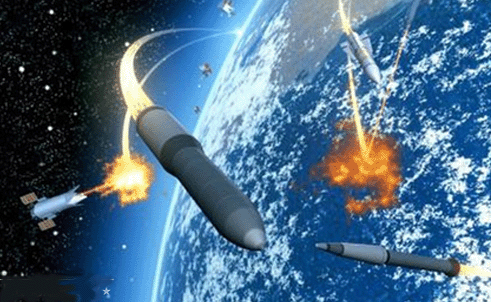 US to turn moon into ‘nuclear weapons site’ US to turn moon into ‘nuclear weapons site’
By Huang Lanlan Source: Global Times: 2020/12/18, The US ambition to build a nuclear power plant on the moon by 2027, which may contribute to future lunar military projects, shows it seeks space supremacy regardless of the damage and dangers it may cause to people, Chinese experts on military and international relations said.
Establishing a nuclear power plant on the moon by the end of 2027 was included in a number of specific goals in a memorandum signed by US President Donald Trump on Wednesday, which is known as Space Policy Directive 6 (SPD-6). The plant would “support a sustained lunar presence and exploration of Mars,” SPD-6 said. Military purposes are likely to be behind the establishment, Chinese military expert and commentator Song Zhongping said. By setting up a nuclear power plant, which includes exploiting nuclear materials and building equipment like nuclear reactors and uranium enrichment facilities, the US can theoretically turn the moon “into a production site of nuclear weapons,” Song told the Global Times Friday. The moon is rich in helium-3, a material that could be used as fuel to produce energy by nuclear fusion, Song said. In the name of building a nuclear power plant, the US may directly exploit this material on the moon and then construct nuclear fuel-processing plants there, he said. The plan once again shows American unilateralism in space, which runs counter to the will of the international community in terms of lunar issues, Li Haidong, a professor at the Institute of International Relations of the China Foreign Affairs University, said………. As Chang’e-5 successfully completed its lunar trip on Thursday, the signing of SPD-6 also shows the US’ intention of dragging China into a space race, trying to divert China’s attention to an endless consumption of national resources for the race from improving its economy and people’s livelihood, Li said. This is similar to what the US did to the Soviet Union in the 1980s under Ronald Reagan’s “Star Wars” program, he noted.
Its goal of building a lunar nuclear power plant, nonetheless, may hardly be achieved on time by 2027 as the US is stuck in domestic trouble and chaos, such as the ongoing COVID-19 pandemic, Li said. https://www.globaltimes.cn/content/1210357.shtml |
|
The power of influence in writing on nuclear issues, – impressive storytelling in Lesley Blume’s “Fallout”
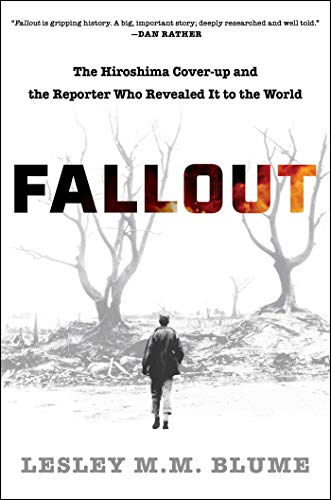 We’re in a storytelling crisis”: Advice for writing on nuclear issues, from the author of “Fallout” Bulletin of the Atomic Scientists, By Sara Z. Kutchesfahani | December 16, 2020 Storytelling is an important tool to change public perception. Recent research has shown that people are ready for nuclear weapons to enter the storytelling space, as long as these new stories are told in less intimidating ways and feature nuclear weapons in the background—rather than the forefront—of a story. Very few publications in the national security space provide a forum for storytelling, with the notable exception being the online publication Inkstick.
How can nuclear policy experts become better storytellers? I thought Lesley M. M. Blume would have some prescient advice. Her new book powerfully shows how one courageous American reporter unraveled one of the deadliest cover-ups of the 20th century—the true effects of the atomic bomb—potentially saving millions of lives. Fallout tells the incredible story of how New Yorker journalist John Hersey of Hiroshima fame was able to go to the Japanese city in the aftermath of the bombing and interview six survivors.
Even before the Japanese surrendered in 1945, the US government and military had begun a secret propaganda and information-suppression campaign to hide the devastating nature of nuclear weapons. The cover-up intensified as Allied occupation forces closed Hiroshima and Nagasaki to Allied reporters, preventing leaks about the horrific long-term effects of radiation that would kill thousands during the months after the blast. For nearly a year, the cover-up worked—until John Hersey got into Hiroshima and managed to report the truth to the world.
As Hersey and his editors prepared his article for publication, they kept the story secret—even from most of their New Yorker colleagues. When the magazine published “Hiroshima” in August 1946 as a single issue, it became an instant global sensation, and it changed the US public’s perception of the dropping of the bombs virtually overnight from that of pride to that of visceral repulsion and existential fear. Hersey’s story brought home, for millions across the United States and around the world, the true implications of the then-new atomic age.
On December 10, I interviewed Lesley about her brilliant book. We talked about how the publication of Hiroshima changed the US public’s perception of the bombs, the lessons learned, and how nuclear experts can become better storytellers. The transcript is below. [on original].
2020. Blume’s book Fallout, published in August 2020, documents the Hiroshima cover-up and how a reporter – John Hersey – revealed it to the world. …………
Lesley M. M. Blume: There was the “before” Hersey’s Hiroshima, and then there was the “after” Hersey’s Hiroshima. Before Hersey’s book came out, the atomic bomb had been largely painted by the US government and military essentially as a conventional mega weapon. It was quickly becoming an accepted part of our conventional arsenal, even a tenable cost-saving weapon—it costs a lot less money to lob a nuke at somebody than it does to move troops into an area to wage combat—and, as such, there was a widespread acceptance of and enthusiasm about the weapon between August 1945 and August 1946. The bomb was normalized, in the public’s estimation, with surprising rapidity. [US President] Harry Truman himself referred to the bomb as just a “bigger piece of artillery.”
After Hersey’s Hiroshima comes out, readers—and not just American readers, but readers around the world—are seeing what these then-experimental weapons indeed do to human beings, not just at the moment of detonation, but in the hours, days, weeks, months, and years to come. This is because Hersey was able to document the first part of the long tail of nuclear weapons, namely that they are the weapon that continues to kill indefinitely after detonation.
The book immediately affected American attitudes: the vast majority of polled Americans in August 1945 were thrilled about the bombs because, they were told, the bombings had saved both American and Japanese lives, hastened the end of the war, and avoided a land invasion. Not only that, but they also viewed it as pure vengeance. When President Truman made his announcement about the Hiroshima bombing, he said that the Japanese had been repaid manyfold for Pearl Harbor. Many people agreed with him then, and they agree with him now; people are still passionate about the payback element of it………..
Lesley M. M. Blume: As I’ve been doing publicity for Fallout this fall since the book came out on August 4, I’ve been pretty shocked by an increased complacency toward the nuclear landscape, which the Bulletin of the Atomic Scientists has deemed the most perilous ever. I‘ve been shocked by how, here we are in the most perilous nuclear landscape in 75 years, how the nuclear threat is not on most people’s minds. And it certainly wasn’t a significant election issue by any stretch of the imagination. Whenever you would see these write ups about where the candidates stood on 10 or 12 issues such as trade with China, the pandemic, or climate change, the nuclear landscape was never one of them. The younger my interviewers were, the less concerned they were, and that’s because it hasn’t been a part of their psyche of what’s surrounding them—and not just because we’ve been dealing with other urgent existential threats like the pandemic and climate change………
And as the pandemic worsens, this issue is getting less and less attention. Fallout came out in the United Kingdom a few weeks ago, and there was no bandwidth for op-eds about staring down the nuclear threat. Nor was there much of an appetite among US editors for an op-ed advocating that the nuclear landscape be a bigger election issue—even among publications that gave Fallout considerable launch coverage.
As vaccines start to roll in, and it’s the beginning of the end for the pandemic, we need to be anticipating the moment when the news landscape opens up enough for us to leap in and start to drive home the urgency of this threat. The nuclear challenges that still face us have never been resolved in 75 years—even during historical moments when world leaders put their all into creating de-escalation mechanisms, when whole populations were completely immersed in the dangers of the nuclear threat. We are now far from eras of peak awareness like the 1950s, 1960s, and 1980s, and we need to work really, really hard to create an increased awareness as soon as possible. Because with the pandemic, there’s a vaccine; with climate change, we can work to dial it back. But nuclear disaster on a global scale? There’s no coming back from that. As Albert Einstein said, “I know not with what weapons World War III will be fought, but World War IV will be fought with sticks and stones.” https://thebulletin.org/2020/12/were-in-a-storytelling-crisis-advice-for-writing-on-nuclear-issues-from-the-author-of-fallout/
Sleepwalking Toward the Nuclear Precipice
|
Sleepwalking Toward the Nuclear Precipice, The World Needs a Wake-Up Call, FOREIGN AFFAIRS, By Ernest J. Moniz and Sam Nunn, December 15, 2020, One of the best accounts of the lead-up to World War I, by the historian Christopher Clark, details how a group of European leaders led their nations into a conflict that none of them wanted. Gripped by nationalism and ensnared by competing interests, mutual mistrust, and unwieldy alliances, “the Sleepwalkers,” as Clark dubs them, made a series of tragic miscalculations that resulted in 40 million casualties. Around the world today, leaders face similar risks of miscalculation—except heightened by the presence of nuclear weapons. The United States and Russia together possess more than 90 percent of the world’s atomic arsenal but they share the stage with seven other nuclear powers, several of which are engaged in volatile rivalries. Whereas a century ago millions died over four years of trench warfare, now the same number could be killed in a matter of minutes. President-elect Joseph Biden, Vice-President-elect Kamala Harris, and their incoming national security team must confront the sobering fact that the potential for nuclear weapons use shadows more of the world’s conflicts than ever before. A single accident or blunder could lead to Armageddon. As a result, Biden will need to chart a new path on nuclear policy and arms control—one that creates new safeguards against accidental or ill-considered use of nuclear weapons and shores up international mechanisms that have long helped to keep the peace. UNTHINKABLE, BUT NOT IMPOSSIBLE The warning bells have been ringing for years. We wrote in Foreign Affairs more than a year ago (“The Return of Doomsday,” September/October 2019) about the elements that have destabilized the previous equilibrium and increased nuclear risks: where national interests clash, countries are making less use of dialogue and diplomacy than they once did; and as arms control structures have eroded, advanced missile systems, new technologies, and cyberweapons have appeared on the scene. Now, the COVID-19 pandemic has exposed the fragility of the international mechanisms for managing transnational risks and underscored the need for new cooperative approaches to anticipate and deal with threats. One lesson of COVID-19 is that the unthinkable does happen. And with nuclear weapons, the consequences would be even more devastating. To reduce the risk of nuclear accident or war, the Biden administration must reestablish nuclear dialogue with key nuclear states and other important powers. To be successful, however, it will have to build a working relationship with Congress, including with its Republican members, on issues that should be not just bipartisan but nonpartisan—such as arms control, nuclear policy, and diplomacy with other nuclear powers. U.S.-Russian relations are in a dismal state, but Washington and Moscow must once again acknowledge that they share an existential interest in preventing the use of nuclear weapons. The Biden administration and congressional leaders must also acknowledge that fact and work together to reverse the erosion of arms control dialogue and structures that have for many decades made the world a safer place. Dealing with adversaries in the nuclear arena calls for diplomacy, not posturing. Both the Biden administration and Congress must create the political space for the United States and Russia to renew military-to-military, diplomat-to-diplomat, and scientist-to-scientist engagement. NUCLEAR RESTARTThere is much Biden can do to signal an immediate shift in U.S. policy. ……. A WAR THAT MUST NEVER BE FOUGHTIn the long term, the Biden administration will need to make a sustained diplomatic effort to revive the many processes, mechanisms, and agreements that allow nations to manage their relations in peacetime and thus to avoid nuclear conflict. ……… The lesson of World War I is that mutual misunderstandings can lead even reluctant leaders into conflict. World leaders are once again sleepwalking toward the precipice—this time of a nuclear catastrophe. They must wake up before it is too late. https://www.foreignaffairs.com/articles/united-states/2020-12-15/sleepwalking-toward-nuclear-precipice |
|
How will Biden get the “nuclear football” i Trump does not attend the inauguration?
Here’s what happens to the ‘nuclear football’ if Trump decides to skip Biden’s inauguration https://www.businessinsider.com.au/what-happens-to-nuclear-football-if-trump-skips-biden-inauguration-2020-12?r=US&IR=T
- American presidents are accompanied by a military aide carrying a briefcase with the tools necessary for nuclear war.
- During presidential inaugurations, nuclear command authority and the “nuclear football” are transferred to the new president.
- But President Donald Trump may not participate in President-elect Joe Biden’s inauguration, which could complicate the transfer.
- The Pentagon said there was a plan for the transfer in that scenario but declined to provide details. But nuclear-weapons experts and a former military aide who carried the briefcase provided some insight.
An important yet discreet part of the inauguration of a new president is the transfer of command and control authority over the US nuclear arsenal, but there is the possibility President Donald Trump will not attend President-elect Joe Biden’s inauguration, which could complicate matters.
Trump has refused to say whether he will attend Biden’s inauguration, but multiple reports have suggested that the president will skip the swearing-in ceremony of his successor and hold a political rally elsewhere instead.
So what happens to the “nuclear football” that accompanies the president if Trump doesn’t show? How does it get to Biden?
“That’s a good question,” Hans Kristensen, a nuclear weapons expert at the Federation of American Scientists, told Insider. “It is an unprecedented situation.”
The president has the sole authority to conduct a nuclear strike, and wherever he goes, he is accompanied by a military aide carrying a briefcase called the “president’s emergency satchel,” more commonly known as the nuclear football.
Every president since John F. Kennedy has been accompanied by the aide carrying the hefty briefcase, which gives the commander in chief the ability to command US nuclear forces while away from physical command and control centres.
The briefcase does not contain a button that can instantly unleash hundreds of nuclear warheads deployed on intercontinental ballistic missiles, submarine-launched ballistic missiles, and strategic bombers. Instead, the briefcase contains communication tools, codes, and options for nuclear war.
Separate from the football, presidents carry a card, sometimes called the “biscuit,” on their person containing authentication codes. In a nuclear conflict, the president would use the codes in coordination with the tools in the briefcase to identify himself to the military and order a nuclear strike.
Incoming presidents are typically briefed on their nuclear responsibilities before taking the oath of office. Then, during the inauguration, the codes they received that morning or the day before become active, and control of the football is quietly and seamlessly passed to the new president.
Trump described that moment as “sobering” and “very scary,”telling ABC News in 2017 that “when they explain what it represents and the kind of destruction that you’re talking about, it is a very sobering moment.”
The transfer of the nuclear football is supposed to occur at noon as the new president is sworn in. The military aide who has been carrying the briefcase hands it off to the newly designated military aide, former Vice President Dick Cheney said in a past Discovery documentary. This traditionally happens off to the side and is not a part of the show.
If Trump is not at the inauguration, then the transfer process will be different. Still, the transfer will need to be instantaneous, said retired Air Force Lt. Col. Buzz Patterson, who carried the football for former President Bill Clinton.
“That’s the way it has to be,” he told Insider. “For the process to work, you have to have this clear handing off of responsibilities.” He said that how that happens would be up to the Pentagon, which serves the office of the commander in chief, not the man.
A Pentagon spokesperson told Insider the Department of Defence had a plan for the transfer on Inauguration Day but declined to provide any further details.
“We war game this stuff, and we practice it ad nauseam for years and years,” Patterson said. “There are systems in place to make sure that happens instantaneously. There won’t be any kind of question about who has it, who is in charge at that point in time.”
“We don’t take this stuff lightly,” he added. “There won’t be any kind of hiccup. It will just go down without anybody even noticing, which is what is supposed to happen.”
Kristensen, the nuclear weapons expert at FAS, speculated that the plan could resemble plans in place for situations in which a president is suddenly killed or incapacitated, situations in which nuclear command and control authority and all accompanying equipment have to be immediately transferred to the vice president or another designated survivor.
Stephen Schwartz, a nonresident senior fellow with the Bulletin of the Atomic Scientists, recently discussed with the Centre for Arms Control and Non-Proliferation what would happen to the nuclear football if Trump did not attend the inauguration.
Schwartz, known for his research on the nuclear football, said there was more than one football. In fact, he explained, there are at least three of them — for the president, vice president, and a designated survivor.
He said that if another nuclear football had not already been prepared, one likely would be before the inauguration. There would be a military aide ready then to begin following Biden as soon as he is sworn in. And, at that time, Trump’s nuclear command and control authority would presumably expire.
“Hopefully President Trump will be there and it will be just a handoff, which is what it’s been for decades,” Patterson said, adding that if he didn’t, “it’s not that big of a deal” because the military will make sure that the transfer occurs as needed.
Doubts about planned Berkshire ”garden town”, because it’s too close to AWE nuclear weapons factory
BBC 15th Dec 2020, Plans to build a new “garden town” could be scrapped over concerns about a
potential nuclear emergency. The proposed 15,000-home development in
Grazeley is within a couple of miles of nuclear weapons factory AWE
Burghfield. The Office for Nuclear Regulation has extended a “detailed
emergency planning zone” (DEPZ) for the plant, taking in most of the site
earmarked for homes.
That means anyone living in the zone could be affected
by a “reasonably foreseeable” radiation emergency. Three Berkshire councils
that have worked jointly on the plans are now considering shelving the
project, according to the Local Democracy Reporting Service (LDRS).
1 This Month





PLEASE OPPOSE HR 8255 AND S.3639 – bills would accelerate satellite deployment, with no environmental review or safeguards – https://ncstd5li.quorum.us/campaign/169331/
To see nuclear-related stories in greater depth and intensity – go to https://nuclearinformation.wordpress.com
-
Archives
- October 2026 (81)
- September 2026 (339)
- August 2026 (330)
- July 2026 (355)
- June 2026 (287)
- May 2026 (306)
- April 2026 (356)
- March 2026 (251)
- February 2026 (267)
- January 2026 (308)
- December 2025 (358)
- November 2025 (359)
-
Categories
- 1
- 1 NUCLEAR ISSUES
- business and costs
- climate change
- culture and arts
- ENERGY
- environment
- health
- history
- indigenous issues
- Legal
- marketing of nuclear
- media
- opposition to nuclear
- PERSONAL STORIES
- politics
- politics international
- Religion and ethics
- safety
- secrets,lies and civil liberties
- spinbuster
- technology
- Uranium
- wastes
- weapons and war
- Women
- 2 WORLD
- ACTION
- AFRICA
- Atrocities
- AUSTRALIA
- Christina's notes
- Christina's themes
- culture and arts
- Events
- Fuk 2022
- Fuk 2023
- Fukushima 2017
- Fukushima 2018
- fukushima 2019
- Fukushima 2020
- Fukushima 2021
- general
- global warming
- Humour (God we need it)
- Nuclear
- RARE EARTHS
- Reference
- resources – print
- Resources -audiovicual
- Weekly Newsletter
- World
- World Nuclear
- YouTube
-
RSS
Entries RSS
Comments RSS

