Joe Biden must end the cover-up of, and the huge money to, Israel’s nuclear weapons
|
Joe Biden should end the US pretence over Israel’s ‘secret’ nuclear weapons, Guardian, Desmond Tutu, 1 Jan 2021

The cover-up has to stop – and with it, the huge sums in aid for a country with oppressive policies towards Palestinians Desmond Tutu is a Nobel peace laureate and a former archbishop of Cape Town Every recent US administration has performed a perverse ritual as it has come into office. All have agreed to undermine US law by signing secret letters stipulating they will not acknowledge something everyone knows: that Israel has a nuclear weapons arsenal. Part of the reason for this is to stop people focusing on Israel’s capacity to turn dozens of cities to dust. This failure to face up to the threat posed by Israel’s horrific arsenal gives its prime minister, Benjamin Netanyahu, a sense of power and impunity, allowing Israel to dictate terms to others. But one other effect of the US administration’s ostrich approach is that it avoids invoking the US’s own laws, which call for an end to taxpayer largesse for nuclear weapons proliferators. Israel in fact is a multiple nuclear weapons proliferator. There is overwhelming evidence that it offered to sell the apartheid regime in South Africa nuclear weapons in the 1970s and even conducted a joint nuclear test. The US government tried to cover up these facts. Additionally, it has never signed the nuclear non-proliferation treaty. Yet the US and Israeli governments pushed for the invasion of Iraq based on lies about coming mushroom clouds. As Israeli nuclear whistleblower Mordechai Vanunu said: the nuclear weapons were not in Iraq – they are in Israel. Amendments by former Senators Stuart Symington and John Glenn to the Foreign Assistance Act ban US economic and military assistance to nuclear proliferators and countries that acquire nuclear weapons. While president, Jimmy Carter invoked such provisions against India and Pakistan. But no president has done so with regard to Israel. Quite the contrary. There has been an oral agreement since President Richard Nixon to accept Israel’s “nuclear ambiguity” – effectively to allow Israel the power that comes with nuclear weapons without the responsibility. And since President Bill Clinton, according to the New Yorker magazine, there have been these secret letters……… This farce should end. The US government should uphold its laws and cut off funding to Israel because of its acquisition and proliferation of nuclear weapons. The incoming Biden administration should forthrightly acknowledge Israel as a leading state sponsor of nuclear proliferation in the Middle East and properly implement US law. Other governments – in particular South Africa’s – should insist on the rule of law and for meaningful disarmament, and immediately urge the US government in the strongest possible terms to act……… https://www.theguardian.com/commentisfree/2020/dec/31/joe-biden-us-pretence-israel-nuclear-weapons |
|
This is the sort of letter that citizens need to be writing – in support of the nuclear weapons ban
 Sudbury letter: Council should support banning of nuclear weapons, https://www.thesudburystar.com/opinion/letters/sudbury-letter-council-should-support-banning-of-nuclear-weaponsAuthor of the article:
The United Nations has passed the Treaty on the Prohibition of Nuclear Weapons and it will become international law on Jan. 22, 2021. Some 86 countries have signed this agreement. Unfortunately, Canada is not one of them.
As it is cities that will be targeted by nuclear weapons, Sudbury, a producer of nickel, would likely be a target. The International Campaign Against Nuclear Weapons (ICANw) is asking cities to support the Treaty on the Prohibition of Nuclear Weapons by passing the following motion (many Canadian cities have already passed this motion including Toronto, Halifax, Vancouver and Victoria):
“Our city of Sudbury, Ont., is deeply concerned about the grave threat that nuclear weapons pose to communities throughout the world. We firmly believe that our residents have a right to live in a world free from this threat. Any use of nuclear weapons, whether deliberate or accidental, would have catastrophic, far-reaching and long-lasting consequences for people and the environment. Therefore, we support the Treaty on the Prohibition of Nuclear Weapons and call on our governments to sign and ratify it.”
The world has about 14,000 nuclear weapons with about 1,500 on hair-trigger alert. The firing of these weapons could happen by accident, miscalculation, terrorism or an unstable government. The catastrophe would be immediate.
I would urge Sudbury city council to pass the motion and support the United Nations Treaty on the Prohibition of Nuclear Weapons.
Richard Denton
Sudbury
How the USA and Soviet Union planned to use nuclear radiation as a weapon.
 This was initially seen as a great idea – you could kill all the people while leaving the omfrastructure intact for your own use.
For decades, the thought of radiological weapons has conjured terrifying images of cities covered in “death dust.” Classified as a weapon of mass destruction — alongside chemical, biological, and nuclear weapons — it has remained a point of mystery as to why these devastatingly indiscriminate weapons were not pursued in earnest by more state and non-state actors alike.
What did early radiological weapons (RW) programs look like? How and why did they arise, and what accounts for their ultimate demise? Aside from a handful of known cases, why have RW programs not proliferated with the same alacrity as other weapons programs?
Thanks to the rigorous and rich historical work of Samuel Meyer, Sarah Bidgood, and William Potter of the Middlebury Institute of International Studies at Monterey, we now have more answers. Focusing on the United States and Soviet Union in the 1940s and 1950s, the authors, in a recent study published in the journal International Security, trace the unique origins of these RW programs, as well as explain why they were subsequently abandoned. Their study, “Death Dust: The Little-Known Story of U.S. and Soviet Pursuit of Radiological Weapons,” reveals a fascinating web of causes, including organizational and bureaucratic politics, international competition, economic and technological constraints, and even the powerful initiatives of well-placed individuals.
While the authors’ work examines the past, it speaks directly to the present and future trajectory of RW programs. If you are interested in military innovation, the history of weapons of mass destruction, the sociology of technology, and science fiction (yes, science fiction!), the exchange featured below is for you.
Samuel Meyer, Sarah Bidgood, and William C. Potter: We define a radiological weapon as one intended to disperse radioactive material in the absence of a nuclear detonation. ……..
……….. May 1941 — the first reference to RW appeared in a U.S. government document: the Report of the Uranium Committee. The report identified three possible military aspects of atomic fission, the first of which was “production of violently radioactive materials … carried by airplanes to be scattered as bombs over enemy territory.” (The other two possible applications noted in the report were “a power source on submarines and other ships” and “violently explosive bombs.”) ………
Technological advances were among the major drivers of RW programs in both the U.S. and the Soviet Union, and RW were initially pursued in tandem with nuclear weapons and chemical weapons (CW) programs. The anticipated promise of RW as a weapons innovation, however, never materialized in either country due to a combination of factors, including technical difficulties in the production and maintenance of the weapons, diminution in the perceived military utility of RW relative to both CW and nuclear weapons, and low threat perceptions about adversary RW capabilities. ……..
the parallelism in many respects between the rise and demise of the U.S. and Soviet RW programs; and (5) the serious but ultimately unsuccessful effort by the United States and the Soviet Union to secure a draft convention at the Conference on Disarmament prohibiting radiological weapons.
MK: Are radiological weapons a thing of the past or do they remain an attractive option for some countries and non-state actors today?
The authors: We are encouraged that no country has either used RW in war or has incorporated them into a national military arsenal. We are concerned, however, that the Russian Federation, despite its own unsuccessful history with RW, has shown renewed interest in advanced nuclear weapons that seek to maximize radioactive contamination. We also worry that some countries may conclude that RW serve their perceived national interests, especially in the absence of international legal restraints. It therefore is important, we believe, to revive U.S.-Russian cooperation to ban radiological weapons and strengthen the norm against their use.
Morgan L. Kaplan is the Executive Editor of International Security and Series Editor of the Belfer Center Studies in International Security book series at the Belfer Center for Science and International Affairs at the Harvard Kennedy School. https://thereader.mitpress.mit.edu/death-dust-the-little-known-story-of-radiological-weapons/
Never give up! 95 year old Hibakusha welcomes the UN nuclear ban treaty
Hibakusha: A-bomb survivor, 95, never giving up the battle to eliminate nuclear weapons https://mainichi.jp/english/articles/20201229/p2a/00m/0na/032000c
December 30, 2020 (Mainichi Japan) Following news that the Treaty on the Prohibition of Nuclear Weapons would enter into force early in 2021, some 200 people including atomic-bomb survivors, or hibakusha, gathered in front of the Atomic Bomb Dome in the western Japan city of Hiroshima on Oct. 25, 2020 and shared their joy.
But one “face” of the city bombed during World War II, who four years earlier had smiled as he shook hands with Barack Obama, the first U.S. President to visit Hiroshima while in office, was not able to take part. The following hibakusha report, coming 75 years after the atomic bombing of Hiroshima, focuses on the life of this figure, 95-year-old Sunao Tsuboi, who has stood at the forefront of hibakusha activities with an indomitable spirit.
Tsuboi has served as chairman of the Hiroshima Prefectural Confederation of A-bomb Sufferers Organizations (Hiroshima Hidankyo) for the past 16 years. He now spends his days at his home in Hiroshima’s Nishi Ward, where a decorative card bears his creed in calligraphic ink: “Futo Fukutsu — Never give up!”
From around the time the imperial year changed from Heisei to Reiwa in May 2019, Tsuboi’s legs became extremely weak, and he was unable to do without his wheelchair. He has been receiving intravenous drips once a fortnight for cancer, heart disease and anemia. This year he received at least 30 blood transfusions, and it has not been easy for him to get out of bed.
On the day of the atomic bombing on Aug. 6, 1945, Tsuboi suffered burns over his entire body, and he remained unconscious for over 40 days. His sight became impaired in his left eye, and he became critically ill three times. To repay his feeling of indebtedness for being able to live, he became a teacher, and continued to share his experiences with students for over four decades, becoming known as “Pikadon Sensei” — a reference to the flash (pika) and boom (don) of the atomic bomb.
After he retired, he continued to share his experiences both in Japan and overseas, visiting 21 countries including Britain, France, China, India, Pakistan and North Korea, which possess nuclear weapons.
“The color of our skin doesn’t have to be the same. We don’t need borders. Humankind won’t be happy unless we help each other,” Tsuboi says. With his fist raised high, he has continued to call for a world without nuclear weapons.
Tsuboi released comments expressing his joy after he learned that the Treaty on the Prohibition of Nuclear Weapons would enter in force.
“I am filled with excitement, thinking, ‘At long last. This is great.’ It is a major step toward my long-held, earnest desire for nuclear weapons to be banned and eliminated,” he said. At the same time, he noted that states with nuclear weapons, as well as Japan, had not ratified the treaty and said, “The road hereafter may be rough.”
Still, each time I have met Tsuboi, he has repeatedly stated, “I won’t give up until there are zero nuclear weapons. Never give up!”
(Japanese original by Naohiro Yamada, Osaka Photo Group)
Pandemic, climate, nuclear weapons – lessons for survival in 2021

Lessons from pandemic-nuclear weapons nexus for survival in 2021 http://www.koreatimes.co.kr/www/opinon/2020/12/197_301593.html By Peter Hayes, 30 Dec 20,
As Earth hurtled around the Sun at over 100,000km per hour, humans were rudely reminded in 2020 by the COVID-19 pandemic that no-one is in charge ― or rather, nature is in charge.
Humanity faces many intertwined global problems in 2021. The short list includes climate change, habitat loss, biodiversity loss, biochemical pollution, overpopulation, demographic aging, food insecurity, water scarcity, disease and pandemics. These problems are both cause and effect of extreme poverty, inequality, forced migration, and social conflict that leads to war.
Hovering above all these inter-twined global problems is the truly existential threat of nuclear war. Nuclear war is the most immediate and direct extinction trap into which the species could fall.
Yet unlike other global problems, nuclear weapons are uniquely and 100 percent human-made. The RECNA Nuclear Warhead Data Monitoring Team at Nagasaki University estimates that as of June 2020, nine nuclear armed states maintain 13,410 nuclear warheads ― enough for about one ton of TNT-equivalent explosive power for every human alive today.
By the same token, the threat of nuclear war is one global problem that can be solved, relatively quickly, and ultimately, forever. Northeast Asia, where the pandemic likely increases the risk of nuclear war, is a case in point. COVID-19 may destabilize nuclear commands and ravage nuclear and conventional forces and, destabilize nuclear-prone conflicts at a time when tension should be reduced, not increased.
To reduce this risk, the Nagasaki 75th Anniversary Pandemic-Nuclear Nexus Scenarios project concluded that leaders in this region must, among many other urgent measures,
― Slow and reverse nuclear force developments and operations in the Northeast Asian region, including through nuclear-weapon-free zones and nonproliferation treaties
― Develop a secure, reliable nuclear hotline network for communicating in a nuclear crisis
― Launch public health security initiatives in the Northeast Asian region to respond to pandemics
― Engage younger generations in the nuclear disarmament movement and mobilize a broader base of potential stakeholders in nuclear issues
― Enlarge existing city networks such as Mayors for Peace and establish new city/regional cooperation networks to play a more direct role in reducing nuclear risk and pushing for nuclear disarmament
Rather than merely increasing the velocity of existing change and bringing underlying conflicts to the surface, the pandemic heralds an epochal, global, and systemic transformation that will lead to a new distribution of power capacities in geopolitical, geoeconomic, and geoecological dimensions.
In this permanent pandemic world, the effective governance of global problems in an era of permanent pandemics may rise bottom-up from “first responder” cities, provinces, corporations, and civil society organizations, driven by sheer necessity to create a global mosaic of networked responses and shared solutions.
This is a world that might adopt the Treaty on the Prohibition of Nuclear Weapons as the foundation of nuclear governance, not the old legal order that approves of the existence and even the use of nuclear weapons.
Cutting across this hopeful image is a darker portrayal of how humans may respond to multiple existential threats in an epoch defined by pandemics. In this 21st century feudalism, great powers are weakened relative to each other, and small and medium powers acquire symmetric and ultra-modern means of military power projection designed to maintain control and keep the other outside borders during protracted pandemics.
Thus, today’s Cold Peace struggling to manage COVID-19 may degenerate into a new Cold War with more states and even non-state actors armed with nuclear weapons.
Although humans can make nuclear weapons to destroy life on a massive scale, they can’t make even a simple life form, let alone a single ant or an ecosystem. Arguably, humanity’s best bet for survival is to reduce its global footprint, anticipate the impacts of global change, and adapt rapidly while nature restores itself.
That task begins with making all humans safe from pandemic infections because no human can be safe while other humans are infected. This is the equivalent of delivering one ton of TNT-equivalent of destructive power in the form of a vial of vaccine ― surely achievable even if revolutionary in principle. From this simple proposition flows a revolution in global governance in all affairs, without which humans will likely face a dire, dark, and bleak future.
As we enter 2021, therefore, states and people must ask themselves whether there are better ways to prepare for the uncertain futures created by the COVID-19 pandemic than to rely on primitive nuclear weapons, and which of these is most robust.
Peter Hayes is honorary professor at the Center for International Security Studies, Sydney University, Australia and director at the Nautilus Institute in Berkeley, California. He is also a research director of the Asia-Pacific Leadership for Nuclear Non-Proliferation and Disarmament (APLN). His article was published in cooperation with the APLN (www.apln.network).
Doubtful that aging Los Alamos National Laboratory could safely produce plutonium triggers, no matter how much funding it gets
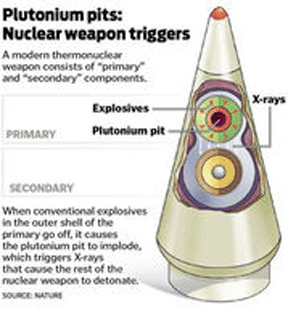 Los Alamos National Laboratory may get boost in nuclear funding, Santa Fe New Mexico By Scott Wyland swyland@sfnewmexican.com– 30 Dec 20, Los Alamos National Laboratory may get boost in nuclear funding, Santa Fe New Mexico By Scott Wyland swyland@sfnewmexican.com– 30 Dec 20, Los Alamos National Laboratory will get a hefty funding boost — including for its work on plutonium pit production — in the military spending bill held up by a presidential veto. Many predict the veto will be overridden, and if it is, the lab’s budget will increase to $3.3 billion from the $2.3 billion allocated last year. The bill puts $837 million into the lab’s plutonium operations, more than double the previous year’s $308 million, as Los Alamos pursues production of 30 nuclear bomb cores by 2026 — a goal critics have questioned. Plans call for the Savannah River Site in South Carolina to make an additional 50 plutonium pits by 2030, so the two facilities will produce a combined 80 pits per year as stated in the 2018 Nuclear Posture Review……..
Watchdog groups call the Trump administration’s more aggressive push to bolster the nuclear stockpile hawkish and unsustainable, and expressed uncertainty about how much the incoming Biden administration might pull back. …… Tom Clements, executive director of SRS Watch, another watchdog group, said the 2021 budget will have to be carried out, and it will take time for President-elect Joe Biden’s administration to draft a new nuclear posture review. But Biden is likely to examine the nuclear modernization program in the coming months, including whether it’s feasible to convert Savannah River’s unfinished mixed-oxide fuel plant into a pit factory, Clements said. “There are growing signs that the SRS pit plant is gonna get a thorough review by the new administration,” Clements said……… Mello said he remains doubtful the aging plutonium facility that never produced more than a dozen pits in a year can be upgraded to crank out 30-plus pits yearly, no matter how much money is spent. “There’s a question of whether Los Alamos will ever be able to do so safely,” Mello said. https://www.santafenewmexican.com/news/local_news/los-alamos-national-laboratory-may-get-boost-in-nuclear-funding/article_cd55c8a6-49f5-11eb-8718-2333908445b5.html |
|
Plowshare anti nuclear-weapons activists again face prison .
 Longtime Anti-Nuke Activists Face Prison, Again, After Breaking Into Naval Base https://www.npr.org/2020/12/28/948116757/longtime-anti-nuclear-activists-face-prison-again-after-breaking-into-naval-base
December 28, 20205: Heard on Morning Edition
EMMA PEASLEE. Dressed in black, the seven intruders cut through a fence and stole along the perimeter of the naval base, trying to avoid detection from the guard towers, as a loudspeaker overhead blared: “Deadly force is authorized!”
Patrick O’Neill, who had a GoPro strapped to his head, tried to reassure himself by remembering a scene in the Bible where Jesus escapes unscathed from a wrathful mob that wants to throw him off a cliff.
When O’Neill and the others reached their target, they poured their own blood on the shield of the Kings Bay naval base in Georgia and attached a poster of Martin Luther King Jr. to a mock-up of a Trident II D5 ballistic missile at the welcome area.
The anti-nuclear activists — Roman Catholics who call themselves Plowshares, from the Biblical passage about “beating swords into plowshares” — followed the metaphor quite literally and took a hammer to the replica of the warhead.
The break-in on the night of April 4, 2018, ended with the arrest and conviction on charges of trespassing and destruction of property for the seven activists aged 58 to 81.
And in the midst of a pandemic that’s wreaking havoc on prisons and disproportionately affecting older people, six of them have been sentenced to up to 33 months in prison. The seventh is scheduled to be sentenced in February.
The Plowshares activists were seeking to revive the anti-nuclear movement by committing acts of civil disobedience.
They are part of a larger faith-based movement that has been around since the 1980s, when anti-nuclear protests used to draw millions into the streets.
Those days are long gone, but the threat of nuclear warfare isn’t. According to some atomic scientists, the threat may be even greater now, and the activists are frustrated that in their view hardly anyone is paying attention.
Which is one reason why they have broken into military bases and sometimes succeeded in doing damage to actual nuclear armaments. In a highly publicized protest in 1980, Plowshares activists hammered two missile nose cones at a General Electric complex in King of Prussia, Pa., causing tens of thousands of dollars worth of damage. In 2012, another group that included an 82-year-old Catholic nun defaced a bunker holding weapons-grade uranium at the Y-12 National Security Complex in Oak Ridge, Tenn.
People are always astounded that a bunch of old people or unarmed people or whatever people can gain access to these weapons at all,” said O’Neill, 64.
Martha Hennessey, 65, had already been to prison three times before beginning her sentence at a federal prison in Danbury, Conn., on Dec. 14. She is the granddaughter of the journalist-turned-activist Dorothy Day, who founded the pacifist Catholic Worker Movement in the 1930s.
Rather than dwell on her own sentence, she drew attention to the mass incarceration of people who have committed minor offenses.
“I mean, there are people being thrown into prison for years for, you know, things that are not even crimes,” she said in an interview before reporting to prison.
Members of the Plowshares group prefer not to talk about the risks they might face in prison, but their families are worried.
“I’m afraid that my dad might die in prison,” said Maura O’Neill, 26, one of O’Neill’s eight children. “I worry that he might contract COVID and get really sick, and it feels like a real possibility.”
Joe Biden reported to be considering cuts to America’s $1.2trillion nuclear modernization program
|
Joe Biden ‘is eyeing cuts to America’s $1.2trillion nuclear modernization program and could reverse Trump administration’s efforts to develop a new warhead’
Daily Mail, By CHRIS JEWERS FOR MAILONLINE 30 December 2020 President-elect Joe Biden is eyeing cuts to America’s $1.2 trillion nuclear modernization program and could reverse the Trump administration’s efforts to develop a new warhead, sources have said. According to CNN, two transition officials and an outside adviser to the incoming administration have said that Biden instead intends to place a greater emphasis on arms control. The incoming commander in chief plans to reassess the more than $1 trillion nuclear modernization program and determine whether it warrants the large expenditure, the three sources told the news organisation. According to the experts, the issue is partly due to finances, with the program taking up a large proportion of the Pentagon’s budget that could be allocated to evolving conventional and asymmetric weaponry. …….. The issue is particular pertinent as a Cold War-era nuclear agreement with Moscow expires just 16 days after Biden takes office on January 20. Many experts believe that the modernization program has grown bloated under President Donald Trump, CNN reports, and instead sustained increases in overall military spending are required in the coming decades………. According to the Congressional Budget Office, the Trump administration aimed to spend nearly $500 billion – accounting for inflation adjustments – on maintaining and replacing its nuclear arsenal over the coming decade……. While progress has been made in reducing Cold War nuclear arsenals, the world’s overall nuclear inventory remains at a very high level – although this number is also coming down gradually. Approximately 91 percent of all nuclear warheads belong to either Russia or the US, each of which has around 4,000 warheads in their stockpiles….. https://www.dailymail.co.uk/news/article-9096071/Joe-Biden-eyeing-cuts-Americas-1-2trillion-nuclear-modernization-program.html |
|
How the marketing of American weapons determines U.S. foreign policy on China

Key Pentagon Official Turned China Policy Over to Arms Industry & Taiwan Supporters October 28, 2020, The triumph of  corporate and foreign interests over one of the most consequential decisions regarding China is likely to bedevil U.S. foreign policy for
  years to come, writes Gareth Porter. https://consortiumnews.com/2020/10/28/key-pentagon-official-turned-china-policy-over-to-arms-industry-taiwan-supporters/ By Gareth Porter
The Grayzone
When the United States finalized a set of seven arms sales packages to Taiwan in August, including 66 upgraded F-16 fighter planes and longer-range air-to-ground missiles that could hit sensitive targets on mainland China, it shifted U.S. policy sharply toward a much more aggressive stance on the geo-strategic island at the heart of military tensions between the United States and China.
Branded “Fortress Taiwan” by the Pentagon, the ambitious arms deal was engineered by Randall Schriver, a veteran pro-Taiwan activist and anti-China hardliner whose think tank had been financed by America’s biggest arms contractors and by the Taiwan government itself.
Since assuming the post of assistant secretary of defense for Asian and Pacific security affairs in early 2018, Schriver has focused primarily on granting his major arms company patrons the vaunted arms deals they had sought for years.
The arms sales Schriver has overseen represent the most dangerous U.S. escalation against China in years. The weapons systems will give Taiwan the capability to strike Chinese military and civilian targets far inland, thus emboldening those determined to push for independence from China.
Although no U.S. administration has committed to defending Taiwan since Washington normalized relations with China, the Pentagon is developing the weapons systems and military strategy it would need for a full-scale war. If a conflict breaks out, Taiwan is likely to be at its center.
Returning Favors
Schriver is a longtime advocate of massive, highly provocative arms sales to Taiwan who has advanced the demand that the territory be treated more like a sovereign, independent state. His lobbying has been propelled by financial support from major arms contractors and Taiwan through two institutional bases: a consulting business and a “think tank” that also led the charge for arms sales to U.S. allies in East Asia.
The first of these outfits was a consulting firm called Armitage International, which Schriver founded in 2005 with Richard Armitage, a senior Pentagon and State Department official in the Reagan and George W. Bush administrations.
Schriver had served as Armitage’s chief of staff in the State Department and then as deputy sssistant secretary of state for East Asian and Pacific affairs. (Armitage, a lifelong Republican, recently released a video endorsement of Joseph Biden for president).
As a partner in Armitage International, Schriver was paid consulting fees by two major arms contractors — Boeing and Raytheon — both of which hoped to obtain arms sales to Taiwan and other East Asian allies to compensate for declining profits from Pentagon contracts.
Schriver started a second national-security venture in 2008 as president and CEO of a new lobbying front called The Project 2049 Institute, where Armitage served as chairman of the board. The name of the new institution referred to the date by which some anti-China hawks believed China intended to achieve global domination.
From its inception, The Project 2049 Institute focused primarily on U.S. military cooperation with Northeast Asian allies — and Taiwan in particular — with an emphasis on selling them more and better U.S. arms.
Schriver, known as the Taiwan government’s main ally in Washington, became the key interlocutor for major U.S. arms makers looking to cash in potential markets in Taiwan. He was able to solicit financial support for the institute from Lockheed Martin, General Atomics, BAE and Raytheon, according to Project 2049’s internet site, which provides no figures on the amounts given by each prior to 2017.
Equally important, however, is The Project 2049 Institute’s heavy dependence on grants from the government of Taiwan. The most recent annual report of the institute shows that more than a third of its funding in 2017 came either directly from the Taiwan government or a quasi-official organization representing its national security institutions.
Project 2049 received a total of $280,000 from the Taiwan Ministry of Defense and Taiwan’s unofficial diplomatic office in Washington (TECRO) as well as $60,000 from the “Prospect Foundation,” whose officers are all former top national-security officials of Taiwan. In 2017, another $252,000 in support for Schriver’s institute came from the State Department, at a time when it was taking an especially aggressive public anti-China line.
By creating a non-profit “think tank,” Schriver and Armitage had found a way to skirt rules aimed at minimizing conflicts of interest in the executive branch.
The Executive Order 13770 issued by President Donald Trump in early 2017 that was supposed to tighten restrictions on conflicts of interest barred Schriver from participation for a period of two years “in any particular matter that is directly and substantially related to my former employer or former clients….”
However, the financial support for Project 2049 from Boeing, Lockheed-Martin, General Atomics, Northrop Grumman and Raytheon, and from Taiwanese official and quasi-official bodies were considered as outside that prohibition, because they were not technically “clients.”
Big Wins for Supporters
Brought into the Pentagon at the beginning 2018 to push China policy toward a more confrontational stance, Schriver spent 2018 and the first half of 2019 moving proposals for several major arms sales to Taiwan — including the new F-16s and the air-to-ground missiles capable of hitting sensitive targets in China — through inter-agency consultations.
He secured White House approval for the arms packages and Congress was informally notified in August 2019, however, Congress was not notified of the decision until August 2020. That was because Trump was engaged in serious trade negotiations with China and wanted to avoid unnecessary provocation to Beijing.
Lockheed Martin was the biggest corporate winner in the huge and expensive suite of arms sales to Taiwan. It reaped the largest single package of the series: a 10-year, $8 billion deal for which it was the “principal contractor” to provide 66 of its own F-16 fighters to Taiwan, along with the accompanying engines, radars and other electronic warfare equipment.
The seven major arms sales packages included big wins for other corporate supporters as well: Boeing’s AGM-84E Standoff Land Attack Missile (SLAM), which could be fired by the F-16s and hit sensitive military and even economic targets in China’s Nanjing region, and sea-surveillance drones from General Atomics.
In February 2020, shortly after Schriver left the Pentagon, the Taiwanese President Tsai Ing-wen received the lobbyist in her office in Taipei and publicly thanked him for having “facilitated the sale of F-16V fighter jets to Taiwan and attached great importance to the role and status of Taiwan in the Indo-Pacific region.” It was an extraordinary expression of a foreign government’s gratitude for a U.S. official’s service to its interests.
Having delivered the goods for the big military contractors and the Taiwan government, Schriver returned to The Project 2049 Institute, replacing Armitage as chairman of the board.
Neocon Vision
The arms sales to Taiwan represented a signal victory for those who still hoping to reverse the official U.S. acceptance the People’s Republic of China as the legitimate government of all of China.
Ever since the 1982 U.S.-China Joint Communique, in which the United States vowed that it had “no intention of interfering in China’s internal affairs or pursuing a policy of “two China’s” or “one China, one Taiwan,” anti-China hardliners who opposed that concession have insisted on making the 1979 Taiwan Relations Act, which called for the United States to sell Taiwan such arms “as may be necessary to enable Taiwan to maintain a sufficient self-defense capability” as keystone of U.S. Taiwan policy.
The neoconservative Project for a New American Century (PNAC) led by William Kristol and Robert Kagan wanted to go even further; it pushed for the United States to restore its early Cold War commitment to defend Taiwan from any Chinese military assault.
Thus a 1999 PNAC statement called on the United States to “declare unambiguously that it will come to Taiwan’s defense in the event of an attack or a blockade against Taiwan, including against the offshore islands of Matsu and Kinmen.”
After leaving the World Bank in 2008 amidst a scandal involving his girlfriend, Paul Wolfowitz – the author of that 1999 statement on East Asia – turned his attention to protecting Taiwan.
Despite the absence of any business interest he was known to have in Taiwan, Wolfowitz was chairman of the board of the U.S.-Taiwan Business Council from 2008 to 2018. The Project 2049 Institute was a key member of the council, along with all the major arms companies hoping to make sales to Taiwan.
During the first days of Wolfowitz’s chairmanship, the U.S.-China Business Council published a lengthy study warning of a deteriorating air power balance between China and Taiwan. The study was obviously written under the auspices of one or more of the major arms companies who were members, but it was attributed only to “the Council’s membership” and to “several outside experts” whom it did not name.
The study criticized both the George W. Bush and Obama administrations for refusing to provide the latest F-16 models to Taiwan, warning that U.S. forces would be forced to defend the island directly if the jets were not immediately supplied. It also called for providing Taiwan with land-attack cruise missiles capable of hitting some of the most sensitive military and civilian targets in the Nanjing province that lay opposite Taiwan.
The delicacy of the political-diplomatic situation regarding Taiwan’s status, and the reality of China’s ability to reunify the country if it chooses to do so has deterred every administration since George H.W. Bush sold 150 F-16 fighter jets to Taiwan. That was, until Shriver’s provocative “Fortress Taiwan” sale went through.
The triumph of corporate and foreign interests in determining one of the most consequential U.S. decisions regarding China is likely to bedevil U.S. policy for years to come. At a moment when the Pentagon is pushing a rearmament program based mainly on preparation for war with China, an influential former official backed by arms industry and Taiwanese money has helped set the stage for a potentially catastrophic confrontation.
Gareth Porter is an independent investigative journalist who has covered national security policy since 2005 and was the recipient of Gellhorn Prize for Journalism in 2012. His most recent book is The CIA Insider’s Guide to the Iran Crisis, co-authored with John Kiriakou, just published in February.
This article is from The Grayzone
Small Nuclear Reactors – the Big New Way – to get the public to fund the nuclear weapons industry
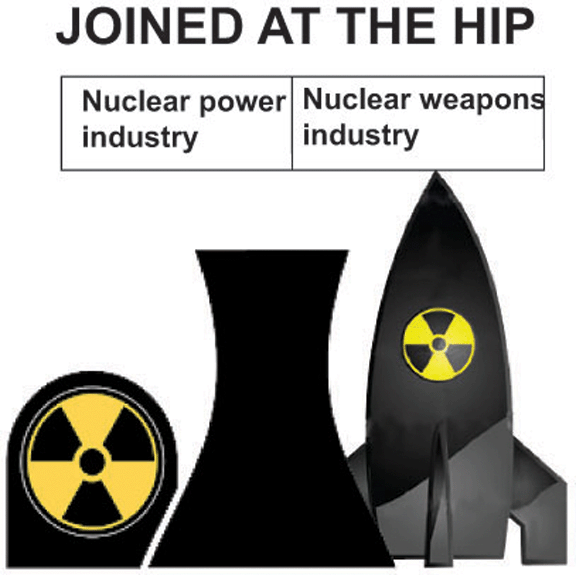
so-called “small nuclear reactors”
Downing Street told the Financial Times, which it faithfully reported, that it was “considering” £2 billion of taxpayers’ money to support “small nuclear reactors”
They are not small
The first thing to know about these beasts is that they are not small. 440MW? The plant at Wylfa (Anglesey, north Wales) was 460MW (it’s closed now). 440MW is bigger than all the Magnox type reactors except Wylfa and comparable to an Advanced Gas-cooled Reactor.
Only if military needs are driving this decision is it explicable.
”Clearly, the military need to maintain both reactor construction and operation skills and access to fissile materials will remain. I can well see the temptation for Defence Ministers to try to transfer this cost to civilian budgets,”
Any nation’s defence budget in this day and age cannot afford a new generation of nuclear weapons. So it needs to pass the costs onto the energy sector.
How the UK’s secret defence policy is driving energy policy – with the public kept in the dark. https://www.thefifthestate.com.au/energy-lead/how-the-uks-secret-defence-policy-is-driving-energy-policy-with-the-public-kept-in-the-dark/ BY DAVID THORPE / 13 OCTOBER 2020
The UK government has for 15 years persistently backed the need for new nuclear power. Given its many problems, most informed observers can’t understand why. The answer lies in its commitment to being a nuclear military force. Continue reading
Untrue: claims that the nuclear bombing of Hiroshima and Nagasaki ended World War 2
 Did the Atomic Bomb End the Pacific War?
The use of the atomic weapon must be seen as a continuation and a start: the nuclear continuation of the conventional terror bombing of Japanese civilians, and the start of a new “cold war.” Portside, August 2, 2020 Paul Ham
Many historians and most lay people still
believe the atomic destruction of Hiroshima and Nagasaki ended the Pacific War.
They claim with varying intensity that the Japanese regime surrendered unconditionally in response to the nuclear attack; that the bomb saved a million or more Amercian servicemen; that Hiroshima and Nagasaki were chosen chiefly for their value as military targets; and that the use of the weapon was, according to a post-war propaganda campaign aimed at soothing American consciences, ‘our least abhorrent choice’.
The trouble is, not one of these claims is true.
That such denial of the facts has been allowed to persist for 75 years, that so many people believe this ‘revisionist’ line – revisionist because it was concocted after the war as a post-facto justification for the bomb – demonstrates the power of a government-sponsored rewrite of history over the minds of academics, journalists, citizens and presidents.
The uranium bomb dropped on Hiroshima, code-named ‘Little Boy’, landed on the city center, exploding above the main hospital and wiping out dozens of schools, killing 75,000 people, including tens of thousands of school children.
‘Fat Man’, the plutonium bomb used on Nagasaki, incinerated the largest Catholic community in Japan, obliterating the country’s biggest cathedral along with a residential district packed with schools and hospitals. Its missed its original target, the city center.
Zealous apologists for the bomb will have started picking holes: Hiroshima held troops? Yes, a few enfeebled battalions. Hiroshima had military factories? Most were on the outskirts of town, well clear of the bomb. Continue reading
Donald Trump’s dangerous nuclear legacy
 Donald Trump Is A Nuclear President—His Legacy Is More Nukes, Fewer Controls https://www.forbes.com/sites/davidaxe/2020/12/24/donald-trump-is-a-nuclear-president-his-legacy-is-more-nukes-fewer-controls/?sh=4d5b0d4abd47
David Axe, Forbes Staff In his single term in the White House, Donald Trump expanded America’s nuclear arsenal and undermined decades of arms-control efforts. While President-elect Joe Biden could reverse some of Trump’s atomic initiatives, it’s highly unlikely he can undo all of them.And it’s impossible for Biden to travel back in time and seize opportunities for nuclear arms-reduction that Trump squandered—with North Korea, in particular.
Kingston Reif, a missile expert at the Arms Control Association in Washington, D.C., neatly summarized Trump’s nuclear initiatives on Twitter in mid-December. To paraphrase:
1. Trump nudged the Pentagon to double the number of low-yield nuclear weapons, which according to experts raise the risk of nuclear war by making nukes seemingly more “useable” in an armed clash between major powers. At the same time, Trump’s nuclear doctrine expanded the list of external threats that officially justify nuclear retaliation. Perhaps most notably, the list of threats now includes a major hacking event. The U.S. Navy subsequently deployed the low-yield W76-2 variant of its Trident II submarine-launched ballistic missile.
2. At the opposite end of the yield spectrum, the billionaire president accelerated development of high-yield SLBMs and canceled a Pentagon plan to decommission the megaton-class B83-1 gravity bomb.
3. To arm these new weapons, Trump took steps to restart production of plutonium cores for nuclear warheads, despite arguments that the United States already possesses plenty of cores. The core-production falls under a roughly $9-billion budgetary boost that Trump helped push through for the U.S. National Nuclear Security Agency, which oversees America’s nukes.
4. Citing Russian development of banned weapons, Trump withdrew the United States from the 1987 Intermediate-Range Nuclear Forces, which limited ground-launched nukes in Europe. The former reality TV star also pulled America out of the 1992 Open Skies Treaty, which allows the United States, Russia and many European states to monitor each other’s atomic arsenals via photographic-reconnaissance flights. Finally, Trump has been reluctant to approve an extension—due in February—of the 2010 New START, a U.S.-Russian accord that puts a cap on nuclear weapons and helped both countries reduce their atomic arsenals in the years prior to Trump’s presidency. It’s possible Biden could bring the USA back into Open Skies while also scrambling to extend New START, but the INF Treaty almost certainly is dead, as both the United States and Russia now openly are developing intermediate-range nukes.
5. After failing several times to negotiate any kind of enforceable arms limitations with North Korea, Trump became the first president since the 1960s not to negotiate any new nuclear arms-control agreement. Instead, he did the very opposite—loosened controls, encouraged proliferation and, as a result, is “the first post-Cold War president not to reduce the size of the nuclear warhead stockpile,” according to Reif.
“The Trump administration’s nuclear legacy is one of failure,” Reif said. “The administration inherited several nuclear challenges, to be sure, but it has made nearly all of them worse.”
No acknowledgment, no compensation, for a British nuclear test hero
Nuclear veteran who died alone is buried with honour by pals days after he was refused medal
A Cold War hero, who believed he was rendered infertile by radiation experiments, got the send-off he deserved, Mirror UK By Susie Boniface, 27 DEC 2020
Ken Miller’s death went almost unnoticed, but his funeral was conducted with the pomp and ceremony due a war hero, Ken had died alone and childless, aged 82, after taking part in three radiation experiments which he believed left him infertile. He had hoped for at least a medal to acknowledge his service. But just days before he died the government refused, saying men like him had faced no risks.
But after the Mirror publicised his story, his fellow veterans pulled out all the stops to honour him at a humanist ceremony on Christmas Eve.
Ken’s coffin, draped in the flag of the British Nuclear Test Veterans Association, was carried into the crematorium by six ex-military pallbearers to the theme tune from A Bridge Too Far, a film that exemplifies the courage of servicemen and the madness of their generals.
The chapel at Morriston Crematorium in Swansea had expected no mourners, and planned a brief ceremony attended only by local officials.
Instead, the seats were as packed as they could be under pandemic rules for social distancing after Ken’s fellow veterans rallied to give him a proper send-off.
The service heard Billie Holiday’s version of Blue Moon, which was released in 1952, the year of Britain’s first nuclear test. And as the Gerry & The Pacemakers classic You’ll Never Walk Alone was played, the standard of the Soldiers, Sailors and Airmen’s Families Association was dipped over Ken’s coffin.
Then a veteran played a poignant Last Post on the bugle and, after a two minutes’ silence, the Reveille………
Ken was one of 22,000 men, many on National Service, who were ordered to take part in Britain’s Cold War bomb tests. Fewer than 1,500 are still alive, and one of them dies, on average, every week.
Born in Oxford, Ken ran away to join the navy and was a junior rating on HMS Warrior when he was ordered to watch three atomic explosions as part of Operation Grapple, at Malden Island in the South Pacific, in 1957.
The biggest, at 720 kilotons, was 35 times more powerful than the blast which levelled the Japanese city of Nagasaki at the end of the Second World War. It was still ruled a failure by scientists, who went on to detonate much larger H-bombs the following year.
Fellow nuke vet David Taunt, 78, of Swindon, began talking to Ken on the phone during the first lockdown as a BNTVA project to help its members.
He said: “He was one of the guys who stood on the deck with his back to it and then turned round and watched the mushroom cloud rise. He said the ship they were on sailed a lot closer to the blast zone than they should have done. And of course, like all the sailors, he used distilled seawater to drink and wash in.”………
on their regular talks, he discussed memories of the nuclear tests with David, who never met him in person and was unable to attend the funeral in Wales because of travel restrictions.
David said: “I was at Operation Dominic in 1961, when the Americans used British troops to help test close to 30 nuclear bombs at Christmas Island………
David was able to get compensation from the US government due to his cancer, because that nation agrees that service at their tests was the most likely cause. But the UK still refuses payouts or any other recognition, and fights every bid for a small war pension.
He said: “Ken would have been quite happy with a medal. It would be confirmation something happened. He appreciated what the BNTVA and the Mirror were doing for us.”
The medal decision is to be reviewed in the New Year, and 10 Tory MPs, including former ministers and influential backbenchers, have written to Boris Johnson demanding he personally intervene. https://www.mirror.co.uk/news/uk-news/nuclear-veteran-who-died-alone-23226173
Russian Army Chief Warns of Nuclear Risks in Cyber Hacks, Space
 Russian Army Chief Warns of Nuclear Risks in Cyber Hacks, Space https://www.bloombergquint.com/politics/russia-general-warns-cyber-attacks-pose-nuclear-risks-tass-says Stepan Kravchenko December 25 2020, (Bloomberg) — The extension of military confrontation into the cyber sphere and space raises the risks of incidents involving nuclear weapons, Russia’s top general warned Thursday, highlighting concerns about growing tensions.
Read more at: https://www.bloombergquint.com/politics/russia-general-warns-cyber-attacks-pose-nuclear-risks-tass-says
Copyright © BloombergQuint
Joe Biden administration might consider cutting nuclear weapons spending

 Biden to Review U.S. Nuclear-Weapons Programs, With Eye Toward Cuts
President-elect promised to reduce ‘excessive’ spending on nuclear arsenal and shrink its role in strategy, but critics say updates are overdue, WSJ, By Michael R. Gordon, Dec. 24, 2020 WASHINGTON—The incoming Biden administration is planning a review of the nation’s $1.2 trillion nuclear-modernization program with an eye toward trimming funding for nuclear weapons and reducing their role in Pentagon strategy
President-elect Joe Biden promised during the campaign to reduce the U.S.’s “excessive expenditure” on nuclear arms and criticized President Trump’s decision to develop new sea-based weapons, including a submarine-launched cruise missile.
The new administration is also likely to review the Pentagon’s decision to develop a new land-based intercontinental ballistic missile, which is estimated to cost more than $100 billion when its warhead is included, some former officials said.
“We have to modernize our deterrent,” said one former official. “But we cannot spend the amount of money that is currently being allocated.”
The expectation that Mr. Biden will take a fresh look at the modernization programs has spurred a debate over the future of the U.S. nuclear deterrent……. (subscribers only) https://www.wsj.com/articles/biden-to-review-u-s-nuclear-weapons-programs-with-eye-toward-cuts-11608805800
1 This Month





PLEASE OPPOSE HR 8255 AND S.3639 – bills would accelerate satellite deployment, with no environmental review or safeguards – https://ncstd5li.quorum.us/campaign/169331/
To see nuclear-related stories in greater depth and intensity – go to https://nuclearinformation.wordpress.com
-
Archives
- October 2026 (74)
- September 2026 (339)
- August 2026 (330)
- July 2026 (355)
- June 2026 (287)
- May 2026 (306)
- April 2026 (356)
- March 2026 (251)
- February 2026 (267)
- January 2026 (308)
- December 2025 (358)
- November 2025 (359)
-
Categories
- 1
- 1 NUCLEAR ISSUES
- business and costs
- climate change
- culture and arts
- ENERGY
- environment
- health
- history
- indigenous issues
- Legal
- marketing of nuclear
- media
- opposition to nuclear
- PERSONAL STORIES
- politics
- politics international
- Religion and ethics
- safety
- secrets,lies and civil liberties
- spinbuster
- technology
- Uranium
- wastes
- weapons and war
- Women
- 2 WORLD
- ACTION
- AFRICA
- Atrocities
- AUSTRALIA
- Christina's notes
- Christina's themes
- culture and arts
- Events
- Fuk 2022
- Fuk 2023
- Fukushima 2017
- Fukushima 2018
- fukushima 2019
- Fukushima 2020
- Fukushima 2021
- general
- global warming
- Humour (God we need it)
- Nuclear
- RARE EARTHS
- Reference
- resources – print
- Resources -audiovicual
- Weekly Newsletter
- World
- World Nuclear
- YouTube
-
RSS
Entries RSS
Comments RSS

