No apologies from France, over nuclear bomb tests’ pollution in Algeria
The New Arab 12th Feb 2021, President Emmanuel Macron’s recent statement that a “memories and truth” commission will be established to look into the history of the French colonisation of Algeria, has led to much public discussion over this bloody legacy.
And in this context, the absence of apologies or offers of reparations by the French state has not gone unnoticed. One area of particular contention in this process is the ongoing and detrimental effects of France’s nuclear testing in Algeria, conducted throughout the
1960s. France conducted its first nuclear test known as the “Gerboise Bleue” in February 1960 in the Sahara Desert – an atomic bomb that was four times the strength of Hiroshima. A total of 17 tests were carried out, four of them atmospheric detonations, and 13 underground.
https://english.alaraby.co.uk/english/comment/2021/2/12/frances-nuclear-colonial-legacy-in-algeria
U.S. rioters did get close to Mike Pence and his ‘nuclear football’

How Close Did the Capitol Rioters Get to the Nuclear “Football”?
The video of Mike Pence shown during the impeachment revealed something startling about the nuclear chain of command. Slate, BY FRED KAPLAN, FEB 11, 2021 Among the many startling videos shown at Wednesday’s impeachment trial documenting the Jan. 6 insurrection at the Capitol, there was one clip that was so brief, subtle, and beside the immediate point that the House managers didn’t highlight it—but it was nevertheless hugely enlightening.
It revealed that, like the president, the vice president is routinely escorted by a military aide who carries a satchel containing the codes that allow him to launch a nuclear attack.The pertinent clip shows Vice President Mike Pence and his family being rushed out of the Capitol to escape the rioters, who, it turns out, were determined to kill him for certifying the Electoral College votes and thus betraying Donald Trump. Following Pence was an Air Force officer carrying two bags, one of which looked a lot like the nuclear satchel, also known as the Football or the Black Bag…………..
During some administrations, a military aide with a Football accompanied the vice president only on out-of-town trips. But a former White House official told me that a military aide with a satchel was always close to Joe Biden when he was Barack Obama’s vice president. Presumably (though nobody has told me this), a military aide carries a satchel close to Kamala Harris too……………
As for the prospect of a rogue veep, there’s probably nothing to worry about. It’s worth noting what’s in the satchel. Contrary to popular culture, there is no “button” to push, nor is there an indented surface that matches the president’s (or vice president’s) palm. What’s actually in the satchel—which is said to weigh 45 pounds—is a card (sometimes called the “biscuit”) citing phone numbers to call and a passcode that authenticates the identity of the caller, some encrypted communication gear to make the call, and a book describing all of the preapproved nuclear attack options and how the president would go about ordering each one. This book used to be a rather heavy tome called the SIOP Execution Handbook (the SIOP, standing for Single Integrated Operational Plan, is the nuclear war plan) or, at various times, the Gold Book or the Black Book. When Carter first leafed through the book, he told the officers who supplied it, “I’m pretty smart, and I don’t understand any of this.” So the operations division of the Pentagon’s Joint Staff condensed the complicated book into a stack of laminated cards (“like a menu at Wendy’s,” as one officer described them) inscribed in very clear language.
To launch a nuclear attack, the president (or the vice president) would transmit the coded message to a one-star general and his staff in the National Military Command Center, located on the Pentagon’s ground floor, who would in turn pass the order on to the missile and bomber crews, who would launch the attack. That’s it. There is no red button, but there are also no other officials involved in the chain of command. (Other officials are supposed to consult and confer, but they don’t have the ultimate say.)
If the vice president ordered an attack (something that the officer carrying the Football would have to allow), the officers in the Pentagon would know whether the authentication code belonged to the president or the vice president. They would also know whether the president was still alive and in command. If he was, they would know that the vice president’s order was not legitimate.
What about the mob? What could they do, had they grabbed the Football? First, it’s very unlikely that they could have grabbed it. The Secret Service agents around Pence would almost certainly meet any such attempt with deadly force. There would have been a dozen or more dead rioters scattered on the bloodied floor near the staircase where Pence, his family, and his entourage had gathered. If the mob’s survivors kept mauling and overpowering Pence and the others, they might not have thought to grab the Football, which is locked in a metal case tucked inside an ordinary-looking satchel. Even if they had grabbed the satchel, bashed the lock, and opened the case, they wouldn’t have known what to do with the stuff inside. Had they figured it out, the officers in the Pentagon would have known the signals were coming from an unauthorized source.
Could the mob have taken the Football and sold it to the Russians or some other adversary? It would be worth millions of dollars. Despite the militias’ self-image as “patriots,” it’s not out of would be worth millions of dollars. Despite the militias’ self-image as “patriots,” it’s not out of the question. According to a U.S. District Court affidavit, Riley June Williams, the Pennsylvania woman accused of breaching the Capitol and stealing Pelosi’s laptop on Jan. 6, intended to give the computer “to a friend in Russia, who then planned to sell the device to SVR, Russia’s foreign intelligence service.”……….
The nuclear bomb may be out of mind for many people in the post–Cold War era, but it is never out of sight—and its loaded trigger is constantly a mere few steps away from the one person with sole authority to destroy the planet. https://slate.com/news-and-politics/2021/02/nuclear-football-vice-president-pence.html
UK’s Freedom of Information law revealed Israel nuclear link, but now FOI is under threat
|
From duck houses to nuclear weapons: what we know because of Freedom of Information law, Open Democracy, Over the past 20 years, the ‘right to know’ legislation has helped expose many abuses of power, but now it’s under threat, Adam Bychawski11 February 2021 ”………. Since the act passed, politicians have repeatedly threatened to limit its powers. Recently, we revealed that an ‘Orwellian’ Cabinet Office unit has been coordinating Freedom of Information (FOI) responses across government departments, and screening journalists’ requests in ways that experts say could be breaking the law. The unit has blocked the release of files about the contaminated blood scandal that claimed the lives of thousands across Britain and information about high-rise buildings that have potentially lethal aluminium cladding. It’s not just journalists and rights campaigners who should be worried – the public should be too. Many of the biggest abuses of power have come to light only because of Freedom of Information requests. Here are just a few examples of what Freedom of Information requests have revealed over the years…………. Britain’s role in Israel’s nuclear weapons program……While the West has for decades been attempting to rein in Iran’s nuclear ambitions, another Middle Eastern state is believed to have quietly built a covert nuclear bomb. Israel has long had a policy of neither confirming nor denying the existence of its nuclear programme. Despite this, it is thought to have established a clandestine arsenal on par with India and Pakistan. How did Israel achieve this with a minimum of international outcry? Freedom of Information disclosures from the 1960s revealed that Britain was among many countries that secretly made hundreds of shipments of nuclear materials to Israel. The documents showed that the nuclear industry played a key role in securing the transfer of the materials, despite warnings by British intelligence that it might be used to make a bomb. ……… A pandemic might seem like an unusual time to plan a “radical shake-up” of the NHS, but a freedom of information request by openDemocracy revealed that is exactly what the government has been preparing. The disclosure showed that Munira Mirza, the controversial head of Boris Johnson’s policy unit, has been apportioned to oversee the plan. Mirza, who previously worked for Johnson during his time as mayor of London, has no background or policy experience in health. The government initially declined to confirm reforms, it took a freedom of information request to confirm they are happening. In February, a leaked document revealed plans to give the government substantially more control over the NHS, prompting concerns from health works about the timing of the changes. Who’s behind a hardline Brexit pressure group?………The public has a right to know who is trying to influence government policy, so Ministers should not prevent this information from being released because it may be politically awkward,” said Transparency International’s research manager, Steve Goodrich. https://www.opendemocracy.net/en/freedom-of-information/duck-houses-nuclear-weapons-what-we-know-because-freedom-information-law/ |
|
Wall Street: the Ultimate War Profiteers

Wall Street: the Ultimate War Profiteers
Wall Street plays the foundational role in the war industry by outright owning war corporations……
Big Finance sits at the top of the war industry by purchasing most shares of war corporations and by owning war corporations. Insatiable demand for profit places immense structural pressure on the Pentagon and Capitol Hill for sky-high U.S. military and intelligence budgets, broad deployment of troops overseas, and the opening up of governmental jobs to corporations. …………
Wars must be created and expanded, and military bases, through which to route goods and services, must be established and entrenched to satisfy investors. Notwithstanding, ending the wars first requires addressing the embedded profit motive, otherwise it is business as usual.
Who Are the Ultimate War Profiteers? A U.S. Air Force Veteran Removes the Veil, Covert Action Magazine By Christian Sorensen February 10, 2021
While war corporations, or so-called “defense contractors,” make billions in profits, Wall Street is the ultimate beneficiary of today’s nonstop wars. The prosaic nature of war profiteering—far from the work of a shadowy cabal—is precisely why the collusion is so destructive and should be outlawed.
The U.S. ruling class deploys the military for three main reasons: (1) to forcibly open up countries to foreign investment, (2) to ensure the free flow of natural resources from the global south into the hands of multinational corporations, and (3) because war is profitable. The third of these reasons, the profitability of war, is often lacking detail in analyses of U.S. imperialism: The financial industry, including investment banks and private equity firms, is an insatiable force seeking profit via military activity.
The war industry is composed of corporations that sell goods and services to the U.S. government and allied capitalist regimes around the world. Investment banks and asset management firms hold most shares of every major public war corporation.
The best-known financial firms holding the stock of war corporations include: Vanguard Group, BlackRock, State Street, JPMorgan Chase, Wells Fargo, and Wellington Management Continue reading
French nuclear attack submarine patrolling South China Sea
|
French Nuclear Attack Boat Patrolled South China Sea https://news.usni.org/2021/02/10/french-nuclear-attack-boat-patrolled-south-china-sea
By: Xavier Vavasseur, February 10, 2021 A French Navy Rubis-class nuclear-powered submarine (SSN) patrolled the South China Sea, the French minister of armed forces announced in a series of tweets.
French armed forces minister Florence Parly called the patrol “a striking proof of the capacity of our French Navy to deploy far and for a long time in connection with our Australian, American and Japanese strategic partners.” On Monday night, Parly shed some light on the current deployment of Rubis-class SSN FS Emeraude (S604) to the Pacific region. In a series of messages on Twitter, she said: “Since September, a nuclear attack submarine (SSN Émeraude) and a support vessel (BSAM Seine) have sailed up to 15,000 km from the coasts of mainland France in the Indian Ocean and the Pacific. This extraordinary patrol has just completed a passage in the South China Sea. A striking proof of the capacity of our French Navy to deploy far and for a long time in connection with our Australian, American and Japanese strategic partners. Why such a mission? To enrich our knowledge of this area and to affirm that international law is the only rule that is valid, whatever the sea in which we sail. Nation of the Indo-Pacific (~ 2 million inhabitants), France has the 2nd largest exclusive economic zone in the world (11 million km2 of which 9 are in the Indo-Pacific). We intend to protect our sovereignty and our interests.” Naval News first reported about Emeraude’s mission to the Pacific when it stopped over in Australia. The submarine then visited the U.S. naval base in Guam and participated in an anti-submarine warfare (ASW) exercise with the U.S. Navy and JMSDF. Following an exercise with the Indonesian Navy Emeraude will likely be joining the French carrier strike group which is set to depart this week for the Indian Ocean and Persian Gulf region. |
|
Call for an independent Scotland to demand removal of nuclear weapons from Faslane
Daily Record 10th Feb 2021. An independent Scotland should delay NATO membership until nuclear weapons are removed from Faslane, a campaign group has demanded. The call is a
challenge to current SNP policy which is to seek continuing membership of
the defence alliance if a majority of Scots vote Yes at a future
referendum.
https://www.dailyrecord.co.uk/news/politics/independent-scotland-should-delay-nato-23461400
The real value of the nuclear ban treaty
 The real value of the nuclear ban treaty https://thebulletin.org/2021/02/the-real-value-of-the-nuclear-ban-treaty/?utm_source=Newsletter&utm_medium=Email&utm_campaign=MondayNewsletter02082021&utm_content=NuclearRisk_ValueTPNW_02042021
By Carl Robichaud, Karim Kamel | February 4, 2021
Last month, 75 years after nuclear weapons were first used, a treaty came into force that bans them. The Treaty on the Prohibition of Nuclear Weapons (TPNW), also known as the ban treaty, is the culmination of a decade of work by civil society leaders and diplomats who, frustrated by stagnation in traditional venues, focused the lens of international humanitarian law on nuclear weapons. This approach, dismissed at first, resonated with many states that understood nuclear weapons to be inherently indiscriminatory and inhumane.
The new treaty outlaws the use or threat of use of nuclear weapons, prohibits their development and possession, bans their transfer or receipt, and prohibits stationing, deploying, or assisting with nuclear arms.
But does any of this matter? The treaty lacks verification and enforcement mechanisms. No state with nuclear weapons will join anytime soon. The nine nuclear-armed states and their allies boycotted the negotiations and pressured other states to abandon the treaty. Each has nuclear modernization programs that will stretch for decades.
Skeptics of the treaty claim it is worse than irrelevant; it will accentuate tensions, undermine collective action on urgent proliferation challenges, diminish alliance cohesion or strategic stability, and potentially establish an alternative to the Treaty on the Nonproliferation of Nuclear Weapons (NPT). We should not, they argue, take any steps that might undermine this bedrock agreement that for 50 years has helped limit the spread of nuclear arms.
These objections are overstated. Collective action against proliferation has been, and will remain, a challenge with or without the ban treaty. Moreover, the treaty was carefully drafted not to conflict with existing nonproliferation obligations, including the NPT.
These objections are overstated. Collective action against proliferation has been, and will remain, a challenge with or without the ban treaty. Moreover, the treaty was carefully drafted not to conflict with existing nonproliferation obligations, including the NPT.
But the broader point holds: The treaty does little to reduce short-term nuclear risks. That is not its point. What the treaty does is establish, in clear and certain terms, that nuclear weapons are unacceptable. Over 122 countries supported the adoption of the treaty, 51 states have ratified it, and these numbers will continue to grow. Even within states that oppose the treaty, many citizens agree with its premise. Various polls suggest more than half of Americans believe the United States should work to eliminate all nuclear weapons, and support for this view is even higher in Japan and among NATO countries. In the words of former US Defense Secretary William Perry, the ban treaty “rightly establishes abolition as the standard that all nations should be actively working to achieve, rather than an indeterminate future goal.”
The status quo, with its 16,000 nuclear weapons, is far from stable. Everyone alive today lives in the shadow of a potential nuclear war. Climate modeling suggests that even a limited nuclear war, such as one between India and Pakistan, could result in a billion deaths as the ash from burning cities “could blot out the sun, starving much of the human race.”
At least from a humanitarian point of view, the question has been settled: Nuclear weapons are unacceptable. That alone will not make them disappear. But, in the meantime, the ban treaty need not distract from bilateral arms-control and threat-reduction efforts. The recent agreement to extend New START should be commended, and we must establish new mechanisms to build confidence and reduce tensions. The existence of a treaty banning nuclear weapons does not contradict these efforts; on the contrary, it should help build support for more sensible nuclear postures and for prohibitions on nuclear explosive testing and the production of weapons-usable materials.
The nuclear age is in its eighth decade, a mere dot on the timeline of human history. In this brief span there have been dozens of known close calls and near misses. So long as these weapons exist, ready to use at a moment’s notice, we court disaster. The nuclear powers find themselves, as Khrushchev wrote to Kennedy during the Cuban missile crisis, in a tightening knot. Untying this knot will require a multi-generation project that brings together verification science with extraordinary foresight, diplomatic skill, and political leadership. But first it requires a change in our collective beliefs about nuclear weapons. This is the contribution of the ban treaty, and it should not be underestimated.
America’s new $100Billion missiles are intended both for attack, and as a target.
Housed in permanent silos spread across America’s high plains, they are intended to draw fire to the region in the event of a nuclear war, forcing Russia to use up a lot of atomic ammunition on a sparsely populated area.
how little some nuclear weapons programs have to do with national defense.!
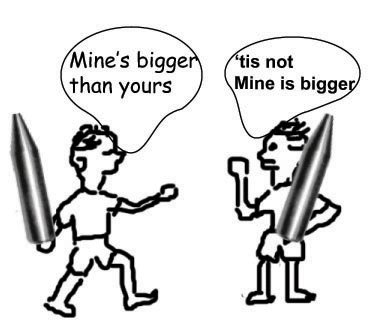 Why is America getting a new $100 billion nuclear weapon?, https://thebulletin.org/2021/02/why-is-america-getting-a-new-100-billion-nuclear-weapon/?utm_source=Newsletter&utm_medium=Email&utm_campaign=MondayNewsletter022021&utm_content=NuclearRisk_NewWeapon_02082021 By Elisabeth Eaves, February 8, 2021 merica is building a new weapon of mass destruction, a nuclear missile the length of a bowling lane. It will be able to travel some 6,000 miles, carrying a warhead more than 20 times more powerful than the atomic bomb dropped on Hiroshima. It will be able to kill hundreds of thousands of people in a single shot.
The US Air Force plans to order more than 600 of them.
On September 8, the Air Force gave the defense company Northrop Grumman an initial contract of $13.3 billion to begin engineering and manufacturing the missile, but that will be just a fraction of the total bill. Based on a Pentagon report cited by the Arms Control Association Association and Bloomberg News, the government will spend roughly $100 billion to build the weapon, which will be ready to use around 2029.
To put that price tag in perspective, $100 billion could pay 1.24 million elementary school teacher salaries for a year, provide 2.84 million four-year university scholarships, or cover 3.3 million hospital stays for covid-19 patients. It’s enough to build a massive mechanical wall to protect New York City from sea level rise. It’s enough to get to Mars.
One day soon, the Air Force will christen this new war machine with its “popular” name, likely some word that projects goodness and strength, in keeping with past nuclear missiles like the Atlas, Titan, and Peacekeeper. For now, though, the missile goes by the inglorious acronym GBSD, for “ground-based strategic deterrent.” The GBSD is designed to replace the existing fleet of Minuteman III missiles; both are intercontinental ballistic missiles, or ICBMs. Like its predecessors, the GBSD fleet will be lodged in underground silos, widely scattered in three groups known as “wings” across five states. The official purpose of American ICBMs goes beyond responding to nuclear assault. They are also intended to deter such attacks, and serve as targets in case there is one.
Under the theory of deterrence, America’s nuclear arsenal—currently made up of 3,800 warheads—sends a message to other nuclear-armed countries. It relays to the enemy that US retaliation would be so awful, it had better not attack in the first place. Many consider American deterrence a success, pointing to the fact that no country has ever attacked the United States with nuclear weapons. This argument relies on the same faulty logic Ernie used when he told Bert he had a banana in his ear to keep the alligators away: The absence of alligators doesn’t prove the banana worked. Likewise, the absence of a nuclear attack on the United States doesn’t prove that 3,800 warheads are essential to deterrence. And for practical purposes, after the first few, they quickly grow redundant. “Once you’ve dropped a couple of nuclear bombs on a city, if you drop a couple more, all you do is make the rubble shake,” said Air Force Maj. Gen. (Ret.) Robert Latiff, a Bulletin Science and Security Board member who, early in his career, commanded a unit of short-range nuclear weapons in West Germany.
|
Deterrence is the main argument for having a nuclear arsenal at all. But America’s land-based missiles have another strategic purpose all their own. Housed in permanent silos spread across America’s high plains, they are intended to draw fire to the region in the event of a nuclear war, forcing Russia to use up a lot of atomic ammunition on a sparsely populated area. If that happened, and all three wings were destroyed, the attack would still kill more than 10 million people and turn the area into a charred wasteland, unfarmable and uninhabitable for centuries to come. The GBSD’s detractors include long-time peace activists, as you’d expect. But many of the missile’s critics are former military leaders, and their criticism has to do with those immovable silos. Relative to nuclear missiles on submarines, which can slink around undetected, and nuclear bombs on airplanes—the two other legs of the nuclear triad, in defense jargon—America’s land-based nuclear missiles are easy marks. Because they are so exposed, they pose another risk: To avoid being destroyed and rendered useless—their silos provide no real protection against a direct Russian nuclear strike—they would be “launched on warning,” that is, as soon as the Pentagon got wind of an incoming nuclear attack. But the computer systems that warn of such incoming fire may be vulnerable to hacking and false alarms. During the Cold War, military computer glitches in both the United States and Russia caused numerous close calls, and since then, cyberthreats have become an increasing concern. An investigation ordered by the Obama administration in 2010 found that the Minutemen missiles were vulnerable to a potentially crippling cyberattack. Because an error could have disastrous consequences, James Mattis, the former Marine Corps general who would go on to become the 26th US secretary of defense, testified to the Senate Armed Services Committee in 2015 that getting rid of America’s land-based nuclear missiles “would reduce the false alarm danger.” Whereas a bomber can be turned around even on approach to its target, a nuclear missile launched by mistake can’t be recalled. William J. Perry, secretary of defense during the Clinton administration (and the chair of the Bulletin’s Board of Sponsors), argued in 2016 that “[w]e simply do not need to rebuild all of the weapons we had during the Cold War” and singled out the GBSD as unnecessary. Replacing America’s land-based nuclear missiles, he wrote, “will crowd out the funding needed to sustain the competitive edge of our conventional forces, and to build the capabilities needed to deal with terrorism and cyber attacks.” Russia has about 4,300 nuclear warheads, the only arsenal on par with America’s, and is also trading up for new weapons. Yet as Perry pointed out, “If Russia decides to build more than it needs, it is their economy that will be destroyed, just as it was during the Cold War.” China—a bigger long-term threat to the United States than Russia, in the eyes of many national security analyses—seems to understand that excessive spending on nuclear weapons would be self-sabotage. Even if, as the Pentagon expects, Beijing doubles the number of nuclear warheads in its arsenal—now estimated at less than 300—it will still have far fewer than either the United States or Russia. For many and perhaps most Americans, nuclear weapons are out of sight and mind. That $100 billion to replace machines that would, if ever used, kill civilians on a mass scale and possibly end human civilization is just another forgotten subscription on auto-renew. But those who do think about the GBSD mostly don’t want it. In a survey of registered voters conducted in October 2020 by the Federation of American Scientists, 60 percent said they would prefer other alternatives to the new missile, ranging from refurbishing the Minutemen to scrapping nuclear weapons altogether. Those results echo a 2019 voter survey, conducted by the Program for Public Consultation at the University of Maryland, that asked if the government should phase out its fleet of land-based nuclear missiles. Sixty-one percent of respondents—53 percent of Republicans and 69 percent of Democrats—said yes. Which all leads to one question: Given the expense, doubtful strategic purpose, and lack of popularity, why is Washington spending so much to replace the Minuteman III? The answers stretch from the Utah desert to Montana wheat fields to the halls of Congress. They span presidential administrations and political parties. They come from airmen and farmers and senators and CEOs. The reasons for the GBSD are historical, political, and to a significant extent economic. In a country where safety net programs are limited and health insurance is a patchwork, and where unemployment remains at nearly double the pre-pandemic rate, many people in the states where the new missile will be built and based see it as a lifeline. Their elected officials take campaign donations from defense companies, to be sure, but are also trying to deliver jobs in a political environment that has been hostile to government spending on anything but defense. Defense is the safety net where other options are few. A lot of people, even some of those whose livelihoods depend on them, would like to see the number of nuclear weapons gradually reduced until they’re gone. The United States stands no chance of making them disappear, though, until more people understand why they happen—and how little some nuclear weapons programs have to do with national defense. |
Drone swarms: coming (sometime) to a war near you. Just not today

Drone swarms: coming (sometime) to a war near you. Just not today. Bulletin of the Atomic Scientists, By Maaike Verbruggen | February 3, 2021 The world got a sneak peek at the future of war last fall when two former Soviet republics in the Caucasus Mountains launched a high-tech barrage of loitering munitions as well as Turkish-, Israeli-, and locally-made drones at each other during a six-week fight over a region disputed by Azerbaijan and Armenia. Media and think-tank writers covering the battle frequently conveyed an eye-popping assessment: Warring factions had used futuristic swarms of drones in the skies over Nagorno-Karabakh. But does this apparent technological leap in warfare mean that such swarms will be a mainstay in conflict?
To spoil the surprise: No, don’t expect a swarm buzzing over your head any time soon.
While militaries are developing the technology, we shouldn’t call the drone formations on the contemporary battlefield swarms. Unlike true swarms, which use artificial intelligence (AI) to operate autonomously, today’s swarms are pre-programmed or remotely controlled. The individual drones neither communicate within the swarm nor do they adapt to their environment. However, at a time of fast-paced drone proliferation, militaries around the world are actively pursuing research and development in swarms.
Even though no one has developed true, autonomous drone swarms yet, we should still be concerned about their humanitarian implications. Just as militaries are preparing for the future of war by developing counter-swarm technologies, the arms control community should start thinking about where to draw the boundaries around their use.
The swarm is coming. In 2017, the US Department of Defense launched a swarm of micro-drones over California where more than 100 vehicles made decisions without human help. The year before, a Chinese academic and corporate partnership reportedly pulled off a similar feat with 67 drones. There is no doubt that the people behind the US Strategic Capabilities Office’s swarm of Perdix drones or the Chinese partnership’s aerial drones do hope to develop fully-fledged swarms—but they are not there yet. We can say the same about the United Kingdom’s drone swarm squadron, Russia’s Flock 93, Chinese naval swarms, and a Turkish “swarm concept,” as well.
According to the swarm robotics literature, swarms are a group of systems that operate as a collective. In a swarm, the individual units interact with each other and have common goals. They execute them as a collective while responding to their environment. “They are going to do their own thing,” a US Air Force official who oversaw the Perdix program told reporters, according to Air Force Magazine. …………….
Swarms and arms control. Swarms pose several potential humanitarian problems. First there is the issue of whether people will have meaningful control over the multiple units in a swarm. Commanding a swarm will be cognitively complex for the operator……….
|
Swarms don’t exist yet, despite frequent claims in the media. But militaries are clearly making advances. It’s time for the arms control community to deal with the potential problems that swarms might pose. Most arms control treaties aim at controlling individual weapons, but the harm of swarms does not stem from the units themselves, but rather from their indirect and collective nature. Arms controllers will need a new conceptual toolkit to think about and deal with the risks. Militaries have long moved away from valuing only military assets that are individual, physical, and weaponized and toward a network-based frame. Maybe the arms control community should follow suit. |
|
|
How to Support the Treaty on the Prohibition of Nuclear Weapons Without Signing It
 How to Support the Treaty on the Prohibition How to Support the Treaty on the Prohibition of Nuclear Weapons Without Signing It Lawfare By Jayita Sarkar, February 7, 2021, Editor’s Note: The Treaty on the Prohibition of Nuclear Weapons (TPNW), which outlaws nuclear weapons, entered force just after Biden’s inauguration. Although the Biden administration is highly unlikely to adhere to it directly, can it take smaller steps in line with the TPNW’s goals? Boston University’s Jayita Sarkar outlines a series of measures the administration could take, such as providing assistance to victims of radiation, that would advance the TPNW’s agenda but do not require complete adherence. – Daniel Byman of Nuclear Weapons Without Signing It Lawfare By Jayita Sarkar, February 7, 2021, Editor’s Note: The Treaty on the Prohibition of Nuclear Weapons (TPNW), which outlaws nuclear weapons, entered force just after Biden’s inauguration. Although the Biden administration is highly unlikely to adhere to it directly, can it take smaller steps in line with the TPNW’s goals? Boston University’s Jayita Sarkar outlines a series of measures the administration could take, such as providing assistance to victims of radiation, that would advance the TPNW’s agenda but do not require complete adherence. – Daniel Byman
……….. How will the Biden administration respond now that it is international law? In recent weeks, former policymakers, including former Secretary of Defense William Perry and former Undersecretary of State for International Security and Nonproliferation Thomas Countryman, have called for the Biden administration to adopt a supportive position on the TPNW. Critics of the treaty, such as then-U.S. Ambassador to the United Nations Nikki Haley, have called for proactive opposition, or at least benign neglect. But perhaps there is a third option that the administration could consider: the middle ground of selective support. …………… When the world is viewed solely through the prism of nuclear deterrence, the TPNW seems unrealistic and its supporters appear as impractical idealists. The TPNW, though, was developed from the approach that foregrounds the “humanitarian consequences” of nuclear weapons. This approach encompasses much more than the notion of a fragile balance of power maintained by nuclear weapons. Much of the treaty is about the effects of nuclear weapons and nuclear explosive devices on the human body. The Biden administration can show its selective support on this issue, breaking with the policy of the past two U.S. administrations. The United States is responsible for the atomic bombings of Hiroshima and Nagasaki in August 1945 and for 1,032 nuclear weapons tests that took place between 1945 and 1992. The majority of the tests were conducted in New Mexico, Nevada, Alaska, and the Pacific Ocean. Article 6 of the TPNW, entitled “Victim assistance and environmental remediation,” calls on state parties to “adequately provide age- and gender-sensitive assistance, without discrimination, including medical care, rehabilitation and psychological support, as well as provide []social and economic inclusion” to those affected by nuclear weapons and nuclear explosive devices. Providing assistance to victims of radiation in the United States has been a slow, arduous and incomplete process. The Radiation Exposure Compensation Act (RECA) was passed only in October 1990 and expanded in 2000. Administered by the U.S. Department of Justice, RECA provides one-time benefits payments to those who have developed cancers and specified diseases as a consequence of radiation exposure caused by nuclear weapons testing and uranium mining, milling or transporting. RECA has provided $2.4 billion in benefits to more than 37,000 claimants since 1990 but is expected to sunset in July 2022. RECA itself has several limitations. First, it has a narrow definition of “downwinders”—the individuals living downwind of the Nevada Test Site who are eligible for compensation. Downwinder-eligibility requires individuals to have a diagnosis of a compensable disease caused by radiation exposure and proof of residence in selected counties of Arizona, Nevada, and Utah during the period of atmospheric testing at the Nevada Test Site. Second, RECA denies compensation to victims of uranium mining after 1971, when the U.S. Atomic Energy Commission’s mining activities were transferred to commercial firms. The 2020 Democratic Party platform explicitly called for increasing victim assistance under RECA. More broadly, the platform also pledged the party to “pursuing environmental justice and climate justice, including for Indigenous peoples and communities.” Given that the majority of downwinders and uranium miners are from Indigenous communities in the United States, the Democratic Party’s commitment to “protecting Native American health” is compatible with the humanitarian consequences approach to nuclear weapons. Moreover, for the first time in its history, the Department of the Interior, the federal agency responsible for appropriation of Indigenous lands since the 19th century westward expansion, will have a Native American head—Rep. Deb Haaland, an enrolled citizen of the Pueblo of Laguna. Haaland and her fellow Democrats from New Mexico have been proactive in pushing for legislation to expand radiation compensation. In other words, the Biden administration has already promised to act on the humanitarian consequences of nuclear testing in the United States. If the administration delivers on its promise, it would be addressing commitments covered in Article 6 of the TPNW, even without signing the treaty. The TPNW is a multilateral treaty, which requires policy harmonization through domestic legislation to be implemented. RECA offers preexisting legal infrastructure on which the Biden administration can build and, with its inclusion of uranium mining, even corrects a major weakness of the TPNW, which focuses solely on victims of nuclear weapons and nuclear explosive devices. To be sure, promoting an expanded RECA as evidence of U.S. selective support for the TPNW would require diplomatic finesse at the United Nations. But, if backed by political will, the State Department under Secretary of State Antony Blinken, Deputy Secretary of State-designee Wendy Sherman, and Undersecretary-designee for Arms Control and International Security Affairs Bonnie Jenkins will have the wherewithal for it. Selective U.S. support to the TPNW would be an unusual approach toward a new treaty, but it would not be unprecedented………… By selectively supporting the TPNW through Article 6 commitments while not acceding to it, the Biden administration can be at the forefront of an anti-racist global nuclear agenda. It can promote the U.S. image abroad, which has been tarnished by the Trump administration’s four years of isolationist “America First” rhetoric. It could also win support at home. According to a 2020 poll by the Chicago Council on Global Affairs, 66 percent of Americans want a world without nuclear weapons. The present moment offers the promise of unprecedented change in global nuclear politics. When the 10th NPT Review Conference takes place in New York in August 2021 (postponed from 2020), it will be the first time in the history of the nuclear age that there will be another nuclear treaty demanding attention and action. The Biden administration could seize the day and make history. https://www.lawfareblog.com/how-support-treaty-prohibition-nuclear-weapons-without-signing-it |
|
USA ramps up production of nuclear bomb cores
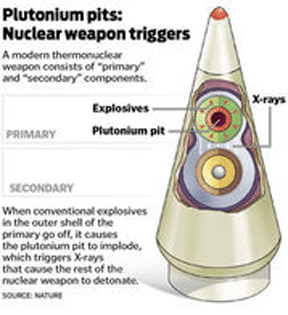 The U.S. is Boosting Production of Nuclear Bomb Cores (For More Nuclear Weapons), The National Interest. Thanks, arms race. by Michael Peck, 7 Feb 21, In another sign that the nuclear arms race is heating up, the U.S. is ramping up production of nuclear bomb cores. The National Nuclear Security Administration (NNSA) has announced that it plans to increase the production of plutonium pits to 80 per year. The grapefruit-sized pits contain the fissile material that give nuclear weapons such tremendous power. The U.S. is Boosting Production of Nuclear Bomb Cores (For More Nuclear Weapons), The National Interest. Thanks, arms race. by Michael Peck, 7 Feb 21, In another sign that the nuclear arms race is heating up, the U.S. is ramping up production of nuclear bomb cores. The National Nuclear Security Administration (NNSA) has announced that it plans to increase the production of plutonium pits to 80 per year. The grapefruit-sized pits contain the fissile material that give nuclear weapons such tremendous power.
Production will center on the Mixed-Oxide Fuel Fabrication Facility at Savannah River site in North Carolina, which would be modified to manufacture at least 50 pits per year, and Los Alamos National Laboratory in New Mexico, which would generate at least 30, by 2030. America’s nuclear weapons cores are aging, with some pits dating back to the 1970s, leading to concerns about the reliability of the U.S. nuclear stockpile……… In its 2018 Nuclear Policy Review, the Trump administration called for 80 new plutonium pits per year. Congress has also allocated large sums, with $4.7 billion alone allocated in FY 2019 for maintenance and life extension of the nuclear stockpile. The NNSA says it is legally mandated to ensure a capacity of at least 80 pits per year. ……. Anti-nuclear groups are furious. “Expanded pit production will cost at least $43 billion over the next 30 years,” argues the Natural Resources Defense Council and other groups. Yet the Defense Department and NNSA have never explained why expanded plutonium pit production is necessary. More than 15,000 plutonium pits are stored at NNSA’s Pantex Plant near Amarillo, Texas. Independent experts have concluded that plutonium pits have reliable lifetimes of at least 100 years (the average pit age is less than 40 years). Crucially, there is no pit production scheduled to maintain the safety and reliability of the existing nuclear weapons stockpile. Instead, proposed future pit production is for speculative new-design nuclear weapons, but those designs have been canceled.” Introducing a new generation of nuclear weapons “could adversely impact national security because newly produced plutonium pits cannot be full-scale tested without violating the global nuclear weapons testing moratorium.” Michael Peck is a contributing writer for the National Interest. He can be found on Twitter and Facebook. https://nationalinterest.org/blog/reboot/us-boosting-production-nuclear-bomb-cores-more-nuclear-weapons-177825 |
|
What is the ”acceptable” death toll for China (and others) in planning for nuclear war?

|
Nuclear numbers: Assessing China’s threshold of ‘unacceptable damage’, TSG Sunday Guardian Live , Manpreet Sethi, February 6, 2021 Contemporary China appears to have a far lower threshold for taking damage than it once projected.Nuclear deterrence works on the principle of causing unacceptable damage in response to nuclear use. But what kind of damage do nations find unacceptable? How does one calculate what would be unacceptable to another? Answers to these questions are difficult, but important because a fair assessment of what the adversary would find unacceptable can help to right-size one’s own nuclear arsenal. Different countries, like different individuals, have disparate thresholds of damage absorption. For instance, during the Cold War, the US concluded that the USSR would be deterred if 50% of Soviet industry and 25% of its population were to be destroyed. Meanwhile, President Kennedy’s hesitation to lose even one American city during the Cuban missile crisis revealed America’s low damage threshold. Interestingly, in the case of Communist China, Premier Mao had created the image that his country had a high damage-taking capacity. Dismissing nuclear weapons as a “paper tiger”, he suggested that American nuclear use could not deter China because even if 50 million Chinese died, an equal number would survive to carry the country forward. But is this assumption true even today? How does modern China perceive damage? ……… Amongst the many factors that can help assess damage tolerance thresholds, five are particularly relevant. The first is to understand the historical experiences since a country that has been through more wars and experienced losses is expected to have a higher damage tolerance threshold. …….. Secondly, damage acceptability depends on the nature of the political system, with the assumption being that a closed, authoritarian system would be able to take more damage than a democracy…………damage acceptability depends on the nature of the political system, with the assumption being that a closed, authoritarian system would be able to take more damage than a democracy. While China is authoritarian, the Chinese Communist Party is extremely careful to sustain an image of legitimacy based on popular support. This, however, is not as easy to maintain today as it once was owing to society having become better educated, expressive and digitally connected. Therefore, the Party decision-making cannot afford to be insulated and ignore the mood of the masses. The third factor is the level of economic development, since an economically well-off and materially aspirational society is believed to have a low stomach for damage. ……….. Fourthly, the damage threshold varies depending on the value a country places on the objective it seeks. The more a country is politically, economically and emotionally invested in the objective, the greater its willingness to bear damage. For instance, in case of a conflict over Taiwan, which China considers an existential threat, its threshold of damage is likely to be higher than in case of conflict in high Himalayas or over areas disputed with India. Contemporary China, therefore, appears to have a far lower threshold for taking damage than it once projected. ……. These, and more such insights, should help India to calculate the “right” size of its nuclear arsenal in order to signal credible deterrence ……..https://www.sundayguardianlive.com/opinion/nuclear-numbers-assessing-chinas-threshold-unacceptable-damage |
|
Increasing risk of nuclear cataclysm , with today’s new technology weapons
 The risk of nuclear cataclysm is increasing, https://www.japantimes.co.jp/opinion/2021/02/07/commentary/world-commentary/us-russia-china-nuclear-weapons-arms-control/, BY ANDREAS KLUTH, BLOOMBERG, Feb 7, 2021
The world can breathe a small sigh of relief this week. The last remaining arms control treaty between the United States and Russia, called New START, will not expire on Feb. 5 after all, as recently feared.
In the nick of time, Russian President Vladimir Putin offered his new American counterpart an extension of the treaty for five years, an option stipulated in its text. Joe Biden agreed — after giving Putin the requisite talking to about Russia’s massive cyberattack on the United States, its jailing of the activist Alexey Navalny and other recent outrages.
In the short term, a new nuclear arms race between the two biggies has thus been avoided. Sort of. But not really — and there’s the rub. A wider glance at the world’s nuclear landscape reveals that the danger of cataclysm, by design or accident, keeps growing.
New START only covers the stockpiles of Russian and American “strategic” weapons. This refers to those warheads the two adversaries point at each other’s homeland. The treaty says nothing about “tactical” nukes, the more flexible and usually smaller warheads built for potential use in a war zone to win or avoid losing a conventional conflict.
But in that tactical category an arms race is already underway. Both the United States and Russia, in the name of upgrading their arsenals, have been designing new tactical nukes and deployment technologies. These include things that were science-fiction during the Cold War, such as nukes delivered by drones from submarines.
This race is thus fundamentally different from the one between the United States and the Soviet Union. Back then, the contest ultimately came down to a count of each side’s warheads. What ultimately stabilized that competition was the macabre but compelling logic of deterrence through “mutual assured destruction” (MAD).
Today’s competition is instead between newfangled technologies and, crucially, the military strategies thus made possible. This multiplication of scenarios and permutations undermines traditional calculations of strategy, which were largely based on the tools of game theory developed during the Cold War.
One upshot is that it’s becoming even more important for all nine of the nuclear powers to “signal” their “postures,” in the jargon. They should explain their intentions and make themselves as predictable as possible to others. And yet the most recent such signaling was hardly reassuring. In Article 4 of its Basic Principles issued last summer, Russia asserts that one purpose of its nuclear arsenal is “the prevention of an escalation of military actions and their termination on conditions that are acceptable for the Russian Federation.”
Translated, this wording suggests that Russia could respond to a conventional conflict with a tactical nuclear strike, as opposed to reserving nukes purely for retaliation in kind. But that makes any altercation potentially explosive in the fissile sense.
A conflict could, for instance, start with hybrid warfare (of the sort Russia used in its 2014 annexation of Crimea), or with cyberwar (as waged during last year’s Russian hack of some 18,000 U.S. computer systems) or with a strike in space against an adversary’s satellites. If the conflagration escalates and becomes “unacceptable,” the next step could be nukes. And then?
The first strike would still detonate somewhere — perhaps in the Baltic region, according to one hypothetical conflict between Russia and NATO. For the local population that would be far from “tactical,” and indeed terminal. It would also demand a response from the alliance.
But should that response be a nuclear counterstrike? At what scale? Against Russian forces, or a city? Moreover, how would Russia, in this hypothetical scenario, react to this “limited” NATO counterstrike? With missiles flying at supersonic speeds, all involved would have at most minutes to decide.
To make the global matrix even more complex, there are also the other seven nuclear powers to consider, and perhaps additional ones in future. Of these North Korea may appear to be the most unhinged. But China is the most ambitious. It could have 350 warheads already, according to some estimates. The Pentagon assumes China will double its arsenal in the coming decade.
China is the main reason why the United States and Russia couldn’t agree on properly renegotiating New START. Donald Trump, Biden’s predecessor, insisted on bringing Beijing into the talks. The Chinese refused. Sarcastically, they wondered aloud whether the Americans and Russians would prefer to let China raise its arsenal to their size or to cut their own down to China’s.
That makes for a good news conference zinger in Beijing. But it won’t help humanity get to grips with its conundrum: More actors are getting more weapons with more technological and tactical applications. The risk that somebody, somewhere pulls a trigger, intentionally or inadvertently, keeps rising.
In a gesture of global protest against this insanity, 86 non-nuclear countries have signed a Treaty on the Prohibition of Nuclear Weapons, with a goal of totally banning these satanic arms. It took effect on Jan. 22. But these — mainly smaller and poorer — states don’t hold the future in their hands.
The big nuclear powers do. They must put their daunting other differences aside and begin comprehensive talks to prevent the worst. And the best placed to extend the invitation is the leader who’s newest in office, and yet has the most experience with disarmament: Biden.
Deploying weapons in space crosses a threshold that cannot be walked back.

weaponizing space could become a classic case of trying to solve one problem while creating a much worse problem.
It’s time for arms control planning to address the issues raised by this drift toward militarization of space. Space is a place where billions of defense dollars can evaporate quickly and result in more threats about which to be concerned. China and Russia have been proposing mechanisms for space arms control at the United Nations for years; it’s time for the U.S. to cooperate in this effort.
Deploying weapons in space crosses a threshold that cannot be walked back.
The US should negotiate a ban on basing weapons in space, BY JOHN FAIRLAMB, — 02/04/21, https://thehill.com/opinion/national-security/536774-the-us-should-negotiate-a-ban-on-basing-weapons-in-space
The Biden administration is assembling a deep bench of personnel with experience negotiating arms control agreements and already has agreed with Russia to extend the New Start Treaty. It’s clear the administration intends to initiate another look at the 2018 Nuclear Posture Review and the massive buildup in nuclear weapons begun by the Trump administration. While it’s good that the Biden administration intends to resume negotiations to continue nuclear force reductions, the specter of placing weapons in space is another area that requires a serious arms control effort.
Now that separate space organizations have been established, major military commands are advocating to develop new capabilities. Pentagon buzzwords characterize space as a “contested domain” and some consider actual war-fighting in space to be inevitable. Some advocates argue that the U.S. should strive for technological superiority in space to ensure our dominance of that critical domain.
The history of technological advancement in weapons systems shows that any advantage gained usually lasts fewer than five years and guarantees a cycle of ever-increasing cost and new perceptions of threat. Already, there are weapons that can be targeted against space-based assets from non-space domains. Russia and China are believed to have deployed ground-based capabilities to attack satellites, and India joined this club last year by using a ground-based missile to bring down a satellite.
Although it isn’t clear how the Biden administration will shape space policy, during his confirmation hearing, Secretary of Defense Lloyd Austin seemed to signal a shift away from a more muscular approach and back to a focus on space resiliency and protecting U.S. space assets. As one analyst concluded, the language Austin used signals the Biden team wants to “start to lean away from … the pugilistic aspects of what’s been articulated [by the Trump administration].” Responding to a question about what his advice would be to the U.S. Space Command concerning military space operations, Austin stressed measures to protect U.S. assets that don’t include offensive options for taking the fight to adversaries. While not a fully articulated space policy, this is a welcome change of tone after the past few years of heavy breathing about waging war in space.
If the U.S. and other nations continue the current drift toward organizing and equipping to wage war in space, Russia, China and others will strive to improve capabilities to destroy U.S. space assets. Over time, this would greatly increase the threat to the full array of U.S. space-based capabilities. Intelligence, communications, surveillance, targeting and navigation assets already based in space, upon which the Department of Defense (DOD) depends for command and control of military operations, increasingly would be at significant risk. As a consequence, weaponizing space could become a classic case of trying to solve one problem while creating a much worse problem.
For example, buried in the DOD 2020 budget is $150 million for research into putting missile defense assets in space to attack enemy nuclear missiles in the boost phase. If the U.S. or another nation does deploy weapons in space, it would be the first country to do so and likely would be a disaster for strategic stability. To ensure the credibility of their nuclear deterrents, Russia, China and others could be expected to respond by deploying additional and new types of long-range ballistic missiles, as well as missiles employing non-ballistic trajectories that are harder to hit. Russia and China also would strive to improve their ability to destroy U.S. space-based interceptors, which would greatly increase the threat to the full array of U.S. space assets.
It’s time for arms control planning to address the issues raised by this drift toward militarization of space. Space is a place where billions of defense dollars can evaporate quickly and result in more threats about which to be concerned. China and Russia have been proposing mechanisms for space arms control at the United Nations for years; it’s time for the U.S. to cooperate in this effort.
In 2015, Frank Rose, assistant secretary for arms control, verification and compliance in the State Department, called for arms control in space at the Association of Southeast Asian Nations Regional Forum workshop on space security. But, he said the Obama administration opposed a 2008 Russian and Chinese proposal to ban all weapons in space because it was unverifiable, contained no prohibition on developing and stockpiling space arms, and did not address ground-based space weapons such as direct ascent anti-satellite missiles.
Instead of just criticizing others’ proposals, the U.S. should join in the effort and do the hard work of crafting a space arms control agreement that deals with the concerns we have and that can be verified. A legally binding international treaty banning the basing of weapons in space should be the objective.
Let’s be clear: Deploying weapons in space crosses a threshold that cannot be walked back. Given the implications for strategic stability, and the likelihood that such a decision by any nation would set off an expensive space arms race in which any advantage gained would likely be temporary, engaging now to prevent such a debacle seems warranted.
John Fairlamb, Ph.D., is a retired Army colonel with 45 years of government service, much of it in joint service positions formulating and implementing national security strategies and policies, including two four-year details in the Department of State and as the political-military affairs adviser for a major Army command. His doctorate is in comparative defense policy analysis.
At last, UK government will investigate birth defects amongst children of nuclear test veterans
Mirror 3rd Feb 2021, Thousands of sick children and adults have finally been offered government research into whether their DNA was damaged by Cold War nuclear bomb tests.
An estimated 155,000 descendants of National Servicemen who took part in atomic weapons tests in the 1950s now report 10 times the normal rate birth defects, and are five times more likely to die as infants. Now Veterans Minister Johnny Mercer has promised to consider thorough research into whether they suffer a genetic legacy from Britain’s radiation
experiments.
https://www.mirror.co.uk/news/uk-news/thousands-offered-research-dna-damage-23436272
1 This Month





PLEASE OPPOSE HR 8255 AND S.3639 – bills would accelerate satellite deployment, with no environmental review or safeguards – https://ncstd5li.quorum.us/campaign/169331/
To see nuclear-related stories in greater depth and intensity – go to https://nuclearinformation.wordpress.com
-
Archives
- October 2026 (74)
- September 2026 (339)
- August 2026 (330)
- July 2026 (355)
- June 2026 (287)
- May 2026 (306)
- April 2026 (356)
- March 2026 (251)
- February 2026 (267)
- January 2026 (308)
- December 2025 (358)
- November 2025 (359)
-
Categories
- 1
- 1 NUCLEAR ISSUES
- business and costs
- climate change
- culture and arts
- ENERGY
- environment
- health
- history
- indigenous issues
- Legal
- marketing of nuclear
- media
- opposition to nuclear
- PERSONAL STORIES
- politics
- politics international
- Religion and ethics
- safety
- secrets,lies and civil liberties
- spinbuster
- technology
- Uranium
- wastes
- weapons and war
- Women
- 2 WORLD
- ACTION
- AFRICA
- Atrocities
- AUSTRALIA
- Christina's notes
- Christina's themes
- culture and arts
- Events
- Fuk 2022
- Fuk 2023
- Fukushima 2017
- Fukushima 2018
- fukushima 2019
- Fukushima 2020
- Fukushima 2021
- general
- global warming
- Humour (God we need it)
- Nuclear
- RARE EARTHS
- Reference
- resources – print
- Resources -audiovicual
- Weekly Newsletter
- World
- World Nuclear
- YouTube
-
RSS
Entries RSS
Comments RSS

