Labour’s nuclear weapons stance needs a rethink
Labour’s nuclear weapons stance needs a rethink, Guardian, Richard Norton-Taylor
London 28 Feb 21,
Readers respond to the shadow defence secretary’s announcement that his party’s commitment to Trident is ‘non-negotiable’
You report (Labour to state ‘non-negotiable’ support for UK’s nuclear weapons, 25 February) that the shadow defence secretary, John Healey, says his party’s commitment to nuclear weapons is “non-negotiable”, seemingly taking a harder line even than successive Conservative governments, which have at least supported talks on multilateral nuclear disarmament.
The new Labour leadership in its rhetoric seems more frightened of being accused at home of being weak on defence than a nuclear attack by a foreign power. For years, Whitehall analysts have considered a pandemic more likely than any real threat of a nuclear attack. Yet for years, ministers and opposition frontbenchers ignored the former while exaggerating the latter. Trade union leaders, meanwhile, back a new Trident missile programme and spending more than £200bn on unusable weapons, citing the need to preserve highly skilled jobs. Yet Britain has had to bank on French engineers for civil nuclear power stations of which Britain now appears to be in dire need. https://www.theguardian.com/world/2021/feb/28/labours-nuclear-weapons-stance-needs-a-rethink
Jeremy Corbyn – Britain Should Join Nuclear Ban Treaty and Scrap Nukes.
 Jeremy Corbyn – Britain Should Join Nuclear Ban Treaty & Scrap Nukes. https://labouroutlook.org/2021/02/27/jeremy-corbyn-britain-should-join-nuclear-ban-treaty-scrap-nukes/, 27th February 2021 “From coronavirus to environmental destruction to economic inequality, we face threats that the war machine cannot fix, & can only worsen.”
Jeremy Corbyn used a speech at the Stop the War Coalition AGM today to make the case for the labour movement taking a stand against nuclear weapons and US-led wars of intervention.
Speaking to Labour Outlook he said, “The public consensus is changing. One hundred and twenty countries have signed the Treaty on the Prevention of Nuclear Weapons at the UN this year.”
In his speech at the AGM, Jeremy pointed out how three out of five people in the UK think we should join them, and four out of five people support a total ban on all nuclear weapons globally.
Jeremy added, “Something else has happened. People have begun to understand where the real threats to our security are.
From coronavirus to environmental destruction to economic inequality, we face threats that the war machine cannot fix, and can only worsen.”
Yesterday saw Labour members across the country oppose the Party’s leadership decision to say support for nuclear weapons was not negotiable, including Emma Dent Coad and Diane Abbott MP in interviews with this publication.
Radioactive dust over Europe – from France’s nuclear bomb tests in the Sahara!
Israel should come clean about the expansion at its secret nuclear weapons plant
The role of the Churches in promoting the U.N. Nuclear Weapons Ban Treaty
 Tomasi: treaty an important first step towards a world free of nuclear arms, https://www.vaticannews.va/en/church/news/2021-02/cardinal-tomasi-holy-see-nuclear-weapons-treaty-disarmement.html In an interview with the World Council of Churches the former Permanent Observer to the UN and Other International Organizations in Geneva and to the World Trade Organization reflects on how Churches can get involved in the goal of freeing the world of nuclear weapons. Tomasi: treaty an important first step towards a world free of nuclear arms, https://www.vaticannews.va/en/church/news/2021-02/cardinal-tomasi-holy-see-nuclear-weapons-treaty-disarmement.html In an interview with the World Council of Churches the former Permanent Observer to the UN and Other International Organizations in Geneva and to the World Trade Organization reflects on how Churches can get involved in the goal of freeing the world of nuclear weapons.
By Lisa Zengarini “The Treaty on the Prohibition of Nuclear Weapons heralds in a new era in international law and increasingly in public opinion” Cardinal Silvano M. Tomasi, has said. In an exclusive interview with the World Council of Churches (WCC) the former Permanent Observer to the UN and Other International Organizations in Geneva and to the World Trade Organization reflects on the positive impact of the Treaty (TPNW) and how Churches can get involved in the goal of freeing the world of nuclear weapons. The TPNW was adopted by the United Nations on 7 July 2017 and entered into force on 22 January 2021. For those nations who signed it, the Treaty prohibits the development, testing, production, stockpiling, stationing, transfer, use and threat of use of nuclear weapons, as well as assistance and encouragement to the prohibited activities. For nuclear armed states joining the treaty, it provides for a time-bound framework for negotiations leading to the verified and irreversible elimination of its nuclear weapons program. Acknowledging that “moral declarations alone will lead to disarmament”, in the interview Cardinal Tomasi, notes that the newly enacted norms “can support and even drive complex negotiations, hopefully toward achieving the goal of a world free from nuclear weapons”, stressing the need for non-nuclear weapons states to make their voices heard on this issue. He also emphasizes the role of civil society actors and of Churches and religious communities: “In this area, religions and all denominations can converge and amplify together the same moral message for believers and non-believers alike”, he says, adding that “local initiatives are very important for moving towards total disarmament” and that “local actors can make their voices heard at higher levels, by contacting their representatives and networking online”. Reminding that “the mere existence of nuclear weapons is a constant risk” and that “the pandemic has brought to light and intensified the extreme inequalities present in our societies”, the former Nuncio reaffirms that the establishment of a World Fund to address human development with the money previously invested in the military and weapons “is primary” in relation to the socio-economic issues we face today: “Pope Francis has recognized that the pandemic brings to light our true priorities and needs as a human family, and has encouraged deep reflection and active changes towards a world more committed to building just systems at the service of the people. It is not only a worthy goal, but a moral good”, he stresses. “Increased investments in arms arise from a feeling of insecurity, but a society can never be secure if the essential needs of its people are not met”, he explains. According to cardinal Tomasi, the present pandemic could act as a “catalyst” toward this ambitious goal: “In economically difficult times for all states – including the great powers – being able to release funds to revive the economy is essential. Decreasing the funds allocated to the arms race and dedicating them to economic recovery is actually a strategic choice for those states that wish to maintain their preeminence within the international system. Their influence and power will soon be judged based on their ability to recover from the crisis”, he concludes. |
|
Nuclear weapons — they’re illegal
|
Nuclear weapons — they’re illegal https://www.santafenewmexican.com/opinion/my_view/nuclear-weapons-theyre-illegal/article_5238752a-5ad4-11eb-932c-2ff8ea90b754.html,By Jay Coghlan, 21 Feb21,
Jan. 22 will go down in history as the day when the tide turned against nuclear weapons. That was the day when theTreaty on the Prohibition of Nuclear Weapons went into effect, signed by 122 countries. It specifically prohibits nations from developing, testing, using or threatening to use nuclear weapons and assisting others in doing so. It reinforces existing international law obligating all states not to test, use or threaten to use nuclear weapons. What immediate impact will it have here, given that the Los Alamos National Laboratory is the birthplace of nuclear weapons and now sole producer of plutonium pit triggers for the expanding U.S. stockpile? The brutally honest answer is no impact, not immediately.
But think about it. Nuclear weapons are now internationally illegal, just as horrendous chemical and biological weapons of mass destruction have long been. But nuclear weapons are the worst WMDs, potentially killing millions more while causing radioactive fallout and famine-inducing nuclear winter. Ask your New Mexican congressional members to explain why nuclear weapons shouldn’t be internationally banned just like chemical and biological WMDs, all of which cause agonizing, indiscriminate suffering and death. Predictably, our politicians and self-interested nuclear weapons labs will point to the sacred cow of “deterrence.” But we need to honestly examine exactly who needs to be deterred when the U.S. is the only country to have used nuclear weapons and our presidents have repeatedly threatened to use them again (for example, Nixon in Vietnam). Furthermore, we just had an arguably deranged president with the sole authority to start nuclear war. The fact is that the U.S. and the Soviet Union/Russia have always had a hybrid of deterrence and nuclear war fighting capability that could overkill the planet many times over. That is why both sides have thousands of nuclear weapons, many on hair trigger alert, instead of the few hundred needed for just deterrence. That is why the U.S. has a $1.5 trillion, so-called “modernization” program to completely rebuild all nuclear warheads and acquire new missiles, submarines and bombers to deliver them. You may be skeptical of a ban treaty, but ask yourself: What have nukes done to protect you from global pandemics and climate change? What are the odds of nuclear war caused by false warnings (as has happened many times) or cyber hacking? How reliable will exorbitantly expensive new nuclear weapons be when they can’t be tested because of the global testing moratorium? Or worse yet may prompt the U.S. back into testing, thereby accelerating the new arms race? It may seem like an impossible dream to abolish nuclear weapons. But that’s what was once said about the abolishment of slavery. We can learn from the Martin Luther Kings, the Harriet Tubmans, the John Lewises that it can be done. Whereas the nuclear weapons ban treaty will have little if any immediate effect on New Mexico’s two nuclear weapons labs, it will be a game changer. Remember that when your congressional members pitch expanding nuclear weapons production as jobs programs; you can respond that they are illegal. Tell them they should show visionary leadership and moral courage by helping to create cleanup and green energy jobs instead. Nuclear weapons are now internationally illegal. The U.S. was among the last major countries to abolish slavery but did so in the end. To modify MLK’s famous quote: “The arc of the moral universe is long, but it bends towards [the] justice” of abolishing nuclear weapons. This ban treaty is the beginning of that end and should be celebrated as such. Jay Coghlan with Nuclear Watch New Mexico has been working on nuclear weapons issues for more than 30 years. For more see nukewatch.org.
|
|
Israel expands Dimona nuclear facility previously used for weapons material
|
Israel expands nuclear facility previously used for weapons material, https://www.theguardian.com/world/2021/feb/18/israel-nuclear-facility-dimona-weapons Julian Borger in Washington, Fri 19 Feb 2021 Satellite images show significant expansion of desert site over past few years Israel is carrying out a major expansion of its Dimona nuclear facility in the Negev desert, where it has historically made the fissile material for its nuclear arsenal. Construction work is evident in new satellite images published on Thursday by the International Panel on Fissile Material (IPFM), an independent expert group. The area being worked on is a few hundred metres across to the south and west of the domed reactor and reprocessing point at the Shimon Peres Negev Nuclear Research Center, near the desert town of Dimona. Pavel Podvig, a researcher with the programme on science and global security at Princeton University, said: “It appears that the construction started quite early in 2019, or late 2018, so it’s been under way for about two years, but that’s all we can say at this point.” The Israeli embassy in Washington The Israeli embassy in Washington had no comment on the new images. Israel has a policy of deliberate ambiguity on its nuclear arsenal, neither confirming nor denying its existence. The Federation of American Scientists estimates that Israel has about 90 warheads, made from plutonium produced in the Dimona heavy water reactor.
Avner Cohen, a leading expert on the Israeli nuclear programme called the new images “intriguing” and noted that the footprint of the Dimona site had remained essentially unchanged for decades. The nuclear facility is reported to have been used by Israel to create replicas of Iran’s uranium centrifuges to test the Stuxnet computer worm used to sabotage the Iranian uranium enrichment programme in Natanz. But that more than 10 years ago, long before the current expansion began. Israel built the Dimona reactor in the 1950s with extensive, clandestine help from the French government. By the end of the decade there were an estimated 2,500 French citizens living in Dimona, which had its own French lycées but all under the cover of official deniability. According to The Samson Option, by the investigative journalist Seymour Hersh, French workers were not allowed to write home directly but had their letters sent via a phoney post-office box in Latin America. Dimona’s role in Israel’s nuclear weapons programme was first disclosed by a former technician at the site, Mordechai Vanunu, who told his story to Britain’s Sunday Times in 1986. Before publication, he was lured from Britain to Italy by a female Israeli agent and abducted by Mossad. Vanunu spent 18 years in prison, 11 of them in solitary confinement, for revealing Dimona’s secrets. |
|
The world came much closer to nuclear war than we realized in 1983.
Apocalypse Averted, The world came much closer to nuclear war than we realized in 1983. https://slate.com/news-and-politics/2021/02/able-archer-nuclear-war-reagan.html-19 Feb 21, BY FRED KAPLAN
The revelations aren’t mere details of history; they also hold relevant lessons for how leaders should think and act in ongoing crises in hot spots around the world today.
The documents, released this week by the State Department historian’s office, focus on a massive military training exercise known as Able Archer, in which NATO simulated the transition from conventional to nuclear conflict in the event of a war in Europe.
It turned out, top Soviet leaders thought that the war game was real—that the U.S. and NATO really were about to launch a nuclear first strike against the USSR—and top Soviet military commanders took steps to retaliate.
In one of those steps, the new documents reveal, the commander of the Soviet 4th Army Air Forces in Eastern Europe ordered all of his units to make “preparations for the immediate use of nuclear weapons.” As part of that order, crewmen loaded actual nuclear bombs onto several combat planes.
Much about the Able Archer war game was first made public just six years ago, when, after more than a decade of legal battles, the National Security Archive, a private research organization, obtained a lengthy, extremely classified U.S. intelligence report detailing exactly what NATO forces did, and how Soviet commanders responded, during the exercise.
But the fact that the Soviets armed their aircraft with nuclear bombs—a discovery based on U.S. and British intelligence intercepts of Soviet communications at the time—has not been declassified until now. The new fact elevates to a higher level the danger that the world briefly faced, even though—unlike with other nuclear near misses, such as the Cuban missile crisis—almost nobody knew it at the time.
The Able Archer crisis might not have been a near miss—it might easily have escalated to a shooting war—had it not been for a single American officer, Lt. Gen. Leonard Perroots, the intelligence chief for U.S. Air Forces in Europe, who saw the Soviet moves, interpreted them correctly, and stopped what might otherwise have been a deadly escalation.
Most U.S. officers viewed Able Archer as a typical war game, nothing that would throw Soviet officers into a panic. But Perroots saw that, in fact, it was something different. It was a lot bigger than most of these games, involving a fleet of cargo transport planes flying 19,000 soldiers in 170 sorties from the United States to bases in Europe. And it was more realistic as well. The cargo planes maintained radio silence. B-52 bomber crews taxied their planes to their runways and loaded them with dummy bombs that looked remarkably real. The Strategic Air Command raised its nuclear alert levels to the highest level. The Soviets were monitoring all of this, of course, as they generally did and as the U.S. commanders knew they would. But they reacted in ways that they never had before—in ways similar to how they might have acted if the U.S. were gearing up for a real attack—including, as we now know, loading nuclear bombs on aircraft in Eastern Europe.
Ordinarily, when the Soviets took such actions, U.S. intelligence agencies would notify senior military officers, either on the scene or back in Washington, who would respond with similar actions, if just to let the Soviets know that we were watching what they were doing and were ready to repel an attack.
When Perroots informed his boss, the commander in chief of U.S. Air Forces in Europe, Gen. Billy Minter, of the Soviets’ “unusual activity” at the start of Able Archer, Minter was about to respond in the usual way, but Perroots advised him to hold off. He recognized that the Soviets were probably reacting to what we were doing—and any further escalation on our part would worsen the situation, might even trigger war. Let’s wait and see what happens next, he suggested.
Ordinarily, when the Soviets took such actions, U.S. intelligence agencies would notify senior military officers, either on the scene or back in Washington, who would respond with similar actions, if just to let the Soviets know that we were watching what they were doing and were ready to repel an attack.
When Perroots informed his boss, the commander in chief of U.S. Air Forces in Europe, Gen. Billy Minter, of the Soviets’ “unusual activity” at the start of Able Archer, Minter was about to respond in the usual way, but Perroots advised him to hold off. He recognized that the Soviets were probably reacting to what we were doing—and any further escalation on our part would worsen the situation, might even trigger war. Let’s wait and see what happens next, he suggested.
And indeed, after Able Archer ended a few days later and the thousands of American troops flew home and SAC lowered its nuclear alert, the Soviets unloaded their bombs and canceled their nuclear alert as well.
One of the newly declassified documents is a memo that Perroots wrote in 1989, as he was retiring from his final career post as director of the Defense Intelligence Agency, detailing what he’d seen and done during Able Archer six years earlier. The National Security Archive has long been trying to obtain the Perroots memo; DIA officials have told the archive’s lawyers that the memo was lost. On their own initiative, State Department historians found it in a file at the CIA.
The Able Archer near miss did come to have consequences—in a good way. While the war game was unfolding, Oleg Gordievsky, a London-based KGB officer who had turned double agent, was providing his British handlers in MI6 with documents revealing that Soviet officials were viewing the exercise as a prelude to an attack by the United States and NATO. The British, as was customary, shared the intelligence with their American cousins. At first, and for more than a year after, the CIA’s top officials were skeptical, dismissing the Soviets’ “war scare” as “propaganda,” designed to inflame anti-American sentiment in Western Europe.
But President Ronald Reagan took the war scare seriously. Just days after the wrap-up of Able Archer, his national security adviser, Robert “Bud” McFarlane, showed him Gordievsky’s reports, which Reagan read with—as McFarlane recalled years later—“genuine anxiety.”
Reagan had been pushing hard against the Kremlin, hoping the pressure might bring down the Soviet system. In 1981, his first year in office, an armada of 83 U.S., British, Canadian, and Norwegian ships sailed near Soviet waters, undetected. In April 1983, seven months before Able Archer, 40 U.S. warships, including three aircraft carriers, approached Kamchatka Peninsula, off the USSR’s eastern coast, maintaining radio silence and jamming Soviet radar. As part of the operation, Navy combat planes simulated a bombing run over a military site 20 miles inside Soviet territory. An internal NSA history noted, “These actions were calculated to induce paranoia, and they did.”
Still, as Reagan read the Gordievsky report, “it did bother him,” McFarlane later recalled, that the Soviets would seriously entertain “the very idea” that he would launch a nuclear first strike. On Nov. 18, 1983, one week after Able Archer was over, he wrote in his diary, “I feel the Soviets are so defense minded, so paranoid about being attacked that without being in any way soft on them we ought to tell them no one here has any intention of doing anything like that.”
The same day, Reagan met with his secretary of state, George Shultz (who died this month at the age of 100), to discuss setting up a back channel of communication with Moscow. The next morning, 12 senior officials met for breakfast in Shultz’s dining room at the State Department to discuss reopening long-moribund talks with Moscow—a topic so sensitive at the time that Shultz told them not to tell anybody that the meeting had even taken place. Two months later, on Jan. 16, 1984, Reagan gave a televised speech. The key line—a dramatic departure from previous pronouncements on the Soviet Union as an “evil empire”—was this: “If the Soviet government wants peace, then there will be peace. … Let us begin now.”
He had to wait a little while. Two Soviet leaders, Yuri Andropov and Konstantin Chernenko, died while Reagan’s diplomats tried to arrange meetings. But then came Mikhail Gorbachev, a genuine reformer, looking for peace with the West so he could finance his politico-economic perestroika, and, soon enough, the Iron Curtain shattered and the Cold War ended.
This might not have happened if Reagan hadn’t realized, in the wake of Able Archer, that his belligerent rhetoric and aggressive actions had gone too far—that he had to dial things back and see if the two countries might get along, before their myriad causes for mutual distrust unleashed catastrophe.
In some ways, the world today is less fraught with ultimate danger than it was 38 years ago. There is no cause for fear of a massive nuclear attack by or against the United States, Russia, or, really, any other country. But at the same time, the world is more densely laced with hot spots that could erupt into war, and war zones that could spread like lethal firestorms, and there are fewer power blocs—no real “superpowers,” in the sense that the term once meant—that might contain the conflagration. Intelligence is scanty or ambiguous about many of these potential crisis areas. Assumptions about an adversary’s ambitions or odd actions can more easily harden into dogma.
USA’s ”doomsday ships”, during the cold War
ICAN chief urges Japanese govt to attend UN Nuclear Ban Treaty meeting

 Antinuke group urges Japan to attend 1st U.N. nuclear ban meeting https://english.kyodonews.net/news/2021/02/739da4953af0-antinuke-group-urges-japan-to-attend-1st-un-nuclear-ban-meeting.html Antinuke group urges Japan to attend 1st U.N. nuclear ban meeting https://english.kyodonews.net/news/2021/02/739da4953af0-antinuke-group-urges-japan-to-attend-1st-un-nuclear-ban-meeting.html
The chief of an antinuclear group has urged Japan to attend the first meeting of parties to a U.N. treaty banning nuclear weapons, saying the only country to have suffered the atomic bombings has a “moral responsibility” to do so.
In a recent online interview with Kyodo News, Beatrice Fihn, executive director of the International Campaign to Abolish Nuclear Weapons, said as an observer, Japan should “discuss issues relevant to survivors of nuclear weapons use” at the meeting as it has “the knowledge and expertise.” The first meeting on the pact outlawing the development, testing, possession and use of nuclear weapons is expected to be held in Austria within a year of the treaty going into force on Jan. 22. Japan has decided not to sign the Treaty on the Prohibition of Nuclear Weapons in consideration of its security ties with the United States, which provides a nuclear umbrella to Tokyo against security threats from North Korea and others. Other nuclear-armed states are also not signatories of the pact. The head of ICAN, which won the 2017 Nobel Peace Prize for its efforts that led to the adoption of the nuclear ban treaty, said her group expects the first meeting of the treaty’s parties to discuss issues such as support for atomic bomb victims and environmental remediation following the use of nuclear weapons. Japan “should engage in these conversations about the rights and the needs of survivors,” Fihn said. “If they don’t do that, you know, it will be to abandon the hibakusha,” or survivors of the 1945 U.S. atomic bombings of Hiroshima and Nagasaki. The Swedish executive director said there has been “a growing voice” from the hibakusha and the Japanese public calling for Tokyo to join the treaty. It’s really an issue of democracy here and the government at some point has to listen,” she said. “I would encourage Japanese people to speak out louder and stronger.” Although Fihn does not believe the administration of U.S. President Joe Biden will join the nuclear ban treaty and begin disarming in the near future, she welcomed the new government that is “serious about multilateralism and diplomacy.” Fihn expressed hope that Washington will “let other countries decide for themselves” on whether or not to join the nuclear ban treaty. Noting “a lot of support” for the pact from citizens of North Atlantic Treaty Organization member countries, she said, “I hope that the U.S. will keep an open mind” when it comes to NATO states joining this treaty. |
|
Biden Must Take Immediate Action to Reduce the Risk of Nuclear War
Biden Must Take Immediate Action to Reduce the Risk of Nuclear War
The continuing proliferation of atomic weapons threatens the safety of billions
https://www.scientificamerican.com/article/biden-must-take-immediate-action-to-reduce-the-risk-of-nuclear-war/ By THE EDITORS | Scientific American March 2021 Issue
When Joe Biden was sworn in as the 46th U.S. president on January 20, he inherited major crises, including a raging pandemic, a planet gripped by escalating climate change, a ravaged economy and a nation riven by hyperpartisanship, worsened by what amounted to an attempted coup inspired by his predecessor. But it is an older existential threat, the fearsome power of nuclear weapons, that should still be the most terrifying. Immediately after his inauguration, the new president gained official control over the “nuclear football,” a 20-kilogram satchel containing launch codes and strike options for unleashing the nation’s vast atomic arsenal on his sole authority, at a moment’s notice. But the intricate international web of agreements and strategies used to restrain this world-destroying power—held by other countries as well as the U.S.—has become dangerously frayed.
Some 9,500 warheads are currently in military service among the world’s nine nuclear-armed states, with over 90 percent held by the U.S. and Russia. Just a minuscule fraction of that alarming total could bring about millions of deaths, unfathomable suffering and a new Dark Age from which recovery would not be guaranteed. And unlike the most significant impacts of climate change, which manifest over decades and centuries, the devastation from nuclear warfare could unfold in mere minutes and hours.
This modern-day sword of Damocles has hung over humanity’s head for generations, held at bay by diplomacy, carefully orchestrated international agreements and the chilling zero-sum game of mutually assured destruction. Yet today, after years of neglect if not outright opposition by those who believe nuclear warfare can be “winnable,” those intertwined threads of safety are worn, loose and about to come apart.
Treaties to limit the proliferation and use of nuclear weapons have expired, more nations than ever before are poised to develop new arsenals, and potential destabilizing factors such as antiballistic missile defense systems and novel hypersonic weapons platforms continue to multiply.
The Biden administration can take several steps to tiptoe back from the brink of disaster while maintaining national security. The first should be Biden’s fulfillment of his campaign promise to extend the New Strategic Arms Reduction Treaty (New START), the sole remaining arms-control agreement with Russia, set to expire on February 5. It is a vital component in curtailing each nation’s existing nuclear forces and the possibility of a new nuclear-arms race. More broadly, extending the treaty should be part of a much needed attempt to improve the perilous state of U.S.-Russia relations—exemplified by Russia’s recent, massive cyberattack on U.S. institutions, including the federal agencies charged with maintaining the national nuclear stockpile. Such efforts could serve as a model for dialogues with other nuclear-armed nations, especially China, which could in turn yield a wider range of solutions to the vexing problem of how to denuclearize North Korea.
And Biden should make good on his promise to reenter the Joint Comprehensive Plan of Action, also known as the Iran nuclear deal, an agreement from which then President Donald Trump withdrew the U.S. in 2018. The 2015 deal sought to extend Iran’s “breakout time”—its capability to produce bombs from enriched fissile material—from a few months to at least a year. But after Trump reinstated severe sanctions, Iran resumed vigorous uranium enrichment. The assassination of Iran’s top nuclear scientist last November and substantial congressional opposition to the deal all set high barriers to the U.S. rejoining. Nevertheless, the consensus view among arms-control experts is that the agreement is the least-worst option for ensuring a nuclear-free Iran.
Yet if such efforts are met with intransigence from Congress—a not unlikely event—Biden should take unilateral actions designed to reduce risks and bolster international cooperation. Drawing down the nation’s number of deployed strategic weapons; reevaluating its byzantine “command and control” systems; and declaring a “no first use” policy for nuclear weapons—something U.S. presidents have so far been unwilling to do—all fall within his purview. Most consequentially, however, Biden should order sweeping changes to what is now the president’s sole authority for launching nuclear weapons. He should insist that it be made in consultation with executive branch officials and congressional leaders, a step that can be taken without weakening deterrent ability, arms-control experts say. If this move were eventually formalized through federal legislation, it could be the most meaningful act of Biden’s presidency toward ensuring a safer world.
Lancaster City Council will call on UK to join nuclear weapons ban
 Lancaster City Council will call on government to join nuclear weapons ban
City councillors have voted in favour of writing to the government to urge it to sign up to the United Nation’s Treaty on Prohibition of Nuclear Weapons, which came into force last month. Lancaster Guardian, By Nick Lakin, Monday, 15th February 2021, The motion was brought to council by Green Councillor Mandy Bannon, who represents Marsh ward.
South Lakeland and Lancaster District Campaign for Nuclear Disarmament (CND), has praised the council for its decision.
The motion brought to council was in response to a global campaign organised by the International Campaign for the Abolition of Nuclear Weapons (ICAN) which was awarded the Nobel Peace Prize in 2017………
Lancaster will join 16 other UK councils who already support the ICAN campaign including Leeds, Manchester, Edinburgh, Oxford, Norwich, and several authorities in London and Scotland…….https://www.lancasterguardian.co.uk/news/uk-news/lancaster-city-council-will-call-government-join-nuclear-weapons-ban-3134898
USA military leaders were unaware of risks to Pence’s ‘nuclear football’ during Capitol riot

 Military officials were unaware of potential danger to Pence’s ‘nuclear football’ during Capitol riot, By Barbara Starr and Caroline Kelly, CNN, February 12, 2021 Military officials overseeing the authorization process to launch nuclear weapons were unaware on January 6 that then-Vice President Mike Pence’s military aide carrying the “nuclear football” was potentially in danger as rioters got close during the violent Capitol insurrection, according to a defense official.
Covid-19 ”Hell” on UK nuclear submarine

‘HELL’ AT SEA Sailors on Royal Navy nuclear submarine come through ‘patrol from hell’ 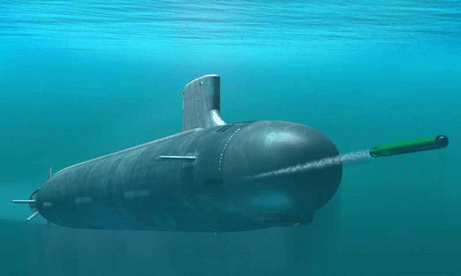 after Covid outbreak at sea, The Sun, Jerome Starkey, 12 Feb 2021,
Dozens on board HMS Vigilant reported sick but, with no access to a test lab, the precise number is not known. They had little chance to escape the bug while working in hot and cramped conditions.
A source said: “Imagine being cooped up underwater and breathing the same air when a killer virus is on the loose. It really was the patrol from hell.”
HMS Vigilant was on patrol as part of the Navy’s continuous at-sea deterrent.
The £3billion sub was the designated “bomber boat” and armed with Trident nukes.
“People sleep in bunks in tiny six-man cabins. They work on top of each other.”…….. https://www.thesun.co.uk/news/14036051/sailors-navy-nuclear-sub-covid-outbreak/
Radioactive poisoning of the environment: France’s nuclear legacy of wastes in Algeria
Impact of France’s nuclear tests persists: Algeria https://www.aa.com.tr/en/africa/impact-of-frances-nuclear-tests-persists-algeria/2143751
Algerian Foreign Minister said nuclear tests were three to four times the size of US bombing of Hiroshima in Japan, Abdul Razzaq Bin Abdullah |13.02.2021 ALGIERS
France’s nuclear experiments in the Algerian desert in the 1960s were three to four times equal to the Hiroshima bombing in Japan, Algerian Foreign Minister Sabri Boukadoum said on Saturday.
In a Twitter post on the occasion of the 61st anniversary of the first French nuclear explosion in the Algerian desert, on Feb. 13, 1960, Boukadoum described the impacts of the tests as “catastrophic”.
“On this day in 1960, imperialist France carried out the first nuclear explosion in the Reggane region in the Algerian desert, in a process code-named ‘Gerboise Bleue’ (Blue Desert Rat),” Boukadoum said.
He added that the French nuclear explosion yielded a force of 70 kilotons (kt) and its catastrophic radiological repercussions still persist.
The first atomic bomb dropped 75 years ago by the United States leveled Hiroshima on Aug. 6, 1945, and killed an estimated 140,000 people with many more dying in the following years from the effects of radiation. Three days later, Washington dropped another atomic bomb on Nagasaki, killing around 70,000 people and forced Japan to surrender six days later.
According to French officials, the colonial authorities carried out 17 nuclear experiments in the Algerian desert in the period between 1960 and 1966. Algerian historians, however, put the number at 57.
On Feb. 13 1960, France conducted its first nuclear test, code-named “Gerboise Bleue” (Blue Desert Rat) in the Sahara Desert, southwest of Algeria.
The French nuclear experiments have caused the death of around 42,000 Algerians and injured thousands due to nuclear radioactivity, in addition to the extensive damage to the environment.
France has rejected Algerian demands to reveal the location of the nuclear waste as well as compensating the victims and those suffering from permanent disabilities due to the harmful effects of nuclear radioactivity.
During the course of the struggle for independence, nearly five million Algerians were killed, while hundreds of thousands more injured. *Ibrahim Mukhtar in Ankara contributed to this report
1 This Month





PLEASE OPPOSE HR 8255 AND S.3639 – bills would accelerate satellite deployment, with no environmental review or safeguards – https://ncstd5li.quorum.us/campaign/169331/
To see nuclear-related stories in greater depth and intensity – go to https://nuclearinformation.wordpress.com
-
Archives
- October 2026 (74)
- September 2026 (339)
- August 2026 (330)
- July 2026 (355)
- June 2026 (287)
- May 2026 (306)
- April 2026 (356)
- March 2026 (251)
- February 2026 (267)
- January 2026 (308)
- December 2025 (358)
- November 2025 (359)
-
Categories
- 1
- 1 NUCLEAR ISSUES
- business and costs
- climate change
- culture and arts
- ENERGY
- environment
- health
- history
- indigenous issues
- Legal
- marketing of nuclear
- media
- opposition to nuclear
- PERSONAL STORIES
- politics
- politics international
- Religion and ethics
- safety
- secrets,lies and civil liberties
- spinbuster
- technology
- Uranium
- wastes
- weapons and war
- Women
- 2 WORLD
- ACTION
- AFRICA
- Atrocities
- AUSTRALIA
- Christina's notes
- Christina's themes
- culture and arts
- Events
- Fuk 2022
- Fuk 2023
- Fukushima 2017
- Fukushima 2018
- fukushima 2019
- Fukushima 2020
- Fukushima 2021
- general
- global warming
- Humour (God we need it)
- Nuclear
- RARE EARTHS
- Reference
- resources – print
- Resources -audiovicual
- Weekly Newsletter
- World
- World Nuclear
- YouTube
-
RSS
Entries RSS
Comments RSS

