Iran and Israel – the situation shows the strong connection between nuclear power and nuclear weapons- small nuclear reactors with enriched uranium fuel.
Nuclear Alert: Iran & Israel Playing High-Stakes Poker with Nuclear Power & Nuclear Weapons Fairewinds, Maggie Gunderson, 14 Apr 21, Fairewindsy now, Fairewinds is sure you know that an explosion at an Iranian nuclear enrichment plant has slowed Iran’s progress to enrich uranium. The crisis shows a very blurry line between Civilian Atomic Power and Military Atomic Bombs!………..
For decades, we are informed there is no correlation between weapons and civilian power. This standoff between Iran and Israel highlights the strong connection between nuclear weapons and nuclear power, like hand-in-glove.
The borderline between bomb-grade uranium and civilian power-grade uranium is determined by how much the isotope Uranium-235 (U-235) is enriched. Traditionally, if uranium enrichment is above 20%, that is considered the low-end of weapons-grade enrichment, which falls between 20% and 100% enrichment for bombs. Therefore, the higher the percent of enrichment of U-235, the easier it is to manufacture a nuclear bomb.
To be cost-effective, the nuke industry claims its U-235 must be more enriched to prevent atomic power reactors from refueling as often. Currently, uranium fuel used worldwide in operating nuclear power plants is enriched to about 6%. But the nuclear industry’s new designs for proposed Small Modular Reactors (SMRs) will use fuel enriched to about 20%.
Yes, as Fairewinds quoted above, SMRs will use nuclear fuel that is “one step away from weapons-grade uranium” used to make bombs!
At Fairewinds, we have two questions today:
- First, what are Iran’s plans for gaining that much enrichment? Iran claims that this centrifuge produced fuel is for peaceful purposes only, then why does the uranium have to be enriched to almost bomb-grade? Is Iran building SMRs?
- Where does that place the United States in world politics with its creation of SMRs? The U.S. plans to build tens of thousands of these allegedly new Small Modular Reactors. Moreover, SMRs use HALEU fuel (High-Assay Low-Enriched Uranium) enriched to almost 20% Uranium-235.
- How does this action make the U.S. any different from what Iran is doing when the U.S. SMRs will contain high-test Uranium identical to what is being enriched in Iran?
- Is this federal push for this new SMR design some type of ploy to spread atomic bomb-grade fuel all over the world?
- The U.S. nuclear power industry is looking at SMRs as its latest cash cow, expecting to sell and build SMRs all over the world! What kind of international threat is this if thousands of proposed SMRs are located all over the U.S. and worldwide?

As a result of the attack on its enrichment facility, Iran has further changed its mind and said it would enrich uranium to 60%. According to the BBC:
Iran will produce 60%-enriched uranium in retaliation for a suspected Israeli attack on a nuclear site, President Hassan Rouhani says, bringing it closer to the purity required for a weapon. … But he reiterated that Iran’s nuclear activities were “exclusively peaceful”.
France, Germany and the U.K. expressed “grave concern” at the move, saying Iran had “no credible civilian need for enrichment at this level”.
Fairewinds is clear that the 20% enriched fuel planned to be used in SMRs is only one easy step away from creating bomb-grade atomic fuel! Now that Iran has informed the world that it intends to enrich its uranium to 60%, scientists worldwide know that there is no peaceful civilian atomic reactor of any kind using U-235 enriched to 60%!
Fairewinds hopes that diplomats will resolve this enrichment conundrum before the military situation escalates further. https://www.fairewinds.org/demystify/nuclear-alert-iran-israel-playing-high-stakes-poker-with-nuclear-power-nuclear-weapons
Unrelenting dishonest propaganda leading us to war against China
Not sleepwalking but marching with eyes wide open to war. Independent Australia, By William Briggs | 13 April 2021 While the USA moves towards war, anti-China rhetoric grows on a daily basis and the idea of war is being sold as the “right” thing, writes Dr William Briggs.
A LIE told often enough can become accepted, but it can never be the truth. China has been declared a threat to all that we hold dear, but it is just not so. China, for all its faults, is not a threat and nor is it practising genocide!
The Uyghur genocide claim gets bigger as each day dawns. Peter Hartcher, in The Age on the 10 April, writes of this genocide and of ‘the evil genius of the system of genocide with Chinese characteristics.’ The “genius” according to Hartcher is that the Chinese are allowing the Uyghurs to live. What a clever and cunning genocide that is!
The plight of the Uyghurs is but the latest lurid episode in a sustained and enormously successful push to demonise China in the eyes of the world. The motivations behind this are simple enough. China’s economic star is rising and America’s best days are behind it.
The world is certainly on the edge of a precipice. There is a broad acceptance, despite an embarrassing lack of evidence, that China is an enemy and, as an enemy, a threat. Nobody is ever eager for war, but people have often enough been persuaded that war is an acceptable option. This is particularly so when an existential threat exists, or in this case, is manufactured. The potential for war, justifications for it and warnings of how it might almost “accidentally” become a reality have come to dominate thought……..
If the USA goes to war with China, it will not be by chance. It has been meticulously planned, costed, budgeted for and the weapons, including “low-yield” nuclear weapons, have been manufactured and deployed by the USA. The world should be aghast at such blatant preparations, but it is not. Those who would take us to war need first to convince us that we have no option, that we are protecting freedom, that we are standing for justice and that a threat exists that the enemy is engaging in genocide.
In the space of just a decade, the people have come to accept this. China has gone from economic saviour of the world to arch enemy. Governments begin the process but could not be expected to convince the people alone. Television and print media: editorials, opinion pieces from leading journalists and international editors, columnists and experts, have all played a decisive role.
A recent poll by the Lowy Institute showed that in 2018, 52 per cent of Australians believed that China would act responsibly in the world. Two very short years later and that figure had dropped to just 23 per cent! The polls are then used by the same anti-China crusaders to prove that a problem exists. They are happy to ignore the effect that a daily barrage of anti-China campaigning can do and how it can shift people’s views…….
The most recent reporting of the treatment of the Uyghurs is that the Chinese are engaged in a campaign of genocide. Genocide was practised in Nazi Germany, in Kampuchea, in Rwanda, in Armenia, in Australia, but to suggest that the Chinese behaviour towards the Uyghurs, while quite possibly repressive, even reprehensible, is genocidal is ludicrous.
There has been discrimination and persecution. Life, for the Uyghurs, has never been easy. However, the West paid little or no attention to these people until about the time that the USA began to talk of “containing” China. It was, for the USA, a fortuitous discovery.
The Chinese, at the end of the 20th Century, waged a campaign against Islamist separatist groups that had become active within the Uyghur population. Violence met violence and conditions worsened for the Uyghurs. None of this concerned Washington. What happened to make things change so dramatically? The Chinese, in all likelihood, did step up repressions but the USA have manipulated events to suit a specific propaganda purpose.
Uyghur stories become more and more horrifying. The Western media was once content to rail against the existence of “re-education” camps. Then it was reports of campaigns of mass rape and then mass sterilisation programs. This morphed into claims of social genocide. Reports of forced labour emerged and evolved into stories of slave labour. The term “social” genocide came into use but has now been shortened to genocide.
This ramping up of rhetoric has one real purpose. China must, at every turn, be shown to be a malignant force. The editorialists, international editors, columnists and journalists have become a willing and shameless weapon in this campaign. If it all ends in war it will not be a chance thing. The world will not be “sleepwalking”.
Nobody wants war but we are being prepared for it. https://independentaustralia.net/politics/politics-display/not-sleepwalking-but-marching-with-eyes-wide-open-to-war,14982#.YHZ_2MRzAdY.twitter
USA’s nuclear rocket plan, and the Nazi history behind it.
The US plans to put a nuclear-powered rocket in orbit by 2025, David Hambling.. (subscribers only)
: https://www.newscientist.com/article/2274199-the-us-plans-to-put-a-nuclear-powered-rocket-in-orbit-by-2025/#ixzz6rrl4rEGB
Nuclear space craft very clearly is part of nuclear weapons programme
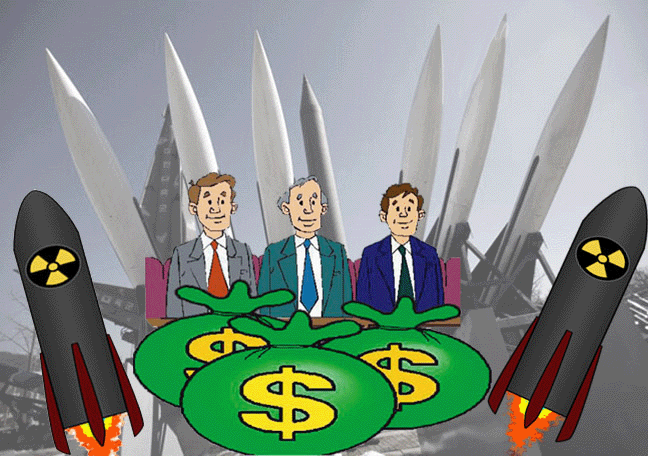
DARPA awards nuclear spacecraft contracts to Lockheed Martin, Bezos’ Blue Origin and General Atomics
PUBLISHED MON, APR 12 2021 HTTPS://WWW.CNBC.COM/2021/04/12/DARPA-NUCLEAR-SPACECRAFT-LOCKHEED-BEZOS-BLUE-ORIGIN-GENERAL-ATOMICS.HTML
The Pentagon’s DARPA awarded contracts to General Atomics, Lockheed Martin and Jeff Bezos’ space venture Blue Origin under the agency’s DRACO (Demonstration Rocket for Agile Cislunar Operations) program.
The Pentagon’s research and development arm on Monday awarded a trio of companies with contracts to build and demonstrate a nuclear-based propulsion system on a spacecraft in orbit by 2025.
General Atomics, Lockheed Martin and Jeff Bezos’ space venture Blue Origin won the Defense Advanced Research Projects Agency or DARPA awards, under the agency’s Demonstration Rocket for Agile Cislunar Operations program or DRACO.
The goal of the program is deceptively simple: Use a nuclear thermal propulsion system to power a spacecraft beyond low Earth orbit.
The National 12th April 2021
The National 12th April 2021, When Scotland becomes an independent country, weapons of mass destruction
will be removed from the Clyde.
Nuclear warheads are only stored at HMNB Clyde for the sole purpose of being mated to Trident II D-5 missiles before
they are loaded onto nuclear submarines. As is widely known, as part of the agreement made by the Thatcher and Reagan governments, the UK’s missiles are maintained by the United States at Kings Bay Georgia, as part of a
shared pool.
Sleekit’ increase in Trident nuclear warheads on the Clyde
Sleekit’ increase in Trident nuclear warheads on the Clyde, The Ferret Rob Edwards, April 11, 2021 The UK Government has secretly boosted the number of Trident nuclear warheads stored on the Clyde over the last five years, according to an analysis of bomb convoys.
| Nukewatch, which monitors the transport of nuclear weapons, estimated that 37 new warheads were delivered from England to Scotland between 2015 and 2020. Nine were added in 2019 and 13 in 2020, it said. In March the Ministry of Defence (MoD) reversed a ten-year-old disarmament plan by announcing the “ceiling” on the UK’s nuclear weapons stockpile would increase from 225 to 260 because of “technological and doctrinal threats”. But Nukewatch argued this increase has already happened without the public being told. It accused Westminster of failing to provide a “fully accurate picture” and of risking “catastrophic consequences”. The Scottish National Party (SNP) warned of a “moral and democratic outrage”. Campaigners lambasted UK ministers for being “sleekit” and treating parliaments and public with “utter contempt”. The MoD did not deny that more warheads had been sent to Scotland. It declined to comment on nuclear transports, and stressed that warhead numbers were “kept under review”. The MoD’s “integrated review” of nuclear weapons policy on 17 March 2021 abandoned a pledge made in 2010 “to reduce our overall nuclear warhead stockpile ceiling from not more than 225 to not more than 180 by the mid-2020s.”It said: “In recognition of the evolving security environment, including the developing range of technological and doctrinal threats, this is no longer possible, and the UK will move to an overall nuclear weapon stockpile of no more than 260 warheads.”.. https://theferret.scot/sleekit-increase-trident-nuclear-warheads/ This prompted Nukewatch to examine its recorded sightings of 78 nuclear bomb convoys between 2010 and 2020. There were 43 trips from the nuclear weapons factory at Burghfield, Berkshire, to the Royal Naval Armaments Depot at Coulport on Loch Loch, and 35 in the other direction………………. The Scottish Campaign for Nuclear Disarmament blamed a series of “sleekit” prime ministers for misrepresenting nuclear realities. “It is now clear that a succession of UK governments have treated parliaments and the public with utter contempt,” said campaign chair, Lynn Jamieson.“They have deceived their own people by this covert escalation and they have attempted to hoodwink the world at large with a show of compliance with the requirements of the Non-Proliferation Treaty.”The suggestion that nuclear weapons brought security was an “arrogant delusional absurdity”, Jamieson argued. Instead they meant “more capacity for mass extinction, life-extinguishing climate change, genocide and risk of irrecoverable accidental https://theferret.scot/sleekit-increase-trident-nuclear-warheads/ |
Scientists urge Biden administration to reduce spending on nuclear weapons.
Science Group Urges Biden Administration to Reduce Spending on Nuclear Weapons https://www.ucsusa.org/about/news/biden-administration-urged-reduce-nuclear-spending
Statement by Stephen Young, Global Security Program at the Union of Concerned Scientists.
WASHINGTON (April 9, 2021)—The Biden administration Fiscal Year 2022 budget overview released today indicates that its request for spending on the military will be even higher than the Trump administration’s last defense budget. As the final 2022 budget request develops, the Union of Concerned Scientists (UCS) calls on the administration to make substantial cuts to the proposed $753 billion in military spending by significantly reducing funding for dangerous and unnecessary nuclear weapons, freeing up funds to better meet the nation’s many other challenges and opportunities.
In particular, UCS urges the administration to eliminate funding for the nuclear missile program known as the Ground Based Strategic Deterrent (GBSD) so it will be better positioned to advance President Biden’s spending priorities such as such as COVID relief, infrastructure, climate change solutions, and economic and racial justice.
In advance of the budget release, Sen. Edward J. Markey and Rep. Ro Khanna set a good example by recently introducing the Investing in Cures Before Missiles (ICBM) Act of 2021 that proposes eliminating all funding for the GBSD and diverting $1 billion of that money toward the development of a universal coronavirus vaccine.
Below is a statement by Stephen Young, senior Washington representative and acting co-director of the Global Security Program at the Union of Concerned Scientists.
“It is far past time for the United States to reconsider its nonsensical plans to spend a trillion dollars to build thousands of new nuclear warheads, hundreds of new long-range nuclear-armed missiles, a hundred long-range nuclear-armed bombers, and a dozen new submarines each carrying 16 nuclear-armed missiles. The world survived one massive nuclear arms race during the Cold War; but we should not tempt fate again. That money could be much better invested in protecting everyone in the United States from this pandemic and the next, from the ravages of climate change, and from the injustice of racial inequality.
“The poster child of wasteful spending is the proposal to spend $264 billion for a new land-based nuclear-armed missile. Those missiles, vulnerable to attack and kept on hair trigger alert, actually increase the risk of nuclear war rather than reduce it.
“The United States must stop relying on the Cold War-created threat of mutually assured destruction to maintain national security. Such a precarious approach risks fatal human error in defiance of all common sense.
“We call on the Biden administration to make major cuts to proposed nuclear weapons programs and start us on the path to actual national and international security.”
It’s getting too late for an effective missile deal with Iran.
The window for an Iran missile deal is already closing, Bulletin of the Atomic Scientists, By John Krzyzaniak | April 7, 2021 Calls to limit Iran’s missile program have become all the rage in Washington. In early March, a bipartisan group of 140 US lawmakers urged the Biden administration to pursue a more “comprehensive” deal with Iran that goes beyond the 2015 Joint Comprehensive Plan of Action to include not just Iran’s nuclear program but also its ballistic missile program and its support for non-state groups in the Middle East. Despite this and similar appeals, the prospects for even a modest missile deal with Iran are looking slimmer by the day. While the more ambitious proposals were unrealistic to begin with, the most feasible option—to lock in a 2,000-kilometer range limit on Iran’s ballistic missiles—may soon slip out of reach too.
Proposals for a missile agreement. Despite the heightened interest in constraining Iran’s missile capabilities, there have been few concrete proposals to accomplish that goal, and even fewer that are remotely plausible.
On the more fanciful side, one proposal involves demanding that Iran give up any and all missiles capable of delivering a 500 kilogram (kg) payload to a range of 300 kilometers (km) or more, on the thesis that such missiles are inherently capable of delivering nuclear weapons. After all, the prospect of Iran’s missiles serving as delivery vehicles for nuclear weapons (if Iran ever decides to build them) is what most worries Western policymakers. Avner Golov and Emily B. Landau advocate for a deal to eliminate Iranian missiles that exceed the 500 kg–300 km threshold in a February 2018 article in Foreign Policy.
Setting aside that the definition of what constitutes a “nuclear-capable” missile is contested, there are three additional problems that make this proposal unworkable. First, depending on how different systems are counted, Iran has at least eight missile types that would be covered by such an agreement, and it would have to give them all up. Second, Israel, Saudi Arabia, and the United Arab Emirates also have missiles that exceed the 500 kg–300 km threshold, and Iran would demand that those countries adhere to the same arrangement. Third, verification of such a deal would present a Herculean task involving an extensive, on-the-ground inspection presence.
None of these conditions seems remotely possible given the current political environment. In fact, Golov and Landau themselves admit that getting Iran to agree to a ban on missiles above the 500 kg–300 km threshold would be “extremely unlikely.”
On the more modest side is the recommendation to lock in a 2,000-km range limit on Iran’s ballistic missiles, including by banning the flight testing of missiles that exceed that range, made by Michael Elleman and Mark Fitzpatrick in a 2018 article in Foreign Policy. Robert Einhorn and Vann Van Diepen also include this among their recommendations in a 2019 report for Brookings…………
if Western policymakers want to seize this modest but worthwhile option, they will need to act quickly, as recent events suggest that Iran may be preparing to throw off the self-imposed range limit. If Iran blows past 2,000-km ranges with its missiles, it won’t be easy to put the genie back in the bottle.
Why the window may be closing. The first and most glaring reason why a missile deal focused on capping Iran’s missiles at 2,000 km—or any missile deal for that matter—may be beyond reach is that there has been no revival of the 2015 nuclear agreement. Since the deal was agreed, Iranian officials including the supreme leader have signaled that the nuclear deal would be an important test in determining whether Western countries were good-faith negotiating partners or not. Iranian Foreign Minister Javad Zarif hammered home this point in an interview published in Politico on March 17, when he said, “if the US passes the test of [the nuclear deal] … then we can consider other issues.”
Fast forward six years, and Iranians—both government officials and the broader public—have been embittered by the experience of the 2015 agreement. In Zarif’s eyes, the United States has “miserably failed” the aforementioned test. Even if the deal is revived and the Biden administration lifts sanctions, convincing Iran to negotiate on its ballistic missiles in particular, which Iranian officials have repeatedly insisted are non-negotiable, would be a hard sell.
But it is Iran’s technological progress that is beginning to erode the 2,000-km range limit, increasing the probability that, as time goes by, Iran will officially cast it off……..Fast forward six years, and Iranians—both government officials and the broader public—have been embittered by the experience of the 2015 agreement. In Zarif’s eyes, the United States has “miserably failed” the aforementioned test. Even if the deal is revived and the Biden administration lifts sanctions, convincing Iran to negotiate on its ballistic missiles in particular, which Iranian officials have repeatedly insisted are non-negotiable, would be a hard sell.
But it is Iran’s technological progress that is beginning to erode the 2,000-km range limit, increasing the probability that, as time goes by, Iran will officially cast it off………………https://thebulletin.org/2021/04/the-window-for-an-iran-missile-deal-is-already-closing/?utm_source=Newsletter&utm_medium=Email&utm_campaign=ThursdayNewsletter04082021&utm_content=NuclearRisk_IranDealWindow_04072021
French Prime Minister visiting Algeria. The question of radioactive dust from nuclear tests will be on the agenda.
*Algeria – French Nuclear Testing**
French atomic tests in Algeria: so much brings the wind. The wind regularly
blows radioactive particles from the Sahara over Europe, a memory of the
atomic tests carried out in Algeria in the 1960s. Will the responsibility
of Paris be on the menu of Jean Castex’s visit to Algiers this weekend.
end?
Liberation 7th April 2021
On April 10 and 11, French Prime Minister Jean Castex will travel to
Algiers, accompanied by eight ministers – including the ministers of
foreign affairs and the armed forces to participate in the 5th session of
the France-Algeria High Level Intergovernmental Committee (CIHN). The
question of the health and environmental consequences of the 17 nuclear
tests carried out by France in the Sahara between 1960 and 1966, as well as
that of nuclear and non-nuclear waste left by France, will be on the menu
of discussions.
ICAN France 7th April 2021
http://icanfrance.org/alerte-presse-les-consequences-des-essais-nucleaires-francais-en-algerie/
75 years after nuclear testing in the Pacific began, the fallout continues to wreak havoc

| 75 years after nuclear testing in the Pacific began, the fallout continues to wreak havoc https://theconversation.com/75-years-after-nuclear-testing-in-the-pacific-began-the-fallout-continues-to-wreak-havoc-158208?fbclid=IwAR3q9QJvy507ds2kD0ibOvkD6ZzxFqgGjfHsGrwqJUVMNpujOu8sAeLVPtY April 6, 2021 Patricia A. O’Brien Patricia A. O’Brien is a Friend of The Conversation.Historian, Visiting Fellow in the School of History, Australian National University and Adjunct Professor in the Asian Studies Program, Georgetown University, This year marks 75 years since the United States launched its immense atomic testing program in the Pacific. The historical fallout from tests carried out over 12 years in the Marshall Islands, then a UN Trust Territory governed by the US, have framed seven decades of US relations with the Pacific nation.Due to the dramatic effects of climate change, the legacies of this history are shaping the present in myriad ways. This history has Australian dimensions too, though decades of diplomatic distance between Australia and the Marshall Islands have hidden an entangled atomic past. In 1946, the Marshall Islands seemed very close for many Australians. They feared the imminent launch of the US’s atomic testing program on Bikini Atoll might split the earth in two, catastrophically change the earth’s climate, or produce earthquakes and deadly tidal waves. A map accompanying one report noted Sydney was only 3,100 miles from ground zero. Residents as far away as Perth were warned if their houses shook on July 1, “it may be the atom bomb test”. Australia was “included in the tests” as a site for recording blast effects and monitoring for atom bombs detonated anywhere in the world by hostile nations. This Australian site served to keep enemies in check and achieve one of the Pacific testing program’s objectives: to deter future war. The other justification was the advancement of science. The earth did not split in two after the initial test (unless you were Marshallese) so they continued; 66 others followed over the next 12 years. But the insidious and multiple harms to people and place, regularly covered up or denied publicly, became increasingly hard to hide. Radiation poisoning, birth defects, leukaemia, thyroid and other cancers became prevalent in exposed Marshallese, at least four islands were “partially or completely vapourised”, the exposed Marshallese “became subjects of a medical research program” and atomic refugees. (Bikinians were allowed to return to their atoll for a decade before the US government removed them again when it was realised a careless error falsely claimed radiation levels were safe in 1968.) In late 1947, the US moved its operations to Eniwetok Atoll, a decision, it was argued, to ensure additional safety. Eniwetok was more isolated and winds were less likely to carry radioactive particles to populated areas. Australian reports noted this site was only 3,200 miles from Sydney. Troubling reports of radioactive clouds as far away as the French Alps and the known shocking health effects appeared. Dissenting voices were initially muted due to the steep escalation of the Cold War and Soviet atomic weapon tests beginning in 1949. Opinion in Australia split along political lines. Conservative Cold War warriors, chief among them Robert Menzies who became prime minister again in 1949, kept Australia in lockstep with the US, and downplayed the ill-effects of testing. Left-wing elements in Australia continued to draw attention to the “horrors” it unleashed. The atomic question came home in 1952, when the first of 12 British atomic tests began on the Montebello Islands, off Western Australia. Australia’s involvement in atomic testing expanded again in 1954, when it began supplying South Australian-mined uranium to the US and UK’s joint defence purchasing authority, the Combined Development Agency. Australia’s economic stake in the atomic age from 1954 collided with the galvanisation of global public opinion against US testing in Eniwetok. The massive “Castle Bravo” hydrogen bomb test in March exposed Marshall Islanders and a Japanese fishing crew on The Lucky Dragon to catastrophic radiation levels “equal to that received by Japanese people less than two miles from ground zero” in the 1945 Hiroshima and Nagasaki atomic blasts. Graphic details of the fishermen’s suffering and deaths and a Marshallese petition to the United Nations followed. When a UN resolution to halt US testing was voted on in July, Australia voted for its continuation. But the tide of public opinion was turning against testing. The events of 1954 dispelled the notion atomic waste was safe and could be contained. The problem of radioactive fish travelling into Australian waters highlighted these new dangers, which spurred increasing world wide protests until the US finally ceased testing in the Marshalls in 1958. In the 1970s, US atomic waste was concentrated under the Runit Island dome, part of Enewetak Atoll (about 3,200 miles from Sydney). Recent alarming descriptions of how precarious and dangerous this structure is due to age, sea water inundation and storm damage exacerbated by climate change were contested in a 2020 Trump-era report. The Biden administration’s current renegotiation of the Compact of Free Association with the Republic of the Marshall Islands, and its prioritisation of action on climate change, will put Runit Island high on the agenda. There is an opportunity for historical redress for the US that is even more urgent given the upsurge in discrimination against US-based Pacific Islander communities devastated by the COVID-19 pandemic. Some are peoples displaced by the tests. Australia is also embarking on a new level of engagement with the Marshall Islands: it is due to open its first embassy in the capital Majuro in 2021.It should be remembered this bilateral relationship has an atomic history too. Australia supported the US testing program, assisted with data collection and voted in the UN for its continuation when Marshallese pleaded for it to be stopped. It is also likely Australian-sourced atomic waste lies within Runit Island, cementing Australia in this history. |
Putin amassing, testing, huge military arsenal in the Arctic
Daily Mail 5th April 2021, Satellite images appearing to show Russia beefing up its military presence
in the Arctic have emerged just days after three of Moscow’s nuclear ballistic missile submarines smashed through the polar region in a show of strength. The images show the Russian military has been rebuilding and expanding numerous facilities across the Arctic in recent years.
From
revamping runways to deploying additional surveillance and air defence assets, the satellite images reveal a continuous effort to expand Moscow’s capabilities in the polar region.
Russia planning to test a ‘doomsday’ nuclear-powered torpedo in the Arctic.
Russia sends ‘doomsday’ nuclear-powered torpedo for test in the Arctic, Marc Bennetts, Moscow, Wednesday April 07 2021, 12.00pm BST, The Time The United States has said that it is watching Russia’s military build-up in the Arctic “very closely” as the Kremlin presses ahead with the testing of a nuclear-powered torpedo.
Russia is believed to be planning to deploy the Poseidon 2M39 missile, nicknamed the “doomsday nuke”, to its Arctic region by the summer of next year. The underwater drone has a range of 10,000km and is designed to detonate off the coastline of enemy cities, flooding them with radioactive waves that would render them uninhabitable for decades. In February President Putin asked the defence ministry for an update on a “key stage”’ of the tests of the Poseidon torpedo. Additional testing is due this year……… (Subscribers only) https://www.thetimes.co.uk/article/russia-sends-doomsday-nuclear-powered-torpedo-for-test-in-the-arctic-wf5ttr260
UK losing credibility with its new, ambiguous, nuclear weapons policy.
U.K. NUCLEAR WEAPONS: BEYOND THE NUMBERS, War On The Rocks, HEATHER WILLIAMS, APRIL 6, 2021, Sometimes numbers only tell part of the story, even when talking about nuclear weapons. For instance, the United Kingdom recently announced that it was increasing the cap on its nuclear stockpile from 225 to 260 warheads. The move — outlined in its government’s highly anticipated review of security and defense policy, Global Britain in a Competitive Age: The Integrated Review of Security, Defence, Development and Foreign Policy — largely took nuclear policy experts by surprise and reversed decades of British reductions. The government explained that the decision to increase its nuclear stockpile for the first time in decades was due to a worsening strategic landscape and technological threats, particularly Russian advances in missile defense and hypersonic weapons. The fact that the United Kingdom decided to make this decision now should be a wakeup call to those concerned about the security of the West and the global nuclear order.
The decision to boost the number of warheads in its arsenal wasn’t the only major nuclear policy change that the United Kingdom included in the Integrated Review. The document explained that the United Kingdom would no longer provide specifics about its nuclear stockpile or the conditions under which it would consider nuclear weapons use. In other words, the United Kingdom has now fully committed to a doctrine of strategic ambiguity. This approach is similar in some respects to what the United States, NATO, Russia, and China have done. But the increase in the warhead stockpile and reliance on strategic ambiguity come at a cost to nuclear diplomacy, and it will be difficult for the United Kingdom to balance these changes with its commitment to being a responsible nuclear power.
The announcement of an increase in the warhead stockpile, in particular, could not have come at a worse time for nuclear diplomacy. In August 2021, the United Kingdom and 190 other states will gather for a meeting of the parties to the Nuclear Non-Proliferation Treaty, which includes a commitment to the “cessation of the nuclear arms race” and “general and complete disarmament.” It will be a challenge for the United Kingdom to demonstrate progress towards nuclear disarmament five months after it has announced an increase in its stockpile cap. The reliance on strategic ambiguity also potentially undermines the country’s efforts to promote nuclear transparency among the treaty’s signatories. Obviously there are other considerations for the United Kingdom’s nuclear doctrine than the Nuclear Non-Proliferation Treaty, but these changes could damage its credibility on disarmament matters. The United Kingdom, therefore, should take additional steps to demonstrate its commitment to transparency, including providing more information on its nuclear modernization plans and leading on risk reduction efforts in the context of the Nuclear Non-Proliferation Treaty.
Reasons for a Larger Stockpile: Security and Technology
In its strategic reviews published in 2010 and 2015, the United Kingdom set a cap of 225 warheads and committed to reducing its stockpile ceiling to 180 warheads by the mid-2020s. The new Integrated Review increases the country’s nuclear stockpile ceiling to 260 warheads, a potential increase of approximately 15 percent from the current stockpile and 45 percent from the previous target.
The U.K. decision reverses decades of progress towards nuclear disarmament. …………
The Price of Ambiguity
Alas, the increased nuclear stockpile and the doctrine of strategic ambiguity will undermine the United Kingdom’s nuclear diplomacy. The move will open the country up to charges of hypocrisy. Future British delegations to international nonproliferation and disarmament negotiations should expect to be asked why other countries should make progress on these issues when the United Kingdom is building up its own nuclear arsenal. While this may seem relatively inconsequential compared to deterring Russian nuclear forces, it will make it harder for the United Kingdom to advance its interests in other areas that it cares about, especially within the Nuclear Non-Proliferation Treaty…………………….. https://warontherocks.com/2021/04/u-k-nuclear-weapons-beyond-the-numbers/
Let’s get rid of nuclear weapons before they ruin us
Let’s get rid of nuclear weapons before they ruin us, https://brookingsregister.com/article/lets-get-rid-of-nuclear-weapons-before-they-ruin-us, By: Carl Kline – Apr 5, 2021 Maybe others remember reading about it back in January 1966. I missed it, or at least don’t remember it. There was an accident in the skies over the Mediterranean Sea. An airborne B52 carrying four hydrogen bombs was being refueled. Something went wrong and the refueling plane exploded, killing all four crew members aboard and sending the B52 crashing to the earth in pieces.
Three of those seven crew members lost their lives.
Three of the hydrogen bombs were found on land, near the Spanish fishing village of Palomares. The non-nuclear explosives in two of the bombs detonated when they hit the ground and spread highly radioactive, carcinogenic, pulverized plutonium over the surrounding countryside. The fourth bomb was found in the ocean after a 2 1/2 month search.
The reason this has come to my attention so many decades later is an ongoing court case. The Air Force sent some 1,500 personnel into the Palomares area to clean up the debris in the midst of all the plutonium dust. They were there for weeks handling that dust, washing it off village surfaces, putting contaminated soil in barrels, cleaning it from clothes, incinerating truckloads of poisoned debris. One small particle of plutonium, inhaled or ingested, can cause cancer.
That was 56 years ago. Some of those veterans are still struggling to get some compensation for their illnesses. Many have died. And only now has a judge ordered the Department of Veterans Affairs to revise how it evaluates disability claims from the accident. The Air Force never even included the plutonium cleanup in its list of “radiation risk activities.”
Thank you for your service.” Sometimes they seem hollow words indeed. I’ll always remember the member of my congregation, laying in the hospital bed where he would soon lose his leg, after years of pain and illness, one of those Army personnel who entered the nuclear testing ground, assured by the Army it was “safe” to do so.
We don’t have to return to the 60s to recognize the consequences of our nuclear death wish. Back in the Cold War era, the French government conducted both underground and above- ground nuclear weapons tests in the Algerian Sahara, contaminating local populations, the surrounding desert and French troops carrying out the tests.
This February 2021, strong winds blew north from the Sahara, carrying dust over Spain, France, the UK and Ireland. Sometimes the large quantity of dust turned the sky orange. In the meantime, the French Association for Control of Radioactivity in the West, announced the dust was radioactive, blowback from those earlier French tests. Researchers gathered the dust from car windshields and found cesium-137, a radioactive isotope not found in nature but produced in nuclear weapons ests. Some 60 years after using their colony for testing, France receives the fallout.The British have a massivesubmarine base near Helensburgh, Scotland. They are intending to increase the discharge of radioactive waste into the ocean, up to 50 times the present discharges.
The liquid radioactive waste is generated by the nuclear reactors that drive the submarines and the processing of the nuclear weapons. The increased waste will contain cobalt-60 and tritium.
One supposes the Atlantic should share in our nuclear nonsense. The Pacific has its own problems with the continuing saga at Fukushima. When will all that radioactive water flow unceasingly into the ocean? How many more water tanks can be constructed and where will Tepco place them? What happens in the next earthquake or Tsunami? The last earthquake, in February of this year, caused 20 of those tanks to “slide.
The Kings Bay Plowshares tried to disturb our conscience almost four years ago with their nuclear disarmament action. The group of seven Catholic activists entered the Kings Bay Naval Submarine Base and carried out a series of symbolic actions, like spray painting “love one another” on the sidewalk. After almost two hours on the base they were willingly arrested.
They were charged with conspiracy, destruction of government property, degradation of a naval battalion, and trespassing. Several have been in jail awaiting sentencing.
They take their Plowshares name from the prophet Isaiah, who famously said to “beat swords into plowshares.” During their time on the base, one of them read the statement of Pope Francis denouncing nuclear weapons.
One wonders where the rest of the Christian community is? Too busy preaching individual salvation to address social salvation? Too focused on worshipping God in sanctuaries and too blind to the work of the devil in the world?
Now that nuclear weapons have been declared illegal by the United Nations and the 50 countries who have signed the treaty, we need an outcry of “enough,” in this country and around the world, before the blowback hits us all
North Korea’s new tactical nuclear weapons means new dangers, new U.S. strategy needed
| North Korea’s tactical nuclear weapons expand deterrence, risk Experts say sanctions relief would get North Korea’s attention to return to negotiations as the country faces economic downfall. Aljazeera, By Frank Smith3 Apr 2021 Seoul, South Korea – North Korea appears to be well on its way to becoming a mature nuclear state despite longstanding United Nations sanctions, after Pyongyang’s tests in late March of cruise and ballistic missiles capable of carrying tactical nuclear warheads. North Korea’s nuclear development increased dramatically under leader Kim Jong Un, who took power in 2010 following the death of his father, Kim Jong Il. Kim Il Sung, the founder of North Korea and Kim Jong Un’s grandfather, conducted 15 ballistic missile tests between 1983 and 1993, according to the database of the Nuclear Threat Initiative, a Washington think-tank.Kim Jong Il oversaw two nuclear tests and 16 missile tests. Kim Jong Un has presided over four nuclear tests and 91 ballistic missile tests, as well as the launches of cruise missiles and the firing of rocket-propelled artillery. “They clearly see this type of weapons development as a key to their survival, and they will not stop,” Eric Gomez, director of defence policy studies at the Cato Institute, told Al Jazeera, while at the same time suggesting there was a window through which the US could at least reduce the threat with greater efforts and compromise. North Korean missile development has continued even as the North has been subject to strict UN Security Council sanctions and through on-and-off talks on denuclearisation.Negotiations have now been stalled for about two years and North Korea has rebuffed offers to resume discussions from the new US administration under Joe Biden. Predictable patternThe development of nuclear and missile programmes has followed a somewhat predictable pattern……….. ……Kim’s wish listTactical nuclear weapons are one of the items on Kim’s wish list that elicit concern, because, despite Kim Jong Un’s assumed preference to maintain personal “assertive control” over any launch of North Korea’s nuclear weapons, with tactical nuclear weapons that expectation changes.“Tactical nuclear weapons are a big headache when it comes to command and control … as they lend themselves to pre-delegation to officers in the field,” explained Panda. That means tactical nuclear weapons could be more widely distributed throughout the country, to more officials capable of launching them in the case of a perceived attack, which raises additional concerns, according to analysts………… ………..the US will have to give more concessions than it has been willing to in the past. Experts said sanctions relief would get North Korea’s attention, particularly with the deterioration of the country’s economy as a result of the COVID-19 pandemic and the closure of borders with China, its key trading partner.It’s an “important source of leverage … a door the North Koreans would be looking to crack open,” said the Carnegie Endowment’s Panda, advocating talks aimed at risk reduction. The Biden administration has said it will soon conclude its policy review on North Korea, which will provide some clarity concerning the new US president’s strategy towards Pyongyang……. https://www.aljazeera.com/news/2021/4/3/north-korea-expanding-and-enhancing-its-weaponry |
1 This Month





PLEASE OPPOSE HR 8255 AND S.3639 – bills would accelerate satellite deployment, with no environmental review or safeguards – https://ncstd5li.quorum.us/campaign/169331/
To see nuclear-related stories in greater depth and intensity – go to https://nuclearinformation.wordpress.com
-
Archives
- October 2026 (74)
- September 2026 (339)
- August 2026 (330)
- July 2026 (355)
- June 2026 (287)
- May 2026 (306)
- April 2026 (356)
- March 2026 (251)
- February 2026 (267)
- January 2026 (308)
- December 2025 (358)
- November 2025 (359)
-
Categories
- 1
- 1 NUCLEAR ISSUES
- business and costs
- climate change
- culture and arts
- ENERGY
- environment
- health
- history
- indigenous issues
- Legal
- marketing of nuclear
- media
- opposition to nuclear
- PERSONAL STORIES
- politics
- politics international
- Religion and ethics
- safety
- secrets,lies and civil liberties
- spinbuster
- technology
- Uranium
- wastes
- weapons and war
- Women
- 2 WORLD
- ACTION
- AFRICA
- Atrocities
- AUSTRALIA
- Christina's notes
- Christina's themes
- culture and arts
- Events
- Fuk 2022
- Fuk 2023
- Fukushima 2017
- Fukushima 2018
- fukushima 2019
- Fukushima 2020
- Fukushima 2021
- general
- global warming
- Humour (God we need it)
- Nuclear
- RARE EARTHS
- Reference
- resources – print
- Resources -audiovicual
- Weekly Newsletter
- World
- World Nuclear
- YouTube
-
RSS
Entries RSS
Comments RSS

