Following Biden climate summit, USA govt keen to promote and export Small Nuclear Reactors

A Spotlight on Advanced Nuclear after the White House Climate Summit– JD Supra, 30 Apr 21. -”…….. With the nuclear ban lifted by the Development Finance Corporation for investment in innovation projects, the U.S. government acknowledged the importance of nuclear in the transition to [?] clean energy in developing economies.
……….. the Department of State announced the launch of its Foundational Infrastructure for the Responsible Use of Small Modular Reactor Technology (FIRST) Program. Through an initial $5.3 million investment, this program will strengthen international collaboration between the U.S. and partner countries seeking to deploy nuclear energy in their clear energy initiatives. This cooperation includes supporting the deployment of advanced nuclear technologies, including small modular reactors (SMRs),…….
When USA attacks a foreign state, the media calls it ”Defense”

It’s Aggression When ‘They’ Do It, but Defense When ‘We’ Do Worse https://fair.org/home/its-aggression-when-they-do-it-but-defense-when-we-do-worse/ALAN MACLEOD Aggression, in international politics, is commonly defined as the use of armed force against another sovereign state, not justified by self-defense or international authority. Any state being described as aggressive in foreign or international reporting, therefore, is almost by definition in the wrong.
It’s a word that seems easy to apply to the United States, which launched 81 foreign interventions between 1946 and 2000 alone. In the 21st century, the United States has attacked, invaded or occupied the sovereign states of Afghanistan, Iraq, Libya, Syria, Pakistan, Yemen and Somalia.
Despite the US record, Western corporate media overwhelmingly reserve the word “aggression” for official enemy nations—whether or not it’s warranted. In contrast, US behavior is almost never categorized as aggressive, thereby giving readers a misleading picture of the world.
Perhaps the most notable internationally aggressive act in recent memory was the Trump administration’s assassination of Iranian general and political leader Qassem Soleimani last year. Yet in its long and detailed report on the event, the Washington Post (1/4/20) managed to present Iran as the aggressor. The US was merely “choos[ing] this moment to explore an operation against the leader of Iran’s Quds Force, after tolerating Iranian aggression in the Persian Gulf for months,” in the Post’s words.
t also gave space to senior US officials to falsely claim Soleimani was aiming to carry out an “imminent” attack on hundreds of Americans. In fact, he was in Iraq for peace talks designed to bring an end to war between states in the region. The Iraqi prime minister revealed that he had invited Soleimani personally, and had asked for and received Washington’s blessing to host him. Trump instead used that information to kill him.
For months, media had been awash with stories, based on US officials’ proclamations, that Iranian aggression was just around the corner (e.g., Yahoo! News, 1/2/20; Reuters, 4/12/19; New York Times, 11/23/19; Washington Post, 6/22/19). The Hill (10/3/19) gave a retired general space to demand that we must “defend ourselves” by carrying out a “serious response” against Iran, who is “test[ing] our resolve with aggressive actions.”
Russia is another country constantly portrayed as aggressive. The New York Times (11/12/20) described a US fishing boat’s mix up with the Russian navy off the coast of Kamchatka as typical Russian aggression, complete with the headline, “Are We Getting Invaded?” The Military Times (6/26/20) worried that any reduction in US troops in Germany could “embolden Russian aggression.” And a headline from the Hill (11/14/19) claimed that “Putin’s Aggression Exposes Russia’s Decline.” In the same sentence that publicized a report advocating that NATO expand to take on China directly, the Wall Street Journal (12/1/20) warned of “Russian aggression.” Suffice to say, tooling up for an intercontinental war against another nuclear power was not framed as Western warmongering.
Other enemy states, such as China (New York Times, 10/6/20; CNBC, 8/3/20; Forbes, 3/26/21), North Korea (Atlantic, 11/23/10; CNN, 8/9/17; Associated Press, 3/8/21) and Venezuela (Wall Street Journal, 11/18/05; Fox News, 3/10/14; Daily Express, 9/30/19) are also routinely accused of or denounced for “aggression.”
Corporate media even present the Taliban’s actions in their own country against Western occupation troops as “aggression” (Guardian 7/26/06; CBS News, 11/27/13; Reuters, 3/26/21). The New York Times (11/24/20) recently worried about the Taliban’s “aggression on the battlefield,” while presenting the US—a country that invaded Afghanistan in 2001 and still has not left—as supposedly committed to the “peace process.”
Even as the US has been flying squadrons of nuclear bombers from North Dakota to Iran and back, each time in effect simulating dropping atomic bombs on the country, media have framed this as a “defensive move” (Politico, 12/30/20) meant to stop “Iranian aggression” (Defense One, 1/27/20) by “deter[ring] Iran from attacking American troops in the region” (New York Times, 12/30/20).
In February, President Joe Biden ordered an airstrike on a Syrian village against what the White House claimed were Iran-backed forces. The Department of Defense absurdly insisted that the attack was meant to “deescalate” the situation, a claim that was lamentably uncritically repeated in corporate media, with Politico (2/25/21) writing that “the strike was defensive in nature” and a response to previous attacks on US troops in Iraq. Needless to say, it did not question the legitimacy of American troops being stationed across the Middle East.
That the US, by definition, is always acting defensively and never aggressively is close to an iron law of journalism. The US attack on Southeast Asia is arguably the worst international crime since the end of World War II, causing some 3.8 million Vietnamese deaths alone. Yet in their seminal study of the media, Manufacturing Consent, Edward Herman and Noam Chomsky (Extra!, 12/87) were unable to find a single mention of a US “attack” on Vietnam. Instead, the war was commonly framed as the “defense” of South Vietnam from the Communist North.
Even decades later, US actions in Vietnam are still often described as a “defense” (e.g., Wall Street Journal, 4/29/05; Christian Science Monitor, 1/22/07; Politico, 10/10/15; Foreign Policy, 9/27/17). In a 2018 autopsy of the conflict headlined “What Went Wrong in Vietnam,” New Yorker staff writer Louis Menand (2/26/18) wrote that “our policy was to enable South Vietnam to defend itself” as the US “tried to prevent Vietnam from becoming a Communist state.” “Millions died in that struggle,” he adds, as if the perpetrators of the violence were unknown.
It was a similar story with the US invasion of Grenada in 1983, which was presented as a defense against “Soviet and Cuban aggression in the Western hemisphere” (San Diego Union-Tribune, 10/26/83).
There have only been three uses of the phrases “American aggression” or “US aggression” in the New York Times over the past year. All came in the mouths of Chinese officials, and in stories focusing on supposedly aggressive Chinese actions. For example, at the end of a long article warning about how China is “pressing its territorial claims aggressively” from the Himalayas to the South China Sea, in paragraph 28 the Times (6/26/20) noted that Beijing’s priority is “confronting what it considers American aggression in China’s neighborhood.” Meanwhile, two articles (10/5/20, 10/23/20) mention that Chinese disinformation calls the Korean War the “war to resist American aggression and aid Korea”. But these were written off as “visceral” and “pugnacious” “propaganda” by the Times.
Likewise, when the phrase “American aggression” appears at all in other leading publications, it is largely only in scare quotes or in the mouths of groups long demonized in corporate media, such as the Houthi rebels in Yemen (Washington Post, 2/5/21), the Syrian government of Bashar al-Assad (Associated Press, 2/26/21) or Saddam Hussein’s generals (CNN, 3/3/03).
The concept of US belligerence is simply not being discussed seriously in the corporate press, leading to the conclusion that the word “aggression” in newspeak means little more than “actions we don’t like carried out by enemy states.”
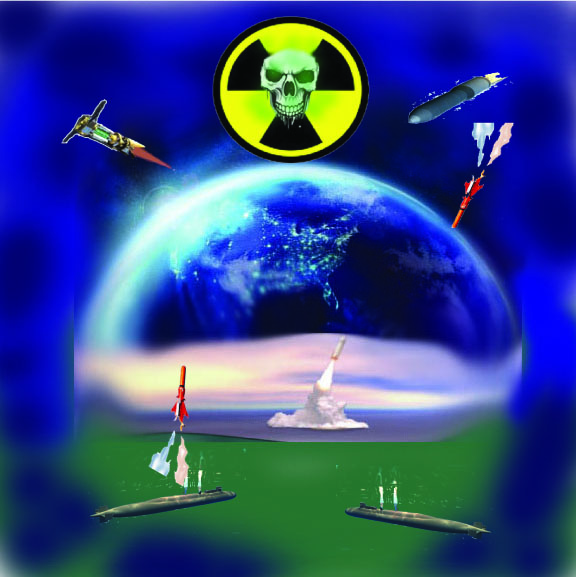
The nuclear menace from under the seas and from high in the sky- theme for May 21
Why would anyone persist in pushing Small Nuclear Reactors (SMRs) and pretending that they can solve climate change, when they clearly cannot?
Well, the answer is – if you’re a toxic macho nuclear zealot or a nuclear weapons corporation – ( Lockheed Martin, Raytheon Technologies, Northrop Grumman, Boeing, and General Dynamics etc)- this myth about SMRs is manna from heaven.
It means that the tax-payer, not private enterprise investors, will take over the SMR push – and the military-industrial-complex will race away with nuclear sites and weapons in space, and with powerful killer nuclear submarines.
Meanwhile those billionaire nuclear gurus – Elon Musk, Bill Gates, Jeff Bezos, , Richard Branson, Jack Ma and othes , will be laughing all the way to the bank, as they promote ”peaceful, nuclear-powered” space travel.
The global media promotes the joy and delight of space travel, rarely acknowledging its intimate connection with militarism. And there’s a crazy sort of national pride – hubris in being in the space race.
The space race to what? Apart from the obvious – nuclear war and annihilation, there’s the danger of ecosystem plutonium pollution from accidents and leaks, drastic accidents, and the gobbling up of public funds that might otherwise go to the public good – health, education, welfare, climate ation – heck – even good international relations!
The USA and Russia have long been in a toxic competition to militarily control the world especially by nuclear submarines. There’s a strange and unwarranted confidence that nuclerar submarines are ”clean” and somehow ”safe”. That’s because they release their radioactive trash unseen, into the world’s ocean waters. When they have an accident, well they just sink, and their poisonous mess is invisible. Dead nuclear submarines seem to be no trouble, hidden on the sea floor. Now that the world has become (a bit) aware of the radioactive danger of nuclear submarines, the dead ones lie in port, as nobody really knows what to do with them, how to clean up the nuclear mess.
In this time of pandemic, it is urgently necessary to put the brakes on NATO, and Russia – in regard to the increasing danger to the world, of nuclear submarines. Even more than cruise ships, they can be a hot-bed of coronavirus – making them even more unsafe in a number of ways.
UK’s £41 billion nuclear submarine project beset by delays, safety problems, cost overruns
Times 25th April 2021, HMS Anson trundled out of Devonshire Dock Hall on Tuesday to a ripple of
applause, before its 7,400-tonne bulk slipped into the water for the first time. The launch of the Royal Navy’s fifth Astute submarine was a milestone for the defence giant BAE Systems, which builds the boats at its cavernous factory at Barrow-in-Furness on the Cumbrian coast.
But despite the fanfare, it was also a reminder of the growing risks that haunt this most sensitive corner of the defence industry. HMS Anson, a hunter-killer submarine powered by a nuclear reactor but armed with conventional weapons,
has been almost a decade in the making. It is years late and is still some way off being ready. It may have to undergo years of trials before being accepted into service. Its launch was delayed by problems with HMS Audacious, the fourth Astute.
It sat in the water for almost three years before leaving Barrow last year. Delays to the Astutes illustrate the
challenges facing Britain’s submarine enterprise, the biggest cost to the Ministry of Defence. Crucially, they point to the risks around the successor programme: the construction of four Trident nuclear warhead-armed submarines, Dreadnoughts, which are needed to sustain the UK’s policy of continuous at-sea deterrent.
Those risks range from delays refuelling the ageing Vanguard submarines they will eventually replace, to setbacks and
cost overruns on vital infrastructure projects, to management churn and weak scrutiny. They suggest that without drastic action, the MoD may have to adjust its expectations for the £41 billion project, particularly the assumption that the first boat will be in service in the “early 2030s”.
https://www.thetimes.co.uk/article/are-britains-nuclear-subs-slipping-below-the-waves-3zt7658zq
The purpose of USA space research is clearly military – they don’t even pretend any more.
US Nuclear Marks Beginning of Age of Space Mining as It Signs Historic Trade Agreement, US Nuclear Corp, April 28, 2021,
Source: US Nuclear Corp. Los Angeles, CA, April 28, 2021 (GLOBE NEWSWIRE) — via NewMediaWire — On April 15, 2021, US Nuclear Corp. (OTCQB: UCLE) signed a historic trade agreement with Solar System Resources Corporation that marked the beginning of the age of space trade and mining. The new agreement sets preliminary prices for the high value materials to be extracted. It also establishes and expands our cislunar and solar system value chain and adds SatRevolution as a new partner. The agreement is a continuation of the Letter of Intent signed on February 5, 2021, and outlines how US Nuclear and Solar Systems Resources Corp. plan to cooperate building a value chain starting with mining and selling valuable helium-3 and lanthanide metals and other materials from space deposits.
Solar Systems Resources Corporation Sp. z o. o. is a space mining company that conducts localization, in-situ verification, and mining of space resources. A third strategic partner, SatRevolution S.A., a leading provider of nanosatellites, is also participating in construction of the value chain mentioned in the agreement. The deal, if completed in full, could be worth many hundreds of billions of dollars and will pave the way to a new frontier mining resources in space.
The agreement is in the form of a Memorandum of Understanding, and highlights include:
……….. The parties will endeavor to support the US (and allies), NATO military, and the development of the operational capabilities of the US Space Force…… https://www.globenewswire.com/news-release/2021/04/28/2218641/0/en/US-Nuclear-Marks-Beginning-of-Age-of-Space-Mining-as-It-Signs-Historic-Trade-Agreement.html
Be aware – Nuclear Thermal Propulsion (NTP) for space rockets has everything to do with the mkilitary, and funding for weapons makers

US Military Seeks Nuclear Space Flight Test by 2025, VOA 26 Apr 21,
The U.S. military has chosen three companies to develop nuclear thermal propulsion, or NTP systems to be tested in space by 2025. The goal is to test the space travel technology in cislunar space – the area between Earth and the moon.
What is NTP? What is NTP?
The U.S. Department of Energy describes on its website how an NTP system works. It needs a radioactive material such as uranium and another element, such as hydrogen, in liquid form. The liquid propellant is pumped through a reactor core. This causes uranium atoms to break apart inside the core and release heat. The heat turns the propellant into gas, which expands through an opening to produce thrust.
The contracts to produce a flight demonstration of NTP technology were awarded by the military’s Defense Advanced Research Projects Agency, or DARPA. The winning contractors were General Atomics, Blue Origin and Lockheed Martin. DARPA did not announce how much the contracts were worth.
In a recent announcement about the project, DARPA said the area of space, or “space domain,” will be very important to business, scientific discovery and national defense. Establishing “space domain awareness in cislunar space…will require a leap-ahead in propulsion technology,” the agency said……..
NTP and NASA
The U.S. space agency NASA has long been interested in nuclear propulsion systems to power its spacecraft of the future. But the technology has not yet been demonstrated…….. https://learningenglish.voanews.com/a/us-military-seeks-nuclear-space-flight-test-by-2025/5864011.html
Canadian government rejects Nuclear Weapons Ban Treaty, but majority of Canadians support it.
Government out of step with Canadians on nuclear weapons, Policy Options, 26 Apr 21, Ottawa refuses to support a UN nuclear weapons ban treaty. Why is there such a disconnect between government policy and public preference? Policy Options,
While most Canadians are aware of the massive destructive power of nuclear weapons, they are rarely asked their opinion about them. Earlier this month, a Nanos poll provided the responses of 1,000 Canadians to a set of nine questions on the theme of nuclear disarmament. The clear preference of 80 per cent of those surveyed was that the world should work to eliminate nuclear weapons.
This sentiment could be seen as merely an abstract aspirational goal, but the poll also addressed levels of support for the United Nations Treaty on the Prohibition of Nuclear Weapons (TPNW) which entered into force this January. Overall, 74 per cent of those polled expressed support for Canada adhering to this treaty. This support is at odds with the Canadian government’s current rejection of the TPNW, which it has argued is ineffective and contrary to NATO policies. Still, the polling numbers suggest the public is supportive of a nuclear weapons ban of some sort, regardless of the government’s concerns.
Popular support for the TPNW didn’t fade even when respondents were presented with a scenario of U.S. opposition to Canada embracing the treaty……… https://policyoptions.irpp.org/magazines/april-2021/government-out-of-step-with-canadians-on-nuclear-weapons/
Scots financial firms invested £7bn in nuclear weapons

Scots financial firms invested £7bn in nuclear weapons, Billy Briggs The Ferret, April 25, 2021, Three major Scottish financial institutions — NatWest Group, Lloyds Banking Group and Standard Life Aberdeen — invested a total of £7bn in nuclear weapons over a two year period.
A new report, seen by The Ferret, also reveals two Scots universities held £2.4m of investments in companies that undertake work related to nuclear weapons, while 11 council pension funds together had £275m invested in 20 firms in the sector.
The study is by Don’t Bank on The Bomb Scotland, a network of organisations campaigning for banks, universities, pension funds and public bodies to divest from companies involved in the production of nuclear weapons. It says these organisations together held investments worth £7.2bn in nuclear weapons producers between 2018 and 2020.
Don’t Bank on the Bomb is calling for divestment. It argues that organisations investing in nuclear weapon producers are “supporting activities that contravene commitments made under the Nuclear Non-Proliferation Treaty”……
Medact Scotland, Scottish CND, Pax Christi Scotland and the Edinburgh Peace and Justice Centre are all members of Don’t Bank on the Bomb Scotland.
The umbrella group says there is a heightened global nuclear risk at the moment. It points to tensions between the US, Israel and Iran over the latter’s nuclear programme, and deadly clashes between nuclear-armed nations India and China in the western Himalayas. ……..
International law on nuclear weapons was strengthened in January 2021 by the UN Treaty on the Prohibition of Nuclear Weapons (TPNW), the study says. The treaty prohibits the development, production, testing, possession, transfer, use and threat of use of nuclear weapons.
Don’t Bank on the Bomb’s report says the treaty is important to note for investors because financial assistance may be viewed as unlawful under international law.
The roles of three major financial groups based in Edinburgh are highlighted by the report. It says Natwest Group, formerly RBS, held investments worth £2bn in 15 companies between January 2018 and January 2020. These investments were made primarily in the form of loans and through the underwriting of bond issuances, while shareholdings make up a small proportion of the total.
Natwest has a policy which “only partially restricts investment in nuclear weapons producers”, the report claims. Meetings were held with the bank in 2020 and March 2021 and Don’t Bank On The Bomb said it sent an open letter to it, drawing attention to the “catastrophic humanitarian and environmental consequences of nuclear weapons” and the recent entry into force of the TPNW.
The letter called on the bank to exclude nuclear weapons from investment and was co-signed by over 40 civil society organisations, including trade unions, faith organisations and environmental NGOs.,……
Lloyds Banking Group, which is registered in Edinburgh, is also named. It invested £3.4bn in 10 nuclear weapons producers between January 2018 and January 2020, the report says. These investments were made primarily in the form of loans and through the underwriting of bond issuances. ……….
Standard Life Aberdeen, headquartered in Edinburgh, is also cited. The report says the company offers customers some socially responsible investment funds that exclude nuclear weapons producers but adds that most of its funds do not.
“The company owned or managed shares worth over £1.5bn in 20 of the world’s top 28 nuclear weapons producers between January 2018 and January 2020. Standard Life Aberdeen should stop investing in weapons of mass destruction,” the report says. ……..
Both Glasgow University and Strathclyde University also invest in the nuclear weapons industry. The former held shares worth £1.9m in 16 companies as of 30 September 2020. Strathclyde University owned shares worth £473,633 in two companies – BAE Systems and Thales.
Don’t Bank on The Bomb calls for “student activism” to “persuade” these universities to change their investment strategies. It claimed the University of Edinburgh changed its policy on arms investments in 2016 in response to a five year “responsible investment campaign”, led by students. ……….
The report adds that at least six Scots universities have policies that either explicitly or implicitly restrict investment in nuclear weapons producers. “It is clear that the University of Glasgow and the University of Strathclyde are outliers when it comes to nuclear weapons investments in the Scottish higher education sector,” the study says……….
On council pension funds, the study found that 11 funds collectively held shares worth over £275m in 20 companies that undertake work related to nuclear weapons as at 30 September 2020.
Lothian Pension Fund was the largest investor in nuclear weapons, holding shares worth nearly £126m in five nuclear weapons producers. This includes £102m invested in the world’s largest arms company, Lockheed Martin. Strathclyde Pension Fund came second, holding shares worth £120m in 16 companies.
Don’t Bank On the Bomb Scotland said: “Most Scottish local authority pension funds are reluctant to exclude harmful industries from investment. However, a growing number of Scottish councils are taking a stand against nuclear weapons investments by passing a resolution that calls on their pension fund to divest from nuclear weapons producers……. https://theferret.scot/scots-financial-firms-invested-7bn-nuclear-weapons/
UK govt has a ”contingency plan”, in case Scotland becomes independent, and wants removal of nuclear weapons bases.
UK nuclear subs could leave Scotland for Devon as Indy referendum fears rise
MINISTRY of Defence planners have re-examined a contingency plan to move the Navy’s nuclear deterrent submarines from Scotland to Devon, according to senior sources last night.
EXPRESS, UK, By MARCO GIANNANGELI 25 Apr 21, It comes as the SNP prepares to fight next month’s Scottish Parliament elections on a manifesto that promises a fresh referendum on independence from the UK. Britain’s nuclear weapons system, made up of four Vanguard-class submarines which carry Trident strategic missiles, has been based at HM Naval Base Clyde on Scotland’s west coast since the 1960s. The base is made up of two sites – Faslane on Gareloch, where the submarines are based, and Coulport on Loch Long two miles away, where the warheads are stored.
Last month’s Integrated Review announced the most significant change to its nuclear weapons policy in at least two decades with the decision to abandon a self-imposed cap of 225 warheads, increasing it to 260.
In 2014 the Government ruled out moving the location of its nuclear deterrent bases ahead of Scotland’s referendum, citing the large costs involved, and still outwardly holds to that line.
But the SNP continues to pledge that it would ban nuclear weapons on Scottish soil, should it become independent…….
One senior Whitehall source confirmed last night: “A contingency plan is now in place should circumstances change and an independent Scottish government decide it no longer wants to host Britain’s nuclear deterrent.”
While the SNP is not expected to have a majority at next month’s Holyrood elections, support from Scottish Greens would still ensure a mandate to seek independence…….https://www.express.co.uk/news/politics/1427576/UK-nuclear-submarines-Scotland-devon-faslane
Rising threat of nuclear war is barely noticed. Corporate media likes it that way.
Rising Threat of Nuclear War Is Barely Noticed, Consortium news, By Caitlin Johnstone
CaitlinJohnstone.com 23 Apr 21, U.S. Strategic Command, the branch of the U.S. military responsible for America’s nuclear arsenal, tweeted the following on Tuesday:
“The spectrum of conflict today is neither linear nor predictable. We must account for the possibility of conflict leading to conditions which could very rapidly drive an adversary to consider nuclear use as their least bad option.”
STRATCOM called it a preview of the “posture statement” it submits to U.S. Congress every year. It was a bit intense for Twitter and sparked a lot of alarmed responses. This alarm was due not to any inaccuracy in STRATCOM’s frank statement, but due to the bizarre fact that our world’s increasing risk of nuclear war barely features in mainstream discourse.
STRATCOM has been preparing not just to use its nuclear arsenal for deterrence but also to “win” a nuclear war should one arise from the (entirely U.S. -created) “conditions” which are “neither linear nor predictable.”
And it’s looking increasingly likely that one will as the prevailing orthodoxy among Western imperialists that U.S. unipolar hegemony must be preserved at all cost rushes headlong toward America’s plunge into post-primacy.
The U.S. has been ramping up aggressions with Russia in a way that has terrified experts, and it looks likely to continue doing so. These aggressions are further complicated on increasingly tense fronts like Ukraine, which is threatening to obtain nuclear weapons if it isn’t granted membership to NATO, either of which would increase the risk of conflict.
Aggressions against nuclear-armed China are escalating on what seems like a daily basis at this point, with potential flashpoints in the China Seas, Taiwan, Xinjiang, Hong Kong, India and any number of other possible fronts………
The fact that those in charge of U.S. nuclear weapons now see both Russia and China as a major nuclear threat, and the fact that U.S. cold warriors are escalating against both of them, is horrifying.
The fact that they’re again playing with “low-yield” nukes designed to actually be used on the battlefield makes it even more so. This is to say nothing of tensions between nuclear-armed Pakistan and nuclear-armed India, between nuclear-armed Israel and its neighbors, and between nuclear-armed North Korea and the Western empire.
The Bulletin of the Atomic Scientists has the 2021 Doomsday Clock at 100 seconds to midnight, citing the rising threat of nuclear war:……………
As I all too frequently find myself having to remind people, the primary risk here is not that anyone will choose to have a nuclear war, it’s that a nuke will be deployed amid heightening tensions as a result of miscommunication, miscalculation, misfire, or malfunction, as nearly happened many times during the last Cold War, thereby setting off everyone’s nukes as per Mutually Assured Destruction.
The more tense things get, the likelier such an event becomes. This New Cold War is happening along two fronts, with a bunch of proxy conflicts complicating things even further. There are so very many small moving parts, and it’s impossible to remain in control of all of them.
Thousands of Starter Buttons
People like to think every nuclear-armed country has one “The Button” with which they can consciously choose to start a nuclear war after careful deliberation, but it doesn’t work that way.
There are thousands of people in the world controlling different parts of different nuclear arsenals who could independently initiate a nuclear war. Thousands of “The Buttons.” It only takes one. The arrogance of believing anyone can control such a conflict safely, for years, is astounding.
A 2014 report published in the journal Earth’s Future found that it would only take the detonation of 100 nuclear warheads to throw 5 teragrams of black soot into the Earth’s stratosphere for decades, blocking out the sun and making the photosynthesis of plants impossible. This could easily starve every terrestrial organism to death that didn’t die of radiation or climate chaos first. China has hundreds of nuclear weapons; Russia and the United States have thousands.
This should be the main thing everyone talks about. There is literally no more urgent matter on earth than the looming possibility that everyone might die in a nuclear war.
But people don’t see it.
On a recent “Tucker Carlson Tonight” appearance, former Congresswoman Tulsi Gabbard did a solid job describing the horrors of nuclear war and the very real possibility that it could be inflicted upon the U.S. due to America’s insane brinkmanship with Russia. She spoke earnestly about how “such a war would come at a cost beyond anything we can really imagine,” painting an entirely accurate picture of “hundreds of millions of people dying and suffering, seeing their flesh being burned from their bones.”
Gabbard is correct, and was right to give such a confrontational account of what we are looking at right now. But if you read the replies to Gabbard’s tweet in which she shared a clip from the interview, you’ll see a deluge of commenters accusing her of “hyperbole,” saying she’s being soft on Russian President Vladimir Putin and admonishing her for appearing on Tucker Carlson. It’s like they can’t even hear what she’s saying, how real it is, how significant it is.
Normalcy Bias & Media Malpractice
People’s failure to wrap their minds around this issue is a testament to the power of normalcy bias, a cognitive glitch which causes the U.S. to assume that because something bad hasn’t happened in the past, it won’t happen in the future. We survived the last Cold War by the skin of our teeth, entirely by sheer, dumb luck; the only reason people are around to bleat “hyperbole” is because we got lucky. There’s no reason to believe we’ll get lucky in this New Cold War environment; only normalcy bias says we will. Believing we’ll survive this Cold War just because we survived the last one is as sane as believing Russian roulette is safe because the guy passing you the gun didn’t die.
It’s also a testament to the power of plain old psychological compartmentalization. People can’t handle the idea of everything ending, of everyone they know and love dying, of watching their loved ones die in flames or from radiation poisoning right in front of them, all because someone made a mistake at the wrong time after a bunch of imperialists decided that U.S. planetary domination was worth putting every terrestrial organism at risk.
But mostly it’s testament to the ubiquitous malpractice of the Western media. It’s inconvenient to the agendas of the imperial war machine to have people protesting these insane Cold War games of nuclear brinkmanship, so their media stenographers barely touch on this issue. If mainstream journalism actually existed, this flirtation with nuclear war would be front and center in everyone’s awareness and people would be flooding the streets in protest against their lives being toyed with as casino chips in an insane all-or-nothing gamble.
This is so much bigger than any of the petty little things we spend our mental energy on from day to day……….The rising threat of nuclear war is the most urgent matter in the world and it’s absolute madness that we’re not talking about it all the time. https://consortiumnews.com/2021/04/23/rising-threat-of-nuclear-war-is-barely-noticed/
Attachments areaPreview YouTube video Tulsi Gabbard issues warning about potential war with RussiaTulsi Gabbard issues warning about potential war with RussiaPreview YouTube video Vasili Arkhipov: HeroVasili Arkhipov: Hero
Not necessary to increase USA’s nuclear arsenal – China’s goal is defence – a stronger-second strike arsenal.
We Don’t Need a Better Nuclear Arsenal to Take on China
The military’s arguments for a nuclear overhaul are unconvincing. Slate, BY FRED KAPLAN, APRIL 23, 2021
This week, top military officers launched their big push on Capitol Hill for a total overhaul of the U.S. nuclear arsenal, at an estimated cost of $1.3 trillion over the next 30 years, and their top rationale—the go-to rationale for just about every large federal program these days—was the threat from China.
Their case was less than compelling
Yes, China is displaying some bellicose behavior these days, economically, politically, and militarily. But a new generation of U.S. intercontinental ballistic missiles, bombers, cruise missiles, and submarines would do nothing to deal with the problem.
Adm. Charles Richard, the head of U.S. Strategic Command, which runs plans and operations for the nuclear arsenal, laid out his case in hearings before House and subcommittees on strategic forces. He noted that China is expanding its nuclear arsenal at an “unprecedented” pace, on course to double in size by the end of the decade. It’s building more solid-fuel missiles, which can be launched right away (older liquid-fuel missiles require hours to load). It’s also building better early-warning radar, putting some of its ICBMs on trucks and moving them around. It might have adopted a launch-on-warning policy.
But all of this adds up to something less alarming than Richard’s rhetoric suggested—namely that the People’s Liberation Army is improving its ability to detect, and respond to, a nuclear attack on the Chinese homeland. Even if the Chinese doubled the size of their arsenal, which would give them about 600 nuclear weapons instead of the current 300, it would be well under half the size of the U.S. arsenal, so they would have no ability to launch a first strike against us.
In other words, China seems to be building a more potent second-strike arsenal—what we in the West would call a deterrent—perhaps in the face of Russia’s build-up of medium-range missiles and America’s development of a missile-defense force. This is troubling only to the extent it means that the United States would have a hard time launching a nuclear first-strike against China.
This is a bit troubling, but for reasons that seem less so, the more deeply the problem is analyzed. China’s military strategy is to establish hegemony in the region—especially in the Taiwan Straits and the South China Sea—and to prevent U.S. air and naval forces from intervening in this area. Beijing has made progress toward this goal by declaring some small islands, which are clearly in international waters, to be Chinese territory and converting them into military bases. It has also built and deployed hundreds of missiles that can attack ships, even large ones, with steadily improving accuracy and steadily longer range. China has also improved its ability to hit satellites and sensors in outer space (through cyber and more conventional means). Again, the goal is to keep the U.S. from intervening in Chinese military ventures. The American trump card in any such conflict has long been its nuclear arsenal (whether any president actually would use nukes to protect, say, Taiwan is another matter), but if China has its own potent nuclear deterrent, this card’s value is reduced: if we attack them, they can attack us……..
But all of this adds up to something less alarming than Richard’s rhetoric suggested—namely that the People’s Liberation Army is improving its ability to detect, and respond to, a nuclear attack on the Chinese homeland. Even if the Chinese doubled the size of their arsenal, which would give them about 600 nuclear weapons instead of the current 300, it would be well under half the size of the U.S. arsenal, so they would have no ability to launch a first strike against us.
n other words, China seems to be building a more potent second-strike arsenal—what we in the West would call a deterrent—perhaps in the face of Russia’s build-up of medium-range missiles and America’s development of a missile-defense force. This is troubling only to the extent it means that the United States would have a hard time launching a nuclear first-strike against China.
This is a bit troubling, but for reasons that seem less so, the more deeply the problem is analyzed. China’s military strategy is to establish hegemony in the region—especially in the Taiwan Straits and the South China Sea—and to prevent U.S. air and naval forces from intervening in this area. Beijing has made progress toward this goal by declaring some small islands, which are clearly in international waters, to be Chinese territory and converting them into military bases. It has also built and deployed hundreds of missiles that can attack ships, even large ones, with steadily improving accuracy and steadily longer range. China has also improved its ability to hit satellites and sensors in outer space (through cyber and more conventional means). Again, the goal is to keep the U.S. from intervening in Chinese military ventures. The American trump card in any such conflict has long been its nuclear arsenal (whether any president actually would use nukes to protect, say, Taiwan is another matter), but if China has its own potent nuclear deterrent, this card’s value is reduced: if we attack them, they can attack us.
……. the main point is this: We would gain no leverage in this scenario by building new ICBMs, bombers, cruise missiles, or submarines. To the extent these sorts of weapons loom as the ultimate deterrent, as a sort of overlord to any military competition, we already have plenty.
………. There will be fierce resistance to any slowdown of the strategic juggernaut. Most members of the congressional armed services committees regard the Nuclear Triad with the same veneration that Catholics bestow to the Holy Trinity. When they ask a witness if he believes in the Triad, they do so with a quivering tone, as if they were priests asking a supplicant if he believes in God.
At the same time, budget pressures are rousing some lawmakers to mull, a bit more deeply than before, whether so many nukes are necessary, whether they all have to be 100 percent reliable to deter adversaries from aggression, whether the recondite scenarios and theories of the nuclear game are quite real. It’s long past time to demystify the nuclear enterprise, to strip away the fear and trembling, and ask how many weapons are needed to do what. https://slate.com/news-and-politics/2021/04/nuclear-triad-overhaul-china.html
70 years later, ionising radiation from nuclear bomb tests still found in U.S. honey

Nuclear fallout is showing up in U.S. honey, decades after bomb tests, Science Nikk Ogasa Apr. 20, 2021
Fallout from nuclear bomb tests in the 1950s and ’60s is showing up in U.S. honey, according to a new study. Although the levels of radioactivity aren’t dangerous, they may have been much higher in the 1970s and ’80s, researchers say.
“It’s really quite incredible,” says Daniel Richter, a soil scientist at Duke University not involved with the work. The study, he says, shows that the fallout “is still out there and disguising itself as a major nutrient.”
In the wake of World War II, the United States, the former Soviet Union, and other countries detonated hundreds of nuclear warheads in aboveground tests. The bombs ejected radiocesium—a radioactive form of the element cesium—into the upper atmosphere, and winds dispersed it around the world before it fell out of the skies in microscopic particles. The spread wasn’t uniform, however. For example, far more fallout dusted the U.S. east coast, thanks to regional wind and rainfall patterns.
Radiocesium is soluble in water, and plants can mistake it for potassium, a vital nutrient that shares similar chemical properties. To see whether plants continue to take up this nuclear contaminant, James Kaste, a geologist at the College of William & Mary in Williamsburg, Virginia, gave his undergraduate students an assignment: Bring back local foods from their spring break destinations to test for radiocesium.
One student returned with honey from Raleigh, North Carolina. To Kaste’s surprise, it contained cesium levels 100 times higher than the rest of the collected foods. He wondered whether eastern U.S. bees gathering nectar from plants and turning it into honey were concentrating radiocesium from the bomb tests.
So Kaste and his colleagues—including one of his undergrads—collected 122 samples of locally produced, raw honey from across the eastern United States and tested them for radiocesium. They detected it in 68 of the samples, at levels above 0.03 becquerels per kilogram—roughly 870,000 radiocesium atoms per tablespoon. The highest levels of radioactivity occurred in a Florida sample—19.1 becquerels per kilogram.
The findings, reported last month in Nature Communications, reveal that, thousands of kilometers from the nearest bomb site and more than 50 years after the bombs fell, radioactive fallout is still cycling through plants and animals………
The findings raise questions about how cesium has impacted bees over the past half-century, says Justin Richardson, a biogeochemist at the University of Massachusetts, Amherst. “They’re getting wiped out from pesticides, but there are other lesser known toxic impacts from humans, like fallout, that can affect their survival.”
After the Chernobyl nuclear disaster in 1986, scientists showed radiation levels nearby could hamper the reproduction of bumble bee colonies. But those levels were 1000 times higher than the modern levels reported here, notes Nick Beresford, a radioecologist at the U.K. Centre for Ecology & Hydrology.
So even though the new study shouldn’t raise any alarm bells over today’s honey, understanding how nuclear contaminants move around is still vital for gauging the health of our ecosystems and our agriculture, says Thure Cerling, a geologist at the University of Utah. “We need to pay attention to these things.” https://www.sciencemag.org/news/2021/04/nuclear-fallout-showing-us-honey-decades-after-bomb-tests
How weapons maker Raytheon determines U.S. foreign policy decisions

Defense Secretary Lloyd Austin—Former Member of Raytheon Board of Directors—Has Awarded Over $2.36 Billion in Contracts to Raytheon Since His Confirmation in January, Covert Action Magazine By Jeremy Kuzmarov – April 19, 2021
”…………… One of the Raytheon company founders, Vannevar Bush, became president of the Massachusetts Institute of Technology (MIT) and chairman of the U.S. Office of Scientific Research and Development (OSRD) during World War II, which initiated the Manhattan Project that led to the development of the atomic bomb.
In 2003, Raytheon put out a press release bragging that half of all air-to-ground precision guided missiles (PGMs) used by coalition forces in Operation Iraqi Freedom were made by Raytheon.
…………….On February 25th, for example, on a visit to the U.S.S. Nimitz, Austin emphasized the need for U.S. warships throughout the globe to deter security threats—from China to Iran. A week later on a tour of Southeast Asia with Secretary of State Antony Blinken, Austin warned about China again and the North Korean nuclear threat and pledged that the U.S. would maintain a robust military presence in the Indo-Pacific.
He further cautioned North Korea that the United States, following military exercises with South Korea, was “ready to fight tonight.”
When fighting resumed in Eastern Ukraine in early April, Austin assured Ukraine’s Defense Minister Andrii Taran of the “U.S. commitment to building the capacity of Ukraine’s forces to defend more effectively against [supposed] Russian aggression”–which was demonstrated by a recent $125 million military aid package–and took to Twitter to reaffirm the U.S.’s “unwavering support for Ukraine’s sovereignty, territorial integrity, and Euro-Atlantic aspirations.”
The latter implied the joining of the European Union (EU) and North Atlantic Treaty Organization (NATO), which would inevitably escalate conflict between the world’s two major nuclear-armed powers (the U.S. and Russia).
On April 13th, Austin announced that the United States would increase its military presence in Germany by about 500 personnel and was scuttling plans introduced by President Donald Trump for a large troop reduction in Europe.
Austin meanwhile in Tel Aviv affirmed the U.S. “ironclad commitment” to Israel, which receives a record $3.8 billion in U.S. military aid each year, and on a visit to Afghanistan stated that the Biden administration wanted to see a “responsible end” to the Afghan war, but that the “level of violence must decrease” for “fruitful diplomacy” to have a chance.
These comments and many others were music to the ears of Raytheon, which gave $506,424 in donations to Biden’s presidential campaign.
…………….Raytheon was also the first major defense contractor to sell weapons to Saudi Arabia, selling the kingdom over 1,000 cluster bombs designed to maximize civilian casualties between 1970 and 1995. The company further hired members of the Saudi Royal Family as consultants, and opened a branch in Riyadh in 2017.
After the Yemen war began in 2015, Raytheon, according to an analysis by The New York Times, booked more than $3 billion in new bomb sales to the Saudis, causing its stock prices to increase from about $108 to more than $180 per share.
In 2019, Raytheon sold an estimated $8 billion in weapons to Saudi Arabia and the United Arab Emirates, which are centrally involved in the war in Yemen.

After an October 2016 Saudi airstrike on a funeral home in Sana’a that killed 140 people and wounded 500 more, human rights workers discovered a bomb shard bearing the identification number of Raytheon.[2] It was one of at least 12 attacks on civilians that human rights groups tied to Raytheon’s ordnance during the first two years of the war.
In order to secure the lucrative Saudi deals, Raytheon took advantage of federal loopholes by sending former State Department officials to lobby their former colleagues, and later benefitted by having their former top lobbyist, Mark Esper, appointed as Defense Secretary in June 2019 in a precursor to General Austin’s hiring.………..
Defense Secretary Lloyd Austin—Former Member of Raytheon Board of Directors—Has Awarded Over $2.36 Billion in Contracts to Raytheon Since His Confirmation in January
French MPs urge Macron to provide data about nuclear waste buried in Algeria
French MPs urge Macron to provide data about nuclear waste buried in Algeria https://www.middleeastmonitor.com/20210415-french-mps-urge-macron-to-provide-data-about-nuclear-waste-buried-in-algeria/, April 15, 2021 Nine French MPs have called on President Emmanuel Macron to provide data and maps about nuclear waste sites in Algeria, agencies reported yesterday. The French conducted nuclear tests in the Algerian Sahara in the 1960s You now have the opportunity to take concrete action in favour of the civilians and the environment which continue to be affected by nuclear waste buried by France in the sands of the Algerian Sahara,” the MPs told Macron. “You must seize it.”They pointed out that the fifth session of the Algerian-French high level intergovernmental committee, which should have held on 11 April, has been postponed indefinitely. The committee works to resolve historical disputes between France and Algeria.
In February, the MPs said, the sky over a large part of France had an orange hue which was the result of sand carried by strong winds from Algeria. “This meteorological episode reminded us once again that France has left an indelible radioactive imprint in the heart of the Sahara… Seventeen nuclear explosions were carried out in [Algeria] between 1960 and 1966, both above ground and underground, to test the French atomic bomb.”Key information is still missing about the waste for the most part buried in the sand, added the MPs. “Providing the details requested,” they insisted, “will ensure the health and safety of the people living in the areas in question, protect future generations and take the necessary and appropriate measures for the restoration of the environment.”
Israel (itself having 80 nuclear weapons) will do ”whatever it takes” to stop Iran getting a nuclear weapon
Israel will do ‘whatever it takes’ to stop Iran on nuclear front -foreign minister https://www.reuters.com/world/middle-east/israel-will-do-whatever-it-takes-stop-iran-nuclear-front-foreign-minister-2021-04-16/Reuters, 17 Apr 21, Israel will do “whatever it takes” to ensure that Iran does not acquire nuclear weapons, Foreign Minister Gabi Ashkenazi said on Friday.
Speaking after a summit with his Greek and Cypriot counterparts and a senior representative from the UAE in Paphos, Cyprus, Ashkenazi said discussions centred around possibilities for building on prosperity and stability in the region.
“We also took time to discuss challenges that Iran and Hezbollah and other extremists pose to the stability of the Middle East and to the regional peace,” he said. “We will do whatever it takes to prevent this extremist … success and definitely, to prevent this regime from having nuclear weapons.”
1 This Month





PLEASE OPPOSE HR 8255 AND S.3639 – bills would accelerate satellite deployment, with no environmental review or safeguards – https://ncstd5li.quorum.us/campaign/169331/
To see nuclear-related stories in greater depth and intensity – go to https://nuclearinformation.wordpress.com
-
Archives
- October 2026 (69)
- September 2026 (339)
- August 2026 (330)
- July 2026 (355)
- June 2026 (287)
- May 2026 (306)
- April 2026 (356)
- March 2026 (251)
- February 2026 (267)
- January 2026 (308)
- December 2025 (358)
- November 2025 (359)
-
Categories
- 1
- 1 NUCLEAR ISSUES
- business and costs
- climate change
- culture and arts
- ENERGY
- environment
- health
- history
- indigenous issues
- Legal
- marketing of nuclear
- media
- opposition to nuclear
- PERSONAL STORIES
- politics
- politics international
- Religion and ethics
- safety
- secrets,lies and civil liberties
- spinbuster
- technology
- Uranium
- wastes
- weapons and war
- Women
- 2 WORLD
- ACTION
- AFRICA
- Atrocities
- AUSTRALIA
- Christina's notes
- Christina's themes
- culture and arts
- Events
- Fuk 2022
- Fuk 2023
- Fukushima 2017
- Fukushima 2018
- fukushima 2019
- Fukushima 2020
- Fukushima 2021
- general
- global warming
- Humour (God we need it)
- Nuclear
- RARE EARTHS
- Reference
- resources – print
- Resources -audiovicual
- Weekly Newsletter
- World
- World Nuclear
- YouTube
-
RSS
Entries RSS
Comments RSS

