Environmental Ruin in Modern Iraq – largely due to depleted uranium.


In particular, she points to depleted uranium, or DU, used by the U.S. and U.K. in the manufacture of tank armor, ammunition, and other military purposes during the Gulf War and the 2003 invasion of Iraq.
The United Nations Environment Program estimates that some 2,000 tons of depleted uranium may have been used in Iraq, and much of it has yet to be cleaned up.
‘Everything Living Is Dying’: Environmental Ruin in Modern Iraq, Decades of war, poverty, and fossil fuel extraction have devastated the country’s environment and its people. Undark, BY LYNZY BILLING, 12.22.2021 All photos by LYNZY BILLING for UNDARK ”’,,,,,,,,,,,,,,,,,,,,,,,,,,,,,,,,,,,,,,,,,,, Miscarriages, of course, are common everywhere, and while pollution writ large is known to be deadly in the aggregate, linking specific health outcomes to local ambient pollution is a notoriously difficult task. Even so, few places on earth beg such questions as desperately as modern Iraq, a country devastated from the northern refineries of Kurdistan to the Mesopotamian marshes of the south — and nearly everywhere in between — by decades of war, poverty, and fossil fuel extraction.
As far back as 2005, the United Nations had estimated that Iraq was already littered with several thousand contaminated sites. Five years later, an investigation by The Times, a London-based newspaper, suggested that the U.S. military had generated some 11 million pounds of toxic waste and abandoned it in Iraq. Today, it is easy to find soil and water polluted by depleted uranium, dioxin and other hazardous materials, and extractive industries like the KAR oil refinery often operate with minimal transparency. On top of all of this, Iraq is among the countries most vulnerable to climate change, which has already contributed to grinding water shortages and prolonged drought. In short, Iraq presents a uniquely dystopian tableau — one where human activity contaminates virtually every ecosystem, and where terms like “ecocide” have special currency.
According to Iraqi physicians, the many overlapping environmental insults could account for the country’s high rates of cancer, birth defects, and other diseases. Preliminary research by local scientists supports these claims, but the country lacks the money and technology needed to investigate on its own. To get a better handle on the scale and severity of the contamination, as well as any health impacts, they say, international teams will need to assist in comprehensive investigations. With the recent close of the ISIS caliphate, experts say, a window has opened.
While the Iraqi government has publicly recognized widespread pollution stemming from conflict and other sources, and implemented some remediation programs, few critics believe these measures will be adequate to address a variegated environmental and public health problem that is both geographically expansive and attributable to generations of decision-makers — both foreign and domestic — who have never truly been held to account. The Iraqi Ministry of Health and the Kurdistan Ministry of Health did not respond to repeated requests for comment on these issues……………………….
experts who study Iraq’s complex mosaic of pollution and health challenges say. Despite overwhelming evidence of pollution and contamination from a variety of sources, it remains exceedingly difficult for Iraqi doctors and scientists to pinpoint the precise cause of any given person’s — or even any community’s — illness; depleted uranium, gas flaring, contaminated crops all might play a role in triggering disease……………………………
This is Eman’s sixth year at the hospital, and her 25th as a physician. Over that time span, she says, she has seen an array of congenital anomalies, most commonly cleft palates, but also spinal deformities, hydrocephaly, and tumors. At the same time, miscarriages and premature births have spiked among Iraqi women, she says, particularly in areas where heavy U.S. military operations occurred as part of the 1991 Gulf War and the 2003 to 2011 Iraq War.
Research supports many of these clinical observations. According to a 2010 paper published in the American Journal of Public Health, leukemia cases in children under 15 doubled from 1993 to 1999 at one hospital in southern Iraq, a region of the country that was particularly hard hit by war. According to other research, birth defects also surged there, from 37 in 1990 to 254 in 2001.
But few studies have been conducted lately, and now, more than 20 years on, it’s difficult to know precisely which factors are contributing to Iraq’s ongoing medical problems. Eman says she suspects contaminated water, lack of proper nutrition, and poverty are all factors, but war also has a role. In particular, she points to depleted uranium, or DU, used by the U.S. and U.K. in the manufacture of tank armor, ammunition, and other military purposes during the Gulf War and the 2003 invasion of Iraq.
The United Nations Environment Program estimates that some 2,000 tons of depleted uranium may have been used in Iraq, and much of it has yet to be cleaned up. The remnants of DU ammunition are spread across 1,100 locations — “and that’s just from the 2003 invasion,” says Zwijnenburg, the Dutch war-and-environment analyst. “We are still missing all the information from the 1991 Gulf War that the U.S. said was not recorded and could not be shared.”
Souad Naji Al-Azzawi, an environmental engineer and a retired University of Baghdad professor, knows this problem well. In 1991, she was asked to review plans to reconstruct some of Baghdad’s water treatment plants, which had been destroyed at the start of the Gulf War, she says. A few years later, she led a team to measure the impact of radiation on soldiers and Iraqi civilians in the south of the country.
Around that same time, epidemiological studies found that from 1990 to 1997, cases of childhood leukemia increased 60 percent in the southern Iraqi town of Basra, which had been a focal point of the fighting. Over the same time span, the number of children born with severe birth defects tripled. Al-Azzawi’s work suggests that the illnesses are linked to depleted uranium. Other work supports this finding and suggests that depleted uranium is contributing to elevated rates of cancer and other health problems in adults, too.
Today, remnants of tanks and weapons line the main highway from Baghdad to Basra, where contaminated debris remains a part of residents’ everyday lives. In one family in Basra, Zwijnenburg noted, all members had some form of cancer, from leukemia to bone cancers.
To Al-Azzawi, the reasons for such anomalies seem plain. Much of the land in this area is contaminated with depleted uranium oxides and particles, she said. It is in the water, in the soil, in the vegetation. “The population of west Basra showed between 100 and 200 times the natural background radiation levels,” Al-Azzawi says.
Some remediation efforts have taken place. For example, says Al-Azzawi, two so-called tank graveyards in Basra were partially remediated in 2013 and 2014. But while hundreds of vehicles and pieces of artillery were removed, these graveyards remain a source of contamination. The depleted uranium has leached into the water and surrounding soils. And with each sandstorm — a common event — the radioactive particles are swept into neighborhoods and cities.
Cancers in Iraq catapulted from 40 cases among 100,000 people in 1991 to at least 1,600 by 2005.

In Fallujah, a central Iraqi city that has experienced heavy warfare, doctors have also reported a sharp rise in birth defects among the city’s children. According to a 2012 article in Al Jazeera, Samira Alani, a pediatrician at Fallujah General Hospital, estimated that 14 percent of babies born in the city had birth defects — more than twice the global average.
Alani says that while her research clearly shows a connection between contamination and congenital anomalies, she still faces challenges to painting a full picture of the affected areas, in part because data was lacking from Iraq’s birth registry. It’s a common refrain among doctors and researchers in Iraq, many of whom say they simply don’t have the resources and capacity to properly quantify the compounding impacts of war and unchecked industry on Iraq’s environment and its people. “So far, there are no studies. Not on a national scale,” says Eman, who has also struggled to conduct studies because there is no nationwide record of birth defects or cancers. “There are only personal and individual efforts.”…………………..

After the Gulf War, many veterans suffered from a condition now known as Gulf War syndrome. Though the causes of the illness are to this day still subject to widespread speculation, possible causes include exposure to depleted uranium, chemical weapons, and smoke from burning oil wells. More than 200,000 veterans who served in Iraq, Afghanistan, and elsewhere in the Middle East have reported major health issues to the Department of Veterans Affairs, which they believe are connected to burn pit exposure. Last month, the White House announced new actions to make it easier for such veterans to access care.
Numerous studies have shown that the pollution stemming from these burn pits has caused severe health complications for American veterans. Active duty personnel have reported respiratory difficulties, headaches, and rare cancers allegedly derived from the burn pits in Iraq and locals living nearby also claim similar health ailments, which they believe stem from pollutants emitted by the burn pits.
Keith Baverstock, head of the Radiation Protection Program at the World Health Organization’s Regional Office for Europe from 1991 to 2003, says the health of Iraqi residents is likely also at risk from proximity to the burn pits. “If surplus DU has been burned in open pits, there is a clear health risk” to people living within a couple of miles, he says.
Abdul Wahab Hamed lives near the former U.S. Falcon base in Baghdad. His nephew, he says, was born with severe birth defects. The boy cannot walk or talk, and he is smaller than other children his age. Hamed says his family took the boy to two separate hospitals and after extensive work-ups, both facilities blamed the same culprit: the burn pits. Residents living near Camp Taji, just north of Baghdad also report children born with spinal disfigurements and other congenital anomalies, but they say that their requests for investigation have yielded no results. ……………………………………… https://undark.org/2021/12/22/ecocide-iraq/
New research into the effects of nuclear bomb tests on Montebello islands
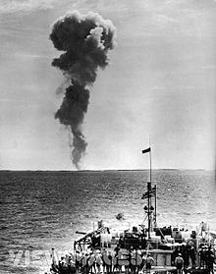 Montebello Islands the focus of new research to test nuclear impact.
 By Susan Standen 22 Mar 21, A new Edith Cowan University research project hopes to collect important data on the impact of historical nuclear testing in the remote Montebello Islands area.
Key points:
- New research will look at remaining radioactive residue in Montebello Islands
- Plutonium nuclides persist in sediment of the marine environment
- The research may be used in future to track fish migrations along the WA coast
Sixty years after the British government conducted nuclear explosion testing on the islands, there is little data available to find how much residue plutonium still exists.
The project hopes to be the first study to outline how and where man-made radioactivity is still existing in the marine sediment.
Collections of sediment are being collected from remote field trips to the islands to analyse amounts of residue plutonium radionuclides.,,,,,,,,,,,,
Ms Hoffman says other island nations affected by nuclear blasts will be able to use the Montebello Islands research as a reference baseline to start their own investigations.
Will it inform health research?
Ms Hoffman says the first step is to find out what remains there as a legacy…………..
The project is a collaboration between the Edith Cowan University, the Department of Biodiversity and Conservation and the Australian Radiation Protection and Nuclear Safety Agency. https://www.abc.net.au/news/2021-03-22/montebellos-nucelar-fallout-research/13260242
Kim Jong-un wants ”arms control talks” with USA, not denuclearisation in the short term
|
North Korea’s new nuclear gambit and the fate of denuclearisation, East Asia Forum, 22 March 2021 Author: Evans JR Revere, BrookingsIn March 2012, North Korean Foreign Minister Ri Yong-ho told a group of US experts and former officials that North Korea would not denuclearise until the United States removed its ‘threat’. He defined this as the US–South Korea alliance, the presence of US troops in South Korea, and the US nuclear umbrella defending South Korea and Japan.
‘If you remove the threat’, Ri said, ‘we will feel more secure, and in 10 or 20 years we will be able to consider denuclearisation’. ‘In the meantime,’ he declared, ‘we can sit down and engage in arms control talks as one nuclear power with another’. Ri’s remarks provided valuable insight into North Korea’s strategy and goals at the time. Today, his words shed light on why North Korean leader Kim Jong-un has doubled down on nuclear and ballistic missile programs. Faced with a new US president whose North Korea policy remains unclear, Kim Jong-un has decided to pre-empt the outcome of the ongoing US policy review by ending all prospects of denuclearisation and expanding his nuclear and missile capabilities instead. In doing so, Kim hopes to compel Washington to engage in ‘arms control talks’ if it hopes to slow the North’s nuclear program. Kim’s gambit to change the main topic of US–North Korea dialogue from denuclearisation to arms control was hiding in plain sight in his January 2021 address to the Korean Workers Party Congress. He described North Korea’s nuclear weapons development as the nation’s ‘strategic and predominant goal’ and an ‘exploit of greatest significance in the history of the Korean nation’. Declaring North Korea a ‘responsible nuclear weapons state’, Kim’s message was that the regime is now a permanent nuclear power and Washington must deal with it as such. No less important was Kim’s announcement of a plan to enhance his nuclear and missile arsenals by developing ‘ultramodern tactical nuclear weapons’, multiple-warhead missiles and solid-fuel intercontinental ballistic missiles. Kim’s remarks signalled his determination to make a dangerous threat even more potent. Much has been said about the Biden administration’s ongoing North Korea policy review. But Kim Jong-un’s remarks to the Party Congress suggest Pyongyang has conducted its own review, the result of which will be a major challenge for a new US administration still finding its feet…………… https://www.eastasiaforum.org/2021/03/22/north-koreas-new-nuclear-gambit-and-the-fate-of-denuclearisation/ |
|
UK nuclear announcement ‘shocking and alarming’ warn the Elders
UK nuclear announcement ‘shocking and alarming’ warn the Elders https://theelders.org/news/uk-nuclear-announcement-shocking-and-alarming-warn-elders MARY ROBINSONNUCLEAR DISARMAMENT-22 Mar 21,
The Elders say UK proposals risk contributing to a dangerous new nuclear arms race.
Following the release by the UK government of its Integrated Review of Security, Defence, Development and Foreign Policy, Mary Robinson, Chair of The Elders, said:
“The announcement today by the UK Government of its intention to increase by over 40% the cap on its nuclear warhead numbers is surprising and deeply alarming. This would be incompatible with the UK’s international obligations to pursue disarmament under the Non-Proliferation Treaty (NPT), and risks contributing to a dangerous new nuclear arms race. It also risks undermining the NPT Review Conference due to take place in August this year.
It is particularly shocking that a permanent member of the UN Security Council should make such an announcement at a time when other countries have been taking positive steps to reverse the deterioration in nuclear arms controls, following the extension of New START between the US and Russia, and the entry into force of the Treaty on the Prohibition of Nuclear Weapons earlier this year.
While the UK cites increased security threats as justification for this move, the appropriate response to these challenges should be to work multilaterally to strengthen international arms control agreements and to reduce – not increase – the number of nuclear weapons in existence.
The Elders call on all nuclear states to demonstrate their commitment to nuclear disarmament, and to make concrete reductions to their stockpiles in line with the minimisation agenda put forward by The Elders.
As decision-makers take stock of the UK government’s announcement, we urge all world leaders to recall the spirit of Ronald Reagan and Mikhail Gorbachev’s declaration in 1985 that “a nuclear war can never be won and must never be fought”, and redouble their efforts to make progress towards achieving a world wholly free from nuclear weapons.”
For media inquiries, please contact Luke Upchurch, Director of Communications at The Elders (+44 7741 742 064) or email:media@theElders.org
Boris Johnson joins Britain up to a perilous, uncontrollable, nuclear weapons race
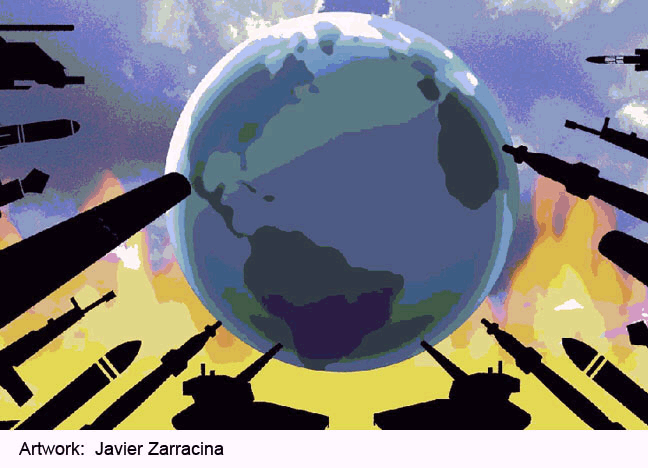  Boris Johnson is playing a dangerous nuclear game Boris Johnson is playing a dangerous nuclear gameSerhii Plokhy, Guardian, 19 Mar 21,Britain has joined an uncontrolled arms race in a world more unstable and unpredictable than even during the cold war
Boris Johnson’s decision to increase the cap on British nuclear stockpiles by more than 40%, from 180 to 260 Trident nuclear warheads, might easily be interpreted as a manoeuvre inspired by domestic politics, rooted in the Conservative party’s longstanding love affair with nuclear power and the recent politics of Brexit. But the decision has broader significance. It reflects the rapidly changing international nuclear environment, and will make it significantly worse. The world entered a new and dangerous era on 2 August 2019. On that day, the planet’s strongest nuclear powers, the US and Russia, declared their withdrawal from the Intermediate-range Nuclear Forces treaty signed by Ronald Reagan and Mikhail Gorbachev in 1987. The treaty was the last cold war-era arms control agreement remaining in force. We are now officially at the start of an uncontrolled nuclear arms race. What this meant became clear on 8 August, less than a week after the Reagan-Gorbachev agreement was abandoned. The reactor of a nuclear-powered and nuclear-armed Russian cruise missile, codenamed Skyfall, exploded in the Barents Sea, killing five Russian scientists and naval officers and contaminating the atmosphere and waters in the Arkhangelsk region of Russia. The ultimate target of Skyfall, as President Putin demonstrated in a public video a year earlier, is the US. Today, we are back to a situation that resembles the period preceding the Cuban missile crisis, when there were no mutually binding arms control agreements and various countries, the UK among them, were competing to outspend one another in building nuclear arsenals. In October 1962, only luck and the fear of nuclear confrontation shared by John Kennedy and Nikita Khrushchev saved the world from nuclear war. The shock of the crisis led the two superpowers to negotiate a number of arms control deals, ranging from the Partial Nuclear Test Ban treaty to arms control and limitation agreements. MAD, or mutually assured destruction, a concept strongly associated in the public imagination with Dr Strangelove’s “Doomsday Machine”, miraculously kept the nuclear powers at bay, maintaining what Churchill called the “balance of terror”………………….. While we face new challenges, we lack the fear of nuclear war developed by previous generations of political leaders and societies. Kennedy and Khrushchev considered nuclear war unwinnable. This is now changing with the scrapping of the old arms control treaties, the renewal of the nuclear arms race, and the development of new technologies making possible the execution of extremely accurate nuclear strikes. These factors have lowered the psychological barrier for using nuclear arms and brought back the illusion of the pre-hydrogen bomb age that wars conducted with limited use of nuclear weapons can be fought and won. That in turn feeds the new nuclear arms race, which the US and Russia have already started by abandoning cold war-era limitations. Hence the true importance of Johnson’s announcement, which opens the door for the UK and other countries to join the race. Even if the government decides not to limit itself to lifting the cap on Trident nuclear warheads and in fact acquires all 80 warheads over a short period of time, the world nuclear balance will hardly change. Despite all the changes around the globe since the end of the cold war, there are still two nuclear superpowers: Russia, with approximately 4,300 warheads, and the US, with an estimated 3,800 warheads. Eighty additional Trident warheads will not make much of a difference, nor will they make the UK safer if it comes to the worst. But by deciding to increase the cap, the UK – the world’s third country to develop its own nuclear capability – is sending the wrong signal: rearm. Instead, the world should be heading to the negotiating table to breathe new life into the arms control talks that all but ceased with the end of the cold war. That is no easy task, as negotiations will now have to go beyond the two nuclear superpowers and include the rest of the nuclear “haves” – first and foremost, China. The UK could play an important role in stopping the new nuclear arms race, instead of restarting it.
|
|
UK govt – cutting costs on troops as it expands nuclear missile numbers?
|
Labour question ‘baffling decision’ to expand nuclear missile numbers as Defence Secretary hints at army numbers cutsLabour have questioned the “baffling decision” to expand the nuclear missile numbers and demanded answers after the UK Defence Secretary refused to rule out cuts to the armed forces. The Scotsman By Alexander BrownSunday, 21st March 2021, ”…………. The Government last week published details of its major review of foreign and defence policy, known as the Integrated Review.
It stated the UK could consider deploying its nuclear arsenal against non-nuclear countries if they possess equivalent weapons of mass destruction – including new “emerging technologies”. However, UK Defence Secretary Ben Wallace refused to deny Army Numbers will be cut by up to 10,000. Asked if he could guarantee to maintain troop numbers, Mr Wallace told Sky’s Sophie Ridge: “I am not going to reveal on the media before Parliament, the details of the numbers of men and women of our armed forces. Labour’s Shadow Defence Secretary John Healey MP called for more support for military numbers, and accused the Government of repeating it’s mistakes. He said: “After weeks of trying to hide their true intentions, the cat is out the bag – the threats Britain faces are increasing but Conservative ministers are cutting the Army yet again. “Over the last decade the Conservatives have broken their pledges on full-time Forces numbers and run down our Armed Forces……… https://www.scotsman.com/news/politics/labour-question-baffling-decision-to-expand-nuclear-missile-numbers-as-defence-secretary-hints-at-army-numbers-cuts-3173345 |
|
UN expresses concern over UK’s move to increase nuclear weapons arsenal
|
UN expresses concern over UK’s move to increase nuclear weapons arsenal https://www.business-standard.com/article/international/un-expresses-concern-over-uk-s-move-to-increase-nuclear-weapons-arsenal-121031800241_1.html
The UN has expressed concerns over the UK’s decision to increase its nuclear weapons arsenal, as part of the country’s foreign policy overhaulThe UN has expressed concerns over the UK’s decision to increase its nuclear weapons arsenal, as part of the country’s foreign policy overhaul. The UK’s decision is contrary to its obligations under Article VI of the Nuclear Non-Proliferation Treaty (NPT), Xinhua news agency quoted Stephane Dujarric, spokesman for UN Secretary-General Antonio Guterres, as saying at a briefing on Wednesday. It could have a damaging impact on global stability and efforts to pursue a world free of nuclear weapons, he said.
“At a time when nuclear weapon risks are higher than they have been since the Cold War, investments in disarmament and arms control is the best way to strengthen the stability and reduce nuclear danger,” Dujarric was quoted as further saying. The UK government on Tuesday announced its plan to increase the number of nuclear warheads to not more than 260, reversing its previous policy of reducing its overall nuclear warhead stockpile ceiling to not more than 180 warheads by the mid-2020s. Outlining the strategy to MPs, Prime Minister Boris Johnson said the UK would have to “re-learn the art” of competing against countries with “opposing values”. But he added the UK would remain “unswervingly committed” to the NATO defence alliance and preserving peace and security in Europe. Speaking to the BBC on Tuesday, Beatrice Fihn, head of the International Campaign to Abolish Nuclear Weapons, described the UK’s decision to change its nuclear provision as “outrageous, irresponsible and very dangerous”. She said it went against international law and did not address the real security threats faced by the UK such as climate change and disinformation. |
|
Outcry in Tahiti over nuclear fallout study
Outcry in Tahiti over nuclear fallout study https://www.rnz.co.nz/international/pacific-news/438520/outcry-in-tahiti-over-nuclear-fallout-study 16 March 2021 Walter Zweifel, RNZ Pacific Reporter
For test veteran groups, the latest findings by Disclose confirmed that France had been economical with the truth.
At the heart of their campaign is the push for compensation, which has been a decade-long battle over measured and measurable fallout.
The Disclose assessment, if accepted, would make thousands more sick people eligible for compensation, and incur on France an obligation to pay out hundreds of millions of dollars.
The pro-independence leader Oscar Temaru said he denounced the tests all along and claims that the Disclose study proves that contamination extended to all inhabited islands as well as to other Pacific countries.
According to him, the test legacy should be raised by the Pacific Islands Forum.
Temaru furthermore pointed to the UN resolution of 2013 which put French Polynesia on the decolonisation list.
He argued that France had to report to the UN about the health and environmental impact of its 193 nuclear weapons tests.
Temaru accused France of duplicity in the way it dealt with French Polynesia and also took a swipe at the territory’s rival political side, which defended the tests.
A former president Gaston Flosse admitted he travelled the Pacific to reassure the region of the tests’ safety, but said he would now oppose the tests with physical force if he had known what price the territory had to pay.
In a statement, Flosse said on one hand that if the Disclose study was correct then France lied to French Polynesians for years.
On the other hand, he said France must re-examine all compensation claims that have been rejected, and should also scrap the compensation law because its very basis no longer existed.
The French Atomic Energy Commission, the French defence minister and the French High Commissioner in French Polynesia have largely dismissed the Disclose study.
In essence, they saw no new elements or said the existing studies had taken all relevant information into account.
The French Polynesian president Edouard Fritch expressed surprise at the virulent reaction in Tahiti.
However, nearly three years ago he told the assembly that he himself had been telling lies about the tests for decades.
For now, the French compensation commission will continue to pay compensation within the established framework, benefiting at best dozens of people.
Compensation is paid out of a sense of national solidarity not because the French state recognises any liability.
‘Toxic masculinity’ – Britain to build more nuclear weapons

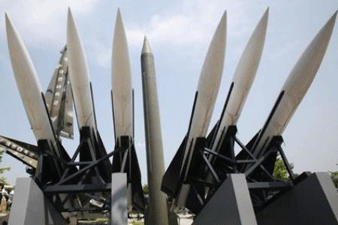
Boris Johnson ‘violating international law’ with plan to build more nuclear weapons, Defence review appears to breach Article 6 of nuclear non-proliferation treaty, Independent, Jon Stone Policy Correspondent, 16 Mar 21,
”………..Reacting to the new policy, Beatrice Fihn, executive director of the International Campaign to Abolish Nuclear Weapons (ICAN), said: “A decision by the United Kingdom to increase its stockpile of weapons of mass destruction in the middle of a pandemic is irresponsible, dangerous and violates international law.
“While the British people are struggling to cope with the pandemic, an economic crisis, violence against women, and racism, the government choses to increase insecurity and threats in the world. This is toxic masculinity on display.
“While the majority of the world’s nations are leading the way to a safer future without nuclear weapons by joining the Treaty on the Prohibition of Nuclear Weapons, the United Kingdom is pushing for a dangerous new nuclear arms race.”
In a further statement, the organisation suggested the UK would face censure at the next NPT review conference, which is due to take place in August at the United Nations.
“The United Kingdom is legally obligated under the nuclear non-proliferation treaty to pursue disarmament. States will meet soon to review the NPT’s success and when they do, the UK will have to answer for its actions,” the statement said.
ICAN won the Nobel Peace Prize in 2017 for its “ground-breaking efforts to achieve a treaty-based prohibition” of nuclear weapons.
Article 6 of the NPT, to which Britain is a signatory, commits countries to “pursue negotiations in good faith on effective measures relating to cessation of the nuclear arms race at an early date and to nuclear disarmament”.
Kate Hudson, general secretary of the UK’s Campaign for Nuclear Disarmament, said: “A decision to increase Britain’s nuclear arsenal absolutely goes against our legal obligations under the nuclear non-proliferation treaty.
“Not only is the UK failing to take the required steps towards disarmament, it is willfully and actively embarking on a new nuclear arms race – at a time when presidents Biden and Putin have renewed their bilateral nuclear reductions treaty. Britain must not be responsible for pushing the world towards nuclear war. This is a dangerous and irresponsible move, and must be reversed.”….. https://www.independent.co.uk/news/uk/politics/boris-johnson-uk-nuclear-weapons-international-law-b1817827.html
UK should build foreig policy on aid, conflict resolution, not on reversing nuclear disarmament
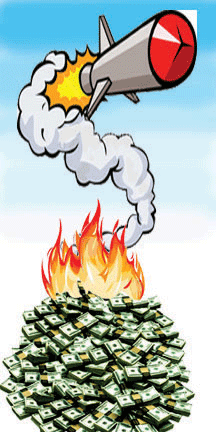 Tax Research UK 16th March 2021. Billions will be wasted, nuclear waste will be created, a dangerous precedent of reversing disarmament will have been set, and the world will be more unsafe, all for no gain. If the UK was wise now (and but isn’t) it would be pursuing a very different foreign policy, based on that of
Norway.
That country does punch above its weight. It has a strong foreign policy based on aid. It uses that to build strong diplomatic links around the world. And in the process it works, quietly, on conflict resolution.
That’s the way foreign policy should be done. We are just aggressively waving colonial flags. And that’s a disaster as well as being nuclear insanity.
https://www.taxresearch.org.uk/Blog/2021/03/16/nuclear-insanity/
China maintains only a lean nuclear weapons force – aimed at survival if attacked.
When it comes to China’s nuclear weapons, numbers aren’t everything
Threat inflation tends to lead to poor policy outcomes. When it comes to China’s nuclear arsenal, it’s important for American leaders to accurately understand the nature of the problem. Nuclear risks between the United States and China manifest differently than those of the past U.S.-Soviet nuclear competition, or that of the United States and Russia today.
Concerns regarding nuclear use in the U.S.-China context stem from, among other things, mutual mistrust and the manipulation of risk below the nuclear threshold, largely from qualitative force posture and strategy choices each country has made. Quantitative factors — most importantly the size of China’s nuclear arsenal — are less pressing.
Despite this reality, a recent exchange between Sen. Tom Cotton, R-Ark., and Adm. Philip Davidson, commander of U.S. Indo-Pacific Command, reveals how the nature of nuclear risk with China continues to be mischaracterized in Washington. Cotton expressed concern during a Senate hearing that China may attain “nuclear overmatch” against the United States if it were to triple or quadruple its nuclear stockpile. Adm. Davidson agreed.
But Cotton misstated the degree to which China may expand its nuclear warhead stockpile relative to the United States. In doing so, he suggests the United States should focus more on quantitative nuclear arms racing, stating that “it is much better to win an arms race than to lose a war.”
Cotton’s framing gets several facts wrong. First, the U.S. Defense Department’s most recent report on the Chinese military states that China’s warhead stockpile is “currently estimated to be in the low-200s.” This pales in comparison to the total U.S. inventory of 5,800 nuclear warheads.
Of these, 3,800 are available for deployment, with approximately 1,400 warheads already on alert delivery systems. Additionally, 150-200 gravity bombs sit in protected bunkers at five European air bases. Insofar as “overmatch” — a concept with little use to nuclear strategists — exists, it is squarely with the United States.
Cotton also incorrectly suggests that the U.S.-Russia New START arms control pact limits the United States to “800 deployed nuclear weapons.” In reality, New START permits 1,550 deployed warheads (including bombers counted as a single warhead apiece per treaty rules).
So why are senior officials and members of Congress so focused on numerical comparisons? Examining qualitative differences between U.S. and Chinese nuclear forces and accompanying doctrines is harder to do. These differences tell a slightly less alarmist story when it comes to the bilateral nuclear competition, but by no means present easy answers to the project of deterring China or avoiding nuclear war.
Since China’s first nuclear test in 1964, its leaders have not sought to “race to parity” with the United States and Russia. This policy originates in part from former chairman of the People’s Republic of China, Mao Zedong, whose had a dismissive view of nuclear weapons, calling them “paper tigers.” But even as China has modernized its nuclear forces and practiced more sophisticated nuclear operations, it maintains a lean nuclear force — one postured to survive an adversary’s first strike and still credibly maintain the “minimal means of reprisal.” Ongoing Chinese investments in road-mobile intercontinental ballistic missiles and better submarine-launched ballistic missiles support this goal……………
Overinflating the nature of the challenge from China’s nuclear forces would be especially unwise if it leads to U.S. overinvestment in nuclear systems, when the challenges in the Asia-Pacific region today require improved conventional deterrence. Strategy, after all, requires matching ends with means. Bipartisan support already exists for new conventional firepower, as evidenced by approval for the Pacific Deterrence Initiative…………..
Chinese leaders, meanwhile, should view the Cotton-Davidson interaction as an example of how U.S. officials may interpret China’s nuclear modernization in a vacuum of information and dialogue. Chinese officials have ducked U.S. offers for strategic dialogue in recent years; hopefully, following an upcoming ministerial meeting, U.S. and Chinese civilian and military officials can discuss — and begin to define — strategic stability. By beginning this dialogue, U.S. officials can focus on solving the qualitative challenges that actually exist, rather than getting bogged down in imagined concerns about “overmatch.” https://www.defensenews.com/opinion/commentary/2021/03/13/when-it-comes-to-chinas-nuclear-weapons-numbers-arent-everything/
UK govt set to increase Trident nuclear warheads, despite commitment to decrease nuclear weaponss stockpile
The National 13th March 2021, THE UK Government is expected to set out plans to increase the number of Trident nuclear warheads next week in what has been described as a “highly provocative” move.
In 2015 the UK’s strategic defence review committed to “reduce the overall nuclear weapon stockpile to no more than 180” by the 2020s – but Whitehall sources indicated this cap may
increase.
Trident nuclear warhead numbers set to increase for first time since cold war
|
Trident nuclear warhead numbers set to increase for first time since cold war https://www.theguardian.com/uk-news/2021/mar/12/trident-nuclear-warhead-numbers-set-to-increase-for-first-time-since-cold-war
Defence and foreign policy review expected to signal rise, in move analysts say is diplomatically provocative Dan Sabbagh Defence and security editor Downing Street’s integrated review of defence and foreign policy is expected next week to signal a potential increase of the number of Trident nuclear warheads for the first time since the end of the cold war.
Whitehall sources indicated that a cap on total warhead numbers – currently set at 180 – is expected to increase, although the exact figure is not yet known, in a move that analysts said was diplomatically provocative. The UK’s stockpile of nuclear weapons peaked at about 500 in the late 1970s, but had been gradually decreasing ever since as the perceived threat from the Soviet Union and now Russia had been assumed to be decreasing. The last strategic defence review, in 2015, committed the UK to “reduce the overall nuclear weapon stockpile to no more than 180 warheads” by the mid 2020s – and reducing the numbers of operationally available warheads to 120. Each warhead is estimated to have an explosive power of 100 kilotons. The atomic bomb dropped on Hiroshima at the end of the second world war was about 15 kilotons. The full reasons for the anticipated move are not yet clear but it comes amid speculation it is designed to help persuade the US to co-fund aspects of a Trident replacement warhead for the the 2030s. Its costs, too, are uncertain. “If this is confirmed, this would be a highly provocative move,” said David Cullen, the director of the Nuclear Information Service. “The UK has repeatedly pointed to its reducing warhead stockpile as evidence that it is fulfilling its legal duties under the nuclear non-proliferation treaty. “If they are tearing up decades of progress in reducing numbers, it will be a slap in the face to the 190 other members of the treaty, and will be regarded as a shocking breach of faith.” Britain has operated its own nuclear weapons since the 1950s but for the past 60 years, following an agreement between the then prime minister, Harold Macmillan, and the then US president, John F Kennedy, the UK has been heavily dependent on US technology. Trident missiles are deployed in four submarines, one of which is continuously at sea to make sure it can strike back in the event of an unprovoked nuclear attack. It relies on an existing US W76 warhead, based on a 1970s design, called Holbrook. However, the W76 is ageing, and the US has proposed developing a more powerful replacement, called the W93. The UK is particularly keen for the US to start work on the W93 and last summer the defence secretary, Ben Wallace, lobbied Congress for the work to go ahead. British MPs voted to renew Trident in principle in 2016, but the Commons is expected to have to vote on a new warhead at some point. In 2016, the Conservatives almost uniformly backed renewal, the SNP voted against, while Labour was split. The MoD has said developing the next generation of Dreadnought submarines to carry the new warhead would cost £30bn plus a £10bn contingency. But officials have so far refused to say how much the warhead would cost. An MoD spokesperson said: “The UK is committed to maintaining its independent nuclear deterrent, which exists to deter the most extreme threats to our national security and way of life. “Replacing the warhead and building four new Dreadnought class submarines are UK sovereign programmes that will maintain the deterrent into the future. We will not comment on speculation about the integrated review, which will be published on Tuesday.” |
|
How the world came close to nuclear war catastrophe
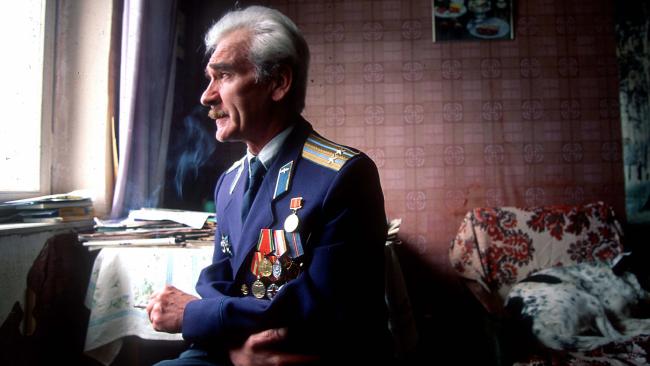
Stanislav Petrov.
Bilinovich: Averting nuclear apocalypse https://observer.case.edu/bilinovich-averting-nuclear-apocalypse/ How the world came close to catastrophe, Beau Bilinovich, Staff Columnist, March 12, 2021
No one wants to be the cause of a nuclear apocalypse. It is our responsibility to avoid one at all costs. But what happens when we don’t have a choice?
There have been numerous times throughout history where we have, by some stroke of luck and fortune, avoided catastrophe. Each of these instances tells a story, an insightful tale of human folly that culminates in one important lesson: We cannot trust ourselves with the most dangerous weapon ever invented.
There is one story which is bittersweet—in the end, everything is okay, yet it leaves everyone with a feeling of unease and urgency. Nonetheless, this story must be told, because we absolutely should learn from it.
The story began on Sept. 26, 1983 and took place deep inside the former Soviet Union. Operations were normal at Serpukhov-15, a military outpost just outside Moscow. The hero of the story was Stanislav Petrov, the officer on duty at the military installation. He and a group of other officers were monitoring Oko, the Soviet Union’s nuclear alert system.
Suddenly, the computer flashed a bright red warning: “Launch.” Alarms wailed. The officers were in shock. The United States had launched an intercontinental ballistic missile (ICBM). Oko detected no doubt.
The officers stood there, frozen, despite being trained for such a harrowing event. They could not believe what was happening.
Two, three, four, five—Oko had detected more missiles. In total, five ICBMs were reported to have been launched towards the Soviet Union on a path of destruction. Petrov had to make a decision soon: inform his higher-ups or wait.
In those crucial moments, Petrov decided not to do anything at all, despite the possibility of catastrophe looming over him. He did not even notify those higher in the chain of command. He waited.
Minutes passed, but no strike ever occurred. Relief. The warning was just a false alarm. No need to worry anymore.
Investigations concluded that the false alarm was triggered by the reflection of sunlight off the tops of clouds. Though this seems like a small mistake, it was not an isolated incident. There have been many other times where the world came close to nuclear war. One false alarm was caused by a computer playing a military training tape, and another by a faulty computer chip—tiny errors that could have bore serious consequences.
But simple mistakes are only one element that makes nuclear weapons so unfathomably dangerous and risky.
Just as concerning is the gross negligence of nuclear missile launch officers. A two-star general responsible for America’s nuclear arsenal was caught on a drunken bender while on a visit to Russia in 2013. Two launch officers were investigated as part of a narcotics scandal, where they reportedly used drugs and other illegal substances. Around 100 officers were implicated in cheating on their proficiency exams; only nine of the officers were duly dismissed.
There are also threats from outside the U.S.
Andrew Futter, associate professor at the University of Leicester, suggested that America’s nuclear weapons system could be hacked to gather information, shut down the system and even launch missiles. In fact, the National Nuclear Security Administration, which controls and maintains the nuclear weapons system, was hacked in December by Russian intelligence services, exposing the country’s most sensitive information regarding nuclear weapons.
Nuclear weapons are risky, dangerous and destructive. In total, there are 14,525 nukes across the world, with the U.S. and Russia possessing the vast majority—over 6,000 each. That is enough explosive power to end the world multiple times over. Humanity would cease to exist in the event of a nuclear war.
This is precisely why the exceptional judgment of Stanislav Petrov is heroic. Most people don’t know him, yet he secretly saved the entire world from a disastrous future. Despite his commendable behavior, we should not rely on one person to protect us.
We are left with no other option than to confront the truth.
Those entrusted with the authority to deploy and launch these missiles at a moment’s notice cannot be trusted. The systems designed to monitor attacks cannot be trusted. Foreign nations in possession of this same deadly tool cannot be trusted. While we may think we can handle nuclear weapons, reality shows the opposite. In truth, no one can be trusted with nuclear weapons. If we do not realize this, we may not have any more stories to tell.
Our inability to trust anyone with these weapons demands that we abolish them. The sooner we accomplish this goal, the safer the world becomes. Getting rid of these weapons is the only way to avoid a nuclear apocalypse.
French Nuclear tests: revelations about a cancer epidemic

|
Nuclear tests: revelations about a cancer epidemic https://www.mediapart.fr/journal/international/090321/essais-nucleaires-revelations-sur-une-epidemie-de-cancers MARCH 9, 2021 BY DISCLOSE
In a confidential report, the Polynesian government acknowledges the existence of a “cluster of thyroid cancers” directly linked to French nuclear tests.On July 2, 1966, in the greatest secrecy, France carried out its first nuclear test in the Polynesian sky. That day, at 5:34 am, Aldebaran, the name given to the bomb, was fired from a barge installed on an azure lagoon, near the Mururoa atoll. A few microseconds after the explosion, a fireball appears. This incandescent mass of several thousand degrees rises in the sky and forms, as it cools, a huge cloud of radioactive dust dispersed by the winds. No less than 46 “atmospheric” tests like this one have been carried out in the space of eight years. Each time, the explosion generated fallout contaminating everything in their path. Starting with the inhabitants of the islands. In total, they were exposed 297 times to intense levels of radioactivity. The general staff have always held to the same line of defense. The atmospheric tests, presented as “clean”, would not have had “consequences for the health” of the Polynesians. For years, the associations defending the victims of the trials have been convinced to the contrary. As for the scientific community, it has tried several times to verify this position through in-depth analyzes of official data, without success. Latest illustrations of this failure: the study published by the National Institute of Health and Medical Research (Inserm) on February 18. At the end of this work commissioned by the Ministry of Defense eight years ago, Inserm considered that the “links between the fallout from atmospheric tests and the occurrence of radiation-induced pathologies” were difficult to establish, due to a lack of data. reliable on the contamination of the archipelagos. Cluster of cancers ” However, a confidential report submitted to the Polynesian government a year earlier, in February 2020, argues the opposite. Disclose has obtained a copy of this never-before-released document. Soberly titled “Health consequences of French nuclear tests in the Pacific”, this eight-page report was written by a French military doctor at the request of the Monitoring Medical Center, an administration created in 2007 by the French and Polynesian governments and responsible for screening radiation-induced diseases. In other words, pathologies linked to repeated exposure to ionizing radiation. According to the author, some 10,000 Polynesians, including 600 children under the age of 15 living in the Gambier Islands, Tureia or even Tahiti have thus received a dose of radioactivity of 5 millisieverts (mSv), that is to say five times more than the minimum threshold (1 mSv) above which exposure is considered dangerous for human health. But the most embarrassing information is on page 5 of the document. For the first time, an official report establishes a direct link between nuclear tests and the extent of the number of cancers in the population. “The presence of a ‘cluster’ of thyroid cancers focused on the islands subjected to fallout during aerial shots, and in particular in the Gambier Islands, leaves little doubt about the role of ionizing radiation, and in particular of thyroid exposure to radioactive iodine, in the occurrence of this excess of cancers, ”says the author. The thyroid, an organ at the base of the neck, is particularly sensitive to ionizing radiation, especially in childhood, when the risk of developing thyroid cancer is greatest. The incidence of thyroid cancer and the link with the atmospheric gunfire campaign were precisely the subject of an Inserm analysis in 2010. According to this study, 153 thyroid cancers were diagnosed between 1985 and 1995 in the population born before 1976 and residing in French Polynesia. As a result, the number of people with thyroid cancer was two to three times higher than in New Zealand and Hawaii. Without being able to establish a direct link with nuclear tests, the college of experts already deplored the lack of available data. Based on data from the time, Disclose and Interprt, in partnership with the Science and Global Security program at Princeton University (United States), reassessed the doses of radioactivity received in the thyroid by the inhabitants of the Gambier, of Tureia and Tahiti during six of the most contaminating nuclear tests. Our estimates show that the doses received would be between two and ten times higher than the estimates established by the French Atomic Energy Commission (CEA) in 2006. How can we explain such a gap between our results and those of the CEA? The answer lies in the details of the calculation options chosen by the scientists at the Atomic Energy Commission. Take the example of Aldebaran, the first test in the open air. The CEA estimated that the population of the Gambier Islands, very exposed to toxic fallout, only drank river water, but no rainwater, which is much more loaded with radioactive particles. Many witnesses met in Polynesia question this assertion. This is the case with Julie Lequesme, 12 years old at the time of the events. “We had only that, rainwater,” says the resident of Taku, a village northeast of Mangareva, the main island of the Gambier archipelago. The same goes for Rikitea, the capital of the island, where “the running water network was not completed until the end of the 1970s”, specifies Jerry Gooding, the former president of the association. , the main organization supporting civilian victims of nuclear tests. Rainwater consumption is also confirmed by at least four official documents we obtained. A study by the Office for Scientific and Technical Research Overseas (Orstom) published in August 1966, one month after the start of the tests, thus notes that some of the islanders only consumed rainwater, in particular in because of their isolation. Same conclusion in a report from the Joint Biological Control Service (SMCB), an army service, dated April 24, 1968. By reintegrating the consumption of rainwater after Aldebaran, our estimates for the exposure of a child aged 1 to 2 at the time are 2.5 times higher than official calculations. Of the six tests we reconstructed, the consumption of rainwater was the main source of exposure to radioactivity for five of them. By choosing not to incorporate this data or by minimizing its importance, the state has therefore knowingly underestimated the extent of the contamination. In the Gambiers, cancer as a legacy According to the Ministry of the Armed Forces, the Gambier Islands have been affected by atmospheric fallout 31 times. In fact, the archipelago was struck by all the tests carried out between 1966 and 1974. Since then, cancer has spread everywhere. From Rikitea to Taku, to the shore of Taravai, the inhabitants are convinced: this plague is directly linked to atomic experiments. By investigating the field and meeting dozens of witnesses, Disclose was able to map the disease in Mangareva, the main Gambier island. Although we have not been able to establish a direct link between the trials and the number of cancers on site, the result is instructive. Yves Salmon developed carcinoma, a radiation-induced cancer of the blood, in 2010. His wife contracted breast cancer. She was recognized as a victim of French nuclear tests. The same goes for his sister. Utinio, Yves Salmon’s neighbor, contracted thyroid cancer in 2001. The man, who still lives near the village of Taku, spent his childhood in the Gambiers. In 2010, the French state finally recognized him as a victim of nuclear tests. Monique, 69, is Utinio’s cousin. She was a thyroid cancer survivor after two years in hospital and received state compensation in August 2011. Monique has six children, four of whom have thyroid cancer. Her two daughters have sought compensation from the Nuclear Test Victims Compensation Committee (Civen) without having received any answers yet. Sylvie (first name has been changed) and her older sister, born in 1972 and 1971, both suffered from breast cancer. “It was when our elders started dying that we really began to wonder,” said the eldest. Their mother died of the same disease in 2009. She was recognized as a victim of nuclear tests, just like Sylvie. This resident of Mangareva now fears for her daughter. Julie Lequesme’s father, an elder from Taku village, died of throat cancer in 1981 after working in Mururoa. “The island doctor told me that based on my father’s X-rays, he was a heavy smoker,” she says. However, my father never touched a cigarette. Her husband, a CEA alumnus, also died of cancer in 2010. In the family of Catherine Serda, a former resident of the small village of Taku, eight people suffered from cancer between the end of the 1970s and the beginning of the 1990s. Their common point: they all lived in Mangareva at the time. tests. If you have any information to give us, you can contact us at enquete@mediapart.fr. If you wish to send documents through a highly secure platform, you can connect to the frenchleaks.fr site |
|
1 This Month





PLEASE OPPOSE HR 8255 AND S.3639 – bills would accelerate satellite deployment, with no environmental review or safeguards – https://ncstd5li.quorum.us/campaign/169331/
To see nuclear-related stories in greater depth and intensity – go to https://nuclearinformation.wordpress.com
-
Archives
- October 2026 (74)
- September 2026 (339)
- August 2026 (330)
- July 2026 (355)
- June 2026 (287)
- May 2026 (306)
- April 2026 (356)
- March 2026 (251)
- February 2026 (267)
- January 2026 (308)
- December 2025 (358)
- November 2025 (359)
-
Categories
- 1
- 1 NUCLEAR ISSUES
- business and costs
- climate change
- culture and arts
- ENERGY
- environment
- health
- history
- indigenous issues
- Legal
- marketing of nuclear
- media
- opposition to nuclear
- PERSONAL STORIES
- politics
- politics international
- Religion and ethics
- safety
- secrets,lies and civil liberties
- spinbuster
- technology
- Uranium
- wastes
- weapons and war
- Women
- 2 WORLD
- ACTION
- AFRICA
- Atrocities
- AUSTRALIA
- Christina's notes
- Christina's themes
- culture and arts
- Events
- Fuk 2022
- Fuk 2023
- Fukushima 2017
- Fukushima 2018
- fukushima 2019
- Fukushima 2020
- Fukushima 2021
- general
- global warming
- Humour (God we need it)
- Nuclear
- RARE EARTHS
- Reference
- resources – print
- Resources -audiovicual
- Weekly Newsletter
- World
- World Nuclear
- YouTube
-
RSS
Entries RSS
Comments RSS

