Russia to test powerful new nuclear weapon
RUSSIA ANNOUNCES PLANS TO TEST NUCLEAR WEAPON CALLED “SATAN II”AFTER YEARS OF DEVELOPMENT, RUSSIA IS READY TO LAUNCH THE POWERFUL NEW NUKES. Futurism, by DAN ROBITZSKI 7 May 221, Son of Satan,
The Russian military is prepared to launch three tests of its powerful new nuclear weapon, the RS-28 Sarmat, which has earned the nickname “Satan II.”
Tests for the new intercontinental ballistic missile will begin within the next few months, military insiders told TASS, a news outlet owned by the Russian government that refers to the weapon as “invulnerable.” That’s alarming news — while the Sarmat has been under development for years, the fact that it’s now ready for test launches brings us into a dangerous new era of ultra-powerful nuclear weapons……….. https://futurism.com/the-byte/russia-test-nuclear-weapon-satan
U.S. Nuclear Weapons Upgrade Sees Delay on Leaky Silos, Old Tech
U.S. Nuclear Weapons Upgrade Sees Delay on Leaky Silos, Old Tech,
Tony Capaccio, Bloomberg News, (Bloomberg) 7 May 21, — Upgrading America’s nuclear missile arsenal will likely take longer than expected because of the complexities of pulling 1970s-era ICBMs out of aging silos and testing and installing replacement missiles and technology to run the system for decades to come, according to a congressional audit.
The Air Force faces the complicated challenge of removing a total of about 400 Minuteman-III intercontinental ballistic missiles and their command-and-control electronics at the rate of about 50 per year from silos and support buildings in various states of deterioration, some with water damage, the Government Accountability Office said in a report Thursday.
The difficulties — which include extracting the missiles and nuclear payloads from the silos, repairing any structural decay, and installing customized electronics and the new weapon, all while maintaining other nuclear systems on alert — mean the new ICBM won’t likely meet an initial 2029 deadline, the declassified GAO report warned.
“The Air Force is using multiple strategies to ensure on-time fielding, including financial incentives for the contractor to meet milestones,” of the Northrop Grumman Corp. program, according to the report. “Nevertheless, program schedule delays are likely” for reasons such as the complicated replacement process.
Modernizing the nation’s Cold War-era capacity to deliver nuclear weapons by air, land and sea — the so-called nuclear triad — remains a key Pentagon priority under the Biden administration after it was jumpstarted by President Barack Obama and continued by President Donald Trump. The effort is expected to cost as much as $1.2 trillion through 2046 for development, purchase and long-term support, the Congressional Budget Office estimated in 2018.
Read the full GAO report on the nuclear triad here………. https://www.bnnbloomberg.ca/u-s-nuclear-weapons-upgrade-sees-delay-on-leaky-silos-old-tech-1.1600134
Amid Widespread Disease, Death, and Poverty, the Major Powers Increased Their Military Spending in 2020
 | |||
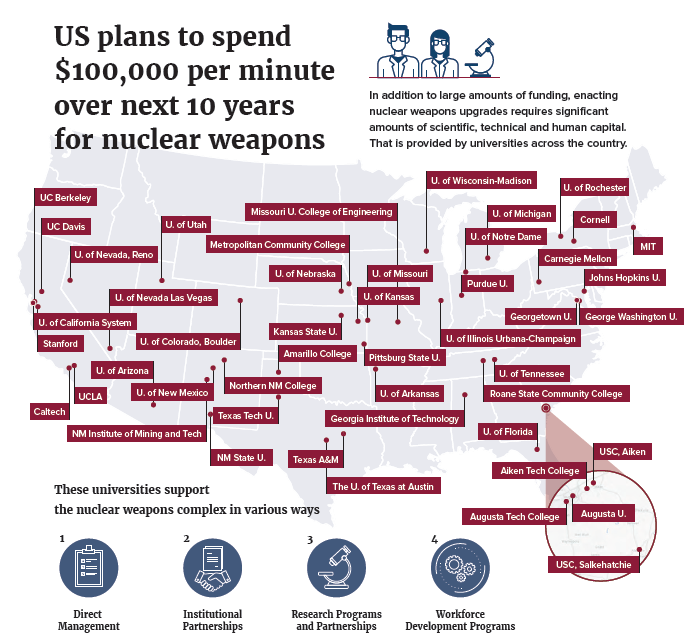
Amid Widespread Disease, Death, and Poverty, the Major Powers Increased Their Military Spending in 2020 https://www.commondreams.org/views/2021/04/28/amid-widespread-disease-death-and-poverty-major-powers-increased-their-military?utm_campaign=shareaholic&utm_medium=Social&utm_source=twitter
The existence of widespread poverty in the world’s mightiest military powers raises the question of what could have been done to alleviate or eliminate it, if during 2020 they had not poured nearly $1.1 trillion into preparations for war.
byLawrence Wittner Last year was a terrible time for vast numbers of people around the globe, who experienced not only a terrible disease pandemic, accompanied by widespread sickness and death, but severe economic hardship.
Even so, the disasters of 2020 were not shocking enough to jolt the world’s most powerful nations out of their traditional preoccupation with enhancing their armed might, for once again they raised their military spending to new heights.
Someday people will ask whether increasing preparations for war by these nations—mostly designed to destroy one another—was the best these governments could do as their populations sank into widespread disease, death, and poverty.
During 2020, world military expenditures increased to $1,981,000,000,000—or nearly $2 trillion—with the outlays of the three leading military powers playing a major part in the growth. The U.S. government increased its military spending from $732 billion in 2019 to $778 billion in 2020, thus retaining its top spot among the biggest funders of war preparations. Meanwhile, the Chinese government hiked its military spending to $252 billion, while the Russian government raised its military outlay to $61.7 billion.
As a result, the U.S. government remained by far the most lavish spender on the military in the world, accounting for 39 percent of the global total. Even so, the Chinese government continued its steady role in the worldwide military buildup, with its military disbursements rising for the 26th consecutive year. Indeed, China’s 76 percent increase in military spending between 2011 and 2020 was the largest among the world’s top 15 big spenders. When added together, the 2020 military expenditures of the United States, China, and Russia accounted for 55 percent of the global total.
This upward spiral in military spending coincided with a sharp rise in the number of the world’s people living in poverty, which soared by an estimated 131 million to 803 million by the end of the year.
In the United States, the richest nation in the world, 2020 produced the largest increase in poverty since the U.S. government began tracking it in 1960. By the end of the year, an estimated 50 million people were struggling with hunger, including 17 million children. Plunged into severe privation, vast numbers of Americans lined up, sometimes in caravans that stretched for miles, to obtain free food at private and public food pantries and other distribution centers. Ignoring the terrible human costs of the economic crisis plaguing the nation during his re-election campaign, President Donald Trump boasted instead of his administration’s “colossal” increase in military spending.
In Russia, where real incomes fell for five of the previous seven years, they dropped still further in 2020. In that year, the average Russian had 11 percent less to spend than in 2013. Indeed, during the first nine months of 2020, as poverty grew, an estimated 19.6 million Russians reportedly lived below the poverty line, equivalent to 13.3 percent of the population. According to a leading economist at Russia’s Institute of International Finance, the authorities “were so concerned about their external threats that they completely forgot about the domestic population.”
The situation was apparently quite different in China. Thanks to the government’s successful efforts to limit the spread of Covid-19, the Chinese economy had an easier time of it in 2020 than did the economies of other major nations. This factor, plus four decades of rapid economic growth and an ongoing campaign to improve the government’s popularity by reducing the country’s worst poverty, led to the Communist Party’s announcement that November that President Xi Jinping and the party had accomplished the miracle of eliminating severe poverty in China.
But all was not as it seemed. In 2020, China, despite its Communist pretensions, had one of the largest gaps between rich and poor throughout the world. By October, its number of billionaires had soared to 878, the highest total in any nation. In contrast, as a New York Times article reported that month, “millions of people on low incomes are working fewer hours at lower pay, depleting savings, and taking out loans to survive.” Moreover, claims as to the eradication of poverty in China were dubious, for the official poverty measuring line there was much lower than in nations with a similar level of economic development. A Brookings Institution economist pointed out that, if China used the same standard as other upper middle-income countries, between 80 and 90 percent of its population would be considered poor. “Even if you aren’t out of poverty, the country will say you’re out of poverty,” remarked a bitter Chinese farmer. “That’s the way it is.”
The existence of widespread poverty in the world’s mightiest military powers raises the question of what could have been done to alleviate or eliminate it if, during 2020, had they not poured nearly $1.1 trillion into preparations for war.
Also, of course, the vast resources used for the military buildup could have bankrolled other programs that would have substantially improved the lives of their citizens. In the United States, as the National Priorities Project noted, the military budget could have funded healthcare for 208 million adults, or 21 million scholarships for university students, or 84 million public housing units, or the employment of 9.2 million elementary school teachers, or 10 million clean energy jobs, or VA medical care for 72 million military veterans.
But, sadly, building the mightiest military forces in world history had greater appeal to the governments of the United States, China, and Russia. Perhaps, someday, people will ask whether increasing preparations for war by these nations—mostly designed to destroy one another—was the best these governments could do as their populations sank into widespread disease, death, and poverty.
Nobel prize winner Beatrice Fihn urges Australia to join the Nuclear Weapons Ban Treaty, as public support for it grows

Australian government urged to heed public support for treaty banning nuclear weapons. Nobel prize-winning anti-nuclear campaigner Beatrice Fihn says ‘change is not only possible, it’s inevitable’ https://www.theguardian.com/australia-news/2021/may/06/australian-government-urged-to-heed-public-support-for-treaty-banning-nuclear-weaponsDaniel Hurst Foreign affairs and defence correspondent@danielhurstbne Thu 6 May 2021
The Australian government is being urged to rethink its opposition to a new international treaty banning nuclear weapons, with a leading campaigner warning of the “indiscriminate destructiveness” of such arms.
Beatrice Fihn, the head of the Nobel prize-winning International Campaign to Abolish Nuclear Weapons (Ican), will use a speech in Tasmania on Thursday to implore the government to heed strong public support for joining the treaty.
“Change is not only possible; it’s inevitable,” Fihn will say when she presents the annual Red Cross Oration at the University of Tasmania.
The Australian government has not joined the Treaty on the Prohibition of Nuclear Weapons, a relatively new agreement that requires parties not to develop, test, produce, acquire, possess, stockpile, use or threaten to use nuclear weapons.
So far, the treaty has been signed by 86 countries, of which 54 have formally ratified it – but it has been snubbed by the nuclear weapons states including the US, Russia and China.
“Australia does not support the Treaty on the Prohibition of Nuclear Weapons,” a spokesperson for the Department of Foreign Affairs and Trade said on Wednesday.
The Australian government argues the new treaty “would not eliminate a single nuclear weapon” because none of the nuclear weapons states have signed it and because it “ignores the realities of the global security environment”.
The government also says the treaty would be inconsistent with its US alliance obligations. However, campaigners point out that several US allies, such as New Zealand, Thailand and the Philippines, have already ratified the treaty.
Fihn, who is based in Geneva and will be addressing the University of Tasmania via video link, will call on the government to act on the “strong and growing support that exists in Australia for this crucial new piece of international law”.
According to prepared remarks provided to Guardian Australia in advance, she will describe the treaty as an “incredible step forward towards a world without nuclear weapons”.
Fihn will say the countries that have joined the treaty are “leading the way forward to a world without nuclear weapons”.
“Meanwhile, in countries that have not yet joined the treaty, including Australia, people are speaking up against nuclear weapons and calling on their countries to join,” she will say.
“Cities around the world, including Berlin, Paris and Washington DC are adopting resolutions calling on their governments to join. In fact, the very first city to sign our Cities Appeal was Melbourne, followed soon after by Sydney – and we’re delighted that the City of Hobart is also on board.”
Polling commissioned by Greenpeace in 2017 found 72.7% of 1,669 Australians surveyed said they supported a ban on nuclear weapons as a step towards the elimination of all nuclear weapons.
“From Australia to Canada, Germany, Japan and the United Kingdom, polls show that the majority of people want their government to join,” Fihn will say.
“Thousands of parliamentarians have pledged to work to bring their respective countries on board. In Australia, 88 of the current members of parliament have taken Ican’s pledge.”
The Ican pledge commits parliamentarians “to work for the signature and ratification of this landmark treaty by our respective countries”.
The federal MPs and senators who have signed up are mostly Labor politicians, including the opposition leader, Anthony Albanese, who has been campaigning against nuclear weapons since early in his political career.
The list also includes the Greens leader, Adam Bandt, and crossbenchers. The Liberal National party MP for Flynn in central Queensland, Ken O’Dowd, has also signed up.
In Thursday’s speech, Fihn will also emphasise the need to “amplify the voices of First Nations peoples in Australia and the Pacific who continue to suffer the horrendous impacts of nuclear tests carried out on their lands and in their waters by the United Kingdom, the United States and France”.
More than 75 years after the US bombing of the Japanese cities of Nagasaki and Hiroshima in 1945, she says, nuclear-armed states are spending billions of dollars each year to build new weapons and to keep the 13,000 existing weapons.
But Fihn says nuclear-armed states “do not prepare for what comes next, after the bombs are dropped”, citing reports that about 80% of hospitals were destroyed in Hiroshima. Out of 300 doctors in the city, 270 died or were injured; out of 1,780 nurses, 1,654 were killed or injured.
“They do not prepare for the hundreds of thousands of burn victims, for the blasted hospitals, for the injured and dying medical professionals left to heal an entire city,” Fihn says.
“The trauma of overwhelmed hospitals and overburdened doctors and nurses around the world who are struggling to meet the needs of patients during the Covid-19 pandemic shows just how impossible it would be for medical infrastructure to respond to even one nuclear weapon detonation.” The Australian government and other non-signatories are being encouraged to send officials to attend, as observers, the first meeting of parties in Vienna early next year.
Guardian Australia understands Australia will consider attendance closer to the event.
The Squad and Their Allies Should Unite to Block Biden’s Massive Military Budget,
The Squad and Their Allies Should Unite to Block Biden’s Massive Military Budget,
This is the moment to put a stop to runaway spending on war and the nuclear arsenal. Common Dreams, byMedea Benjamin, Marcy Winograd 5 May 21, A month before the vote on the federal budget, progressives in Congress declared, “We’ve studied President Biden’s proposed $753 billion military budget, an increase of $13 billion from Trump’s already inflated budget, and we can’t, in good conscience, support this.”
Now that would be a show stopper, particularly if they added, “So we have decided to stand united, arm in arm, as a block of NO votes on any federal budget resolution that fails to reduce military spending by 10-30 percent. We stand united against a federal budget resolution that includes upwards of $30 billion for new nuclear weapons slated to ultimately cost nearly $2 trillion. We stand united in demanding the $50 billion earmarked to maintain all 800 overseas bases, including the new one under construction in Henoko, Okinawa, be reduced by a third because it’s time we scaled back on plans for global domination.”
“Ditto,” they say, “for the billions the President wants for the arms-escalating US Space Force, one of Trump’s worst ideas, right up there with hydroxychloroquine to cure COVID-19, and, no, we don’t want to escalate our troop deployments for a military confrontation with China in the South China Sea. It’s time to ‘right-size’ the military budget and demilitarize our foreign policy.”
Progressives uniting as a block to resist out-of-control military spending would be a no-nonsense exercise of raw power reminiscent of how the right-wing Freedom Caucus challenged the traditional Republicans in the House in 2015. Without progressives on board, President Biden may not be able to secure enough votes to pass a federal budget that would then green light the reconciliation process needed for his broad domestic agenda.
For years, progressives in Congress have complained about the bloated military budget. In 2020, 93 members in the House and 23 in the Senate voted to cut the Pentagon budget by 10% and invest those funds instead in critical human needs. A House Spending Reduction Caucus, co-chaired by Representatives Barbara Lee and Mark Pocan, emerged with 22 members on board.
Meet the members of the House Defense Spending Reduction Caucus:
Barbara Lee (CA-13); Mark Pocan (WI-2); Bonnie Watson Coleman (NJ-12); Ilhan Omar (MN-5); Raùl Grijalva (AZ-3); Mark DeSaulnier (CA-11); Jan Schakowsky(IL-9); Pramila Jayapal (WA-7); Jared Huffman (CA-2); Alan Lowenthal (CA-47); James P. McGovern (MA-2); Peter Welch (VT-at large); Alexandria Ocasio-Cortez (NY-14); Frank Pallone, Jr (NJ-6).; Rashida Tlaib (MI-13); Ro Khanna (CA-17); Lori Trahan (MA-3); Steve Cohen (TN-9); Ayanna Pressley (MA-7), Anna Eshoo (CA-18).
We also have the Progressive Caucus, the largest Caucus in Congress with almost 100 members in the House and Senate. Caucus Chair Pramila Jayapal is all for cutting military spending. “We’re in the midst of a crisis that has left millions of families unable to afford food, rent, and bills. But at the same time, we’re dumping billions of dollars into a bloated Pentagon budget,” she said. “Don’t increase defense spending. Cut it—and invest that money into our communities.”
Now is the time for these congresspeople to turn their talk into action.
Consider the context. President Biden urgently wants to move forward on his American Families Plan rolled out in his recent State of the Union address. The plan would tax the rich to invest $1.8 trillion over the next ten years in universal preschool, two years of tuition-free community college, expanded healthcare coverage and paid family medical leave.
President Biden, in the spirit of FDR, also wants to put America back to work in a $2-trillion infrastructure program that will begin to fix our decades-old broken bridges, crumbling sewer systems and rusting water pipes. This could be his legacy, a light Green New Deal to transition workers out of the dying fossil fuel industry.
But Biden won’t get his infrastructure program and American Families Plan with higher taxes on the rich, almost 40% on income for corporations and those earning $400,000 or more a year, without Congress first passing a budget resolution that includes a top line for military and non-military spending. Both the budget resolution and reconciliation bill that would follow are filibuster proof and only require a simple majority in the House and Senate to pass.
Easy.
Nuclear weapons have triggered a new geological era

NUCLEAR WEAPONS IN THE ANTHROPOCENE
Nuclear weapons have triggered a new geological era, but what does that really mean ? Inkstick Media: Peter Waring, 3 May 21, There were a few possible contenders when a working group established by the International Commission on Stratigraphy began searching for a “golden spike” — a geological inflection point marking the end of one era and the beginning of another. ………
from a geological perspective, no marker better captures humanity’s impact on the physical environment than the fallout from decades of atmospheric nuclear testing.

In 2019, the Working Group voted overwhelmingly to recommend establishing a new era — the Anthropocene — to record the beginning of the period where humans have drastically altered the planet. The proposed start day was July 16, 1945, the day of the Trinity Test.

The beginning of the nuclear age marks a new stratigraphic boundary in Earth’s history. The “bomb spike,” as it came to be known, represents the level of carbon 14 and plutonium 239 in the atmosphere, both of which peaked in the mid-1960s at the height of the Cold War. And though levels have subsequently reduced — as states limited and finally halted atmospheric testing — evidence of the spike is now a matter of geological record. In other words, it will exist for as long as the Earth does. But what does this really mean for our security and our environment?
RACING TOWARD CATASTROPHE
Humanity and the environment are now “mutually transformative — and potentially mutually destructive,” a fact which forces us to confront the possibility that the era of climate stability, known as the Holocene, has ended and that our own collective and individual actions are to blame. Apart from its prominent geological signature, the “bomb spike” is also emblematic of the so-called Great Acceleration, the exponential growth in various metrics of human activity since the mid-twentieth century, which include: population, technology, economic development, industrial output, energy consumption, carbon emissions, and international tourism. These measures have been thrust ever upwards by the spread of extractive capitalism, endless technological innovation, and an underlying assumption that somehow the realm of human activity exists outside and separate from nature. Today, we are not witnessing the failure of this world view. Rather, we are witnessing the consequences of its success.
Nuclear arsenals are regularly justified as a bulwark against threats to the postwar, liberal international order. But it is precisely this global system that has served as the launching pad for the Great Acceleration. And as such, it is difficult to separate our conceptions of wealth, progress, and liberty — the very things nuclear weapons are meant to secure — from the causes of human-induced climate change. We have been led to believe that this skyward trajectory is a good thing, that all of our problems will disappear if only there were more progress, more technology, more freedom. But like Icarus, have we flown too close to the sun?
OUR WORST ENEMY
The Manhattan Project, which developed the first atomic weapons, has been described as a “full stop on modernity” — or in other words, the natural terminus of a worldview that separated humankind from our environment. It is the belief that we can do whatever we want to nature and that the Earth exists to support humanity. The Manhattan Project, which developed the first atomic weapons, has been described as a “full stop on modernity” — or in other words, the natural terminus of a worldview that separated humankind from our environment. It is the belief that we can do whatever we want to nature and that the Earth exists to support humanity.
Modernity in this sense is not merely technology or our institutions but rather a mode of thought premised on a belief in human supremacy. Nuclear weapons are the apotheosis of modernity. We can take whatever we want from the Earth and we can destroy it too. Here is the intersection some nuclear threat experts have been looking for, between the environmental movement and the nuclear movement. Between a cause with seemingly endless cultural cachet and one that appears like a mid-century relic.
The nuclear weapons industry is undoubtedly the source of much environmental damage: There are uranium mines, plutonium production facilities, and former test sites. But the true impact exists on a different register altogether. It is more than just the material effects, more even than the devastating ecological impact of a nuclear blast.
Atomic weapons are the most extreme example of our world-possessing pretensions. Their existence and central role in our security apparatus is representative of a mode of thought that portrays humanity as the chief protagonist in the story of Earth. The Anthropocene is the point at which the plot changes.
It is also clear that on a planet increasingly defined by human activity the old dichotomies of friend and foe — of good and evil — are no longer relevant. But constructing enemies is at the core of nuclear thinking as only the most extreme adversaries can justify the most extreme weapons. During the Cold War this was a relatively simple task, albeit one pursued with a kind of cartoonish zeal by politicians on both sides. And while there is a worrisome element of deja vu about the rising discord between Russia and NATO, talk of a new Cold War seems oddly out of place in a world of pandemics and catastrophic climate change. Yet it remains an inescapable feature of the Atomic Age that enemies must be suitably evil and suitably different from us. They must “hate freedom” and they must reject the so-called “rules-based” global order. More significantly, the enemies themselves are largely inconsequential: When they crumble or retreat into the background, we create new ones. As long as the weapons exist there will be myths to justify them. Arundhati Roy perhaps said it best:
“Nuclear weapons pervade our thinking. Control our behavior. Administer our societies. Inform our dreams. They bury themselves like meat hooks deep in the base of our brains. They are purveyors of madness.”
The Anthropocene forces us to grapple with this madness and to reconsider our need for enemies. It demands that we confront unsettling truths and come to terms with the prospect that the greatest threat to our security and way of life is our way of life.
ADJUSTING OUR POLITICS
The long half-life of the Atomic Age is as much the product of outdated thinking as it is bureaucratic inertia or military strategy. The scholarship surrounding nuclear weapons is held back — stuck — by a kind of thinking that belongs to a different epoch. International Relations (IR) and its dominant paradigms of realism and liberalism have lost whatever explanatory power they once had. They are no longer fit for purpose as either an academic discipline or a collection of governing institutions. They have become a trap of our own making. In fact, IR fails even to acknowledge the threat posed by the Anthropocene or the consequences of inaction. The global apparatus constructed to manage twentieth-century challenges, such as genocide, nuclear conflict, and world wars has proved disastrously ill-suited to our new era.
This has been particularly true with regards to the supposed preeminence of the nation-state, which serves as the very basis of world governance. But it is precisely this belief — the privileging of the national above the international, of the human above the planetary — that has drawn attention away from the devastation occurring all around us.
Viewed from the perspective of deep geological time, the pantomime of global politics and state rivalry has been little more than a distraction. What good are states if their future consists of flooded cities, devastated ecosystems, and uninhabitable wastelands? And can states defend the interests of future generations, both human and non-human?
If indeed the domain of the human and the natural are now indistinguishable, then it follows that our notions of international security and geopolitics must change. What is needed is not more realism or liberalism or business-as-usual diplomacy but rather an altogether new way of organizing the world — a theory of IR based on the belief that the Earth itself matters. ……. https://inkstickmedia.com/nuclear-weapons-in-the-anthropocene/
Britain is now undermining the Nuclear Non Proliferation Treaty (NPT)
ICAN (accessed) 3rd May 2021, Five Ways the UK is Undermining the NPT. The NPT has played an unparalleled
role in curtailing the nuclear arms race and it continues to play a role in keeping the world safe. It is at the centre of international efforts to stop the spread of nuclear weapons, to create a nuclear weapon free world,and to enable access to the peaceful use of nuclear energy.”
But the UK has now taken steps which dangerously undermine this crucial treaty. In its Integrated Review of Security, Defence, Development and Foreign Policy, the UK government announced that it will increase the maximum size of its
nuclear arsenal and reduce the information it provides about it.
Having consistently committed itself over the past decade to reducing its stockpile to a maximum of 180 warheads by the mid 2020s, the UK has now raised this limit to 260, an increase of over 40%. At the same time, the UK will no longer release operational stockpile, deployed warhead or deployed missile numbers.
https://www.icanw.org/five_ways_the_uk_is_undermining_the_npt
Bangor City Council supports the U.N. Treaty on the Prohibition of Nuclear Weapons, as do over 400 other jurisdictions.
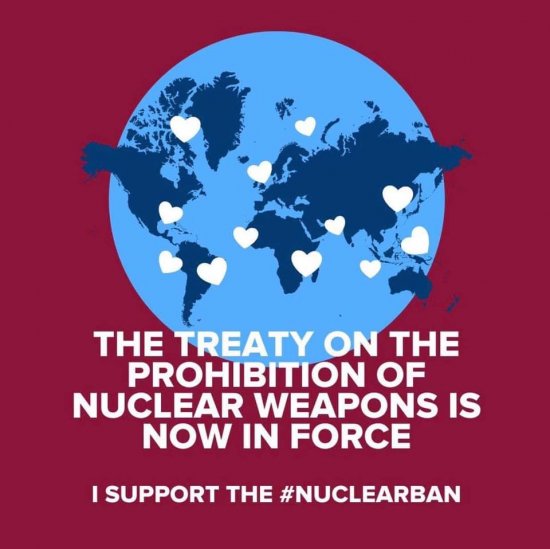
Nation Cymru 1st May 2021, Bangor City Council has become the first Welsh Council to support the
Treaty on the Prohibition of Nuclear Weapons. The treaty came into force in
January and seeks to start a process for effective nuclear disarmament and
to unlock the ongoing stalemate in discussions at the Nuclear
Non-Proliferation Treaty (NPT) Review Conferences.
There are currently 54 states that have ratified the TPNW, including the Irish Republic, Austria,
South Africa, New Zealand, Mexico and the Vatican State. A further 32
states have signed it and are in the process of ratifying it. To date over
400 towns, cities, counties and federal states have passed TPNW
resolutions, including Paris, Berlin, Oslo, Barcelona, Washington DC,
Sydney, Amsterdam, Bruges, Geneva, Montreal, Hiroshima and Nagasaki.
Most Scots feel unsafe about having nuclear weapons base on the Clyde
The National 1st May 2021, ONLY a quarter of Scots voters have said they feel safer having nuclear
weapons based on the Clyde, according to a new opinion poll. The latest
survey from James Kelly asked people the question: “The UK Government
argues that its nuclear weapons protect the public due to a ‘deterrent’
effect. However, others argue that the presence of nuclear weapons on the
Clyde puts the public in greater danger by making the area a target for
nuclear attacks, and by creating a risk of serious accidents.
https://www.thenational.scot/news/19272880.less-quarter-scots-feel-safer-nuclear-weapons-clyde/
New Zealand nuclear veterans want apology and compensation from the government
New Zealand’s nuclear horror still not acknowledged say vets Stuff, Janine Rankin May 02 2021 Photos on a wall, names on a board and an academic study will ensure the radiation damage to 551 men who witnessed Britain’s nuclear bomb explosions in the Pacific is never forgotten.
But what the New Zealand survivors of those blasts really want is an apology and compensation from the Government.
The stories of the nuclear veterans and the subsequent heartache and illness affecting them and the off-spring of those who had families have been retold in Palmerston North this weekend.
It was the third opening of Denise Baynham’s exhibition of the photographs and stories of navy veterans “Operation Grapple, We were There” at Te Manawa art gallery……………
…….. The men exposed to those bomb blasts, many times more powerful than the bombs that ended World War II in Japan, suffered radiation damage, and still do.
A carefully controlled sample of 50 veterans showed three times the frequency of genetic damage, technically called total chromosome translocations, than the control group.
Rowland is now the association’s patron, and he and Sefton’s close friend and successor Tere Tahu are determined to have the Government acknowledge the harm done.
They have a meeting with Veterans’ Affairs Minister Meka Whaitiri on May 10, with the goal of gaining an audience with Prime Minister Jacinda Ardern.
Veteran John Purcell said until now, they had only received “a wall of silence” from successive ministers.
“It is my belief that the Crown abrogated its duty of care by dispatching HMNZS Pukaki and Rotoiti to take part in the British nuclear testing, being fully aware that we were being sent into harm’s way.”
What he wants is a public apology, a public acceptance of the research findings, urgent research regarding the children and grandchildren of veterans, and compensation., https://www.stuff.co.nz/national/125002784/new-zealands-nuclear-horror-still-not-acknowledged-say-vets
In India’s pandemic nightmare, India and Pakistan need to invest in health, not nuclear weapons.

Oxygen is more important than uranium, DW, 1 May 21, India and Pakistan can afford to buy weapons and test ballistic missiles, but they can’t cope with the COVID crisis. DW’s Shamil Shams says it is time for both to invest in public health and focus less on warmongering.
Dr. Mubarak Ali, a progressive Pakistani historian, recently wrote on social media that the mishandling of the coronavirus pandemic in India and Pakistan proves that “oxygen is more important than uranium.”
Both India and Pakistan are grappling with an acute public health crisis brought on by coronavirus. India lacks oxygen for COVID patients, and Pakistan can’t afford to buy vaccines.
However, both nuclear-armed states continue to devote a large chunk of their national budgets to military spending.
The pandemic situation in India is nightmarish. During the week following April 18, India reported 2.24 million new cases, the highest number recorded by any country in a seven-day period since the pandemic began.
India also logged 16,257 deaths, almost double the 8,588 deaths recorded the previous week, according to Health Ministry data. Since the start of the pandemic last year, India has registered over 17.6 million COVID cases and almost 200,000 related deaths.
This “second wave” is particularly lethal and has exposed the fragility of India’s health infrastructure. Hospitals are overwhelmed with COVID patients, and there aren’t enough places to cremate or bury the dead.
The situation is Pakistan is getting worse by the day. Infections and deaths are surging.
As of Tuesday, April 27, Pakistan has recorded almost 805,000 COVID cases and 17,329 deaths. Experts say the actual numbers are likely much higher.
The vaccine rollout has been quite slow in Pakistan because the government doesn’t have the funding to purchase doses. China and other countries have donated a few million vaccine doses, but it is not enough to vaccinate a country of 220 million people.
Stubborn arrogance
Yet, the ruling classes in India and Pakistan are not ready to reevaluate their public spending policies.
For over 70 years since both countries gained independence from British rule, India and Pakistan have invested more in defense than in the wellbeing of their people.
Their militaries have thrived, even as a large segment of their populations have fallen below the poverty line.
This is what happens when a developing county prioritizes security-based national spending. India and Pakistan have the latest tanks and fighter jets, yet their hospitals lack ICU beds and ventilators………
Misplaced priorities
Even the world’s most developed health care systems have been pushed to the edge by the coronavirus pandemic. And for developing countries, the pandemic has demonstrated the necessity of a functional health care system for prosperity.
Powerful militaries and massive defense budgets cannot fight a virus.
Therefore, India and Pakistan can no longer justify supporting a nuclear arsenal while their populations suffer due to a lack of medicines, oxygen cylinders and hospitals.
The rulers of the two nations must put an end to their warmongering and resolve their disputes politically and diplomatically. The best way to deal with COVID – and potential pandemics in the future – is through regional cooperation.
The way many Pakistanis have offered support to Indians during their health crisis is proof that the two nations can overcome many challenges if they help each other.
The pandemic has demonstrated that if the arch-rival south Asian neighbors don’t move toward reconciliation and peace, their economies are bound to collapse in the long run, and even their mighty armies will not be able to stop it. https://www.dw.com/en/opinion-oxygen-is-more-important-than-uranium/a-57350243?fbclid=IwAR3Cwkkmbw2jocuXnqY6MpWWHOnWzy182c0WUa1XIkWRvAntNSlZS2t4CVY
Mobile nuclear reactors? Scathing report slams ‘disturbing’ military program
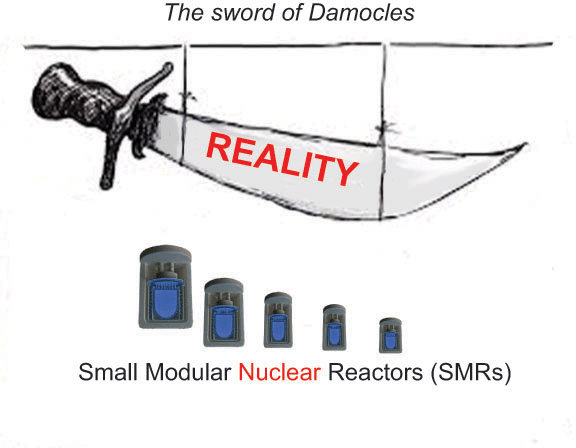
Mobile nuclear reactors? Scathing report slams ‘disturbing’ military program, Times, 1 May 21, Todd South The author of an academic report on Pentagon plans to build mobile nuclear reactors to power future combat bases called the effort “extremely disturbing” and “based on a lie.”
The report released Thursday slams the Pentagon and Army G-4, logistics — specifically the Army office’s 2018 report that lays out the potential uses and needs for such mobile nuclear reactors in future operations.
Alan J. Kuperman wrote the 21-page report titled, “Proposed U.S. Army Mobile Nuclear Reactors: Costs and Risks Outweigh Benefits,” in his role as coordinator of the University of Texas at Austin’s Nuclear Proliferation Prevention Project.
“They don’t reduce casualties, they increase costs and they increase threats to the lives of U.S. service members,” Kuperman said.
The program, known as “Project Pele,” is prototyping the mobile advanced microreactor concept under the Pentagon’s Strategic Capabilities Office……..
The DoD spokesman pointed out that the project is part of a collaboration involving the Department of Energy, Nuclear Regulatory Commission, U.S. Army Corps of Engineers and private industry. Project Pele is not being designed for a specific military service branch but does include experts across defense for a variety of requirements.
Army officials for G-4 deferred comment on the program to DoD……..
Congress approved funding for prototype reactors and the Army awarded $40 million in contracts to three nuclear reactor companies in March 2020 for Project Pele, according to the NPPP report.
Kuperman struck at the Army’s rationale, calling the project unnecessary and dangerous. He counters some of the main justifications that have been provided by DoD and Army reports:
High cost – Kuperman said the Army’s claims that nuclear power can provide cheaper electricity for powering future forward bases is “based on unrealistic assumptions.” Those include that such a reactor would have low construction costs and operate for 18 hours a day over 40 years. The more likely scenario is a mobile reactor would run for half that time over about 10 years, meaning nuclear electricity could cost 16 times more than estimates and still seven times more than diesel-generated power.- Vulnerability to missile attacks – The report points to the 2020 missile attack on forces at al-Asad air base in Iraq. Even with warnings hours ahead of time, more than 100 U.S. personnel suffered traumatic brain injury from the 11 strikes that hit the facility. And the missiles were 10 times more accurate than the Army has predicted in its report on the vulnerability of reactors to precision strikes. The service admits that a direct hit on a reactor would destroy the device. Kuperman notes that even the Army’s plans to protect the reactors, by burying them underground, could inadvertently cause meltdowns by impeding air cooling and causing overheating. A similar strike on an similar such future base with a reactor could cause far more devastating consequences.
Captured reactors – Should a U.S. base housing a mobile reactor be overrun or abandoned, the radioactive waste from the reactor could be used in “dirty bomb” terror attacks.- No mission for reactors – One of the chief purposes of pursing such reactor programs was to reduce casualties from diesel transport to remote bases. But Defense Department data shows a dramatic drop in casualties of five per 1 million gallons of fuel delivered in 2005 to nearly zero by 2013.
- High-energy weapons don’t need reactors – Kuperman states that the justification that future high-energy or laser weapons that the Army hopes to have protecting bases don’t require a reactor to power. “A high energy weapon would have to be fired millions of times to justify a reactor,” Kuperman said. “In reality such a weapon would be fired perhaps hundreds of times in its lifetime.”
- Transport problems – The Army wants to air deliver these reactors to combat posts. Kuperman questions the “regulatory nightmare” that would create. The program calls for initial tests flying the reactors domestically to run then returning them, and their radioactive waste, to another domestic location. Foreign transport would require approval of countries airspace traversed and the approval of a host nation where the reactor would be placed, he said. Other Army recommendations include truck or rail transport domestically and either ship or over-the-ocean flights to friendly ports to then move the reactors again via truck or rail.
Army Times reported on the proposed program in 2019, which had drawn backlash from the Union of Concerned Scientists and its then-director of the Nuclear Safety Project, Edwin Lyman, who called the proposal, “naïve.”The original proposal, approved by the Pentagon’s Strategic Capabilities Office asked for industry solutions in January 2019 on providing a less than 40-ton small, mobile nuclear reactor design that could operate for three years or more and provide 1 to 10 megawatts of power.Planners want the reactor to fit inside a C-17 cargo plane for air transport to theater. More recent moves have reduced the power output to 5 megawatts……..
Lyman notes a major failure with one of the original eight designs in 1961 when a core meltdown and explosion of the ML-1 reactor in Idaho killed three operators.
The three deployed to Antarctica, Greenland and Alaska proved “unreliable and expensive to operate,” Lyman wrote in his response to the Army’s 2018 report on the mobile reactor program.Lyman told Army Times on Thursday that a number of those old reactors required decades of decommissioning and one used at Fort Belvoir, Va., near Washington D.C. is finally scheduled for decommissioning in late 2021……….. https://www.armytimes.com/news/your-army/2021/04/30/mobile-nuclear-reactors-scathing-report-slams-disturbing-military-program/
Like Trump, Biden administration to ramp up nuclear bomb-making
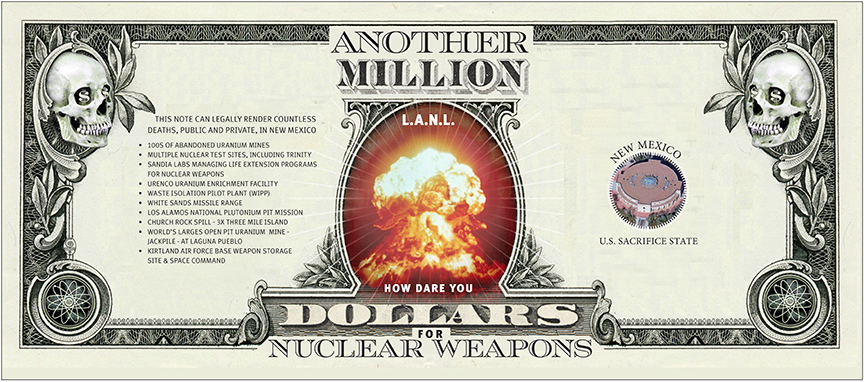
| US pushes ahead with nuclear plans despite watchdog concerns, 9 news, By Associated Press Apr 30, 2021 The Biden administration appears to be picking up where former President US Donald Trump left off as the federal agency that oversees US nuclear research and bomb-making has approved the conceptual design and cost range for infrastructure investments for a multibillion-dollar project to manufacture key components for the nation’s nuclear arsenal. The National Nuclear Security Administration in a decision announced Wednesday stated that planning and construction could cost upwards of $5.15 billion initially.The agency did not articulate what exactly that money would be spent on nor does it include the cost of other preparations that would be needed for Los Alamos National Laboratory to begin producing 30 plutonium cores per year. The push to resume production of the nuclear triggers has spanned multiple presidential administrations, with supporters arguing that the US needs to ensure the stability and reliance of its arsenal given growing global security concerns. The nuclear agency also has said most of the cores in the stockpile date back to the 1970s and 1980s. Lab Director Thom Mason during a virtual community meeting Thursday evening fielded several questions about the project, saying the goal of the work is not to expand the arsenal but rather to extend the life of the existing stockpile……… watchdog groups have been sounding alarms over the potential for more security and safety lapses at the northern New Mexico lab and the potential for environmental contamination. Another concern is the nuclear waste that would be generated by the work. The groups have said the cost estimate outlined by the agency in its decision is roughly double the projections made just last year. Greg Mello with the Los Alamos Study Group said the ballooning budget and uncertainty over whether the lab can meet the federal government’s mandated production schedule “throw further doubt on the wisdom of proceeding with industrial pit production” at Los Alamos.“ LANL’s facilities are simply too old and inherently unsafe, its location too impractical,” he said.“Even with a much smaller stockpile, LANL could not undertake this mission successfully.” Some groups have threatened to sue the US Energy Department and the National Nuclear Security Administration, saying a more comprehensive review should have been done on the plans to produce plutonium cores at Los Alamos and at the Savannah River Site in South Carolina. They argue that nearby communities already have been saddled with legacy contamination from previous defence work.Critics are fearful that the project will result in factories that resemble the Rocky Flats facility in Colorado, which had a long history of leaks, fires and environmental violations and needed a $9 billion clean up that took years to finish………..J Jay Coghlan of Nuclear Watch New Mexico called the federal government’s plans “unnecessary and provocative,” saying more production will result in more waste and help to fuel a new arms race……https://www.9news.com.au/world/us-pushes-ahead-with-nuclear-plans-despite-watchdog-concerns/506472b5-da49-4939-971c-4a36586a3843 |
Extinction Rebellion climate activists block Faslane nuclear base

Extinction Rebellion block Faslane nuclear base entrance, Climate activists set up a blockade at the Faslane nuclear base by attaching themselves to plant pots. https://www.bbc.com/news/uk-scotland-glasgow-west-56941041 30 Apr 21,
Members of Extinction Rebellion Scotland staged the protest at the north gate of the base on the Gare Loch in Argyll and Bute.
The all-female group placed three planters painted with the words “Safe”, “Green”, and “Future” on the road.
Police Scotland said they were made aware of the incident at 06:20 and officers were at the scene.
HMNB Clyde – known as Faslane – is the Royal Navy’s main presence in Scotland.
It is home to the core of the submarine service, including the UK’s nuclear weapons, and the new generation of hunter-killer submarines.
The protest group said they were demanding a future “safe from the threat of nuclear weapons and environmental destruction”.
Extinction Rebellion said the action was part of the Peace Lotus campaign, a global day of anti-war resistance celebrating the anniversary of the end of the Vietnam War.
An HMNB spokesman confirmed police were in attendance and assisting Ministry of Defence officers in dealing with the protest. He added: “Well-established, fully co-ordinated procedures are in place to ensure the effective operation of HMNB Clyde is not compromised because of protest action.”
Following Biden climate summit, USA govt keen to promote and export Small Nuclear Reactors

A Spotlight on Advanced Nuclear after the White House Climate Summit– JD Supra, 30 Apr 21. -”…….. With the nuclear ban lifted by the Development Finance Corporation for investment in innovation projects, the U.S. government acknowledged the importance of nuclear in the transition to [?] clean energy in developing economies.
……….. the Department of State announced the launch of its Foundational Infrastructure for the Responsible Use of Small Modular Reactor Technology (FIRST) Program. Through an initial $5.3 million investment, this program will strengthen international collaboration between the U.S. and partner countries seeking to deploy nuclear energy in their clear energy initiatives. This cooperation includes supporting the deployment of advanced nuclear technologies, including small modular reactors (SMRs),…….
1 This Month





PLEASE OPPOSE HR 8255 AND S.3639 – bills would accelerate satellite deployment, with no environmental review or safeguards – https://ncstd5li.quorum.us/campaign/169331/
To see nuclear-related stories in greater depth and intensity – go to https://nuclearinformation.wordpress.com
-
Archives
- October 2026 (67)
- September 2026 (339)
- August 2026 (330)
- July 2026 (355)
- June 2026 (287)
- May 2026 (306)
- April 2026 (356)
- March 2026 (251)
- February 2026 (267)
- January 2026 (308)
- December 2025 (358)
- November 2025 (359)
-
Categories
- 1
- 1 NUCLEAR ISSUES
- business and costs
- climate change
- culture and arts
- ENERGY
- environment
- health
- history
- indigenous issues
- Legal
- marketing of nuclear
- media
- opposition to nuclear
- PERSONAL STORIES
- politics
- politics international
- Religion and ethics
- safety
- secrets,lies and civil liberties
- spinbuster
- technology
- Uranium
- wastes
- weapons and war
- Women
- 2 WORLD
- ACTION
- AFRICA
- Atrocities
- AUSTRALIA
- Christina's notes
- Christina's themes
- culture and arts
- Events
- Fuk 2022
- Fuk 2023
- Fukushima 2017
- Fukushima 2018
- fukushima 2019
- Fukushima 2020
- Fukushima 2021
- general
- global warming
- Humour (God we need it)
- Nuclear
- RARE EARTHS
- Reference
- resources – print
- Resources -audiovicual
- Weekly Newsletter
- World
- World Nuclear
- YouTube
-
RSS
Entries RSS
Comments RSS

