Biden previously called Submarine-Launched Nuclear Cruise Missile a ”bad idea”, but now it’s in the Budget.

U.S. Navy Funds New Submarine-Launched Nuclear Cruise Missile Biden Called ‘A Bad Idea’ .Forbes, David Hambling, 2 June 21, I’m a South London-based technology journalist, consultant and author Budget documents reveal the U.S. Navy is developing a new nuclear-armed Sea-Launched Cruise Missile, known as SLCM-N. President Biden described the missile as “a bad idea” when campaigning in 2019. Though an
obvious candidate for cancelation, the SLCM-N program is going ahead.
…………………Putting nuclear cruise missile on Virginia-class would be a quick and easy way of ramping up strategic capability. Currently, the only nuclear-armed subs are the fourteen Ohio-class ballistic missile subs, so SLCM-N on Virginia-class would more than double that at a stroke.
But there are downsides.
“Putting nuclear-armed missiles back on the conventional surface or attack submarine fleets of the Navy is a real cause for concern,” says Monica Montgomery, a research analyst at the Center for Arms Control and Non-Proliferation. “Doing so would erode the higher-priority conventional missions of the Navy by reducing the number of conventional missiles each boat could carry and increase the possibility of conflict escalation through miscalculation by blurring the line between conventional and nuclear cruise missiles on these vessels.”
“Putting nuclear-armed missiles back on the conventional surface or attack submarine fleets of the Navy is a real cause for concern,” says Monica Montgomery, a research analyst at the Center for Arms Control and Non-Proliferation. “Doing so would erode the higher-priority conventional missions of the Navy by reducing the number of conventional missiles each boat could carry and increase the possibility of conflict escalation through miscalculation by blurring the line between conventional and nuclear cruise missiles on these vessels.”
“Reversing the Trump administration’s plan to pursue a nuclear SLCM should be an easy choice,” Reif says.
Reif describes the SLCM-N as “a costly hedge on a hedge” – an extra backup for an already extensive and growing nuclear arsenal – making it a pointless extravagance.
Reif also notes that the nuclear capability will come at the expense of urgently needed conventional weapons.
“Arming such vessels with nuclear cruise missiles would also reduce the number of conventional missiles each boat could carry, at a time when Pentagon leaders argue that strengthening conventional deterrence is their top priority in the Asia-Pacific,” says Reif.
Biden himself noted that fielding low-yield weapons as alternatives to more powerful ballistic missiles would make the U.S. “more inclined to use them” and increase the risk of a nuclear war.
The SLCM-N project is starting small, just $15.2 million in this year’s budget compared to the billions for other nuclear programs. But if the analysts are right, the U.S. Navy is buying trouble rather than new capability. https://www.forbes.com/sites/davidhambling/2021/06/02/us-navy-funds-new-submarine-launched-nuclear-cruise-missile-biden-called-a-bad-idea/?sh=405441c022b2
5 Republicans and 1 Democrat – the U.S. Senate nuclear caucus – Intercontinental Ballistic Missile (ICBM) Coalition – bribed by nuclear weapons companies to pour $1.7trillion into new and ‘modernised’ nukes

Meet the Senate nuke caucus, busting the budget and making the world less safe, https://responsiblestatecraft.org/2021/05/26/meet-the-senate-nuke-caucus-busting-the-budget-and-making-the-world-less-safe/ These lawmakers represent states with a direct interest in pouring billions into modernizing and building new weapons. Marcy Winograd and Medea Benjamin, MAY 26, 2021
Democrats might control the legislative and executive branches of the U.S. government right now, but a small Republican-dominated Intercontinental Ballistic Missile (ICBM) Coalition exercises outsized influence in a frightening campaign for nuclear rearmament.
The coalition, comprising six senators from states that house, develop, or test underground land-based nuclear weapons, is pushing a wasteful and dangerous $1.7 trillion, decades-long plan to produce new nuclear weapons, some with warheads 20 times more powerful than the atomic bomb dropped on Hiroshima.
While the 1980s witnessed the nuclear freeze and a mass movement to demand nuclear disarmament between the U.S. and Soviet Union, the 1990s gave birth to the missile caucus, the Congressional engine careening the U.S. into a renewed nuclear arms race.
All but one of the members of this caucus is a Republican from a deep red state — including North Dakota, Montana, Wyoming, Utah and South Dakota — that didn’t vote for Joe Biden. Members of the Senate ICBM Coalition are Co-Chairs John Hoeven (R-N.D.) and Jon Tester (D-Mont.); John Barrasso (R-Wyo.); Steve Daines (R-Mont); Mike Lee (R-Utah); and Mike Rounds (R-S.D.).
The lone Democrat, Tester, a third-generation farmer and former elementary school music teacher, wields a critical gavel as Chair of the Senate Appropriations Subcommittee on Defense, a committee that will write the appropriations bill for military expenditures. Tester told the D.C.-based Advanced Nuclear Weapons Alliance this year that he was committed to keeping new nuclear weapons production “on track.”
If the ICBM Coalition and the weapons lobby have their way, the United States will brandish a new nuclear arsenal in order to, in their view, replace aging and outdated nuclear weapons ill-suited to meet the challenges of a renewed Cold War. Critics charge that the development and production of new nuclear weapons violates the spirit and letter of the Treaty on the Non-Proliferation of Nuclear Weapons (NPT), signed by the United States and Soviet Union in 1968.
In addition to violating a treaty joined by 191 nations, U.S. production of new nuclear weapons is likely to escalate the arms race, sabotage future arms control negotiations with Russia or China and encourage non-nuclear nations to enrich weapons-grade uranium.
Although it was the Trump administration that in 2020 awarded Northrop Grumman a $13.3 billion sole-source contract to build new land-based nuclear missiles called Ground Based Strategic Deterrent (GBSD), it is the Biden administration that is slated to include, as part of its record high $753 billion military budget, $30 billion or more for the GBSD. This would be a down payment on the estimated $264 billion cost to replace all 400 underground Minuteman III missiles in North Dakota, Wyoming, Montana, Nebraska and Colorado, from 2029 through 2075.
The GBSD is part of a euphemistically labeled “nuclear modernization” program proposing, in addition to new ICBMs, new ballistic missile submarines outfitted with low-yield, five-kiloton tactical nuclear weapons, as opposed to larger 100-kiloton “strategic” nuclear weapons meant for a global nuclear showdown.
The Trump administration’s 2018 nuclear posture review reasoned these “more usable” tactical nuclear weapons would keep the Russians and Chinese in check. Critics argue that these smaller, shorter-range tactical nuclear weapons blur the distinction between conventional and nuclear war, making these weapons more likely to be employed under the misguided assumption that a nuclear war can be limited.
The push for rearmament, including a new nuclear cruise missile, a modified gravity bomb with two-stage radiation implosion and long-range strike bomber, comes amid concern the Biden administration’s heated anti-China rhetoric could plunge us into a nuclear war.
Pentagon Papers whistleblower Daniel Ellsberg recently released classified documents that revealed U.S. military leaders penned plans in 1958 to execute a first nuclear strike against China in a dispute over Taiwan’s sovereignty. According to the documents, Pentagon officials were willing to risk a million deaths in the event the Soviet Union fired back with nuclear weapons. In releasing the classified material and purposefully risking prosecution, Ellsberg told the New York Times, “I do not believe the participants were more stupid or thoughtless than those in between or in the current cabinet.”
With Secretary of Defense Lloyd Austin, former Secretary of Defense Ash Carter, Republicans and Tester cheerleading for the GBSD, a missile caucus lobbyist might think the American people would prefer to spend hundreds of billions of dollars on new ICBMs and nearly two-trillion dollars on the entire nuclear escalation package than investing in Medicare for All or clean water in Flint, Michigan. A 2020 University of Maryland poll revealed, however, that 61 percent of Americans–including both Democratic and Republican majorities–support phasing out the United States’s 400 land-based intercontinental ballistic missiles.
Knowing this, why would Biden and Democratic politicians carry out the mission of the small Republican-dominated missile caucus and its chums in the profitable weapons industry? Northrop Grumman, with a net worth of $50 billion, promises nuclear rearmament will create 10,000 jobs, but compare that number to the 3-million employed under FDR’s Civilian Conservation Corps that planted 3-billion trees.
The answer to why the missile caucus is so influential is: money. And lots of it.
ICBM weapons contractors contributed more than $15 million from 2012-2020 to members of the Senate and House Armed Services and Appropriations committees and subcommittees, according to the Arms Control Association. Steven Semler, co-founder of the Security Policy Reform Institute, notes these contractors even buy influence among members of the Congressional Progressive Caucus (CPC), last year donating $376,650 to Democrat Adam Smith (D-Wash.), Chair of the House Armed Services Committee; $148,135 to Donald Norcross (D-N.J.) and $63,086 to Ruben Gallego (D-Ariz.), all of whom belong to the CPC.
While Biden may fear appearing “soft” on defense if he retreats from relaunching our nuclear program, progressives are preparing for a fierce debate. GBSD opponents include an impressive diplomatic team: William Perry, former Secretary of Defense; Daniel Ellsberg, author, The Doomsday Machine: Confessions of a Nuclear War Planner; and William Hartung, director of the Arms and Security Program at the Center for International Policy.
Hartung, author of Prophets of War: Lockheed Martin and the Making of the Military-Industrial Complex,recommends nixing the ICBMs entirely. “Because of their extreme vulnerability to attack, ICBMs are kept on high alert status, leaving the president a matter of minutes to decide whether to launch them on warning of an impending attack,” he says.
There is no law of gravity that compels the current president or Congress to continue funding this drive for nuclear rearmament.
Abdul Khan and the illegal and immoral world of nuclear proliferation

Smiling Buddha and how Khan network’s inside job made Pakistan a nuclear state, Financial Express, May 31, 2021 By Subhash Jangala
By conducting the first confirmed nuclear weapons test by a non-member of the UN Security Council, India caught the entire international intelligence community unawares.
On 26th May 2021, India celebrated Buddha Jayanti, the anniversary of the great soul obtaining enlightenment. Exactly 47 years ago, on the Buddha Jayanti of 1974, Smiling Buddha ushered India into the nuclear age. By conducting the first confirmed nuclear weapons test by a non-member of the UN Security Council, India caught the entire international intelligence community unawares. Thousands of miles away from the test site in Pokhran, Rajasthan was Almelo, a tiny municipality in eastern Netherlands. As the news of the Indian nuclear test trickled in, a silent storm started brewing in a man’s heart. 1974’s Buddha Jayanti not only heralded India’s geopolitical assent, it also flagged off Pakistan’s steep decline in international status and reputation.
Abdul Qadeer Khan, a Pakistani metallurgical engineer employed in a uranium enrichment plant in Almelo, took India’s successful nuclear test to heart. In his work, Khan got several opportunities to work with Highly Enriched Uranium (HEU) in Netherlands. Khan quickly dispatched a letter to Pakistan’s newly powerful Prime Minister, Zulfiqar Ali Bhutto explaining why HEU was the miracle cure for Pakistan’s struggle with making a plutonium bomb. After several attempts, Bhutto did give Khan a hearing and was impressed. Thus began a decades-long saga of illegal and criminal transfer of nuclear materials and technologies from across the world into Pakistan and then via Pakistan to other states like Iran and Libya.
Back in the 1970s and 80s, Anti Money Laundering regulations and investigation into Proliferation Finance weren’t as developed as they are today. This allowed Khan and the Pakistan Government to run a complex international network of benami companies and suppliers that have created and helped sustain a nuclear black economy. A deeper study of the proliferation episode makes for interesting reading……………………..
As years progressed, Khan used his contacts to obtain components from across the world, expanding Pakistan’s chances of testing their first nuclear bomb. At the same time, the West, unmindful of Khan’s dogged belief in his experiment and Pakistan’s tenacious resolve to match India kiloton-for-kiloton, took a laid-back and lackadaisical route to control the black nuclear economy that Pakistan was helping create. Eventually, his endearing nature and Pakistan’s resolute support, Khan managed to assemble all the components required to make his nuclear dream go live.
However, Khan’s dream did not end with making Pakistan a formidable opponent to India in the nuclear battlefield. Khan expanded his activities deeper into the illegal and immoral world of nuclear proliferation. He helped create a market where any budding nuclear adventurist could order from a list of raw materials which could be sourced from any of the reliable suppliers across the world. A “Flipkart for Nuclear dummies” was born. This market place operated from the following places, [shown on map on original]
Khan Research Laboratories in Pakistan and SMB Computers in Dubai (a front company) operated as the hub and the rest were all procurement or delivery centres. An investigation by the Malaysian Police into one such transaction revealed the inner workings of the network. The same is presented below in 8 steps. [diagram on original]
……….. The most important link that connected the entire network was the fact that, apart from the core individuals, no entity had a clue what was being produced and for whom.
The fraud continued for a while. On a fateful day in 2004, the US exposed the outlines of the world;s largest nuclear proliferation ring. In a dramatic television appearance Feb. 4, Abdul Qadeer Khan, the father of the Pakistani bomb, acknowledged that he had secretly provided North Korea, Libya, and Iran with crucial building blocks for making nuclear weapons. Khan, considered a national hero, apologized to the people of Pakistan for what he had done and was pardoned by the then Pakistani President Gen. Pervez Musharraf shortly afterward.
On this Buddha Jayanti, the story of AQ Khan should alert sanctions compliance organisations across the globe to the new challenges like the need to transition to a low carbon energy economy, introduction of advanced materials and growth of underground markets through the dark web. International organisations should re-dedicate themselves to technology, co-operative diplomacy, Exchange of Information and cross-cultural capacity building to ensure rogue proliferators and black markets don’t emerge in newer and more sophisticated areas of crime.
(The author is an officer of the 2011 batch of the Indian Revenue Service. He is presently posted as Joint Director (OSD) in the Directorate General of Administration and Taxpayer Services at New Delhi. Prior to this role, he worked as a Tax Diplomat in the Foreign Tax and Tax Research Division of the Central Board of Direct Taxes. The views expressed are the author’s own, and do not represent the official position or policy of the Government of India or Financial Express Online.) https://www.financialexpress.com/world-news/smiling-buddha-and-how-khan-networks-inside-job-made-pakistan-a-nuclear-state/2262259/
Nuclear test veterans: ‘My dad was treated like a guinea pig’

Nuclear test veterans: ‘My dad was treated like a guinea pig’, By Chris Wood, BBC News 30 May 21, When David Purse was sent to Australia, he thought it would be a “wild adventure” in a little-explored place.
However, the RAF flight lieutenant’s posting to a remote area called Maralinga was to test atomic weapons.
Son Steve, 47, from Prestatyn in Denbighshire, puts his own “unique” condition down to “a rare genetic mutation” caused by radiation.
The Ministry of Defence said three large studies found no link between the tests and ill health.
But a study at Brunel University is currently looking at the possibility genetic damage from the tests has affected the children of personnel.
“Flying through mushroom clouds or watching”, Steve believes men were “treated like guinea pigs” and wants recognition for them, adding: “It wasn’t an act of God but an act of government.”
In all, about 40,000 British personnel took part in the testing of atomic and hydrogen bombs in the 1950s and 1960s.
Most were in the Pacific – the biggest being Operation Grapple, where about 22,000 people oversaw the exploding of bombs in 1957.
Maralinga, in South Australia, saw the first test launches of atomic weapons from aircraft in 1962.
“He was told at short notice and was looking forward to visiting a warm country, a relatively unexplained place, and having a wild adventure,” Steve said of his father.
However, he was “close enough to ground zero to see sand to turn to glass” during tests, with no protective equipment.
Steve added: “There was a rope saying ‘do not enter’ but radiation was in the sand and would blow into food, into their face.
“They would swim in the lagoon, and catch fish that contained highly toxic radiation.”……………..
Steve describes his condition as “unique”, with doctors unable to diagnose it exactly, but says it is a form of short stature, similar to that of actor Warwick Davis.
He believes it is because of a “rare genetic mutation” as a result of the nuclear tests, and part of the “roulette” future generations must live with.
Steve is worried his baby son, Sascha, could also develop problems as he grows older.
“That’s the sad thing, it probably won’t die with veterans,” he said………
The possibility that children of personnel could be affected was first raised in a study at New Zealand’s Massey University in 2007.
Al Rowlands, who led the investigation at the university, said results were “unequivocal” that veterans had suffered genetic damage as a result of radiation.
Support group Labrats estimates there are 200,000 descendants of those who took part in British tests – and says the UK is the only nuclear state not to properly recognise its veterans and support them.
It conducted a health survey with 123 people who took part in tests, 76 from the UK.
“Many [problems experienced by descendants] tend to be autoimmune diseases, but if there are problems, they tend to be severe,” said founder Alan Owen.
“There are bone problems, teeth problems, eye sight. Issues that are meant to affect one in 1,000 – we talked to 10 descendants, four were affected.
“They have developed cancer, heart problems, a wide range of diseases.”
He described talking to veterans about their fears, adding: “When a grandchild is born, they don’t ask if it’s a boy or a girl, but if it’s okay. It’s quite sad they’re living with that now.”
Mr Owen’s father was involved at Operation Dominic, where the United States conducted 31 tests in the Pacific in 1962.
The American government has paid compensation to British personnel present and Mr Owen wants recognition by UK authorities.
He believes there are about 1,500 British nuclear veterans still alive, adding: “All they want is for the government to say ‘we did wrong, it was the 1950s’.
“No prime minister has ever met nuclear veterans. Anthony Eden was warned about the consequences and his reply was ‘it’s a pity but we can’t help it’…………
A number of veterans have already called for an apology, linking their cancer to the testing.
The Ministry of Defence responded by saying: “The National Radiological Protection Board has carried out three large studies of nuclear test veterans and found no valid evidence to link participation in these tests to ill health.”
The Brunel University study has been carried out with those involved in British nuclear tests and their children, with results due soon.
“We anticipate that our findings will have a lasting benefit for the broader nuclear community by providing scientific evidence that will resolve current uncertainties and speculation about potential adverse health effects in nuclear test veterans and their families,” said chief investigator Rhona Anderson. https://www.bbc.com/news/uk-wales-57157476
The USA-UK nuclear cabal

A toxic relationship that could destroy the world
The USA-UK nuclear cabal — Beyond Nuclear International The USA-UK nuclear cabal
May 30, 2021 by beyondnuclearinternational
A “special relationship” in nuclear collusion
By Leonard Eiger On March 16th the United Kingdom announced (in its Integrated Review of Security, Defence, Foreign Policy and Development titled Global Britain in a Competitive Age) that it will increase the limit on its nuclear arsenal for the first time in decades. Instead of maintaining a cap of 180 warheads (as it had previously stated), the UK will increase its stockpile cap to 260 warheads — a 40% increase. The review also broadens the role of nuclear weapons to include the possible use of nuclear weapons to address emerging technologies (cyber attacks). This is shocking and unacceptable! Indeed, it seems the British Empire is flexing its imperial muscles as it breaks away from the rest of Europe.
The announcement comes at a precarious time. A new nuclear arms race is brewing. The US and Russia, the two largest nuclear powers (with some 93 percent of global nuclear warheads) are failing to lead the world away from reliance on nuclear weapons, and other nations are following their lead. At a time when most nations are calling for an end to nuclear weapons (UN Treaty on the Prohibition of Nuclear Weapons), rather than setting a positive example and supporting the treaty, the UK is instead fanning the flames of proliferation. And, it is getting loads of help along the way.
Just prior to the announcement a spokesperson for the UK Ministry of Defence reiterated the longstanding claim that the “UK is committed to maintaining its independent nuclear deterrent, which exists to deter the most extreme threats to our national security and way of life.” The British have been claiming their nuclear weapons systems to be “independent” for so long that the world seems to have accepted this fraudulent claim. In fact, the UK’s nuclear forces are anything but independent, and there is ample evidence to disprove the governments claim. To more fully understand the situation, we need to study a bit of history.
Although the US declared its independence when the original 13 American colonies severed their political connections to Great Britain, the two countries have since found it mutually beneficial to develop a strong alliance; what has become known as the “Special Relationship,” an unofficial term used to describe certain aspects of their relationship including political, diplomatic, cultural, economic, and military.
And nowhere has their relationship been quite as special as is the case involving nuclear weapons. The two countries signed the Mutual Defence Agreement (MDA) in 1958, a secretly negotiated bilateral treaty on nuclear weapons cooperation under which both countries agreed to exchange classified information to develop their respective nuclear weapon systems.
The treaty permits “the transfer between the United States and the United Kingdom of classified information concerning atomic weapons; nuclear technology and controlled nuclear information; material and equipment for the development of defence plans; training of personnel; evaluation of potential enemy capability; development of delivery systems; and the research, development, and design of military reactors.”
The MDA was last amended in 2014. In 2018, officials from the UK and US met to celebrate the 60-year anniversary of the MDA. The official statement from the US State Department referred to “promoting peace to fighting terrorism” and “advancing each nations’ mutual understanding of the safety, security, and reliability of their respective nuclear weapon stockpiles,” while making no mention of the direct transfers of nuclear warheads and their delivery systems (missiles) currently deployed on British Trident submarines.
The MDA only came about after the UK developed its own thermonuclear weapons, and the US then agreed to supply delivery systems, and designs and nuclear material for British warheads. Both countries’ ballistic missile submarines are commonly referred to as “Trident” due to the missiles they both carry, which are the Trident II D5 submarine-launched ballistic missile manufactured by Lockheed Martin Aerospace, a US-based corporation.
The UK leases the Trident missiles, deployed on its four Trident submarines, from the US government. Those submarines return regularly to the US Trident submarine base in King’s Bay, Georgia, for the maintenance and replacement of the missiles. As of 2017, the UK paid an annual contribution of approximately $16.7 million towards the operations cost of Kings Bay.
Both the Trident missile’s navigation and guidance systems are the same on both US and UK versions, and utilize US software. The US Navy supplies weather and gravity data to both US and UK submarines, which is vital to ensuring missile accuracy. Both hardware and software for the fire control system (used to assign targets to warheads) are produced by US companies. The hardware is produced by General Dynamics, a US-based corporation.
All test launches of Trident missiles from British Trident submarines are conducted off the Florida coast and under US supervision. The test data is analyzed by the Applied Physics Laboratory (APL) at Johns Hopkins University and by the Charles Stark Draper Laboratories.
The UK’s warheads are what the UK calls “Holbrook”, and are mounted on Trident II D5 missiles carried on British Vanguard-class “Trident” nuclear submarines. The “Holbrook” thermonuclear warhead is nearly identical to the US W76 warhead deployed on those same Trident II D5 missiles on US OHIO-class “Trident” submarines. Is this a case of plagiarism or just an all-too cozy, mutually beneficial relationship between two nuclear-armed nations?
According to the British government, their nuclear warheads are designed, manufactured and maintained by the Atomic Weapons Establishment (AWE) in the UK. AWE has been managed since 2000 by AWE Management, of which US-based Lockheed Martin Corporation is a partner, holding a 51 percent stake in the operation. It was announced in late 2020 that the British government will regain direct control of operations and development of AWE as of June 2021.
A UK Ministry of Defence fact sheet states that their warheads are “designed and manufactured in the U.K.” However, a declassified U.S. Department of Energy (DOE) document obtained by the Federation of American Scientists (FAS) under the Freedom of Information Act directly links the warhead designs on U.S. and U.K. Trident missiles. Alas, the British nuclear warheads are not so British (if at all)……………
Looking into the future, both the US and UK are engaged in programs to build the next generation of ballistic missile submarines to replace their current fleets. Both new subs will incorporate the US-built Common Missile Compartment. There has been talk about a replacement missile for the D5, and a new warhead called the W93 is already being planned, and the British government is engaged in extensive lobbying for it.
The evidence is abundantly clear. The British Trident system is dependent on and, in many ways controlled by, the US in essentially every aspect. It is by no means an “independent nuclear deterrent,” even if you believe in deterrence theory. And this has deeply important meaning under international legal norms.
Article I of the Treaty on the Non-Proliferation of Nuclear Weapons (NPT), to which the US and UK are both signatories, explicitly prohibits the “transfer to any recipient whatsoever nuclear weapons or other nuclear explosive devices or control over such weapons or explosive devices directly, or indirectly…” Under international law the NPT should take precedence over the the US-UK mutual defence agreement, and therefore the agreement would be in violation of the NPT.
The US and UK have, for decades, undermined both the letter and intent of the NPT through their special nuclear relationship. They have found ways to make their nuclear arsenals more effective and continue to modernize in the name of deterrence and national security. And now, the UK has announced an increase in its nuclear warhead cap. While the UN and a number of countries have chimed in with grave concerns about the UK’s announcement, the US has been noticeably silent. Might the US be pondering such an increase? After all, aren’t treaties meant to be broken (as we saw in the prior US administration)?
sn’t it time to end the special nuclear relationship? Isn’t it time to re-think “deterrence” theory and “national security”? Isn’t it time to recognize that so long as nuclear weapons exist, humanity teeters on the brink of disaster?
And speaking of history, we need to learn the lessons of the past. We have come close to the nuclear precipice far too many times, and the (Doomsday) clock is still ticking. We can’t stop the Clock until we abolish nuclear weapons. Empires come and empires go, yet humanity has only one chance. As for the US and UK, it is time for citizens of both nations to come together to pressure our governments to end the special nuclear relationship, and sign and ratify the Treaty on the Prohibition of Nuclear Weapons, showing real leadership towards a world free of the threat of nuclear annihilation.
Leonard Eiger is a student and practitioner of nonviolence, working for the abolition of all nuclear weapons. He coordinates media and outreach for Ground Zero Center for Nonviolent Action, the Puget Sound Nuclear Weapon Free Zone and the NO To NEW TRIDENT Campaign.
Headline photo by Nicholas Raymond/Creative Commons/www.freestock.ca https://beyondnuclearinternational.org/2021/05/30/the-usa-uk-nuclear-cabal/
Ain’t it lovely to see USA Democrats and Republicans in full agreement – on spending $squillions in unnecessary nuclear weapons, of course.

Biden nuclear nominee would continue Trump-era plutonium pit production plans, Defense News, By: Joe Gould WASHINGTON ― President Joe Biden’s nominee to oversee nuclear warhead development, Jill Hruby, said Thursday the U.S. should continue plans to ramp up production of plutonium cores, a key component in nuclear weapons, by using two sites.
Federal officials, under President Donald Trump, set a deadline of 2030 for increased production of the plutonium cores or pits, with work split between Los Alamos National Laboratory in New Mexico and the Savannah River Site in South Carolina ― which is 25 percent into a refit.
At stake are jobs and billions of federal dollars to upgrade buildings or construct new factories, and it’s been an open question whether Biden would review those plans.
Hruby, who would lead the National Nuclear Security Administration, said at her Senate confirmation hearing that expanding pit production is the “biggest issue” facing the agency. While Los Alamos is on track to produce 30 pits per year by 2026, plans to produce 50 pits per year at Savannah River have slipped, pushing the 80-pit target to “somewhere between 2030 and 2035,” she said.
As Senate Armed Services Committee Chairman Jack Reed, D-R.I., described it, nuclear modernization efforts ― which include five warhead programs and facility recapitalizations ― are fueling NNSA’s highest workload since the 1980s. The organization is a semiautonomous agency of the Energy Department.
Senate Strategic Forces Subcommittee Chairman Angus King, I-Maine, prompted Hruby to affirm that the 80-pit goal is part of nuclear maintenance and modernization vital for deterrence and peace.
“The number of pits that are projected to be needed are a minimum of 80 pits per year. That’s a significant capability at Los Alamos. If we were to do it all there, it would require much more infrastructure investment,” Hruby said, adding that the expansion at Savannah River “allows us to have a cost-effective program, use the talents across the NNSA complex.”
The panel’s top Republican, Sen. Jim Inhofe, whose support for an NNSA budget increase in 2019 fueled one of several clashes with then-Energy Secretary Dan Brouillette, recounted Thursday that he’d personally intervened with then-President Trump. In a sign Hruby’s nomination is in good shape, Inhofe said he agrees with her priorities around weapons programs, infrastructure and the workforce ― and he elicited her agreement to keep him informed of her progress.
However, one lawmaker was critical of the rising costs of nuclear weapons. Massachusetts Sen. Elizabeth Warren pointed to a “staggering” 29 percent increase in NNSA’s newly projected costs for sustaining and modernizing warheads over the next 25 years to $505 billion. Calling this “out of control,” Warren worried that overruns would crowd out the Energy Department’s important nonproliferation budget…….. https://www.defensenews.com/congress/2021/05/27/biden-nuclear-nominee-would-continue-trump-era-plutonium-pit-production-plans/
As USA ramps up its nuclear weapons, China is urged to follow suit

China urged to increase sea-based nuclear deterrent amid US intensified strategic threat https://www.globaltimes.cn/page/202105/1224773.shtml By Zhang Hui May 28, 2021 Facing a serious strategic threat from the US, China was urged to increase the number of nuclear weapons, especially its sea-based nuclear deterrent of intercontinental submarine-launched ballistic missiles, to deter potential military action by US warmongers, Chinese military experts said on Friday, after reports that the US’ new defense budget will modernize its nuclear arsenal to deter China.
Having a nuclear arsenal appropriate to China’s position will help safeguard national security, sovereignty and development interests and establish a more stable and peaceful world order, which will be beneficial for the world, they said.The US defense budget, set to be sent to Congress on Friday, is expected to include investments in troop readiness, space, and the Pacific Deterrence Initiative aimed at countering China’s military existence in the region, and nuclear weapons technology, Reuters reported on Thursday.
However, Chinese military experts believe that US attempts of increasing military deployment in the Indo-Pacific region will not increase returns for the US as most countries in the region will not allow the flames of war initiated by the US to burn themselves.
The US would buy ships and jets and develop and test hypersonic weapons and other “next-generation” weapons systems to build capabilities to counter Russia and China. The total national security budget will be $753 billion, a 1.7 percent increase over the 2021 figure, Reuters said.
China has kept its defense spending at around 1.3 percent of GDP in recent years, which is far below the average global level of 2.6 percent, data shows. The US, by far the world’s top military spender, has spent about four times that of China in recent years.
Chinese analysts said China has never taken aim at US military spending, nor does China want to engage in any form of arms race with the US.
But the US has applied greater military pressure on China, sending warships and warplanes at an increasing frequency to the South China Sea and Taiwan Straits.
The US is also preparing what US media called its “biggest navy exercise in a generation with 25,000 personnel across 17 time zones,” as it’s preparing for a “possible conflict” with China and Russia.
The US attempted to deepen the militarization of space with its new budget plan, including its investment on future weapons. Considering that the US deems China its top imaginary enemy, China needs to increase the quantity and quality of nuclear weapons, especially submarine-launched ballistic missiles, to effectively safeguard its national security, sovereignty and development interests, Song Zhongping, a Chinese military expert and TV commentator, told the Global Times on Friday.
Some military experts said China should increase the number of its most advanced intercontinental ballistic missiles (ICBM), the DF-41, which has the longest operational range among all Chinese ICBMs.
Facing a serious strategic threat from the US, China was urged to increase the number of nuclear weapons, especially its sea-based nuclear deterrent of intercontinental submarine-launched ballistic missiles, to deter potential military action by US warmongers, Chinese military experts said on Friday, after reports that the US’ new defense budget will modernize its nuclear arsenal to deter China.
Having a nuclear arsenal appropriate to China’s position will help safeguard national security, sovereignty and development interests and establish a more stable and peaceful world order, which will be beneficial for the world, they said.
Song said that strengthening sea-based strategic nuclear deterrence is also an important direction for China’s future development, as these weapons are better at stealth and secondary nuclear strikes.
China could use its most advanced submarine-launched ballistic missile (SLBM) to effectively counter the US threat, Song said.
China just commissioned three PLA Navy warships, namely the Changzheng 18, the Dalian and the Hainan, at a naval port in Sanya, South China’s Hainan Province in April. Observers identified the Changzheng 18 as a likely Type 09IV nuclear-powered strategic ballistic missile submarine.
Burning themselves
The US Pacific Deterrence Initiative, created to counter China, focuses on competition in the Indo-Pacific and aims to boost US preparedness in the region by funding radars, satellites and missile systems, according to Reuters.
Wei Dongxu, a Beijing-based military expert, told the Global Times on Friday that the initiative enables the US to use a variety of spy satellites to conduct reconnaissance and intelligence gathering to provide extensive and accurate intelligence support for US military operations, including joint military operations with its allies, and the US will also use allies, such as US overseas military bases, to deploy more radar systems to guide its weapons.
On the day its budget was sent to Congress, US Secretary of Defense Lloyd Austin was expected to meet with India’s Minister of External Affairs, Subrahmanyam Jaishankar, as part of India’s first cabinet-level visit to Washington, the Pentagon said.
“The secretary’s meeting with the external affairs minister will continue discussions that the two held in New Delhi in March and will continue the robust bilateral defense and security relationship between our two countries,” the Pentagon said.
Chinese military experts said it’s likely that India would buy more American weapons, have more military drills with the US or deepen its cooperation with the US in military intelligence sharing, and the US will use these in exchange for India’s cooperation for its Indo-Pacific strategy.
But India will have second thoughts on US military deployment on its soil, Song said, noting that weapons and radar deployment involves a country’s sovereignty, and India, which has been claiming to pursue an independent foreign policy, will unlikely give the US a satisfactory answer.
Even if India would like to deepen its military cooperation with the US, certain cooperation such as opening military bases to the US is not an option for India, Song said.
India may not be a very ideal partner, and most of US allies in Asia, including Japan and South Korea, also fear that the flames of war would eventually burn themselves.
In South Korea, protests against US military presence have become louder in the past years, and South Korea will not allow the US to turn Northeast Asia into a battlefield and drag itself into war, nor will it sacrifice its relations with China, observers said.
Zhang Junshe, a senior research fellow at the PLA Naval Military Studies Research Institute, told the Global Times on Friday that Australia is likely to allow the US to deploy more military equipment on its soil, making it the only US friend on its Indo-Pacific strategy.
By doing this, Australia will make itself a target for future military conflicts between the US and other countries, Zhang said, adding that a responsible government which really cares about the interests of its people would never allow it.
How the war industry captures government (extract from A People’s Guide to the War Industry )
A People’s Guide to the War Industry -2: Profits & Deception Consortium News, May 26, 2021 Christian Sorensen ”…………….Capitalists running the war industry utilize a five-step strategy to capture government:
- Pull retiring military officers into war corporations
- Stack the deck by placing ex-industry officials in the Pentagon’s leadership
- Finance congressional campaigns
- Lobby creatively and expansively
- Fund think tanks & corporate media
War corporations recruit retired high-ranking military officers. War corporations use these eager retirees to open doors, influence policy, and increase sales. Generals and admirals retire from the U.S. Armed Forces and then join war corporations where they set to work converting their knowledge (about the acquisition process, senior military and civilian leaders, long-term military policy, and how the Pentagon works) and connections into profit.
Corporate jobs for these retired officers include manager, vice president, lobbyist, consultant, and director. Only a small number of 3- and 4-star officers declines this systemic corruption. War corporations have plenty to pull from, as there are more generals and admirals in uniform today in 2021 than there were at the end of World War II. Mere issuance of a bulletin announcing the hiring of a former high-ranking general or admiral often leads to a boost in stock price.
U.S. military officers benefit professionally and financially from implementing MIC aggression. There is no downside for high-ranking officers who support nonstop war. They’ll soon retire with full benefits, and likely go work for a war corporation. Officers who make it to the highest military ranks are very good at conforming to the system.
These officers support nonstop wars of choice and broad military deployments, and defer to pro-war pretexts and jargon coming from industry think tanks and pressure groups. They judge military activity in terms of numbers (dollars spent, weapons purchased, bases active, troops deployed) instead of clear soldierly goals.
Many officers are unable or unwilling to distinguish between the needs of a war corporation and the needs of a professional uniformed military. These U.S. military officers don’t see war corporations; they see a total force in which military and industry work together. An officer who dissents in a forceful manner risks their career. As the MIC crafts pretexts to justify its own existence and expansion, officers who go against the system from the inside are isolated, shed, or spit out.
Reality is difficult to stomach: There is an absolute dearth of class consciousness and moral courage within the Pentagon. The upper ranks of the U.S. Armed Forces are rife with a caliber of officer predisposed to seek out profit and reward upon retirement.
Executives move smoothly from corporations to the Pentagon, particularly the sundry civilian offices (secretary, deputy secretary, and assistant deputy secretary). These men and women who run the Pentagon have been raised in an environment of profiteering; they are steeped in corporate thought; their allegiance is to corporate success. They bring with them their industry contacts and an exploitative ideology. They turn to corporate products when presented with a military problem. They benefit professionally and financially.
Industry executives, the most rapacious of the capitalist class, enter “public service” and influence programs and policies. This invariably boosts the profits of former industry employers, who, thenceforth, capture and direct more of the U.S. military establishment. (Such actions, profit invested to make more profit, is money functioning as capital.)
Giant corporations finance the campaigns of people running for congressional office. Those people, once in office, help out the corporations. Washington is so corrupt that they’ve basically legalized this process — they’ve legalized bribery. In Buckley v. Valeo (1976), the U.S. Supreme Court ruled that limits on election spending are unconstitutional; in Citizens United v. Federal Election Commission (2010), the Supreme Court distorted the First Amendment’s free speech clause, allowing corporations to spend unlimited amounts on political contributions; and in McCutcheon v. Federal Election Commission (2014), the Supreme Court got rid of limits on the total number of political contributions one can give over a two-year period.
We are told that the Supreme Court defends liberty and provides a check against the executive and legislative branches, however, the function of the Court, as its rulings demonstrate, is to abet corporate authority and financial interest in line with what the Executive and Legislative branches pursue.
The war industry targets both houses of Congress, particularly elected officials on relevant committees (Armed Services, Appropriations, Intelligence, Foreign Relations). The war industry finances many political action committees, or PACs. These are tax-exempt organizations that aggregate donations to fund political campaigns or influence federal elections. Super PACs (a.k.a. independent expenditure-only committees) allow unlimited contributions. Funding congressional campaigns directly impacts the way U.S. elected officials vote.
Politicians and their war industry bosses are proficient at claiming the “defense” industry creates jobs. Take caution when a war corporation throws the word “jobs” around. Many of these jobs are part-time, temporary, or menial (e.g. painter, welder, roustabout), parsed out to an increasingly desperate workforce. Some are construction jobs that vanish in a year or so. Working-class jobs in the war industry are often in difficult conditions.
Industry jobs that pay very well typically require advanced degrees, which the majority of the population does not have. Furthermore, some jobs are non-U.S. jobs (e.g. microchips manufactured overseas). Other jobs are induced (e.g. the mom making less-than-minimum wage on a ridesharing app driving an industry executive from work to a pub, or the waiter at a St. Louis restaurant where a missile engineer dines). Industry inflates job tallies. The goal is to confine the congressional side of the MIC, which cites the inflated jobs numbers and goes along for the ride.
The claim that the “defense” industry brings jobs is a stale public relations ploy. It hides the truth: Spending on healthcare, education, or clean energy creates more jobs than spending on the military.
The war industry can inflate job numbers because there is no accountability coming from Washington: Capitol Hill is largely content letting Corporate America police itself. Readers are likely familiar with cases where corporations get to inspect their own product (e.g. the airline industry, the pork industry) instead of external government inspectors doing the job.
Corporations policing corporations is rampant in the war industry, like when the advertising agency GSD&M measures the effectiveness of its own efforts at recruiting working class youth into the military. Sometimes one corporation polices part of industry, like when Calibre Systems conducts “cost and economic analysis of major weapons system programs and associated acquisition/financial management policies and procedures.” ……… https://consortiumnews.com/2021/05/26/a-peoples-guide-to-the-war-industry-2-profits-deception/
A People’s Guide to the War Industry, by Christian Sorensen — Rise Up Times

“The main role of the federal government under capitalism is to maintain the capitalist economic system and set the general conditions by which large corporations and billionaires are able to accrue more and more profit.”
A People’s Guide to the War Industry, by Christian Sorensen — Rise Up Times A People’s Guide to the War Industry -2: Profits & Deception https://consortiumnews.com/2021/05/26/a-peoples-guide-to-the-war-industry-2-profits-deception/May 26, 2021 Christian Sorensen maps out the global system of weapons mongering. Second in a series of five articles on the U.S. military-industrial-congressional complex. By Christian Sorensen
Special to Consortium News War corporations are spread across the United States. The top war industry hubs in the U.S. are Huntsville, Alabama; greater Boston; greater Tampa, Florida; the Dallas-Fort Worth region; southern California; and the corridor stretching from northeast Virginia, through Washington, to Baltimore (consistently home to the wealthiest counties in the country).
The U.S. war industry profits well through global supply chains, including setting up subsidiaries in allied capitalist countries and using those countries’ industrial bases to produce parts of a weapons platform (such as the costly, underperforming F-35 Joint Strike Fighter, parts of which are built in locations as diverse as Italy and Japan).
War corporations manage global chains by organizing, coordinating, and enforcing a hierarchical command structure upon disparate locations. Orders flow down the chain and capital flows up, allowing the corporation’s executives, and ultimately Wall Street — not workers who make the products — to harvest enormous amounts of wealth. This exacerbates inequality, not just in Lemont Furnace, Pennsylvania, and Marietta, Georgia, but also Rochester, England, and Aire-sur-l’Adour, France — all locations where U.S. war products are made. War corporations paint these actions as “building lasting capacity” and other euphemisms.
A euphemism is a kinder, gentler term used in place of a direct, often more accurate one. The MIC employs euphemisms adeptly. Public relations gurus know the English language very well. Recall George Orwell’s 1946 essay “Politics and the English Language:”
”In our time, political speech and writing are largely the defence of the indefensible… Thus political language has to consist largely of euphemism, question-begging and sheer cloudy vagueness.”
With the care of a sommelier, MIC propagandists select the perfect euphemisms to mask their activities and present death and destruction in comfortable terms. Getting rid of euphemism, pursuing an honest language, is one step toward achieving a system that benefits people and planet.
Globe-Spanning Installations
Military installations are avenues through which corporations route goods and services. Sometimes the U.S. military sets up an installation overseas with permission from the allied capitalist regime. Sometimes the ruling class orders the military to take the land by force. It stole land in Guam, compensating locals a paltry sum or nothing at all. It took the Enewetak Atoll in the Marshall Islands. It stole Vieques, Puerto Rico. It teamed up with the Danish government to remove the indigenous Inughuit to make way for Thule Air Base in northwest Greenland. And the Pentagon and State Department teamed up with the United Kingdom to remove Chagossians from the Chagos Archipelago in the Indian Ocean in order to set up what is now called Naval Support Facility Diego Garcia.
Incredible corporate profit (e.g. base operations, ordnance, platforms, construction, fuel, maintenance) runs through each military installation. Most U.S. military bases overseas are not located in active war zones. The largest concentrations of U.S. troops are on bases in the Persian Gulf, Europe, and the Western Pacific.
There are thousands of U.S. military installations inside the United States (land stolen from the Native Americans). As contract announcements indicate, Corporate America is sometimes put in charge of studying and documenting the effect a planned base or weapons range might have on the surrounding community — aircraft noise, potential for mishaps and accidents, and the extent to which land use works with or against local designs — even though Corporate America stands to benefit if the base or range gets established.
Duping Workers
In the capitalist economic system, relatively few people control the means of production (e.g. machinery, factories). In order to survive, most people (the working class) sell their ability to work. They receive a wage in return. A worker’s work is what makes money for the ruling class. This is true across all industries, including the war industry.
Workers who design and assemble the major weapons of war form the core of the working class within the war industry. They put together missiles at Raytheon’s factory in Tucson, Arizona. They manufacture drones at General Atomics’ factory in Poway, California. They fabricate land vehicles at AM General’s factory in South Bend, Indiana. They build landing craft at Textron’s factory in New Orleans, Louisiana. Whatever the workers produce is not theirs to use or sell. Instead, their output belongs to the capitalist class. These rulers (literally sitting in corporate suites) decide what to produce, how to produce it, and to whom to sell it.
The ruling class profits by underpaying the workers. A given worker on a given day produces value, which we’ll call A, B, C, D, E, F, and G. The corporation pays the worker a wage comparable to F and G. The rest (A, B, C, D, E) is “surplus value.” This difference between what a worker is paid in wages and the value a worker creates is how the corporation profits
Those profits go toward executives’ compensation (CEO pay at the top five war corporations totaled almost half a billion dollars over the course of 2015-2019); boost stock price and allow for stock buybacks; and are invested to make more profit. Money used to expand business to increase future profits is functioning as capital. An example of this is General Dynamics building a 200,000-square-foot building for submarine assembly at its Groton, Connecticut, shipyard in order to make more goods to sell for profit.
The ruling class inundates the working class with various forms of advertising, public relations gimmicks, propaganda, and disinformation in order to keep the working class (which greatly outnumbers the ruling class) passive and compliant. Many within the working class have swallowed such deception.
Working class jobs within the war industry are various, and include administrative assistant, analyst, armed mercenary, astrophysicist, data officer, engineer, lawyer, lobbyist, linguist, mathematician, public relations specialist, technician, and tradesperson. From the haughtiest academic to the humblest welder, what propaganda have they seized in order to justify working in the war industry?
Civilian Use
Unlike products from other industries, the public cannot eat, consume, play with, learn from, or interact with most goods and services sold by the war industry. Employees of war corporations invoke civilian applications of military technology: The internet, the jet engine, radar, and satellite technology all came about from military funding.
But these are ancillary benefits. Imagine what technological benefits society could achieve if $750 billion per year was directed intentionally toward research and development of technology that benefits human wellbeing and the natural world, not military and war.
We can harness the human mind in many ways. Nonetheless, so far — by the numbers — the U.S. government has only spent significant monies on military and war. Try throwing that kind of money at the sciences and arts every year — via other federal departments, such as Interior, Agriculture, Health & Human Services, Transportation — and see where unpressured, non-militarized research and development lead.
Distancing
Lockheed Martin’s director of communications once said, “The missile has nothing to do with the manufacturer… Lockheed Martin was not the one that was there, firing the missile” (Robert Fisk, Independent,May 18, 1997).
Such distancing is no different from an engineer at a U.S. university who justifies her work on nuclear weapons along the lines of, “Well it’s not me pushing the button. Surely, there are military professionals in charge of these weapons.” Other workers in the war industry rationalize by arguing, “I might disagree with the wars, but I’m not the one elected to make such decisions. I’m just doing my job.” Those who resort to distancing focus on their own daily, incremental tasks, blocking out all consequence.
Traditional Patriotism
Traditional patriotism rallies a person around the flag and shuns holding authority to account. Traditional patriotism allows the wars to continue. True patriotism, however, involves questioning government, making government accountable, and changing government when it is polluted and corrupt. True patriotism, as retired Major Danny Sjursen puts it, is “participatory and principled.”
Support the Troops
Some people justify working for the war industry by saying they do it for the troops. Journalist Jeffrey Stern describes how one machinist at a missile factory rationalizes his role:
“[T]he thing that he said made him most proud about working at Raytheon was helping to keep American servicemen and women safe. The company makes a point of hiring veterans with combat injuries, which reminds him of whom he’s working for and why. He feels it when he sees the gigantic photos of service members that the company hangs in the most prominent parts of the plant. The photos, he explained, are of relatives of Raytheon workers. When he’s at work, the notion of helping American servicemen and women is not abstract. It’s almost tactile.”
Well played, Raytheon! The phrase “support the troops” is a clever slogan through which the MIC throws a blanket of patriotism over the underlying issue: supporting the wars. “Support the troops” has been very effective in getting the working class to line up in favor of war.
Delusion & Moral Bankruptcy
Many people within the war industry are deluded or morally bankrupt and therefore have no problem working in such a destructive industry. Delusion and moral bankruptcy are the direct result of decades of refined capitalist propaganda and indoctrination. Many workers don’t understand that the system exists because of their exploitation. Many don’t understand that the war industry exists as a means of profit. Nor does the increasingly privatized and standardized public-school system emphasize the critical thinking needed to alter such a sad state of affairs.
Lack of Courage
Many smart people, blissfully comfortable with the paycheck that being part of the war industry work brings, lack the courage to act. Consider one plucked at random from the middle ranks of a war corporation. The man’s résumé is impressive: degree from a prestigious university, awards from industry and the Pentagon, and not one ounce of moral courage. His participation in the war industry leads directly to the deaths of innocents abroad and perpetuates war.
This flexible, powerful recipe allows one to justify working in the war industry.
A few people within the MIC recognize the gravity of the situation — that funneling so much money toward military, espionage, and war has a negative effect on U.S. security because it drains manpower, time, and capital, and forestalls social care — but are afraid of the consequences of speaking up.
Group think, hierarchy, compartmentation, economic incentive, and chain of command enforce the status quo. Violence and social isolation deter the few who push back against the machinery of war. The minor whistleblower is ostracized and demoted, the leaker fined and locked up. When just a few people push back, the MIC crushes them. When the working class pushes back, united and together, the MIC has a problem on its hands.
The ruling class employs other devices to ensure the workers continue to sell their labor power. Divide and conquer is a popular device: pit the workers against one another, profiting the capitalist while exhausting the worker. Wedge issues, such as race and nationalism, further split the working class along arbitrary, divisive lines, as seen when U.S. workers buy into the demonization of Arab, Persian, or Chinese workers.
Capitalists also elevate a few workers here and there above other fellow workers (think of the foreman in a Virginia shipyard or a taskmaster in an office producing signals intelligence software). These elevated few are given a tad more money in exchange for keeping the majority of the workers in line.
Replacing workers with machines and automating jobs keeps the workforce desperate. With so many people unemployed and underemployed, capitalist rulers get to pick the most passive laborers for war industry jobs, the ones who will keep their heads down and not raise a fuss about the relative pittance they’re paid. Purchasing the necessities of life (e.g. food, exorbitant healthcare, sky-high rent, utilities) requires that workers continue to sell their labor (the products of which maim and kill the working class in other countries) through which the ruling class becomes fantastically wealthy.
Academia
Education in the United States exists within narrow confines. The working class educated in elementary and secondary schools are not given the opportunity to learn about capitalism, let alone the horrific nature and devastating effects of the U.S. war industry. They are not taught about how the interests of the ruling class (including the Pentagon’s leadership, industry executives, Wall Street financiers, and Congress) clash head-on with the interests of the working class. An uneducated population will not mobilize effectively against its oppressors. This atmosphere of ignorance greatly benefits the MIC.
The war industry and the Pentagon fund extensive science, technology, engineering, and math (STEM) initiatives across the U.S. and in allied countries. By attracting students into STEM careers, the war industry and the Pentagon prepare and safeguard their future. Industry promotion of STEM lays the groundwork for future design, engineering, and production capacity, while the Pentagon promotes STEM in order to foster a technologically literate workforce and future generations of enlisted troops who are capable enough to operate the war industry’s products. STEM efforts are comprehensive, covering a wide geographical area and all ages, from elementary through university.
Many universities in the United States are part of the U.S. war industry. The role of these academic institutions is threefold: research and develop technology, serve as a holding station (e.g. Harvard’s Belfer Center) for MIC elites before they rotate into government or corporate suites, and accept philanthropy from war profiteers thereby whitewashing capitalist brutality. The main academic participants in the war industry include but are not limited to the Massachusetts Institute of Technology (MIT), Johns Hopkins University, Stanford University, the University of Dayton, and Georgia Tech.
The U.S. government runs many research labs pursuing military and intelligence R&D. The Army Research Lab and the Intelligence Advanced Research Projects Activity are located in Maryland. The Defense Advanced Research Projects Agency (DARPA) and the Office of Naval Research are in Arlington, Virginia. The Air Force Research Lab is run out of Wright-Patterson Air Force Base, northeast of Dayton, Ohio, with branches in New Mexico and upstate New York. The U.S. Army Corps of Engineers’ Engineer Research & Development Center is in Vicksburg, Mississippi. Most work in and for these labs is carried out by corporations and academic institutions, not uniformed military personnel.
A report by the Government Accountability Office (GAO) issued in September 2020 detailed, “DOD does not know how contractors’ independent R&D projects fit into the department’s technology goals.”
“Brain drain” happens when industry herds intelligent people toward purposes of war, like when a graduate of an engineering school goes to work for a war corporation instead of a municipality. Humanity thus loses skilled human beings as a result. Brain drain is a great tragedy, and the war industry’s biggest success. In Boston, the U.S. Air Force alone funds ninety different research projects, according to the Air Force Secretary. And that’s just the publicly declared actions of one branch of the military in one city.
Lockheed Martin alone employs nearly 50,000 scientists and engineers, according to its CEO in her presentation to the Society of Women Engineers. Imagine if these minds were working on problems and projects for the betterment of humanity and the planet, instead of devising more ingenious ways to surveil or murder. Imagine the possibilities.
Effective science is based on free, open discussion. Military funding and stipulations (compartmentation, shoehorned focus, classification, near-term deadlines, stove-piped fields) oppose free, open discussion. Breakthroughs benefitting humanity rarely happen when people are tied to military-industry funding priorities, schedules, and narrow cognitive confines. Military and industry shun and condemn the polymath, the free thinker, and the uninhibited tinkerer. Military and industry embrace and fund the careerist, the complicit academic, the rigid functionary, the greedy corporatist, and the aspiring bureaucrat. Military-industry science may possess strong minds, but it does not often make the scientific breakthroughs society needs.
Influence
Strategy involves establishing priorities, making choices, and then matching available resources to goals, means to ends. Capitalists running the war industry utilize a five-step strategy to capture government:
- Pull retiring military officers into war corporations
- Stack the deck by placing ex-industry officials in the Pentagon’s leadership
- Finance congressional campaigns
- Lobby creatively and expansively
- Fund think tanks & corporate media
War corporations recruit retired high-ranking military officers. War corporations use these eager retirees to open doors, influence policy, and increase sales. Generals and admirals retire from the U.S. Armed Forces and then join war corporations where they set to work converting their knowledge (about the acquisition process, senior military and civilian leaders, long-term military policy, and how the Pentagon works) and connections into profit.
Corporate jobs for these retired officers include manager, vice president, lobbyist, consultant, and director. Only a small number of 3- and 4-star officers declines this systemic corruption. War corporations have plenty to pull from, as there are more generals and admirals in uniform today in 2021 than there were at the end of World War II. Mere issuance of a bulletin announcing the hiring of a former high-ranking general or admiral often leads to a boost in stock price.
U.S. military officers benefit professionally and financially from implementing MIC aggression. There is no downside for high-ranking officers who support nonstop war. They’ll soon retire with full benefits, and likely go work for a war corporation. Officers who make it to the highest military ranks are very good at conforming to the system.
These officers support nonstop wars of choice and broad military deployments, and defer to pro-war pretexts and jargon coming from industry think tanks and pressure groups. They judge military activity in terms of numbers (dollars spent, weapons purchased, bases active, troops deployed) instead of clear soldierly goals.
Many officers are unable or unwilling to distinguish between the needs of a war corporation and the needs of a professional uniformed military. These U.S. military officers don’t see war corporations; they see a total force in which military and industry work together. An officer who dissents in a forceful manner risks their career. As the MIC crafts pretexts to justify its own existence and expansion, officers who go against the system from the inside are isolated, shed, or spit out.
Reality is difficult to stomach: There is an absolute dearth of class consciousness and moral courage within the Pentagon. The upper ranks of the U.S. Armed Forces are rife with a caliber of officer predisposed to seek out profit and reward upon retirement.
Executives move smoothly from corporations to the Pentagon, particularly the sundry civilian offices (secretary, deputy secretary, and assistant deputy secretary). These men and women who run the Pentagon have been raised in an environment of profiteering; they are steeped in corporate thought; their allegiance is to corporate success. They bring with them their industry contacts and an exploitative ideology. They turn to corporate products when presented with a military problem. They benefit professionally and financially.
Industry executives, the most rapacious of the capitalist class, enter “public service” and influence programs and policies. This invariably boosts the profits of former industry employers, who, thenceforth, capture and direct more of the U.S. military establishment. (Such actions, profit invested to make more profit, is money functioning as capital.)
Giant corporations finance the campaigns of people running for congressional office. Those people, once in office, help out the corporations. Washington is so corrupt that they’ve basically legalized this process — they’ve legalized bribery. In Buckley v. Valeo (1976), the U.S. Supreme Court ruled that limits on election spending are unconstitutional; in Citizens United v. Federal Election Commission (2010), the Supreme Court distorted the First Amendment’s free speech clause, allowing corporations to spend unlimited amounts on political contributions; and in McCutcheon v. Federal Election Commission (2014), the Supreme Court got rid of limits on the total number of political contributions one can give over a two-year period.
We are told that the Supreme Court defends liberty and provides a check against the executive and legislative branches, however, the function of the Court, as its rulings demonstrate, is to abet corporate authority and financial interest in line with what the Executive and Legislative branches pursue.
The war industry targets both houses of Congress, particularly elected officials on relevant committees (Armed Services, Appropriations, Intelligence, Foreign Relations). The war industry finances many political action committees, or PACs. These are tax-exempt organizations that aggregate donations to fund political campaigns or influence federal elections. Super PACs (a.k.a. independent expenditure-only committees) allow unlimited contributions. Funding congressional campaigns directly impacts the way U.S. elected officials vote.
Politicians and their war industry bosses are proficient at claiming the “defense” industry creates jobs. Take caution when a war corporation throws the word “jobs” around. Many of these jobs are part-time, temporary, or menial (e.g. painter, welder, roustabout), parsed out to an increasingly desperate workforce. Some are construction jobs that vanish in a year or so. Working-class jobs in the war industry are often in difficult conditions.
Industry jobs that pay very well typically require advanced degrees, which the majority of the population does not have. Furthermore, some jobs are non-U.S. jobs (e.g. microchips manufactured overseas). Other jobs are induced (e.g. the mom making less-than-minimum wage on a ridesharing app driving an industry executive from work to a pub, or the waiter at a St. Louis restaurant where a missile engineer dines). Industry inflates job tallies. The goal is to confine the congressional side of the MIC, which cites the inflated jobs numbers and goes along for the ride.
The claim that the “defense” industry brings jobs is a stale public relations ploy. It hides the truth: Spending on healthcare, education, or clean energy creates more jobs than spending on the military.
The war industry can inflate job numbers because there is no accountability coming from Washington: Capitol Hill is largely content letting Corporate America police itself. Readers are likely familiar with cases where corporations get to inspect their own product (e.g. the airline industry, the pork industry) instead of external government inspectors doing the job.
Corporations policing corporations is rampant in the war industry, like when the advertising agency GSD&M measures the effectiveness of its own efforts at recruiting working class youth into the military. Sometimes one corporation polices part of industry, like when Calibre Systems conducts “cost and economic analysis of major weapons system programs and associated acquisition/financial management policies and procedures.”
The claim that the “defense” industry brings jobs is a stale public relations ploy. It hides the truth: Spending on healthcare, education, or clean energy creates more jobs than spending on the military.
The war industry can inflate job numbers because there is no accountability coming from Washington: Capitol Hill is largely content letting Corporate America police itself. Readers are likely familiar with cases where corporations get to inspect their own product (e.g. the airline industry, the pork industry) instead of external government inspectors doing the job.
Corporations policing corporations is rampant in the war industry, like when the advertising agency GSD&M measures the effectiveness of its own efforts at recruiting working class youth into the military. Sometimes one corporation polices part of industry, like when Calibre Systems conducts “cost and economic analysis of major weapons system programs and associated acquisition/financial management policies and procedures.”
Second in a five-part series by the author. Part 3 on Friday: ‘Bribery and Propaganda’
Christian Sorensen is an independent journalist mainly focused on war profiteering within the military-industrial complex. An Air Force veteran, he is the author of the recently published book, Understanding the War Industry. He is also a senior fellow at the Eisenhower Media Network (EMN), an organization of independent veteran military and national security experts. His work is available at War Industry Muster.
NATO’s U.S. nuclear weapons in Europe not safe. U.S. soldiers’ Flashcard Apps reveal secrets

“secrecy about US nuclear weapons deployments in Europe does not exist to protect the weapons from terrorists, but only to protect politicians and military leaders from having to answer tough questions about whether NATO’s nuclear-sharing arrangements still make sense today. This is yet one more warning that these weapons are not secure.”
US Soldiers Expose Nuclear Weapons Secrets Via Flashcard Apps, Bellingcat, Foeke Postma, May 28, 2021,
For US soldiers tasked with the custody of nuclear weapons in Europe, the stakes are high. Security protocols are lengthy, detailed and need to be known by heart. To simplify this process, some service members have been using publicly visible flashcard learning apps — inadvertently revealing a multitude of sensitive security protocols about US nuclear weapons and the bases at which they are stored.
While the presence of US nuclear weapons in Europe has long been detailed by various leaked documents, photos and statements by retired officials, their specific locations are officially still a secret with governments neither confirming nor denying their presence.
As many campaigners and parliamentarians in some European nations see it, this ambiguity has often hampered open and democratic debate about the rights and wrongs of hosting nuclear weapons.
However, the flashcards studied by soldiers tasked with guarding these devices reveal not just the bases, but even identify the exact shelters with “hot” vaults that likely contain nuclear weapons.
They also detail intricate security details and protocols such as the positions of cameras, the frequency of patrols around the vaults, secret duress words that signal when a guard is being threatened and the unique identifiers that a restricted area badge needs to have.
Like their analogue namesakes, flashcard learning apps are popular digital learning tools that show questions on one side and answers on the other. By simply searching online for terms publicly known to be associated with nuclear weapons, Bellingcat was able to discover cards used by military personnel serving at all six European military bases reported to store nuclear devices.
Experts approached by Bellingcat said that these findings represented serious breaches of security protocols and raised renewed questions about US nuclear weapons deployment in Europe.
Dr Jeffrey Lewis, founding publisher of Arms Control Wonk.com and Director of the East Asia Nonproliferation Program at the James Martin Center for Nonproliferation Studies, said that the findings showed a “flagrant breach” in security practices related to US nuclear weapons stationed in NATO countries.
He added that “secrecy about US nuclear weapons deployments in Europe does not exist to protect the weapons from terrorists, but only to protect politicians and military leaders from having to answer tough questions about whether NATO’s nuclear-sharing arrangements still make sense today. This is yet one more warning that these weapons are not secure.”
Hans Kristenssen, director of the Nuclear Information Project at the Federation of American Scientists, broadly agreed and said that safety is provided by “effective security, not secrecy.”
Some flashcards uncovered during the course of this investigation had been publicly visible online as far back as 2013. Other sets detailed processes that were being learned by users until at least April 2021. It is not known whether secret phrases, protocols or other security practices have been altered since then.
However, all flashcards described within this article appear to have been taken down from the learning platforms on which they appeared after Bellingcat reached out to NATO and the US Military for comment prior to publication.
………………For nuclear disarmament activists, however, the information revealed by US soldiers emphasises what they see as the dangers of hosting nuclear weapons in Europe as well as the lack of strategic sense in doing so.
When contacted to comment on these findings Susi Snyder, project leader of the No Nukes program at Dutch peace organisation PAX and coordinator of the Don’t Bank on the Bomb campaign, remarked “The public in European countries hosting B61 bombs overwhelmingly support the Treaty on the Prohibition of Nuclear Weapons. Policies of secrecy that deny democracy can’t last, and risk the security of the population. Secret stationing, like nuclear weapons, are no solution to the threats of today, or tomorrow.”
Kristensen of the Federation of American Scientists added: “There are so many fingerprints that give away where the nuclear weapons are that it serves no military or safety purpose to try to keep it secret. Safety is accomplished by effective security, not secrecy. Granted, there may be specific operational and security details that need to be kept secret, but the presence of nuclear weapons does not. The real purpose of secrecy is to avoid a contentious public debate in countries where nuclear weapons are not popular.” https://www.bellingcat.com/news/2021/05/28/us-soldiers-expose-nuclear-weapons-secrets-via-flashcard-apps/
For USA, health care is too costly, while weapons makers wildly profitable -as $634 Billion to go to nuclear arms
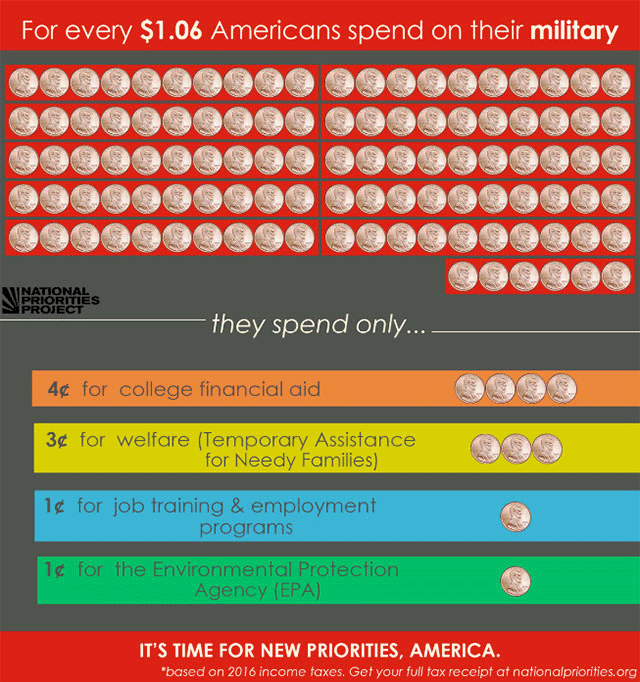
The US Will Spend on Nuclear Weapons in the Next Decade, https://jacobinmag.com/2021/05/military-spending-nuclear-weapons-department-of-defense
BY JULIA ROCK, 26 May 21, According to a new Congressional Budget Office report, we’re set to spend well over a half a trillion dollars over the next decade on nuclear weapons. Yet we’re somehow told that Medicare for All is too expensive.
As Capitol Hill lawmakers continue to insist that initiatives like Medicare for All are too expensive, a new congressional report shows that the United States government is on a path to spend more than a half-trillion dollars on nuclear weapons in just the next decade. The report emerges at the same time a separate analysis shows that a handful of top executives at defense contractors are being wildly enriched by a Pentagon spending spree.
The first report from the Congressional Budget Office (CBO) finds that the federal government is on track to spend $634 billion over the next decade to maintain its nuclear forces. Almost two-thirds of those costs are for the Department of Defense, mostly to maintain ballistic missile submarines and intercontinental ballistic missiles. About one-third is for the Department of Energy.
For comparison that is:
- 1.5 times the cost of all of the $1,400 stimulus checks that were sent to people through the American Rescue Plan earlier this year.
- Nearly fourteen times the $47 billion that Congress has spent so far this year helping Americans who are behind on rent.
- Over one-third of the cost of cancelling the $1.7 trillion in student debt held by Americans, most of which is never going to be repaid.
- More than seven times the estimated $81 billion of outstanding medical debt in America, as of 2018.
The new CBO estimate represents a 28 percent increase over the last ten-year estimate that the CBO made on US nuclear forces two years ago.
The figures were released just a few weeks after a new analysis from the Center for International Policy, a foreign policy think tank in Washington, found that “In 2020 alone, the CEOs of the [Pentagon’s] top five contractors received a total of $105.4 million in compensation.”
When accounting for all top corporate officials, these firms paid out more than a quarter billion dollars of total executive compensation in 2020 — and paid out more than $1 billion over the last four years.
About half of the Pentagon’s budget goes directly to corporations such as Lockheed Martin and General Dynamics, according to the report.
So far, the deficit scolds who wanted to narrow eligibility for stimulus checks, student debt cancellation, or rent relief haven’t complained about the spending.
In 1958, U.S military had plans to use nuclear weapons against China, in a crisis over Taiwan.
US military considered using nuclear weapons against China in 1958 Taiwan Strait crisis, leaked documents show https://edition.cnn.com/2021/05/24/china/us-china-taiwan-1958-nuclear-intl-hnk/index.html
By Ben Westcott, CNN, May 24, 2021 Hong Kong, Military planners in Washington pushed for the White House to prepare plans to use nuclear weapons against mainland China during the Taiwan Strait crisis in 1958, newly leaked documents appear to confirm.The documents, first reported on by the New York Times Saturday, reveal the extent of Washington’s discussions about using nuclear weapons to deter a Chinese invasion of Taiwan, including the acceptance by some US military leaders of possible retaliatory nuclear strikes on US bases.
The new information was provided to the Times by Daniel Ellsberg, the whistleblower who in 1971 leaked the Pentagon Papers that detailed the US government’s duplicity in its handling of the Vietnam War.”US first use of nuclear weapons should not be contemplated, prepared, or threatened anywhere, under any circumstances, including the defense of Taiwan,” Ellsberg said in a post to his Twitter on Sunday.
The Taiwan leak comes from previously classified sections of a 1966 report by think tank Rand Corporation on the 1958 Taiwan Straits crisis, written by M. H. Halperin for the Office of the then-Assistant Secretary of Defense.After the Communist Party took power in mainland China in 1949, following a brutal civil war, the Nationalist government fled to Taiwan. But Beijing viewed the island as part of its territory, and the two sides clashed intermittently over the following decades.
The closest the US and China came to armed conflict was during the Taiwan Strait crisis in 1958, when the People’s Republic of China fired artillery at Taipei’s outlying islands. Washington worried the shelling could be a precursor to a full invasion.he shelling focused on the Quemoy and Matsu island groups, which lie between Taiwan and mainland China and are described by Rand Corporation as “the first line of defense” for Taipei.Although it is already public knowledge that the Eisenhower administration debated whether to use nuclear weapons to deter China from attacking Taiwan, the documents appear to reveal the extent of the planning for the first time.According to the leaked documents, some US Defense and State department officials were concerned the loss of the outlying islands in 1958 could lead to a full “Chinese Communist takeover of Taiwan.”
In the event of an air and sea attack on the islands, US Air Force Gen. Nathan Twining said the US would have to use nuclear weapons against Chinese air force bases “to prevent a successful air interdiction campaign,” beginning with “low-yield ten to fifteen kiloton nuclear weapons.”If this didn’t lead to a break in the assault from mainland China, “the United States … would have no alternative but to conduct nuclear strikes deep into China as far north as Shanghai.”According to the documents, the Chairman of the Joint Chiefs acknowledged this would “almost certainly” lead to nuclear retaliation against Taiwan and the US military base at Okinawa in Japan. “But he stressed that if national policy is to defend the offshore islands then the consequences had to be accepted,” the document said.Given China had yet to develop its own nuclear capabilities, any nuclear retaliation would have come from the Soviet Union, possibly sparking an even more devastating global conflict. The report said it isn’t clear where the nuclear retaliation would have originated.
The document said the US Joint Chiefs, and Twining in particular, saw the use of atomic weapons as “inevitable.” In one section, Gen. Laurence S. Kuter, the top Air Force commander for the Pacific, “flatly” states that any US air action against a Chinese attack on the outlying islands “had no chance of success unless atomic weapons were used from the outset.”In the end, Eisenhower was hesitant to use nuclear weapons and pushed for the US troops to stick to conventional arms. Joshua Pollack, editor of the Nonproliferation Review, said on Twitter Sunday that the idea the US would have risked a nuclear exchange with the Soviet Union over islands with “no military value” was “jarring.”“It’s no surprise the White House said no,” he said.A ceasefire was reached in the Taiwan Strait on October 6, 1958, although there have been ongoing tensions between Beijing and Taipei.
In January 2019 speech, Chinese President Xi Jinping warned he would take “all means necessary” and not “renounce the use of force” to rejoin Taiwan to the Chinese mainland.Beijing claims full sovereignty over Taiwan, a democracy of almost 24 million people located off the southeastern coast of mainland China, even though the two sides have been governed separately for more than seven decades.With military tensions rising again between the US and China, whistleblower Ellsberg said in his interview with the Times that he had supplied the documents due to his concerns over the possibility of a new war over Taiwan.
On Sunday, Ellsberg took to Twitter to call for both sides to exercise restraint.“Note to @JoeBiden: learn from this secret history, and don’t repeat this insanity,” he said.
1st U.N. nuclear ban meeting may be postponed until after Non Proliferation Treaty review
1st U.N. nuclear ban meeting may be postponed until after NPT review, https://english.kyodonews.net/news/2021/05/7809e5aa594f-1st-un-nuclear-ban-meeting-may-be-postponed-until-after-npt-review.html
The first meeting of parties to a U.N. treaty banning nuclear weapons, set to be held next January, may be pushed to the spring so that it takes place after a rescheduled U.N. conference on nuclear nonproliferation, diplomatic sources said Tuesday.
The review conference on the Nuclear Non-Proliferation Treaty, held every five years in New York, has already been pushed back multiple times from its original date of April last year to August this year due to the coronavirus pandemic, but there are talks of postponing it again to the beginning of next year.
The Treaty on the Prohibition of Nuclear Weapons, which is the first international pact outlawing the development, testing, possession and use of nuclear weapons, came into effect in January this year with the support of many non-nuclear states.
Its first meeting, which must be held within one year of coming into force, is currently scheduled for January next year in Austria. Japanese survivors of the 1945 atomic bombing are also expected to attend.
With the momentum for nuclear disarmament waning due to the pandemic, the international community stands at a critical juncture concerning whether nuclear-armed states will curb their nuclear expansion.
As it will be unrealistic to hold both conferences in January next year, proposals have been made to postpone the first meeting of the nuclear ban treaty by several months or hold the meeting in January as scheduled but postpone substantive discussions until after the NPT review conference.
There are strong calls among countries supporting the nuclear weapon ban treaty to hold the NPT conference as soon as possible, with many likely eager to also observe the discussions at the review conference attended by the nuclear powers
Costs of upgrading USA’s nuclear arsenal has jumped up by $140 billion in just 2 years.

Surprise! Upgrading America’s Nuclear Arsenal Will Be Stupefyingly Expensive
The cost jumped $140 billion in just 2 years. Here’s why. Popular Mechanics, BY KYLE MIZOKAMIMAY 26, 2021
- The Congressional Budget Office (CBO) now says the cost of updating the U.S.’s nuclear weapons is $140 billion more than it estimated just 2 years ago.
- The increase is largely due to inflation and the inclusion of new, expensive projects the CBO didn’t cover 2 years ago.
- The new estimate comes as a proposal in Congress seeks to trim the nuclear budget.
- The nonpartisan Congressional Budget Office’s (CBO) estimate of nuclear weapon expenditures over the next decade has jumped a staggering $140 billion in just 2 years………………………. https://www.popularmechanics.com/military/weapons/a36534316/cost-upgrading-us-nuclear-arsenal-increases/
The Doomsday Clock
Chernobyl Alert and The Doomsday Clock The Conversation, BY ROBERT HUNZIKER 21 May 21, ” ……………..The Doomsday Clock
Along those lines, the world-famous Doomsday Clock, initially based upon the threat of nuclear warfare, measures humanity’s nearness to utter annihilation: The Bulletin of the Atomic Scientists (“BAS”) a global organization of science and policy experts, has set the famous clock at 100 seconds to midnight: “The bad news is that we’re still closer to midnight than we’ve been at any time since the clock was introduced more than 60 years ago because: (1) widespread mishandling of the COVID-19 pandemic in nations worldwide (2) little progress in eliminating nuclear weapons (3) insufficient mitigation of destructive climate change, and (4) threats to national security by rightwing extremists, the BAS decided to hold the clock at the present unsettling time slot, as a warning and “wake-up call.” (Source: Do0msday Clock Stands at 100 Seconds to Midnight, LiveScience)
The perilous setting of the clock so close to midnight is warranted on several counts, e.g., COVID pulled back the wizard’s curtain, revealing a cartoonish figurine of irresponsibility by governments of the world to handle emergencies: “An historic wakeup call that governments are woefully unprepared to handle pandemics,” Ibid.
Throughout history, political parties that rely upon lies bring society down to its knees with shameless destruction, for example, the fall of Rome, the 5th century AD: “By the time of Augustine (354-430 AD), the Roman Empire had become an Empire of lies. It still pretended to uphold the rule of law, to protect the people from the Barbarian invaders, to maintain the social order. But all that had become a bad joke for the citizens of an empire by then reduced to nothing more than a giant military machine dedicated to oppressing the poor in order to maintain the privileges of the rich. The Empire itself had become a lie: that it existed because of the favor of the Gods who rewarded the Romans because of their moral virtues. Nobody could believe in that anymore: it was the breakdown of the very fabric of society; the loss of what the ancient called the auctoritas, the trust that citizens had toward their leaders and the institutions of their state.” (Source: Cassandra’s Legacy, The Empire of Lies, February 8, 2016).
Robert Hunziker lives in Los Angeles and can be reached at rlhunziker@gmail.com. https://www.counterpunch.org/2021/05/21/chernobyl-alert-and-the-doomsday-clock/
1 This Month





PLEASE OPPOSE HR 8255 AND S.3639 – bills would accelerate satellite deployment, with no environmental review or safeguards – https://ncstd5li.quorum.us/campaign/169331/
To see nuclear-related stories in greater depth and intensity – go to https://nuclearinformation.wordpress.com
-
Archives
- October 2026 (67)
- September 2026 (339)
- August 2026 (330)
- July 2026 (355)
- June 2026 (287)
- May 2026 (306)
- April 2026 (356)
- March 2026 (251)
- February 2026 (267)
- January 2026 (308)
- December 2025 (358)
- November 2025 (359)
-
Categories
- 1
- 1 NUCLEAR ISSUES
- business and costs
- climate change
- culture and arts
- ENERGY
- environment
- health
- history
- indigenous issues
- Legal
- marketing of nuclear
- media
- opposition to nuclear
- PERSONAL STORIES
- politics
- politics international
- Religion and ethics
- safety
- secrets,lies and civil liberties
- spinbuster
- technology
- Uranium
- wastes
- weapons and war
- Women
- 2 WORLD
- ACTION
- AFRICA
- Atrocities
- AUSTRALIA
- Christina's notes
- Christina's themes
- culture and arts
- Events
- Fuk 2022
- Fuk 2023
- Fukushima 2017
- Fukushima 2018
- fukushima 2019
- Fukushima 2020
- Fukushima 2021
- general
- global warming
- Humour (God we need it)
- Nuclear
- RARE EARTHS
- Reference
- resources – print
- Resources -audiovicual
- Weekly Newsletter
- World
- World Nuclear
- YouTube
-
RSS
Entries RSS
Comments RSS

