Canada’s Moltex small nuclear reactor project -its plutonium process brings danger of nuclear weapons proliferation.
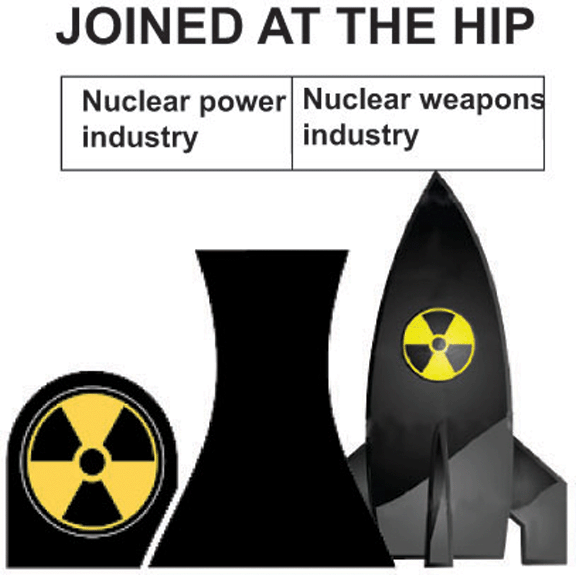
Diane Francis: Trudeau’s multi-million dollar nuclear deal called out by non-proliferation experts https://financialpost.com/diane-francis/diane-francis-trudeaus-multi-million-dollar-nuclear-deal-called-out-by-non-proliferation-experts ,
Scientists fear that the technology used to extract plutonium from spent fuel could be used to make nuclear bombs, Diane Francis Aug 12, 2021 In May, the Geneva-based International Campaign to Abolish Nuclear Weapons (ICAN) called out Prime Minister Justin Trudeau’s government over a deal he has approved and funded that critics say will undermine the goal of nuclear non-proliferation, according to an article published in the Hill Times and recently republished in the Bulletin of the Atomic Scientists.
Moltex Energy was selected by NB Power and the Government of New Brunswick to develop its new reactor technology and locate it at the Point Lepreau nuclear plant site by the early 2030s. Moltex is one of several companies that are promoting small, “next generation” nuclear reactors to replace fossil fuels in the production of electricity.
Moltex, a privately owned company that is based in the United Kingdom and has offices in Saint John, N.B., says it will “recycle nuclear waste” from New Brunswick’s closed Point Lepreau nuclear plant for use in its small-scale nuclear reactor. Federal funding and approval was announced on March 18 by Dominic LeBlanc, a New Brunswick MP who serves as minister of intergovernmental affairs.
The scientists dispute the claim that this is “recycling” and are concerned because the technology Moltex wants to use to extract plutonium, a key ingredient in nuclear weapons, from spent fuel could be used by other countries to make nuclear bombs. Decades ago, the U.S. and many of its allies, including Canada, took action to prevent this type of reprocessing from taking place.
“The idea is to use the plutonium as fuel for a new nuclear reactor, still in the design stage. If the project is successful, the entire package could be replicated and sold to other countries if the Government of Canada approves the sale,” reads the article.
On May 25, nine high-level American non-proliferation experts sent an open letter to Trudeau expressing concern that by “backing spent-fuel reprocessing and plutonium extraction, the Government of Canada will undermine the global nuclear weapons non-proliferation regime that Canada has done so much to strengthen.”
The signatories to the letter include senior White House appointees and other government advisers who worked under six U.S. presidents and who hold professorships at the Harvard Kennedy School, Princeton University and other eminent institutions.
The issue of nuclear proliferation dates back to 1974, when Canada got a black eye after India tested its first nuclear weapon using plutonium that was largely extracted using the CIRUS reactor, which was supplied by Canada for peaceful uses. Shortly after, other countries attempted to repurpose plutonium from reactors and were stopped — except for Pakistan, which, like India, succeeded in creating atomic weapons.
The Hill Times pointed out that, “To this day, South Korea is not allowed to extract plutonium from used nuclear fuel on its own territory — a long-lasting political legacy of the 1974 Indian explosion and its aftermath — due to proliferation concerns.”
The letter to Trudeau concluded: “Before Canada makes any further commitments in support of reprocessing, we urge you to convene high-level reviews of both the non-proliferation and environmental implications of Moltex’s reprocessing proposal including international experts. We believe such reviews will find reprocessing to be counterproductive on both fronts.”
The scientists’ letter has not yet been answered by the government. However, Canadians deserve to be fully briefed on all this and its implications. They deserve to know who owns Moltex, what the risks are to non-proliferation and why taxpayers are sinking millions of dollars into a project that’s morally questionable and potentially hazardous.Read and sign up for Diane Francis’ newsletter on America at dianefrancis.substack.com.
America’s ground-based nuclear missile silos – expensive and unnecessary

New report questions the necessity of ICBM silos in Montana, Wyoming and North Dakota https://dailymontanan.com/2021/07/28/new-report-questions-the-necessity-of-icbm-silos-in-montana-wyoming-and-north-dakota/
Researchers question whether America can afford to spend money on new system
BY: DARRELL EHRLICK – JULY 28, 2021 A massive recent report by the Federation of American Scientists calls into question whether ground-based nuclear missiles, like the ones siloed in Montana, are still necessary to the country’s safety.
The question of nuclear missiles is not new, but lead author Matt Korda, a research associate at the Nuclear Information Project of the federation, said the issue needs revisiting since the war system that was created at the beginning of the Cold War has outlived the Soviet Union, and the world’s political system has rapidly changed.
Korda explained that new security threats have presented themselves, which means that America’s defenses must adapt. For example, terrorism from small groups instead of threats from countries are a reality that was unlikely during the height of the Soviet-America conflict. Also, economic inequality and social unrest within the country have also changed the conversation. Furthermore, global warming and the effects of climate change and the new threat of pandemics mean that America must re-think its priorities.
A massive recent report by the Federation of American Scientists calls into question whether ground-based nuclear missiles, like the ones siloed in Montana, are still necessary to the country’s safety.
The question of nuclear missiles is not new, but lead author Matt Korda, a research associate at the Nuclear Information Project of the federation, said the issue needs revisiting since the war system that was created at the beginning of the Cold War has outlived the Soviet Union, and the world’s political system has rapidly changed.
Korda explained that new security threats have presented themselves, which means that America’s defenses must adapt. For example, terrorism from small groups instead of threats from countries are a reality that was unlikely during the height of the Soviet-America conflict. Also, economic inequality and social unrest within the country have also changed the conversation. Furthermore, global warming and the effects of climate change and the new threat of pandemics mean that America must re-think its priorities.
Korda’s research questions whether the assumptions – like trying to make a snap-judgment decision – isn’t more of a liability than a strength.
“There’s a bias in this system toward launching them really quickly,” Korda said.
Moreover, because anyone looking to launch an attack on America wouldn’t necessarily know the location of bombers or submarines, it would make the stationary missiles in places like Montana a target.
“It would invite a devastating attack,” Korda said.
In other words, in the event of a nuclear attack, Montana, Wyoming and North Dakota may be the first places to be wiped off the map.
He said part of the report’s purpose was to dive into the theories that have become a sort of gospel in the defense world – that America’s enemies would be forced to attack the ground-based silos first before targeting larger population centers like Washington, D.C., Los Angeles or New York City.
He said with countries like China and North Korea developing nuclear missiles with quick flight times, the idea that they would target a place like Montana or Wyoming before more populated West Coast targets isn’t logical.
“We have always assumed that ground-based missiles would deter an attack, but there’s no evidence that would happen,” Korda said.
Instead, Korda argues in the report, the entire system and the next generation of missiles, estimated at a lifetime cost of more than $260 billion, is based on the idea that an enemy would have to target the ground-based system first.
Moreover, because of the quick launch decisions, the ability to recall the nuclear missiles would be nearly impossible, raising the chances that a false alarm could trigger an accidental nuclear war.
Korda’s study also calls into question whether as many nuclear warheads are necessary. For example, China currently has around 300, with plans not to exceed 600. Its current stockpile of nukes is less than 10 percent of the United States’ inventory. Korda said that if a threat like China only needs 600, then that would seem to indicate America may not need as many to be safe.
“The U.S. nuclear posture and policy kind of presumes that escalation (of a nuclear attack) can be controlled after they go off, but I don’t think that’s the case,” Korda said.
He pointed out that even the conservative-leaning RAND Corporation has stated that America’s nuclear arsenal is two to three times as much as the country likely needs.
The new study doesn’t just call into question the military strategy and history of the ground-based nuclear missiles, it also links it to an economic question: Whether America can afford to update and continue the program with emerging threats.
“Is the money better spent in missiles or would it be better to put it toward action on climate change or even disinformation?” said research assistant Tricia White.
The importance of the Radiation Exposure Compensation Act and of coming to terms with USA’s nuclear history.
When Nuclear Fallout Comes Home. Rep. Teresa Leger Fernández (NM03) spoke on the importance of the Radiation Exposure Compensation Act and coming to terms with our nuclear history. https://nationalinterest.org/blog/buzz/when-nuclear-fallout-comes-home-191720by Harry Tarpey Whether in New Mexico, Guam, or the Marshall Islands, the consequences of uranium mining, atmospheric testing, and nuclear weapons manufacturing continue to impact communities around the world, with little awareness from the international community.
I know people who have been impacted by uranium mining, and by the fallout and nuclear testing, so this is not abstract,” said Rep. Teresa Leger Fernández of New Mexico’s 3rd District, who recently sat down for an interview with Press the Button. “These are people I know, these are families I know—you can’t ignore it.”
Leger Fernández is a leading advocate in Congress for the extension and expansion of the Radiation Exposure Compensation Act (RECA), reforms that would establish a more robust and easier to navigate compensation program for the victims of nuclear radiation in the United States and its territories.
RECA is a federal statute established in 1990 as a mechanism to compensate individuals whose health or livelihood was affected by unintended radiation exposure due to our nuclear weapons complex. To date, it has compensated over $2.2 billion to tens of thousands of claimants suffering from health ailments caused by exposure to radiation.
These include atomic veterans, downwinders, and individuals working on atmospheric nuclear tests and in uranium mines.
Though many of these recipients have undoubtedly benefited from the program, Leger Fernández and her colleagues are recommending several improvements to the statute to expand its impact.
One such change she is championing is an increase in the amount of compensation provided per individual grant. “Right now, [RECA payments] are $50,000. That’s not sufficient, so we’re going to raise it to $150,000.” The legislation she will be co-sponsoring, if passed, would expand the limited scope of eligibility that RECA currently maintains to include geographic areas and age groups not currently covered by the statute.
When RECA was first designed, “it had a very limited area where, if you happen to be exposed in these certain counties, you got compensation. But we know that it’s not just a few counties that were impacted,” argues Leger Fernández, “we need to make sure they are all entitled to the compensation.”
Although this expansion would no doubt have a positive impact within her district, Leger Fernández views it as an issue that resonates well beyond her constituency: “I want to take on this fight because this impacts not just New Mexicans, but people elsewhere, who were exposed to radiation from testing, from the development of the weapons, through no fault of their own are
now suffering the consequences. We as a government who inflicted this harm cannot stand back and say ‘too bad’—we must act.”
With RECA set to either expire or be reauthorized in July 2022, Leger Fernández views the year ahead as an important opportunity to reassess and refine RECA to ensure its continued effectiveness. “We need to take this moment and re-authorize the act,” she told guest host Lily Adams, “but also, when we look at it, ask ‘where is [RECA] efficient, and what do we need to do to make it better?”
Japanese teenager calls for nuke-free world at U.N. disarmament confab
Japanese teenager calls for nuke-free world at U.N. disarmament confab https://english.kyodonews.net/news/2021/08/fbf868a14e17-japanese-teenager-calls-for-nuke-free-world-at-un-disarmament-confab.html
KYODO NEWS – Aug 13, 2021 A Japanese teenager on Thursday called for the abolition of nuclear weapons at a U.N. disarmament conference session that highlighted the importance of incorporating the voice of youth in its discussions.
“We must take a big step towards the total elimination of nuclear weapons,” said Rio Sasaki, an 18-year-old student at a senior high school in Hiroshima, which, along with Nagasaki, was one of the two Japanese cities devastated by U.S. atomic bombs in the final days of World War II.
Addressing the conference online, she related the physical and psychological pains suffered by her grandmother throughout her life as a victim of the atomic bomb and said that young people like herself bear a strong responsibility to eliminate nuclear weapons.
“I hope the world will respond to our call,” she said.
The session, which was dedicated to a discussion on youth and disarmament, was opened by U.N. High Representative for Disarmament Affairs Izumi Nakamitsu.
Nakamitsu highlighted in a video message the huge potential of youth to bring positive change in the world, including in the field of disarmament.
Noting that 40 percent of the world’s population is under the age of 25, Nakamitsu said that “inclusiveness is necessary to achieve the ultimate objectives of disarmament, nonproliferation and arms control, and for the effectiveness and sustainability of the agreements that we reach and the work that we do.”
Other youths who attended the meeting included those from Canada and Vietnam.
Sasaki is among Japan’s so-called high school student peace messengers who are selected each year to convey the messages of the two Japanese A-bombed cities.
The messengers have usually visited the European headquarters of the United Nations in Geneva, where disarmament conferences take place, and submitted signatures that they have collected to push for the abolition of nuclear weapons.
But this year, like last year, they have not been able to travel to Switzerland due to the coronavirus pandemic.
Join the fight against climate change and nuclear war
Join the fight against climate change and nuclear war Louis Brendan Curran, Baltimore https://www.baltimoresun.com/opinion/readers-respond/bs-ed-rr-climate-change-nuclear-war-letter-20210814-r4zlhppx7rcsfegznkhgkp4k6a-story.htmlAUG 14, 2021 We face two existential threats: climate change and nuclear war. We must fight both.
I salute President Joe Biden and the Federal Emergency Management Agency’s dedication of $3.8 billion to directly combat the effects — if not the causes — of climate change (”Biden announces record amount of climate resilience funding,” Aug. 6). But we would be complete fools if we guard against an existential threat that will be years in reaching maximum effect and we do not also make an equal effort to end the threat of nuclear annihilation, something that could happen accidentally or intentionally in only a matter of hours.
This month marked the 76th anniversary of two other “dates that live in infamy”: the Aug. 6 and 9th atomic bombings of Hiroshima and Nagasaki in 1945. The devastation wreaked there, while truly horrific, claiming well over 250,000 lives, pales in comparison to what any single nuclear weapon could do today. Despite some gradual reduction in the world’s nuclear arsenal over the past couple decades, there are now way more than 1,000 nuclear warheads spread out among 13 countries. This is literally a potential nuclear apocalypse just waiting to happen.
……….. the Baltimore City Council passed a “Back From The Brink” resolution urging our federal government to do everything possible to make progress toward disarming and eliminating all nuclear weapons worldwide. Other cities and towns have done so as well.
More significantly, 86 nations have signed, and 55 (and counting) countries have become, state parties to the U.N. Treaty for the Prevention of Nuclear War, a treaty that now binds all state parties to forswear all nuclear weaponry. One country, South Africa, has disarmed its nuclear arsenal,q but the United States and the other Nuclear Dozen nations have not.
The battle to belatedly address climate change will cost way more than the $3.8 billion that FEMA now plans to spend. The United States alone spends exponentially more than that maintaining our current nuclear arsenal, and even is budgeting a multibillion dollar “updated-replacement” arsenal, to continue this expensive insanity.
What can we do? First, Baltimore can get off its duff and post large “Nuclear Free Zone” signs at all city gateways, as required by law. Second, we can insist that our state’s two U.S. senators and eight representatives prioritize working to end the nuclear threat — and we can elect replacements for those who won’t or don’t. Third, we can insist that our president prioritize nuclear arms reduction treaties with all other nuclear nations at once or elect one who will in 2024. Fourth, we can support the nonprofit organizations that amplify our voices in this effort to dismantle this coequal threat to life on earth.
And lastly, we can divert the billions of taxpayer dollars that we spend on maintaining a weapons system that we will never use to instead fight climate change. Two threats. Two battlefronts. We have no choice. We must fight both until we succeed.
Strong call for New York City to legislate against investment of pension funds into nuclear weapons production

“We call on Speaker Corey Johnson and the City Council to vote and urgently pass Res. 976 and Intro.1621 to divest pension funds from nuclear weapon producers and reaffirm New York City as a Nuclear Weapons Free Zone. The legislation introduced by Council member Danny Dromm already inspired a historic hearing in City Hall and has the support of a majority of the City Council. As New Yorkers this is our moment to make hope and peace possible for a new generation.”
Nuclear disarmament campaigners press for legislation in New York City on 76th Anniversary of Hiroshima and Nagasaki Bombings. Pressenza, 13.08.21 – US, United States – Pressenza New York In a commemoration of the August 6 and August 9, 1945 bombings of Hiroshima and Nagasaki that was both somber and spirited, New York City-based nuclear disarmament advocates assembled outside the Municipal Building in downtown New York City. Advocates joined members of the International Campaign to Abolish Nuclear Weapons (ICAN), 2017 Nobel Peace Laureate in honoring New York nuclear disarmament heroes and urging Council Speaker Corey Johnson to reaffirm NYC as a nuclear weapons free zone.
Speakers included Michie Takeuchi, second generation Hiroshima Hibakusha survivor, Robert Croonquist, Hibakusha Stories Project founder, Bud Courtney of the Catholic Worker, Dr. Emily Welty, Director of Peace and Justice Studies at Pace University, Seth Shelden, ICAN representative at the United Nations and Brendan Fay ogranizer with NYCAN (New York Campaign to Abolish Nuclear Weapons).
Dr. Emily Welty reminded the gathering that the site for the Vigil is profound with history, because the development of the atomic bombs began across the street from City Hall at the Manhattan Project headquarters, at 270 Broadway.
In remarks Brendan Fay, Irish gay activist and nuclear disarmament advocate highlighted the legacy of LGBTQ New Yorkers in the global movement for nuclear disarmament.
- Bayard Rustin (1912-1987) highlighted the connection between colonialism, racism and nuclear weapons and traveled to Algeria in 1959 to protest French nuclear testing.
- James Baldwin (1924 –1987) as a member of National Committee for a Sane Nuclear Policy was among the leading speakers at the 1961 Peace Rally in Washington, DC. He said, “What am I doing here? Only those who would fail to see the relationship between the fight for civil rights and the struggle for world peace would be surprised to see me. Both fights are the same.”
- David McReynolds (1929-2018) was the first openly gay presidential candidate, a socialist and lifelong pacifist. During his 40-year career with the War Resisters League he became an international hero of the nuclear disarmament movement.
- Leslie Cagan (b. 1947) was a lead organizer of the largest disarmament rally in US history, the June 12, 1982 Rally Against the Arms Race.
- Peter Ciccchino (1960-2000) was arrested over two dozen times for peace, for nuclear disarmament, and for housing and human rights.
Fay thanked Council Member Danny Dromm (District 25) for introducing the nuclear divestment legislation in 2019. “Council Member Dromm follows the steps of previous council members including Council President and civil rights leader Paul O’Dwyer (1907 – 1998) who was a strong advocate for nuclear disarmament in City Hall.
Holding a poster of African American Civil rights leader and nuclear disarmament advocate Bayard Rustin,
Fay said, “As LGBTQ+ New Yorkers we join the rest of the human family this August 6th and August 9th in raising our voices to demand a world without nuclear weapons, for the sake of the children, for a future of hope. On this 76th anniversary of the bombing of Hiroshima and Nagasaki we say there is no Pride in bomb production. There is no Pride in raising the rainbow flag while investing in weapons of death.”
What of the nuclear weapons New York worker pensions are invested in? They are built to divide, harm, maim, kill. $475 million (0.25%) of New York worker pension funds are currently invested in the production of nuclear weapons. Our worker pensions must no longer be used as weapons of war. We are nurses, doctors, teachers, sanitation workers, firefighters, social workers, artists – our common cause is justice and peace……..
Fay said, “We call on Speaker Corey Johnson and the City Council to vote and urgently pass Res. 976 and Intro.1621 to divest pension funds from nuclear weapon producers and reaffirm New York City as a Nuclear Weapons Free Zone. The legislation introduced by Council member Danny Dromm already inspired a historic hearing in City Hall and has the support of a majority of the City Council. As New Yorkers this is our moment to make hope and peace possible for a new generation.”…….
Resolution 976 calls on the Comptroller to instruct pension funds to divest from companies involved in the production of nuclear weapons (approximately $475 million dollars) and re-affirms New York City as a Nuclear Weapons Free Zone.
Introduction 1621 establishes a Nuclear Disarmament Advisory Committee to advise the City Council.
The Treaty on the Prohibition of Nuclear Weapons, adopted by 122 countries in 2017, makes nuclear weapons comprehensively illegal and became international law on January 22, 2021. https://www.pressenza.com/2021/08/nuclear-disarmament-campaigners-press-for-legislation-in-new-york-city-on-76th-anniversary-of-hiroshima-and-nagasaki-bombings/
Why Are We Still Building Nuclear Weapons? Follow the Money

Why Are We Still Building Nuclear Weapons? Follow the Money, Forbes, William Hartung, 11 Aug 21,

The FY 2022 Pentagon budget proposal includes billions of dollars for new nuclear delivery vehicles, with a handful of prime contractors as the primary beneficiaries. For example, Northrop Grumman’s NOC+0.9% twelve largest subcontractors for its new ICBM include some of the nation’s largest defense companies, including Lockheed Martin LMT+0.3%, General Dynamics GD+0.8%, L3Harris, Aerojet Rocketdyne AJRD+0.2%, Honeywell, Bechtel, and the Collins Aerospace division of Raytheon RTX+1.1% Technologies. Other beneficiaries of the funding of new nuclear delivery vehicles include Raytheon (a nuclear-armed cruise missile), General Dynamics (ballistic missile submarines), Lockheed Martin (submarine-launched ballistic missiles), and Northrop Grumman – again – for the new nuclear-armed bombers.
This month marks the 76th anniversary of the bombings of Hiroshima and Nagasaki, events that resulted in the immediate deaths of well over 100,000 people and underscored the devastating consequences of building, deploying, and using nuclear weapons. Those attacks should have served as a wake-up call on the need to control and eliminate these potential world-ending weapons, but determined efforts by scientists, political leaders, policy advocates, and grassroots advocates around the world have yet to abolish them……………
the international community, under the leadership of the International Campaign to Abolish Nuclear Weapons (ICAN), has created and brought into force the Treaty on the Prohibition of Nuclear Weapons, which has been signed by 86 nations and ratified by 55 of them. This is an historic accomplishment, but the real culprits – the major nuclear weapons states that possess the vast bulk of the world’s nuclear weapons – have yet to sign onto the measure.
The United States maintains an active nuclear stockpile of roughly 4,000 nuclear weapons, including over 1,500 deployed warheads. Russia’s stockpile is comparable, at roughly 4,400, while China follows with roughly 300 strategic nuclear warheads. Despite its considerably smaller arsenal, recent revelations regarding China’s construction of new silos for long-range nuclear missiles are cause for real concern as they raise the risk of accelerating the nuclear arms race at great risk to the future of the planet. These developments demand dialogue to roll back the production of new nuclear weapons systems, leading to reductions in the size of global arsenals and the ultimate elimination of this existential threat.
The continued development and deployment of intercontinental ballistic missiles (ICBMs) is of particular concern. As former Secretary of Defense William Perry has noted, ICBMs are “some of the most dangerous weapons in the world” because a president would have only a matter of minutes to decide whether to launch them upon warning of a nuclear attack, increasing the possibility of an accidental nuclear war based on a false alarm.
Given all of the above, why is the United States still building nuclear weapons, more than seven decades after the devastation of Hiroshima and Nagasaki? The U.S. is not alone in building a new generation of nuclear weapons – Russia and China are doing so as well. But the Pentagon’s 30-year plan to build new nuclear-armed bombers, missiles, and submarines – along with new nuclear warheads to go with them at a cost of up to $2 trillion – is the height of folly and an unnecessary, grave risk to the lives of current and future generations. A major reason for this misguided policy can be summed up in a phrase – there is money to be made in perpetuating the nuclear arms race.
The FY 2022 Pentagon budget proposal includes billions of dollars for new nuclear delivery vehicles, with a handful of prime contractors as the primary beneficiaries. For example, Northrop Grumman’s NOC+0.9% twelve largest subcontractors for its new ICBM include some of the nation’s largest defense companies, including Lockheed Martin LMT+0.3%, General Dynamics GD+0.8%, L3Harris, Aerojet Rocketdyne AJRD+0.2%, Honeywell, Bechtel, and the Collins Aerospace division of Raytheon RTX+1.1% Technologies. Other beneficiaries of the funding of new nuclear delivery vehicles include Raytheon (a nuclear-armed cruise missile), General Dynamics (ballistic missile submarines), Lockheed Martin (submarine-launched ballistic missiles), and Northrop Grumman – again – for the new nuclear-armed bomber.
Additional recipients of nuclear weapons-related funding are the firms that run the nuclear warhead complex. Major contractors include Honeywell and Bechtel, which run key facilities for the development and production of nuclear warheads.
Nuclear weapons contractors spend millions of dollars on campaign contributions and lobbying efforts every year in their efforts to shape nuclear weapons policy and spending. While not all of this spending is devoted to lobbying on nuclear weapons programs, these expenditures are indicative of the political clout they can bring to bear on Congress as needed to sustain and expand the budgets for their nuclear-related programs.
The major nuclear weapons contractors made a total of over $119 million in campaign contributions from 2012 to 2020, including over $31 million in 2020 alone. The companies spent $57.9 million on lobbying in 2020 and employed 380 lobbyists among them.
The only way to be truly safe from nuclear weapons is to eliminate them altogether, as called for in the United Nations Treaty on the Prohibition of Nuclear Weapons. As noted above, the major nuclear powers have yet to sign onto the treaty but pressing them to do so should be a central component of efforts to rein in nuclear dangers.
It’s time that we stopped allowing special interest lobbying and corporate profits to stand in the way of a more sensible nuclear policy. The future of humanity depends on it. https://www.forbes.com/sites/williamhartung/2021/08/10/why-are-we-still-building-nuclear-weapons—-follow-the-money/?sh=442b7ad15888
UN pledges full support to Nagasaki voices fuelling ‘powerful global movement’ against nuclear arms
UN pledges full support to Nagasaki voices fuelling ‘powerful global movement’ against nuclear arms. https://news.un.org/en/story/2021/08/1097372 9 Aug 21, António Guterres has reaffirmed the full support of the United Nations to amplifying the powerful testimony of the survivors of the atomic bomb that was dropped on the Japanese city of Nagasaki, 76 years ago, which has helped build a “powerful global movement against nuclear arms”.
In his message to the Nagasaki Peace Memorial on the 9 August anniversary, the UN Secretary-General said he continued to be humbled by the “selfless acts of the hibakusha, the name given to those who survived and continue to bear witness.
“Your courage in the face of immense human tragedy, is a beacon of hope for humanity”, he said in his address, delivered on his behalf at the ceremony by the UN High Representative for Disarmament Affairs, Izumi Nakamitsu.
“I reaffirm the full support of the United Nations to ensuring that your voices are heard by the world’s people, and especially by younger generations.”
Out of the ashes
The UN chief told the people of the city that was devastated in 1945, just days after the first bomb was dropped by the United States on Hiroshima during the final days of World War Two, that they had built a “cultural metropolis” out of the ashes.
“Your dynamic city exemplifies modernity and progress, while you work diligently to prevent devastation from ever befalling another city”, he said, warning however that the prospect of another nuclear weapon being used, were as dangerous now, as any time since the height of the Cold War between the US and former USSR.
“States are racing to create more powerful weapons, and broadening the potential scenarios for their use. Warlike rhetoric is turned up to maximum volume, while dialogue is on mute”, said the Secretary-General.
Grounds for hope
But two developments this year provide grounds for hope, in the form of the reaffirmation from the US and Russia, “that a nuclear war cannot be won and must never be fought”, together with a commitment to engage in arms control talks.
Secondly, said Mr. Guterres in his message, the Treaty on the Prohibition of Nuclear Weapons has now come into force, representing “the legitimate fears of many States, about the existential danger posed by nuclear weapons.”
And for the parties to the Nuclear Non-Proliferation Treaty, the UN chief said they all parties now need to reinforce “the norm against nuclear weapons” at the upcoming Tenth Review Conference, and take real steps towards elimination.
It is incumbent on all Member States of the UN, “to seek the abolition of the most deadly weapons ever made”, said Mr. Guterres, and together, we must prevent the tragedy of Nagasaki’s nuclear destruction, “from ever occurring again.”
Nagasaki remembers the atomic bomb, Olympic officials refuse to allow a minute’s silence.

Nagasaki nuclear attack remembered https://www.taipeitimes.com/News/world/archives/2021/08/10/2003762363
ATOMIC BOMB ANNIVERSARY: Small turnout due to COVID-19 did not lessen the observance, also marking the first year of a mostly symbolic nuclear ban treaty
The Japanese city of Nagasaki yesterday commemorated the 76th anniversary of the detonation of a US atomic bomb over the city, with the mayor calling for the global community to build on a new nuclear ban treaty.
Nagasaki was hit by an atomic inferno that killed 74,000 people, three days after the nuclear bomb that hit Hiroshima.
The twin attacks brought forth the nuclear age and gave Japan the bleak distinction of being the only country to be struck by foreign atomic weapons.
Survivors and a handful of foreign dignitaries offered a silent prayer at 11:02am local time, the exact time the second — and last — nuclear weapon used in wartime was dropped. For a second year, the number of people attending was much smaller due to COVID-19 restrictions. The ceremony is the first since an international treaty banning nuclear weapons came into force last year.
“World leaders must commit to nuclear arms reductions and build trust through dialogue, and civil society must push them in this direction,” Nagasaki Mayor Tomihisa Taue said.
The treaty has not been signed by countries with nuclear arsenals, but activists believe it will have a gradual deterrent effect.
Japan has not signed it either, saying the accord carries no weight without being accepted by nuclear-armed states.
The country is also in a delicate position, as it is under the US nuclear umbrella, with US forces responsible for its defence.
As the only country that has suffered atomic bombings during the war, it is our unchanging mission to steadily advance the efforts of the international community, step by step, towards realization of a world free of nuclear weapons,” Japanese Prime Minister Yoshihide Suga said at the ceremony.
On Friday, Japan marked 76 years since the US dropped an atomic bomb on Hiroshima, killing around 140,000 people.
Barack Obama in 2016 became the first sitting US president to visit Hiroshima, but Washington has never acceded to demands for an apology for the bombings.
International Olympic Committee president Thomas Bach traveled to Hiroshima in July, before the start of the Tokyo Games, to mark the start of an Olympic truce — a tradition that calls for a halt to global conflict to allow the safe passage of athletes.
However, city officials were disappointed after the IOC refused a request to stage a minute of silence at the Games to mark Friday’s anniversary.
Why China is increasing its nuclear deterrence capacity
China needs to increase nuclear capacity to maintain minimum deterrence against rising US coercion, By Hu Xijin Global Times, Aug 07, 2021 On Friday, US Secretary of State Antony Blinken expressed his “deep concern” about the “rapid growth” of China’s nuclear arsenal with Southeast Asian foreign ministers. He accused Beijing of “sharply deviating from its decades-old nuclear strategy based on minimum deterrence.” This is the US’ official response from the highest level after various US think tanks over the past few months have claimed that China is building a great number of “new missile silos” in Yumen of Northwest China’s Gansu Province and in the Hami region in Northwest China’s Xinjiang Uygur Autonomous Region.
Chinese officials have not directly responded to these allegations made by US think tanks. They have neither confirmed nor denied them.It is important to note that China has never abandoned its minimum deterrence nuclear strategy. However, due to the comprehensive strategic threat that the US keeps posing to China, the nuclear capabilities Beijing needs to achieve “minimum deterrence” are now different from the past. As the potential risk stemming from US nuclear coercion against China is clearly increasing, China needs to have sufficient nuclear forces to contain such a risk
Even many ordinary Chinese people feel the urgency of strengthening China’s nuclear deterrent is common sense. We don’t know if those structures shown in the satellite photos in Yumen and Hami are silos or the foundations of wind power plants as some scholars have speculated. But if it does turn out that they really are silos, Chinese public opinion will definitely support the construction of them unconditionally.
Washington is in no moral position to accuse China of this. China has only a fraction of the number of nuclear warheads that the US has. China is also the only nuclear power that has pledged not to be the first to use nuclear weapons. The US has never indicated that it would consider making the same commitment.
There is no information from Beijing on whether it is strengthening its nuclear buildup in the face of a realistic threat from Washington. But even if we were doing that, it would have nothing to do with Southeast Asian countries, or even with Japan and Australia, because China’s nuclear policy also includes another firm commitment of not using or threatening to use nuclear weapons against any non-nuclear-weapon state.
Once China substantially strengthens its nuclear forces, its only purpose will be to deter the US. Since there is already no mutual trust between China and the US, Chinese society is fully convinced that the US’ ultimate strategic goal is to bring China down. While not giving up on maintaining peace between the two countries, we must be prepared for the possibility that a war could eventually occur in the Taiwan Straits or the South China Sea. One of China’s major strategic missions today is to make the most complete layout for that day…………….https://www.globaltimes.cn/page/202108/1230817.shtml
The myth that the nuclear destruction of Hiroshima and Nagasaki was justified

Over the years, the myth that the “nuking” of two Japanese cities was justified, has lost much of its appeal on both sides of the Pacific
Mythmaking and the Atomic Destruction of Hiroshima and Nagasaki, CounterPunch BY JACQUES R. PAUWELS, 8 Aug 21, Myth: The war in the Far East only ended in the summer of 1945, when the US president and his advisors felt that, to force the fanatical Japanese to surrender unconditionally, they had no other option than to destroy not one but two cities, Hiroshima and Nagasaki, with atom bombs. This decision saved the lives of countless Americans and Japanese who would have perished if the war had continued and required an invasion of Japan.
Reality: Hiroshima and Nagasaki were destroyed to prevent the Soviets from making a contribution to the victory against Japan, which would have forced Washington to allow Moscow to participate in the postwar occupation and reconstruction of the country. It was also the intention to intimidate the Soviet leadership and thus to wrest concessions from it with respect to the postwar arrangements in Germany and Eastern Europe. Finally, it was not the destruction of Hiroshima and Nagasaki, but the Soviet entry into the war against Japan, which caused Tokyo to surrender.
With the German capitulation in early May 1945, the war in Europe was over. The victors, the Big Three,[1] now faced the complex and delicate problem of the postwar reorganization of Europe. The United States had entered the war rather late, namely in December 1941. And the Americans only started to make a major contribution to the victory against Germany with the landings in Normandy in June 1944, that is, less than one year before the end of the hostilities in Europe. When the war against Germany came to an end, however, Uncle Sam occupied a seat at the table of the victors, ready and eager to look after his interests, to achieve what one might call the American war aims. (It is a myth that the presumably deeply isolationist Americans just wanted to withdraw from Europe: the country’s political, military, and economic leaders had urgent reasons for maintaining a presence on the old continent.) The other big victorious powers, Britain and the Soviet Union, also looked to pursue their interests. It was clear that it would be impossible for one of the three to “have it all”, that compromises would have to be reached. From the American point of view, the British expectations did not present much of a problem, but Soviet aspirations were a concern. What, then, were the war aims of the Soviet Union?
As the country that had made the biggest contribution by far to the common victory over Nazi Germany and suffered enormous casualties in the process, the Soviet Union had two major objectives. First, hefty reparation payments from Germany as compensation for the huge destruction wrought by Nazi aggression, a demand similar to the French and Belgian demands for reparations payments from the Reich after World War I. Second, security against potential future threats emanating from Germany………………………….
on April 25, 1945, only days before the German capitulation, the president received electrifying news. He was briefed about the top-secret Manhattan Project, or S-1, the code name for the construction of the atom bomb. That new and powerful weapon, on which the Americans had been working for years, was almost ready and, if tested successfully, would soon be available for use. Truman and his advisors thus fell under the spell of what the renowned American historian William Appleman Williams has called a “vision of omnipotence”. They convinced themselves that the new weapon would enable them to force their will on the Soviet Union. The atomic bomb was “a hammer”, as Truman himself put it, that he would wave over the heads of “those boys in the Kremlin”.[3]
Thanks to the bomb, it would now be possible to force Moscow to withdraw the Red Army from Germany and to deny Stalin a say in its postwar affairs. It now also seemed a feasible proposition to install pro-Western and even anticommunist regimes in Poland and elsewhere in Eastern Europe, and to prevent Stalin from exerting any influence there. It even became thinkable that the Soviet Union itself might be opened up to American investment capital as well as American political and economic influence,………… Indeed, with the nuclear pistol on his hip, the American president did not feel that he had to treat “the boys in the Kremlin”, who did not have such a super-weapon, as his equals……….
Possession of a mighty new weapon also opened up all sorts of possibilities with respect to the ongoing war in the Far East and the postwar arrangements to be made for that part of the world, of great importance to the leaders of the US, as we have seen when dealing with Pearl Harbor. Nevertheless, playing that powerful trump card would only be possible after the bomb had been successfully tested and was available to be used………
Truman concluded that only an actual demonstration of the atomic bomb could persuade the Soviets to give way.
…………………The Americans thus knew only too well that the situation of the Japanese was hopeless. “Fini Japs when that comes about”, Truman wrote in his diary, referring to the expected Soviet intervention in the war in the Far East.[9]
…………….. In order to finish the war against Japan without having to make more sacrifices, Truman thus had a range of attractive options. He could accept the trivial Japanese condition, immunity for their emperor; he could also wait until the Red Army attacked the Japanese in China, thus forcing Tokyo into accepting an unconditional surrender after all; and he could have instituted a naval blockade that would have forced Tokyo to sue for peace sooner or later. But Truman and his advisors chose none of these options. Instead, they decided to knock Japan out with the atomic bomb.
This fateful decision, which was to cost the lives of hundreds of thousands of people, mostly civilians, offered the Americans considerable advantages.
………………… The atom bomb seemed to offer the American leaders an additional important advantage. Truman’s experience in Potsdam had persuaded him that only an actual demonstration of this new weapon would make Stalin pliable. Using the atom bomb to obliterate a Japanese city seemed to be the perfect stratagem to intimidate the Soviets and coerce them to make major concessions with respect to postwar arrangements in Germany, Poland, and elsewhere in Central and Eastern Europe. Truman’s secretary of state, James F. Byrnes, reportedly declared later that the atom bomb had been used because such a demonstration of power was likely to make the Soviets more accommodating in Europe.
To make the desired terrifying impression on the Soviets – and the rest of the world -, the bomb obviously had to be dropped on a big city. It is probably for this reason that Truman turned down a proposal, made by some of the scientists involved in the Manhattan Project, to demonstrate the power of the bomb by dropping it on some uninhabited Pacific island: there would not have been sufficient death and destruction. It would also have been extremely embarrassing if the weapon had failed to work its deadly magic; but if the unannounced atomic bombing of a Japanese city backfired, no one would have known and no one would have been embarrassed. A big Japanese city had to be selected, but the capital, Tokyo, did not qualify, since it was already flattened by previous conventional bombing raids, so that additional damage was unlikely to loom sufficiently impressive. In fact, very few cities qualified as the required “virgin” target. ……….
The atom bomb was ready just in time to be put to use before the USSR had a chance to become involved in the Far East………………
Already on August 10, 1945, just one day after the Soviet Union’s entry into the war in the Far East, a second bomb was dropped, this time on the city of Nagasaki. About this bombardment, in which many Japanese Catholics perished, a former American army chaplain later stated: “That’s one of the reasons I think they dropped the second bomb. To hurry it up. To make them surrender before Russians came”.[11] (The chaplain may or may not have been aware that among the 75,000 human beings who were “instantaneously incinerated, carbonized and evaporated” in Nagasaki were many Japanese Catholics as well an unknown number of inmates of a camp for allied POWs, whose presence had been reported to the air command, to no avail.)[12]
Japan capitulated not because of the atom bombs but because of the Soviet entry into the conflict. ………………………
Truman, however, wanted to use the bomb for a number of reasons, and not just to get the Japanese to surrender. He expected that dropping the atom bomb would keep the Soviets out of the Far East and terrorize that country’s leaders, so that Washington could impose its will on the Kremlin with respect to European affairs. And so, Hiroshima and Nagasaki were pulverized. Many American historians realize this only too well. Sean Dennis Cashman writes:
With the passing of time, many historians have concluded that the bomb was used as much for political reasons . . . Vannevar Bush [the head of the US Office of Scientific Research and Development] stated that the bomb “was also delivered on time, so that there was no necessity for any concessions to Russia at the end of the war”. Secretary of State James F. Byrnes [Truman’s secretary of state] never denied a statement attributed to him that the bomb had been used to demonstrate American power to the Soviet Union in order to make [the Soviets] more manageable in Europe.[16]
Truman himself, however, hypocritically declared at the time that the purpose of the two nuclear bombardments had been “to bring the boys home”, that is, to quickly finish the war without any further major loss of life on the American side. This explanation was uncritically broadcast in the American media and thus was born a myth eagerly propagated by them and by mainstream historians in the US and in the Western World in general, and of course by Hollywood.
The myth that two Japanese cities were nuked to force Tokyo to surrender, thus shortening the war and saving lives, was “made in USA”, but it was to be eagerly espoused in Japan, whose post-war leaders, vassals of the US, found it extremely useful for a number of reasons, as War Wilson has pointed out in his excellent article on the Bomb. First, the emperor and his ministers, who were in many ways responsible for a war that had caused so much misery for the Japanese people, found it extremely convenient to blame their defeat, as Wilson puts it, on “an amazing scientific breakthrough that no one could have predicted”. The blinding light of the atomic blasts made it impossible, so to speak, to see their “mistakes and misjudgments”. The Japanese people had been lied to about how bad the situation really was, and how the misery had dragged on so long just to save the emperor, but the Bomb provided the perfect excuse for having lost the war. No need to apportion blame; no court of enquiry need be held. Japan’s leaders were able to claim they had done their best. So, at the most general level the Bomb served to deflect blame from Japan’s leaders.
Second, the Bomb earned Japan international sympathy. Like Germany, Japan had waged a war of aggression and committed all sorts of war crimes. Both countries looked for ways to improve their image, seeking to exchange the mantle of perpetrator. for that of victim…………
Third, echoing the American notion that the Bomb had ended the war was certain to please Japan’s post-war American overlords. The latter would protect Japan’s upper class against the demands for radical societal change emanating from radical elements, including communists,………………..
Over the years, the myth that the “nuking” of two Japanese cities was justified, has lost much of its appeal on both sides of the Pacific……………
References: multiple sources are quoted . https://www.counterpunch.org/2021/08/06/mythmaking-and-the-atomic-destruction-of-hiroshima-and-nagasaki/
Complicit – The countries, companies and think tanks that support the deadly nuclear arms trade

The world spends $137,000 a minute on nuclear weapons
Complicit — Beyond Nuclear International 8 Aug 21, The countries, companies and think tanks that support the deadly nuclear arms trade
From ICAN
A new report from ICAN — Complicit: 2020 Global Nuclear Weapons spending — names names and produces some horrifying spending numbers, made all the more immoral by the desperate needs around the world due to the COVID-19 pandemic, along with the ever worsening conditions brought on by the climate crisis.
As the report notes, “In 2020, during the worst global pandemic in a century, nine nuclear-armed states spent $72.6 billion on their nuclear weapons, more than $137,000 per minute, an inflation adjusted increase of $1.4 billion from last year.”
It goes on to ask the obvious question: Why? The answer lies in the profits to be made by the world’s nuclear weapons companies, not to mention the funding flowing to a few think tanks, some of which have missions that should make taking this money unacceptable. “Not only does this report reveal the massive spending on nuclear weapons during the worst global pandemic in a century, it also shines a light on the shadowy connection between the private companies building nuclear weapons, lobbyists and think tanks,” wrote ICAN’s Susi Snyder in an email to launch the report.
She also narrates this short video above that explains the findings.
“The exchange of money and influence, from countries to companies to lobbyists and think tanks, sustains and maintains a global arsenal of catastrophically destructive weapons. Each person and organisation in this cycle is complicit in threatening life as we know it and wasting resources desperately needed to address real threats to human health and safety”, says the report’s executive summary. It goes on:
“The $72.6 billion spent on nuclear weapons was split between governmental departments and private companies. Companies in France, the United Kingdom and the United States received $27.7 billion from nuclear-weapon-related contracts in 2020, of which $14.8 billion was new.
“Those companies then funded think tanks that research and write about nuclear weapons policies. At least twelve major think tanks that research and write about nuclear weapons in India, France, the United Kingdom, and the United States received collectively between $5 million and $10 million from companies that produce nuclear weapons.
“The CEOs of companies that produce nuclear weapons sit on their advisory boards and are listed as ‘partners’ on their websites.
“And to make sure the enormous budgets are approved to pay for these contracts, those same companies hire lobbyists. In 2020, nuclear weapons producers spent $117 million in lobbying on defence. For every $1 spent lobbying, an average of $236 in nuclear weapon contract money came back.
“Nuclear-armed states spent an obscene amount of money on illegal weapons of mass destruction in 2020, while the majority of the world’s countries support a global nuclear weapons ban. But the story doesn’t stop there. Companies, lobbyists and think tanks are complicit and deserve to be held accountable for their role in building and shaping a world with more than 13,000 life- ending weapons. We need to call on them to cut it out.”
The executive summary of the report then calls out the names of the countries, companies and think tanks complicit in effectively planning the world’s destruction.
Country Spending On Nuclear Weapons In 2020
The United States: $37.4 billion; $70,881 / minute
China: $10.1 billion; $19,149 / minute
Russia: $8 billion; $15,222 / minute
The United Kingdom: $6.2 billion; $11,769 / minute
France: $5.7 billion; $10,786 / minute
India: $2.48 billion; $4,567 / minute
Israel: $1.1 billion; $2,059 / minute
Pakistan: $1 billion; $1,968 / minute
North Korea: $667 million; $1,265 / minute
2020 Total: $72.6 billion; $137,666 / minute
2019 Total: $71.2 billion* $135,424 / minute
*Adjusted for inflation…………………..
more https://beyondnuclearinternational.org/2021/08/08/complicit/
The hard fought campaign continues – to ban nuclear weapons.
Public statement on the nuclear assassination of Hiroshima and Nagasaki https://www.pressenza.com/2021/08/public-statement-on-the-nuclear-assassination-of-hiroshima-and-nagasaki/07.08.21 – World without Wars and Violence It was a warm northern morning on 6 August 1945 in the city of Hiroshima, and despite the war, the atmosphere was somewhat normal, far from the scenes of war, with children going to school and the elderly going to work. Nothing foreshadowed the horror they would later experience when a powerful nuclear bomb would wipe out their lives forever. Neither children nor adults anywhere on earth ever imagined that anyone in this world would be capable of inflicting such an atrocity on their fellow human beings. Women and children burned, mutilated, their skin and eyes hanging out was the first Dantesque image of that horrific morning, then the effects of radiation that caused agony just as painful and prolonged.
World without Wars and Violence remembers with sadness one more year the fateful nuclear explosions of Hiroshima and Nagasaki 76 years ago, and does so in a hopeful attempt to ensure that such a horrific event can never happen again, in the naïve hope that the conscience of the human species has evolved enough not to do something so abhorrent again.
World without Wars and Violence, a member of the International Action Network on Nuclear Weapons (ICAN), a network that received the 2017 Nobel Peace Prize for its contribution to the drafting of a Treaty to Ban Nuclear Weapons. The Treaty was approved at the United Nations on 7 July 2017 with the approval of 122 nations, opened for signature on 20 September 2017, and finally entered into force on 22 January 2021 with 55 states having ratified it to date.
World without War argues that the campaign to ban nuclear weapons has been hard fought and wide-ranging, and will continue to be so until the vast majority of the world’s countries ratify the Treaty, including the nine nuclear weapons states, namely the United States, Russia, China, France, the United Kingdom, Israel, India, Pakistan and North Korea. Although these countries have not signed the Treaty, there are some that have indicated their willingness to do so if the others, especially the United States, do so. And while most European countries do not have them, they do have nuclear missile sites, being allies of the nuclear-weapon states in NATO.
Many efforts are being made at all levels, says World without Wars, to bring about a break with this Atlantic organisation, not only in terms of ratifying the ban on nuclear weapons, but also as an alliance, because it is considered a belligerent and expansionist organisation.
World without Wars also adds that campaigns are being carried out to get cities around the world to adhere to the idea of approving a treaty banning nuclear weapons, which has been very fruitful as more than a hundred cities around the world have given their support to the ban.
Similarly, a Network of Parliamentarians for the Prohibition of Nuclear Weapons has been formed and has been signed by hundreds of parliamentarians around the world. Not to mention the numerous professional organisations such as the Physicians for a Nuclear Ban, who are campaigning for support and holding events. It is worth noting that there are 607 ICAN member organisations in 106 countries, which shows the massiveness of the campaign for the abolition and elimination of these diabolical devices.
In this regard, Beatrice Fihn, ICAN’s executive director, upon receiving the Nobel Peace Prize, said forcefully: “Nuclear weapons as well as chemical weapons, biological weapons, cluster bombs and landmines are now illegal. Their existence is immoral. Their abolition is in our hands. The end is inevitable. But will that end be the end of nuclear weapons or the end of us? We must choose one. We are a movement for rationality, for democracy, for freedom from fear”.
Pope Francis, the leader of the Catholic world, also said: “We must never stop working in support of the major international legal instruments on nuclear non-proliferation and disarmament, including the Treaty on the Prohibition of Nuclear Weapons”.
Despite this enormous support from civil society around the world for the prohibition of nuclear weapons, there is a lack of political will on the part of first world leaders to eliminate nuclear weapons from their nuclear arsenals and to sustain the World without Wars, as they are clearly not respecting the will of the vast majority of the world’s population who want to get rid of them for good as a threat to their very survival. And even though recently at their meeting in Geneva the top representatives of nuclear power, Biden and Putin, declared that a nuclear war should never be started because no one would gain from it, it is not understood why they do not commit themselves to dismantling their arsenals. And the reasons may be, according to this organisation:
Mutual distrust that there is real disarmament between the adversaries.
The stubborn insistence that their existence has prevented a third conventional world war.
The high economic interests involved in the nuclear industry
Trillions of dollars continue to be invested in the maintenance and development of nuclear weapons, with no real commitment to their elimination. Thus, despite the fact that nuclear weapons are now illegal under the Treaty on the Prohibition of Nuclear Weapons (CTBT), the governments that possess them continue to go against the will of their people, their own citizens who elected them, argues World without Wars.
t is incomprehensible how the only country that has been the victim of a nuclear detonation, Japan, can have as a military ally the country that nuclear bombed it, just because it has a nuclear umbrella that is supposed to prevent a nuclear attack by China or North Korea, going against the will of the vast majority of the Japanese population who detest nuclear weapons with good reason.
One of the survivors (hibakusha) of the holocaust, Setzuko Thurlow said on receiving the Nobel Peace Prize in Oslo: “To all presidents and prime ministers of all nations I plead: join this Treaty, eradicate forever the threat of nuclear annihilation. As a thirteen-year-old girl, trapped in smoking rubble, I kept pushing and moving towards the light. I survived. Our light is now the Ban Treaty. To everyone in this room and to everyone listening in the world, I repeat those words I heard calling to me in the ruins of Hiroshima. Don’t give up. Keep pushing. Do you see the light? Crawl towards it.
World without Wars and Violence has taken up his call and is organising marches all over the world where the abolition and total elimination of nuclear weapons is among its cardinal objectives. Precisely on July 18 it launched its Latin American March which begins on September 15 and concludes in Costa Rica on October 2, the International Day of Nonviolence.
Undoubtedly, we must begin to do what has not been done for centuries, what has never been done in the history of humanity, which is to build and strengthen trust between all the countries of the world, to change the paradigm of competition for power and natural resources, of egoistic nationalism, for collaboration and mutual cooperation between all nations, for overcoming racial, religious and political antagonisms and building a Great Universal Human Nation in which the union and tolerance of all cultures prevails over all differences and a multilateralism of true United Nations working for a better common destiny for all the peoples of the earth is achieved.
We are at the final crossroads of our human civilisation, and we have a historic opportunity to move towards a wonderful future for the human species. It all depends on each one of us.
Now, in the times of the UN Nuclear Ban Treaty, nuclear deterrence continues, but becomes increasingly discredited
Nuclear deterrence is an idea that became a potentially lethal ideology, one that remains influential despite having been increasingly discredited…………….
Spectres Of Nuclear ‘MAD’ness: Between Deterrence And Survival – Eurasia Review August 8, 2021K.M. Seethi With the Treaty on the Prohibition of Nuclear Weapons (TPNW) in place, is there an optimistic scenario of a nuclear-weapon free world? This might certainly be a difficult but persistently challenging question the world has been grappling with ever since the cities of Hiroshima and Nagasaki were devastated by atomic bombs, way back in 1945.
Spectres of nuclear holocaust have been haunting political communities across the world even after the end of Cold War. While the world’s most powerful nuclear-weapon states (NWS) have been locked in a military logjam—often characterised as ‘Mutually Assured Destruction’ (MAD)—a few states in Asia (including threshold states like Iran) still get absorbed in the logic of ‘limited nuclear deterrence.’………………
Nukes Accumulation
Paradoxical it may seem, the Asian continent has again become a hotbed of global nuclear threats with several nuclear-weapon states now spanning fault lines running through East Asia, in the Korean Peninsula, China’s eastern and southern coastline and across the Himalayas in South Asia and West Asia–and all of them presently recalibrating their nuclear profiles. And the share of Asia in the ‘horizontal proliferation’ is quite significant. As per the data brought out by the Stockholm International Peace Research Institute (SIPRI), the NWS—the United States, Russia, the United Kingdom, France, China, India, Pakistan, Israel and North Kore—together have in their arsenal an estimated 13,080 nuclear weapons at the beginning of 2021. While Russia (6255) and the U.S. (5550) possess more than 90 per cent of the world’s nuclear weapons, China has 350 weapons in its inventory, followed by France (290), UK (225), Pakistan (165), India (156), Israel (90), and North.
Nuclear Ban Regime
The efforts seeking a legally mandatory instrument to ban nuclear weapons have long been underway. However, they have found a new relevance in the past decade with the increasing awareness about the humanitarian and environmental costs of use of nuclear arms. ……………… culminated in the passing of a resolution (71/258) by the UN General Assembly in 2017 to negotiate a legally binding instrument to ban nuclear weapons, leading towards their total elimination. And the Conference was held from 27 to 31 March and from 15 June to 7 July in New York which led to the TPNW. (Treaty for the Prohibition of Nuclear Weapons)
The Treaty envisages a broad set of regulations for prohibition on partaking in any nuclear weapon programmes and activities. These regulatory clauses stipulate that the signatories shall “not develop, test, produce, acquire, possess, stockpile, use or threaten to use nuclear weapons.” It also forbids “the deployment of nuclear weapons on national territory and the provision of assistance to any State in the conduct of prohibited activities.” The Treaty also makes it mandatory for the signatories “to provide adequate assistance to individuals affected by the use or testing of nuclear weapons, as well as to take necessary and appropriate measure of environmental remediation in areas under its jurisdiction or control contaminated as a result of activities related to the testing or use of nuclear weapons.”
TPNW was adopted (by a vote of 122 States in favour, with one vote against and one abstention) at the United Nations on 7 July 2017, and opened for signature by the Secretary-General on 20 September 2017. Following the deposit with the Secretary-General of the 50th instrument of ratification or accession of the Treaty on 24 October 2020, it entered into force on 22 January 2021 in accordance with its Article 15 (1).
‘Consensus’ For Opposition!
TPNW, which currently has 86 signatory states, has been totally ignored by the NWS and NATO member states. ‘Consensus’ among the NWS in regard to their opposition to the Treaty could also be a grim reminder. For example, in a joint statement made at the First Committee of the 73rd session of the UN General Assembly in October 2018, Russia, China, UK, U.S. and France had informed that they would not sign the TPNW. The statement says: “We will not support, sign or ratify this Treaty. The TPNW will not be binding on our countries, and we do not accept any claim that it contributes to the development of customary international law; nor does it set any new standards or norms. We call on all countries that are considering supporting the TPNW to reflect seriously on its implications for international peace and security.” ………………………..
Between Deterrence and Survival
In his The Evolution of Nuclear Strategy (1989), Lawrence Freedman says, “The Emperor Deterrence may have no clothes, but he is still Emperor.” David Barash adds: “Despite his nakedness, this emperor continues to strut about, receiving deference he doesn’t deserve, while endangering the entire world. Nuclear deterrence is an idea that became a potentially lethal ideology, one that remains influential despite having been increasingly discredited…………….
Way back in 1955, the well-known Russell-Einstein Manifesto had warned of the perils of nuclear weapons. This declaration put across what Bertrand Russell and Albert Einstein called “the stark and dreadful and inescapable” problem of the nuclear age: “Shall we put an end to the human race; or shall mankind renounce war?” Given the continuing proliferation tempo, both vertically and horizontally, peace loving people across the world can never abandon the dream of achieving the elimination of nuclear weapons from the face of the earth. The risk of catastrophic misuse of nuclear weapons, deliberately or―more likely―by accident or miscalculation, is as grave and immediate as it has ever been. And the existential threat nuclear weapons pose to life on this planet is as significant as those of climate change and global pandemic, and in many ways more immediate.
*The author is Director, Inter University Centre for Social Science Research and Extension (IUCSSRE), Mahatma Gandhi University, Kerala who also served as Dean and Professor of International Relations, MGU. He can be contacted at kmseethimgu@gmail.com https://www.eurasiareview.com/08082021-spectres-of-nuclear-madness-between-deterrence-and-survival-oped/
Bribing politicians pays off for weapons companies

The countries, companies and think tanks that support the deadly nuclear arms trade, From ICAN 8 Aug 21,
” ………….Company defence contract awards and defence lobby spending in 2020
Aerojet Rocketdyne: Awarded: $132 million Spent lobbying: $2.3 million
Airbus: Awarded: $170 million Spent lobbying: $6.1 million
BAE Systems: Awarded: $10.8 billion ($72.5 million for nuclear weapons) Spent lobbying: $5.6 million
Bechtel: Awarded: $2.9 billion Spent lobbying: $990,000
Boeing: Awarded: $50 billion ($105 million for nuclear weapons) Spent lobbying: $15.6 million
Constructions Industrielles de la Méditerranée (CNIM): Awarded: $39.1 million Spent lobbying: $17,226
Charles Stark Draper Laboratory: Awarded: $443.5 million ($342.3 million for nuclear weapons) Spent lobbying: $120,000
Fluor: Awarded: $3.9 billion Spent lobbying: $5.1 million
General Dynamics: Awarded: $39.4 billion ($10.8 billion for nuclear weapons) Spent lobbying: $13.9 million
Honeywell International: Awarded: $14 billion ($41.6 million for nuclear weapons) Spent lobbying: $7.4 million
Huntington Ingalls Industries: Awarded: $7.4 billion ($53 million for nuclear weapons); Spent lobbying: $5.2 million
Jacobs Engineering: Awarded: $2.6 billion Spent lobbying: $900,000
L3 Harris Technologies: Awarded: $5.6 billion ($60 million for nuclear weapons) Spent lobbying: $200,000
Leidos: Awarded: $10.8 billion Spent lobbying: $2.4 million
Leonardo: Awarded: $728.8 million Spent lobbying: $86,644
Lockheed Martin: Awarded: $124.5 billion ($2.1 billion for nuclear weapons) Spent lobbying: $15 million
Northrop Grumman: Awarded: 29.1 billion ($13.7 billion for nuclear weapons) Spent lobbying: $13.3 million
Raytheon Technologies Corporation: Awarded: $27.5 billion ($450 million for nuclear weapons) Spent lobbying: $15.2 million
Safran: Awarded: $12.3 million Spent lobbying: $382,211
Serco: Awarded: $896 million Spent lobbying: $420,000
Textron: Awarded: $1.8 billion ($3.2 million for nuclear weapons) Spent lobbying: $5.1 million
Total: Awarded: $332 billion ($27.7 billion for nuclear weapons) Spent lobbying: $117 million………
more https://wordpress.com/read/feeds/72759838/posts/3488978062
1 This Month





PLEASE OPPOSE HR 8255 AND S.3639 – bills would accelerate satellite deployment, with no environmental review or safeguards – https://ncstd5li.quorum.us/campaign/169331/
To see nuclear-related stories in greater depth and intensity – go to https://nuclearinformation.wordpress.com
-
Archives
- October 2026 (58)
- September 2026 (339)
- August 2026 (330)
- July 2026 (355)
- June 2026 (287)
- May 2026 (306)
- April 2026 (356)
- March 2026 (251)
- February 2026 (267)
- January 2026 (308)
- December 2025 (358)
- November 2025 (359)
-
Categories
- 1
- 1 NUCLEAR ISSUES
- business and costs
- climate change
- culture and arts
- ENERGY
- environment
- health
- history
- indigenous issues
- Legal
- marketing of nuclear
- media
- opposition to nuclear
- PERSONAL STORIES
- politics
- politics international
- Religion and ethics
- safety
- secrets,lies and civil liberties
- spinbuster
- technology
- Uranium
- wastes
- weapons and war
- Women
- 2 WORLD
- ACTION
- AFRICA
- Atrocities
- AUSTRALIA
- Christina's notes
- Christina's themes
- culture and arts
- Events
- Fuk 2022
- Fuk 2023
- Fukushima 2017
- Fukushima 2018
- fukushima 2019
- Fukushima 2020
- Fukushima 2021
- general
- global warming
- Humour (God we need it)
- Nuclear
- RARE EARTHS
- Reference
- resources – print
- Resources -audiovicual
- Weekly Newsletter
- World
- World Nuclear
- YouTube
-
RSS
Entries RSS
Comments RSS

