Nuclear weapons standout calls for US commitment to UN treaty
Nuclear weapons standout calls for US commitment to UN treaty, By CHRIS LARABEEStaff Writer, Greenfield REcorderPublished: 1/23/2022 11:05:01 AM
GREENFIELD — On the one-year anniversary of the United Nations Treaty on the Prohibition of Nuclear Weapons becoming international law, a group gathered on the Greenfield Common and in Northampton to celebrate the treaty and to raise awareness that the United States has not signed on.
“Fifty nations have signed on. … How can we face the world?” asked Greenfield resident Patricia Greene. “We’re here to say not all of us agree.”
Greene and several other residents called out the United States’ “pugnacious” stance toward many other countries and said America should focus on peace.
“I feel that the main thing our country needs to do is look at peaceful relations,” Greene said. “We’re so divided internally, maybe heal that over, too.”
The anniversary of the treaty comes days before a state Public Safety and Homeland Security hearing Jan. 26 on Bill H.3688, which was filed by Rep. Lindsay Sabadosa, D-Northampton, and would establish an 11-member commission to investigate and report on what measures may be necessary and appropriate to protect Massachusetts residents from the threat posed by nuclear weapons and to contribute toward the total elimination of these weapons from all countries.
According to the United Nations’ website, 59 countries have ratified the treaty, which recognizes the threat of nuclear weapons and requires their elimination. Among the countries that have yet to even sign the treaty include many world powers, such as the United States, China, Japan and the majority of the European Union and England.
Pat Hynes, who sits on the Traprock Center for Peace and Justice’s board of directors, said the 11-member commission, if it was created, would find many people in Massachusetts with similar sentiments to the group standing on the frozen Greenfield Common.
“They would certainly find a very high majority opposing nuclear weapons,” Hynes said. “I hope the committee and State House have the courage to pass the bill.”
Hynes recalled a quote from World War II Army Gen. Omar Bradley that the world contains “nuclear giants and ethical infants.” She added it’s been disappointing that nuclear weapons continue to be produced, even after the horrors of bombing Hiroshima and Nagasaki and the existential threat of the Cold War.
“I’d say it’s tragic, especially with all the other crises happening,” Hynes said, highlighting climate change and the COVID-19 pandemic as current threats. “We don’t need to add to them.”………………..
https://www.recorder.com/Nuclear-weapons-standout-calls-for-U-S-commitment-to-U-N-treaty-44696552
The production, servicing and berthing of nuclear-powered submarines in or near population centres present unacceptable health risks.

Following revelations in freedom of information requests to Declassified UK records show 97,430 stable iodine tablets were pre-issued to people in Plymouth, Portland and Barrow-in-Furness from 2016-21 to protect them from radiation.
Kate Hudson, general secretary of the Campaign for Nuclear Disarmament (CND), said: “The production, servicing and berthing of nuclear-powered submarines in or near population centres present unacceptable health risks.
“Safeguarding our communities cannot be achieved through limited distribution of pills,” she said, adding that the vessels, some of which carry nuclear warheads, “need to be disarmed and decommissioned.” As Tim Deere-Jones has pointed out “I’m amazed at the way Governments and Regulators allow the “nuclear authorities” to mainstream on publicly highlighting the dangers of one or two radionuclides such as Iodine and Caesium and discuss them endlessly while avoiding the additional issues of the other 50/60 + nuclides that would be released by a meltdown or a LOCA or any other significant event.”
Radiation Free Lakeland 22nd Jan 2022
Call for Japan to join nuclear ban treaty on first anniversary
Call for Japan to join nuclear ban treaty on 1st anniversary, https://www.asahi.com/ajw/articles/14528449
THE ASAHI SHIMBUN, January 23, 2022 Supporters of a U.N. treaty banning nuclear weapons gathered Jan. 22 in Hiroshima and Nagasaki to mark the first anniversary of the pact going into force, stepping up their calls on Japan to sign it.
Standing in front of the symbolic Atomic Bomb Dome in Hiroshima, 10 or so members of a Hiroshima-based group calling for the abolition of nuclear weapons hoisted a banner that read the “whole world should join the Treaty on the Prohibition of Nuclear Weapons.”
“Unless Japan, the only country in the world to have been ravaged by atomic bombing, speaks out in the international community, it will be impossible to eliminate nuclear weapons,” said Shuichi Adachi, a lawyer representing the group.
Participation in the rally was kept to a minimum as a safety precaution against the COVID-19 pandemic.
Tomoyuki Mimaki, a representative of the association of A- and H-bomb sufferers in Hiroshima Prefecture, expressed disappointment with a joint statement released Jan. 21 by Tokyo and Washington on the issue of nuclear weapons.
“They treated the question with kid gloves,” he said dismissively, noting that although the statement encouraged the world’s political leaders and youth to visit Hiroshima and Nagasaki, it made no reference to the treaty.
Mimaki, 72, said he sent a letter to Prime Minister Fumio Kishida, who is from a constituency in Hiroshima, urging Japanese representatives to attend the first meeting of signatory countries of the treaty in Austria in March as observers.
Attendance on the part of Japan, he said, is indispensable as Kishida has pledged that Tokyo will work as an intermediary between the nuclear and nonnuclear powers.
In Nagasaki, about 150 nuclear-bomb survivors and their supporters gathered in the Peace Park to press the Japanese government to join and ratify the treaty.
“The government continues to ignore the treaty even though many countries have signed it,” said Shigemitsu Tanaka, president of the Nagasaki Atomic-bomb Survivors Council. “We want to get the public become familiar with the treaty so we can join forces in applying pressure on the government.”
Fifty-nine countries and territories have ratified the treaty.
But the nuclear powers as well as Japan, which is protected under the U.S. nuclear umbrella for its defense purposes, have refrained from doing so.
According to the Japan Council against Atomic and Hydrogen Bombs, 627 assemblies, or 35 percent, of the 1,788 local governments, including those at the prefectural level, had adopted a resolution as of Jan. 12 calling on the Japanese government to sign and ratify the treaty.
The figure included 90 or so local governments that adopted the resolution after the treaty went into force in 2021.
“The resolution adopted by local governments reflects public opinion and thus is more visible,” said Shiro Maekawa, an official of the council who tracks the trend among local governments on the issue. “The Japanese government should hear what the public says.”
Washington pumping up war fever

Washington pumping up war fever http://space4peace.blogspot.com/2022/01/washington-pumping-up-war-fever.html It’s nonstop in the western media. The message – war with Russia is coming.
An American friend of mine, now living in Russia, has two sons in the US Army. One of them said to him today, “your two sons are going to be fighting your beloved Russia.” So the troops are obviously being told to prepare for war. One of those sons, an Army Special Forces soldier has been sent to western Ukraine several times to train the Nazi death squads that have been brought into the Ukrainian Army since the US orchestrated coup d’état in 2014.
Russia has repeatedly stated that they have no intention of invading Ukraine – unless Ukraine first strikes Crimea or the Donbass (eastern Ukraine that borders Russia where two Russian-ethnic republics are located that have continually been targets of the right-wing Kiev government since 2014).
Russia constantly says they have no desire to take over the failed Ukrainian state – in fact Moscow says that the US-NATO have driven that country into the ground since the 2014 coup and they should help it recover. But the Washington agenda is chaos – just like Iraq, Syria, Libya and other places US-NATO have destroyed with their ‘freedom war machine’.
Let’s take a moment and look at possible reasons for the US-NATO daily agitation for war.
- The western corporate powers see their reign as ‘global rulers’ rapidly vanishing and know this is the last chance to bring down Russia and China before the ‘multi-polar’ world comes into fruition in the next few years.
- The west is led by evil, psychopaths who thirst for war. The neo-cons come to mind.
- It’s all a big public relations scheme to create a rare ‘win’ for the west. If Russia does not invade Ukraine then the US-NATO can claim it was all because they stood up to the ‘Russian bear’, proving that their out-of-date alliance still has a role in the world today.
- Western oligarchs can’t stand to let Russia have all those natural resources in the Arctic that are becoming possible to extract due to melting ice. So Russia must be broken up into smaller nations giving Mr. Big the chance to make the grab. See the RAND Corporation study that lays out the plan to balkanize Russia here. Thus there is no stopping this rush to war.
- US-NATO are bluffing. It’s all a great distraction to help take the heat off Big Pharma’s global vaccine campaign and growing international economic problems.
- You pick – give us your take in the comments.
- Now let’s review some of the reasons why war might be avoided.
If the US-NATO really went to full blown war with Russia then it would likely go nuclear. China would probably be pulled in. If this happens forget covid – kiss your family good-bye. Is the US-NATO stupid enough to try this? Yes they are but there are some sensible leaders in Europe who know this would not be such a great idea. Let’s hope they have the stuff it takes to help shut down this insanity.- The US-NATO constant aggression is a big money maker for the military industrial complex so this current war talk is a cash cow for them. But they are not stupid and know that nuclear war does not help their profit line.
- Think back to 2003 and George W. Bush’s ill-fated ‘shock and awe’ attack on Iraq that turned that nation into a chaotic failed state. Prior to the US-UK attack there were massive protests around the world for peace.
This time, as Washington-Brussels do their daily war-prep media barrage, there are few global protests. In fact there are some in the ‘US peace movement’ who buy the hype and believe Russia wants to remake the Soviet Union by invading Europe. Anyone who is actually paying real attention at this moment knows that story line is bullshit. But sadly some who should be protesting US-NATO provocations and aggression are not doing so. This weakens our ability to stop WW III.
I hope and pray that more people will speak out – and soon. Our lives depend on your courage and your action.
Just a reminder. Russia did not INVADE Crimea.

Bruce Gagnon, 21 Jan 22, Russia did not invade Crimea. They had a long-term lease with Ukraine that allowed over 20,000 military personnel at the Russian navy and air bases there.
The Russian-ethnic people of Crimea self-organized a referendum and voted 96% to seek to rejoin Russia. They saw the 2014 Nazi-led take over in Kiev during the US orchestrated coup and wanted nothing to do with the ‘new Ukraine’ regime.
See this excellent film produced by Oliver Stone https://vimeo.com/252426896?ref=fb-share
Mayors for Peace UK / Ireland Chapter and NFLA celebrates first nuclear weapons ‘banniversary’.
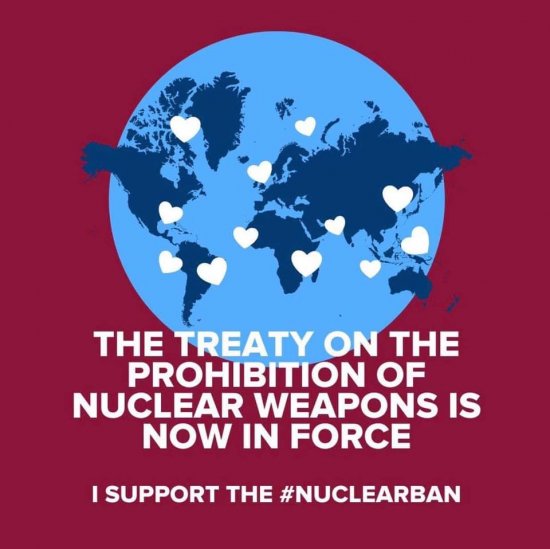
Richard Outram, UK / Ireland Mayors for Peace / NFLA Secretary, Richard.outram@manchester.gov.uk / 21 Jan 22,
Local authorities working for peace in the UK and Ireland will be celebrating the first ‘banniversary’ of the UN treaty making nuclear weapons illegal (22January).
The United Nations Treaty on the Prohibition of Nuclear Weapons (the Treaty) entered into force on the 22 January 2021, 90 days after the fiftieth nation ratified acceptance of it.
The Treaty requires signatory states to undertake not to develop, test, produce, acquire, possess, stockpile, deploy, use, or threaten to use nuclear weapons or permit or support other states to do so. The Treaty also requires any state which is a party to the treaty to provide assistance to persons and communities affected by the use or testing of nuclear weapons and to work to clear up land contaminated by such activities which lies under its jurisdiction or control[i].
Across the world, campaigners will be celebrating the first so-called ‘banniversary’, and the huge progress that has been made in the cause of advancing nuclear disarmament over the last year, in advance of a much-anticipated First Meeting of the States Parties currently scheduled to be hosted by Vienna, Austria between 22-24 March 2022.
59 UN member states have now ratified their acceptance of the Treaty and a further 27 have signed and are currently in the process of doing so. 101 financial institutions across the world representing almost $4 trillion have also announced they will shun further investment in nuclear weapons because of the Treaty.[ii]
The UK / Ireland Chapter of the international Mayors for Peace movement and the UK / Ireland Nuclear Free Local Authorities will be amongst the many organisations celebrating the date. Both are partner organisations of ICAN (the International Campaign to Abolish Nuclear Weapons).
Born out of the frustration that the UN Non-Proliferation Treaty had failed to deliver nuclear disarmament after almost half-a-century, ICAN, a global coalition of civil society, faith and peace organisations, atomic bomb and test survivors, scientists, doctors, academics and concerned world citizens, began to work for a treaty ban.[iii] Their work led to the Treaty being adopted by 122 of the world’s states at the United Nations on 7 July 2017 and later that year, ICAN and its partners were awarded the Nobel Peace Prize.
Subsequently ICAN worked with these states to bring the Treaty into law.
Commenting, Manchester City Councillor Eddy Newman, speaking on behalf of the UK / Ireland Chapter of Mayors for Peace, said:
“In the past, similar treaties have banned germ and chemical weapons, landmines, and cluster bombs and in the last year we have already achieved so much as a world community in moving forward a nuclear weapons ban. However there remain many challenges. Yesterday (20 January), the Bulletin of Atomic Scientists announced that the Doomsday Clock remains at 100 seconds to midnight in recognition that our world faces many grave threats. One, which is existential, is the ever-present threat of nuclear annihilation. Despite world opinion favouring nuclear disarmament, the nuclear weapon armed states, amongst them the United Kingdom, continue to refuse to engage with this Treaty and continue to renege upon their solemn promise made over 50 years ago as signatories to the Non-Proliferation Treaty to do so.”
The Chair of the Nuclear Free Local Authorities Steering Committee, Leeds City Councillor David Blackburn, added:
“Although the Republic of Ireland has creditably signed the Treaty, one of our priorities as Mayors for Peace Councils and Nuclear Free Local Authorities in the UK must be to continue to put pressure on the UK Government to engage with the treaty. One way to do this is to ask our member Councils to pass resolutions calling on the government to do so. This will be a priority for both of our organisations over the coming year. Leeds and Manchester are both amongst the UK Councils which have already passed such resolutions, and we hope many more will do so in 2022.[iv]”
Doomsday Clock continues to hover dangerously
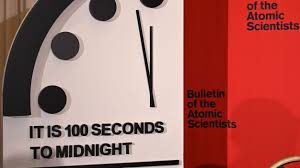
Doomsday Clock unchanged: scientists, https://www.canberratimes.com.au/story/7589207/doomsday-clock-unchanged-scientists/?cs=14232 The Doomsday Clock has remained at 100 seconds to midnight for a third year in a row as scientists said the world is “no safer” than it was this time last year.
Maintaining last year’s setting means the clock’s keepers believe the threat of global apocalypse has not cooled off in the past 12 months.
Rachel Bronson, president and chief executive of the Bulletin of the Atomic Scientists, said: “This year, in our statement, the science and security board highlights several bright spots and many disturbing trends.
The board describes a mixed-threat environment, one with positive developments counteracted by accelerating negative ones.
“Today, the members of the science and security board deem the world to be no safer than it was last year at this time, and therefore have decided to set the Doomsday Clock at 100 seconds to midnight.
“The Doomsday Clock continues to hover dangerously, reminding us how much work is needed to ensure a safer and healthier planet. We must continue to push the hands of the clock away from midnight.”
Doomsday clock stays at 100 seconds to midnight.

What the Doomsday Clock is really counting down to, The number of human-made existential risks has ballooned, but the most pressing one is the original: nuclear war. Vox, By Bryan Walsh @bryanrwalsh Jan 21, 2022 One hundred seconds to midnight. That’s the latest setting of the Doomsday Clock, unveiled yesterday morning by the Science and Security Board of the Bulletin of the Atomic Scientists.
That matches the setting in 2020 and 2021, making all three years the closest the Clock has been to midnight in its 75-year history. “The world is no safer than it was last year at this time,” said Rachel Bronson, the president and CEO of the Bulletin of the Atomic Scientists. “The Doomsday Clock continues to hover dangerously, reminding us how much work is needed to ensure a safer and healthier planet.”
As for why the world is supposedly lingering on the edge of Armageddon, take your pick. Covid-19 has amply demonstrated just how unprepared the world was to handle a major new infectious virus, and both increasing global interconnectedness and the spread of new biological engineering tools mean that the threat from both natural and human-made pathogens will only grow. Even with increasing efforts to reduce carbon emissions, climate change is worsening year after year. New technologies like artificial intelligence, autonomous weapons, even advanced cyberhacking present harder-to-gauge but still very real dangers.
The sheer number of factors that now go into Bulletin’s annual decision can obscure the bracing clarity that the Doomsday Clock was meant to evoke. But the Clock still works for the biggest existential threat facing the world right now, the one that the Doomsday Clock was invented to illustrate 75 years ago. It’s one that has been with us for so long that it has receded into the background of our nightmares: nuclear war — and the threat is arguably greater at this moment than it has been since the end of the Cold War.
The Doomsday Clock, explained
The Clock was originally the work of Martyl Langsdorf, an abstract landscape artist whose husband Alexander had been a physicist with the Manhattan Project. He was also a founder of the Bulletin, which began as a magazine put out by scientists worried about the dangers of the nuclear age and is now a nonprofit media organization that focuses on existential risks to humanity……………………. https://www.vox.com/22893594/doomsday-clock-nuclear-war-climate-change-risk
Options for Australia’s nuclear submarines – all of them impractical
Nuclear-powered submarines for Australia: what are the options? The Strategist , 20 Jan 2022, Pete Sandeman The political and strategic ramifications of the AUKUS pact involving the US, UK and Australia continue to reverberate, but the details of how Australia will acquire nuclear-powered submarines (SSNs) have often been overlooked. There are daunting technical, industrial and financial challenges on the long road to joining that club.
Even the acquisition of conventional submarines isn’t easy and projects completed on time and budget are rare. Nuclear propulsion adds another layer of complexity and cost, and the engineering challenge has been described as more demanding than building the space shuttle. There are good reasons why SSN ownership is limited to a small group of elite nations—the US, Russia, China, the UK, France and India. (With considerable French assistance, Brazil is on track to have its first nuclear boat in the late 2020s.)
………. Some commentators suggest that Australia’s first boats at least could be bought off UK or US production lines. Alternatively, old or ‘surplus’ submarines could be leased until new vessels are available. These assumptions are at odds with the US Navy’s and Royal Navy’s struggles with bringing new boats into service and maintaining ageing vessels.
…….Defence Minister Peter Dutton has said the RAN is considering leasing boats from the USN or RN but that’s far from a certainty. The RN is already severely short of active boats—nominally down to six SSNs, and able to field two or three on a good day. The USN is trying to maintain its existing force, struggling to build enough new Virginia-class SSNs while its Los Angeles-class boats are phased out. However supportive of Australia the UK may be, it has no suitable boats available to lease. The US has a far bigger fleet with 28 Los Angeles boats still active, but its force is already overcommitted and Washington is unlikely to offer anything, except perhaps a recently retired boat as a static training vessel.
Neither the US nor UK keeps submarines ‘in reserve’. The UK has already expensively extended the 1980s-vintage Trafalgar-class boats well past their 30th birthdays. None of the growing collection of decommissioned hulks could be returned to service with all the funds and will in the world. Their nuclear fuel is spent, and they would need colossally expensive refits and refuelling. More critically, submarines have finite hull lives. Every dive fatigues the pressure hull and pipework to a point where safe diving becomes severely restricted or the boat becomes unseaworthy. Older boats become increasingly hard to maintain and struggle to retain their all-important minimal acoustic signature.
The US has a more effective submarine dismantling program than the UK and its LA-class boats are gradually being scrapped. The inactive boats that remain intact are equally tired and some were withdrawn from service prematurely to avoid the cost of mid-life refuelling. There’s a slim chance that one or two of these boats could see further service with the RAN but only at enormous expense, and refitting them would put more strain on overburdened US industrial capacity.
………. Some suggest the Astute’s the best solution, optimistically proposing that the first couple be built in the UK before technology transfer enables the remaining six to be made in Australia. …… Unfortunately, there are almost insurmountable obstacles to the class ever numbering more than seven.
In the UK, completion of the remaining Astute-class boats is finely balanced with the construction of the Dreadnought-class ballistic missile submarines (SSBNs) and there’s not space in the shipyard or skilled people available to add additional boats….
People didn’t prepare for nuclear submarine exports and AUKUS was a bolt from the blue.
Assuming money was no object, new engineers could be recruited and the Barrow facilities could be enlarged, the project would still be in trouble because the Astute’s PWR-2 reactor no longer meets modern safety benchmarks and production has almost ceased……
Even if additional PWR-2 reactors could be acquired and the Astute boats could be constructed in Australia, they’d be semi-obsolete when they began to arrive in service by the late 2030s.
………….. Although the USN benefits from an established design and an industrial base that’s vastly more efficient than that of the RN, the yards and supply chain will need to expand significantly to fulfil the ambitious plans to grow the USN fleet. A recent report to Congress noted that ‘observers have expressed concern about the industrial base’s capacity for executing such a workload without encountering bottlenecks or other production problems in one or both of these programs’.
The USN also has issues maintaining its existing submarines. …………………..
When the AUKUS announcement was made, the Australian government promised to acquire at least eight nuclear submarines to be built by ASC in South Australia. There’s limited submarine building experience left at ASC since the Collins boats were completed in the early 2000s. The deal with the French to build Attack-class boats included technology transfer to regenerate the skills base. Whatever SSN design is selected, greater assistance will be needed from the UK or US. With limited nuclear infrastructure, Australia is unlikely to be able to enrich uranium to fuel the reactors. It’s likely that the reactor compartments will have to be imported pre-fabricated from the US or UK. The entire submarine enterprise will require Australia to establish a new safety and regulatory framework.
………. Former prime minister Malcolm Turnbull said of the AUKUS deal: ‘There is no design, no costing, no contract. The only certainty is that we won’t have new submarines for 20 years, and their cost will be a lot more than the French subs.’ This is broadly correct. The eventual acquisition of SSNs is possible, but there are many potential showstoppers. The single biggest factor will probably be just how much the US government is willing to prioritise industrial assistance to the RAN at the expense of growing and supporting its own submarine fleet. The US has only ever exported nuclear technologies to Britain and must amend its laws to do the same for Australia.
A couple of elderly SSNs might be available for lease in the 2030s, but realistically it will be the 2040s before the RAN has sufficient SSNs to exert a strategic effect. The geopolitical situation could be vastly different then, and growing Chinese power and influence won’t wait for others to attain parity. The Australian public will also have to buy in to a project needing political commitment for decades and the RAN will have to lean heavily on allies and provide an enormous budget to cover the true financial costs of nuclear ownership.
Pete Sandeman is the main writer and editor of the UK site Navy Lookout, which he founded in 2007. He is a regular contributor to Warships International Fleet Review magazine and a member of the UK’s Independent Defence Media Association. This is an edited version of a piece he wrote for Navy Lookout. https://www.aspistrategist.org.au/nuclear-powered-submarines-for-australia-what-are-the-options/
UK FS: global coalition against Russia, China; “recreating USSR”; Ukraine new Afghanistan, Chechnya — Anti-bellum
One doesn’t get more provocative than this, especially the reference to Chechnya. From only the second female foreign secretary of the UK. (Margaret Beckett, who served barely a year, preceding her in that category.) UK foreign secretary compares Russia’s potential invasion of Ukraine with Afghan war Foreign Secretary Liz Truss has warned Russia that invading […]
UK FS: global coalition against Russia, China; “recreating USSR”; Ukraine new Afghanistan, Chechnya — Anti-bellum
January 22 -one year since nuclear weapons became illegal

January 22: Nuclear weapons illegal one year https://www.orangeleader.com/2022/01/19/opinion-january-22-nuclear-weapons-illegal-one-year/, January 19, 2022, By Dawn Burleigh The corporate-military-political complex that continues to renew the arsenals of the nine nuclear nations represents a colossal failure of imagination.
Everyone knows that a nuclear war cannot be won, that the weapons are strategically useless, and that they are a catastrophic world-ending accident waiting to happen.
Everyone knows that the trillions spent on these weapons along with boondoggles like the F-35 Strike Fighter are heartlessly siphoned away from the fight against Covid, acute hunger in Afghanistan and elsewhere, and the climate emergency—let alone decent pay for day-care workers.
If nuclear catastrophe happens, say the optimists (when it happens say the pessimists), anyone who survives will cast a searching look upon the whole rotten system that fostered such a monstrous end to the human effort to secure itself on the planet. Some will want to assign blame, assuming enough institutional structure remains to replicate the conditions of a Nuremberg-like court of judgment, but that worthy effort would come too late.
Let us choose optimism and posit that disaster can be averted. We then find ourselves between two paradigms, the first where war has often been the first resort in conflict and always looms as a possibility behind diplomacy, and the second where everyone understands the no-win reality of the weapons that requires eliminating them and evolving a different kind of global security system.
Whatever form such a system might take, a world federation, a renewed United Nations, or a major upgrade in prestige and publicity for diplomatic processes, is less important than the simple education of all the citizens of the planet to the reality of our situation: we must change or die.
The extended moment of the paradigm shift may be, as former Secretary of Defense Perry has ceaselessly warned, the most dangerous time of all, where nuclear war is even more likely than during the Cold War. But the risk of continuing to drift is far greater than the risk of efforts, like those of the International Campaign to Abolish Nuclear Weapons and countless others, to eliminate these world-ending weapons.
Global conflicts remain complex and of course not principally caused by the weapons makers, though it is clear that the arms race is fueled by greed, and its inertial momentum immensely complicates diplomatic efforts to resolve conflict short of war. Nuclear weapons overshadow the points of tension involving the nuclear superpowers, including Ukraine (Russia vs. NATO, Taiwan (China vs. the U.S. et al.) and Kashmir (India vs. Pakistan).
A relatively small number of people, heads of government and of large corporations along with diplomats, hold the fate of the earth in their hands. In the United States Congress should hold hearings where members of this elite group of nuclear strategists can be held to a standard of absolute clarity—justifying to American citizens why they need to spend above a trillion dollars to renew our arsenal, and why they refuse to consider the will of the Earth’s people:
86 nations are signatories to the United Nations Treaty on the Prohibition of Nuclear Weapons. January 22 will mark the one year anniversary of the date the treaty became international law. Nuclear weapons are illegal, immoral, and useless.
Winslow Myers, syndicated by PeaceVoice, author of “Living Beyond War: A Citizen’s Guide,” serves on the Advisory Board of the War Preventive Initiative.
A mutual suicide pact: Australia’s undeclared nuclear weapons strategy

A mutual suicide pact: Australia’s undeclared nuclear weapons strategy, Pearls and Irritations, By Michael McKinleyJan 20, 2022 As the world’s nuclear arsenals build even more killing power, the need for Australia to abandon this perilous defence arrangement only increases.
The conventional wisdom has it that in the matter of nuclear weapons Australia is an exemplary international citizen. According to the Standard Version, it diligently supports the various nuclear arms control and disarmament regimes, and adheres to the position which regards nuclear weapons as instruments of nuclear deterrence and thus of the stable relations between major powers. Nuclear war-fighting is eschewed. Virtue is asserted. Res ipsa loquitor. The problem is that both claims are not only false, but embedded within what passes for defence policy with increasing willed ignorance, deceit and dishonesty.
At issue is the Australia’s unqualified general support for the various postures the US adopts and the particular role which it provides through the joint Australia-US facilities at Pine Gap and Northwest Cape. Their status as integral components in US global nuclear strategy – and thus nuclear targets in the event of major, peer-to-peer-war challenges the concept of government by consent of the governed.
The arrangements and agreements between Canberra and Washington have never been made public; indeed, successive governments have been industrious in their attempts to close off anything resembling national dialogue or debate on them.
This, of course, is a traditional and dishonourable tradition. Its origins are to be found in the official dishonesty surrounding Australia granting the British government the right to conduct a series of nuclear weapons tests at Maralinga, Emu Plains and the Montebello Islands from 1952 to 1963.
Unabated, it has coarsened the legal and ethical fabric of the nation’s security and foreign policy ever since to the point where the obvious has to be restated because, essentially, it no longer gives cause for shame, outrage, or anger.
Consider just six issues on which policymakers and mainstream national security commentators and scholars have been mute.
Diplomacy, it seems, has been substituted for by bellicose statements by high-level military and civilian personnel which exhibit, little more than its relegation to an irrelevance beyond its cosmetic utility.
Second, there is proliferation by stealth. The US initiative to modernise its nuclear arsenal by installing the burst-height compensating super-fuze has extraordinary implications. It effectively triples the killing power of its ballistic missiles and, as described by three of America’s most respected weapons analysts (Hans Kristensen, Matthew McKinzie and Theodore Postol) in the Bulletin of the Atomic Scientists the situation is one in which the US has developed “the capacity to fight and win a nuclear war by disarming enemies with a surprise first strike.”
Third, the advent of weapons with warheads described as “variable yield,” “low yield,” “clean” (sic), or “mini nukes” has encouraged declarations at the highest levels in the US that, under certain circumstances, nuclear weapons have “tactical” utility. And they are a matter of pride: as the head of US Strategic Command told a congressional committee in 2020, these innovations made him “proud to be an American.”
Fourth, this embrace of tactical nuclear weapons cannot be separated from the explicit intention to envisage nuclear weapons as inescapably enmeshed in the overarching concept of deterrence. Put another way, for Admiral Richard, and those of a like mind, there is no meaningful distinction to be made between conventional and nuclear deterrence: they comprise a single entity, the former being dependent on the latter for its intellectual and strategic credibility.
By extension the fifth comes into focus: the US to continuing to reserve to itself the right to a nuclear first strike. In 2020, in testimony before the Senate Armed Services Committee, General Tod Wolters, commander of US European Command and Supreme Allied Commander Europe, went so far as to enthuse over it with this endorsement: “I’m a fan of flexible first use policy.”
Sixth and finally, there is nuclear deterrence itself. The term is employed in polite conversation as though it was simply a technical description; in reality, however, it is an obscenity and this becomes obvious when its explicit principle is confronted.
In simple terms it is a mutual suicide pact to the preserve the status quo of the time. Richard Tanter on this site has accurately described Australia’s position within the alliance and under the nuclear umbrella as one which it expects the US to commit genocide in the name of the country’s defence.
An important point is missed here: this understanding or expectation has never been put to the Australian people. ……………… https://johnmenadue.com/a-mutual-suicide-pact-australias-undeclared-nuclear-weapons-strategy/
Australia-UK talks – all about nuclear submarines and military co-operation against China.

Nuclear submarines and closer interaction with British military to dominate Australian talks with UK, ABC, By defence correspondent Andrew Greene Closer military cooperation and possible basing of British defence assets in Australia will be discussed when ministers from both nations hold long-awaited face-to-face talks in Sydney this week.
Key points:
- British and Australian ministers will discuss the nuclear submarine deal and emerging security threats
- This will be the countries’ first in-person AUKMIN meeting since before the pandemic
- Scott Morrison will host the British ministers at Kirribilli House ahead of the talks
The British foreign and defence secretaries are due to arrive on Thursday ahead of their formal AUKMIN talks with their Australian counterparts on Friday.
This year’s Australia–United Kingdom Ministerial Consultations is expected to be dominated by the recent AUKUS nuclear submarine deal, as well as growing concerns over China’s power in the Indo-Pacific. ……………………….. https://www.abc.net.au/news/2022-01-19/nuclear-submarines-dominate-australia-uk-talks/100765474
Nuclear weapons must be relegated to the past – Treaty for the Prohibition of Nuclear Weapons

The letter also marks the first anniversary of Pope Francis’ statement prior to the entry into force of the treaty on Jan. 22, 2021; the Pope said nuclear weapons “strike large numbers of people in a short space of time and provoke long-lasting damage to the environment.” On Tuesday, the archbishop said, “It is the duty of the Archdiocese of Santa Fe, the birthplace of nuclear weapons, to support that treaty while working toward universal, verifiable nuclear disarmament.”
As of this week, the treaty has 59 member nation signatories. The purpose of the treaty is to outlaw the manufacture, testing, possession, stockpiling and use or threat of use of nuclear weapons. It is the legal form chosen by 122 nations who, in 2015, sought a route toward disarmament that would be more effective than the United States’ languishing 1970 promise to disarm “at an early date.”
 | |||
Nuclear weapons must be relegated to the past, https://www.santafenewmexican.com/opinion/my_view/nuclear-weapons-must-be-relegated-to-the-past/article_d247c8d8-7559-11ec-ab06-bfa71f3f3b1e.html, By Basia Miller, Jan 16, 2022 .
On Jan. 11, the Archbishop of Santa Fe, John C. Wester, shared his pastoral letter, “Living in the Light of Christ’s Peace: A Conversation Toward Nuclear Disarmament” (“Archbishop decries labs’ weapons production,” Jan. 12).
His letter, a timely, courageous and powerful call for a culture of peace, comes at a time when the United States appears to be entering a new arms race, one in which contamination of the waters and lands of the Rio Grande watershed with radioactive, toxic and hazardous pollutants is often accepted passively, without questioning the deadly — and growing — enterprise behind it.
In his summary, the archbishop makes a link between the costs of military spending and the reciprocal effect on civilian life. He says, “Moreover, we are robbing from the poor and needy with current plans to spend at least
$1.7 trillion to ‘modernize’ our nuclear weapons and keep them forever.”
The archbishop presented his letter six days before the Dr. Martin Luther King Jr. holiday and 10 days before the first anniversary of the entry into force of the International Treaty on the Prohibition of Nuclear Weapons, on Jan. 22.
The letter also marks the first anniversary of Pope Francis’ statement prior to the entry into force of the treaty on Jan. 22, 2021; the Pope said nuclear weapons “strike large numbers of people in a short space of time and provoke long-lasting damage to the environment.” On Tuesday, the archbishop said, “It is the duty of the Archdiocese of Santa Fe, the birthplace of nuclear weapons, to support that treaty while working toward universal, verifiable nuclear disarmament.”
As of this week, the treaty has 59 member nation signatories. The purpose of the treaty is to outlaw the manufacture, testing, possession, stockpiling and use or threat of use of nuclear weapons. It is the legal form chosen by 122 nations who, in 2015, sought a route toward disarmament that would be more effective than the United States’ languishing 1970 promise to disarm “at an early date.”
The long-range expectation is the dynamic among the treaty’s signatory nations (including the NATO countries) will gradually curb the United States’ appetite for building more weapons. The purpose was once “deterrence,” but even that rationalization has been undermined.
In this way, a new legal norm will have been created by which nuclear weapons follow the pattern of the worldwide ban on landmines and chemical and biological weapons.
An occasion to honor Dr. Martin Luther King Jr. and celebrate the first anniversary of the Treaty for the Prohibition of Nuclear Weapons is planned by local activists and veterans groups at Ashley Pond in Los Alamos from 1 p.m. to 3 p.m. on Saturday, Jan. 22. The public is invited. Basia Miller is a board member of Concerned Citizens for Nuclear Safety. She has lived in Santa Fe for over 30 years.
Missouri Bill to honour nuclear veterans
Bob Bromley Bill seeks to honor veterans of the Nuclear Age, https://www.fourstateshomepage.com/news/local-news/bob-bromley-bill-seeks-to-honor-veterans-of-the-nuclear-age/ by: Gretchen Bolander Jan 17, 2022 JASPER COUNTY, Mo. — It’s been decades since the US entered the Nuclear Age, but a southwest Missouri lawmaker says it’s never too late to recognize the sacrifice made through the Atomic Program.
State Representative Bob Bromley of Carl Junction is part of an effort that’s underway to recognize the military veterans associated with the US Atomic Program.
“I think every time we get the opportunity to thank them we should. Because once they’re gone, they’re gone,” said Jim Beeler, military supporter.
Jim Beeler says it’s important to thank any vet for their service, and today, especially those who were a part of the US Atomic Program.
“It’s nice to see someone recognize that.”
State Rep. Bob Bromley is sponsoring House Bill 1652 which would designate a section of Highway 171 as “Atomic Veterans Memorial Highway.” Bromley says it’s important to recognize the role these veterans played in the 1940s, 50s, and 60s, and the potential toll to their health after being exposed to radiation.
“There were 23 different types of cancers that develop with a lot of these veterans. And they were not eligible with their medical records and everything to get compensation,” said MO Rep. Bob Bromley, R.
Often tied to the top secret nature of the work. It took decades to change that.
“Some of them did not get compensated for their cancers and different things that was caused by this exposure to radiation ’til the mid 90s. And so it’s just very important to understand the sacrifice and the contribution that all these veterans made.”
The bill has already gone before the Veterans Committee and is expected to see an initial vote this week. Missouri is just one of a list of states considering this measure to recognize Atomic Veterans.
1 This Month





PLEASE OPPOSE HR 8255 AND S.3639 – bills would accelerate satellite deployment, with no environmental review or safeguards – https://ncstd5li.quorum.us/campaign/169331/
To see nuclear-related stories in greater depth and intensity – go to https://nuclearinformation.wordpress.com
-
Archives
- October 2026 (39)
- September 2026 (339)
- August 2026 (330)
- July 2026 (355)
- June 2026 (287)
- May 2026 (306)
- April 2026 (356)
- March 2026 (251)
- February 2026 (267)
- January 2026 (308)
- December 2025 (358)
- November 2025 (359)
-
Categories
- 1
- 1 NUCLEAR ISSUES
- business and costs
- climate change
- culture and arts
- ENERGY
- environment
- health
- history
- indigenous issues
- Legal
- marketing of nuclear
- media
- opposition to nuclear
- PERSONAL STORIES
- politics
- politics international
- Religion and ethics
- safety
- secrets,lies and civil liberties
- spinbuster
- technology
- Uranium
- wastes
- weapons and war
- Women
- 2 WORLD
- ACTION
- AFRICA
- Atrocities
- AUSTRALIA
- Christina's notes
- Christina's themes
- culture and arts
- Events
- Fuk 2022
- Fuk 2023
- Fukushima 2017
- Fukushima 2018
- fukushima 2019
- Fukushima 2020
- Fukushima 2021
- general
- global warming
- Humour (God we need it)
- Nuclear
- RARE EARTHS
- Reference
- resources – print
- Resources -audiovicual
- Weekly Newsletter
- World
- World Nuclear
- YouTube
-
RSS
Entries RSS
Comments RSS

