Redesigning nuclear arms control for new realities
Redesigning nuclear arms control for new realities, European Leadership Network, 18 Jan 22.
“When we first launched the report in early December, Russian forces were massing on the borders of Ukraine. As I write this, just weeks later, a full-blown crisis has developed between nuclear Russia and nuclear NATO. This report has only gained in relevance since its release, as we need nuclear arms control more than ever.
Senior Russians have compared this to the Cuban Missile Crisis and have spoken, as has the NATO Secretary General, of the possibility of large-scale conflict in Europe. These are real dangers, but there are also real opportunities to re-start nuclear arms control. This crisis lends momentum to the long haul rebuilding of US, British, French and NATO muscle memory for nuclear risk reduction. Under the skilful steering of Nevine Scheper and Oliver Thraenert of the Centre for Security Studies in Zurich, I and my fellow authors have offered a long-term, clear-eyed look at what it is going to take for the transatlantic community to do nuclear arms control effectively. This summary couldn’t be more timely.”
Adam Thomson, Director of the ELN
Nuclear arms control has lost its place in the current security landscape. A revival of arms control, which is urgently needed, will not be possible by going back to old approaches. Instead, arms control needs to adapt to new circumstances. Western experts have devoted a great deal of attention to possible further steps on the reductions pathway, such as a follow-on agreement to the New START Treaty or a new agreement on non-strategic nuclear weapons and their delivery systems. In the meantime, far too little attention has been given to the new deterrence landscape or the political strategy that must be put in place to arrive at a point where new arms control approaches fit that landscape. …………………………………………. https://www.europeanleadershipnetwork.org/commentary/redesigning-nuclear-arms-control-for-new-realities/
The media downplays Ukraine’s ties to Nazism, as they promote weapons sales, and war against Russia
Absent information
The fact that that Ukraine’s government and armed forces include a Nazi-sympathizing current surely would have an impact on US public opinion—if the public knew about it. However, this information has been entirely absent in recent editions of the New York Times and Washington Post.
Shortly after the Maidan uprising of 2013 to 2014 brought in a new government, Ukraine began whitewashing Nazi collaborators on a statewide level. In 2015, Kyiv passed legislation declaring two WWII-era paramilitaries—the Organization of Ukrainian Nationalists (OUN) and the Ukrainian Insurgent Army (UPA)—heroes and freedom fighters, and threatening legal action against anyone denying their status. The OUN was allied with the Nazis and participated in the Holocaust; the UPA murdered thousands of Jews and 70,000–100,000 Poles on their own accord.
Hawkish Pundits Downplay Threat of War, Ukraine’s Nazi Ties, Fair, GREGORY SHUPAK 16 Jan 22, With the United States and Russia in a standoff over NATO expansion and Russian troop deployments along the Ukrainian border, US corporate media outlets are demanding that Washington escalate the risk of a broader war while misleading their audiences about important aspects of the conflict.
Many in the commentariat called on the US to take steps that would increase the likelihood of war. In the New York Times (12/10/21), retired US Army Lt. Col. Alexander Vindman wrote that “the United States must support Ukraine by providing more extensive military assistance.” He argued that “the United States should consider an out-of-cycle, division-level military deployment to Eastern Europe to reassure allies and bolster the defenses of the North Atlantic Treaty Organization,” even while calling for a strategy that “avoids crossing into military adventurism.” He went on to say that “the United States has to be more assertive in the region.”
Yet the US has been plenty “assertive in the region,” where, incidentally, America is not located. In 2014, the US supported anti-government protests in Ukraine that led to the ouster of democratically elected, Russia-aligned Ukrainian president Viktor Yanukovych (Foreign Policy, 3/4/14). Russia sent its armed forces into the Crimea, annexed the territory, and backed armed groups in eastern Ukraine.
Since then, the US has given Ukraine $2.5 billion in military aid, including Javelin anti-tank missiles (Politico, 6/18/21). The US government has applied sanctions to Russia that, according to an International Monetary Fund estimate, cost Russia about 0.2 percentage points of GDP every year between 2014 and 2018 (Reuters, 4/16/21).
Furthermore, the North Atlantic Treaty Organization (NATO)—a US-led military alliance hostile to Russia—has grown by 14 countries since the end of the Cold War. NATO expanded right up to Russia’s border in 2004, in violation of the promises made by the elder George Bush and Bill Clinton to Russian leaders Mikhail Gorbachev and Boris Yeltsin (Jacobin, 7/16/18).
In the Washington Post (12/24/21), Republican Sen. Rob Portman and Democratic Sen. Jeanne Shaheen jointly contended in Orwellian fashion that the Biden administration should take “military measures that would strengthen a diplomatic approach and give it greater credibility.” They wrote that “the United States must speed up the pace of assistance and provide antiaircraft, antitank and anti-ship systems, along with electronic warfare capabilities.” The authors claimed that these actions “will help ensure a free and stable Europe,” though it’s easy to imagine how such steps could instead lead to a war-ravaged Europe, or at least a tension-plagued one.
Indeed, US “military measures” have tended to increase, rather than decrease, the temperature. Last summer, the US and Ukraine led multinational naval maneuvers held in the Black Sea, an annual undertaking called Sea Breeze. The US-financed exercises were the largest in decades, involving 32 ships, 40 aircraft and helicopters, and 5,000 soldiers from 24 countries (Deutsche Welle, 6/29/21). These steps didn’t create a “stable Europe”: Russia conducted a series of parallel drills in the Black Sea and southwestern Russia (AP, 7/10/21), and would go on to amass troops along the Ukrainian border.
Afghan precedent……
Whitewashing Nazis
US media should present Americans with a complete picture of Ukraine/Russia so that Americans can assess how much and what kind of support, if any, they want their government to continue providing to Ukraine’s. Such a comprehensive view would undoubtedly include an account of the Ukrainian state’s political orientation. Lev Golinkin in The Nation (5/6/21) outlined one of the Ukrainian government’s noteworthy tendencies:
Shortly after the Maidan uprising of 2013 to 2014 brought in a new government, Ukraine began whitewashing Nazi collaborators on a statewide level. In 2015, Kyiv passed legislation declaring two WWII-era paramilitaries—the Organization of Ukrainian Nationalists (OUN) and the Ukrainian Insurgent Army (UPA)—heroes and freedom fighters, and threatening legal action against anyone denying their status. The OUN was allied with the Nazis and participated in the Holocaust; the UPA murdered thousands of Jews and 70,000–100,000 Poles on their own accord.
Every January 1, Kyiv hosts a torchlight march in which thousands honor Nazi collaborator Stepan Bandera, who headed an OUN faction; in 2017, chants of “Jews Out!” rang out during the march. Such processions (often redolent with antisemitism) are a staple in Ukraine….
Ukraine’s total number of monuments to Third Reich collaborators who served in auxiliary police battalions and other units responsible for the Holocaust number in the several hundred. The whitewashing also extends to official book bans and citywide veneration of collaborators.
The typical reaction to this in the West is that Ukraine can’t be celebrating Nazi collaborators because it elected [Volodymyr] Zelensky, a Jewish president. Zelensky, however, has alternated between appeasing and ignoring the whitewashing: In 2018, he stated, “To some Ukrainians, [Nazi collaborator] Bandera is a hero, and that’s cool!”
Furthermore, according to a George Washington University study, members of the far-right group Centuria are in the Ukrainian military, and Centuria’s social media accounts show these soldiers giving Nazi salutes, encouraging white nationalism and praising members of Nazi SS units (Ottawa Citizen, 10/19/21). Centuria leaders have ties to the Azov movement, which “has attacked anti-fascist demonstrations, city council meetings, media outlets, art exhibitions, foreign students, the LGBTQ2S+ community and Roma people”: the Azov movement’s militia has been incorporated in the Ukrainian National Guard (CTV News, 10/20/21). Azov, the UN has documented, has carried out torture and rape.
Absent information
The fact that that Ukraine’s government and armed forces include a Nazi-sympathizing current surely would have an impact on US public opinion—if the public knew about it. However, this information has been entirely absent in recent editions of the New York Times and Washington Post.
From December 6, 2021, to January 6, 2022, the Times published 228 articles that refer to Ukraine, nine of which contain some variation on the word “Nazi.” Zero percent of these note Ukrainian government apologia for Nazis or the presence of pro-Nazi elements in Ukraine’s armed forces. …………
the Post ran 201 pieces that mention the word “Ukraine.” Of these, six mention the word “Nazi,” none of them to point out that the Ukrainian state has venerated Holocaust participants, or that there are Nazis in the Ukrainian military. Max Boot (1/5/22) and Robyn Dixon (12/11/21), in fact, dismissed this fact as mere Russian propaganda. In Boot’s earlier Ukraine piece (12/15/21), he acknowledged that the UPA collaborated with the Nazis and killed thousands of Polish people, but his article nevertheless suggested that the UPA offer a useful model for how Ukrainians could resist a Russian invasion, asserting that “all is not lost” in case of a Russian invasion, because “Ukrainian patriots could fight as guerrillas against Russian occupiers”:………………….
Evidently neither the UPA’s precedent of fascist massacres, nor the presence of similarly oriented groups in contemporary Ukraine’s armed forces and society, give Boot pause. He’d rather the US continue flooding the country with weapons; the consequences aren’t a concern of Boot’s.
Readers seeking riotous calls to violence in Eastern Europe should turn to the Times and the Post, but those who are interested in a thoroughgoing portrait will be disappointed. https://fair.org/home/hawkish-pundits-downplay-threat-of-war-ukraines-nazi-ties/
AUKUS an unwelcome guest at the table of nuclear disarmament.

AUKUS is emblematic of a belligerence that is at odds with moral and ethical demands for the future. It posits a vision of military aggression and confrontation that increase the risk of war and war turning nuclear; and concedes authoritarianism and lack of debate as defining principles for the present
AUKUS an unwelcome guest at the table of nuclear disarmament, Pearls and Irritations,
By Sanjay BarboraJan 16, 2022 Despite many shortcomings, the Non-Proliferation Treaty remains a symbol of an inconsistent effort to ensure a world without threats of nuclear war.
The 2022 Review Conference (RevCon) of the Parties to the Nuclear Non-Proliferation Treaty (NPT) which was to meet from January 4 to 28 in New York has been postponed because of the resurgent virus. Consultations are under way to set a new meeting time.
………………As governments and civil society consider their priorities for the review conference, what then are we to expect? This question assumes greater significance for Australia, as the country’s leaders respond to the changing climate following the hastily announced AUKUS trilateral pact for the supply of nuclear-powered submarines to Australia in 2021.
Three closely related aspects ought to be considered by the country’s decision makers as they address the review conference. They are (a) Australia’s commitment to international obligations, (b) security implications of the proposed AUKUS submarines, and (c) reactions within civil society, either as they exist now or as may be anticipated in the future.
………………. In the past, Australia’s stated position was to aim for greater accountability from the Nuclear Weapons States (NWS), while widening the scope of non-nuclear weapons states (NNWS) to pursue the development of domestic nuclear energy. However, this position was undermined by its active opposition to and attempts to derail the Treaty on the Prohibition of Nuclear Weapons (TPNW) adopted by the UN General Assembly in 2017.
A decision to acquire nuclear-powered submarines under the AUKUS partnership would threaten this fraught history with further uncertainties. It would offer the United States an even greater say in Australian foreign policy in the Asia-Pacific-Indian Ocean region.
The specious defence that eight-nuclear propelled submarines do not constitute a breach of Australia’s commitment to nuclear disarmament and non-proliferation has two obvious problems.
Firstly, politicians and political commentators have made it clear that current tensions with China have played a substantial role in the current government’s decision to override earlier agreements for creating domestic capacities to build submarines with French support.
Secondly, this dystopian vision of a future world of nuclear showdowns could encourage governments of other NNWS in the region and elsewhere to follow a similar disingenuous narrative for nuclear militarisation.
In any case, the pathway from civil use to military weaponisation remains an issue of concern, that any sovereign country might follow. This could undo several decades of Australian diplomacy that sought to place the country as a reliable partner for securing peaceful policies and development in the Asia-Pacific-Indian Ocean region.
AUKUS is emblematic of a belligerence that is at odds with moral and ethical demands for the future. It posits a vision of military aggression and confrontation that increase the risk of war and war turning nuclear; and concedes authoritarianism and lack of debate as defining principles for the present…………..
The NPT Review Conference, therefore offers an opportunity to revive Australian civil society’s responsibility to reiterate its commitment to regional and global peace and a world free of nuclear weapons.
Professor Sanjay Barbora, Tata Institute of Social Sciences, India, is a Research Affiliate with the University of Melbourne’s Initiative for Peacebuilding. This article was stimulated by a closed-door roundtable discussion, “Would AUKUS undermine the NPT?” hosted by the Initiative for Peacebuilding on December 10. https://johnmenadue.com/aukus-an-unwelcome-guest-at-the-table-of-nuclear-disarmament/
Horrors of Hiroshima, a reminder nuclear weapons remain global threat

UN News, 15 January 2022, Peace and Security, Despite the annihilation of two major Japanese cities in 1945, atomic bombs have not been relegated to the pages of history books, but continue to be developed today – with increasingly more power to destroy than they had when unleashed on Hiroshima and Nagasaki back in 1945.
Those first nuclear weapons deployed by the United States, indiscriminately killed tens of thousands of non-combatants but also left indelible scars for the immediate survivors, that they, their children and grandchildren still carry today.
“The Red Cross hospital was full of dead bodies. The death of a human is a solemn and sad thing, but I didn’t have the time to think about it because I had to collect their bones and dispose of their bodies”, a then 25-year-old woman said in a recorded testimony, 1.5 km from Hiroshima’s ground zero.
“This was truly a living hell, I thought, and the cruel sights still stay in my mind”
To highlight the tireless work of the survivors, known in Japanese as the hibakusha, the UN’s Office for Disarmament Affairs, created an exhibition at UN Headquarters in New York which has just come to a close, entitled: Three Quarters of a Century After Hiroshima and Nagasaki: The Hibakusha—Brave Survivors Working for a Nuclear-Free World.
It vividly brings to life the devastation and havoc wreaked by those first atomic bombs (A-bombs), and their successor weapons, the more powerful hydrogen bombs (H-bombs) which began testing in the 1950s
Quest to save humanity
In the aftermath of the bombings in Japan, the hibakusha, conducted intense investigations with the aim of preventing history from repeating itself.
With an average age of 83 today, the dwindling band continue to share their stories and findings with supporters at home and abroad, “to sav[ing] humanity…through the lessons learned from our experiences, while at the same time saving ourselves”, they say, in the booklet No More Hibakusha -Message to the World, which accompanies the exhibit.
Recounting the day in Hiroshima that 11 members of her family slept together in an air raid shelter, a then 19-year-old woman spoke of how three small children died during the night, while calling for water.
“The next morning, we carried their bodies out of the shelter, but their faces were so swollen and black that we couldn’t tell them apart, so laid them out on the ground according to height and decided their identities according to their size”.
These brave survivors testify that peace cannot be achieved ever, through the use of nuclear weapons.
‘Absolute evil’
A group of elderly hibakusha, called Nihon Hidankyo, have dedicated their lives to achieving a non-proliferation treaty, which they hope will ultimately lead to a total ban on nuclear weapons.
“On an overcrowded train on the Hakushima line, I fainted for a while, holding in my arms my eldest daughter of one year and six months. I regained my senses at her cries and found no-one else was on the train”, a 34-year-old woman testifies in the booklet. She was located just two kilometres from the Hiroshima epicentre.
Fleeing to her relatives in Hesaka, at age 24 another woman remembers that “people, with the skin dangling down, were stumbling along. They fell down with a thud and died one after another”, adding, “still now I often have nightmares about this, and people say, ‘it’s neurosis’”.
One man who entered Hiroshima after the bomb recalled in the exhibition, “that dreadful scene – I cannot forget even after many decades”.
A woman who was 25 years-old at the time, said, “when I went outside, it was dark as night. Then it got brighter and brighter, and I could see burnt people crying and running about in utter confusion. It was hell…I found my neighbour trapped under a fallen concrete wall…Only half of his face was showing. He was burned alive”.Uniting for peace
The steadfast conviction of the Hidankyo remains: “Nuclear weapons are absolute evil that cannot coexist with humans. There is no choice but to abolish them”.
In August 1956, the survivors of the 1945 atomic bombs in Hiroshima on 6 August and Nagasaki three days later, formed the “Japan Confederation of A and H-Bomb Sufferers Organizations”.
Encouraged by the movement to ban the atomic bomb that was triggered by the Daigo Fukuryu Maru disaster – when 23 men in a Japanese tuna fishing boat were contaminated by nuclear fallout from a hydrogen bomb test at Bikini Atoll in 1954 – they have not wavered in their efforts to prevent others from becoming nuclear victims.
“We have reassured our will to save humanity from its crisis through the lessons learned from our experiences, while at the same time saving ourselves”, they declared at the formation meeting.
The spirit of the declaration, in which their own sufferings are linked to the task of preventing the hardship that they continue to carry, resonates still in the movement today…………………………………………….
The hibakusha became more and more vocal in the suffering that was inflicted upon them, hoping that it could help create a road map towards the abolition of nuclear weapons.
In oral testimonies, they shared their experiences both during and after the bombings and sent written messages to the NPT Review Conference in 2010 appealing to the world.
In July 2017, the Treaty on the Prohibition of Nuclear Weapons (TPNW), which complements the NPT, was adopted and came into force last year on 22 January……………………
the UN is committed to ensuring their testimonies live on, as a warning to each new generation.
The Hibakusha are a living reminder that nuclear weapons pose an existential threat and that the only guarantee against their use is their total elimination”, Mr. Guterres stated. “This goal continues to be the highest disarmament priority of the United Nations, as it has been since the first resolution adopted by the General Assembly in 1946”.
While the Tenth Review Conference of the NPT, which had been scheduled for January, has been postponed on account of the COVID-19 pandemic, he continued to urge world leaders to “draw on the spirit of the Hibakusha” by putting aside their differences and taking “bold steps towards achieving the collective goal of the elimination of nuclear weapons”. https://news.un.org/en/story/2022/01/1109602
Can Santa Fe survive as a nuclear weapons suburb?
 | |||


Will Santa Fe “fold up,” democratically and spiritually, when this new “Manhattan” fully appears? Is the faith of that man of peace, St. Francis — the very name of this city — obsolete to political leaders in the city and the state?
Can Santa Fe survive as a nuclear weapons suburb? https://www.santafenewmexican.com/opinion/my_view/can-santa-fe-survive-as-a-nuclear-weapons-suburb/article_b6ab8ce8-7556-11ec-b47a-57273af4ebbc.html, By Greg Mello, 16 Jan 22,
Many Santa Feans understand that Los Alamos National Laboratory, the most lavishly funded nuclear weapons facility in the world, has embarked on a new mission: making plutonium warhead cores (“pits”) on an industrial scale, to involve 4,000 full-time personnel and 24/7 operations.
It’s among the dirtiest and most dangerous missions in the nuclear weapons complex, not seen at LANL since the 1940s. It’s centered in an old facility built for research and development, now to be driven far beyond its original capacity.
LANL predicts it will spend $18 billion to start up production over this decade. In constant dollars, this is 15-fold what the Manhattan Project spent in New Mexico — indeed it dwarfs the cost of every other project in New Mexico history.
The pits will cost at least $50 million apiece, 200 times their weight in gold. A single LANL pit, assuming all goes well, will cost as much as the combined annual salaries of 1,000 New Mexico teachers, or the equipment for 5,000 residential solar systems. A major reason our society is failing is because it is kept on a war footing.
This huge program has nothing to do with national security, except in the negative sense. It is not needed to maintain any stockpile weapon. As military planners say, it’s (very) “early to need” and there are now perfectly sound, cheaper plans to do without LANL’s production should something go wrong. Why wait?
After extensive analysis under both the Obama and Trump administrations, the National Nuclear Security Administration in 2017 firmly rejected what is now LANL’s pit plan. The New Mexico delegation fought back, enlisting congressional hawks to help blackmail the Trump administration into building an unheard-of two pit factories. Up to now, a barely functioning Congress has gone along with the game. Time will tell just how long this scam holds up.
LANL’s pit production, for all its cost and danger, just isn’t enough to support any foreseeable U.S. stockpile. If LANL is a pit factory, there will be two.
What about Santa Fe, then?
On July 18, 1945, Harry Truman wrote in his diary, “Believe [Japan] will fold up before Russia comes in. I am sure they will when Manhattan appears over their homeland.”
Will Santa Fe “fold up,” democratically and spiritually, when this new “Manhattan” fully appears? Is the faith of that man of peace, St. Francis — the very name of this city — obsolete to political leaders in the city and the state?
What exactly would Santa Fe stand for or mean if nuclear weapons — the ultimate in human disposability — became its main tangible product? When our schools and community colleges direct our young people into LANL’s “pipeline” of plutonium minions? Or do you suppose their potential for creativity, compassion and wisdom could be better developed in other ways, as the region faces the towering crises of the 21st century?
Can Santa Fe survive as a nuclear weapons suburb? It certainly can, as a kind of nuclear “Pottersville” — a sprawling, increasingly ugly “city” with growing inequality, a vacuum where shared ideals should be, with no real urban center or shared human purposes, its most cherished traditions washed away by too much money given to too few people doing “work” society doesn’t need or want. It would be a city divided against itself to be sure, with plenty of poverty, human tragedy and crime.
Santa Fe could be a city that aims for justice and peace, where the obligation of respect binding us together is fostered, where the potential of every child is honored. Those political values are incompatible with manufacturing more nuclear weapons.
Greg Mello is executive director of the Los Alamos Study Group.
Scots plan to celebrate anniversary of Treaty on the Prohibition of Nuclear Weapons (TPNW)
Janet Fenton: SCOTS are getting ready to mark the anniversary of the entry
into force of the Treaty on the Prohibition of Nuclear Weapons (TPNW) on
January 22 with events across the country on the day itself and in the
lead-up to it, reflecting a global movement for a response to the
escalating dangers presented by nuclear weapons, climate change and
pandemics.
A motion supporting the TPNW has attracted cross-party support
and will be debated in the Scottish Parliament on Thursday. This will also
highlight the first meeting of those who are signed up to the TPNW which is
due to take place in Vienna this March, and Scottish Parliamentarians will
be in attendance along with representatives from the majority of UN member
countries. The UK Government is choosing to boycott the negotiations.
The National 15th Jan 2022
https://www.thenational.scot/news/19850719.scotlands-role-key-mark-anniversary-tpnw/
Why joint US-South Korean research on plutonium separation raises nuclear proliferation danger
Why joint US-South Korean research on plutonium separation raises nuclear
proliferation danger by Frank N. von Hippel. South Korea, like the United
States, has long relied on nuclear power as a major source of electric
power.
As a result, it has amassed large stores of spent nuclear fuel and,
as in the United States, has experienced political pushback from
populations around proposed central sites for the spent fuel. South Korea
also has a history of interest in nuclear weapons to deter North Korean
attack.
Bulletin of Atomic Scientists 13th Jan 2022
Why joint US-South Korean research on plutonium separation raises nuclear proliferation danger
Biden is urged to eliminate land-based nuclear missiles, as US policy is revised.
| |||
Biden Urged to Eliminate Land-Based Nuclear Missiles as US Policy Is Revised, https://truthout.org/articles/biden-urged-to-eliminate-land-based-nuclear-missiles-as-us-policy-is-revised/?eType=EmailBlastContent&eId=e59d913f-a733-43f1-8c81-c99670e89de9Mike Ludwig, Truthout,
As the Biden administration considers changes to Trump-era nuclear policy, 60 national and regional organizations released a statement this week calling for the elimination of 400 land-based intercontinental ballistic missiles (ICBMs) that are “now armed and on hair-trigger alert in the United States.”
“Intercontinental ballistic missiles are uniquely dangerous, greatly increasing the chances that a false alarm or miscalculation will result in nuclear war,” the statement reads. “There is no more important step the United States could take to reduce the chances of a global nuclear holocaust than to eliminate its ICBMs.”
Progressives, scientists and some Democrats in Congress are also pushing President Joe Biden, who has pledged to reduce U.S. reliance on nuclear weapons in its defense strategy, to adopt a “no first use” policy and declare that the U.S. will never be the first to launch a nuclear attack. Taking such a stance would strengthen the U.S. position in global nonproliferation talks, advocates say.
The White House is slowly pursuing such talks with other nuclear-armed governments including Russia, the United Kingdom and France, which recently issued a joint statement declaring that “nuclear war cannot be won and must never be fought.” Pakistan and India, two regional rivals armed with nuclear weapons, issued statements calling the joint statement a positive development in international arms control.
A “no first use” or “sole purpose” policy, advocates say, would also be consistent with the Democratic Party platform and Biden himself, who has said that nuclear weapons should only be used to deter nuclear attack. The Trump administration went in the opposite direction with its 2018 Nuclear Posture Review, which says that deterring a nuclear attack is not the “sole purpose” of nuclear weapons and nuclear war could be used to deter “non-nuclear” attacks and achieve “U.S. objectives” if deterrence fails.
The Biden administration is working on a new Nuclear Posture Review, which could be completed early this year, according to Politico. The administration would not comment on internal deliberations for the review, but unnamed officials told Politico it is unlikely to include deep cuts to nuclear weapons spending as the U.S. works to overhaul and modernize its vast nuclear arsenal.
Federal spending on nuclear forces is projected to reach $634 billion over the next decade, a 28 percent increase over 2019 projections, according to the Congressional Budget Office. Advocates for arms control said Biden should have — and still could — put the most controversial nuclear weapons projects approved under former President Donald Trump on pause until the new posture review is completed.
Writing for Defense One, Tom Collins, the policy director at the peace group Ploughshares, argues that Biden must act fast to rein in a Pentagon bureaucracy intent on keeping money flowing to the nuclear war machine, or his own policy will end up looking a lot like Trump’s:
The good news is that President Biden knows more about nuclear policy than any commander-in-chief in recent history. If Biden makes this a priority, there is every reason to think that he will approve new policies that will reduce the risk of nuclear war and make the nation and world safer.
Unfortunately, the president has left these crucial issues to officials who are not committed to his vision. A key strategy document — called the Nuclear Posture Review — has been drafted by an entrenched Pentagon bureaucracy that apparently wants to keep core elements of the Trump agenda intact, including new nuclear weapons and more ways to use them.
Biden is under pressure from conservative war hawks in Congress and the Pentagon to avoid cuts to new nuclear weapons programs approved under Trump, as Russia and China are thought to be bolstering their own arsenals. These proposed weapons systems are different than the existing ICBMs, which require billions of tax dollars for upkeep and sit ready to launch in silos located on the U.S. mainland.
The U.S. maintains a vast nuclear arsenal that can strike from the air, sea and land. The statement issued this week reports that 400 ICBM missile silos — relics of the arms race with the Soviet Union that first raised fears that global nuclear war that would lay waste of all of human civilization — are scattered across Colorado, Montana, Nebraska, North Dakota and Wyoming.
Citing a former Defense Secretary William Perry, the 60 peace and civil society groups issued the “call to eliminate ICBMs” on Wednesday. Perry has explained that the ICBMs are the weapons most likely to spark a catastrophic nuclear war. If enemy missiles were launched at the U.S., the president would only have about 30 minutes to decide whether to retaliate before the ICBMs are destroyed, a terrible decision that could result in “nuclear winter,” according to the statement.
“Rather than being any kind of deterrent, ICBMs are the opposite — a foreseeable catalyst for nuclear attack. ICBMs certainly waste billions of dollars, but what makes them unique is the threat that they pose to all of humanity,” the statement reads.
Even if the ICBMs facilities were closed, the U.S. would still retain a devastating nuclear arsenal that could respond to attacks across the world. Missiles carried on submarines and aircraft could kill millions of people. However, they are not subject to the same “use them or lose them” dilemma as the ICBMs.
“Until now, the public discussion has been almost entirely limited to the narrow question of whether to build a new ICBM system or stick with the existing Minuteman III missiles for decades longer,” said Norman Solomon, national director of RootsAction, one of the groups that signed the statement. “That’s like arguing over whether to refurbish the deck chairs on the nuclear Titanic. Both options retain the same unique dangers of nuclear war that ICBMs involve.”
It is time for Israel to come clean about its nuclear weapons.
It is time for Israel to come clean about its nuclear weapons, America The Jesuit Review, Drew Christiansen, January 14, 2022 Yet again, Covid-19 has led to the postponement of the 10th Nonproliferation Treaty (NPT) Review Conference, which was originally scheduled for 2020, the 50th anniversary of the treaty going into effect. The meeting of the state parties to the treaty is now delayed until this coming August. The treaty is the most important in the badly shredded network of arms control agreements that were drawn up in the Cold War and post-Cold War eras to prevent nuclear war and to set the world on the path to abolition of nuclear weapons.
The NPT is the one treaty to which the historic, or legacy, nuclear powers (China, France, the Russian Federation, the United Kingdom and the United States) all belong. All have opposed the 2017 Treaty on the Prohibition of Nuclear Weapons that explicitly aims for the abolition of nuclear weapons. But non-nuclear states largely support the TPNW, as they believe the legacy states have abused the NPT to defend their own interests and, particularly in the last decade, to evade their own commitments to nuclear disarmament.
Non-nuclear states also perceive legacy states as playing favorites with certain nations outside the NPT, including Israel. In today’s nuclear landscape, however, Israel can no longer justify its evasiveness about its nuclear status, and its aggressive policies toward potential nuclear states among its regional rivals have made it a destabilizing force, constraining progress toward disarmament. It is time for Israel to come clean about its nuclear capacity and to join the international system of arms control.
The new realities of a multipolar nuclear world
While the TPNW establishes a duty for member states to try to universalize the treaty, the NPT has no such requirement. Its members seem content to sustain the status quo with a divide between the legacy nuclear states and non-nuclear states, with four nuclear-armed states outside the treaty (Pakistan, India and North Korea, in addition to Israel). In recent years, however, the bipolar balance of power between the United States and the former Soviet Union that sustained the treaty, with lesser powers in subordinate roles, has evolved dramatically.
This means that in its 52nd year, the NPT, with its current membership, is less useful as a framework for nuclear disarmament than it was only a decade ago. New realities include the fact that China is vying to become a nuclear superpower on par with the United States and Russia by modernizing its nuclear arsenal. Also, North Korea has become a powerful rogue state, developing a variety of weapons and delivery systems, challenging the United States, and threatening America’s East Asian allies of South Korea and Japan.
As for Israel, it remains the sole (though undeclared) possessor of nuclear weapons in the Middle East and seems determined to remain so. Securing its nuclear superiority has become the driving force of its strategic policy. After bombing nuclear reactors in Iraq and Syria, it has reportedly conducted assassinations of nuclear scientists and sabotage operations, and it encouraged the Trump administration’s withdrawal from the 2015 international agreement designed to deny Iran the potential for developing its own bomb. Senior Israeli aides now regard those moves as a mistake because the Iranian program has shown surprising resilience. The situation in Iran is also a reminder that in a multipolar nuclear world, with major actors outside the NPT, that treaty fails to provide the nuclear peace it once promised……………….. https://www.americamagazine.org/politics-society/2022/01/14/israel-npt-nuclear-nonproliferation-treaty-242184
To Avert ‘Global Nuclear Holocaust,’ US Groups Demand Abolition of ICBMs
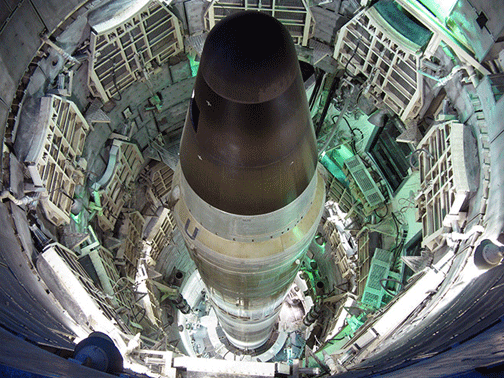
To Avert ‘Global Nuclear Holocaust,’ US Groups Demand Abolition of ICBMs https://www.commondreams.org/news/2022/01/12/avert-global-nuclear-holocaust-us-groups-demand-abolition-icbmsWhistleblower Daniel Ellsberg says no other immediate action would go further “to reduce the real risk of a false alarm in a crisis causing the near-extinction of humanity.”
JAKE JOHNSON More than 60 U.S. organizations issued a joint statement Wednesday calling for the total elimination of the country’s land-based nuclear missiles, warning that the weapons are both an enormous waste of money and—most crucially—an existential threat to humankind.
Organized by the advocacy groups RootsAction and Just Foreign Policy, the statement argues that intercontinental ballistic missiles (ICBMs) are “uniquely dangerous, greatly increasing the chances that a false alarm or miscalculation will result in nuclear war.”
“There is no more important step the United States could take to reduce the chances of a global nuclear holocaust than to eliminate its ICBMs,” continues the statement, which was signed by Beyond the Bomb, Global Zero, Justice Democrats, CodePink, and dozens of other anti-war groups.
“Everything is at stake,” the groups warn. “Nuclear weapons could destroy civilization and inflict catastrophic damage on the world’s ecosystems with ‘nuclear winter,’ inducing mass starvation while virtually ending agriculture. That is the overarching context for the need to shut down the 400 ICBMs now in underground silos that are scattered across five states—Colorado, Montana, Nebraska, North Dakota, and Wyoming.”
The statement comes just two weeks after President Joe Biden signed into law a sprawling military policy bill that allocates billions of dollars to research, development, and missile procurement for the Ground-Based Strategic Deterrent (GBSD) program, an initiative that is expected to replace the current Minuteman III ICBMs in the coming years.
Ahead of the $778 billion legislation’s passage, some progressive lawmakers—most prominently Rep. Ro Khanna (D-Calif.) and Sen. Ed Markey (D-Mass.)—called for a pause in GBSD development, a demand that went unheeded.
Daniel Ellsberg, the legendary whistleblower and longtime proponent of nuclear disarmament, told Common Dreams in an email that “most of the so-called ‘defense’ budget is legislative pork.”
“But some of it—in particular, the maintenance and proposed replacement to the current ICBM program—is toxic pork,” he added. “It’s not just unnecessary, it’s positively dangerous, to our own security and that of the rest of the world.”
Before leaking the Pentagon Papers to the press in 1971, Ellsberg specialized in nuclear weapons and operational planning for a possible nuclear war during his time as a consultant to the Defense Department, an experience he recounts in his 2017 book The Doomsday Machine: Confessions of a Nuclear War Planner.
“We should have gotten rid of our silo-based ICBMs no less than half a century ago, when they had become totally vulnerable to attack,” Ellsberg told Common Dreams. “Ever since then, deterrence of a nuclear attack should have been based solely on our invulnerable submarine-launched missile force, which is itself far larger than that function requires or should permit.”
Echoing the anti-war coalition’s fear that a potential “false alarm” could spark nuclear catastrophe, Ellsberg noted that “the survival in wartime of hundreds of land-based missiles depends on their being launched, irrevocably (unlike bombers), on electronic and infrared warning before attacking missiles might arrive.”
“Such a warning, however convincing, may be false; and that has actually happened, more times than our public has ever become aware,” he said. “No other strategic weapons besides ground-based ICBMs challenge a national leader to decide, absurdly within minutes, whether ‘to use them or lose them.’ They should not exist.”
“No other specific, concrete American action would go so far immediately to reduce the real risk of a false alarm in a crisis causing the near-extinction of humanity,” Ellsberg concluded.
In a statement, RootsAction national director Norman Solomon lamented that recent public discussion surrounding U.S. nuclear weapons policy “has been almost entirely limited to the narrow question of whether to build a new ICBM system or stick with the existing Minuteman III missiles for decades longer.”
“That’s like arguing over whether to refurbish the deck chairs on the nuclear Titanic,” said Solomon. “Both options retain the same unique dangers of nuclear war that ICBMs involve. It’s time to really widen the ICBM debate, and this joint statement from U.S. organizations is a vital step in that direction.”
Sydney Poitier film ”The Bedford Incident” was based on true nuclear war near misses.
Sidney Poitier’s Most Frightening Role Was as the Conscience of Nuclear War DEN OF GEEK, By Tony Sokol|January 11, 2022
The Bedford Incident is one of the most underrated nuclear nightmare movies, and one of Sidney Poitier’s least known classics………………..One of Poitier’s greatest roles is as a costar, not only taking second billing to Richard Widmark in The Bedford Incident (1965), but to the premise of the movie itself: World War III in the Atomic Age. It may sound like a sci-fi setup, but the science was not fiction.
Poitier, who won the Best Actor Oscar in 1964 for Lilies of the Field, plays magazine reporter Ben Munceford in The Bedford Incident. The Cold War thriller isn’t as well-known as Stanley Kubrick’s Dr. Strangelove or: How I learned to Stop Worrying and Love the Bomb or Sidney Lumet’s Fail-Safe, but it is as chilling as any apocalyptic vision ever put on screen.
The Bedford Incident was directed by James B. Harris, who had been Kubrick’s producer until he turned Peter George’s 1958 novel Red Alert into the over-the-top farce of Dr. Strangelove. Harris was terrified of a nuclear standoff, and saw Mark Rascovich’s 1963 book The Bedford Incident as a powerful celluloid deterrent……………..
Historical Close Calls with Nuclear War
Part of the reason The Bedford Incident so successfully plays into the terrors of global atomic warfare is because it is so meticulously crafted. It is not a fast-paced film. It is a realistic enactment told in a leisurely fashion so all the details can be put in their proper place, like the machinery of a submarine. This tinge of cinematic verité underscores what is so frightening about the movie. Complete global devastation can be triggered in the course of ordinary actions.
But the main reason The Bedford Incident is the stuff of recurring nuclear nightmares is because it is based on real incidents.
During the Cold War, U.S. Navy captains were trained to presume any Russian sub they encountered was equipped with nuclear torpedoes. A single Soviet nuclear ballistic submarine could carry over a dozen Intercontinental Ballistic Missiles armed with hydrogen bombs capable of destroying cities.
In August 1957, the USS Gudgeon was monitoring Russia’s Pacific naval base, Vladivostok, when it triggered an alert on Soviet radio channels. Eight destroyers set out in pursuit. After the sub’s captain, Lt. Cmdr. Norman B. ”Buzz” Bessac, failed to lose the ships by ordering the sub to “go quiet,” the Gudgeon dived 200 feet beneath the surface, well under periscope depth. Russian destroyers dropped depth charges. The Gudgeon shot decoys from its garbage tube, and submerged past the 700-feet maximum depth the ship was designed for to escape sonar.
The hold-down lasted over 30 hours before the sub requested backup from U.S. 7th Fleet headquarters in Japan. When the Gudgeon finally surfaced, its torpedo tubes were at the ready. After accepting the nautical intrusion as a navigational miscalculation, the Soviet ships allowed the Gudgeon to sail.
The second incident happened at the peak of the Cuban Missile Crisis. In October 1962, U.S. Navy destroyers in the Atlantic Ocean pursued the Soviet submarine B-59, which was armed with a T-5 nuclear torpedo. When the sub failed to surface, the destroyers dropped depth charges. The submarine captain was set to launch the T-5 but flotilla commander Vasili Arkhipov overruled the decision, and the standoff was handled diplomatically. The U.S. didn’t learn the submarine had nuclear capability until after the fall of the Soviet Union…………………………………………………
The Bedford Incident, distributed by Columbia Pictures but filmed at Shepperton Studios in the U.K., was made without Navy cooperation. It reflected the changing attitudes toward the military. It was co-produced by Widmark, who infused his Capt. Finlander with elements of Senator Barry Goldwater, the 1964 Republican presidential candidate voted most likely to start a nuclear war in the infamous “Daisy Girl” commercial. Commodore Wolfgang Schrepke (Eric Portman), a former Nazi U-boat commander onboard as a NATO attaché, says Finlander is “frightening.”…………………………………
In the pantheon of apocalyptic cinema, The Bedford Incident is highly regarded, but sadly underseen. It is more frightening than more epic doomsday films because it shows how realistically simple it could be to trigger armageddon. Poitier brings the universal appeal of unreasoning terror by playing the ineffective everyman. If he can’t stop the madness, none of us can. https://www.denofgeek.com/movies/sidney-poitier-frightening-role-nuclear-war/
Russia concerned that NATO wants to lower the threshold for nuclear weapons use.
|
Russia finds worrisome NATO’s wish to lower nuclear threshold — diplomat https://tass.com/defense/1387211Alexander Grushko also pointed to the complete degradation of the arms control system
BRUSSELS, January 12. /TASS/. Russia is seriously worried by NATO’s wish to lower the threshold for nuclear weapons use, Deputy Foreign Minister Alexander Grushko told a news conference following a meeting of the Russia-NATO Council on Wednesday.
“In conducting their military policies, the United States and its allies have been trying to gain superiority in all media: on land, in the air and at sea. Now there are also outer space and cyberspace. As well as all possible theaters of combat operations. Conceptually, operationally and technically the threshold of nuclear weapons use is being lowered. We see that the scenarios of various exercises incorporate the nuclear component, which causes our most serious concern,” Grushko said.
He pointed to the complete degradation of the arms control system.
It all began when the United States pulled out of the anti-ballistic missile treaty. Then it prevented NATO countries from ratifying the agreement on the adaptation of the conventional forces in Europe (CFE) treaty, which might serve as a corner stone of European security. Then the US administration dropped the INF treaty (on the elimination of intermediate and shorter-range missiles). And last year the Open Skies Treaty was seriously undermined,” Grushko concluded.
The Russia-NATO Council’s meeting was a second round of consultations by Russia and the West on Russia’s proposals for European security. The first stage – talks between Russia and the United States – took place in Geneva on January 10. A third will follow on the OSCE platform in Vienna on January 13.
Biden team weighs killing Trump’s new nuclear weapons
Biden team weighs killing Trump’s new nuclear weapons
Officials are considering canceling weapons that were backed by the last administration. By BRYAN BENDER POLITICO , 01/12/2022
The Biden administration is considering killing off several nuclear weapons programs that were greenlit by the Trump White House as an internal debate over the nation’s atomic arsenal enters its final phase.
According to nine current and former officials with knowledge of the deliberations, the Nuclear Posture Review, which is expected to be completed as early as next month, is not expected to make major changes to nuclear policy. Nor is it likely to recommend deep cuts to multibillion-dollar plans to build new intercontinental ballistic missiles, nuclear-armed submarines and stealth bombers, they said.
But national security officials are debating whether to jettison a new nuclear-armed cruise missile now in the research phase, retire a Cold War-era thermonuclear bomb, and possibly even remove a new “low-yield” warhead that the previous administration deployed on submarines, the current and former officials said. Most spoke on condition they not be identified in order to discuss internal deliberations and private conversations.
Such changes would fall short of the overhaul of nuclear policy and programs that President Joe Biden has long argued would help blunt a nuclear arms race, namely a declaration that the United States would not be the first to strike an adversary using atomic weapons.
Yet halting the Trump-era “add-ons,” as they are called, are considered the most likely cuts if Biden wants to reverse the previous administration’s elevation of nuclear weapons in U.S. strategy, due to resistance from military leaders to big changes as Russia and China build up their arsenals……………………………………………….
Even for the relatively modest changes to the weapons portfolio being considered, there is likely to be strong resistance on the Hill and inside the Pentagon. https://www.politico.com/news/2022/01/12/biden-trump-nuclear-weapons-526976
Claims of strange unidentified craft flying over top secret US Air Force base.
I guarded nuclear weapons and saw yellow orb-like UFOs flying over top-secret US Air Force base The Sun , Henry Holloway, Jan 12 2022 AN EX-NUCLEAR weapons tech has claimed he saw UFOs flying overhead while serving in the military at a top secret US Air Force base.
Adrian Reister, 37, decided to break his silence as the unknown phenomena has become a serious national security concern for US lawmakers and the Pentagon.
But he is speaking out as a variety of former US intelligence officials, nuclear launch officers, and fighter pilots have come forward about their UFO experiences in the last few years.
And it comes as former US Presidents Barack Obama and Bill Clinton even admitted there is something happening in the skies over the US that cannot be explained.
Adrian told The Sun Online he witnessed yellow orb UFOs flying over the base on two occasions while working as a “gun guard”.
Through his duties, he had a clear view and understanding of the bombers, fighter jets and other aircraft which would take off and leave the base.
So he is 100 per cent sure the objects he witnessed were not military or civilian aircraft – and the lights also did not move like any known vehicles……………………………………….
US lawmakers demanded reports of nuclear security as part of the purview of a new UFO office included in a mulit-billona defence bill signed off by Joe Biden.
It came after a number of former US servicemen came forward and revealed their own experiences with UFOs at nuclear weapons facilities.
The veterans even claimed the phenomena had “interfered” with weapons – including taking them offline – as they demanded transparency from the US.
UFOs have stepped from a fringe conspiracy theory to a serious national security debate in the US.
And a historic report by the Pentagon earlier in the year revealed 144 sightings by the military since 2004 remain unexplained.
Biden signed into law at the end of December a new UFO investigation unit that will run on the ground investigations and probe any “threat” posed by the phenomena.
The office will be set up jointly between the Department of Defense and the Office of the Director of National Intelligence (DNI) — a key marriage between the intelligence and military communities.
It will probe whether or not the strange craft that has been reportedly buzzing the US military are unknown technology from Russia and China or potentially something more alien.,,,, https://www.the-sun.com/news/4448824/nuclear-weapons-ufos-top-secret-base-whiteman/
Nuclear war is a genuine threat, so why have non-proliferation efforts stalled?
Nuclear war is a genuine threat, so why have non-proliferation efforts stalled? Arab News, 10 Jan 22,
- The Treaty on the Non-Proliferation of Nuclear Weapons committed states to reduce their arsenals with the goal of eliminating them
- The P5 group of nations released a joint statement on Jan. 3 affirming “a nuclear war cannot be won and must never be fought”
NEW YORK CITY: Although the world is understandably preoccupied with the coronavirus pandemic, climate change, and regional conflicts, it would be wrong to assume that the threat of nuclear war had vanished. In fact, the probability of nuclear annihilation remains perilously high.
At the beginning of the year, the pandemic claimed yet another casualty — the 10th Review Conference of the parties to the Treaty on the Non-Proliferation of Nuclear Weapons, which had been scheduled to take place on Jan. 4.
The postponement of the meeting until August went largely unreported at the time because, it would appear, the perceived threat posed by nuclear weapons had lost its urgency in recent decades.
However, the development came as tensions escalated between Western countries and Russia over Ukraine as well as between the US and China over Taiwan.
The non-proliferation treaty, or NPT, which forms the foundation of the non-proliferation regime, was signed in 1968 and came into force in 1970. It is the single most important instrument that the 191 states-parties have to prevent further proliferation and lead the world toward total disarmament.
The bargain that underpins the NPT is very simple: The nuclear states under the treaty commit to reduce their nuclear arsenals with the ultimate goal of eliminating them, and the non-nuclear states adhere to their commitments enshrined in the treaty to not acquire nuclear weapons.
Not everyone has adhered to this. India, Pakistan, Israel, and North Korea are not signatories, while Iran, although an NPT signatory, is nevertheless enriching uranium and is locked in a battle with the West over its nuclear program.
It is the second time the 10th RevCon has been rescheduled due to the pandemic. The 2020 conference, which would have coincided with the NPT’s 50th anniversary, was also delayed, scuttling hopes of getting the non-proliferation regime back on track and breathing new life into the arms control and disarmament process.
The three pillars of the NPT — non-proliferation, disarmament, and the peaceful use of nuclear technologies — have seen varying degrees of success.
While the non-nuclear states kept their end of the bargain and adhered to the treaty, bar a couple of exceptions, the nuclear states have been less faithful. They have not fulfilled their obligations, as stipulated by article six of the NPT, to rid the world of nuclear weapons. This has led to tensions and placed a strain on the whole non-proliferation regime.
Looking for an alternative, the non-nuclear states pushed for a process in the UN General Assembly, which culminated in the adoption of a Treaty on the Prohibition of Nuclear Weapons on July 7, 2017, coming into force on Jan. 22, 2021.
However, the conference’s postponement could not have come at a worse time, as anxiety over the fraying of the architecture of arms control is mounting.
Experts believe the risk of nuclear war is greater than ever. The Bulletin of the Atomic Scientists has set its Doomsday Clock at 100 seconds to midnight — the closest the timepiece has been to symbolic doom in its more than 70 years of its existence.
A speech by former US Senator Sam Nunn, an authority on nuclear weapons, on the 50th anniversary of the NPT in 2020 described the danger in stark terms…………….
The Stockholm International Peace Institute has estimated that the world’s nuclear states collectively possessed approximately 13,080 nuclear weapons as of January 2021. That figure represented a small decrease on the 13,400 estimate of 2020.
However, this has been offset by the increase in the number of nuclear weapons deployed with operational forces, from 3,720 in 2020 to 3,825 in 2021. Of these, around 2,000 were “kept in a state of high operational alert,” the institute said in its 2021 report.
All of this has occurred in the absence of a credible arms control process because of growing tensions between the US and Russia over Ukraine, and America and China over Taiwan, Hong Kong, and the Indo-Pacific.
Although they were disappointed by the conference postponement, the non-nuclear states were heartened on Jan. 3 when the US, Russia, China, France, and the UK, a group of powers known as the P5, put out a joint statement claiming they “consider the avoidance of war between nuclear-weapon states and the reduction of strategic risks as our foremost responsibilities.
However, this has been offset by the increase in the number of nuclear weapons deployed with operational forces, from 3,720 in 2020 to 3,825 in 2021. Of these, around 2,000 were “kept in a state of high operational alert,” the institute said in its 2021 report.
All of this has occurred in the absence of a credible arms control process because of growing tensions between the US and Russia over Ukraine, and America and China over Taiwan, Hong Kong, and the Indo-Pacific.
Although they were disappointed by the conference postponement, the non-nuclear states were heartened on Jan. 3 when the US, Russia, China, France, and the UK, a group of powers known as the P5, put out a joint statement claiming they “consider the avoidance of war between nuclear-weapon states and the reduction of strategic risks as our foremost responsibilities……………….
From the standpoint of Arab countries, there was also an important element missing from the joint statement, which failed to mention the 1995 NPT resolution introduced by the US, the UK, and Russia agreeing in support of the principle of a Middle East region free from all weapons of mass destruction.
It had been hoped that the 10th RevCon would provide an opportunity to acknowledge the progress made in this regard. The first Conference on the Establishment of a Middle East Zone Free of Nuclear Weapons and Other Weapons of Mass Destruction took place at the UN headquarters in New York in 2019, chaired by Jordan, and again in 2021, chaired by Kuwait.
Israel, the only state in the Middle East thought to possess nuclear weapons, did not attend any of the sessions, nor did the US, despite being one of the main sponsors of the 1995 resolution.
Supporters of arms control therefore have little choice but to wait until August to see whether the P5 will back up their words with action and deliver a “meaningful outcome” that will preserve the integrity of the NPT. https://www.arabnews.com/node/2001751/world
1 This Month





PLEASE OPPOSE HR 8255 AND S.3639 – bills would accelerate satellite deployment, with no environmental review or safeguards – https://ncstd5li.quorum.us/campaign/169331/
To see nuclear-related stories in greater depth and intensity – go to https://nuclearinformation.wordpress.com
-
Archives
- October 2026 (39)
- September 2026 (339)
- August 2026 (330)
- July 2026 (355)
- June 2026 (287)
- May 2026 (306)
- April 2026 (356)
- March 2026 (251)
- February 2026 (267)
- January 2026 (308)
- December 2025 (358)
- November 2025 (359)
-
Categories
- 1
- 1 NUCLEAR ISSUES
- business and costs
- climate change
- culture and arts
- ENERGY
- environment
- health
- history
- indigenous issues
- Legal
- marketing of nuclear
- media
- opposition to nuclear
- PERSONAL STORIES
- politics
- politics international
- Religion and ethics
- safety
- secrets,lies and civil liberties
- spinbuster
- technology
- Uranium
- wastes
- weapons and war
- Women
- 2 WORLD
- ACTION
- AFRICA
- Atrocities
- AUSTRALIA
- Christina's notes
- Christina's themes
- culture and arts
- Events
- Fuk 2022
- Fuk 2023
- Fukushima 2017
- Fukushima 2018
- fukushima 2019
- Fukushima 2020
- Fukushima 2021
- general
- global warming
- Humour (God we need it)
- Nuclear
- RARE EARTHS
- Reference
- resources – print
- Resources -audiovicual
- Weekly Newsletter
- World
- World Nuclear
- YouTube
-
RSS
Entries RSS
Comments RSS

